Day: January 1, 2023
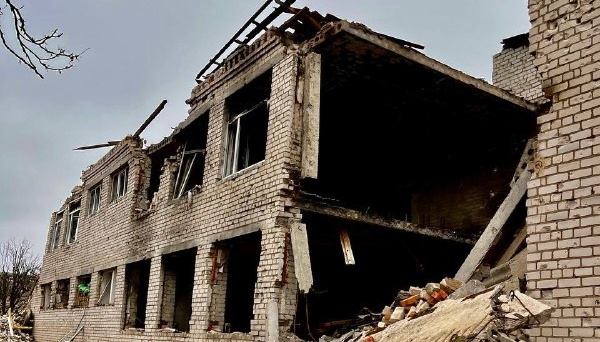
Two people were killed and 50 others hurt in Ukraine because of Russia’s armed aggression on Saturday, December 31.
According to Ukrinform, Deputy Head of the President’s Place of work Kyrylo Tymoshenko said this in a publish on Telegram, referring to figures from regional armed service administrations.
One particular man or woman was wounded in the Dnipropetrovsk region, just one individual wounded in the Donetsk region, 5 wounded in the Zaporizhzhia region, six wounded in the Mykolaiv region, one wounded in the Kharkiv area, one particular human being killed and 4 wounded in the Kherson location, ten men and women wounded in the Khmelnytskyi region, and a person human being killed and 22 wounded in Kyiv.
The Russian military on December 31 carried out enormous assaults on 11 areas in Ukraine.
The post Russian troops kill two civilians in Ukraine on Dec 31 appeared first on Ukraine Intelligence.
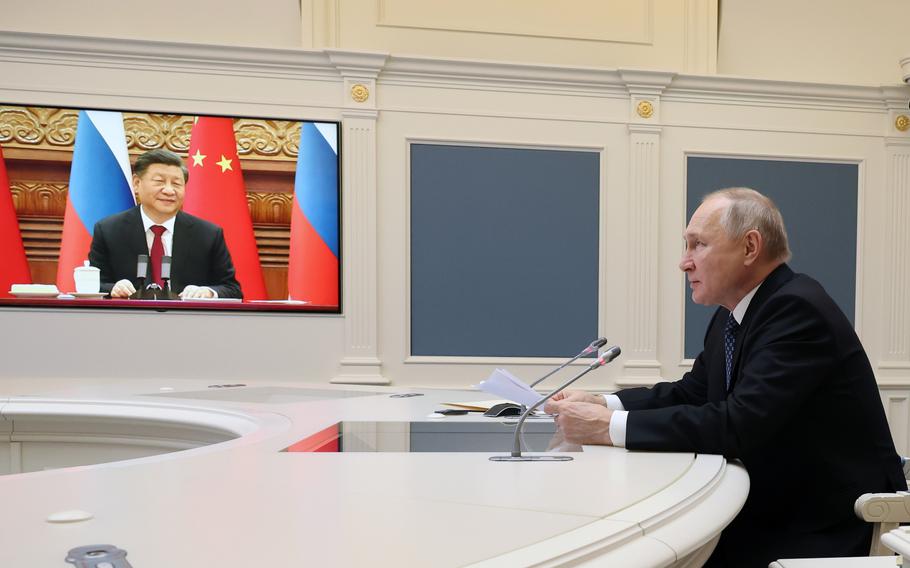
Russian President Vladimir Putin speaks during a meeting with Chinese President Xi Jinping, seen onscreen, via a video conference at the Kremlin in Moscow, Russia, Friday, Dec. 30, 2022. (Mikhail Klimentyev, Sputnik, Kremlin Pool Photo via AP)
Putin, Xi vow closer ties as Russia bombards Ukraine again
By FELIPE DANA Associated Press
KYIV, Ukraine (AP) — Russian President Vladimir Putin and Chinese leader Xi Jinping vowed Friday to deepen their bilateral cooperation against the backdrop of Moscow’s 10-month war in Ukraine, which weathered another night of drone and rocket attacks following a large-scale missile bombardment.
Putin and Xi made no direct mention of Ukraine in their opening remarks by videoconference, which were broadcast publicly, before going into private talks. But they hailed strengthening ties between Moscow and Beijing amid what they called “geopolitical tensions” and a “difficult international situation,” with Putin expressing his wish to extend military collaboration.
“In the face of increasing geopolitical tensions, the significance of the Russian-Chinese strategic partnership is growing as a stabilizing factor,” said Putin, whose invasion of a neighboring country has been stymied by fierce Ukrainian resistance and Western military aid.
The Russian leader said he expected Xi to visit Moscow in the spring. Such a trip “will demonstrate to the whole world the strength of the Russian-Chinese ties on key issues, will become the main political event of the year in bilateral relations,” he said.
Putin said military cooperation has a “special place” in the relationship between their countries. He said the Kremlin aimed to “strengthen the cooperation between the armed forces of Russia and China.”
Xi, in turn, said through a translator that “in the face of a difficult and far from straightforward international situation,” Beijing was ready “to increase strategic cooperation with Russia, provide each other with development opportunities, be global partners for the benefit of the peoples of our countries and in the interests of stability around the world.”
In its report on the meeting, Chinese state broadcaster CCTV described the events in Ukraine as a “crisis.” The term marked a departure from China’s usual references to the “Ukraine situation,” and the change may reflect growing Chinese concern about the direction of the conflict.
“Xi Jinping emphasized that China has noted that Russia has never refused to resolve the conflict through diplomatic negotiations, for which it (China) expresses its appreciation,”” CCTV reported.
Ties between Moscow and Beijing have grown stronger since Putin sent his troops into Ukraine on Feb. 24. Just last week, Moscow and Beijing held joint naval drills in the East China Sea. Putin and Xi also spoke by video link last December.
China, which has promised a “no limits” friendship with Russia, has pointedly refused to criticize Moscow’s actions in Ukraine, blaming the U.S. and NATO for provoking the Kremlin, and has blasted the punishing sanctions imposed on Russia.
Russia, in turn, has strongly backed China amid the tensions with the U.S. over Taiwan.
Russia and China are both facing domestic difficulties. Putin is trying to maintain domestic support for a war that has lasted longer than anticipated, while a surge in COVID-19 cases has overwhelmed hospitals in China.
In Ukraine, authorities reviewed the toll from a widespread Russian missile attack on power stations and other vital infrastructure Thursday that was the biggest such bombardment in weeks. Four civilians were killed during the barrage, according to Kyrylo Tymoshenko, the deputy head of the Ukrainian president’s office.
The General Staff of the Armed Forces of Ukraine said in its Friday morning update that Russian forces had unleashed a total of 85 missiles and 35 airstrikes on targets across Ukraine in the previous 24 hours. Russia also launched 63 attacks from multiple launch rocket systems, the military report said.
Following the first waves of missiles on Thursday morning, Russian forces attacked Ukraine with Iranian-made Shahed-131/136 drones on Thursday night and early Friday, all of which were shot down, the Ukrainian air force said.
Some were aimed at Kyiv, Mayor Vitali Klitschko said Friday. Of seven exploding drones launched against the Ukrainian capital, two were shot down on the approach to the city and five over Kyiv itself, according to Klitschko.
Ukrainian President Volodymyr Zelenskyy said in his nightly video address that Russia hasn’t abandoned plans to capture all of Donetsk, aiming to accomplish the goal by New Year’s Day. Zelenskyy also warned Ukrainians there could be another widespread air assault.
“There are two days left in this year. Perhaps the enemy will try once again to make us celebrate the New Year in the dark. Perhaps, the occupants are planning to make us suffer with the next strikes on our cities,” he said. “But no matter what they plan, we know one thing about ourselves: we will survive. We will. We will drive them out. No doubt about it. And they will be punished for this terrible war.”
Alena Verbitskaya, presidential commissioner for the protection of the rights of defenders of Ukraine, said Friday that 3,392 Ukrainian servicemen are now in Russian captivity. Another 15,000 people are classified as missing, he told Germany’s RedaktionsNetzwerk.
VATICAN CITY (AP) — Pope Francis prayed for his predecessor’s passage to heaven as he presided over a special New Year’s Day Mass Sunday in St. Peter’s Basilica, a day after Pope Emeritus Benedict XVI died in retirement at the Vatican.
The huge basilica will host Benedict’s coffin starting on Monday. Thousands of faithful are expected to attend the first of three days of viewing.
Benedict, 95, died Saturday morning in the Vatican where he had lived since retirement. He was the first pope in centuries to resign, citing his increasing frailty.
Francis looked weary and sat with his head bowed as Mass began on the first day of the year, an occasion the Catholic church dedicates to the theme of peace.
He departed from his written homily to pray aloud for Benedict, imploring the Virgin Mary to “accompany him in his passage to the hands” of God.
The pontiff will lead Benedict’s funeral on Thursday in St. Peter’s Square. That rite will be a simple one, the Vatican has said, in keeping with the wishes of Benedict, who for decades as a German cardinal had served as the Church’s guardian of doctrinal orthodoxy before he was elected pope in 2005.
In the last years, Francis has hailed Benedict’s stunning decision to become the first pope to resign in 600 years and has made clear he’d consider such a step as an option for himself.
Hobbled by knee pain, Francis, 86, on Sunday arrived in the basilica in a wheelchair, before taking his place in a chair for the Mass, which was being celebrated by the Vatican’s secretary of state.
Francis, who has repeatedly decried the war in Ukraine and its devastation, recalled those who are victims of war, passing the year-end holidays in darkness, cold and fear.
“At the beginning of this year, we need hope, just as the Earth needs rain,” Francis said.
___
Nicole Winfield contributed from the Vatican.
___
More on the death of Emeritus Pope Benedict XVI: https://apnews.com/hub/pope-benedict-xvi
Carina Johansen/Getty Images; Jeremy Moeller/Getty Images
- Tesla stock is down more than 65% in 2022, but longtime bull Adam Jonas of Morgan Stanley isn’t giving up.
- Despite recently trimming his price target, Jonas still sees 122% upside for Tesla shares.
- He thinks Tesla will extend its lead in the electric-vehicle space next year, and also benefit from the Inflation Reduction Act.
Morgan Stanley remains bullish on Tesla stock despite recent turmoil and worry over Elon Musk’s focus.
In a recent client note, longtime Tesla proponent Adam Jonas cut his price target on the stock $250, down from $330 previously. But despite the mea culpa, his new forecast still calls for 122% upside from Wednesday’s close.
Jonas offered two main reasons for his continued optimistic outlook: Tesla will extend its existing lead versus electric-vehicle competitors, and also see benefits from the Inflation Reduction Act.
When addressing Tesla’s more than 65% drop in 2022, including a 40% plunge in December alone, Jonas stopped short of blaming CEO Elon Musk’s preoccupation with Twitter — something that a growing chorus of critics have pointed to as a major loss driver. He instead attributed it to supply outpacing demand for the first time since the COVID-19 pandemic, and assorted “technical factors.”
“The last two years of demand exceeding supply will be substantially inverted to supply exceeding demand,” Jonas wrote. “Within this environment, we believe players that are self-funded (non-reliant on external capital funding) with demonstrated scale and cost leadership throughout the value chain (from manufacturing to up-stream material supply) can be relative winners.”
He continued: “Between a worsening macro backdrop, record high unfavorability, and increasing competition, there are hurdles to overcome. Yet we do believe that in the face of all these pressures, Tesla will widen its lead in the EV race, as it leverages its cost and scale advantages to further itself from the competition.”
Read the original article on Business Insider
Brittany Chang/Insider
- I sailed on Royal Caribbean International’s new 9,300-person Wonder of the Seas.
- The world’s largest cruise ship is filled with fun spaces for intergenerational families.
- These are the vessel’s 13 best amenities, services, and activities from a thrilling water show to the zipline.
Royal Caribbean International’s new 1,188-foot-long Wonder of the Seas is currently the world’s largest cruise ship.
Brittany Chang/Insider
And with this giant size comes plenty of amenities to entertain guests for days.
Brittany Chang/Insider
Almost every modern family-oriented cruise ship has amenities like a pool, water slide, and outdoor decks.
Brittany Chang/Insider
But only Royal Caribbean’s 18-deck Wonder of the Seas has an outdoor boardwalk with a candy store …
Brittany Chang/Insider
… an expansive underwater-themed playground for children …
Brittany Chang/Insider
… and an overwhelmingly bright and expansive pool deck.
Brittany Chang/Insider
There’s a long list of activities and services available for up to 9,288 occupants.
Brittany Chang/Insider
The list can be a lot, so here are the 13 best ones I saw when the cruise line invited me on the ship’s non-revenue sailing for media and travel agents.
Brittany Chang/Insider
1. The Wonder of the Seas is divided into eight distinct “neighborhoods.”
Brittany Chang/Insider
No two neighborhoods look alike.
Brittany Chang/Insider
But some are named after real-life recognizable destinations like Central Park and Boardwalk.
Brittany Chang/Insider
2. The ship has over 20 dining venues including a new-to-brand Southern comfort restaurant with a live band …
Brittany Chang/Insider
… a sushi and teppanyaki venue, a seafood restaurant …
Brittany Chang/Insider
… and recognizable spots like Starbucks and Johnny Rockets.
Brittany Chang/Insider
Unfortunately for budget travelers, these are all paid specialty venues.
Brittany Chang/Insider
3. But the ship’s buffets and primary dining venue still offer plenty of food for travelers who don’t want to shell out the additional cash.
Brittany Chang/Insider
These buffets include an outdoor build-your-own taco bar, a hot dog stand …
Brittany Chang/Insider
… and a traditional indoor cruise buffet with a seafood, international fare, and dessert section.
Brittany Chang/Insider
4. Every cruise ship has bars and lounges but the Wonder of the Seas’ are especially unique.
Brittany Chang/Insider
Not every cruise vessel has a bar with two robotic arms, liquor on the ceiling, and no bartenders.
Brittany Chang/Insider
There’s also a bar that rises and lowers between two decks depending on the time of day …
Brittany Chang/Insider
… as well as several watering holes with live music — including a karaoke bar — and plenty of room to dance.
Brittany Chang/Insider
4. There is a water playground and rows of pools and hot tubs scattered throughout the pool deck, giving guests a colorful place to relax and play under the sun.
Brittany Chang/Insider
5. This outdoor deck also has three water slides, including two for racing.
Brittany Chang/Insider
The colorful chairs, pools, and slides make the pool deck an overwhelming feast for the eyes.
Brittany Chang/Insider
And the rows of outdoor lounge chairs seem endless as you walk through the pool deck.
Brittany Chang/Insider
6. The deck above the pools has a collection of unique outdoor activities including a dry slide inside the mouth of a giant anglerfish …
Brittany Chang/Insider
… a mini-golf course, a surf simulator …
Brittany Chang/Insider
… a sports court, and a zip line that takes guests over the Central Park neighborhood.
Brittany Chang/Insider
7. The adults-only solarium has three hot tubs, a multi-level pool, and animal topiaries.
Brittany Chang/Insider
8. The open-air Boardwalk neighborhood actually looks like a boardwalk.
Brittany Chang/Insider
The wood plank flooring, ice cream and candy store, arcade games …
Brittany Chang/Insider
… sports bar, and carousel all make the neighborhood convincing.
Brittany Chang/Insider
But unlike a traditional boardwalk, this neighborhood is also home to the two large rock climbing walls that flank the Aqua Theater.
Brittany Chang/Insider
9. The “inTENse” nighttime show at the Aqua Theater is a unique synchronized event unlike any traditional song-and-dance cruise ship musical.
Brittany Chang/Insider
Here, a tightrope walker opens a thrilling performance filled with divers, a shifting stage filled with water, and synchronized swimmers and dancers.
Brittany Chang/Insider
10. But the onboard entertainment doesn’t stop at this water show.
Brittany Chang/Insider
There’s also an ice skating performance and a superhero-themed show with drones that fly around the crowd.
Brittany Chang/Insider
11. The Wonder of the Seas has a tiny slice of New York City with the Central Park neighborhood.
Brittany Chang/Insider
Here, over 20,000 plants fill the open-air space lined with speciality dining and upscale shopping.
Brittany Chang/Insider
It’s one of the more tranquil walking spaces aboard the ship, especially when there’s live music in the heart of the neighborhood.
Brittany Chang/Insider
12. Like Central Park, the Royal Promenade neighborhood looks nothing like a cruise ship.
Brittany Chang/Insider
Instead, this indoor walkway resembles a mall with plenty of stores, fast dining options, and bars.
Brittany Chang/Insider
But unlike a typical mall, the Royal Promenade has a giant metal cowboy hat and a Ford Mustang parked in the middle of the walkway.
Brittany Chang/Insider
13. You could find yourself in the same elevator as a surprise piano player.
Brittany Chang/Insider
The piano man graces different elevators every night …
Brittany Chang/Insider
… but guests won’t know which one until they hear the piano music and the cheers of listeners as the elevator travels throughout the 18 decks.
Brittany Chang/Insider
Small features like this make Royal Caribbean’s Wonder of the Seas an especially unique floating resort.
Brittany Chang/Insider
Many spaces aboard the vessel don’t resemble those on a traditional cruise ship.
Brittany Chang/Insider
So it’s no surprise the Wonder of the Seas has “contributed significantly” to Royal Caribbean’s record number of bookings throughout 2022, Vicki Freed, Royal Caribbean’s senior vice president of sales, trade support, and service, told Insider in an email statement.
Brittany Chang/Insider
Source: Insider
Read the original article on Business Insider
AP Photo/Nati Harnik
- Warren Buffett’s annual salary has been $100,000 for more than 40 years.
- Berkshire Hathaway spends triple that amount on his security each year.
- Buffett lives modestly despite owning about $100 billion of Berkshire stock.
Warren Buffett is an investing icon, the boss of Berkshire Hathaway, and one of the richest people on the planet. Yet he earns a modest annual salary of $100,000 — and hasn’t seen a pay rise in over 40 years, Securities and Exchange Commission filings show.
As Berkshire’s CEO and chairman, Buffett recommends to his board of directors how much he should be paid, and decides the rest of the executives’ compensation. The 92-year-old has received $100,000 a year since 1980 — a fraction of the $18 million average pay of S&P 500 CEOs in 2021.
Buffett doesn’t earn much from other sources either. He netted double his salary in annual directors’ fees in the 1990s and early 2000s, before he resigned as a director of The Washington Post Company and stepped down from other corporate boards.
The highest annual compensation he’s ever received at Berkshire was $525,000 in 2010, comprising his $100,000 salary, $75,000 in directors’ fees, and $350,000 allocated to his security costs.
Berkshire spends far more on Buffett’s personal and home security than it pays him directly. Keeping the boss safe has cost the company roughly $300,000 a year since 2008, or about $5 million in total.
Buffett isn’t in desperate need of a big salary. He owns roughly $100 billion of Berkshire stock — which he’s gradually giving away — and doesn’t spend much: he lives in a modest family home, drives a basic car, and eats breakfast at McDonald’s.
The investor also doesn’t use a company car, belong to any clubs where Berkshire pays his dues, or commandeer company-owned aircraft for his personal use.
Buffett shared his views on salaries at Berkshire’s annual shareholder meeting in 2017, when he was asked how much his successor would be paid. He expressed hope that the next CEO would already be rich, and wouldn’t be motivated to earn 10 or 100 times the money their family needs to live on.
“They might even wish to, perhaps, set an example by engaging for something far lower than, actually, what you can say their true market value is,” he continued, adding it would be “terrific” if that was the case.
Buffett is a firm believer that CEOs should be incentivized to deliver long-term success for their companies. He believes massive annual salaries, bonuses, and short-term stock options encourage short-term thinking.
Charlie Munger — Buffett’s right-hand-man and Berkshire’s vice-chairman — has followed Buffett’s example. He’s also received an annual salary of $100,000 for several decades now, SEC filings show.
In contrast, Ajit Jain and Greg Abel, who head up Berkshire’s insurance and non-insurance divisions respectively, are paid far more handsomely. Both men have earned a $16 million salary and a $3 million bonus in each of the past three years. Notably, Buffett has named Abel as his planned successor as Berkshire CEO.
Finally, Berkshire’s finance chief, Marc Hamburg, has seen his salary grow from about $300,000 in 1996 to $3.3 million in 2021.
Read the original article on Business Insider
Astrid Stawiarz/Getty Images
- “The Big Short” investor Michael Burry suggested the S&P 500 could plunge below 1,900 points.
- The Scion Asset Management chief based his prediction on how past crashes have played out.
- Burry said brief rallies were likely, and joked about his penchant for premature predictions.
Michael Burry, the hedge fund manager of “The Big Short” fame, rang the alarm on the “greatest speculative bubble of all time in all things” in the summer of 2021. He warned the retail investors buying up meme stocks and cryptocurrencies that they were headed towards the “mother of all crashes.”
The Scion Asset Management chief’s grim prediction may be coming true, as the S&P 500 and Nasdaq indexes tumbled by 19% and 33% respectively in 2022. In tweets posted in May 2022 then subsequently deleted, Burry took credit for calling the sell-off, explained why he expects further declines, and cautioned against buying into relief rallies.
Here’s a roundup of Burry’s best tweets about the stock-market slump:
The pandemic crash was just the start
@michaeljburry
The S&P 500 index has rebounded strongly from the pandemic crash in the spring of 2020, rising from a low of 2,192 points to around 3,800 points today. However, it could halve in value to below 1,900 points over the next few years, Burry tweeted on May 3, 2022.
When the S&P 500 has crashed in the past, it has traded lower several years later, Burry noted. He pointed to the index bottoming 13% lower in 2009 than it did in 2002, 17% lower in 2002 than it did during the Long-Term Capital Management fiasco in 1998, and 10% lower in 1975 than in 1970.
If the benchmark index follows that historical pattern, it could trade 15% lower than its level in the spring of 2020, Burry said.
There may be epic but short-lived rallies
@michaeljburry
A “dead cat bounce” refers to a temporary rebound in stock prices after a significant fall, often because speculators buy shares to cover their positions.
They often occur during major declines in the stock market, Burry said in a May 4 tweet. The implication is that investors shouldn’t get their hopes up about any rallies in the coming months, as they’re likely to be brief respites that won’t result in a market recovery.
Burry noted that 12 of the 20 largest one-day rallies in the Nasdaq index took place as the dot-com bubble burst, while nine of the S&P 500’s 20 biggest one-day rallies occurred in the aftermath of the Great Crash in 1929.
Don’t be fooled by stocks rebounding
@michaeljburry
Stocks could stage multiple rallies before the crash is over, Burry warned in a May 5 tweet.
He noted that after the dot-com bubble burst, the Nasdaq rallied 16 times by more than 10% — gaining on average 23% each time — on its way to a 78% decline at its nadir.
Burry also emphasized that after the Great Crash of 1929, the Dow Jones index rallied 10 times by more than 10%, rising by an average of 23% each time, before bottoming at a 89% decline.
Stocks are on a dangerous trajectory
@michaeljburry
The US stock market appears to be following the pattern of previous bubbles, leaving it poised for a monumental crash, Burry noted in a May 8 tweet.
The Scion chief pointed to the S&P 500’s trajectory over the past 10 years, noting it was strikingly similar to the index’s chart for the decade leading up to the dot-com crash, and the Dow’s chart for the 10 years before the Great Crash of 1929.
Burry suggested that human nature was behind the consistently decade-long buildups, and implied that history is repeating itself.
Burry predicts correctly, but early
@michaeljburry
Burry appeared to take a victory lap in a May 10 tweet, suggesting he believes the stock-market crash that he’s been warning about has finally arrived.
The Scion boss joked he was early with his prediction, just as he was during the mid-2000s US housing bubble.
Burry also nodded to Elon Musk calling him a “broken clock” last year, after the Scion chief bet against Tesla stock, predicted it would collapse in value, and questioned Musk’s motives for selling his company’s shares.
Stocks are set to tumble a lot further
@michaeljburry
Investors can expect stocks to fall a lot further, Burry warned in a May 11 tweet.
The investor noted that 5.2 times Microsoft’s outstanding shares were traded between the software stock’s peak during the dot-com bubble and its bottom in 2002. That figure was 3.3 times during the financial crisis, but had only reached 0.5 times at the time of his tweet.
Burry noted it was a similar story with Amazon and JPMorgan, indicating it could be a while before those stocks and others bottom out.
Read the original article on Business Insider
2023-01-01T12:15:45Z
Brazilian President Luiz Inacio Lula da Silva’s 580-day stretch behind bars imbued him with a renewed sense of social justice, the leftist’s allies and confidants said, convincing him of the need to prioritize ending poverty over boosting profits.
Lula takes office on Sunday for an unprecedented third term, capping a dramatic turnaround for one of the world’s most enduring political leaders, who first ran for president in 1989.
Jailed for graft in 2018 – the year right-wing former President Jair Bolsonaro was elected – Lula’s convictions were overturned in 2019, allowing him to oust Bolsonaro in October’s election.
As he strives to unite a nation riven by economic woes, a bruising pandemic and Bolsonaro’s far-right populism, Lula is looking to his prison days for inspiration, allies and confidants told Reuters.
He learned from three failed presidential bids to tone down his leftist ideals and make peace with Brazil’s powerful private sector during his 2003-10 presidency. But Lula 3.0 plans to double down on fighting poverty, ending hunger, and attacking racism, allies said, while also rewarding loyal Workers Party (PT) jail visitors with key cabinet positions.
“Prison reinforced the sense that he has a duty above all to the poor in Brazil,” said Tarso Genro, a former PT governor of Rio Grande do Sul and a close Lula associate. “He went to prison strong and came out stronger.”
The more ideological Lula who emerged from jail in 2019 should not be a cause for concern, friends and allies said. He is still the same pragmatist who honed his powers of persuasion as a union leader in the Sao Paulo auto plants of the 1970s, they added.
Lula aides have encouraged comparisons with former South African leader Nelson Mandela, who spent over a quarter of a century behind bars as an opponent of the country’s apartheid.
But many on Faria Lima, the so-called “Brazilian Wall Street,” who fondly recall the business-friendly Lula of the early 2000s are holding their breath, worried that increased social spending and a loyalist cabinet will damage Brazil’s fiscal credibility and usher in a new era of graft-stained statism.
“The initial reaction to Lula 3.0 on Faria Lima is not favorable,” said economist Andre Perfeito, referring to the market dip after Lula’s spending proposal was announced. “Many investors bet on Bolsonaro winning and they almost got it right, so it is natural they are not happy.”
Recent cabinet appointments – including PT leader Fernando Haddad as finance minister – have also troubled some investors.
Lula also recently named PT stalwart and economist Aloizio Mercadante as head of national development bank BNDES, which during previous PT governments lent billions of reais to projects consumed by allegations of waste and graft, though bank officials have said they were transparent.
Lula’s spokesman Jose Chrispiniano said the president supported fiscal responsibility and believes that strengthening the economy is the best way to combat poverty.
“He does not see any contradiction between caring for the poorest and promoting growth. On the contrary, he thinks caring for the poor and giving them the opportunity to work and consume is what generates sustainable growth,” he told Reuters.
Lula’s new-found social awareness was ignited by reading books on race, slavery and hunger behind bars, as well as biographies of Fidel Castro and Nelson Mandela, according to his website. He also perused “Lulismo in crisis,” a critical review of his movement and its missteps by his former press secretary Andre Singer.
It was augmented by his relationship with Rosangela da Silva, or Janja, a PT activist 20-years his younger whom he married on release and who looks set to be a key political player. Lula became a widower when his first wife Mariza died the year before he went to jail.
Janja – who helped organize Lula’s election certification and Sunday’s inauguration, as well as advising on cabinet choices – was among hundreds of PT true-believers who camped outside his prison in the southern city of Curitiba.
“Good morning, President Lula,” his devotees would chant as the day began, followed by “Good night, President Lula,” as he went to bed.
From his 15-square-meter cell on the third floor of the Federal Police headquarters in Curitiba, Lula set about reorganizing the PT and managing his legal defense. It was there he planned the failed presidential campaign of Haddad, a regular visitor who lost to Bolsonaro in 2018.
When he left prison, Lula was determined to set the record straight on his imprisonment and said he wanted to be re-elected to clear his name in the people’s court. He called his imprisonment a political witch-hunt, fabricated by the right to keep him from running in 2018.
Another close aide, PT Senator Humberto Costa, said Lula matured politically in jail.
“What drove him to run again was the need to leave his mark, not just politically but historically, by bringing lasting change to Brazil,” Costa said.
Related Galleries:
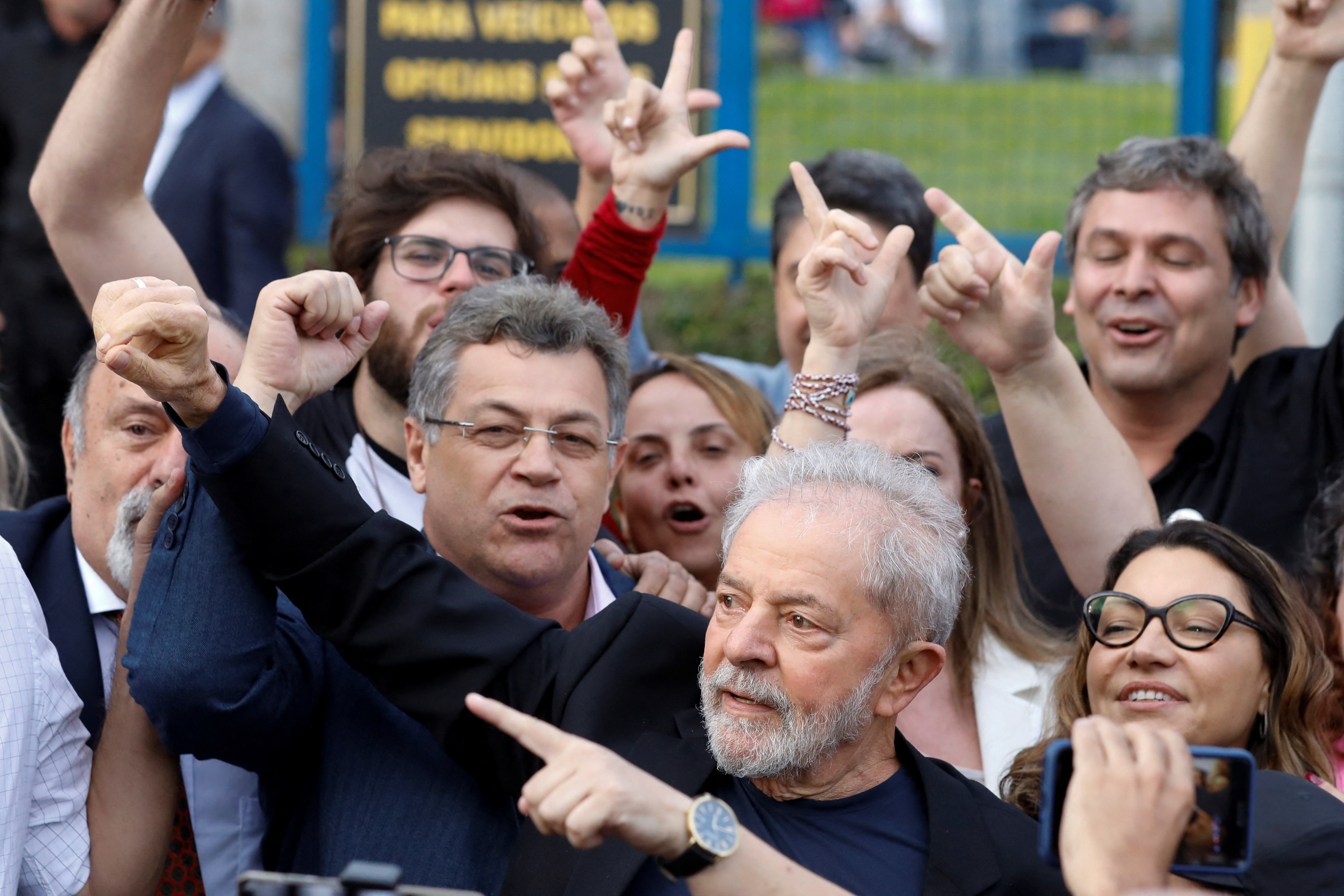
Former Brazilian President Luiz Inacio Lula da Silva gesture as he is released from prison, in Curitiba, Brazil November 8, 2019. REUTERS/Rodolfo Buhrer
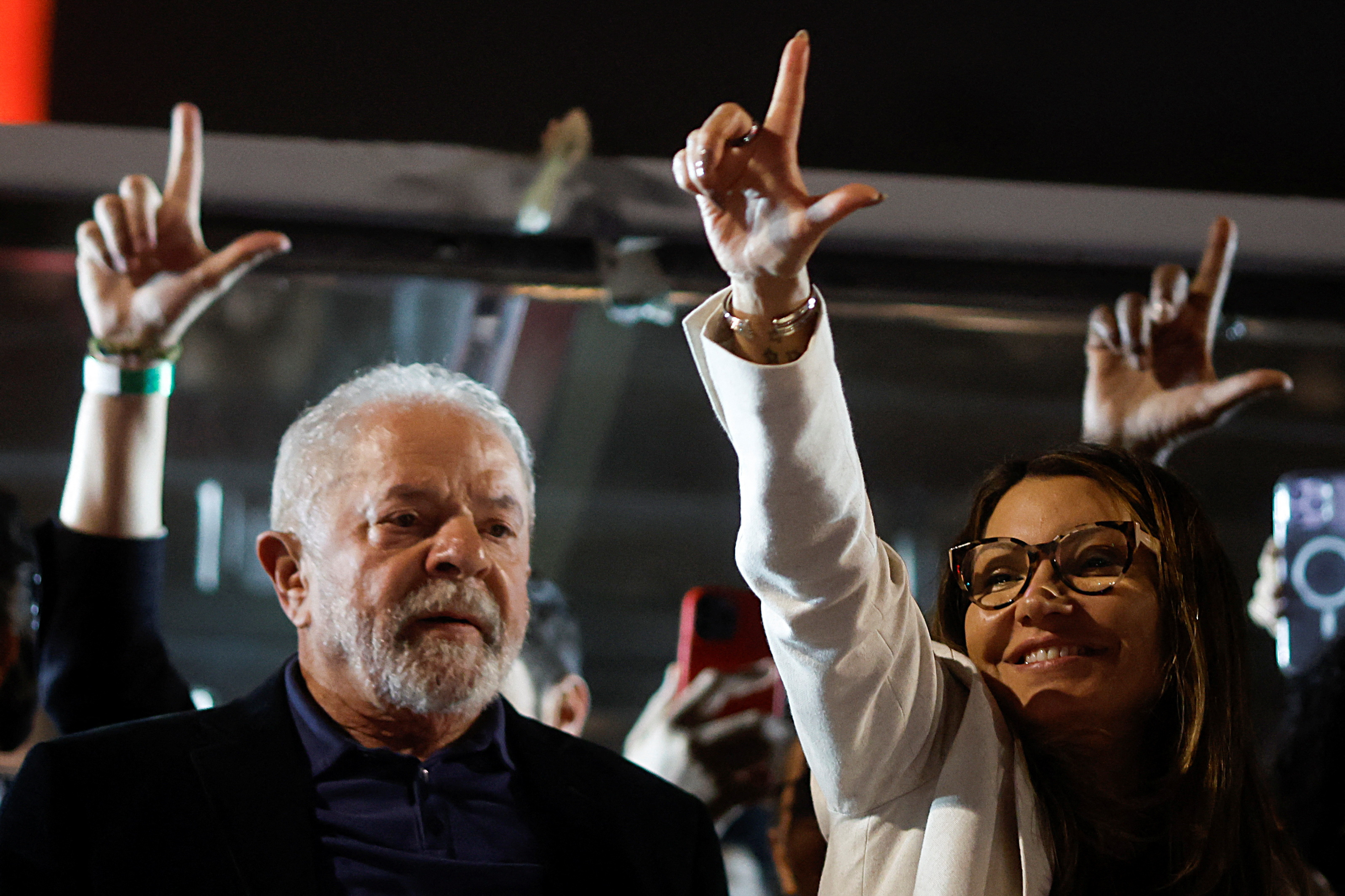
Brazil’s former President and presidential candidate Luiz Inacio Lula da Silva stands next to his wife Rosangela da Silva as she gestures the letter L for Lula after the results of the first round of Brazil’s presidential election, in Sao Paulo, Brazil October 2, 2022. REUTERS/Amanda Perobelli
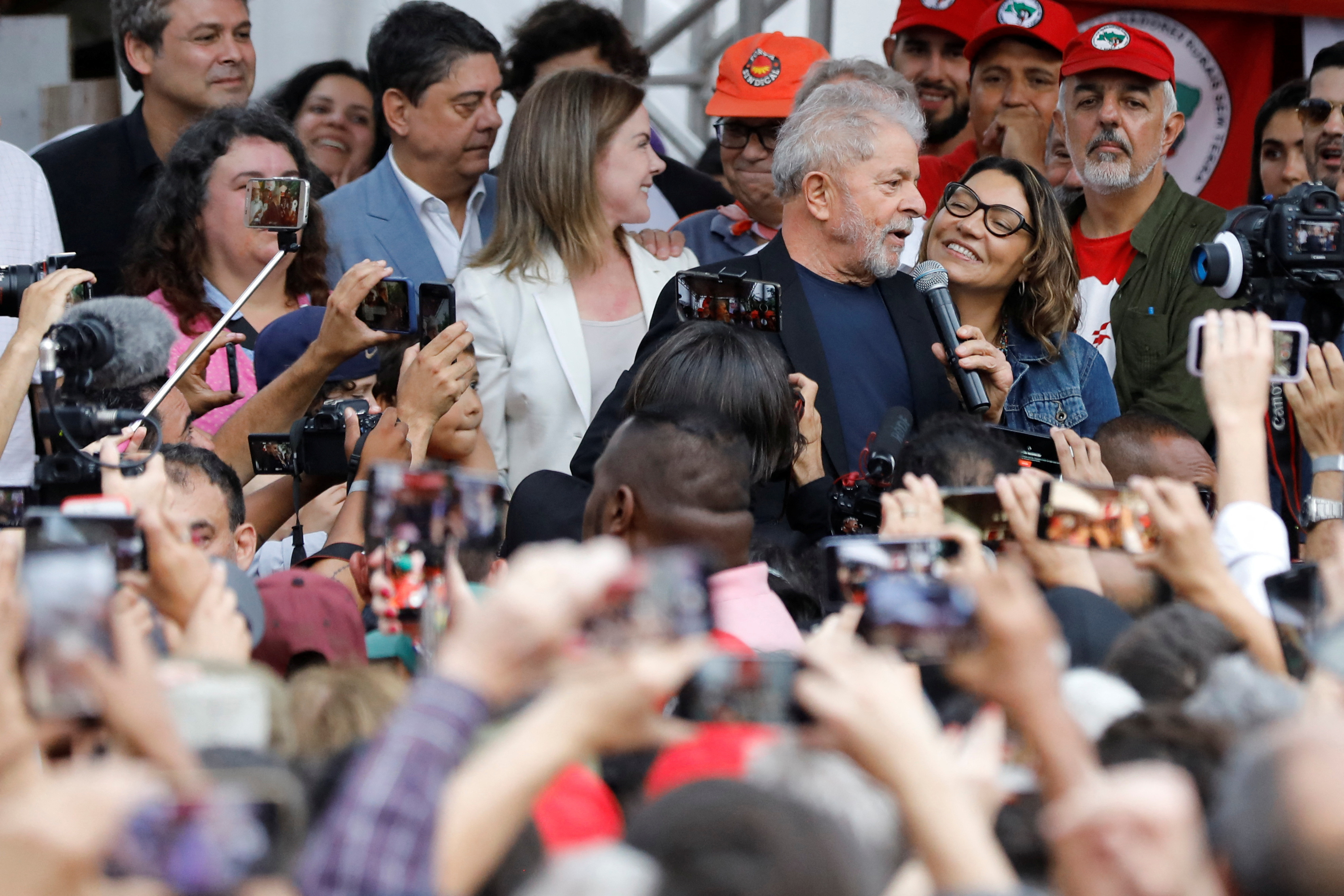
Former Brazilian President Luiz Inacio Lula da Silva gives a speech after being released from prison, in Curitiba, Brazil November 8, 2019. REUTERS/Rodolfo Buhrer
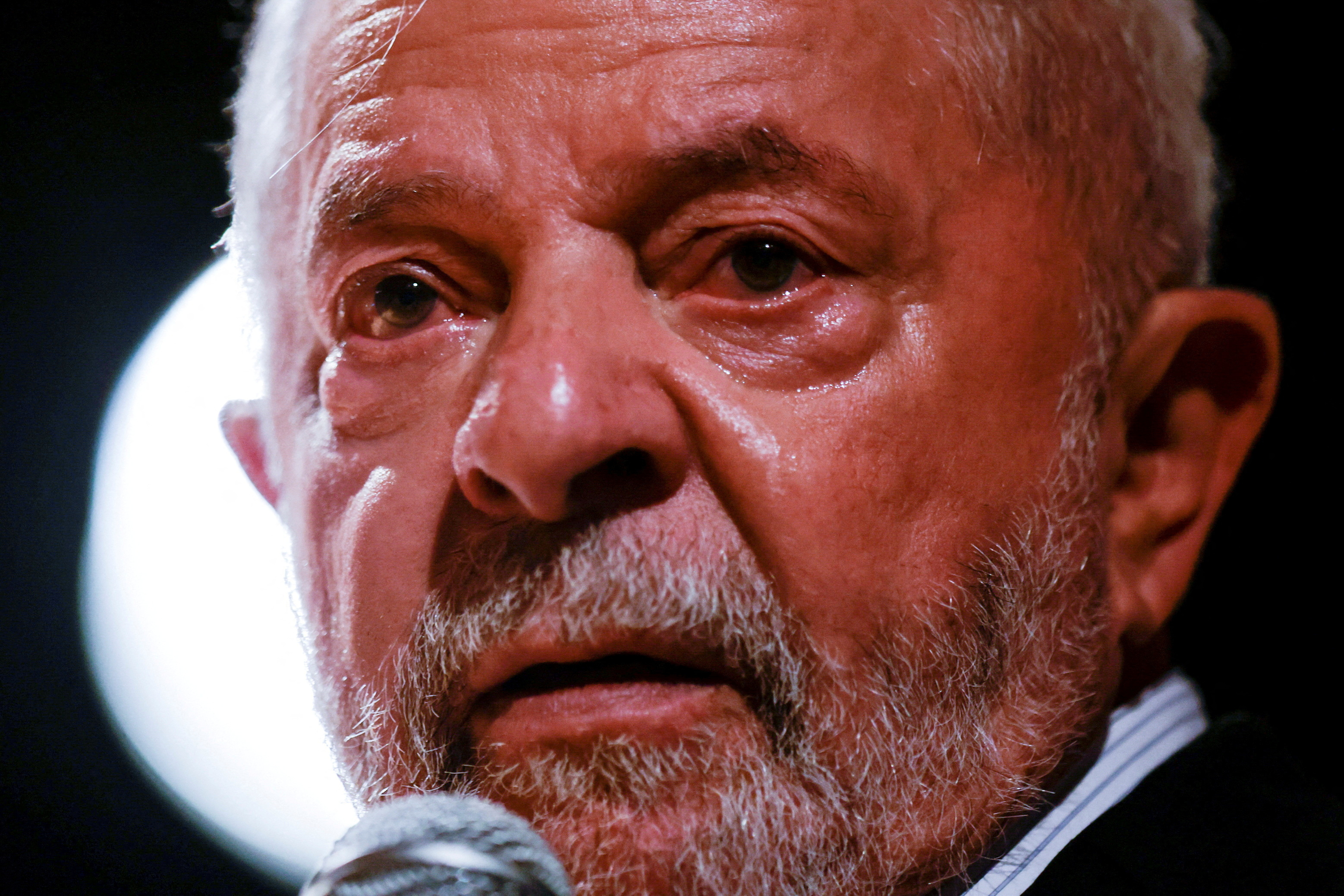
Brazilian President-elect Luiz Inacio Lula da Silva cries while speaking during a meeting with members of the government transition team in Brasilia, Brazil November 10, 2022. REUTERS/Ueslei Marcelino REUTERS