Categories
Audio Sources - Full Text Articles

Lula returns to office in a troubled, divided Brazil

2023-01-01T14:15:36Z

The usually calm capital of Brazil readies for leftist Luiz Inacio Lula da Silva’s inauguration on Saturday (December 31).

Leftist leader Luiz Inacio Lula da Silva will be sworn in as president of Brazil on Sunday under tightened security in the Brazilian capital following threats of violence by supporters of his far-right predecessor Jair Bolsonaro.

The ceremony in Congress begins at 3 p.m. (1800 GMT), after which Lula will go the Planalto palace to don the presidential sash before a crowd of 30,000 supporters, while some 300,000 are expected to gather to celebrate on Brasilia’s esplanade.

Lula, 77, narrowly defeated Bolsonaro in October to win an unprecedented third presidential term after a hiatus that saw him spend a year and a half behind bars on corruption convictions that were later overturned.

In his previous years as Workers Party (PT) president from 2003-2010, the former union leader lifted millions of Brazilians from poverty during a commodity boom that buoyed the economy.

Now, he faces the daunting challenge of improving Brazil’s stagnant economy while also uniting a country that has become painfully polarized under Bolsonaro.

“A lot is expected of Lula. He’ll have the difficult mission to restore normality and predictability in Brazil, and above all to rapidly deliver results that improve the quality of life for its inhabitants,” said Creomar de Souza, director of Dharma Political Risk consultancy in Brasilia.

Bolsonaro left Brazil for Florida on Friday, avoiding having to hand over the sash to his rival, whose victory he has yet to recognize, while also removing himself from any immediate legal risks related to his time in office.

His supporters have protested for two months that the election was stolen and called for a military coup to stop Lula returning to office in a climate of vandalism and violence.

One supporter was arrested for making a bomb that was discovered on a truck laden with aviation fuel at the entrance to Brasilia airport, and confessed he was seeking to sow chaos to provoke a military intervention.

In a thinly veiled dig, acting President Hamilton Mourao, who was Bolsonaro’s vice president, criticized his former boss for failing to lead the country and allowing anti-democratic sentiment to thrive after his October defeat at the polls.

“Leaders who were supposed to reassure and unite the nation … allowed silence or inopportune and deleterious protagonism to create an atmosphere of chaos and social disintegration,” Mourao said in a speech on Saturday night.

Mourao defended Bolsonaro’s four years in power for leaving a strong economy, but criticized environmental backsliding after deforestation in the Amazon reached a 15-year-high.

As tens of thousands of Lula supporters arrived in central Brasilia for Sunday’s celebrations, authorities deployed 10,000 police and troops to reinforce security and search participants, who cannot bring bottles, cans, flag masts or toy guns. Carrying firearms by civilians was also temporarily banned.

Organizers said delegations from 50 nations and 19 heads of state and governments, including the king of Spain, have confirmed their attendance.

On Friday, before flying to Florida, Bolsonaro delivered a teary address to the nation in which he condemned the bomb plot as a “terrorist act” but praised his supporters who camped outside army barracks across the country calling for a coup.

Related Galleries:

Brazilian President-elect Luiz Inacio Lula da Silva stands next to Sonia Guajajara, nominee for minister of Indigenous Peoples, during the presentation of the ministers nominated for his government at the transition government building in Brasilia, Brazil December 29, 2022. REUTERS/Adriano Machado

Brazilian President-elect Luiz Inacio Lula da Silva attends the presentation of the ministers nominated for his government at the transition government building in Brasilia, Brazil December 29, 2022. REUTERS/Adriano Machado/File Photo


Categories
Audio Sources - Full Text Articles

Power outage forces Philippines to suspend flights, shut airspace

2023-01-01T14:18:14Z

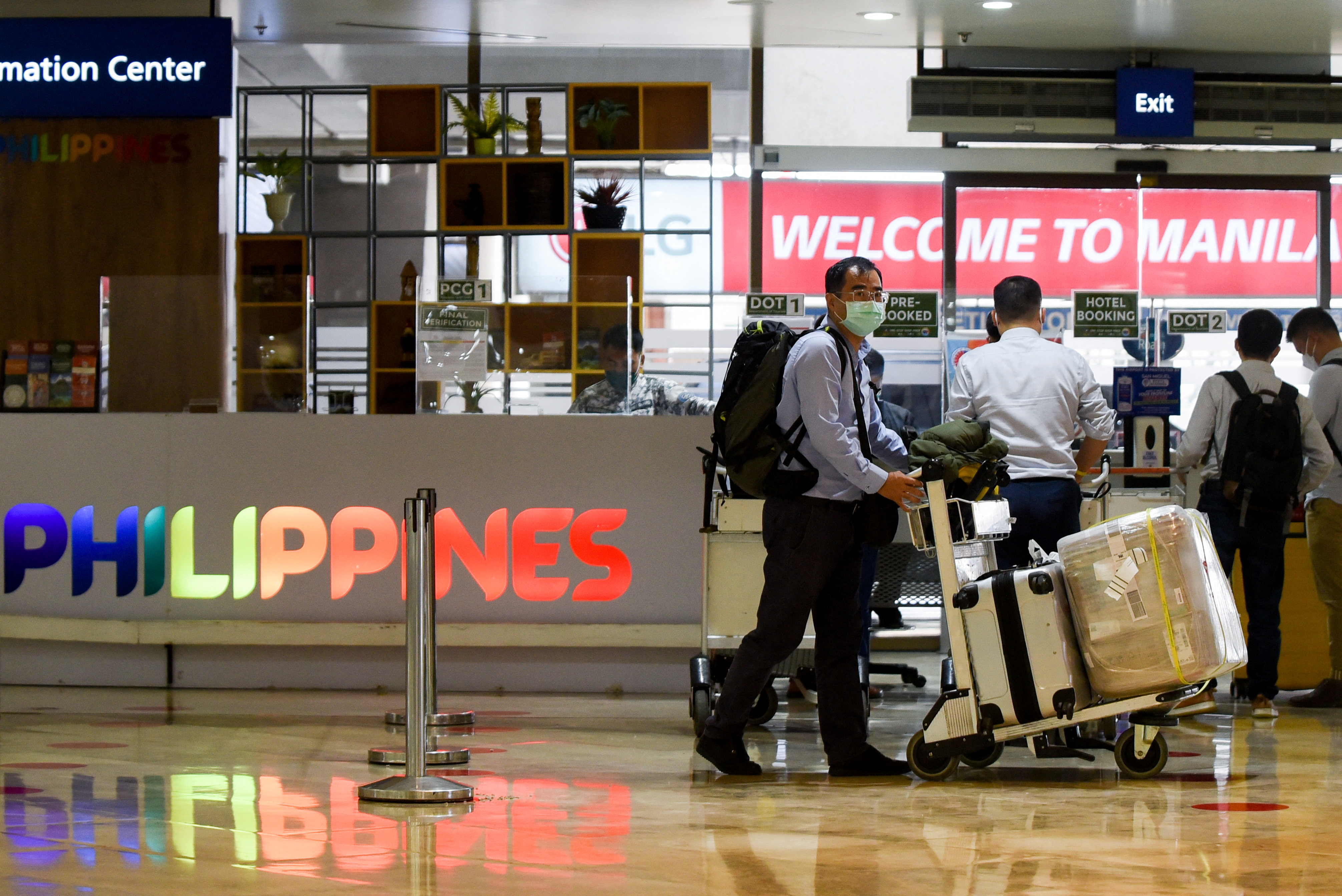
A foreign passenger wearing a face mask as a protection against the coronavirus disease (COVID-19) arrives at the Ninoy Aquino International Airport, in Pasay City, Metro Manila, Philippines, February 10, 2022. REUTERS/Lisa Marie David

Philippine authorities halted flights in and out of Manila on New Year’s Day due to a malfunction of air traffic control, which also prevented airlines bound to other destinations from using the country’s airspace.

A total of 282 flights were either delayed, cancelled or diverted to other regional airports, affecting around 56,000 passengers at Manila’s Ninoy Aquino International Airport (NAIA), the airport operator said on Sunday.

It was unclear how many overflights were affected.

Transportation Secretary Jaime Bautista apologized for the inconvenience to passengers as he blamed a power outage for the breakdown of the central air traffic control system that also affected operations at other airports in the country.

He said the outdated existing facility should be upgraded immediately and that a back-up system was also needed.

“This is air traffic management system issue,” he said in a media briefing. “If you will compare us with Singapore, for one, there is a big difference, they are at least 10 years ahead of us.”

As of 0800 GMT, “the system has been partially restored thereby allowing limited flight operations”, the Manila International Airport Authority said in a statement. By late evening, eight flight arrivals and eight departures had been allowed, according to the airport operator.

Video clips and photos posted on social media showed long queues at the airport and airline personnel distributing food packs and drinks to stranded passengers.

“We’re told radar and navigation facilities at NAIA down. I was on my way home fm Tokyo – 3 hours into the flight, but had to return to Haneda,” tweeted one passenger – Manuel Pangilinan, chairman of Philippine telecommunications conglomerate PLDT Inc.

“6 hours of useless flying but inconvenience to travellers and losses to tourism and business are horrendous. Only in the PH. Sigh.”

Budget carrier Cebu Pacific (CEB.PS) and Philippine Airlines (PAL.PS) said they were offering passengers due to fly on Sunday free rebooking or the option to convert tickets to vouchers.

Categories
Audio Sources - Full Text Articles

Anita Pointer of the Pointer Sisters dead at 74

2023-01-01T14:21:18Z

Jermaine Jackson (R) performs with the Pointer Sisters June (L), Ruth (2nd L) and Anita on stage during an award ceremony in Zwentendorf in Lower Austria July 24, 2009. Jackson received the SAVE THE WORLD AWARD 2009 on behalf of his late brother Michael Jackson tonight. REUTERS/Herwig Prammer/File Photo

Anita Pointer, one of the Grammy-winning Pointer Sisters whose string of pop, country and R&B hits in the 1970s and ’80s included “I’m So Excited,” “Jump (For My Love)” and “Fire,” died of cancer on Saturday at age 74, her publicist said.

Pointer was surrounded by family at her Beverly Hills home when she died, publicist Roger Neal said.

Anita was the second oldest of four sisters who started performing as the duo of June and Bonnie in 1969 and soon became a trio when Anita quit her job as a secretary to join the group, according to an official biography.

The Pointer Sisters later became a quartet for a while with Ruth, the only one of the original singing sisters still alive, though Bonnie left the group in the late 1970s and they became a trio once again. The Pointer sisters also have two surviving brothers, Fritz and Aaron.

Anita was preceded in death by her daughter Jada, who died in 2003, when Anita took over raising her granddaughter, Roxie McKain Pointer.

“While we are deeply saddened by the loss of Anita, we are comforted in knowing she is now with her daughter Jada and her sisters June & Bonnie and at peace. She was the one that kept all of us close and together for so long. Her love of our family will live on in each of us,” the family said in a statement.

The sisters grew up singing in the church of their father, a preacher in Oakland, California.

Their debut album in 1973 produced their first hit single “Yes We Can Can.”

Among their bigger hits were “Fire” in 1978, “He’s So Shy” in 1980, “Slow Hand” in 1981, and “Neutron Dance,” “Automatic” and “Jump” in 1983. “I’m So Excited” from 1982 remains a standard.

In recent years, the group continued performing with Ruth singing along with her daughter Issa and granddaughter Sadako.


Categories
Audio Sources - Full Text Articles

Happy New Year! Welcome to 2023: the end of Donald Trump, the Democrats come out swinging, and what comes next

Help support Palmer Report! Our articles are all 100% free to read, with no forced subscriptions and nothing hidden behind paywalls. If you value our content, you’re welcome to pay for it:

Pay $5 to Palmer Report:

Pay $25 to Palmer Report:

Pay $75 to Palmer Report:


President Joe Biden and the Democratic Congress have done a fine, even historic, job of moving the nation forward over the past two years. And over the past two years, a number of dangerously corrupt and deranged political figures have arisen on the right. Yet because he just won’t go away, Donald Trump is still sucking much of the optical oxygen out of the room. This is the year where that will change.

Don’t get me wrong; Trump’s impending indictment and arrest, along with his eventual criminal trials, and the manner in which that’ll bring an ugly end to his 2024 “campaign” for President, will get plenty of headlines. If anything, those events will bring Trump more headlines than he’s been getting of late. But those headlines will be the devastating kind – and they’ll cause Trump’s political relevance to start being spoken of in the past tense.

2023 will be the year in which Donald Trump is finally held accountable, and finally pushed out of the conversation when it comes to current and viable political figures. But through all the endless coverage of his indictments, trials, and downfalls, it’ll be important to remember that politics will still be moving forward without him – and there will be crucial stories to cover on both sides.

On the Republican side, the story is not just George Santos. It’s that pretty much every Republican in Congress is George Santos when it comes to lying constantly, and most of them are just better at figuring out how to get away with it. Even if Santos is forced out in 2023, it’ll be important not to let the media portray that as “crisis over.” As long as the Republican House is dominated by people like Jim Jordan, Marjorie Taylor Greene, Kevin McCarthy, Elise Stefanik, and Lauren Boebert, Santos is just icing on the toxic cake.

On the Democratic side, there are a few key storylines. These House Democrats are the most savvy and fearless we’ve seen in our lifetime, and while they’ll be fighting from the minority position, they’re going to put on one heck of a fight. And in spite of all the headlines we’ll see about how President Biden’s agenda is supposedly finished because he no longer controls the House, history suggests that his moves could be more consequential in his second two years than they were in his first two years.

Click here to support Palmer Report! Our articles are all 100% free to read, with no forced subscriptions and nothing hidden behind paywalls. If you value our content, you’re welcome to pay for it:

Pay $5 to Palmer Report:

Pay $25 to Palmer Report:

Sign up for the Palmer Report mailing list

Follow Palmer Report on FacebookTwitterPostMastodon


Meanwhile, throughout 2023 there will be endless speculation about the 2024 presidential race. Most of it will be empty ratings driven nonsense. The majority of Republicans who are currently hinting at running in 2024 are unpopular and non-viable, and are only doing it to try to squeeze a book deal or a commentator gig out of it. And while Biden has already made it clear that he’s likely to run in 2024, the media will push the narrative that Biden won’t run, so it can chase headlines about other supposed 2024 Democratic candidates instead.


In other words, some things don’t change. But we’re heading into what could ultimately be a fascinating political year. We’re about to see what will happen to the Republican Party once Donald Trump’s remaining influence and leverage are run through a shredder. We’re about to see a whole lot of Republicans try to fill the vacuum created by Trump’s downfall, and fall flat on their faces. And we’re about to see Biden and the Democrats come out swinging in a way that’ll frankly surprise a lot of people.

Through all of this, let’s keep in mind the entire reason we’ve all gotten involved in politics and political activism to begin with: to fight and worthwhile battles, win elections, and deliver positive change for our nation and planet in a way that benefits us all. As long as we keep abiding by those principles, we will win more political battles than we lose. And in the end, that’s what winning looks like. Happy New Year!

Support Palmer Report! Our articles are all 100% free to read, with no forced subscriptions and nothing hidden behind paywalls. If you value our content, you’re welcome to pay for it:

Pay $5 to Palmer Report:

Pay $25 to Palmer Report:

Pay $75 to Palmer Report:

Write for the Palmer Report Community Section.

Help support Palmer Report! Our articles are all 100% free to read, with no forced subscriptions and nothing hidden behind paywalls. If you value our content, you’re welcome to pay for it:

Pay $5 to Palmer Report:

Pay $25 to Palmer Report:

Pay $75 to Palmer Report:

The post Happy New Year! Welcome to 2023: the end of Donald Trump, the Democrats come out swinging, and what comes next appeared first on Palmer Report.

Categories
Audio Sources - Full Text Articles

A 44-year-old who moved from California to Indiana saves $3,210 a month and thinks more people should consider living in the Midwest: ‘LA is the glitz and glamour, but when you take that aside, are you actually enjoying your life?’

A woman rides her bike across Purdue campus.A woman rides her bike across Purdue campus in West Lafayette, Indiana.

Daniel Acker/Blomberg/Getty Images

  • Vanessa Hughes recently moved to West Lafayette, Indiana, a city of 45,000 and a major university.
  • She and her husband left LA after 22 years there in order to pay down debt and save money.
  • Hughes said the move, which saves them more than $3000 a month, has been worth it.  

After 22 years in Los Angeles, Vanessa Hughes, 44,  picked up and moved to West Lafayette, Indiana this fall.

Relocating to the Midwestern city of 45,000 people, home to Purdue University and located about 68 miles northwest of Indianapolis, has saved Hughes and her husband about $3,210 a month. 

“After the pandemic, people are challenging their way of thinking when it comes to where they live,” Hughes told Insider. “LA is glitz and glamour, but when you take that aside, are you actually enjoying your life?”

One key motivation was financial. In California, Hughes, a freelance television editor who can work from anywhere, was renting a small three-bedroom home for $3,000 a month — a price that she called a “steal” for the area. In West Lafayette, she’s paying half the amount for a significantly bigger space with a yard for their two dogs. 

The cash she is saving on rent, car insurance, and other expenses is helping her family pay down credit card debt and better prepare for life’s hurdles.

“Credit card debt is a huge reason for relocating,” said Hughes, adding that she can finally build an emergency fund. “Some people are better at saving than others, but I have not done a great job. My partner and I have aging parents. If I stayed in LA, I feel like if anything ever happened, I wouldn’t be able to help.”

Vanessa Hughes and her husband.Vanessa Hughes and her husband, Ian Golding.

Courtesy of Vanessa Hughes.

With remote work flourishing, still-high home prices, and higher inflation — a trend that will  likely carry over into 2023 — California’s expensive cost of living pushes  many residents to move away to more affordable US cities that offer them better and larger living spaces. According to a September 2022 report from moving company MoveBuddha, California saw the nation’s biggest outflow of migration in 2022, with only 51 moves in for every 100 people who move out. 

In 2023, the search for affordable housing could pull more homebuyers towards Midwestern spots like West Lafayette. 

Orphe Divounguy, a senior economist at Zillow, told Insider in December that the region’s relative affordability will entice many remote workers next year.

Vanessa Hughes dog and backyard.Hughes’ dog plays in their backyard, which is bigger than in LA.

Courtesy of Vanessa Hughes.

“The Midwest has some of the most affordable housing markets in the country even for locals,” Divounguy told Insider. “It provides a great opportunity for those living in expensive markets like New York to get more bang for their buck.”

Money isn’t everything: Hughes said she was also lured by her new neighborhood’s comfortable lifestyle. 

“Affordability was definitely a lure to West Lafayette, but not the highest priority,” Hughes said. “West Lafayette specifically appealed to my husband and I because of the quality of living, wonderful people, lots of parks and bike paths, a sense of community, Purdue’s amazing campus, and high speed internet — which we can’t do our jobs without.”

West Lafayette also gives people $5,000 plus perks to move there 

Hughes and her husband, who is originally from Indiana, attended the Indianapolis 500 car race in May. After their trip, Hughes saw an ad on Instagram that piqued her interest. 

MakeMyMove — an Indianapolis-based group that partners with cities to offer financial incentives and perks to people who move to them — was touting a relocation stipend of up to $5,000 for the greater Lafayette area. 

“MakeMyMove came up on Instagram for exactly what I was looking for,” she said. “We were already thinking about moving. It more or less just gave us a timeline and picture of what it would look like to be here.” 

Besides the stipend, movers to the area who are vetted by MakeMyMove can receive a long list of perks, including Purdue library membership and free food and drink on campus. With the stipend, that’s a total value of about $10,000. 

Purdue UniversityThe Purdue campus.

Michael Hickey/Getty Images

By the end of November, they had made the move to West Lafayette. So far, Hughes said, she has claimed a $2,500 stipend, access to the university library and its alumni association, and a free Care.com membership. She plans to take the company up on other money or perks down the line, she added.  

West Lafayette is just one place that offers people incentives to move there. At least 25 other cities have similar programs, ranging from Tulsa, Oklahoma to Morgantown, West Virginia, and perks doled out range from a bike to a coworking membership to money toward a down payment for a house. 

And while the biggest pain point of the move was setting up new healthcare services and driving cross country with their dogs, Hughes said the benefits outweigh the hassle.

“I feel less stressed living in West Lafayette,” she said. “The price at the pump, the grocery store, gym, car insurance, and even eating out at Westside Diner are a welcome change to my budget. I am still struggling to pay down high interest credit cards, and it will take time. But now, it feels possible.”

Read the original article on Business Insider
Categories
Audio Sources - Full Text Articles

How to make extra money as a reseller in 2023, from 3 people who turned their Poshmark and Facebook Marketplace side hustles into valuable income

resellers.2

Jacob Zinkula

  • Many Americans are looking for ways to make extra income, and online reselling platforms have helped.
  • Insider spoke with three women who have found success as resellers.
  • They shared their stories, as well as advice they have for others looking to get started.

As the New Year approaches, many people are making financial goals for the year ahead. Some looking to earn an extra buck may consider joining the crowd that has figured out how to use reselling as a low cost way to effectively start businesses of their own.  

As inflation continues to erode bank accounts, many Americans have explored work outside the traditional 9-to-5 to generate income. US workers filed over five million new business applications in 2021, the most since 2005. A recent Upwork study found that 60 million Americans — or 39% of the US workforce — had performed freelance work full-time or part-time over the prior 12 months. Others have ditched college for trade schools or apprenticeship programs. And some have embraced reseller platforms like Poshmark or Facebook Marketplace to earn extra cash or become full-time resellers. 

Insider previously spoke with three women who have found success as resellers. They shared their stories, as well as advice they have for others hoping to follow in their footsteps. 

A mom of three made $735,000 last year reselling on social mediaMona Mejia

Mona Mejia

44-year-old Mona Mejia made $735,000 last year selling new and used clothing, home goods, and toys on social media. 

She said she’s never invested a single dollar out-of-pocket into her business. 

In 2015, Mejia’s family was in need of additional income to supplement her husband’s pay. It was a “really hard time,” she said. “You don’t know where you’re going to eat.”

When her sister introduced her to the reseller platform Poshmark, she began selling a few items from her closet. It wasn’t until roughly a year ago, however — when she started selling on livestreams through Instagram, TikTok, and Facebook, that her business really took off. 

Mejia said she thinks anyone can find success as a reseller but emphasized that it takes hard work and commitment.

“A lot of people see where I’m at right now. And they’re like, ‘Oh, I want to do that right now,'” she said. “Yeah, it’s going to happen eventually, but it’s not just going to happen overnight. So I would say don’t give up and just keep listing, keep sharing your closet, be consistent.” 

Read more: A 44-year-old mom of 3 made $735,000 last year from a reselling business she launched using just the clothes in her closet

A 27-year-old makes extra money selling other people’s trashSarah Scott

Sarah Scott

27-year-old Sarah Scott works full-time as a digital marketing advisor but made an additional $37,000 this year selling other people’s trash on Facebook Marketplace

Scott was driving home one night in January 2020 when she noticed there was “a ton” of furniture and other household items left on her neighborhood’s curbs.

On a whim, she decided to pick up an “entire car load” — including a coffee table, a bookcase, and a broken lawnmower. Within 48 hours, she’d sold it all on Facebook Marketplace, a section of Facebook where users can buy and sell goods, often to and from people in their local area.

After her surprise initial success on Facebook Marketplace, she decided to dive in. 

“I realized, after doing it the second night just within my own town, that this was going to be very lucrative,” she said. 

Read more: How selling neighborhood ‘trash’ on Facebook Marketplace for 5 hours a week landed a 27-year-old an extra $37,000 this year

A mom quit her toxic job to become a full-time resellerCandice Murray

Candice Murray

Candice Murray said her 2016 decision to leave what she called a “toxic” and “emotionally and mentally abusive” work environment changed her life. The 48-year-old New Yorker now works full time selling clothes, shoes, and bags exclusively through the reseller platform Poshmark.

The Poshmark life isn’t an easy one, however. She made roughly $23,000 last year, and said the work of shopping, sanitizing, photographing, listing, packaging, and shipping could make it feel like a “24/7 job.”

Still, Murray said the extra income has been huge for her family.

“This is not play money for me. It’s helped me put two kids through college,” she says. “Electric bills, phone bills, this is very serious for me, and it helps my husband tremendously. 

Read more: A mom of 3 quit her toxic job to be a reseller on Poshmark. She loves it but warns it’s a ’24/7′ commitment.

Read the original article on Business Insider
Categories
Audio Sources - Full Text Articles

Did Putin really poop himself? How an influential Telegram account is spreading wild, unproven claims about the Kremlin’s inner workings

Vladimir Putin in Astana KazakhstanRussian President Vladimir Putin at the Commonwealth of the Independent States summit in Astana, Kazakhstan on October 14, 2022.

Contributor/Getty Images

  • The Russian Telegram account General SVR is a source of many juicy tabloid stories about Putin.
  • Among them are repeated rumors of serious health issues, and an infamous claim that he pooped himself.
  • Experts on Russian media strongly doubt the account, and say it does more harm than good.

In early December, a sensational story ripped through the tabloid press: President Vladimir Putin had stumbled and fallen down the stairs, involuntarily soiling himself in the process.

It proved an irresistible tale for a Western audience largely horrified by Putin’s invasion of Ukraine and hungry for his ultimate demise. 

The claims were covered in The Sun, the New York Post, the Daily Mail, Gawker, and Newsweek, among others. They attributed them to a single, anonymous source: the mysterious Telegram account known as General SVR.

The channel is a striking example of the wild media ecosystem that has boomed since the Russian invasion of Ukraine.

Gruesome videos and eye-catching claims abound, reaching vast audiences often with little evidence or context. Some inevitably spills over into established media reporting.

General SVR emerged in 2020, claiming to be run by former and current members of the Russian Foreign Intelligence Service, or SVR, as well as other state bodies.

In a statement to Insider, a spokesperson for General SVR declined to identify the account’s sources, citing personal security, but said it has “complete confidence” in them.

“They have never let us down,” the spokesperson said.

Since its inception, the account has pumped out a steady stream of unevidenced but fascinating claims about the Kremlin’s inner workings and Putin’s allegedly failing health.

They range from alleging in May that Putin would temporarily hand over power in order to have cancer surgery; to saying Putin had a coughing fit just before his September speech announcing the mobilization of reservists.

The most recent, scatological claim prompted a rare public denial from the Kremlin, which told Newsweek: “This is completely untrue.”

The Kremlin’s own claims are themselves highly unreliable. But the fact that the epicenter of Russian power was forced to assure the world that Putin did not poop himself is testament to the outsize power of General SVR.

Among those used to more rigorous documenting of Russia’s secrets, General SVR prompts open derision.

Aric Toler, of the respected investigative outfit Bellingcat, told his Twitter followers in May to “ignore everything coming from” the account. 

Experts on Russian media told Insider that General SVR is unlikely to be a credible source — and argue that despite the momentary embarrassment it can cause Putin, it is probably doing more harm than good.

Who is General SVR?

General SVR is sometimes referred to by the pseudonym “Viktor Mikhailovich,” but nobody knows for sure who exactly is behind the account, but two names frequently crop up, with different theories attached.

One is Valery Solovey, a Russian academic who is sometimes described as a conspiracy theorist, who was raided by Russian authorities on February 16 this year, as the independent Russian news outlet Meduza reported

Solovey is a source of rumors about Putin published under his own name, such as his remarks reported in The Sun in 2020, when he claimed that the Russian president was readying to step down by January 2021. As we know, Putin did not step down.  

Per Meduza, which itself cited local media, Solovey was named as a witness in an investigation into General SVR, which stood accused of breaking Russian hate-speech laws, but he was ultimately freed. 

Soon after his questioning, the General SVR channel made a post denying any connection to Solovey.

In a comment to Insider, Solovey said that he is not connected to the channel but claimed that it has “high reliability” and that even Putin himself gets briefed on its contents. 

Asked if he would name any of the figures behind the account, he said: “No.”

In response to allegations that he is a conspiracy theorist, Solovey pointed to claims of his that did come true, including the prediction that Russia would invade Ukraine.

The second figure linked to the account is Ukrainian lawyer Viktor Yermolaev, according to Meduza. Insider was unable to contact him, but he firmly denied the claim to Meduza, saying that he has no contact with anyone in Russia. 

Dr Lucy Birge, a researcher specializing in Russian media and politics, told Insider that “it wouldn’t be difficult to see what the strategic goal is” for a Ukrainian running the account.

But there is still little more than speculation to go on.

Selling a cartoon Putin

The wild world of General SVR should be understood in the wider context of how Telegram is used in Russia, according to Dr Jade McGlynn, a researcher on Russian propaganda and media. 

Russia’s traditional media landscape has steadily tightened, as Insider’s John Haltiwanger has reported, forcing many independent outlets to relocate outside of Russia and be branded a “foreign agent.”

In tandem with that process arose Telegram — an encrypted platform that allows unfiltered, anonymous publication to vast audiences. (The Kremlin has tried, and failed, to block the app).

Initially perceived as a place for authentic voices, Telegram soon became “a space for impersonations and info ops,” McGlynn told Insider.

Info ops are missions, usually by the military, to spread information meant to harm an enemy or influence a conflict.

While there are dozens of active, well-read channels — both pro-and anti-Putin — General SVR cuts through to Western media because it is “punchy,” McGlynn said.

For her, part of the problem lies in oversimplifying the situation — and potential solutions to the conflict.

Constant headlines painting Putin as being on the verge of death with no real evidence backing it up can lead western readers to think “‘great, well Putin’s going to be gone soon, so we needn’t worry too much,'” as she put it. 

That, in turn, could dial down public urgency around continued military aid to Ukraine — a matter that is increasingly under question in the US and the UK

Birge agreed. “It’s not difficult to see how that image of Russia sells,” she told Insider. And there’s even an advantage for Putin in that, no matter how negative the story is, it centers Russia as a world power, she said. 

For Birge, the phenomenon reveals much more about what Western news consumers want to read than it does about Russia.

And it comes because there is a massive “informational vacuum” around Russia’s elite, she said. 

“Obviously there are things going on behind the scenes and we don’t know what they are,” she said. “It’s tempting to follow this unidentified person who has all the answers.”


Read the original article on Business Insider
Categories
Audio Sources - Full Text Articles

Trump loves to hate the ‘fake news media.’ But his political team subscribes to the New York Times, the Washington Post, and other mainstream outlets.

Fake News

Mitchell Layton/Getty Images

  • One of Trump’s political action committees subscribes to the media organizations he detests.
  • The Save America PAC is subscribed to the New York Times and the “thoroughly disgusting” Washington Post, among other outlets.
  • A Trump-connected PAC is also fundraising off of the former president’s distaste of the news media.

The “Lamestream Media.”

The “Fake News Media.”

“THE ENEMY OF THE PEOPLE.”

Former President Donald Trump incessantly denigrates news publications and their “lying” and “slime” journalists for how they cover him, his family, and the Republican Party.

But Trump is also a news media patron: his political action committee pays for subscriptions to several of Trump’s most detested news outlets, according to an Insider analysis of Federal Election Commission records.

Trump’s Save America PAC subscribed to the New York Times, the “thoroughly disgusting” Washington Post, and even Insider. The PAC also subscribed to the Financial Times, Epoch Times, Bloomberg, and Gannett newspapers.

Many political campaigns purchase subscriptions to news publications of interest — what sets Trump apart is his expressed hatred for the publications to which his organizations are subscribing.

During the 2021-2022 election cycle, the Save America PAC purchased multiple $17 subscriptions to the New York Times, $40 subscriptions to the Financial Times, and a $75 subscription to the Washington Post.

The Save America PAC did not respond to Insider’s request for comment.

Trump-connected committees are not only paying for the news, they’re also fundraising off the anti-media movement espoused by Trump.

On December 14, for example, the Save America Joint Fundraising Committee blasted out a text message from the former president.

“Pres Trump: The FAKE NEWS is out of control,” the message read. “I need YOU to take the Media Accountability Survey. ALL RESPONSES to me.”

The survey, which also acts as a campaign donation solicitation page, notes that 99% of the money received would go to Trump’s 2024 re-election campaign. 

“Do you think the media is corrupt?” The survey asks. “Do you think the radical Left and the Corrupt Media want to put America LAST?”

But even despite his distaste for the news media, Trump continues to blast articles he enjoys to his audience on TRUTH Social and via email, regardless of where they came from, such as when he recently cited Insider’s reporting about media layoffs to gloat in an email.

“ICYMI: ‘Netflix, NBCUniversal, BuzzFeed, Vice, and other media companies have laid off thousands in 2022…'”

Read the original article on Business Insider
Categories
Audio Sources - Full Text Articles

Macy’s CEO says he was told being openly gay would harm his career when he started in 1983

Photograph of Macy's CEO Jeff Gennette speaking into a microphoneA file photo of Macy’s CEO Jeff Gennette.

John Lamparski/Getty Images

  • Macy’s CEO Jeff Gennette was told being gay would harm his career, per The Wall Street Journal.
  • Gennette, who started at Macys in 1983, said he got pushback for his sexuality.
  • He worked almost his entire career at Macy’s, and was made CEO in 2017.

Macy’s CEO Jeff Gennette said he was told that being openly gay could harm his career, The Wall Street Journal reported.

Gennette was describing the attitudes to his sexuality in 1983, when he joined Macy’s and was open about being gay.

In an interview with the Journal published Saturday, Gennette, said that other people treated his sexuality like a dark secret even though he did not.

He said it led to a mentor tipping him off that “things are being said” about him.

Gennette said the mentor seemed to be telling him that “maybe I should be less transparent about it if I wanted to get ahead in my career.”

He said there were also other times being gay was presented as a “deterrent.”

Gennette didn’t take the advice, and continued at Macy’s as an openly gay man for his entire career except a two-year stint with the toy retailer FAO Schwarz.

In July, Gennette told Time magazine “there were no gay CEO examples” for him to look up to in his early career, and that he felt “like an outsider” while he was the only gay person in Macy’s senior leadership.

Gennette joined the company as an executive trainee in 1983 after graduating from Stanford, per the company’s corporate website.

He went on to work in the retailer’s men’s and children’s departments, as well as being the executive vice president and director of stores for Macy’s Central in Atlanta, and another executive role in its West division.

He became president in 2014, CEO in 2017, and chairman in 2018..

Insider contacted Macy’s for comment.

Read the original article on Business Insider
Categories
Audio Sources - Full Text Articles

Benedict leaves German homeland with complicated legacy

BERLIN (AP) — Pope Benedict XVI leaves his homeland with a complicated legacy: pride in a German pontiff but a church deeply divided over the need for reforms in the wake of a sexual abuse scandal in which his own actions of decades ago were faulted.

Benedict has long drawn mixed reviews in Germany, a country where Christians are roughly evenly split between Catholics and Protestants and where many struggled with his conservative stance.

The day after the then-Cardinal Joseph Ratzinger was elected as the first German pope for centuries in 2005, best-selling newspaper Bild’s front page screamed “We are the Pope!” The left-leaning Tageszeitung countered with the headline “Oh, my God!”

Chancellor Olaf Scholz said that “as the ‘German’ pope, Benedict XVI was a special church leader for many, not just in this country.” He paid tribute to the late pontiff as “a formative figure of the Catholic Church, a combative personality and a wise theologian.”

“As the church in Germany, we think with gratitude of Pope Benedict XVI: He was born in our country, his homeland was here, and he helped shape church life here as a theological teacher and bishop,” said the head of the German Bishops’ Conference, Limburg Bishop Georg Baetzing.

Still, a decade after his resignation, deep divisions are apparent in the German church between traditionalists in Benedict’s mold and relative liberals.

“The German pope filled many with pride, but above all with hope,” said Irme Stetter-Karp, the head of an influential lay organization, the Central Committee of German Catholics, or ZdK. “For some, this hope was richly fulfilled. For others, there remained an unfulfilled longing to find a way … for their Christianity to succeed in the 21st century.”

Since 2019, German Catholic bishops and representatives from the ZdK have been engaged in a potentially trailblazing reform process — the “Synodal Path” — that is addressing calls to allow blessings for same-sex couples, married priests and the ordination of women as deacons.

German church leaders insist that the process won’t lead to a schism and vow to see it through, even as they face pressure from suspicious Vatican officials.

Illustrating both the pressure for reform and the divisions it faces, a Synodal Path assembly in September failed to approve a text calling for a liberalization of sexual teaching because, while it won 82% backing overall, it failed to get the required support of two-thirds of German bishops.

The retired pope himself stayed out of the fray though his longtime secretary, Archbishop Georg Gaenswein, has signaled his own strong skepticism about the Synodal Path.

The process was launched in response to the abuse scandal that has rocked the church in Germany and elsewhere in recent years, something that has contributed to large numbers of Germans formally leaving the church.

In 2018, a church-commissioned report concluded that at least 3,677 people were abused by clergy in Germany between 1946 and 2014. More than half of the victims were 13 or younger, and nearly a third served as altar boys.

Various dioceses tasked law firms or others to put together reports on their own past. That has led to massive and unresolved tensions in the Cologne diocese, where the archbishop, Cardinal Rainer Maria Woelki, drew widespread criticism for his handling of a report he commissioned. His offer of resignation has been pending with Pope Francis for months.

An independent report in the Munich and Freising archdiocese, where Benedict served as archbishop from 1977 to 1982, turned the spotlight on the retired pope himself last January. Its examination of decades of abuse cases faulted their handling by a string of church officials past and present, including the then-Cardinal Ratzinger in four cases.

Benedict asked forgiveness for any “grievous faults” in his handling of clergy sex abuse cases, but denied any personal or specific wrongdoing. Reform advocates and victim support groups criticized what they saw as a tone-deaf response.

The bishops’ conference head, Baetzing, said Saturday that “he asked for forgiveness from those who were affected; still, questions remained open.” But he stressed Benedict’s role in turning around the church’s approach to clergy sexual abuse as head of the Congregation for the Doctrine of the Faith and later as pope.

The pro-reform group We are Church said that Benedict’s response to the abuse report did serious damage to his reputation and was generally critical of him as an “implacable reactionary.”

As pontiff, Benedict — who left his homeland for the Vatican in 1982 — made three visits to Germany, including a trip to his native Bavaria in 2006 and a 2011 trip in which he became the first pope to address the German parliament.

His only known trip outside Italy since his retirement also took him to Germany. He returned to Bavaria for a few days in June 2020 to see his elder brother, the Rev. Georg Ratzinger, shortly before the latter’s death.

The governor of Bavaria, Markus Soeder, said that “he always carried his homeland in his heart” and that many there “will remember him gratefully not just as Pope Benedict XVI, but also as a humble pastor.”

“He gave many people strength and orientation,” Soeder said. “But at the same time, he also had to face responsibility for difficult phases in his work.”

In his “spiritual will,” released by the Vatican Saturday, Benedict wrote: “I pray for our country to remain a country of faith and urge you, dear compatriots: do not let yourselves be deterred from the faith.”

___

Follow AP’s coverage of the death of Pope Emeritus Benedict XVI at https://apnews.com/hub/pope-benedict-xvi

WP Radio
WP Radio
OFFLINE LIVE