Categories
Audio Sources - Full Text Articles

U.S. Senate to vote Thursday on bill to avoid rail shutdown

2022-12-01T19:50:03Z

The U.S. Senate will vote on Thursday on a bill to block a national railroad strike, Senate Majority Leader Chuck Schumer said, as well as a bill that would provide paid sick days to railroad workers.

The U.S. House of Representatives on Wednesday voted to approve a bill to impose a tentative contract deal reached in September on a dozen unions representing 115,000 workers, who could strike on Dec. 9. The House also separately voted to require seven days of paid sick leave for rail workers, a measure the White House has not endorsed.

Democratic and Republican leaders came to an agreement on expediting votes, known as a time agreement, and the Senate will vote on both bills on Thursday.

“Votes will be quick,” Schumer said on the Senate floor in announcing the timing. “I am glad that the two sides have come together so that we can avoid this shutdown, which would be extremely damaging to the country.”

A vote will also take place on a proposal to extend the “cooling off” period before workers could go on strike, Schumer said.

U.S. President Joe Biden has praised the proposed contract that includes a 24% compounded pay increase over five years and five annual $1,000 lump-sum payments, and he had asked Congress to impose the contract without any modifications.

Without the legislation, rail workers could go on strike as soon as Dec. 9, but the impacts would be felt as soon as this weekend as railroads stop accepting hazardous materials shipments.

A rail strike could freeze almost 30% of U.S. cargo shipments by weight, stoke already surging inflation, cost the American economy as much as $2 billion per day and strand millions of rail passengers.

Biden’s administration pressed the Senate to pass the bill rapidly, warning that serious economic disruptions could be felt within days.

“There is no substitute in the American transportation system for a functioning freight rail network,” Transportation Secretary Pete Buttigieg told CNBC. “It wouldn’t just bring down our rail system, it would really shut down our economy.”

Senator Bernie Sanders and others demanded a separate vote on the sick leave issue as a condition of agreeing to fast-track consideration of the rail contract vote. He denounced railroad companies for refusing to offer paid sick leave.

“They are maybe the worst case of corporate greed that I have seen,” Sanders said. “That is really barbaric in the year 2022 in America.”

Schumer said he wants to see paid sick leave included in the legislation.

Based on the recommendations of an emergency board appointed by Biden, railroads and the U.S. Chamber of Commerce oppose amending the contract deal struck in September. The American Association of Railroads said the sick leave proposal would “undermine bargaining and artificially add to contracts beyond the scope of the Biden-endorsed agreements.”

There are no paid short-term sick days under the tentative deal after unions asked for 15 and railroads settled on one personal day.

Eight of 12 unions have ratified the deal. But some labor leaders have criticized Biden for asking Congress to impose a contract that workers in four unions have rejected over its lack of paid sick leave.

The contracts cover workers at carriers including Union Pacific (UNP.N), Berkshire Hathaway Inc’s (BRKa.N) BNSF, CSX (CSX.O), Norfolk Southern Corp (NSC.N) and Kansas City Southern.

Related Galleries:

An aerial view of gantry cranes, shipping containers, and freight railway trains ahead of a possible strike if there is no deal with the rail worker unions, at the Union Pacific Los Angeles (UPLA) Intermodal Facility rail yard in Commerce, California, U.S., September 15, 2022. REUTERS/Bing Guan

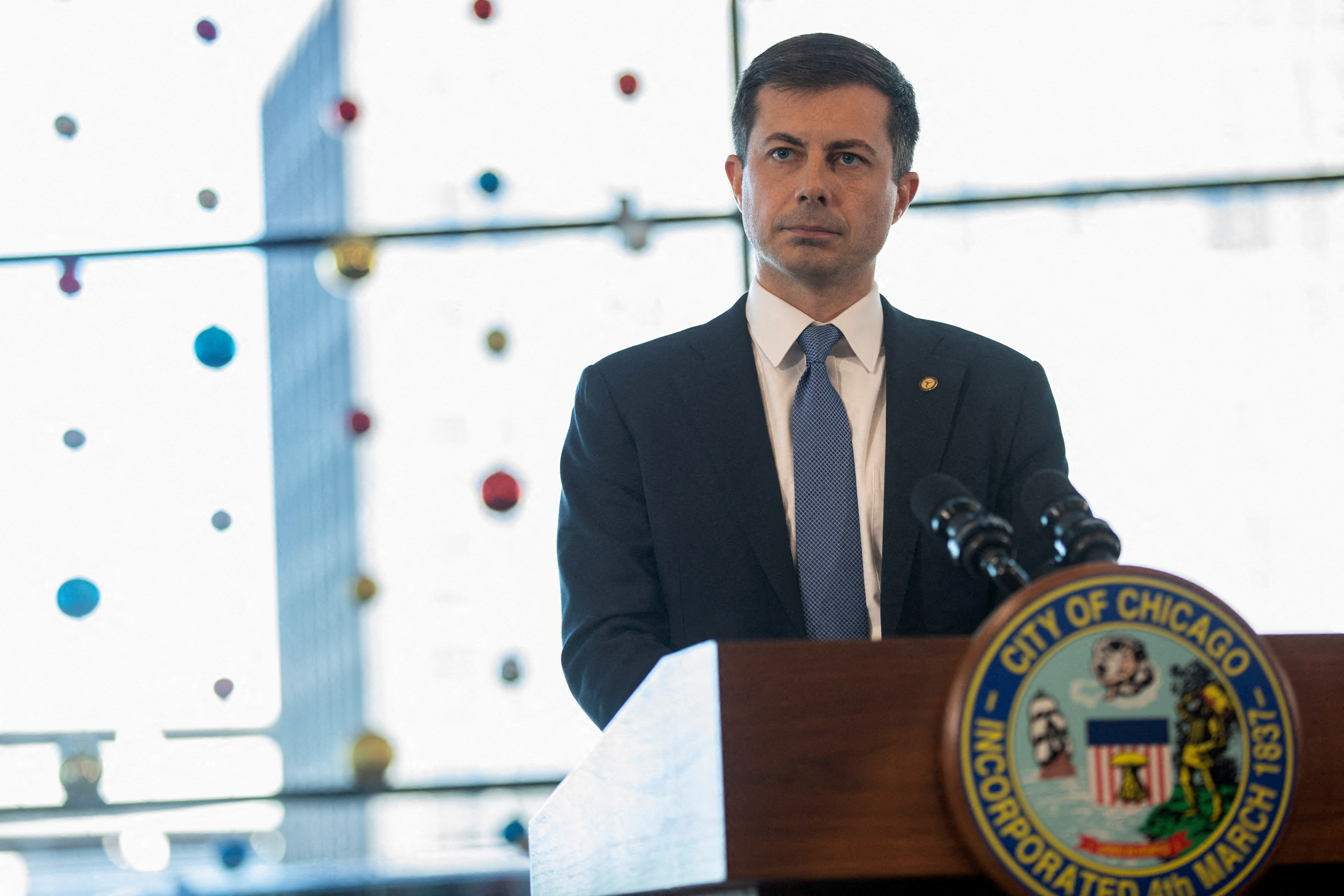
U.S. Transportation Secretary Pete Buttigieg speaks ahead of expected Thanksgiving travel at O’Hare airport in Chicago, Illinois, U.S., November 21, 2022. REUTERS/Jim Vondruska
Categories
Audio Sources - Full Text Articles

Biden, Macron condemn Russia invasion of Ukraine at White House meeting

2022-12-01T19:52:51Z

French President of France Emmanuel Macron awarded “Legion d’Honneur” medals to World War II veterans at the French Embassy in Washington on Wednesday (November 30).

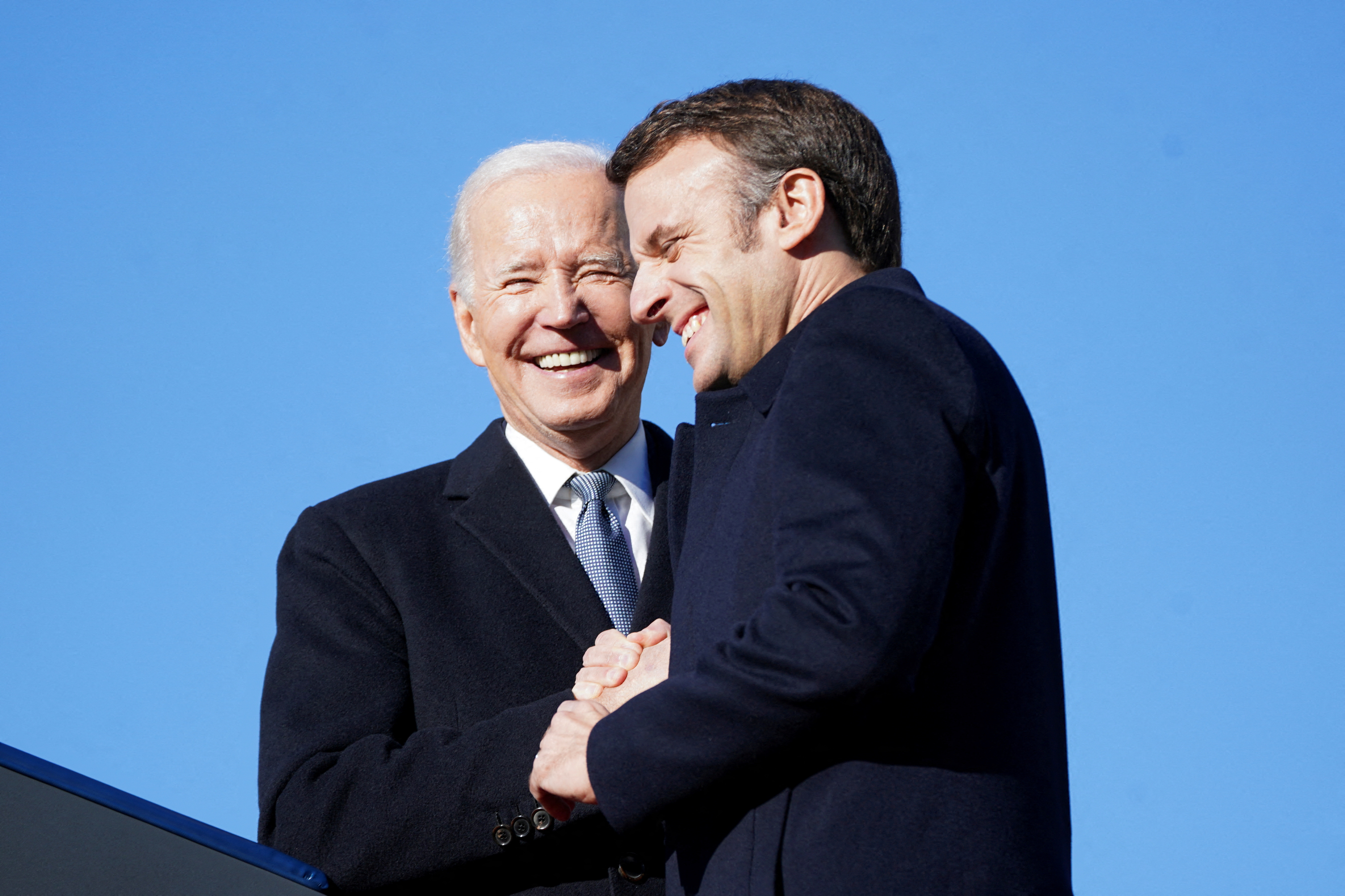
U.S. President Joe Biden and French President Emmanuel Macron presented a united front on Ukraine on Thursday at the White House, and Biden said he would talk to Russian President Vladimir Putin, if he was willing to end the invasion.

Biden has resisted talking to Putin since the Russian leader launched the invasion in February, while Macron has kept lines of communication with Putin open.

“I’m prepared, if he’s willing to talk, (to) find out what he’s willing to do.” Biden told a joint news conference with Macron.

But Biden said he would only do this in consultation with his NATO allies and would do nothing that would harm Ukrainian interests. “I’m not going to do it on my own,” he said.

Biden is playing host to Macron for the first state visit since the U.S. president took power in early 2021. Besides pledging support for Ukraine, the two leaders sought ways to ease some economic tensions in Oval Office tensions.

Biden pledged to Macron to make changes to U.S. legislation that passed the Congress this year that European nations fear will harm their economies. Bills aimed at boosting U.S. renewable energy and the semiconductor industry have “glitches” that can be addressed, Biden said.

“There are tweaks that we can make that can fundamentally make it easier for European countries to participate and or be on their own,” said Biden, who said he and Macron had a long discussion about the topic.

Macron said it was important for the United States and its European allies to “re-synchronize” their approaches.

“France did not come here to ask for some kind of exception for its economy. We came to share how the consequences of this regulation impact us,” he said.

In a joint statement issued after their Oval Office talks, the two leaders said they were committed to holding Russia to account “for widely documented atrocities and war crimes, committed both by its regular armed forces and by its proxies” in Ukraine.

They vowed to coordinate on their concerns regarding “China’s challenge to the rules-based international order, including respect for human rights and to work together with China on important global issues like climate change.”

Macron raised French and European concerns about subsidies in Biden’s Inflation Reduction Act (IRA), a $430 billion bill that offers massive subsidies for U.S.-made products and is aimed at addressing the climate crisis.

European leaders say the legislative package signed by Biden in August is unfair to non-American companies and would be a serious blow to their economies as Europe deals with the fallout from Russia’s February invasion of Ukraine.

Meanwhile Thursday, NATO ministers met in Bucharest and pledged more aid to Ukraine to help against Russia’s attacks on energy infrastructure as winter bites.

The alliance, of which the United States and France are founding members, was also discussing how to address challenges posed by China’s military buildup and its cooperation with Russia, U.S. Secretary of State Antony Blinken said. Macron has said in the past that China should not be a focus for NATO.

The Macrons arrived in Washington on Tuesday for his second state visit to the United States since the French leader took office in 2017.

Biden, 80, and Macron, 44, have had many meetings at international gatherings but this was the most amount of time they have spent together. A glittering state dinner was planned, with 200 Maine lobsters flown in for the occasion.

Biden and his wife Jill greeted Macron and his wife Brigitte with hugs, kisses and broad smiles as they celebrated more than 200 years of U.S.-French relations.

The two leaders and their wives, who dined together informally on Wednesday, took part in a South Lawn arrival ceremony that featured a military honor guard, a red-jacketed colonial band with the Fife and Drum Corps and national anthems.

Among the gifts Macron brought was a vinyl and CD version of the original soundtrack of Claude Lelouch’s 1966 film “Un Homme et une Femme,” the film the Bidens went to see on their first date, according to the Elysee Palace.

The Bidens presented Macron with a custom mirror made of fallen wood from the White House grounds and a custom vinyl record collection of great American musicians.

The formal dinner in a pavilion on the White House South Lawn will feature music from Jon Batiste, Chardonnay from the Napa Valley and cheeses from Oregon, California and Wisconsin.

Related Galleries:

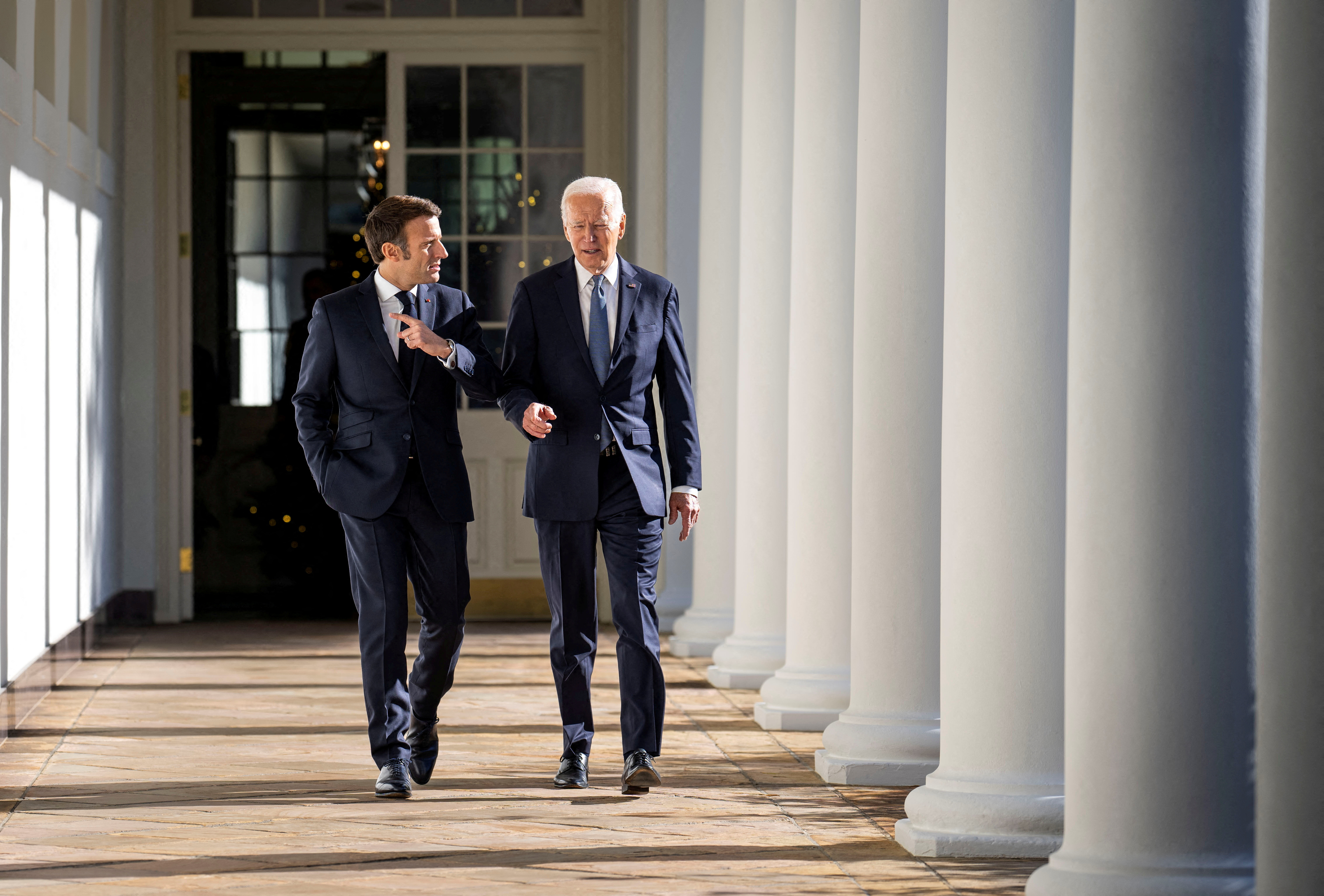
President Joe Biden and French President Emmanuel Macron walk down the Colonnade to the Oval Office at the White House, Thursday, Dec. 1, 2022. Doug Mills/Pool via REUTERS

French President Emmanuel Macron and U.S. President Joe Biden stand together during an official State Arrival Ceremony on the South Lawn at the White House in Washington, U.S., December 1, 2022. REUTERS/Jonathan Ernst

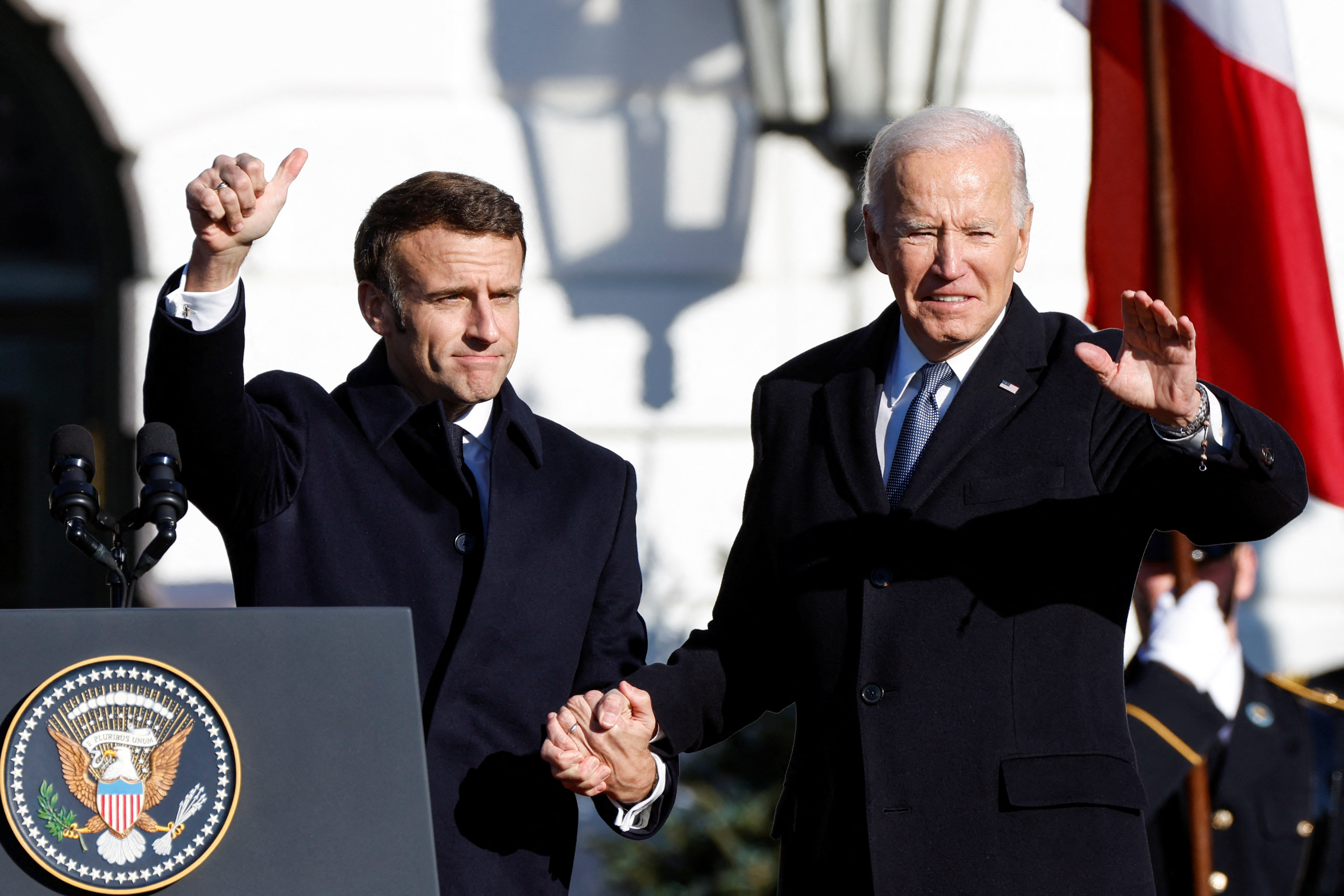
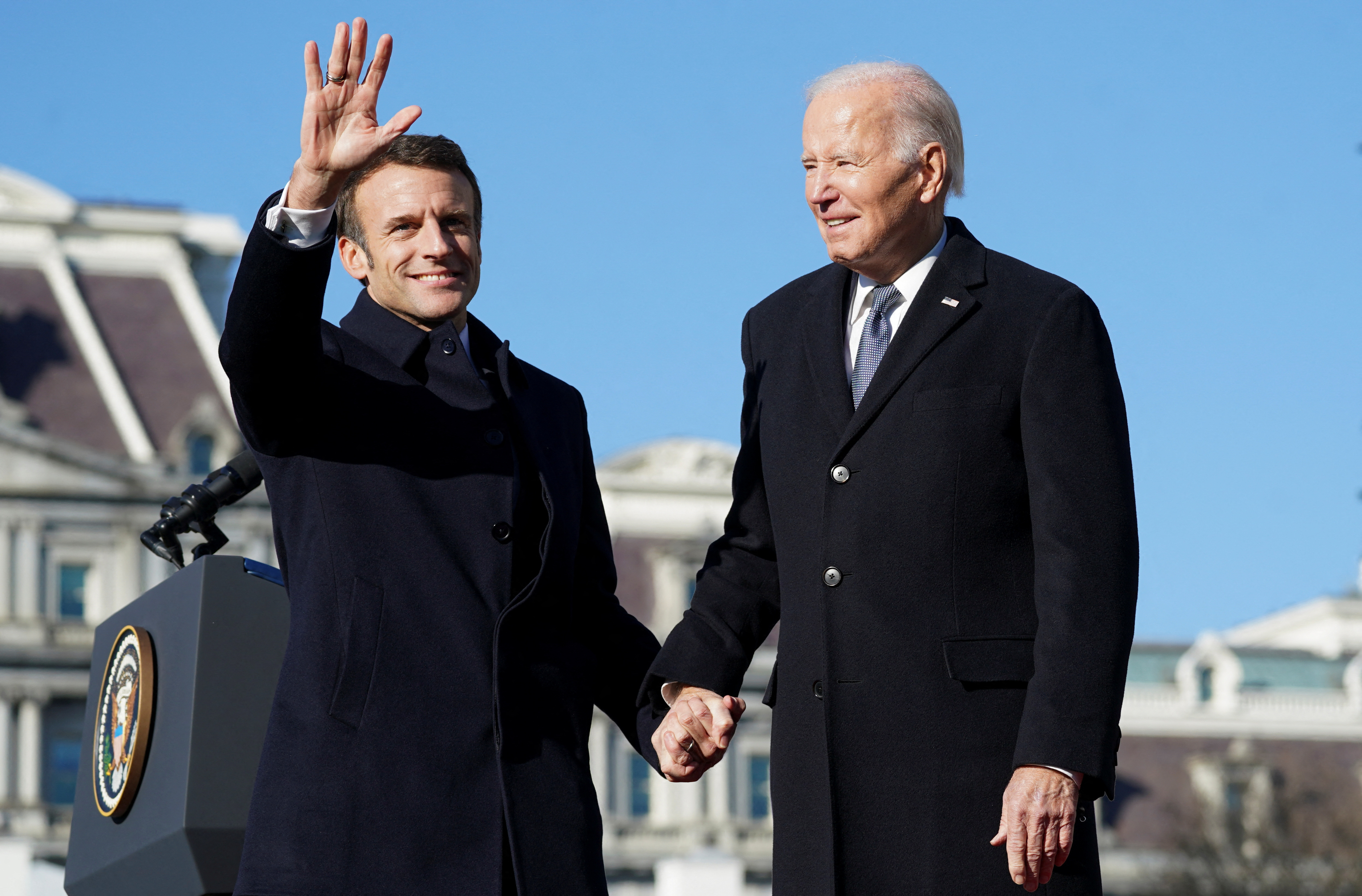
French President Emmanuel Macron waves as he holds U.S. President Joe Biden’s hand onstage during an official State Arrival Ceremony for Macron on the South Lawn of the White House in Washington, U.S., December 1, 2022. REUTERS/Kevin Lamarque

U.S. President Joe Biden greets French President Emmanuel Macron during an official State Arrival Ceremony for French President Emmanuel Macron and Brigitte Macron on the South Lawn at the White House in Washington, U.S., December 1, 2022. REUTERS/Kevin Lamarque

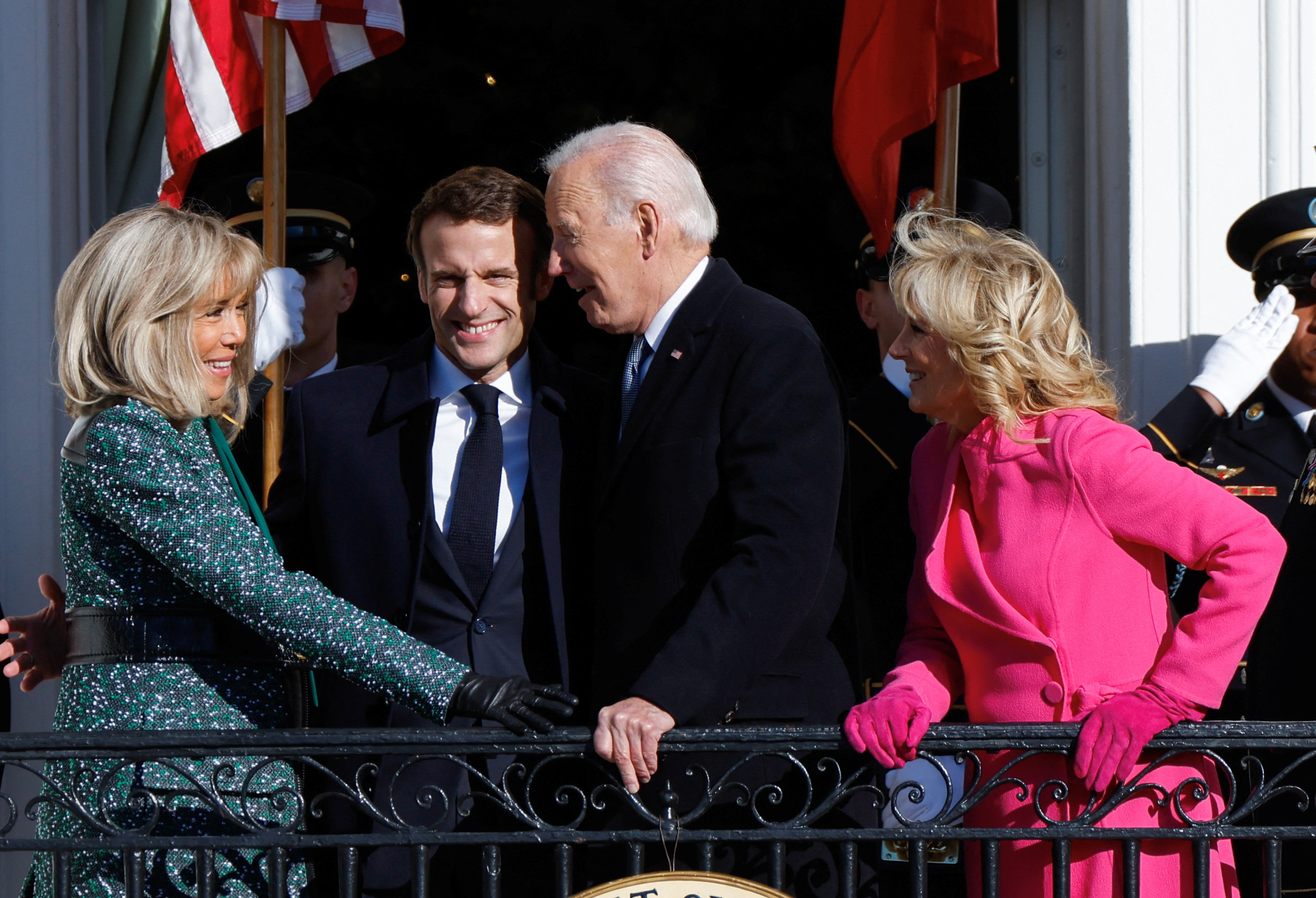
Brigitte Macron, wife of French President Emmanuel Macron, talks with U.S. President Joe Biden and first lady Jill Biden as they gather on the Truman Balcony after an official State Arrival Ceremony on the South Lawn at the White House in Washington, U.S., December 1, 2022. REUTERS/Jonathan Ernst

French President Emmanuel Macron speaks with U.S. President Joe Biden at his side during an official State Arrival Ceremony for Macron on the South Lawn at the White House in Washington, U.S., December 1, 2022. REUTERS/Jonathan Ernst

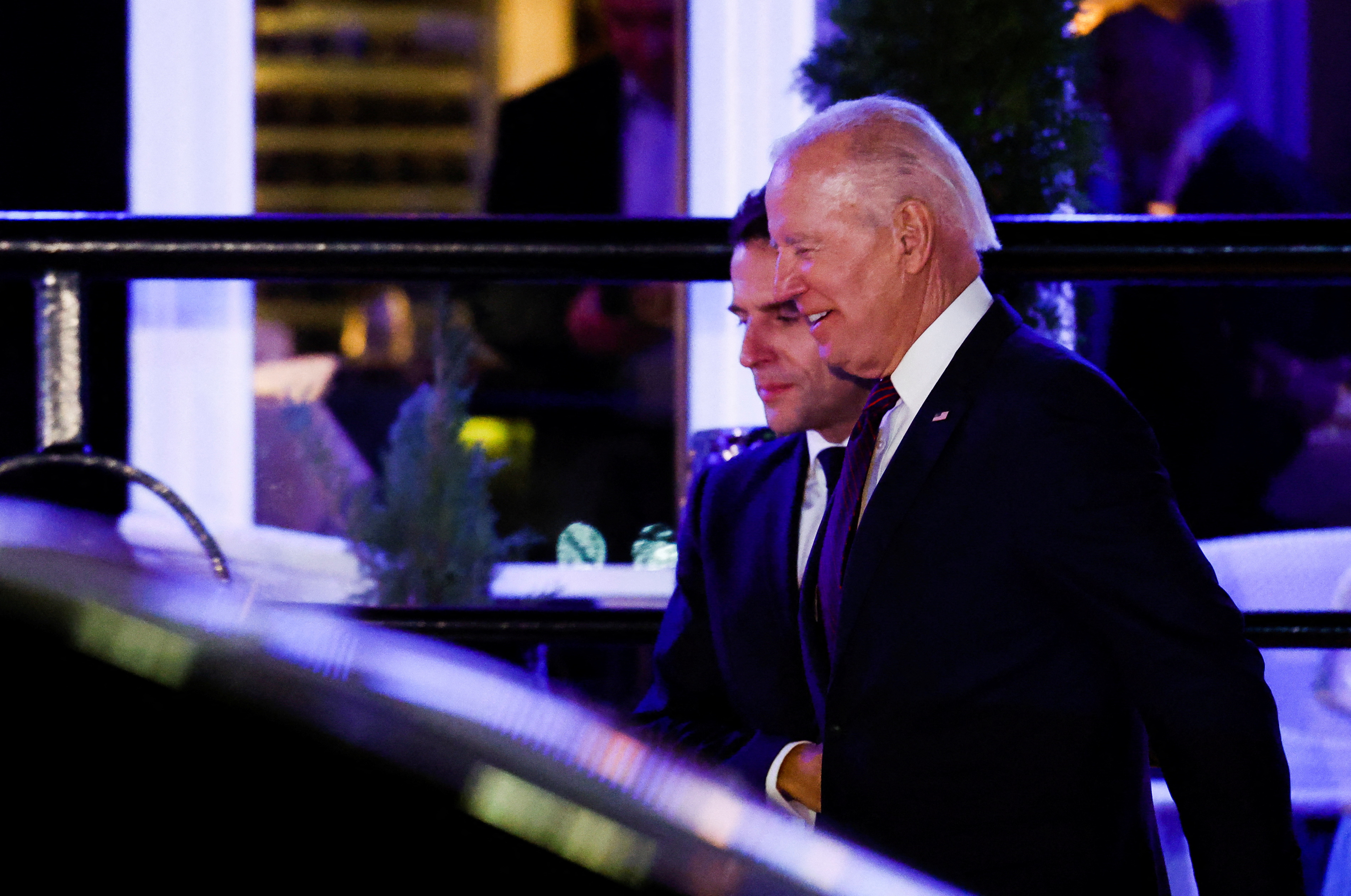
U.S. President Joe Biden and French President Emmanuel Macron walk next to a vehicle as they meet for dinner at Fiola Mare restaurant in the Georgetown neighborhood of Washington, U.S., November 30, 2022. REUTERS/Evelyn Hockstein

U.S. President Joe Biden and French President Emmanuel Macron walk outside Fiola Mare restaurant in the Georgetown neighborhood of Washington, U.S., November 30, 2022. REUTERS/Evelyn Hockstein

U.S. President Joe Biden and French President Emmanuel Macron walk next to vehicles as they meet for dinner at Fiola Mare restaurant in the Georgetown neighborhood of Washington, U.S., November 30, 2022. REUTERS/Evelyn Hockstein

U.S. President Joe Biden and French President Emmanuel Macron walk outside Fiola Mare restaurant in the Georgetown neighborhood of Washington, U.S., November 30, 2022. REUTERS/Evelyn Hockstein

Members of an honor guard carry U.S. and French flags prior to the start of an official State Arrival Ceremony for French President Emmanuel Macron and Brigitte Macron on the South Lawn at the White House in Washington, U.S., December 1, 2022. REUTERS/Jonathan Ernst
Categories
Audio Sources - Full Text Articles

Did the Talmud warn us about ‘Cocaine Bear?’

GettyImages-953616896-scaled.jpg

There’s a new movie coming out called Cocaine Bear about a bear who consumes cocaine and goes on a killing spree. The sages predicted this. Sort of.

In the Talmudic tractate Bava Kamma, 15b, which deals with liability and torts, the bear is named as one of the wild beasts that is “forewarned.” 

Essentially, this means, if you encounter a wild bear, you can expect some damage. 

In an email, Chaim Saiman, chair of Jewish law at Villanova University, said that, if someone owns the bear who does damage he “will face strict liability for doing so and does not get the usual warning shots before he is held liable.” 

Bava Kamma goes on to note that, “concerning acts of damage performed with the tooth, the animal is considered forewarned with regard to eating that which is fitting for it to eat.”

Is cocaine fitting for a bear to eat? I’d say no. But, as the actual story that inspired the film makes clear, bears will tear into pretty much anything if given the chance.

Saiman said the cocaine bear calls to mind a troubling anecdote in II Kings, where Elisha, mocked by children on his way to Bethel, curses the little boys who jeer at him. Two she-bears appear out of the woods and mangle 42 of the children. (Judging by the trailer of Cocaine Bear, it looks like at least one child will be imperiled.) 

The nature of the anecdote, and whether the bear or the forest they emerged from were miraculous or natural, is debated in Sotah 47a.

“Further, Mishna Sanhedrin 1.4 debates whether a bear (and other wild animals) who kill a person need to be put on trial before 23 judges, or whether they should just be killed on the spot,” Saiman wrote. 

In the actual 1985 event that inspired Cocaine Bear, the only real miracle was that about $20 million of cocaine fell from a plane in Blue Ridge, Georgia, allowing an unwitting black bear to sample several million dollars’ worth from a duffel bag. The bear was killed on the spot, but not for any rampage: He overdosed, the highest bear since those dancing ones on Grateful Dead shirts. 

Far from being infamous or fodder for Talmudic debate, this bear is such a legend they stuffed him and now keep him at a place called the Kentucky Fun Mall, where he is affectionately known as Pablo Eskobear.

When officials discovered the bear, there was “nothing left but bones and a big hide,” Gary Garner of the Georgia Bureau of Investigation told the Associated Press at the time.

The first people on the scene may have walked away with a riddle (also a film option) reminiscent of another big hairy fella, Samson.

In Judges, Samson challenges his wedding guests to puzzle out what he was possibly talking about when he said “Out of the eater came something to eat, and out of the strong came something sweet.”

He was referring to a lion he killed that, for some reason, had bees and honey in its carcass. It’s not quite the windfall that several million dollars’ worth of cocaine would be, but it was a good nosh for young Samson and his parents.

Will director Elizabeth Banks rehash Samson’s famous stumper? Will the late Ray Liotta, as a drug kingpin, fell the cocaine-crazed brute because he was forewarned? We’ll have to wait till February to find out.

The post Did the Talmud warn us about ‘Cocaine Bear?’ appeared first on The Forward.

Categories
Audio Sources - Full Text Articles

Kanye West: ‘I love Jewish people but I also love Nazis’

kanye-alex-jones-nick-fuentes.jpg

In the latest installment of Kanye West’s antisemitic, far-right diatribes, the rapper went on Alex Jones’s Infowars in a two-hour livestream on Thursday afternoon, along with noted white supremacist Nick Fuentes, whom West recently named as his adviser for a 2024 presidential campaign.

During the broadcast, West, who was wearing an opaque black mask over his entire face, went on numerous antisemitic diatribes echoing his recent statements, including blaming Jews and “Zionists” for “debanking” his accounts and financially attacking him.

But West also openly declared his support for Hitler and the Nazis. “I see good things about Hitler also,” West said at one point. “Every human being has something of value that they brought to the table, especially Hitler.”

“The Jewish media have made us feel like the Nazis and Hitler have nothing to offer the world,” West added.

West also repeatedly did an impression of incoming Israeli Prime Minister Benjamin Netanyahu by speaking in a mocking, high-pitched voice. (West simply called the politician “Netan,” explaining that he had only learned Netanyahu’s name two weeks prior and had decided to drop the “yahu.” Earlier in the broadcast, he acted out a bit about the name Netanyahu with a small net and a bottle of Yoo-hoo beverage.)

It’s this kind of thing. Here is Kanye talking to a prop “Bibi Netanyahu” he brought with him. Unbelievably, this is one of the more tame parts of the interview.pic.twitter.com/ldirzIwxOf

— Ben Collins (@oneunderscore__) December 1, 2022

During the segment, Fuentes also spoke about whether the Talmud allows for pedophilia, and said “Jews write in their Talmud that Christ is burning in hell.” Later, Jones asked Fuentes whether he was a white supremacist, and Fuentes denied it, saying simply, “No.”

West, Jones and Fuentes also discussed antisemitism, and affirmed that they believe that there are some “good Jews,” naming Laura Loomer as one of the few. Loomer then called in to speak on the second segment, where she said that as a Jew, she supports their free speech message.

Jones, who is known for spreading conspiracy theories on his show, such as the false idea that actors faked the Sandy Hook school shooting, attempted to push back against West’s antisemitism. “I’m not on the whole Jew thing,” Jones said.

The Infowars host compared the Italian mafia to the “Jewish mafia,” pointing out that he doesn’t condemn all Italians for the Italian mafia, and so perhaps they should not blame all Jews for the Jewish mafia. West, Fuentes and Loomer ignored the statement.

Once or twice, Jones attempted to redirect West, and encourage him to talk about Trump, Russia or the pandemic. But the rapper insistently returned to his belief that Jews control of the media, and his support for Hitler.

“I don’t like the word evil next to Nazis,” West said. “I love Jewish people but I also love Nazis.”

Jones laughed. “Oh man,” Jones said. “Well, I have to disagree with that.”

The post Kanye West: ‘I love Jewish people but I also love Nazis’ appeared first on The Forward.

Categories
Audio Sources - Full Text Articles

India’s Richest Man Is Buying a Major TV Channel. It’s a Blow to Independent Media in the Country

New Delhi Television, or NDTV, began as a weekly bulletin in 1989, bringing news from around the world to Doordarshan, the Indian public broadcaster that aired on the television inside every household. Soon, it grew into India’s first and largest private network, producing news, current affairs, and entertainment for a largely English-speaking Indian audience.

Since it was first founded by husband and wife Prannoy and Radhika Roy, NDTV has changed ownership many times—including this week, when a hostile takeover bid launched by Gautam Adani, Asia’s richest man who is worth $130 billion, gained more ground. In August, Adani’s new media venture AMG Media Networks announced that it had indirectly acquired a 29% stake in the company and would make an open offer for another 26%. The Roys, who had long resisted the billionaire’s control, accused him of taking over without consent or consultation and resigned from the board on Tuesday.

[time-brightcove not-tgx=”true”]

Experts say this move marks the endgame for independent media in India, leaving the country’s biggest television news channels in the hands of billionaires who have strong ties to the Indian government led by Prime Minister Narendra Modi’s Bharatiya Janata Party. In 2014, Mukesh Ambani, another Modi-friendly billionaire, pulled a similar move and acquired Network18, one of India’s largest media companies.

“NDTV stood out as the last channel that was trying to be independent, as far as this government is concerned,” says Suhas Chakma, the Director of the Rights and Risks Analysis Group in New Delhi.

Read More: ‘They Can Target Anybody’: India’s War on Free Press Is in High Gear

NDTV became known for its trailblazing news talk shows that established election vote analysis on Indian television. In the 1990s, it struck a deal with Rupert Murdoch’s Star Network and ventured into entertainment and lifestyle. Sanjay Pinto, one of the network’s earliest journalists, described it as having a “distinct, ‘first-come’ advantage.”

“Being the first, private national English broadcaster made many of us household names and recognizable faces across the country,” Pinto wrote in his book, My NDTV Days. “There was no shouting or screaming on Prime Time. In those half-hour bulletins, pan-India stories from across India were aired.”

Today, the network claims to have some 35 million followers across its television and online platforms. According to a study conducted by the Reuters Institute for the Study of Journalism, 75% of Bharatiya Janata Party supporters and 81% of all other political supporters trust NDTV as a source of news and information. This year, the channel also declared its most-profitable result in over a decade.

But the revenues barely make a dent in Adani’s sprawling conglomerate of businesses, which are worth $260 billion and make him the world’s third-richest man, right behind Elon Musk and Jeff Bezos. Instead, the billionaire is harboring other ambitions for NDTV: “Why can’t you support one media house to become independent and have a global footprint?” he told the Financial Times.

Many question what Adani’s vision for media independence might look like, considering his vocal support for Modi. In the past, this relationship has seen his business not only align with the Hindu nationalist government’s vision for India but also grow overnight as the country’s biggest private operator of ports, airports, and coal mines.

Read More: India’s New Internet Rules Are a Step Toward ‘Digital Authoritarianism,’ Activists Say. Here’s What They Will Mean

It also clashes with what NDTV is best known for: being a vocal critic of the government. In recent years, the broadcaster, along with other critical independent outlets and journalists, has faced a slew of tax raids, lawsuits, social media trolls, and arrests. In 2020, Amnesty International was forced to shut down operations in India after the Indian government froze its bank accounts. India—often called the world’s largest democracy—now ranks 150 out of 180 countries in the World Press Freedom Index by Reporters Without Borders, having dropped by another ten places in the last year.

“If you look at all the other Indian media houses, they now tend to cozy up to the government and be spokespersons for the party,” says Chakma from the Rights and Risks Analysis Group.

Indian television news channels are particularly notorious for their panel discussions, with experts who toe the government line and praise Modi’s initiatives often descending into shouting matches. It’s particularly worrying for media analysts like Chakma, given the reach of television news and the power it still yields over the national debate in India. “With this takeover, there’s no other platform left for independent journalism except for the internet, but large swaths of the country still watch television news,” he says.

During the general election in 2014, NDTV’s website received 16.5 billion hits in a single day, leading the Modi administration to look for ways to decrease the channel’s influence. According to some reports, it pulled nearly all government advertising from the network—what most Indian TV networks primarily rely on for their revenue as the government is still the country’s biggest advertiser.

Read More: They Shared a Video of a Muslim Man Being Attacked in India. Now They’re Being Investigated by Police

Along with the acquisition of NDTV, Adani’s AMG Media Network has a stake in the business news publication BQ Prime, formerly known as Bloomberg Quint. Adani has said his push into media is a “responsibility” rather than a business opportunity.

“Independence means if the government has done something wrong, you say it’s wrong,” he told the Financial Times. “But at the same time, you should have courage when the government is doing the right thing every day. You have to also say that.”

It’s a sign that the government has been successful in creating a “nationalism narrative,” says Chakma. “Earlier, we used to talk about the public interest, but now we talk about the majority interest,” he says. “And the majority interest is that you can’t criticize the government, irrespective of what it does.”

Still, he contended that there was a huge public appreciation for outlets like NDTV; otherwise, the network wouldn’t have survived. With the next general election coming up in 2024, the latest acquisition brings into question whether the space for critical coverage—as well as air time given to opposition parties—will also shrink.

Categories
Audio Sources - Full Text Articles

Why Prince William and Kate Were Booed on Their U.S. Tour

Prince William and Kate Middleton arrived in the U.S. for the first time in eight years Wednesday. But their trip has already been overshadowed by fresh accusations of racist conduct by the royal institution and scenes of NBA fans booing the couple and chanting “USA, USA” as they sat court-side at a Celtics vs Miami Heat game in Boston.

William and Kate arrived in the city for a three-day visit ahead of the Earthshot Prize, the prince’s environmental awards ceremony taking place Friday. It is also their first overseas trip since Queen Elizabeth II’s death in September, which granted them their new titles as Prince and Princess of Wales, after King Charles III assumed the throne.

[time-brightcove not-tgx=”true”]

It’s not the first royal trip that has garnered controversy for Prince William and Kate. In March, they made headlines when their tour of former British colonies in the Caribbean sparked republican demonstrations. The couple was forced to cancel the first stop in Belize due to protests, and were met by demonstrations in Jamaica and the Bahamas—with many demanding reparations and apologies from the crown. All three nations have since announced plans to re-evaluate their place in the Commonwealth.

Below, what to know about William and Kate’s royal trip to Boston, and why racism allegations back home may cast a shadow over the success of their trip.

Why were Americans booing Prince William and Kate?

The basketball snub occurred just hours after the royal family’s latest controversy unfolded on home soil; Lady Susan Hussey, William’s 83-year-old godmother and a long-standing lady of the household, resigned from her royal duties amid allegations of racist conduct that saw her repeatedly ask Ngozi Fulani, a Black British charity worker, “where she really came from” during an event on Tuesday.

The event led by Camilla, the Queen Consort, saw around 300 guests invited to Buckingham Palace to support her campaign against domestic violence. Fulani, an attendee, heads up Sistah Space, the U.K.’s only domestic abuse charity specifically for women and girls of African and Caribbean heritage.

According to the BBC, Fulani recounted the full conversation she had with Hussey, including repeated attempts to know where she was “really” from despite the charity worker reminding her that she is British. In a subsequent interview with BBC Radio 4’s Today program, Fulani described the exchange as a “violation” and an “interrogation.”

“I have to really question how this can happen in a space that’s supposed to protect women against all kinds of violence,” Fulani told the radio hosts.

In a statement forwarded to TIME, a Kensington Palace spokesperson yesterday said they are “really disappointed” to hear about Fulani’s experience. They added that “racism has no place in our society” and that it was right for Hussey to resign over her “unacceptable” comments.

Read More: Longtime Royal Aide Resigns After Making Racist Remarks at Buckingham Palace Event

Why are the Prince and Princess of Wales in the U.S.?

Amid the controversy, William remained focused on the Earthshot Prize—his primary reason for being in the U.S. He and Kate joined the mayor of Boston, Michelle Wu, and U.S. ambassador to Australia, Caroline Kennedy, at an event ahead of the awards. William told attendees, “We are both looking forward to spending the next few days learning about the innovative ways the people of Massachusetts are tackling climate change.”

Since its inception in October 2022, Earthshot has offered £1 million ($1.2 million) in prize money across five environmental categories: nature protection, clean air, ocean revival, waste elimination, and climate change. Winners—who will be announced at Boston’s MGM Music Hall on Friday—and all 15 finalists will also receive help to expand their green projects.

In a briefing on Wednesday, White House Press Secretary Karine Jean-Pierre also confirmed that William and Kate will meet with President Joe Biden during their trip but added that they are still “finalizing and working through the details.”

The trip marks a return to the U.S. for William and Kate, who last visited the country during a three-day trip to New York City in 2014. Prior to this, they made their American debut as a married couple during a 2011 trip to California.

Read More: Prince William and Kate’s Tour Was Meant to Secure the Monarchy in the Caribbean. Instead, It’s Raising New Questions About Its Future

What does the race controversy mean for Britain’s royal family?

The royal family have been embroiled in a number of recent racism scandals, including a 2021 exposé that showed the Queen’s courtiers banned “coloured immigrants or foreigners” from serving in clerical roles in the royal household until at least the late 1960s.

The royal family is also still recovering from the reputational fallout of Harry and Meghan’s resignation as working royals in March 2020, followed by a two-hour interview with Oprah Winfrey in March 2021. The couple notably told Winfrey the royal family had “concerns and conversations” over the skin color of their son Archie before he was born in 2019. This prompted comments from Prince William to Sky News that they are “very much not a racist family.”

On Tuesday, Prince Harry and Meghan Markle are also due to attend the Robert F Kennedy Ripple of Hope awards, where they will be honored for their work on social change.

Categories
Audio Sources - Full Text Articles

Rethinking the constraints to localization of foreign aid

By Patrick Fine

It is not local organizations that lack the capacity to work with USAID. Instead, it is USAID that lacks the capacity in its operating systems and organizational culture to work with local organizations.

The Biden administration has made localization—generally defined as shifting contracts and grants from U.S. organizations to local non-governmental organizations (LNGOs)—a centerpiece of its foreign assistance policy. Just months into her role as USAID administrator, Samantha Power set up a working group to operationalize localization policy and announced targets to increase funding to LNGOs to at least twenty-five percent of USAID awards by the end of 2024. Following up on this commitment, in October 2022 USAID launched a new localization policy titled, “Strengthening Local Capacity In USAID Programming And Partnerships” to “guide USAID decisions about why and how to invest in the capacity of local partners to better achieve inclusive and locally-led development.”

As indicated by its title, the new policy rests upon an old trope that the major constraint for working with local organizations is their lack of capacity to effectively and accountably implement aid programs. Before local organizations can be full partners, the argument goes, it is first necessary to strengthen their organizational capacity (and who better to do this than USAID’s traditional international partners?). In fairness, in the immediate post-colonial period, many countries had fledgling public institutions. Civil society and the private sector were still nascent and, in some cases, suppressed. There were few post-secondary education institutions, and the pool of experienced professionals was small.  But those days are long gone.

As conditions in lower-income countries have changed, so have the arguments about local capacity constraints. After generations of investment in education, technical training, and social infrastructure, no one now argues that developing countries lack talented people. Indeed, the ranks of development organizations are filled with highly qualified, deeply experienced local professionals who have grown up working in international development. In countries where the development industry has for decades provided a disproportionate share of professional opportunities, it is not surprising that it has attracted the best and brightest. The head of the U.S. President’s Emergency Plan for AIDS Relief (PEPFAR), the U.S. government’s largest foreign assistance program, who is originally from Cameroon, is but one prominent example.

No longer able to point to a lack of qualified people, excuses for not working with local organizations focused on administrative and financial accountability shortcomings. Local organizations might have technical expertise, but they lack the management and financial controls to account for funds and report on results. The history of foreign assistance is replete with examples of funds being misused, poorly accounted for, and outright stolen. However, it is disingenuous to ascribe the risks associated with financial management, controlling corruption, and accounting for results as unique to local organizations. One only has to look at the latest report from USAID’s inspector general for a “Who’s Who” of respected international organizations whose programs failed to meet their objectives and had millions of dollars of questioned and disallowed costs due to management mistakes, poor accounting, corruption, and theft. This is not because those organizations lack capacity, rather it is because development work is a high-risk endeavor. Believing the risks are inherently greater with local partners is a prejudice that needs to be discarded.

The most recent iteration of the capacity argument is that local organizations may be good at what they do, but they lack the sophisticated management systems to comply with the U.S. government’s voluminous requirements. USAID’s traditional partners have spent years—in many cases decades—and millions of dollars (reimbursed by their U.S. government awards) building the systems to comply with the “Code of Federal Regulations,” the “Federal Acquisition Regulations,” the “Office of Management and Budget’s Uniform Guidance,” and USAID’s own “Automated Directives System” that stipulate over 70 small-print pages of standard provisions, rules, and regulations.

It is this last argument that points to the real lack of capacity. If the U.S. government were truly determined to localize its programs it would create the administrative and management systems necessary to do so. Yet, this has not happened. In fact, looking at USAID’s funding obligations over the last two years two things stand out: First, funding to public international organizations such as U.N. agencies including UNICEF and the World Food Program—has increased nearly four-fold. This is understandable given the proliferation of humanitarian crises in recent years and the fact that PIO grants can be done quickly on a sole source basis. Second, most of USAID’s large U.S. partners saw stable or increased funding over the period 2018 to 2022. This is not what you would expect to see if localization was taking hold.

None of this should be interpreted as a lack of sincerity on USAID’s part. There is no doubt that Administrator Power wants to see more local solutions; it is just not something USAID has the capacity to do given its political, legal, and institutional constraints.

So, what can be done?

Achieving a more ambitious localization vision will remain out of reach until USAID builds the organizational capacity to work with local organizations. Three concrete actions that would accelerate the transition to local organizations and contribute to more equitable development are:

  • Upgrade USAID’s Local Works into a full-fledged LNGO financing facility. This would have more in common with philanthropy than traditional bilateral programs, drawing on the methods and tools of charitable foundations and making greater use of operating support grants. A critical first step would be negotiating with partner governments the portion of USAID funds allocated for LNGO programs. While amounts would vary by country, this would create the structure and incentives to quickly reach the 25 percent target. (Remarkably, the localization discussion has barely acknowledged the equities of national governments. Not all partner governments will be enthusiastic about dividing the aid pie with LNGOs). To be viable at scale, a localization financing facility must have its own administrative practices and tools, much like the Office for Disaster Assistance has its own operating systems. USAID would need the United States Office of Management and Budget to issue new LNGO-specific grant award and management guidance.
  • Pay local organizations more than the de minimus overhead rate. Most local organizations are limited to a 10 percent overhead rate while international partners earn 20 to 40 percent (in some cases more) through their negotiated indirect cost agreements. These rates and previous studies make clear that the costs of implementing U.S. government programs far exceed 10 percent. This reform would enable local organizations to hire the personnel and build management systems to comply with international standards and help level the playing field with international organizations. As a bureaucratic innovator, USAID should be able to devise an equitable way for local organizations to recover the full cost of doing business with the U.S. government.
  • Build a risk management function in USAID missions. For decades USAID has outsourced most risk management to its international partners. Those IPs have built sophisticated compliance departments that use state-of-the-art techniques to manage program and financial risks. In contrast, few USAID staff know what a comprehensive Portfolio Risk Management function looks like. To truly localize its programs, USAID must build an in-house risk management function. This will require establishing independent compliance offices (just as INGOs have done) with staffing and a budget for robust monitoring and auditing. PEPFAR provides some examples of this type of work and the level of resources required.

To realize its localization policy USAID must build its own capacity to support locally-led development. Adopting the measures proposed here would change the power dynamics between USAID and local actors, opening new opportunities for LNGOs to be more resilient and look beyond USAID financing to more sustainable operating models. Only by adopting structural changes can USAID entrench the culture and practices needed to drive institutional change within a large government bureaucracy.

2006-08-31T120000Z_1791245304_GM1DTJYEPI
fblike20.png pinterest20.png twitter20.png email20.png rss20.png  
Categories
Audio Sources - Full Text Articles

Synagogues are joining the ‘effective altruism’ movement. Will the Sam Bankman-Fried scandal stop them?

11-30-2022-Sam-Bankman-Fried.jpg

(JTA) — A few years ago, Adam Azari was frustrated over how little could do to alleviate suffering in the world with his modest income as a writer and caretaker for people with disabilities.

He kept thinking about a set of statistics and ideas he had encountered during his graduate studies in philosophy. For example, he remembered reading that for the price of training a guide dog for the blind in the United States, one could prevent hundreds of cases of blindness in the developing world.

This hyper-rational way of thinking about doing good was called effective altruism, and it was growing into a movement, known as E.A for short. Some proponents were even opting to pursue lucrative careers in finance and tech that they otherwise might not have chosen so they would have more money to give away.

Azari, meanwhile, had become a believer who was stuck on the sidelines. Then, one day, he had what he calls a “personal eureka moment.” Azari would return to his roots as the son of a Reform rabbi in Tel Aviv and spread the word of E.A. across the Jewish denomination and among its millions of followers.

“It suddenly hit me that the Reform movement has this crazy untapped potential to save thousands and thousands of lives by simply informing Jews about effective giving,” he recalled.

He badgered his father, Rabbi Meir Azari, and, for a moment, thought of becoming a rabbi himself. But he abandoned the idea and focused on pitching E.A. to the Reform movement’s international arm, the World Union for Progressive Judaism. Azari found an ally in WUPJ’s president, Rabbi Sergio Bergman, and the organization soon decided to sponsor his efforts, paying him a salary for his work.

Over the past year, Azari’s Jewish Effective Giving Initiative has presented to about 100 rabbis and secured pledges from 37 Reform congregations to donate at least $3,000 to charities rated as the most impactful by E.A. advocates and which aid poor people in the developing world. Per E.A. calculations, it costs $3,000 to $5,000 to save a single life.

“Progressive Judaism inspires us to carry out tikkun olam, our concrete action to make the world better and repair its injustices,” Bergman said. “With this call we not only do what the heart dictates in values, ​​but also do it effectively to be efficient and responsible for saving a life.”

This charitable philosophy appears to be gaining traction in the Jewish world just as one of the figures most associated with it, who happens to be Jewish, has become engulfed in scandal.

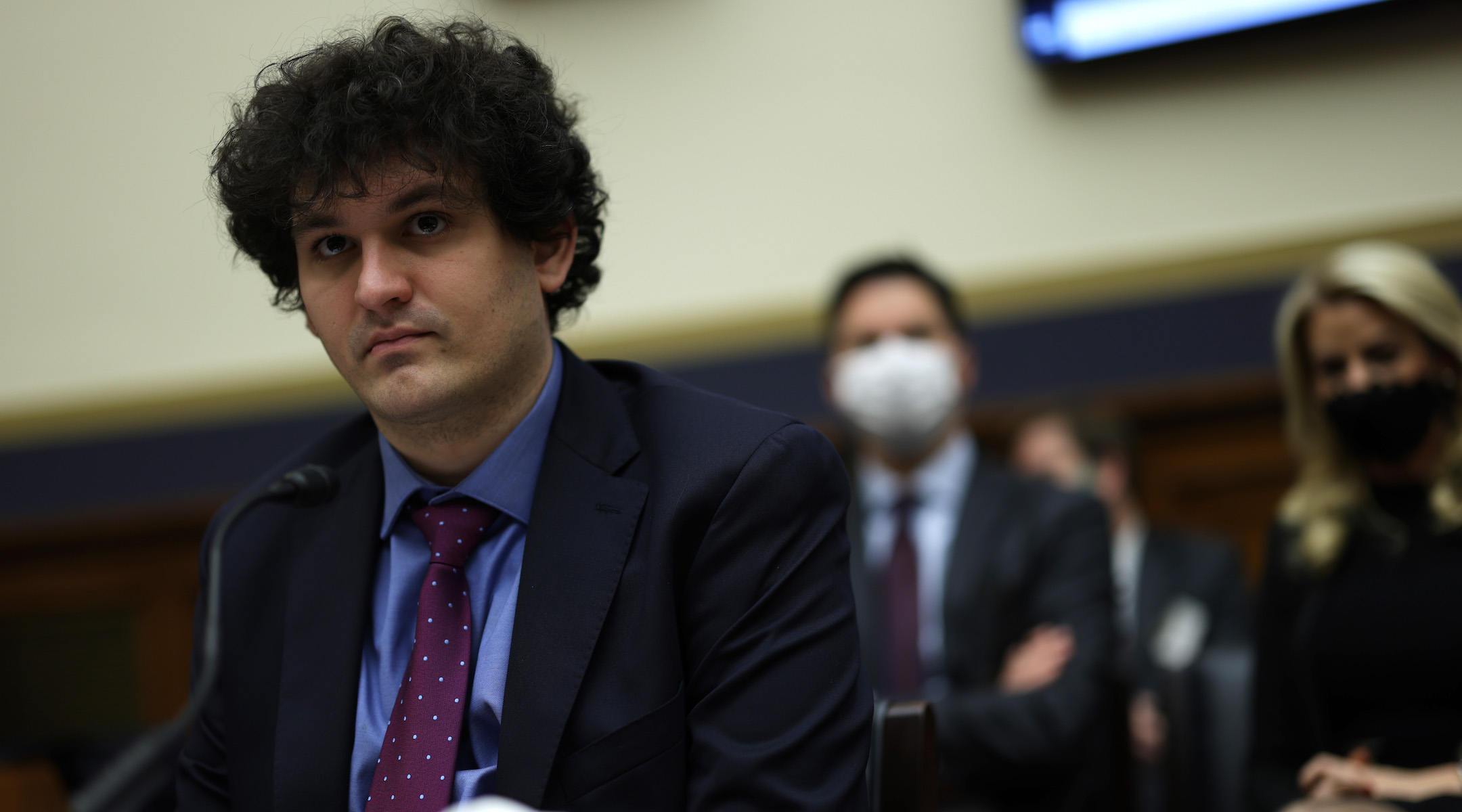
Sam Bankman-Fried built a cryptocurrency empire worth billions, amassing a fortune he pledged to give away to causes such as artificial intelligence, combatting biohazards and climate change, all selected on criteria developed by the proponents of effective altruism.

A few weeks ago, Bankman-Fried’s fortune evaporated amid suspicions of financial misconduct and revelations of improper oversight at his company, FTX, a cryptocurrency exchange that was worth as much as $32 billion before a run of withdrawals ultimately left it illiquid. The situation has drawn comparisons to the implosion of Bernie Madoff’s Ponzi scheme, and authorities investigating the situation have said Bankman-Fried could face criminal penalties over his role.

In the wake of FTX’s collapse, Bankman-Fried has suggested that his embrace of E.A. was insincere, a tactic to bolster his reputation.

But Azari and the organizer of another initiative, a growing reading and discussion group called Effective Altruism for Jews, are undaunted and don’t believe the scandal should taint the underlying principles of the movement.

“Whether you call it E.A. or just directly donating to global health and development, it doesn’t matter,” Azari said. “The basic idea is to support these wonderful charities, and I don’t think the FTX scandal changes any of that. Malaria nets, vitamin A supplements and vaccine distribution are still super cost-effective, evidence-based ways of helping others.”

Azari added that he has had several meetings with rabbis since the news about Bankman-Fried broke and that no one has asked him about it.

“I don’t think people are making the connection,” he said. “And to me, there is no connection between us and FTX.”

When talking to rabbis about why E.A. would make a good fit with their congregation’s charitable mission, Azari cites the Jewish value of tikkun olam, a mandate to “repair the world” often used to implore people to care for others. He explains that donating to charities with a proven track record is a concrete way to fulfill a Jewish responsibility.

That kind of thinking proved attractive to Steven Pinker, the prominent Harvard psychologist, who has endorsed Azari’s initiative. In a recorded discussion with Azari and others last year, Pinker recalled his Reform upbringing, which included Hebrew school, summer camp and synagogue services.

“The thing I remember most is how much of my so-called religious education was like a university course in moral philosophy,” Pinker said. “We chewed over moral dilemmas.”

As an adult, Pinker returned to Jewish teachings on charity and, in particular, those of the medieval philosopher Maimonides, examining these ideas through the lens of E.A. He began to wonder about the implications of Maimonides’ focus on evaluating charity based on the motives of the donor. That focus, he concluded, doesn’t always lead to the best outcomes for the beneficiary.

“What ultimately ought to count in tzedakah, in charity, is, are you making people better off?” he said.

Also on the panel with Azari and Pinker was the man credited with authoring the foundational texts upon which E.A. is built. Peter Singer, who is also Jewish and whose grandfather died in the Holocaust, teaches bioethics at Princeton. Starting in the 1970s, Singer wrote a series of books in which he argues for a utilitarian approach to ethics, namely, that we should forgo luxuries and spend our money to save lives. The extremes to which he has taken his thinking include suggesting that parents of newborn babies with severe disabilities be permitted to kill them.

From Bankman-Fried to Singer, the list of Jews who have either promoted E.A. or lead its institutions is long. With their estimated fortune of $11.3 billion, Facebook co-founder Dustin Moskovitz and his wife Cari Tuna have eclipsed Bankman-Fried as the wealthiest Jews in the field. There’s also popular philosopher Sam Harris and New York Times columnist Ezra Klein, who have each dedicated episodes of their podcast to the topic.

The website LessWrong, which defines itself as “a community blog devoted to refining the art of rationality,” is seen as an important early influence; it was founded by Eliezer Yudkowsky, an artificial intelligence researcher who grew up in a Modern Orthodox household but does not identify religiously as a Jew anymore. Two other Jews, Holden Karnofsky and Elie Hassenfeld, left the hedge fund world to establish GiveWell, a group whose research is considered the premier authority on which charities are deserving of E.A. donations.

The prevalence of Jews in the movement caught the attention of E.A. enthusiast Ben Schifman, an environmental lawyer for the federal government in Washington, D.C. About two years ago, Schifman proposed creating a group for like-minded individuals in hope of helping grow the movement. In an online post, he laid out the history of Jewish involvement and wrote a brief introduction to the topic of Judaism and charity.

Today, Schifmam runs a group called Effective Altruism for Jews, whose main program is an eight-week fellowship involving a reading and discussion group with designated facilitators. Schifman said about 70 people spread across 10 cohorts are currently participating. There’s also a Shabbat dinner program to bring people together for informal meetings with funding available for hosts.

Participants discuss how ideas that are popular in E.A. might relate to Jewish traditions and concepts, and also brainstorm ways to popularize the movement in the wider Jewish community, according to Schifman.

“There’s a lot of low-hanging fruit with regards to the Jewish community and sharing some of the ideas of Effective Altruism, like through giving circles at synagogues or, during the holidays, offering charities that are effective,” Schifman said in an interview that took place before the Bankman-Fried scandal broke.

Asked to discuss the mood in the community following the collapse of Bankman-Fried’s company and an affiliated charity, FTX Future Fund, Schifman provided a brief statement expressing continued confidence in his project.

He said, “While we’re shocked by the news and our hearts go out to all those affected, as an organization EA for Jews isn’t funded by FTX Future Fund or otherwise connected to FTX. We don’t expect our work will be impacted.”

Even if Schifman and Azari are right that their movement is robust enough to withstand the downfall of a leading evangelist, a debate remains about what impact E.A. can or should have on philanthropy itself.

Andres Spokoiny, president and CEO of the Jewish Funders Network, wrote about the question with skepticism in an article published more than two years ago. He argued against “uncritically importing the values and assumptions” of effective altruists, whose emphasis on the “cold light of reason” struck him as detached from human nature.

In a recent interview, Spokoiny echoed similar concerns, noting that applying pure rationality to all charitable giving would mean the end of cherished programs such as PJ Library, which supplies children’s books for free to Jewish families, that may not directly save lives but do contribute to a community’s culture and sense of identity.

He also worries that too strong a focus on evidence of impact would steer money away from new ideas.

“Risky, creative ideas don’t tend to emerge from rational needs assessments,” he said. “It requires a transformative vision that goes beyond that.”

But Spokoiny also sounded more open to E.A. and said that as long as it does not try to replace traditional modes of philanthropy, it could be a useful tool of analysis for donors.

“If donors want to apply some of E.A. principles to their work, I’d say that is a good idea,” he said. “I am still waiting to see if this will be a fad or buzzword or something that will be incorporated into the practice of philanthropy.”

This article originally appeared on JTA.org.

The post Synagogues are joining the ‘effective altruism’ movement. Will the Sam Bankman-Fried scandal stop them? appeared first on The Forward.


Categories
Audio Sources - Full Text Articles

Spain pledges 350M euros to save Doñana wetlands

BARCELONA, Spain (AP) — Spain’s government pledged to invest 350 million euros ($368 million) in the country’s Doñana wetlands, a UNESCO world heritage site that ecologists say is dying due to the misuse of water and climate change.

Spanish Prime Minister Pedro Sánchez announced the pledge Thursday during a visit to the Doñana National Park in southern Spain.

A European Union court ruled last year that Spanish authorities had failed in their duty to protect the wetlands, and the government faces a hefty fine unless takes actions to preserve the ecosystem.

Sitting on an estuary where the Guadalquivir River meets the Atlantic Ocean, the wetlands cover 74,000 hectares (182,000 acres). They are a wintering site for a half-million waterfowl and a stopover spot for millions of other birds that migrate from Africa to northern Europe.

But the national park’s lagoons and marshes have dried up under a prolonged drought and decades of agriculture and a nearby beach town draining the aquifer underlying the area. The area surrounding the park is plagued by hundreds of unauthorized wells that illegally pump out water to feed crops, mostly red berries that are exported across Europe.

The Spanish government said the 350 million euros would go toward recovering “this emblematic space and reverting the situation of environmental degradation.”

Measures to save the park will include “the reduction of extractions from underground water sources and the recovery of surface water,” the government said in a statement.

The World Wildlife Fund applauded the action by central authorities but demanded that regional authorities do more to control the illegal extraction of water.

“We consider this a great step,” the conservation organization said. “(But) we believe that the priority is to close down all the farms using illegal irrigation in the area around Doñana.”

___

Follow all AP stories on climate change at https://apnews.com/hub/climate-and-environment

Categories
Audio Sources - Full Text Articles

Tough Oregon gun law faces legal challenge, could be delayed

PORTLAND, Ore. (AP) — Midterm voters in Oregon narrowly passed one of the toughest gun control laws in the nation, buoying the hopes of gun control supporters, but the new permit-to-purchase mandate and ban on high-capacity magazines now faces a lawsuit that could put it on ice just days before it’s set to take effect.

A federal judge in Portland will hear oral arguments Friday on whether Measure 114, which is scheduled to go into law Dec. 8, violates Americans’ constitutionally protected right to bear arms. Depending on the outcome, the groundbreaking law could be delayed for months or longer as it works its way through the courts, legal experts said.

The Oregon ballot measure is part of a national trend of gun policy being decided by voters because “significant reform is stalled and that has put all the battles over gun control and gun safety at the state level,” said Adam Winkler, a constitutional law professor and expert in gun policy at the University of California, Los Angeles School of Law.

“Ballot measures are one way for people to seize the reins of policy-making. People can act for themselves to change the law and on an issue like gun safety there is a really growing and active gun safety movement in America,” he said. “That’s not something we probably would have said 20 years ago.”

Measure 114, which passed by a slim majority in November, was born out of concern about the 2018 mass shooting in Parkland, Florida and gained public momentum last spring following massacres at a grocery store in Buffalo, N.Y. and at an elementary school in Uvalde, Texas, said Mark Knutson, chairman of the interfaith Lift Every Voice Oregon campaign and pastor at Portland’s Augustana Lutheran Church.

“The arc of the moral universe is bending towards justice, and justice today is going to be ending gun violence in this country,” he said. “That’s why I trust this process will work … and a year and a half, two years from now, it’ll be 70% of the population saying this was the right thing to do — not the 51% that passed it.”

The biggest legal flash point is a ban on magazines over 10 rounds unless they are owned by law enforcement or a military member or were owned before the measure’s passage. Those who already own high-capacity magazines can only possess them in their homes or use them at a firing range, in shooting competitions or for hunting as allowed by state law after the measure takes effect.

The law also requires gun buyers to obtain a permit to purchase a new gun. Permit applicants must take a state-approved, hands-on gun safety training course with live or dry rounds, submit a photo ID and undergo fingerprinting and a criminal background check. The state will keep a list of permit-holders that’s exempt from public disclosure; the $65 permits will be good for five years and can be used to buy multiple guns in that five-year period with a fresh background check.

The lawsuit filed by the Oregon Firearms Federation, a local sheriff and a gun store owner asks the court to declare the law unconstitutional and issue an injunction to prevent it from going into effect next week. Alternatively, the plaintiffs seek a partial order on the high-capacity magazine ban.

John Kaempf, attorney for the plaintiffs, declined to comment before Friday’s hearing.

His filing cites a U.S. Supreme Court ruling in June which struck down a New York law that placed limits on carrying guns outside the home. That 6-3 ruling indicated a shift in the way the nation’s high court will evaluate Second Amendment infringement claims and resulted in the court sending a similar ban on high-capacity magazines in California back to a lower court for review.

Legal experts say Oregon’s ban on high-capacity magazines will face the same scrutiny and the court will also take a close look at Oregon’s “permit to purchase” mandate to determine if the additional steps now required to gain access to firearms are also a Second Amendment violation, said Norman Williams, a constitutional law professor at Willamette University College of Law in Salem, Oregon.

While supporters of Measure 114 have cited the recent mass shootings in Colorado and Virginia as further evidence the law is needed and timely, Williams says that likely won’t have much bearing on the courts’ rulings in this case.

“It’s going to take the federal courts months, if not years, to sort out what parts of Measure 114 are constitutional and what parts, if any, aren’t … and I think this is the type of measure that the U.S. Supreme Court itself might have some interest in reviewing,” he said.

“Proponents of gun safety regulations, in emphasizing the continuing gun violence in our society, are in some sense making an argument that doesn’t resonate with the federal judges considering the constitutionality of these measures.”

Details about the permit process and hands-on training are still being worked out and some local agencies have complained they don’t have the budget or staff necessary to enforce the law’s provisions. Several local sheriffs have said publicly they won’t enforce the law in their jurisdictions.

State lawmakers are likely to advance legislation to aid the law’s implementation and provide funding in the upcoming session, said Elizabeth McKanna, chair of the Measure 114 legislative committee.

The uncertainty around Measure 114′s future has driven a surge in firearms sales that began after it passed as gun owners worry they might not be able to obtain a new permit for weeks or months if some or all of it goes into effect.

As of this week, Oregon State Police had more than 35,000 pending background check transactions for gun purchases and was averaging 3,000 requests a day compared to less than 900 a day the week before Measure 114 passed, according to agency data. On Black Friday, the agency received 6,000 background check requests alone, OSP Capt. Kyle Kennedy said in an email.

Shaun Lacasse, vice president of The Gun Room Inc., said the increase in background checks reflects the increase in gun sales he’s seen at his store in response to anxiety about the impacts of the new law.

“How long is it going to take for all of that system to get started and be implemented? It’s going to be months — many many months — before the first permits are even going to be able to be issued,” said Lacasse, who said sales at his Portland business have at least quadrupled since the law passed.

“We don’t how long we’re going to have to be in purgatory until this is all sorted out.”

Meanwhile, OSP is “working diligently” with local law enforcement agencies to implement the law next week, Kennedy said.

____

Follow Gillian Flaccus on Twitter here.

WP Radio
WP Radio
OFFLINE LIVE