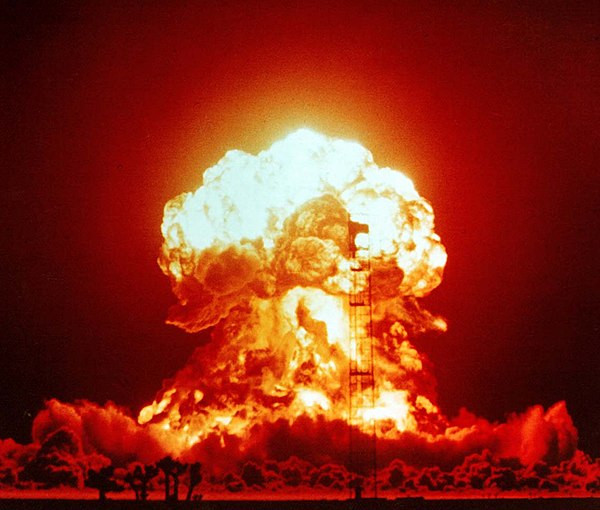
How Putin has revived fear of a nuclear war
 The Brooklyn Times - bklyntimes.com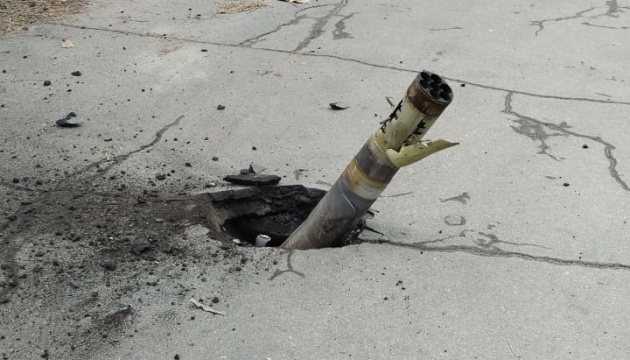
The Russian military shelled Kherson location 50 occasions about the past working day, a few civilians have been injured.
According to Ukrinform, Yaroslav Yanushevych, head of the Kherson Regional Military Administration, wrote this on Telegram.
“Information and facts on enemy shelling about the past working day, December 27. The Russian occupiers shelled the territory of Kherson area 50 occasions,” he wrote.
It is famous that the Russian forces employed artillery, MLRS, mortars and tanks to attack tranquil settlements.
In specific, the enemy attacked the city of Kherson 23 situations. Enemy shells strike a health-related institution, a kindergarten, a bakery, warehouses, personal and apartment properties.
According to Yanushevych, a few men and women gained accidents of different degrees of severity as a consequence of Russian shelling.
As noted by Ukrinform, the Russian invaders shelled a maternity hospital in the city of Kherson town, no casualties were described.
iy
The post Russian troops attack Kherson region 50 times over past day, injuring three people appeared first on Ukraine Intelligence.
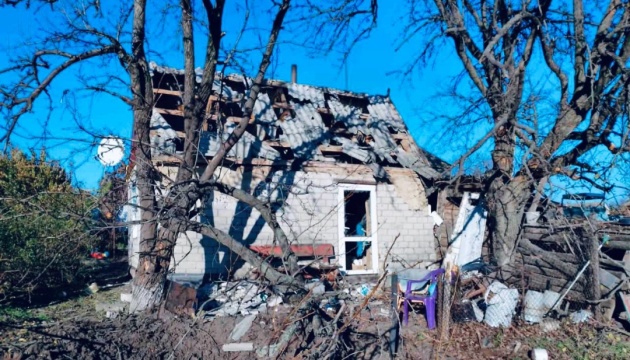
The Russian troops hurt eight civilians in Ukraine on December 27.
Kyrylo Tymoshenko, Deputy Head of the Business of the President of Ukraine, explained this in a put up on Telegram, referring to figures from the regional armed forces administrations, Ukrinform stories.
In unique, 3 people today were hurt in Donetsk region, two individuals were wounded in Kharkiv location (such as a person in a mine blast), and a few were being hurt in Kherson region.
Browse also: Russians injure a few civilians in Donetsk area
As noted by Ukrinform, eight regions in Ukraine arrived less than enemy shelling on December 27.
iy
The post Russian forces injured eight civilians in Ukraine over past day appeared first on Ukraine Intelligence.
Jeenah Moon/Reuters
The saga of Sam Bankman-Fried and the collapse of his cryptocurrency firm FTX could soon be a book from the author of “The Big Short” and “Moneyball.”
Author Michael Lewis met with Bankman-Fried for “several hours” soon after the latter was put under house arrest at his parents’ home in Palo Alto, The New York Post reported on Tuesday.
A lawyer and spokesperson for Bankman-Fried did not immediately respond to requests for comment from Insider, nor did a representative for Lewis.
Bankman-Fried is facing several fraud-related charges after the implosion of FTX, of which he is the founder and former CEO, and was extradited to the US from the Bahamas last week.
He was released from a New York federal court on December 22 on a $250 million bail. The amount wasn’t paid out, but is secured by his parents’ home where he’s staying, along with other types of collateral.
Lewis is the author of best-selling books like “The Big Short,” about how the housing bubble led to the financial crisis of the late 2000s, and “Moneyball,” which detailed how Oakland A’s general manager Billy Beane used analytics to assemble a roster.
Both were turned into Oscar-nominated films in 2015 and 2011, respectively. “The Big Short” won the Oscar for best adapted screenplay.
This isn’t the first time Lewis had met with Bankman-Fried. In November, the Hollywood trade The Ankler reported that Lewis had been interviewing Bankman-Fried for six months.
Deadline reported last month that Apple was closing in on a deal for the rights to Lewis’ eventual book on the fall of FTX and Bankman-Fried, with plans to turn it into a film.
Yuki Iwamura/AP
Southwest Airlines has blamed its operational meltdown on the busy holiday weekend and the powerful winter storm but said on Tuesday its antiquated scheduling system also played a role.
On Monday, the Dallas-based carrier canceled 74% of its flights, according to FlightAware data. As of 3:30 p.m. on Tuesday, another 63% have been canceled for a total of about 2,600.
Since its original statement last updated on Tuesday, Southwest has added to its reasoning for the chaos, telling Insider, “we have had issues with our scheduling tools, causing a scheduling issue.”
“We were fully staffed and prepared for the approaching holiday weekend when the severe weather swept across the continent, where Southwest is the largest carrier in 23 of the top 25 travel markets in the US,” the carrier said in a statement. “These operational conditions forced daily changes to our flight schedule at a volume and magnitude that still has the tools our teams use to recover the airline operating at capacity.”
Captain Mike Santoro, vice president of the Southwest Airlines Pilots Association (SWAPA), told Insider on Tuesday that while the winter storm was a “catalyst” for the disruptions, the company’s “outdated” scheduling software created the snowball.
He explained the system tracks the company’s pilots and flight attendants’ whereabouts, but it got so overloaded that it could not keep up.
“When we get out of position, it’s a tough task for our schedulers to put it back together, and right now they’re having to do it by hand,” he explained. “The problem is the software just doesn’t keep track of us.”
For example, he explained one flight had two pilots and three flight attendants assigned to a flight but needed one more flight attendant for the plane to legally fly.
There were several deadheading flight attendants onboard, meaning they were being flown to another city for an assignment but were “ready, willing, and able to work” that flight as well.
But, because the system didn’t know they were on that aircraft and the flight attendants couldn’t get in contact with crew scheduling, the company canceled the flight when it didn’t need to.
“Even though we had a crew available, [scheduling] had no idea those flight attendants were in the back of the airplane.”
Lyn Montgomery, president of Southwest’s flight attendant union, TWU Local 556, also pointed to the scheduling software in an interview with Texas news outlet KHOU, saying the storm “created the issues,” but the carrier failed to quickly recover to due “outdated technology.”
Other airlines, like United Airlines and American Airlines, largely avoided this. This is because their systems are more modern and can handle the workload quicker than Southwest’s can. The latter’s systems failed to keep up because flight attendants use a system largely reliant on phone lines, Montgomery told KHOU. That system can get clogged up, forcing crews to wait on hold for hours waiting for a new assignment.
According to Southwest, to recover its operation it will “continue operating a reduced schedule by flying roughly one-third of our schedule for the next several days.”
On Tuesday, Senators Edward J. Markey (D-Mass.) and Richard Blumenthal (D-Conn.), members of the Senate Commerce Committee, also pointed to “internal failures at the company,” and said passengers should be compensated for the disruptions.
“Southwest cannot avoid compensating passengers by claiming these flight cancellations were caused by recent winter storms,” they said. “As Southwest executives have acknowledged, the mass cancellations yesterday were largely due to the failure of its own internal systems. As such, those cancellations should be categorized as ‘controllable,’ and Southwest should compensate passengers accordingly.”
Jonathan Ferrey/LIV Golf via Getty Images
A handful of then-President Donald Trump’s aides heard ahead of January 6, 2021, that he might be planning to walk with supporters down Pennsylvania Avenue to the Capitol as a Joint Session of Congress met to certify the election results.
According to the former White House Deputy Press Secretary Judd Deere, they laughed it off — it just wasn’t realistic for Trump to walk that far.
“I’ve never seen the man walk across a golf course without a golf cart. I can’t imagine him walking up Pennsylvania Avenue,” Deere told investigators with the January 6 committee during a deposition in March 2022, adding that there were also “security concerns” about such a movement.
The committee, which put out its full report on Friday, released transcripts of additional interviews on Tuesday.
Deere told the committee that several days ahead of January 6, he had “jokingly” talked about the possibility of Trump going to the Capitol with Molly Michael and Nick Luna, two other Trump White House aides.
“It was lighthearted, in jest,” said Deere. “It was, ‘He said this today. You won’t believe what he said today.'”
He also told investigators that the trio didn’t discuss further details of the day during that conversation because “it was never serious that he was going to go the Capitol.”
Deere said he also sought to confirm on January 5 with Tony Ornato, then the Deputy Chief of Staff at the White House, that Trump was not planning on going to the Capitol the following day.
And Deere said that he still did not think that was the case even after Trump suggested during his speech on the Ellipse on January 6 that he would be joining the crowd of his supporters as they marched to the Capitol.
“I was 100 percent confident that we were not doing an additional movement,” Deere told investigators. “If the deputy chief of staff for operations told me we are not doing an additional movement, we are not doing an additional movement.”
In June, Cassidy Hutchinson revealed during an explosive January 6 committee hearing that Trump not only wanted to go the Capitol, but had attempted to grab the steering wheel of the SUV where he was sitting when he was told that he could not go. The committee later said in its preliminary final report that it had confirmed from other sources that a “furious interaction” had taken place.
Deere’s testimony suggests that many White House officials were unaware of Trump’s plan.
“I have heard rumor of that,” Deere told investigators, saying he couldn’t recall who he had heard it from. “I have heard that when he came off the stage, as well as even when he got back to the White House, he wanted to make the movement.”
Deere, who now serves as communications director for Governor-elect Sarah Huckabee Sanders of Arkansas, also told the committee that he had encouraged Trump to concede after the Electoral College voted on December 14 and drafted a resignation letter on the night of January 6.
“January 6th was a sad and frustrating day, and I was hurt,” he said, adding that he pondered whether “we as staff had failed him.”
“Maybe I should have pushed harder,” he added.
Deere declined to comment.
CNN
—
For Andrei Soldatov and his friends, February 24 marked the end of Russia as they knew it.
In the early hours of that day, President Vladimir Putin announced that he had ordered Russian troops into Ukraine. “And all of a sudden, everything we still believed in got completely compromised,” Soldatov, a Russian investigative journalist who lives in self-imposed exile in London, told CNN.
Life in Russia had for many years been getting more difficult for dissidents, independent journalists and anyone speaking up against Putin’s regime, but Soldatov said people like him still had some hope to hold on to. The war changed that, he said.
“It was horrible to live under Putin and it was very far from the idea of democracy, but you still had some established institutions which you would almost take for granted that they would exist no matter what, and all of a sudden, everything collapsed,” he said, pointing to the near complete eradication of any remaining independent media, civil society and human rights groups.
One woman who still lives in Moscow and whom CNN will call Olga, described February 24 as the point of no return. “Life turned into a nightmare from which it is impossible to wake up, round-the-clock reading of the news, protests at which there were more security forces than civilians,” she told CNN via an encrypted messaging service, describing the shame and hopelessness she feels. “The aggressor is our country. On our behalf, on my behalf, this terrible massacre is being waged,” she said.
CNN is not publishing the woman’s name and is using a pseudonym at her request because of the risks to her personal safety. Speaking to foreign journalists about her involvement in the demonstrations – and even the use of the word “war” as opposed to the Kremlin-approved term “special military operation” – puts her at risk of arrest and potentially a lengthy prison sentence.
While Russian state media gives the impression that everyone in Russia supports the war and Putin, many of the country’s more liberal, educated and well-traveled citizens have spent the past nine months horrified about the violence inflicted on Ukraine by their own country.
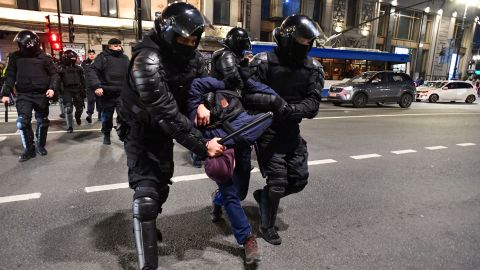
But with the increasingly repressive regime cracking down on any signs of opposition, the choices of those who dissent are extremely limited.
Hundreds of thousands of Russians have left the country, some out of principle or because they were facing persecution, others to avoid Western sanctions or the risk of being drafted into the military. Thousands have been detained, according to rights groups. Many others have been forced to withdraw from public life or lost their jobs, after hundreds of western companies withdrew from Russia and many local and foreign NGOs and campaign groups were shuttered.
The repression of dissent has been brutal. According to independent human rights monitor OVD-Info, there have been more than 19,400 detentions for protesting against the war in Russia and dozens are prosecuted every week under a new law that made it illegal to disseminate “fake” information about the invasion.
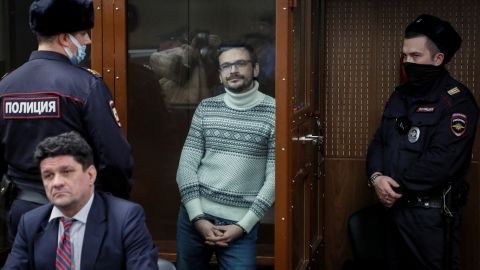
A court in Moscow used the law earlier this month when it sentenced Kremlin critic Ilya Yashin to more than eight years in prison for speaking up about the alleged killing of civilians by Russian troops in the Ukrainian town of Bucha, outside Kyiv. The Kremlin has denied any involvement in the mass killings, while reiterating baseless claims that the images of civilians bodies were fake.
Soldatov spoke to CNN on the day he received, in London, an official letter from the Russian authorities detailing criminal charges against him.
Like Yashin and hundreds of others, he is accused of spreading false information about the Russian military and law enforcement and is now on Russia’s wanted list. He denies the charges and says he was simply reporting the truth about the actions of the Russian government in the run up to and during the invasion of Ukraine.
Any remnants of a free press have been wiped out since the war started. Western publications and social media sites have been blocked online, forcing Russians seeking alternatives to the official propaganda to go underground using virtual private networks, or VPNs, which allow people to browse the internet freely by encrypting their internet traffic. Data from Sensortower, an apps market research company, show the top eight VPN apps in Russia were downloaded almost 80 million times in Russia this year, despite the government’s efforts to crack down on their use.
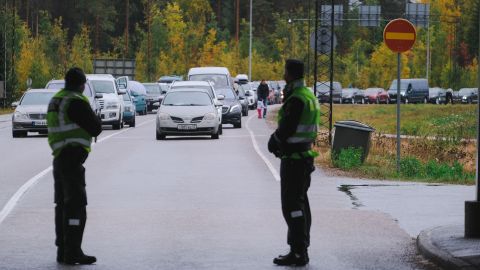
The clampdown has forced many people to reconsider their future in Russia. According to official statistics published by the Russian government, more than half a million people left Russia in the first 10 months of the year – more than twice as many in the whole of 2021.
The true number might be much higher, as many would have likely left unofficially.
It is unclear how many have left for political reasons, but almost 50,000 Russian citizens requested asylum in another country in the first six months of the year, according to the UN refugee agency, UNHCR. That’s more than the annual figure for any of the past 20 years.
The US Border Patrol recorded 36,271 encounters with Russian citizens between October 2021 and September 2022. The number includes people who were apprehended or expelled by the border force and is significantly higher than the 13,240 and 5,946 recorded in the two previous fiscal years.
OK Russians, a non-profit helping Russian citizens fleeing persecution, said its surveys suggest those who are leaving are on average younger and more educated than the general Russian public.
“If you take the Moscow liberal intelligentsia, and of course, I’m talking only about the people I know and I know of, I would say that maybe 70% left. It’s journalists, it’s people from universities, sometimes schools, artists, people who have clubs and [foundations] in Moscow that got closed down,” Soldatov said.
The numbers that have left Russia pale in comparison to the more than 4.8 million Ukrainians who have registered as refugees across Europe because of the war, but the huge outflow of mostly educated people is having a significant impact on Russian society.
“If you are losing the educated middle-class portion of the population, then it matters for your economic prospects, but it also matters for the potential political reconstitution of the country,” said Kristine Berzina, a Russia expert at the German Marshall Fund of the United States. She pointed to the exodus of liberal, educated Iranians following the country’s 1979 revolution as an example of what can happen when large numbers from such demographics leave the country.
“You don’t need to have a fully radicalized population to be able to support a radical regime,” she said.
Maria only has one friend left in Moscow. Everybody else fled following President Vladimir Putin’s decision to launch an invasion into Ukraine.
“They all left right at the beginning of March,” she said. “[For them] it is impossible to live in a country that started a war.”
Maria has asked CNN not to publish her full name or details of her employer because of personal security concerns. The NGO for which Maria works is deemed a foreign agent under Russia’s recently expanded law on foreign agents, which means she is at risk of being persecuted.
“Everyone who is against the war saw their lives simply destroyed,” she told CNN. “We can’t complain now, because someone will immediately tell you – and quite reasonably so – that no one is interested in you right now. It’s Ukrainians who suffered the most. Of course, they are in much worse conditions now. But that doesn’t mean we’re okay.”
Maria said she remains determined to stay in Russia, even though all of her friends and her son have left. Her elderly mother can’t – and doesn’t want to – travel abroad, and Maria is not willing to leave her. “If I knew for sure that the borders would not be closed and I could come at any time if my mother needed my help, it would probably be easier for me to leave. But knowing that something else could happen at any moment scares me,” she told CNN.
She still believes her work is important, but said she is struggling to see any hope for the future. Like Olga, she described her own life as a perpetual cycle of panic, horror, shame and self-doubt.
“You’re constantly torn apart: Are you to blame? Did you not do enough? Can you do something else or not, and how should you act now?” she said. “There are no prospects. I’m an adult, and I didn’t exactly have all my life figured out, but all in all I understood what would happen next. Now nobody understands anything. People don’t even understand what will happen to them tomorrow.”
Soldatov said he had begun to question his own identity. “The things we held dear, like the memory of the Second World War, for instance, became completely compromised,” he said, referring to Putin’s baseless claim that Russian forces are “denazifying” Ukraine.
“It’s part of the Russian national identity that the Russian army helped to win the war (against Hitler’s Germany) and now it feels absolutely wrong because this message was used by Putin. You start questioning the history,” he said, adding that the favorable reaction by some parts of the Russian society to the invasion prompted him to research pre-war rhetoric in Germany.
Speaking about Russians as “us” had begun to feel wrong because he deeply disagreed with Russia’s actions, he said. But saying “Russians” didn’t seem right either. “Because of course, I’m Russian, I also have some partial responsibility for what is going on and I do not want to hide from it.”
Maria, a historian by training, has spent years taking part in anti-government protests, describing herself as a liberal deeply opposed to Putin, a former KGB agent. “I always knew that our country should not be led by a person from the KGB. It is too deeply rooted with horrors, deaths and all that,” she said.
She said that when the war broke out, she grew more worried about attending demonstrations and stopped when it became too dangerous. She doesn’t see a scenario under which the regime in Russia could be overthrown any time soon, she said, pointing out that all of the opposition leaders “are in jail or have been killed.”
Berzina said that the expectation of some in the West – that “once people start feeling as though their leaders are doing wrong, that there is an immediate wave of protests on the streets and call for government change that actually has an effect” – does not reflect the reality of life in Russia.
“The Putin regime has done a very good job of either forcing out or imprisoning all viable alternatives that are of the more democratic fashion and then on the other side you have fear of going out into the streets if there’s no clear path forward,” she said.
Olga, the woman who lives in Moscow and has regularly attended protests against the war, has also lost hope.
“Almost all opposition leaders and opinion leaders are now either in prison or abroad. People have a huge potential for political action, but there is no leader and no power base,” she said, adding that civilians will not come out against the armed police, the National Guard, and other security forces.
“It is probably difficult for people from democratic countries to understand the realities of life in a powerful autocracy,” she said. “It’s a terrifying feeling of one’s own insignificance and helplessness in front of a gigantic machine of death and madness.”
The post Meet the dissident Russians living the ‘nightmare from which it is impossible to wake up’ appeared first on Ukraine Intelligence.
Ukraine’s head of armed service intelligence, Kyrylo Budanov, thinks the offensive from Belarus is a Russian disinformation marketing campaign, but prolonged-phrase challenges continue to be.
Ongoing military workout routines in Belarus and weapon materials from Russia are increasing alarms amongst some analysts, still there stays no consensus on no matter if a new invasion of Ukraine from the north and northwest is in the will work.
On Dec. 25, Kyrylo Budanov, the Chief of the Primary Intelligence Directorate of the Ministry of Defense, claimed in an interview with the New York Instances that Russia’s action in Belarus forces Ukraine to hold a considerable variety of troops in the north, tied up and unable to battle Russia in the south and east.
He also highlighted how “carousels” just take soldiers by teach towards the Ukrainian border and then back again, supplying the effect of greater troop movements.
“All these are all things of disinformation strategies,” Budanov said.
“Long-expression pitfalls continue being,” he admitted. Having said that, no intelligence now factors to an rapid risk.
In accordance to Budanov, Russian troops are not lined up in assault formation. The mobilized are being qualified in Belarus before becoming sent to the Donbas, but the coaching ranges lack serviceable devices for the assault.
On Dec. 21, the Institute of Review of the War analysts observed the indicators are now combined. Some gurus confirmed that evidence of a Russian pressure create-up in Belarus helps make extra sense in the context of preparations for a new offensive than the present workout routines and maneuvers. At the exact same time, there is no evidence that Moscow is actively planning a strike force in Belarus.
Trainloads of Russian troops and machines relocating into Belarus have spiked considering the fact that October, according to President Aleksandr Lukashenko, because Minsk and Moscow are forming a joint fight pressure in the west of the place, with the collective security mission of deterring NATO or a Ukrainian invasion.
The post Russian Build-up in Belarus Aims to Keep Ukrainian Troops Pinned in the North – Intelligence Chief appeared first on Ukraine Intelligence.
Advertisements – Advertising at The News And Times – advertising-newsandtimes.com | WE CONNECT!
Audio | Video | Top News | On Twitter | Security | FBI | Capitol Riot | JOSSICA | Trump | Russia | Putin | Russia – Ukraine War | Covid-19 | Brooklyn NY | Puerto Rico | World
September 4, 2026 3:19 am
The News And Times | Featured Posts | All Articles | Current News | Selected Articles | Shared Links | Opinions | In My Opinion | Sites | Blogs | Links | Twitter | Facebook

Contact Form | Blogs | Sites | News Reviews | Links | Advertising
All The News That’s Fit To Web