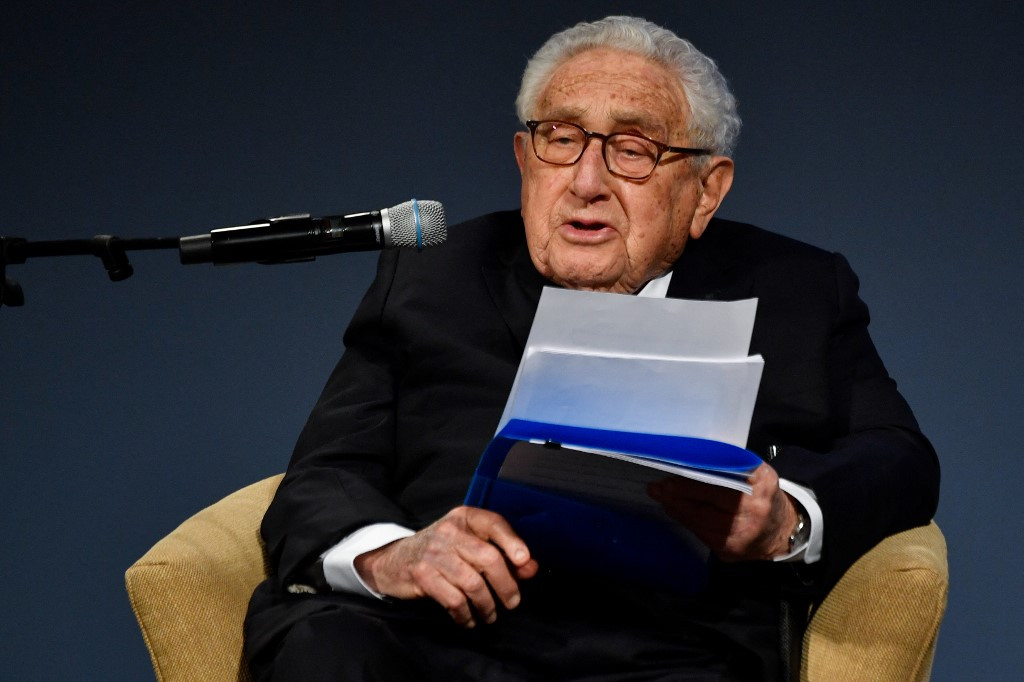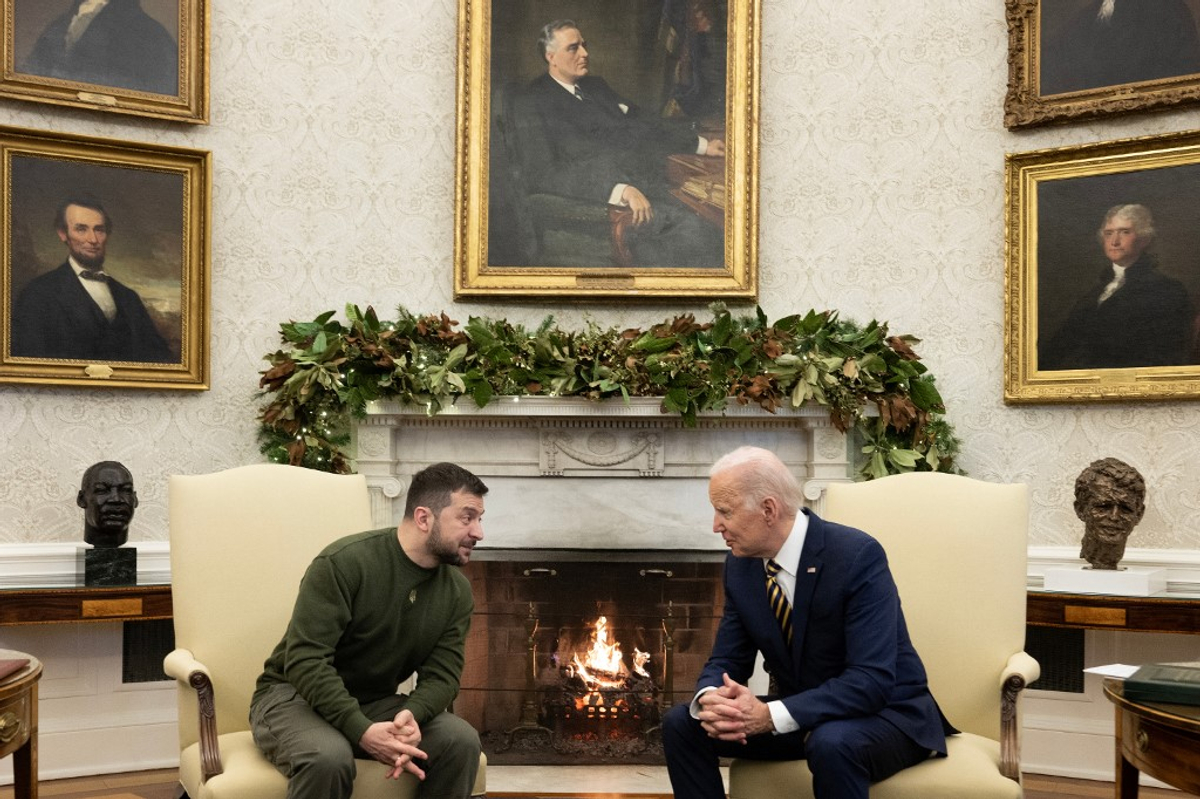
President Zelensky delivered a historic speech to Congress, expressing gratitude for American support in fighting Russian aggression.
 The Brooklyn Times - bklyntimes.com
BERLIN (AP) — The German government said Thursday that it has nationalized energy company Uniper after the European Union gave its blessing for it to rescue the gas supplier.
The government announced its plan to nationalize Uniper in September, expanding state intervention in the energy sector to prevent a shortage resulting from Russia’s war in Ukraine. The deal built on an initial rescue package agreed in July and features a capital increase of 8 billion euros ($8.5 billion) that Germany is financing.
Uniper’s existing shareholders approved the measures on Monday. The EU’s executive Commission gave its conditional approval on Tuesday. The government is obliged to reduce its stake to 25% plus one share by 2028, a deadline that can only be extended with the Commission’s approval.
Germany’s finance and economy ministries said Thursday that the government has now taken a stake of some 99% in the company. Uniper’s existing management remains in place.
Uniper was controlled until now by Finland-based Fortum. The Finnish government has the largest stake in Fortum.
Before the war in Ukraine, the company bought about half of its gas from Russia, which started cutting deliveries to Germany in June and hasn’t supplied any gas to the country since the end of August.
Uniper has incurred huge costs as a result of those cuts because it was forced to buy gas at far higher market prices to meet its supply contract obligations. Last month, it said it had initiated proceedings to seek damages from Russia’s Gazprom at an international arbitration tribunal in Stockholm.

Tesla Inc (TSLA.O) is offering $7,500 discounts on Model 3 and Model Y electric vehicles (EV) delivered in the United States this month, its website showed on Wednesday, amid concerns the automaker is facing softening demand as economies slow and EV tax incentives loom.
That is up from the $3,750 credit it has offered on Model 3 and Model Y vehicles delivered before the end of the year. It has also recently started offering free supercharging for 10,000 miles (16,093 kms) for the December vehicles.
The latest discount came just days after the U.S. Treasury Department delayed restrictions on EV incentives until March, meaning Teslas and other U.S-made electric vehicles are likely to qualify for the full $7,500 credits temporarily.
Customers have canceled their orders and held off their purchases until the new credits take effect in January, weighing on Tesla demand.
Analysts also worry that rising interest rates and CEO Elon Musk’s controversial Twitter management could hurt the Tesla brand and sales.
“The fact they seem to be cutting price to increase deliveries volumes doesn’t raise confidence, particularly at a time where we see increasing competition,” Craig Irwin, a senior analyst at ROTH Capital Partners, said.
The rare discounts follow a series of price hikes over the past couple of years by the automaker, which blamed supply chain disruption and inflation.
Tesla is also offering $5,000 credit in Canada on Model 3 and Model Y vehicles delivered before the end of the year. The U.S. automaker has also given a discount of 6,000 yuan ($860) on some models in China to the end of 2022.
Tesla in October said it would miss its vehicle delivery target this year, but downplayed concerns about demand after its revenue missed Wall Street estimates.
($1 = 6.9761 yuan)
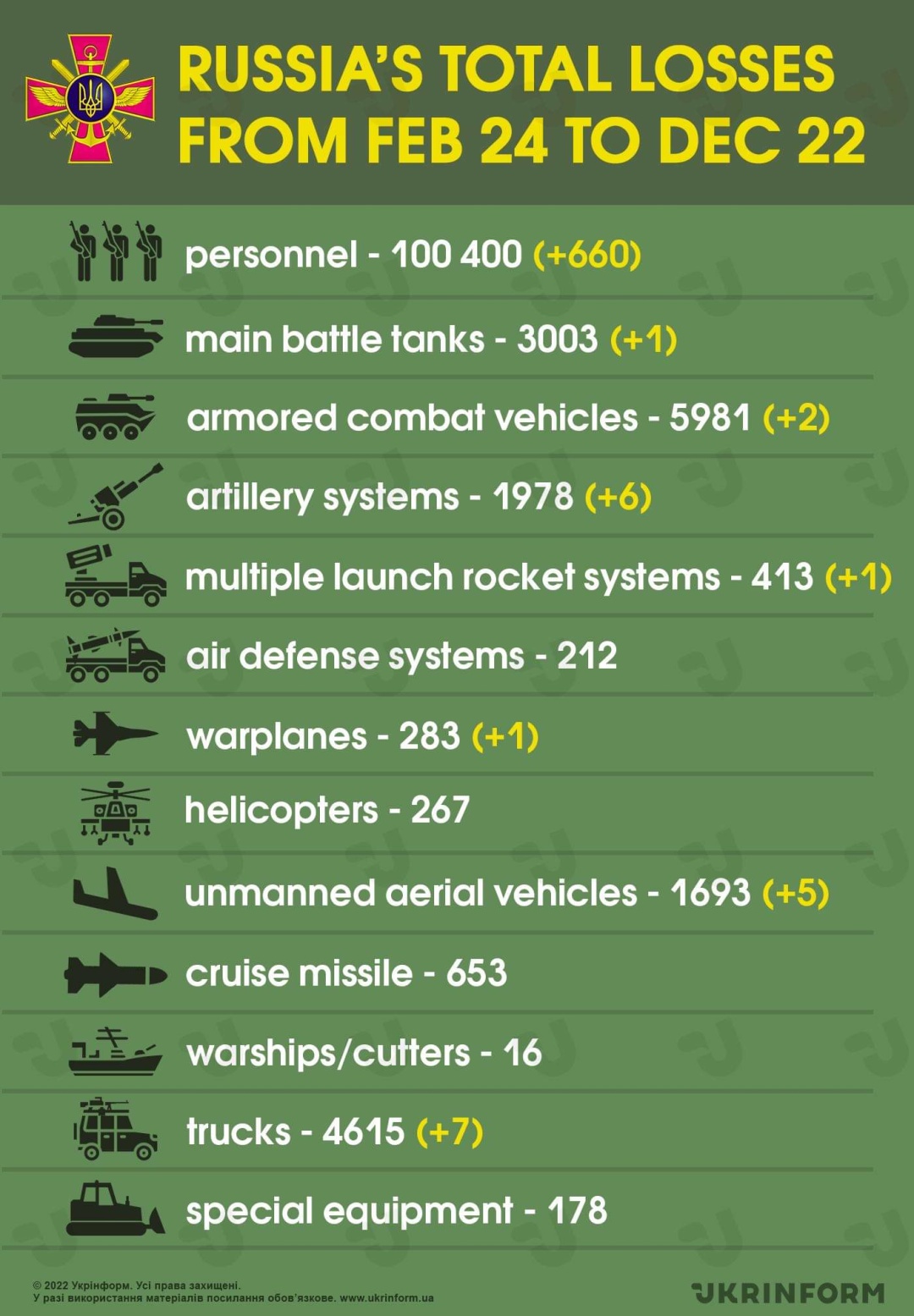
Ukrainian forces have already killed about 100,400 Russian troops in Ukraine between February 24 and December 22, including 660 in the earlier day on your own.
The Common Staff of the Armed Forces of Ukraine explained this in a post on Facebook, an Ukrinform correspondent reports.
As of December 22, 2022, the enemy’s whole overcome losses involved also 3,003 tanks (+1 in excess of the past day), 5,981 armored fighting cars (+2), 1,978 artillery systems (+6), 413 a number of start rocket devices (+1), 212 anti-plane warfare techniques, 283 plane (+1), 267 helicopters, 4,615 motor automobiles and gas tanks (+7), 653 cruise missiles, 16 warships/boats, 1,693 unmanned aerial vehicles (+5), 178 pieces of exclusive tools.
On December 21, Ukraine’s Protection Forces repelled enemy assaults around 16 settlements in the Luhansk and Donetsk regions.
The post Russian military death toll in Ukraine rises to 100,400 appeared first on Ukraine Intelligence.
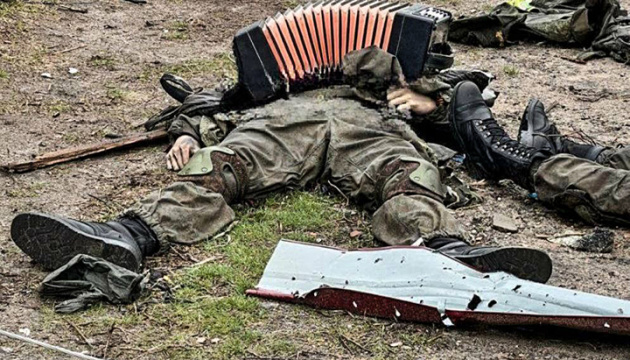
Russian troops on December 21 released 6 missile strikes, 15 air strikes and carried 64 assaults working with multiple start rocket techniques. At the exact time, because February 24, the Ukrainian Armed Forces have by now destroyed much more than 100,000 Russian invaders.
The Standard Employees of the Ukrainian Armed Forces reported this in a put up on Fb, Ukrinform stories.
“Continuing the aggression, in the earlier 24 several hours, the enemy launched six missile strikes and 15 air strikes, in specific, on civilian targets in the Zaporizhzhia region. The enemy also released 64 attacks utilizing several start rocket methods. About the previous day, our soldiers repelled the assaults of the occupiers outside the house the settlements of Novoselivske, Stelmakhivka, Ploshchanka and Chervonopivka in the Luhansk region and Berestove, Yakovlivka, Soledar, Bakhmut, Opytne, Kurdiumivka, Ozarianivka, Maiorsk, New York, Krasnohorivka, Nevelske and Marinka in the Donetsk area,” the report claimed.
On December 17 of this year, Ukrainian forces hit an enemy personnel and products concentration location near Horlivka, Donetsk region, killing 13 Russian troopers, which include 4 officers. An amphibious assault motor vehicle and a few trucks with ammunition had been also ruined. Information about those wounded is being clarified.
In purchase to build fortifications in the Belgorod region, the regional Russian leadership introduced the recruitment of volunteers for a monetary reward for the development of trenches and the installation of cement pyramids.
In the earlier 24 hrs, the Air Force of the Ukrainian Defense Forces carried out 14 strikes on the enemy’s armed forces staff and products areas. Ukrainian defenders also shot down an enemy Forpost UAV and two Lancet-3 UAVs.
Ukrainian rocket and artillery models struck a few command posts and two regions where the enemy’s manpower was concentrated.
In total, because February 24, given that the commencing of the whole-scale invasion, Russia has by now misplaced far more than 100,000 personnel, 3,000 tanks and about 6,000 other armored cars in Ukraine.
The post Ukrainian forces kill more than 100,000 Russian invaders – General Staff appeared first on Ukraine Intelligence.
The Associated Press estimated at least 10,300 new graves in and around Mariupol — most in the Staryi Krym cemetery — by analyzing satellite imagery from early March through December, noting sections where the earth had been disturbed.
AP measured each grid section where the cemetery had been expanded and calculated the total space occupied by new graves to be more than 51,500 square meters.
AP then reviewed drone and video footage that showed the Russians had used heavy machinery to dig long trenches which were then filled back in. The graves were visible as dirt mounds, sometimes with wooden crosses bearing names and dates but mostly with hand-scrawled numbers on small placards. A few graves were marked with more than one number, potentially indicating more than one set of human remains.
AP analyzed the video footage to count the number of graves in specific sections of the cemetery, estimating an average of roughly one grave for every six square meters. AP applied that metric to the total space where new burial plots had been dug. AP then applied the same methodology to two smaller nearby cemeteries in the villages of Manghush and Vynohradne, where similar mass graves had been dug since March. In addition, there is a trench grave dug by Ukrainians during the siege.
Three forensic archaeologists experienced in mass graves war crimes investigations said the analysis was sound, based on the limited information available and the lack of access to the graves. Roland Wessing, who helped excavate mass graves in Bosnia, Croatia and Iraq, cautioned that the number of graves doesn’t necessarily match the number of Ukrainians killed.
The analysis can’t determine how the occupants of the graves died. However, mass burial sites elsewhere in Ukraine exhumed by international forensics investigators and observed by AP were often found to contain more than one set of human remains per grave. Many showed clear indications of violent death, such as blast injuries, bullet wounds and hands bound with rope.
Throughout Mariupol, Russian workers are tearing down bombed-out buildings at a rate of at least one a day, hauling away shattered bodies with the debris.
Russian military convoys are rumbling down the broad avenues of what is swiftly becoming a garrison city, and Russian soldiers, builders, administrators and doctors are replacing the thousands of Ukrainians who have died or left.
Many of the city’s Ukrainian street names are reverting to Soviet ones, with the Avenue of Peace that cuts through Mariupol to be labeled Lenin Avenue. Even the large sign that announces the name of the city at its entrance has been Russified, repainted with the red, white and blue of the Russian flag and the Russian spelling.
Eight months after Mariupol fell into Russian hands, Russia is eradicating all vestiges of Ukraine from it – along with the evidence of war crimes buried in its buildings. The few open schools teach a Russian curriculum, phone and television networks are Russian, the Ukrainian currency is dying out, and Mariupol is now in the Moscow time zone. On the ruins of the old Mariupol, a new Russian city is rising, with materials from at least one European company, The Associated Press found.
But the AP investigation into life in occupied Mariupol also underlines what its residents already know all too well: No matter what the Russians do, they are building upon a city of death. More than 10,000 new graves now scar Mariupol, the AP found, and the death toll might run three times higher than an early estimate of at least 25,000. The former Ukrainian city has also hollowed out, with Russian plans to demolish well over 50,000 homes, the AP calculated.
___
Associated Press journalists were the last international media in Mariupol to escape heavy shelling in March, before Russian forces took the city over. This is the story of what has happened since. AP reconnected with many people whose tragedies were captured in photos and video during the deadliest days of the Russian siege.
___
Death surrounds Mariupol in the rapidly growing cemeteries on its outskirts, and its stench lingered over the city into the autumn. It haunts the memories of survivors, both in Mariupol and in exile.
Every one of the dozens of residents the AP spoke with knew someone killed during the siege of Mariupol, which began with the Feb. 24 invasion. As many as 30 people arrive at the morgue each day in hopes of tracking down a loved one.
Lydya Erashova watched her 5-year-old son Artem and her 7-year-old niece Angelina die after a Russian shelling in March. The family hastily buried the young cousins in a makeshift grave in a yard and fled Mariupol.
They returned in July to rebury the children, only to learn while on the road that the bodies had already been dug up and taken to a warehouse. As they approached the city center, each block was bleaker than the last.
“It is horror. Wherever you look, whichever way you look,” said Erashova. “Everything is black, is destroyed.”
Neither she nor her sister-in-law could bear to go inside the warehouse to identify the bodies of their children. Their husbands, who are brothers, chose the tiny coffins – one pink and one blue – to be placed together in a single grave.
Erashova, who is now in Canada, said no Russian rebuilding plan could possibly bring back what Mariupol lost.
“Our lives have been taken from us. Our child was taken from us,” she said. “It’s so ridiculous and stupid. How do you restore a dead city where people were killed at every turn?”
RECKONING WITH DEATH
The AP investigation drew on interviews with 30 residents from Mariupol, including 13 living under Russian occupation; satellite imagery; hundreds of videos gathered from inside the city, and Russian documents showing a master plan. Taken together, they chronicle a comprehensive effort to suppress Mariupol’s collective history and memory as a Ukrainian city.
Mariupol was in the crosshairs of the Kremlin from the first day of the invasion. Just 40 kilometers (25 miles) from the Russian border, the city is a port on the Sea of Azov and crucial for Russian supply lines.
The city was hit relentlessly with airstrikes and artillery, its communications severed, its food and water cut off. Yet Mariupol refused to give in for 86 days. By the time the last Ukrainian fighters holed up in the Azovstal steel mill surrendered in May, Mariupol had become a symbol of Ukrainian resistance.
That resistance came at a high price. The thoroughness of Russia’s destruction of Mariupol can still be seen today. Videos taken across the city and satellite images show that munitions have left their mark on nearly every building across its 166 square kilometers (64 square miles).
Large swaths of the city are devoid of color and life, with fire-blackened walls, grey demolition dust and dead trees with shredded foliage. But the worst destruction Mariupol suffered may be measured in its death toll, which will never be fully known.
An AP analysis of satellite imagery taken over the past eight months of occupation shows 8,500 new graves in the outlying Staryi Krym cemetery alone, with possibly multiple bodies beneath each mound. There are at least three other trench gravesites around the city, including one created by Ukrainians themselves at the beginning of the siege.
In all, a total at least 10,300 new graves are scattered around Mariupol, according to AP’s methodology, confirmed by three forensic pathologists with expertise in mass graves. Thousands more bodies likely never even made it to the graveyard.
Back in May, when the city finally fell, the municipal government in exile estimated 25,000 people at a minimum had died. But at least three people in the city since June say the number killed is triple that or more, based on conversations with workers documenting body collection from the streets for the Russian occupation authorities.
Svitlana Chebotareva, a Mariupol resident who fled in March, said her neighbor died in a flat nearby, and the body is still there. Chebotareva returned home this autumn for just long enough to retrieve her belongings, since residents are free to come and go so long as they pass checkpoints. She said the Russians expect gratitude with their offer of a few new apartments.
“I don’t know how it’s possible now to give us ‘candies’ in exchange for destroyed homes and killed people,” she said in Kyiv. “And they still believe it anyway.”
ERASING A UKRAINIAN CITY
The notices are taped to peeling, pockmarked walls by the entry, and addressed to “DEAR RESIDENTS.”
This is how those who remained in Mariupol learn their buildings are scheduled for imminent demolition. Often, despite shattered windows, frozen pipes and no electricity, they are still living inside because they have nowhere else to go.
In a review of hundreds of photos and video clips along with documents from occupation authorities, the AP found that more than 300 buildings in Mariupol have been or are about to be demolished. Some are individual homes, but most are multistory apartment blocks in the khrushchyovka style, launched by Soviet leader Nikita Khrushchev in a housing crisis in the 1960s. With around 180 apartments inside or more, each building was designed to house as many families as possible.
That means in all, the demolitions will remove well over 50,000 homes, according to AP calculations.
“There is no discussion, people aren’t prepared,” said an activist in Mariupol, who like all inside Mariupol requested anonymity for fear of retribution. “People still live in the basements. Where they can go is unclear.”
Only Russians handle the debris itself, according to another resident still in the city who works on the sites. The stated reason is to avoid accidents, he said.
But Petro Andryushchenko, an aide to Mariupol’s mayor who is exiled in Dnipro, believes the real reason is to ensure that people don’t see the rotting corpses being hauled away. He said many of the buildings, especially in the neighborhood around Azovstal , contain 50 to 100 bodies each that will never get a decent burial. Those deaths will go unrecorded.
110 Mytropolytska is one of the buildings on Russia’s demolition list, scheduled to come down any day.
The smell of fresh-baked bread still brings Inna Nepomnyshaya, a doctor, back to her last night in March in her sixth-floor apartment there. When she saw the street price of bread in her besieged city, she decided to bake her own.
The smell warmed the air the next morning when her son-in-law arrived. It was time to leave, he insisted. Russian forces were closing in.
Nepomnyshaya was at her daughter’s building when Russian tanks rolled up to her own at dusk on March 11. As AP journalists watched and recorded from the upper floor of nearby Hospital No. 2, one tank raised its gun at 110 Mytropolytska and fired.
The shell shattered the walls of Nepomnyshaya’s apartment and obliterated those of the neighbors above, below and behind her. Most of the neighbors were huddled in the basement, but two elderly women, Lydya and Nataliya, couldn’t make the trip up and down the stairs.
Their bodies would be buried in the courtyard soon after. Weeks later, AP video showed the rough graves still there.
With communications to the city cut, Nepomnyshaya did not learn of the fate of her apartment until her family had escaped to Ukrainian-held territory. Like many who left Mariupol, she still speaks of the city in the present tense.
“I live in Mariupol, this is my home,” she said, speaking by candlelight in a café in Dnipro, another city that had lost power. “This house was my fortress, and they took it away from me.”
Also on the demolition list are the buildings on either side. One was hit by at least one airstrike on March 11; the walls of another are in ruins.
Russia is now moving into the historic city center. Russian authorities in October dismantled Mariupol’s memorial to victims of the Holodomor, the Soviet-engineered famine in the 1930s that killed millions of Ukrainians, according to video posted on Russian television. They also painted over two murals commemorating victims of Russia’s 2014 attack on Ukraine, images obtained by the AP show.
“They spend an inordinate amount of time focusing on things like erasing demonstrations of Ukrainian identity and very little time tending to the needs of the Mariupol people,” said Michael Carpenter, U.S. ambassador to the Organization for Security and Cooperation in Europe, which for years monitored eastern Ukraine. “It’s really a very brutal inhuman colonial experiment unfolding before our eyes.”
BUILDING A RUSSIAN CITY
As it tries to raze the remains of Ukraine, Russia has laid out a plan for a new city with a new population. At its heart will lie the historic Mariupol theater, according to the master plan first reported by the Russian site The Village in August and seen by The Associated Press.
The majestic Drama Theater became the city’s main bomb shelter until twin Russian airstrikes hit on March 16. Hundreds died, an AP investigation found, and residents said the site reeked of bodies all summer. To mask the ruins, Russian authorities have put up a screen so tall it can be seen from space, etching the theater’s outline on the paneling in a ghostly reminder of its previous life.
Also in the document are plans to restore the ruins of the obliterated Azovstal steel mill, the last Ukrainian holdout. The site is slated to be transformed into an industrial park by the end of next year, though there are no signs that any work has begun.
But a Russian military compound went up in record time, according to satellite imagery from Maxar Technologies that showed the vast U-shaped building with the Russian Army slogan emblazoned on the rooftop.
Russia already has constructed at least 14 new apartment buildings — a small fraction of the number coming down — and is repairing at least two of the hospitals it damaged by shelling. Video obtained by The Associated Press showed rows of pallets stacked with insulation from the Danish company Rockwool, which maintains its division in Russia despite criticism. Construction materials are not subject to sanctions.
In a statement, Rockwool’s Vice President of Communications Michael Zarin said the insulation panels were distributed without the company’s “knowledge or consent,” and that he hopes its products help restore health care, warmth and shelter to Ukrainians.
Videos show no furniture visible in the windows of the new apartments and few people on the sidewalks outside. Only pensioners, the disabled and those affiliated with the occupation seem to be getting them, according to multiple people still in Mariupol.
One man applied to the list in September and found himself in 11,700th place. He has friends in the 2,000 range who are still waiting, like him. And an old man he knows, whose number was in the 9,000s has already moved into one of the new buildings.
“I don’t know how it happens. I won’t speculate,” he said.
However, the man said he has no issue with the demolition of buildings that aren’t fit to live in. He is cautiously relaunching his own company in the new city.
But the plans for a Russian Mariupol depend on a population that simply no longer exists.
Thousands of Mariupol’s former residents were sent to Russia with little or no choice, and thousands more fled into other areas of Ukraine. Of Mariupol’s former population of around 425,000, just over a quarter stayed, according to estimates from Andryushchenko.
The Russian master plan for Mariupol calls for a population of 212,000 in 2022, and back to 425,000 by 2030. Right now, about 15,000 of the people in Mariupol people are Russian troops, said Andryushchenko, who drew his estimate from information about the soldiers taking over homes and public buildings. He said Russian riot police have begun patrolling the city to head off protests over the lack of heat, electricity and water.
Videos seen by the AP showed military convoys, along with construction trucks, clogging the streets. The activist the AP spoke with also confirmed an increase in the number of soldiers since Russian forces retreated from the Kharkiv and Kherson regions.
Construction workers from Russia show no signs of leaving, and tents were visible outside the Port City mall until the winter. Doctors and city administrators also have come in from Russia, according to Russian government announcements and physicians who left the city after refusing to work for the occupation authorities.
“There is no more Russian city now than Mariupol,” Dmitry Sablin, a Russian lawmaker born in Mariupol, said in an interview with Russian media in June after visiting the city.
The Kremlin is moving as swiftly as it can to ensure that those Ukrainians who stay see their future as Russians.
On Nov. 15, Russian President Vladimir Putin awarded Mariupol the title of “City of Military Glory” for the heroism of people he described as its defenders. On Dec. 7, Putin said his war against Ukraine had turned the Sea of Azov into “Russia’s internal sea.”
This suits many of those who remained behind just fine. Mariupol has always had some residents who considered themselves Russian.
“Whoever doesn’t like it, doesn’t come back,” one woman said.
NO FUTURE IN SIGHT
Russia’s occupation of Mariupol has divided families and friends into two categories: Those who stayed and those who fled. Both grapple with what Mariupol once was and will be.
When Ivan Kalinin escaped, he left behind the body of his wife Iryna and their unborn first child, both killed in the March 9 Russian airstrike on the maternity hospital. His parents and hers stayed in Mariupol.
He last saw his wife that morning when her labor began, and she sent him to fetch clothes and diapers. He learned about the airstrike at a military blockade on the way to the hospital. He and his father found her body the next day at another hospital.
“I do not even know how I survived it,” he said quietly. “I was drinking every day to fall asleep.”
Kalinin, who now lives in Wales, cannot imagine going home. Nor can he imagine life anywhere else.
“It is too painful for me to be there. I might return at some point — it is my hometown, after all,” he said. “I fall asleep every day hoping this is a dream. And I wake up with understanding that it is a reality.”
Mariupol is now torn between Russia and Ukraine. Some people who stayed are waiting for Russian citizenship just to get on with their lives. Yet the Ukrainian letter ï , which is not found in Russian, is appearing as graffiti around the city — a small act of defiance in a place many described as full of fear.
Nepomnyshaya, whose apartment was struck by a Russian shell, dreamed recently that she’d returned home and smelled bread. But she is not sure if she ever can or will go back.
“I believe that Mariupol will be rebuilt, that it will be Ukraine after all,” she said. “But I know that this smell is just a memory.”
___
Hinnant and Stepanenko reported from Dnipro, Ukraine. El Deeb reported from Beirut. Tilna reported from Lviv, Ukraine. Marshall Ritzel in New York, Michael Biesecker in Washington, and Mstyslav Chernov, Jamey Keaten, Evgeniy Maloletka and Inna Varenytsia in Kyiv, Ukraine, contributed.
Advertisements – Advertising at The News And Times – advertising-newsandtimes.com | WE CONNECT!
Audio | Video | Top News | On Twitter | Security | FBI | Capitol Riot | JOSSICA | Trump | Russia | Putin | Russia – Ukraine War | Covid-19 | Brooklyn NY | Puerto Rico | World
September 25, 2026 1:09 pm
The News And Times | Featured Posts | All Articles | Current News | Selected Articles | Shared Links | Opinions | In My Opinion | Sites | Blogs | Links | Twitter | Facebook

Contact Form | Blogs | Sites | News Reviews | Links | Advertising
All The News That’s Fit To Web