Categories
Audio Sources - Full Text Articles

Photos show squalid conditions at the Bahamas prison where Sam Bankman-Fried will spend his holidays

A corrections officer at Fox Hill looks in on a crowded cell of prisoners.Fox Hill is known to be overcrowded and have unsanitary conditions, per human rights reports.

Reuters

  • A judge in the Bahamas ordered Sam Bankman-Fried remanded to custody during a Monday hearing.
  • The former FTX CEO will spend the next two months at Fox Hill, the Bahamas’ only prison.
  • Photos from the facility show overcrowding and squalid conditions. 

Sam Bankman-Fried is set to spend his holidays incarcerated in the Bahamas’ only prison after a magistrate judge ordered him remanded to custody on Tuesday following his arrest on US fraud charges.

The Fox Hill correctional center, located in Nassau, is known for its harsh conditions and overcrowding, according to human rights reports. Bankman-Fried, 30, has already joined hundreds of other detainees at the prison after a judge this week said he posed a “great” flight risk. 

The Bahamas has one of the highest rates of imprisonment in the world, with 409 per 100,000 people detained in the country, according to the World Prison Brief, an online database housed by the Institute For Crime & Justice Policy Research, Birkbeck College, University of London.

Conditions at the facility suffer due to the sheer number of prisoners incarcerated there.

A corrections officer at Fox Hill stands in front of an inmate cell.A 2021 human rights report on The Bahamas by the US State Department found that infestations of rats, maggots, and insects were common at Fox Hill.

Reuters

A combination of overcrowding and understaffing at the facility has led some inmates to only be allowed outside for 30 minutes a week, Romona Farquharson, a local attorney, told The Wall Street Journal. Space constraints have also resulted in some inmates who are awaiting trial to be housed in the center’s maximum security block, Farquharson said.

Reuters reported Tuesday that Bankman-Fried will initially be held in the Fox Hill medical department. 

A 2021 human rights report on the Bahamas by the US State Department offered further insight into the squalid conditions at the center. Inmates at the facility said they had to remove human waste by bucket and were prone to bed sores after being forced to lie on the hard ground for long periods of time.

Plastic water judgs and trash cans sit outside a cell at Fox Hill.Inmates at the facility said they had to remove human waste by bucket, according to a 2021 human rights report on the Bahamas by the US State Department.

Reuters

Photos taken from a Reuters video of the facility show a tiny cell with six mattresses and one toilet. 

A Fox Hill cell with three bunk beds and a toilet.The Fox Hill correctional center, located in Nassau, is known for its harsh conditions and overcrowding, according to human rights reports.

Reuters

The State Department report also cited infestations of rats, maggots, and insects. A correctional officer in the Reuters video confirmed that rodent infestations have been a problem at the facility. 

A toilet in a cell at Fox Hill.As many as six inmates can share one tiny cell with just one toilet.

Reuters

Inmates have also said they were subjected to poor nutrition while at Fox Hill, sometimes facing long delays in between meals. Reports from Bankman-Fried’s Tuesday hearing said the disgraced FTX founder and his legal team tried to use his vegan diet as a reason to be released from custody. 

Inmates at Fox Hill also cited a lack of access to proper medical care and psychological care, according to the 2021 State Department report. 

Authorities in the Bahamas detained Bankman-Fried on Monday, acting on a request from US officials. A federal criminal indictment unveiled on Tuesday charged Bankman-Fried with multiple counts, including wire fraud, money laundering, and campaign finance violations, related to the collapse of one of the largest crypto exchanges earlier this year.

Bankman-Fried resigned from his role at FTX last month after the exchange filed for bankruptcy following a liquidity disaster. Regulators and prosecutors have alleged that he duped investors and defrauded customers while at the helm of the company. 

Read the original article on Business Insider
Categories
Audio Sources - Full Text Articles

Russia is losing in Ukraine and ‘will continue to fail in all its war aims,’ the UK’s armed forces chief says

A Ukrainian soldier deployed on the Kherson front to support to the Ukrainian army in Kherson Oblast on November 05, 2022.A Ukrainian soldier deployed on the Kherson front to support to the Ukrainian army in Kherson Oblast on November 05, 2022.

Metin Aktas/Anadolu Agency via Getty Images

  • The head of the UK’s armed forces said on Wednesday that Russia is losing in Ukraine. 
  • Admiral Sir Tony Radakin also said the war will only get worse for Russia.
  • “Russia faces a critical shortage of artillery munitions,” Radakin said. 

The head of the UK’s armed forces says Russia is losing in Ukraine, offering a blunt assessment of the state of the war as Moscow’s unprovoked invasion creeps toward its 10-month mark. 

“Russia is losing” and the “free world is winning,” Admiral Sir Tony Radakin, the United Kingdom’s chief of defense staff, said Wednesday during a speech at the Royal United Services Institute think tank in London.

Radakin ripped into Russia over the invasion, which he decried as tragic, dangerous, illegal, and unjustified. But Radakin underscored that Moscow is failing in the war, adding that “it will only get worse for Russia.”

Russia is estimated to have suffered roughly 100,000 casualties in the war so far, an astonishing number in less than a year of fighting. On top of manpower issues, which Russian President Vladimir Putin sought to address via a partial military mobilization that did not go well, Russian forces are also running low on proper equipment and ammunition.

“Let me tell Putin tonight what his own generals and ministers are probably too afraid to say: that Russia faces a critical shortage of artillery munitions,” Radakin said, explaining that this means “their ability to conduct successful offensive ground operations is rapidly diminishing.”

Putin planned for a quick war, but “Russian guns have now been firing for almost 300 days” and “the cupboard is bare,” Radakin went on to say, echoing US officials who have pointed out that Russia is running through its munitions faster than it can replenish them.

Russia has lost much of the territory that it managed to occupy in the early days of the invasion. A Ukrainian counteroffensive that began in recent months has seen Russia’s military lose ground, including in territories that Putin illegally annexed in September. In November, Russian forces retreated from Kherson — the first major Ukrainian city that Russia captured.

“Russia has failed – and will continue to fail – in all its war aims. Russia is diminished on the world stage,” Radakin said. The war saw Russia increasingly isolated, condemned in the UN, and booted from the UN Human Rights Council. Russia has also been widely accused of war crimes.

The top UK admiral credited Ukraine’s “ingenuity, courage and determination of Ukraine” for Russia’s failures in the conflict, as well as the coalition that’s formed to support Kyiv and punish Moscow over the war. 

Russia’s war in Ukraine pushed a number of countries to abandon longstanding stances of neutrality. Finland and Sweden, who have historically been militarily non-aligned, moved to join NATO as a result of the invasion. Germany provided weapons to Ukraine, breaking from a historic policy of not sending arms to conflict zones. 

“Despite Putin’s best efforts to divide, he has unintentionally assembled an extraordinary coalition of democracies against him. It’s as if he has illuminated what our beliefs really mean and entail. The importance of aggression being defeated. The need to abide by international rules, ” Radakin said, adding that Russia was “ill prepared” for the economic response to the invasion. Western countries have slapped crippling economic sanctions on Russia, and in November, Russia’s economy entered a recession.

“Morally, conceptually and physically, Putin’s forces are running low,” Radakin said, urging the Russian leader to act now and withdraw his forces to save Russian and Ukrainian lives. Russia, however, recently rejected a call from Ukrainian leadership to withdraw its forces, signaling that fighting will continue.

Read the original article on Business Insider
Categories
Audio Sources - Full Text Articles

Gen Z employees are using new slang in the workplace and it’s confusing their colleagues. Here’s a breakdown of the jargon.

TikTok screen grab "The gen z teaching the millennials how to use 'nauuur'"A screenshot from a TikTok by @wethepvblic.

wethepvblic/TikTok

  • Gen Z employees are learning what they should and shouldn’t say at work amid a generational language barrier.
  • Words like “ick” and “slay” have found their way into office lingo for younger employees, reports say.
  • A human resources professional told Insider Gen Z should be mindful when bringing new sayings to the workplace. 

Chronically online Gen Zers are bringing the slang they’ve learned through social media to the office, which could make it tricky for other generations who are trying to work with — and understand — them.

Employees who are part of Generation Z — those born between 1997 and 2012 — are introducing coworkers to a variety of new phrases in the workplace. These days, the jargon circulates through TikTok and is starting to appear in more mainstream office settings, The Washington Post reported.

Zachary Timms, a 25-year-old project engineer, told Insider he’s in a unique position as an elder Gen Zer. Although he’s familiar with the new slang, he said he’s less comfortable than his younger peers are using it.

“I don’t think it’s appropriate to use slang in the office. In a conservative field like engineering, I know that my older coworkers are less likely to get it, so I avoid using slang,” Timms said.

Kevon Martin, assistant human resources manager for Hyatt Regency Houston, told Insider there’s a time and a place for slang.

“Older colleagues can benefit from being more adaptable and relatable to their younger coworkers, so they know how to appeal to a younger consumer base,” Martin told Insider. “However, Gen Z must also recognize you can’t come to work and use whatever slang words you’d use with each other because it’s not the same environment.”

While some of these phrases originated from Black and LGBTQ+ creators, they are wide-ranging in their origins and references. Below is a list of phrases a Gen Z colleague might use and what they (usually) mean.

Ick

The term “ick” has long been used to describe something gross or unpleasant, but it has taken on a new meaning thanks to a current trend on TikTok. At first, “give me the ick” was used by Gen Zers to refer to traits or habits that turned them off from a person they’re dating, but now many are sharing “icks” in all aspects of life.

In December, a group of Atlanta-based nurses were ridiculed publicly for sharing their “icks” about patients in a TikTok video. The caption read “Icks, Labor & Delivery (Edition),” and the video featured multiple nurses sharing things they didn’t like about patients.

The employees appear to have since lost their jobs, based on an apology posted to Facebook by Emory Healthcare which referred to them as “former employees.”

Stories like the former staffers of Emory Hospital may give young people pause when considering more casual behavior around the office. But Martin told Insider it can work if executed appropriately — and not disparagingly — in an environment of open communication between colleagues of multiple generations. 

Naur

Simply put, naur just means no or know. It functions as a more dramatic way of saying “no” or “know,” and sounds like “no” with an Australian accent. 


Slay

To “slay” anything means someone is doing an exceptional job at their work or a task at hand. 

@sam_thegirl Just some new ideas if you find your friends are getting board of slay #slay #slayqueen ♬ Monkeys Spinning Monkeys – Kevin MacLeod & Kevin The Monkey


Understood the assignment

If a coworker says this, they mean a task has been completed exactly as it was meant to be done.


Say less

A shortened version of “say no more.” It’s used when you completely agree or understand what someone has just said.

—Ace Boogie (@NewStripeCity) December 12, 2022


Unserious

This is a more fun way of saying something or someone is ridiculous, or that it can’t be taken seriously.

—Gibson Johns (@gibsonoma) December 12, 2022


Read the original article on Business Insider
Categories
Audio Sources - Full Text Articles

Russian security teams are scrambling to hunt down Ukrainian spies as locals in captured towns direct fire and gather critical intel

destroyed Russian tank with "Z" visibleRemains of a destroyed Russian tank in the outskirts of Myroliubivka, a liberated village in Kherson province.

Celestino Arce/NurPhoto via Getty Images

  • Behind enemy lines, Ukrainian civilians are helping their country target Russian positions.
  • In Kherson, local activists used Telegram to send photos and coordinates for Russian troops.
  • “Our guys and girls are everywhere,” a Ukrainian official told The Wall Street Journal.

In Crimea, a Ukrainian car repairman went out drinking with Russian officers and then later shared the details of their conversations and the location of invading troops with his own country’s military. In occupied Kherson, a man who performed at weddings before the war said he had pivoted to planting explosives under Russian soldiers’ vehicles. And outside the city’s airport, a tech worker snapped photos of the enemy’s vehicles, collecting intelligence that was then promptly used to blow them up.

These stories were shared Wednesday by The Wall Street Journal, which reported that regular Ukrainians, using simple tools like smartphones and the messaging app Telegram, have proven very useful to their country’s intelligence gathering processes. Ukrainian forces can act on the intel in under 15 minutes, putting fire on Russian positions.

“These people see Russian tanks moving, they see where troops go for dinner, where they party, where they do their laundry, and they share that information with us,” a Ukrainian security official told the news outlet. “Without them our army would have no way of knowing.”

Russian forces have felt the effects, and these everyday spies are becoming a priority for Russia. Its security and intelligence agents having raided the homes of suspected informants and imprisoned several on charges of espionage. The Journal said that few have been released, as civilians are rarely exchanged in Ukraine and Russia’s prisoner swaps.

Russia has also tried to infiltrate the Telegram channels being used against them.

In one case detailed by the Journal, a man who was arrested by Russia’s FSB tried days later to rejoin his online comrades,  who by that time were requiring each member of their group to post a daily video to prove their identity and that they were not under duress. His face swollen and his hand shaking as he held a cigarette, the man claimed the background, which resembled a detention facility, was his grandmother’s home. He did not pass the test.

In a recent interview with the War on the Rocks podcast, Brig. Gen. Viktor Khorenko, the head of Ukraine’s Special Operations Forces, credited local partisans with helping beat back Russia’s invading force, saying that they have given Ukrainian forces an advantage over the invading Russian troops.

“We know the terrain. We know the people. Our people actually helped us a lot,” Khorenko said during the interview.

When putting together teams to send to various places, “we try to find people and to integrate those people into those autonomous groups who know the local population and actually maybe were originally from those places, who have some relatives there, who have communication, who can be acting like a pathfinder,” he explained. “That was really a big advantage.”

Have a news tip? Email this reporter: cdavis@insider.com

Read the original article on Business Insider
Categories
Audio Sources - Full Text Articles

Elizabeth Warren slams the Fed’s Jerome Powell for ‘pushing hard to get more people fired’ as he continues to aggressively fight inflation

Elizabeth WarrenDemocrats have proposed other ways to fight inflation without hurting jobs.

Charles Krupa/Associated Press

  • The Federal Reserve hiked interest rates again today, but not at the same fast pace as past months.
  • Rate hikes are meant to ease inflation — and could increase unemployment and cause a recession.
  • Senator Elizabeth Warren told HuffPost that Fed Chair Jay Powell is pushing to get more people fired.

The nation’s central bank might be easing off the gas pedal when it comes to fighting inflation — but that’s not enough for Massachusetts Sen. Elizabeth Warren.

On Wednesday, the Federal Reserve announced it would be increasing interest rates yet again, raising them 0.5 percentage points. This was a promising sign for consumers given that the past four consecutive hikes came in at 0.75 percentage points, and it followed promising data from the Consumer Price Index on Tuesday, which measured a decrease in inflation year-over-year in November to 7.1%.

But inflation is still undoubtedly high and far from the Fed’s goal of reaching the pre-pandemic level of 2% — and it has lawmakers like Warren concerned that continuing to hike rates will send the economy into a recession and trigger job losses.

“He’s pushing hard to get more people fired because he thinks that is one way to help bring down inflation,” Warren told HuffPost’s Arthur Delaney, referencing Federal Reserve Chair Jay Powell. But, Warren said, that’s “sure painful for the families who lose their jobs.”

It’s an argument that Democrats have continually deployed in their pushback to the blunt force tactic the Fed uses to bring down inflation. Interest rate hikes are the main tool that the Federal Reserve can employ to offset inflation, but they do risk tipping the country into inflation — and leaving more workers unemployed.

This isn’t the first time Warren has sounded the alarm on continued interest rate hikes. She previously joined other Democratic lawmakers in sending a letter to Powell urging him to consider the risk to Americans’ employment his tactics to fight inflation have brought, and during a speech last month, Warren said that “there is a big difference between landing a plane and crashing it.”

“Powell risks pushing our economy off a cliff,” she added. “And who will be most likely to lose their jobs? Not stock brokers and investment bankers. Nope. The people out of work will be low-wage workers and those already struggling most with rising prices.”

The Federal Reserve isn’t the only body that could take action: Congress could step in with legislation aimed at lowering prices. Warren, for instance, cosponsored legislation that would have taxed oil and gas company’s record profits, and sent the money back to Americans in checks. Sens. Bernie Sanders and Ed Markey have introduced legislation to impose a 95% tax on big corporations’ record pandemic profits.

Liz Shuler, the president of the AFL-CIO, the country’s largest labor federation, echoed Warren’s sentiments.

“Raising interest rates is NOT the only solution for our economic crisis,” Shuler wrote on Twitter. “You know who’s NOT feeling the cost of inflation this holiday season? Major corporations & their CEOs, whose profits have increased by more than *80%* in the last two years alone.”

Amid Warren’s concerns that the Fed could lead the economy into a recession, the overarching theme of Powell’s Wednesday remarks was uncertainty. He couldn’t say whether there will be a recession next year, and if there is one, how bad it will be, but he emphasized that until prices are significantly lower, continued interest rate increases will persist.

“I don’t think anyone knows whether we’re going to have a recession or not,” Powell said. “And if we do, whether it’s going to be a deep one or not, it’s just, it’s not knowable.”

Read the original article on Business Insider
Categories
Audio Sources - Full Text Articles

Suspect accused of attacking Paul Pelosi said he also was targeting Tom Hanks and Hunter Biden, police alleged in court

San Francisco police officers and F.B.I. agents gather in front of the home of U.S. Speaker of the House Nancy Pelosi (D-CA) on October 28, 2022 in San Francisco, California.San Francisco police officers and F.B.I. agents gather in front of the home of U.S. Speaker of the House Nancy Pelosi (D-CA) on October 28, 2022 in San Francisco, California.

Photo by Justin Sullivan/Getty Images

  • The suspect accused of attacking Paul Pelosi had other targets, police testified Monday.
  • The suspect planned to target Tom Hanks, California Gov. Gavin Newsom, and Hunter Biden, according to KTLA. 
  • The suspect is accused of breaking into Nancy Pelosi’s home and beating her husband with a hammer.

The suspect accused of attacking Paul Pelosi in October later admitted that he also planned to target famous figures including superstar actor Tom Hanks and Hunter Biden, police alleged in court on Wednesday.

San Francisco Police Department Lt. Carla Hurley testified during a preliminary hearing at the San Francisco County Superior Court that during an interrogation of David DePape, the 42-year-old revealed that he planned to target several other individuals, according to local station KTLA.

Among the targets were Hollywood icon Tom Hanks, President Joe Biden’s son, Hunter, and California Gov. Gavin Newsom, Hurley testified, according to the report, adding that DePape wanted to discuss “all the corruption” in Washington, DC with President Joe Biden’s son.

Republicans have frequently criticized Hunter Biden and have vowed to use their new power in the House of Representatives to investigate the president’s son.

DePape was charged with felony counts of assault and kidnapping related to the October 28 attack at Nancy Pelosi’s San Francisco home.

Though he was looking for the House speaker, who was not home, DePape ended up in a fight with Pelosi’s husband, Paul, whom DePape hit in the head with a hammer — sending him to the hospital for emergency surgery.

Paul Pelosi has since been released from the hospital.

Read the original article on Business Insider
Categories
Audio Sources - Full Text Articles

Astronauts explain why nobody has visited the moon in 50 years — and the reasons are depressing

flag moon buzz aldrin apollo 11 astronaut planting nasa 371257main_Flag_fullApollo 11 astronauts planted a flag on the moon on July 20, 1969.

NASA

  • The last time a person visited the moon was in December 1972, during NASA’s Apollo 17 mission.
  • Astronauts say the reasons humans haven’t returned are budgetary and political, not scientific or technical.
  • It’s possible NASA will be back on the moon by 2025, at the very earliest.

Landing 12 people on the moon remains one of NASA’s greatest achievements, if not the greatest.

Astronauts collected rocks, took photos, performed experiments, planted flags, and then came home. But those stays during the Apollo program didn’t establish a lasting human presence on the moon.

Fifty years after the most recent crewed moon landing — Apollo 17 in December 1972 — there are plenty of reasons to return people to Earth’s giant, dusty satellite and stay there.

NASA has promised that we will see US astronauts on the moon again soonish — maybe by 2025 at the earliest, in a program called Artemis, which will include the first women to ever touch the lunar surface. 

Former NASA Administrator Jim Bridenstine, who ran the agency during the Trump administration, said it’s not science or technology hurdles that have held the US back from doing this sooner. 

“If it wasn’t for the political risk, we would be on the moon right now,” Bridenstine said on a phone call with reporters in 2018. “In fact, we would probably be on Mars.”

So why haven’t astronauts been back to the moon in 50 years? 

“It was the political risks that prevented it from happening,” Bridenstine said. “The program took too long and it costs too much money.”

Researchers and entrepreneurs have long pushed for the creation of a crewed base on the moon — a lunar space station.

“A permanent human research station on the moon is the next logical step. It’s only three days away. We can afford to get it wrong and not kill everybody,” Chris Hadfield, a former astronaut, previously told Business Insider. “And we have a whole bunch of stuff we have to invent and then test in order to learn before we can go deeper out.”

A lunar base could evolve into a fuel depot for deep-space missions, lead to the creation of unprecedented space telescopes, make it easier to live on Mars, and solve longstanding scientific mysteries about Earth and the moon’s creation. It could even spur a thriving off-world economy, perhaps one built around lunar space tourism.

But many astronauts and other experts suggest the biggest impediments to making new crewed moon missions a reality are banal and somewhat depressing.

It’s really expensive to get to the moon — but not that expensive

Saturn V rocket dawn 1967

Bloomsbury Auctions

A tried-and-true hurdle for any spaceflight program, especially missions that involve people, is the steep cost.

NASA’s 2022 budget is $24 billion, and the Biden administration is asking Congress to boost that to nearly $26 billion in the 2023 budget.

Those amounts may sound like a windfall, until you consider that the total gets split among all the agency’s divisions and ambitious projects: the James Webb Space Telescope, the giant rocket project called Space Launch System (SLS), and far-flung missions to the sun, Jupiter, Mars, the asteroid belt, the Kuiper belt, and the edge of the solar system. (By contrast, the US military is on track for a budget of about $858 billion in 2023.)

Plus, NASA’s budget is somewhat small relative to its past.

“NASA’s portion of the federal budget peaked at 4% in 1965,” Apollo 7 astronaut Walter Cunningham said during congressional testimony in 2015. “For the past 40 years it has remained below 1%, and for the last 15 years it has been driving toward 0.4% of the federal budget.”

A 2005 report by NASA estimated that returning to the moon would cost about $104 billion ($162 billion today, with inflation) over about 13 years. The Apollo program cost about $142 billion in today’s dollars.

“Manned exploration is the most expensive space venture and, consequently, the most difficult for which to obtain political support,” Cunningham said during his testimony.

He added, according to Scientific American: “Unless the country, which is Congress here, decided to put more money in it, this is just talk that we’re doing here.”

Referring to Mars missions and a return to the moon, Cunningham said, “NASA’s budget is way too low to do all the things that we’ve talked about.”

The problem with presidents

Trump astronautFormer US President Donald Trump wanted to get astronauts back on the moon in 2024.

Reuters/Carlos Barria

President Biden may — or may not — be in office the next time NASA lands astronauts back on to the moon in 2025, or later.

And therein lies another major problem: partisan political whiplash. 

“Why would you believe what any president said about a prediction of something that was going to happen two administrations in the future?” Hadfield said. “That’s just talk.”

The process of designing, engineering, and testing a spacecraft that could get people to another world easily outlasts a two-term president. But incoming presidents and lawmakers often scrap the previous leader’s space-exploration priorities.

“I would like the next president to support a budget that allows us to accomplish the mission that we are asked to perform, whatever that mission may be,” Scott Kelly, an astronaut who spent a year in space, wrote in a Reddit “Ask Me Anything” thread in January 2016, before President Trump took office. 

But presidents and Congress don’t often seem to care about staying the course.

In 2004, for example, the Bush administration tasked NASA with coming up with a way to replace the space shuttle, which was set to retire, and also return to the moon. The agency came up with the Constellation program to land astronauts on the moon using a rocket called Ares and a spaceship called Orion. NASA spent $9 billion over five years designing, building, and testing hardware for that human-spaceflight program.

Yet after President Barack Obama took office — and the Government Accountability Office released a report about NASA’s inability to estimate Constellation’s cost — Obama pushed to scrap the program and signed off on the SLS rocket instead.

Trump didn’t scrap SLS. But he did change Obama’s goal of launching astronauts to an asteroid, shifting priorities to moon and Mars missions. Trump wanted to see Artemis land astronauts back on the moon in 2024. 

Such frequent changes to NASA’s expensive priorities have led to cancellation after cancellation, a loss of about $20 billion, and years of wasted time and momentum.

Biden seems to be a rare exception to the shifty presidential trend: he hasn’t toyed with Trump’s Artemis priority for NASA, and he’s also kept Space Force intact. 

Buzz Aldrin said in testimony to Congress in 2015 that he believes the will to return to the moon must come from Capitol Hill.

“American leadership is inspiring the world by consistently doing what no other nation is capable of doing. We demonstrated that for a brief time 45 years ago. I do not believe we have done it since,” Aldrin wrote in a statement. “I believe it begins with a bipartisan congressional and administration commitment to sustained leadership.”

The real driving force behind that government commitment to return to the moon is the will of the American people, who vote for politicians and help shape their policy priorities. But public interest in lunar exploration has always been lukewarm.

Even at the height of the Apollo program, after Aldrin and Neil Armstrong stepped onto the lunar surface, only 53% of Americans said they thought the program was worth the cost. Most of the rest of the time, US approval of Apollo hovered below 50%.

Most Americans think NASA should make returning to the moon a priority at this point. More than 57% of nationwide respondents to an INSIDER poll in December 2018 said returning to the moon is an important goal for NASA, but only about 38% said that living, breathing humans need to go back. (Others who want the US to land on the moon say robots could do the lunar exploring.)

Should NASA return to the moon

Samantha Lee/Business Insider

Support for crewed Mars exploration is stronger, with 63% of respondents to a 2018 Pew Research Center poll saying it should be a NASA priority. Meanwhile, 91% think that scanning the skies for killer asteroids is important.

The challenges beyond politics

moon base made 3d printingMany space enthusiasts have long hoped to build a base on the moon, but the lunar surface’s harsh environment wouldn’t be an ideal place for humans to thrive.

NASA

The political tug-of-war over NASA’s mission and budget isn’t the only reason people haven’t returned to the moon. The moon is also a 4.5-billion-year-old death trap for humans and must not be trifled with or underestimated.

Its surface is littered with craters and boulders that threaten safe landings. Leading up to the first moon landing in 1969, the US government spent what would be billions in today’s dollars to develop, launch, and deliver satellites to the moon to map its surface and help mission planners scout for possible Apollo landing sites.

But a bigger worry is what eons of meteorite impacts have created: regolith, also called moon dust.

Madhu Thangavelu, an aeronautical engineer at the University of Southern California, wrote in 2014 that the moon is covered in “a fine, talc-like top layer of lunar dust, several inches deep in some regions, which is electrostatically charged through interaction with the solar wind and is very abrasive and clingy, fouling up spacesuits, vehicles and systems very quickly.”

Peggy Whitson, an astronaut who lived in space for a total of 665 days, previously told Business Insider that the Apollo missions “had a lot of problems with dust.”

“If we’re going to spend long durations and build permanent habitats, we have to figure out how to handle that,” Whitson said.

There’s also a problem with sunlight. For about 14 days at a time, the lunar surface is a boiling hellscape that is exposed directly to the sun’s harsh rays; the moon has no protective atmosphere. The next 14 days are in total darkness, making the moon’s surface one of the colder places in the universe.

NASA is developing a fission power system that could supply astronauts with electricity during weeks-long lunar nights — and would be useful on other worlds, including Mars.

“There is not a more environmentally unforgiving or harsher place to live than the moon,” Thangavelu wrote. “And yet, since it is so close to the Earth, there is not a better place to learn how to live, away from planet Earth.”

NASA has designed dust- and sun-resistant spacesuits and rovers, though it’s uncertain whether that equipment is anywhere near ready to launch.

A generation of billionaire ‘space nuts’ may get there

spacex starship steel moon landing space colonization elon musk twitter D5US3AeU8AAHxyVAn illustration of SpaceX’s Starship vehicle on the surface of the moon, with Earth in the distance.

Elon Musk/SpaceX via Twitter

Another issue, astronauts say, is NASA’s graying workforce. These days, more American kids polled say they dream about becoming YouTube stars, rather than astronauts.

“You’ve got to realize young people are essential to this kind of an effort,” Apollo 17 astronaut Harrison Schmitt recently told Business Insider. “The average age of the people in Mission Control for Apollo 13 was 26 years old, and they’d already been on a bunch of missions.”

Schweickart echoed that concern, noting that the average age of someone at NASA’s Johnson Space Center is closer to 60 years old.

“That’s not where innovation and excitement comes from. Excitement comes from when you’ve got teenagers and 20-year-olds running programs,” Schweickart said. “When Elon Musk lands a [rocket booster], his whole company is yelling and screaming and jumping up and down.”

Musk is part of what astronaut Jeffrey Hoffman has called a “generation of billionaires who are space nuts,” developing a new, private suite of moon-capable rockets.

“The innovation that’s been going on over the last 10 years in spaceflight never would’ve happened if it was just NASA and Boeing and Lockheed,” Hoffman told journalists during a roundtable in 2018. “Because there was no motivation to reduce the cost or change the way we do it.”

The innovation Hoffman was referring to is work of Musk’s rocket company, SpaceX, as well as by Jeff Bezos, who runs aerospace company Blue Origin.

“There’s no question: If we’re going to go farther, especially if we’re going to go farther than the moon, we need new transportation,” Hoffman added. “Right now we’re still in the horse-and-buggy days of spaceflight.”

Many astronauts’ desire to return to the moon aligns with Bezos’ long-term vision. Bezos has floated a plan to start building the first moon base using Blue Origin’s upcoming New Glenn rocket system. 

“We will move all heavy industry off of Earth, and Earth will be zoned residential and light industry,” he said in April 2018.

Musk has also spoken at length about how SpaceX’s forthcoming Starship launch system could pave the way for affordable, regular lunar visits. SpaceX might even visit the moon before NASA or Blue Origin. 

“My dream would be that someday the moon would become part of the economic sphere of the Earth — just like geostationary orbit and low-Earth orbit,” Hoffman said. “Space out as far as geostationary orbit is part of our everyday economy. Someday I think the moon will be, and that’s something to work for.”

Astronauts don’t doubt whether or not we’ll get back to the moon and onto Mars. It’s just a matter of when.

“I guess eventually things will come to pass where they will go back to the moon and eventually go to Mars — probably not in my lifetime,” Lovell said. “Hopefully they’ll be successful.”

This story was originally published on July 14, 2018. It has been updated. 

Correction: A previous version of this story included an incorrect number of moonwalkers. During NASA’s Apollo program, 12 people landed on the moon.

Read the original article on Business Insider
Categories
Audio Sources - Full Text Articles

He Used AI to Publish a Children’s Book in a Weekend. Artists Are Not Happy About It

Ammaar Reshi was playing around with ChatGPT, an AI-powered chatbot from OpenAI when he started thinking about the ways artificial intelligence could be used to make a simple children’s book to give to his friends. Just a couple of days later, he published a 12-page picture book, printed it, and started selling it on Amazon without ever picking up a pen and paper.

The feat, which Reshi publicized in a viral Twitter thread, is a testament to the incredible advances in AI-powered tools like ChatGPT—which took the internet by storm two weeks ago with its uncanny ability to mimic human thought and writing. But the book, Alice and Sparkle, also renewed a fierce debate about the ethics of AI-generated art. Many argued that the technology preys on artists and other creatives—using their hard work as source material, while raising the specter of replacing them.

[time-brightcove not-tgx=”true”]

I spent the weekend playing with ChatGPT, MidJourney, and other AI tools… and by combining all of them, published a children’s book co-written and illustrated by AI!

Here’s how! 🧵 pic.twitter.com/0UjG2dxH7Q

— Ammaar Reshi (@ammaar) December 9, 2022


Reshi, a product design manager from the San Francisco Bay Area, gathered illustrations from Midjourney, a text-to-image AI tool that launched this summer, and took story elements from a conversation he had with the AI-powered ChatGPT about a young girl named Alice. “Anyone can use these tools,” Reshi tells TIME. “It’s easily and readily accessible, and it’s not hard to use either.”

His experiment creating an AI-generated book in just one weekend shows that artificial intelligence might be able to accomplish tasks faster and more efficiently than any human person can—sort of. The book was far from perfect. The AI-generated illustrations had a number of issues: some fingers looked like claws, objects were floating, and the shadowing was off in some areas. Normally, illustrations in children’s books go through several rounds of revisions—but that’s not always possible with AI-generated artwork on Midjourney, where users type a series of words and the bot spits back an image seconds later.

A Page From Alice and Sparkle
Courtesy Ammaar ReshiArtists singled out this page from Alice and Sparkle as showing the limits of the AI-powered technology. The illustration has several apparent flaws, including the character appearing to have claws.

Alice and Sparkle follows a young girl who builds her own artificial intelligence robot that becomes self aware and capable of making its own decisions. Reshi has sold about 70 copies through Amazon since Dec. 4, earning royalties of less than $200. He plans to donate additional copies to his local library.

Reshi’s quixotic project drew praise from many users for its ingenuity. But many artists also strongly criticized both his process and the product. To his critics, the speed and ease with which Reshi created Alice and Sparkle exemplifies the ethical concerns of AI-generated art. Artificial intelligence systems like Midjourney are trained using datasets of millions of images that exist across the Internet, then teaching algorithms to recognize patterns in those images and generate new ones. That means any artist who uploads their work online could be feeding the algorithm without their consent. Many claim this amounts to a high-tech form of plagiarism that could seriously harm human artists in the near future.

Reshi’s original tweet promoting his book received more than 6 million impressions and 1,300 replies, many of which came from book illustrators claiming artists should be paid or credited if their work is used by AI.

“In order to protect the rights and property of artists, there must be stricter regulation around how art is used to train AI algorithms,” says Michelle Jing Chan, an illustrator of children’s books. “Artists should be appropriately compensated when their works are used in the training of algorithms.”

“The main problem to me about AI is that it was trained off of artists’ work,” adds Adriane Tsai, also a children’s book illustrator. “It’s our creations, our distinct styles that we created, that we did not consent to being used.”

Already, some companies and brands are choosing AI technology over human talent. The San Francisco Ballet used images generated by Midjourney to promote this season’s production of the Nutcracker. A digitally-generated fashion model, Shudu Gram, has modeled for brands including Louis Vuitton. And at comedy clubs, artificial intelligence is being used to deliver standup jokes.

The phenomena has made many creatives nervous about their own futures, wondering if people will pay for their services when they could generate it for much cheaper using AI.

“As somebody who makes my money and finds my joy and writing, it’s deeply troubling to see people seeking cheap alternatives to actual human writing, which is already one of the most deliriously underpaid professions,” says Abraham Josephine Riesman, an author.

Reshi responded to these concerns by calling on the creators of the AI tools at OpenAI and Midjourney to ensure protections for artists and authors whose work may be used in artificial intelligence algorithms.

“I think there’s real concern and I actually do hear out those artists,” Reshi says. “It’s really important that the tech industry that’s working on these tools involves them in the process of creation.”

Categories
Audio Sources - Full Text Articles

Police testify about attack on U.S. House Speaker Pelosi“s husband

2022-12-14T22:13:05Z

Speaker of the House Nancy Pelosi, D-CA and her husband Paul Pelosi arrive for the formal Artist’s Dinner honoring the recipients of the 44th Annual Kennedy Center Honors at the Library of Congress in Washington, D.C., U.S., December 4, 2021. REUTERS/Ken Cedeno

A San Francisco police officer testified on Wednesday that he witnessed the attack on U.S. House of Representatives Speaker Nancy Pelosi’s husband when the suspect attacked Paul Pelosi with a hammer in late October.

Prosecutors at the preliminary hearing for suspect David Wayne DePape, 42, played a recording of Paul Pelosi’s 911 call during the hearing and showed video of the attack from police body cameras, USA Today reported.

“My partner said, ‘Drop the weapon’ …. He started to pull the hammer, Mr. Pelosi let go and the man lunged and hit Mr. Pelosi in the head,” San Francisco Police Officer Kyle Cagney testified on Wednesday, adding the House speaker’s husband was struck “very hard,” according to the USA Today report.

The suspect, demanding to see the House speaker, had broken into her San Francisco home and attacked her husband in an assault that had stoked fears about political violence in the United States in the days leading to the midterm elections.

San Francisco Police Sergeant Carla Hurley, who interviewed DePape on the day of the attack, testified to the hearing on Wednesday that the assailant told her he wanted to target other people too, including California Governor Gavin Newsom, actor Tom Hanks and President Joe Biden’s son Hunter Biden, CBS News reported.

San Francisco Superior Court Judge Stephen Murphy conducted the hearing on Wednesday to establish if there was enough evidence to bring the suspect to trial.

After the attack, Paul Pelosi, 82, underwent surgery for a skull fracture and injuries to his right arm and hands. He was releasedfrom hospital in early November. The suspect was arrested and faced charges of attempted murder and other felonies.

DePape threatened to take the House speaker hostage, prosecutors said. He pleaded not guilty to federal criminal charges last month.

Categories
Audio Sources - Full Text Articles

Biden says U.S. is “all in“ on Africa“s future

2022-12-14T22:06:38Z

President Joe Biden announced an agreement aimed at bolstering trade ties between the United States and Africa on Wednesday after years in which the continent took a back seat to other U.S. priorities as China made inroads with investments and trade.

“The United States is ‘all in’ on Africa’s future,” Biden told African leaders attending a three-day summit in Washington.

Biden’s remarks, and the summit, aim to position the United States as a partner to African countries amid its competition with China, which has sought to expand its influence by funding infrastructure projects on the continent and elsewhere. Chinese trade with Africa is about four times that of the United States, and Beijing has become an important creditor by offering loans with less stringent conditions than Western lenders.

Biden said a new U.S. agreement with the African Continental Free Trade Area will give American companies access to 1.3 billion people and a market valued at $3.4 trillion. He listed companies that had made deals at the summit, including General Electric Co (GE.N) and Cisco Systems Inc (CSCO.O).

“When Africa succeeds, the United States succeeds. Quite frankly, the whole world succeeds as well,” the president said.

Delegations from 49 countries and the African Union, including 45 African national leaders, are attending the three-day summit, which began on Tuesday, the first and is the first of its kind since 2014. Washington has offered $55 billion in support for Africa under the Biden administration for food security, climate change, trade partnerships and other issues.

After his remarks, Biden viewed some of the World Cup semifinal match between Morocco and France with Morocco’s prime minister, Aziz Akhannouch, and other leaders attending the summit, the White House said.

This afternoon, Biden will host leaders facing 2023 elections, including from Gabon and Liberia for a discussion on elections and democratic principles. Then Biden and his wife, Jill, will host African leaders and their spouses at a White House dinner with Vice President Kamala Harris and her husband Doug Emhoff.

The summit is part of a renewed push to boost ties with a continent as China gains influence with trade, investment and lending drives. Beijing has held its own high-level meetings with African leaders every three years for more than two decades.

Some U.S. officials have been reluctant to frame the gathering as a battle for influence. Biden didn’t mention China in his remarks, and Washington has toned down its criticism of Beijing’s lending practices and infrastructure projects.

Biden is expected to announce his support for the African Union’s joining the G20 group of the world’s largest economies as a permanent member during Thursday’s summit events.

U.S. Trade Representative Katherine Tai told African counterparts on Tuesday she wants to improve the continent’s U.S. trade preferences program to boost investment.

“We are not looking for a relationship that is transactional, that’s extractive, that is burdensome, or leaves various countries in a more fragile, poor state after a deal is done,” State Department spokesman Ned Price told reporters on Monday.

On Wednesday, White House national security spokesman John Kirby highlighted the importance of U.S. investments in Africa and helping countries there play a more active role in the global economy.

“It’s a two-way discussion that we want to have with Africa about trade, investment and opportunities for economic growth,” he told reporters.

At an opening trade forum on Wednesday, African leaders called for more investment.

“Instead of exporting commodities, the U.S. should find an opportunity in investing,” Kenyan President William Ruto said. “They have the machinery, they have the know-how, so that they can produce for the African continent in Africa.”

Ruto cited projections that Africa’s agribusiness sector will more than triple to $1 trillion by 2030 and said U.S. capital can help solve the continent’s physical infrastructure deficit to unlock this growth.

According to a Eurasia Group analysis, in 2021 China-Africa trade, at $254 billion, greatly outstripped U.S.-Africa trade, which stood at $64.3 billion. Those figures are up from $12 billion and $21 billion, respectively, in 2002.

Beijing’s lending to Africa has led to Western charges that China has mired African countries in debt.

Beijing’s ambassador to Washington rejected the idea ahead of the summit, citing a report that African countries owe three times more debt to Western institutions, while noting that Chinese-built hospitals, highways, airports and stadiums are “everywhere” in Africa.

China remains the region’s largest bilateral investor, but its new loan commitments to Africa have declined in recent years.

It’s not all about economic sway – Washington has been alarmed by China’s efforts to establish a military foothold in Africa, including on the Atlantic coast in Equatorial Guinea.

For their part, many African leaders reject the idea that they need to choose between the United States and China.

“The fact that both countries have different levels of relations with African countries makes them equally important for Africa’s development,” Ethiopia’s U.N. ambassador, Taye Atske Selassie Amde, told Reuters. “However, it should be known each African country has the agency to determine their respective relationship and best interest.”

Related Galleries:

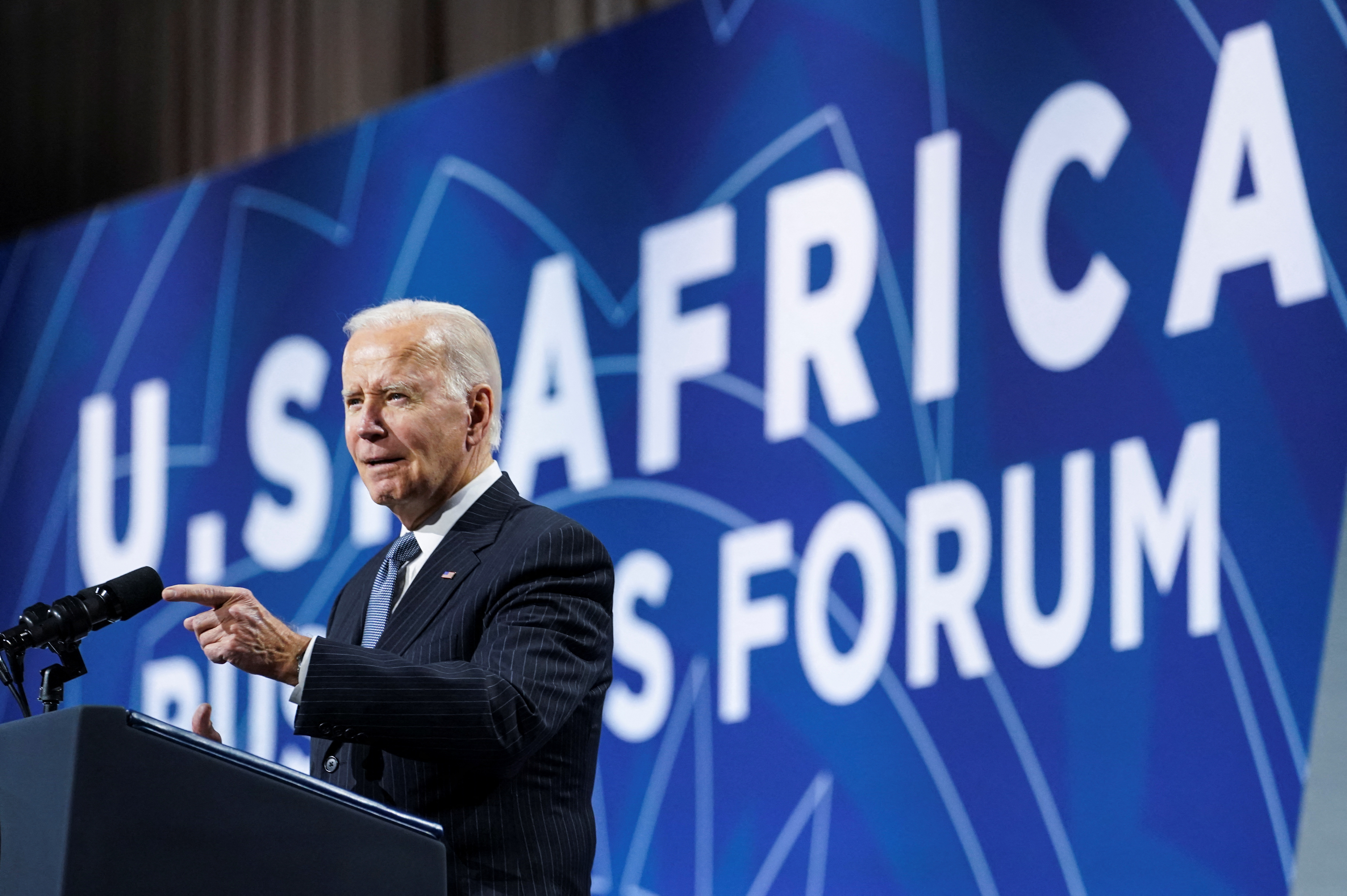
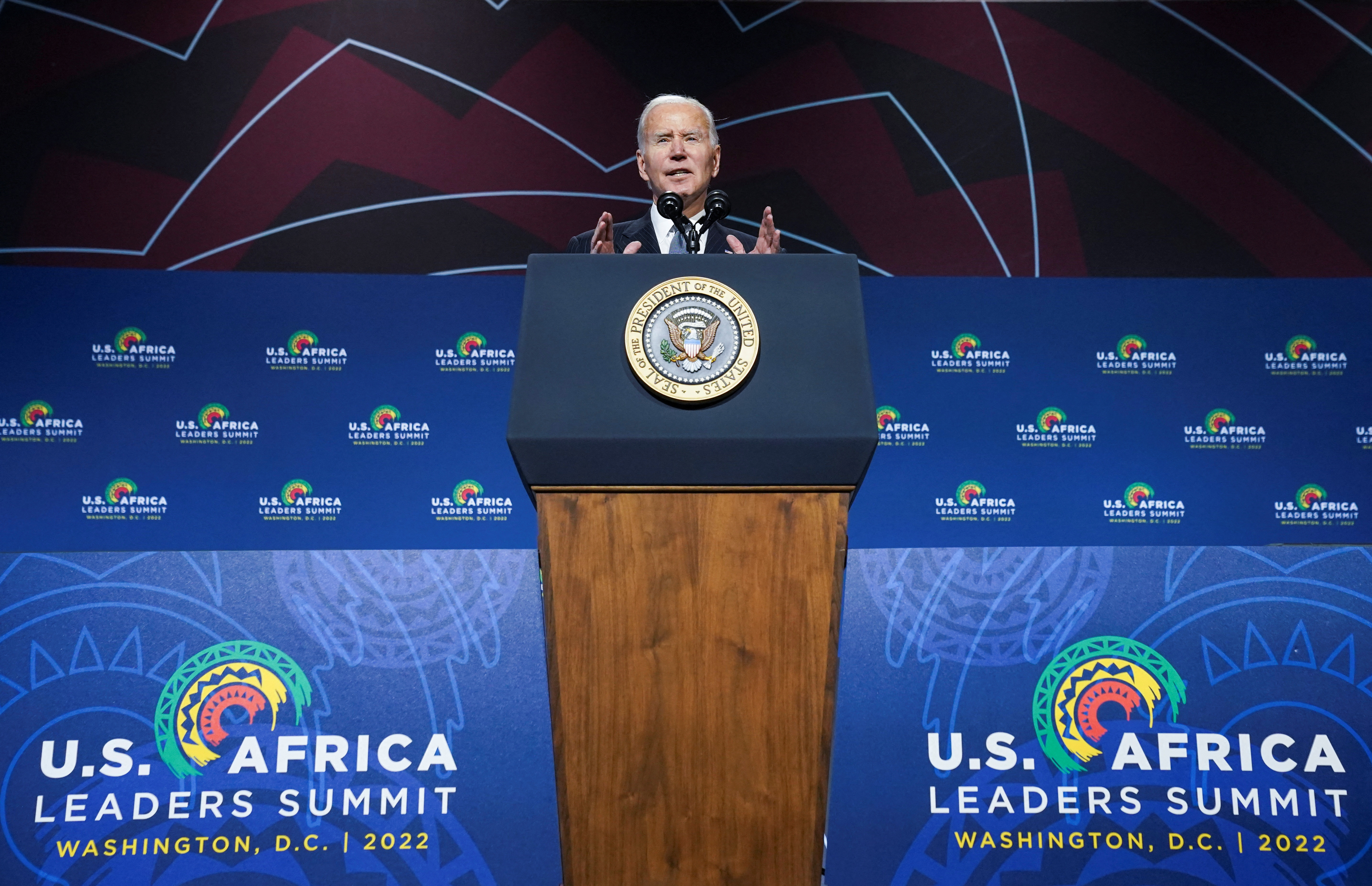
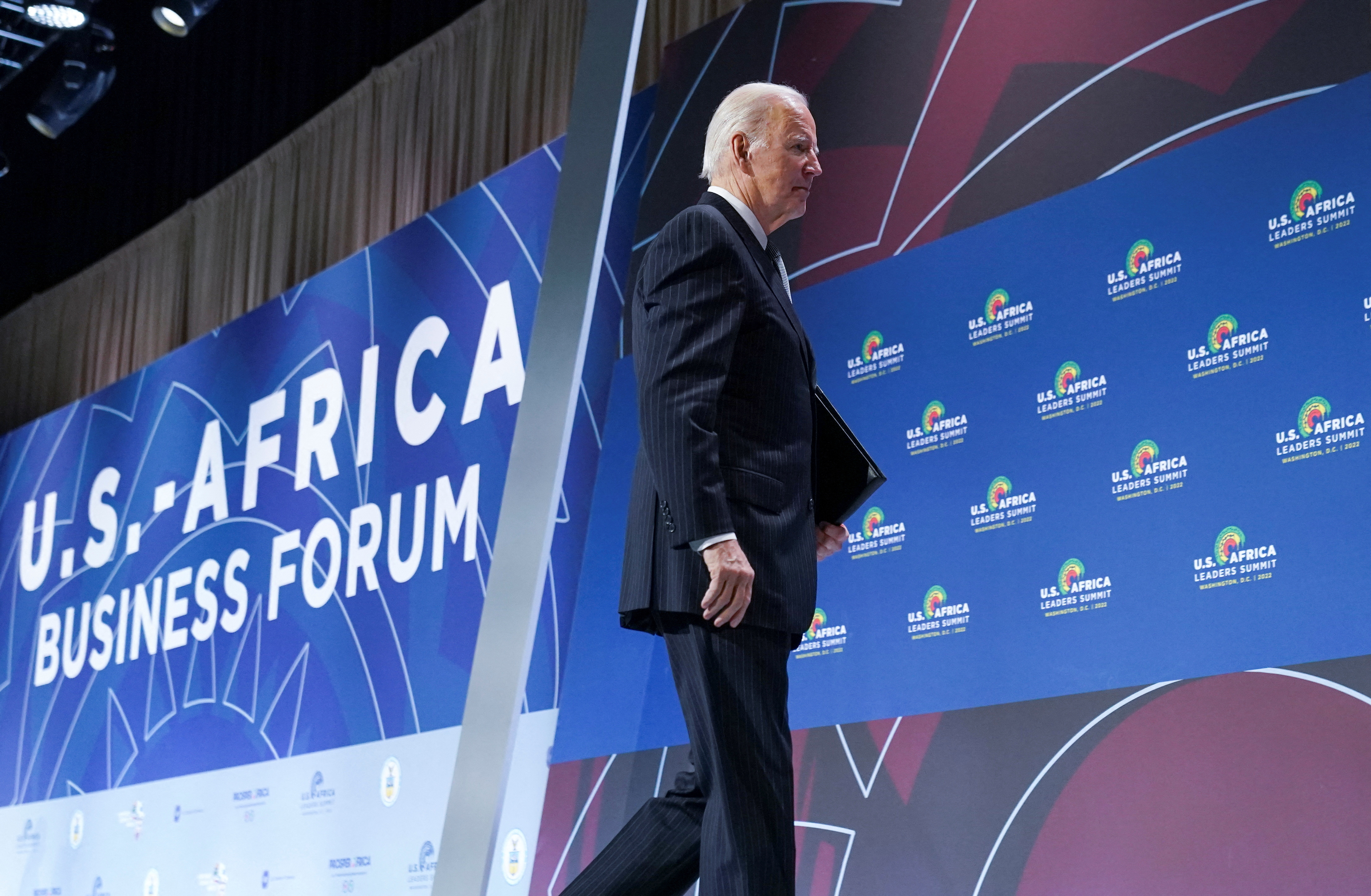
U.S. President Joe Biden delivers keynote remarks at a U.S.-Africa Business forum at the 2022 U.S.-Africa Leaders Summit in Washington, U.S., December 14, 2022. REUTERS/Kevin Lamarque

U.S. President Joe Biden delivers keynote remarks at a U.S.-Africa Business forum at the 2022 U.S.-Africa Leaders Summit in Washington, U.S., December 14, 2022. REUTERS/Kevin Lamarque

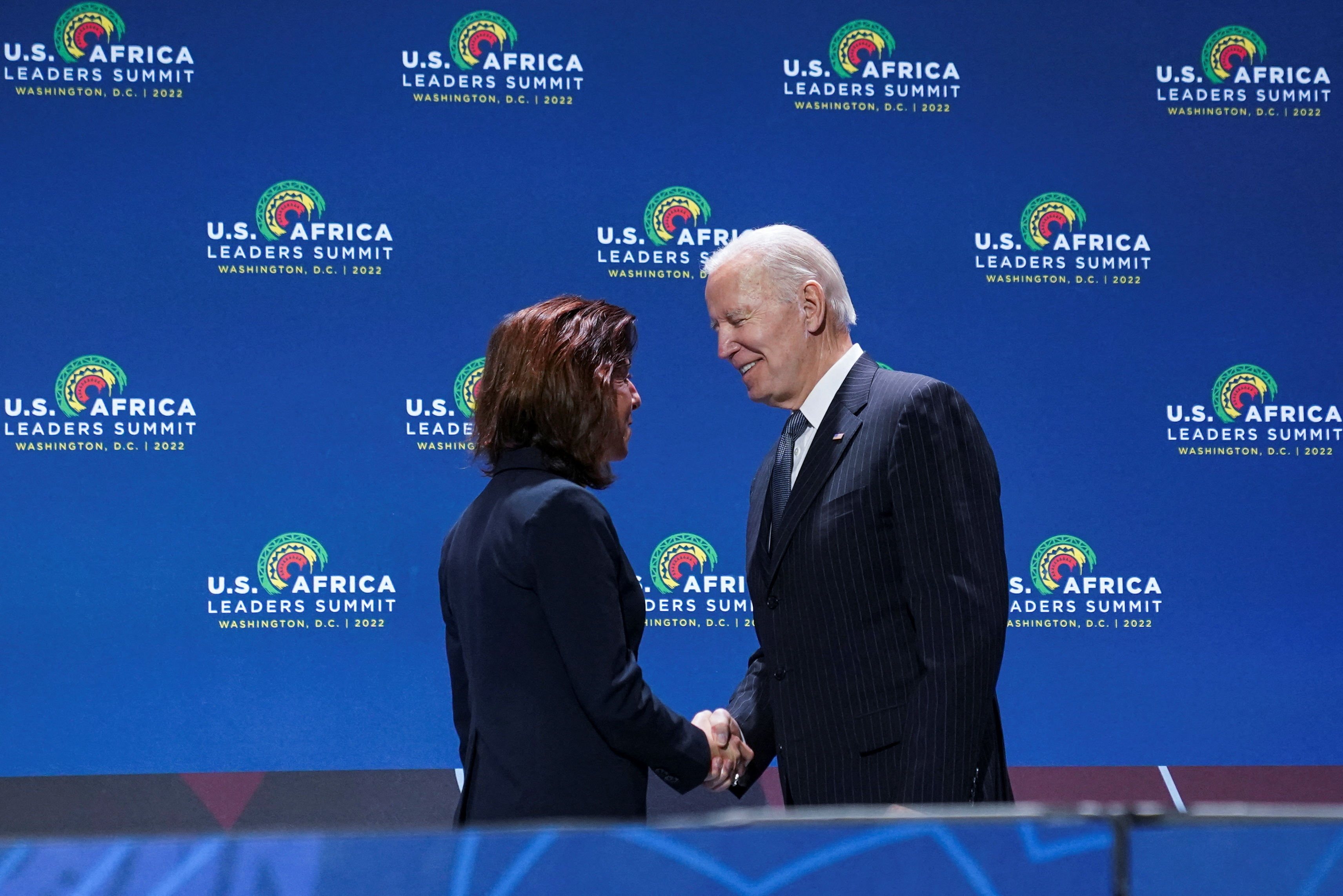
U.S. President Joe Biden greets U.S. Secretary of Commerce Gina Raimondo at a U.S.-Africa Business forum, where they spoke during the 2022 U.S.-Africa Leaders Summit in Washington, U.S., December 14, 2022. REUTERS/Kevin Lamarque

U.S. President Joe Biden delivers keynote remarks at a U.S.-Africa Business forum at the 2022 U.S.-Africa Leaders Summit in Washington, U.S., December 14, 2022. REUTERS/Kevin Lamarque

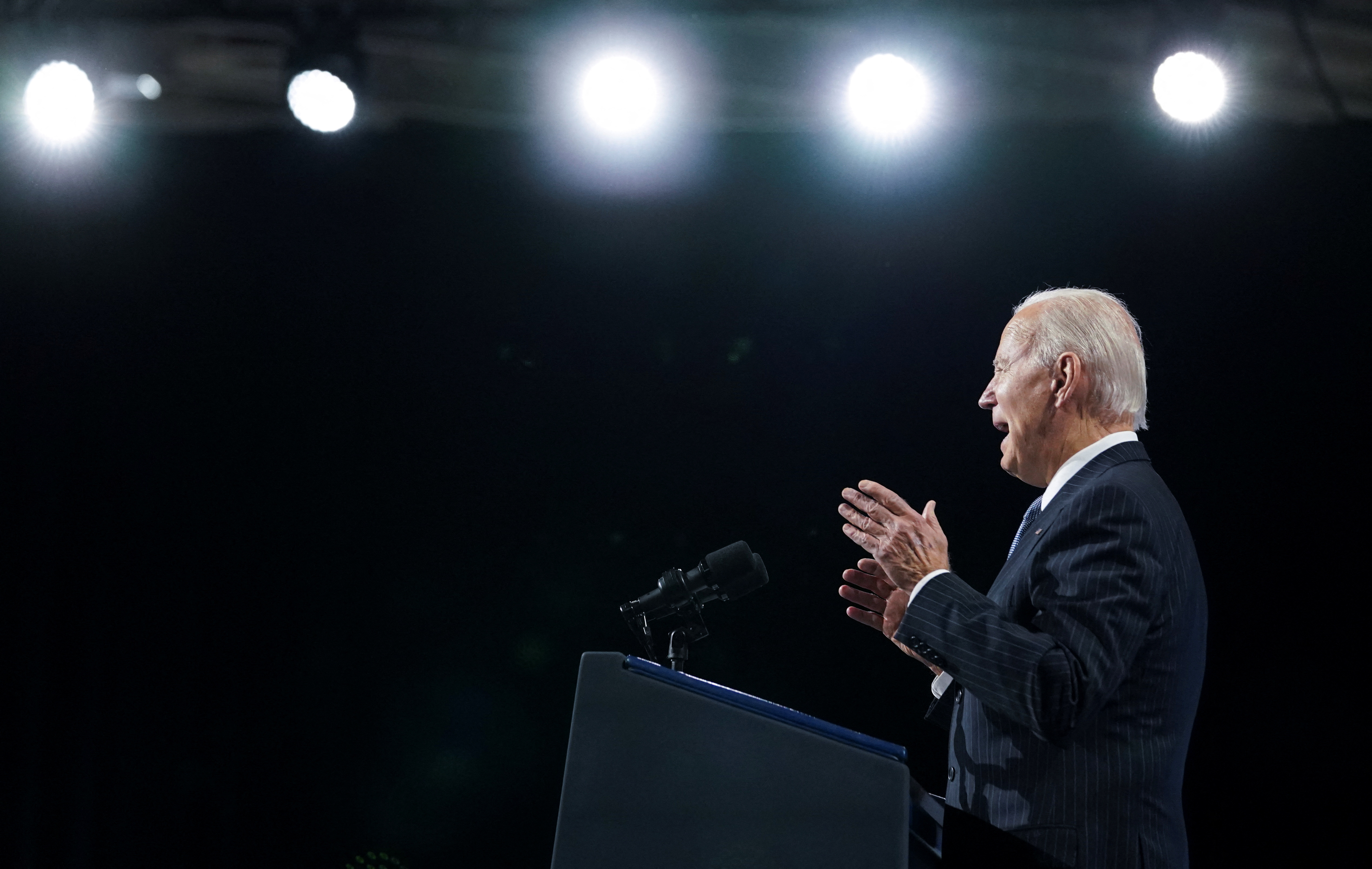
U.S. President Joe Biden departs after delivering remarks at a U.S.-Africa Business forum at the 2022 U.S.-Africa Leaders Summit in Washington, U.S., December 14, 2022. REUTERS/Kevin Lamarque

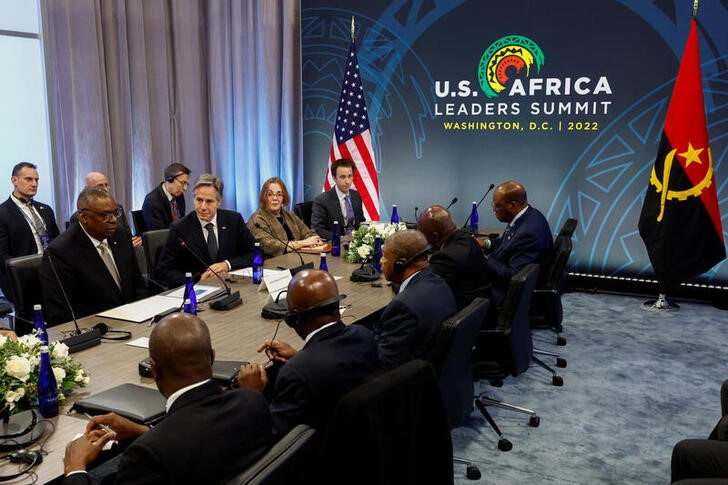
U.S. Secretary of State Antony Blinken and U.S. Defense Secretary Lloyd Austin meet with Angolan President Joao Lourenco during the U.S.-Africa Leaders Summit 2022 in Washington, U.S., December 13, 2022. REUTERS/Evelyn Hockstein/Pool

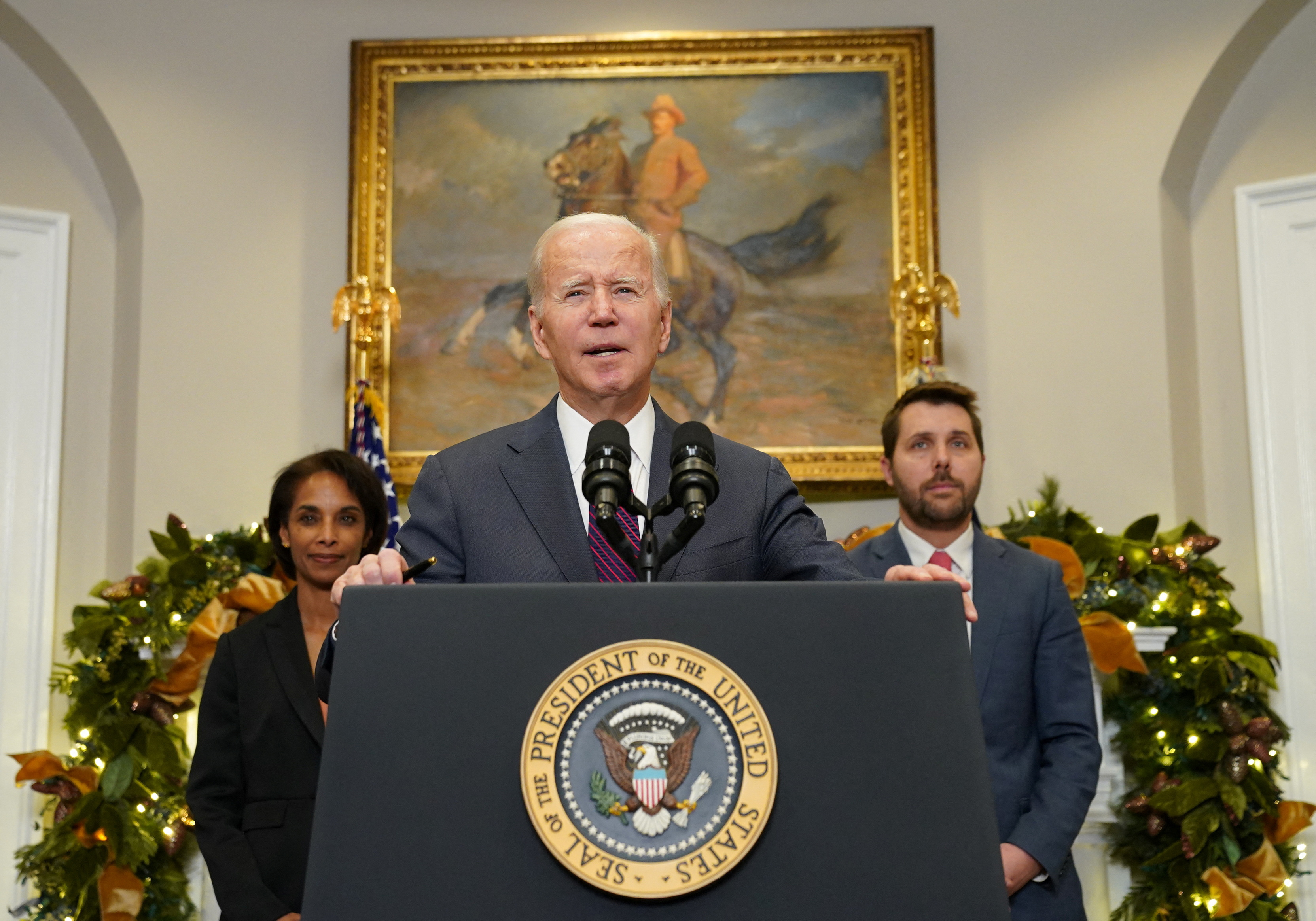
U.S. President Joe Biden speaks about inflation at the White House in Washington, U.S., December 13, 2022. REUTERS/Kevin Lamarque


WP Radio
WP Radio
OFFLINE LIVE