Categories
Audio Sources - Full Text Articles

Explainer: How the U.S. plans to commit $55 billion to Africa over three years

2022-12-13T16:40:16Z

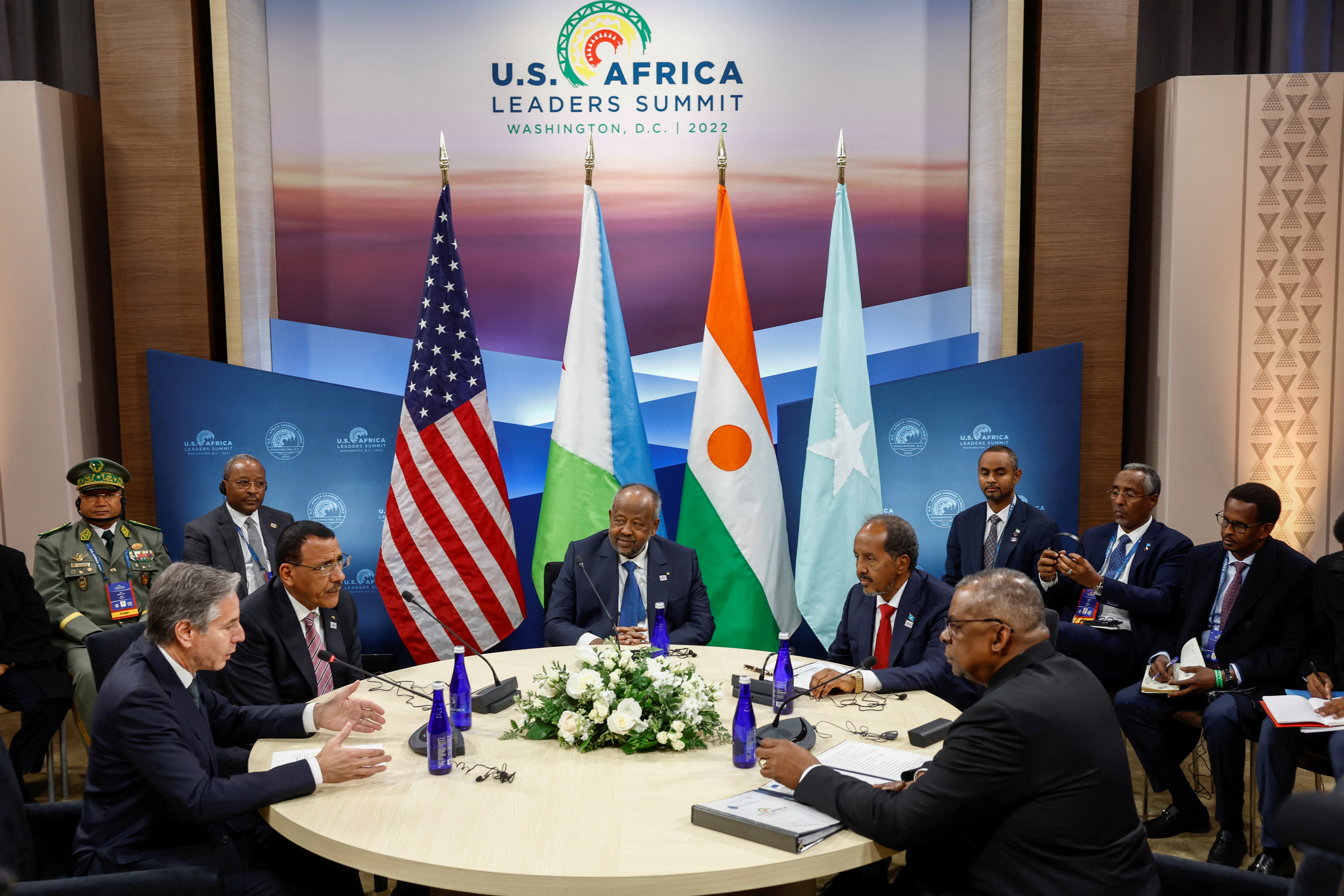
U.S. Secretary of State Antony Blinken and U.S. Defense Secretary Lloyd Austin meet with Djibouti’s President Ismail Omar Guelleh, Somalia’s President Hassan Sheikh Mohamud and Niger’s President Mohamed Bazoum during the U.S.-Africa Leaders Summit 2022 in Washington, U.S., December 13, 2022. REUTERS/Evelyn Hockstein/Pool

The United States plans to commit $55 billion to Africa over the next three years, White House national security adviser Jake Sullivan told reporters on Monday.

The money will go to “a wide range of sectors to tackle the core challenges of our time,” and is being distributed in close partnership with Congress, Sullivan said.

Much of the funds appear to come from previously announced programs and budgets.

Here is what the White House has said so far about where the $55 billion will go:

The Biden-Harris administration has invested and committed to provide nearly $20 billion in health programs in the Africa region, the White House said on Tuesday.

That includes $11.5 billion to address HIV/AIDS; more than $2 billion to combat malaria; more than $2 billion in support of family planning and reproductive health as well as maternal and child health; and more than $2 billion to address the health, humanitarian, and economic impacts of COVID-19.

The administration also plans to ask Congress for $4 billion for healthcare workers in Africa, investing $1.33 billion annually from 2022 to 2024.

Since January 2021, the administration has invested and plans to provide at least $1.1 billion to support African-led efforts to support conservation, climate adaptation, and energy transitions.

These funds include U.S. International Development Finance Corporation investments into Malawi’s Golomoti JCM Solar Corporation, and a Climate Action Infrastructure Facility.

Categories
Audio Sources - Full Text Articles

French court sentences eight over 2016 truck attack in Nice

2022-12-13T16:44:55Z

Photos and names of the 86 victims of the July 14, 2016 truck attacks are seen on a memorial on the Promenade des Anglais in Nice, France, August 29, 2022. REUTERS/Eric Gaillard

A French court found seven men and one woman guilty on Tuesday for their roles in a 2016 truck rampage in the southern city of Nice in which 86 people were killed.

Attacker Mohamed Lahouaiej Bouhlel was shot dead by police on the spot after causing devastation and chaos on a two km (1.2 mile) stretch of Nice’s seaside boulevard, where families had been celebrating Bastille Day, France’s national holiday.

The Paris court found Mohamed Ghraieb, the main defendant and a friend of Bouhlel, guilty of belonging to a terrorist organisation. He was handed an 18-year prison sentence.

The judges also found Chokri Chafroud and Ramzi Arefa, two other high-profile defendants – who had been accused of helping Bouhlel to obtain weapons and the truck – guilty of belonging to a terrorist organisation. They were handed jail sentences of 18 and 12 years respectively.

Five other people were handed sentences of two to eight years.

None of the defendants was accused of taking part in the attack or even of complicity – a decision which survivors said they were struggling with.

Islamic State claimed responsibility a few days after the Nice rampage but offered no proof that the attacker, who had a record of domestic violence and petty crime, had had any direct contact with the group.

The verdict can be appealed.

Categories
Audio Sources - Full Text Articles

Schumer expects yearlong funding bill to include Ukraine aid, vote reform

2022-12-13T16:29:35Z

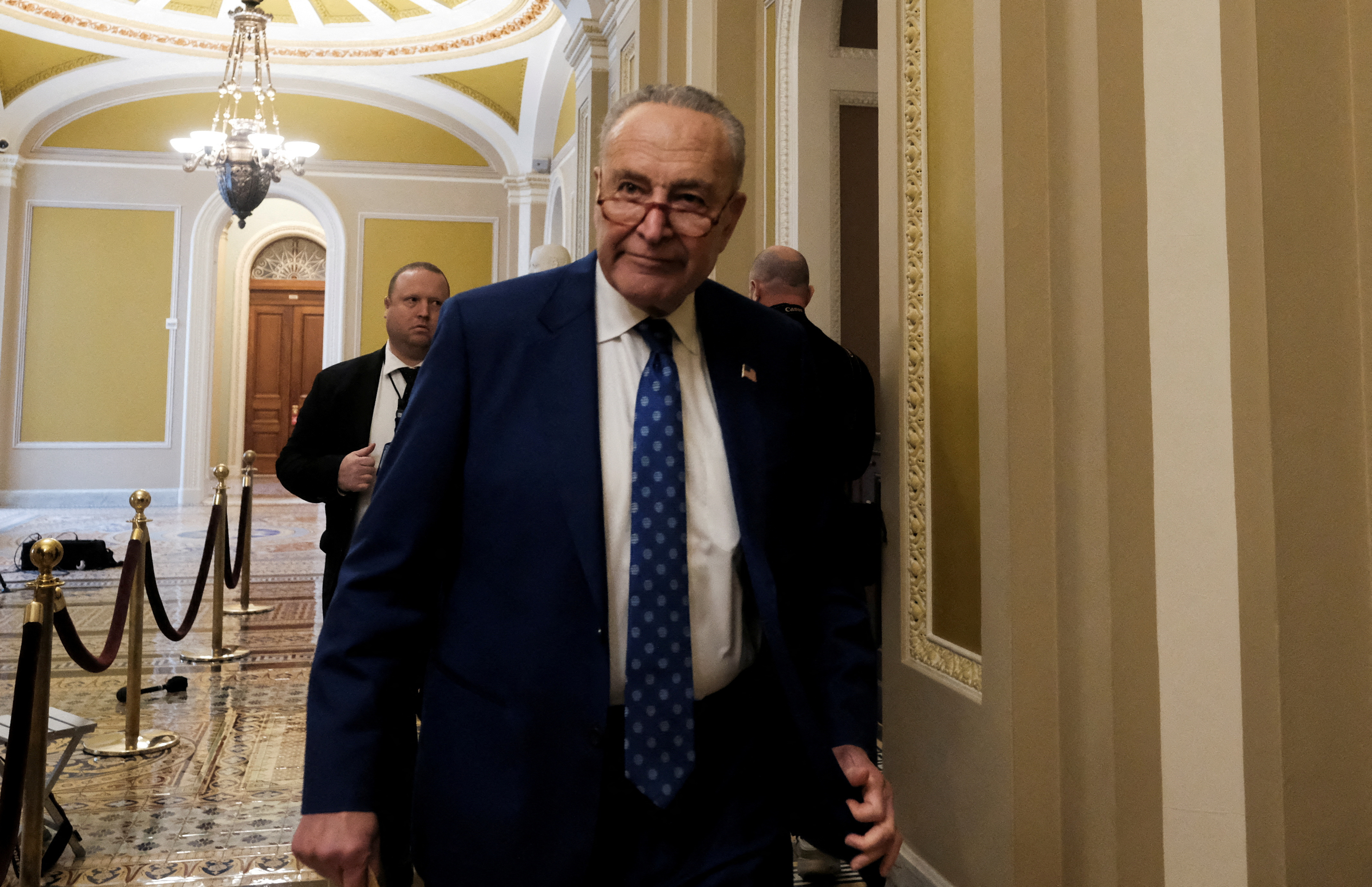
U.S. Senate Majority Leader Chuck Schumer walks at the U.S. Capitol building in Washington, U.S., November 15, 2022. REUTERS/Michael Mccoy

U.S. Senate Majority Leader Chuck Schumer on Tuesday said he expects a yearlong government funding bill to include more funding for Ukraine and measures to reform the way Congress certifies presidential elections.

The Senate should be ready to vote on a bill to keep the federal government operating for one week past a Friday deadline, as negotiations continue between Democrats and Republicans over the longer-term measure, Schumer said on the Senate floor.

Both parties agree on support for Ukraine as it battles Russia and reforms aimed at avoiding a repeat of the turmoil of Jan. 6, 2021, Schumer said. He said negotiations continue on other matters.

“There’s a lot of work left to do,” Schumer said. “But we’re optimistic that if we preserve the good faith we’ve seen so far, we will get there.”

The yearlong measure, which is likely to spend more than $1.5 trillion, would fund the government until October 2023 and would have to be passed by the Senate and the House of Representatives.

Republicans want to increase defense spending while avoiding an increase in domestic spending. Democrats oppose that approach.

Categories
Audio Sources - Full Text Articles

Biden’s Africa Summit Legitimizes Strongmen Like Kagame

President Joe Biden this week will host heads of state for the second U.S.-Africa Leaders’ Summit, eight years after the first, convened under the Obama administration. Former president Trump did not engage with the continent, aside from casually hurling racist insults at African nations and cozying up to his ”favorite dictators.” So, while this high-level gathering is a welcome resumption, it is telling to see who will be arriving this week, longevity in office being something of a red flag. To be sure, there have been notable democratic turnovers since the last summit: In the Gambia in 2016 and Zambia in 2021, citizens bravely stood up to and voted out their autocratic leaders. Kenya—a hugely influential African country—this year organized an election that was widely certified by observers to be credible, free, and fair.

[time-brightcove not-tgx=”true”]

But many retrograde African leaders– including 10 who attended in 2014—will soon touch down in Washington, walk the red carpet at the White House, and smile for photographs that will assuredly be used for propaganda purposes back home. A smiling portrait with the American president, after all, will signal to repressed citizens abroad that their pro-democracy efforts are futile. It sends the unequivocal message that no matter how hard they agitate or persevere, the U.S. will stand by their oppressors – and even shake their hands.

Perhaps no African leader plays this game of image management better than Paul Kagame of Rwanda, effectively in power since 2000—longer than the average Rwandan citizen has been alive. Kagame is among the 20 percent of African heads of state who will make a repeat appearance at this week’s summit, being billed as an opportunity to identify “shared values.” But even among this cohort of long-reigning despots and dictators, Rwanda’s president stands out as particularly cunning and ruthless in his full-throttle consolidation of political power back home—a decades-long pursuit that has been, in part, aided and abetted by the United States during successive administrations.

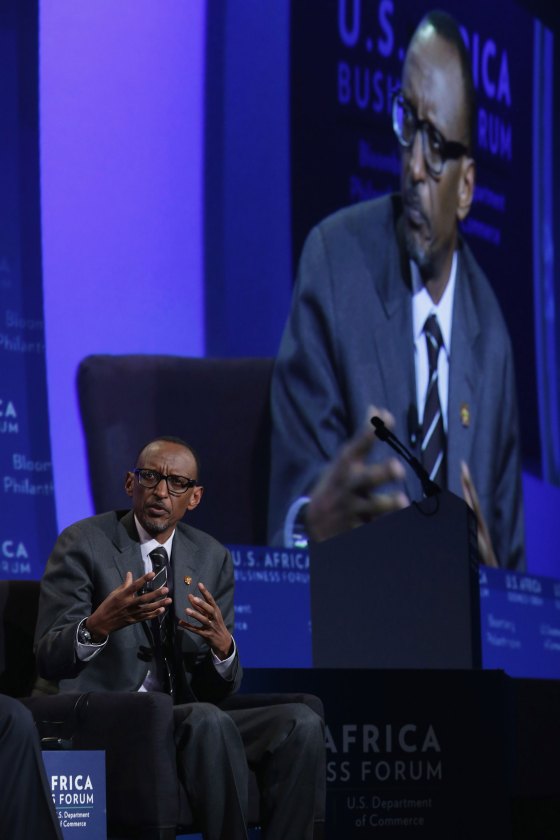
U.S. Rwanda President Paul Kagame speaks during a panel at the U.S.-Africa Business Forum on August 5, 2014 in Washington, D.C.
Chip Somodevilla—Getty ImagesU.S. Rwanda President Paul Kagame speaks during a panel at the U.S.-Africa Business Forum on August 5, 2014 in Washington, D.C.

As Kagame once said of his political opponents, “Many of them tend to die.” So, too, has any façade of democracy in Rwanda. Since winning the country’s first direct presidential elections in 2003—with over 95% of the vote, a winning percentage that has grown to 99% in recent years— Kagame has systematically installed the structures of a totalitarian state in which literally any measure can, and will, be taken by state authorities to silence the calls for inclusivity and democratic reform—from intimidation to collective punishment and from kidnappings to ‘disappearances.’ Even state-sanctioned murder has become routine.

The August 2020 kidnapping of Paul Rusesabagina—a permanent U.S. resident and a Presidential Medal of Freedom Honoree whose actions in the 1994 genocide inspired the film Hotel Rwanda—has cast an especially piercing light on the regime. The ordeal has prompted several congressional resolutions demanding his unconditional release. In July, Senator Robert Menendez, chairman of the Senate Foreign Relations Committee, requested a comprehensive review of U.S. policy toward Rwanda, committing to place a hold on all U.S. security assistance over concerns about human rights and Rwanda’s apparent role in the humanitarian catastrophe unfolding in neighboring Congo. Most prominently, Secretary of State Antony Blinken used his authority, provided by the U.S. Congress, to designate Rusesabagina as “wrongfully detained,” the same designation as Brittney Griner, who was freed from a Russian prison last week after intense U.S. negotiations. To put this into context: there is not another world leader alive today who would have the ability to move freely around Washington with this diplomatic red flag on their record.

As dire as the situation has been in Rwanda, an argument can be made that it is growing worse. And it may deteriorate further in the following months. This is because 2024 will mark both the 30-year anniversary of the 1994 genocide as well as fall on a presidential election year, one in which Kagame will contest for a fourth term after forcing through a change in the country’s constitution to extend his rule. As an anonymous Rwandan citizen told a Human Rights Watch researcher: “Here, the problem is talking the truth. If you do, they go after you.”

The U.S. government, of course, is fully aware of this expanding catalog of serious crimes, both at home in Rwanda and abroad through the use of transnational repression. In addition to the added scrutiny in the halls of the U.S. Congress, Rwanda’s myriad human rights abuses are published annually in the Department of State’s Country Reports on Human Rights Practices.

Nevertheless, since officially taking power in 2003, total aid and development assistance to the Kagame regime has increased by 400%, according to data from the World Bank. In Fiscal Year 2021, the U.S. alone provided over $147 million in bilateral assistance, including to “advance goals in democracy and governance.” These investments—which comprise a significant percentage of Rwanda’s state budget—have emboldened an already brazen dictator. Instead of committing to reform—in line with the demands of citizens across Africa for more openness, civil liberties, and multi-party democracy—Kagame merely snubs his nose at the condemnations of his abusive rule, while cynically accusing his critics of “hypocrisy.”

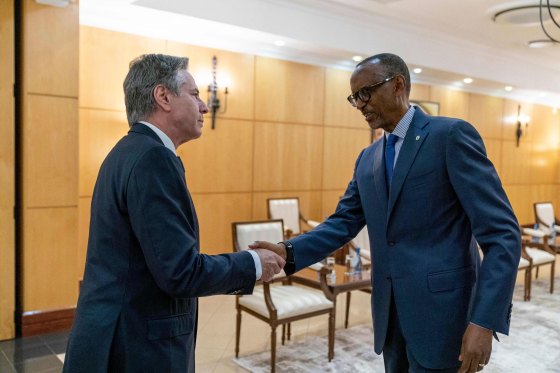
US Secretary of State Antony Blinken meets with Rwandan President Paul Kagame at the Presidents Office in Urugwiro Village in Kigali, Rwanda, on August 11, 2022.
Andrew Harnik—Pool/AFP/Getty ImagesUS Secretary of State Antony Blinken meets with Rwandan President Paul Kagame at the Presidents Office in Urugwiro Village in Kigali, Rwanda, on August 11, 2022.

The transformation of Africa will be driven by Africans, especially younger generations, those who see freedom of speech and free and fair elections as the key pillars of democracy. But by funding and enabling Africa’s aging autocrats, the U.S will stand in the way of those ambitions. If the Biden Administration is sincere about building on “shared values” and advancing equitable relationships with African citizens, then investments beyond retrograde strongmen like Paul Kagame would be an ideal place to start.


Categories
Audio Sources - Full Text Articles

I burned out trying to juggle a side hustle and full-time job. Here’s the 5-step plan I used to decide when it was time to go all-in on my business.

headshot of Leah PhiferLeah Phifer.

Courtesy of Leah Phifer

  • Leah Phifer is an employee-engagement consultant who helps organizations retain their staff.
  • She left her job in the government in May to focus exclusively on her small business.
  • She knew it was time to quit once she recognized burnout and was able to cover her needs.

Like many first-time entrepreneurs, I started my employee-engagement consultancy, WhyWork, as a side hustle. I had a solid nine-month plan to transition it into my primary employment, including income benchmarks and a transition to part-time work in my job as a human-resources specialist for the United States Department of Agriculture. This plan was based on financial advice I derived from a variety of reputable sources, including the Forbes Expert Panel and Harvard Business Review.

But most entrepreneurs never do anything halfway, and I was no exception. About three months into my plan, I was working 15 to 20 hours a week on my business while also juggling a 40-hour workweek. Then two of my immediate family members suffered health issues that required an additional 10 to 15 hours a week of caregiving.

Having experienced burnout one other time in my life after running for Congress in one of the nation’s largest districts, I knew I had to get it under control before it brought down my mental health, putting both my young business and full-time job at risk.

I decided to focus on my consulting practice, but I didn’t know if I was ready to go all-in. So I came up with a plan.

If you’re undertaking a similar assessment, here are a few ways to get clear on when to make the leap into full-time entrepreneurship and avoid burning out in the process.

1. Name the problem

Acknowledging burnout is the first step to overcoming it. To understand if what you’re feeling is burnout, start by identifying the cause.

According to the World Health Organization, there are three components to burnout. The first is cynicism, which occurs when you can’t see the impact of your work, so you feel it’s insignificant or meaningless. The second is inefficacy, when you feel like a failure at work because you lack the resources or autonomy to do your job well. The third component is discussed the most frequently — exhaustion. Exhaustion occurs when working long-term in high-pressure situations or logging more hours each day than is feasible for your energy levels. Suffering from one or more of these components at any given time constitutes burnout.

When I sat down to assess why my energy levels were so depleted, I realized I was suffering from exhaustion brought on by time poverty — the feeling of having too many things to do and not enough time to do them. Research shows that once people make enough to meet their basic needs, additional money doesn’t make them any happier, but additional time does. This boost in happiness then contributes to higher productivity and creativity at work (two attributes I knew would benefit my small business). I used this knowledge to change my goals from a foundation of “wants” and “shoulds” to ones based on meeting my basic needs.

2. Acknowledge it will only get worse if left unaddressed

Once you’re clear on where your feelings of depletion, stress, or negativity come from, the next step requires coming to terms with the action needed. You can’t just power through burnout — you must take action to avoid derailing your personal or professional life.

When I paused to understand how I was feeling, I realized I was suffering from exhaustion by working more hours than my body could reasonably handle. The only thing to do was eliminate some areas of work — even if it meant making sacrifices. If your feelings of depletion at work stem from cynicism or inefficacy, one step you can take is asking your boss or coworkers for what you need to make a meaningful impact at your job.

3. Make a plan to cover what you need

Most people can’t eliminate major obligations in their life at the first sign of burnout. My first sign came when, after a long day at work, I broke down crying while waiting to pick up a prescription for my grandma. I called my fiancé from the pharmacy parking lot and told him I couldn’t survive another five months at this pace. I was nervous, as we’d spent so much time putting together the financial plan to take my business full-time.

He was immediately supportive. When I got home, we laid out our finances and designed a plan that allowed us to meet our financial needs instead of goals. My original goal-based plan was to earn approximately $8,000 a month in consulting revenue, bringing me to the equivalent of my government salary before I resigned. Upon reassessment, we realized I didn’t need to completely replace my income — I only needed to cover my bills, which cost approximately $3,500 a month.

I left the USDA this May when my business made $3,700. The new plan allowed me to leave my job sooner by focusing on what I needed.

4. Enlist support 

Once you’ve made a decision, accountability is key. Even in the midst of the Great Resignation, it’s hard to walk away from a job you’ve been doing for years, especially if you have friends there.

Find a friend or family member to hold you accountable, someone to ensure you’re executing the plan. In addition to my partner, I also told my mom about the new plan. She was not only supportive but relieved after watching my stress levels mount for months. When I found myself hesitant to tell my boss, my partner and mom reminded me why I needed to do this and what was at stake.

5. Be open to change

The realization of how burnout could affect my business ultimately aided the final point of my plan and introduced me to some of the best advice for entrepreneurship — be prepared to pivot. Focusing on my business full-time allowed me to better assess the market, illuminating needs my original business plan didn’t address.

When I launched WhyWork, I focused exclusively on interviewing employees to uncover their unique motivators and goals, then capturing that in an individual engagement plan for their leadership. That remains the heart of my consulting practice, but I now offer individual burnout coaching, workshops, and wellbeing assessments as well. One of my most popular offerings now is a hands-on workshop where participants build models with Legos to work through complex challenges. Truly listening to what your target clientele needs will allow your business to grow.

Read the original article on Business Insider
Categories
Audio Sources - Full Text Articles

FTX founder Sam Bankman-Fried made political contributions under other people’s names, US authorities allege

Samuel Bankman-Fried, founder and CEO of FTX, testifies during a Senate Committee on Agriculture, Nutrition and Forestry hearing about "Examining Digital Assets: Risks, Regulation, and Innovation," on Capitol Hill in Washington, DC, on February 9, 2022Samuel Bankman-Fried, founder and former CEO of FTX, testifies during a Senate Committee on Agriculture, Nutrition and Forestry hearing about “Examining Digital Assets: Risks, Regulation, and Innovation,” on Capitol Hill in Washington, DC, on February 9, 2022

Photo by SAUL LOEB/AFP via Getty Images

  • A federal indictment alleges FTX CEO and founder Sam Bankman-Fried committed several campaign finance violations.
  • Bankman-Fried is accused of donating to politicians under others’ names, wire fraud, money laundering, and more.
  • He was arrested on Monday in the Bahamas and is expected to be extradited to the US.

US authorities allege that former FTX CEO and co-founder Sam Bankman-Fried violated multiple campaign finance laws, including by sending donations to politicians “in the names of other persons.”

Bahamian authorities arrested Bankman-Fried on Monday with the expectation that he will be extradited to the US. A freshly unsealed indictment accuses him of conspiracy to commit wire fraud, conspiracy to commit securities fraud, laundering money, and more. 

And among the litany of charges levied against Bankman-Fried, he’s accused of committing several campaign finance violations. The indictment, which came down from the Southern District of New York, accuses Bankman-Fried and unnamed others of conspiring to “defraud the United States” in several ways.


One way that Bankman-Fried defrauded the US, the indictment alleges, is by donating to candidates and political action committees using other people’s names. The names used by Bankman-Fried and others were not named in the indictment.

“The defendant, and others known and unknown, would and did knowingly and willfully make contributions to candidates for federal office, joint fundraising committees, and independent expenditure committees in the names of other persons,” the indictment notes.

According to the Federal Election Commission’s website “Contributions in the Name of Another are Strictly Prohibited.” 

“Reimbursing someone for a contribution or otherwise contributing in the name of another person can result in substantial civil penalties and jail time,” the site notes.

Using these methods, the indictment alleges Bankman-Fried and unnamed others donated more than $25,000 in total in a calendar year, in violation of campaign finance regulations. 

Bankman-Fried was no run-of-the-mill donor — the former CEO was one of the Democratic Party’s largest donors, publicly sending committees and politicians tens of millions. In a recent interview, however, Bankman-Fried said he donated an equal amount to Republicans using “dark,” or non-publicly disclosed methods.

“All my Republican donations were dark,” Bankman-Fried said. “The reason was not for regulatory reasons, it’s because reporters freak the fuck out if you donate to Republicans. They’re all super liberal, and I didn’t want to have that fight.”

Relatedly, the Citizens for Responsibility and Ethics in Washington filed a complaint with the FEC last week regarding Bankman-Fried’s use of dark money groups to hide his Republican donations.

Read the original article on Business Insider
Categories
Audio Sources - Full Text Articles

The electric F-150 is the ‘best truck Ford has ever made,’ MotorTrend says

The Ford F-150 Lightning.The Ford F-150 Lightning is the second electric pickup to win MotorTrend’s Truck of the Year award.

Tim Levin/Insider

  • The Ford F-150 Lightning is MotorTrend’s 2023 Truck of the Year. 
  • The magazine says the electric model is Ford’s best truck ever. 
  • MotorTrend praised its acceleration, handling, style, and importance to the EV movement. 

The all-electric F-150 is MotorTrend’s favorite new pickup truck, nabbing the magazine’s coveted 2023 Truck of the Year award. 

But the F-150 Lightning isn’t just the best truck this year. MotorTrend says it’s Ford’s best truck ever. 

“The F-150 Lightning’s instantaneous torque and standout ride and handling make it without a doubt the
best truck Ford has ever made,” Ed Loh, the magazine’s head of editorial, said in a press release. “The Ford F-150 Lightning is no less than a milestone achievement in the history of American mobility.”

The Lightning is a massive deal both for Ford and the wider transition toward clean vehicles. A zero-emission version of America’s most popular truck (the Ford F-Series), it’s seen by many as a crucial stepping stone toward mass acceptance of EVs. (Electric cars make up some 5% of US car sales today.)

MotorTrend said the Lightning excels across six criteria: safety, efficiency, value, advancement in design, and performance of intended function.

As opposed to other new electric trucks like the GMC Hummer EV and Rivian R1T (which won last year’s award), the Lightning targets existing truck owners with its familiar, traditional styling and feel. From the outside, it looks nearly identical to a gas-powered F-150. 

“While some vehicles change the world by being radically different, others, like the Ford F-150 Lightning, change it by being different where it counts and familiar where it helps,” MotorTrend said, adding that the truck “successfully bridges the gulf between the powertrain of the future and the pickup truck of today.” 

MotorTrend also noted the Lightning’s $52,000 starting price (which is lower than other EV trucks), its ability to provide electricity to homes, job sites, and campsites, and its excellent handling. The Lightning accomplishes truck stuff as well as any of its gas-powered rivals, the outlet said, but towing is a weak spot for all electric pickups. 

Read the original article on Business Insider
Categories
Audio Sources - Full Text Articles

The November inflation report won’t change Wednesday’s Fed decision but could influence a slower pace of tightening next year, economist says

Federal Reserve Chair Powell Speaks At The Brookings InstitutionChair of the U.S. Federal Reserve Jerome Powell speaks at the Brookings Institution, November 30, 2022 in Washington, DC. Powell discussed the economic outlook, inflation and the labor market.

Drew Angerer/Getty Images

  • Wednesday’s rate hike decision won’t be influenced by the latest inflation report, according to Ian Shepherdson. 
  • The Pantheon Macroeconomics chief economist wrote in a Tuesday note that the Fed could slow down in 2023. 
  • He noted encouraging signs of disinflationary pressure present in consumer data. 

The latest inflation report will do little to impact the Federal Reserve’s rate hike decision on Wednesday but could lead to a slowdown in monetary tightening in 2023, according to Pantheon Macroeconomics. 

Chief economist Ian Shepherdson wrote in a Tuesday note viewed by Insider that central bank chair Jerome Powell could strike a more tepid tone compared to the hawkishness on display in his November comments. 

Ultimately, Shepherdson says, “this report does not change tomorrow’s Fed decision; they will hike by 50bp.” he added that Powell’s “more dovish colleagues likely will be emboldened by this report” which could lead to a change in policy next year.

“We now think 25bp is more likely on Feb 1, and we think that will be the final hike,” Shepherdson said. “Disinflationary pressure has been visible in the pipeline for some time, but now it is emerging where it counts, in the consumer data.”

Shepherdon noted that rapid fall in used vehicle prices helped pull down core inflation – which strips out often volatile components like energy and food – which slowed to a 0.1% increase below expectations. He also posits that the 0.7% increase in rents last month, while volatile, could “slow sharply over the next year.”


Read the original article on Business Insider
Categories
Audio Sources - Full Text Articles

Can COP keep up with an evolving climate effort?

By Emily Carlton, David G. Victor

Another United Nations climate conference (COP) has come and gone, leaving the world to scratch its head over what was accomplished. The annual conference has ballooned over the years into a massive climate festival: nearly 50,000 people — an all-time record — taking part in the rituals of formal diplomacy and, in parallel, a flashy climate change expo. So what came of it?

If you ask people who paid attention only to the formal negotiations, the answer is not much. Meetings were frustrating and adversarial, focused on broken promises and eking out small, hard-fought victories. When they finally ended — two days after the formal deadline had expired — there was a sense of relief that consensus had been reached, but bewilderment about its content. Most visibly, parties agreed to set up a new funding mechanism to compensate developing countries for the “loss and damage” caused by climate change. But the fund was empty of money. What the celebrated agreement really does is lay out a process for future negotiations on a slew of issues where governments don’t much agree — including who will pay into the fund and how the money, if it ever appears, will get spent.

Those who focused more on the other things happening around COP27 have a different and more encouraging story to tell. That story is full of examples of implementation — small groups of governments and firms working together to transform key industrial sectors. Too often, these examples of productive cooperation and practical action get overlooked because they happen largely outside the negotiating room.

As the climate effort shifts from forging consensus around the need to do something, to actually doing things, implementation is what really matters. The character of the COP event is evolving accordingly — every year, firms, governments, researchers, and civil society show up in greater numbers to showcase and build on their activities in what is now a full-blown climate expo. But even as focus on the ground shifts away from formal diplomacy and toward action, media coverage keeps the spotlight on the formal process.

The message coming out of COP matters. The Paris Agreement was built on the logic that action by some will beget more action by others — building trust and collaboration, ratcheting ambition and generating momentum. The COP is the most important climate conference in the world. Many look to it to gauge the temperature of progress on global climate action. For the event to continue inspiring collective action, the world needs a more holistic message about its outcomes — not just the division and chaos coming from the negotiating room, but also the real efforts and purposeful learning emerging outside it.

Competing stories from COP27

The big diplomatic win dominating COP27 news was the creation of the loss and damage fund to compensate vulnerable countries for climate impacts. Certainly this was important, both morally and to maintain the legitimacy of the Paris Agreement, which is partly rooted in meaningful global consensus. But the victory was largely symbolic, punting on all the hardest questions about how the fund will work (stay tuned for a big fight in 2023 over whether high-emitting developing countries like China should be required to contribute). Still, it was unexpected and an uphill battle. Going in to COP27, loss and damage funding was widely seen as a non-starter (developed countries balked at the cost and precedent), but Europe, with the most at stake in maintaining global climate solidarity, blinked at the last moment and agreed, leaving other rich countries little choice but to follow. Ultimately, the celebration following the loss and damage agreement seems to stem less from achieving meaningful progress and more from well-managed expectations.

On other issues seen as key going into COP27, the negotiations ended with even less forward movement. On mitigation, only 30 countries heeded last year’s call for all countries to update their pledges to cut emissions. The final COP27 decision included no decision to phase out coal or fossil fuels and only a weak reference to the target of stopping warming at 1.5oC above pre-industrial levels, to the bitter disappointment of the EU and other developed countries. (Never mind that actually stopping warming at 1oC is essentially impossible and has been for a long time.) On adaptation, the final decision was procedural, setting out a plan to negotiate rules and metrics that might eventually lead to a global goal. And on climate finance, negotiators began a multi-year process to set a new annual goal for how much money rich countries should provide to the developing world; meanwhile, the existing $100 billion promise remains unmet.

But the disappointing and slow results in the formal negotiating rooms obscure important gains outside it. On climate finance, for example, a partnership announced last year between South Africa and several G-7 countries, who will invest $8.5 billion to facilitate a fair transition away from coal, made an important advancement with the publication of an investment plan. A second such partnership for $20 billion was announced with Indonesia, and similar agreements are being negotiated with Vietnam, India, and other big coal consuming nations.

Other examples of government actions — along with private sector initiatives — abound. The financial sector rolled up its sleeves and got to work transforming their high-profile promises into concrete and credible moves to direct capital away from high emissions industries. Meanwhile, a new door opened for cooperation between the United States and China — cooperation that will be vital for any future agreement to have real impact, given China’s large and growing emissions profile. Unlike diplomatic outcomes, which are centrally reported on the United Nations Framework Convention on Climate Change (UNFCCC) website, these kinds of examples emerge piecemeal, across the media, sometimes during COP but often after the fact.

Fixing the COP

The effort to stop global warming is advancing, and COP must advance with it. For a long time, what was needed was global consensus on the need to do something and a framework for driving collective action — the stuff of formal diplomacy and universal participation. Now, with the Paris Agreement adopted and its rules mostly worked out, those diplomatic needs are waning. Much more important, as COP27’s Egyptian hosts rightly identified, is implementation. Implementation doesn’t happen by global consensus; instead, it happens in small groups of motivated governments and firms learning how to cut emissions — groups who are arriving at COP in bigger numbers and with better intentions each year.

Can COP become tethered more tightly to what matters?

In principle, the formal COP process could pivot to focus more on facilitating implementation — for example, by doing what has long been done in the Montreal Protocol and helping governments and firms learn which new technologies and shifts in business practice actually help fix the environmental problem at hand. Doing that, however, will be hard because conflicts are rife. Even getting an agreement on the need for review will inevitably end in gridlock. For example, the Paris Agreement’s formal “enhanced transparency framework,” — the process for reporting and reviewing countries’ climate activities — instead of being a vehicle for sharing progress, critically evaluating efforts, or learning, is much more focused on country-level reporting and self-declared compliance. The resulting biennial reports, often hundreds of pages long, are posted on the UNFCCC website and largely ignored by people working to cut emissions in key sectors.

Meanwhile, the reality at COP meetings is, on its own, already evolving in the right direction. As one veteran attendee put it, “COPs used to be 80% negotiations, 20% trade show, now it is the reverse.” Increasingly, folks who are changing facts on the ground — creating new industries, shifting capital, testing new technologies, experimenting with new local and regional policies — are showing up. That’s a good start. The trade show has already become a premier place to showcase how the world is grappling with the transformations needed to manage climate change.

The trade show could become more purposeful if some of COP’s leaders would lead. Unlike the negotiations, which are centrally organized by the UNFCCC, there is little rhyme or reason to what happens around the edges. Organizations spend many thousands of dollars on pavilions, side events, and exhibits, and feel pressured to fill them with content — or at least words and flash. That content is difficult to follow, either virtually or in person, because it is decentralized, disorganized, and lower in coverage-priority than the negotiations. Being there feels like thrift store shopping — digging through a huge bin of miscellaneous events happening at once to find a few gems.

A motivated COP presidency could help create more order in the side activities of COP so they are less of a bazaar and more of an actual conference. (The U.K. did that in Glasgow, and the next hosts — the United Arab Emirates — are well positioned to do something similar.) A laser focus on productive problem-solving would require organizing these activities in a way that fits the problem — by sector — and making sure that alongside the inevitable bazaar there are some more highly organized elements.

Industrial leaders should also be invited to play a bigger role, by showing what implementation means in practice. Many important initiatives are taking shape, such as in steel, shipping, aviation, finance, and many other sectors. But the leaders should do more to show how the varied experiments they are running are panning out in practice. In effect, the world is running a series of experiments, sector by sector, without yet a reliable mechanism to learn from all that investment.

Making COP positive and productive won’t be easy, but it is important. The current system is highlighting global cooperation at its very worst, spotlighting disagreements that are unavoidable and unsolvable while burying in chaos the good news of the trade show. Real progress is unfolding, in pockets of first movers who are changing facts on the ground. These first movers inevitably won’t march to the drummer of diplomatic consensus.

2022-11-12T000000Z_817726207_MT1NURPHO00
fblike20.png pinterest20.png twitter20.png email20.png rss20.png  
Categories
Audio Sources - Full Text Articles

Quantifying India and its foreign relations through media monitoring

By Shamika Ravi, Mudit Kapoor

In September 2022, India became the fifth largest economy in the world by overtaking the United Kingdom, according to a recent report from the International Monetary Fund. India’s economic and political rise has both domestic and global implications and might alter the nature of the country’s foreign relations with powerful countries like the United States, China, and Russia, and vice versa. Furthermore, global events, such as the protectionist tech policies imposed by former President Trump on Chinese trade policies, the COVID-19 pandemic, the Russia-Ukraine war, and the deepening of authoritarianism in China, are forcing global realignment. Consequently, countries like India are reassessing their foreign relations with existing major powers and signaling interests and preferences vis-à-vis new emerging powers.

In this essay, we quantify India’s foreign relations based on news that involves the country and the top economies in the world: Australia, China, France, Germany, Great Britain, Japan, the United States, and Russia. We exploit the Global Database of Society, which is a part of the Global Data on Events, Location, and Tone (GDELT) Project that monitors news (broadcast, print, and digital) across the globe in more than 65 languages. Within 15 minutes of a news event breaking worldwide, the GDELT Project translates the event if it is in a language other than English and processes the news to identify the event, location, people, and organizations involved and the nature and theme of the event based on more than 24 emotional measurement packages (the largest deployment of sentiment analysis) to assess more than 2,300 emotions and themes to “contextualize, interpret, respond to, and understand global events” in near real-time.

The GDELT database lends itself to fascinating quantitative analysis of the changing nature of international relations as reflected in the news and media coverage. In our analysis, we find significant changes in India’s bilateral relations with major economies like France, China, Russia, and the United States in recent years. We also find structural breaks and major realignment in the relations of global powers vis-à-vis China since 2018.

Research methods

We limit our analysis to the GDELT event database that records events (such as appeals for rights, ease of restrictions on political freedoms, protest, etc.), the date of the event, and the actors involved (which could be geographic, ethnic, religious, etc.), the country of the actors, the number of mentions of the event (the higher the mentions, the more important the event), and the average media tone associated with the event, which is a numeric value that can range from -100 (extremely negative tone) to +100 (extremely positive tone), with typical values between -10 and +10 and with zero indicating a neutral event. Our analyses focus on events from June 15, 2015, to September 24, 2022. Overall, we analyze more than 99 million events, where the major actors were from three large countries: India, China, and the United States. We also estimate an average daily tone for each of the three countries by constructing a weighted mean of the average tone of all the events recorded on that date, with the number of mentions as a weight for each event. Our primary objective is to identify the pattern of the daily weighted average tone of the events related to India, China, and the United States from 2015 to 2022. To achieve this, we fit a Bayesian regression with a cubic spline and seven knots and plot the posterior mean with 95% intervals of the weighted average daily tone.

Media Tone: China vs. USA vs. India

Overall, we find that events related to China, an authoritarian country with severe restrictions on free media, have a relatively more positive tone than the tone of events in democracies such as India and the United States. However, since 2018, the tone of events related to China has begun a sharp downward trend. This change toward China was also observed in a 2021 Pew survey on Americans’ views toward China. It is also interesting to note a more positive trend in tone for India-related events since 2020, which remains steady and does not exhibit any sharp pattern.

GDELT Tone

(i) India’s relations with the United States, China, and Russia

In our analysis of events related to India, China, the United States, and Russia, we focus on events where the prominent actor is India. Until late 2021, events related to India and Russia had a relatively more positive tone than those associated with India and the United States. and India and China. However, since late 2021, there has been a sharp reversal in the tone of events related to India and Russia. This is most likely a direct outcome of the Russian-Ukrainian war.

We also find that the tone of events related to India and China had a sharp reversal during the Doklam crisis in 2017 when there was a military border standoff between the Indian Armed Forces and the People’s Liberation Army of China. This was in response to the Chinese constructing a road at the trijunction area of India-Bhutan-China. The border standoff lasted more than two months and ended only when the Chinese halted the road construction and troops from both sides withdrew from Doklam. There was a short recovery in late 2018, however, from early 2019 onwards, there has been a sharp reversal in tone which worsened at the start of the COVID-19 pandemic in early 2020. Thereafter, India-China relations have continued to remain steady but at a historic low.
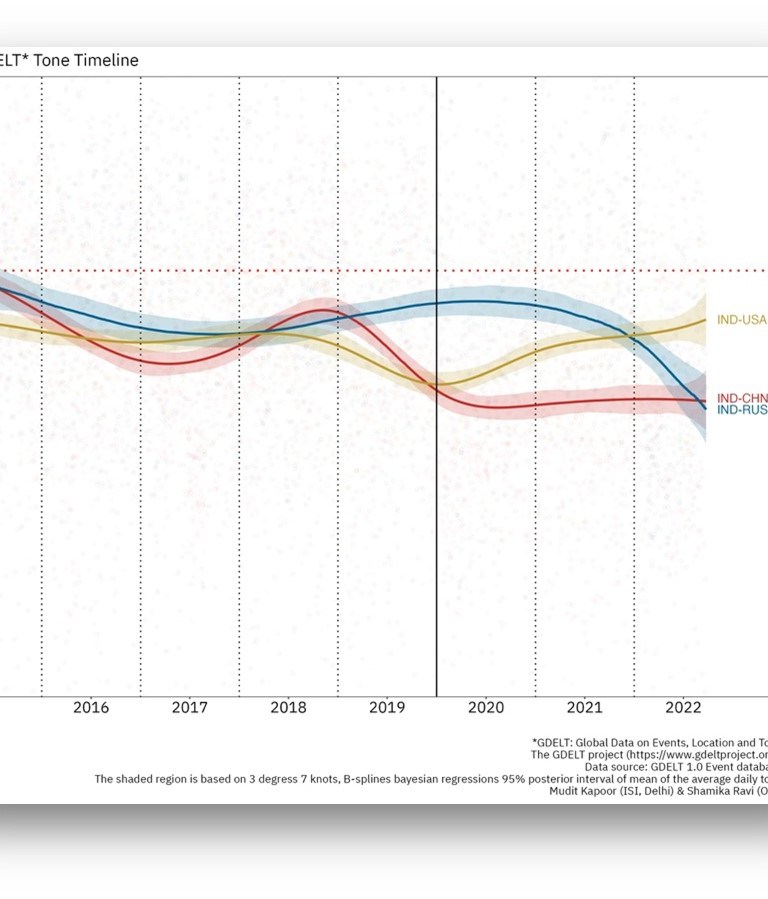
India foreign relations with China, Russia, and the U.S.

Concerning events related to India and the United States, we observe that their tone was steady and continuous until the middle of 2018, after which it started to fall. This downward trend continued until 2020 (the year of U.S. elections and the start of the pandemic), after which we observe a steady rise in the tone of events related to India and the United States.

(ii) Global realignment: China v. India

In our analysis, we also reviewed events that relate India and China to the world’s top economies: Australia, China, France, Germany, Great Britain, Japan, the United States, and Russia. We include Pakistan (PAK) and Israel (ISR) for this analysis, as both countries are important actors in India’s foreign policy.

Tone - India, China with CTR

Over the entire period, the average tone of events that relate India to the major economies has remained somewhat similar, except for France and Israel, where there is a significant upward swing in the average tone after 2021. Not surprisingly, this reflects the dramatic improvements in India’s ties with Israel and France in recent years.

In contrast, since 2018, the average tone of events that relate China to the major economies has experienced a downward trend. In particular, the India-China gap in the average tone with Australia, Germany (DEU), France, and the United States widened after 2018. However, since 2020, the downward trend in the average tone of events has either reversed or remained constant. The most striking result of this analysis concerns Russia’s relations with India and China. We observe a sharp downward trend in the tone of events concerning Russia’s relations with both China and India between 2021 and 2022, which is most likely the outcome of the Russia-Ukraine war.

Broadly, the average tone of events that relate India to the major economies is higher compared to events that relate China to the major economies (in particular, Australia, Germany, France, and the United States); this gap has widened since 2018-2019. Results for Pakistan are along expected lines, as the tone of events covering its relations with China and India remain steady and unaffected by global events over time. Pakistan’s relations with China are significantly better than its relations with India, which have a systematic and significant negative tone.

Conclusion

The findings of our research suggest that events related to China (which has heavy-handed, authoritarian restrictions on all forms of media) have a relatively more positive tone than large federal democracies when it comes to media, such as India and the United States, which have a relatively free press. However, since 2018-2019, there has been a sharp downward trend in tone of events related to China, perhaps reflecting the changing view of China in the western world, particularly within the United States, and the former president’s political attack on China concerning its trade policy. However, in the last two years, we have observed a reversal in this trend, which could reflect an easing of the tension post-pandemic and change in the U.S. government.

When analyzing events that relate India and China to the top economies and Russia, we find a widening gap in the average tone of events. However, when it comes to Russia post-2021, there has been a sharp decline in the average tone of events for both China and India, perhaps an outcome of the Russia-Ukraine conflict. Based on the average tone of events, the findings suggest a consistent realignment of the world’s top economies in their foreign relations concerning India and China, especially after 2018.


fblike20.png pinterest20.png twitter20.png email20.png rss20.png  
WP Radio
WP Radio
OFFLINE LIVE