Categories
Audio Sources - Full Text Articles

Ukrainians hid orphaned children from Russian deportation

KHERSON, Ukraine (AP) — Hours after Russia invaded Ukraine in February, health staff at a children’s hospital in the south started secretly planning how to save the babies.

Russians were suspected of seizing orphan children and sending them to Russia, so staff at the children’s regional hospital in Kherson city began fabricating orphans’ medical records to make it appear like they were too ill to move.

“We deliberately wrote false information that the children were sick and could not be transported,” said Dr. Olga Pilyarska, head of intensive care. “We were scared that (the Russians) would find out … (but) we decided that we would save the children at any cost.”

Throughout the war Russians have been accused of deporting Ukrainian children to Russia or Russian-held territories to raise them as their own. At least 1,000 children were seized from schools and orphanages in the Kherson region during Russia’s eight-month occupation of the area, say local authorities. Their whereabouts are still unknown.

But residents say even more children would have gone missing had it not been for the efforts of some in the community who risked their lives to hide as many children as they could.

At the hospital in Kherson, staff invented diseases for 11 abandoned babies under their care, so they wouldn’t have to give them to the orphanage where they knew they’d be given Russian documents and potentially taken away. One baby had “pulmonary bleeding”, another “uncontrollable convulsions” and another needed “artificial ventilation,” said Pilyarska of the fake records.

On the outskirts of Kherson in the village of Stepanivka, Volodymyr Sahaidak the director of a center for social and psychological rehabilitation, was also falsifying paperwork to hide 52 orphaned and vulnerable children. The 61-year-old placed some of the children with seven of his staff, others were taken to distant relatives and some of the older ones remained with him, he said. “It seemed that if I did not hide my children they would simply be taken away from me,” he said.

But moving them around wasn’t easy. After Russia occupied Kherson and much of the region in March, they started separating orphans at checkpoints, forcing Sahaidak to get creative about how to transport them. In one instance he faked records saying that a group of kids had received treatment in the hospital and were being taken by their aunt to be reunited with their mother who was nine months pregnant and waiting for them on the other side of the river, he said.

While Sahaidak managed to stave off the Russians, not all children were as lucky. In the orphanage in Kherson — where the hospital would have sent the 11 babies — some 50 children were evacuated in October and allegedly taken to Crimea, which Russia illegally annexed in 2014, a security guard at the institution and neighbors told The Associated Press.

“A bus came with the inscription Z (a symbol painted on Russian vehicles) and they were taken away,” said Anastasiia Kovalenko, who lives nearby.

At the start of the invasion, a local aid group tried to hide the children in a church but the Russians found them several months later, returned them to the orphanage and then evacuated them, said locals.

Earlier this year, The Associated Press reported that Russia is trying to give thousands of Ukrainian children to Russian families for foster care or adoption. The AP found that officials have deported Ukrainian children to Russia or Russian-held territories without consent, lied to them that they weren’t wanted by their parents, used them for propaganda, and given them Russian families and citizenship.

The Institute for the Study of War, a Washington-based think tank, says Russian officials are conducting a deliberate depopulation campaign in occupied parts of Ukraine and deporting children under the guise of medical rehabilitation schemes and adoption programs.

Russian authorities have repeatedly said that moving children to Russia is intended to protect them from hostilities. The Russian Foreign Ministry has rejected the claims that the country is seizing and deporting the children. It has noted that the authorities are searching for relatives of parentless children left in Ukraine to find opportunities to send them home when possible.

Russian children’s rights ombudswoman Maria Lvova-Belova personally oversaw moving hundreds of orphans from Russian-controlled regions of Ukraine for adoption by Russian families. She has claimed that some of the children were offered an opportunity to return to Ukraine but refused to do so. Her statement couldn’t be independently verified.

UNICEF’s Europe and Central Asia child protection regional adviser, Aaron Greenberg, said that until the fate of a child’s parents or other close relatives can be verified, each separated child is considered to have living close relatives, and an assessment must be led by authorities in the countries where the children are located.

Local and national security and law enforcement are looking for the children who were moved but they still don’t know what happened to them, said Galina Lugova, head of Kherson’s military administration. “We do not know the fate of these children … we do not know where the children from orphanages or from our educational institutions are, and this is a problem,” she said.

For now, much of the burden is falling on locals to find and bring them home.

In July, the Russians brought 15 children from the front lines in the nearby region of Mykolaiv to Sahaidak’s rehabilitation center and then on to Russia, he said. With the help of foreigners and volunteers, he managed to track them down and get them to Georgia, he said. Sahaidak would not provide further details about the operation for fear of jeopardizing it, but said the children are expected to return to Ukraine in the coming weeks.

For some, the threat of Russia deporting children has brought unexpected results. In October when there were signs that the Russians were retreating, Tetiana Pavelko, a nurse at the children’s hospital, worried they’d take the babies with them. Unable to bear children of her own, the 43-year-old rushed to the ward and adopted a 10-month-old girl.

Wiping tears of joy from her cheeks, Pavelko said she named the baby Kira after a Christian martyr. “She helped people, healed and performed many miracles,” she said.

___

Follow AP’s coverage of the war in Ukraine: https://apnews.com/hub/russia-ukraine

Categories
Audio Sources - Full Text Articles

Ukraine Says ‘Animal Eyes’ Have Been Sent to its Embassies

nfwrhenxevdpxaua45qsd67srq.jpg

A number of Ukrainian diplomatic missions in the European Union have received packages containing animal eyes in what Kyiv described Friday as a “well-planned campaign of terror”.

The Ukrainian foreign ministry announcement came after a security guard at the embassy in Madrid was lightly injured Wednesday opening a letter bomb addressed to the ambassador through the mail, prompting Kyiv to boost security at its missions.

The war-torn country’s embassies in Hungary, the Netherlands, Poland, Croatia, Italy and Austria as well as general consulates in Naples and Krakow and the consulate in the Czech city of Brno received the “bloody” packages, said foreign ministry spokesman Oleg Nikolenko.

The parcels were soaked in a liquid, he said in a statement, apparently referring to blood.

“We have grounds to believe that a well-planned campaign of terror and intimidation of Ukrainian embassies and consulates is under way,” Foreign Minister Dmytro Kuleba said in the statement.

Ukrainian authorities will not be intimidated, he added.

“We will continue to work effectively for the victory of Ukraine,” Kuleba said.

– ‘Crushed animal eye’ –

In Spain, the interior ministry confirmed that the Ukrainian embassy had received a package.

“The envelope received this afternoon at the Ukrainian embassy did not contain any mechanism or explosive or explosive substance,” the ministry said in a statement.

“Inside was found a crushed eye of an animal.”

Speaking to AFP earlier, a Spanish police spokesperson said “further analysis” of the package was under way.

In the Czech Republic, police said on Twitter that the package sent to the Ukrainian consulate in Brno contained “animal tissue,” adding that an “in-depth analysis” would be carried out.

In Warsaw, police were notified about a package at the Ukrainian mission on Thursday.

“We quickly ruled out any danger,” police spokesman Sylwester Marczak told AFP, refusing to specify what was inside the package.

And in the Hague, an AFP reporter saw a police car parked near the Ukrainian embassy in the city Friday afternoon. An embassy employee declined to comment.

Kyiv called on foreign governments to “guarantee” the protection of Ukrainian diplomatic missions abroad.

Russian President Vladimir Putin sent troops to Ukraine on February 24 unleashing what has become the largest armed conflict in Europe since World War II.

Russian forces have in recent weeks suffered humiliating military defeats on the ground in Ukraine.

The post Ukraine Says ‘Animal Eyes’ Have Been Sent to its Embassies appeared first on Kyiv Post.

Categories
Audio Sources - Full Text Articles

EXPLAINED: The Russian Oil Price Cap That Starts Today

01ukraine-briefing-oil-price-cap-talks-1

A price cap on Russian oil comes into force today as western nations seek to punish the Kremlin financially for its invasion of Ukraine without upsetting already fragile global economic markets.

The move is a delicate balancing act with many moving parts that has the potential to affect countries right around the world.

This is how it will – hopefully – work…

What’s the point of it?

Countries seeking to punish Russia economically for its invasion of Ukraine face a tricky task.

The country’s oil production and the massive revenues it brings make it an obvious target, but many nations around the world rely on it and too harsh an intervention could cause devastating economic shocks.

The new price cap, agreed in a deal by EU, G7 and Australia, aims to restrict Russia’s revenue while making sure Moscow keeps supplying the global market.

How will the cap work?

The cap is due to take effect alongside an EU embargo on maritime deliveries of Russian crude oil, which comes several months after an embargo imposed by the U.S. and Canada.

Russia is the world’s second-largest crude exporter and without the cap it would be easy to find new buyers at market prices.

The measure means only oil sold at a price equal to or less than $60 per barrel can continue to be delivered. Companies based in the EU, G7 countries and Australia will be banned from providing services enabling maritime transport, such as insurance, with oil above that price.

The G7 nations – Canada, France, Germany, Italy, Japan, the U.K. and the U.S. – provide insurance services for 90 percent of the world’s cargo and the EU is a major player in sea freight, AFP reports.

This means they should be able to pass on the cap to the majority of Russia’s customers around the world, making for a credible price cap.

If a ship flying the flag of a third country is identified carrying Russian oil at a price above the cap, Western operators will be banned from insuring and financing it for 90 days.

All countries are invited to formally join the measures. States that do not adopt them can continue to buy Russian oil above the price cap, but without using Western services to acquire, insure or transport it.

The cap will be reviewed from mid-January and then every two months, with the option to modify it according to price changes.

How will this affect Russia?

Russia will still make money from selling crude oil as the cap of $60 is well above the current cost of producing it, meaning Moscow will have an incentive to continue pumping.

Will it work?

It’s less a question of if it will work, more how effective it will be.

The market price of a barrel of Russian Urals crude is currently hovering around $65 dollars a barrel, suggesting the measure may have only a limited impact in the short term.

But in terms of the cap being adhered to and countries other than those which agreed the deal, the signs are positive so far.

“We have clear signals that a number of emerging economies, particularly in Asia, will observe the principles of the cap,” said a European official, adding that Russia is already “under pressure” from its customers to offer discounts.

It would be very complicated to find alternatives for services provided by European companies, which dominate tanker transport and insurance, the official said.

How has Russia reacted?

The Kremlin has threatened to stop deliveries of crude oil but western officials believe this won’t happen as the Kremlin would lose even more money at a time when its economy is teetering.

One European official said Russia would also remain concerned about maintaining the state of its infrastructure, which would be damaged if production is halted, and keeping the confidence of its customers, including China and India.

Russia’s response has been to warn of negative global consequences while seemingly acknowledging they can’t do much about the price cap.

“We will sell oil and oil products to countries that will work with us on market terms, even if we have to reduce production somewhat,” Russia’s Deputy Prime Minister Alexander Novak said after an OPEC+ videoconference on Sunday.

“We are currently working on mechanisms to prohibit the use of the price cap tool at any level,” Novak added, warning that the cap can only cause “further market destabilization.”

But Brussels insists the cap will help stabilize the markets and “directly benefit emerging economies and developing countries,” which will be able to get hold of Russian crude at a lower cost.

Can Russia get around it?

Not easily. They could create their own fleet of tankers and insure them themselves, but Brussels believes “building a maritime ecosystem overnight will be very complicated” and such make-do measures could have trouble convincing customers.

What has Ukraine said?

 Ukraine has welcomed the move but suggested on Saturday that the cap should have been set even lower, arguing that the $60 level is not enough to penalize the Kremlin.

The post EXPLAINED: The Russian Oil Price Cap That Starts Today appeared first on Kyiv Post.

Categories
Audio Sources - Full Text Articles

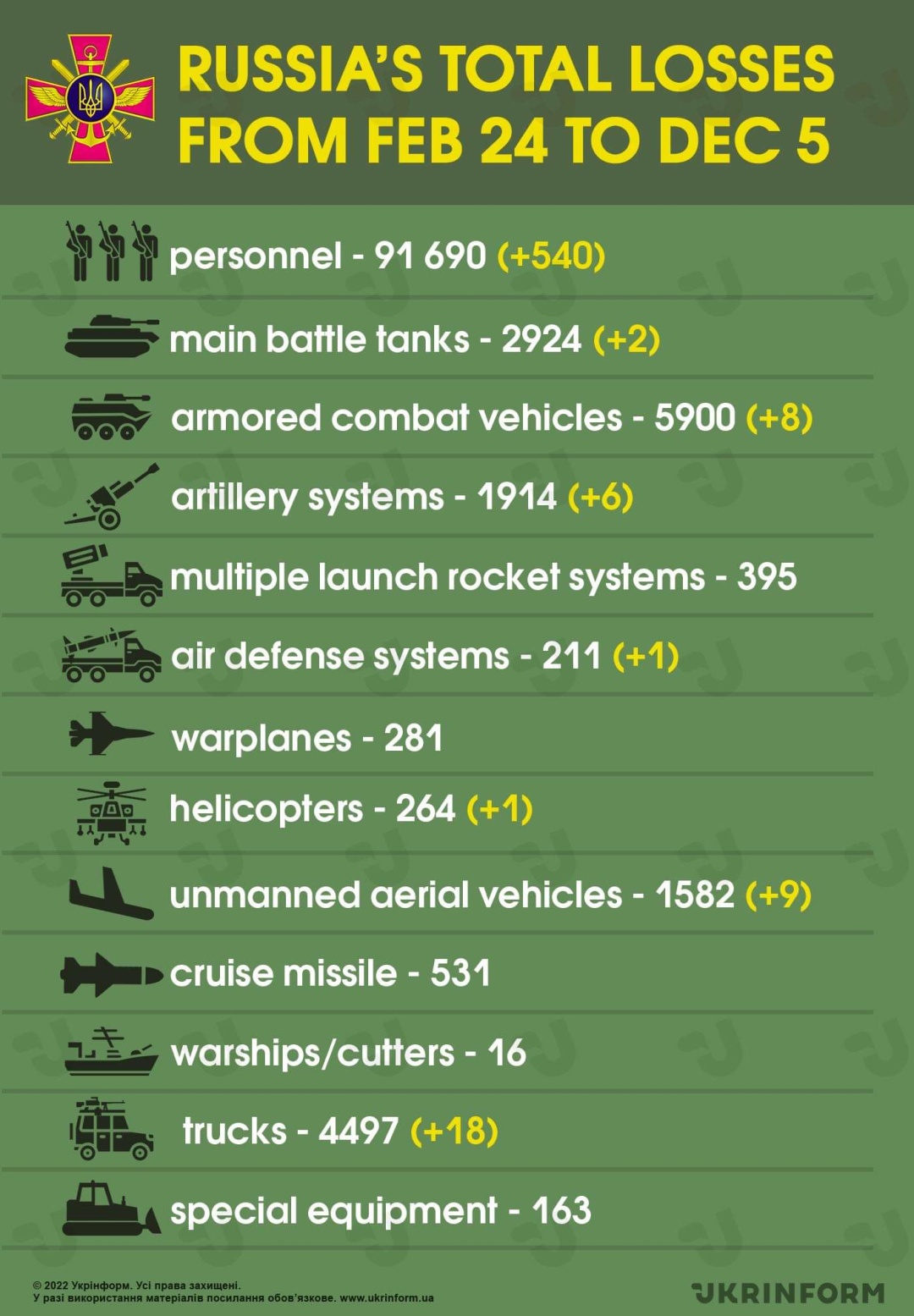
Ukraine Army eliminates about 91,690 enemy troops

Russia has presently lost about 91,690 troops in Ukraine (+540 over the past working day).

The related statement was produced by the General Employees of the Armed Forces of Ukraine on Fb, an Ukrinform correspondent reviews.

Between February 24, 2022 and December 5, 2022, the enemy’s whole fight losses included also 2,924 tanks (+2 over the earlier working day), 5,900 armored preventing vehicles (+8), 1,914 artillery devices (+6), 395 a number of start rocket programs, 211 anti-plane warfare techniques (+1), 281 aircraft, 264 helicopters (+1), 4,497 motor automobiles and gasoline tanks (+18), 16 warships/boats, 1,582 unmanned aerial vehicles (+9), 163 particular machines models. A whole of 531 enemy cruise missiles have been shot down.

Russian troops suffered the optimum losses in the Lyman way and the Bakhmut direction. The details are yet to be up to date.

mk

Source link

The post Ukraine Army eliminates about 91,690 enemy troops appeared first on Ukraine Intelligence.

Categories
Audio Sources - Full Text Articles

Russian oil cap begins, trying to pressure Putin on Ukraine

KYIV, Ukraine (AP) — Western countries on Monday began imposing a $60-per-barrel price cap and ban on some types of Russian oil, part of new measures aimed at stepping up pressure against Moscow over its war on Ukraine.

The European Union, along with Australia, Britain, Canada, Japan and the United States agreed to the price cap on Friday. The move has prompted a rejection from Kremlin and also criticism from Ukrainian President Volodymyr Zelenskyy — whose government wants the cap to be half as high.

The 27-country European bloc also imposed an embargo on Russian oil shipped by sea.

Questions have arisen about just how the Western measures will affect market prices. On Monday, U.S. benchmark crude traded up 90 cents to $80.88.

Many other factors, including COVID-19 prevention measures in China that have crimped its manufacturing, are also having an impact on demand for crude and thus prices. They are far down from a peak earlier during the war.

Russian Deputy Prime Minister Alexander Novak, who is in charge of energy issues, warned in televised comments on Sunday that Russia won’t sell its oil to countries that would try to use the cap.

“We will only sell oil and oil products to the countries that will work with us on market terms, even if we have to reduce output to some extent,” Novak said in televised remarks hours before the price cap came into effect.

The Ukrainian government demanded over the weekend a lower price cap, to $30 per barrel, insisting that at the $60 level Russia would still reap annual oil revenues of $100 billion — money that can be used to finance its war machine.

Russia, the world’s No.2 oil producer, relies on the sale of oil and gas to underpin its economy, which has already come under sweeping international sanctions over President Vladimir Putin’s war in Ukraine.

In recent weeks, Russia has been pounding Ukrainian infrastructure — including power plants — with military strikes and keeping an offensive going in the east, notably in and around the town of Bakhmut.

Russian forces have also been digging in near the southern city of Kherson, which was recaptured by Ukrainian forces last month after an 8-month occupation.

The war that began with Russia’s invasion of Ukraine on Feb. 24 has displaced millions from their homes, killed and injured an untold number of civilians, and shaken the world economy — notably through the fallout on the prices and availability of foodstuffs, fertilizer and fuel that are key exports from Ukraine and Russia.

___

Follow AP’s coverage of the war in Ukraine: https://apnews.com/hub/russia-ukraine
Categories
Audio Sources - Full Text Articles

Supreme Court taking up clash of religion and gay rights

WASHINGTON (AP) — The Supreme Court is hearing the case Monday of a Christian graphic artist who objects to designing wedding websites for gay couples, a dispute that’s the latest clash of religion and gay rights to land at the highest court.

The designer and her supporters say that ruling against her would force artists — from painters and photographers to writers and musicians — to do work that is against their faith. Her opponents, meanwhile, say that if she wins, a range of businesses will be able to discriminate, refusing to serve Black customers, Jewish or Muslim people, interracial or interfaith couples or immigrants, among others.

The case comes at a time when the court is dominated 6-3 by conservatives and following a series of cases in which the justices have sided with religious plaintiffs. It also comes as, across the street from the court, lawmakers in Congress are finalizing a landmark bill protecting same-sex marriage.

The bill, which also protects interracial marriage, steadily gained momentum following the high court’s decision earlier this year to end constitutional protections for abortion. That decision to overturn the 1973 Roe v. Wade case prompted questions about whether the court — now that it is more conservative — might also overturn its 2015 decision declaring a nationwide right to same-sex marriage. Justice Clarence Thomas explicitly said that decision should also be reconsidered.

The case being argued before the high court Monday involves Lorie Smith, a graphic artist and website designer in Colorado who wants to begin offering wedding websites. Smith says her Christian faith prevents her from creating websites celebrating same-sex marriages. But that could get her in trouble with state law. Colorado, like most other states, has what’s called a public accommodation law that says if Smith offers wedding websites to the public, she must provide them to all customers. Businesses that violate the law can be fined, among other things.

Five years ago, the Supreme Court heard a different challenge involving Colorado’s law and a baker, Jack Phillips, who objected to designing a wedding cake for a gay couple. That case ended with a limited decision, however, and set up a return of the issue to the high court. Phillips’ lawyer, Kristen Waggoner of the Alliance Defending Freedom, is now representing Smith.

Like Phillips, Smith says her objection is not to working with gay people. She says she’d work with a gay client who needed help with graphics for an animal rescue shelter, for example, or to promote an organization serving children with disabilities. But she objects to creating messages supporting same-sex marriage, she says, just as she won’t take jobs that would require her to create content promoting atheism or gambling or supporting abortion.

Smith says Colorado’s law violates her free speech rights. Her opponents, including the Biden administration and groups such as the American Civil Liberties Union, the NAACP Legal Defense & Educational Fund, disagree.

Twenty mostly liberal states, including California and New York, are supporting Colorado while another 20 mostly Republican states, including Arizona, Indiana, Ohio and Tennessee, are supporting Smith.

The case is 303 Creative LLC v. Elenis, 21-476.

Categories
Audio Sources - Full Text Articles

China“s patchy COVID easing sows confusion but comforts investors

2022-12-05T06:30:12Z

A partial easing of the world’s toughest COVID-19 curbs sowed confusion across China on Monday, even as global investors cheered the prospects of a broader policy shift in the wake of last month’s historic protests and mounting economic damage.

Three years into the pandemic, China’s zero-tolerance measures, from shuttered borders to frequent lockdowns, contrast sharply with the rest of the world, which has largely decided to live with the virus.

The strict approach has battered the world’s second-largest economy, put mental strain on hundreds of millions and last month prompted the biggest show of public discontent in mainland China since President Xi Jinping took power in 2012.

Although the protests largely petered out amid a heavy police presence across major cities, regional authorities have cut back on lockdowns, quarantine rules and testing requirements to varying degrees.

China will also soon announce a nationwide easing of testing requirements, allowing some positive cases and close contacts to isolate at home, people familiar with the matter told Reuters last week.

That has prompted some analysts to suggest China may drop border controls and re-open the economy sooner than expected.

“The risk of an earlier but managed exit has increased,” Goldman Sachs chief China economist Hui Shan said in a note on Monday, adding that the bank expected such a reopening from April. Other analysts expect such moves later in the year.

But the lack of clarity leaves some in China scared of being caught on the wrong side of fast-changing rules.

Yin, who lives in a small city near Beijing, the capital, said her in-laws had come down with a fever and she herself now had a sore throat, but they did not want to be tested for fear of being thrown into government quarantine facilities.

“All we want is to recover at home, by ourselves,” she told Reuters, speaking on condition of anonymity.

The yuan currency firmed to its strongest level against the dollar since mid-September amid a broad market rally as investors hope the unwinding of pandemic curbs will brighten the outlook for global growth.

Economic data underscored the damage from the curbs, as services activity shrank to six-month lows in November.

But in another hopeful sign for business, a source at Apple supplier Foxconn (2317.TW) told Reuters the firm expected its COVID-hit Zhengzhou plant – the world’s biggest iPhone factory – to resume full production later this month or early the next.

Alongside the easing of local curbs, Vice Premier Sun Chunlan, who oversees COVID efforts, said last week the ability of the virus to cause disease was weakening.

That change in messaging aligns with the position held by many health officials around the world for more than a year.

As the virus weakens, conditions are improving for China to scale back management of COVID-19 as a serious contagious disease, state media outlet Yicai said late on Sunday, in comments that are among the first to float the idea.

In recent days, major cities across China have continued to loosening the toughest of those measures.

Authorities in the southwestern municipality of Chongqing urged local bodies not to test too much. “Do not repeat testing or increase testing,” they said.

The eastern province of Zhejiang said it planned to largely end mass testing, while the metropolis of Nanjing dropped COVID tests for use of public transport.

So has Beijing, though entry to many office buildings in the capital still requires negative tests, leaving workers confused.

The scrapping of the requirement for negative tests to buy medicines for cold and fever in various cities, intended to deter people from using the drugs to disguise symptoms, has led instead to mass buying, some state media said.

Daily tallies of new COVID infections have also dropped in some regions as authorities row back on testing.

Although the heat of last week’s protests appears to have died down, frustration can occasionally boil over.

In the central city of Wuhan, where the virus first emerged in late 2019, people pushed down barriers on Saturday to break out of a lockdown at a garment industrial park, video clips posted on Twitter showed.

Reuters was able to verify that the incident happened in Wuhan.

On a rain-soaked Sunday, dozens of students carrying umbrellas gathered at a city university to protest its COVID policies, demanding greater “transparency” by officials, according to videos widely shared on Twitter.

Related Galleries:

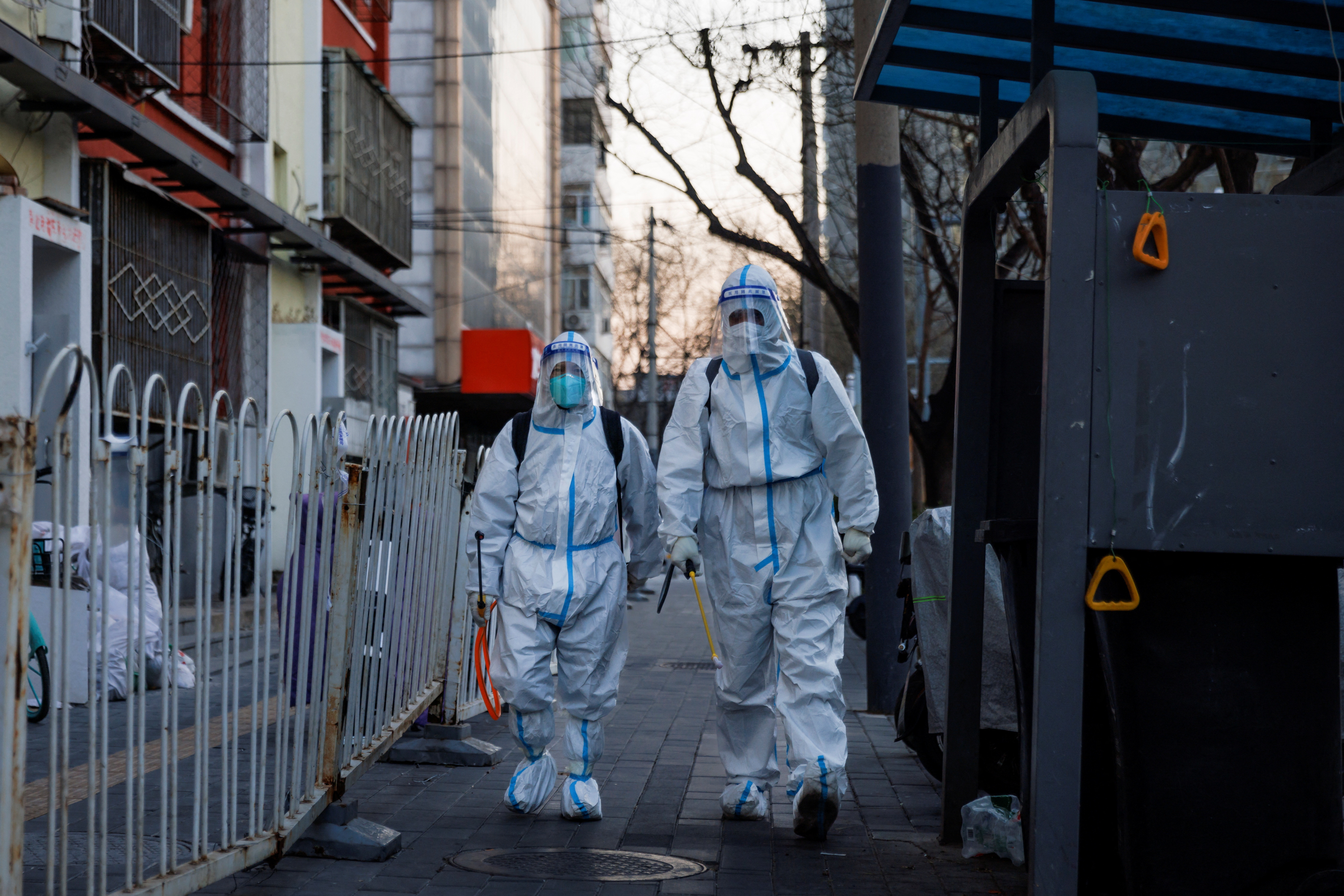
Pandemic prevention workers in protective suits walk in a street as coronavirus disease (COVID-19) outbreaks continue in Beijing, December 4, 2022. REUTERS/Thomas Peter

A woman presents her health code to a pandemic prevention worker in a protective suit to enter a residential compound as coronavirus disease (COVID-19) outbreaks continue in Beijing, December 4, 2022. REUTERS/Thomas Peter

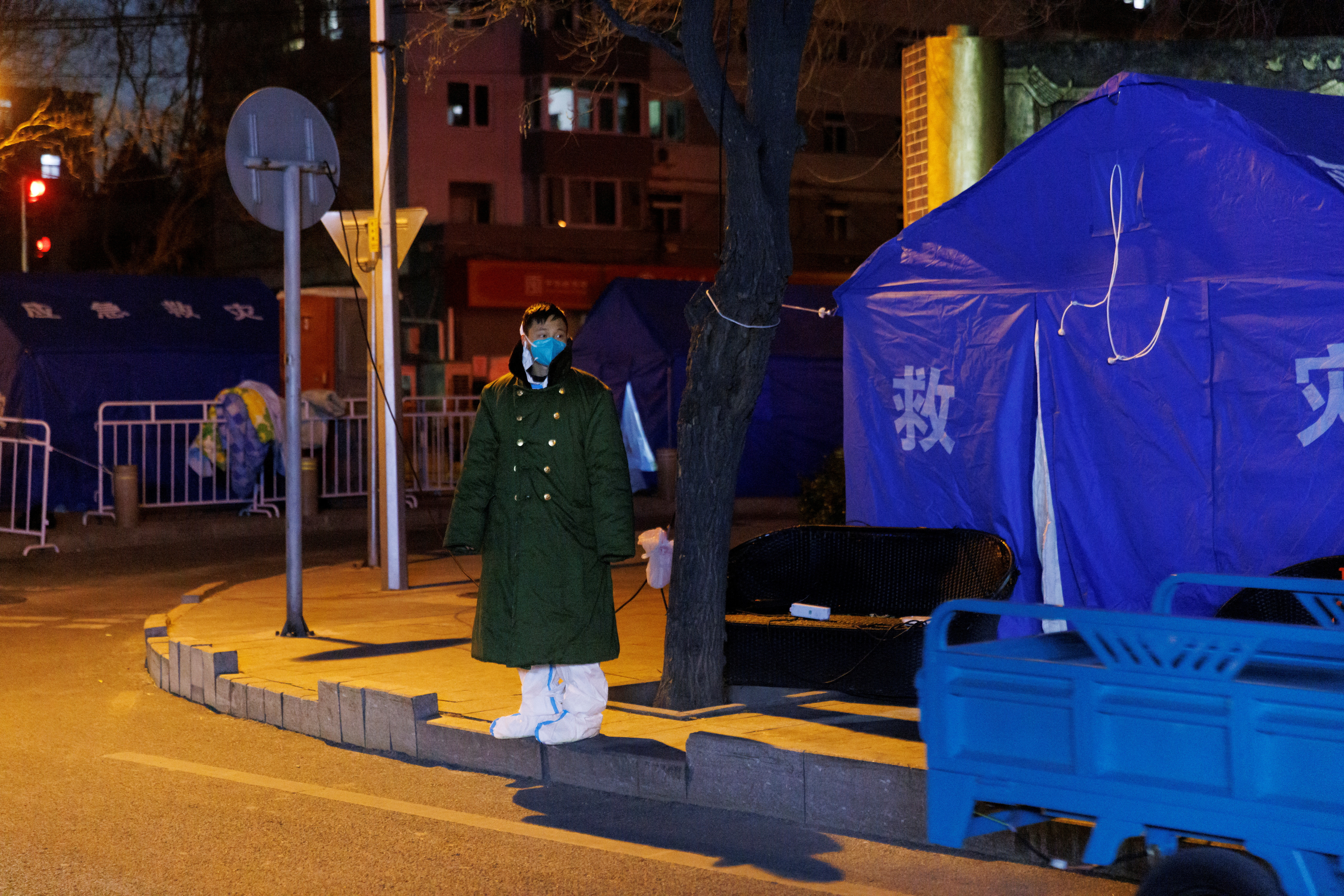
A pandemic prevention worker wears a winter coat over his protective suit as he stands outside a tent that serves as his living quarter as coronavirus disease (COVID-19) outbreaks continue in Beijing, December 4, 2022. REUTERS/Thomas Peter

A pandemic prevention worker wears a winter coat over his protective suit as he stands outside a tent that serves as his living quarter as coronavirus disease (COVID-19) outbreaks continue in Beijing, December 4, 2022. REUTERS/Thomas Peter

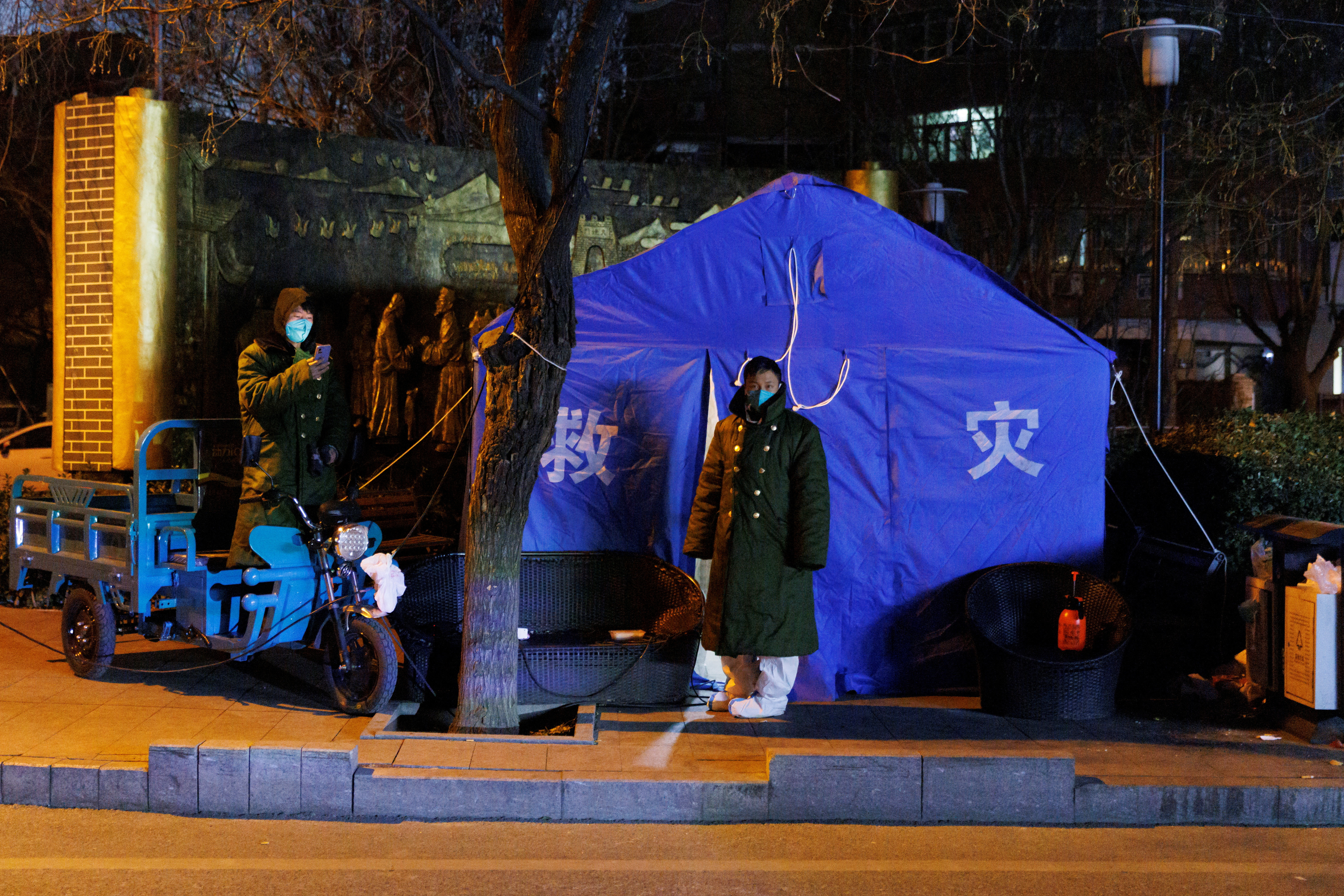
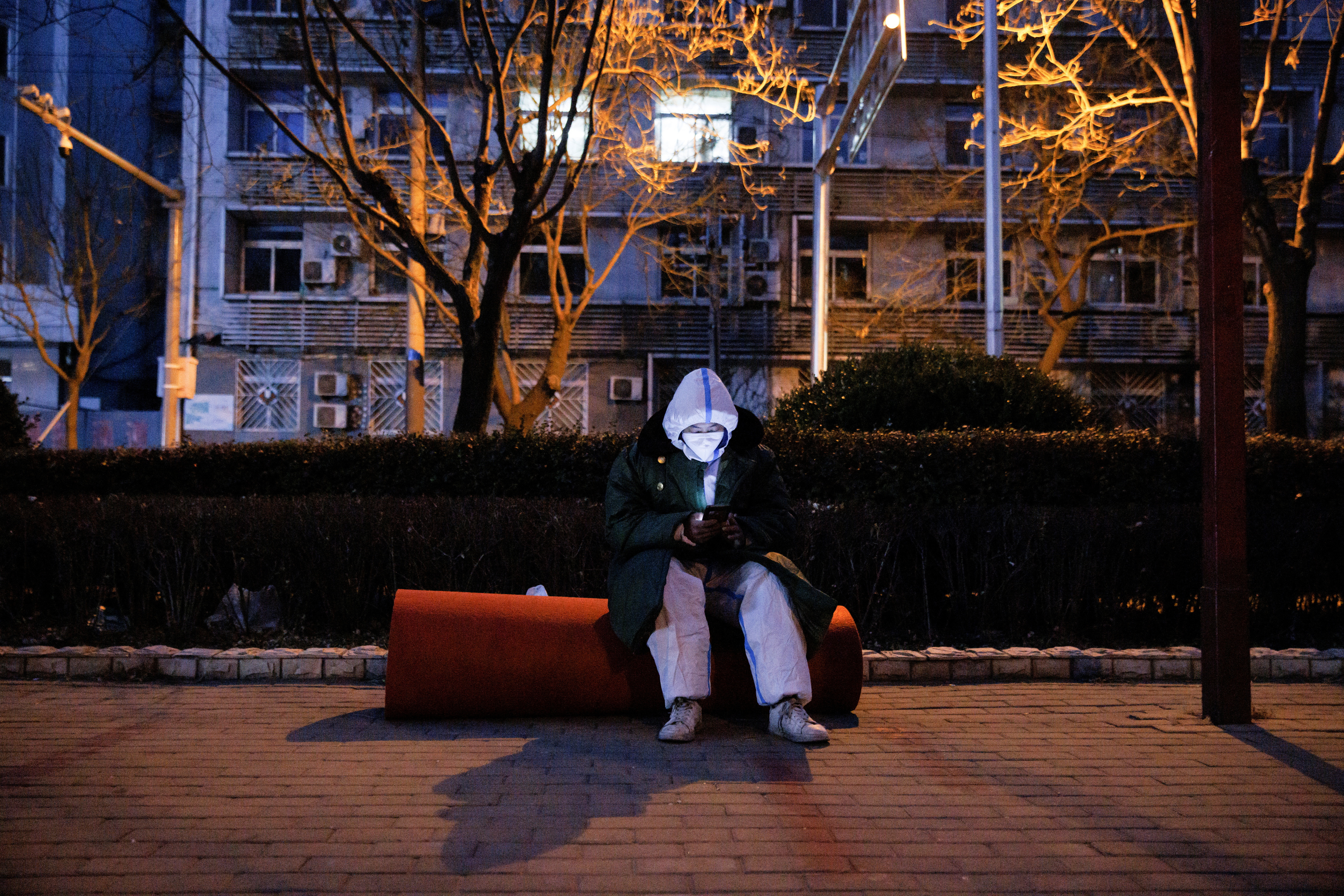
A pandemic prevention worker wears a winter coat over his protective suit while using his phone as coronavirus disease (COVID-19) outbreaks continue in Beijing, December 4, 2022. REUTERS/Thomas Peter
Categories
Audio Sources - Full Text Articles

Lazarus APT uses fake cryptocurrency apps to spread AppleJeus Malware

The North Korea-linked Lazarus APT spreads fake cryptocurrency apps under the fake brand BloxHolder to install the AppleJeus malware.

Volexity researchers warn of a new malware campaign conducted by the North Korea-linked Lazarus APT against cryptocurrency users. The threat actors were observed spreading fake cryptocurrency apps under the fake brand BloxHolder to deliver the AppleJeus malware for initial access to networks and steal crypto assets.

The APT group employed the AppleJeus malware since at least 2018 to steal cryptocurrencies from the victims.

The new campaign observed by Volexity started in June 2022, the APT group registered the domain name bloxholder[.]com, and then set up a website related to automated cryptocurrency trading.

The new campaign attributed to Lazarus started in June 2022 and was active until at least October 2022.

In this campaign, the threat actors used the “bloxholder[.]com” domain, a clone of the HaasOnline automated cryptocurrency trading platform.

The website is a clone of the legitimate website, HaasOnline (haasonline[.]com.)

Volexity_AppleJeus Lazarus Figure-01-2048x899

The attackers used the website to distribute a Windows MSI installer masquerading as the BloxHolder app, which was used to install AppleJeus malware along with the QTBitcoinTrader app.

“This discovered file, the  “BloxHolder application”, is actually another case of AppleJeus being installed alongside the open-source cryptocurrency trading application QTBitcoinTrader that is available on GitHub. This same legitimate application has previously been used by the Lazarus Group, as documented in this report from CISA.” reads the report published by Volexity. “The MSI file is used to install both the malicious and legitimate applications at the same time.”

In October 2022, the researchers observed the Lazarus Group installing AppleJeus using a weaponized Microsoft Office document, named ‘OKX Binance & Huobi VIP fee comparision.xls,’ instead of an MSI installer.

The document contains a macro split into two parts, the first one is used to decode a base64 blob that contains a second OLE object containing a second macro. The initial document also stores several variables, encoded using base64, that allow defining where the malware will be deployed in the infected system.

The last stage payload is downloaded from a public file-sharing service, OpenDrive

Volexity experts were not able to retrieve the final payload employed since October, but they noticed similarities in the DLL sideloading mechanism which is similar to the one used in the attacks relying on MSI installer.

“While the file was no longer available at the time of analysis, based on public sandbox results for the file in question, the downloaded payload, “Background.png”, embeds the following three files:

  • “Logagent.exe” – a legitimate file (md5: eb1e19613a6a260ddd0ae9224178355b)
  • “wsock32.dll” – a side-loaded library internally named HijackingLib.dll (md5: e66bc1e91f1a214d098cf44ddb1ae91a)
  • “56762eb9-411c-4842-9530-9922c46ba2da” – an encoded payload decoded by “wsock32.dll”

“continues the analysis. “The three files are dropped on disk using hardcoded offsets that can be found in the second macro.”

Experts speculate Lazarus used DLL sideloading to avoid malware analysis, the threat actors also noticed that recent AppleJeus samples obfuscated strings and API calls using a custom algorithm.

“The Lazarus Group continues its effort to target cryptocurrency users, despite ongoing attention to their campaigns and tactics. Perhaps in an attempt to allude detection, they have decided to use chained DLL side-loading to load their payload. Additionally, Volexity has not previously noted the use of Microsoft Office documents to deploy AppleJeus variants.” concludes volexity. “Despite these changes, their targets remain the same, with the cryptocurrency industry being a focus as a means for the DPRK to bolster their finances.”

Follow me on Twitter: @securityaffairs and Facebook and Mastodon

Pierluigi Paganini

(SecurityAffairs – hacking, APT)

The post Lazarus APT uses fake cryptocurrency apps to spread AppleJeus Malware appeared first on Security Affairs.

Categories
Audio Sources - Full Text Articles

BP doubles down on hydrogen as fuel of the future

2022-12-05T06:18:40Z

BP chief executive Bernard Looney is betting on hydrogen to power future low-carbon businesses as the governments of major economies stump up cash to develop the fuel to decarbonise.

Low-carbon hydrogen already has a big fan-base and is forecast to play a major role in reducing greenhouse gas emissions from heavy industries and some forms of transport.

But it is expensive to produce and often needs government support to compete against fossil fuels.

The United States, for example, is offering large incentives for producing it under President Joe Biden’s $430 billion Inflation Reduction Act (IRA).

BP (BP.L) has been quick to react and is in the early planning stages to develop a large, low-carbon hydrogen hub around its Whiting, Indiana refinery, Tomeka McLeod, BP’s newly-appointed head of hydrogen in the United States, told Reuters.

When Looney took office nearly three years ago, he pledged to reshape BP and cut carbon emissions by reducing oil and gas output and growing renewables. He is preparing to update investors on Feb. 7 on where things stand.

Hydrogen will have a starring role along with offshore wind, BP company sources told Reuters.

BP has overhauled its structure to create a dedicated hydrogen division led by Felipe Arbelaez which includes 150 staff. It also made several investments in large hydrogen projects, including in Australia, Europe and Britain.

It is also exploring the potential for developing green hydrogen in Oman, the company told Reuters, and is also looking into projects in Mauritania.

BP’s spending on low-carbon hydrogen remains modest but is expected to grow into the hundreds of millions by the end of the decade as projects gets under way, the company sources said.

BP spent roughly a quarter of its $15.5 billion budget in 2022 on low-carbon businesses, when including the $4.1 billion acquisition of U.S. biogas producer Archaea, according to Reuters calculations.

Looney and BP’s head of renewables Anja-Isabel Dotzenrath will unveil in February a clean hydrogen production target for the first time, aiming to capture 10% share of hydrogen in “core markets” by 2030, the company sources said.

“Hydrogen will be a big focus and it is moving much faster than we ever thought it would,” Chief Financial Officer Murray Auchincloss told Reuters last month.

Most hydrogen is currently used in oil refining and the fertilizer industry and is usually made by heating natural gas, a highly polluting process, known as grey hydrogen.

But grey hydrogen becomes “blue hydrogen” if the polluting emissions are captured. There is also “green hydrogen”, which is made by splitting water using renewables-powered electrolysis.

To expand its blue hydrogen business, BP is counting on its oil and gas experience to build carbon capture and storage facilities, where carbon is injected into depleted reservoirs

It is also planning to boost its renewables power generation capacity to 50 gigawatt by 2030 which will be used in part to power electrolysers.

BP declined to comment on whether it will set a hydrogen production target or on its spending plans for hydrogen.

BP’s project at its Whiting refinery will initially replace around 200,000 tonnes of grey hydrogen used by the refinery every year with blue hydrogen, McLeod said. The project could start operating by 2026-2027 and be expanded to green hydrogen.

“Our focus in the U.S., and it’s similar around the world, is how do we decarbonise and re-imagine our own assets,” she said.

The low-carbon fuel will in a second phase be used by other heavy industries in the area to reduce some 36 million tonnes of CO2 emitted there every year.

The project will rely on subsidies, highlighting hydrogen’s challenge in competing with lower-cost fossil fuels.

The IRA offers a $3 per kilogramme tax credit for clean hydrogen, which brings green hydrogen to par or even below the cost of grey and blue hydrogen, according to analysts.

“With the hydrogen production tax credits that are now in place, it has … allowed green hydrogen to be a lot more competitive,” McLeod said.

Subsidies will initially allow green and blue hydrogen to compete with grey hydrogen, allowing consumers to switch to cleaner fuel, McLeod said.

“Demand growth for new hydrogen applications is going to be a function of cost competitiveness,” said Andy Brogan, Global Oil and Gas Leader at EY.

“There are material components of energy demand where hydrogen is the only obvious technologically viable alternative to carbon intensive options,” Brogan said. “However, these are often price sensitive so the rapid acceleration will be dependent on cost.”

BP is already one the biggest investors in hydrogen projects among the world’s top oil and gas companies, including Shell (SHEL.L), TotalEnergies (TTEF.PA), Repsol and Italy’s Eni (ENI.MI), according to Globaldata, a data provider.

BP acquired in June a 40.5% stake in a 26 gigawatt renewables project in Australia that could produce green hydrogen. It is developing two projects in Britain where it aims to produce 1.5 gigawatt of blue and green hydrogen by 2030.

Related Galleries:

The BP logo is seen at a BP gas station in Manhattan, New York City, U.S., November 24, 2021. REUTERS/Andrew Kelly/Files

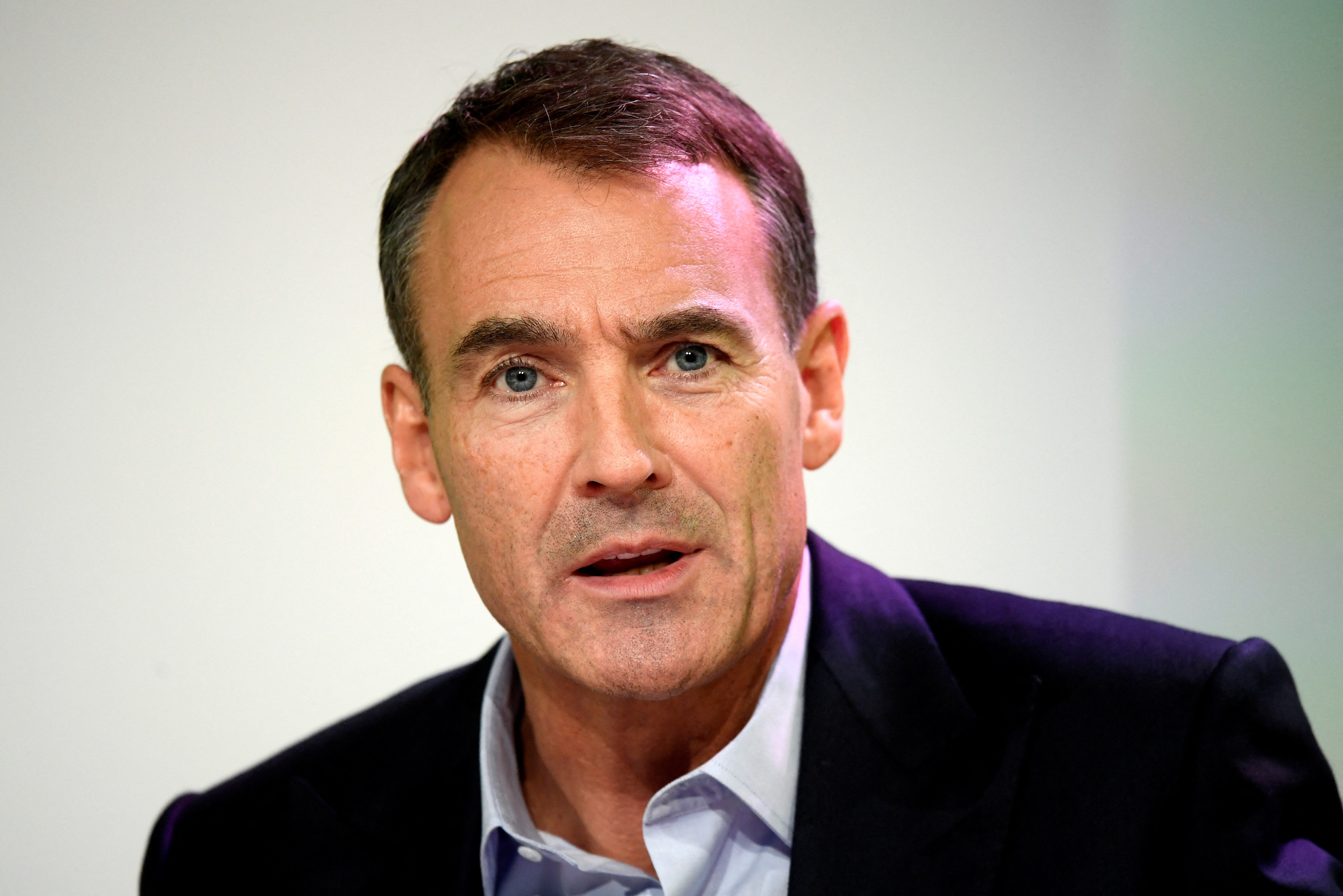
BP’s Chief Executive Bernard Looney in central London, Britain February 12, 2020. REUTERS/Toby Melville


Categories
Audio Sources - Full Text Articles

Asia shares bank on eventual China opening; oil gains

2022-12-05T06:20:18Z

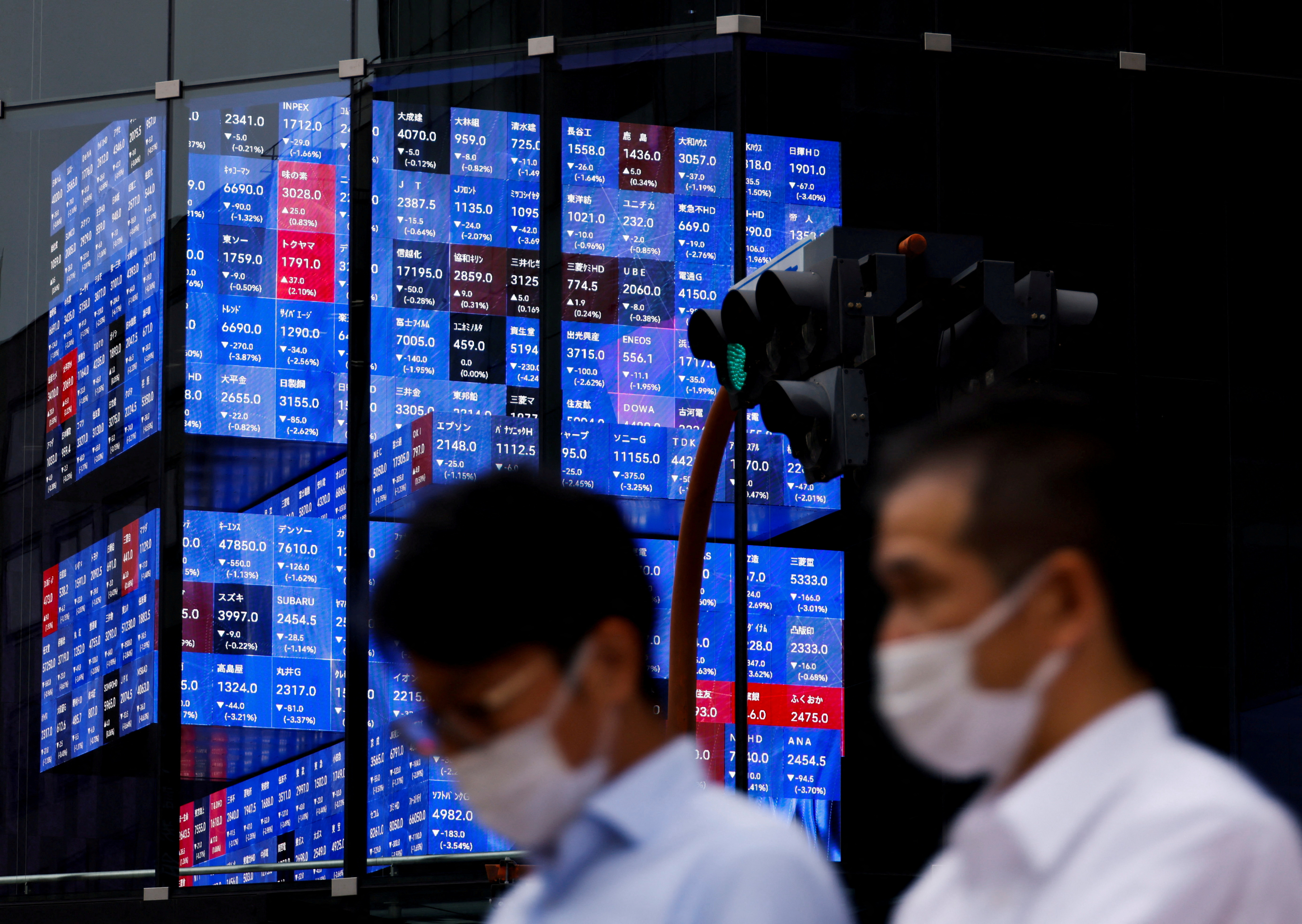
People pass by an electronic screen showing Japan’s Nikkei share price index inside a conference hall in Tokyo, Japan June 14, 2022. REUTERS/Issei Kato

Asian shares extended their rally on Monday as investors hoped steps to unwind pandemic restrictions in China would eventually brighten the outlook for global growth and commodity demand, nudging the dollar down against the yuan.

The news helped oil prices firm as OPEC+ nations reaffirmed their output targets ahead of a European Union ban and price caps on Russian crude, which begin on Monday.

More Chinese cities announced an easing of coronavirus curbs on Sunday as Beijing tries to make its zero-COVID policy less onerous after recent unprecedented protests against restrictions. read more

There were also reports Beijing might lower the threat classification for COVID-19, though clarity was lacking on timetables for future steps. read more

“While the easing of some restrictions does not equate to a wholesale shift away from the dynamic COVID zero strategy just yet, it is further evidence of a shifting approach and financial markets look to be firmly focussed on the longer term outlook over the near-term hit to activity as virus cases look set to continue,” said Taylor Nugent, an economist at NAB.

Chinese blue chips (.CSI300) gained 1.7%, on top of last week’s 2.5% bounce, while the Hang Seng (.HS11) jumped 3.5%.

MSCI’s broadest index of Asia-Pacific shares outside Japan (.MIAPJ0000PUS) added 1.7% to a three-month top, after rallying 3.7% last week. Japan’s Nikkei (.N225) edged up 0.1%, while South Korea (.KS11) eased 0.4%.

EUROSTOXX 50 futures added 0.1%, while FTSE futures were flat. S&P 500 futures and Nasdaq futures both fell 0.1%.

Wall Street had lost some momentum on Friday after November’s robust U.S. payrolls report challenged hopes for a less aggressive Federal Reserve, though Treasuries still ended last week with solid gains. read more

Indeed, 10-year note yields have fallen 74 basis points since early November, effectively undoing much of the tightening of the Fed’s last outsized increase in cash rates.

Markets are wagering Fed rates will top out at 5% and the European Central Bank around 2.5%.

“But U.S. and Euro area labour demand remain surprisingly strong, and alongside a recent easing in financial conditions, the risks are shifting toward higher-than-anticipated terminal rates for both the Fed and the ECB,” warns Bruce Kasman, head of economic research at JPMorgan.

“The combination of labour market resilience with sticky wage inflation adds to the risk that the Fed will deliver a higher than 5% rate forecast at its upcoming meeting and that Chair Jerome Powell’s press conference will shift to more open-ended guidance regarding any near-term ceiling on rates.”

The Fed meets on Dec. 14 and the ECB the day after. Speaking on Sunday, French central bank chief Francois Villeroy de Galhau said he favoured a hike of half a point next week. read more

Central banks in Australia, Canada and India are all expected to raise their rates at meetings this week.

The steep decline in U.S. yields has taken a toll on the dollar, which fell 1.4% last week on a basket of currencies to its lowest since June.

It lost 3.5% on the yen alone and last traded at 134.34 , leaving October’s peak of 151.94 a distant memory. The euro resumed it rise to $1.0578 , having added 1.3% last week to its highest since early July.

The dollar also slipped under 7.0 yuan in offshore trade to hit the lowest in three months at 6.9677.

The drop in the dollar and yields has been a boon for gold, which was up 0.5% at a four-month peak of $1,807 an ounce after rising 2.3% last week.

Oil prices bounced after OPEC+ agreed to stick to its oil output targets at a meeting on Sunday.

The Group of Seven and European Union states are due on Monday to impose a $60 per barrel price cap on Russian seaborne oil, though it was not yet clear what impact this would have on global supply and prices. read more

Brent gained $1.67 to $87.24 a barrel, while U.S. crude rose $1.46 to $81.44 per barrel.

WP Radio
WP Radio
OFFLINE LIVE