Categories
Audio Sources - Full Text Articles

Moscow Idaho Murders #Moscow #IdahoMurders #MoscowIdaho #Murders #FBI FBI: It can be the combination of these two hypotheses: ENRAGED MALE WITH SPETSNAZ BEHIND HIM, egging him on, assisting and pushing him every step of the way; like in many other mass and group killings.

Moscow Idaho Murders

#Moscow #IdahoMurders

#MoscowIdaho #Murders

#FBI FBI:

It can be the combination of these two hypotheses: ENRAGED MALE WITH SPETSNAZ BEHIND HIM, egging him on, assisting and pushing him every step of the way; like in many other mass and group killings.

FjI16FRXoAAILvv.jpg:large

Categories
Audio Sources - Full Text Articles

Moscow Idaho Murders #Moscow #IdahoMurders #MoscowIdaho #Murders #FBI FBI: If not Spetsnaz, consider this profile: Inadequate, sick loner male, a student in the same community, a drone enthusiast, enraged by the rejection of these young women and their lifestyles. RAGE & BLOOD.

Moscow Idaho Murders #Moscow #IdahoMurders #MoscowIdaho #Murders #FBI FBI:

If not Spetsnaz, consider this profile: Inadequate, sick loner male, a student in the same community, a drone enthusiast, enraged by the rejection of these young women and their lifestyles.

RAGE & BLOOD.

FjIvWlaWAAAbU1r.png:large

Categories
Audio Sources - Full Text Articles

Signal’s President Meredith Whittaker on What’s Next for the Private Messaging App 

(To receive weekly emails of conversations with the world’s top CEOs and business decisionmakers, click here.)

Fifty years ago, journalist Bob Woodward descended into a dark underground parking lot in Arlington, Virginia, for a rendezvous far too sensitive to be carried out over the phone. His covert meetings with a government source—later immortalized as “Deep Throat” in the film All the President’s Men—eventually helped Woodward and his colleague Carl Bernstein blow open the Watergate scandal that would change the course of American history.

In our interconnected world, underground car park meetings may appear antiquated. But together with the internet’s revolution in connectivity has come an increase in surveillance – from spyware targeting journalists and activists, to governments pressuring technology corporations to hand over users’ personal data.

[time-brightcove not-tgx=”true”]

In this new online world, the safest way to communicate is still in-person, without electronic devices. (When whistleblower Edward Snowden met with lawyers in a Hong Kong safe house in 2013, he urged them to put their cell phones in a refrigerator in a different room to prevent digital eavesdropping.) But since the latter half of the 2010s, apps marrying the convenience of digital communication with the security of an underground car-park meeting have exploded in popularity. These apps use end-to-end encryption – a mathematical way of scrambling data that makes it very easy for the sender and recipient of a message to decode it, but extremely difficult, if not impossible, for an eavesdropper to decipher.

Chiefly responsible for this trend is Signal – the private messaging app employed by hundreds of millions of users. Its gold-standard encryption technology lies behind WhatsApp, used by more than 2 billion people worldwide. Unlike WhatsApp, Signal encrypts data from your contacts, whom you’re messaging, when, and how often, meaning this crucial metadata – oftentimes more sensitive than the contents of messages themselves – is equally safe.

As a journalist, Signal has long been one of the most important tools in my toolbox. When I can’t meet my source in person, it’s the next-best option for a sensitive conversation. When I last wrote about Signal, in 2020, the non-profit that runs the app was riding high. After a year of political and social instability, many dissidents and protesters had begun using Signal, amid a growing tech backlash that was also leading others to question the security of their personal data, and seek alternatives to Big Tech.

I wanted to revisit Signal today, not only because it seems so much about the internet is in flux. It was also an excuse to speak with Meredith Whittaker—one of the sharpest critics of Big Tech—who earlier this year was appointed Signal’s President. Whittaker has a storied career, from leading protests inside Google against the firm’s work on military contracts to, most recently, advising FTC chair Lina Khan on the dangers of artificial intelligence. Now, Whittaker is helping lead Signal, one of the tech industry’s most promising outsiders, toward long-term financial stability. At the same time, she’s increasingly getting the recognition she’s due as torchbearer for a radical vision: not only for an internet where the surveillance business model is recognized as inherently dangerous, but one where alternatives are abundant and easy to use.

In this wide-ranging conversation, Whittaker spoke to TIME about the state of the tech landscape, where Signal is going next—and don’t miss her choice words about the crypto meltdown.

This conversation has been condensed and edited for clarity.

The internet as a whole is in a period of what seems like significant flux. Elon Musk has acquired Twitter and seems to be rewriting the rules about who can have access to large platforms. Companies like Meta are laying off large segments of their workforces. At a time where authoritarians around the globe are leveraging technology to strengthen social control, it appears Silicon Valley is turning away from the safeguards it belatedly erected to prevent these kinds of abuses. I’m curious as to what you think of the environment right now.

I think we are getting a really clear lesson that is bringing into stark relief the fact that what we think of as “tech” is a collection of companies, and they are controlled by people who have specific incentives: generally profit and growth. We have become, over the past couple of decades, dependent in pretty profound ways on computational infrastructures that are run at the whim of these companies that are, as a rule, predicated on mass surveillance. We don’t have any control over it in any meaningful sense.

Ultimately, they can call it a town square, all these corporate slogans that paint these products and services as socially beneficial. But I think we need to question the narrative that access to U.S. technology is inherently liberatory. We need to recognize that most of these technology companies conduct surveillance, and can be pushed by governments to turn over very, very sensitive information. We saw Apple turn off AirDrop in China recently, right before a wave of significant protests broke out. We saw Google pull the Navalny voting app from the Russian Google Play Store. Fifteen or so years ago we had the case in China where Yahoo! turned over sensitive information about dissidents that led to real personal harm – that’s one of the few cases where we have all the information so we can draw that connection.

I think we have to recognize that these tools are often collecting sensitive data, and that whether by interception or by coercing these companies directly, authoritarian governments can gain access to this data.

What is Signal doing differently?

Signal is working to provide the most widely used private messaging service on the planet.

To do that, we need to invest in research and development; we also need to structure our organization differently. We don’t think privacy is safe under shareholder driven corporations. So we are structured as a nonprofit. That means we don’t have equity, we don’t have a board breathing down our neck to increase profits and growth and we’re safer from the ‘founders take an unethical buyout’ possibility than we would be otherwise. So we’re not going to just sell Signal to a crypto exchange and go live on a yacht. That’s not actually a possibility, even if I decided to become evil.

Frankly, our operational revenue is different. We are funded by donations. And the premise there is that we are accountable to the people who rely on Signal for privacy, not to advertisers, not to customers behind the scenes who are paying for access to our users. We are directly accountable to our users.

Is it sustainable? Do you have enough donations to keep yourselves going?

We are just experimenting with and developing our donor-funded model. So at this point, we’re fully funded by donations, but part of those donations include a 0% interest long term loan from [executive chairman of the Signal Foundation] Brian Acton. We have that generous contribution from Brian that’s allowing us the room to do that. We have some large donors, and then we are ramping up the pipeline of small donors. Our focus on small donors is because we want to be directly accountable to the people who rely on Signal. And given that providing robust privacy challenges those in power, we also want sources of funding that are as hard as possible to quickly disrupt. So we don’t want a single point of failure. Millions of people donating a little bit is the ideal model for us.

You recently said on Twitter that Signal will be launching usernames soon. How’s that going?

Usernames are a feature we’ve had requests for, for a long time. They’re a difficult feature to build in accordance with our strict privacy promises, but we’re working on them. And, you know, we’re hopeful that they’ll launch in the first half of 2023. What they’ll do is allow people to use Signal without giving anyone else their phone number. So you can give someone your username, and someone can connect with you on Signal via your username without ever knowing your phone number. It’s another layer of privacy preservation. We’ve heard, particularly from journalists, or folks who use Signal in a professional or maybe more public capacity, that they want to be able to broadcast their Signal information without broadcasting their phone number. So this allows that.

When I interviewed Signal’s executive chairman Brian Acton in 2020, we spoke about the multi-year effort to make the app more user-friendly so that privacy doesn’t require a sacrifice on the part of the user. Signal recently released Stories, the feature pioneered by Snapchat and since copied by Instagram, WhatsApp and many others. Why was it important for you to bring Stories to Signal, and have they had the uptake you’d hoped for?

Stories are ephemeral, ambient messages that don’t demand a response, that let people share their day with folks visually. They are really, really popular, particularly in Southeast Asia and South America. And we’d heard from those folks that there’s a real desire; that they’re a make or break feature. So we built them. We’re not in the business of prescribing the tools people prefer to communicate. We’re in the business of making those tools private, so people who actually use them can benefit from privacy without having to be an ascetic staring at a command line.

People are using Signal Stories. We don’t collect any data about people, but we can see that the feature is being used. We can’t see anything about the accounts that are using it or anything that would be able to connect it back with individuals.

Our goal is that everyone in the world can pick up their device, and without thinking twice about it, or even having an ideological commitment to privacy, use Signal to communicate with anyone they want. We’re not growth hacking, we’re not trying to optimize for engagement. We’re not trying to get clicks. But we want to create that network effect of encryption, because privacy only works if the people you’re talking to use it.

If you don’t use the app, it doesn’t matter how much I care about privacy, I’m not going to be able to have a private communication with you. So we really need to take a hugely expansive view and put what people actually do, what they actually want, at the center of that. We’re not in the business of educating people until, browbeaten, they understand that privacy is important. We’re in the business of putting something in their hands they can use intuitively, that will genuinely protect their privacy, whether or not they believe it is important.

For so many years, the network effect has been one of the key dynamics keeping power in the hands of the giant tech corporations. If all your friends are on Facebook and Instagram it’s very hard to quit those services, even if you disagree with the business model or wish for better online spaces. I love the idea of subverting that dynamic and using it for privacy-protecting purposes. But on the other hand – and I don’t know if these ideas are slightly contradictory or not – the research you guys are doing is open source. Even as you’re building your own network effect, you’re not digging a moat to keep out competitors. You’re building an architecture that other people can take and freely integrate into their own services.

Yeah, absolutely. The Signal Protocol is the canonical example. It is the gold standard for messaging encryption. It was a significant and groundbreaking contribution to the field of cryptography. And it’s what WhatsApp uses, it’s what Google has used to encrypt their own messaging systems. We also developed methods for group chats, that means we don’t know who’s sending a message to whom. That metadata protection deserves almost more emphasis than the encryption of the messages themselves. Our goal is to know as little as possible, and we’re constantly pushing the boundaries of how little is possible.

As a general rule we open source our code, and we have a wonderful and robust community of people who are like, scrutinizing it, or validating it, who are finding issues and raising them in a ticket on our GitHub. So a key element there is that you don’t have to take our word for it. The lack of trade secrecy and a lack of obscurity means that it’s actually validated.

Curveball question here: quantum computing seems to be advancing very fast. And one of the risks of that is that at some point in the future, it will become possible for quantum computers to easily decrypt even material that is currently very strongly encrypted under current state-of-the-art protocols. No one knows when, so there’s quite a lot of uncertainty. How is Signal thinking about that risk?

We are investing in research to update the Signal protocol for post-quantum. It’s long term, slow burn research work that isn’t always publicized, but that we continue to do. But post quantum robustness for the protocol and the other encryption methods we use is definitely something we’re working on. The hope and the plan is to roll that out before it’s necessary, so there’s no gaps. I’m not a cryptographer, and I don’t spend all my time in the literature here. But I think the answer of ‘when’ is very much up in the air, based on what I do understand. There is a tech hype cycle playing fast and loose with terms like quantum computing, even as it’s very true that quantum is progressing, and we do need to be responsible and make the required investment to ensure we’re prepared.

Signal is currently beta-testing a way to transfer MobileCoin, a type of cryptocurrency that allows for anonymous payments, within the Signal app. But with the whole FTX collapse, and the increased scrutiny on crypto’s use case as a vehicle for money laundering, and for increasing the wealth of the wealthiest at the expense of some of the poorest in society – is crypto still something that Signal wants to connect its name and its reputation to?

I mean, look, crypto is a vehicle for extremely risky securities trading. Most of the money goes through centralized exchanges. A lot of these exchanges don’t seem to be capitalized. This is a moment in crypto where I think it’s becoming clear that a lot of what was valorized as technical innovation is more akin to securities fraud. Crypto is a shitshow right now.

But the goal of enabling people who are unbanked, or outside of traditional economies, to make payments securely is one that I do agree with. We’ve seen folks be deplatformed from major credit card platforms. The technological mechanisms that are centralizing surveillance around financial transactions, have been used to deplatform sex workers or others, and render them unable to live. So I believe that cash and other forms of anonymous payments need to exist, because the coercive power of financial surveillance at the level that we’re seeing is dangerous and can lead to forms of social control that can be extremely dangerous. But I think we’re watching crypto at a moment where a lot of the mask is off.

Signal is not MobileCoin. Signal is a separate organization. Mobile coin is a very, very experimental integration [into Signal]. But again, I will say, you know, Signal’s core focus is private messaging. I think anonymous payments are a necessary service. But currently crypto is a shit show that we are observing carefully.


Categories
Audio Sources - Full Text Articles

Why the FBI Is Concerned About TikTok

FBI Director Chris Wray believes TikTok poses threats to national security as a Chinese-owned app “that doesn’t share our values” and could “manipulate content.” The popular video-sharing app, owned by the Chinese technology company ByteDance, boasted more than 1 billion active global users last year, a majority of which are American.

Wray voiced similar concerns last month at a House Homeland Security Committee hearing, claiming that China’s ruling Communist Party could use the app to push influence through TikTok’s powerful recommendation algorithm and by collecting user data or controlling software for espionage purposes.

Read More: For Some Women With ADHD, TikTok Is the First Place They Felt Heard

[time-brightcove not-tgx=”true”]

“All of these things are in the hands of a government that doesn’t share our values and that has a mission that’s very much at odds with what’s in the best interests of the United States,” Wray said at a speaking engagement at the University of Michigan on Friday. “That should concern us.”

National security laws in China require private companies operating in the country to provide their data to the government if requested. American concerns around the app’s security have persisted since TikTok launched six years ago and became the most downloaded app in the U.S. in 2018.

“The Chinese government has shown a willingness to steal Americans’ data on a scale that dwarfs any other,” Wray said. He added that Americans should be very concerned about giving China “that much ability to shape content,” “engage in influence operations” and “access to people’s devices.”

Former President Donald Trump vocalized his alarm about TikTok in 2020 and set a deadline for TikTok to find an American buyer if the app wanted to continue operating in the U.S. Under the Biden administration, that ban was revoked in 2021, but Biden issued an executive order to investigate apps connected to foreign adversaries.

Read More: TikTok Has Started Collecting Your ‘Faceprints’ and ‘Voiceprints.’ Here’s What It Could Do

In September, TikTok Chief Operating Officer Vanessa Pappas testified at a Senate hearing that the company doesn’t store American data in China. This year, TikTok operations in the U.S. pivoted to routing the app through Oracle, an American software company, to ensure stricter content moderation that’s less susceptible to influence from Chinese authorities.

Dialogue continues in Washington about the app’s safety and future, and last month Republican Marco Rubio and Republican Representative Mike Gallagher proposed legislation that they hope will ban TikTok for good. Lawmakers from both parties have indicated concern about TikTok, including Democratic Senate Intelligence Committee Chair Mark Warner.

Categories
Audio Sources - Full Text Articles

Microsoft Says Russia Will Intensify Cyber Attacks on Ukraine, Allies This Winter

630_360_1642177940-190.jpg

This winter, Russia will boost its cyber activities in an attempt to influence countries that support Ukraine. That’s according to Bloomberg, which refers to Microsoft, an Ukrinform correspondent reports.

“Moscow will intensify its cyber efforts to pressure the sources of Ukraine’s military and political support both domestic and foreign,” the article said.

It added that Clint Watts, general manager of Microsoft’s digital threat analysis center, urged customers to prepare for more Russian cyber attacks over the winter.

Alongside almost two months of missile and drone strikes on Ukraine’s civilian infrastructure, there have been “complementary” cyber attacks on Ukrainian and foreign-based supply chains as well as “cyber-enabled influence operations,” he added.

Those efforts are intended to “undermine US, EU, and NATO political support for Ukraine, and to shake the confidence and determination of Ukrainian citizens.”

So far, Russian efforts to amplify popular dissent — for example, over high energy prices and inflation across Europe — have had limited impact, but they “foreshadow what may become broadening tactics during the winter ahead,” the report said.

Watts said that Russian operatives are attempting to boost certain narratives online through state-affiliated media outlets and social media accounts, including efforts to undermine elected officials and democratic institutions.

The post Microsoft Says Russia Will Intensify Cyber Attacks on Ukraine, Allies This Winter appeared first on Kyiv Post.

Categories
Audio Sources - Full Text Articles

Iowa caucuses, built on myth, lose place at head of the line

DES MOINES, Iowa (AP) — The Hy-Vee Hall ballroom in Des Moines erupted in cheers in 2008 when the youthful Illinois senator hinted at the improbable possibility of the feat ahead: “Our time for change has come!”

That Iowa, an overwhelmingly white state, would propel Barack Obama’s rise to become America’s first Black president seemed to ratify its first-in-the-nation position in the presidential nominating process.

But in the half-century arc of the state’s quirky caucuses, Obama’s victory proved to be an outlier. All other Democratic winners turned out to be also-rans.

The caucuses and their outsize importance were largely an exercise in myth-making, that candidates could earn a path to the White House by meeting voters in person where they live, and earnest, civic-minded Midwesterners would brave the winter cold to stand sometimes for hours to discuss issues and literally stand for their candidate.

As the caucuses have played out, the flaws have become glaring. First among them: The state’s Democrats botched the count in 2020, leaving an embarrassing muddle. But there were more. Since 2008, the state’s political makeup has changed dramatically, from a reliable swing state to solidly Republican. And with the Democratic Party increasingly becoming a party of diversity, Iowa’s lack of it left the state without much of a rationale for leading the way.

“We’ve been headed this way for a while,” said Joe Trippi, who managed Missouri Rep. Dick Gephardt’s winning Iowa campaign in 1988, adding “2020 broke the camel’s back.”

The Democratic National Committee’s rulemaking arm voted Friday to remove Iowa as the leadoff state in the presidential nominating order and replace it with South Carolina starting in 2024, a dramatic shakeup championed by President Joe Biden to better reflect the party’s deeply diverse electorate.

The caucuses were once a novel effort to expand local participation in national party decision-making, but this vestige of 19th century Midwestern civic engagement has simply been been unable to keep pace with the demands of 21st century national politics.

“The times have changed and maybe it’s time for this nominating process to change,” said Emily Parcell, Obama’s 2008 Iowa political director.

To much of the nation, the caucuses were a quadrennial curiosity, seen in TV shots framed by snowy cornfields, with a reminder piece the summer before featuring candidates awkwardly sampling the Iowa State Fair’s menu of fried food or gazing at a life-sized cow carved from butter.

The seeds of the myth were etched into the national narrative in the 1970s by a cadre of political writers, mostly from Washington, who tracked Indiana’s Birch Bayh, Arizona’s Mo Udall, Idaho’s Frank Church and an obscure governor from Georgia, Jimmy Carter, to cafes, VFW halls and living rooms.

Their stories offered a sheen of quaint civic responsibility, citizens meeting candidates, often several times, and a willingness to brave a bone-chilling winter night for them.

Despite the lore, Carter did not actually win Iowa. He received more votes than his rivals, but more participants chose “uncommitted.” The early votes weren’t even binding and were actually just the first step in a national delegate selection process ultimately determined at the state convention months later.

Having a contest where rules allowed for no winner was an early sign the arcane process would one day become a key point in the argument against keeping Iowa first.

But in 1976, the legend was born. An outsider could generate momentum heading into the first-in-the-nation New Hampshire primary election.

Richard Bender, an architect of Iowa’s caucuses, never expected his work to become a national spectacle.

“We knew this was a story. And we knew it was first, and that was fun,” said Bender. “But we didn’t realize when we did it that this was going to be huge. In a sense, it was an accident.”

The caucuses are not elections, but rather party-run events, conducted by local Democratic officials and volunteers, a concept that has long bedeviled outsiders.

Like Iowa’s Republican Party caucuses, which remain first in the GOP’s 2024 presidential sequence, the Democratic caucuses are open only to voters who note the party affiliation on their voter registration.

Iowa first moved its caucuses from spring to winter before the 1972 campaign, and added a presidential vote to the agenda to invite more participation during an era of unrest.

Young activists, like then-25-year-old Bender, felt antiwar voices were missing as the Vietnam War dragged on.

In 1972, antiwar outsider Eugene McCarthy finished stronger than expected in the low-turnout affair, so lightly covered by the news media that the handful of national reporters present fit into a single office at state party headquarters in Des Moines.

But it set in motion increased attention that would over time celebrate and caricature Iowa, make and bury candidacies and eventually reveal structural problems that would lead to the caucuses’ downfall.

“There was a kind of romanticism of neighbors gathering to make this important decision. There was something wholesome about that,” said Democratic strategist David Axelrod, who was senior adviser to Obama’s 2008 campaign.

“They took on sort of mythic importance and, over time, they became somewhat of an industry,” said Axelrod, who also advised the late Illinois Sen. Paul Simon’s 1988 campaign and former North Carolina Sen. John Edwards’ in 2004. “Some of that wholesomeness wore off.”

One landmark, Cronk’s Cafe in Denison, served as the backdrop for countless campaign events. It is now closed. The old bar at the Savery Hotel, where candidates would often stop by for a drink, has been renovated. And candidates, strategists and national news figures now tend to favor the indulgent 801 Chophouse in the apex tower of Des Moines’ skyline.

Likewise, the campaigns evolved from tests of more provincial interests to national trial runs.

Missouri Rep. Dick Gephardt won the 1988 Iowa caucuses on a local economic populist message aimed at addressing the financial crisis gripping Iowa farmers.

Sixteen years later, Iowa became the battleground over the Iraq War, the dominant issue roiling Democrats nationally.

Vermont Gov. Howard Dean wandered Iowa in anonymity before would-be rivals voted in 2002 to authorize military force in Iraq. He leapt the following summer to Iowa favorite as an antiwar voice. Massachusetts Sen. John Kerry’s comeback victory signaled national Democrats’ priority to nominate a combat veteran with national security credentials to challenge wartime President George W. Bush.

Four years later, the showdown between national Democratic favorite Hillary Clinton and the rocketing newcomer Obama would complete the transition from the little-noticed 1970s campaigns to national referendum on the party’s direction.

With each cycle, the Democrats’ criticism of Iowa as non-representative of the party increased, coming to a calamitous head on caucus night in February 2020.

A smartphone app designed to calculate and report results failed, prompting a telephone backlog that prevented the party from reporting final results for nearly a week after the Feb. 3 contest.

The Associated Press was unable to declare a winner after irregularities and inconsistencies marred the results. Top finishers Bernie Sanders and Pete Buttigieg were denied the full measure of momentum ahead of New Hampshire eight days later.

“I think we all look back and recognize that was the death knell,” said John Norris, who managed Kerry’s 2004 Iowa campaign and the Rev. Jesse Jackson’s in 1988.

“The huge uptick in social media, it’s opened the floodgates for people to criticize it; every flaw, every critique of Iowa is now magnified,” Norris added.

In desperation, Iowa Democrats proposed an all-vote-by-mail caucus. The change would have excised the very heart of the caucus campaign, grassroots organizing punctuated by candidate contact, said Trippi.

“Money and celebrity are going to be more important at a time when money and celebrity has gotten us where we’re at today,” he said. “Maybe we should be marveling at how long they held on.”

Categories
Audio Sources - Full Text Articles

In Mexico, endangered monarch butterflies inspire hopes of a comeback

2022-12-04T13:03:49Z

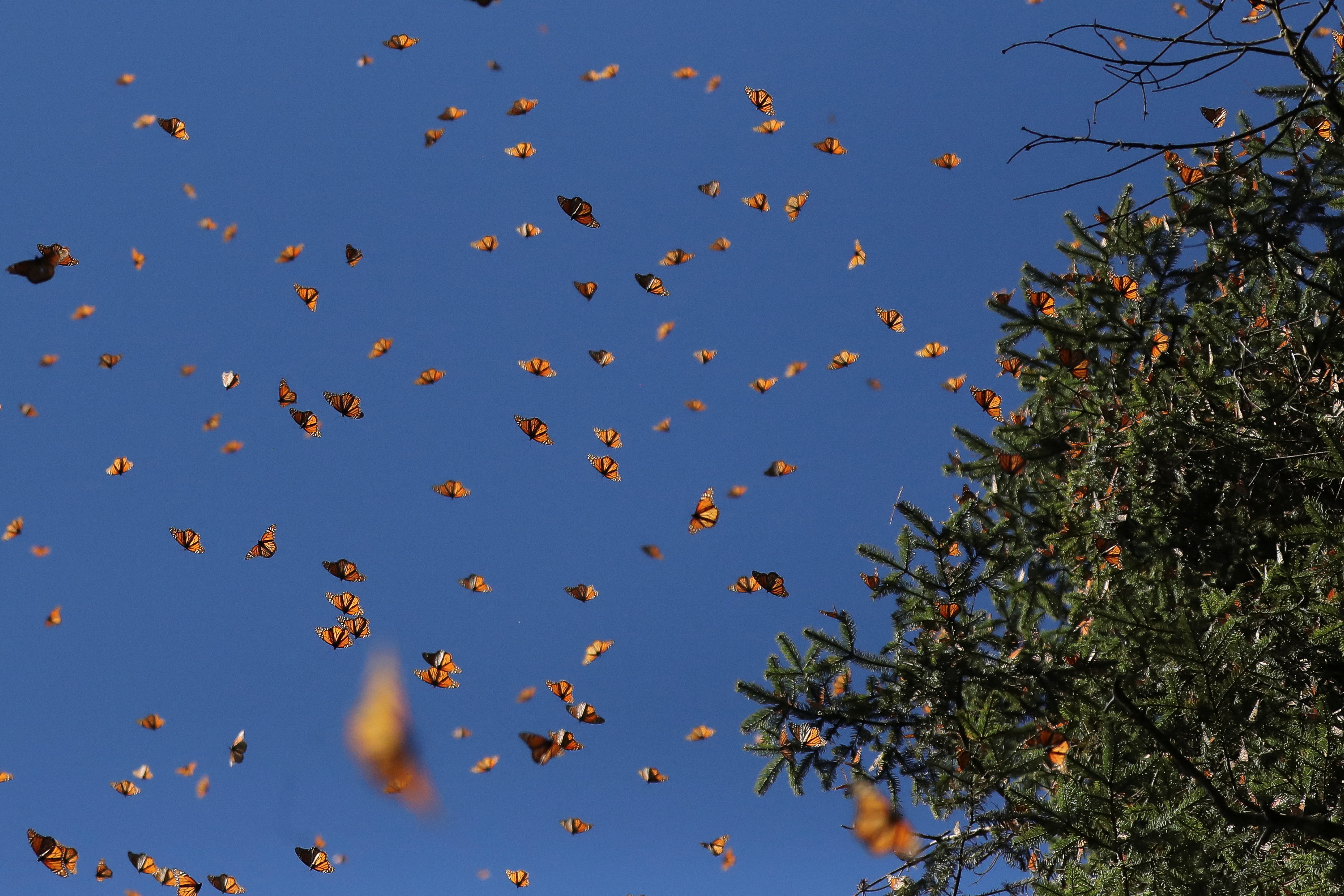
From a distance, they appear like autumn foliage: millions of endangered monarch butterflies blanketing trees in a kaleidoscope of brown, orange and black.

As the crisp mountain air warms, they flutter above dazzled visitors who have come to see an annual tradition that persists despite the environmental and human pressures threatening it.

Every year, migratory monarchs travel up to 2,000 miles (3,000 km) from the eastern United States and Canada to spend the winter among the forests of central and western Mexico.

Winter weekends bring hundreds of visitors to Sierra Chincua, an idyllic monarch sanctuary in the western state of Michoacan, about three hours drive from Mexico City.

Sierra Chincua in 1986 was brought into the protected Monarch Butterfly Biosphere Reserve, which is now a UNESCO World Heritage Site spanning some 138,000 acres (56,000 hectares).

“Tourism helps conserve the forest, it’s how we sustain our families,” said Juan Vidal, one of three dozen park rangers who patrol the forest and work as guides.

Today, the 54-year-old Vidal says there are fewer monarchs than when he first came as a child.

The migratory monarch population has fallen between 22% and 72% over the past decade, according to the International Union for the Conservation of Nature, which declared the species endangered in July.

Scientists blame climate change, pesticides and illegal logging for the population decline.

The monarchs’ presence in the states where they spend the winter, Michoacan and neighboring Mexico state, extended across 45 acres (18 hectares) in the mid-1990s. But by last winter the area had fallen to just 7 acres (3 hectares).

Last year’s migration, however, offered a glimmer of hope for the monarch’s future. Their presence in Mexico was actually up by more than a third compared to 2020.

Luis Martinez, one of the rangers at Sierra Chincua, expects this year to show further improvement. “We have more butterflies this year, more got here because the colony is bigger,” he said.

As the monarchs begin to arrive around Mexico’s Day of the Dead holiday in early November, some locals see the butterflies as the returning souls of ancestors.

Visitor Lizbeth Cerrato said the “unique experience” was like “watching souls flying above.”

“It’s so many feelings woven together.”

Related Galleries:

Monarch butterflies are seen at the Sierra Chincua butterfly sanctuary in Angangeo, Michoacan state, Mexico December 3, 2022. REUTERS/Raquel Cunha

Monarch butterflies fly at the Sierra Chincua butterfly sanctuary in Angangeo, Michoacan state, Mexico. December 3, 2022 REUTERS/Raquel Cunha

A park ranger holds a male monarch butterfly at the Sierra Chincua butterfly sanctuary in Angangeo, Michoacan state, Mexico December 3, 2022. REUTERS/Raquel Cunha

Monarch butterflies rest on a tree at the Sierra Chincua butterfly sanctuary in Angangeo, Michoacan state, Mexico December 3, 2022. REUTERS/Raquel Cunha

Monarch butterflies rest on the ground at the Sierra Chincua butterfly sanctuary in Angangeo, Michoacan state, Mexico December 3, 2022. REUTERS/Raquel Cunha
Categories
Audio Sources - Full Text Articles

OPEC+ keeps steady policy amid weakening economy, Russian oil cap

2022-12-04T13:04:16Z

An OPEC sign is seen on the day of OPEC+ meeting in Vienna in Vienna, Austria October 5, 2022. REUTERS/Lisa Leutner

OPEC+ agreed to stick to its oil output targets at a meeting on Sunday as the oil markets struggle to assess the impact of a slowing Chinese economy on demand and a G7 price cap on Russian oil on supply.

The decision comes two days after the Group of Seven (G7) nations agreed a price cap on Russian oil.

OPEC+, which comprises the Organization of the Petroleum Exporting Countries (OPEC) and allies including Russia, angered the United States and other Western nations in October when it agreed to cut output by 2 million barrels per day (bpd), about 2% of world demand, from November until the end of 2023.

Washington accused the group and one of its leaders, Saudi Arabia, of siding with Russia despite Moscow’s war in Ukraine.

OPEC+ argued it had cut output because of a weaker economic outlook. Oil prices have declined since October due to slower Chinese and global growth and higher interest rates, prompting market speculation the group could cut output again.

But on Sunday the group of oil producers decided to keep the policy unchanged. Its key ministers will next meet on Feb. 1 for a monitoring committee while a full meeting is scheduled for June 3-4.

On Friday, G7 nations and Australia agreed $60 per barrel price cap on Russian seaborne crude oil in a move to deprive President Vladimir Putin of revenue while keeping Russian oil flowing to global markets.

Moscow said it would not sell its oil under the cap and was analysing how to respond.

Many analysts and OPEC ministers have said the price cap is confusing and probably inefficient as Moscow has been selling most of its oil to countries like China and India, which have refused to condemn the war in Ukraine.

Neither the OPEC meeting on Saturday nor the OPEC+ meeting on Sunday discussed the Russian price cap, sources said.

JP Morgan said on Friday that OPEC+ could review production in the new year based on fresh data on Chinese demand trends and consumer compliance with price caps on Russia crude output and tanker flow.

Categories
Audio Sources - Full Text Articles

Moscow Idaho Murders #Moscow #IdahoMurders #MoscowIdaho #Murders #FBI FBI: Conduct the INVESTIGATIVE EXPERIMENT: Use the specially equipped #KnifeDrone in that house: it can open the sliding doors and windows, and of course inflict the multiple wounds quickly, “in cold blood”.

Moscow Idaho Murders

#Moscow #IdahoMurders

#MoscowIdaho #Murders

#FBI FBI: Conduct the INVESTIGATIVE EXPERIMENT: Use the specially equipped #KnifeDrone in that house: it can open the sliding doors and windows, and of course inflict the multiple wounds quickly, “in cold blood”.

FjIt-6OXEAEU2ED.jpg:large

Categories
Audio Sources - Full Text Articles

Moscow Idaho Murders #Moscow #IdahoMurders #MoscowIdaho #Murders This hypothesis has to be considered very, very seriously: Russian Intel + Russian MOB. #FBI – FBI: DO NOT INVESTIGATE IT AT YOUR OWN PERIL! Keep your eyes wide shut! Spetsnaz – GS: google.com/search?q=spets…

Moscow Idaho Murders

#Moscow #IdahoMurders

#MoscowIdaho #Murders

This hypothesis has to be considered very, very seriously: Russian Intel + Russian MOB.

#FBI – FBI: DO NOT INVESTIGATE IT AT YOUR OWN PERIL! Keep your eyes wide shut!

Spetsnaz – GS: google.com/search?q=spets…

FjIo6-aXgAEq8t-.jpg:large

WP Radio
WP Radio
OFFLINE LIVE