Categories
Audio Sources - Full Text Articles

Ukraine urges tougher Western squeeze on Russian oil prices

KYIV, Ukraine (AP) — The office of Ukrainian President Volodymyr Zelenskyy called Saturday for a lower price cap on Russian oil than the one agreed to by Ukraine’s Western supporters, while Russian authorities called the $60-per-barrel cap harmful to free, stable markets.

Andriy Yermak, the head of Zelenskyy’s office, wrote on social media that the price ceiling set by the European Union, Australia, Britain, Canada, Japan, and the United States on Friday didn’t go far enough. The cap is set to take effect Monday, along with an EU embargo on Russian oil shipped by sea.

“It would be necessary to lower it to $30 in order to destroy the enemy’s economy faster,” Yermak wrote on Telegram, staking out a position also favored by Poland — a leading critic of Russian President Vladimir Putin’s war in Ukraine.

The Russian Embassy in Washington insisted that Russian oil “will continue to be in demand” and criticized the price limit as “reshaping the basic principles of the functioning of free markets.” A post on the embassy’s Telegram channel predicted the per-barrel cap would lead to “a widespread increase in uncertainty and higher costs for consumers of raw materials.”

The price cap aims to put an economic squeeze on Russia and further crimp its ability to finance a war that has killed an untold number of civilians and fighters, driven millions of Ukrainians from their homes and weighed on the world economy for more than nine months.

The General Staff of the Ukrainian Armed Forces reported that since Friday Russia’s forces had fired five missiles, carried out 27 airstrikes and launched 44 shelling attacks against Ukraine’s military positions and civilian infrastructure.

Kyrylo Tymoshenko, the deputy head of the president’s office, said the attacks killed one civilian and wounded four others in eastern Ukraine’s Donetsk region. According to the U.K. Defense Ministry, Russian forces “continue to invest a large element of their overall military effort and firepower” around the small Donestsk city of Bakhmut, which they have spent weeks trying to capture.

In southern Ukraine’s Kherson province, whose capital city of the same name was liberated by Ukrainian forces three weeks ago following a Russian retreat, Gov. Yaroslav Yanushkevich said evacuations of civilians stuck in Russian-held territory across the Dnieper River would resume temporarily.

Russian forces pulled back to the river’s eastern bank last month. Yanushkevich said a ban on crossing the waterway would be lifted during daylight hours for three days for Ukrainian citizens who “did not have time to leave the temporarily occupied territory.” His announcement cited a “possible intensification of hostilities in this area.”

Kherson is one of four regions that Putin illegally annexed in September and vowed to defend as Russian territory. From their new positions, Russian troops have regularly shelled Kherson city and nearby infrastructure in recent days, leaving many residents without power. Running water remained unavailable in much of the city.

The other regions annexed in violation of international law are Donetsk, Luhansk and Zaporizhzhia.

Ukrainian authorities also reported intense fighting in Luhansk and Russian shelling of northeastern Ukraine’s Kharkiv region, which Russia’s soldiers mostly withdrew from in September.

The mayor of the northeastern city of Kharkiv, said some 500 apartment buildings were damaged beyond repair, and nearly 220 schools and kindergartens were damaged or destroyed. He estimated the cost of the damage at $9 billion.

___

Inna Varenytsia in Kherson, Ukraine, contributed to this report.

Categories
Audio Sources - Full Text Articles

EU Creating Cyber Laboratory for Ukrainian Armed Forces

eu_ukraine3.jpeg

The EU has financed and delivered equipment for a cyber lab, security software and hardware to the Ukrainian Armed Forces; the cyber lab was unveiled in Kyiv on Friday, the European Union External Action Service has reported.

“This cyber lab will provide training environment to test and strengthen the hands-on skills of military cyber defence professionals with realistic virtual scenarios and real-time simulations that help to identify, monitor and protect from future cyberattacks faster and more effectively,” the message reads.

The laboratory was opened under the assistance program within the framework of the European Peace Facility.

The European Peace Facility is an off-budget instrument aimed at enhancing the Union’s ability to prevent conflicts, build peace and strengthen international security, by enabling capacity-building activities for military actors, and the provision of training, equipment and infrastructure for security purposes under the Common Foreign and Security Policy (CFSP).

On 15 December 2021, the EU adopted an assistance measure under the European Peace Facility to support the Ukrainian Armed Forces worth EUR 31 million, including on cyber defence.

The post EU Creating Cyber Laboratory for Ukrainian Armed Forces appeared first on Kyiv Post.

Categories
Audio Sources - Full Text Articles

England bonds over cards ahead of Senegal World Cup clash

DOHA, Qatar (AP) — For a nation that has frequently flattered to deceive at soccer’s major tournaments, a card game that relies on the art of deception is strengthening the bond among England’s players ahead of their match against Senegal in the World Cup round of 16.

Werewolf, a game of roleplay and deduction, has become a popular pastime for the squad between games.

“It’s about being the best liar,” said midfielder Declan Rice. “The villagers have got to snuff out the wolves and the wolves have got to lie and tell everyone why they are not a wolf. There is a lot of teamwork, ganging up.”

Whatever England is doing at its base in Qatar, it’s working so far.

It plays Senegal on Sunday after topping Group B and tying Spain as leading scorers in the tournament so far with nine goals.

No other team picked up more than the seven points England recorded on its way to the knockout round and it is only one of three still undefeated.

Yet the message from coach Gareth Southgate and captain Harry Kane this week has been about maintaining focus and standards.

Belgium and Germany were high-profile departures from the group stage, while defending champion France, along with Argentina, Spain, Brazil and Portugal have all been on the wrong end of upsets.

And to think England’s 0-0 draw with the United States was considered enough of a shock that it prompted loud jeers from Three Lions fans after that match last week.

“I think it’s always difficult when you see big teams or big players in teams that don’t have the success that you want or don’t live up to the expectation of a nation or where they see themselves,” said defender John Stones. “We don’t ever want to fall into that category. I think that is great motivation for us as a reminder — you never want to take anything for granted or who you are playing against.”

England may be considered a major soccer nation, but its only tournament success came when it hosted and won the World Cup in 1966.

The years since have been pitted with disappointment and underachievement.

There has been an upturn under Southgate, who led the team to the semi-finals of the World Cup in Russia in 2018 and to the final of last year’s European Championship, which it lost on penalties to Italy.

The bond he has developed among the players is seen as a key factor in England’s improvement.

Southgate is also meticulous about his planning, from psychological help to deal the pressure of taking penalties to even the most minor details.

At a team meeting this week, players were reminded about leaving their socks out the “right way” for the kitmen to collect after training.

“We get on each other for things like that because we have created those standards,” said Stones. “If you start getting sloppy with the little things, the bigger things start to get sloppy very easily. Any one percent or two percent of things that we can do to get better … obviously those are small things, but they matter to us.”

So there should be no danger of England taking Senegal lightly.

The African Cup of Nations winner finished second in Group A behind the Netherlands. That was despite suffering the pre-tournament disappointment of star striker Sadio Mane being ruled out.

“They’re knockout games now: if you win, you get to stay here; if you lose, you go home,” said Senegal coach Aliou Cissé. “There’s no need to overthink things, every team is at the same level.

“Our squad is experienced today, they’ve gone through a lot together and they know how to prepare for this type of game now, in competitions like this one,” he added.

___

James Robson is at https://twitter.com/jamesalanrobson

___

AP World Cup coverage: https://apnews.com/hub/world-cup and https://twitter.com/AP_Sports

Categories
Audio Sources - Full Text Articles

A Murder in the Amazon Reveals What the Fight Over the Rainforest Is All About

In the south of the Amazon, just where two dirt roads cross, is a small bar, set back a bit from the highway. There’s no name over the door because it’s part of a house, really, but everyone calls it Guiga’s bar, after its owner. Like many of the bars dotted across the region, Guiga’s is ramshackle and no-frills. There’s a pool table along one side and a few tables and chairs out front, but that’s it. People go to get some shade, grab a beer, and swap local gossip, not for the décor or ambience.

The last known whereabouts of Ari Uru-Eu-Wau-Wau was in Guiga’s bar, sometime before midnight on April 18, 2020. Ari was a member of the Uru-Eu-Wau-Wau Indigenous people, and he’d spent that evening drinking in a series of bars scattered along the unpaved roads near the group’s reservation. The next morning his body was found at the side of a road around half an hour away. His head was caked with blood that had dried quickly in the searing heat. His phone was nestled in the grass a few feet away. On the sides of the road were walls of grass, and behind that were fields where the mighty Amazon rain forest had once stood.

[time-brightcove not-tgx=”true”]

The story of Ari Uru-Eu-Wau-Wau, and the investigation into his murder, is in one way the story of Brazilian Indigenous peoples: their genocide, their daily struggles in a hostile world, and their fight for justice. But it’s also a contemporary tale, of climate change, Brazil, and the influence of Jair Bolsonaro, the recently defeated Brazilian President whose disregard for the Amazon and its inhabitants has led the whole planet to the edge of environmental Armageddon.

Indigenous people have been under siege since Bolsonaro took power four years ago, and the Amazon has borne the brunt of his neglect. Deforestation, land grabs, and violence are up; equality, credibility, and empathy are down.

People like the Uru-Eu-Wau-Wau have good reason to lament the former army captain’s reign. It was in the 1970s, as the military forged a path into the untouched part of the jungle, that the Uru-Eu-Wau-Wau first came into recorded contact with a Brazil they had never hoped to meet. The Amazon was (and still is) Brazil’s Wild West, and the military dictators of the time saw it as a weak spot, a vast frontier coveted by bigger geopolitical powers and vulnerable to outside invasions. It was also an El Dorado, a treasure trove of metals, jewels, plants, animals, and raw materials ripe for the picking. So the military sent diggers to cut roads into the forest and encouraged people to go down them and plant a flag for the fatherland. In the slogan of the time, they offered “a land without men for men without land,” and millions took them up on it.

It spelled disaster for the Uru-Eu-Wau-Wau and hundreds of other Indigenous groups. Today, the Uru-Eu-Wau-Wau number only around 200, most of whom live in six communities scattered around a 1.8 million-hectare reservation in Rondônia, one of nine Brazilian states that make up the Amazon. The territory is being squeezed on all sides by loggers and ranchers. And it’s that pressure, say the Uru-Eu-Wau-Wau, that led to the death of Ari, a schoolteacher and leader, taken at the age of just 35.

Killing Indigenous people got easier in Brazil these past few years. Before taking office, Bolsonaro vowed not to give them “one more centimeter of land,” and he was true to his word. Bolsonaro hollowed out the state agency charged with protecting Indigenous groups, known as FUNAI, and he let environmental agencies rot, starving them of funds and staff, and deliberately creating conditions for loggers, miners, ranchers, and hunters to invade with impunity.

Deforestation has gone up every year since he took power, this year hitting a 15-year high. An astonishing 99% of all deforestation in 2021 contained indications of illegality, according to a study by MapBiomas. Violence has soared, and Indigenous people feel under siege. Even though reservations are fenced off—to keep the invaders out, not to keep the native people in—invasions by hunters and prospectors after land, gold, timber, and fish went from 109 in 2018 to 305 last year, according to Cimi, an Indigenous-rights group. The Amazon is now home to all kinds of opportunists, from small farmers grabbing a parcel of land to make a home and plant a few bananas, to international crime syndicates taking advantage of the vacuum.

“Drug-trafficking organizations, arms-trafficking organizations, illegal fishing and hunting organizations, they are all operating in the Amazon now,” says Suely Araújo, a former head of Ibama, the conservation and sustainable-development arm of the Ministry of the Environment.

And yet being in the Amazon is magical. On a river, in absolute silence bar the hum of the motor and the water lapping the sides of the boat; in the undergrowth, surrounded by shafts of yellow light and the pungent smell of wet soil; at night, below skies with so many stars, they seem to light up the ground beneath them.

Protecting these wonders became so much harder under Bolsonaro. The whole point of FUNAI, whose forerunner was set up in 1910, is to secure land for the most endangered Indigenous groups and then monitor the reservations to ensure invaders are kept out. Its mission statement is to “protect and promote the rights of Brazil’s Indigenous peoples.”

But when Bolsonaro starved it of funds, the opportunists poured in, often telling anyone who challenged them the President had their backs. It was a shock to people like Ari and Bitaté, the Uru-Eu-Wau-Wau’s 22-year-old leader, and they instinctively knew they had to react. Now, when they get word of illegal deforestation on their land, they don’t just inform FUNAI. They pack their bags, power up their drones, and set out to resolve the problem.

They do so as members of the guardians of the forest, a cross between a patrol and a pressure group. Indigenous people across Brazil have formed similar troupes over the past 10 years as a way to combat encroachment and destruction. Using modern technology to delineate their land, and traditional tools to protect themselves, it is one of the few ways they can actively defend the place they call home.

When news of incursions came in, Ari gathered at dawn with other Uru-Eu-Wau-Wau guardians, and together they would hike into the forest, backpacks over one shoulder, bows and arrows over the other. They knew the invaders were dangerous—“We are always being threatened,” says Bitaté—but drones helped them see what they were dealing with from afar. If the invaders were alone, or unarmed, they could scare them off or even, in rare cases, hand them over to police. Sometimes they settled for destroying the shacks the invaders holed up in; other times they would make off with their food or stove or, if they were really lucky, with their chain saws. Often they needed just to make their presence felt for the invaders to retreat.

“Ari used to say, ‘We are survivors. This is our land. This is where we are from,’” Bitaté says. “He wanted to protect it not just for himself but for his children and his grandchildren. When he died, we lost someone who was always on the front lines, someone who said, ‘We must not bow our heads.’”

There are, finally, reasons for optimism. On Oct. 30, Luiz Inácio Lula da Silva was elected President, defeating Bolsonaro. The Amazon and climate were two of the recurring themes of the campaign, and Lula has promised to repeat the success from a decade ago when his government reduced deforestation by more than 80%.

Most notably for the Uru-Eu-Wau-Wau, Lula has vowed to give Indigenous people more control over their own affairs. “Get ready, Brazil’s Indigenous people, because I am going to create a Ministry for Native Peoples,” he said in August. “Get ready, because FUNAI will no longer be run by a white man with green eyes. It will be run by an Indigenous man or woman.”

Downie has been reporting about Brazil and the Amazon for more than 20 years. A TIME Studios documentary about Uru-Eu-Wau-Wau, The Territory, premiered on the National Geographic Channel on Dec. 1 and will stream on Disney+

Categories
Audio Sources - Full Text Articles

Exclusive: The Making of the U.S. Military’s New Stealth Bomber

In the predawn darkness of the western Mojave Desert, workers make their way across a parking lot toward a sprawling complex of factories, hangars and runways. Teams of armed military and civilian guards patrol the grounds leading to the 5,800-acre facility, which is ringed by an elaborate security system and monitored from space by orbiting reconnaissance satellites.

At a fence bristling with razor-wire, the men and women pull key cards from their belt-loop lanyards, flash them on a contact sensor, punch in their numerical codes and push through high-gate turnstiles. Inside, they stow signal-emitting electronics like iPhones and earbuds at a bank of storage shelves, then swipe in at computer monitors to confirm their identities and security clearance. At last, they step onto a gleaming production floor the size of several football fields, a place off-limits to anyone who doesn’t have authorization to the “black world” of U.S. government secrecy known as SAR: Special Access Required.

[time-brightcove not-tgx=”true”]

This is U.S. Air Force Plant 42, where the military’s new stealth bomber, the B-21 Raider, is built. After nearly a decade in the shadows, the B-21 was presented on Dec. 2 evening to an invitation-only crowd of 3,000, including Defense Secretary Lloyd Austin, top military generals, industry executives and factory workers. The thin gray aircraft resembled a stingray as it glided through the parting hangar doors and artificial fog to applauding visitors, who were stationed 75 feet away and only permitted to view it head-on to maintain a veil of secrecy. Later, Austin spoke about the B-21’s ability to carry “nuclear and conventional munitions” along with future weapons not yet invented. “We are again making it plain to any potential foe: the risks and costs of aggression far outweigh any conceivable gains,” he said.

The B-21 is America’s first advanced weapon system in a new Cold War with Russia and China. Strategists at the Pentagon envision the radar-evading B-21 penetrating those countries’ air defenses to strike fortified targets should the growing military competition with Moscow and Beijing ever turn hot. If everything goes to plan, aerospace giant Northrop Grumman Corp. will produce at least 100 B-21s for the Air Force in the coming years at a current cost of $692 million per bomber—a price tag comparable to that of a skyscraper.
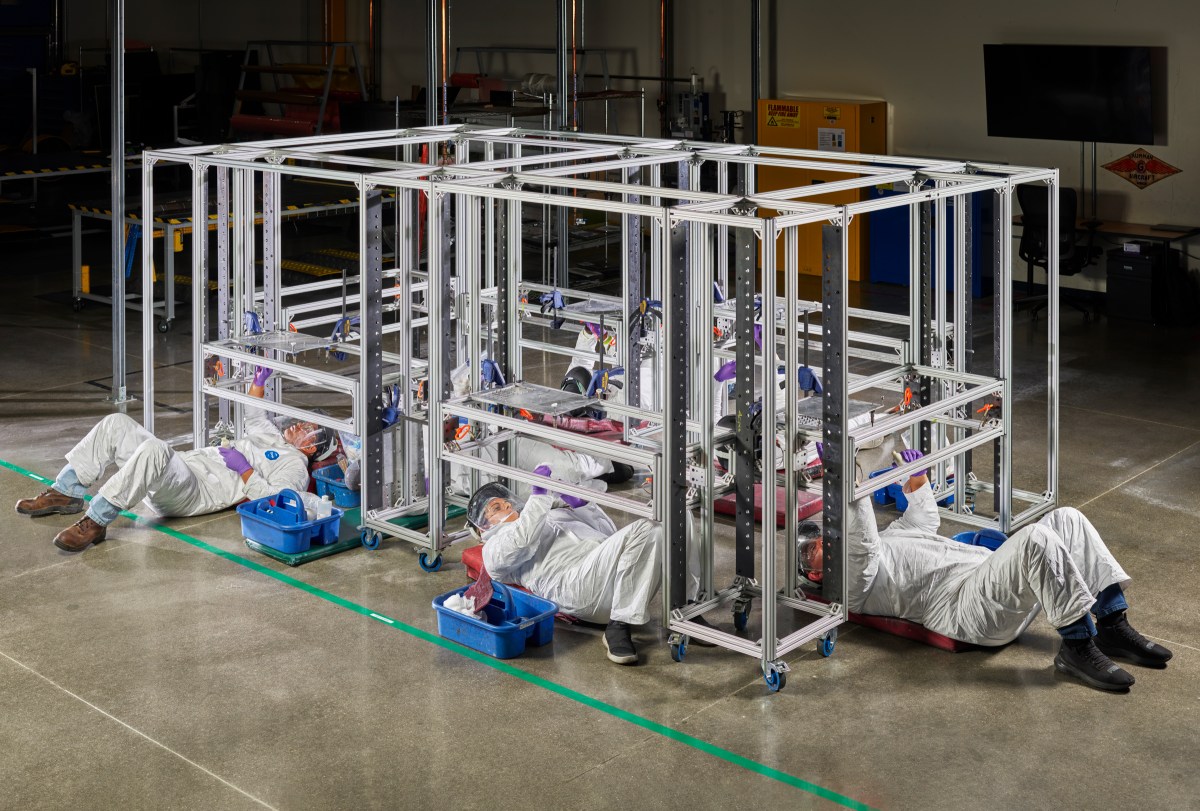
Northrop Grumman B-21 Bomber
Christopher Payne for TIMENew employees are instructed on production methods at a training center before starting on active assembly lines.

But the road from well-funded Pentagon war plans to deployable high-tech weaponry is littered with expensive failures. For nearly 40 years, the Air Force has been unable to purchase new planes on time, on budget, and in sufficient numbers. The last time the Air Force bought a bomber, in the 1980s, it wanted 132 planes at about $500 million per aircraft. What it received was 21 bombers at $2 billion apiece. Northrop was its partner on that project too and stumbled through production delays and engineering snags. The B-21’s predecessor, known as the B-2 and produced at the same facility, became a symbol of the government’s broken procurement process—a cutting-edge weapons system that is high-priced, short in supply, and seldom used.

The question hanging over the B-21 is whether Northrop and the Air Force have learned their lessons from the past before embarking on this new, massive, strategic gamble. For the past year, TIME has followed the development of the B-21, visiting Plant 42 ahead of the rollout, observing engineering, manufacturing and testing teams; speaking with more than three dozen military, industry and political personnel involved with the program; and reviewing government documents detailing costs and development. While the program has hit early milestones, the largest challenges lie ahead for the Pentagon and its tendency to underestimate risk, technical difficulty and cost to get big-ticket programs like B-21 rolling.

More than money is at stake. Success or failure for the B-21 program may determine whether the U.S. retains a long-range bomber advantage over its global rivals or saddles taxpayers with interest payments on yet another gold-plated budget-buster for years to come.


Each B-21 bomber begins its life on the northern end of Building 401 at Plant 42 as a wedge-shaped, granite-colored shell of light-weight composite materials. It moves southward down the line from one workstation to the next, transforming into a bomber: avionics, radars, sensors, weapons bays, windows, and wings. Traditionally, airplanes are manufactured from the inside-out, but it’s the other way around for stealth airplanes. Hundreds of thousands of parts are pieced together inside the B-21’s sleek boomerang-shaped shell. The goal is to keep the sinister-looking jet’s exterior as smooth as glass to reduce radar-reflection.

Stealth is the B-21’s defining feature. From the beginning, Northrop’s engineers have labored to create a plane that can fly undetected through enemy air space and remain invisible to missiles and fighter jets. To lower the infrared and acoustic “signatures,” the B-21 is designed to fly at subsonic speeds, powered by jet engines embedded into the wings like shark gills. High-tech coating materials are applied to the rounded exterior, creating a sponge-like skin reputed to absorb radar waves as they strike the aircraft. The B-21 is designed to be even stealthier than the B-2, which reportedly appeared no bigger than a tennis ball on radar screens despite a wingspan akin to a 747 jumbo jet.

The B-21’s size, weight, range and payload remain undisclosed, but to the trained-eye it’s noticeably smaller than the B-2. Many of the plane’s technical details, however, will likely remain classified for as long as any of us are alive. The Air Force and Northrop have poured an untold fortune to prevent information from leaking out. Many suppliers remain unaware they are making parts for the B-21. Northrop engineers and technicians weren’t unable to tell family or friends they worked on the program until June and even then, couldn’t reveal details about what they do all day. “There can be some challenges because we can’t really talk about what we do at work,” says Hassan Charles, a B-21 technician at Plant 42. “But a lot of hands went into making this bird, a lot of hours, a lot of challenging times.”

One Tuesday in November, Charles and dozens of workers swarmed around four unfinished B-21s, tinkering with fasteners, gauges, switches, and wiring designed to withstand a nuclear blast. It’s hand-on, labor-intensive work carried out by technicians rather than robots on an automated line. The B-21 team has churned out two planes thus far: T-1, the aircraft unveiled during the Dec. 2 rollout, and G-1, which is now undergoing ground tests. Since winning the bomber contract in October 2015, Northrop has constructed three new buildings for assembly here at Plant 42, renovated workspaces and has jump-started new hiring programs to add to the 5,000 people now employed on the program. When new employees are hired, they often wait weeks until they obtain government clearances, an investigation process to weed out potential spies and criminals.

Read More: The Mission to Modernize America’s Aging Nuclear Missiles.

Northrop Grumman B-21 Bomber
Christopher Payne for TIME | A small portion of this image was removed for security purposes.Jessi Ross, a program director, and Hassan Charles, a surface technician, are among 5,000 employees at Northrop Grumman now working on the B-21 bomber.

Perched above the assembly line is a strip of offices, where Northrop’s B-21 engineers work. The maze of gray cubicles is festooned with artwork scotch-taped to the walls, featuring grinning skulls and pirate-themed posters with phrases like, “Rise of the Raider.” (The B-21’s nickname, Raider, was inspired by the improbable 1942 U.S. air raid on Tokyo during World War II led by Lieutenant Colonel Jimmy Doolittle.) The team uses the latest virtual modeling and three-dimensional simulation programs to identify and eliminate technical issues before they physically get onto the jet. The company says the digital approach should help cut time and cost as the program nears flight-testing.

Embedded with the Northrop team is Colonel Tim Spaulding, the Air Force’s B-21 program director and certified test pilot. Spaulding says he is confident the technology is flagging some flaws. But tempering expectations, he says unforeseen issues inevitably will be discovered when the plane first takes to the skies next year. “It’d be great if you didn’t have to learn anything when we build a complex project,” Spaulding says. “We know we will. Our goal is to learn it as quickly as we can and to be able to make whatever corrections, if any are required, as quickly as we can.”

As much as anyone, Spaulding is responsible for keeping the program on time and on budget. More than once, he’s had to balance the urge to add new capabilities to the plane with the fear of getting derailed from the schedule. He’s aware of the cascade of mistakes that have long-plagued Air Force projects: ever-changing design requirements, unreliable production rates and exploding cost projections. “Everyone wants a Battlestar Galactica, packed with the latest technology,” he says, driving between buildings at Plant 42. “We have to get the first airplanes out there and going, before we’re ready to make them better.”

So far, the Air Force says, the B-21 is hitting all its projected targets, but it’s hard to independently discern the plane’s true costs. Yes, the bomber’s projected $692 million per plane price tag is below the planned costs that the Pentagon announced a decade ago. But the unclassified numbers—published under the Air Force’s procurement and “Research, Development, Test and Evaluation” budget lines—don’t tell the whole story. Huge swathes of the program remain classified and if it garners so-called “black budget” funding, the public won’t know. According to the Pentagon’s 2023 request, the Air Force plans to spend nearly $20 billion on producing the B-21 for the next five years, but it’s not clear how many planes that will buy. Production timelines and rates are classified.

Secrecy is a means to keep foreign adversaries in the dark, but it’s also a means to hide costs, says Chuck Spinney, a retired Pentagon weapons analyst who has spent more than a half-century studying politicization of defense procurement. “The trouble with maintaining oversight on programs like the B-21 is all the interesting parts are black,” he says. “That’s by design. It’s business as usual. Because when we find out that something goes wrong—and something always does—it’s either too early to tell or too late to do anything about it.”

More expenditures lie ahead. For instance, the B-21 is designed to drop nuclear weapons, requiring special testing and equipment. But the Air Force doesn’t intend to certify the plane for nuclear missions until two years after it enters service sometime in “the mid-2020s,” according to Pentagon auditing documents. Outside analysts view that as a cost-cloaking decision that defers requests for additional funding into future budgets. In addition, the B-21 is designed to be one part of a “family of systems,” which may include drones flying alongside it on future bombing runs. It’s not clear if additional funding will be needed for the system to function properly together.

Northrop Grumman B-21 Bomber
Christopher Payne for TIME | A small portion of this image was removed for security purposes.Northrop Grumman has opened new hiring and training pipelines as production on the B-21 program picks up.

Such financial oversight evasion is an area of long-standing expertise for the military, says William Hartung, senior fellow with the Quincy Institute for Responsible Government. “The Pentagon routinely understates the costs of major systems, and I expect the B-21 to be no different,” he says. “It’s not a question of whether there will be overruns, but how high they will go, and whether they lead to massive additional spending or a reduction in the proposed buy of the planes.”

The Pentagon’s most recent fighter-jet program, the F-35, has been beset with production delays and cost overruns for 21 years, with acquisition costs nearly doubling to $428 billion for 2,470 planes. Before that, the Air Force wanted 648 F-22 fighter jets for $149 million each. It received 188 at a price tag of more than $400 million per copy. With this track record, says William LaPlante, the Pentagon’s chief weapons buyer, the suspicion of the B-21’s true costs is understandable. “Since the beginning of the program, there’s always been a lot of skepticism—and I think for good reason,” he says. “We’re just going to have to keep proving to the American people and hold our military accountable to the fact that the program is going well.”


The aerospace industry was stunned when underdog Northrop won the B-21 contract in 2015, beating out a joint-bid by the nation’s two largest defense contractors, Boeing Co. and Lockheed Martin Corp. Northrop’s work on the B-2 had changed the fortunes of the company from a small firm known for building lightweight fighters into a defense behemoth. But even though Congress invested more than $20 billion in research and development for the B-2, the bat-winged bomber turned out to be a delicate creature. Its radar-evading qualities were revolutionary in military technology, but it turned out those same features demanded constant coddling and were sensitive to everything but picture-perfect weather. The B-2 is derisively called a “hangar queen” because for each hour one is in the air, it spends 51 hours on the ground in maintenance, according to Air Force statistics. The jet has made more appearances flying over air shows and sporting events than it has above active battlefields. For every hour it’s airborne, it costs $150,741, the Government Accountability Office reported in November.

Northrop contends stealth technology has come a long way since the B-2 when many aerospace engineers still used slide rules and drafting tables. A small number of employees on the B-21 worked on its predecessor, themselves, and a cadre of retired engineers are called upon for advice on avoiding pitfalls. The battle-scars of the B-2 may help alleviate the problems Northrop ran into on the first project. “When I walked in the door, very early days, I was handed a B-2 lessons-learned paper, and was pretty much told to memorize it,” says Jessi Ross, a B-21 director at Northrop. “And it covered everything, as far as successes and things we would like to do better if we had an opportunity to go do it again.”

While the B-2 needs a specialized temperature-controlled hangar, Northrop engineers say the B-21 will be left outside under a shelter along the flight line like other planes. Where mechanics spend hours scraping away radar-absorbing material on the B-2 to access wiring under its 100-plus panels, the plan is for those doors to simply pop open on the B-21. And while it can require months of maintenance for a B-2 to fly, the B-21 is designed to do so every day.

The B-21 is a prospective gold mine for Northrop, whose annual revenues have soared 52% to $35.7 billion in the seven years since being awarded the initial contract. Air Force officials say that over the next 30 years it will cost at least $203 billion to develop, purchase and operate 100 B-21s. And Northrop hopes the Air Force will order far more. For that to happen, the jets need to move out of assembly and into the hands of Air Force pilots, says Kathy Warden, the company’s chief executive officer. “It’s constantly in our mind that we have an obligation to deliver on our commitments,” Warden tells TIME at Northrop’s headquarters in Falls Church, Va. “Part of that is the affordability commitment that we make, not just the technical capability that we’re delivering. And that proved to be a challenge for the Northrop Grumman team on the B-2.”

Read More: Chinese and Russian Warplanes Patrol the Pacific In a Show of Strengthening Military Ties.

In April, Warden announced Northrop received a $67 million incentive fee from the Air Force for hitting performance targets thus far. The company plans to continue to stay ahead of timelines in the coming months. Typically, the first assembled jets are one-off prototypes that need to be heavily modified once the design kinks are worked out. The B-21 rolled out Dec. 2 is more or less production-ready, Northrop officials say, which they hope will streamline the testing process.

Veteran budget watchers remain skeptical. “The reality is the cost of high-tech systems invariably rises because of unrealistic goals and impractical solutions,” says Dan Grazier, a retired Marine captain with the nonprofit Project On Government Oversight. “We shouldn’t act surprised if the B-21 doesn’t live up to every promise.”


Theoretically, the end of a major war like the one in Afghanistan brings a “peace dividend,” with curtailed defense spending. Not so this time in the unruly wake of the U.S. retreat from Kabul in August 2021. In October, the Biden Administration unveiled a new defense strategy that puts the U.S. military on a Cold War-footing with both Russia and China. The plan foresees the U.S. confronting two nuclear peer-adversaries for the first time in history with a multi-year build-up of modernized weaponry, enhanced foreign alliances and a top-to bottom $1.2 trillion overhaul of the American nuclear arsenal.

The B-21 is a significant line-item in that national security plan and, its designers hope, an important part of America’s ability to project force around the world. Onboard computers allow the bomber to fly with a pilot or as a drone, and will enable it to share data with other airborne warplanes. It will also use an open-architecture design, so capabilities are updated and improved with software upgrades rather than hands-on maintenance overhauls.

Northrop Grumman B-21 Bomber
Christopher Payne for TIMEU.S. Air Force Plant 42 is a sprawling aircraft manufacturing complex in the Mojave Desert about 60 miles northeast of downtown Los Angeles

It’s not hard to see why planners want the new plane. The Air Force now has the smallest and oldest fleet in the nation’s history. Roughly half of the Air Force’s 141 bombers are B-52s, which rolled off assembly lines during the Kennedy Administration. During the last Cold War, the military’s justification for big weapons programs focused on the Soviet Union, but the argument has shifted today as tensions with China rise. In the Asia-Pacific region, extensive distances are an obstacle for any battle plan, and Beijing has spent years investing in its air defense network with sophisticated radars, long-range S-400 surface-to-air missiles, and J-20 stealth fighters. These systems could prove problematic if, for example, China decides to invade the U.S.-allied island of Taiwan and an American President chooses to help defend it. Salvos of cruise missiles could slam into many targets from more than 1,000 miles away, but only a bomber can persist in contested airspace, find, identify, and attack mobile missiles threatening U.S. aircraft carriers and other forces.

The new B-21 stealth bombers are designed to fly thousands of miles away, slip undetected through enemy air defenses, drop several tons of bombs on targets and clear the way for U.S. and allied militaries. Only the B-2 can currently do that, and the U.S. owns just a handful.

That’s one reason the B-21 appears to have budgeting tailwinds behind it. Another is bipartisan support for the program that has been generated in part through concerted lobbying. Northrop spent $8.7 million in 2022 on lobbying, according to OpenSecrets.org. Among the talking points: the fact that the B-21 now provides 8,000 jobs in 40 states with the promise of more if production ramps up.

Now that the bomber has been unveiled, the next challenge will take place about 25 miles northeast of Plant 42 at Edwards Air Force Base. There, high above the desert, test pilots will push the jet to its aerodynamic limits. How it performs will go a long way to revealing whether the stealthy B-21 program—or just its costs—are primed to take off.

With reporting by Anisha Kohli and Julia Zorthian

Categories
Audio Sources - Full Text Articles

Uvalde shooting victims seek $27B, class action in lawsuit

AUSTIN, Texas (AP) — Victims of the Uvalde school shooting that left 21 people dead have filed a lawsuit against local and state police, the city and other school and law enforcement officials seeking $27 billion due to delays in confronting the attacker, court documents show.

The lawsuit, which was filed in federal court in Austin on Tuesday, says officials failed to follow active shooter protocol when they waited more than an hour to confront the attacker inside a fourth-grade classroom.

It seeks class action status and damages for survivors of the May 24 shooting who have sustained “emotional or psychological damages as a result of the defendants’ conduct and omissions on that date.”

Among those who filed the lawsuit are school staff and representatives of minors who were present at Robb Elementary when a gunman stormed the campus, killing 19 children and two teachers in the deadliest school shooting in the U.S. in nearly a decade.

Instead of following previous training to stop an active shooter “the conduct of the three hundred and seventy-six (376) law enforcement officials who were on hand for the exhaustively torturous seventy- seven minutes of law enforcement indecision, dysfunction, and harm, fell exceedingly short of their duty bound standards,” the lawsuit claims.

City of Uvalde officials said they had not been served the paperwork as of Friday and did not comment on pending litigation.

The Texas Department of Public Safety and the Uvalde Consolidated School District did not respond to requests for comment.

A group of the survivors also sued Daniel Defense, the company that made the gun used by the shooter, and the store where he bought the gun. That separate lawsuit seeks $6 billion in damages.

Daniel Defense, based in Black Creek, Georgia, did not respond to a request for comment. In a congressional hearing over the summer, CEO Marty Daniels called the Uvalde shooting and others like it “deeply disturbing” but separated the weapons themselves from the violence, saying America’s mass shootings are local problems to be solved locally.

Earlier this week, the mother of a child killed in the shooting filed another federal lawsuit against many of the same people and entities.

Two officers have been fired because of their actions at the scene and others have resigned or been placed on leave. In October, Col. Steve McCraw, the head of the Texas Department of Public Safety, acknowledged mistakes by officers when confronted for the first time by families of the Uvalde victims over false and shifting accounts from law enforcement and lack of transparency in the available information. But McCraw defended his agency, saying they “did not fail” Uvalde.

___

Follow AP’s coverage of the Uvalde school shooting: https://apnews.com/hub/uvalde-school-shooting https://apnews.com/hub/uvalde-school-shooting

Categories
Audio Sources - Full Text Articles

Russia says “dangerous“ price cap won“t curb demand for its oil

2022-12-03T12:54:17Z

An aerial view shows the Vladimir Arsenyev tanker at the crude oil terminal Kozmino on the shore of Nakhodka Bay near the port city of Nakhodka, Russia August 12, 2022. REUTERS/Tatiana Meel

Russia said on Saturday it would continue to find buyers for its oil, despite what it said was a “dangerous” attempt by Western governments to introduce a price cap on its oil exports.

A coalition of Western countries led by the G7 group of nations agreed on Friday to cap the price of Russian seaborne oil at $60 a barrel, as they aim to limit Moscow’s revenues and curb its ability to finance its invasion of Ukraine.

Russia has repeatedly said it will not supply oil to countries that implement the cap – a stance reaffirmed by Mikhail Ulyanov, its ambassador to international organisations in Vienna, in posts on social media.

“Starting from this year Europe will live without Russian oil,” he said.

In comments published on Telegram, Russia’s embassy in the United States criticised what it said was the “reshaping” of free market principles and reiterated that its oil would continue to be in demand despite the measures.

“Steps like these will inevitably result in increasing uncertainty and imposing higher costs for raw materials’ consumers,” it said.

“Regardless of the current flirtations with the dangerous and illegitimate instrument, we are confident that Russian oil will continue to be in demand.”

Categories
Audio Sources - Full Text Articles

Dems move to make South Carolina, not Iowa, 1st voting state

WASHINGTON (AP) — Democrats voted Friday to remove Iowa as the leadoff state on the presidential nominating calendar and replace it with South Carolina starting in 2024, a dramatic shakeup championed by President Joe Biden to better reflect the party’s deeply diverse electorate.

The Democratic National Committee’s rule-making arm made the move to strip Iowa from the position it has held for more than four decades after technical meltdowns sparked chaos and marred results of the state’s 2020 caucus. The change also comes after a long push by some of the party’s top leaders to start choosing a president in states that are less white, especially given the importance of Black voters as Democrats’ most loyal electoral base.

Discussion on prioritizing diversity drew such impassioned reaction at the committee gathering in Washington that DNC chair Jaime Harrison wiped away tears as committee member Donna Brazile suggested that Democrats had spent years failing to fight for Black voters: “Do you know what it’s like to live on a dirt road? Do you know what it’s like to try to find running water that is clean?”

“Do you know what it’s like to wait and see if the storm is going to pass you by and your roof is still intact?” Brazile asked. “That’s what this is about.”

Following Biden’s recommendations, the committee also opted to have New Hampshire and Nevada jointly vote second, a week after South Carolina, followed by Georgia and Michigan, two critical battleground states that would round out the top five in subsequent weeks. All the proposed contests would likely be held in February 2024.

That’s a change from the current calendar, with Iowa holding the first-in-the-nation caucuses since 1972, followed by New Hampshire’s first-in-the-nation primary since 1920. Nevada and South Carolina have gone next since the 2008 presidential election, when Democrats last did a major overhaul of their primary calendar.

The move will still have to be approved by the full DNC in a vote likely early next year, but it will almost certainly follow the rule-making committee’s lead.

The revamped schedule could largely be moot for 2024 if Biden opts to seek a second term, but may remake Democratic presidential cycles in 2028 and beyond. The president has said for months that he intends to run again, and White House aides have begun making staffing discussions for his likely reelection campaign, even though no final decision has been made.

Biden wrote in a letter to rules committee members on Thursday that the party should scrap “restrictive” caucuses altogether because their rules on in-person participation can sometimes exclude working-class and other voters. He told also told party leaders privately that he’d like to see South Carolina go first to better ensure that voters of color aren’t marginalized as Democrats choose a presidential nominee.

Four of the five states now poised to start the party’s primary are presidential battlegrounds, meaning the eventual Democratic winner would be able to lay groundwork in important general election locales. That’s especially true for Michigan and Georgia, which both voted for Donald Trump in 2016 before flipping to Biden in 2020. The exception is South Carolina, which hasn’t gone Democratic in a presidential race since 1976.

The first five voting states would be positioned to cast ballots before Super Tuesday, the day when much of the rest of the country holds primaries. That gives the early states outsize influence since White House hopefuls struggling to raise money or gain political traction often drop out before visiting much of the rest of the country.

Scott Brennan, a rules committee member from Iowa, said “small, rural states” like his “must have a voice in the presidential nominating process.”

“Democrats cannot forget about entire groups of voters in the heart of the Midwest without doing significant damage to the party in newer generations,” Brennan said.

The Republican National Committee has already decided to keep Iowa’s caucus as the first contest in its 2024 presidential primary, ensuring that GOP White House hopefuls — which include Trump — have continued to frequently campaign there.

House Majority Whip Jim Clyburn, South Carolina’s lone congressional Democrat and one of Biden’s top supporters in Congress, said the president called him Thursday to inform him of his push to move his state up.

“I didn’t ask to be first,” Clyburn said. “It was his idea to be first.”

Clyburn’s endorsement of Biden in 2020 boosted the candidate’s flagging presidential campaign just ahead of South Carolina’s primary, which he won big. That helped Biden shake off early losses in Iowa, New Hampshire and Nevada and eventually take the White House.

“He knows what South Carolina did for him, and he’s demonstrated that time and time again, by giving respect to South Carolina,” Clyburn said.

Still, the vote by the rules committee has faced serious pushback, with some states vowing to ignore the changes altogether. That’s despite the panel approving language saying states could lose all of their delegates to the party’s national convention if they attempt to violate new rules.

Iowa and New Hampshire have said laws in their states mandate them going before others, and they intend to abide by those, not DNC decrees.

Nevada, with its heavily Hispanic population, has balked at sharing the second-place slot with New Hampshire, a state 2,500 miles away.

Nevada committee member Artie Blanco’s voice cracked as she argued against the change.

“If we want to build a strong relationship with Latinos,” Blanco said, “then Nevada must stand alone on a date and not have to share that date.”

___

Associated Press writer Meg Kinnard contributed from Columbia, S.C.

Categories
Audio Sources - Full Text Articles

Ukraine Welcomes Russian Oil Price Cap Agreed by EU, G7

opu_photo-credit-presidential-office.jpe

Ukraine on Saturday, Dec, 3, welcomed a $60 price cap on Russian oil agreed by the EU, G7 and Australia, saying it would “destroy” Russia’s economy.

The price cap, previously negotiated on a political level between the G7 group of wealthy democracies and the European Union, will come into effect with an EU embargo on Russian crude oil from Monday.

Poland had refused to back the price cap plan over concerns the ceiling was too high, before its ambassador to the EU confirmed Warsaw’s agreement on Friday evening.

The embargo will prevent shipments of Russian crude by tanker vessel to the EU, which account for two thirds of imports, potentially depriving Russia’s war chest of billions of euros.

“We always achieve our goal and Russia’s economy will be destroyed, and it will pay and be responsible for all its crimes,” Ukraine’s presidential chief of staff Andriy Yermak said on Saturday on Telegram.

But a cap of “$30 would have destroyed it more quickly”, he added.

The G7 said it was delivering on its vow “to prevent Russia from profiting from its war of aggression against Ukraine, to support stability in global energy markets and to minimise negative economic spillovers of Russia’s war of aggression”.

The White House described the deal as “welcome news”, saying a price cap will help limit Russian President Vladimir Putin’s ability to fund the Kremlin’s “war machine”.

– Infrastructure strikes ‘inevitable’ –

After suffering humiliating defeats during what has become the largest armed conflict in Europe since World War II, Russia began targeting Ukrainian energy infrastructure in October, causing sweeping blackouts.

Putin said Russian strikes on Ukrainian infrastructure were “inevitable”, in his first conversation with German Chancellor Olaf Scholz since mid-September.

“Such measures have become a forced and inevitable response to Kyiv’s provocative attacks on Russia’s civilian infrastructure,” Putin told Scholz, according to a Kremlin readout of the telephone talks.

The Kremlin leader referred in particular to the October attack on a bridge linking Moscow-annexed Crimea to the Russian mainland.

During the hour-long call, Scholz “urged the Russian president to come as quickly as possible to a diplomatic solution, including the withdrawal of Russian troops”, according to the German leader’s spokesman.

But Putin urged Berlin to “reconsider its approaches” and accused the West of carrying out “destructive” policies in Ukraine, the Kremlin said, stressing that its political and financial aid meant Kyiv “completely rejects the idea of any negotiations”.

Ukrainian President Volodymyr Zelensky had ruled out any talks with Russia while Putin is in power, shortly after the Kremlin claimed to have annexed several Ukrainian regions.

– Talks off the table –

The Kremlin also indicated Moscow was in no mood for talks over Ukraine, after US President Joe Biden said he would be willing to sit down with Putin if the Russian leader truly wanted to end the fighting.

“What did President Biden say in fact? He said that negotiations are possible only after Putin leaves Ukraine,” Putin’s spokesman Dmitry Peskov told reporters, adding Moscow was “certainly” not ready to accept those conditions.

The White House, meanwhile, sought to pour water on the idea of talks as well on Friday, saying Biden currently has “no intention” of sitting down with Putin.

Russia’s strikes have destroyed close to half of the Ukrainian energy system and left millions in the cold and dark at the onset of winter.

In the latest estimates from Kyiv, Mykhaylo Podolyak, an adviser to Zelensky, said as many as 13,000 Ukrainian soldiers have died in the fighting.

Both Moscow and Kyiv are suspected of minimising their losses to avoid damaging morale.

Top US general Mark Milley last month said more than 100,000 Russian military personnel have been killed or wounded in Ukraine, with Kyiv’s forces likely suffering similar casualties.

The fighting in Ukraine has also claimed the lives of thousands of Ukrainian civilians and forced millions to flee their homes.

Those who remain in the country have had to cope with emergency blackouts as authorities seek to relieve the pressure on the energy infrastructure.

The post Ukraine Welcomes Russian Oil Price Cap Agreed by EU, G7 appeared first on Kyiv Post.

Categories
Audio Sources - Full Text Articles

Addressing Climate Change Will Not “Save the Planet”

A boiler tower is surrounded by mirrors at the Ivanpah Solar Electric Generating System in the Mojave Desert on August 26, 2022 near Nipton, California.

A boiler tower surrounded by mirrors at the Ivanpah Solar Electric Generating System in the Mojave Desert, Calif., on Aug. 26, 2022.

Photo: David McNew/Getty Images


Conservation biology finds itself in a terrifying place today, witness to mass extinction, helpless to stop the march of industrial Homo sapiens, the pillage of habitat, the loss of wildlands, and the impoverishment of ecosystems. Many of its leading figures are in despair. “I’m 40 years into conservation biology and I can tell you we are losing badly, getting our asses kicked,” Dan Ashe, director of the U.S. Fish and Wildlife Service under President Barack Obama, told me recently. “There are almost no reasons to be optimistic.”

This might explain the discipline’s desperate hitching of its wagon to the climate movement. Climate, after all, is the environmental cause du jour, eclipsing all other sustainability concerns, increasingly attractive as a rallying cry for a public that has canonized it as one of the major political, social, and economic issues of our time. Mainstream climate activism of the Bill McKibben variety points toward a grandly hopeful end within the confines of acceptable capitalist discourse: decarbonization of the global economy, with technologies driven by profit-seeking corporations subsidized by governments. Taking up this banner of optimistic can-do-ism, the environmental movement has convinced itself, and sought to convince the public, that with a worldwide build-out of renewable energy systems, humanity will power its dynamic industrial civilization with jobs-producing green machines while also — somehow — rescuing countless species from the brink.

“But this happens to be a lie,” Ashe told me. “The lie is that if we address the climate crisis, we will also solve the biodiversity crisis.”

“The lie is that if we address the climate crisis, we will also solve the biodiversity crisis.”

A group of conservationists took up the question of climate and extinctions last year in the journal Conservation Letters, warning that “threats to biodiversity are increasingly seen through the single myopic lens of climate change.” The authors, who titled their article “An inconvenient misconception: Climate change is not the principal driver of biodiversity loss,” included Joel Berger, a wildlife biologist at Colorado State University; evolutionary biologist Andrew Dobson, who teaches at Princeton; and Tim Caro, an evolutionary ecologist at the University of California, Davis. “There is an assumption,” they observed, “that climate change is now the most important ‘horseman of the biodiversity apocalypse’” — despite this being “at best premature.”

When it comes to effects on wildlife, climate change is more like a mule, slow and plodding. Yes, a warmed atmosphere is projected to be a significant factor in the extinction crisis in future decades, but what’s destroying species today is habitat fragmentation and loss, overhunting and overexploitation, agricultural expansion, pollution, and industrial development. It isn’t climate change that caused a 69 percent loss in total wildlife populations between 1970 and 2018, according to a World Wildlife Fund study published this year. The cause is too many people demanding too much from ecosystems, or human overshoot of the biophysical carrying capacity of the Earth.

Overshoot is a product of both excessive numbers and rising affluence. Access to the things that create what we call quality of life, like indoor lighting and temperature controls, especially air conditioning; more diverse dietary choices, especially meat; and greater access to transportation, especially air travel — all signs of rising affluence, all delightful if you are a human, yet all demand more energy and material inputs that involve scouring and denuding more wildlands and animal habitat to feed, clothe, house, and energize burgeoning humanity.

According to the co-authors of the Conservation Letters piece, we are “dangerously ignoring” this reality and instead doubling down on the “distortion” that climate mitigation is all that matters to protecting wildlife. Over the last 30 years, the proportion of scientific papers closely tying climate change and global warming to changes in patterns of biodiversity has “steadily increased,” according to their analysis. Media coverage of climate change in relation to biodiversity has followed suit, repeating and compounding the error. The net result of this “misguided focus on climate change” has been the undermining of conservation science “as an evidence-based scientific discipline.” As Dobson put it to me, “If conservation biologists don’t take a balanced look at the evidence, they can’t claim to be evidence-based.”

The crux of the problem is that mainstream environmentalists have siloed climate change as a phenomenon apart from the broad human ecological footprint, separate from deforestation, overgrazing of livestock, megafauna kill-off, collapsing fisheries, desertification, depleted freshwater, soil degradation, oceanic garbage gyres, toxification of rainfall with microplastics, and on and on — the myriad biospheric effects of breakneck growth. Climate change is “but one symptom of an environmentally dysfunctional system of constant growth of economies and populations,” ecologist William Rees, professor emeritus at the University of British Columbia, told me.

“The meta-problem that we need to keep our eyes on,” Rees said, is ecological overshoot. Modern techno-industrial culture, he writes, “is systematically — even enthusiastically — consuming the biophysical basis of its own existence.” Rees describes this as a malignant process, humanity as cancer.

Rees is hardly alone in his stark assessments of the status quo. In the most recent letter of “world scientists’ warning,” a semiannual notice to the public, 12 experts in life sciences, global system dynamics, and ecology noted that “most planetary boundaries that regulate the state of the Earth are beyond their safe space. Therefore, climate change is not a stand-alone issue. It is part of a larger systemic problem of ecological overshoot.”

The authors added the commonsense observation that humanity “cannot sustain unlimited growth in a finite world,” a physical law of life on Earth that we ignore at our peril.

Solar panels, part of an electricity generation plant, June 18, 2021 in Kern County near Mojave, California.

Solar panels that are part of an electricity generation plant near Mojave, Calif., on June 18, 2021.

Photo: Patrick T. Fallon/AFP via Getty Images


It may be that solving the climate crisis, because we will solve it with bold technologies to maintain ourselves in overshoot — as opposed to practicing humility and restraint with an eye toward contraction of the human enterprise — will accelerate extinctions, due to the demands for space and minerals to drive the technologies. To generate solar and wind power on the scale necessary to decarbonize the U.S. utility and transportation sectors, for example, requires land use on a massive scale.

Solar and wind occupy much larger acreage than oil and gas, requiring networks of roads and utility corridors, transportation and transmission capacity that doesn’t exist today. Environmental lawyer Michael Gerrard, founder and director of the Sabin Center for Climate Change Law at Columbia Law School, estimates that the U.S. needs a tripling or even quadrupling of transmission capacity — up from the 160,000 miles of high-voltage power lines now in operation — to move all the new green energy to consumers, who are mostly in cities, from the remote places where it’s harvested.

A report for the Brookings Institution states that wind and solar require 10 times more land per unit of power produced than coal- or natural gas-fired power plants, a figure that takes into account the land torn up and habitat destroyed in order to drill out, pump, and transport fossil fuels. “Renewable power production,” the report states matter-of-factly, “will take place in areas that have not seen energy development.”

There is also the global scale of mining needed to extract and process the lithium, nickel, cobalt, rare earths, and other necessities for renewables infrastructure. The net result: Decarbonizing will likely lead to huge fragmentation of land, in the U.S. and overseas, particularly in minerals-rich China and the “global south.” And not just wildlife will be affected: The “death villages” around the Bayan Obo mine in China, source of 70 percent of the world’s rare earths, are testament to the health cost of green-tech mining, which is only going to accelerate in pace and scale.

Consider the green destruction of habitat now unfolding in the Mojave Desert across California and Nevada, where the rush to build industrial solar is catastrophic for native flora and fauna. “Utility-scale solar is just as bad as urbanization and development,” said Patrick Donnelly, who works at the Center for Biological Diversity investigating the environmental effects of the renewable energy rush in the American West. “The result is that the Mojave is in big trouble.”

Start with site-specific Mojave plant species such as the tricorner milkvetch and the white-margined beardtongue, lovely rare flowers endemic only to certain valleys and basins. They are goners under the solar regime. From there the picture only gets uglier, with the likely wiping out of huge stretches of habitat for the broad suite of Mojave fauna: foxes, hawks, badgers, rabbits, and, most prominently, the desert tortoise, the keystone species of the Mojave, whose construction of extensive burrows provides homes for at least a dozen other species. “If there were no desert tortoises to dig new burrows,” states a Fish and Wildlife Service manual about the species, it would lead to “the demise of the ecosystem.”

“The worst thing these massive solar projects do is cause direct habitat loss for the tortoise and friends,” Donnelly told me. The grim future that rampant solar development promises for Mojave wildlife is already in evidence where migratory passages for tortoises have been compromised by existing solar. Climate change modeling tells us the optimal temperature range for the tortoise is moving steadily northward, and so the tortoise will seek the path north to survive. Critical passages for this expected migration have been cut off. Ivanpah Valley, a bottleneck between the east Mojave and the north Mojave, is now severed by solar. Pahrump Valley, another passage to the north, is slated for solar that will have a similar blockading effect. There are tens of thousands of acres in the Mojave Desert containing what the U.S. Bureau of Land Management calls “high density populations” of desert tortoise that are now being developed for solar, with the expected result, according to Donnelly and other watchdogs, that tortoises there will wink out.

Some 60,000 acres of BLM land adjacent to near-pristine Death Valley National Park have been proposed for industrial solar. One of the sites is Sarcobatus Flat, a wild place mostly empty of human habitation, which is a value in itself, as wildlife needs big open spaces free of the meddling of Homo sapiens. Situated in the Great Basin-Mojave transition zone, Sarcobatus is a vast valley of Joshua trees, greasewood, and blackbrush. The Joshua tree, which the Fish and Wildlife Service is considering for protection under the Endangered Species Act, is on a path to extinction, Joshua tree woodlands being one of the most imperiled ecosystems in the American West. The solar project at Sarcobatus Flat would kill, bulldoze, and stack in cordwood piles between 50,000 and 70,000 of the trees, according to a field estimate by the nonprofit Basin and Range Watch.

The Great Basin Desert to the north, meanwhile, remains mostly free of the techno-industrial regime. But that’s ending with the advent of new electrical transmission projects into these remotest parts of Nevada, a project called Greenlink that electricity and natural gas provider Nevada Energy is funding. Greenlink North, pending approval, is planned to run along Highway 50, the famous Loneliest Road in America, from Reno to Ely, through some of the wildest parcels of public land in the state — and prime habitat of the endangered greater sage-grouse. This ground-nesting bird, like the desert tortoise, is an indicator species of landscape health.

The purpose of the transmission line, as Nevada Energy has made clear, is to render solar economically feasible in those remote sun-rich landscapes. Greenlink North, along with the associated solar fields it will make possible, is expected to devastate some of the last strongholds of sage-grouse in north-central Nevada, as the birds are exquisitely sensitive to the light and noise of development.

We will be a kind of gleaming metallic Noah’s Ark that carries few animals, only lots of people.

It may be that global society can achieve a measure of sustainability in climate terms — but on a planet that has been stripped of creatures like the tortoise and the sage-grouse, shorn of natural agency, reduced to a biological pauper, its last wildernesses occupied for the greater good of the industrial juggernaut. We will be a kind of gleaming metallic Noah’s Ark that carries few animals, only lots of people.

Pondering these matters, Dan Ashe had arrived at a revelation that amounted to a conservation biologist’s worst nightmare. “I’ve come around to the idea that a lot of the diversity of life on Earth may be incompatible with human ambitions and aspirations. On the other hand,” he told me, “I can be very optimistic about climate because ultimately humanity is going to deal with carbon pollution. It’s an issue for our well-being. We can solve it by building machines and making money. That’s obvious in the Inflation Reduction Act. … But with the biodiversity crisis, you can’t solve it with machines, and it involves constraints on our making money. And history shows we aren’t very good at constraint.”

Ashe suggests that conservation biologists cease the empty claims about “saving the planet” with climate mitigation and start speaking truth: There is at present no plan, in any country, anywhere, on a global or national scale, to address extinctions, biodiversity crash, and habitat loss. The dismal reality is that with a green build-out, we will be saving not the complex web of life on Earth but the particular way of life of one privileged domineering species that depends for its success on a nature-ravaging network of technological marvels. Only once this truth is understood can honest decisions be made about what kind of world humanity wishes to inhabit in the age of ecological disorder.

The post Addressing Climate Change Will Not “Save the Planet” appeared first on The Intercept.

WP Radio
WP Radio
OFFLINE LIVE