
Day: December 2, 2022
Michael Novakhov retweeted:
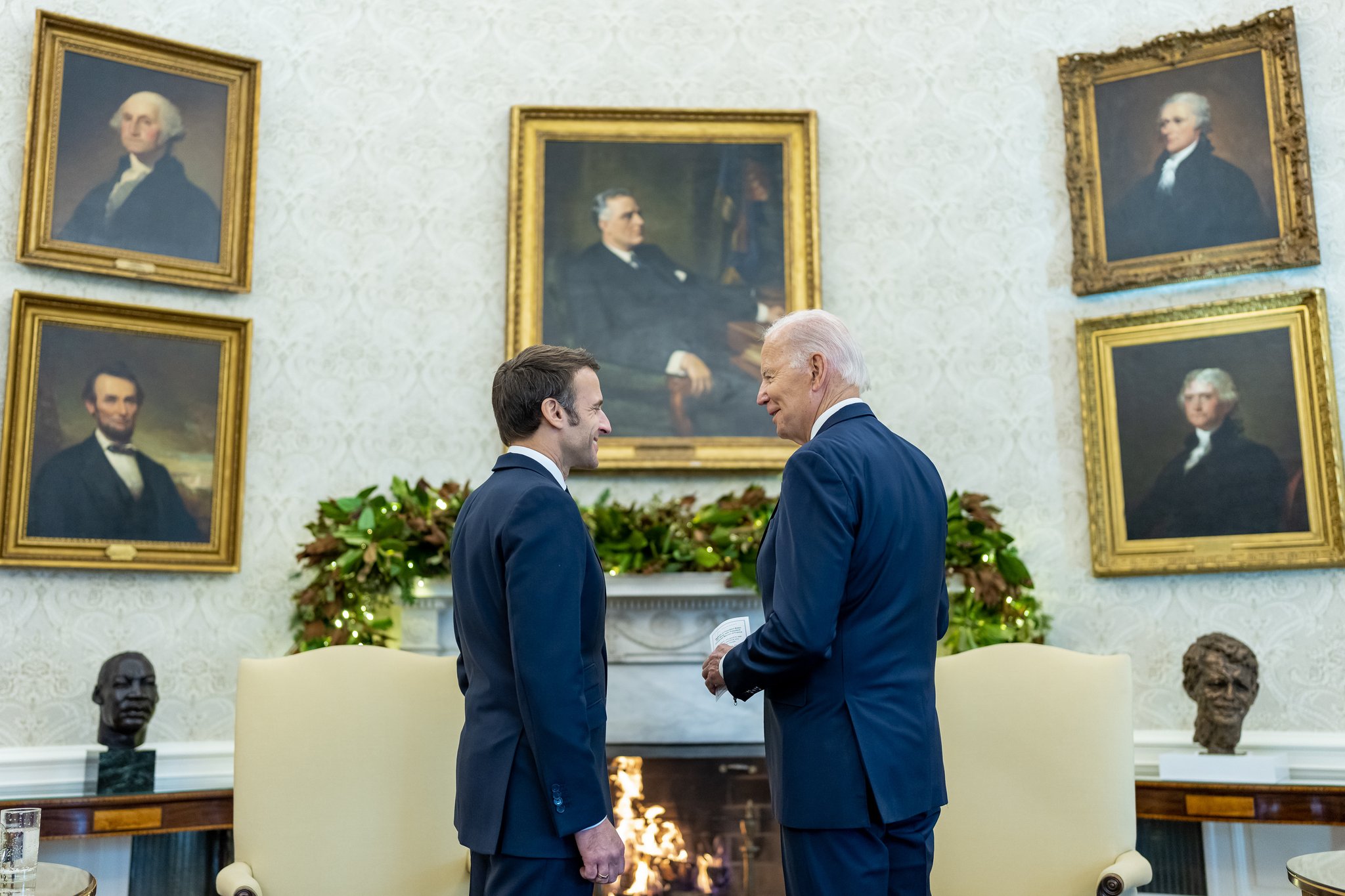
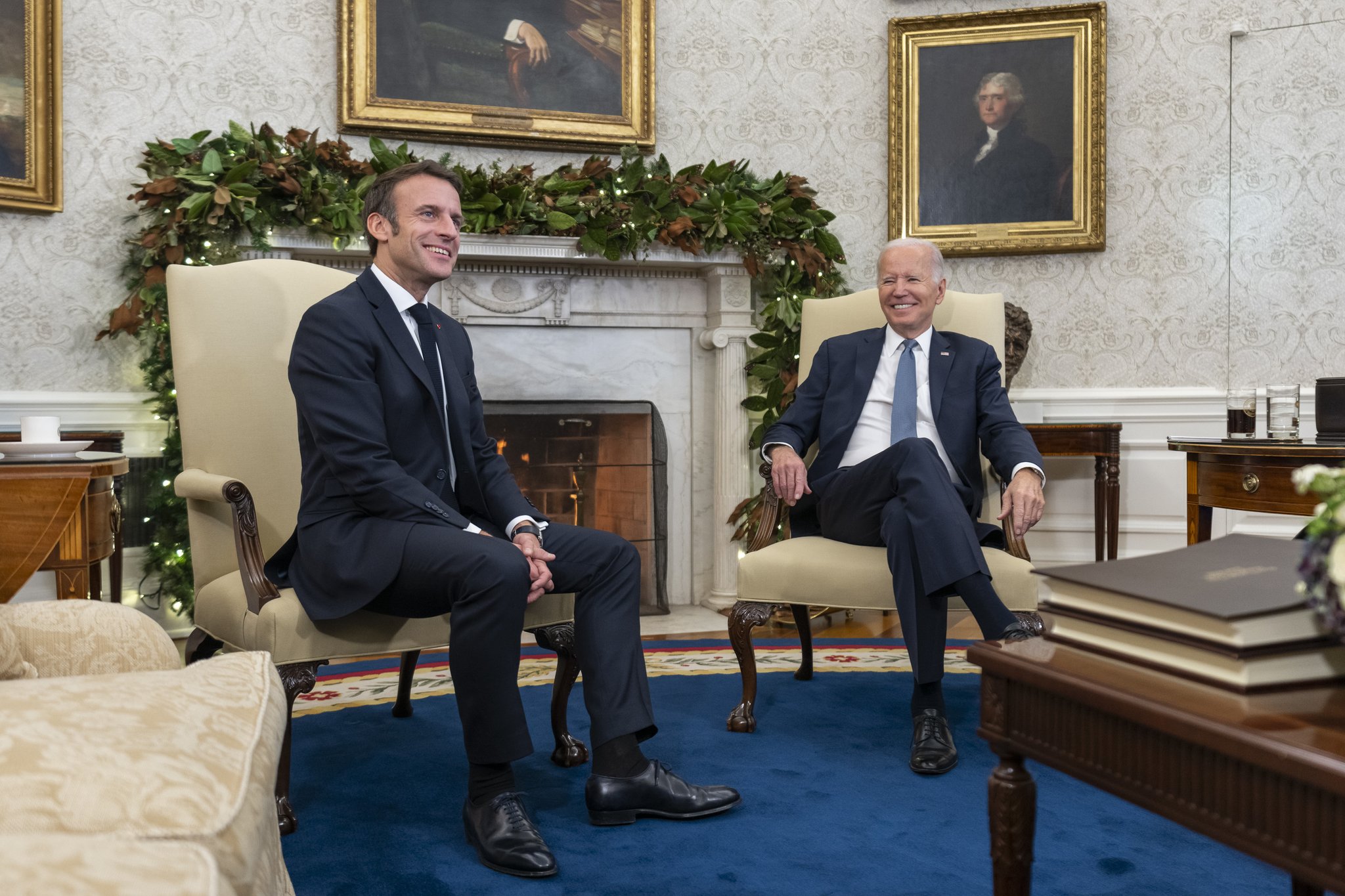
Friends in times of triumph and of trial, France and the United States will meet the future just as we always have: undaunted by any challenge that lies ahead.
Michael Novakhov retweeted:
It was a pleasure sitting down with my friend President Macron of France to outline our nations’ shared vision to strengthen security and increase prosperity worldwide, combat climate change, build greater resilience to its effects, and advance democratic values.
Key Takeaways
- Belarusian President Alexander Lukashenko continued to set informational conditions to resist Russian pressure to enter the war against Ukraine.
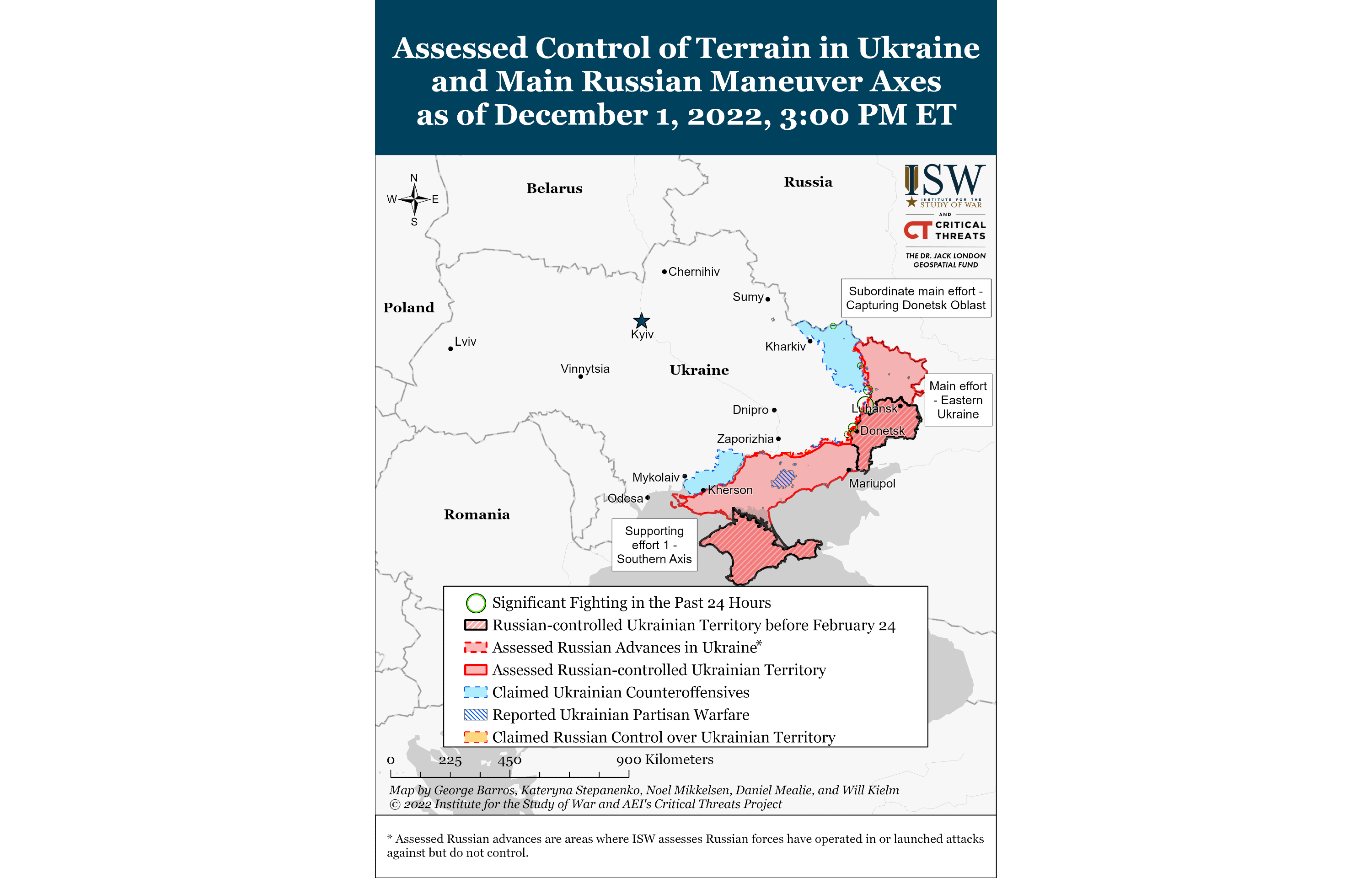
- Russian forces continued efforts to defend against Ukrainian counteroffensive operations along the Svatove-Kreminna line.
- Russian forces continued to make incremental gains around Bakhmut and to conduct offensive operations in the Avdiivka-Donetsk City area.
- Russian forces continued to conduct defensive measures and move personnel on the east bank of the Dnipro River in Kherson Oblast.
- Russian military movements in Zaporizhia Oblast may suggest that Russian forces cannot defend critical areas amidst increasing Ukrainian strikes.
- Russian forces are holding reserves in Crimea to support defensive operations in Zaporizhia Oblast and on the east bank of the Dnipro River.
- The Kremlin’s financial strain continues to feed domestic unrest.
- Evidence persists regarding the continuation of partial mobilization in the face of low morale and high desertion rates amongst Russian troops.
- Wagner Group financier Yevgeniy Prigozhin continued attempts to bolster the Wagner Group’s reputation.
- Russian occupation officials continued efforts to integrate occupied territories into the Russian financial and legal spheres.
- Russian forces continued to exploit Ukrainian civilians and civilian infrastructure in support of Russia’s war effort in Ukraine.
Belarusian President Alexander Lukashenko continued to set informational conditions to resist Russian pressure to enter the war against Ukraine by claiming that NATO is preparing to attack Belarus. Lukashenko blamed Ukraine and NATO for a growing number of provocations near the Belarus-Ukrainian border and stated that Ukraine is trying to drag NATO forces into the war.[1] Lukashenko stated that Belarusian officials managed to deter a potential adversary from using military force against Belarus and that NATO is building up forces and intensifying combat training in neighboring countries.[2] The Belarusian Minister of Defense Viktor Khrenin stated that there is no direct preparation for war and that Belarus will only defend its territory.[3] Ukrainian Main Military Intelligence Directorate (GUR) representative Vadym Skibitsky reported that there are no signs of the formation of a strike group on Belarusian territory.[4] Lukashenko and Khrenin likely made the comments to bolster what ISW has previously assessed as an ongoing information operation aimed at fixing Ukrainian forces on the border with Belarus in response to the threat of Belarus entering the war.[5] Lukashenko and Khrenin also likely focused the information operation on supposed NATO aggression and provocative activities along the Belarusian border to suggest that the Belarusian military needs to remain in Belarus to defend against potential NATO aggression, and thus set informational conditions for resisting Russian pressure to enter the war in Ukraine. ISW continues to assess that Belarusian entry into the Russian war on Ukraine is extremely unlikely.
See the full report here.
The post ISW Russian Offensive Campaign Assessment, December 1 appeared first on Kyiv Post.
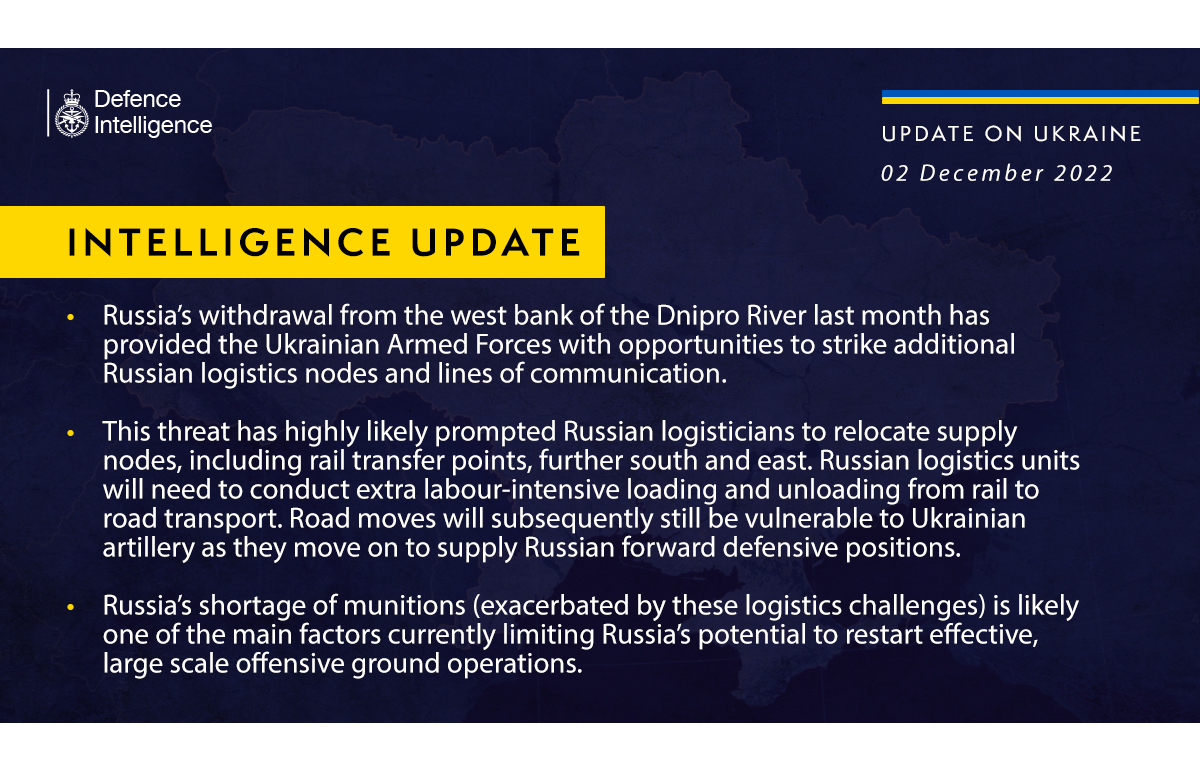
- Russia’s withdrawal from the west bank of the Dnipro River last month has provided the Ukrainian Armed Forces with opportunities to strike additional Russian logistics nodes and lines of communication.
- This threat has highly likely prompted Russian logisticians to relocate supply nodes, including rail transfer points, further south and east.
- Russian logistics units will need to conduct extra labour-intensive loading and unloading from rail to road transport. Road moves will subsequently still be vulnerable to Ukrainian artillery as they move on to supply Russian forward defensive positions.
- Russia’s shortage of munitions (exacerbated by these logistics challenges) is likely one of the main factors currently limiting Russia’s potential to restart effective, large scale offensive ground operations.
The post British Defence Intelligence Update Ukraine – 02 December 2022 appeared first on Kyiv Post.
A single of the biggest mysteries of the current conflict in Ukraine – aside from just what just Russian President Vladimir Putin is pondering on any supplied day – is the variety of troops killed or wounded in the combating so much.
Both sides have been unwilling to launch official figures and, as the war drags on into its tenth thirty day period, the community has had extremely minor to go on.
What is the most recent?
On Thursday Dec. 1, it was claimed as several as 13,000 Ukrainian troops have been killed since Russia released its whole-scale invasion on Feb. 24, a senior adviser to President Volodymyr Zelensky stated.
“We have formal estimates from the Standard Staff… And they variety from 10,000 … to 13,000 useless,” Mykhailo Podolyak advised Ukraine’s Channel 24 on Thursday.
Is this precise?
It is challenging to say as we only have this statement to go on. Podolyak did include that President Zelensky would make the formal details public “when the proper moment will come,” but he did not give any strategy of when that might be.
Why do we not know for absolutely sure?
Both Ukraine and Russia have legit good reasons for hiding the true scale of their losses.
Putin completely envisioned the whole invasion of Ukraine to be around in a make any difference of days, with Russian troops currently being welcomed by Ukrainians and a joyous victory parade in Kyiv to mark the complete occupation of the region, achieved with negligible losses of adult men and machines.
Evidence of this assumption arrived with the discovery that numerous Russian soldiers killed whilst getting aspect in the original assault on the cash have been discovered to be carrying their gown uniforms to be worn throughout the envisioned celebrations.
This was the system that was offered by Putin to the Russian community and at any time considering the fact that this was obliterated by Ukrainian resistance, the Kremlin has been engaged in steady and more and more determined attempts to spin defeat right after defeat.
Yet spinning the fact that tens of countless numbers of Russian troops have been killed by Ukrainians who were meant to welcome them with bouquets and hugs appears to be as well considerably for even the wide Kremlin propaganda machine to offer with. In its place, it has largely overlooked the issue.
What about the Ukrainians?
For Ukraine it is simply a matter of morale which remains very substantial amid both of those the public and the armed forces, but is inevitably suffering as the war drags on.
Ukrainian authorities have consequently been cagey about releasing official casualty figures as they concern it could adversely have an effect on the country’s resistance to Russian aggression.
What have both sides reported formally up until eventually now?
In June, as Russian forces battled to choose total command of the easternmost Luhansk location,
President Zelensky explained Ukraine was shedding “60 to 100 troopers for every day, killed in action, and about 500 persons wounded in action”.
He did not give a overall determine, but this variety could about be in line with the estimate of 13,000 supplied by Podolyak, albeit it with a huge margin of error.
Formal figures from Russia are almost undoubtedly vastly lessen than truth. Defense Minister Sergei Shoigu in September stated 5,937 Russian troops experienced been killed in the practically 7 months of preventing to that stage.
As this was the previous formal statement on the make any difference, it is continue to the official figure.
What about international estimates?
Prime U.S. Normal Mark Milley very last month explained more than 100,000 Russian military staff have been killed or wounded in Ukraine, with Kyiv’s forces possible getting suffered identical casualties.
Individuals figures – which could not be independently verified – are the most specific to day from the U.S. federal government.
Thousands of Ukrainian civilians have also been killed in the worst battling in Europe in a long time.
The post EXPLAINED: How Many Troops has Ukraine Lost in Russia’s Invasion? – Kyiv Post appeared first on Ukraine Intelligence.
Even on Elon Musk’s Twitter, there are red lines for permissible content, and Kanye West, who now calls himself Ye, crossed one of them with a late Thursday night post that prompted the network to suspend his account.
The artist tweeted an image combining the Star of David with a swastika, which got removed by the social media service. In its place was a message saying the post violated Twitter Inc.’s rules and a link to its policy page explaining enforcement actions. Since then, the entire account has been suspended, with all of its tweets now obscured. Ye had 32.2 million followers before the suspension.
[time-brightcove not-tgx=”true”]
Read More: Twitter Is Collapsing, and Nothing Can Replace It
Musk addressed the issue after the post’s initial removal, saying Ye had — not for the first time — breached Twitter’s rule against incitement to violence and his account would be suspended. It’s the most high-profile test yet of Musk’s avowed policy of making Twitter a home for free speech, even where it offends, so long as it’s not in breach of the law.
Two weeks earlier, the social network’s new owner welcomed Ye back from his Twitter exodus, at the same time as he restored former US president Donald Trump’s access. Ye had left Twitter after the service took action on his posts that it deemed antisemitic.
The cordial relations between the two men did not seem to last long, however, as Ye’s most recent tweet, which he labeled his last, featured an unflattering image of a shirtless Musk on vacation. Musk responded to that post with the words “That is fine.” He also replied to the tweet containing the removed image with “This is not.”
2022-12-02T07:33:36Z
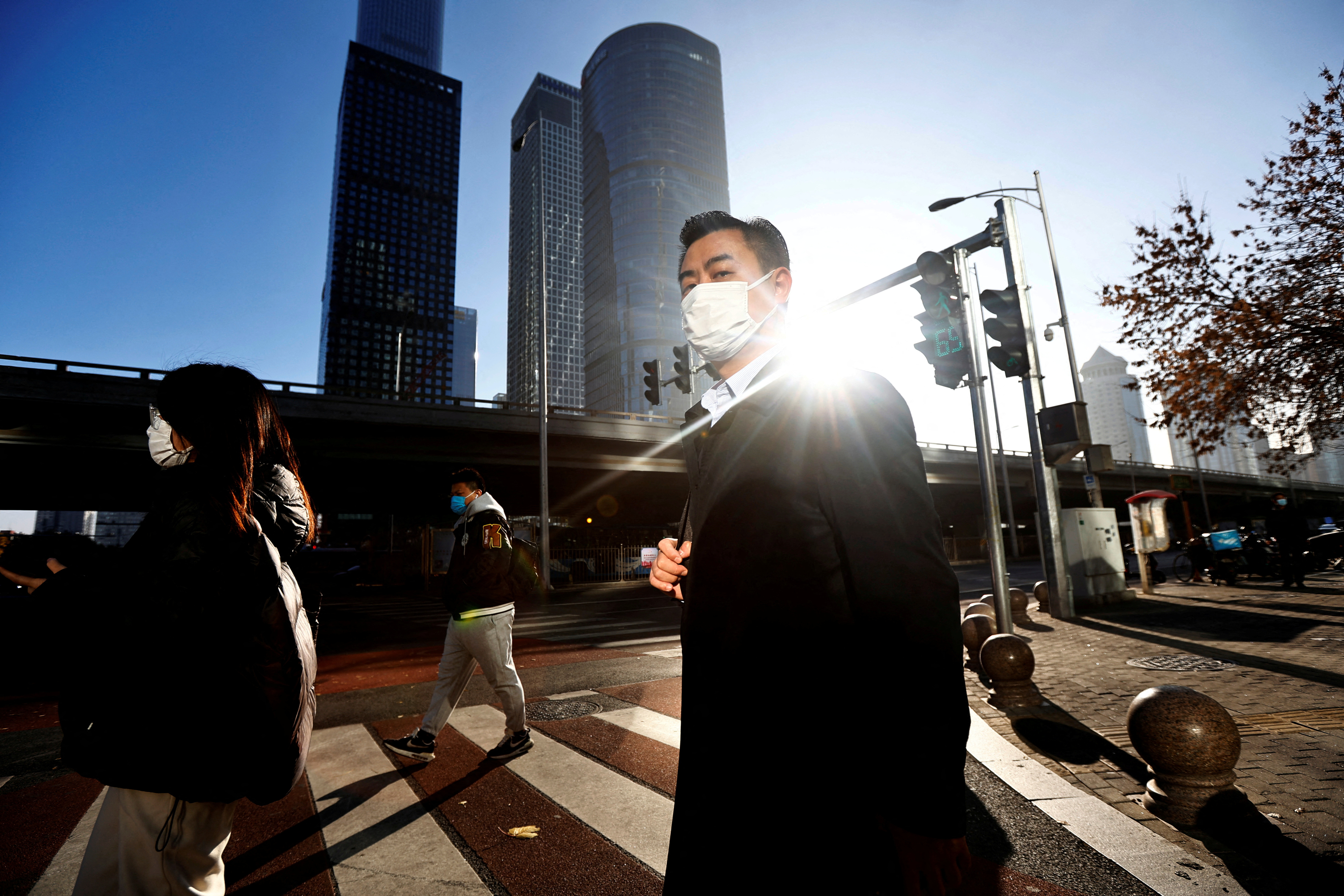
People walk across a street during morning rush hour, following the outbreak of the coronavirus disease (COVID-19), in the Central Business District (CBD) in Chaoyang District, Beijing, China November 21, 2022. REUTERS/Tingshu Wang/File Photo
As a physics student at the elite Peking University in Beijing, Lynn Lau was expecting big Chinese private sector companies to scour the campus this summer for upcoming talent.
But with the world’s second-largest economy growing at its slowest rate in decades, many recruiters stayed away this year.
The wishes of Lau’s parents that she had a “safe” civil service career suddenly made more sense.
“Last year, I feel my older classmates by this point had already got offers from big companies but then these same companies this year have just been in wait-and-see mode,” Lau said.
Lau is among more than 2.6 million people state media said have signed up for the nationwide civil service exam, competing for a record 37,000 central government jobs and tens of thousands of other provincial and city government posts.
Those jobs are drawing record interest this year even as cash-strapped administrations in some cities cut wages, in a sign that economic weakness in zero-COVID China is becoming endemic. State news agency Xinhua said some posts had as many as 6,000 candidates fighting for them, while the average was around 70 to one.
Private firms in tech, finance or tutoring are shedding tens of thousands of jobs and youth unemployment this year hit a record 20%.
An unprecedented 11.6 million students, equal to the entire population of Belgium, are expected to graduate next year.
Finding them jobs will be one of the biggest challenges for the Communist Party, which points to the staggering prosperity China has seen over the past four decades to justify its monopoly on power.
Alicia Garcia-Herrero, chief economist for Asia Pacific at Natixis, says the preference for civil servant jobs has surged.
“The reasons are obvious: the negative sentiment, the fear of the future,” she said.
Those in the private sector are finding conditions more demanding in an economy battered by COVID-19 lockdowns, a property market downturn and soft demand for exports, with long hours and lots of stress.
On social media, young Chinese refer to the civil service as “the end of the universe,” meaning the safest place around in such an environment.
However, the exam was due on Dec 3-4 but has since been postponed due to COVID-19 outbreaks and no new date has been announced, adding to the stress.
In WeChat groups, students share tips on how to improve their scores and offer each other emotional support as they await word and try to prepare.
Shangshang, a 21-year-old college senior in the Yunnan province who declined to give her full name, said a government role would lower the risk of “implosion” – a term young Chinese often use to describe overwhelming pressure at work.
“Being a civil servant gives you a lot of stability,” she said.
Civil servant jobs in China have been in high demand for thousands of years as a sure way for those with high scores at the five-hour, multidisciplinary exam to move up the social ladder.
To this day, families take pride in their children joining the 55 million people state enterprise sector, or the civil service, which according to the latest data in 2015 was more than 7 million strong and is likely much bigger now.
Those jobs on average pay more than 100,000 yuan ($14,000) a year, but can be 3-4 times that in big coastal cities. That’s often much more than what similar private sector roles pay, and tend to come with housing subsidies and other perks.
That has helped them remain popular despite city governments in several provinces, including Guangdong, Jiangsu, Zheijiang and Fujian, cutting pay by up to a third this year, according to at least six civil servants and some local media articles.
It is unclear how widely spread the state sector pay cuts are across China, but provincial governments – hit by the property downturn and COVID costs – are grappling with a $1 trillion budget shortfall this year.
City clerks go home with less money “by no fault of their own, but simply because of severe fiscal challenges,” one Guangzhou government official told Reuters on condition of anonymity.
“This year may be the worst of the past 10 years but it could be the best of the coming 10,” the official said.
Jane Kang, who works in a county-level prosecutor office in the Fujian province, says her 110,000-120,000 yuan a year salary will be 10-15% lower in 2022. That makes her unhappy, but she sees limited options to improve her condition.
“If I can’t leave the country, then I will remain in the system,” Kang said. “If you work in the system, you have more job security than ordinary people working outside of it.”
The work environment has deteriorated as well, some government employees say.
One government employee in Guangzhou said her bosses demand she only commutes between home and the office to minimise COVID risks, even during times when the rest of the city’s population can move more freely.
“I want to go to a park, want to eat in restaurant, and to have a haircut,” she said.
Chen, a 25-year-old law student in Guangzhou, is aware of the pay cuts and restrictions but insists a state job is her best option and studies six to eight hours a day for the exam.
“The present state of the job market has definitely increased my desire to become a civil servant,” she said.
($1 = 7.1599 Chinese yuan renminbi)
Michael Novakhov retweeted: