Categories
Audio Sources - Full Text Articles

Ukraine’s economy resists against Russian missile attacks

Russia is striving to cripple Ukraine’s overall economy with lengthy-array missile attacks. Kyiv Publish has questioned different authorities whether or not the scenario has achieved a critical position and what the potential clients for the in close proximity to potential are.

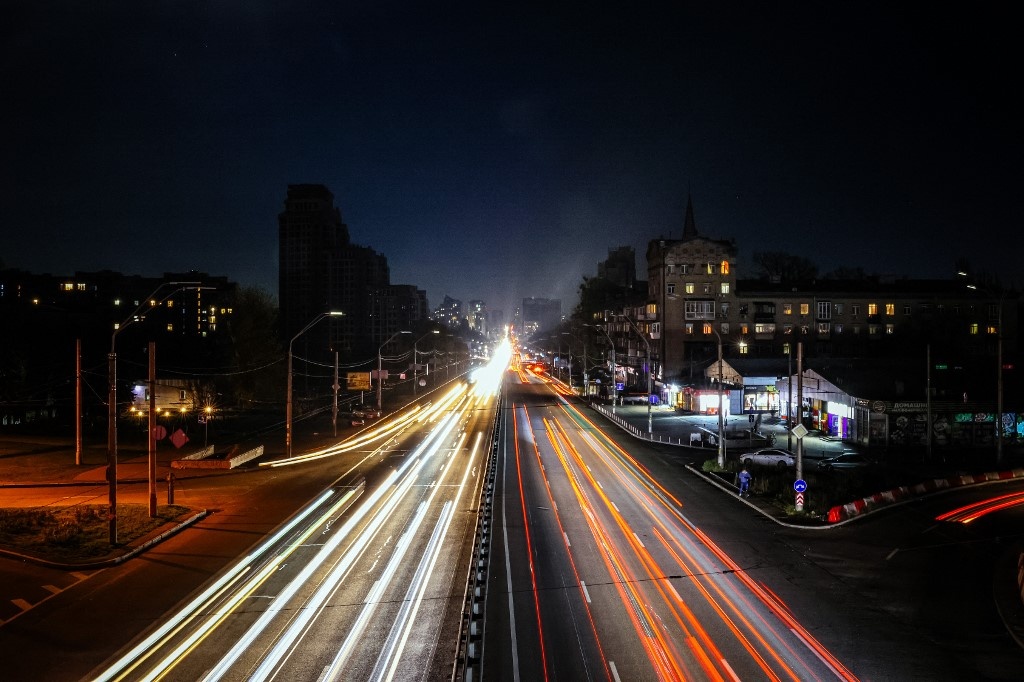
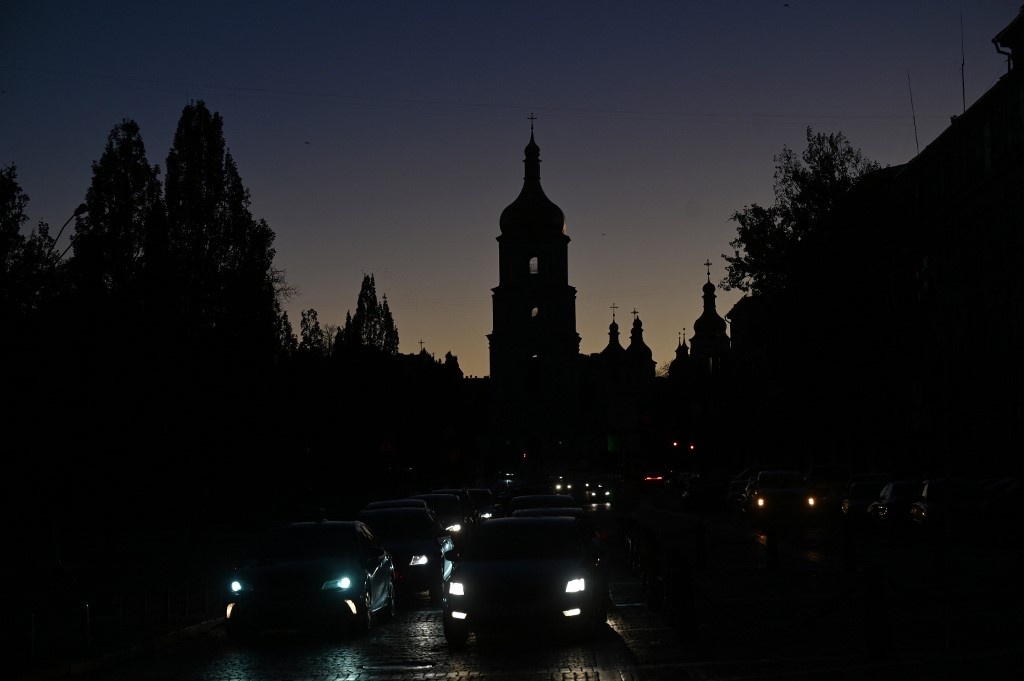
On Nov. 23, Russia released a different huge missile strike on Ukraine’s important infrastructure, which induced blackouts all over the place, like in the capital Kyiv, leaving millions of persons without having electric power, h2o, heating and telecommunications.

By the subsequent day, Kyiv Mayor Vitaliy Klitschko posted on Telegram: “Water provide has already been restored on the left financial institution of the town. On the right bank, we program to restore it in the initially fifty percent of the working day. Seventy % of the funds even now stays without the need of electrical energy.”

Comparable electricity outages were being noticed in the areas of Lviv, Odesa and Khmelnytsky regions.

The blackouts pressured most of the country’s organizations to suspend procedure. Many foods stores, pharmacies and cafes without the need of access to power generators had to choose an emergency day-off.

The ongoing Russian strikes on Ukrainian infrastructure severely worsen the economic scenario in the region: GDP carries on to slide, foremost to expanding unemployment.

Missile strike information hurts organization

Olesya Astafyeva is the co-proprietor of a bar-cafe in Kyiv. Like almost all organizations, it depends on power provide. The scheduled crisis outages have forced her group to adapt to the new circumstances.

“For that type of contingency, we have a candlelight menu. We provide dishes like bruschettas or salads that the cooks get ready in advance. When electricity is off, we do not serve dishes that require to be cooked. We serve cocktails,” Astafyeva informed Kyiv Submit.

Prospects can get to start with study course dishes heated on modest gas stoves. The bar also has highly effective lamps with rechargeable batteries.

“Since Oct. 10 [the first wave of air raids on Kyiv], our product sales have fallen. As before long as a substantial launch of missiles is reported, customers cancel all table reservations. Two or three times a 7 days we are in the red. Since of the strikes, we earned 40 to 50 % fewer than in September,” Astafyeva reported.

She added that now her bar has much less shoppers simply because quite a few men and women have still left the city for the wintertime and all those who remain rarely dine out because they are loath to shell out hours in the subway waiting out an air raid alarm.

She admits that the catering organization is really delicate to news but is sure that her bar will endure the tough occasions. “We endured the COVID lockdown crisis, so we know how offer with hard circumstances,” she claimed.

Rather of laying off some of her staff, she made a decision to elevate their salaries a small at the expense of bigger selling prices on the menu.

“I understand that this is my investment in the foreseeable future. We’ll retain our buyers and get even far more, due to the fact they’ll understand that our selling prices are ideal. That will give our bar an gain,” Astafyeva discussed.

The financial system is having difficulties, but it won’t collapse

Economic authorities are not fairly so optimistic in their forecasts. Dragon Cash, a important financial investment company, expects a 5 p.c financial decline upcoming year, primarily owing to the latest missile strikes on Ukrainian infrastructure.

“We have downgraded the real GDP outlook for 2022 to -32 percent year-on-12 months and count on -5 percent in 2023, even with the modify in the essential assumption pertaining to the class of war,” the firm noted.

The Countrywide Financial institution previously forecast a 32 % GDP drop in 2022 and a 4 to 5 per cent development in 2023, the latter forecast staying primarily based on an anticipated reduction in security threats for the place.

Serhiy Fursa, deputy director for securities at Dragon money, thinks that it will be pretty tricky for Ukraine to reverse the economic downturn and mature.

“Unemployment will improve. Far more people today will leave Ukraine for the wintertime and these who are overseas will be held back from returning by missile strikes and blackouts at minimum right until spring,” Fursa informed Kyiv Write-up.

He is not significantly anxious about the operation of the banking method and is absolutely sure that some of the banking companies will proceed running underneath any instances because they are well prepared. At the exact same time, he advises Ukrainians to keep money rather of relying on credit history playing cards.

Natalia Shapoval, director of the KSE Institute at the Kyiv School of Economics, expects some electrical power-intense businesses, these kinds of as people in the metallurgy or chemical sectors, to shut down since of electric power supply disruptions, as they need much more power than turbines can offer.

“Ukrainian corporations are uniquely adaptive. Numerous of them, like gasoline stations, supermarkets, cafes and places to eat are switching to generators,” Shapoval informed Kyiv Post. As a consequence, businesses selling turbines, heat blankets, quilts and other products that aid every person get by the winter will make a excellent financial gain, according to her.

Shapoval does not believe that that the country’s economic system will be paralyzed. “Yes, it will have large complications, but it will not die. When the war started off and the Kyiv location was occupied, when nobody understood what was going to come about, 30 % of our businesses nevertheless ongoing to run. And there will not be a full shutdown now,” the professional concluded.


Resource url

The post Ukraine’s economy resists against Russian missile attacks appeared first on Ukraine Intelligence.
Categories
Audio Sources - Full Text Articles

Russian military death toll in Ukraine rises to 86,710

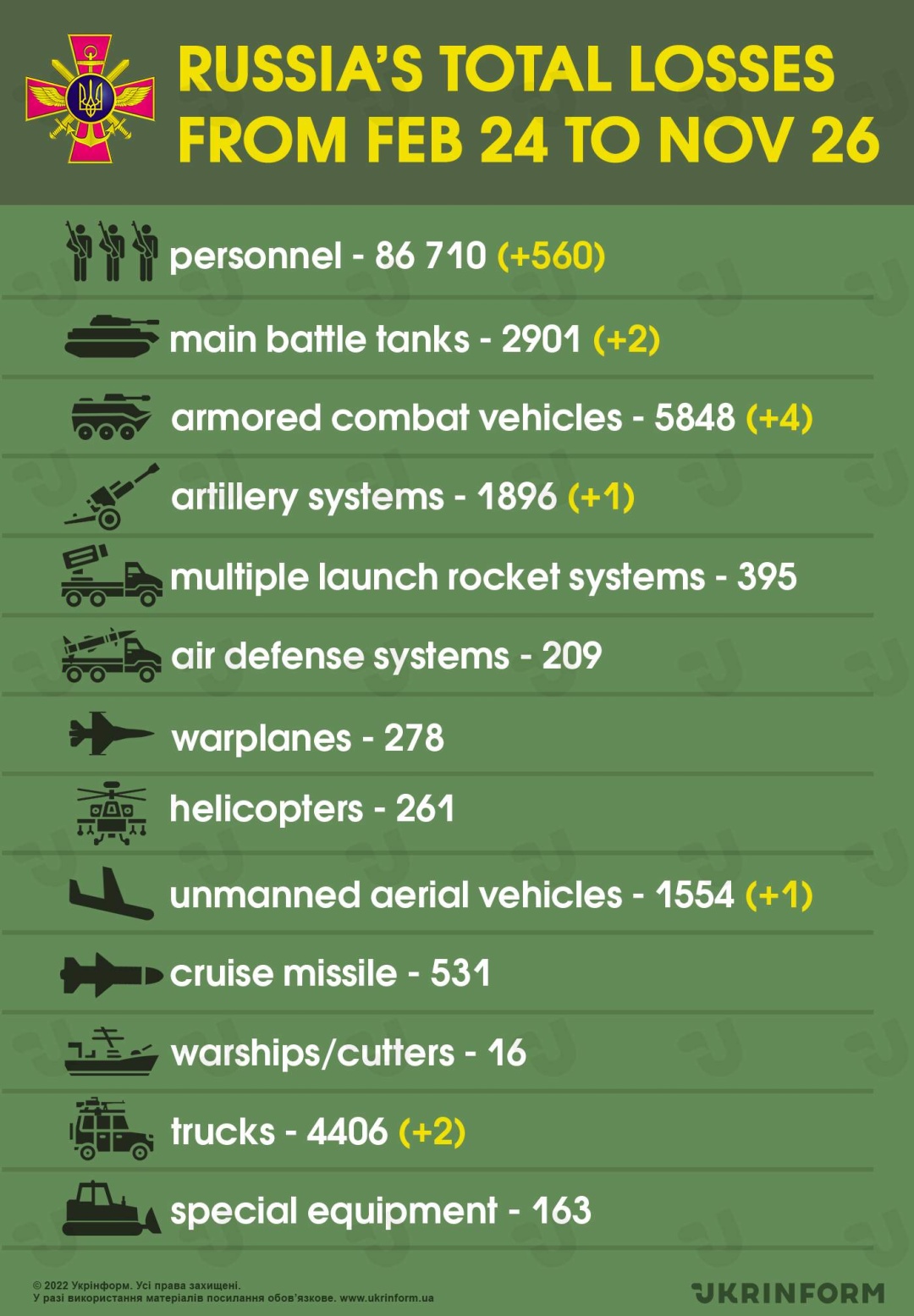
The Armed Forces of Ukraine have previously eradicated about 86,710 Russian troops in Ukraine from February 24 to November 26, like 560 in excess of the earlier working day by yourself.

The Basic Personnel of the Armed Forces of Ukraine reported this on Facebook, according to Ukrinform.

The enemy’s full fight losses contain also 2,901 tanks (+2 more than the past working day), 5,848 armored fight motor vehicles (+4), 1,896 artillery systems (+1), 395 multiple start rocket methods, 209 air defense techniques, 278 warplanes, 261 helicopters, 4,406 motor motor vehicles (+2), 16 warships/cutters, 1,554 unmanned aerial vehicles (+1), 163 exclusive machines units. A whole of 531 enemy cruise missiles were being shot down.

Information on enemy losses is remaining additional clarified.

iy

Source link

The post Russian military death toll in Ukraine rises to 86,710 appeared first on Ukraine Intelligence.

Categories
Audio Sources - Full Text Articles

Economic Blackout? How Russian Air Raids Affect Ukraine

000_32mj4nj-3.jpg

Russia is trying to cripple Ukraine’s economy with long-range missile attacks. Kyiv Post has asked various experts whether the situation has reached a critical point and what the prospects for the near future are.

On Nov. 23, Russia launched another massive missile strike on Ukraine’s critical infrastructure, which caused blackouts throughout the country, including in the capital Kyiv, leaving millions of people without power, water, heating and telecommunications.

By the following day, Kyiv Mayor Vitaliy Klitschko posted on Telegram: “Water supply has already been restored on the left bank of the city. On the right bank, we plan to restore it in the first half of the day. Seventy percent of the capital still remains without electricity.”

Similar power outages were observed in the regions of Lviv, Odesa and Khmelnytsky regions.

The blackouts forced most of the country’s businesses to suspend operation. Many food stores, pharmacies and cafes without access to power generators had to take an emergency day-off.

The ongoing Russian strikes on Ukrainian infrastructure seriously aggravate the economic situation in the country: GDP continues to fall, leading to growing unemployment.

Missile strike news hurts business

Olesya Astafyeva is the co-owner of a bar-restaurant in Kyiv. Like nearly all businesses, it depends on power supply. The scheduled emergency outages have forced her team to adapt to the new circumstances.

“For that kind of contingency, we have a candlelight menu. We serve dishes like bruschettas or salads that the cooks prepare in advance. When power is off, we don’t serve dishes that need to be cooked. We serve cocktails,” Astafyeva told Kyiv Post.

Customers can order first course dishes heated on small gas stoves. The bar also has powerful lamps with rechargeable batteries.

“Since Oct. 10 [the first wave of air raids on Kyiv], our sales have fallen. As soon as a massive launch of missiles is reported, customers cancel all table reservations. Two or three days a week we are in the red. Because of the strikes, we earned 40 to 50 percent less than in September,” Astafyeva said.

She added that now her bar has fewer customers because many people have left the city for the winter and those who stay rarely dine out because they are loath to spend hours in the subway waiting out an air raid alarm.

She admits that the catering business is very sensitive to news but is sure that her bar will endure the hard times. “We endured the COVID lockdown crisis, so we know how deal with difficult situations,” she said.

Instead of laying off some of her staff, she decided to raise their salaries a little at the expense of higher prices on the menu.

“I understand that this is my investment in the future. We’ll keep our customers and get even more, because they’ll understand that our prices are appropriate. That will give our bar an advantage,” Astafyeva explained.

The economy is struggling, but it won’t collapse

Economic experts are not quite so optimistic in their forecasts. Dragon Capital, a major investment company, expects a 5 percent economic decline next year, mostly due to the current missile strikes on Ukrainian infrastructure.

“We have downgraded the real GDP outlook for 2022 to -32 percent year-on-year and expect -5 percent in 2023, despite the change in the key assumption regarding the course of war,” the company reported.

The National Bank earlier forecast a 32 percent GDP decline in 2022 and a 4 to 5 percent growth in 2023, the latter forecast being based on an expected reduction in security risks for the country.

Serhiy Fursa, deputy director for securities at Dragon capital, believes that it will be very difficult for Ukraine to reverse the economic downturn and grow.

“Unemployment will increase. More people will leave Ukraine for the winter and those who are abroad will be held back from returning by missile strikes and blackouts at least until spring,” Fursa told Kyiv Post.

He is not much concerned about the operation of the banking system and is sure that some of the banks will continue operating under any circumstances because they are prepared. At the same time, he advises Ukrainians to keep cash instead of relying on credit cards.

Natalia Shapoval, director of the KSE Institute at the Kyiv School of Economics, expects some energy-intensive businesses, such as those in the metallurgy or chemical sectors, to shut down because of power supply disruptions, as they need more energy than generators can provide.

“Ukrainian businesses are uniquely adaptive. Many of them, like gas stations, supermarkets, cafes and restaurants are switching to generators,” Shapoval told Kyiv Post. As a consequence, businesses selling generators, warm blankets, quilts and other goods that help everyone get through the winter will make a good profit, according to her.

Shapoval does not believe that the country’s economy will be paralyzed. “Yes, it will have huge problems, but it will not die. When the war started and the Kyiv region was occupied, when nobody knew what was going to happen, 30 percent of our businesses still continued to operate. And there won’t be a total shutdown now,” the expert concluded.


The post Economic Blackout? How Russian Air Raids Affect Ukraine appeared first on Kyiv Post.

Categories
Audio Sources - Full Text Articles

NATO Troops Conduct Exercises Near Belarus, Russia Borders

Some 2,000 Allied troops took part in the Tumak 22 exercise in northern Poland near the borders with Belarus and Russia’s Kaliningrad exclave.

This was reported by Poland’s Ministry of Defense, according to Ukrinform.

Polish military from various units practiced operational interoperability with their American, British, Romanian, and Croatian counterparts.

In the course of the exercises, the military crossed rivers and reservoirs, repelled the attacks of a conventional enemy, and also ran a counteroffensive.

A thousand units of combat equipment and logistical support were also involved in the drills.

“We know very well that the tasks, in addition to those we have seen, also relate to maintaining the border – both that with Belarus and with Russia’s Kaliningrad region. We react early, not after. We are immune to any threats posed by Russian policy,” Blaszczak added.

As Ukrinform reported earlier, Canada began training Ukrainian sappers on Polish soil.

The post NATO Troops Conduct Exercises Near Belarus, Russia Borders appeared first on Kyiv Post.

Categories
Audio Sources - Full Text Articles

Flashes of Arab unity at World Cup after years of discontent

DOHA, Qatar (AP) — For a brief moment after Saudi Arabia’s Salem Aldawsari fired a ball from just inside the penalty box into the back of the net to seal a World Cup win against Argentina, Arabs across the divided Middle East found something to celebrate.

Such Arab unity is hard to come by and fleeting when it arrives. But Qatar’s hosting of the World Cup has provided a moment where many in the Arab world have rallied by Doha and the Saudi team’s win.

Whether that momentum continues will be tested on Saturday as Saudi Arabia faces Poland — and as regional tensions, religious differences and renewed economic competition between countries resume.

“All Arabic countries are celebrating because one Arab team won,” said 27-year-old Saudi Rakan Yousef after Arab fans congratulated him in Doha, Qatar, on the Green Falcons’ win. “Even the emir of Qatar attended our match. … There’s this feeling now that we are all brothers. That’s why I’m speechless.”

The Arab world’s division start even with the Arabic language.

Spoken Arabic changes regionally, with the Berber-infused Arabic of North Africa, the rapid-fire Egyptian heard in movies and television comedies, the soft Levantine drawl and the guttural dialect of the Gulf Arabs.

Religion is another differentiator — there are Muslims, both Sunni and Shiite with subgroups within, and minority Christians, Druze, Baha’i and others. Different views on religion and regional rivalries bleed into conflicts, such as the ongoing war in Yemen.

But despite an attempt by al-Qaida to stir up extremists, the monthlong World Cup in energy-rich Qatar so far has seen unity among the Gulf Arab nations. Saudi Crown Prince Mohammed bin Salman and Egyptian President Abdel Fattah el-Sissi, the heads of state in two countries that only some two years ago had boycotted Qatar, attended the tournament’s opening match.

Dubai’s ruler, Sheikh Mohammed bin Rashid Al Maktoum, called Qatar’s hosting of the tournament “a milestone for all Arabs” and also attended the opening. That feeling was shared by others as well.

“We are proud to be here for the first World Cup in an Arabic country,” Morocco coach Walid Regragui said.

Jordan’s Foreign Minister Ayman Safadi similarly praised Qatar while dismissing the criticisms of journalists — and by extension, rights groups.

“Qatar did a tremendous job organizing a World Cup. … Qatar never claimed it was perfect,” Safadi said. “We have differences in opinion, we have differences in views but that should not take away from the fact that Qatar has really put together a World Cup that is unique in every sense of the word.”

But the biggest surprise came two days later as Saudi Arabia stunned Argentina by winning their opener in the tournament, with Aldawsari doing a cartwheel and a flip. Qatar’s ruling emir, Sheikh Tamim bin Hamad Al Thani, attended the match and wore a Saudi flag around his shoulders.

One veteran Saudi sports journalist, Majed al-Tuwaijri, even wept on air after the match.

“This is the most beautiful and important moment in my life and my 30-year media career,” he said, his voice choking up. “I find myself failing to express myself because of the complexity of my feelings toward this great historical victory.”

Saudi Arabia’s King Salman declared Wednesday a public holiday to commemorate the win. In the kingdom and outside of it, people cheered and waved the country’s green and white flag to celebrate.

The Saudi flag itself carries two images that show its complicated place in the wider Arab world. It bears a white sword and the Arabic inscription of the shahada, a Muslim declaration of faith: “There is no god but Allah; Muhammad is the Messenger of Allah.” After the death of the Prophet Muhammad in 632 A.D., Islam spread from the austere desert reaches of the Arabian Peninsula that later would become Saudi Arabia.

Today, Saudi Arabia maintains beheading as a form of execution and is one of the world’s top enforcers of the death penalty. The kingdom also has used its oil money since the 1980s to export an ultraconservative view of Islam called Wahhabism into mosques around the world. Extremists have exploited Wahhabi organizations receiving Saudi funding as well.

That history, as well as regional politics, make a wholehearted embrace of Saudi Arabia more complicated for Arabs in the Mideast. While some celebrated Saudi Arabia’s win in the Gaza Strip, the Palestinian enclave blockaded by Egypt and Israel is ruled by the militant group Hamas. The kingdom, while not diplomatically recognizing Israel, now allows Israeli airlines overflight rights.

The limits also can be seen in Yemen, where Saudi Arabia has been fighting the country’s Iranian-backed Houthi rebels since 2015. Houthi Information Minister Daifallah al-Shami on Twitter offered “a thousand congratulations” to Saudi Arabia for placing “Arab football back on the map.” He later deleted the tweet and apologized.

“There are red lines that no party or person should cross,” al-Shami wrote.

The Saudi win, which the daily newspaper Okaz described as “restoring the glories” of the kingdom, also fits into the new, more nationalistic Saudi Arabia forming under Crown Prince Mohammed bin Salman.

As the prince has risen to power, the kingdom has socially liberalized by allowing women to drive, reopening movie theaters and curtailing its morality police. His comments to the team ahead of the tournament, urging them to “enjoy” the matches, have been repeated constantly in Saudi Arabia’s tightly controlled press.

But Prince Mohammed also led a self-described corruption crackdown targeting anyone with power in the kingdom. U.S. intelligence agencies believe the brutal slaying of Washington Post columnist Jamal Khashoggi at the Saudi Consulate in Istanbul came at his orders, something denied by the kingdom.

Meanwhile, economic competition between the United Arab Emirates and Saudi Arabia has been increasing as Riyadh tries to draw international business from Dubai. Qatar, which faced a Saudi-led boycott only two years earlier, has embraced the kingdom while solidifying ties with the United States as hedge. The inconclusive war in Yemen still rages.

Soccer provides a respite, but no panacea for those woes.

“You’d have to have a historical lobotomy to think this is a stable region,” said David B. Roberts, an associate professor at King’s College London who long has studied Gulf Arab nations.

___

Associated Press writers Isabel DeBre and Gerald Imray in Doha, Qatar, and Renata Brito in Barcelona, Spain, contributed to this report.

___

Follow Jon Gambrell on Twitter at www.twitter.com/jongambrellAP.

___

AP World Cup coverage: https://apnews.com/hub/world-cup and https://twitter.com/AP_Sports

Categories
Audio Sources - Full Text Articles

‘More Than 6 Million’ Ukraine Households Hit by Power Cuts

black_out.jpeg

Ukraine’s President Volodymyr Zelensky said Friday that over six million households in the country are still affected by power cuts, two days after targeted Russian strikes on Ukraine’s energy infrastructure.

“As of this evening, blackouts continue in most regions (of Ukraine) and in Kyiv. In total, more than six million subscribers,” Zelensky said in his daily address, adding that the number of affected households has reduced “by half” since Wednesday.

Zelensky said that some 600,000 subscribers were experiencing power cuts in the capital Kyiv with the Odessa, Lviv, Vinnytsia and Dnipropetrovsk regions also among the worst affected.

The systematic and targeted Russian attacks over recent weeks have brought Ukraine’s energy infrastructure to its knees as winter approaches, spurring fears of a health crisis and a further exodus from the war-torn country.

The post ‘More Than 6 Million’ Ukraine Households Hit by Power Cuts appeared first on Kyiv Post.

Categories
Audio Sources - Full Text Articles

British Defence Intelligence Update Ukraine – 26 November 2022

briti.jpeg

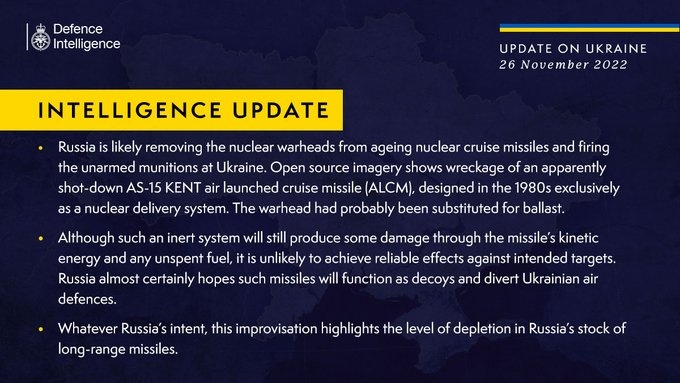
  • Russia is likely removing the nuclear warheads from aging nuclear cruise missiles and firing the unarmed munitions at Ukraine. Open source imagery shows wreckage of an apparently shot-down AS-15 KENT air launched cruise missile (ALCM), designed in the 1980s exclusively as a nuclear delivery system. The warhead had probably been substituted for ballast.
  • Although such an inert system will still produce some damage through the missile’s kinetic energy and any unspent fuel, it is unlikely to achieve reliable effects against intended targets. Russia almost certainly hopes such missiles will function as decoys and divert Ukrainian air defences.

  • Whatever Russia’s intent, this improvisation highlights the level of depletion in Russia’s stock of long-range missiles.

The post British Defence Intelligence Update Ukraine – 26 November 2022 appeared first on Kyiv Post.

Categories
Audio Sources - Full Text Articles

ISW Russian Offensive Campaign Assessment, November 25

isw-1.png

Key Takeaways

  • Reports of a group of understaffed and ill-supplied mobilized personnel are dividing the Russian information space.
  • President Vladimir Putin falsely presented a meeting with hand-picked women as an open discussion with mothers of mobilized personnel.
  • An investigation by Forbes’ Ukrainian service revealed that the war in Ukraine has had a serious financial impact on the Russian Federation’s annual budget.
  • The Russian MoD may have increased the frequency of POW exchanges to soothe discontent in the Russian information space.
  •  A Ukrainian official confirmed that Ukrainian forces killed Iranian military advisors in Russian-occupied Crimea and threatened to target Iranian military presence on Ukrainian territory.
  • Russian military leadership may be circulating a document stating that Russia needs to mobilize five million personnel to win the war in Ukraine, which Russia cannot do.
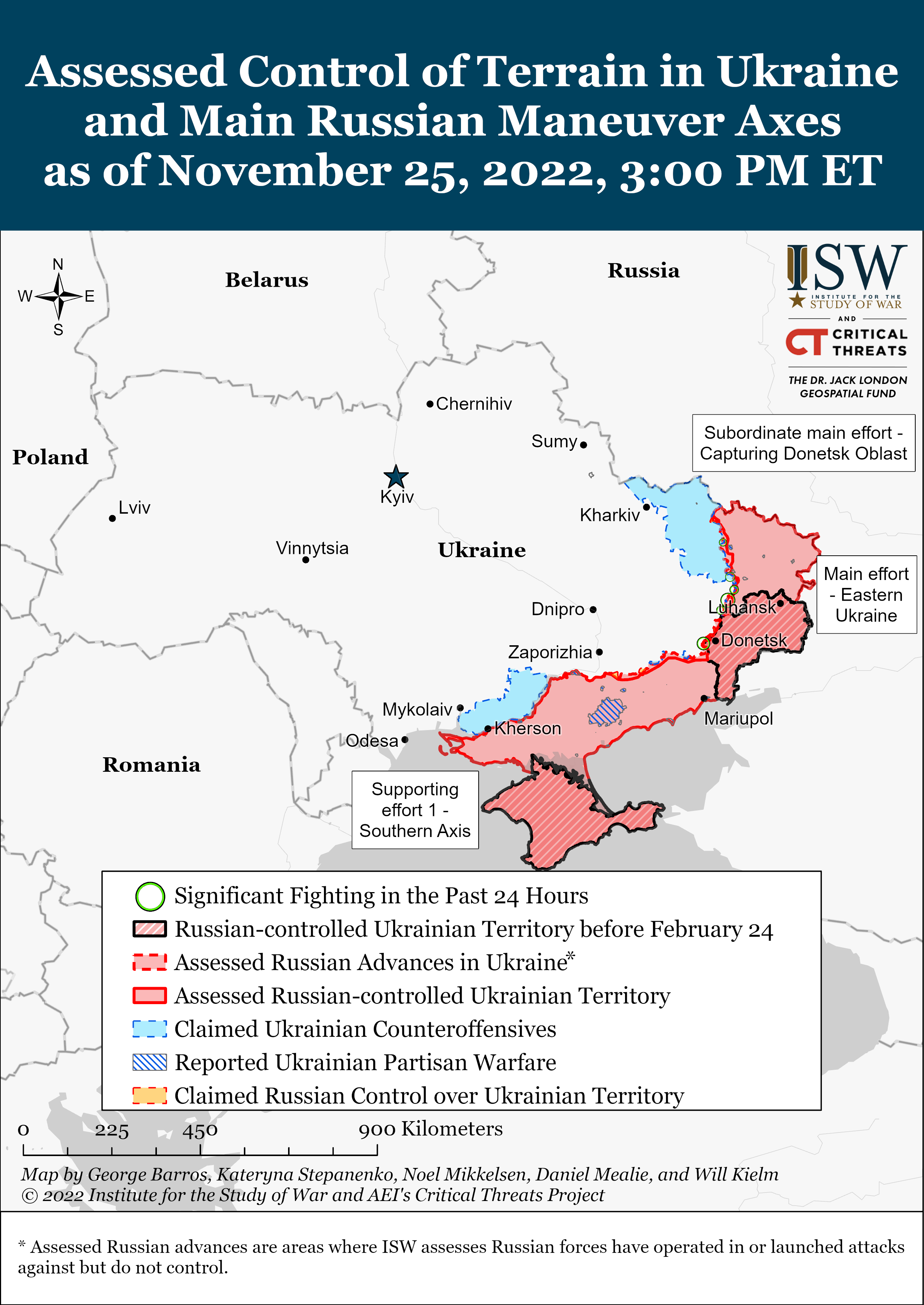
  • Russian forces conducted limited counterattacks to regain lost positions northwest of Svatove and Russian sources claimed that Ukrainian forces continued counteroffensive operations toward Kreminna.
  • Russian forces continued to conduct offensive operations in the Bakhmut and Avdiivka areas, and influential Russian figures may be setting informational conditions to deflect blame for a lack of progress in the Bakhmut area.
  • Russian forces continued to establish defenses south of the Dnipro River in Kherson Oblast and around critical ground lines of communication (GLOCs) connecting Crimea to southern Kherson Oblast.
  • Russian sources and officials continue attempts to shape the narrative around a likely second partial mobilization while denying the potential for general mobilization.
  • Russian officials are continuing efforts to stimulate demographic change in occupied areas of Ukraine by deporting Ukrainian residents and replacing them with imported Russian citizens.

 Reports of poorly staffed, provisioned, and supplied Russian mobilized personnel are dividing the Russian information space, exposing the tension between milblogger mobilization narratives, Wagner Group narratives, and actual Russian efforts to alleviate morale issues. Mobilized personnel from Serpukhov, Moscow Oblast, claimed on November 23 that the Russian military command sent them into battle without proper training, uniforms, or protective gear, leading them to suffer mass casualties. These personnel also claimed that command only feeds the mobilized personnel once a day despite having enough food to provide more meals.[1] A Russian source reported that the Serpukhov mobilized personnel now face a military tribunal for desertion, but the men later released a second video denying that they are deserters and stating they are willing to serve on the second and third lines of defense rather than the front line.[2]

Russian milblogger responses split between calling for compassion for the mobilized personnel and punishment only for leadership, and punishment for the entire unit. A Russian milblogger claimed that these Russian personnel abandoned their positions in Makiivka, Luhansk Oblast, and left other members of their unit to be executed when surrendering to Ukrainian forces (an accusation that the Ukrainian government is investigating).[3] Some Russian milbloggers, including at least one channel affiliated with the Wagner Group, sympathized with the Serpukhov personnel and criticized the Russian training and command issues that led to this situation.[4] These milbloggers also criticized other Russian milbloggers who, they say, wrongfully condemned the Serpukhov personnel for Russian military command, training, and provisioning issues out of their control. One Russian milblogger even claimed that military personnel do not refuse to fight, but that they do not want to be “cannon fodder.”[5] Alexander “Sasha” Kots, a milblogger whom Russian President Vladimir Putin recently appointed to the Russian Human Rights Council, called for objectivity when viewing the video and said he would raise the issue with Putin in his new position on the Human Rights Council.[6] However, some milbloggers still criticized Kots for being too soft on the Serpukhov personnel and called for increasingly harsh penalties.[7] The mixed responses from milbloggers with various Kremlin and external affiliations about ongoing mobilization issues further illustrates the extent of the erosion of Russian morale and the increase in confusion among the pro-war Russian nationalist community resulting from poorly-executed mobilization and other force generation efforts.

Russian President Vladimir Putin falsely presented a meeting with 18 hand-picked women holding influential positions in the Russian political sphere as an open discussion with the mothers of mobilized personnel on November 25, two days before Russian Mother’s Day.[8] Russian media publicized the meeting in an apparent attempt to assuage discontent from relatives of the mobilized and appeals from genuine mothers’ and wives’ groups.[9] Putin used the meeting to pledge to improve conditions for the mobilized, to call on Russians to distrust unfavorable media reports surrounding mobilization, and to display solidarity with the families of Russian soldiers.[10] Meanwhile, the calls of relatives of Russian soldiers have reportedly not received a response. A Russian news channel posted a video on November 24 in which a Russian woman claims that authorities will not meet with her even though she has been looking for her soldier son who disappeared in March.[11] The Council of Mothers and Wives posted that unidentified individuals began to surveil their members following their November 21 announcement of a roundtable discussion to consider the problems facing conscripts.[12] YouTube channel Moms of Russia posted a video appeal to Putin in which several mothers asked Putin to prevent the mobilization of their only child.[13] ISW saw no evidence of a response to the video from Putin. The Council of Mothers and Wives reportedly also expressed the belief that the invitation to Putin’s meeting of mothers only applied to specially selected individuals.[14]

An investigation by Forbes’ Ukrainian service revealed the extent of the financial strains that the war in Ukraine has imposed on Russia’s annual budget. Forbes found that Russia has spent $82 billion dollars on the first nine months of the war in Ukraine, amounting to one quarter of its entire 2021 annual budget of $340 billion.[15] The investigation emphasized the impact that mobilization had on military-related expenditures since October and observed that providing for the 300,000 mobilized cost an additional $1.8 billion per month in addition to the increased costs of providing ammunition, equipment, and salaries to mobilized recruits, which in total amounted to a $2.7 billion increase following mobilization. ISW has previously reported on the detrimental effects of mobilization and the Kremlin’s overall war effort on the Russian federal budget.[16] In addition to the massive impact the first nine months of the war have had on the federal budget, ISW has also observed that local Russian administrations on the regional level have disproportionately borne the brunt of mobilization in a way that will continue to have reverberating social and financial impacts into 2023.[17]

The Russian Ministry of Defense (MoD) may have increased the frequency of prisoner of war (POW) exchanges in an attempt to soothe discontent in the information space regarding its prior failures to negotiate the return of Russian POWs. Russian and Ukrainian sources reported three concurrent POW exchanges between November 23 and 25. Russian and Ukrainian officials exchanged 35 Russian POWs for 35 Ukrainian POWs on November 23, 50 Russian POWs for 50 Ukrainian POWs on November 24, and nine Russian POWs for nine Ukrainian POWs on November 25.[18] The frequency of POW exchanges over the past few days is an inflection in itself- the Russian MoD has been notably restrained in the conduct of such exchanges and has faced significant criticism over its apparent lack of regard for Russian POWs in recent months.[19] The increased frequency of POW exchanges is likely meant partially to address discontent from Russian milbloggers, who reported on the most recent series of exchanges with a relatively neutral tone and emphasized the equal ratio of exchange.[20]

A Ukrainian official confirmed that Ukrainian forces killed Iranian advisors in Russian-occupied Crimea in October and stressed that Ukraine would target any Iranian military presence on Ukrainian territory. Ukrainian National Security and Defense Council Secretary Oleksiy Danilov confirmed that Ukrainian forces killed the Iranian military advisors in a November 24 interview with the Guardian.[21] Danilov did not specify how many Iranian advisors Ukrainian forces killed, but an October 10 Jerusalem Post report put the figure at 10 Iranian military advisors.[22] US National Security Council Spokesperson John Kirby confirmed on October 20 that Iranian military personnel are in Russian-occupied Crimea to assist Russian forces in operating Iranian-made drone in attacks on Ukrainian civilians and civilian infrastructure.[23] Danilov also threatened that Ukrainian forces would target any Iranian military presence on Ukrainian territory.[24] The confirmation and threat will likely not dissuade Iran from continuing to support Russia through the provision of high-precision weapons systems. ISW has previously assessed that Iran may be supplying drones and potentially ballistic missiles to the Russian Federation to more clearly establish an explicit bilateral security relationship with Russia in which they are more equal partners.[25]

Russian leadership may be distributing a document among Russian servicemembers stating that Russia needs to mobilize five million personnel to win the war in Ukraine, an impossible task for the Russian Federation. The Ukrainian General Staff Deputy Chief Oleksiy Hromov stated on November 24 that the military-political leadership of the Russian Federation has prepared a document titled “Conclusion of the War with NATO in Ukraine” and has begun distributing it among Russian servicemembers.[26] The document reportedly identifies shortcomings of the Russian Armed Forces and notes the need for Russia to mobilize five million Russians to win the war in Ukraine.[27] It is unclear whether Russian leadership considers the five million figure a possible target or whether it is an unreachable projected force requirement, reasonable or not, that suggests that they cannot achieve their objectives in Ukraine. Russia’s chaotic and ineffective conduct of partial mobilization with the target of 300,000 mobilized personnel suggests that the mobilization of five million Russians is an impossible task for the Russian Federation. Russian leadership may have drafted and distributed the document in the fashion of Soviet-style after-action reports that deflect responsibility from the overarching strategic leadership failures of the war and place culpability for failure on the operational and tactical failures of the Russian military. Hromov, however, provided no additional details and ISW has been unable to obtain any corroboration or independent reporting about the document.

See the full report here.

The post ISW Russian Offensive Campaign Assessment, November 25 appeared first on Kyiv Post.

Categories
Audio Sources - Full Text Articles

Huge COVID protests erupt in China“s Xinjiang after deadly fire

2022-11-26T07:46:43Z

(Reuters) – Rare protests broke out in China’s far western Xinjiang region, with crowds shouting at hazmat-suited guards after a deadly fire triggered anger over their prolonged COVID-19 lockdown as nationwide infections set another record.

?m=02&d=20221126&t=2&i=1615403003&r=LYNX

Protests against coronavirus disease (COVID-19) outbreak measures in Urumqi city, Xinjiang Uygur, China in this screen grab obtained from a video released November 25, 2022.Video obtained by Reuters/via REUTERS

Crowds chanted “End the lockdown!”, pumping their fists in the air as they walked down a street, according to videos circulated on Chinese social media on Friday night. Reuters verified the footage was published from the Xinjiang capital Urumqi.

Videos showed people in a plaza singing China’s national anthem with its lyric, “Rise up, those who refuse to be slaves!” while others shouted that they wanted to be released from lockdowns.

China has put the vast Xinjiang region under some of the country’s longest lockdowns, with many of Urumqi’s 4 million residents barred from leaving their homes for as long as 100 days. The city reported about 100 new cases each of the past two days.

Xinjiang is home to 10 million Uyghurs. Rights groups and Western governments have long accused Beijing of abuses against the mainly Muslim ethnic minority, including forced labour in internment camps. China strongly rejects such claims.

The Urumqi protests followed a fire in a high-rise building there that killed 10 on Thursday night.

Authorities have said the building’s residents had been able to go downstairs, but videos of emergency crews’ efforts, shared on Chinese social media, led many internet users to surmise that residents could not escape in time because the building was partially locked down.

Urumqi officials abruptly held a news conference in the early hours of Saturday, denying that COVID measures had hampered escape and rescue but saying they would investigate further. One said residents could have escaped faster if they had better understood fire safety.

‘BLAME THE VICTIM’

Dali Yang, a political scientist at the University of Chicago, said such a “blame-the-victim” attitude would make people angrier. “Public trust will just sink lower,” he told Reuters.

Users on China’s Weibo platform described the incident as a tragedy that sprang out of China’s insistence on sticking to its zero-COVID policy and something that could happen to anyone. Some lamented its similarities to the deadly September crash of a COVID quarantine bus.

“Is there not something we can reflect on to make some changes,” said an essay that went viral on WeChat on Friday, questioning the official narrative on the Urumqi apartment fire.

China defends President Xi Jinping’s signature zero-COVID policy as life-saving and necessary to prevent overwhelming the healthcare system. Officials have vowed to continue with it despite the growing public pushback and its mounting toll on the world’s second-biggest economy.

While the country recently tweaked its measures, shortening quarantines and taking other targeted steps, this coupled with rising cases has caused widespread confusion and uncertainty in big cities, including Beijing, where many residents are locked down at home.

China recorded 34,909 daily local cases, low by global standards but the third record in a row, with infections spreading numerous cities, prompting widespread lockdowns and other curbs on movement and business.

Shanghai, China’s most populous city and financial hub, tightened testing requirements on Saturday for entering cultural venues such as museums and libraries, requiring people to present a negative COVID test taken within 48 hours, down from 72 hours earlier.

Beijing’s Chaoyang Park, popular with runners and picnickers, shut again after having briefly reopened.

Categories
Audio Sources - Full Text Articles

Everything You Need to Know About Holodomor Remembrance Day

Despite being ravaged by war and Russian aggression, the people of Ukraine will commemorate the 90th anniversary of the Holodomor genocide this year on Saturday,  Nov. 26.

The Holodomor was a man-made disaster, the result of the brutal dictatorship of Joseph Stalin and his Soviet government. It resulted in the widespread starvation of millions in Soviet Russia’s grain-growing territories in 1932 and 1933.

A yearly national remembrance day honouring the victims of the Holodomor was established on the fourth Saturday of November by a decree issued by Ukrainian President Leonid Kuchma in 1998.

Each year, when Ukrainians reflect on the Holodomor genocide, they remember millions of their ancestors—many of whom were just children—who died from starvation in Ukraine.

The genocide occurred before the Holocaust, and it is no secret that Ukraine continues to be traumatized by it even now. The tragedy left a deep scar on the country — making it just one aspect of Ukraine’s tumultuous relationship with Russia.

This year, Ukrainians will continue to look back on their history and acknowledge a terrifying recurring theme: Russian brutality and terror which persists nearly a century later.

What was the Holodomor genocide, and when did it take place?

Millions of Ukrainian citizens perished in the Holodomor genocide, an artificial, man-made famine that the Soviet Union under Joseph Stalin orchestrated 90 years ago in 1932-1933. Many of those who survived the Holodomor were farming families, ordinary everyday people and members of farming communities.

In most studies that have analysed the atrocity, the number of Ukrainians who died during the Holodomor is estimated to have ranged between 3.5 million and 7 million. Historical sources indicate that at its peak in the summer of 1933, an estimated 28,000 Ukrainians were dying of starvation every single day.

While this was happening, the Soviet Union, exported  4.27 million tonnes of grain from Ukraine to earn hard currency for its industrialization drive – enough to nourish at least 12 million people for an entire year.

Given there was more than enough food to feed all the people in Ukraine, you might be wondering how and why the genocide occurred.

One of the reasons for carrying out this horrifying act was to stifle Ukrainian resistance movements, particularly those opposed rule from Moscow and sought to establish an independent Ukrainian state.

The Ukrainian language and culture have traditionally been strongly linked to villages and rural life, yet another reason why Stalin’s regime targeted these areas for mass famine.

The Soviet Foreign Minister Maxim Litvinov went as far as to publicly refute the existence of famine in 1933 and despite offers of assistance from the Red Cross and other humanitarian organisations, the Soviet leadership rejected them and stuck to their line denying anything untoward was taking place.

To this day, Moscow rejects the idea it was a genocide, placing the events in the broader context of famines that devastated regions of Central Asia and Russia at the time.

A monument to victims of the Holodomor famine in Kyiv.  (AFP)

How did the Holodomor actually take place?

The famine was directly caused by a 19329 decision by Stalin to collectivize agriculture.  Communist Party provocateurs who supported Stalin’s ideology and vision, evicted those farmers who were in outright opposition to collectivization and forced Ukrainians to abandon their land, private possessions, and other assets to the new collective farms.

This collectivization led to mass instability in the form of lower output and food shortages. It also sparked a series of urban unrests, such as armed uprisings in various parts of the country.

During the Holodomor, Ukrainians had a clear choice — to follow communist ideology or die.

The regime led by dictator Joseph Stalin, and supported by a whole army of dedicated communist agitators, made escape out of the crisis for Ukrainians impossible.

To make matters worse, Ukrainians risked provoking the government if they revealed their true identities by speaking Ukrainian or exhibiting their culture.

Accepting one’s Ukrainian identity implied accepting one’s status, imposed ruthlessly by Soviet ideology and thinking, as a subhuman villager who was incapable of contributing to society in the eyes of the Soviet state, or even accepting the risk that one must face death.

Accounts of extreme distress on the part of Ukrainian farmers, together with cases of anarchy, robbery, executions, and extreme hunger, are to be found in historic Soviet police files.

As you read this, you may have noticed something familiar: acts of violence and oppression, similar to those taking place in Ukraine right now in 2022, which seek to eradicate contemporary Ukraine and its identity as a sovereign state by murdering and torturing the local  population.

The impact of genocide on Ukrainian national identity

Since people starved in the villages, where the majority of Ukrainians lived, cities ended up being the only locations where Ukrainians could flee this living horror. The expansion of factories and other large-scale industrial facilities in urban areas also meant that more people could find work and earn enough money to survive.

These urban areas also evolved into hubs, where it was easier to try to brainwash Ukrainians into becoming the archetypal Soviet citizen.

During this period, the advancement of a solely  Soviet identity and authoritative force exerted on Ukrainian citizens to speak the Russian language also increased. This made an indelible imprint on Ukraine and its history.

Collectivisation was, according to Soviet propaganda, the catalyst for the state’s progress, and the final goal was clear: to solidify Russian nationalism and allegiance at the heart of the Soviet empire.

How genocide shaped Ukrainian history

Today Ukraine has a museum dedicated to the victims of the Holodomor.

The National Museum of the Holodomor-Genocide is a state research, cultural, and educational organization. This weekend it will commemorate the anniversary of genocidal acts committed against the Ukrainian people in 1932–1933.

Are there parallels to today?

The current conflict has fuelled fears that history may repeat itself, with Russia’s targeting of grain storage facilities and its blockade of Ukraine’s Black Sea exports have sparked accusations that Moscow is again using food as a weapon of war.

When announcing his country is to officially declare the Holodomor a genocide next week, Robin Wagener of Germany’s Green party, said Putin is operating “in the cruel and criminal tradition of Stalin”.

“Once more, the basis for life in Ukraine is meant to be taken away through violence and terror, and the entire country brought to heel,” he told the daily Frankfurter Allgemeine Zeitung.

Global reaction

The 90th anniversary of the Holodomor has sparked reaction from all over the world.

In a statement released on Wednesday, Nov. 22, President Joe Biden said: .

“This November marks the anniversary of the Holodomor —’death by hunger.’ During his regime, Joseph Stalin imposed harsh and repressive policies on Ukraine, including creating a deliberate famine in 1932-33 that caused millions of innocent Ukrainian women, men, and children to perish.”

Pope Francis also paid tribute to the 90th anniversary, and drew parallels between the suffering that Ukrainians are currently going through and that which they endured during the genocide.

He issued additional requests for devotions for “terrible suffering of the dear and martyred Ukrainian people.”

“Saturday begins the anniversary of the terrible genocide of the Holodomor, the extermination by starvation artificially caused by Stalin between 1932-1933,” Pope Francis said. “Let us pray for the victims of this genocide and let us pray for so many Ukrainians — children, women, elderly, babies — who today are suffering the martyrdom of aggression.”

Speaking at the Holodomor Remembrance Prayer Service earlier this week at St. Patrick’s Cathedral in New York, U.S. Public Delegate Andrew Weinstein of the United States to the General Assembly of the United Nations, said this year’s commemoration is especially meaningful, as it “is set against the backdrop of yet another tragedy against the Ukrainian people.”

The Netherland’s deputy prime minister, Wopke Hoekstra, also honoured the Holodomor Genocide victims on Twitter on November 16:

“Russia’s use of food as a tool of war against Ukraine echoes the horror of the Holodomor. This man-made famine in 1932-’33 by the regime of Stalin led to the death of millions of Ukrainians. Yesterday we paused to reflect on this terrible event in history at the @HolodomorMuseum.”

Only 16 nations, including the U.S. and the Vatican, have to date proclaimed the Holodomor to be a genocide but this week Germany said it is also to declare the 1930s starvation of millions in Ukraine under Joseph Stalin a “genocide”, adopting language used by Kyiv, according to a draft text seen by AFP on Friday.

The post Everything You Need to Know About Holodomor Remembrance Day appeared first on Kyiv Post.

WP Radio
WP Radio
OFFLINE LIVE