
Categories
Audio Sources - Full Text Articles

“Tantura” Exposes the Lie at the Heart of Israel’s Founding Myth

The state of Israel so fears its own history that it passed a law, in 2011, penalizing anyone who commemorates the day of its establishment as one of mourning rather than celebration. Dubbed the “Nakba law” after the Arabic word for “catastrophe,” which Palestinians have always used in reference to the establishment of the Israeli state and their own displacement, the law captures the existential anxiety of a country that has never acknowledged its past even as it continues to struggle with its ramifications.

Israel’s narrative of its own birth is tightly orchestrated and controlled. Before the military opened its archives of the 1948 war, it issued a policy forbidding the release of any documents detailing the forced deportation of Palestinians; any human rights violations, including war crimes, committed by Israeli forces; or anything that might “harm the [Israeli Defense Forces]’s image” or expose it as “devoid of moral standards.”

Few in Israel are interested in finding out anyway. What happened in the days leading up to and following Israel’s establishment, at what cost their country came to exist, are questions that generations of Israelis have refused to ask. “For Israelis, the founding myth is that the Palestinians just ran away by themselves,” Alon Schwarz, an Israeli filmmaker, told me when we recently met. “Israel is lying to itself.”

Even in the so-called Zionist left circles in which Schwarz grew up, questioning the events surrounding 1948 was always “taboo,” he noted. So after his first film about a Holocaust survivor was widely celebrated in Israel — because “it fit the national narrative,” he said — he set out to tell another story, that of the horrors that young men and women carried out in order to build an Israeli state where Palestinians once lived.

The result is “Tantura,” the product of more than two years of research and interviews with dozens of those men and women, now in their 90s, about events most of them had never talked about and many of them once outright denied. In “Tantura,” named after a Palestinian beachside village near Haifa that was wiped off the map during the Nakba, Schwarz sets out to investigate the massacre of an unknown number of villagers that was carried out just a week after the establishment of the Israeli state.

It’s a story few Israelis want to hear — “a story they don’t know what to do with,” he said — but Schwarz is not the first one who tried to tell it. In the 1990s, Teddy Katz, an Israeli graduate student, interviewed members of the IDF’s Alexandroni Brigade, the unit that carried out the massacre, and wrote a thesis based on their testimonies. He was destroyed for it, taken to court, forced to retract his thesis, and to apologize. He never got his degree. But nobody, before Schwarz, asked Katz to listen to those interviews. Armed with the tapes, years later, Schwarz returned once again to the members of the brigade, now close to the end of their lives, and asked them to speak about what one doesn’t speak about in Israel.

The film is a harrowing inquiry into individual memory and trauma as they clash with the untouchable narrative of a nation that has convinced itself of its purity.

The film, made more vivid by unseen archival footage of the Nakba and the modern-day forensic reconstruction of a long-erased mass grave turned parking lot, is a harrowing inquiry into individual memory and trauma as they clash with the untouchable narrative of a nation that has convinced itself of its purity. It is an effort to learn the truth of what happened in Tantura, but more so a film about Israeli society and the lingering damage of its founding sin.

It’s also a story that Palestinians have never stopped telling, but there is something unique about hearing it from the perpetrators themselves. “The Palestinians know the story. They’ve been talking about it, and the world has heard from them, but the world believes the Israeli side a lot of the times, and Israelis do not admit to this story,” said Schwarz. “This is a story of Israel looking the other way.”

What Schwarz hopes comes of this film, ultimately, is recognition of what Israelis did to Palestinians. “We robbed them of their history,” he said. “We not only ethnically cleansed them, took them out, denied their return, but we also robbed them of the true story. We robbed them of the right to remember, and that is terrible.”

Schwarz knew when he set out to tell Tantura’s story that like Katz before him, he was probing into a chapter of Israeli history that nobody there wanted to disturb. As Katz’s wife recalls in the film, after her husband’s thesis caused a scandal, several people told her, “Listen, we know it happened. But why say it? Why talk about it?”

In one of the film’s most poignant scenes, Katz, in a wheelchair after suffering multiple strokes, asks Schwarz whether he is ready to be “hunted down like I was.” In a way, Schwarz’s film met the same forceful rejection as Katz’s thesis. Tantura was one of the most discussed films in Israel in recent years, and one of the most condemned. For all the debate, not many people watched it. In the U.S., the film opened at Sundance and earned much critical praise, but no distributor was willing to risk the guaranteed backlash of associating with it. “It’s not a crowd-pleaser,” said Schwarz. “People look away. People want to go to the shopping mall and eat ice cream.”

Some historians, including prominent ones, have denounced Schwarz as a fraud and a liar much as they did Katz before him. But once again, few seemed willing to excavate the past and dig through the evidence. “Don’t you want to solve it once and for all?” Schwarz asks a historian who told him he doesn’t believe witnesses. “I don’t care if it isn’t solved,” the historian replies in the film.

Israel is hardly the only country that whitewashed the history of its founding to serve a nationalist narrative, but because that history is so recent and because some of those who can contradict that narrative are still alive, Tantura offers a rare insight into how national myths are created and defended, and at what cost.

In Israel’s case, that narrative is defended all the more forcefully and that insight is made all the more urgent by the fact that the dispossession of the Palestinian people is ongoing. The recent Israeli election, which returned former Prime Minister Benjamin Netanyahu to power and is slated to give the country its most right-wing government to date, is yet another reminder of the state’s unfinished expansion.

Palestinians are hardly the ones who need reminding of that, or of the past. In contrast to many of the Israeli brigade members interviewed in the film — some of whom claim not to remember horrific details about the battle for Tantura but remember going for a swim at the beach after the massacre — a Palestinian woman who was a child at the time says in the film, “I remember everything that happened in Tantura. I haven’t forgotten a thing.”

The post “Tantura” Exposes the Lie at the Heart of Israel’s Founding Myth appeared first on The Intercept.
Categories
Audio Sources - Full Text Articles

Giroud and Mbappe hungry for goals as France faces Denmark

DOHA, Qatar (AP) — Olivier Giroud will overtake Thierry Henry to become France’s all-time leading scorer with 52 goals if he scores against Denmark at the World Cup on Saturday. If Kylian Mbappe finds the net he will move level with another France great.

A victory against the Danes at Stadium 974 will also qualify Les Bleus for the knockout round, and as group winners if Tunisia and Australia draw in the other Group D game.

So there’s plenty to look forward to, although France captain Hugo Lloris is still striking a cautious note.

“If you look too far ahead in a competition that’s when you can stumble. There’s a big mountain for us to climb tomorrow,” Lloris said Friday. “It will be a battle; the fact the Danes drew against Tunisia means they need to win.”

Giroud and Mbappe looked sharp together and both scored in Tuesday’s 4-1 win against Australia.

Another goal for Mbappe would bring his tally to 30 for France.

That would move him level with Just Fontaine, whose 13 goals at the 1958 World Cup remains a tournament record. In those days players were not earning massive salaries or endorsements, so Fontaine’s prize for leading scorer in Sweden was a hunter’s rifle.

It was an appropriate reward for such a ruthless sharpshooter, who scored his 30 in just 21 games before his career was wrecked by a knee injury.

So Giroud and Mbappe are in illustrious company, and they’re doing well together. Mbappe scored one goal and set up Giroud’s second against Australia.

Their blossoming partnership is significant for the goals but also because for a long time they were considered incompatible. Mbappe was more at ease alongside Karim Benzema, who took Giroud’s place at last year’s European Championship, while Giroud struck up a good partnership with Antoine Griezmann at Euro 2016 and the last World Cup.

With Benzema out injured and Griezmann dropping into a midfield role, the Mbappe-Giroud partnership has happened circumstantially. Both are well served by the speed and crossing of winger Ousmane Dembele, who’s also back in the side.

“His pass for Mbappe’s header (against Australia) was magnificent,” Deschamps said. “He always has that ability to beat a player.”

The trio are important to France’s chances of retaining its title.

But however strong the French attack looks, there are evident weaknesses in an injury-hit defense. Lucas Hernandez was the latest to join the list after sustaining a ruptured ACL in his right knee against the Australians.

Central defender Raphael Varane hasn’t played since a hamstring injury with Manchester United on Oct. 11.

Deschamps hinted that Varane will start Saturday.

“He could have played the first game (against Australia) as he was fit,” Deschamps said. “The important thing is that he feels mentally and physically ready, which he is.”

France desperately needs him after a patched-up and inexperienced back four was easily breached on Australia’s first goal.

“We gave away four chances against Australia,” Deschamps said. “There are things to improve.”

The Danes beat France twice during the Nations League this year and Deschamps thinks they don’t get enough credit.

“I think they are underestimated considering their true quality,” Deschamps said. “They’re able to change systems easily throughout a match and that causes problems.”

But even if the Danes have what it takes to cause the French problems in defense, the question is whether their own defense can stop France’s new-look attack.

___

AP World Cup coverage: https://apnews.com/hub/world-cup and https://twitter.com/AP_Sports

Categories
Audio Sources - Full Text Articles

Michael Novakhov retweeted: На войну с Украиной РФ уже потратила 82 млрд долларов, подсчитал Forbes. Это четверть годового бюджета страны. Осенью стоимость расходов выросла вдвое и сейчас составляет не менее 10 млрд долларов в месяц. Собственные ресурсы РФ на войну иссякают p.dw.com/p/4K2U7?maca=r…

Michael Novakhov retweeted:

На войну с Украиной РФ уже потратила 82 млрд долларов, подсчитал Forbes. Это четверть годового бюджета страны. Осенью стоимость расходов выросла вдвое и сейчас составляет не менее 10 млрд долларов в месяц. Собственные ресурсы РФ на войну иссякают p.dw.com/p/4K2U7?maca=r…

Categories
Audio Sources - Full Text Articles

youtube.com/watch?v=Zk0J_9…

youtube.com/watch?v=Zk0J_9…
Categories
Audio Sources - Full Text Articles

Michael Novakhov retweeted: @RBReich Interesting … now pay $8

Michael Novakhov retweeted:

@RBReich Interesting … now pay $8

Categories
Audio Sources - Full Text Articles

youtube.com/watch?v=P5bESf…

youtube.com/watch?v=P5bESf…
Categories
Audio Sources - Full Text Articles

youtube.com/watch?v=sxWvWN…

youtube.com/watch?v=sxWvWN…
Categories
Audio Sources - Full Text Articles

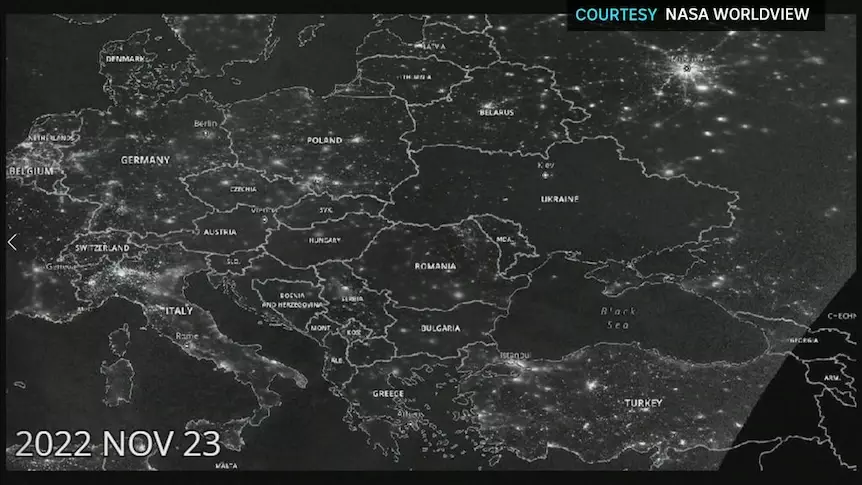
Ukraine from Space – Incredible NASA Image Shows Devastating Effects of Russian Strikes

f4a09c97ad350d28611f0cadd2958541.webp

The U.S. space agency NASA has released a series of images that lay bare the extent of the energy crisis currently facing Ukraine as a consequence of continued Russian strikes against civilian infrastructure.

As lights shine brightly in neighboring European countries, almost the whole of Ukraine is in darkness with just a few pinpricks of light visible.

Ukraine’s energy system suffered major blackouts and is still recovering after another large-scale Russian missile attack on Wednesday, Nov. 23.

Fifty percent of Kyiv’s residents were still without power on Friday, according to authorities.

Volodymyr Kudrytsky, the head of national electricity operator Ukrenergo, said repair work was continuing across the country, and that the grid had already “passed the most difficult stage” after the most recent attacks.


The post Ukraine from Space – Incredible NASA Image Shows Devastating Effects of Russian Strikes appeared first on Kyiv Post.

Categories
Audio Sources - Full Text Articles

Ukrainian, Turkish first ladies agree on evacuation of two orphanages from Odesa region

630_360_1669368407-198.jpg

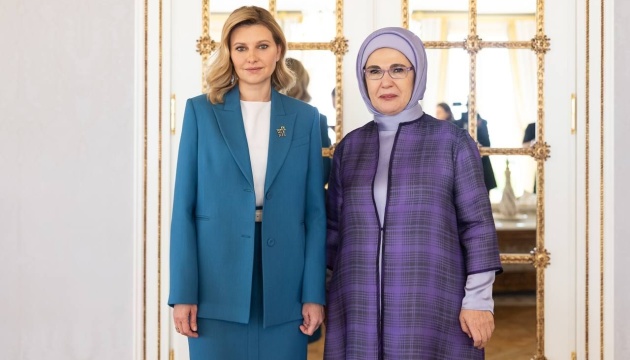
Ukraine’s Initial Lady, Olena Zelenska, and Turkey’s Initially Girl, Emine Erdogan, have agreed on the evacuation of two orphanages from the Odesa region.

The spouse of the Ukrainian president explained this in an interview with BBC Russian, Ukrinform reports.

“We have agreed with Mrs. Emine Erdogan on the evacuation of two orphanages from the Odesa region. These are incredibly young kids below the age of 3, for whom it is perilous to keep in Ukraine now. I think that they will go to Turkey currently in a number of months,” Zelenska explained.

She famous that she does not feel her colleagues are fatigued by the Russian-Ukrainian war. Zelenska expressed gratitude for the fact that they all realize that the war in Ukraine is a worldwide war, a war of worldviews.

“Everybody chooses who they are with. And they are with me. They are with us. All my colleagues at the Summit [Summit of First Ladies and Gentlemen] — we do a great deal together. Some of them have this sort of shut get hold of that we can skip the official 10 minutes of greetings throughout the meeting and promptly get started speaking about our assignments,” Zelenska additional.

She specified that a good deal of assignments ended up in the pipeline – all those connected to humanitarian aid, evacuation of young children from Ukraine. In this context, the first girl said that the evacuation of small children with oncological disorders experienced started from the first days of the war. Zelenska explained that her colleagues from other nations played a big position in this situation, amongst them Very first Girls Agata Kornhauser-Duda of Poland, Brigitte Macron of France and Elke Budenbender of Germany.

Source link

The post Ukrainian, Turkish first ladies agree on evacuation of two orphanages from Odesa region appeared first on Ukraine Intelligence.

Categories
Audio Sources - Full Text Articles

NATO vows to aid Ukraine ‘for as long as it takes’

BRUSSELS (AP) — NATO is determined to help Ukraine defend itself against Russia for “as long as it takes” and will help the war-wracked country transform its armed forces into a modern army up to Western standards, the alliance’s Secretary-General Jens Stoltenberg vowed on Friday.

Speaking to reporters ahead of a meeting of NATO foreign ministers in Romania next week, Stoltenberg urged countries that want to, either individually or in groups, to keep providing air defense systems and other weapons to Ukraine. NATO as an organization does not supply weapons.

“NATO will continue to stand with Ukraine for as long as it takes. We will not back down,” the former Norwegian prime minister said. “Allies are providing unprecedented military support, and I expect foreign ministers will also agree to step up non-lethal support.”

Stoltenberg said that members of the 30-nation security organization have been delivering fuel, generators, medical supplies, winter equipment and drone jamming devices, but that more will be needed as winter closes in, particularly as Russia attacks Ukraine’s energy infrastructure.

“At our meeting in Bucharest, I will call for more,” he said. “Over the longer term we will help Ukraine transition from Soviet era equipment to modern NATO standards, doctrine and training.”

Stoltenberg said Ukrainian Foreign Minister Dmytro Kuleba would join the ministers to discuss his country’s most pressing needs but also what kind of long-term support that NATO can provide. NATO’s top civilian official said the support will help Ukraine move toward joining the alliance one day.

The Nov 29-30 meeting in Bucharest is being held almost 15 years after NATO promised that Ukraine and Georgia would one day become members of the organization, a pledge that deeply angered Russia.

Also attending the meeting will be the foreign ministers of Bosnia, Georgia and Moldova – three partners that NATO says are coming under increasing Russian pressure. Stoltenberg said the meeting would see NATO “take further steps to help them protect their independence, and strengthen their ability to defend themselves.”

Since President Vladimir Putin ordered the invasion 10 months ago, NATO has bolstered the defenses of allies neighboring Ukraine and Russia but has carefully sought to avoid being dragged into a wider war with a major nuclear power.

But Stoltenberg put no pressure on Ukraine to enter peace talks with Russia, and indeed NATO and European diplomats have said that Putin does not appear willing to come to the table.

“Most wars end with negotiations,” he said. “But what happens at the negotiating table depends on what happens on the battlefield. Therefore, the best way to increase the chances for a peaceful solution is to support Ukraine.”

WP Radio
WP Radio
OFFLINE LIVE