Categories
Audio Sources - Full Text Articles

Kyiv Post Morning Memo – Everything You Need to Know on Thursday, Nov. 24

7-morning-memo-1024x576.png

Good morning from Kyiv where the city – and the rest of Ukraine – is reeling from yet another barrage of Russian missiles targeting civilian infrastructure.

What’s happening today?

 Today is basically a clean-up operation to fix everything caused by yesterday’s strikes, as mentioned above.

Russia’s continued attacks mean millions of Ukrainians were left without water and power overnight as the country’s already damaged and struggling infrastructure took yet another pounding.

In Kyiv there were water and electricity cuts and overnight, 70 percent of the city was without electricity as temperatures hovered just above freezing.

As of the morning of Thursday, Nov. 24, water was on tap again on the left bank of the Dnipro River. Kyiv Mayor Vitaliy Klitschko said those living on the right side of the city should have water “in the first half of the day”.

You can read more on this story here.

What has Zelensky said?

 Rather than his usual daily address, on Wednesday evening President Zelensky spoke to an emergency meeting of the UN Security Council (UNSC), calling Russian air strikes on Ukraine’s battered power grid an “obvious crime against humanity”.

“When we have the temperature below zero, and scores of millions of people without energy supplies, without heating, without water, this is an obvious crime against humanity,” he said.

The UN Security Council is unlikely to be able to do anything to alleviate Ukraine’s situation given Russia is a permanent member with the power of veto over any proposals, something Zelensky was keen to highlight.

“This is nonsense that the veto right is reserved for the one who is waging a criminal war,” he said.

“Justice must be restored within the UN structures themselves. The terrorist state should not participate in any voting on the issues of its aggression, its terror.

“The world should not be held hostage by one international terrorist.”

What’s the situation on the front lines?

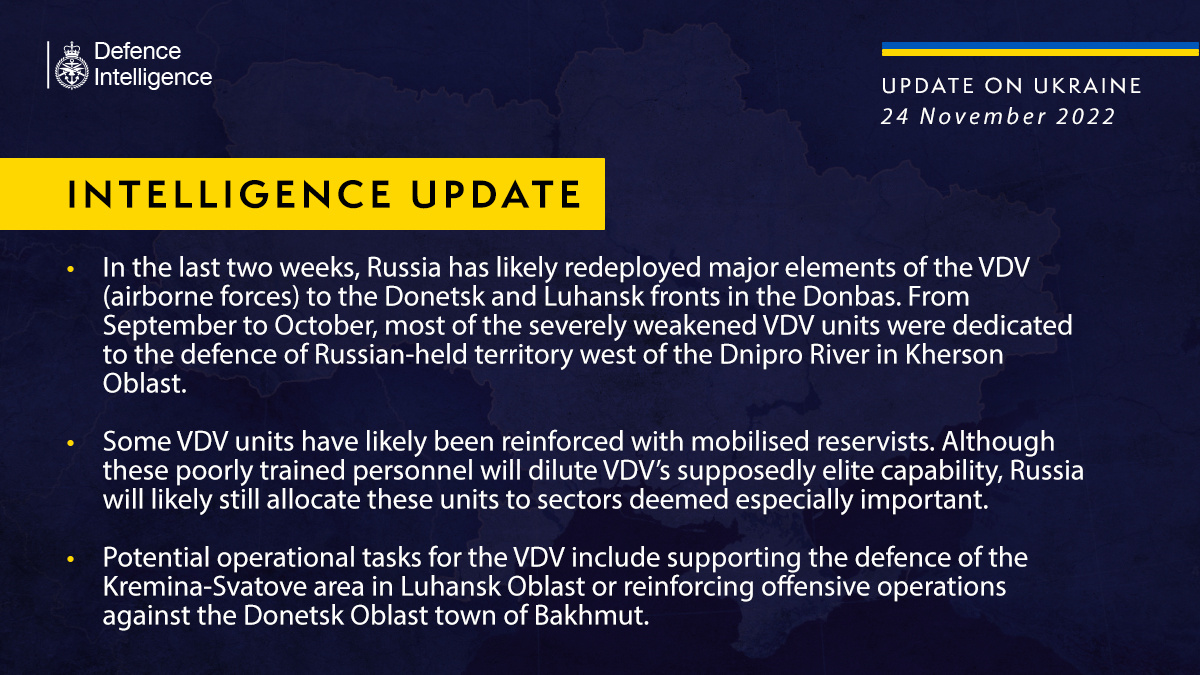
The British Ministry of Defence (MoD) focuses on Russian airborne troops (VDV), saying Russia has likely redeployed major elements to “Donetsk and Luhansk fronts in the Donbas”.

Although they’re being moved to key areas of the battlefield, the MoD notes units have been reinforced with mobilised reservists and “these poorly trained personnel will dilute VDV’s supposedly elite capability”.

It adds: “Potential operational tasks for the VDV include supporting the defence of the Kremina-Svatove area in Luhansk Oblast or reinforcing offensive operations against the Donetsk Oblast town of Bakhmut.”

The Institute for the Study of Wars daily assessment covers a multitude of topics, most notably:

  • Russian politicians continue to promote openly genocidal rhetoric against Ukraine. Moscow City Duma Deputy and pro-Kremlin journalist Andrey Medvedev posted a long rant to his Telegram channel on Nov. 23. wherein he categorically denied the existence of the Ukrainian nation, relegating Ukrainian identity to a “political orientation”. Medvedev called Ukraine a pagan cult of death that worships prisoner executions and called for the total “liquidation of Ukrainian statehood in its current form.”
  • The Kremlin continues to pursue its maximalist goals and is likely issuing vague statements about its intent to mislead Western Countries into pressuring Ukraine into negotiations.
  • The Kremlin is continuing crypto-mobilization efforts at the expense of other Russian security services.

And that’s it for today’s Morning Memo. Kyiv Post will bring you the latest news throughout the day and we’ll be back with another edition tomorrow.

The post Kyiv Post Morning Memo – Everything You Need to Know on Thursday, Nov. 24 appeared first on Kyiv Post.

Categories
Audio Sources - Full Text Articles

Main units of Russia’s airborne forces likely redeployed to Donetsk, Luhansk directions

630_360_1668461240-442.jpg

In the past two weeks, Russia has possible redeployed key models of its airborne forces (VDV) to the Donetsk and Luhansk fronts.

The British Protection Ministry stated this in its intelligence update on Thursday, Ukrinform experiences.  

According to the British intelligence, from September to October, most of the severely weakened VDV models had been committed to the defence of Russian-held territory west of the Dnipro River in Kherson location.

“Some VDV units have most likely been reinforced with mobilised reservists. Even though these inadequately trained staff will dilute VDV’s supposedly elite capacity, Russia will possible even now allocate these models to sectors deemed specifically crucial,” the ministry stated.

Likely operational responsibilities for the VDV contain supporting the defence of the Kremina-Svatove space in Luhansk region or reinforcing offensive operations versus the Donetsk region city of Bakhmut.

As Ukrinform reported, the British intelligence previously claimed that Russian troops are most likely to prioritize retaining regulate of the city of Svatove in Luhansk location, as the spot is the invaders’ most susceptible operational flank.

iy

Source link

The post Main units of Russia’s airborne forces likely redeployed to Donetsk, Luhansk directions appeared first on Ukraine Intelligence.

Categories
Audio Sources - Full Text Articles

Stories of Ukrainian resistance revealed after Kherson pullout


Near Kherson city, Ukraine

CNN

 — 

Two Russian soldiers walked down a street in Kherson on a spring evening in early March, just days after Moscow captured the city. The temperature that night was still below freezing and the power was out, leaving the city in complete darkness as the soldiers made their way back to camp after a few drinks.

As one stumbled on, the other stopped to relieve himself on the side of the pavement. Suddenly, a knife was thrust deep into the right side of his neck.

He fell to the grass. Moments later, the second Russian soldier, inebriated and unaware, met the same fate.

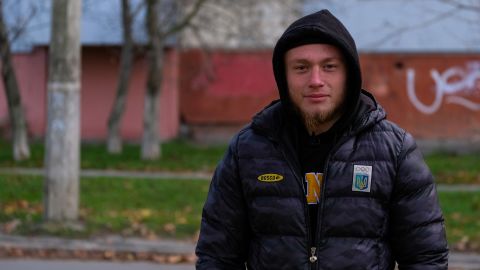
“I finished the first one immediately and then I caught up with the other and killed him on the spot,” says Archie, a Ukrainian resistance fighter who described the scene above to CNN.

He says he moved on pure instinct.

'Archie' killed two Russian soldiers on his own, days after they took over Kherson. He later joined up with other partisans to form a coordinated resistance movement.

“I saw the orcs in uniform and I thought, why not?,” Archie adds, using a derogative term for Russians, as he walks through that same street. “There were no people or light and I seized the moment.”

The 20-year-old is a trained mixed martial arts fighter, with nimble feet and sharp reflexes, who had previously always carried a knife for self-defense, but never killed anyone. CNN is referring to him by his call sign to protect his identity.

“Adrenaline played its role. I didn’t have any fear or time to think,” he says. “For the first few days I felt very bad, but then I realized that they were my enemies. They came to my home to take it from me.”

Archie’s account was backed up by Ukrainian military and intelligence sources who handled communications with him and other partisans. He was one of many resistance fighters in Kherson, a city of 290,000 people before the invasion, which Russia tried to bend but could not break.

People in Kherson made their views clear soon after Russia took over the city on March 2 coming out onto the main square for daily protests, donning the blue and yellow Ukrainian flag.

But Kherson, the first large city and only regional capital Russian troops were able to occupy since the start of the invasion, was an important symbol for Moscow. Dissent could not be tolerated.

Protesters were met with tear gas and gunshots, organisers and the more outspoken residents were arrested and tortured. When peaceful demonstrations didn’t work, the people of Kherson turned to resistance and ordinary citizens like Archie started to take action on their own.

“I wasn’t the only one in Kherson,” Archie says. “There were a lot of clever partisans. At least 10 Russians were killed every night.”

Initially solo operations, like-minded residents began organising themselves in groups, coordinating their actions with the Ukrainian military and intelligence outside the city.

“I have a friend with whom we would drive around the city, looking for gatherings of Russian soldiers,” he says. “We checked their patrol routes and then gave all the information to guys on the frontline and they knew who to pass onto next.”

Russian soldiers weren’t the only ones targeted for assassination. Several Moscow-installed government officials were targeted during the eight months of the Russian occupation. Their faces were printed in posters placed all over the city, promising retribution for their collaboration with the Kremlin, in a psychological war that lasted throughout the occupation.

Many of those promises were kept, with some of those officials gunned down and others blown up in their cars in incidents that pro-Russian local authorities described as “terrorist attacks.”

Archie was arrested by the occupying authorities on May 9, after attending a victory day parade, celebrating the Soviet Union’s win in World War II, wearing a yellow and blue stripe on his t-shirt.

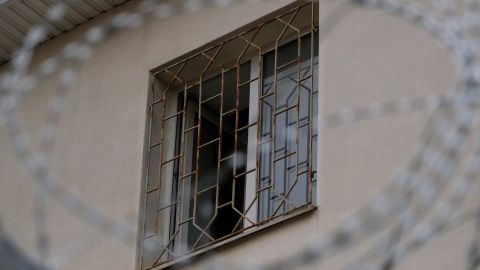
He was taken to a local pre-trial detention facility which had been taken over by the Russian Federal Security Service (FSB) and used to torture Ukrainian soldiers, intelligence officers and partisans, according to Archie.

Ihor says while he was held at this Russian detention center, he spent much of his time looking out the window, day dreaming about escaping the horrors within.

“They beat me, electrocuted me, kicked me and beat me with batons,” Archie recalls. “I can’t say they starved me, but they didn’t give much to eat.”

“Nothing good happened there,” he said.

Archie was lucky enough to be let go after nine days and after being forced to record a video saying he’d agreed to work with the Russian occupiers. His account of what transpired in the facility has been confirmed by Ukrainian military sources and other detainees.

But many others never left, according to Archie and other resistance fighters, as well as Ukrainian military and intelligence sources.

Ihor, who asked CNN not to reveal his last name for his protection, was also held at the facility.

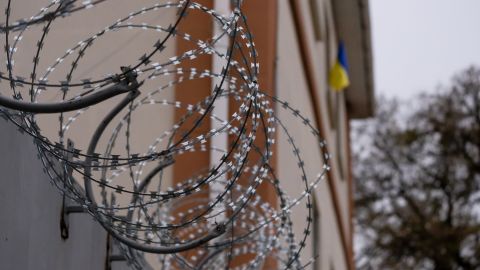
The Ukrainian flag now hangs atop a detention center used by Russian forces to hold and torture Ukrainian soldiers, dissidents and partisans.

“I was kept here for 11 days and throughout that time I heard screaming from the basement,” the 29-year-old says. “People were tortured, they were beaten with sticks in the arms and legs, cattle prods, even hooked up to batteries and electrocuted or waterboarded with water.”

Ihor was caught transporting weapons and says “luckily” he was only beaten.

“I arrived after the time when people were beaten up to death here,” he recalls. “I was stabbed in the legs with a taser, they use it as a welcome. One of them asked what I’d been brought in for and another two of them started hitting me in the ribs.”

Ihor and other partisans helped Ukrainian forces zero-in on this warehouse, where Russian forces had stationed military assets, and target it with artillery.

Through his detention, Ihor was able to hide that he was a member of the Kherson resistance and that transporting weapons was not the only thing he did. Ihor says he also supplied intelligence to the Ukrainian military – an activity that would have incurred far more brutal punishment.

“If we found something, saw it, (we) took a picture or a video (and) sent it to Ukrainian forces and then they would decide whether to hit it or not,” he explains.

Among the coordinates he communicated to the Ukrainian military is a warehouse within Kherson city. “The Russian military kept between 20 to 30 vehicles here, there were armored trucks, armored personnel carriers and some Russians lived here,” Ihor says.

Departing Russian forces were quick to hollow out what was left of the prized interior, but the wrecked building bears the marks of the violent strike. Most of the roof has collapsed, its walls lay shattered and broken glass still covers most of the floor. The structure remains in place but in parts its metal has been mangled by the blast.

Ihor filmed this warehouse used by Russian forces as he walked past it, pretending to be making a phone call. His information helped Ukrainian forces target and destroy it.

Ihor used the Telegram messaging app to communicate the building’s coordinates to his military handler, who he referred to as “the smoke.” Along with the information, he sent a video he secretly recorded.

“I turned on the camera, pointed it at the building and then I just walked and talked on the phone while the camera was filming,” he explains. “Afterward I deleted video, of course, because if they were to stop me somewhere and check my videos and pictures there would be questions…”

He sent the information in mid-September and, just a day later, the facility was targeted by Ukrainian artillery.

The United States and NATO have assessed that when Russia began its invasion of Ukraine, the Kremlin expected its forces to be greeted as saviors, welcomed with open arms. Reality failed to live up to expectation, not just in the territories where Moscow’s armies were pushed back, but also in the areas it was able to seize.

The strike on the warehouse which Ihor helped with, is one of many facilitated by Ukrainian partisans inside Kherson working tirelessly and under threat to disrupt Russian activities within the city.

Eight months after it was occupied by Russia, the city of Kherson is now back in Ukrainian hands and Moscow’s armies are on the back foot, forced to withdraw from the western bank of the Dnipro river.

But despite achieving victory here, Ukraine continues to faces almost daily crippling missile strikes almost everywhere else, all while Russian forces continue to press on in the East.

Looking back, Ihor, father to a three-month-old daughter, says he was lucky he wasn’t caught.

“It wasn’t hard, but it was dangerous,” he explains. “If they were to catch me filming such a thing, they would take me in and probably wouldn’t let me come out alive.”


Source link

The post Stories of Ukrainian resistance revealed after Kherson pullout appeared first on Ukraine Intelligence.

Categories
Audio Sources - Full Text Articles

Ukraine races to restore power after outages in Kyiv, other cities

2022-11-24T08:05:00Z

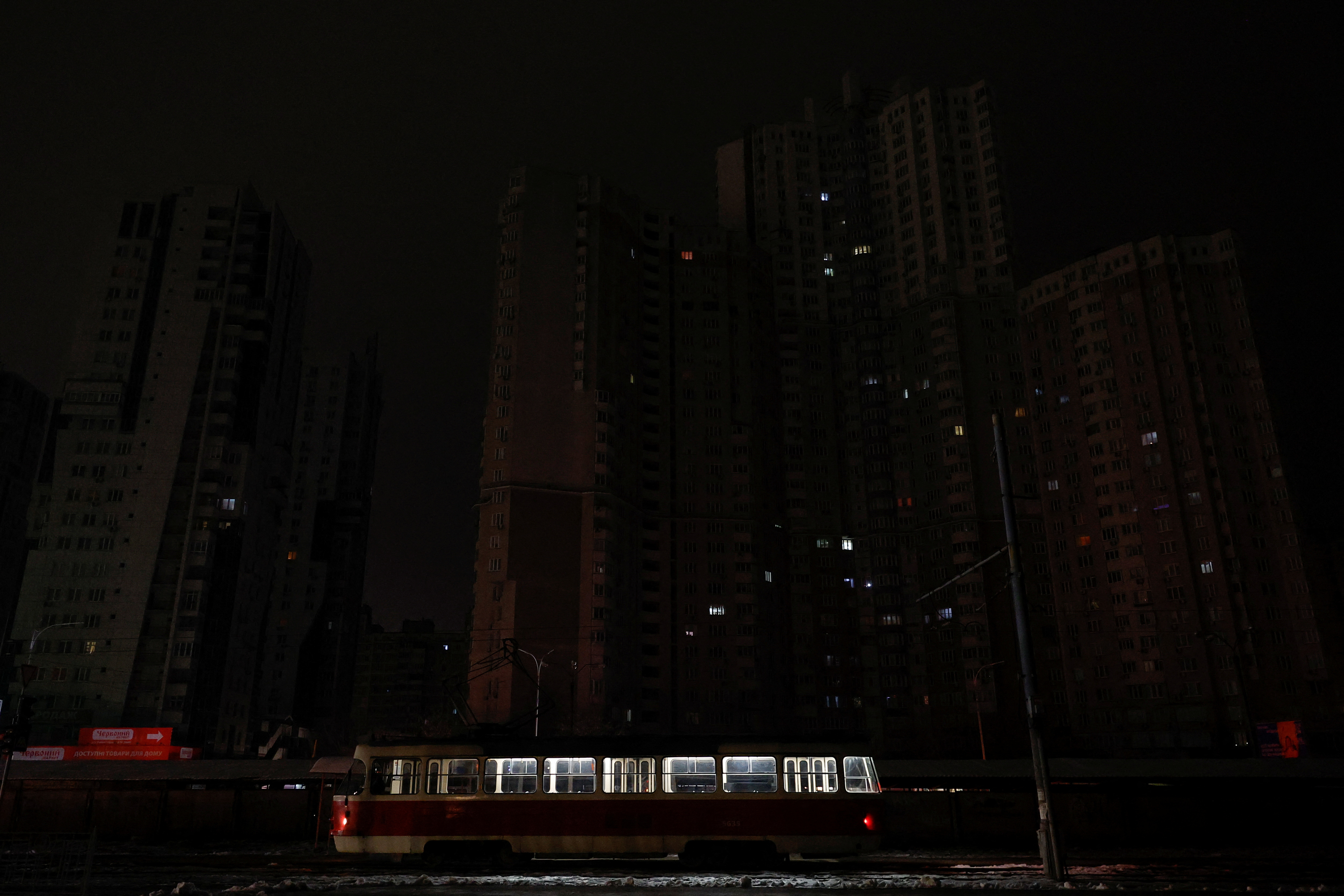
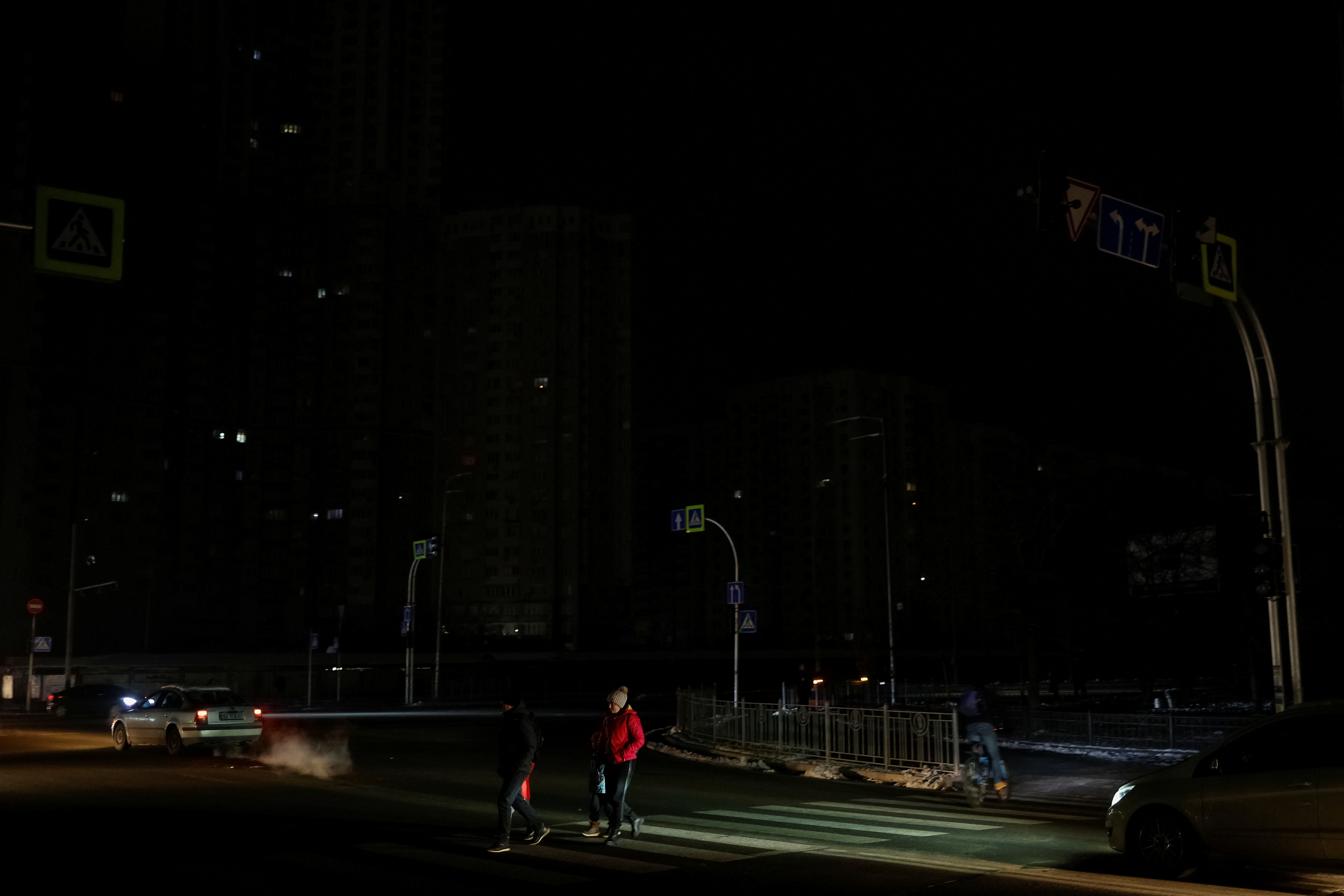
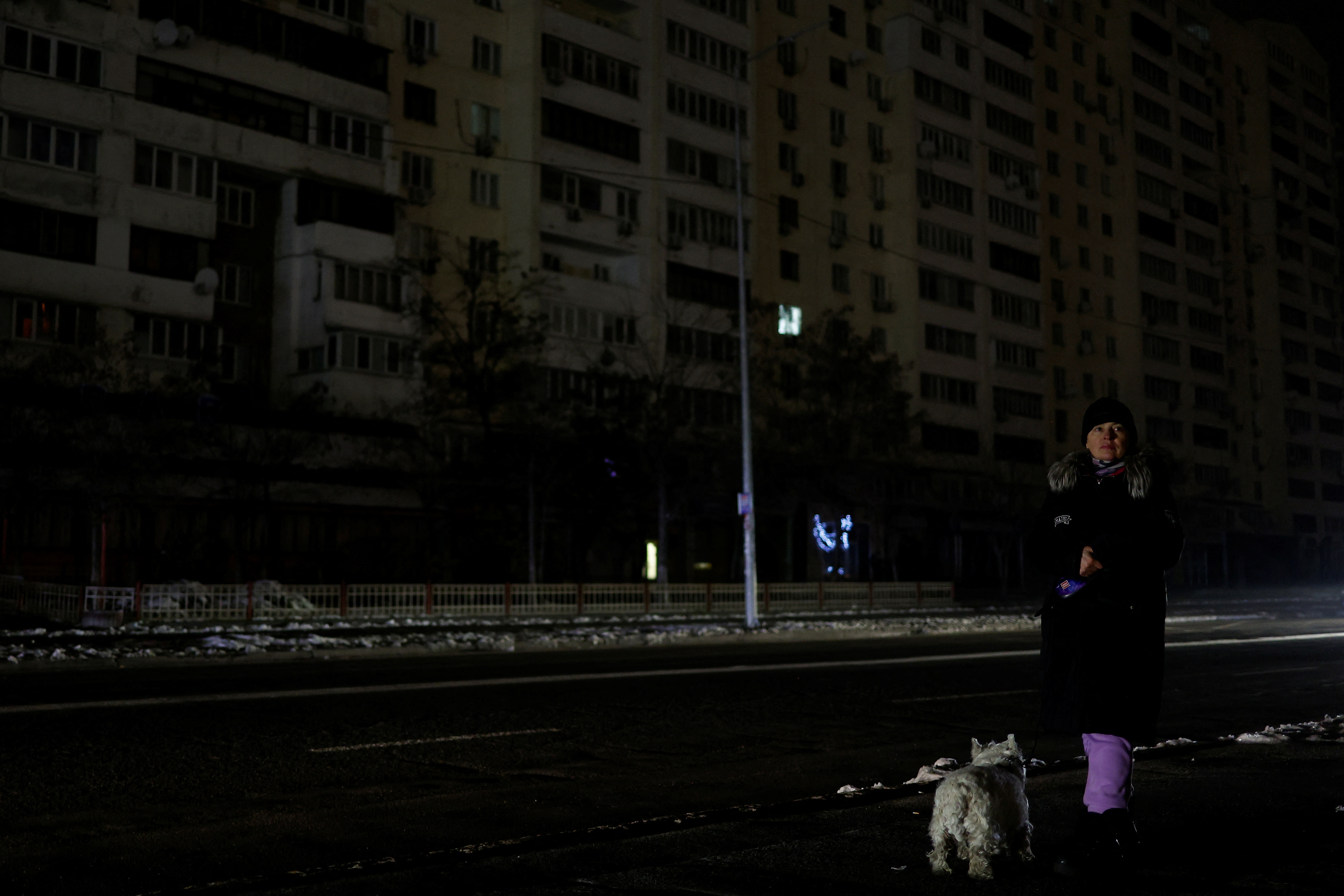
More than two thirds of the Ukrainian capital was still without power on Thursday morning and a swathe of residents had no running water, a day after Russian missile strikes caused Kyiv’s biggest outages in nine months of war.

Energy Minister German Galushchenko said three nuclear power stations that were switched off because of the attacks on Wednesday were expected to be back on line later on Thursday, and this would help ease supply problems.

“The situation is difficult throughout the country,” he said in televised comments, adding that power generation would gradually increase throughout the day.

Kyiv was one of the main targets of Wednesday’s attacks on energy facilities that cut power in many regions and made emergency blackouts necessary in others to conserve energy and enable repairs as winter sets in.

The temperature plunged below zero degrees Celsius overnight in a city that had 2.8 million residents before the war and where it has already snowed and the streets are icy.

Kyiv Mayor Vitali Klitschko said electricians and repair workers were doing everything to get the power back on “as fast as possible” but the recovery would depend largely on the overall energy “balance” of the nationwide grid.

Kyrylo Tymoshenko, deputy chief of President Volodymyr Zelenskiy’s staff, said power supplies had been restored in the Kirovohrad and Vinnytsia regions.

Power was also largely back in the northern region of Sumy, and 3,000 miners who had been trapped underground during a power outage had been brought to the surface in central Ukraine, regional officials said.

In the south, Mykolaiv region governor Vitali Kim appealed to Ukrainians to be as frugal as possible in their use of power.

“Consumption has been growing this morning (which is logical), there isn’t enough capacity in the system to switch it on for more consumers!!,” he wrote on the Telegram messaging app.

“The energy system is united like we all are! If you’ve turned off a few unneeded lights, that’s really important!!!”

Related Galleries:

A tram is seen in front of apartment buildings without electricity after critical civil infrastructure was hit by Russian missile attacks, amid Russia’s invasion of Ukraine, in Kyiv, Ukraine November 23, 2022. REUTERS/Valentyn Ogirenko

People cross a street without electricity after critical civil infrastructure was hit by Russian missile attacks, amid Russia’s invasion of Ukraine, in Kyiv, Ukraine November 23, 2022. REUTERS/Valentyn Ogirenko

A woman with a dog waits for a bus in a street without electricity after critical civil infrastructure was hit by Russian missile attacks, amid Russia’s invasion of Ukraine, in Kyiv, Ukraine November 23, 2022. REUTERS/Valentyn Ogirenko
Categories
Audio Sources - Full Text Articles

EXCLUSIVE Russians, Ukrainians met in UAE to discuss prisoner swap, ammonia, sources say

2022-11-24T08:10:20Z

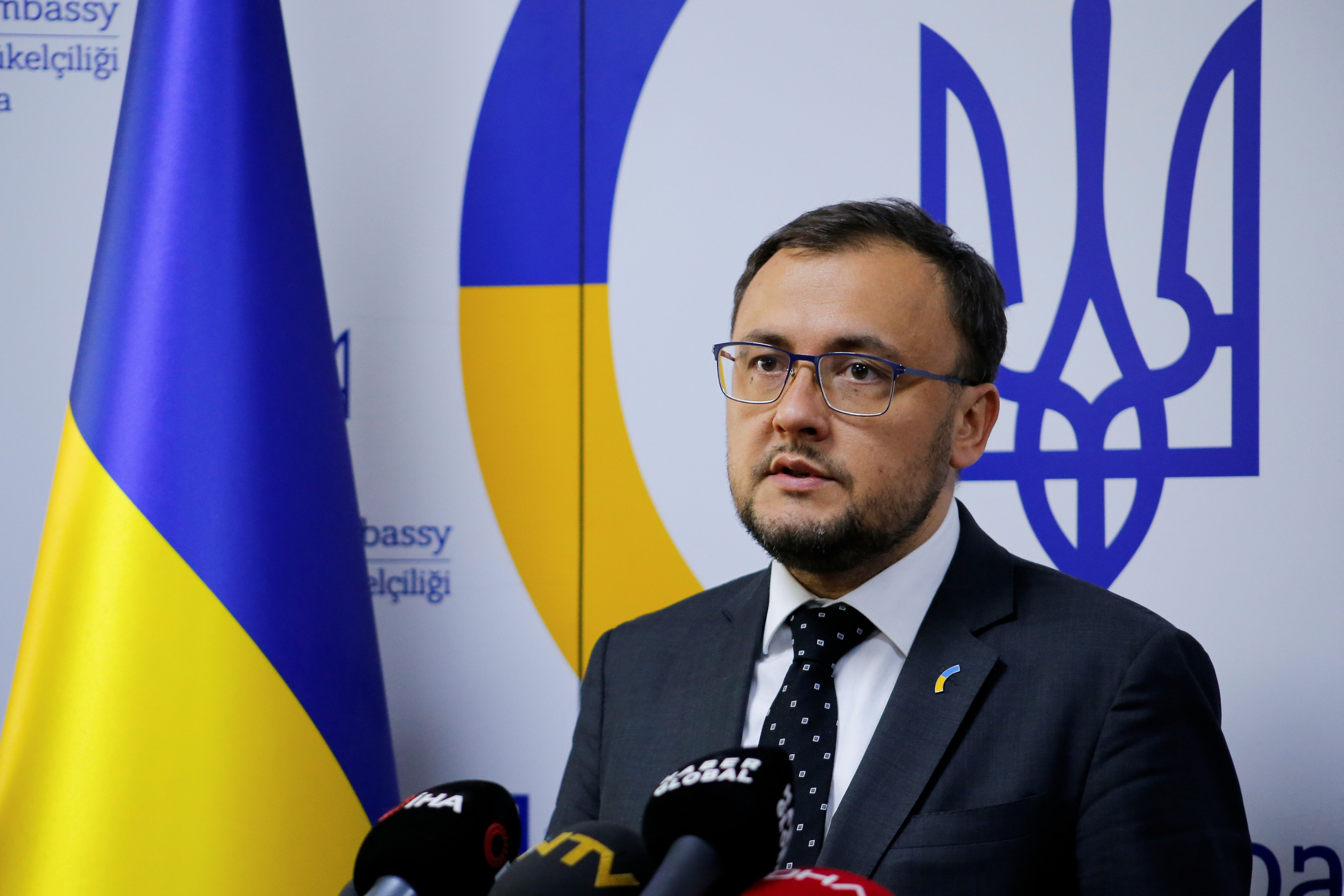
Ukrainian Ambassador to Turkey Vasyl Bodnar speaks during a news conference in Ankara, Turkey February 24, 2022. REUTERS/Cagla Gurdogan

Representatives from Russia and Ukraine met in the United Arab Emirates last week to discuss the possibility of a prisoner-of-war swap that would be linked to a resumption of Russian ammonia exports, which go to Asia and Africa, via a Ukrainian pipeline, three sources with knowledge of the meeting said.

The sources said the talks were being mediated by the Gulf Arab state and did not include the United Nations despite the U.N.’s central role in negotiating the ongoing initiative to export agricultural products from three Ukrainian Black Sea ports. Ammonia is used to make fertilizer.

However the talks aim to remove remaining obstacles in the initiative extended last week and ease global food shortages by unblocking Ukrainian and Russian exports, they added.

The sources asked not to be named in order to freely discuss sensitive matters.

The Russian and Ukrainian representatives travelled to the UAE capital Abu Dhabi on Nov. 17 where they discussed allowing Russia to resume ammonia exports in exchange for a prisoner swap that would release a large number of Ukrainian and Russian prisoners, the sources said.

Reuters could not immediately establish what progress was made at the talks.

The Ukrainian ambassador to Turkey, Vasyl Bodnar, told Reuters that “releasing our prisoners of war is part of negotiations over opening Russian ammonia exports”, adding “Of course we look for ways to do that at any opportunity”. Bodnar said he was unaware if a meeting took place in the UAE.

Putin said on Wednesday that Russian officials would work to unblock Russian fertilisers stuck in European ports and to resume ammonia exports.

The UAE’s foreign ministry, Russia and Ukraine’s defence and foreign ministries did not respond to Reuters’ requests for comment.

Asked if the United Nations were involved in the talks, a spokesperson for the organisation declined to comment.

The export of Russian ammonia would be via an existing pipeline to the Black Sea.

The pipeline was designed to pump up to 2.5 million tonnes of ammonia gas per year from Russia’s Volga region to Ukraine’s Black Sea port of Pivdennyi, known as Yuzhny in Russian, near Odesa for onward shipment to international buyers. It was shut down after Russia sent its troops into Ukraine on Feb. 24.

The export of ammonia was not part of the renewal of the U.N.-backed grains corridor deal that restored commercial shipping from Ukraine.

Last week, Rebeca Grynspan, Secretary-General of U.N. agency UNCTAD, who leads the negotiations on fertiliser, said she was optimistic Russia and Ukraine could agree to the terms for the export of Russian ammonia via the pipeline, without giving details.

Ukraine’s President Volodymyr Zelenskiy has publicly set several conditions before allowing Russia to resume its ammonia exports via the pipeline, including a prisoner swap and reopening of Mykolaiv port in the Black Sea.

Neither Russia nor Ukraine have released official figures on how many prisoners of war they have taken since Russia invaded in February. On Oct. 29, Ukrainian President Volodymr Zelenskiy said that since March, Russia had freed a total of 1,031 prisoners.

Russia and Ukraine have disclosed few details about direct meetings between representatives from the two countries following the abandonment of ceasefire talks in the first few weeks following Moscow’s invasion on February 24.

Abu Dhabi’s efforts follow in the footsteps of Saudi Arabia, which scored a diplomatic win by securing freedom for foreign fighters captured in Ukraine in September.

The UAE, like Saudi Arabia, is a member of the OPEC+ oil alliance that includes Russia and has also maintained good ties with Moscow despite Western pressure to help isolate Russia over the invasion of Ukraine, which Moscow calls its “special military operation”.

UAE President Mohammed bin Zayed al-Nahyan visited Moscow last month where he discussed with President Vladimir Putin the possibility of Abu Dhabi mediating for an ammonia deal, two of the sources said.

Ukraine is a major producer of grains and oilseeds. Russia is the world’s largest wheat exporter and a major supplier of fertilisers to global markets.

Since July, Moscow has repeatedly said its shipments of grain and fertilisers, though not directly targeted by sanctions, are constrained because sanctions make it harder for exporters to process payments or to obtain vessels and insurance.

Categories
Audio Sources - Full Text Articles

After Russian retreat, Ukrainian military plans next move

KHERSON, Ukraine (AP) — The Ukrainian sniper adjusted his scope and fired a.50-caliber bullet at a Russian soldier across the Dnieper River. Earlier, another Ukrainian used a drone to scan for Russian troops.

Two weeks after retreating from the southern city of Kherson, Russia is pounding the town with artillery as it digs in across the Dnieper River.

Ukraine is striking back at Russian troops with its own long-distance weapons, and Ukrainian officers say they want to capitalize on their momentum.

The Russian withdrawal from the only provincial capital it gained in nine months of war was one of Moscow’s most significant battlefield losses. Now that its troops hold a new front line, the army is planning its next move, the Ukrainian military said through a spokesman.

Ukrainian forces can now strike deeper into the Russian-controlled territories and possibly push their counteroffensive closer to Crimea, which Russia illegally captured in 2014.

Russian troops continue to establish fortifications, including trench systems near the Crimean border and some areas between the Donetsk and Luhansk regions in the east.

In some locations, new fortifications are up to 60 kilometers (37 miles) behind the current front lines, suggesting that Russia is preparing for more Ukrainian breakthroughs, according to the British Ministry of Defense.

“The armed forces of Ukraine seized the initiative in this war some time ago,” said Mick Ryan, military strategist and retired Australian army major general. “They have momentum. There is no way that they will want to waste that.”

Crossing the river and pushing the Russians further back would require complicated logistical planning. Both sides have blown up bridges across the Dnieper.

“This is what cut Russians’ supply lines and this is also what will make any further Ukrainian advance beyond the left bank of the river more difficult,” said Mario Bikarski, an analyst with the Economist Intelligence Unit.

In a key battlefield development this week, Kyiv’s forces attacked Russian positions on the Kinburn Spit, a gateway to the Black Sea basin, as well as parts of the southern Kherson region still under Russian control. Recapturing the area could help Ukrainian forces push into Russian-held territory in the Kherson region “under significantly less Russian artillery fire” than if they directly crossed the Dnieper River, said the Institute for the Study of War, a Washington-based think tank. Control of the area would help Kyiv alleviate Russian strikes on Ukraine’s southern seaports and allow it to increase its naval activity in the Black Sea, the think tank added.

Some military experts say there’s a possibility the weather might disproportionately harm poorly-equipped Russian forces and allow Ukraine to take advantage of frozen terrain and move more easily than during the muddy autumn months, ISW said.

Russia’s main task, meanwhile, is to prevent any further retreats from the broader Kherson region and to strengthen its defense systems over Crimea, said Bikarski, the analyst. Ryan, the military strategist, said Russia will use the winter to plan its 2023 offensives, stockpile ammunition and continue its campaign targeting critical infrastructure including power and water plants.

Russia’s daily attacks are already intensifying. Last week a fuel depot was struck in Kherson, the first time since Russia withdrew. This week at least one person was killed and three wounded by Russian shelling, according to the Ukrainian president’s office. Russian airstrikes damaged key infrastructure before Russia left, creating a dire humanitarian crisis. Coupled with the threat of attack, that is adding a layer of stress, say many who weathered Russia’s occupation and are leaving, or considering it.

Ukrainian authorities this week began evacuating civilians from recently liberated parts of Kherson and Mykolaiv regions, fearing lack of heat, power and water due to Russian shelling will make winter unlivable.

Boarding a train on Monday, Tetyana Stadnik has decided to go after waiting for the liberation of Kherson.

“We are leaving now because it’s scary to sleep at night. Shells are flying over our heads and exploding. It’s too much,” she said. “We will wait until the situation gets better. And then we will come back home.”

Others in the Kherson region have decided to stay despite living in fear.

“I’m scared,” said Ludmilla Bonder a resident of the small village of Kyselivka. “I still sleep fully clothed in the basement.”

Categories
Audio Sources - Full Text Articles

British Defence Intelligence Update Ukraine – 24 November 2022

fitz_suwaaa4rqe.jpeg

  • In the last two weeks, Russia has likely redeployed major elements of the VDV (airborne forces) to the Donetsk and Luhansk fronts in the Donbas.
  • From September to October, most of the severely weakened VDV units were dedicated to the defence of Russian-held territory west of the Dnipro River in Kherson Oblast.
  • Some VDV units have likely been reinforced with mobilised reservists. Although these poorly trained personnel will dilute VDV’s supposedly elite capability, Russia will likely still allocate these units to sectors deemed especially important.
  • Potential operational tasks for the VDV include supporting the defence of the Kremina-Svatove area in Luhansk Oblast or reinforcing offensive operations against the Donetsk Oblast town of Bakhmut.

The post British Defence Intelligence Update Ukraine – 24 November 2022 appeared first on Kyiv Post.

Categories
Audio Sources - Full Text Articles

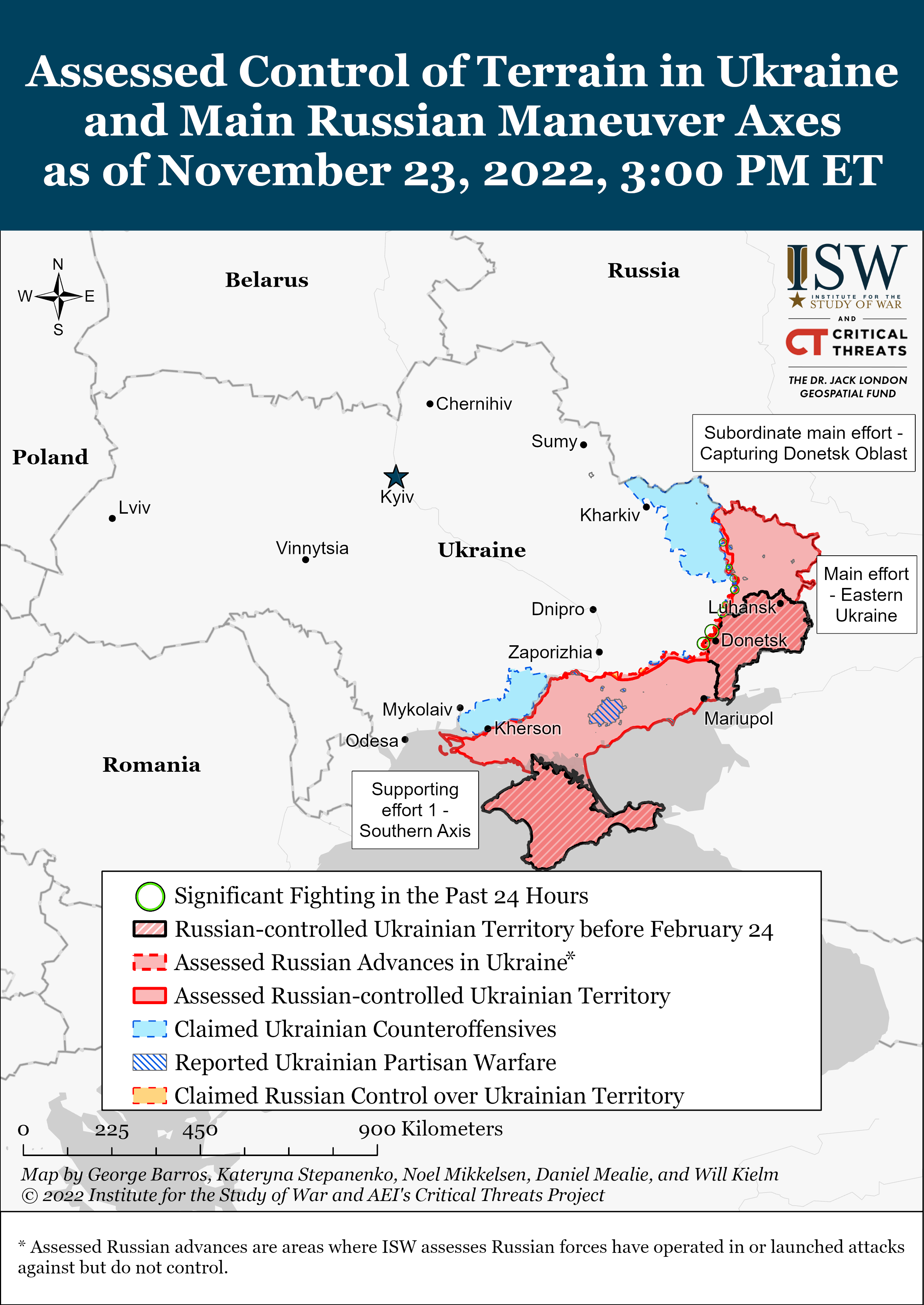
ISW Russian Offensive Campaign Assessment, November 23

draftukrainecotmapnovember232022.png

Key Takeaways

  • The Russian military conducted another set of massive, coordinated missile strikes on Ukrainian critical infrastructure.
  • Russian politicians continue to promote openly genocidal rhetoric against Ukraine.
  • The Kremlin continues to pursue its maximalist goals and is likely issuing vague statements about its intent to mislead Western Countries into pressuring Ukraine into negotiations.
  • Russian sources claimed that Ukrainian forces continued counteroffensive operations in the directions of Kreminna and Svatove.
  • Russian forces continued offensive operations around Bakhmut and Avdiivka.
  • Russian forces continued defensive operations on the east (left) bank of the Dnipro River in Kherson Oblast.
  • The Kremlin is continuing crypto-mobilization efforts at the expense of other Russian security services.
  • Russian forces and occupation officials continued to forcibly relocate residents and confiscate their property.

The Russian military conducted another set of massive, coordinated missile strikes on Ukrainian critical infrastructure in a misguided attempt to degrade the Ukrainian will to fight. Ukrainian Air Force Command reported on November 23 that Russian forces launched 70 cruise missiles and five drones at Ukrainian critical infrastructure targets. Ukrainian Air Force Command reported that Ukrainian air defenses shot down 51 of the Russian cruise missiles and all five drones.  The Ukrainian General Staff reported that Russian forces struck residential buildings, thermal power plants, and substations in the city of Kyiv as well as in Kyiv, Vinnytsia, Lviv, and Zaporizhia oblasts. Ukrainian, Russian, and social media sources claimed that Russian forces also struck targets in Ivano-Frankivsk, Odesa, Mykolaiv, Kherson, Cherkasy, Dnipropetrovsk, Sumy, Poltava, Kirovohrad, and Kharkiv oblasts. Ukrainian officials reported widespread disruptions to energy, heating, and water supplies as a result of the Russian strikes. ISW has previously assessed that the Russian military is still able to attack Ukrainian critical infrastructure at scale in the near term despite continuing to deplete its arsenal of high-precision weapons systems. Ukrainian Deputy Defense Minister Hanna Malyar stated that the Russian military mistakenly believes that the destruction of energy infrastructure will direct Ukrainian efforts to protect rear areas and divert Ukrainian attention away from the front in eastern and southern Ukraine. Malyar stated that Russia’s campaign against critical infrastructure will not weaken the motivation of Ukraine’s civilian population, and the Ukrainian Security and Defense Council Secretary Oleksiy Danilov asserted that Russian missile and drone strikes will not coerce Ukraine into negotiations.

Prominent Russian politicians continue to promote openly genocidal rhetoric against Ukraine. Moscow City Duma Deputy and pro-Kremlin journalist Andrey Medvedev posted a long rant to his Telegram channel on November 23 wherein he categorically denied the existence of the Ukrainian nation, relegating Ukrainian identity to a “political orientation.”Medvedev called Ukraine a pagan cult of death that worships prisoner executions and called for the total “liquidation of Ukrainian statehood in its current form.” This rhetoric is openly exterminatory and dehumanizing and calls for the conduct of a genocidal war against the Ukrainian state and its people, which notably has pervaded discourse in the highest levels of the Russian political mainstream. As ISW has previously reported, Russian President Vladimir Putin has similarly employed such genocidal language in a way that is fundamentally incompatible with calls for negotiations.

The Kremlin has not backed down from its maximalist goals of regaining control of Ukraine but is rather partially obfuscating Russia’s aims to mislead Western countries into pressuring Ukraine to sue for peace. Kremlin Spokesperson Dmitry Peskov stated on November 21 that changing the current government in Ukraine is not a goal of the Russian “special military operation” in Ukraine, observing that Russian President Vladimir Putin “has already spoken about this.” Putin had said on October 26 that Ukraine has “lost its sovereignty” and come fully under NATO’s control. Putin’s speech at the Valdai Discussion Club on October 27 again rejected Ukraine’s sovereignty, noting that Russia “created” Ukraine and that the “single real guarantee of Ukrainian sovereignty” can only be Russia. Putin has also consistently upheld his talking point that Ukraine is a Nazi state that must be “denazified.” Putin’s demands amount to a requirement for regime change in Kyiv even if he does not explicitly call for it in these recent statements. The fact that Peskov refers back to these comments by Putin makes reading any serious walking-back of Russian aims into Peskov’s comments highly dubious.

The Kremlin’s obfuscation of its aims likely intended for a Western audience is nevertheless confusing Russian war supporters. Peskov’s statement likely aimed to mitigate the effects of Vice-Speaker of the Russian Federation Council Konstantin Kosachev’s pro-war rant declaring that Russia can only normalize relations with Ukraine following the capitulation of the Ukrainian government. The two contrasting statements confused the pro-war community. A Wagner Group-affiliated milblogger sarcastically observed that Russia is aimlessly fighting a war without a clear goal in response to Peskov’s statement. ISW has reported on similar reactions to the Kremlin’s decision to exchange Ukrainian prisoners of war from Mariupol, whom Kremlin officials and propagandists vilified as “Nazis” and ”war criminals.”

The Kremlin’s hesitance to publicly commit fully to an extreme nationalist ideology and to the war is also bewildering propagandists who preach such ideology to the Russian masses. Russian political and military “experts” on a Russian state TV show pushed back against Russian propagandist Vladimir Solovyov’s claim that Kherson Oblast is fully Russian, which would justify the use of nuclear weapons. The “experts” said that the use of nuclear weapons to defend territory that is not fully occupied is irrational and even said that NATO poses no threat to Russia. Russian propagandists have been making outlandish nuclear threats and accusing NATO of planning to attack Russia throughout Putin’s regime and especially before and during the February 2022 invasion of Ukraine; such dismissal of common Kremlin talking points in such a forum is unprecedented. ISW has also previously reported that Russian extreme nationalist ideologist Alexander Dugin accused Putin of not fully committing to the pro-war ideology. Putin has generally sought to balance extreme nationalist talking points to gather support from the nationalist-leaning community and a more moderate narrative to maintain the support of the rest of the Russian population. Russian military failures and the increasing sacrifices Putin is demanding of the Russian people to continue his disastrous invasion are bringing his deliberate obfuscation of war aims and attempts to balance rhetorically into sharp relief, potentially fueling discontent within critical constituencies.

The post ISW Russian Offensive Campaign Assessment, November 23 appeared first on Kyiv Post.

Categories
Audio Sources - Full Text Articles

7 Biggest Ecological Threats in Ukraine from Russia’s War

photo_2022-11-24-09.49.52.jpeg

A top Ukrainian lawmaker described the worst environmental threats the country now faces as a result of the full-scale Russian invasion.

Oleh Bondarenko, lawmaker and head of the Parliamentary Committee on Environmental Policy and Nature Management, has accused the occupying forces of committing deliberate acts of ecocide.

Speaking in an exclusive interview with Kyiv Post, he outlined the seven biggest ecological threats including radioactive leakage, deforestation and air and river pollution.

Radiation leakage 

The most significant environmental risk is radiation pollution and the uncontrolled leakage of radioactive substances from the Chornobyl and Zaporizhzhia nuclear power plants.

“After the Russians seized the plants [in early March], I said back then that the Russian authorities did not understand what they were doing,” explained Bondarenko..

“If there is an uncontrolled nuclear reaction, even an indirect hit to the plant that will cause an explosion, the radioactive cloud can cover the territory of Ukraine and the south of the Russian Federation, Belarus, and the whole of Europe.

“It will affect a large part of the world.”

River pollution

According to Bondarenko, due to the war more than 4.6 million people in Ukraine have problems with access to drinking water, and 1.4 million Ukrainians do not have access to safe drinking water at all.

The destruction of water treatment infrastructure means there is a risk of chemicals and other toxic materials entering the water supply.

Toxic chemicals specifically generated by the conflict can also make their way into rivers, destroying the ecosystems they contain. These can come from remnants of explosives, submerged enemy equipment and tanks, all of which will lead to water pollution.

Air pollution 

“As a result of the war, explosions, the burning of gas stations and oil depots [targeted by Russian missiles] can lead to significant air pollution in certain regions. The air would be so polluted with chemicals that it would lead to an environmental disaster,” Bondarenko said.

Soil pollution

Soil contamination with fuels and lubricants and other petroleum products occurs as a result of movement and damage of the land by military equipment. In soils impregnated with fuels and lubricants, water permeability decreases, oxygen is displaced, biochemical and microbiological processes are disturbed.

“The same pollution applies to soils which cannot be plowed and planted for any crops which can happen in any territory of Ukraine,” the head of the committee noted.

Deforestation 

As a result of the full-scale Russian invasion, almost a third of the entire forested area of Ukraine has suffered: The number of fires has increased significantly.

The damage caused to forests in Ukraine alone comes to about $370 million or Hr 14 billion.

Destruction of Ukrainian nature reserves 

Bondarenko noted that the possible loss of certain areas of environmental importance for Ukraine is a separate issue. The potential destruction of the Askania-Nova Biosphere Reserve in the Kherson region and damage caused to the Black Sea Biosphere Reserve are particular areas of concern.

“Such damage cannot even be calculated in accordance with any methodology. No methods in the world enable the calculation of a reduction in the natural reserves in such volumes. Biosphere reserves are being destroyed in hostilities, which is the most significant environmental damage for Ukraine,” he said.

Ecocide on occupied territories, including Crimea 

There are many cases of environmental damage which cannot be recorded because it has happened  where there isn’t access because of illegal occupation or hostilities.

The total damage caused to the ecology of Ukraine will only be discovered once all occupied territories have been liberated.

“I am sure that illegal mining took place in the Donetsk and Luhansk Regions, parts of the   Kharkiv Region, and in Crimea. We still need to fully understand how this is calculated,” Bondareko said.

According to him, the estimated losses will run into trillions of hryvnias.

The post 7 Biggest Ecological Threats in Ukraine from Russia’s War appeared first on Kyiv Post.

Categories
Audio Sources - Full Text Articles

ISW Russian Offensive Campaign Assessment, November 23 – Kyiv Post

Essential Takeaways

  • The Russian armed service done a further established of large, coordinated missile strikes on Ukrainian essential infrastructure.
  • Russian politicians go on to encourage brazenly genocidal rhetoric from Ukraine.
  • The Kremlin proceeds to pursue its maximalist goals and is probable issuing obscure statements about its intent to mislead Western Nations into pressuring Ukraine into negotiations.
  • Russian sources claimed that Ukrainian forces ongoing counteroffensive functions in the directions of Kreminna and Svatove.
  • Russian forces ongoing offensive operations all-around Bakhmut and Avdiivka.
  • Russian forces ongoing defensive functions on the east (still left) bank of the Dnipro River in Kherson Oblast.
  • The Kremlin is continuing crypto-mobilization efforts at the cost of other Russian security products and services.
  • Russian forces and profession officers ongoing to forcibly relocate citizens and confiscate their home.

The Russian military conducted one more set of enormous, coordinated missile strikes on Ukrainian vital infrastructure in a misguided try to degrade the Ukrainian will to struggle. Ukrainian Air Pressure Command documented on November 23 that Russian forces released 70 cruise missiles and 5 drones at Ukrainian significant infrastructure targets. Ukrainian Air Pressure Command reported that Ukrainian air defenses shot down 51 of the Russian cruise missiles and all 5 drones.  The Ukrainian Normal Staff members reported that Russian forces struck residential properties, thermal electrical power vegetation, and substations in the city of Kyiv as very well as in Kyiv, Vinnytsia, Lviv, and Zaporizhia oblasts. Ukrainian, Russian, and social media resources claimed that Russian forces also struck targets in Ivano-Frankivsk, Odesa, Mykolaiv, Kherson, Cherkasy, Dnipropetrovsk, Sumy, Poltava, Kirovohrad, and Kharkiv oblasts. Ukrainian officers claimed popular disruptions to electrical power, heating, and drinking water provides as a result of the Russian strikes. ISW has previously assessed that the Russian military is nevertheless in a position to assault Ukrainian essential infrastructure at scale in the around phrase irrespective of continuing to deplete its arsenal of substantial-precision weapons techniques. Ukrainian Deputy Protection Minister Hanna Malyar said that the Russian army mistakenly thinks that the destruction of power infrastructure will immediate Ukrainian initiatives to secure rear spots and divert Ukrainian attention away from the front in jap and southern Ukraine. Malyar mentioned that Russia’s marketing campaign from important infrastructure will not weaken the drive of Ukraine’s civilian inhabitants, and the Ukrainian Safety and Defense Council Secretary Oleksiy Danilov asserted that Russian missile and drone strikes will not coerce Ukraine into negotiations.

Notable Russian politicians keep on to encourage openly genocidal rhetoric against Ukraine. Moscow Metropolis Duma Deputy and pro-Kremlin journalist Andrey Medvedev posted a extensive rant to his Telegram channel on November 23 wherein he categorically denied the existence of the Ukrainian country, relegating Ukrainian identity to a “political orientation.”Medvedev identified as Ukraine a pagan cult of dying that worships prisoner executions and referred to as for the complete “liquidation of Ukrainian statehood in its recent variety.” This rhetoric is overtly exterminatory and dehumanizing and phone calls for the perform of a genocidal war in opposition to the Ukrainian point out and its men and women, which notably has pervaded discourse in the greatest levels of the Russian political mainstream. As ISW has previously documented, Russian President Vladimir Putin has in the same way utilized these kinds of genocidal language in a way that is essentially incompatible with calls for negotiations.

The Kremlin has not backed down from its maximalist goals of regaining command of Ukraine but is fairly partially obfuscating Russia’s aims to mislead Western international locations into pressuring Ukraine to sue for peace. Kremlin Spokesperson Dmitry Peskov mentioned on November 21 that altering the latest government in Ukraine is not a purpose of the Russian “special army operation” in Ukraine, observing that Russian President Vladimir Putin “has now spoken about this.” Putin had stated on Oct 26 that Ukraine has “lost its sovereignty” and appear thoroughly less than NATO’s handle. Putin’s speech at the Valdai Discussion Club on Oct 27 all over again rejected Ukraine’s sovereignty, noting that Russia “created” Ukraine and that the “single real ensure of Ukrainian sovereignty” can only be Russia. Putin has also continually upheld his conversing stage that Ukraine is a Nazi point out that will have to be “denazified.” Putin’s calls for volume to a prerequisite for regime transform in Kyiv even if he does not explicitly contact for it in these new statements. The point that Peskov refers back to these reviews by Putin would make examining any major going for walks-back of Russian aims into Peskov’s comments really doubtful.

The Kremlin’s obfuscation of its aims very likely intended for a Western viewers is however puzzling Russian war supporters. Peskov’s statement very likely aimed to mitigate the results of Vice-Speaker of the Russian Federation Council Konstantin Kosachev’s professional-war rant declaring that Russia can only normalize relations with Ukraine adhering to the capitulation of the Ukrainian authorities. The two contrasting statements puzzled the professional-war local community. A Wagner Group-affiliated milblogger sarcastically observed that Russia is aimlessly combating a war without the need of a very clear intention in response to Peskov’s statement. ISW has noted on identical reactions to the Kremlin’s final decision to trade Ukrainian prisoners of war from Mariupol, whom Kremlin officials and propagandists vilified as “Nazis” and ”war criminals.”

The Kremlin’s hesitance to publicly dedicate completely to an extreme nationalist ideology and to the war is also bewildering propagandists who preach these ideology to the Russian masses. Russian political and armed forces “experts” on a Russian condition Tv exhibit pushed back again towards Russian propagandist Vladimir Solovyov’s claim that Kherson Oblast is entirely Russian, which would justify the use of nuclear weapons. The “experts” reported that the use of nuclear weapons to protect territory that is not totally occupied is irrational and even explained that NATO poses no threat to Russia. Russian propagandists have been building outlandish nuclear threats and accusing NATO of setting up to assault Russia all over Putin’s regime and specially before and throughout the February 2022 invasion of Ukraine such dismissal of prevalent Kremlin speaking details in these a forum is unparalleled. ISW has also beforehand documented that Russian severe nationalist ideologist Alexander Dugin accused Putin of not entirely committing to the professional-war ideology. Putin has normally sought to harmony severe nationalist talking details to gather help from the nationalist-leaning neighborhood and a a lot more moderate narrative to keep the support of the relaxation of the Russian populace. Russian military services failures and the rising sacrifices Putin is demanding of the Russian people to carry on his disastrous invasion are bringing his deliberate obfuscation of war aims and tries to balance rhetorically into sharp aid, potentially fueling discontent in just significant constituencies.

Supply connection

The post ISW Russian Offensive Campaign Assessment, November 23 – Kyiv Post appeared first on Ukraine Intelligence.

WP Radio
WP Radio
OFFLINE LIVE