Categories
Audio Sources - Full Text Articles

Do ultra-Orthodox Jews celebrate Thanksgiving?

ultra-orthodox-thanksgiving-1542305966.j

This story was published in 2018. 

“Uncle Melvin’s birthday party.”

That is what my mother’s Chabad relatives used to call her family’s Thanksgiving dinner when she grew up in Los Angeles in the 1980s and 1990s.

While these ultra-Orthodox family members did not think it was appropriate to celebrate a holiday paying homage to Pilgrims and Native Americans, they did feel it was perfectly acceptable to commemorate Uncle Melvin’s blessed birth, which occurred on November 25 (which almost always fell out around Thanksgiving Day).

My ultra-Orthodox relatives conveniently renamed the celebration so they would not miss out on an elaborate meal of Turkey, stuffing, pie and all the trimmings. The non-religious members of the family, my mother included, obviously understood the purpose of the ruse, but since it brought everyone to the table for a festive meal, the subterfuge was laughed off or ignored.

It turns out that my mother’s relatives were and are not unique in their objection to celebrating Thanksgiving. While each year, millions of Americans of all different religious, cultural and ethnic persuasions look forward to sitting down to a traditional Thanksgiving meal, many ultra-Orthodox Jews ignore all such culinary commemorations and treat Thanksgiving like any other day of the week.

Most yeshivas and kollels are open. Some ultra-orthodox schools may be closed, but some are open for half a day. Agudath Israel of America, which serves as a leadership and policy umbrella organization for Yeshivish Jews in the United States, frequently holds their annual convention during Thanksgiving week, and this year is no exception: The Agudah Convention, “Moving Forward,” begins on Thanksgiving Day.

My immediate family, who identifies as Yeshivish (non-Hasidic) ultra-Orthodox, has a casual relationship with Thanksgiving. Some years, we’ve gone out to a Thanksgiving buffet at a local kosher restaurant. Other years my father, who is the cook in our family, has prepared a traditional Thanksgiving meal. These days, we just push off the celebration to Friday night and have a festive Shabbat dinner with our neighbors; we refer to that Friday night dinner of turkey as our “Shabbos Thanksgiving meal.”

Still, I wanted to understand how other Yeshivish families treat Thanksgiving and see where the seeming ambivalence to such a popular American holiday came from.

I spoke with my Lakewood rebbetzin, who grew up ultra-Orthodox in America in the 1950s and 60s. I asked if Yeshivish people generations ago celebrated Thanksgiving.

“My family would do a dinner,” she told me. “My mother made a turkey. Many people had hakaras hatov (gratitude) to America after the war, for opening their doors. But then we stopped doing it. Rav Kamenetsky said there was a lot of religion behind it, so we didn’t celebrate it anymore.”

Rabbi Yaakov Kamenetsky was a prominent Torah scholar, posek (halachic decisor) and Talmudist in the post-World War II American Jewish community. My rebbetzein’s family was close to him. Coincidentally, he didn’t think that turkey was kosher at all, unlike most of the rest of the kosher-keeping world. (While he didn’t observe Thanksgiving, he was known to pass out candy on Halloween, but that’s a discussion for another time.)

Was Rabbi Kamenetsky onto something? While most Americans consider Thanksgiving to be a secular holiday, there is a plausible and historical basis to a religious interpretation of the holiday.

The Pilgrims were Puritans — a Christian sect who left England and sought refuge and religious solace in the New World due to the corruption of, and persecution by, the Church of England.

The Puritan concept of God was based on the Trinity, which is in conflict with Judaism’s concept of the absolute unity or oneness of God.

According to traditional Jewish sources, the theology of the Trinity is akin to idolatry since it is not deemed to be a purely monotheistic belief system.

The purpose of the first Thanksgiving celebrated by the Pilgrims in November 1621 was to give thanks to their concept of God for having saved them from a harsh winter. It might follow that recreating a celebration today which originally paid homage to a polytheistic concept of God would be forbidden as an act of idol worship.

Following this logic, it makes perfect sense why the overwhelming majority of families in Lakewood and other Yeshivish communities in America do not celebrate Thanksgiving.

But like any topic, there are other views on this matter in the ultra-Orthodox world. I spoke to a Yeshivish rabbi in my community and his position was clear: “Of course you should follow your posek, but I don’t see a problem with Thanksgiving. Rav Moshe [Feinstein] allowed people to eat turkey on Thanksgiving as long as it wasn’t this set thing. Those who want to celebrate Thanksgiving have an authority to rely on.”

Rabbi Moshe Feinstein was regarded by many as the de facto supreme halachic authority for Yeshivish Jews in North America, and the possible Christian underpinnings of Thanksgiving did not seem to bother this rabbi at all.

“I really believe Thanksgiving today is a secular holiday and not a religious holiday. The focus is more on secular values, and values do not make it more forbidden. Look, people can celebrate Thanksgiving differently. It doesn’t even have to be about giving thanks. I think the focus is more on having strong family bonds that unfortunately many Americans don’t have today,” the rabbi continued.

But even with a dispensation from Rabbi Feinstein, it seems like the Yeshivish world is very comfortable ignoring the day. Some do so simply for practical and not religious reasons.

A former neighbor I spoke to who does not observe Thanksgiving gave me this rationale: “Who wants to cook such a big meal and eat such a big meal on Thursday when you have to do the same thing a day later on Friday, on Shabbos?” she asked me.

“If someone else cooked it, I would go. Honestly, my boys are in yeshiva and no one is home. I would just rather focus on cooking and getting ready for Shabbos.”

Do Yeshivish people feel like they are missing out by not celebrating Thanksgiving? Even though my rebbetzin grew up celebrating, she does not feel like she is at a loss. “Eating turkey is not a way to show patriotism or gratitude to the United States,” she said.

“Even though schools and offices are open in Lakewood, everyone is thankful to America. Today with Thanksgiving, the emphasis is on eating and not on being grateful. Being a law-abiding American and upholding everything that is true and right counts more.”

The post Do ultra-Orthodox Jews celebrate Thanksgiving? appeared first on The Forward.

Categories
Audio Sources - Full Text Articles

Lawfare No Bull: The Eleventh Circuit Hears Oral Argument in the Trump Mar-a-Lago Case

Today on Lawfare No Bull: On Nov. 22, the U.S. Court of Appeals for the Eleventh Circuit heard oral argument in the case regarding the storage of classified documents at former president Trump’s Mar-a-Lago residence and the subsequent seizure of those documents by the Justice Department. Justice Department prosecutors argued the merits of their appeal of District Judge Aileen Cannon’s appointment of a special master to review the seized documents.

You can subscribe to Lawfare No Bull on Apple Podcasts or wherever you get your podcasts. Ad-free versions of all of Lawfare’s podcast offerings are available on our Patreon page.

Categories
Audio Sources - Full Text Articles

The Week That Was

Lawfare%20logo_16_14.jpeg

Anna Bower detailed the events of a Nov. 22 hearing before the Court of Appeals for the Eleventh Circuit in the Justice Department’s appeal of U.S. District Court Judge Aileen Cannon’s order appointing a special master to review documents recovered by the FBI at Mar-a-Lago. 

Benjamin Wittes sat down with Roger Parloff to discuss the Oath Keeper trial now that the case has gone to the jury. They spoke about which charges are likely to stick and which aren’t, the performance of the various defendants that took the stand, and what kind of verdict they expect when the jury ends deliberations:

Scott R. Anderson and Alan Z. Rozenshtein were joined by Hyemin Han and Katherine Pompilio to discuss the week’s big national security news. They spoke about former President Donald Trump’s announcement of his 2024 candidacy, Attorney General Merrick Garland’s appointment of a special counsel to oversee investigations into the former president’s attempts to interfere with the results of the 2020 election, North Korea’s recent test of an ICBM, and more:

Brian C. Kalt discussed the history of impeachments and the role of partisan polarization in creating the phenomenon of futile impeachments. Kalt questioned the value of futile impeachments, the recent trend of outsourcing impeachment investigations, and argued that censure could have a more potent political impact. 

Tyler McBrien sat down with Alex de Waal, executive director of the World Peace Foundation, to discuss the conflict in Ethiopia and Tigray. They spoke about the current state of the conflict, the terms of the recent truce, and the options for accountability for forced starvation and other war crimes committed by both parties to the conflict:

Daveed Gartenstein-Ross, Andrew Zammit, Emelie Chace-Donahue, and Madison Urban presented their framework for the categorization of ideologically complex violent extremists. Through the creation of their neologism and accompanying framework they attempt to provide a more detailed look at a broad range of ideological actors and assist with prevention and detection efforts.

Eugene Linden explored the history of fragging—when troops turn on their superiors—in the Vietnam War, the role of conscripts in fragging attempts, and how it mirrors a similar phenomenon in the Russian army during its invasion of Ukraine.

Han also shared the U.S. Department of State’s Nov. 17 filing in Cengiz et al v. bin Salman et al stating that the department recognizes Saudi Crown Prince Mohammed bin Salman’s sovereign immunity as a sitting head of state. Cengiz initiated the lawsuit in 2020 against bin Salman for his alleged role in the 2018 assassination of her fiancée, Jamal Khashoggi, a Saudi journalist and dissident.

Vishnu Kannan and Mubashar Rizvi summarized the Department of Commerce’s Bureau of Industry and Security’s new export controls restricting the People’s Republic of China’s access to semiconductors and supercomputer components. They evaluated the potential impacts of the new restrictions on U.S.-China relations, how the restrictions reflect a change in the U.S. underlying approach to technological advancement, and the Chinese government’s reaction to the new export controls.

Stewart Baker, Brian Fleming, Charles-Albert Helleputte, and Michael Ellis sat down to discuss Elon Musk’s recent takeover of Twitter, the U.S.-China Economic and Security Review Commission’s latest report, Google’s settlement with 40 states over its storage of location history data, and more:

Ryan Morhard considered the implications of programmable biology for the United States and its geopolitical agenda. Morhard discussed the applicability of biotechnology for a range of issues, such as energy and food security, and offered ways the United States can lead biotechnology advancements. 

And Han sat down with Karen Sokol, professor at the Loyola University New Orleans College of Law, and Chris Callahan, a Ph.D. candidate at Dartmouth College, to discuss the United Nations Climate Change Conference and the historic agreement to establish a loss and damage fund meant to provide resources to nations bearing the brunt of climate change:

And that was the week that was. 

Categories
Audio Sources - Full Text Articles

Zelenskiy appeals to UN Security Council over Russian strikes on infrastructure

2022-11-23T18:15:27Z

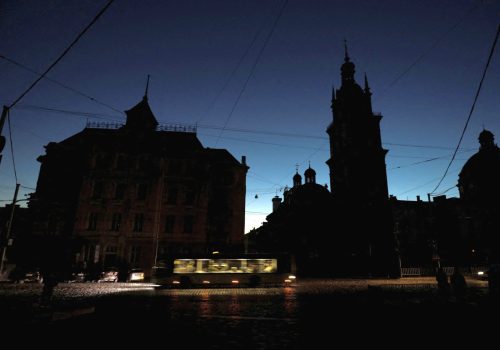
(Reuters) -Ukrainian President Volodymyr Zelenskiy appealed to the United Nations Security Council on Wednesday to take action to stop Russian air strikes targeting vital infrastructure that have once again plunged Ukrainian cities into darkness and cold as winter sets in.

?m=02&d=20221123&t=2&i=1615194614&r=LYNX

FILE PHOTO: Ukraine’s President Volodymyr Zelenskiy is seen on the screen as he speaks during the 68th Annual Session of the NATO Parliamentary Assembly in Madrid, Spain, November 21, 2022. REUTERS/Juan Medina/File Photo

Russia unleashed a missile barrage across Ukraine earlier in the day, forcing shutdowns of nuclear power plants and killing civilians in Kyiv.

“Today is just one day but we have received 70 missiles. That’s the Russian formula of terror,” Zelenskiy said via video link to the council chamber in New York, adding that hospitals, schools, transport infrastructure and residential areas had all been hit.

Ukraine is waiting to see “a very firm reaction” to Wednesday’s air strikes from the world, he added.

The council is unlikely to take any action in response to the appeal since Russia is a member with veto power.

Zelenskiy called for Russia to be denied a vote on any decision concerning its actions.

“We cannot be hostage to one international terrorist,” he said. “Russia is doing everything to make an energy generator a more powerful tool than the U.N. Charter.”

U.S. Ambassador to the U.N. Linda Thomas-Greenfield said Putin was “clearly weaponizing winter to inflict immense suffering on the Ukrainian people.”

The Russian president “will try to freeze the country into submission,” she added.

Russia’s U.N. ambassador Vasily Nebenzya was present at the meeting but did not immediately have an opportunity to respond.

Earlier, another Russian diplomat, Dmitry Polyansky, head of Russia’s permanent U.N. mission, said Zelenskiy’s appearance was a violation of the council’s procedural rules.

“Today the Ukrainians, frightened by our attacks on infrastructure, requested an urgent meeting of the U.N. Security Council,” Polyansky wrote on Telegram.

Categories
Audio Sources - Full Text Articles

North Korea cautions sanctions and pressure will fuel more hostility

2022-11-23T22:09:18Z

North Korea on Thursday denounced Seoul’s push to impose additional sanctions on Pyongyang following its repeated missile launches, saying such measures will add to the North’s “hostility and anger,” state media KCNA reported.

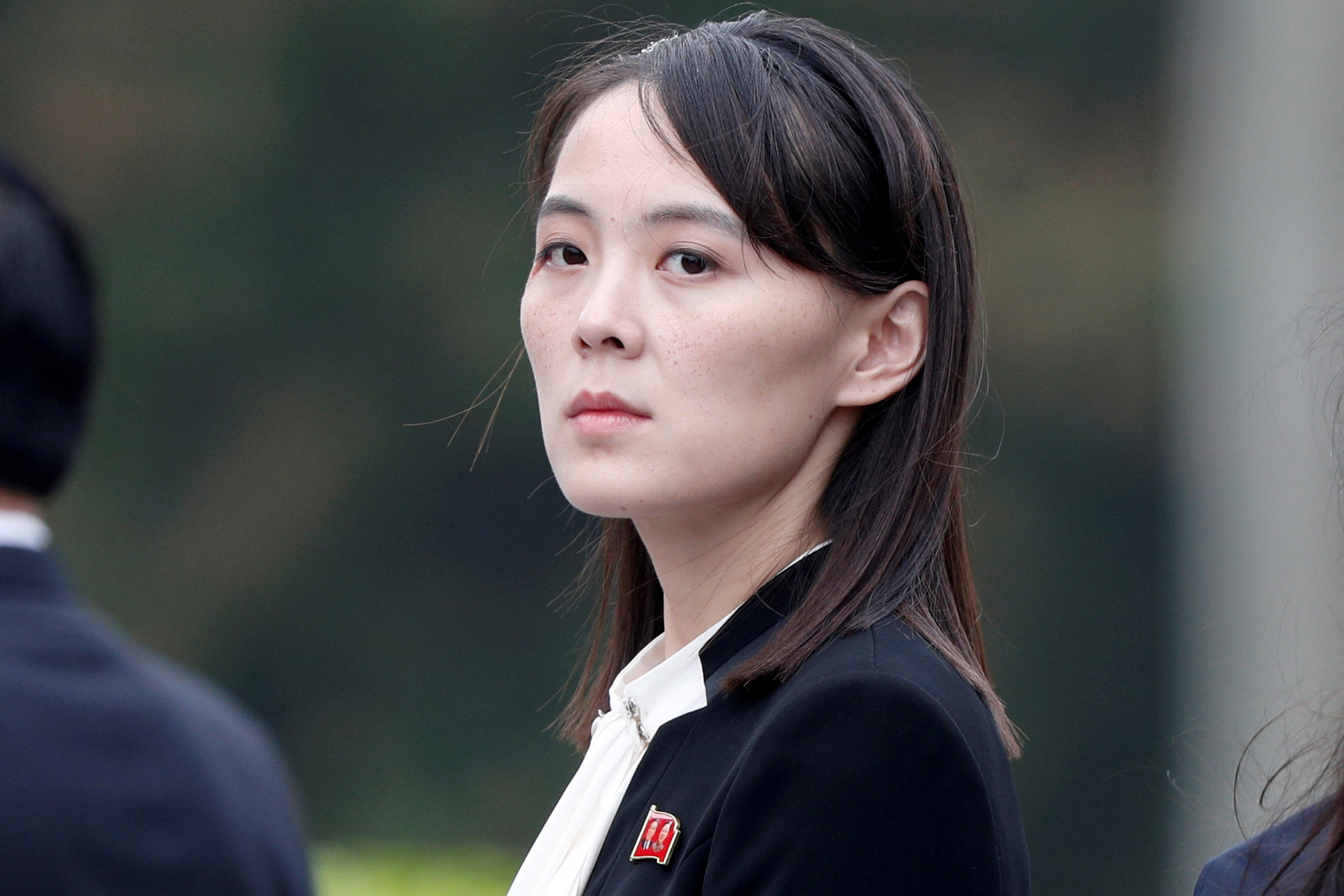
North Korean leader Kim Jong Un’s powerful sister, Kim Yo Jong, made the remarks in a statement carried by KCNA, calling South Korean President Yoon Suk-yeol “and other idiots” a “faithful dog” of the United States.

South Korea’s foreign ministry said on Tuesday it was reviewing independent sanctions on Pyongyang. It said sanctions on the cyber sector were among those considered in case the North pushes ahead with a nuclear test.

North Korea has conducted an unprecedented number of ballistic missile launches this year. For months Washington has said North Korea could conduct a nuclear bomb test, the first since 2017, at any time.

“If they think that they can escape from the present dangerous situation through ‘sanctions,’ they must be really idiots as they do not know how to live in peace and comfort,” Kim Yo Jong said in the statement.

The United States has urged the United Nations Security Council to hold North Korea accountable for its missile tests in one voice, accusing China and Russia of “emboldening” Pyongyang by blocking Security Council action.

China and Russia backed tighter sanctions following Pyongyang’s last nuclear test in 2017, but in May both vetoed a U.S.-led push for more U.N. penalties over its renewed missile launches.

“We warn the impudent and stupid once again that the desperate sanctions and pressure of the U.S. and its South Korean stooges against the DPRK will add fuel to the latter’s hostility and anger,” Kim Yo Jong said, using the initials of the North’s official name.

Related Galleries:

Kim Yo Jong, sister of North Korea’s leader Kim Jong Un attends wreath-laying ceremony at Ho Chi Minh Mausoleum in Hanoi, Vietnam March 2, 2019. REUTERS/Jorge Silva/Pool/File Photo

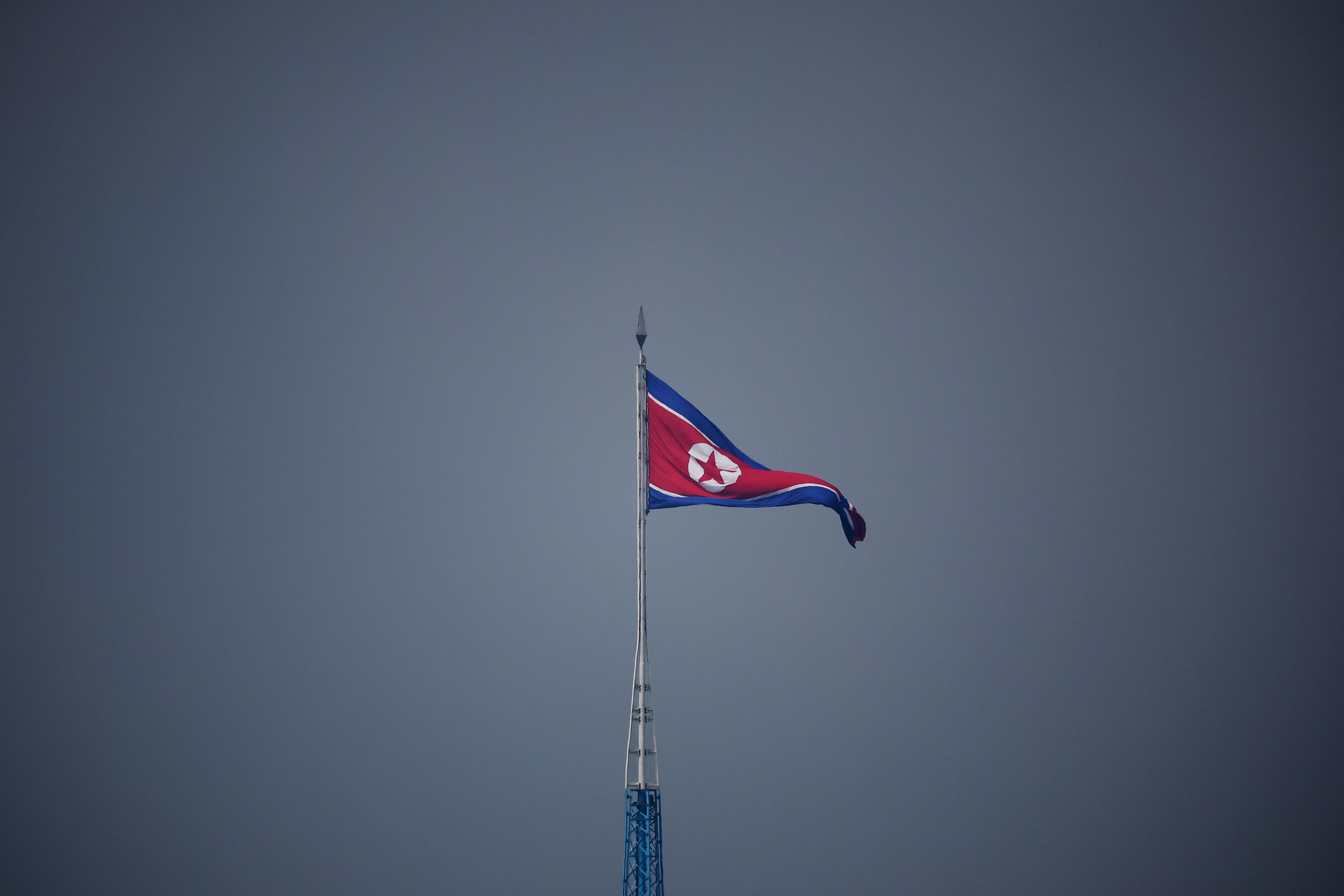
FILE PHHOTO: A North Korean flag flutters at the propaganda village of Gijungdong in North Korea, in this picture taken near the truce village of Panmunjom inside the demilitarized zone (DMZ) separating the two Koreas, South Korea, July 19, 2022. REUTERS/Kim Hong-Ji/Pool
Categories
Audio Sources - Full Text Articles

The EU mediation impotent to resolve dispute between Kosovo and Serbia

Tensions between Kosova and Serbia are unlikely to decrease. Calling for restraint on both sides, High Representative of the European Union Josep Borrell and EU Special Representative of Europe Miroslav Lajcak invited Kosova Prime Minister Kurti and Serbian President Vucic to an urgent meeting in Brussels. Looking of a quick agreement, after 8 hours of talks in the tripartite meeting, the EU’s special representatives failed to convince the parties to agree on the solution of the license plate issue. 

Although no agreement was reached after this meeting, the High Representative of the EU Borrell came out with a reprimanding statement for both parties, placing the blame more on Kosova. He harshly accused the Kosovar side, represented by Prime Minister Kurti, for the lack of respect for international legal obligations, while Kosova has rights to fully enforce its sovereignty and strengthening the rule of law in the north of the country. The EU request was that Kosova should not start issuing penalties and Serbia should not produce new license plates for Kosova Serbs. According to Borrell, Serbian President Aleksandar Vucic accepted the proposal given by the EU, but not the Prime Minister of Kosova, adding that for any tension, both parties will be held responsible.

On the other hand, Prime Minister Kurti stated that he had gone to talks for the final agreement according to the Franco-German plan supported by the EU and the USA, while he did not expect that there would be discussions about postponement of license plate deadlines. According to Kurti, during this meeting, Borrell gave up the previous deadline for an agreement before March 2023 and the EU’s proposal for the normalization of relations. During the urgent meeting held in Brussels, Kurti was practically negotiating in front of three officials whose countries do not recognize Kosova’s independence. Spain and Slovakia, where the EU mediators come from, do not recognize Kosova as a state, just like Serbia. 

Seeing that the meeting with the EU mediators was not productive for Kosova, meanwhile Serbia which maintains parallel structures in the territory of Kosova was favored by EU mediators, Kurti after this meeting, returned to implement the request of the USA, for a 48-hour postponement of second phase decision for license plate registration. All this in principle looks like a chess battle between Kurti and Vucic only, but in fact it is a failure of EU mediation because the situation actually is quite fragile and unstable, risking the expansion of the conflict.

On the other hand, Vucic is playing the victim and dedicated to peace while the European Union is accommodating him, and putting pressure on Kosova. Vucic is the only one who has not condemned the Russian invasion in Ukraine and execute Putin`s instructions to destabilize Western Balkans. By threatening to ignite conflict, if Kosova strengthens the law within its territory, by decision on license plates, Vucic is buying time to undermine Kosova statehood and the dialogue process, the consequences have already begun. Due to the situation in the north, the proposal for visa liberalization, which was said to be held today, has been removed from the agenda of today’s meeting of the ambassadors of the EU member states. Although the EU has always stated that visa liberalization and the dialogue process are two separate issues, in practice we have seen several times that these two processes are closely linked and if the agreement between Kosova and Serbia is not reached, visa liberalization for Kosova will be denied too.

Considering that dialogue issue is experiencing crises from time to time, and attempts to enforce its sovereignty in the north of Kosova are constantly failing, the license plate issue, in fact, would not be so problematic in a normal situation, but in this case it is used as a pretext by Serbia to cause tension. However, the USA is committed to finding a solution within the 48-hour period that would reduce tensions in the north of the country. Currently there cannot be a comprehensive agreement between the two countries to be applauded, but in the next few hours left, I think there will be a ‘compromise’ between both parties which would de-escalate current situation, in order to leave room to continue with the dialogue process, and this will only be done with the mediation of the USA, because the EU seems to have failed to offer neutrality in the dialogue process between Kosova and Serbia.

Categories
Audio Sources - Full Text Articles

Lessons from the Cuban Missile Crisis: Putin is no Khrushchev

Whether history rhymes or not, with war raging in Ukraine and Russian pundits threatening direct nuclear attacks against the US, perhaps some knowledge of the past may be helpful in assessing where this conflict is headed.

One could argue that we are now at a comparable moment to 1915, when World War I ground to a bloody stalemate. Alternatively, is this 1940 after Hitler overran Western Europe? Or have we now reached the modern equivalent of Midway and Stalingrad in 1942, when the course of World War II profoundly shifted in favor of the allies?

There is a better analogy. Sixty years ago, the US and Soviet Union faced off in the most dangerous superpower confrontation of the Cold War. But if the Cuban Missile Crisis is to be used as a comparison for the Ukraine war, it is crucial to dispel the myth that Soviet Leader Nikita Khrushchev provoked the crisis. In reality, US President John Kennedy did so by promising to close a so-called missile gap that was actually in America’s favor.

For decades, the myth has held that a courageous young US President forced a dangerous adversary to remove Soviet missiles from Cuba. But that rendition is tragically incomplete. Khrushchev was greatly reducing Soviet military spending well before Kennedy took office in 1961. In January 1960, Soviet reserve forces were cut by one million men. In January 1961, newly elected President Kennedy embarked on a massive nuclear and conventional military buildup. In April, the disastrous Bay of Pigs invasion of Cuba was launched. Each development disrupted Khrushchev’s plans.

Facing angry and alarmed generals, Khrushchev would attempt to outflank US strategic superiority at minimal cost by secretly installing short-range nuclear missiles in Cuba, targeting America’s east coast. But Khrushchev’s ploy failed on all counts. A naval “quarantine” was imposed on Cuba. Khrushchev relented and the Soviet Union began its massive rearmament.

Any comparisons with the current situation are not exact. Ukraine is not Cuba. Cuba was a Soviet ward, ninety miles off the Florida coast. Ukraine borders both Russia, its enemy, and NATO. NATO was not involved in the Cuban crisis but is engaged in Ukraine. Nor is Russia the USSR. Russia is a nuclear superpower. In 1962, the USSR was not. Similarly, Putin is not Khrushchev. Khrushchev had a Presidium that two years after Cuba would remove him, whereas Putin is not so constrained. To Khrushchev, Cuba was not existential. Putin may view Ukraine differently, especially after announcing the annexation of four partially occupied Ukrainian provinces.

Biden is not Kennedy. Kennedy’s response to Soviet missiles in Cuba reflected his failure to understand the real cause of the crisis. After forming a secret Executive Committee (EXCOM) of experts for advice, Kennedy disregarded Moscow’s first threatening hot line message. These were perhaps the two most important decisions of the crisis. He also made all the intelligence public at the UN. Biden did not form an EXCOM. Instead, his staff has conferred with outside experts on an ad hoc basis. Biden has been cautious and even self-deterring in rearming Ukraine to prevent escalation. He released intelligence exposing Russia’s invasion plans, which might have had the opposite effect of taunting Putin into attack.

Subscribe to UkraineAlert

As the world watches the Russian invasion of Ukraine unfold, UkraineAlert delivers the best Atlantic Council expert insight and analysis on Ukraine twice a week directly to your inbox.

2015-08-20T120000Z_1614809784_GF10000177

  • Name

    First

    Last

  • Email*
  • Email
    This field is for validation purposes and should be left unchanged.

What could this mean for Ukraine? First, the US, NATO, and Russia are currently deadlocked over how to end the crisis. The US refuses negotiations or a ceasefire without a complete Russian withdrawal from Ukraine and a commitment for reparations. Putin’s September 21 speech was regarded by Washington as an ultimatum implying nuclear weapons could be used. Biden could ignore that warning as Kennedy did. However, the annexation of four Ukrainian regions is a further indication of the gravity of the situation.

Second, Kennedy left Khrushchev a way out of the crisis, privately agreeing not to invade Cuba and to withdraw missiles from Turkey. Despite intense political pressure to condemn, punish, and hold Putin solely responsible for the invasion, especially from Ukraine that understandably wants all its territory back, some flexibility may be prudent if the war is to be ended.

Third, Kennedy tightly controlled all negotiations within the EXCOM. Biden has ceded to Ukrainian President Volodymyr Zelenskyy the right to decide where, when, and how negotiations will take place. Do NATO and the US want to allow a decision or error on Zelenskyy’s part to precipitate a wider war? One hopes not.

Fourth, are Biden and Putin repeating Kennedy’s and Khrushchev’s mutual misjudgments and misunderstandings? If yes, is that resolvable?

Fifth, the Soviet ambassador in Washington during the Cuban Missile Crisis, Anatoly Dobrynin, served as a critical, trusted intermediary. Who can be today’s Dobrynin, given that Biden has labeled Putin a “war criminal?” This is a good question with no answer.

The Cuban Missile Crisis was resolved in thirteen days. The Ukraine war is now entering its tenth month and seems to be stalemated. In 1962, Kennedy’s strategy resolved the crisis. Today’s strategy only serves to extend, not end, the war. What to do?

In light of these issues, the administration requires a new strategy. Observations from the Cuban Missile Crisis are instructive. Perhaps an EXCOM is needed. Misunderstandings and misjudgments are always present. An EXCOM may mitigate these dangers. Above all, a multi-pronged strategy that includes non-military means such as diplomacy and sanctions is needed to end the war on favorable terms and provide long-term security for Ukraine.

Admitting Ukraine to NATO is not currently realistic. Admission would violate NATO’s requirements for fixed borders and would also contradict common sense. Upon entry, Article 5 would be tested. An attack against one is an attack against all. Is NATO prepared for war against Russia? And frankly, Ukraine will not get the required unanimity for entry. Finland and Sweden so far have not.

The first and most important step is to give Ukraine more than only a defensive capability to protect itself. To deter future Russian aggression, Ukraine must have the capacity to retake lost territory. As in Cuba, diplomacy is also needed. Intermediaries could be China, India, France, Turkey, or the UN. India and China made interesting comments about Russia at September’s Shanghai Cooperation Organization meeting in Samarkand. And as in Cuba, there must be off-ramps for all parties.

A combined arms capability for Ukraine would require tanks, advanced tactical aviation, and missiles with the range to strike Russia, along with enhanced intelligence, training, and logistical support. Other NATO states should be providing similar support along with the US.

For the long term, perhaps a Taiwan Relations-like Act between the US and Ukraine could be signed. While not a defense treaty, the US would commit to ensuring Ukraine had sufficient capacity for self-defense. And as a quid pro quo, Ukraine would agree to deferring NATO membership for at least a decade.

Only the future will determine whether the crisis in Ukraine was more dangerous than Cuba in 1962. At the moment, given that the Cuban Missile Crisis was satisfactorily resolved and nuclear weapons were not verbally threatened, Ukraine would seem to be a far more volatile and risky scenario.

A coherent strategy is vital to avoid a Putin nuclear blitz. Sadly, based on the current path of hoping Ukraine will inflict sufficient casualties on the Russian army to force a negotiation, nothing can be ruled out. And that is not a place any sensible person wishes to be.

Dr. Harlan Ullman is a senior advisor at the Atlantic Council and the prime author of “shock and awe.” His latest book, The Fifth Horseman and the New MAD: How Massive Attacks of Disruption Became the Looming Existential Danger to a Divided Nation and the World at Large, provides the complete story of the Cuban Missile Crisis. The book is available on Amazon. He can be reached on Twitter @harlankullman. An abridged version of this article previously appeared on UPI.

Further reading

The views expressed in UkraineAlert are solely those of the authors and do not necessarily reflect the views of the Atlantic Council, its staff, or its supporters.

The Eurasia Center’s mission is to enhance transatlantic cooperation in promoting stability, democratic values and prosperity in Eurasia, from Eastern Europe and Turkey in the West to the Caucasus, Russia and Central Asia in the East.

Follow us on social media
and support our work

The post Lessons from the Cuban Missile Crisis: Putin is no Khrushchev appeared first on Atlantic Council.

Categories
Audio Sources - Full Text Articles

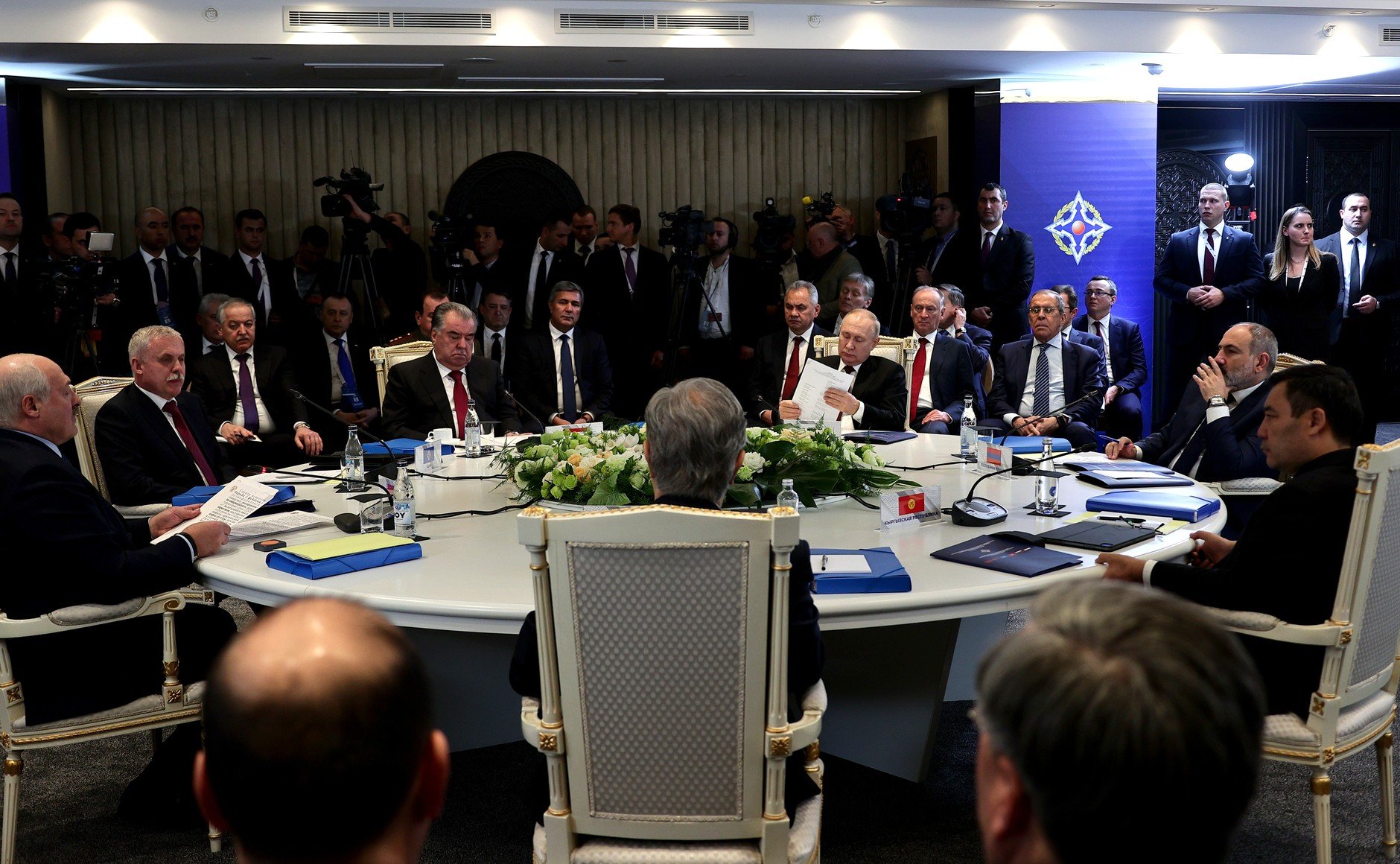
Саммит ОДКБ • Президент России kremlin.ru/events/preside…

Саммит ОДКБ • Президент России kremlin.ru/events/preside…

FiSA_R8XgAAEgnf.jpg:large

Categories
Audio Sources - Full Text Articles

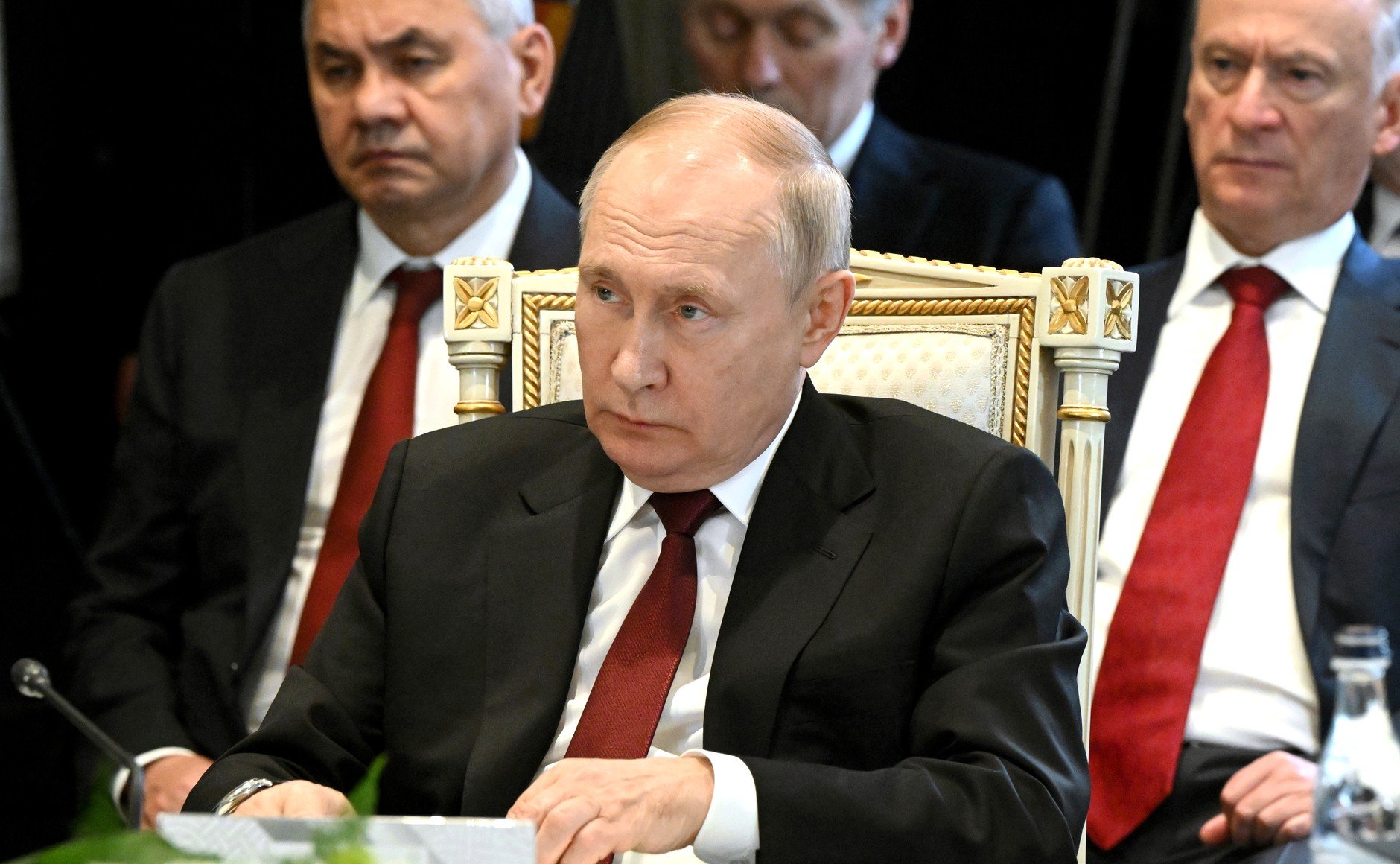
Саммит ОДКБ • Президент России kremlin.ru/events/preside…

Саммит ОДКБ • Президент России kremlin.ru/events/preside…

FiSAVQKWIAoMzmb.jpg:large

Categories
Audio Sources - Full Text Articles

Wednesday Reboots the Addams Family With a Biting Condemnation of Colonialism—Just in Time For Thanksgiving

In 1993’s Addams Family Values, Wednesday Addams (Christina Ricci) has been sent away to summer camp, and she is not happy about it. To make matters worse, the camp counselors have written a Thanksgiving-themed play in which they are forcing her to participate, cast as Pocahontas. Wednesday’s nemesis, the obnoxiously chipper Amanda Buckman (Mercedes McNab), stars as the “beautiful and kindly pilgrim lady” Sarah Miller, who has invited Pocahontas’ tribe to the supposed first Thanksgiving. At the last second, Wednesday breaks from the script.

“Wait,” she says, deadpan. “We cannot break bread with you.”

[time-brightcove not-tgx=”true”]

“You have taken the land which is rightfully ours,” she continues. “Years from now, my people will be forced to live in mobile homes on reservations. Your people will wear cardigans and drink highballs. We will sell our bracelets by the roadsides. You will play golf and enjoy hot hors d’oeuvres. My people will have pain and degradation. Your people will have stick shifts. The gods of my tribe have spoken. They have said, ‘Do not trust the pilgrims—especially Sarah Miller.’”

With that, she declares that she will scalp the pilgrims and destroy their village. All hell breaks loose as members of Pocahontas’ tribe of misfits run amok, setting the pilgrim village ablaze.

This iconic scene—seared into the cultural memory (of millennials, at least) although its stereotypes have aged poorly—epitomizes Wednesday Addams’ acerbic sense of justice. And it inspired Miles Milar and Al Gough, the showrunners behind Wednesday, the Netflix horror-comedy series starring Jenna Ortega which is out on Nov. 23. The show is the latest take on a family that first appeared in New Yorker cartoons in 1938, followed by the beloved ‘60s TV show and the ‘90s adaptations starring Ricci, Anjelica Huston, Raúl Julia, and Christopher Lloyd.

“People know her from that moment. So how do we extrapolate that?” says Milar, who along with Gough answered that question with a premise that involved colonial Americans as oppressors. “It felt very effortless to put her in a pilgrim idea. It was very organic to the Addams family.”

The Addams Family roots

No matter the time period in which they’re portrayed, members of the Addams family have always been viewed as outsiders. To their neighbors, they’re creepy and they’re kooky, they sound funny, they dress oddly, they eat strange foods: they’re a perfect allegory for immigrant families.

Milar and Gough decided to finally make this explicit after years of being implied. In the Netflix show, Wednesday’s newfound psychic visions introduce us to one of Gomez’s ancestors from Mexico, Goody Addams, who started a secret society to “protect outcasts from harm and bigotry.”

When Wednesday was in development, the idea of “outcasts” versus “normies” came even before that of critiquing colonialism. The concept of celebrating those rejected by society sprang directly from Charles Addams’ cartoons. “In some form, the Addams were always disruptors in a normal world,” says Gough. “The Charles Addams cartoons were a reaction to the ‘50s America: the white picket fence and the house. It’s a little subversive, but also pointing out that it’s also kind of bullsh-t.”

In Wednesday, says Milar, “It’s an allegory for racism and prejudice and all those things that we’re dealing with now. And I think that’s the interesting thing about genre shows: That you can—not in a sledgehammer way, but in a way that’s buried—talk about real issues that are affecting the modern world.”

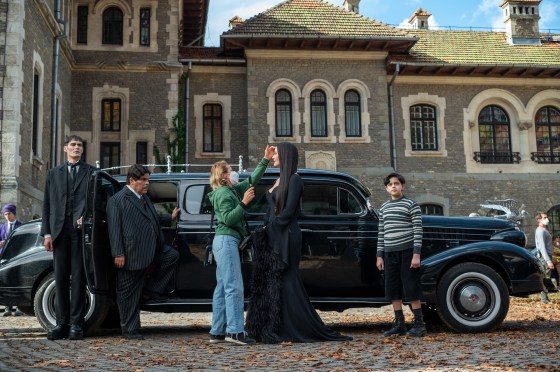
In a behind-the-scenes photo, a member of the hair and makeup team adjusts Catherine Zeta-Jones's look between scenes.
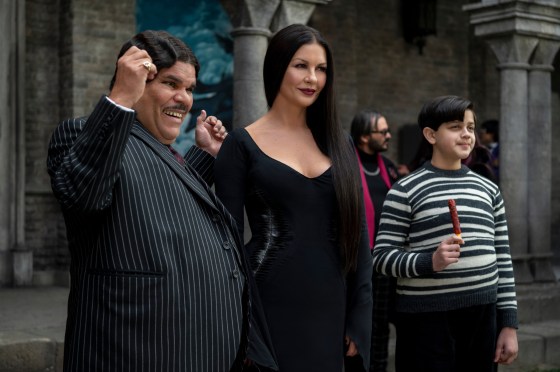
Vlad Cioplea—NetflixThe butler Lurch (George Burcea), Gomez (Luis Guzmán), Morticia (Catherine Zeta-Jones), and Pugsley (Issac Ordonez) visit Nevermore Academy for Parents’ Weekend.

Outcasts and immigrants

One of the issues that Wednesday addresses—which pairs well with its critique of colonialism—is immigrant identity. In the 1991 film The Addams Family and its 1993 sequel Addams Family Values, Puerto Rican actor Raúl Julia played Gomez Addams, Wednesday’s father. Since then, some have viewed the Addams family as canonically Latino—a view affirmed by Wednesday’s casting of Puerto Rican actor Luis Guzmán as Gomez and Mexican and Puerto Rican actor Jenna Ortega as Wednesday.

“Wednesday is technically a Latina character, and that’s never been represented,” Ortega said in a behind-the-scenes video. “Any time that I have an opportunity to represent my community, I want that to be seen.”

Milar says that while they considered many actors for the lead role, they always hoped to cast a Latina actor. “That was always our goal. We wanted to make sure we didn’t leave any stone unturned. And obviously Jenna was Latina, but also she was the best actress, by far, for the role.”

In the first episode of Wednesday, a mournful rendition of La Llorona plays on the gramophone in Wednesday’s dorm room as she clacks away on her typewriter. When the Addams come to visit for Parents’ Weekend, Wednesday’s younger brother Pugsley (Isaac Ordonez) sucks on a tamarind candy. “It’s not hammered over the head, but there are moments,” says Milar. “The choices of music she plays and food. It’s subtly laid in that she is also American; she’s the daughter of immigrants. Because Gomez grew up in Mexico.”

Gomez, Morticia, and Pugsley look on at Parent's Weekend. Gomez has both fists in the air, cheering.
Vlad Cioplea—NetflixPugsley Addams (Issac Ordonez) sucks on a tamarind stick candy at Parents’ Weekend.

An Addams Family Thanksgiving

The show’s release date set for late November rather than October may have surprised some, given the gothic family’s longtime association with Halloween. But the Addams family also holds a strong connection to both anti-colonialism and Thanksgiving, at least since the 1993 movie.

Wednesday’s pilgrim storyline flashes back in time to a fictional settler named Joseph Crackstone who founded Jericho, the Vermont town where much of the show unfolds, in the early 1600s. Jericho sits adjacent to Nevermore Academy, the school that Wednesday attends alongside werewolves and vampires. And Pilgrim World, a modern living-history museum that offers daily witch trials, describes Crackstone, much like Sarah Miller, as “beloved and pious.”

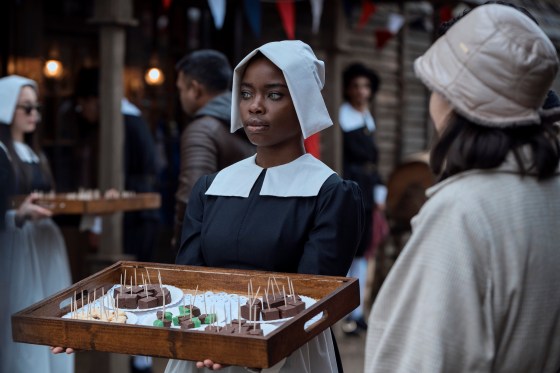
On Outreach Day—intended to improve relations between Nevermore “outcasts” and Jericho “normies”—Wednesday is forced to volunteer with her classmates serving free fudge samples at Pilgrim World.

Bianca Barclay (Joy Sunday), wearing a black and white pilgrim outfit, holds out a wooden tray of fudge samples with toothpicks in them.
Vlad Cioplea—NetflixBianca Barclay (Joy Sunday), a siren student at Nevermore, offers free fudge samples at Pilgrim World as part of Outreach Day.

“Enjoy your ‘authentic’ pilgrim fudge made with cacao beans procured by the oppressed Indigenous people of the Amazon,” she tells a group of tourists in fluent German. “All proceeds go to uphold this pathetic whitewashing of American history. Also, fudge wasn’t invented for another 258 years. Any takers?”

“Our first idea was that Thanksgiving was a time the pilgrims invited the outcasts and then murdered them,” says Gough. “That just felt like a very Addams family kind of approach. So that’s something that was very much in the DNA—and then obviously plays through the whole mystery of the show.”

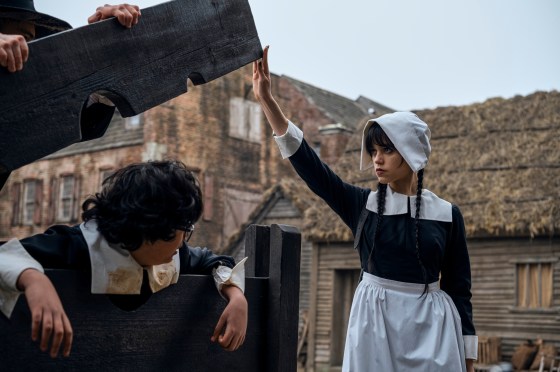
Joseph Crackstone, as Wednesday soon discovers, swore to persecute all outcasts. In true fire-and-brimstone style, he rounded up the oppressed of the settlement—from those accused of witchcraft to immigrants, including an Addams family ancestor—shackled them to the floor of a barn, and lit the whole thing on fire. In the present day, Wednesday retaliates by burning down a new memorial statue of Crackstone—freshly dedicated on Outreach Day—in the town square.

Wednesday lifts the top part of the stocks off of Eugene's head, freeing him to escape. Eugene's clothes are covered in fudge.
Vlad Cioplea—NetflixWednesday frees Eugene (Moosa Mostafa) from the stocks at Pilgrim World, where he was trapped by bullies.

Gough grew up in southern Maryland, where there was an early settlement, not unlike Pilgrim World. He visited colonial Williamsburg as a kid. Tim Burton, who co-created and co-directed the series, went to similar attractions in Massachusetts and New England when he was researching 1999’s Sleepy Hollow.

“It was something that was always fascinating to see, but then once you learn the real history, you realize, ‘Oh, OK, it’s being told from a certain point of view,’” says Gough. “We wanted to disrupt that point of view and have Wednesday be a key point.”

TV shows about dysfunctional families abound: Succession, Arrested Development, Yellowstone, Game of Thrones, Empire. Few fictional families, though, are functional—and even fewer love each other fiercely for their differences.

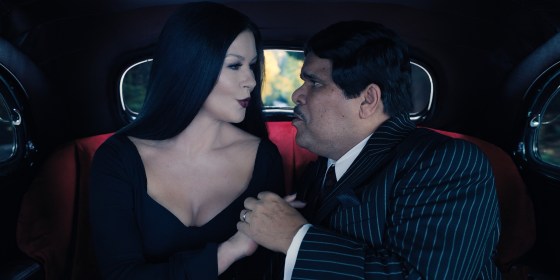
Morticia and Gomez clasp hands and lock eyes in the backseat. They look like they're about to kiss.
Courtesy of NetflixMorticia (Catherine Zeta-Jones) and Gomez (Luis Guzmán) share a moment in the family car.

“Especially when you’re going into the holidays—when people have to get together and that’s always so stressful—there’s divisions for whatever reasons,” says Gough. “I think people ultimately wish, ‘Oh, I wish we could go to Thanksgiving and all just get along and celebrate our differences and be empathetic to them.’”

Enter: the Addams family. Created as the ultimate outsiders, Wednesday, her brother Pugsley, and their parents Morticia and Gomez are, in fact, timeless and aspirational in their closeness.

“We wanted to lean into that part of the Addams family,” says Gough of the immigrant identity. “A lot of it people had assumed, but it hadn’t really been explored. And the beauty of an eight-hour show is that you get to explore.”

WP Radio
WP Radio
OFFLINE LIVE