Categories
Audio Sources - Full Text Articles

North Korea rebuked as allied countries hold emergency meeting over missile launch

2022-11-18T10:36:49Z

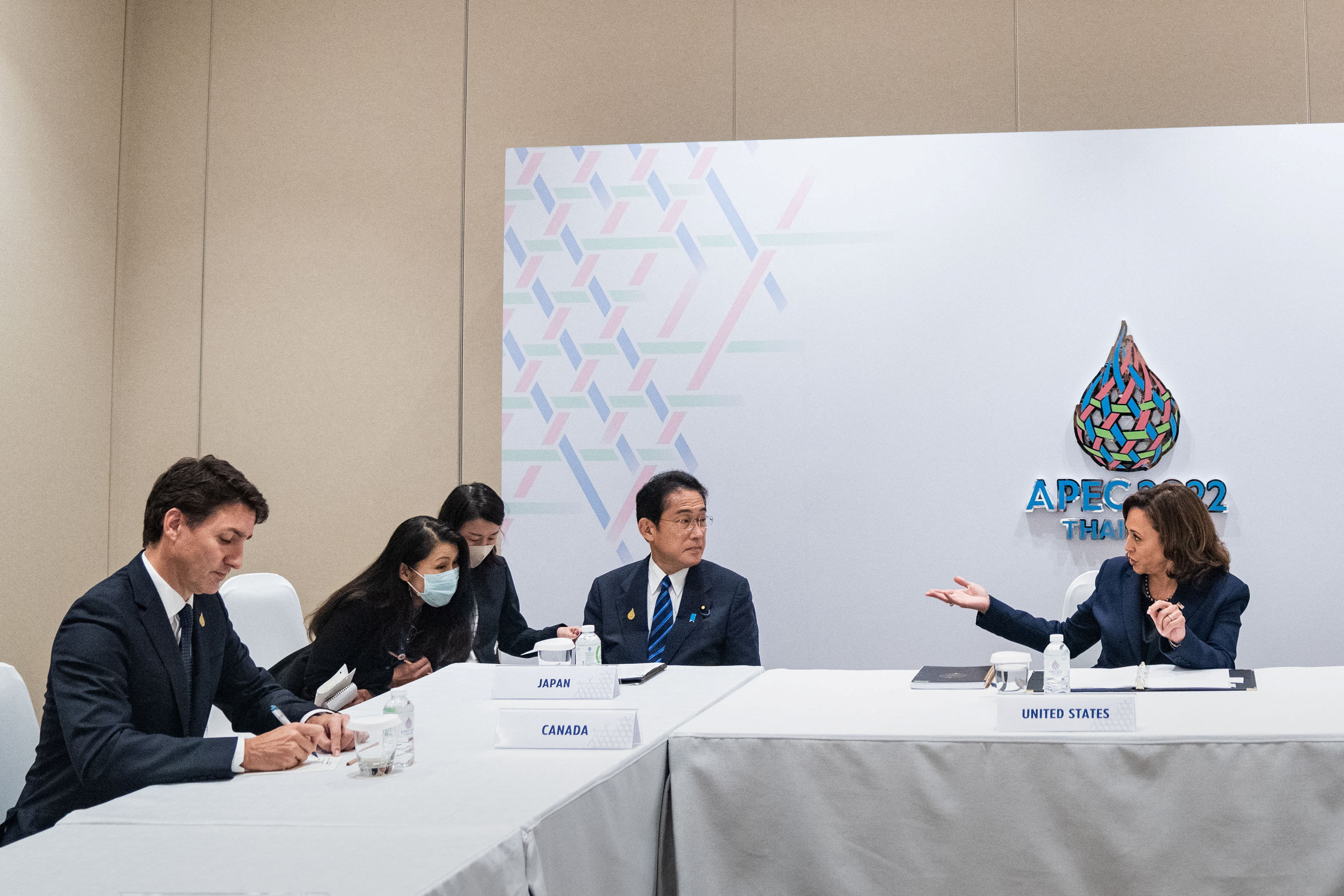
U.S. Vice President Kamala Harris, right, holds a meeting with Prime Minister Fumio Kishida of Japan, middle, Prime Minister Han Duck-soo of the Republic of Korea, Prime Minister Anthony Albanese of Australia, Prime Minister Jacinda Ardern of New Zealand, and Prime Minister Justin Trudeau of Canada, left, to consult North Korea’s recent ballistic missile launch at the Asia-Pacific Economic Cooperation (APEC) summit in Bangkok, Thailand, on Friday, Nov. 18, 2022. Haiyun Jiang/Pool via REUTERS

Leaders of the United States, South Korea, Japan and allied countries convened an emergency meeting during an Asian summit on Friday and condemned North Korea’s firing of a suspected intercontinental ballistic missile, calling for a united response.

The missile, which landed just 200 kilometres (130 miles) off Japan, was capable of reaching the mainland United States, Japanese officials said.

Meeting on the sidelines of the Asia-Pacific Economic Cooperation (APEC) meeting in Bangkok, U.S. Vice President Kamala Harris called the launch a “brazen violation” of multiple U.N. resolutions and said North Korea’s actions were destablising for security in the region.

South Korean Prime Minister Han Duck-soo said the North’s activities were illegal and “will never be tolerated”, calling for a united front and a resolute response.

Japanese Prime Minister Fumio Kishida said such launches were occurring with “unprecedented high frequency” lately.

“There is the possibly that North Korea will launch further missiles,” he warned.

The incident came a day after a smaller missile launch by the North and its warning of “fiercer military responses” to the U.S. boosting its regional security presence.

Canadian Prime Minister Justin Trudeau said North Korea’s move needed to be condemned “by all regions around the world”, while Australian counterpart Anthony Albanese said the missile launches were “reckless actions”.

“We stand with the world, and indeed with our allies, in opposing and condemning this action in the strongest possible terms,” Albanese said.

“And we stand ready to be part of a global response to this.”

New Zealand leader Jacinda Ardern said she acknowledged the “anxiety, the deep concern, the security threat” felt in Japan and South Korea.

Categories
Audio Sources - Full Text Articles

Scientists try to bolster Great Barrier Reef in warmer world

KONOMIE ISLAND, Australia (AP) — Below the turquoise waters off the coast of Australia is one of the world’s natural wonders, an underwater rainbow jungle teeming with life that scientists say is showing some of the clearest signs yet of climate change.

The Great Barrier Reef, battered but not broken by climate change impacts, is inspiring hope and worry alike as researchers race to understand how it can survive a warming world. Authorities are trying to buy the reef time by combining ancient knowledge with new technology. They are studying coral reproduction in hopes to accelerate regrowth and adapt it to handle hotter and rougher seas.

Underwater heat waves and cyclones driven in part by runaway greenhouse gas emissions have devastated some of the 3,000 coral reefs making up the Great Barrier Reef. Pollution fouls its waters, and outbreaks of crown of thorns starfish have ravaged its corals.

Researchers say climate change is already challenging the vibrant marine superstructure and all that depend upon it — and that more destruction is to come.

“This is a clear climate change signal. It’s going to happen again and again,” said Anne Hoggett, director of the Lizard Island Research Station, on the continuing damage to the reef from stronger storms and marine heat waves. “It’s going to be a rollercoaster.”

Billions of microscopic animals called polyps have built this breathtaking 1,400-mile long colossus that is visible from space and perhaps a million years old. It is home to thousands of known plant and animal species and boasts a $6.4 billion annual tourism industry.

“The corals are the engineers. They build shelter and food for countless animals,” said Mike Emslie, head of the Long-Term Monitoring Program of the reef at the Australian Institute for Marine Science.

Emslie’s team have seen disasters get bigger, and hit more and more frequently over 37 years of underwater surveys.

Heat waves in recent years drove corals to expel countless tiny organisms that power the reefs through photosynthesis, causing branches to lose their color or “bleach.” Without these algae, corals don’t grow, can become brittle, and provide less for the nearly 9,000 reef-dependent species. Cyclones in the past dozen years smashed acres of corals. Each of these were historic catastrophes in their own right, but without time to recover between events, the reef couldn’t regrow.

In the last heat wave however, Emslie’s team at AIMS noticed new corals sprouting up faster than expected.

“The reef is not dead,” he said. “It is an amazing, beautiful, complex, and remarkable system that has the ability to recover if it gets a chance – and the best way we can give it a chance is by cutting carbon emissions.”

The first step in the government’s reef restoration plan is to understand better the enigmatic life cycle of the coral itself.

For that, dozens of Australian researchers take to the seas across the reef when conditions are ripe for reproduction in a spawning event that is the only time each year when coral polyps naturally reproduce as winter warms into spring.

But scientists say that is too slow if corals are to survive global warming. So they don scuba gear to gather coral eggs and sperm during the spawning. Back in labs, they test ways to speed up corals’ reproductive cycle and boost genes that survive higher temperatures.

One such lab, a ferry retrofitted into a “sci-barge”, floats off the coast of Konomie Island, also known as North Keppel Island, a two-hour boat ride from the mainland in Queensland state.

One recent blustery afternoon, Carly Randall, who heads the AIMS coral restoration program, stood amidst buckets filled with coral specimens and experimental coral-planting technologies. She said the long-term plan is to grow “tens to hundreds of millions” of baby corals every year and plant them across the reef.

Randall compared it to tree-planting with drones but underwater.

Her colleagues at AIMS have successfully bred corals in a lab off-season, a crucial first step in being able to at scale introduce genetic adaptions like heat-resistance.

Engineers are designing robots to fit in a mothership that would deploy underwater drones. Those drones would attach genetically-selected corals to the reef with boomerang-shaped clips. Corals in specific targets will enhance the reef’s “natural recovery processes” which would eventually “overtake the work that we’ve been doing to keep it going through climate change,” she said.

Australia has recently been slammed by historic wildfires, floods, and cyclones exacerbated by climate instability.

That has driven a political shift in the country as voters have grown more concerned with climate change, helping sweep in new national leadership in this year’s federal elections, said Bill Hare, CEO of Climate Analytics.

The nation’s previous prime minister, Scott Morrison, was a conservative who was chided for minimizing the need to address climate change.

The new center-left government of Anthony Albanese passed legislation to reach net zero carbon emissions by 2050 and includes 43% green house gas reductions by 2030. Australia is one of the world’s largest exporters of coal and liquefied natural gas, and lags behind major industrial countries’ emission targets.

The new government has blocked a coal plant from being opened near the Great Barrier Reef, yet recently allowed other coal plants new permits.

It is also continuing investment to boost the reef’s natural ability to adapt to rapidly warming climate.

The Italy-sized reef is managed like a national park by the Great Barrier Reef Marine Park Authority.

GBRMPA chief scientist David Wachenfeld said that “despite recent impacts from climate change, the Great Barrier Reef is still a vast, diverse, beautiful and resilient ecosystem.”

However, that is today, in a world warmed about 1.1 degrees Celsius (2 degrees Fahrenheit).

“As we approach two degrees (Celsius) and certainly as we pass it, we will lose the world’s coral reefs and all the benefits that they give to humanity,” Wachenfeld said. He added that as home to over 30% of marine biodiversity, coral reefs are essential for the livelihoods of hundreds of millions of people all over the tropics.

The reef is “part of the national identity of Australians and of enormous spiritual and cultural significance for our First Nations people,” Wachenfeld said.

After long mistreatment and neglect by the federal government, Indigenous groups now have a growing role in management of the reef. The government seeks their permission for projects there and hires from the communities to study and repair it.

Multiple members of the Yirrganydji and Gunggandji communities work as guides, sea rangers and researchers on reef protection and restoration projects.

After scuba diving through turquoise waters teeming with fish and vibrant corals, Tarquin Singleton said his people hold memories more than 60,000 years old of this “sea country” — including previous climatic changes.

“That connection is ingrained in our DNA,” said Singleton, who is from the Yirrganydji people native to the area around Cairns. He now works as a cultural officer with Reef Cooperative, a joint venture of tourism agencies, the government and Indigenous groups.

“Utilizing that today can actually preserve what we have for future generations.”

The Woppaburra people native to Konomie and Woppa islands barely survived Australian colonization. Now they’re forging a new kind of unity “in a way that wouldn’t happen normally” by sharing ancient oral histories and working on research vessels, said Bob Muir, an Indigenous elder working as a community liaison with AIMS.

For now, reef-wide farming and planting corals is plausible science fiction. It’s too expensive now to scale up to levels needed to “buy the reef time” as humanity cuts emissions, Randall said.

But she said that within 10 to 15 years the drones could be in the water.

But Randall warns that robots, coral farms and skilled divers “will absolutely not work if we don’t get emissions under control.”

“This is one of many tools in the toolkit being developed,” she said. “But unless we can get emissions under control, we don’t have much hope for the reef ecosystem.”

___

Follow AP’s climate and environment coverage at https://apnews.com/hub/climate-and-environment and Sam McNeil on Twitter @stmcneil

___

Associated Press climate and environmental coverage receives support from several private foundations. See more about AP’s climate initiative here. The AP is solely responsible for all content.

Categories
Audio Sources - Full Text Articles

What did Nancy Pelosi represent in US politics? | Moira Donegan

To Republicans, Pelosi has long taken on a kind of mythic malice. But progressives, too, were not enamored of her

As the new House Republican majority stumbles into power, with all the chaotic, embittered bumbling of a rich man’s son who can only seem to fail upwards, another, peculiar kind of political transition is taking place: Nancy Pelosi, 82, is leaving the House speakership, almost certainly for the last time.

Perhaps no individual has come to symbolize the Democrats more to the people who do not like the party. To Republicans, Pelosi has long taken on a kind of mythic malice. To the Fox-watching white male, Pelosi symbolizes liberal elitism, a vague but totalizing specter of corruption, and that particular kind of liberal decadence that can be evoked by the name of the city that makes up nearly all of her longtime congressional district: San Francisco. She’s a woman in power, and she’s long been supportive of gay rights, and she opposed the Iraq war. She’s been a reliable opponent of conservatives’ favorite culture war crusades: she supports gun control and opposes Confederate statues. In an association facilitated by misogyny, her very face is a shorthand for liberal extremism, a visual code that denotes secularism, taxation and frightening new pronouns.

Continue reading…

Categories
Audio Sources - Full Text Articles

Scheduled rolling blackouts to be introduced across Ukraine Friday, emergency shutdowns possible

630_360_1456760162-5290.jpg

Beforehand authorised schedules of hourly ability outages will be used in the course of Ukraine on November 18. Also, additional unexpected emergency shutdowns could be introduced if required.

That is according to Ukraine’s energy program operator Ukrenergo, Ukrinform reports.

“Because of to the sharp cooling of temperatures, electric power use is escalating every single day in Ukraine’s locations wherever electrical energy source has currently been restored immediately after substantial missile strikes on the electrical power infrastructure on November 15. This complicates the presently challenging circumstance in the power process,” the report reads.

Go through also: Russia attacks power amenities run by DTEK 13 occasions in excess of previous 1.5 months

It is mentioned that electricity firms are compelled to use restrictions. This is a important evaluate to protect the steadiness of the power method pursuing Russia’s sixth qualified missile assault on strength infrastructure services. Repair service crews are doing the job all-around the clock to restore weakened infrastructure in purchase to bring electrical power back again to Ukrainian properties.

Source link

The post Scheduled rolling blackouts to be introduced across Ukraine Friday, emergency shutdowns possible appeared first on Ukraine Intelligence.

Categories
Audio Sources - Full Text Articles

Russia Says “Fortifying” Annexed Crimean Peninsula

000_32ew2ud.jpg

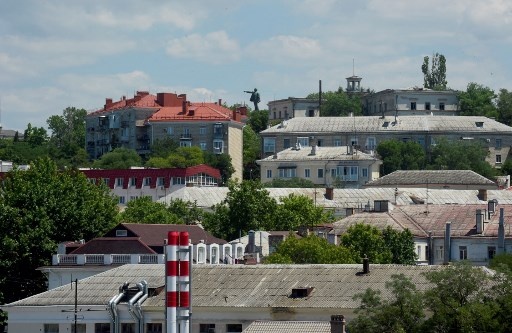
Russia said on Friday it was strengthening positions on the Crimean peninsula, annexed from Ukraine in 2014, as Kyiv’s forces reclaim territory in the neighbouring Kherson region.

“Fortification work is being carried out on the territory of Crimea under my control with the aim of guaranteeing the security of all Crimeans,” the Moscow-appointed governor of the region, Sergei Aksyonov, said on social media.

Russia annexed Crimea in the wake of nationwide pro-democracy demonstrations that led to the ouster of Ukraine’s former Kremlin-friendly president.

It was used as a launching pad in February for what the Kremlin calls its “special military operation” in Ukraine.

Aksyonov said that the fortification work was being carried out even though the military and law enforcement were already taking measures.

Ukraine forces in recent months have been pushing a counter-offensive in the south of the country and last week reclaimed Kherson, the capital of the Ukrainian region bordering Crimea.

Russia claimed to have also annexed that region along with three more in September, vowing to defend them with all available military means.

Ukraine President Volodymyr Zelensky has said his forces intend to recapture the peninsula, too.

There have been several explosions at or near Russian military installations in Crimea since February, including a coordinated drone attack on a key Russian naval port at Sevastopol.

In October, the Kerch bridge connecting the peninsula to the Russian mainland was partially destroyed in an attack attributed to Ukraine by Moscow.

The post Russia Says “Fortifying” Annexed Crimean Peninsula appeared first on Kyiv Post.

Categories
Audio Sources - Full Text Articles

APEC summit disrupted by North Korean ICBM test

2022-11-18T09:55:18Z

Several Asia-Pacific leaders gathered for an economic summit in the Thai capital broke away from their meeting on Friday to condemn North Korea after it test fired an intercontinental ballistic missile.

Separately, police fired rubber bullets to disperse anti-government protesters in Bangkok as the host of the Asia-Pacific Economic Cooperation (APEC) summit, Thai Prime Minister Prayuth Chan-ocha, was opening the conference.

U.S. Vice President Kamala Harris called an emergency gathering of leaders from Australia, Japan, South Korea, Canada and New Zealand on the sidelines of the summit after North Korea carried out the missile test just an hour before its inauguration.

“This conduct by North Korea most recently is a brazen violation of multiple U.N. Security Council resolutions,” she said at the meeting. “It destabilises security in the region, and unnecessarily raises tensions.

Thailand’s Prayuth earlier urged participants at the summit to seek sustainable growth and development after economic and social challenges from COVID, climate change and geopolitical rivalries.

“We can no longer live like we did. We need to adjust our perspective, ways of life and ways of doing business,” he said to an audience that included Harris and China’s President Xi Jinping.

Established to promote economic integration, APEC groups 21 economies that account for 38% of the global population, and 62% of gross domestic product and 48% of trade.

Prayuth did not refer to North Korea’s missile, which Japanese officials said landed just 200 km (130 miles) off Japan and had sufficient range to reach the mainland of the United States.

Japanese Prime Minister Fumio Kishida, who is in Bangkok for the APEC meeting, told reporters that North Korea had “repeated its provocations with unprecedented frequency”.

The APEC gathering is the third summit in the region in the past week. A Southeast Asian summit that included China, Japan and the United States was held in Cambodia while the Group of 20 (G20) nations met on the Indonesian island of Bali.

The earlier meetings were dominated by the war in Ukraine as well as tensions over Taiwan and the Korean peninsula.

Campaigners are keen to see leaders address food insecurity, surging inflation, climate change and human rights.

A reminder of grassroots demands came as Thai pro-democracy protesters clashed with police about 10 km (6 miles) from the central Bangkok summit venue.

Videos on social media showed protesters trying to overturn a police car, throwing projectiles and charging at police, while officers in riot gear advanced on them with shields and beat them back with batons.

An official in charge of security for the summit said police fired rubber bullets to disperse about 350 anti-government protesters. Police said they arrested 10 people.

French President Emmanuel Macron, a special guest at the summit, urged APEC leaders to re-embrace international rules and multilateralism for global peace and stability.

The Russian war in Ukraine was “an aggression against international rules”, he said, and countries should pursue inclusive, sustainable development to address inequality and instability.

“We have to reform the DNA of our economies. All have accepted capitalism and trade but we have to make it more inclusive and sustainable,” he said.

At the G20 meeting in Indonesia, countries unanimously adopted a declaration saying most members condemned the Ukraine war, but that also acknowledged some countries saw the conflict differently.

Russia is a member of both G20 and APEC but President Vladimir Putin has stayed away from the summits. First Deputy Prime Minister Andrei Belousov is representing him at APEC.

Xi, warning against Cold War tensions in a region that is a focus for competition between Beijing and Washington, said on Thursday the Asia-Pacific was no one’s backyard and should not become an arena of big power rivalry,

“No attempt to wage a new cold war will ever be allowed by the people or by our times,” Xi said in remarks at a business event linked to the summit.

Relations between the world’s two largest economies have been strained in recent years over issues like tariffs, Taiwan, intellectual property, the erosion of Hong Kong’s autonomy and disputes over the South China Sea.

In a move likely to be seen by China as provocative, a U.S. official said Harris would visit the Philippine islands of Palawan on the edge of the disputed South China Sea on Tuesday.

The trip will make Harris the highest-ranking U.S. official to visit the island chain adjacent to the Spratly Islands. China has dredged the sea floor to build harbours and airstrips on the Spratlys, parts of which are also claimed by Brunei, Malaysia, the Philippines, Taiwan and Vietnam.

Related Galleries:
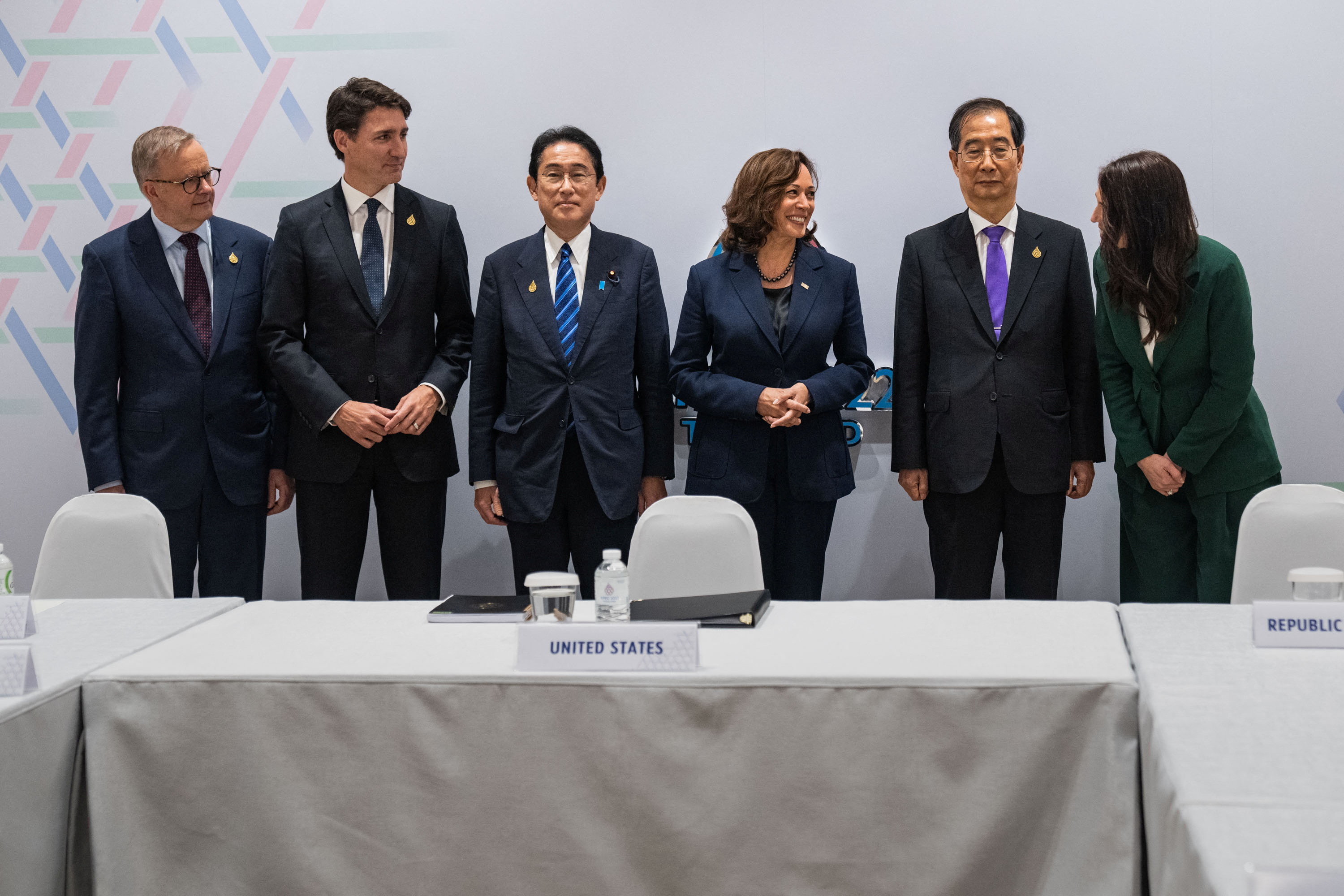
U.S. Vice President Kamala Harris, third to the right, holds a meeting with Prime Minister Fumio Kishida of Japan, third to the left, Prime Minister Han Duck-soo of the Republic of Korea, second to the right, Prime Minister Anthony Albanese of Australia, left, Prime Minister Jacinda Ardern of New Zealand, right, and Prime Minister Justin Trudeau of Canada, second to the left, to consult North Korea’s recent ballistic missile launch at the Asia-Pacific Economic Cooperation (APEC) summit in Bangkok, Thailand, on Friday, Nov. 18, 2022. Haiyun Jiang/Pool via REUTERS
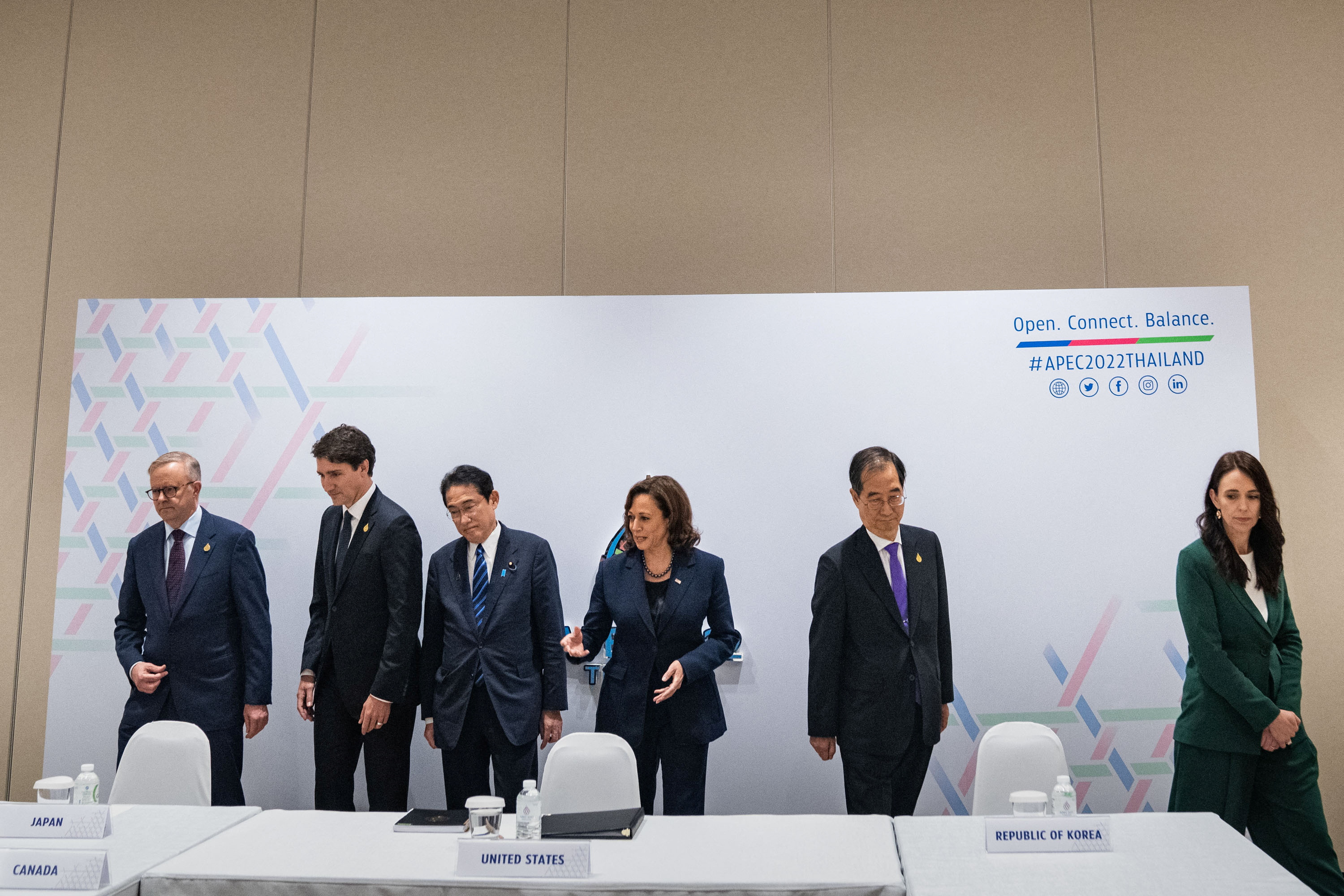
U.S. Vice President Kamala Harris, third to the right, holds a meeting with Prime Minister Fumio Kishida of Japan, third to the left, Prime Minister Han Duck-soo of the Republic of Korea, second to the right, Prime Minister Anthony Albanese of Australia, left, Prime Minister Jacinda Ardern of New Zealand, right, and Prime Minister Justin Trudeau of Canada, second to the left, to consult North Korea’s recent ballistic missile launch at the Asia-Pacific Economic Cooperation (APEC) summit in Bangkok, Thailand, on Friday, Nov. 18, 2022. Haiyun Jiang/Pool via REUTERS

U.S. Vice President Kamala Harris, middle, holds a meeting with Prime Minister Fumio Kishida of Japan, left, Prime Minister Han Duck-soo of the Republic of Korea, right, Prime Minister Anthony Albanese of Australia, Prime Minister Jacinda Ardern of New Zealand, and Prime Minister Justin Trudeau of Canada, to consult North Korea’s recent ballistic missile launch at the Asia-Pacific Economic Cooperation (APEC) summit in Bangkok, Thailand, on Friday, Nov. 18, 2022. Haiyun Jiang/Pool via REUTERS
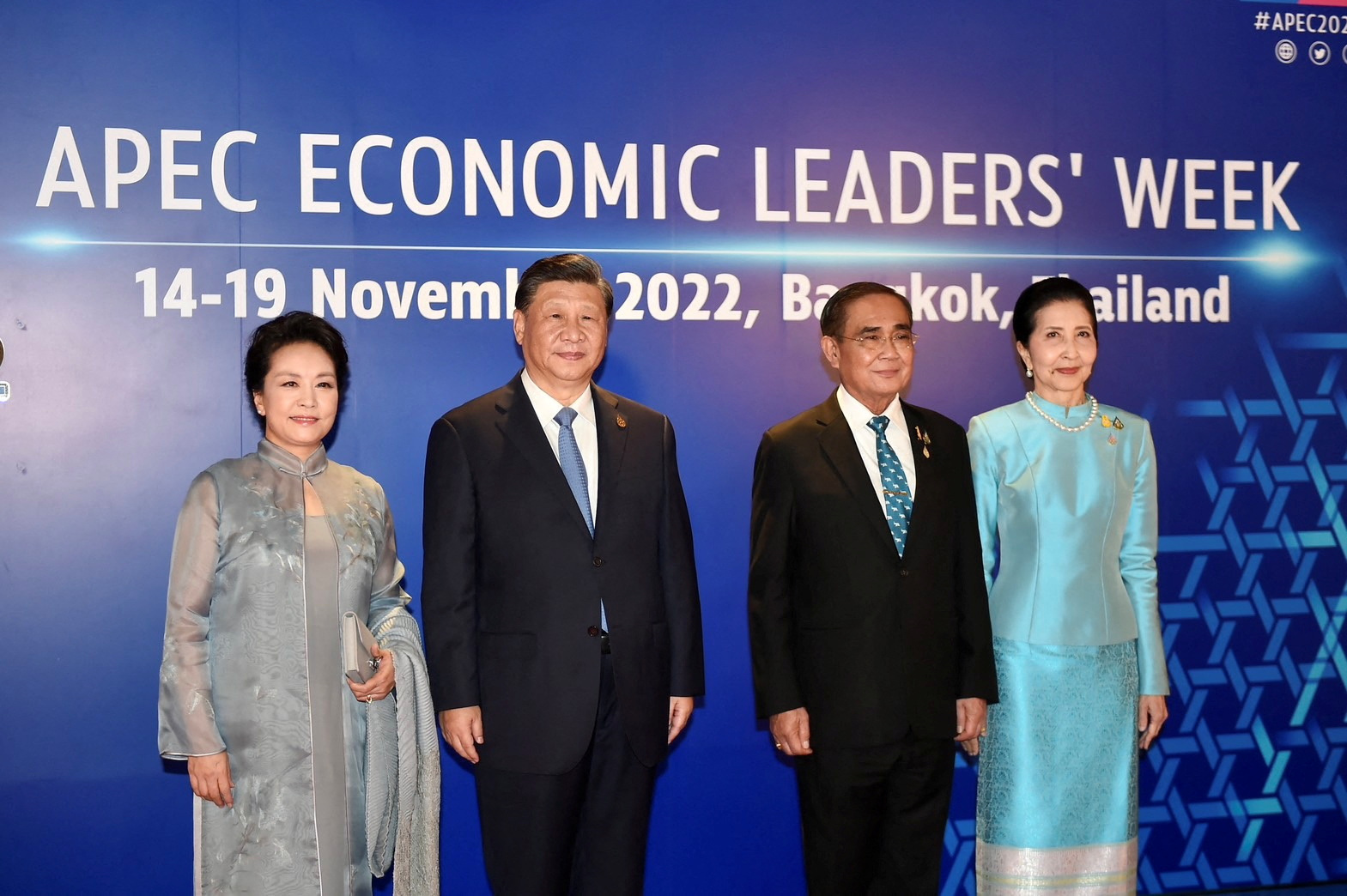
Thailand’s Prime Minister Prayuth Chan-ocha, wife Naraporn Chao-ocha, China’s President Xi Jinping and wife Peng Liyuan attend the Gala dinner of the APEC Summit 2022, in Bangkok, Thailand, November 17, 2022. Thailand Government House/Handout via REUTERS

A general view at the APEC Leaders’ Informal Dialogue with Guests during the Asia-Pacific Economic Cooperation (APEC) Summit 2022, in Bangkok, Thailand November 18, 2022. REUTERS/Athit Perawongmetha/Pool
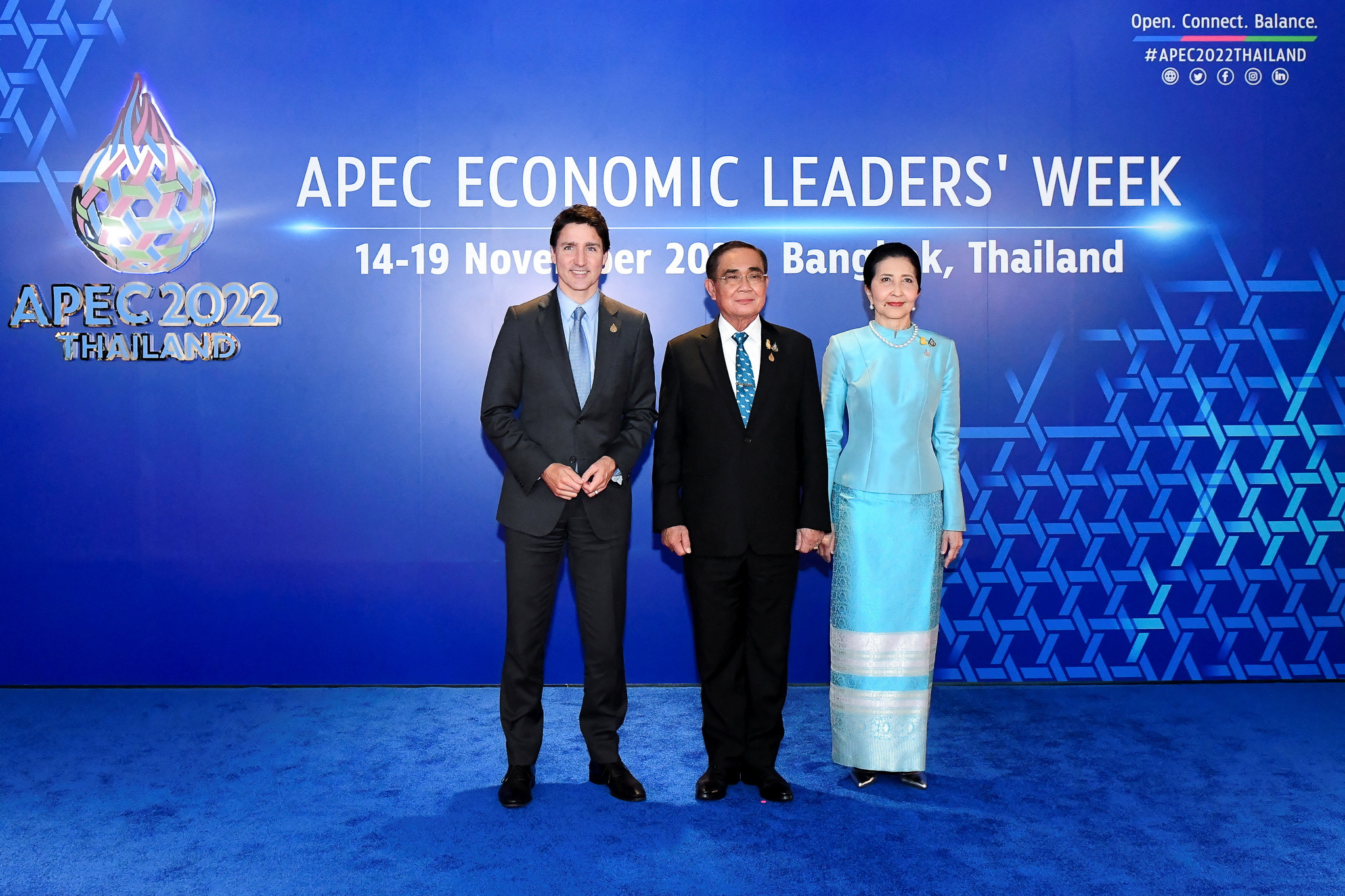
Thailand’s Prime Minister Prayuth Chan-ocha, wife Naraporn Chao-ocha and Canadian Prime Minister Justin Trudeau attend the Gala dinner of the APEC Summit 2022 in Bangkok, Thailand, November 17, 2022. Thailand Government House Handout via REUTERS

Japanese Prime Minister Fumio Kishida walks after the 29th APEC Economic Leaders? Meeting (AELM) during the APEC 2022 in Bangkok, Thailand, 18 November 2022. Thailand hosts the Asia-Pacific Economic Cooperation or APEC 2022, the summit for economic cooperation comprising 21 leading member economies to promote free trade in the Asia-Pacific region. Rungroj Yongrit/Pool via REUTERS
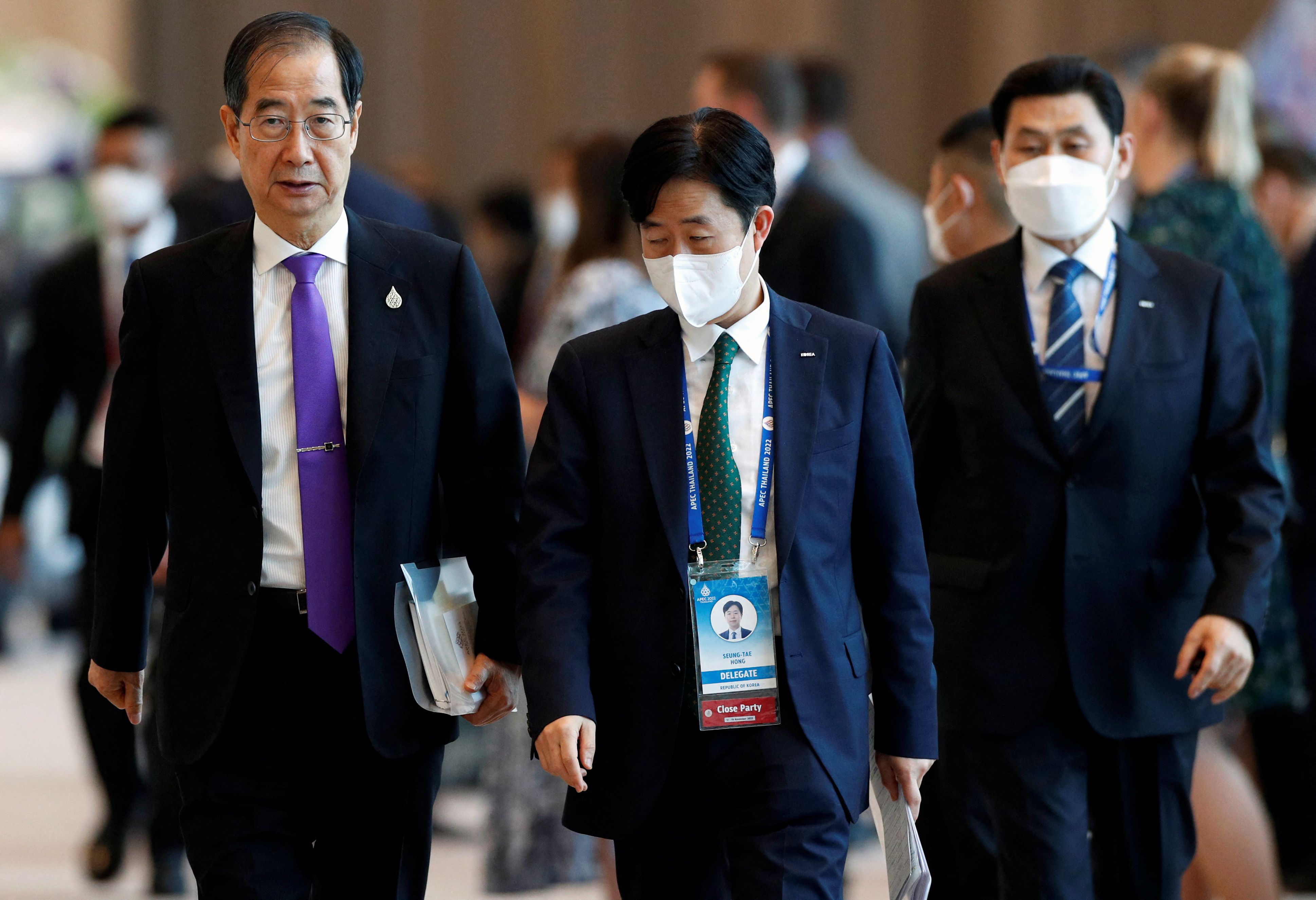
South Korean Prime Minister Han Duck-soo attends the 29th APEC Economic Leaders? Meeting (AELM) during the APEC 2022 in Bangkok, Thailand, 18 November 2022. Thailand hosts the Asia-Pacific Economic Cooperation or APEC 2022, the summit for economic cooperation comprising 21 leading member economies to promote free trade in the Asia-Pacific region. Rungroj Yongrit/Pool via REUTERS

New Zealand Prime Minister Jacinda Ardern gestures as she attends the 29th APEC Economic Leaders? Meeting (AELM) during the APEC 2022 in Bangkok, Thailand, 18 November 2022. Thailand hosts the Asia-Pacific Economic Cooperation or APEC 2022, the summit for economic cooperation comprising 21 leading member economies to promote free trade in the Asia-Pacific region. Rungroj Yongrit/Pool via REUTERS
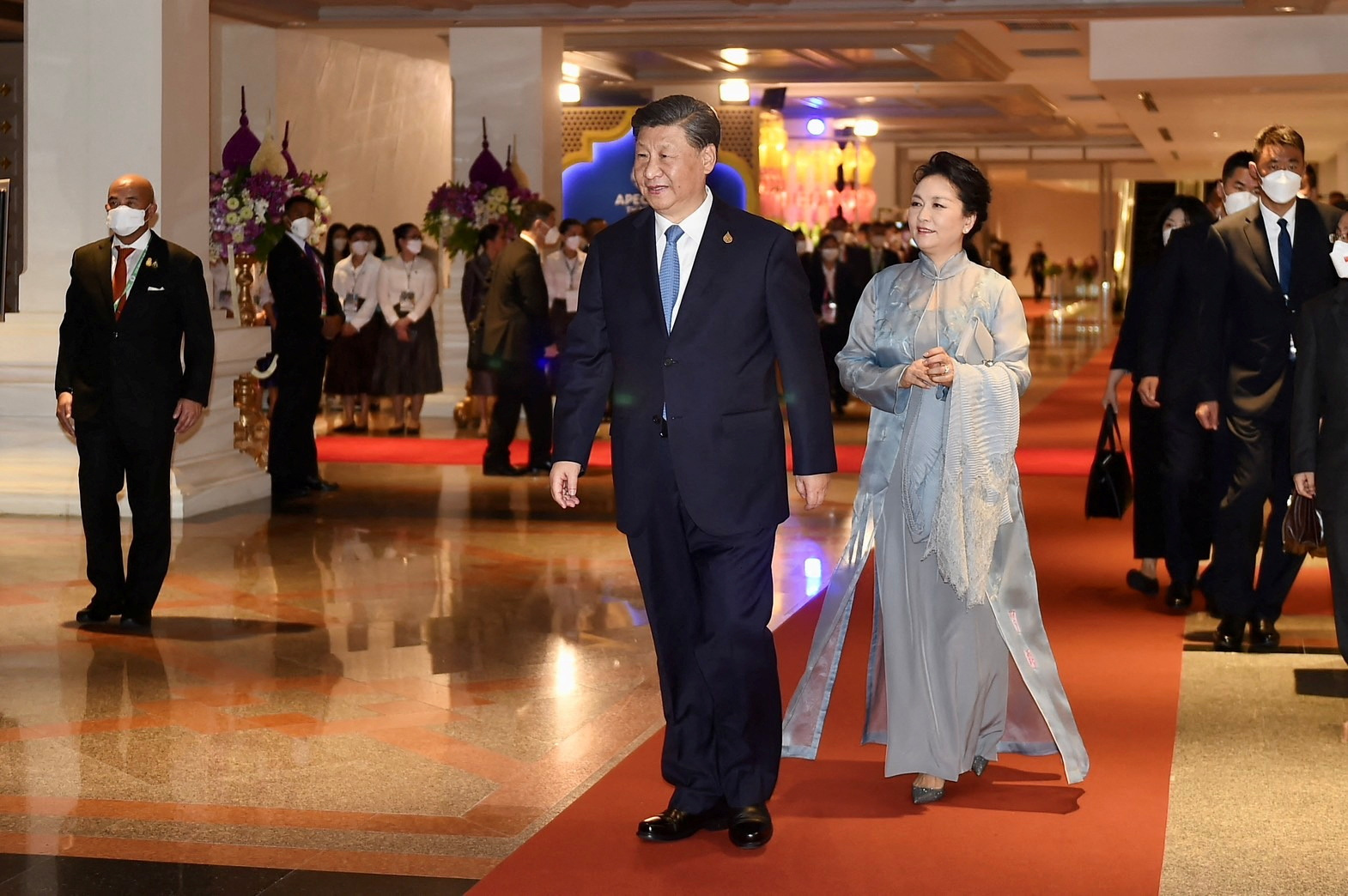
China’s President Xi Jinping and wife Peng Liyuan attend the Gala dinner of the APEC Summit 2022 in Bangkok, Thailand, November 17, 2022. Thailand Government House Handout via REUTERS

Categories
Audio Sources - Full Text Articles

Who is Viktor Bout, the arms dealer who could be swapped for Griner?

2022-11-18T10:01:14Z

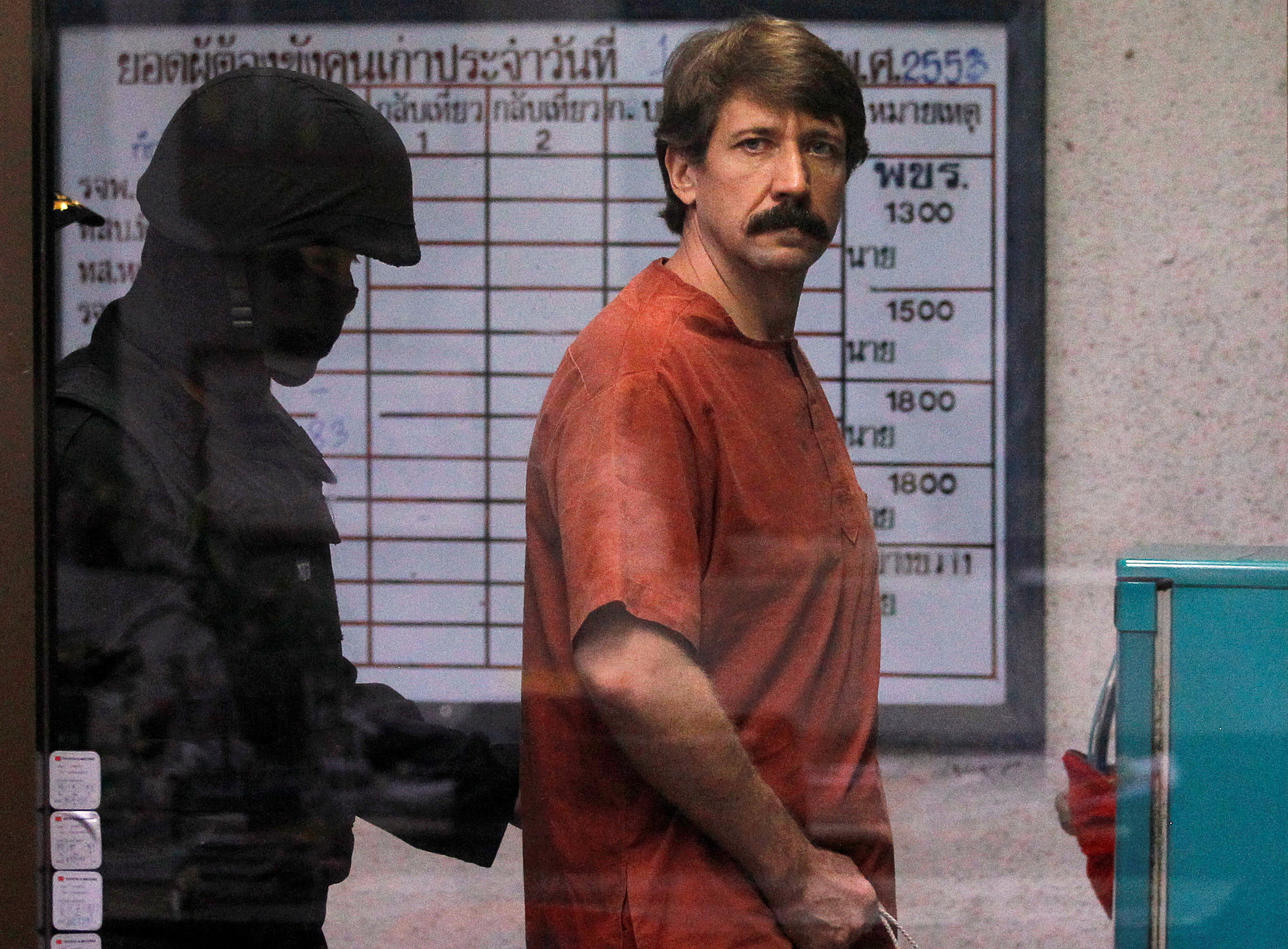
Alleged arms smuggler Viktor Bout from Russia is escorted by a member of the special police unit as he arrives at a criminal court in Bangkok October 4, 2010. Thailand’s criminal court held a hearing today on a second case lodged against Bout. REUTERS/Damir Sagolj/File Photo

The life of Viktor Bout reads like a spy thriller.

Russia wants the jailed arms dealer back in Moscow and is discussing a prisoner swap with the United States that could see him exchanged for Americans imprisoned in Russia including basketball star Brittney Griner.

Variously dubbed “the merchant of death” and “the sanctions buster” for his ability to get around arms embargoes, Bout, 55, was one of the world’s most wanted men prior to his 2008 arrest on multiple charges related to arms trafficking.

For almost two decades, Bout became the world’s most notorious arms dealer, selling weaponry to rogue states, rebel groups and murderous warlords in Africa, Asia and South America.

His notoriety was such that his life helped inspire a Hollywood film, 2005’s Lord of War, starring Nicolas Cage as Yuri Orlov, an arms dealer loosely based on Bout.

Even so, Bout’s origins remained shrouded in mystery. Biographies generally agree that he was born in 1967 in Dushanbe, then the capital of Soviet Tajikistan, close to the border with Afghanistan.

A gifted linguist, who later used his reported command of English, French, Portuguese, Arabic and Persian to build his international arms empire, Bout reportedly attended the Dushanbe Esperanto club as a young boy, becoming fluent in the artificial language.

A stint in the Soviet army followed, where Bout has said he achieved the rank of lieutenant, serving as a military translator including in Angola, a country that would later become central to his business.

Bout’s big breakthrough came in the days after the 1989-91 collapse of the Communist bloc, cashing in on a sudden glut of discarded Soviet era weaponry to fuel a series of fratricidal civil wars in Africa, Asia and beyond.

With the Soviet Union’s vast air fleet disintegrating, Bout was able to acquire a squadron of around 60 old Soviet military aircraft based out of the United Arab Emirates, by which he could supply his products around the world.

A 2007 biography entitled “Merchant of Death: Guns, Planes, and the Man Who Makes War Possible” by Douglas Farah and Stephen Braun reported several details of Bout’s murky trade. Reuters could not independently verify its description.

From a base in the Gulf emirate of Sharjah, he interwove his arms trafficking empire with a seemingly innocuous logistics business, always insisting when queried that he was a legitimate entrepreneur with respectable clients and no case to answer.

Even so, Bout, who first appeared on the CIA’s radar amid reports of a shadowy Russian citizen trading arms in Africa, was by the turn of the millennium one of the most wanted men in the world.

But Bout, whose clients included rebel groups and militias from Congo to Angola and Liberia, had little in the way of firm ideology, tending to place business above politics.

In Afghanistan, he variously sold guns to Islamist Taliban insurgents and their foes in the pro-Western Northern Alliance, according to “Merchant of Death”.

It said Bout supplied guns to former Liberian President and warlord Charles Taylor, now serving a 50-year prison term for murder, rape and terrorism, to various Congolese factions, and to Philippine Islamist militant group Abu Sayyaf.

The end only came in 2008, after an elaborate sting operation by the U.S. Drug Enforcement Administration saw Bout tracked across multiple countries to a luxury hotel in Bangkok.

During a spectacular sting operation, Bout was caught on camera agreeing to sell undercover U.S. agents posing as representatives of Colombia’s leftist FARC guerrillas 100 surface-to-air missiles, which they would use to kill U.S. troops. Shortly afterwards, he was arrested by Thai police.

After over two years of diplomatic wrangling in which Russia loudly insisted that Bout was innocent and his case politically charged, Bout was extradited to the United States, where he faced a raft of charges, including conspiracy to support terrorists, conspiracy to kill Americans, and money laundering.

Bout was tried on the charges related to FARC, which he denied, and in 2012 was convicted and sentenced by a court in Manhattan to 25 years in prison, the minimum sentence possible.

Ever since, the Russian state has been keen to get him back.

On Aug. 5, the United States and Russia said they were ready to discuss a prisoner swap, a day after basketball star Griner was sentenced to nine years in prison for bringing cannabis-infused vape cartridges into Russia. read more read more

Russian Deputy Foreign Minister Sergei Ryabkov said on Friday that it hopes a possible swap including Bout could be agreed.

“Viktor Bout is among those who are being discussed, and we certainly count on a positive result,” Ryabkov was quoted as saying by Interfax.

Sources familiar with the situation told Reuters that Washington had offered to exchange Bout for Griner and former U.S. Marine Paul Whelan, who in 2020 was sentenced to 16 years in jail for spying. read more

Russian Foreign Minister Sergei Lavrov has said Bout’s extradition from Thailand was “a glaring injustice” and suggested he was innocent.

Comments from a 2012 interview with the judge who presided over Bout’s New York City trial that his 25-year sentence was “excessive” have occasionally been seized on by Russian media making the case for Bout’s return home.

Earlier this year, speculation rose that Bout was set to be exchanged for Trevor Reed, a U.S. Marine Corps veteran jailed in Russia on assault charges. Reed was ultimately freed in return for Konstantin Yaroshenko, a Russian pilot jailed in the United States on drug trafficking charges.

For some experts, the Russian state’s continued interest in Bout, plus his skills and connections in the international arms trade, hint strongly at Russian intelligence ties.

In interviews, Bout has said he attended Moscow’s Military Institute of Foreign Languages, which serves as a training ground for military intelligence officers.

“Bout was almost certainly a GRU agent, or at least a GRU asset,” said Mark Galeotti, an expert on the Russian security services at the Royal United Services Institute think-tank, referring to Russia’s military intelligence service.

“His case has become totemic for the Russian intelligence services, who are keen to show that they don’t abandon their own people,” Galeotti added.

According to Christopher Miller, a journalist who has corresponded with neo-Nazis imprisoned along with Bout at United States Penitentiary Marion in Illinois, the former arms dealer keeps a photo of Russian President Vladimir Putin in his cell and says he does not believe Ukraine should exist as a state.

Reached by Reuters over the WhatsApp messaging service, Bout’s wife Alla, who lives in St Petersburg, said: “We very much hope that everything will be resolved and an agreement will be reached.

“All that’s left to do is to pray,” she added.

Categories
Audio Sources - Full Text Articles

World Cup could mean redemption for Brazil forward Neymar

When Neymar was preparing to play for Brazil at his first World Cup back in 2014, the hype surrounding him was considerable.

He had just moved from Santos to Spanish club Barcelona as one of the most promising young players in the world. And he had impressed early on with the Catalan club, quickly gaining the status of star in the world of soccer.

The common questions surrounding Neymar at the time were about when — not if — he would be crowned the best in the world.

Fast forward eight years, though, and things have changed considerably. The Brazilian remains one of the top players in the world, but he has failed to fully meet the expectations that came along his high-profile move to Europe.

Neymar lost visibility after joining Paris Saint-Germain in 2017, and it’s been a while since he has been in consideration for the best player of the year awards.

His performances with Brazil in World Cups have mostly disappointed since the 2014 tournament at home, when he was carried off on a stretcher because of a back injury in the quarterfinals. At the 2018 World Cup in Russia, Neymar crouched on the field and stared in disbelief as the Belgium players celebrated their victory over Brazil in the last eight.

He was crucial for Brazil when the country won its first Olympic gold medal at the 2016 Rio de Janeiro Games, a feat that was celebrated widely nationwide and earned him widespread praise.

But at 30 years old, the questions surrounding Neymar ahead of the World Cup in Qatar are a bit different.

Did he make a mistake by leaving Barcelona to join PSG? Is he being overshadowed by Lionel Messi and Kylian Mbappé? Is he past his peak?

But for Neymar, the only question that really matters is whether he can come through for Brazil and lead the national team to its first World Cup title in 20 years.

“I don’t want to let this World Cup get away from me,” Neymar said earlier this year. “I don’t want to let this opportunity slip through my hands. I’m doing everything possible to prepare for it, physically and mentally. It is my biggest dream right now. I’m focused on winning this title.”

This year’s World Cup could mean redemption for Neymar, and if he does find a way to lead Brazil to the title in Qatar, his name will most likely be back at the top of the award lists.

“I’ll give my life at the World Cup,” Neymar said in a chat with former Brazil midfielder Diego Ribas. “It’s a unique moment. I’ve been through two World Cups and I now how it works. Everything happens really fast, and if you are not at your 100%, if you are not prepared, the opportunity passes by you.”

Neymar, who said as a youngster his dream was to be the best player in the world, has been doing well this season again and is one of the leaders of a PSG team that hopes to finally win its first Champions League title. He enters the World Cup — which he doesn’t rule out as being his last one — as one of the most in-form players.

“He is flying right now,” Brazil coach Tite said.

Neymar apparently hasn’t been affected by the recent fraud trial regarding his 2013 transfer from Santos to Barcelona, where he and his father are among those accused of hiding the real cost of the transfer. He is facing a prison sentence of more than two years if found guilty, though some of the chargers against him have been dropped.

Tite is undoubtedly relying on Neymar to take the helm and lead Brazil in Qatar, hoping that his talent — and now his maturity — will finally make the difference and give the national team a chance to win its first World Cup title since 2002, when Neymar was still only 10.

And hopefully for Brazil, instead of leaving the field on a stretcher like in 2014 or watching opponents celebrate like in 2018, Neymar will end his World Cup run by lifting the trophy for his team and his people.

___

AP World Cup coverage: https://apnews.com/hub/world-cup and https://twitter.com/AP_Sports

___

Tales Azzoni on Twitter: http://twitter.com/tazzoni

Categories
Audio Sources - Full Text Articles

Russia not ruling out more talks with U.S., foreign ministry says

2022-11-18T09:39:40Z

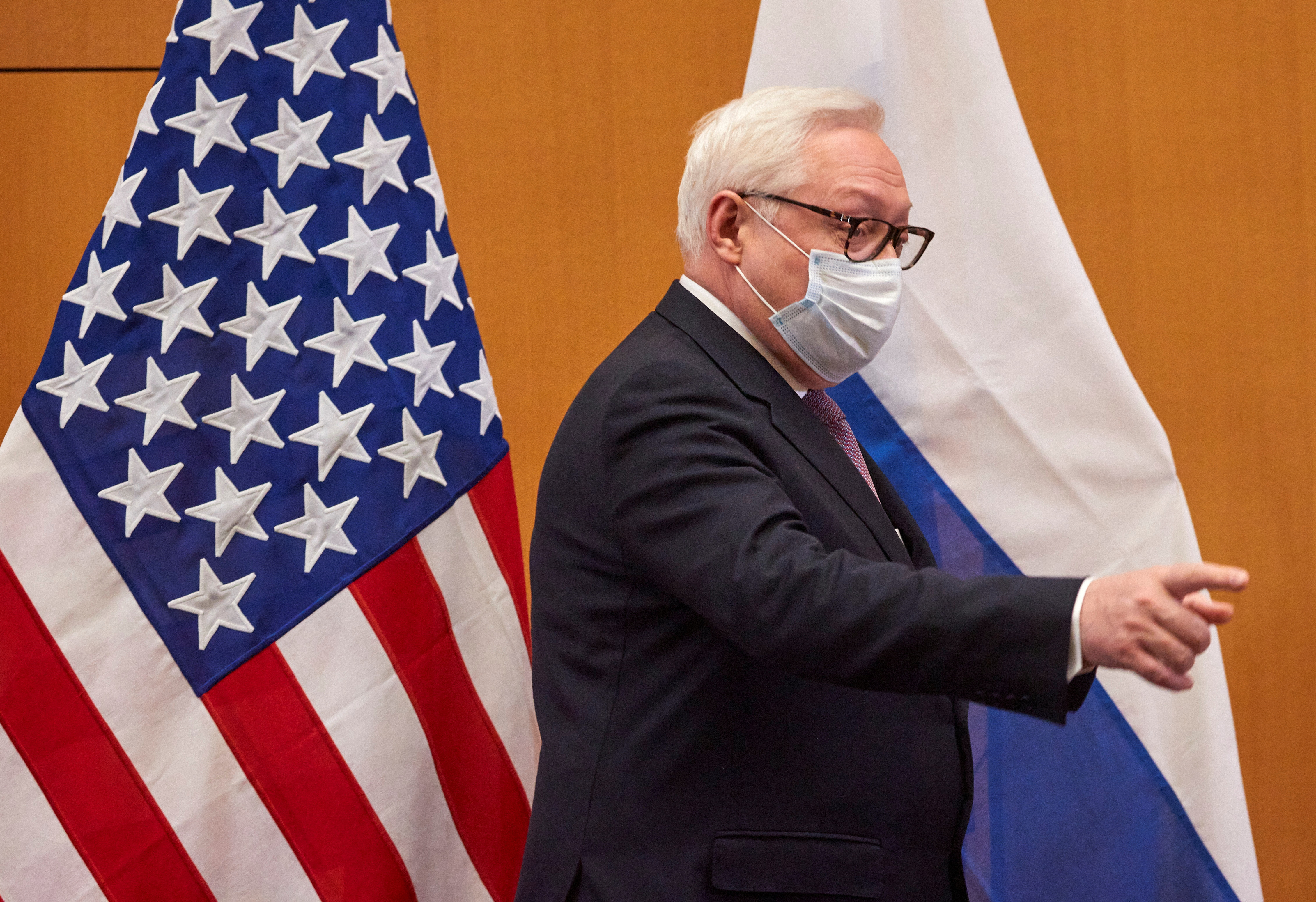
Russian Deputy Foreign Minister Sergei Ryabkov arrives for security talks with U.S. Deputy Secretary of State Wendy Sherman at the United States Mission in Geneva, Switzerland January 10, 2022. REUTERS/Denis Balibouse

Russia is not ruling out further high-level meetings with the United States on “strategic stability”, Moscow’s deputy foreign minister Sergei Ryabkov said on Friday, as an upcoming meeting between the two powers in Cairo on nuclear proliferation nears.

“If the Americans show interest and readiness, we will not refuse,” Ryabkov was quoted as saying.

Strategic stability is a term Russia and the United States, the world’s two biggest nuclear powers, use to mean reducing the risk of nuclear war.

Russian and the U.S. officials are expected to meet soon in the Egyptian capital of Cairo from Nov. 29 to Dec. 6 to discuss the New START nuclear arms reduction treaty.

However, Ryabkov earlier indicated there was nothing to talk about with the U.S. on the subject of Ukraine.

“No, there is simply nothing to talk about with them on Ukraine. There can simply be no dialogue, let alone negotiations, given the radical opposing positions,” he was quoted by Interfax as saying earlier.

Categories
Audio Sources - Full Text Articles

Kremlin: no talk of Putin-Biden summit

2022-11-18T09:52:53Z

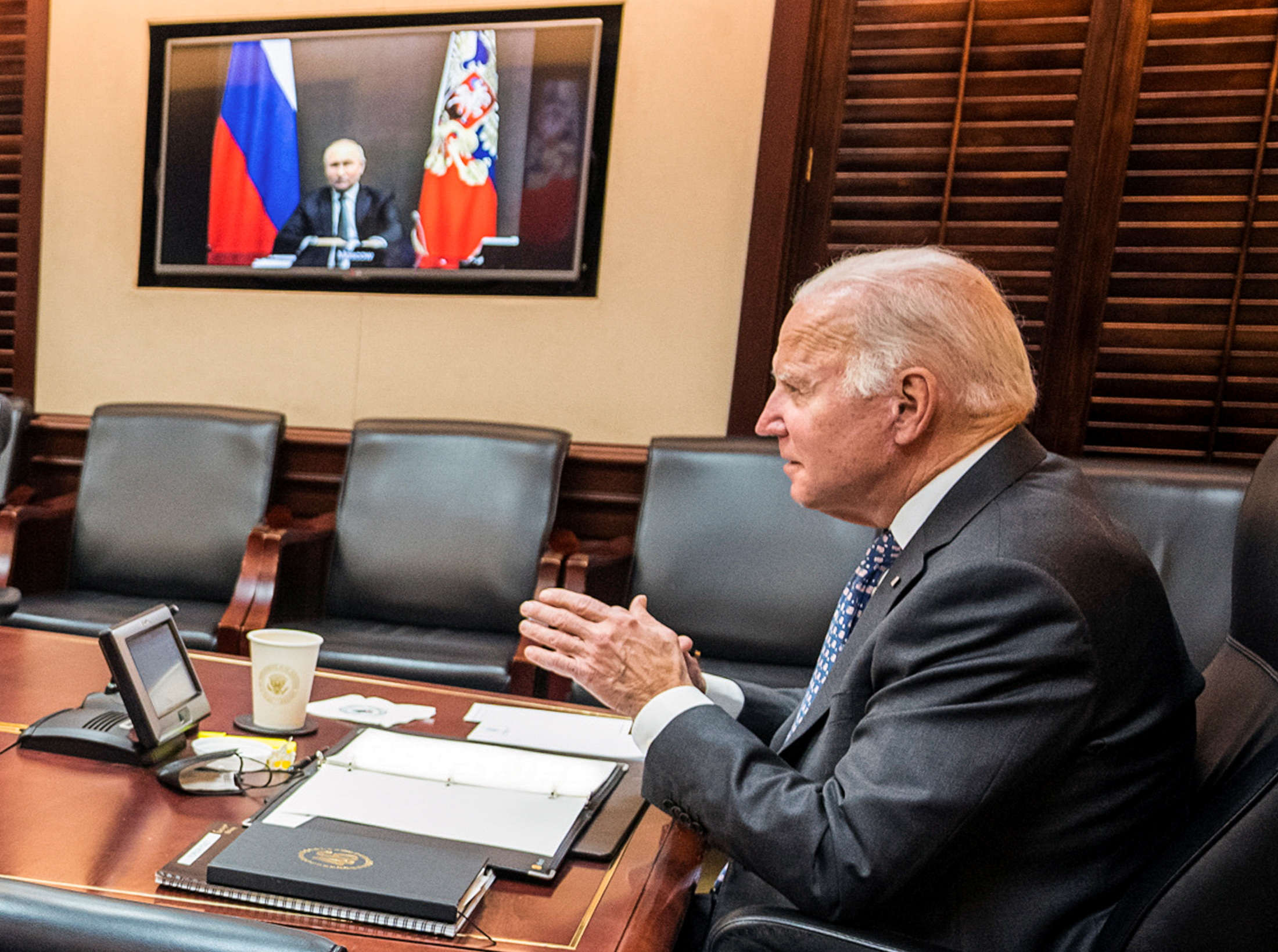
U.S. President Joe Biden holds virtual talks with Russia’s President Vladimir Putin amid Western fears that Moscow plans to attack Ukraine, during a secure video call from the Situation Room at the White House in Washington, U.S., December 7, 2021. /The White House/Handout via REUTERS

There is no talk of a summit between President Vladimir Putin and U.S. President Joe Biden, Kremlin spokesman Dmitry Peskov said on Friday.

WP Radio
WP Radio
OFFLINE LIVE