Categories
Saved Web Pages

About Those Documents at Mar-a-Lago

merlin_211236264_1f7a2f64-3b4a-491f-b12c

Aug. 18, 2022, 6:00 a.m. ET

  • Send any friend a story

    As a subscriber, you have 10 gift articles to give each month. Anyone can read what you share.

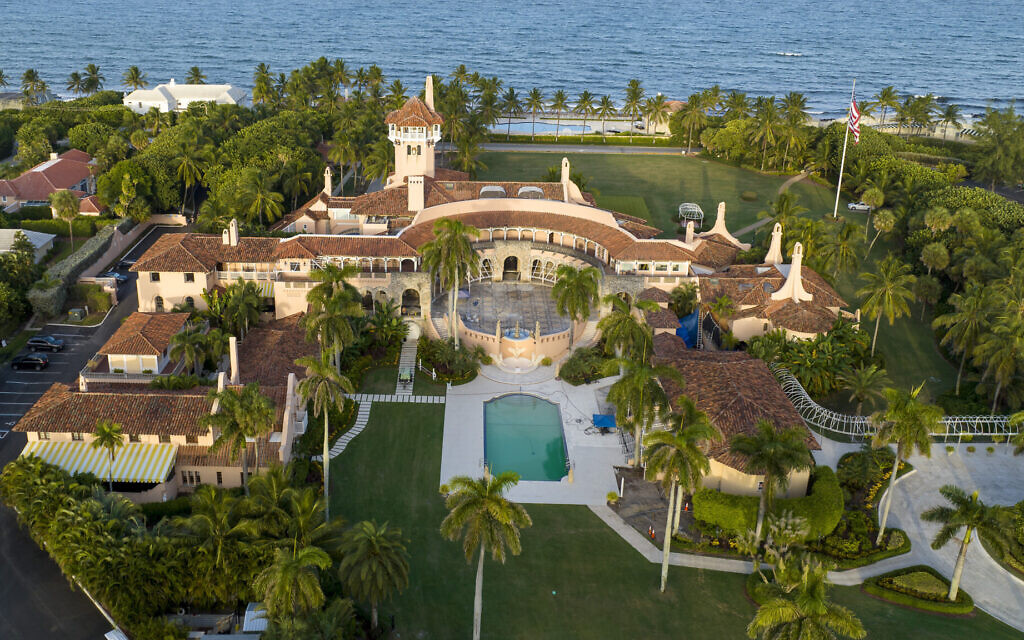
Last week, the F.B.I. took the extraordinary step of searching Mar-a-Lago, former President Donald J. Trump’s private club and Florida home. Their goal? To find materials he was thought to have improperly removed from the White House, including classified documents.

An inventory of the material taken from the search showed that agents seized 11 sets of documents with some type of confidential or secret marking on them.

We explore some of the latest developments in the case.

Maggie Haberman, a White House correspondent for The New York Times.

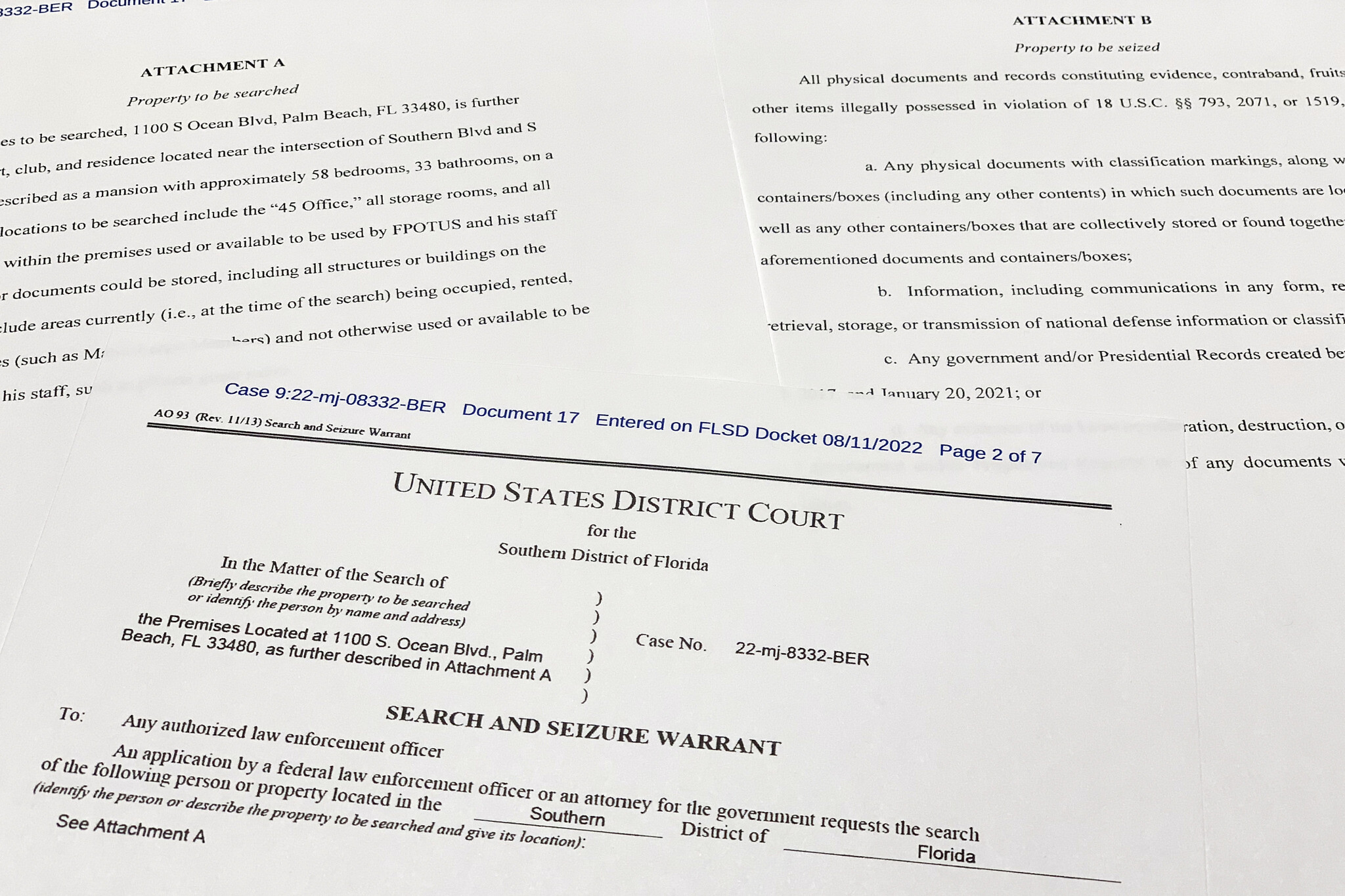
ImageItems removed from Mar-a-Lago included files marked as top secret and meant to be viewed only in secure government facilities, according to a copy of the search warrant.

Items removed from Mar-a-Lago included files marked as top secret and meant to be viewed only in secure government facilities, according to a copy of the search warrant.Credit…Giorgio Viera/Agence France-Presse — Getty Images

Maggie Haberman contributed reporting.

Fact-checked by Susan Lee.

The Daily is made by Lisa Tobin, Rachel Quester, Lynsea Garrison, Clare Toeniskoetter, Paige Cowett, Michael Simon Johnson, Brad Fisher, Chris Wood, Jessica Cheung, Stella Tan, Alexandra Leigh Young, Lisa Chow, Eric Krupke, Marc Georges, Luke Vander Ploeg, M.J. Davis Lin, Dan Powell, Dave Shaw, Sydney Harper, Robert Jimison, Mike Benoist, Liz O. Baylen, Asthaa Chaturvedi, Rachelle Bonja, Diana Nguyen, Marion Lozano, Corey Schreppel, Anita Badejo, Rob Szypko, Elisheba Ittoop, Chelsea Daniel, Mooj Zadie, Patricia Willens, Rowan Niemisto, Jody Becker, Rikki Novetsky, John Ketchum, Nina Feldman, Will Reid, Carlos Prieto, Sofia Milan, Ben Calhoun and Susan Lee.

Our theme music is by Jim Brunberg and Ben Landsverk of Wonderly. Special thanks to Sam Dolnick, Paula Szuchman, Lisa Tobin, Larissa Anderson, Cliff Levy, Lauren Jackson, Julia Simon, Mahima Chablani, Desiree Ibekwe, Wendy Dorr, Elizabeth Davis-Moorer, Jeffrey Miranda, Renan Borelli and Maddy Masiello.

Categories
Saved Web Pages

Jared Kushner’s ‘Breaking History’ Is a Soulless and Very Selective Memoir

09kushner-cover-facebookJumbo.jpg

In this lengthy book, Kushner recounts the time he spent in the White House during his father-in-law’s term.

  • Send any friend a story

    As a subscriber, you have 10 gift articles to give each month. Anyone can read what you share.

Aug. 17, 2022, 5:00 a.m. ET

BREAKING HISTORY
A White House Memoir
By Jared Kushner
492 pages. Broadside Books. $35.

The United States Secret Service isn’t known for its sense of humor, but when it gave Jared Kushner the code name “mechanic,” was someone betting that he’d call his memoir “Breaking History”?

It’s a title that, in its thoroughgoing lack of self-awareness, matches this book’s contents. Kushner writes as if he believes foreign dignitaries (and less-than dignitaries) prized him in the White House because he was the fresh ideas guy, the starting point guard, the dimpled go-getter.

He betrays little cognizance that he was in demand because, as a landslide of other reporting has demonstrated, he was in over his head, unable to curb his avarice, a cocky young real estate heir who happened to unwrap a lot of Big Macs beside his father-in-law, the erratic and misinformed and similarly mercenary leader of the free world. Jared was a soft touch.

“Breaking History” is an earnest and soulless — Kushner looks like a mannequin, and he writes like one — and peculiarly selective appraisal of Donald J. Trump’s term in office. Kushner almost entirely ignores the chaos, the alienation of allies, the breaking of laws and norms, the flirtations with dictators, the comprehensive loss of America’s moral leadership, and so on, ad infinitum, to speak about his boyish tinkering (the “mechanic”) with issues he was interested in.

This book is like a tour of a once majestic 18th-century wooden house, now burned to its foundations, that focuses solely on, and rejoices in, what’s left amid the ashes: the two singed bathtubs, the gravel driveway and the mailbox. Kushner’s fealty to Trump remains absolute. Reading this book reminded me of watching a cat lick a dog’s eye goo.

The tone is college admissions essay. Typical sentence: “In an environment of maximum pressure, I learned to ignore the noise and distractions and instead to push for results that would improve lives.”

Every political cliché gets a fresh shampooing. “Even in a starkly divided country, there are always opportunities to build bridges,” Kushner writes. And, quoting the former White House deputy chief of staff Chris Liddell: “Every day here is sand through an hourglass, and we have to make it count.” So true, for these are the days of our lives.

Kushner, poignantly, repeatedly beats his own drum. He recalls every drop of praise he’s ever received; he brings these home and he leaves them on the doorstep. You turn the pages and find, almost at random, colleagues, some of them famous, trying to be kind, uttering things like:

It’s really not fair how the press is beating you up. You made a very positive contribution

I don’t know how you do this every day on so many topics. That was really hard! You deserve an award for all you’ve done.

I’ve said before, and I’ll say again. This agreement would not have happened if it wasn’t for Jared.

Jared did an amazing job working with Bob Lighthizer on the incredible USMCA trade deal we signed yesterday.

Jared’s a genius. People complain about nepotism — I’m the one who got the steal here.

I’ve been in Washington a long time, and I must say, Jared is one of the best lobbyists I’ve ever seen.

A therapist might call these cries for help.

“Breaking History” opens with the story of Kushner’s father, the real estate tycoon Charles Kushner, who was imprisoned after hiring a prostitute to seduce his brother-in-law, having the encounter filmed and sending the tape to his sister. He was a good man who did a bad thing, Jared says, and Chris Christie, while serving as the United States attorney for New Jersey, was cruel to prosecute him so mercilessly.

There is a flashback to Kushner’s grandparents, Holocaust survivors who settled in New Jersey and did well. There’s a page or two about Kushner’s time at Harvard. He omits the fact that he was admitted after his father pledged $2.5 million to the college.

If Kushner can recall a professor or a book that influenced him while in Cambridge, he doesn’t say. Instead, he recalls doing his first real estate deals while there. He moved to New York, and bought and ruined a great newspaper (The New York Observer) by dumbing it down and feting his friends in its pages.

His wooing of Ivanka Trump included a good deal of jet-setting. Kushner briefly broke up with her, he writes, because she wasn’t Jewish. (She would later convert.) Wendi Murdoch, Rupert’s wife, reunited them on Rupert’s yacht. Kushner describes the power scene:

On that Sunday, we were having lunch at Bono’s house in the town of Eze on the French Riviera, when Rupert stepped out to take a call. He came back and whispered in my ear, “They blinked, they agreed to our terms, we have The Wall Street Journal.” After lunch, Billy Joel, who had also been with us on the boat, played the piano while Bono sang with the Irish singer-songwriter Bob Geldof.

With or without you, Bono.

Once in the White House, Kushner became Little Jack Horner, placing a thumb in everyone else’s pie, and he wonders why he was disliked. He read Sun Tzu and imagined he was becoming a warrior. It was because he had Trump’s ear, however, that he won nearly every time he locked antlers with a rival. Corey Lewandowski — out. Steve Bannon — out.

Secretary of State Rex Tillerson, who begged Kushner to stop meddling internationally — out. (Kushner cites Tillerson’s “reclusive approach” to foreign policy.) By the end, Tillerson was like a dead animal someone needed to pull a tarpaulin over.

Kushner was pleased that the other adults in the room, including the White House chief of staff Reince Priebus, the White House counsel Don McGahn and the later chief of staff John Kelly, left or were ejected because they tried, patriotically, to exclude him from meetings he shouldn’t have been in. The fact that he was initially denied security clearance, he writes, was much ado about nothing.

The bulk of “Breaking History” — at nearly 500 pages, it’s a slog — goes deeply into the weeds (Kushner, in his acknowledgments, credits a ghostwriter, the speechwriter Brittany Baldwin) on the issues he cared most about, including prison reform, the Covid response and the Middle East, where he had a win with the Abraham Accords.

This book ends with Kushner suggesting he was unaware of the events of Jan. 6 until late in the day. He mostly sidesteps talking about spurious claims of election fraud. He seems to have no beliefs beyond carefully managed appearances and the art of the deal. He wants to stay on top of things, this manager, but doesn’t want to get to the bottom of anything.

You finish “Breaking History” wondering: Who is this book for? There’s not enough red meat for the MAGA crowd, and Kushner has never appealed to them anyway. Political wonks will be interested — maybe, to a limited degree — but this material is more thoroughly and reliably covered elsewhere. He’s a pair of dimples without a demographic.

What a queasy-making book to have in your hands. Once someone has happily worked alongside one of the most flagrant and systematic and powerful liars in this country’s history, how can anyone be expected to believe a word they say?

It makes a kind of sense that Kushner is likely to remain exiled in Florida. “The whole peninsula of Florida was weighted down with regret,” as Cynthia Ozick put it in “The Shawl.” “Everyone had left behind a real life.”

Categories
Saved Web Pages

Новым командующим Черноморским флотом РФ стал вице-адмирал Соколов

This article links to a state controlled Russian media. Read more.

Вице-адмирал Виктор Соколов назначен новым командующим Черноморским флотом РФ. Сегодня, 17 августа он был представлен членам военного совета в Севастополе.

Вице-адмирал Соколов возглавил Черноморский флот РФ

“Приказ был главкома о его назначении. Членам военного совета прошло представление. Публичного мероприятия не было, и, наверное, его и не будет в связи с введенным в городе желтым уровнем террористической опасности”, — цитирует РИА Новости источник на флоте.

По его словам, во время спецоперации руководство решило не устраивать из назначения Соколова публичную акцию.

Вице-адмирал Соколов служит на флоте с 1985 года. В 2013 году он был назначен заместителем командующего Северным флотом. В 2019 году руководил главным военно-морским учебным заведением РФ — Военно-морской академией им. Н. Г. Кузнецова

Соколов сместил на посту командующего Черноморским флотом адмирала Игоря Осипова.

Categories
Saved Web Pages

Путин заявил о попытках США затянуть конфликт на Украине

936173-putin-zayavil-popitkah-ssha-zatya

Президент России Владимир Путин заявил, что США пытаются затянуть конфликт на Украине. По его словам, Вашингтон также заинтересован в обострении ситуации в Азии, Африке и Латинской Америке.

«Ситуация на Украине показывает, что США пытаются затянуть этот конфликт. И точно так же они действуют, разжигая конфликтный потенциал в Азии, Африке, Латинской Америке», – сказал Путин в своем обращении к участникам Московской конференции по международной безопасности (цитата по ТАСС).

Таким образом, по его мнению, Запад пытается сохранить «ускользающую из его рук гегемонию» и проводит политику сдерживания. В качестве примера Путин также привел поездку спикера палаты представителей конгресса США Нэнси Пелоси на Тайвань. Действия американского политика российский президент назвал «тщательно спланированной провокацией».

Российские власти неоднократно обвиняли США в желании затянуть конфликт на Украине. В начале августа посол России в США Анатолий Антонов заявил, что Вашингтон не собирается содействовать разрешению ситуации. Он обвинил американские власти в том, что те «продолжают подливать масла в огонь», выделяя дополнительную военную помощь Киеву.

Первый заместитель руководителя администрации президента РФ Сергей Кириенко также выразил мнение, что НАТО будет воевать на территории Украины против России «до последнего украинца».

Министр иностранных дел России Сергей Лавров же заявлял, что, накачивая Украину оружием, западные страны не дают ей делать конструктивные шаги и не позволяют вести переговоры с Россией. В последний раз переговоры делегаций Москвы и Киева по урегулированию ситуации на Украине проходили весной в Стамбуле.

Подписывайтесь на «Ведомости» в Telegram и будьте в курсе главных новостей экономики и бизнеса

Categories
Saved Web Pages

Rudy Giuliani’s former associate Lev Parnas described branches of the ‘Trump Crime Family’ on Twitter

One of the hardest transitions Kyla Jenée Lacey has endured in her life was when her family moved from Chicago to Winter Springs, Florida. a predominantly white town about 30 minutes north of Orlando.

At age 9, for the first time in her life, Lacey realized what it meant to be a racial minority in America. From then on, she was one of the few black students in her classes, she said, and her skin color has become an obstacle to her integration. She felt like the token black girl – and she quickly realized that speaking Vernacular African American English (AAVE) to his white classmates would only question his intelligence.

“For me, it was a lot of survival involved in my socialization because I didn’t feel accepted by other black kids, and I didn’t feel accepted by white kids,” she said.

But outside the boundaries of the school, the black tongue was his refuge. As bilingual kids, she bounced between AAVE and standard English. When she was at home speaking AAVE, she didn’t need to impress anyone; she felt most herself and connected to her heritage, she said.

AAVE, also known as African American English (AAE), African American Language (AAL), Black English, or Ebony, is a style of English often spoken in Black American homes. Linguists don’t know how Black English originated, but they believe it may have originated from West African or Creole languages. Just like these forms of speech, AAVE serves as a communication between people with a common culture.

According to Deandre Miles-Hercules, a doctoral student at the University of California, Santa Barbara, the language was created by enslaved black people living in the South, separated from their home country and language. As Black Americans moved north and west during the Great Migration, they took the language with them, and each region created slightly different versions of Black English over time.

How America Developed Two Sign Languages – One White, One Black

For Lacey, it wasn’t until she attended school at the University of Central Florida in the early 2000s, surrounded by all-black roommates and more black people, that she began to dispel the idea. that his humanity would never be as validated as his White counterparts. She no longer had to blend in or prove herself to people who would look down on her for speaking AAVE, she said.

So when she started seeing non-black people disrespecting AAVE in virtual spaces more recently, she was in a rush. It annoyed him, for example, to see subtitles added to broadcast newsmagazines when black interviewees spoke coherently. She also hated how the language had been weaponized online by non-black people to imply an aggressive tone, and how non-native AAVE speakers sometimes mispronounced black English words because they had only seen them. typed on a screen.

“I know the words have different meanings in different groups,” she said. “You can’t take very ingrained black language, an absolute staple of black language, and say, because there’s confusion on Twitter, we’re not allowed to use our words.”

As Gen Z influencers and black artists continue to shape the internet landscape, from viral memes to TikTok dances, AAVE has appeared in more online spaces. But some black AAVE speakers believe the language has been misidentified as new vocabulary started by young people – and they have been calling on non-blacks to glorify internet stars who slaughter speech and fail to understand the cultural significance of language.

Language uncovers the evolution of a speaker’s history, geography and culture, Miles-Hercule said. While AAVE lands in the laps of people who didn’t grow up speaking it, those who try and fail to use it properly may be considered ignorant by black communities. At worst, they are seen as appropriating black culture and perpetuating racism as they attack black speech without taking on the struggle of black Americans, the speakers say.

Amoura Monroe, a 20-year-old living in Los Angeles argues that a big part of the problem comes when the language is misattributed to Gen Z lingo, stan culture, or internet slang.

For example, “Gen Z Hospital,” a skit from “Saturday Night Live,” was meant to poke fun at the way young people talk. But like Monroe and others Twitter users noted, many words, such as “tea” and “pressed”, were actually derived from AAVE. (NBCUniversal did not immediately respond to a request for comment.)

“It takes away the significance,” Monroe said of using AAVE for comedy. “Black people are ridiculed for this. … They laugh at them and people stereotype us for talking that way.

Words such as “kill,” “period,” “extra,” and “cap” take on slightly different meanings in the context of AAVE, which many non-native speakers are unable to fully grasp, Monroe added.

Monroe said she was also bothered by celebrities trying to speak AAVE. These non-black people speak it as a form of entertainment, “giving them a black caricature in a way, kind of like a minstrel show,” Monroe said. Meanwhile, she added, black people are denigrated and told they speak badly when using it.

Recently, song lyrics including AAVE were at the center of the debate. In June, a The social media storm has led singer-songwriter Lizzo to change the lyrics of his song ‘Grrrls’ after disability advocates pointed out that a word in its original version, ‘spaz’, is seen as an ableist insult. The word has been used to denigrate people with disabilities who suffer from spasms, including those with cerebral palsy or spinal muscular atrophy.

Beyoncé has used the slur ‘ableist’ in a new song. After the outcry, she deletes it.

Then, in August, Beyoncé announced she would drop the same word from “Heated,” a song from her latest album, “Renaissance.”

Some AAVE speakers have defended black artists, saying the word has another meaning — to go wild — and that its use in “Grrrls” and “Heated” was not meant to offend.

“Lizzo let WHITE people bully her into not using AAVE in her song,” said a fan tweeted. “Black people have been using ‘spazz’ for decades and it has nothing to do with making fun of people with disabilities.”

Others disagreed: “The word is an insult. Let it go and leave some compassion for the people who have been hurt by that word instead,” said one black autistic man. wrote.

Dilemmas such as those of Lizzo and Beyoncé reveal the conflicts that have arisen as AAVE becomes more mainstream in pop culture, especially through song lyrics and social media posts.

How Iggy Azalea mastered his ‘blaccent’

AAVE speakers have also criticized what they see as the hypocrisy of non-black people on the internet who monitor language use while profiting from various aspects of black life.

According to Jamaal Muwwakkil, also a doctoral student at UC Santa Barbara, non-black people often gain social capital when they use black language and culture: “When we think about social media and entertainment, the economic capital that people derive from the appropriation of black language, fashion, etc., in many ways replaces the loss of economic capital…of our literal bodies in movable slavery.

Black speakers point up the memification of Sweet Brown – who said “No one has time for that” in a 2012 Oklahoma City TV report – as evidence of how the use of black language can elevate the social status of a person. The viral clip led to Brown’s multiple TV appearances and film role.

However, Muwwakkil said, without the known historical and cultural context of native speakers, AAE is vulnerable to distortion online.

Is there a DC dialect? It’s a topic that locals are “cisified” enough to discuss.

The terminology used to describe Black English is also controversial. Muwwakkil disapproves of the use of the term AAVE and prefers African American English, as he believes speech and gestures are not a different language, vernacular or dialect.

He also takes issue with the term code-switching, or switching between two languages, which he says is disproportionately applied to black people and implies that African-American English has less legitimacy than standard English. Everyone changes the way they speak depending on their relationship to the person and the setting they’re conversing in, he said, and different ways of speaking should be equally acceptable, a concept called “code meshing.” .

Several years removed from her high school days, Lacey said she always switches from Black English to Standard English to avoid discrimination, although she wishes she didn’t feel the need to.

But she also sees refusing to talk about it around white people as a form of control, she said: “AAVE is the closest thing we have to a cultural secret.”

Despite what some black speakers view as misuse and scrutiny of the language, they believe it will continue to thrive as a bastion of black culture – and that it will continue to evolve as black people intend it.

As Muwwakkil said, “There will never be a way of ceasing to be the creative force that has always been part of black language and culture.

Categories
Saved Web Pages

The war of Westishness

Jeremy-01-for-web.jpg

It feels like an eternity ago, that grim wintry pre-dawn of Thursday 24 February. A time before the place names Bucha and Irpin, Kramatorsk and Mariupol became bywords for the bloodiest war in Europe since 1945; before the letter Z became emblematic of a new fascism; before a new Iron Curtain fell over the continent; before it became impossible to describe the Covid-19 pandemic as a “once in a decade” shock to the global system. A time when a British prime minister could, as Boris Johnson had done in November, blithely declare that “the old concepts of fighting big tank battles on the European landmass are over”.

The final act of that pre-invasion era was at one with the dark poetry of the moment. In a ten-minute video address issued in the early hours of 24 February, after months of Russian troop build-ups on the Ukrainian border and increasingly deranged rhetoric from Moscow, Volodymyr Zelensky made a last-ditch plea for peace. Ukraine’s president appealed directly to Russian citizens in their own language: “The people of Ukraine want peace,” he said, but warned that the country would defend itself: “While attacking, you will see our faces. Not our backs. Our faces.” Then, just before 5am local time, Vladimir Putin announced a “special military operation”. Within minutes, air-raid sirens and the first explosions were heard in cities across the country. 

The world woke up to a new reality. In a piece for the New Statesman website that morning I argued that “precedents will be set in the next days: precedents about what is acceptable in the international system of the early-to-mid 21st century and what is not; precedents that will shape the decades to come”. It would be up to Ukraine and its Western allies, I wrote, to ensure Putin did not achieve mastery over this historical turning point. At the time reports were emerging that US officials believed Kyiv could fall within one to four days, with Putin then expected to install a Kremlin puppet government and partition Ukraine. 

Set against this, however, was the obvious Ukrainian determination to resist. Half a year on, it is true that swathes of the country lie in ruins. Barbaric Russian acts in Kyiv’s northern suburbs during the first weeks of the war and in southern and eastern cities over the spring and summer recalled the genocidal worst of the Balkan wars and the Second World War. Despite many thousands of Ukrainian military and civilian casualties, and the displacement of millions of its citizens, a democratic and free Ukraine still stands tall.

[See also: Russia is still underestimating Ukraine]

Subscribe to Morning Call View all newsletters

Russian troops turned out to be poorly prepared and unmotivated. They were not able to seize Kyiv in the first weeks of the war and withdrew from the area at the end of March. And while Russia has made gains in the eastern Donbas and along a southern Black Sea corridor to Crimea – itself illegally occupied in Putin’s initial 2014 attack on Ukraine – Russia appears to be making slow progress towards taking the whole Donbas region. US estimates put the numbers of Russian dead or injured at up to 80,000 – more in six months than the Soviet Union incurred during its entire 1979-89 war in Afghanistan. 

The war has also changed the geopolitical landscape. Ukraine’s defence has drawn not just on its own impressive resolve, but also on huge transfers of Western military and economic aid. The conflict has jolted American attention back to Europe and revitalised Nato, which is now sending substantial reinforcements to its eastern flank and admitting Sweden and Finland as new members. It has disrupted flows of staple commodities – oil and gas, grain and fertiliser – and contributed to rising inflation, a looming global recession and humanitarian crises in poor countries. It has reshaped how powers further afield, notably China, view the decades ahead.

How to create a responsible form of “buy now, pay later”
“Unions are helping improve conditions for drivers like me”
Transport is the core of levelling up

As much as the morning of 24 February 2022 was a turning point – the Zeitenwende, or epochal shift, of German chancellor Olaf Scholz’s coinage three days later – it cannot be understood in isolation. It came against a tumultuous global backdrop: the debacles of the Iraq and Afghanistan wars, the rise of China and relative decline of the West, the turmoil of the Trump presidency, Europe’s waning relevance, the shift towards a more multipolar and anarchic world order and, most recently, the Covid-19 pandemic. To understand the meaning of the war, six months in but far from over, is to situate it with that wider move away from the easy optimism of the immediate post-Cold War years and towards something new and, for now, still hazy.

If the war had gone as Putin had hoped, that work of analysis would have been rather straightforward. A Ukraine successfully subjugated and sundered as punishment for its alignment with the West would have made a potent symbol of a new post-Western era, the collapse of the old order and the rise of a new, authoritarian-friendly multipolarity. Instead the events of the past six months tell a sufficiently complex story – of democratic resilience, of shifting power balances, of both authoritarian revisionism and weakness, of global systems both brittle and adaptable – to spark a genuine debate about what they mean.

Putin still clings to the narrative he had hoped the war would substantiate. At the St Petersburg economic summit on 17 June, he accused Western countries of being in denial over their own decline: “They do not realise that in recent decades, new and powerful centres have been formed on the planet, each of which is developing its own political systems and public institutions.” This chimes with the Chinese view of the conflict. Writing of a recent discussion with a Beijing academic, Mark Leonard of the European Council on Foreign Relations reports: “My Chinese interlocutor sees the situation in Ukraine not as a war of aggression between sovereign countries, but rather as a revision of post-colonial borders following the end of Western hegemony.”

Within the West itself, opinion is divided. Optimists see in Ukraine’s resilience, and in the new purpose the war has given Nato, the seeds of some sort of Western revival. By contrast, realist-pessimist types have mostly deemed it either a distraction from America’s contest with China or a demonstration of the need to do unpalatable deals with thugs like Putin to prevent international chaos – or some combination of the two. Thus the war has conformed to the wider habit of sweeping, “return of the West” or “death of the West” binary arguments. Such thinking goes back decades, but it has intensified in the recent years of international and domestic turmoil. 

I noted one example of this feast-or-famine demeanour last summer. A year before, in February 2020, the Munich Security Conference had warned of an era of Trumpian “Westlessness”. Yet by June 2021, ahead of a G7 meeting in Cornwall that would be the first of Joe Biden’s presidency, the hubristic slogan of the moment seemed to be “the West is back” (as if one favourable US election result could rewind the clock to the late 1990s). I argued then that a better term for new global realities would be “Westishness”, defined as a middle-ground scenario “in which aspects of the West’s values and power endure but others fragment”. This might include a “Eurasian” Europe more bound up with events to its east, as well as more heated internal battles about the values and meaning of the West and a fragmentation of global governance. 

What that term “Westishness” lacks in lexical elegance it perhaps makes up for in nuance. It captures something of the past half-year of war in Ukraine, and of an age defined not by the binary triumph of one system over another but by its own in-between-ness. We are living through neither the old post-Cold War era nor the first chapter of a fundamentally new international order, but a transitional period with its own distinct rules and realities.

A useful exercise after six months of a war that has exemplified Westishness is to ask what it tells us about this interstitial time. To ask: what are the defining characteristics of a Westish world? In the hope of starting a discussion, and of at least providing some examples, here are ten:

1. A West that’s over-reliant on the US

For all its misery, the war has been a reminder of US strength. From halfway around the world, Washington has supplied Ukraine with intelligence, military and economic resources, enabling the country to largely hold off a nuclear-armed aggressor with a military budget ten times its own. Between 24 February and 1 July this year, America allocated €23.8bn in military aid, while the largest European donors, Britain and Poland, committed €4.4bn and €1.8bn respectively. It is thanks especially to American Himars (multiple rocket launchers) that Ukraine has been able to stall the artillery-led Russian advance in the Donbas. The Biden administration has driven the reinvigoration of Nato in recent months: it has committed to establishing a new permanent military headquarters in Poland and providing the backbone of a proposed expansion of Nato’s rapid-response force to 300,000 troops. 

These developments are the quintessence of Westishness. They tell a story of robust, even awe-inspiring US strength that simply does not square with the gloomy proclamations of American collapse and retreat issued at dark moments, such as the storming of the Capitol on 6 January 2021 or the debacle of the Afghanistan withdrawal eight months later. Yet they also tell a story of in-between-ness, of circumstances produced by the very fact of the West swaying between supremacy and decline. For the war has also illustrated Western over-reliance on American strength. After all, if support for Ukraine had been left to the Europeans, Kyiv might now be in Russian hands. And an overly US-centric West is emphatically vulnerable to a Trump or Trumpist victory in the 2024 US presidential election.

[See also: Nato’s “comeback” pivots on America’s troubled politics]

2. Technology over size

In mid August, Russian forces in southern Ukraine have been blindsided by devastating strikes on their anti-aircraft missile systems, including one on a major airbase in occupied Crimea. These may have involved advanced anti-radar Harm missiles, part of a recent US arms shipment. By contrast, Russian military hardware captured by Ukrainians has turned out to contain US-made microchips – some of them reportedly extracted from dishwashers and refrigerators, in a sign of Russian technological backwardness.

The role of Western technology in helping to level the field in the David-vs-Goliath struggle points to a broader trait of the Westish world: it is at least debatable whether the reality of the West’s declining relative economic weight matters as much as its prevailing (if now contested by China) technological leadership. Washington certainly hopes it does not. As Adam Tooze wrote for the New Statesman last year (“The new age of American power”, 10 September 2021), “the ultimate goal of the Pentagon planners is to loosen that link between economic performance and military force”, by using “ultra-advanced technology”.

3. Disorderly interdependence

Another element of the in-between state is that interdependence, the watchword of the 1990s utopians, has not gone away. Borders, in many places, still matter less than they used to. Nation-state sovereignty remains, on the whole, relative rather than absolute. Yet, as the world becomes more anarchic, that interdependence is creating more and more vulnerabilities. The invasion has exposed the weaknesses of multilateral international institutions like the UN. Europe is now bracing for a chilly winter of gas cut-offs, the political effects of which could be severe. Putin’s blockage of Black Sea ports – now tentatively lifted – has threatened famine and political breakdown in states such as Ethiopia and Egypt. This is neither a world of “the West is back” nor of ubiquitously rising walls, but of highly networked international systems that no institutions or rules are capable of managing. 

4. Globalisation reshaped

In the Western pessimist camp, it is fashionable to proclaim globalisation over. The war in Ukraine has lent credence to this idea. By triggering severe Western sanctions on Russia, pushing Russia and China closer together, and spooking Western investors out of Chinese markets – given the parallels between Putin’s war and a possible Chinese invasion of Taiwan – it has accelerated the shift to a world of closed economic blocks.

Yet the story really is more complex. Western trade with Russia has been replaced by trade with others – witness the European rush to do gas deals with Azerbaijan, Algeria and the Gulf states. Likewise, as John Springford of the Centre for European Reform noted in a recent article for the think tank, Covid-19 has caused services trade to rise and goods trade to fall but recover relatively quickly, while foreign direct investment and migration flows have continued to surge. Globalised systems can adapt, in other words. And much of what is termed “deglobalisation” is in fact politics taking primacy over economic considerations. As power becomes more contested and diffuse in a Westish world, globalisation is not dying; rather, it is being shaped more by those contests and less by purely market- and price-based factors. 

5. Weaponised global crises

We live in an era of crises of the “Anthropocene” – that is, crises caused directly by humankind’s impact on the planet. But those crises can also be harnessed for geopolitical goals, as Russia attempted to do in recent months by limiting grain and fertiliser flows out of Ukraine and Russia. Putin may lack the economic and technological heft to defeat a Western-backed adversary, but he does hope to sow chaos in the West’s near-abroad (through, say, the collapse of a Western security client like Egypt or massive new European migration crises). The greater the strains on environmental and commodity ecosystems, the more opportunities such actors will have to exploit them.

6. An ambivalent Global South

On 2 March, the UN General Assembly voted on a resolution condemning the invasion. Countries representing fully 59 per cent of the world’s population either abstained or voted against this. That pattern has continued in the months since: states in the Global South have broadly erred towards neutrality. Most notable among them is India. The country about to overtake China as the world’s most populous is aligned with the West on several topics – most notably the containment of China in the Pacific and Indian Oceans – but has in the past months shown its resistance to Western pressure to condemn Russia over its war.

That resistance is rooted in decades of Indian strategic doctrine, specifically a military relationship with Russia dating back to Soviet days, but it is also a window onto the mercurial instincts of states in the Global South in a period of Westishness.

7. Power to the pivot states

Related to this is a particular role for states capable of pivoting between Western and non-Western powers. It is a useful ability in a Westish age: no economic alliance remotely competes with the West – the US remains by far the world’s greatest power – and yet the West’s relative decline also presents new openings for contrary alliances. States that can walk this tightrope have particular advantages. 

One is Kazakhstan, long in Russia’s shadow but a state that has sought to keep its distance from Putin’s war in Ukraine (refusing to recognise the Kremlin’s puppet regimes in the Donbas, for example) while maintaining cordial relations with both the West and China. Another example is Saudi Arabia, as tightening oil markets have thawed a relationship with the US that had been frozen by the brutal murder of the journalist Jamal Khashoggi.

Other pivot states include Algeria, Vietnam and Brazil. But perhaps the best example of all is Turkey, where President Recep Tayyip Erdoğan has simultaneously supplied Ukraine with valuable Bayraktar drones while maintaining relations with Russia and negotiating a deal to free up grain shipments through the Black Sea and the Bosphorus. The symbolic capital of Westishness is surely Istanbul. 

8. Authoritarian limits exposed

Ukraine’s resilience and the role of US might and technology have shown the limitations of authoritarian systems. Russia’s leadership has been exposed as overly centralised, its troops as under-motivated and its system as slow to correct mistakes. It so happens that this has taken place over the period in which the weaknesses of the Chinese system have also become clear. The emerging superpower’s inept Covid strategy has merged with twin debt and property crises to raise doubts about when – and even whether – China will overtake the US as the world’s most powerful state. 

That does not change the fact of Western decline. But it does indicate a dangerous new reality: of authoritarian states strong enough to accrue more relative power within the global system but not strong enough to found new poles of stability. Much has been made in recent months of the new links between China, Russia and Iran, for example. But the notion of the three coalescing into a serious, trusting, enduring alliance comparable even to today’s fragmenting Nato is ludicrous. 

9. Old assumptions examined

A Westish international order is inherently fluid. Therefore one of its defining traits is a constant and febrile process of debate and questioning. In the US, Putin’s invasion of Ukraine has put Biden’s central foreign policy agenda in doubt. (Is an “alliance of democracies” really the priority of a president fresh back from a trip-of-necessity to Riyadh to bump fists with the man behind Khashoggi’s murder and dismemberment?)

In Washington it has intensified debates between defenders of a proactive liberal-democratic America (say, writers like Anne Applebaum or David Frum), voices of old-school realism (such as the political scientist John Mearsheimer) and the new “restrainers” (such as the historian Stephen Wertheim) arguing for a US policy of non-intervention abroad. In Berlin the war has triggered an unsettling examination of Germany’s old assumptions about “Wandel durch Handel” (change through trade). In London it has coaxed out a fascinating tension between idealist Atlanticist Brexiteers (like Liz Truss) and Brexiteers of a more realist persuasion (like Dominic Cummings).

[See also: Germany’s impending energy crisis is no reason for it to abandon Ukraine]

10. New challenges at home

To the extent that it has been tough and proactive, America’s response to the war speaks of internal robustness. It has required: Biden to have prevailed over Trump’s attempt to override the US constitution in early 2021; the country to draw on its economic and technological supremacy; and American politics to generate stable consent for the White House to do things such as revitalise Nato.

Likewise, the extent to which Europe will get through a winter of gas shortages orchestrated by Moscow will be largely determined by the state of its political and economic systems. Can the EU, its states, firms and citizens, pull together to get through the cold months with disrupted energy supplies?

In a world in which many Western strengths endure, but the challenges to them are becoming more formidable, the deciding factors may turn out to be domestic ones. America retains the ability to attract many of the world’s brightest scientists and researchers in a way China cannot. Europe’s economies can adapt to adversity and change in ways that Russia’s cannot. But all that depends on a degree of cohesion and openness that is far from certain in times of such disruption. Whether these can be sustained may well ultimately decide what sort of world-historical era follows our own period of Westishness.

Observant readers will notice just how many of these points also apply to the pandemic. Covid-19 also showed us many of the contours of a Westish world: the centrality of technology; the awkward middle-zone of an interdependent order without the structures to manage its own interdependence; an adaptive but political globalisation; a geopolitical edge to an Anthropocene crisis; authoritarian states at once too strong to be boxed in entirely by Western power but too weak to provide real stability; and a West whose fortunes depend most on its own internal cohesion. The pandemic and the war belong together as a double-headed crisis.

Truly, then, we are in a global Zeitenwende. But history tells us that such epochal shifts tend to take at least a couple of years to play out. The French Revolution was more than the Storming of the Bastille. The start of the Second World War was more than the first German tanks rumbling into Poland. The end of the Cold War was more than the Berlin Wall falling on 9 November 1989. If we are indeed entering the era of Westishness, the period of transition will surely be dated to at least as early as the start of 2020 and at least as late as 2023. 

That is not to take away from the importance of the war. In a future in which, say, the world of 2060 looks back on the early 2020s as a significant turning point, 24 February 2022 will doubtless be a – or even the – date that serves as shorthand for a wider shift. 

So too will the events of autumn and winter 2022. At the time of writing, Ukraine’s long-mooted offensive to retake Kherson (the only major occupied city west of Crimea) is reportedly stalling for lack of weaponry. Its success depends on further increases in Western backing. China has just conducted its biggest ever military exercise simulating an invasion of Taiwan, yet remains mired in its Covid woes at home. Donald Trump is said to be canvassing the announcement of a second-term run. These are symptoms of an age of Westishness that may well last decades. The mid 21st century is dawning.

[See also: Driving through Ukraine, I am confronted by the end of the world]

Categories
Saved Web Pages

President Putin accuses US of trying to ‘prolong’ Ukraine conflict

Puttin.jpg

KYIV – Russian President Vladimir Putin accused Washington on Tuesday of drawing out the war in Ukraine, as explosions rocked a Russian military facility on the Kremlin-controlled peninsula of Crimea. The first UN-chartered vessel laden with grain meanwhile left Ukraine for Africa following a hallmark deal brokered by Turkey and the UN to relieve a global food crisis.

“The situation in Ukraine shows that the US is trying to prolong this conflict,” Putin said, addressing the opening ceremony of a security conference in Moscow.

Washington is “using the people of Ukraine as cannon fodder”, he said, lashing out at the United States for supplying weapons to Kyiv.

Russia invaded Ukraine in February, anticipating little military resistance and hoping for a lightning takeover that would topple the government in Kyiv within hours.

But after failing to capture the capital, Russia’s military instead has become entrenched in a protracted bout of attrition with the sprawling front line in the east and south. The United States has provided key economic and military backing to Kyiv, in particular supplying Ukraine with long-range, precision artillery that has allowed it to strike Russian supply facilities deep inside Moscow-controlled territory. Huge fireballs erupted at the site in Crimea early on Tuesday where ammunition was temporarily being stored and clouds of black smoke billowed into the air, images posted on social media showed.

Russia says Crimea arms depot blasts act

of ‘sabotage’

Russia’s defence ministry said Tuesday that a fire that set off explosions at a munitions depot in Moscow-annexed Crimea was caused by an act of “sabotage”. “On the morning of August 16, as a result of an act of sabotage, a military storage facility near the village of Dzhankoi was damaged,” the ministry said in a statement carried by Russian news agencies.  “Damage was caused to a number of civilian facilities, including power lines, a power plant, a railway track as well as a number of residential buildings. There were no serious injuries,” it added.

In an earlier statement, the ministry said a fire erupted around 6:15 am local time (0315 GMT) at a temporary military storage site near the village of Mayskoye in the Dzhankoi district, causing ammunition to detonate.

Categories
Saved Web Pages

The FBI ran a child porn site to catch predators, and now the accused are crying foul

S6RG4NS2HE4MHEEKTSQJMRCFGM.jpg

When Daryl Glenn Pawlak logged into a large child pornography website and downloaded images using his work computer, he was charged with receipt and possession of child pornography.

The operator of the website that was exploiting children, however, was not arrested.

That’s because it was the FBI. And federal prosecutors are defending the agency’s decision to secretly hijack and peddle child porn for two weeks as part of a sting operation.

During that time, tens of thousands of images of child pornography were uploaded to the site.

“Not only was the government the largest distributor of child pornography … it was also the largest exploiter of children,” Pawlak’s attorney said in a court filing. “This conduct is the essence of outrageousness, and a serious need for deterrence exists.”

The case has ignited debate among legal scholars and defense attorneys about internet privacy and the FBI’s decision to keep such a website up and running while more children were harmed.

Dozens of defense attorneys have filed motions to suppress evidence from the controversial child pornography sting, called Operation Pacifier. In some cases, federal judges have granted those motions. But most attempts to get charges thrown out have failed, legal experts say, even though some judges have ruled that the government violated the law and acted inappropriately.

Joining legal challenges nationwide, Pawlak’s attorneys are trying to get the charges dismissed, arguing that the government went too far by using a single warrant in Virginia to hack the computers of people all over the country, including his client.

The American Civil Liberties Union compared it to Operation Fast and Furious, a failed sting operation run by the U.S. Bureau of Alcohol, Tobacco, Firearms and Explosives beginning in 2009 that resulted in 2,000 firearms winding up in the hands of criminals.

In that case, ATF allowed people to illegally buy the guns to traffic to Mexico in the hopes of tracking them to Mexican drug cartel leaders. But that didn’t happen, and instead the agency lost track of the guns, including two that were found at the scene of the 2010 murder of a U.S. Border Patrol agent.

The FBI declined to comment about Operation Pacifier. The U.S. attorney’s office in Dallas said in court filings that it acted within the law and that dismissing the case would give people like Pawlak a “free pass” for trolling the web for photos and videos of children being sexually abused.

“The FBI’s process here should be encouraged, not deterred,” a prosecutor in Dallas said in a court filing.

Defense attorneys say the matter will eventually be resolved in the appellate courts, if not the U.S. Supreme Court.

Historically, the government has taken down such websites immediately.

Douglas Anderson, chair of the University of North Texas’ philosophy and religion department, said the government was conducting a cost-benefit analysis, weighing damage to children against catching people who download child porn.

He said he was surprised children were used in such a calculation.

“It’s a moral conundrum for anyone who takes the view that we are committed to protecting them in all ways,” Anderson said. “They’re weighing it against these kids’ lives.”

World opinion says we have a basic duty to protect children, Anderson said.

“You’d have to have something pretty overwhelming to offset damaging more people,” he said. “It would have to be awfully extreme to allow even one child to be harmed.”

The trap is set

The FBI in early 2015 seized, controlled and monitored a child pornography website on the “dark web” called Playpen for about two weeks.

Playpen began operating around August 2014 on the Tor Network, a group of volunteer-operated servers that allows users to browse the internet anonymously using free software.

A username and password were required to view the images. A foreign law enforcement agency’s tip led the FBI to Playpen’s server, authorities said.

In February, the FBI obtained a search warrant from a federal judge in Virginia that allowed the agency to run Playpen for up to 30 days on a government-controlled server.

Agents hacked into the computers of people who logged into Playpen and accessed its content. Agents were not authorized to rummage through a computer’s files or search other content, court records said.

Pawlak, 39, created a Playpen account in September 2014 and accessed the website more than 300 times, prosecutors said. In less than a second, agents knew what computer the Burleson man was using. That led to the two child pornography charges against him.

FBI Headquarters in Washington, D.C. (Getty Images)FBI Headquarters in Washington, D.C. (Getty Images)

Pawlak was indicted on July 6 in Dallas and remains free on bond. A hearing on the matter is scheduled for later this month.

Several men were charged with similar offenses in federal court in Houston under the same FBI operation, including a former pediatrician at M.D. Anderson Cancer Center.

“The FBI took quick action to locate otherwise anonymous child predators and received the blessing of two federal judges to conduct the short-term, monitored operation that was authorized by a warrant,” Assistant U.S. Attorney Jamie L. Hoxie said in court records filed in Pawlak’s case.

During the operation, numerous users were identified, leading to child pornography charges against about 180 people nationwide, including those producing images, court records show. At least 49 children were rescued from abuse, authorities said.

Work computers used

Pawlak works at North Texas fracking sites that drill for natural gas for his job in the energy industry, according to court documents. Prosecutors say he used his work-issued laptop computers to view and download child pornography. He accessed the images from August 2014 to May 2015, according to the indictment.

Pawlak spoke to an FBI agent on the phone when agents searched his home in October 2015, court records show. He “made clear that his interests in children” and child pornography “go far beyond the FBI’s limited, monitored operation involving the Playpen website,” Hoxie said in a court filing.

Pawlak told agents he first viewed child pornography in 2012 when a work colleague sent it to his work email, records show.

“Thereafter, Pawlak’s interest in child pornography continued due to a perceived element of danger or excitement,” Hoxie said in a court filing. “He preferred to view child pornography depicting girls that were between 7 and 11 years old.”

The FBI found hundreds of child pornography images from his current and former work computers, records said. Pawlak is charged with receipt and possession of child pornography.

“Pawlak sought out child pornography, including images depicting young girls the same age as his own daughter being raped and sexually humiliated by grown men,” Hoxie wrote for the government.

Hoxie said that while the technology the FBI used was “somewhat novel,” it was within the bounds of the law.

“The FBI received the rare opportunity to make a dent in the otherwise impervious community of child predators using Tor to victimize children,” she wrote.

Outrageous conduct?

Steven Jumes, Pawlak’s attorney, wrote in a Dec. 28 motion to dismiss the indictment that the FBI hosted an estimated 22,000 images, videos and links of child pornography that more than 100,000 people accessed.

“The government has taken leaps and bounds over the line of acceptable investigative techniques when it exploited and re-victimized thousands of children without taking any precautions to minimize the harm to them,” Jumes said in the motion. “Congress has long recognized that each viewing of child pornography re-victimizes the child.”

The harm to victims is lifelong, he said, because it’s impossible to completely eradicate all copies of the images.

“The line of what constitutes ‘going too far’ has been so offensively disregarded that such outrageous conduct can only be said to violate due process,” Jumes wrote.

Jumes also said in the motion that dismissing the case against his client “admittedly puts the court in the position of rewarding an indicted wrongdoer.”

But he said he’s asking for a dismissal not to reward Pawlak but to “uphold the integrity of law enforcement action.”

Earle Cabell federal courthouse in downtown Dallas, where a legal challenge to a child...Earle Cabell federal courthouse in downtown Dallas, where a legal challenge to a child pornography case will be heard.

The government denies its conduct was outrageous.

“The reality the FBI faced was that taking down the Playpen site, without catching its thousands of users, would not stop the child-pornography problem,” Hoxie wrote in a court filing.

But a federal judge in the state of Washington ruled in November in an Operation Pacifier case that the government’s conduct was exactly that.

U.S. District Judge Robert J. Bryan wrote that the government improved the child porn website’s “technical functionality” and that it “re-victimized hundreds of children” by keeping the website online.

“The government used the child victims as bait to apprehend viewers of child pornography without informing the victims and without the victims’ permission — or that of their families,” Bryan wrote in his ruling.

However, the judge declined to dismiss the charges in the case, saying the government acted in good faith and did not violate search and seizure standards.

‘Abuse of power’

Colin Fieman, a federal public defender in Tacoma, Wash., has coordinated with defense attorneys across the nation on Operation Pacifier cases. He said the difficulty is in showing that the defendant was permanently harmed by the government misconduct.

“Hopefully, someone in Washington cares about it from an ethical standpoint and maybe something good will come of it,” Fieman said.

Fieman said the FBI took no steps to block the more shocking parts of the website, like instructions on how to abuse children.

The criminal cases are still relatively new, he said, and will be resolved in the appellate courts.

“There is still a long way to go,” Fieman said.

Andrew Crocker, staff attorney with the Electronic Frontier Foundation, a San Francisco nonprofit group dealing with civil liberties in the digital world, said the government abused its power in these cases.

“They got a single warrant to hack into the computers of anyone visiting this website without any limitation,” he said.

Warrants have to say exactly who will be searched and where, he said. But this case gave the government authorization for “vast hacking operations.” Prosecutors should use a more targeted approach, seeking warrants on specific users, he said. Crocker called it unprecedented for a single warrant to give rise to this many prosecutions.

“It was as if they said, ‘We can search anywhere,'” Crocker said. “The breadth of this operation is what we are objecting to … hacking into a computer is very invasive. The government needs to meet a high standard.”

Steven JumesSteven Jumes

Jumes told The Dallas Morning News that the Pawlak case is a significant for all Americans because it challenges the government’s authority to hack into and search computers.

“The repercussions of what happens in the Operation Pacifier cases will shape the future of privacy expectations and the limits on government action for years to come,” he said.

Others question how authorities could otherwise have caught as many child predators who gather on hidden websites to victimize children.

“We had a window of opportunity to get into one of the darkest places on Earth, and not a lot of other options except to not do it,” Ron Hosko, a former senior FBI official told USA Today last year. “There was no other way we could identify as many players.”

More coverage on child pornography prosecutions

4NRALCGGE344354G3JBOISWDBA.jpg

City of Dallas employee busted after co-workers say he was viewing child porn on his phone

Hutchins man accused of tricking 14-year-old girl into sending sexually explicit photos

Categories
Saved Web Pages

Child porn on government devices: A hidden security threat

1017048_1_120516-monteschild-passcode_st

Daniel Payne, director of the Pentagon’s Defense Security Service, admitted this spring to encountering “unbelievable” amounts of child pornography on government computers.

The comment came during an event in Virginia where military and intelligence officials gathered to address threats posed by federal workers. Mr. Payne, who spent much of his career in senior CIA and intelligence community roles before taking the Pentagon post, wanted to stress the value of monitoring employees’ systems to ensure they remained fit to handle top-secret information.

But the revelation raised many more troubling questions. Who was downloading the sexually explicit and criminal material? How much of it was on intelligence agency networks? And why didn’t the federal government deploy more robust technologies to keep child pornography from spreading on its networks?

While the notion of government employees and contractors with high levels of security clearance looking at child pornography was disturbing on its own, internal records retrieved through the Freedom of Information Act revealed the problem is not limited to military and intelligence agencies.

In the past three years, agencies ranging from the Postal Service to the Federal Highway Administration substantiated about 40 allegations that employees or contractors opened child pornography or provocative images of minors using government resources. The number of confirmed cases may be higher now since many federal organizations, such as the National Security Agency (NSA), did not respond to requests for records about similar investigations.

At a time when the US government is struggling to contain the problem of insider threats – employees who, for instance, steal national secrets or unwittingly damage US security by infecting federal computers systems with malicious software – pornographic images of children on government computers present a profound national security risk that if left unresolved could endanger American lives at home and abroad.

In interviews with more than a dozen federal officials and cybersecurity experts, they all acknowledge that government employees who download child pornography are more susceptible to coercion by foreign spies and criminal hackers. 

What’s more, the forums where pornographers trade in sexual images of children are rife with malicious software, giving criminal hackers or intelligence operatives working with America’s adversaries myriad ways to infiltrate US government computer networks to potentially steal state secrets.

“These people misusing their computers, their government property, in addition to being odious and really stupid, does create an additional risk because they are subject to blackmail and the like,” says Larry Clinton, president of the Internet Security Alliance, a tech industry group. “And we have a major problem with the insider threats of cybersecurity, including people who are compromised for various reasons.”

Indeed, foreign attackers often initiate cyberespionage campaigns by breaking through the point of least resistance on a network – such as careless employees. For instance, the alleged Russian hackers who infiltrated US political parties ahead of the presidential election exploited human security weaknesses to tamper with the election, baiting political operatives to click bogus security alerts that offered cyber spies entree to email accounts.

Criminal hackers commonly use ads and other images on porn sites to deliver malicious software designed to steal passwords, infect computers, and encrypt documents on victims’ computers. A May 2015 study by the cybersecurity firm Blue Coat Systems found that pornography, in general, continues to be one of the most popular methods that hackers use to hide malicious software. The spring of that year, security researchers discovered that hackers installed programs designed to infect users’ computers in highly popular porn sites that accounted for more than 250,000 million monthly visits.

And it’s not just criminal hackers that are delivering malware through sites where people trade in pornographic images. Last month, tech reporter Joseph Cox reported in Motherboard that the FBI took advantage of a “nonpublicly known vulnerability” to unmask users of a child pornography site called Playpen, which is accessible only through the anonymizing web browser Tor. 

The case illustrates how government agencies can track people on supposedly hidden forums that trade in illicit images. “A lot of these types of sites are accessible through Tor browsers,” said Steve Bongardt, a former profiler with the FBI’s cyber behavioral analysis program. “They are not absolutely anonymous,” he added, pointing to the Playpen investigation.

So while those who traffic in child pornography face a federal 30-year maximum prison sentence for a first-time offense, those who are government employees – especially the ones stashing images on government computers – bring even higher national security risks. 

“The risk of a foreign intelligence service using a federal employee’s child pornography habit, particularly online, in the last two decades, and trying to coerce that individual into recruitment is well known, and an accurate high threat,” said Mr. Bongardt, who now works as a private insider threat and computer forensics analyst as president of consulting firm the Gyges Group.  

“If a foreign government takes a hard look at recruiting someone, they have the ability to find out a lot about their online behavior and in the context of that, there have been cases, where they then use that behavior to leverage a recruitment against that individual,” he said, speaking about deviant personnel in general, not child pornography users specifically.

Inspector general officials within the Tennessee Valley Authority, a government-owned utility, and NASA, as well as other agencies, said flat out that they feel digital child pornography could jeopardize government networks. 

“Yes, because the systems that those images are kept on are notorious for malware and other illegal activities that could infect agency computers, thereby putting agency information at risk,” says Stefanie Hoglund, spokeswoman for the Tennessee Valley Authority Inspector General.

Additionally, says Renee N. Juhans, inspector general executive officer for NASA, employees who have visited child porn sites or downloaded explicit content are far less likely to report problems with their work computers, leaving them far more exposed to criminal hackers and spy operatives.

The threats inside

Shaken by recent internal security lapses in general, the Obama administration is in the midst of overhauling screening procedures for national security employees and contractors. Information leaks by ex-NSA contractor Edward Snowden and the fatal shooting of 12 people in the Washington Navy Yard by a contractor shaped the reforms, along with a massive hack of background check records at the Office of Personnel Management (OPM) that was discovered in 2015. More recently, the NSA began investigating perhaps the biggest ever leak of top-secret documents allegedly at the hands of agency contractor Harold Thomas Martin who was arrested this summer.

The new personnel vetting approach will include automatic checks of social media, criminal records, and other data sources. The aim is to continuously evaluate a person’s behavior for signs the individual may constitute a security threat. A new information hub to help flag potential threats will share data from “user activity monitoring” of employees’ computer activities, according to a May 19 Privacy Act notice. Network surveillance may record keystrokes, screenshots, and content transmitted via email, chat, and data import or export.

According to OPM, some measures are currently in place to spot child pornography users within the federal workforce. “Background investigations do rely on the cooperation of individuals and the accessibility of records,” an OPM spokeswoman said in an emailed statement. “Background investigations have processes designed to obtain information about adverse conduct such as this through reviews of records, interviews and searches of relevant data sources.”

The Obama administration doesn’t keep official numbers related to employees who access child pornography on federal government computers. The government’s basic firewall does not have the capability to recognize child porn, according to the Homeland Security Department (DHS). That system, called EINSTEIN, helps detect and thwart known cyberassaults, while another antimalware program called Continuous Diagnostics and Mitigation, comprising an array of sensors and services, flags network risks. The two DHS-led efforts “do not investigate the behavior of individual employees,” a Homeland Security official said.

Last week, a White House commission released cybersecurity recommendations for the incoming Trump administration and called post-Snowden efforts to address the insider threat problem “at best uneven and far too slow.” The panel, whose members included former NSA Director Keith Alexander, said the next administration should make adequate funding available and direct a deputy assistant to the president to oversee that problem.

An annual defense policy package that Congress could pass as early as this week orders the Pentagon by Sept. 30, 2019, to finish crafting a tool that collects and stores “user activity monitoring” records plus other personnel data on federal workers. The bill also authorizes $5 million for developing insider threat systems. 

Scope of the problem

It’s unclear if federal investigators uncovered malware on computers or thumb drives they searched in the dozens of cases where they uncovered child porn. The probes focused on employee wrongdoing, not cybersecurity. Agency inspector general offices referred most allegations they could corroborate to the Justice Department for potential prosecution.

This year alone, for instance, the Postal Service has completed nine investigations into alleged access of child pornography on government computers, according to inspector general records obtained through a Freedom of Information Act request. Between 2014 and 2016, the USPS inspector general closed 34 investigations into that category of misconduct. At the same time, the Postal Service has more than a century of experience identifying people who traffic in the illicit market, because offenders used to distribute child pornography via snail mail.

“If anyone is probably reporting and very sensitive to it, it’s going to be them,” said Bongardt, the former FBI agent. “They are very good about trying to police their own, with regards to it.”

Postal Service investigators substantiated 79 percent of the 34 cases, said Bruce Marsh, USPS inspector general director of government relations. “A few of the substantiated allegations involved employees found to have involvement with child exploitation/pornography but not on postal systems,” he said.

One well-known case of a government employee charged in connection to child pornography is that of Federal Highway Administration staffer Eric Worrell. According to a March 2016 Inspector General report from the Transportation Department, Mr. Worrell’s alleged transgressions came to light when a personal thumb drive of his containing child pornography was found in a hallway in a Sacramento, Calif., federal building. 

The department’s investigation “identified hundreds of images of child erotica and child pornography” on Worrell’s government-issued computer, according to the report. “He was taken into custody and the federal computer that he used there at the office was seized as part of the investigation to determine whether any of that material was on a government computer,” Federal Highway Administration spokesman Doug Hecox said. Worrell left the agency in March 2015.  The US Attorney’s Office for the Eastern District of California announced this March that US District Judge Troy L. Nunley sentenced Worrell to five years in prison, followed by 20 years of supervised release. 

At least a handful of people who once had clearance to log into military and intelligence networks allegedly viewed child pornography or child erotica at various times during or before 2009 – and as recently as 2014, according to one spy agency. The National Reconnaissance Office (NRO) cut off four individuals’ access to the spy satellite agency’s systems and information, or denied them access if the individual was undergoing a security investigation, after probing their activities, agency officials said. The NRO referred the cases to Justice.

A 2014 NRO investigation reported that a software engineer contractor “made admissions of ‘cracking’ secure wireless networks and viewing child pornography on the internet.” The subject had been granted access to sensitive NRO networks on June 25, 2012 and denied access in November 2013. The wireless network the contractor claimed to have hacked was not an agency network, an NRO official said. 

A separate 2014 probe claimed another person associated with the agency admittedly “viewed, downloaded and saved child pornography” about 30 times within two months in 2009. That individual had access to NRO classified information between 2009 and 2013 but there’s no evidence that person used NRO computer systems to access child pornography, the agency said. The material involved in that case consisted of pornographic images of 15 to 17 year old females.

“Substantiated cases of child pornography result in termination of employment at the NRO and the revocation of access to classified information,” agency spokeswoman Loretta DeSio said. 

At NASA, a search of an employee’s department-issued flash drive revealed 122 images of two prepubescent girls, about 8 to 12 years old. The pictures showed the girls “provocatively posed in bikinis, short skirts, shorts, and/or high heels,” according to a November 2015 inspector general report. Also, a bag holding the employee’s work-issued Dell laptop stowed a personal hard drive allegedly containing “thousands of images of young girls in provocative poses in addition to two images which appear to be child pornography,” the report states. “All available evidence was presented to prosecutors,” NASA spokeswoman Karen Northon said in an Aug. 9 email, adding, “the subject is no longer a federal employee.”

Limits to tracking child porn

Another reason the federal government does not track the number of child pornography users among its ranks is because the FBI says “a child pornography offender’s place of employment is not relevant to their sexual interest in children,” says Matthew Bertron, an agency spokesman. 

“Child pornography offenders typically use multiple devices and media to engage in the possession, distribution and/or production of child pornography; so it is not surprising if such activity also occurred with government provided devices/networks and while at work. In fact, it underscores this need-driven behavior and how their desire to access this illegal material outweighs the risk of getting caught at work or while using a work device,” said Mr. Bertron. “The FBI is focused on eliminating child pornography and arresting any offender no matter where they are or who they work for.”  

But many experts say the offender’s employer does matter when attackers are attempting to target high-level government officials. If you are cyber spy, “a lot of times you don’t care about the third level admin who’s bored and is looking at whatever they are looking at — but you are using that as a pathway to get to the person the admin works for who may be really important and have important information on his or her system,” said Mr. Clinton of the Internet Security Alliance.

Network monitoring systems and background checks are supposed to catch unauthorized internet viewing, but due to inadequate personnel investigations, policy issues, and funding constraints, not every department has the ability to prevent IT abuse, security experts say. Some but not all agencies use programs for filtering specific web content on employee devices.  

“Government, as well known at this stage, has often not invested adequately to protect their own systems,” said Clinton. “Historically, the agencies have not adequately received funding for cybersecurity writ large.” In fiscal 2014 and again in fiscal 2015, agencies collectively spent about $13 billion on data protection, according to White House reports on compliance with federal information security legislation. For fiscal 2017, Obama has requested $19 billion from Congress for cybersecurity, a 35 percent boost over the sum lawmakers approved for fiscal 2016.

Tech problems and human solutions

One of the agencies equipped with web-tracking tools is the Federal Trade Commission, where officials made a point of noting that the agency’s security system immediately alerted officials when software detected potentially illegal images. The FTC’s web filter, developed by Blue Coat, indicated a male employee attempted to open two websites that the filter categorized as containing “child pornography,” according to a May 2015 inspector general report. The FTC IG was notified that same day. Later, separate monitoring software installed on the employee’s machine determined he accessed or at least tried to access several images “of young, post-pubescent nude Asian girls posing in lascivious positions,” the report states. 

The Commerce Department also has been using “protective filtering tools” to detect – and block – downloads of unlawful pornography by employees, department officials said in an emailed statement, adding that “all requests are logged, analyzed and reported” to the inspector general.

One of several allegations that Commerce probed involved an employee in the National Marine Fisheries Service’s Southeast Regional Office who attempted to download images an agency firewall tagged “as being of a child pornographic nature,” an October 2014 investigation states.

To outwit monitoring systems, federal employees who traffic in child pornography have resorted to encrypting their communications to avoid detection, according to experts. And while government managers have the authority to shut down encrypted channels on agency networks – doing so could have adverse effects and also lead to malware infections on government networks.

“What if someone wants to do online banking? And almost every type of website that you go to now has some type of HTTPS,” an increasingly popular setting that prevents hackers from intercepting what you submit on a site, said Bongardt, the ex-FBI profiler.

Some organizations could end up embracing decryption tools with the sophistication to only peer into dangerous content and leave private correspondence alone. These systems search emails for strings of letters or words such as “intellectual property,” “classified,” or “confidential,” to prevent leaks and other abuses, without reading and saving personal messages, he said. “We’ve got to have the ability to really look at that and make sure we know all the data that’s going on and traversing our networks and that’s really important,” he said. 

In addition to a technical solution, Bongardt said, there’s also an important human element to catching and trying to eliminate child pornography from federal workers’ computers. “We don’t want everybody being paranoid about looking at their neighbor,” he said. “But if they happened to see, looking over John’s shoulder, something on their box that looks like child pornography, we have to train our people and give them the ability to report that.”

Categories
Saved Web Pages

US government opposes unsealing affidavit for search of Trump’s estate

AP22224740965472-1024x640.jpg

WASHINGTON (AP) — The Justice Department on Monday rebuffed efforts to make public the affidavit supporting the search warrant for former president Donald Trump’s estate in Florida, saying the investigation “implicates highly classified material” and the document contains sensitive information about witnesses.

The government’s opposition came in response to court filings by several news organizations, including The Associated Press, seeking to unseal the underlying affidavit the Justice Department submitted when it asked for the warrant to search Trump’s Mar-a-Lago estate earlier this month.

Trump, in a Truth Social post early Tuesday, called for the release of the unredacted affidavit in the interest of transparency.

The court filing — from Juan Antonio Gonzalez, the US attorney in Miami, and Jay Bratt, a top Justice Department national security official — argues that making the affidavit public would “cause significant and irreparable damage to this ongoing criminal investigation.”

The document, the prosecutors say, details “highly sensitive information about witnesses,” including people who have been interviewed by the government, and contains confidential grand jury information.

Get The Times of Israel’s Daily Edition by email and never miss our top stories
By signing up, you agree to the terms

The government told a federal magistrate judge that prosecutors believe some additional records, including the cover sheet for the warrant and the government’s request to seal the documents, should now be made public.

The FBI’s unsealed search warrant for former President Donald Trump’s Mar-a-Lago estate in Palm Beach, Florida, is photographed Aug. 12, 2022. (AP Photo/Jon Elswick)

A property receipt unsealed Friday showed the FBI seized 11 sets of classified documents, with some not only marked top secret but also “sensitive compartmented information,” a special category meant to protect the nation’s most important secrets that if revealed publicly could cause “exceptionally grave” damage to US interests. The court records did not provide specific details about information the documents might contain.

The Justice Department acknowledged Monday that its ongoing criminal investigation “implicates highly classified material.”

The search warrant, also unsealed Friday, said federal agents were investigating potential violations of three different federal laws, including one that governs gathering, transmitting or losing defense information under the Espionage Act. The other statutes address the concealment, mutilation or removal of records and the destruction, alteration or falsification of records in federal investigations.

The Mar-a-Lago search warrant, carried out last Monday, was part of an ongoing Justice Department investigation into the discovery of classified White House records recovered from Trump’s home earlier this year. The National Archives had asked the department to investigate after saying 15 boxes of records it retrieved from the estate included classified records.

Former US president Donald Trump gestures as he departs Trump Tower, August 10, 2022, in New York, on his way to the New York attorney general’s office for a deposition in a civil investigation. (AP Photo/Julia Nikhinson)

It remains unclear whether the Justice Department moved forward with the warrant simply as a means to retrieve the records or as part of a wider criminal investigation or an attempt to prosecute the former president.

Multiple federal laws govern the handling of classified information, with both criminal and civil penalties, as well as presidential records.

But the Justice Department, in its filing Monday, argued that its investigation is active and ongoing and that releasing additional information could not only compromise the probe but also subject witnesses to threats or deter others from coming forward to cooperate with prosecutors.

“If disclosed, the affidavit would serve as a roadmap to the government’s ongoing investigation, providing specific details about its direction and likely course, in a manner that is highly likely to compromise future investigative steps,” the government wrote in the court filing.

It’s not (only) about you.

Supporting The Times of Israel isn’t a transaction for an online service, like subscribing to Netflix. The ToI Community is for people like you who care about a common good: ensuring that balanced, responsible coverage of Israel continues to be available to millions across the world, for free.

Sure, we’ll remove all ads from your page and you’ll unlock access to some excellent Community-only content. But your support gives you something more profound than that: the pride of joining something that really matters

Join the Times of Israel Community Join our Community Already a member? Sign in to stop seeing this

You’re a dedicated reader

We’re really pleased that you’ve read X Times of Israel articles in the past month.

That’s why we started the Times of Israel ten years ago – to provide discerning readers like you with must-read coverage of Israel and the Jewish world.

So now we have a request. Unlike other news outlets, we haven’t put up a paywall. But as the journalism we do is costly, we invite readers for whom The Times of Israel has become important to help support our work by joining The Times of Israel Community.

For as little as $6 a month you can help support our quality journalism while enjoying The Times of Israel AD-FREE, as well as accessing exclusive content available only to Times of Israel Community members.

Thank you,
David Horovitz, Founding Editor of The Times of Israel

Join Our Community Join Our Community Already a member? Sign in to stop seeing this

WP Radio
WP Radio
OFFLINE LIVE