A professor who researches U.S. militia groups has warned that any indictment against former President Donald Trump arising from a search of Florida home would cause “fire to burn.”
Criminologist Brian Levin told CNN‘s Kim Brunhuber on Friday that people could act based on the rhetoric surrounding the raid at Mar-a-Lago and appeared to criticize some of the former president’s allies for their recent comments.
Trump has denied any wrongdoing and has argued that the search of his Palm Beach home was politically motivated. He’s also suggested that the FBI agents involved in the search could have been “planting” evidence.
Nobody has been charged with any crime arising from the investigation into the handling of White House documents but the warrant authorizing the search, unsealed on Friday, cited possible violations of three federal statutes that all carry potential prison sentences, including the Espionage Act.
“This particular instance feels to me like a muster call,” Levin said. “And then, as this heats up, where there’s a certain event, an indictment – we’re not saying it’s happening – but if it does, that will cause this fire to burn more.”
He added: “The kindling is already out there and we are quite concerned because this kind of stuff heats up and gets more directed as we go down that trail as to what’s going to happen with respect to a possible criminal prosecution of the former president.”
Levin is director at the Center for the Study of Hate & Extremism and his comments come after an armed man was shot dead after firing into an FBI field office in Cincinnati, Ohio with a nail gun. The man had been at the U.S. Capitol on January 6, 2021, according to reports.
Brunhuber asked Levin about “right politicians and media figures” and asked him if he thought those figures “just don’t care about the consequences of stoking political violence.”
“I don’t think they care,” Levin said. “And we had reams of data showing that both hate crimes, extremist plots and including homicides, go up downstream around this kind of rhetoric.”
“What this does is it labels certain groups and individuals as legitimate targets of aggression,” he went on. “But sometimes that aggression is manifest as what we’re seeing online in this firehose of insults, epithets and conspiracy theories.”
“But for some, they’re gonna act on it either individually or in a more organized fashion,” Levin warned. He added that based on FBI data, “the worst day for hate crimes” was when Trump’s impeachment in 2019 was announced.
“So we see this time and time again with the downstream effects of whatever is percolating in this swamp of grievance where that is then scapegoated on to individuals ranging from Antifa, BLM to the FBI,” he said.
Newsweek has asked the FBI for comment.
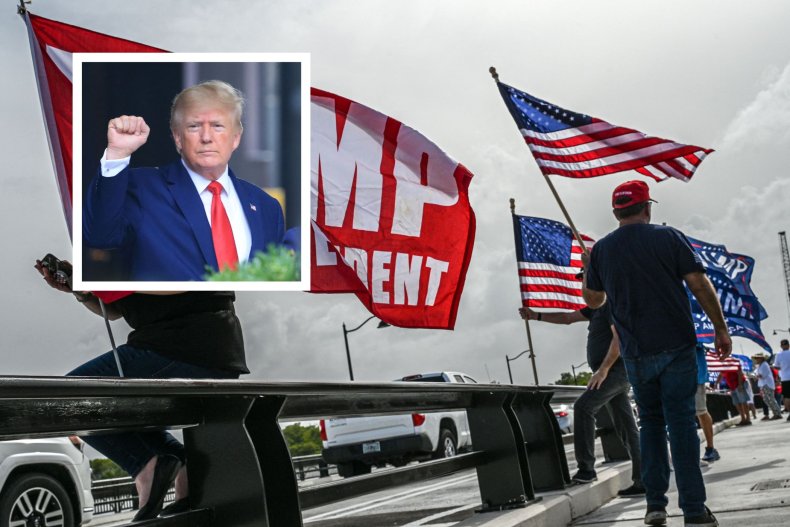
Supporters of former US President Donald Trump gather near his residence at Mar-a-Lago in Palm Beach, Florida, on August 9, 2022. Inset, Former U.S. President Donald Trump leaves Trump Tower to meet with New York Attorney General Letitia James
GIORGIO VIERA/GETTY