Categories
Saved Web Pages

Russia Reactivates Its Trolls and Bots Ahead of Tuesday’s Midterms

06misinfo-russia-02-1-473b-facebookJumbo

Researchers have identified a series of Russian information operations to influence American elections and, perhaps, erode support for Ukraine.

  • Send any friend a story

    As a subscriber, you have 10 gift articles to give each month. Anyone can read what you share.

    Give this articleGive this articleGive this article
The St. Petersburg building that is said to be the site of the Russian Internet Research Agency. Cybersecurity researchers have tied the agency to a new Russian misinformation effort.

The St. Petersburg building that is said to be the site of the Russian Internet Research Agency. Cybersecurity researchers have tied the agency to a new Russian misinformation effort.Credit…Mstyslav Chernov/Associated Press

Steven Lee Myers

By Steven Lee Myers

Steven Lee Myers, who has reported from Russia and China, writes about misinformation and is based in San Francisco.

Nov. 6, 2022, 5:00 a.m. ET

The user on Gab who identifies as Nora Berka resurfaced in August after a yearlong silence on the social media platform, reposting a handful of messages with sharply conservative political themes before writing a stream of original vitriol.

The posts mostly denigrated President Biden and other prominent Democrats, sometimes obscenely. They also lamented the use of taxpayer dollars to support Ukraine in its war against invading Russian forces, depicting Ukraine’s president as a caricature straight out of Russian propaganda.

The fusion of political concerns was no coincidence.

The account was previously linked to the same secretive Russian agency that interfered in the 2016 presidential election and again in 2020, the Internet Research Agency in St. Petersburg, according to the cybersecurity group Recorded Future.

It is part of what the group and other researchers have identified as a new, though more narrowly targeted, Russian effort ahead of Tuesday’s midterm elections. The goal, as before, is to stoke anger among conservative voters and to undermine trust in the American electoral system. This time, it also appears intended to undermine the Biden administration’s extensive military assistance to Ukraine.

“It’s clear they are trying to get them to cut off aid and money to Ukraine,” said Alex Plitsas, a former Army soldier and Pentagon information operations official now with Providence Consulting Group, a business technology company.

The campaign — using accounts that pose as enraged Americans like Nora Berka — have added fuel to the most divisive political and cultural issues in the country today.

It has specifically targeted Democratic candidates in the most contested races, including the Senate seats up for grabs in Ohio, Arizona and Pennsylvania, calculating that a Republican majority in the Senate and the House of Representatives could help the Russian war effort.

The campaigns show not only how vulnerable the American political system remains to foreign manipulation but also how purveyors of disinformation have evolved and adapted to efforts by the major social media platforms to remove or play down false or deceptive content.

Last month, the Federal Bureau of Investigation and the Cybersecurity and Infrastructure Security Agency issued an alert warning of the threat of disinformation spread by “dark web media channels, online journals, messaging applications, spoofed websites, emails, text messages and fake online personas.” The disinformation could include claims that voting data or results had been hacked or compromised.

The agencies urged people not to like, discuss or share posts online from unknown or distrustful sources. They did not identify specific efforts, but social media platforms and researchers who track disinformation have recently uncovered a variety of campaigns by Russia, China and Iran.

Recorded Future and two other social media research companies, Graphika and Mandiant, found a number of Russian campaigns that have turned to Gab, Parler, Getter and other newer platforms that pride themselves on creating unmoderated spaces in the name of free speech.

These are much smaller campaigns than those in the 2016 election, where inauthentic accounts reached millions of voters across the political spectrum on Facebook and other major platforms. The efforts are no less pernicious, though, in reaching impressionable users who can help accomplish Russian objectives, researchers said.

“The audiences are much, much smaller than on your other traditional social media networks,” said Brian Liston, a senior intelligence analyst with Recorded Future who identified the Nora Berka account. “But you can engage the audiences in much more targeted influence ops because those who are on these platforms are generally U.S. conservatives who are maybe more accepting of conspiratorial claims.”

Many of the accounts the researchers identified were previously used by a news outlet calling itself the Newsroom for American and European Based Citizens. Meta, the owner of Facebook and Instagram, has previously linked the news outlet to the Russian information campaigns centered around the Internet Research Agency.

The network appears to have since disbanded, and many of the social media accounts associated with it went dormant after being publicly identified around the 2020 election. The accounts started becoming active again in August and September, called to action like sleeper cells.

Nora Berka’s account on Gab has many of the characteristics of an inauthentic user, Mr. Liston said. There is no profile picture or identifying biographical details. No one responded to a message sent to the account through Gab.

The account, with more than 8,000 followers, posts exclusively on political issues — not in just one state but across the country — and often spreads false or misleading posts. Most have little engagement but a recent post about the F.B.I. received 43 responses and 11 replies, and was reposted 64 times.

Since September the account has repeatedly shared links to a previously unknown website — electiontruth.net — that Recorded Future said was almost certainly linked to the Russian campaign.

Electiontruth.net’s earliest posts date only from Sept. 5; since then, it has posted articles almost daily ridiculing President Biden and prominent Democratic candidates, while criticizing policies regarding race, crime and gender that it said were destroying the United States. “America under Communism” was one typical headline.

The articles all have pseudonyms as bylines, like Andrew J, Truth4Ever and Laura. According to Mr. Liston, the website domain was registered using Bitcoin accounts.

Electiontruth.net lists a cafe in Cotter, Ark., as its contact. The cafe has closed, replaced by the Cotter Bridge Market. The market’s owners said they knew nothing about the website.Credit…Trent Bozeman for The New York Times

For its contact information, electiontruth.net lists a cafe inside a converted gas station in Cotter, Ark., a town of 900 people on a bend in the White River. The cafe has closed, however, and been replaced by Cotter Bridge Market, a produce shop and deli whose owners said they knew nothing about the website. No one at Election Truth responded to a request for comment submitted through the site.

Mr. Liston said that links to electiontruth.net appeared to be closely coordinated with the accounts on Gab linked to the Russians.

In another campaign, Graphika identified a recent series of cartoons that appeared on Gab, Gettr, Parler and the discussion forum patriots.win. The cartoons, by an artist named “Schmitz,” disparaged Democrats in the tightest Senate and governor races.

One targeting Senator Raphael Warnock of Georgia, who is Black, employed racist motifs. Another falsely claimed that Representative Tim Ryan, the Democratic Senate candidate in Ohio, would release “all Fentanyl distributors and drug traffickers” from prison.

The cartoons received little engagement and did not spread virally to other platforms, according to Graphika.

A recurring theme of the new Russian efforts is an argument that the United States under President Biden is wasting money by supporting Ukraine in its resistance to the Russian invasion that began in February.

Nora Berka, for example, posted a doctored photograph in September that showed President Volodymyr Zelensky of Ukraine as a bikini-wearing poll dancer being showered with dollar bills by Mr. Biden.

“As working class Americans struggle to afford food, gas, and find baby formula, Joe Biden wants to spend $13.7 billion more in aid to Ukraine,” the account posted. Not incidentally, that post echoed a theme that has gained some traction among Republican lawmakers and voters who have questioned the delivery of weapons and other military assistance.

“It’s no secret that Republicans — that a large portion of Republicans — have questioned whether we should be supporting what has been referred to as foreign adventures or somebody else’s conflict,” said Graham Brookie, senior director of the Digital Forensics Lab at the Atlantic Council, which has also been tracking foreign influence operations.

The F.B.I. and the Cybersecurity and Infrastructure Security Agency did not respond to requests for comment about the Russian efforts. Mr. Brookie called the revived accounts “recidivist behavior.” Gab did not respond to a request for comment.

As before, it may be hard to measure the exact impact of these accounts on voters come Tuesday. At a minimum, they contribute to what Edward P. Perez, a board member with the OSET Institute, a nonpartisan election security organization, called “manufactured chaos” in the country’s body politic.

While Russians in the past sought to build large followings for their inauthentic accounts on the major platforms, today’s campaigns could be smaller and yet still achieve a desired effect — in part because the divisions in American society are already such fertile soil for disinformation, he said.

“Since 2016, it appears that foreign states can afford to take some of the foot off the gas,” Mr. Perez, who previously worked at Twitter, said, “because they have already created such sufficient division that there are many domestic actors to carry the water of disinformation for them.”
Categories
Saved Web Pages

Always Remember What Putin Represents and why his Russia has to be Defeated – Kyiv Post – Ukraine’s Global Voice

000_1mx5cz.jpg

When I hear of skepticism among Americans around the idea of Russian interference in U.S. elections, I laugh to myself. Even before the war of 2022, Russian interference in the lives of Ukrainians was a verified fact of life. They hindered our ability to market our natural resources, bribed our politicians, and stole our land through previous (2014) incursions into Crimea and Donbas.

For many years, Russia has been conducting a full-blown hybrid war against us, involving not only military destruction, but cyberattacks, economic warfare and a plethora of lies and disinformation.

But one instance was personal to me – a millennial Ukrainian – in a different way. On one occasion in 2020, I found myself watching Russian journalists broadcast a lie that I was pregnant with Ukraine President Volodymyr Zelensky’s baby. For eleven minutes, live on Russian television, six experts discussed a nonexistent affair and pregnancy.

The disinformation spread so widely throughout the former Soviet Union that I even received calls from places like Belarus and Kyrgyzstan. Of course, the real target of this disinformation attack was not me, but the first couple of Ukraine – Zelensky and his wonderful and inspirational wife Olena. But, above all, it showed the depths to which Russia was willing to go in pursuit of dominance over its perceived competitors.

From 2019-2021 I was press secretary to Zelensky. It was a post I earned thanks to a career in journalism and in competition with thousands after he opened the job to the public following his 2019 election. It was a first, fair hiring process for a top-level government position in Ukraine.

During the two years I served, I was in the room for key meetings with the leaders of Europe as Zelensky made his debut on the international stage. I was there receiving the media calls to the Ukraine government press office in the wake of then President Donald Trump’s wild threats to our relationship with the U.S.

This move weakened our standing in the world at a critical period when Russia’s President Vladimir Putin was looking to assert his claims to the independent, ex-Soviet states that surround Russia. Those threats resulted in Trump’s first impeachment when he unsuccessfully demanded Zelensky conduct a sham investigation into the Biden family.

A president devoted and diligent

While Trump and Putin were playing their dirty games, Zelensky tried to remind the world and Ukraine that politics should serve the people. He made every meeting and decision based on his understanding of how it would affect the people. He could really care about the problems of an ordinary person he didn’t know if he found out about them.

Once, during a photo shoot, a representative of a French publication told a story about a resident of the Luhansk region. The photographer divided the story into several parts and told each one as he took pictures of Zelensky from a new angle. With the last click of the camera, the story ended. It was a sad story of an abandoned old man with a disability who was confined to a bed in a war zone and needed medical care.

This was one of those stories that didn’t make it into the media. Zelensky wrote down the old man’s personal information in a notebook with a pen and immediately called the head of the Luhansk region to have this man taken to a safe place and given the necessary care.

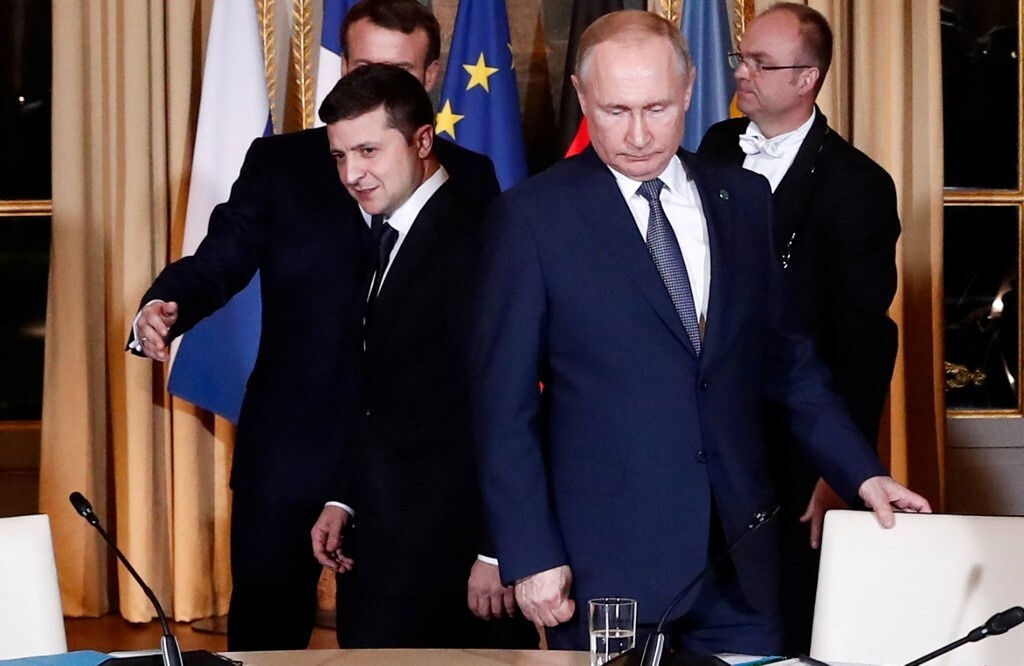
And I was there for the first Normandy format meeting in 2019, renewed after three years of frozen dialogue. This used to be the negotiation format where the four leaders of Germany, France, Ukraine and Russia were seeking ways to achieve peace in Donbas. There, Zelensky proved himself to be a wise and dutiful negotiator – vociferously consulting prepared notes and scribbling more as he met with Presidents Emmanuel Macron and Vladimir Putin, and Chancellor Angela Merkel.

A president detached and dangerous

Putin, today’s enemy to Ukraine’s existence, on the other hand, was isolated and surrounded by aged advisors. He clearly felt uncomfortable. Every now and then, he called someone over from his team to verify some point of information. He frequently avoided giving direct answers to questions and spat out claims that Russia was not a participant in the war in Donbas – a fact everyone at the table knew was not true.

It showed what Putin was, years before he launched the illegal war in Ukraine that he fights today. A man detached from truth, held up by feckless advisors who won’t coax him to sensibility or peace.

There is no winning in waiting for a rational response from Putin’s Russia. He will only escalate until he cannot anymore.

I’d advise all to watch out for their next elections, especially as the world grows used to Russian aggression through military might. In the abstract it might seem small to make a claim of sexual perversion against a foreign leader for the sake of harming his political standing, but know this is but a small sample of the all-out assault on the truth that Russia performs in traditional and social media against its targets.

Putin’s view of Russia as on par with the U.S., Europe, and China on the world stage demands attention at all times and at all costs, in ways both large and small. The U.S. and leaders of Europe must understand this, and they must understand the full scope of what is at stake in Ukraine.

We’ve fought hard and shown what the new Ukraine – the democratic freedom-loving Ukraine – can muster against great odds, but we will still need help.

We need help for ourselves and for the cause of liberty against the autocratic desires of Putin’s Russia. He has openly stated he will not stop at Ukraine, launching open threats against the U.S., Poland, Sweden and Finland during the course of this war alone.

The War in Ukraine is Zelensky’s war to save his own people, yes. But it is also a war to preserve a way of life for all who hold faith in democracy and representative government. I do hope this, the fight of our lives, will remain in the world’s thoughts as we enter another crucial period in Putin’s war on freedom.

Iuliia Mendel is a journalist, author of “The Fight of Our Lives,” and a former press secretary for Ukrainian President Volodymyr Zelensky.

The views expressed are the author’s and not necessarily of Kyiv Post.

Categories
Saved Web Pages

Donald Trump Ordered To Testify In January 6 Capitol Riot Case

Donald Trump Ordered To Testify In January 6 Capitol Riot Case

The panel subpoenaed Donald Trump Friday to testify on his involvement in Capitol riot violence.

Washington:

Lawmakers probing the 2021 attack on the US Capitol subpoenaed former president Donald Trump Friday to testify on his involvement in the violence, in a major escalation of their sprawling inquiry.

The summons came after the House panel of seven Democrats and two Republicans voted unanimously last week to compel Trump’s appearance before investigators.

It requires the 76-year-old Republican to produce documents by November 4 and to appear for a deposition beginning on or around November 14 — the Monday after the crucial November 8 midterm elections.

“As demonstrated in our hearings, we have assembled overwhelming evidence, including from dozens of your former appointees and staff, that you personally orchestrated and oversaw a multi-part effort to overturn the 2020 presidential election and to obstruct the peaceful transition of power,” the committee told Trump in a letter.

Trump, who urged his supporters to “fight like hell” in a fiery speech near the White House on January 6, 2021, was impeached for inciting the mob to storm Congress later that day to halt the peaceful transfer of power to Joe Biden.

The letter accuses Trump of bidding to overturn the election despite knowing claims of fraud had been overwhelmingly rejected by more than 60 courts and refuted by his campaign staff and senior advisors.

“In short, you were at the center of the first and only effort by any US president to overturn an election and obstruct the peaceful transition of power, ultimately culminating in a bloody attack on our own Capitol and on the Congress itself,” it added.

Without confirming Trump had received the subpoena, his lawyer David Warrington said his team would “review and analyze” the document and “respond as appropriate to this unprecedented action.”

The White House declined to comment on the matter but offered the broad statement that it is “important to get to the bottom of January 6.”

– Aggressive escalation –

Subpoenas from the panel have proved difficult to enforce, with former White House aide Steve Bannon the only target convicted of contempt of Congress for refusing to comply.

Bannon was sentenced to four months in prison on Friday, although he remains out on bail pending an appeal.

Trump is notorious for his ability to run down the clock on congressional investigations and legal action, and it remains highly unlikely that he would agree to give evidence.

The subpoena expires in any case with the new congressional term in January. Republicans are expected to win back the House of Representatives in November’s elections, and plan immediately to end the investigation.

But the move marks an aggressive escalation of the probe, which has issued more than 100 subpoenas and interviewed more than 1,000 people since its launch in 2021.

While no sitting president has ever been forced to testify before Congress, lawmakers have summoned several former presidents to discuss their conduct in office.

Trump’s compliance would mean testifying under oath and could result in being charged with perjury were he to lie.

If he refuses to comply, the full House can hold him in criminal contempt in a vote recommending him for prosecution, as it did with Bannon.

– ‘Clear and present’ danger –

The panel unveiled reams of evidence across eight hearings in the summer on the former president’s involvement in a complex series of connected schemes to overturn the 2020 election.

Witness testimony provided stunning examples of Trump and his allies pressuring election officials and trying to get lawfully cast votes nullified in swing states, and of Trump’s inertia amid the mob uprising.

The committee also pressed its position that Trump — who continues to be a wellspring of disinformation about the 2020 presidential election — remains a “clear and present” threat to democracy.

Lawmakers plan to release a final report by the end of the year.

The committee has not announced whether it will make direct criminal referrals over the Capitol attack, although the move would amount to little more than a gesture as the Justice Department is already investigating.

The list of records that Trump is required to produce includes all of his communications on the day of the insurrection, as well as various categories of messages in the weeks leading up to the riot.  

Investigators specifically mention Signal, suggesting the committee has determined that Trump used the encrypted communications app while participating in the plot.

The software allows users to have messages delete automatically within any time period selected.

The requested documents include any Signal communications between Trump and far-right militias such as the Oath Keepers and Proud Boys.

(This story has not been edited by NDTV staff and is auto-generated from a syndicated feed.)

Categories
Saved Web Pages

Far Right’s Rise in Israel Driven by Anxiety and Fear

merlin_215490585_be5d7f23-1bf0-4faf-9bac

To win election, Benjamin Netanyahu and his far-right allies harnessed perceived threats to Israel’s Jewish identity after ethnic unrest last year and the subsequent inclusion of Arab lawmakers in the government.

  • Send any friend a story

    As a subscriber, you have 10 gift articles to give each month. Anyone can read what you share.

    Give this articleGive this articleGive this article
Supporters of Benjamin Netanyahu last month during a Likud party rally in Sderot, Israel. A far-right alliance, Religious Zionism, has given back to Mr. Netanyahu his parliamentary majority.

Supporters of Benjamin Netanyahu last month during a Likud party rally in Sderot, Israel. A far-right alliance, Religious Zionism, has given back to Mr. Netanyahu his parliamentary majority.Credit…Amit Elkayam for The New York Times

Patrick Kingsley
Nov. 5, 2022, 10:58 a.m. ET

LOD, Israel — The sectarian unrest between Arabs and Jews that swept across Israeli cities in May 2021 helped end Benjamin Netanyahu’s last term in office. Seventeen months later, fallout from that same unrest has helped put him back in power — at the head of one of the most right-wing coalitions Israel has ever known.

Last year’s riots, in places like Lod, a central city with a mixed Arab and Jewish population, helped nudge Naftali Bennett — a onetime ally of Mr. Netanyahu — toward breaking ranks. Mr. Bennett ran on the promise of trying to heal Israel’s sectarian divides, and he formed a rival coalition with centrist, leftist and Arab lawmakers that ousted Mr. Netanyahu from office last June.

Right-wing Jewish voters this past week punished Mr. Bennett for that decision, which they grew to see as a betrayal of Israel’s Jewish identity. His party suffered a wipeout in the general election on Monday, while support for a more extreme alliance doubled. And it is that far-right alliance, Religious Zionism, that has given back to Mr. Netanyahu his parliamentary majority.

“Nobody who voted for Bennett looked at what happened over the last year and thought, ‘Let’s do that again,’” said Noam Dreyfuss, a community organizer in Lod who voted for Mr. Bennett in 2021.

“Most of us voted this time for Religious Zionism,” Mr. Dreyfuss said. With Religious Zionism, he added, “What you vote for is what you get.”

An event on Friday that was organized by Noam Dreyfuss, a community organizer in Lod who voted for Naftali Bennett in 2021 but for Religious Zionism this year.Credit…Amit Elkayam for The New York Times
Mr. Dreyfuss on Friday in Lod. With Religious Zionism, he said, “What you vote for is what you get.”Credit…Amit Elkayam for The New York Times

Israel’s rightward shift began decades ago and accelerated after the second Palestinian intifada, or uprising, in the early 2000s. A wave of Palestinian terrorist attacks at the time swayed many Israelis toward the right-wing narrative that Israel had no partner for peace.

Israel’s lurch toward the far right in this election, however, was also born from more recent fears about Israel losing its Jewish identity.

The 2021 riots occurred against the backdrop of unrest in Jerusalem and the outbreak of war between Israel and Gazan militants. The unrest saw two Arabs and two Jews killed, hundreds injured and thousands arrested, most of them Arabs. Among Arabs, the fallout fueled a sense of discrimination and danger. Among Jews, it fed fears of an enemy within — Israel’s Arab minority, which forms about a fifth of the population of nine million.

Ever since, the riots have become a shorthand among some Jews for wider anxiety about other kinds of threats, including deadly attacks on Israelis and unrest in southern Israel this year.

The formation of a unity government last summer that included right-wingers like Mr. Bennett as well as Arab Islamists was partly rooted in political pragmatism, but it also aimed to salve the wounds of the riots and encourage greater Jewish-Arab partnership.

Yet to many right-wing voters, it was seen as a betrayal. They perceived the coalition’s dependence on Raam, the Arab party that sealed the government’s majority, as a danger to the state’s Jewish character. The efforts by Jewish-led leftist parties in the coalition to secularize aspects of Israeli public life, like permitting public transportation on the Jewish Sabbath, also exacerbated fears that Israel’s Jewishness was under threat.

Mr. Netanyahu’s main far-right ally, Itamar Ben-Gvir, campaigned on a promise to tackle perceived lawlessness, end perceived Arab influence on government and strengthen Israel’s Jewish identity.

Itamar Ben-Gvir, Mr. Netanyahu’s main far-right ally, during a night walk with supporters last month in Jerusalem.Credit…Avishag Shaar-Yashuv for The New York Times

Mr. Ben-Gvir’s main campaign slogan asked: “Who’s the landlord here?”

Critics of Mr. Ben-Gvir focus on his history of extremism and antagonism toward Arabs.

As a young man, he was convicted of racist incitement and support for a terrorist group. He was barred from army service because Israeli officials deemed him too extremist. He was a follower of a rabbi who wanted to strip Arab Israelis of their citizenship. Until 2020, he hung in his home a large photograph of a Jewish extremist who shot dead 29 Palestinians in a West Bank mosque in 1994. Today, he still wants to deport anyone he deems disloyal to Israel.

But many of Mr. Ben-Gvir’s new supporters saw someone else: a straight-talker who recognized their anxieties and proposed a response.

“People voted for him, not necessarily because they are racists, but because they thought he might be a strong leader that could bring order to the street,” said Shuki Friedman, the vice president of the Jewish People Policy Institute, a Jerusalem-based research group that focuses on Jewish identity.

The streets of Lod on Friday. Sectarian unrest swept across Israeli cities, including Lod, last year.Credit…Amit Elkayam for The New York Times
Hussen Shehada, the father of the former Lod city councilor Fida Shehada, picking olives in his garden on Friday in Lod.Credit…Amit Elkayam for The New York Times

Mr. Ben-Gvir’s rise was propelled by Israel’s “general shift to the right, fears over personal security and fears for the Jewish character of the state,” Dr. Friedman said.

Among the Palestinian minority, which fears Mr. Ben-Gvir’s rise, the fallout from the riots also prompted electoral consequences in places like Lod.

If the riots briefly raised questions for Jewish Israelis about the future of a Jewish homeland, they also left Palestinian Israelis feeling terrified and discriminated against.

Nationally, the vast majority of those arrested in the riots were Arabs, leading to accusations of systemic bias.

In Lod, a group of Jews accused of killing an Arab resident were quickly released and acquitted, while several Arabs suspected of killing a Jew were detained and charged with murder.

In this past week’s election, this sense of disproportion helped bolster Balad, a small Arab party that won three times more votes in Lod than the other Arab-led parties combined. Its leader, Sami Abu Shehadeh, became known for defending the city’s Arab residents in the riots’ aftermath.

Ms. Shehada on Friday outside her home in Lod. She voted this past week for Balad, a small Arab party that won three times more votes in Lod than the other Arab-led parties combined.Credit…Amit Elkayam for The New York Times

“Sami was here with the people after the events of May,” said Fida Shehada, a former Lod city councilor who voted Balad for the first time. “It’s natural for people here to support him.”

Known in Arabic as Lydda or Lydd, Lod’s recent tensions exacerbate longstanding Palestinian trauma. During the wars surrounding the creation of the state of Israel in 1948, after local Arabs and their allies refused the partition proposed by the United Nations, many Palestinian residents of the city were expelled and never allowed to return.

Mr. Ben-Gvir’s new supporters say they do not necessarily agree with all of his positions.

Rinat Mazuz-Bloch, a youth group leader, voted for Mr. Bennett in 2021 and Mr. Ben-Gvir in 2022 — but not out of a desire for revenge.

“People didn’t vote Ben-Gvir because we want to hit the Arabs back,” Ms. Mazuz-Bloch said. “They’re here and we need to relate to them.”

But, she added, “We have to say out loud that this is a Jewish state.”

Rinat Mazuz-Bloch, a youth group leader, on Friday with her family in their home in Lod. She voted for Mr. Bennett in 2021 and Mr. Ben-Gvir in 2022.Credit…Amit Elkayam for The New York Times
A game of table tennis on Friday in the backyard of Omri Saar, a city councilman for Likud in Lod.Credit…Amit Elkayam for The New York Times

Mr. Dreyfuss, the community organizer, said that he was not necessarily opposed to Arab participation in government, and that he accepted that Raam, the small Arab party that formed part of the departing government, made a sincere effort to accept Israel’s status as a Jewish state.

But Mr. Dreyfuss still believes that an Arab party should not hold the balance of power in the government, as Raam did.

“The mistake is to be dependent on them,” he said. “Once you have a majority, then you can add them.”

Mr. Ben-Gvir’s success was rooted not only in his hard-line approach to Arabs, but also in his opposition to the departing government’s moves to secularize aspects of Israeli public life. And some simply voted for him to enlarge his party’s presence in Parliament, making it harder for Mr. Netanyahu’s party, Likud, to form an alliance with centrists.

“The vote for Religious Zionism was a vote for a clearer and sharper position,” said Omri Saar, a city councilman for Likud in Lod.

After Mr. Bennett’s U-turn in 2021, Mr. Saar said, “There’s no doubt many chose a more extreme party than Likud to make sure that their vote would stay in the right-wing camp.”

And to Mr. Saar, that was a positive thing, even if it cost Likud a few votes itself. “It’s good that we have someone who can pull us in the right direction,” he said.

Religious Zionism posters affixed to a house on Friday in Lod. Credit…Amit Elkayam for The New York Times

Mr. Dreyfuss, whose organization was subject to an arson attack during the riots, also denied that Mr. Ben-Gvir’s election would be so harmful to Arabs.

By cracking down on lawlessness in Arab neighborhoods, Mr. Ben-Gvir would improve the personal safety of any Arab who was not involved in crime, Mr. Dreyfuss said.

“Everyone can live here,” Mr. Dreyfuss said.

“But they need to remember that we’re the landlords here,” he added.

Reporting was contributed by Jonathan Shamir from Lod, Israel; Hiba Yazbek and Myra Noveck from Jerusalem; and Carol Sutherland from Moshav Ben Ami, Israel.

Categories
Saved Web Pages

New York City psychiatrist Pamela Buchbinder masterminded hit on her ex-lover, judge says

buchbinder-sentencing.jpg

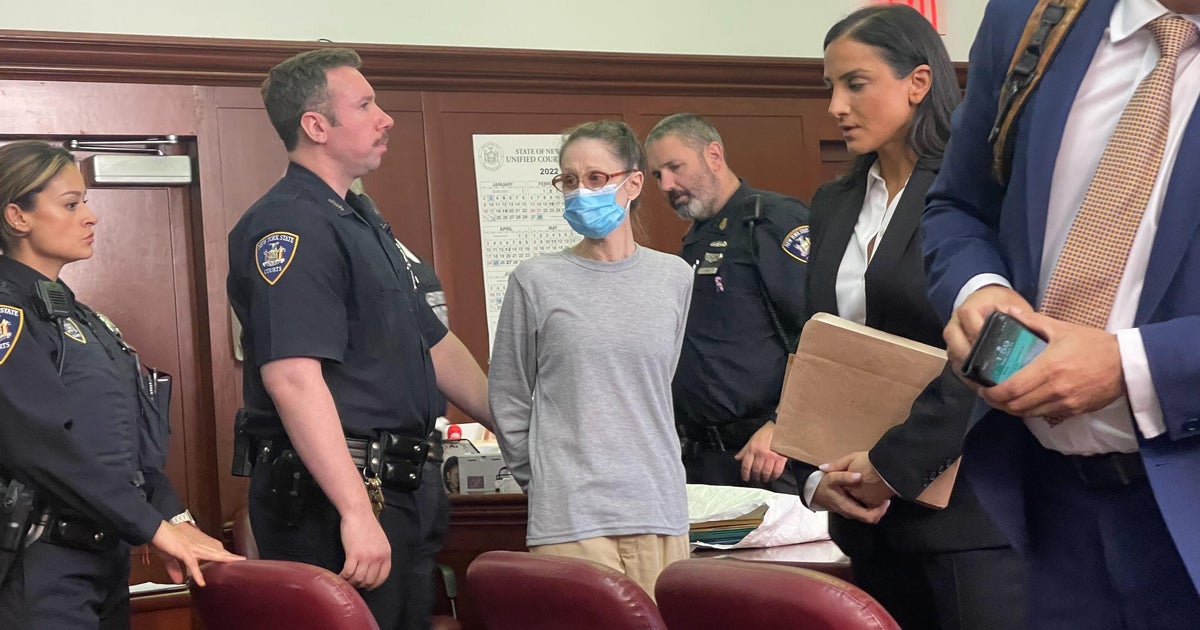
On Oct. 11, 2022, Manhattan psychiatrist Pamela Buchbinder was sentenced to 11 years in prison after admitting her guilt in connection with one of the most bizarre crime stories in New York City history — the brutal and nearly fatal 2012 attack on her ex-lover and the father of her child, Dr. Michael Weiss.

According to authorities, the assault on Weiss in his Manhattan office was the climax of an epic “War of the Roses” battle between two extremely well-educated and respected psychiatrists. “48 Hours” correspondent Peter Van Sant exclusively reports in “The Psychiatrist and The Selfie,” airing Saturday 9/8c on CBS and streaming on Paramount+.

What made the crime even more astonishing, according to Van Sant, was the fact that the alleged “hit man” turned out to be Buchbinder’s troubled young cousin, Jacob Nolan, who claimed that Buchbinder had manipulated him into carrying out the murder for her.

Back in 2012, Buchbinder and Weiss were going through a bitter custody battle over their son, Calder, then 4 years old, and fighting over visitation. Yet, despite their arguing, it turned out Weiss took out a $1.5 million life insurance policy for his son, and gave his mother, Buchbinder, control in the event of Weiss’s death, starting on Nov. 9, 2012.

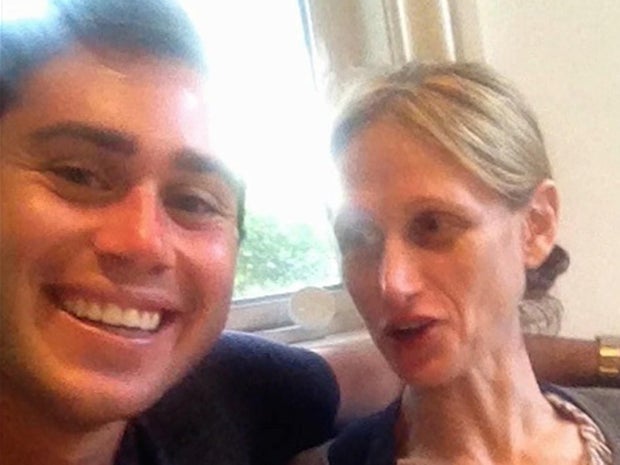
Jake Nolan and and Dr. Pamela Buchbinder Jake Nolan and and Dr. Pamela Buchbinder

By then, authorities said, Buchbinder allegedly had taken her bipolar cousin under her wing, seemingly to help him deal with his mental health and drug and alcohol issues.  But instead of healing Nolan, the son of a wealthy real estate investor, authorities claimed Buchbinder slowly brainwashed and weaponized him into carrying out the hit.

Buchbinder accompanied Nolan to a local Home Depot on Nov. 11, 2012, where they purchased a sledgehammer, according to authorities. And the following day, Nolan took the sledgehammer and a knife Weiss had given Buchbinder as a gift, and used a map Buchbinder drew of Weiss’s office to surprise him. 

But the assault did not kill Weiss. Instead, the two ended up fighting in the office, with both of them left bloodied, and badly hurt.

According to prosecutors, while they waited for paramedics to arrive to take them to the hospital, Nolan snapped a selfie, which he sent to Buchbinder to show her what happened to him.

Crime scene photos: NYC sledgehammer attack Crime scene photos: NYC sledgehammer attack 13 photos

Nolan’s defense attorney, Steven Brounstein, later said that Nolan was “putty” in Buchbinder’s hand.

And at Nolan’s trial in 2016, Brounstein acknowledged Nolan committed the assault, but he argued that Buchbinder took advantage of Nolan’s fragile and submissive mental health, and therefore was not fully responsible for his actions.

Prosecutors, however, disagreed, insisting that being bipolar did not mean that Nolan did not understand what he was doing, or had been turned into a “babbling idiot who had no control over his facilities.”

In the end, a Manhattan jury took less than an hour to convict Nolan, then 23, and he was sentenced to more than nine years in prison. But his conviction did not end speculation that his older psychiatrist cousin was also responsible for the brutal assault.

In 2017, prosecutors eventually charged Buchbinder in connection with the attack, and she then spent five years on Rikers Island as her lawyers wrangled over the case and the courts were shut down due to the pandemic.

Meanwhile, her high-powered lawyers, Ronald Fishetti, Eric Franz and Monica Nejathaim, claimed Buchbinder was not only innocent, but there were legitimate explanations about her relationship with Nolan, and the evidence against her.

But last September, Buchbinder — looking rail-thin and gaunt — surprised the court by announcing she had reached a deal with prosecutors, and she pleaded guilty to lesser charges in exchange for 11 years in prison.

A month later, however, when she showed up for her routine sentencing, Buchbinder stunned the court again – this time saying she wanted to withdraw her plea. She claimed that on the day she pleaded guilty, she was exposed to mace on Rikers Island, did not take her medication, and inadvertently got a contact high when someone was smoking drugs on her bus ride to court.

Judge Thomas Farber, however, rejected her argument, and continued the sentencing, with Weiss then reading a victim’s impact statement in which he laid out how the attack left him with PTSD, and a fear that Buchbinder’s hatred for him will continue even after she is released from prison.

Then, Manhattan Assistant District Attorney Joel Seidemann took to the podium.

“I think it’s necessary to make the record straight,” Seidemann began. “The defendant tried to have Dr. Michael Weiss murdered … she hated his guts.”

“She sought to destroy him because of their failed relationship,” he continued. “She stood to control $1.5 million in life insurance on his life in the name of his son.”

Buchbinder responded succinctly. “If there was one true statement Mr. Seidemann said, I missed it,” she said.

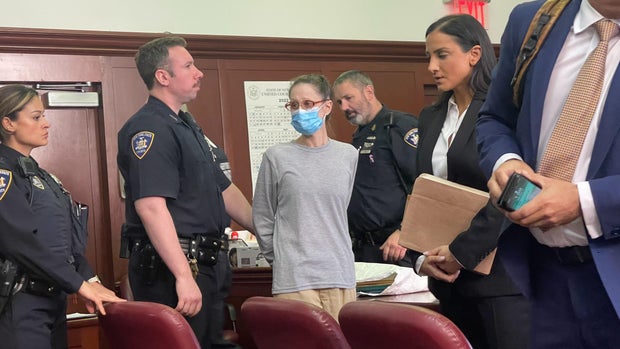
Pamela Buchbinder sentencing In 2017, Pamela Buchbinder was charged with second-degree attempted murder and first-degree attempted assault. In 2022 (pictured in center) she accepted a deal to spend 11 years in prison, in exchange for pleading guilty to attempted assault and a lesser charge in connection with Dr. Weiss’s attack. Murray Weiss

Finally, Farber sentenced Buchbinder to 11 years and issued an order of protection, but not before he had his say.

“There can be no doubt that if you plot to bash somebody’s head in with a sledgehammer that the intent is to cause his death,” the judge said.

Outside court after Buchbinder was led away in handcuffs, her attorneys said that with time off for good behavior, Buchbinder will be free in 2027 to start her life over, and try to re-establish her relationship with her son.

Categories
Saved Web Pages

Germany’s Scholz in China amid trade, Ukraine, rights issues

3000.jpeg

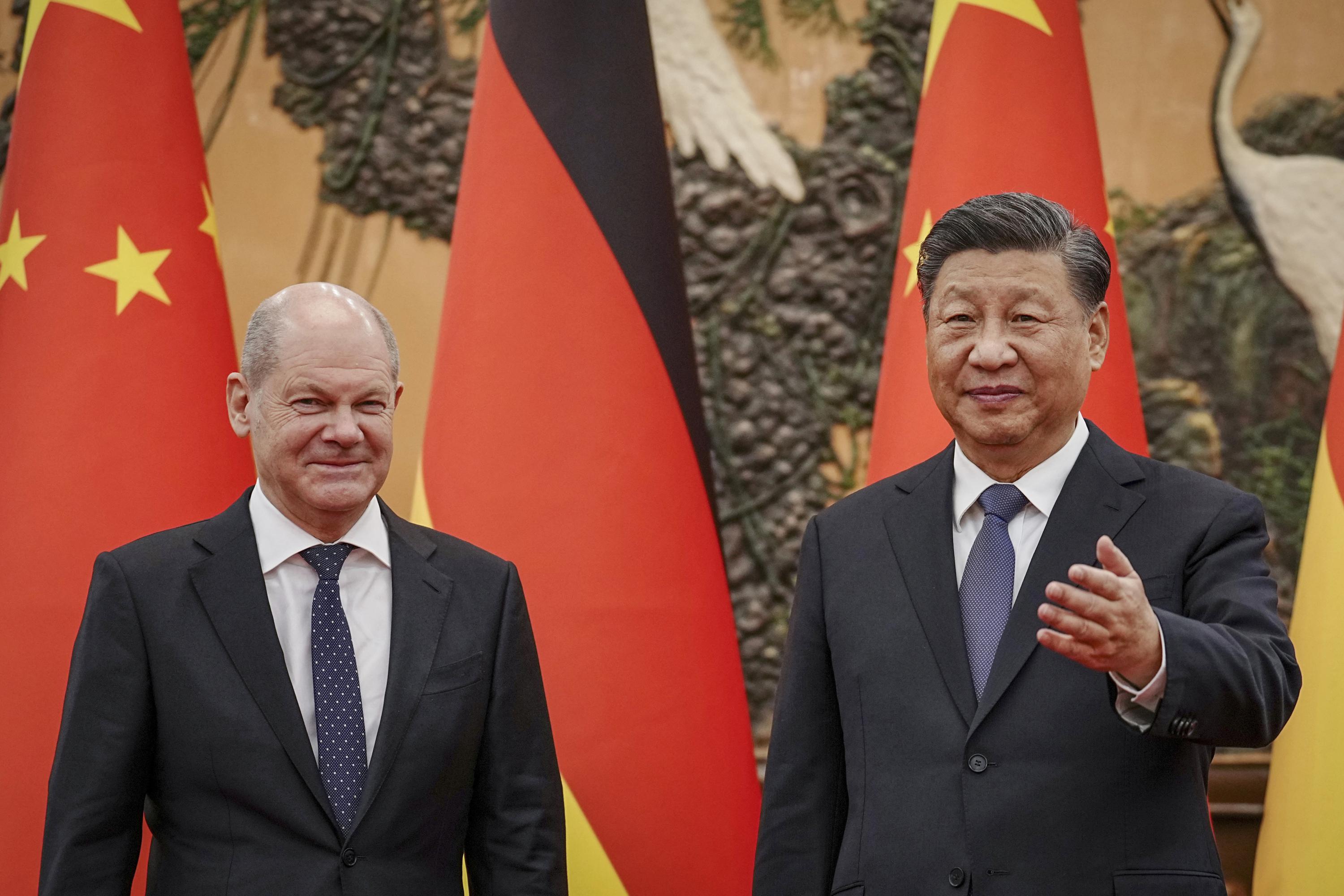
BEIJING (AP) — German Chancellor Olaf Scholz met with Chinese President Xi Jinping in Beijing on Friday for a one-day visit that has drawn criticism over China’s tacit support for Russia in its war on Ukraine and lingering controversies over economic ties and human rights issues.

Scholz, who is traveling with several top German business leaders, received a formal welcome from Xi, who was recently re-appointed head of the ruling Communist Party, at the Great Hall of the People in the heart of Beijing.

Xi noted that Scholz’s visit comes as the sides mark more than 50 years of diplomatic relations dating back to when the countries, despite their fierce Cold War rivalry, relaunched economic exchanges that remain a key part of the relationship to this day.

“At present, the international situation is complex and changeable,” Xi was quoted as saying by state broadcaster CCTV, without specifically mentioning Ukraine. “As influential powers, China and Germany should work together in times of change and chaos to make more contributions to world peace and development.”

In his opening remarks, Scholz referred directly to the conflict that has created millions of refugees and upended world food and energy markets, saying, “We come together at a time of great tension,” according to German news agency DPA.

“In particular, I want to highlight the Russian war against Ukraine, which poses many problems for our rules-based world order,” Scholz was quoted as saying.

Scholz also touched on global hunger, climate change and developing world debt as “important issues,” DPA reported.

Scholz, who relies on a coalition of his Social Democratic Party, the Greens and the Free Democratic Party, has come under criticism for making the visit to China so soon after the 69-year-old Xi’s triumph at last month’s congress, in which he was named to a third five-year term and packed the all-powerful Politburo Standing Committee with committed allies who support his vision of tighter control over society and the economy and a more confrontational approach to the West.

The visit also occurred amid rising tensions over Taiwan and follows a U.N. report that said Chinese human rights violations against Xinjiang’s Uyghurs and other ethnic groups may amount to “crimes against humanity.”

Scholz was accompanied on the trip by about a dozen top German business leaders, including the CEOs of Volkswagen, BMW, BASF, Bayer and Deutsche Bank, most of which are doing a thriving business in China. Scholz will also meet company representatives in Beijing.

That has some German observers questioning whether the country is becoming overly reliant on the Chinese market, just as it did with Russia for energy supplies.

Following lunch, Scholz and his delegation were to meet with Premier Li Keqiang, who nominally has responsibility over China’s economy.

Despite their political disputes, Scholz’s visit reflects the importance of Germany’s trade ties with the world’s second-largest economy.

In an article for the German daily Frankfurter Allgemeine Zeitung, Scholz said he was traveling to Beijing “precisely because business as usual is not an option in this situation.”

“It is clear that if China changes, the way we deal with China must also change,” Scholz said, adding that “we will reduce one-sided dependencies in the spirit of smart diversification.” Scholz also said he would address “difficult issues” such as the rights of ethnic minorities in Xinjiang, who have been detained in large numbers in what the U.S. and others have called a campaign of genocide.

Scholz is the first leader from the G7 group of industrialized nations to meet with Xi since the start of the global COVID-19 pandemic, which was first detected in China in 2019. The diplomatically delicate trip comes as Germany and the European Union work on their strategy toward an increasingly assertive and authoritarian Beijing.

Scholz’s messages will face close scrutiny, particularly at home where some have criticized him for normalizing China’s behavior. While his nearly year-old government has signaled a departure from predecessor Angela Merkel’s firmly trade-first approach, his trip follows domestic discord over a Chinese shipping company’s major investment in a container terminal in Germany’s crucial port of Hamburg.

With China still imposing tough COVID-19 restrictions, his delegation is moving in an anti-virus bubble, undergoing testing and won’t stay in Beijing overnight. At just 11 hours, it is the shortest trip ever to China by a German leader. The aircrew who brought him to Beijing flew to South Korea to wait out the visit and avoid having to be quarantined.

German officials say the trip is intended to probe where China is going and what forms of cooperation are possible.

An official pointed to China’s “particular responsibility” as an ally of Russia to help end the war in Ukraine and press Moscow to tone down its nuclear rhetoric; to concerns over tensions in Taiwan and the broader region; to Germany’s desire for a “level playing field” in economic relations; and to Scholz’s current status as this year’s chair of the Group of Seven industrial powers.

Categories
Saved Web Pages

Ukrainian suicide drone boats packed with bombs are threatening Russia’s once feared Black Sea fleet, and it may not be able to stop them

63640c3cff27460018ed7ad0?width=1200&form

It did not annihilate any ships, but the assault on Russia’s Black Sea Fleet — using a swarm of unmanned vehicles in the air and sea — so angered the Kremlin, which dubbed it a “terrorist act,” that it briefly pulled out of a deal to protect grain shipments from Ukraine, in the process threatening food supplies to some of its few remaining allies. 

Kyiv has not taken credit for the hours-long attack, marked by its novel use of armed, unmanned boats powered by jet ski engines, but it is almost certainly responsible. And experts say the relatively minor damage it apparently caused last week at Sevastopol — a city with a critical naval base in Crimea illegally annexed by Moscow in 2014 — should not obscure the strategic importance of cheaply but effectively demonstrating that nowhere is safe for Russian forces.

“It’s partly a PR victory for Ukraine,” Bryan Clark, a retired US Navy officer and expert on autonomous weapons at the Hudson Institute, told Insider. “But it’s also going to force the Russians to put some kind of defensive measures in place.”

“It’s a way of throwing sand in the gears of the Russian military operation,” he continued, “because now Russia has to spend money and time and people defending something that they previously thought was not under threat.”

—Rob Lee (@RALee85) October 29, 2022

Following the attack on the USS Cole in 2000, when extremists rammed an explosive-laden ship into the side of the American destroyer during a refueling stop in Yemen, the United States was put on notice that its naval assets could be harmed by a massively outgunned adversary. Today US ships at port are protected by harbor sentry boats as well as a floating security barrier that prevents small craft from approaching.

“This is the first time you’ve seen a naval drone be employed as part of a direct attack on a ship and actually cause some damage,” Clark said. “The Russians now are going to have to respect this threat and put fencing up, put floating security barriers up, put some watchstanders [sentries] up and arm them. It imposes a tax, if you will, on the Russians.”

Russia has not, to date, taken such steps to protect its Black Sea Fleet, a force which has participated in the missile barrages of Ukraine and lost its flagship in another stunning Ukrainian attack. That failure could be due to hubris — thinking Crimea is as safe as Russia proper. But it has now had its own USS Cole moment, one that reflects the dramatic strides in and easy accessibility of off-the-shelf technology.

“You can really create this thing from scratch — yourself,” Clark said.

Russian Navy cruiser Moskva in Sevastopol Crimea

Russian Navy missile cruiser Moskva docked in the bay of the Crimean city of Sevastopol, March 30, 2014. It was sunk in April after a Ukrainian attack. OLGA MALTSEVA/AFP via Getty Images

The ‘evolution’ of naval warfare

It could also give Russia pause should it consider another assault on the port city of Odesa. Nothing powered by a jet ski engine is going to be able to match the speed and range of a Russian ship at sea; when Ukraine sunk the cruiser Moskva, the former flagship of Russia’s Black Sea Fleet, it did so with a cruise missile. But a cluster of naval drones can wreak havoc when those ships approach the coast.

Stacie Pettyjohn, a senior fellow and director of the Defense Program at the Center for a New American Security, said Ukraine has already shown with its Sevastopol attack that it can threaten Russia’s navy despite losing most of its own naval assets when Russia took Crimea.

“It was really impressive from the perspective of the fact that the Ukrainians coordinated with these seven unmanned surface vehicles and, at the same time, had unmanned aerial vehicles attacking the base and the port simultaneously, which shows a good degree of coordination and discipline,” Pettyjohn told Insider. 

Russian commanders, from here on out, might now “limit what parts of the Black Sea that they’re patrolling,” she noted, forcing Moscow to rely more on its dwindling supply of long-range cruise missiles to strike at targets in Ukraine.

Naval drones won’t fundamentally alter the course of the conflict in Ukraine.. “It does give the Ukrainians a good capability that they can use,” Pettyjohn said. But, ultimately: “I’d say it’s more of an evolution than a revolution.”

Have a news tip? Email this reporter: cdavis@insider.com

Categories
Saved Web Pages

Amid Ukraine War, Putin is Changing How Russia is Governed

79247__7a00b7fc9107b5b2414c572b5b13928c.

When declaring martial law in Russian-occupied Ukraine last month, Russian President Vladimir Putin also handed special powers to regional authorities across Russia and created an influential new government body that is charged with coordinating supplies to the military.

To the average Russian, these changes might look trivial. But, step by step, Putin is laying the foundations for a fundamental restructuring of Russian politics.

As a result of decrees signed by Putin, regional governors can now limit civil liberties — and the federal government in Moscow has the scope to move the economy to a war footing. Different regions have been given different powers. For example, the authorities in annexed Crimea can temporarily resettle residents and put restrictions on those entering and exiting the region. In Moscow, the authorities can limit the movement of vehicles. Following October’s successful attack on the Crimean Bridge, infrastructure defenses are also being reinforced all over the country. 

Let down in Ukraine by his natural allies, the security services, Putin is now looking to senior figures in the civilian bureaucratic apparatus. And the Coordination Council, the government body which Putin set up in mid-October and which held its first meeting last week, is headed by Prime Minister Mikhail Mishustin. 

Essentially, Putin has directed the Council to transform the economy so it can sustain the needs of the Armed Forces in Ukraine. Specifically, it will set targets for supplying the army; control prices, suppliers and logistics; and build and equip barracks and other military facilities. 

Decisions taken by the Council are not only binding for officials, but also for businesses. Mishustin has already announced that much of Russia’s manufacturing sector, including small businesses, will be required to produce equipment for the army.

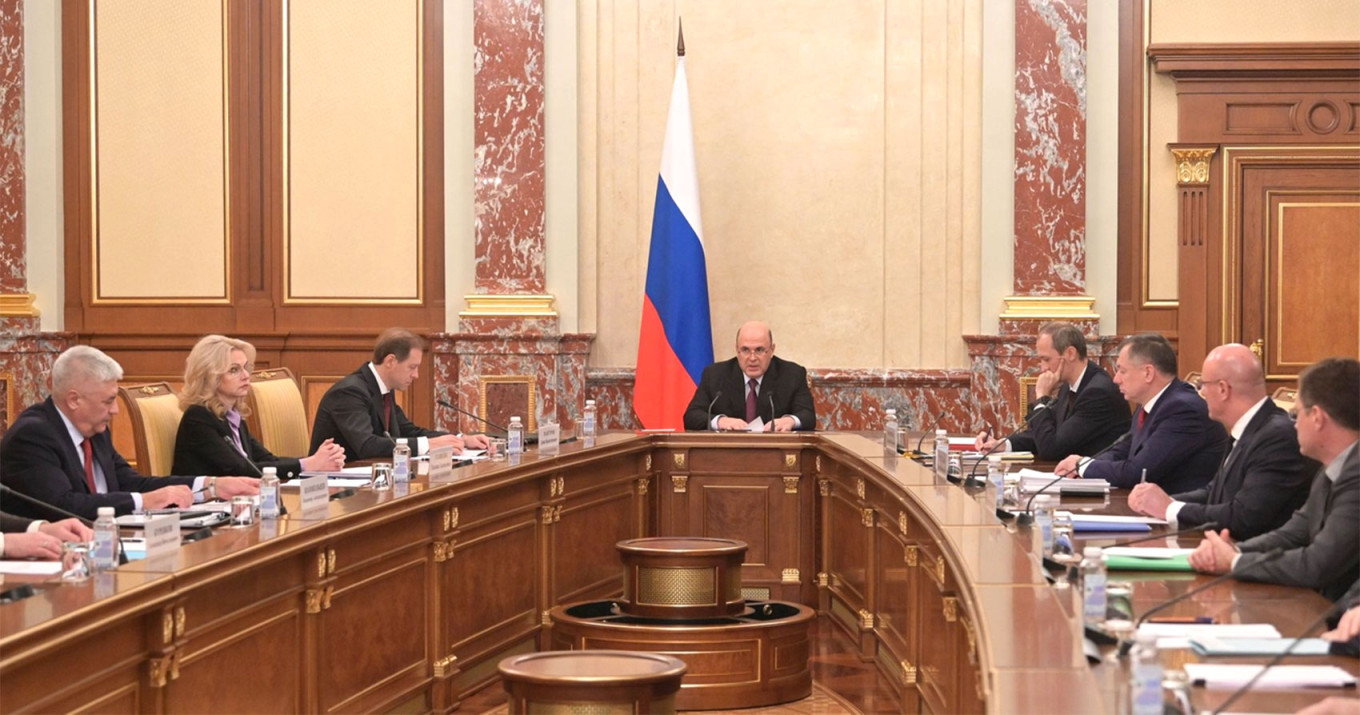
The first meeting of the Coordination Council. government.ru The first meeting of the Coordination Council. government.ru

Judging by the scope of its powers, the Council will — to some extent — supersede even the Russian government itself. In the thick of the fighting in Ukraine, Putin is effectively carrying out political reforms and restructuring his power vertical — in an attempt to win the war. In his first meeting with Council members, Putin said that the time had come to “update” Russia’s system of government. “This is precisely why… this Coordination Council was created,” he told the assembled group.

Rebuilding power structures in wartime like this is a de facto admission that the Defense Ministry has failed in its goals in Ukraine. Putin bet heavily on military success at the start of the war, but this never materialized.

Russian soldiers have complained for months about insufficient supplies of weapons, ammunition, medicine and rations. Things failed to improve even after Putin replaced veteran Deputy Defense Minister Dmitry Bulgakov in September. And when mobilization was announced at the end of September, the Defense Ministry’s failures were put on display for all to see.

From now on, civilian officials will be tasked with supplying the army. In a bottom-up decision-making process resembling that used during the coronavirus pandemic, the onus will be on the federal government and local governors, who have a better understanding of their local areas. In other words, the responsibility for unpopular new measures will be delegated to regional officials. Failure will be punished by Putin himself — by humiliation in front of the TV cameras.

Putin apparently believes that Russia’s handling of the pandemic was a success, despite the country having one of the world’s highest excess death numbers. The key — and possibly sole — criterion for judging this “success” is that coronavirus did not impact Putin’s personal popularity or threaten his grip on power.

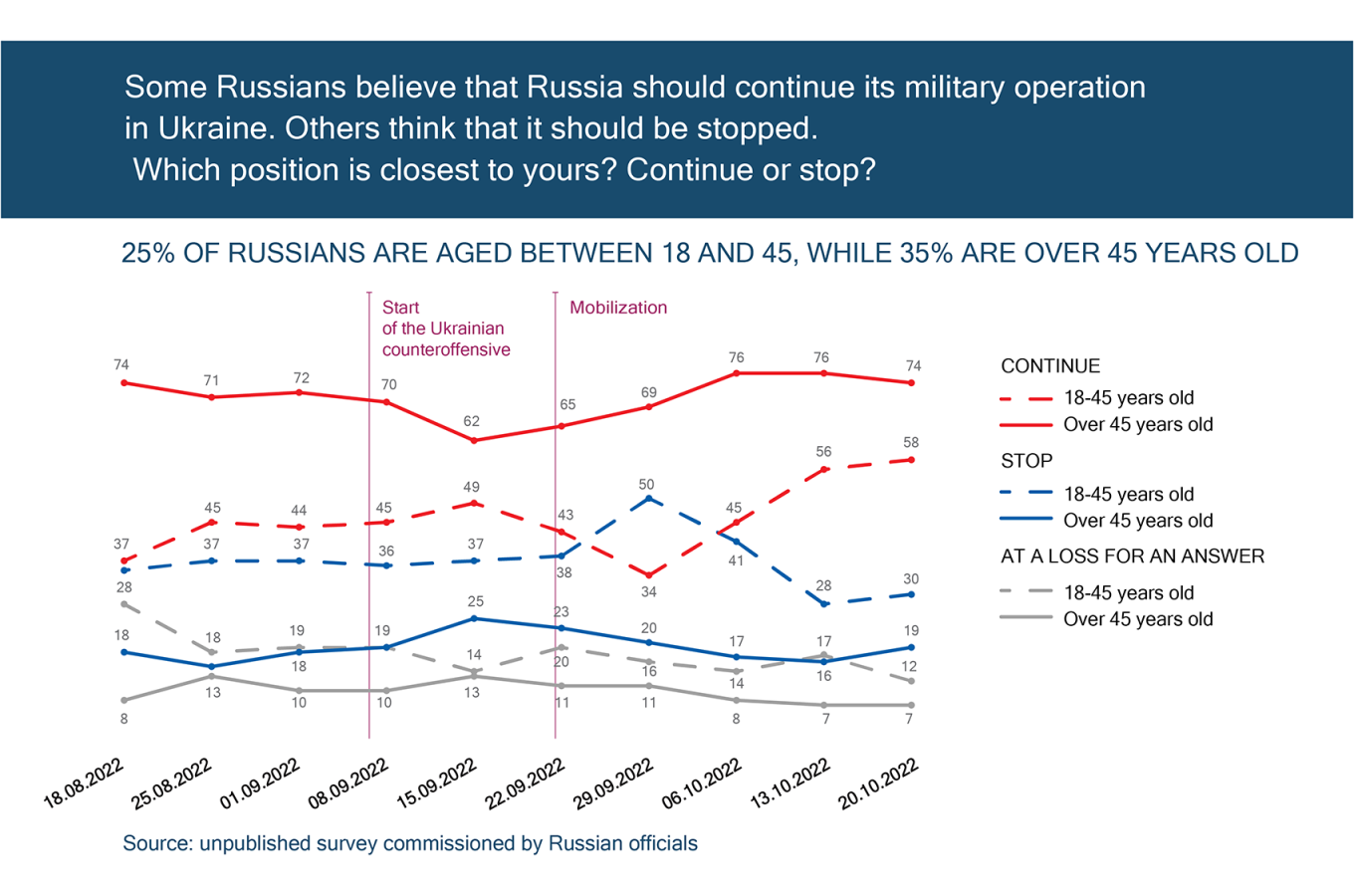
Of course, Putin closely monitors Russian public opinion when it comes to the war. In a copy we obtained of an unpublished survey for officials that was carried out by a Kremlin-controlled polling agency, the results reveal the Ukrainian counteroffensive and Russia’s mobilization announcement have shaken the public’s faith in what the Kremlin calls its “special military operation.”

Eng2.png

The survey suggested 68% of Russians believe the war should be continued and 22% that it should be halted. Although, it’s worth remembering that independent polling experts have warned about trusting the results of surveys when those publicly opposing the invasion can be jailed under wartime censorship laws. 

In line with Russian propaganda that likens the current conflict to World War II, some state-run media outlets have compared Putin’s new Council with Stalin’s State Defense Committee, which was established in 1941. The committee, which remained in operation until Nazi Germany was defeated four years later, helped transform the Soviet economy and its decisions were binding for all state bodies.

One high-ranking Russian official said he was certain that, regardless of politics, Putin’s decision is the right one in terms of management effectiveness. 

“After mobilization was announced, the scale of the task was extraordinary,” he said. “We need to calculate everything correctly: what people at the front will eat, what they will wear, etc.”

As a part of this, any Russian businesses that can be repurposed will be obliged to produce supplies needed by the Armed Forces. “For example, companies that are currently sewing car seat covers can start sewing military uniforms,” the official said.

Others, however, are less sure. Sergei Aleksashenko, a former deputy finance minister, said it’s too early to say whether Russia is mobilizing its economy. He told us there were never any market principles in state defense contracts. “The Defense Ministry twisted arms, issued orders and set its prices,” he said. 

The Coordination Council’s membership is composed of more civilian officials than military ones. Apart from Mishustin, it includes Moscow Mayor Sergei Sobyanin, deputy prime ministers and senior financial and economic managers (with the notable exception of the head of the Central Bank). Members from the so-called siloviki include the heads of the Defense Ministry, the Federal Security Service (FSB), the Foreign Intelligence Service, the National Guard, the Interior Ministry and the Emergency Situations Ministry.

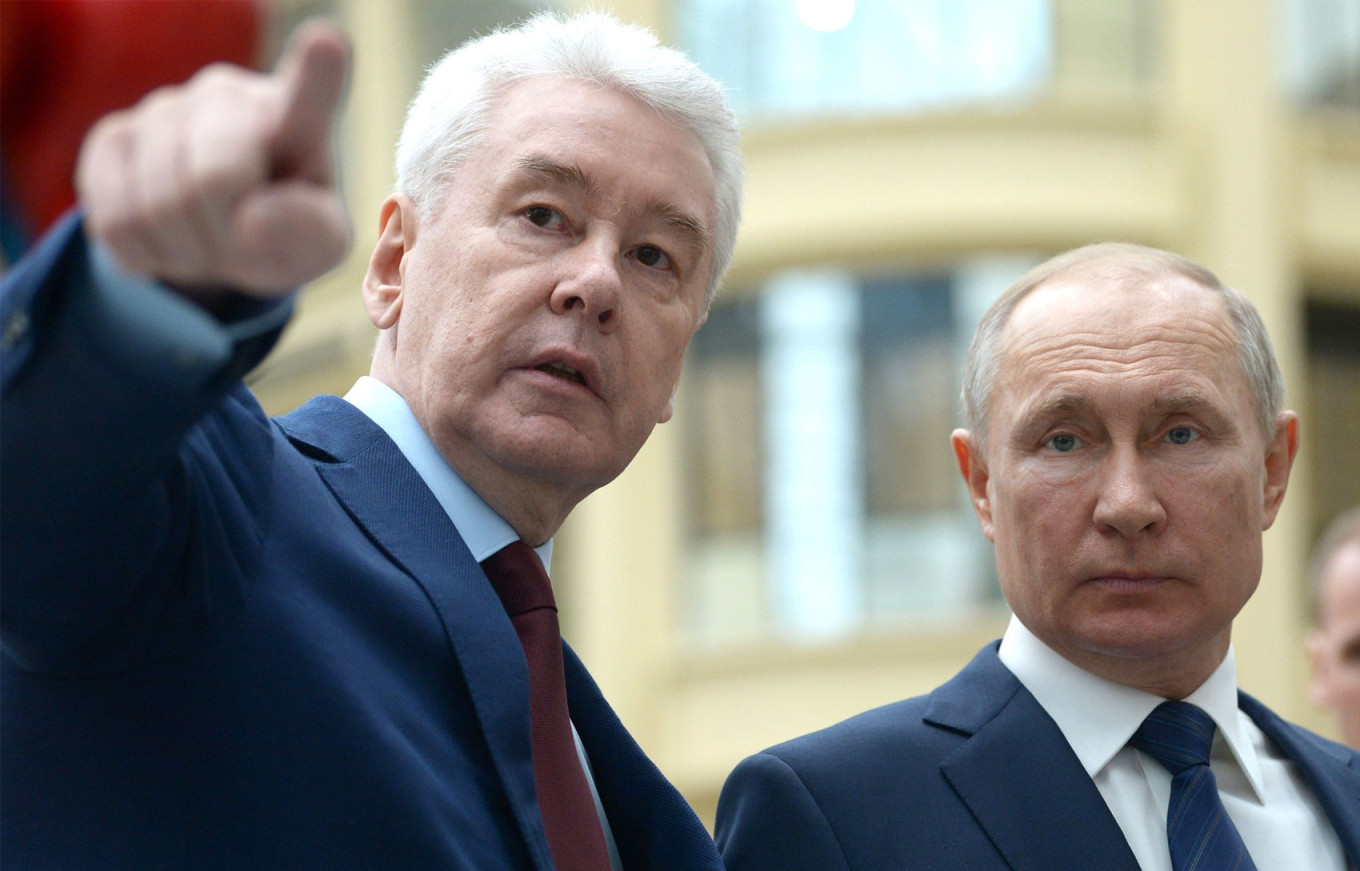
Putin and Moscow Mayor Sergei Sobyanin. kremlin.ru Putin and Moscow Mayor Sergei Sobyanin. kremlin.ru

Until recently, civilian officials were focused on maintaining economic stability and working to maintain the illusion among ordinary Russians that the war was something far away with few consequences for day-to-day life. Russia’s relatively successful insulation from the major economic shocks of sanctions — thanks to the efforts of the Central Bank and the government — has been key to preserving Putin’s popularity. 

But now, the president is pushing these same civilian officials to the fore. They are charged with solving the army’s supply problems and raising troop morale — by improving conditions for soldiers as well as ensuring that social benefits are awarded to their families and that they receive promised cash payouts. 

Mishustin is now the most senior manager of Russia’s war effort (after Putin). He will be aided in this role by the excellent relations he built with the FSB and other security agencies during his 10-year tenure leading the Federal Tax Service. However, he is also known for advocating closer ties to the West. He held onto these ambitions even after he became prime minister, and reportedly, for example, aspired to put forward another Russian bid to join the Organization for Economic Co-operation and Development (OECD).

Even now, Mishustin is far from a hawk. This is in stark contrast to former Prime Minister Dmitry Medvedev, who has emerged as one of the loudest pro-war voices among Russian officials. Our sources suggest that, while Mishustin is certainly no liberal, he has never really supported this war.

Mishustin’s old friend, Moscow Mayor Sobyanin, was also likely kept in the dark about Putin’s plans to invade Ukraine. Neither Mishustin nor Sobyanin have an FSB background and neither knew Putin during the early years of his career in St. Petersburg. Before the war, Sobyanin was even praised in the Western media, which highlighted the mayor’s interest in modern, Western urban design. Since February, Sobyanin has fought to minimize the impact of the war on Moscow — for example, city authorities have tried to make sure that not too many pro-war “Z” symbols are visible on Moscow’s streets.

Putin’s overhaul of government means that civilian officials — like Sobyanin and Mishustin — will now be unable to take a backseat. As it turned out, it is these civilian officials, not the siloviki, as many assumed, who form the backbone of the regime. These career bureaucrats, ultimately the most competent part of the system, include many who were horrified by the invasion. Now, Putin wants them to take on prominent roles in the ongoing war effort. 

Paradoxically, Putin’s security forces, in which he invested most of the country’s resources, proved unable to cope with the demands of the fighting.

In Putin’s new setup, Shoigu has been informally demoted. When the Crimean Bridge was attacked, he lost his position as a battlefield leader. Instead, Putin placed General Sergei Surovikin in charge of Russia’s forces in Ukraine. Now, even military logistics have been taken away from the Defense Ministry, leaving Shoigu as a rank-and-file member of Mishustin’s Coordination Council. Shoigu is only entrusted with menial tasks, such as calling his foreign counterparts to frighten them with tall tales of a Ukrainian “dirty bomb” plot.

This doesn’t mean that Putin is about to abandon his old comrade Shoigu. That’s not his style. After all, replacing a defense minister in wartime, especially one who polls as the country’s second most popular political figure, would be seen by Putin as an admission of mistakes. That is something the president always tries to avoid.

You can read more by Farida Rustamova and Maxim Tovkailo on their Substack.

Categories
Saved Web Pages

Russia says world’s five nuclear powers ‘on brink of armed conflict’ – follow live

APTOPIX_Russia_Putin_70268.jpg?quality=7

Jump to content

NewsWorldEurope

Arpan Rai

Thursday 03 November 2022 05:21

Comments

Russia summons UK ambassador over Black Sea Fleet drone strike

Volodymyr Zelensky says Moscow’s attempted blackmail has failed as Vladimir Putin was forced to take a U-turn and resume the grain exports deal in Europe.

“Today, we have a significant diplomatic outcome for our country and the whole world – the Grain Export Initiative will continue being implemented. Russian blackmail has led nowhere,” Mr Zelensky said in his address last night.

Vladimir Putin resumed Moscow’s participation in a UN-brokered deal allowing Ukrainian grain exports after he was urged by western officials to “stop using food as a weapon.”

Russia suspended its involvement in the Black Sea Grain Initiative over the weekend, saying it could not guarantee the safety of civilian ships because of a major drone attack on Russian vessels in the Bay of Sevastopol on the Crimean peninsula.

Elsewhere, the US has collected evidence which indicates that North Korea is covertly supplying Russia with a “significant” number of artillery shells for its war in Ukraine, it has been revealed.

Pyongyang was attempting to obscure the shipments by funnelling them through countries in the Middle East and North Africa, White House national security spokesperson John Kirby said.

1667452472

The world’s five big nuclear powers are teetering “on the brink of a direct armed conflict”, Russia has claimed, warning of catastrophic consequences.

Blaming the west for “provocation”, Moscow ramped up the nuclear rhetoric, pinpointing “irresponsible and impudent actions aimed at undermining our national security”.

The statement by the foreign ministry said avoiding a nuclear clash was the country’s first priority, and that Russia stood by a joint declaration with the US, China, Britain and France in January affirming their joint responsibility for avoiding a nuclear war.

Read the full story here:

Avoiding ultimate clash is top priority, claims Moscow as it blames West for ‘provocation’

Arpan Rai3 November 2022 05:14
1667448811

Foreign secretary James Cleverly will urge international allies to bolster resilience against Vladimir Putin’s “weaponisation” of energy and food at a meeting of G7 foreign minister in Germany today.

Mr Cleverly will warn that the Russian leader is plunging the world’s poorest “further into despair”.

He is set to stress the need to work together in the face of economic insecurity driven by Moscow’s war on its neighbour.

Mr Cleverly will accuse the Russian president of exploiting a scheme to export grain from Ukraine to low-income countries around the globe – claiming this shows his willingness to “hold the world’s vulnerable hostage”, the foreign office said.

Read the full story here:

James Cleverly is set to stress the need to work together in the face of economic insecurity driven by Moscow’s war on its neighbour.

Arpan Rai3 November 2022 04:13
1667446520

At least four Russian ammunition depots situated in Ukraine’s south have been destroyed, the Ukrainian military’s southern unit said today.

The Ukrainian salvo of 150 fire missions and an airstrike on Russian positions traced in Ukraine’s south have destroyed four Russian depots and tanks carrying fuel, the southern command said in an update.

Now, Russia now has seven ships in the Black Sea, including one warship and one surface-to-surface missile carrier with eight Kalibr cruise missiles on board, the military unit said.

Arpan Rai3 November 2022 03:35
1667445927

Volodymyr Zelensky said Moscow’s blackmail has failed and remained fruitless as Vladimir Putin has been forced to take a U-turn and resume the grain exports deal in Europe.

“Today, we have a significant diplomatic outcome for our country and the whole world – the Grain Export Initiative will continue being implemented. Russian blackmail has led nowhere,” Mr Zelensky said in his address last night.

He added: “Once again, everyone saw that there is only one threat to global food security in our region, and that is the Russian Federation, and no one else.”

The Ukrainian president thanked the UN and secretary general Antonio Guterres for “personally responding in a principled and effective way.”

“This entire situation was immediately reflected in the stock exchanges’ indicators – we see some decrease in the price of both wheat and corn. Every time Russian blackmail intensifies, food prices rise. And every time the world does not give in to blackmail, foodstuffs become cheaper,” Mr Zelensky said.

Mr Zelensky said that the phantom threat of the global food crisis would have not existed had there been no attack from Russia on Ukraine.

“Because every Russian missile that hits our ports, grain storage facilities, and power plants that power our agricultural production ultimately affects the standard of living of tens of millions of people in many countries. This includes Egypt, Algeria, Somalia, Sudan, Lebanon, Bangladesh, India, China, Indonesia, Vietnam…,” he said.

Arpan Rai3 November 2022 03:25
1667445253

Good morning, welcome to our coverage of the Ukraine war on Thursday, 3 November.

Arpan Rai3 November 2022 03:14
1667413883

Thanks for following our live updates, we are pausing our coverage for the evening.

Katy Clifton2 November 2022 18:31
1667410216

Pakistan has denounced statements from a Russian senator that accused Islamabad of helping Ukraine develop nuclear bombs, calling them illogical.

Pakistan’s ministry of foreign affairs said on Tuesday that the statements were baseless and sought an explanation from its Russian counterpart.

“We are surprised by such an unfounded and baseless statement. It is without any rationale, and is entirely inconsistent with the spirit of Pakistan-Russia relations,” foreign office spokesperson Asim Iftikhar said in a statement.

Ukrainian specialists travelled to Pakistan to discuss nuke technologies, claimed a Russian senator

Emily Atkinson2 November 2022 17:30
1667408409

Ben Wallace pledges to ‘fight for as much money as he can get’ to fund defence department
Emily Atkinson2 November 2022 17:00
1667406609

Russian president Vladimir Putin has been urged by Western officials “stop using food as a weapon” after Moscow agreed to rejoin the UN-brokered deal allowing Ukraine grain exports.

Russia suspended its involvement in the Black Sea Grain Initiative over the weekend, saying it could not guarantee the safety of civilian ships crossing the Black Sea because of an attack on its fleet there.

The Kremlin claimed there was a major drone strike on Russian vessels in the Bay of Sevastopol on the Crimean peninsula – an area Mr Putin annexed from Ukraine in 2014 – part of which it said had originated from within the grain export corridor. Ukraine has said that was a false pretext.

Read our full report here:

Russia suspended its involvement in the Black Sea Grain initiative over the weekend

Emily Atkinson2 November 2022 16:30
1667404816

Vladimir Putin has said Moscow reserved the right to withdraw again from a UN-brokered grain shipment deal that it had returned to – but that if it did so, it would not impede grain shipments from Ukraine to Turkey.

In televised remarks, Putin said that, in return for rejoining the agreement, Russia had demanded guarantees that Ukraine would not launch attacks from parts of the Black Sea covered by the deal.

Emily Atkinson2 November 2022 16:00

Registration is a free and easy way to support our truly independent journalism

By registering, you will also enjoy limited access to Premium articles, exclusive newsletters, commenting, and virtual events with our leading journalists

Already have an account? sign in

Registration is a free and easy way to support our truly independent journalism

By registering, you will also enjoy limited access to Premium articles, exclusive newsletters, commenting, and virtual events with our leading journalists

Already have an account? sign in

(FILE) Russian President Vladimir Putin chairs a Security Council meeting via videoconference

Sputnik

Please refresh the page or navigate to another page on the site to be automatically logged inPlease refresh your browser to be logged in

Categories
Saved Web Pages

MSN

WP Radio
WP Radio
OFFLINE LIVE