Categories
Saved Web Pages

U.S. and Allies Pledge Additional Arms for Ukraine, but Kyiv Wants More

15ukraine-nato-facebookJumbo.jpg

Some NATO countries are wary of sending heavy weapons, hoping for a negotiated truce, but the alliance insists publicly that it is committed to helping Ukraine defeat Russia.

Secretary of Defense Lloyd J. Austin III, left, and Gen. Mark A. Milley, the chairman of the Joint Chiefs of Staff, speaking at a NATO ministers’ meeting on Wednesday in Brussels.

Secretary of Defense Lloyd J. Austin III, left, and Gen. Mark A. Milley, the chairman of the Joint Chiefs of Staff, speaking at a NATO ministers’ meeting on Wednesday in Brussels.Credit…Valeria Mongelli/Agence France-Presse — Getty Images

Steven Erlanger

BRUSSELS — President Biden on Wednesday announced a further $1 billion in weapons and aid for Ukraine, as the United States and its allies met to craft a response to Ukraine’s increasingly urgent calls for advanced arms to beat back Russia’s invasion.

The package, detailed by Secretary of Defense Lloyd J. Austin III after a meeting with allies at NATO headquarters in Brussels, includes more long-range artillery, anti-ship missile launchers and more rounds for howitzers and for a sophisticated American rocket system on which Ukrainians are currently being trained. Overall, the United States has now committed about $5.6 billion in security assistance to Ukraine since Russia invaded on Feb. 24.

Mr. Biden said in a statement that he had told President Volodymyr Zelensky of Ukraine about the new weapons during a 40-minute call Wednesday morning. Mr. Zelensky and his aides have recently ramped up public pressure on the West to supply vastly more of the sophisticated armaments it has already sent, questioning their allies’ commitment to the Ukrainian cause and insisting that nothing else can stop the inexorable, brutal Russian advance in eastern Ukraine.

But Western officials and arms experts caution that flooding the battlefield with advanced weapons is far slower and more difficult than it sounds, facing obstacles in manufacturing, delivery, training and compatibility — and in avoiding depletion of Western arsenals.

President Biden speaking in Philadelphia on Wednesday.Credit…Kenny Holston for The New York Times

The leaders of the European Union’s largest countries — Germany, France and Italy — are expected to pay their first visit to Mr. Zelensky in Ukraine on Thursday, in a show of solidarity, but it remains unclear whether they will have much to offer. The leaders — Chancellor Olaf Scholz of Germany, President Emmanuel Macron of France and Prime Minister Mario Draghi of Italy — have all expressed the desire for a more rapid conclusion of the war through peace talks with Russia, raising hackles in Ukraine.

Mr. Austin, together with Ukraine’s defense minister, Oleksii Reznikov, met at NATO headquarters with defense officials from some 45 countries supporting Ukraine, to try to assess what weapons Ukraine needs right now and how its allies can best provide them.

“We can’t afford to let up, and we can’t lose steam,” Mr. Austin said in opening the gathering, urging allies to redouble their efforts to help Ukraine.

“We must intensify our shared commitment to Ukraine’s self-defense, and we must push ourselves even harder to ensure that Ukraine can defend itself, its citizens and its territory,” he added.

He said that Germany would offer Ukraine three long-range, multiple-launch artillery rocket systems with ammunition. Slovakia is promising helicopters and ammunition, and Canada, Poland and the Netherlands pledged more artillery.

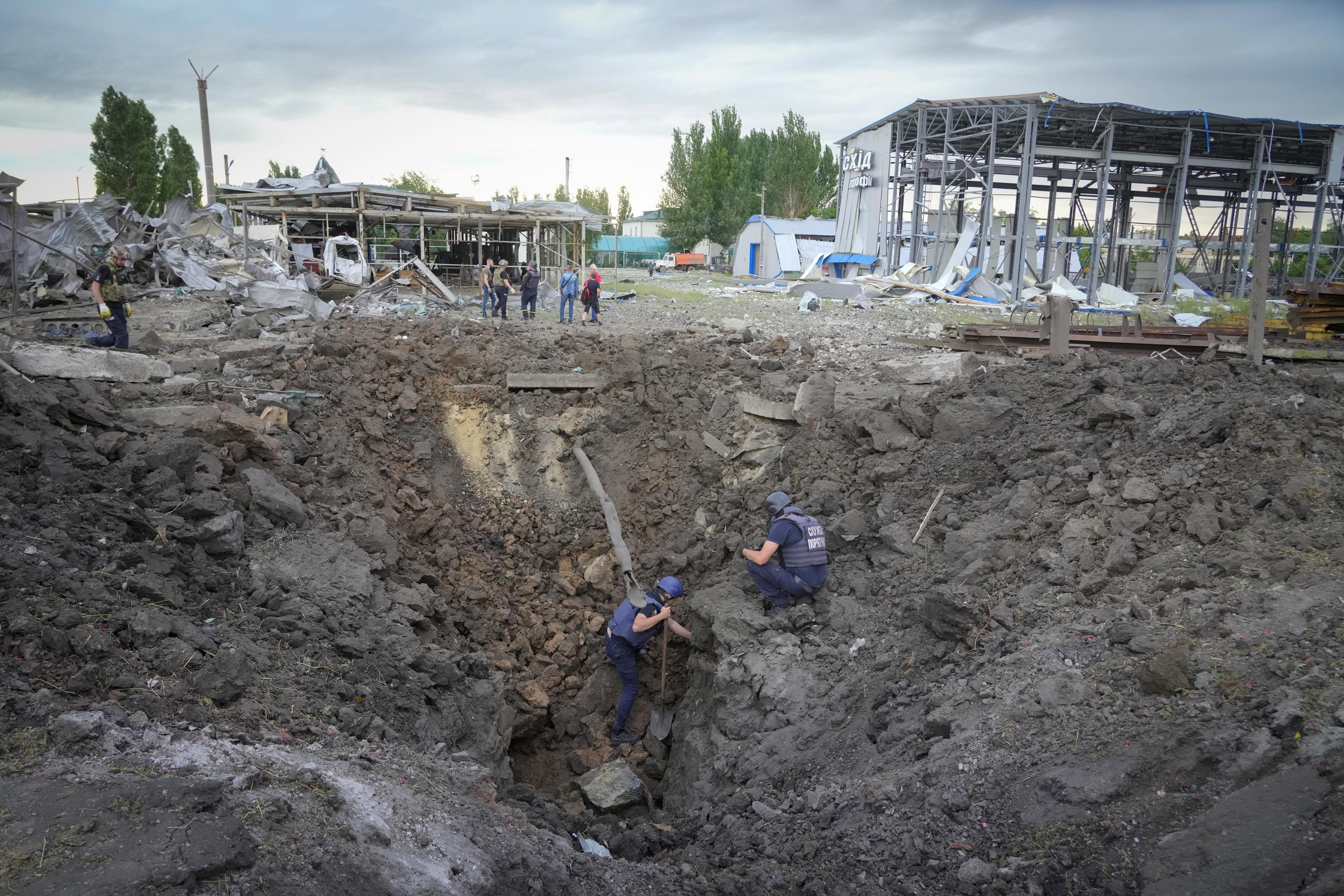
President Vladimir V. Putin’s forces, advancing in the Donbas region of eastern Ukraine, are close to capturing Sievierodonetsk, the city that has been the focus of the fighting, and Ukrainian troops in the area are at risk of encirclement. In what seems like a replay of the siege in Mariupol, hundreds of civilians and troops are sheltering in bunkers below an industrial plant in the city.

Ukraine, Mr. Austin said, “is facing a pivotal moment on the battlefield.”

A destroyed building on Wednesday in Lysychansk, the sister city to the besieged Sievierodonetsk.Credit…Tyler Hicks/The New York Times

The Russian military in Donbas is relying heavily on its immense advantage in long-range artillery, pounding Ukrainian soldiers — as well as cities and towns — from a distance before trying to move in. The Ukrainians have drawn them into some close-quarters combat, with both sides reportedly suffering heavy casualties.

“It is vital to hold on there, in Donbas,” Mr. Zelensky said in a video address early Wednesday. “The more losses the enemy suffers there, the less power they will have to continue the aggression.”

Gen. Mark A. Milley, the chairman of the Joint Chiefs of Staff, said in Brussels that not just the sovereignty of Ukraine was at stake, but “the rules-based international order is also under threat due to the actions of Russia in Ukraine.”

NATO defense ministers are preparing for the alliance’s annual summit in Madrid this month, where it will unveil its first new strategic concept since 2010, when it described Russia as a potential partner. The new stance is being negotiated in drafts but is understood to set out a direction for NATO that sees Russia as an adversary, and mentions the threats posed to the trans-Atlantic alliance by China for the first time.

The ministers are also discussing how to satisfy Turkey, which has put a hold on the membership applications of Sweden and Finland over larger concerns about Kurdish separatism and terrorism. In response to Mr. Putin’s invasion of Ukraine, the Swedes and Finns decided to abandon their long-held military nonalignment and join NATO.

Ukrainian officials have been pleading daily for more long-range artillery and complaining loudly that the West has been to slow to provide it. The howitzers and rocket launchers delivered or pledged by the United States and others fall far short of what Ukraine says it needs to match Russian firepower.

Mykhailo Podolyak, a leading adviser to Mr. Zelensky, said this week that Ukraine needs 1,000 155-mm howitzers, 300 multiple-launch rocket systems and 500 tanks, among other things, to achieve battlefield parity — several times as much heavy weaponry as has been promised.

A Ukrainian gun crew firing a 155-mm howitzer toward Russian positions in the Donetsk region of Ukraine last month. Ukraine says it needs hundreds more of the long-range weapons.Credit…Ivor Prickett for The New York Times

Mr. Austin and NATO insist they understand the urgency.

“Russia is using its long-range fires to try to overwhelm Ukrainian positions,” said Mr. Austin, a retired four-star Army general.

The most advanced weapons the United States has so far supplied Ukraine include four HIMARS truck-mounted multiple-launch rocket launchers, with rockets that have a range of up to 40 miles, greater than anything Ukraine currently possesses. The first Ukrainian team is scheduled to complete its training on the system on Wednesday, and it will be deployed in the battlefield next week, a Biden administration official said.

The package announced on Wednesday includes another three HIMARS launchers. Germany pledged three similar launchers, and Britain had previously promised three.

The new U.S. commitment also includes 18 M777 155-mm howitzers, in addition to 108 already delivered, and 36,000 shells for them.

Mr. Austin and General Milley pushed back on the charge that the allies were being too cautious in rushing advanced weapons to Ukraine, saying that everything was being done in coordination with Ukrainian military leaders.

“I think the international community has done a pretty good job of providing that capability. But it’s never enough,” Mr. Austin said. “And so we’re going to continue to work hard to move as much capability as we can as fast as we can.”

But promising weapons and delivering them are two different things.

It’s one thing to get a large howitzer or tank or thousands of artillery shells to Ukraine’s western borders. But given that NATO countries do not want to risk direct confrontation with Russian forces, transport from there must be done by Ukrainians or private contractors.

Simply getting the weapons across Ukraine to the eastern battlegrounds depends on railroads and transport networks that are being bombed and shelled by Russian forces to disrupt supply.

Shipments of American weapons, including Javelin antitank missiles, arriving in Ukraine in January.Credit…Brendan Hoffman for The New York Times

Ukraine’s military is running very low on shells for its artillery based on Soviet designs, some of it dating to the Soviet era, and Western countries do not make compatible ammunition. Former Soviet bloc countries like Poland have only so many munitions that are familiar to Ukrainian soldiers and work with their guns.

More modern Western equipment requires training, done in other countries, with those Ukrainians trained sent back to operate equipment or train others.

Modern weapons also require sophisticated maintenance, which takes further training, and American weapons generally do not use the metric system, which means different tools and wrenches.

And different NATO member countries have varying equipment requiring varying training and tools. The French have provided Ukraine some of the most sophisticated artillery in the world, the Caesar self-propelled howitzer. Like the American M777, it fires 155-mm shells, but operating the two guns is not the same.

And not only are sophisticated weapons systems expensive, but the supply is limited and production is often slow. Some countries sending arms to Ukraine have expressed fears of depleting their own stocks and weakening their national security, and some have secured commitments from the United States and others to provide replacements.

The United States has also been concerned that the Ukrainians not be given weapons with such long ranges that they can hit targets deep within Russia itself. So it did not immediately supply the HIMARS mobile rocket launcher, and it is not supplying the longest-range rockets the system can use.

American M142 HIMARS rockets being launched during a military exercise in Morocco last year.Credit…Fadel Senna/Agence France-Presse — Getty Images

There are also concerns about keeping control of advanced technology. For instance, there are efforts to get Ukraine more sophisticated anti-ship missiles, to drive the Russian navy further from the Ukrainian coast off Odesa. But those missiles include technology that can only be exported after obtaining special permission, and there are concerns that such weapons not fall into the hands of the Russians.

The United States and its allies have been careful to express sympathy for Ukraine’s plight, and not to say that Kyiv’s complaints about the pace of supply are unfair or unfounded.

“It’s an evolving list,” said the U.S. ambassador to NATO, Julianne Smith. “The list that they gave us early on in the conflict looks very different from the list that we’re talking about now. We were heavily focused in the beginning on air defense. We transitioned to a conversation about ammunition. We’ve had moments where we’ve talked about coastal defense. We’re talking about heavy rocket artillery. We have shifted the conversation.”

NATO member countries will continue to provide Ukraine with heavy weapons and long-range systems, and a new package of assistance to Kyiv will be agreed on by allies in consultation with Ukraine, NATO’s secretary general, Jens Stoltenberg, said before the defense ministers’ meeting Wednesday.

“Ukraine is in a really very critical situation, so there is an urgent need for support,” he said.

Eric Schmitt, Michael D. Shear and David E. Sanger contributed reporting from Washington.

Categories
Saved Web Pages

US sending Ukraine new $1 billion arms package amid grinding Donbas fight

L2NCHCXM7BDDXFPXUZDXATRD2Y.jpg

WASHINGTON ― The U.S. will send Ukraine another $1 billion in weapons to fight Russia, including Harpoon anti-ship launchers for the first time, and more ammunition for high-tech, medium-range rocket launchers, the Biden administration announced Wednesday.

The U.S. aid will include two Harpoon launchers and an unspecified number of Guided Multiple Launch Rocket System, or GMLRS, rockets for previously committed M142 High Mobility Artillery Rocket Systems, or HIMARS, U.S. Defense Secretary Lloyd Austin announced in Brussels. Also included are 18 M777 howitzers, 36,000 rounds of 155mm ammunition and thousands of secure radios.

Amid calls from Washington and Kyiv for more and faster shipments of weapons for Ukrainian forces, Austin and Gen. Mark Milley, the chairman of the U.S. Joint Chiefs of Staff, acknowledged Russia’s military superiority and defended U.S. and allied efforts to even the odds. With Ukrainian forces facing a tough fight for Eastern Ukraine, the U.S. has been sending arms meant to take out positions from which Russian forces launch brutal artillery barrages.

“When you’re in the fight, you can never get enough, and you can never get it quick enough,” Austin said at a press conference with Milley. “But having said all that, we’re going to work hard to make sure we’re doing everything humanly possible ― we’re going to continue to move heaven and earth to get them the capability that they need.”

The new U.S. aid uses a combination of $350 million in presidential authority to draw equipment from U.S. military stocks and $650 million in the separate Ukraine Security Assistance Initiative. Defense officials say the Pentagon plans to use USAI to buy truck-mounted Harpoon launchers, which the U.S. doesn’t operate, but the missiles themselves would come from allies and partners. Denmark previously committed to providing Harpoons to Ukraine.

Austin hosted a meeting of about 50 nations at NATO headquarters in Brussels to discuss the weapons deliveries to the invaded nation. Afterward, he highlighted three multiple-launch rocket systems and GMLRS ammunition for Ukraine from Germany, Mi-series helicopters and rockets from Slovakia and artillery donations from Canada, Poland and the Netherlands.

Though Russia has more artillery, it’s using it for mass fires and isn’t necessarily hitting military targets, as Ukrainian forces are, Milley said. He argued Russia’s slow-moving gains in the nearly four-month war don’t mean its victory in Eastern Ukraine is inevitable.

“War takes many, many turns, so I wouldn’t say it’s an inevitability, but I would say the numbers do favor the Russians. In terms of artillery, they do outnumber, they outgun and outrange … and they do have enough forces,” Milley said. “But the Russians have run into a lot of problems. They’ve got command and control issues, logistics issues, morale issues and leadership issues.”

The administration pledged June 1 it would send the HIMARS, with GMLRS rockets that have a range of about 40 miles. Milley said Wednesday that by the end of the month, the U.S. will have supplied the systems and trained Ukrainian crews to operate and maintain them.

Within weeks, Ukrainian forces will have 10 multiple launch rocket systems from U.S., UK, and Germany, with more than 100 rounds of ammunition. “They’re top notch gunners, and the effect that they’re achieving on the battlefield right now with the [M777s] has been very, very good, very effective ― and we expect the same out of the HIMARS,” Milley said.

U.S. President Joe Biden announced the aid Wednesday after he held a call with Ukrainian President Volodymyr Zelenskyy. The U.S. is also sending $225 million in humanitarian assistance, including medical supplies, food, shelter, and cash for families to purchase essential items.

“The bravery, resilience, and determination of the Ukrainian people continues to inspire the world. And the United States, together with our allies and partners, will not waver in our commitment to the Ukrainian people as they fight for their freedom,” Biden said.

Noting “painful” losses in Severodonetsk, which he said would be the key to controlling the Donbas region, Zelenskyy pleaded anew with the West for more and faster deliveries of arms in a statement Tuesday. Ukraine needs “modern anti-missile weapons,” he said, adding that its air defense units had shot down “some” Russian missiles fired at Ukrainian cities.

“Even though Russia has fewer and fewer modern missiles with each passing day, Ukraine’s need for such systems remains,” Zelenskyy said

Republicans and Democrats in Congress have criticized the Biden administration directly in recent days, urging it to do more.

House Armed Services Committee Chairman Adam Smith, D-Wash., said he’s told the administration “near constantly” that it’s been overly timid about sending Ukraine sophisticated systems like long-range artillery and the Grey Eagle, a reusable flying drone with a 200-mile range that is used by the U.S. Army.

“I think we need to be giving more sophisticated systems, particularly when it comes to drones and long-range artillery,” Smith said Wednesday at a wide-ranging reporters’ roundtable ahead of the administration’s announcement. “I think we ought to get them that equipment more quickly.”

The administration’s been “too cautious” as it considers the risks of exposing U.S. technology and how long it will take to train Ukrainian troops, Smith added.

The U.S. has sent Ukrainian forces the Puma flying drone and Switchblade loitering munition as well as the Phoenix Ghost, a new drone developed by the U.S. Air Force.

Ukraine promised the U.S. it would not strike deep into Russian territory as part of the deal to acquire HIMARS ― a step meant to avoid escalating the war.

But Smith said he disagrees with Biden’s decision not to supply Ukraine with longer-range rockets that can reach into Russia and that the U.S. should be sending even more artillery and ammunition to help Ukraine stand up to Russia’s superior weaponry.

“Quantity is a huge part of the issue right now,” Smith said.

Amid such criticism, Pentagon policy chief Colin Kahl said Tuesday the U.S. intends to continue to send Ukraine what it needs and that the powerful, precision GMLRS ammunition allows Ukrainian forces to get more impact for a single shot.

“Think of this more like the effect of an airstrike than launching off full salvos,” Kahl said at a Center for a New American Security event. “In other words, you can do a lot for a little or you don’t need a lot to have a significant effect.”

Overall, the U.S. has committed about $4.6 billion in security assistance to Ukraine since the beginning of the Biden administration, including $3.9 billion since Russia invaded.

The Pentagon has pivoted to supplying Ukraine with western weapons like the M777 howitzer or truck-mounted HIMARS as stocks from former Warsaw Pact countries that match Ukraine’s Soviet-era weapons have run out, Kahl said.

He downplayed reports of Russia’s progress, saying both Russian and Ukrainian forces are taking “significant casualties.” Still, Kahl said Russian President Vladimir Putin, after failing to take Kyiv in the war’s early days, continues to want to take over Ukraine completely.

“Our sense is that he has not changed his overall objectives,” Kahl said. “He has designs on a significant portion of Ukraine, if not the whole country. That said, I do not think he can achieve those objectives.”

Joe Gould is senior Pentagon reporter for Defense News, covering the intersection of national security policy, politics and the defense industry.

OKNSPXQPBZBXFFF6RVTFMJZXCM.jpg
CJ2HRSYZXFGZ7ARAPTOS653J2A.jpg
Gen. Anthony Cotton, Air Force Global Strike Command commander, speaks during the Striker Stripe event May 9, 2022, at Barksdale Air Force Base, Louisiana. (Airman 1st Class Chase Sullivan/Air Force)
HKLL27XGYJAL7NK3OGUXD3Q7XQ.jpg
Categories
Saved Web Pages

Monkeypox: Stigma undermines response, WHO says

61999158_6.jpg

Among global recorded infections, 80% of monkeypox cases have been detected in Europe, said the World Health Organization (WHO) Europe at a press briefing on Wednesday. 

The majority of the 1,160 confirmed cases come from a group of 22 nations that include EU countries, Iceland, Liechtenstein and Norway, said Dr. Andrea Ammon, Director of the European Center for Disease Prevention and Control.

WHO calls for early coordination 

Though there have been no reported deaths from the infectious disease, the WHO called for early coordination in preventing its spread. 

Mass vaccination is not recommended at this time, but “some countries have already begun to stockpile vaccines,” said the WHO’s regional director Hans Kluge.

He warned against governments acting alone, without considering needs of other nations. This “can lead to damaging consequences down the road,” the WHO official added.

There is currently one vaccine approved for monkeypox in the EU, but little has been done to make it widely available. The WHO is currently working on a system to establish fair distribution of the vaccine through COVAX — a dispersal mechanism designed to ensure that lower-income countries receive vaccines. 

Kluge also announced the WHO released emergency funds to “rapidly establish monkeypox identification and sequencing in countries that do not yet have the tools to detect the virus in labs.”

Pride celebrations will continue as planned

While the spread of monkeypox among men that have sex with men is higher than that of other groups, the disease “does not select according to gender orientation but uses opportunities to spread,” explained Ammon. 

Transmission is currently being driven by skin-to-skin and mouth-to-mouth contact. Monkeypox has an incubation period of 21 days, so it is hard to detect where it arises exactly, explained WHO expert Catherine Smallwood at the meeting. 

The WHO is still trying to understand the pattern of transmission. 

Europe will host over 750 Pride events this summer. Steve Taylor, board member at EuroPride, said that the disease’s concentration in the community of men who have sex with men should not be a reason to cancel Pride events. 

“Our community understands risk, but we also understand safety,” said Taylor. 

Instead, EuroPride will work with the WHO to develop messaging that raises awareness of monkeypox at Pride festivities. 

Categories
Saved Web Pages

Ukraine: German Chancellor Scholz arrives in Kyiv — live updates

62148761_6.jpg

  • 3 European leaders go to Kyiv, expected to meet with Ukraine’s Zelenskyy 
  • 10,000 civilians remaining in Sievierodonetsk, governor says 
  • Germany says can deliver weapons to Ukraine ‘end of July or the start of August’

This was last updated at 07:22 UTC/GMT

Governor says 10,000 civilians still in Sievierodonetsk 

Serhiy Gaiday, the governor of the eastern Ukrainian Luhansk region, said that around 10,000 civilians are still in the key city of Sievierodonetsk, where fighting has been raging amid a dire humanitarian condition. 

“Out of 100,000 residents, around 10,000 remain,” Gaiday said on the Telegram messaging app.

He said Ukraine’s army is “holding back the enemy as much as possible.”

Earlier this week, Ukraine said Russian forces destroyed all bridges connecting the city, making it difficult to evacuate civilians or deliver humanitarian aid. 

Russia is believed to be now in control of at least the majority of the city.

European leaders arrive in Kyiv

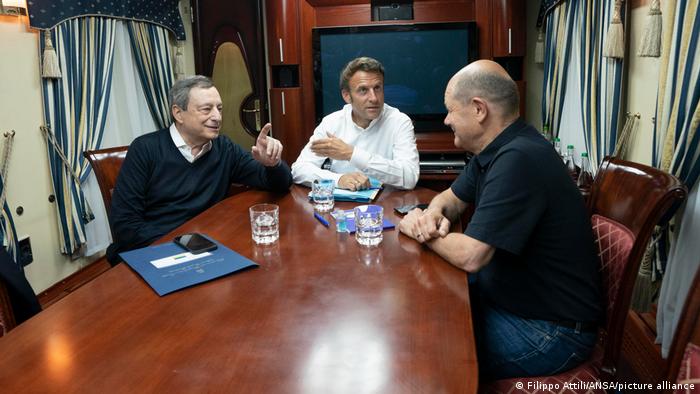
German Chancellor Olaf Scholz, French President Emmanuel Macron and Italian Prime Minister Mario Draghi arrived in Kyiv on Thursday, the French presidential palace said. 

Scholz said the three leaders wanted “to show their support for Ukraine and the citizens of Ukraine.”

“But we don’t just want to demonstrate solidarity, we also want to assure that the help we organize — financial and humanitarian, but also when it comes to weapons — will be continued,” he said. Support will continue for as long as is necessary, he said.

The trio took an overnight train to Kyiv from Poland. They are expected to meet with Ukrainian President Volodymyr Zelenskyy.

Major German and Italian media outlets, including Germany’s ZDF and Italy’s Repubblica, had earlier published a photo of the three leaders on the train.

It is the first time the three travel to Kyiv since the war started in Ukraine. 

Italian Prime Minister Mario Draghi, French President Emmanuel Macron and German Chancellor Olaf Scholz on a train

Draghi, Macron and Scholz took an overnight train from Poland to Kyiv

There had been speculation earlier this week that Scholz would be part of the joint trip ahead of a G7 summit at the end of June.

The visit also comes a day before the European Commission is set to make a recommendation on Ukraine’s status as an EU candidate. 

The three leaders have come under criticism over their response to the war. Critics say France and Germany, and, to a lesser extent, Italy, have been slow to deliver weapons to Ukraine. Scholz and Macron have also been criticized for maintaining contact with Russian President Vladimir Putin. 

German minister: Weapons can be delivered to Ukraine by August

German Defense Minister Christine Lambrecht said three multiple rocket launchers could be delivered to Ukraine in July or August after Ukrainian forces receive adequate training on them. 

Kyiv has complained that weapons that Germany pledged to Ukraine were not delivered. Berlin says Ukrainian troops must first be trained to use them. 

“The training on these multiple rocket launchers can begin at the end of June, meaning they can be delivered at the end of July or the start of August,” Lambrecht told reporters as she arrived for a second day of talks with her NATO counterparts in Brussels.

German ex-chancellor seeks to recuperate parliamentary office

Former German Chancellor Gerhard Schröder has sent a letter to the Bundestag budget committee that challenges the decision to revoke his right to a parliamentary office.

Schröder was Germany’s chancellor from 1998 to 2005. After leaving office he was involved with Russian energy firms Gazprom and Rosneft. Since Moscow’s invasion of Ukraine, he has drawn criticism for his ties to Moscow.

The committee voted in May to wind down his office. The office was allocated more than €400,00 ($418,000) last year.

In a letter to the committee’s chair, Schröder’s lawyer said that the former chancellor had learned “via the media” that his office was being “put on hold.”

“This decision is based on the determination that he no longer has any ‘continuing obligations arising from the office,'” Schröders lawyer said in the letter, adding that this determination is not substantiated and that it was unclear what these “continuing obligations” would constitute.

The letter also argues that a resolution taken from the media is “evidently illegal and unconstitutional.”

Schröder’s lawyer said that he hopes for “the chance to reach a mutually acceptable settlement by way of conversation on an even playing field.”

Gazprom cuts gas supply to Germany by around 60% in 2 days

Russian energy giant Gazprom has begun reducing the volume of gas it supplies to Germany via the Nord Stream 1 pipeline to a daily maximum of 67 million cubic meters early on Thursday.

On Tuesday, Gazprom announced it would reduce the maximum delivery volume to 100 million cubic meters of gas per day, down from 167 million cubic meters.

Overall, the cut represents an approximate 60% reduction in gas supplies to Germany in just two days.

German Economy Minister Robert Habeck accused Moscow of attempting to create unease and increase gas prices. He added that it was still possible to source alternative gas supplies on the market, albeit at a high price.

Report: 2 US volunteers in Ukraine missing

Two Americans who volunteered to support Ukraine’s armed forces have reportedly gone missing.

The Telegraph newspaper cited an unnamed fellow fighter as saying that the two Americans were captured by Russian forces during a June 9 battle northeast of Kharkiv.

The two Americans are identified as Alexander Drueke and Andy Huynh, US military veterans who had been living in the state of Alabama.

White House spokesperson John Kirby said that he could not confirm the disappearance, but that “if it’s true, we’ll do everything we can to get them safely back home.”

Kirby went on to discourage Americans from volunteering to fight in Ukraine.

“It is a war zone. It is combat. And if you feel passionate about supporting Ukraine, there’s any number of other ways to do that that are safer and just as effective,” Kirby said.

Ukraine says Russian companies use Georgian entities to bypass sanctions

David Arakhamia, Ukraine’s chief negotiator with Russia, said Russian people and companies are circumventing Western sanctions by making use of Georgian entities to do so.

He told a German Marshall Fund event in Washington that Russians are “heavily” using “Georgian banks, Georgian financial system, Georgian companies and so on,” to dodge the West’s sanctions regime.

“If you are a sanctioned Russian person, you go to the Internet, you open up a Georgian company, open up remotely the bank account and start processing,” Arakhamia added.

He also urged Washington to take action to close the loophole.

What happened in Russia’s invasion of Ukraine on Wednesday

Ukrainian President Volodymyr Zelenskyy said defending the Donbas region in eastern Ukraine was “vital” as the outcome would indicate “who will dominate in the coming weeks” of the war.

Serhii Haidai, the governor of Luhansk province, said that the fighting around the contested city of Sievierodonetsk and other places in eastern Ukraine “is getting more difficult.” By contrast, Britain’s Ministry of Defense said that Russian forces were now in control of the city of Sievierodonetsk.

The United States will provide Ukraine with another $1 billion (€963 million) to help the country amid Russia’s assault in the eastern Donbas region. The latest boost of aid will include major weapons systems that the Ukrainian government has appealed for such as howitzers, anti-ship missile launchers and rounds for the High Mobility Artillery Rocket Systems.

The US will also send an additional $225 million in humanitarian aid to provide assistance for drinking water, food, shelter and other essential items. 

Russia’s Defense Ministry said its missiles had destroyed a warehouse in the Lviv region, which was being used to store ammunition for weapons donated by NATO members. 

Germany will only be able to deliver three instead of four planned rocket launchers to Ukraine, Defense Minister Christine Lambrecht said. 

Turkish Foreign Minister Mevlut Cavusoglu said his country is ready to host four-way talks with the UN, Russia and Ukraine in order to unblock the passage of grain through the Black Sea.

A UN panel investigating possible human rights violations said they are collecting evidence, but that it is too early to say whether the allegations constitute war crimes.

Chinese state media reported Chinese President Xi Jinping spoke with Russian leader Vladimir Putin by phone and said his country would continue to support Russia’s “sovereignty and security.”

You can revisit our updates from Tuesday, June 15, here.

fb, ar, sdi/jsi (AFP, AP, dpa, Reuters)

Categories
Saved Web Pages

US, Germany sending weapons to Ukraine as Russia advances

3000.jpeg

KYIV, Ukraine (AP) — The Russian military said it used long-range missiles Wednesday to destroy a depot in the western Lviv region of Ukraine where ammunition for NATO-supplied weapons was stored, and the governor of a key eastern city acknowledged that Russian forces are advancing in heavy fighting.

The battle for Sievierodonetsk in Ukraine’s eastern Donbas area has become the focus of Russia’s offensive in recent weeks.

Russia-backed separatists accused Ukrainian forces of sabotaging an evacuation of civilians from the city’s besieged Azot chemical plant, where about 500 civilians and an unknown number of Ukrainian fighters are believed to be sheltering from missile attacks. It wasn’t possible to verify that claim.

Russian officials had announced a humanitarian corridor from the Azot plant a day earlier, but said they would take civilians to areas controlled by Russian, not Ukrainian, forces.

The Ukrainian governor of Luhansk, Serhiy Haidai, told The Associated Press that “heavy fighting in Sievierodonetsk continues today as well.” The Luhansk and Donetsk regions make up the Donbas.

The situation in the city is getting worse, Haidai said, because Russian forces have more manpower and weapons. “But our military is holding back the enemy from three sides at once,” he added.

In the Lviv region near the border with NATO member Poland, Russian forces used high-precision Kalibr missiles to destroy the depot near the town of Zolochiv, Russian Defense Ministry spokesman Igor Konashenkov said. Konashenkov said shells for M777 howitzers, a type supplied by the United States, were stored there. He said four howitzers were destroyed elsewhere and that Russian airstrikes also destroyed Ukrainian “aviation equipment” at a military aerodrome in the southern Mykolaiv region.

Ukrainian officials did not immediately comment on the Zolochiv strike.

While focusing most of their attacks on eastern Ukraine, where they are trying to capture large swaths of territory, Russian forces have also been hitting more specific targets elsewhere, using high-precision missiles to disrupt the international supply of weapons and destroy military infrastructure. Civilian infrastructure has been bombarded as well, even though Russian officials have claimed they’re only targeting military facilities.

Youtube video thumbnail

NATO members are pledging to send more and longer-range weapons to Ukraine.

President Joe Biden said Wednesday the U.S. will send an additional $1 billion in military aid, the largest single tranche of weapons and equipment since the war began. The aid will include anti-ship missile launchers, howitzers and more rounds for the High Mobility Artillery Rocket Systems — all key weapons systems that Ukrainian leaders have urgently requested.

Germany is providing Ukraine with three multiple launch rocket systems of the kind that Kyiv has said it urgently needs to defend itself against Russia’s invasion. Defense Minister Christine Lambrecht said Wednesday that Germany will transfer three M270 medium-range artillery rocket systems along with ammunition.

Germany said the transfer, which echoes similar moves by Britain and the United States, will be accompanied by training and will have “a swift and significant battlefield impact.”

In recent days, Ukrainian officials have spoken of the heavy human cost of the war, with Kyiv’s forces outgunned and outnumbered in the east.

Ukrainian President Volodymyr Zelenskyy thanked Biden for the new aid package.

“The security support of the United States is unprecedented,” he said, reporting on a phone call the two leaders held earlier Wednesday. “It brings us closer to a common victory over the Russian aggressor.”

Zelenskyy said he has accepted invitations to speak at the NATO and Group of Seven summits at the end of the month.

“During the 112 days of this war, the Ukrainian army has proved that courage and wisdom on the battlefield, together with the ability to tactically outmaneuver the enemy, can have a significant result, even despite the Russian army’s significant advantage n number of soldiers and equipment,” he said in his nightly video address.

“Of course we are doing everything we can to overcome this advantage. Every day I fight for Ukraine to receive the weapons and equipment we need.”

Meanwhile, Dmitry Medvedev, the deputy chair of Russia’s Security Council, ominously suggested that Russia is intent on not just claiming territory but eliminating Ukraine as a nation. In a Telegram post, he wrote that he saw Ukraine wants to receive liquefied natural gas from its “overseas masters” with payment due in two years.

He added: “But there’s a question. Who said that in two years, Ukraine will even exist on the map?”

Mykhailo Podolyak, an adviser to Zelenskyy, responded on Twitter: “Ukraine has been and will be. Where will Medvedev be in two years? That’s the question.”

___

MORE STORIES ON THE RUSSIA-UKRAINE WAR:

— Mines are killing people in Ukraine even after the fighting leaves their areas

— U.S. sending $1 billion more in military aid

— Two U.S. veterans reported missing in Ukraine

— Russia again cuts natural gas exports to Europe

— Russia’s economic forum takes place but with fewer participants

__ French president suggests he will visit Kyiv to show support for Ukraine

__

OTHER DEVELOPMENTS:

Turkish Foreign Minister Mevlut Cavusoglu said it may be possible to create secure corridors to transport Ukrainian grain through the Black Sea without the need to clear sea mines near Ukrainian ports.

Cavusoglu’s comments Wednesday came a week after he discussed with his Russian counterpart Sergey Lavrov a U.N. plan to open up Odesa and Ukraine’s other Black Sea ports to allow millions of tons of grains to be shipped to world markets.

Russia has demanded that Ukraine remove mines from the Black Sea before grain exports can resume by ship. Ukraine rejects the proposal, insisting it would leave its ports vulnerable to Russian attacks.

Cavusoglu told reporters that since the location of the mines is known, it would be possible to establish “secure corridors” that avoid them. Turkey, Russia and Ukraine have appointed military officers and set up a telephone hotline to try to overcome hurdles over crop exports.

U.N. spokesperson Stéphane Dujarric welcomed Cavusoglu’s comments as “extremely positive” but declined to discuss the plan.

___

A U.N. delegation investigating war crimes in Ukraine has visited areas of the country that were held by Russian troops and found evidence that could support war crimes allegations.

The delegation chaired by Erik Møse, a Norwegian judge, visited sites including the Kyiv suburbs of Bucha and Irpin, where Ukrainian authorities have accused Russia of mass killings of civilians.

“At this stage we are not in a position to make any factual findings or pronounce ourselves on issues of the legal determination of events,” Møse said.

“However, subject to further confirmation, the information received and the visited sites of destruction may support claims that serious violations of international human rights law and international humanitarian law, perhaps reaching war crimes and crimes against humanity, have been committed in the areas,” he said.

With Ukrainian and international organizations investigating war crimes cases, Møse expressed concern at the risk of investigations “overlapping” or causing witnesses more trauma by probing the same events repeatedly.

___

Karmanau reported from Lviv.

___

Follow the AP’s coverage of the war at https://apnews.com/hub/russia-ukraine

Categories
Saved Web Pages

Spy agencies’ focus on China could snare Chinese Americans

3000.jpeg

WASHINGTON (AP) — As U.S. intelligence agencies ramp up their efforts against China, top officials acknowledge they may also end up collecting more phone calls and emails from Chinese Americans, raising new concerns about spying affecting civil liberties.

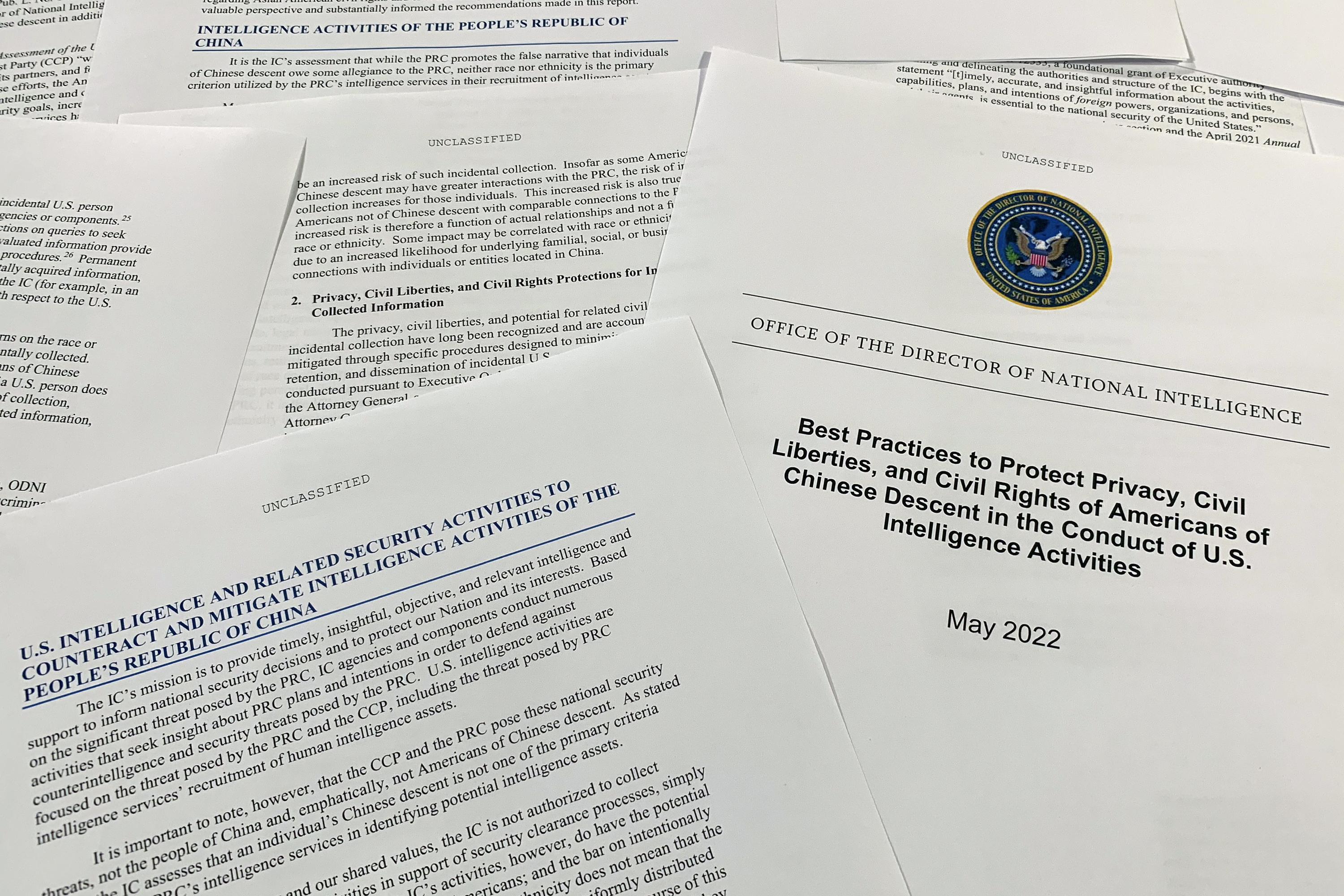
A new report from the Office of the Director of National Intelligence makes several recommendations, including expanding unconscious bias training and reiterating internally that federal law bans targeting someone solely due to their ethnicity.

U.S. intelligence agencies are under constant pressure to better understand China’s decision-making on issues including nuclear weapons,geopolitics and the origins of the COVID-19 pandemic — and have responded with new centers and programs focusing on Beijing. While there’s bipartisan support for a tougher U.S. approach to China, civil rights groups and advocates are concerned about the disparate effect of enhanced surveillance on people of Chinese descent.

As one example, people who speak to relatives or contacts in China could be more likely to have their communications swept up, though intelligence agencies can’t quantify how often due in part to civil liberties concerns.

There’s a long history of U.S. government discrimination against groups of citizens in the name of national security. Japanese Americans were forced into internment camps during World War II, Black leaders were spied upon during the civil rights movement of the 1960s, and mosques were surveilled after the Sept. 11 attacks. Chinese Americans have faced discrimination going back to the Chinese Exclusion Act of 1882, the first law to explicitly ban immigration from a specific ethnic community.

Aryani Ong, co-founder of the advocacy group Asian American Federal Employees for Non-Discrimination, noted that people of Asian descent are sometimes “not fully trusted as loyal Americans.” She said the report, published May 31, would be useful to conversations about what she described as the conflation of civil rights and national defense.

Ong and other advocates pointed to the Justice Department’s “China Initiative,” created to target economic espionage and hacking operations by Beijing. The department dropped the name of the program after it had come to be associated with faltering prosecutions of Asian American professors at U.S. college campuses.

“Often we hear responses that we cannot weaken our national security, as if protecting constitutional rights of Asian Americans (is) contrary to our defense,” said Ong, who is Indonesian and Chinese American.

But in trying to produce demographic data on the impact of surveillance, the intelligence agencies say there’s a paradox: Examining the backgrounds of U.S. citizens whose data is collected requires more intrusion into those people’s lives.

“To try to find out that type of information would require additional collection that would absolutely not be authorized because it isn’t for the foreign intelligence purpose for which the intelligence community gets its authorities,” Ben Huebner, the chief civil liberties officer for Director of National Intelligence Avril Haines, said in an interview.

But, Huebner added, “I think the fact that we can’t analytically get to those types of metrics doesn’t mean that we get to sort of drop the ball on this.”

One potential disparity highlighted by the report is what’s known as “incidental collection.”

In surveilling a foreign target, intelligence agencies can obtain the target’s communications with a U.S. citizen who isn’t under investigation. The agencies also collect phone calls or emails of U.S. citizens as they sweep for foreign communications.

The National Security Agency has vast powers to surveil domestic and foreign communications, as revealed in part by documents leaked by Edward Snowden. Under NSA rules, two people have to sign off on putting any new foreign target under surveillance. The NSA masks the identities of U.S. citizens under federal law and intelligence guidelines and turns over potential domestic leads to the FBI.

The FBI can access some of the NSA’s collection without a warrant. Civil rights advocates have long argued that searches under what’s known as Section 702 disproportionately target minority communities.

The ODNI report notes that there “may be an increased risk of such incidental collection” for Chinese Americans as well as people not of Chinese ancestry who have business or personal ties to China. The report recommends a review of artificial intelligence programs to ensure they “avoid perpetuating historical biases and discrimination.” It also suggests agencies across the intelligence community expand unconscious bias training for people who handle information from incidental collection.

ODNI is also studying delays in granting security clearances and whether people of Chinese or Asian descent face longer or more invasive background investigations. While there is no publicly available data on clearances, some applicants from minority communities have questioned whether they undergo extra scrutiny due to their race or ethnicity. According to the report, U.S. intelligence assesses that “neither race nor ethnicity is the primary criterion utilized by the PRC’s intelligence services in their recruitment of intelligence assets.”

Sen. Mark Warner, a Virginia Democrat who chairs the Senate Intelligence Committee, said in a statement that he welcomed the recommendations “to increase awareness of existing non-discrimination prohibitions and improve transparency around the security clearance process.”

But Sen. Marco Rubio, a Florida Republican who is the committee’s vice chairman, said requiring new training on unconscious bias and cultural competency was a distraction.

“The Chinese Communist Party likes nothing more than when we are distracted by divisive, internal politics,” Rubio said in a statement.

The ODNI report highlights FBI training on race and ethnicity as a “best practice” in the intelligence community. In a statement, the FBI said that there was “no place for bias and prejudice in our communities” and that law enforcement “must work to eliminate these flawed beliefs in our agencies to best serve those we are sworn to protect. The FBI said its agents are trained in “obedience to the Constitution” and in “treating everyone with dignity, empathy and respect.”

A senior NSA official, speaking on condition of anonymity to discuss sensitive intelligence matters, said the agency currently requires unconscious bias training for managers and hiring officials, but not all employees. The NSA does train intelligence analysts on rules that prohibit the collection of intelligence for suppressing dissent or disadvantaging people based on their race, ethnicity, gender or sexual orientation, and is reviewing ODNI’s recommendations.

The CIA late last year issued new instructions to officers discouraging the use of the word “Chinese” to describe China’s government. The guidance suggests referring to the leadership as “China,” “the People’s Republic of China” or “PRC,” or “Beijing,” while using “Chinese” to refer to the people, language or culture.

“It’s important to be clear that our concern is about the threat posed by the People’s Republic of China, the PRC — not about the people of China, let alone fellow Americans of Chinese or Asian descent,” CIA Director William Burns said in a recent speech at the Georgia Institute of Technology. “It is a profound mistake to conflate the two.”

Categories
Saved Web Pages

Putin’s Crimea grab shows he misunderstands 21st century power

?url=https%3A%2F%2Fcalifornia-times-brig

Russia seems to have learned little in the 160 years since the Crimean War. Launching ships and sending armies to grab land may work in the short term, but there are always negative consequences that bring big regrets later.

In 1853, Russia’s man in charge was Czar Nicholas I, who hoped to take advantage of the weakening Ottoman Empire and expand Russian power and influence around the Black Sea and beyond. In 1853, using the pretext of protecting Orthodox Christians in the Ottoman-controlled Holy Land, Russia went to war and quickly destroyed the Ottoman fleet. Not a bad start.

However, by the time the war ended three years later, things had not worked out so well. France and Britain had won the conflict, and the weakness of Russia’s serf-dominated armies was exposed. Nicholas was dead and the czarist system began a decline that would lead to the monarchy’s 1917 demise. War debts were so high that the new czar, Alexander II, decided to sell Alaska to the United States because he could not afford to defend such a distant territory.

Russia’s current autocrat, Vladimir Putin, may be thinking his easy capture of Crimea from the fledgling government of Ukraine is a bold and clever move. Under the pretext of protecting Russians, he may have plans to snatch Ukraine’s Russian-speaking eastern industrial region. And he can act with the certain knowledge that, unlike the 1850s, Western powers have no stomach for war.

But that only proves Western leaders have learned the lessons of history. In the intertwined world of the 21st century, the power that really counts is economic power. Sure, the United States and the European Union have no inclination to send troops to defend Ukraine, but they have economic weapons that could severely undermine Russia’s tottering economy.

The Russian ruble is already tumbling, and Mark Adomanis, writing in Forbes, says that is just the beginning of trouble for Putin’s regime: “The economic costs to Russia will be severe. The Moscow stock market is going to get absolutely clobbered when it opens tomorrow, and many foreign investors are going to bolt for the exits as quickly as they can. Depending on the severity of the situation in Ukraine, the Russian financial system could come screeching to a halt.” And all of that is happening even before the U.S. and Europe follow through on threats to impose sanctions, freeze Russian assets and toss Russia out of the Group of Eight.

Meanwhile, valid questions about the legitimacy of the new government in Kiev will be set aside by American and European leaders. Instead, they will rush to prop up the Ukrainian economy as a display of solidarity with the pro-Western factions whose ouster of President Viktor Yanukovych started the crisis in the first place.

On Monday, former New York Mayor Rudolph Giuliani went on Fox News and weirdly praised Putin for his ability to act quickly and decisively. Unlike President Obama, Putin is “what you call a leader,” Giuliani said.

We can be grateful Giuliani never got close to being our president. Acting without considering long-term consequences is not leadership; it is the sort of unthinking recklessness that started the Crimean War in the 19th century – not unlike the “resolute” tough-guy idiocy that sent American troops rushing off to Iraq for a decade of misery at the start of this century.

Let’s let Putin play that game if he chooses. If Obama and European leaders employ their economic weapons smartly, Putin can be taught a harsh lesson about real power in the modern world.

Categories
Saved Web Pages

Federal Reserve raises benchmark interest rate 0.75% as it tries to calm inflation

download.jpg

moneywatch

By Irina Ivanova

June 15, 2022 / 2:02 PM / MoneyWatch

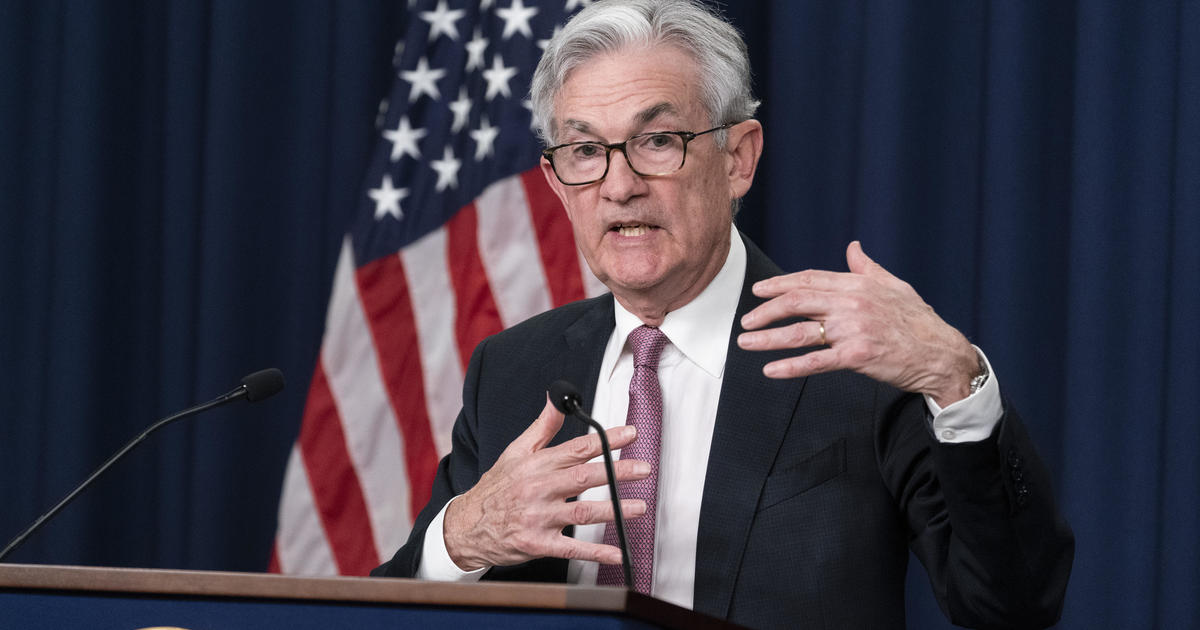
The Federal Reserve said on Wednesday that it is raising its benchmark interest rate by three-quarters of a percentage point, the sharpest hike since 1994, as it seeks to combat the fiercest surge in U.S. inflation in four decades. 

The U.S. central bank set its target rate in the range of 1.25 to 1.5%. The federal funds rate, which controls how much banks pay to borrow money from each other, affects borrowing costs for consumers and businesses. 

The Fed had previously suggested it was likely to boost rates by half a percentage point at each of its three meetings this year, but recent signals that inflation is accelerating spurred policymakers to move more aggressively to slow economic growth in a bid to tame prices.

Overall, the economy remains strong, with unemployment near a 50-year low of 3.6% and businesses continuing to hire. But the steepest inflation since 1981 is hitting households hards and causing consumer spending to shrink, with the government reporting that retail sales fell in May. The 0.3% decline, the first such drop since December, is a sign that high gas prices may be forcing consumers to spend less on other purchases. 

Last week, a sentiment survey by the University of Michigan found that Americans’ expectations for future inflation are rising, a worrisome sign for the Fed because expectations can become self-fulfilling.

Federal Reserve chairman Jerome Powell is set to speak to reporters at 2:30 p.m., explaining his outlook for the U.S. economy. 

This is a developing story. The Associated Press contributed reporting.

First published on June 15, 2022 / 2:02 PM

© 2022 CBS Interactive Inc. All Rights Reserved.

Categories
Saved Web Pages

This new immersive show in Brooklyn is an actual quinceañera

image.jpg

As far as immersive plays go, Quince, a novel production mounted inside the Bushwick Starr’s new theater (a former dairy plant!), is a pretty solid and creative one.

The 90-minute show is a coming-of-age story that centers around Cindy, a teenage Mexican American with an overbearing mother (Maria) getting ready to imminently celebrate her quinceañera, a traditional 15th birthday celebration. Throughout the play, Cindy is also in the midst of exploring her queer identity, her transition to womanhood and her relationship to her Latin American roots. Yes, that’s a lot. 

Other characters include Maria’s brother Salomon, whom Cindy comes out to, and Father Joaquin, a “seemingly decent priest,” according to the New York Times.

Perhaps most interestingly, ticket holders are asked to be part and parcel of the storyline, which is partly performed in Spanish as well. A Mexican food cart takes up residence outside of the theater right before the show and guests are encouraged to buy meals that they can then eat during the performance on tables decorated specifically for Cindy’s Mexican celebration.

There are three stages scattered throughout the space, so performers are constantly in the midst of the audience, making them feel part of the production. In a way, ticket holders become Cindy’s family members and party guests.

Running through June 26, Quince has already proven its worth. In the summer of 2020, Brooklyn-based ensemble The Team mounted a shorter version of the production for a few outdoor performances at the People’s Garden in Brooklyn. 

This version of the play is presented with One Whale’s Tale, the company that writer Camilo Quiroz-Vázquez and director Ellpetha Tsivicos actually belong to.

But that is not all: an open-air adaptation of the show, this one dubbed QUINCE en la Plaza, will be mounted for a one-night-only performance at Hearst Plaza at Lincoln Center on July 17. 

Get tickets for Quince right here and snag ones for Quince en la Plaza here. 

Popular on Time Out

[title]

Categories
Saved Web Pages

Only total defeat in Ukraine can cure Russia of its imperialism

2022-05-22T000000Z_1369287754_MT1NURPHO0

Only total defeat in Ukraine can cure Russia of its imperialism

With Russia’s invasion of Ukraine now in its fourth month and encountering serious military setbacks, there is a growing debate over what a potential Ukrainian victory might look like.

Some government officials in Kyiv have announced Ukraine’s aspiration to liberate all territories occupied by Russia, including Crimea. The Ukrainian army’s proven ability to defeat Russian forces on the battlefield and the accelerating delivery of heavy weapons from the West make this goal of complete liberation at least theoretically possible.

However, some Western leaders fear the consequences of a comprehensive Ukrainian victory and favor the idea of a compromise peace. Most notably, French President Emmanuel Macron has repeatedly warned against “humiliating” Vladimir Putin. Advocates of appeasement ignore the fact that any settlement which leaves Russia in possession of Ukrainian lands occupied since 2014 would weaken the international security order and effectively reward Russia for aggression, thereby setting the stage for further wars.

Talk of a Ukrainian victory is certainly optimistic but by no means implausible. Moscow has already suffered catastrophic losses during the first 100 days of the war, with British military intelligence in mid-May estimating that Russia had lost around one-third of its invasion force amid “consistently high levels of attrition.”

Ukraine’s battlefield success has so far been achieved largely with outdated Soviet arms and light defensive Western weapons. With more sophisticated heavy weapons now beginning to reach Ukraine in significant quantities, further Ukrainian victories seem possible.

There are a number of good reasons to pursue the complete liberation of Ukraine. On purely humanitarian grounds, the millions of Ukrainians living in occupied areas of the country deserve to be freed from Russian rule. Forcing Russian troops to retreat entirely from Ukraine would also be the best way to prevent another round of aggression in the years ahead.

Crucially, Ukraine’s liberation would be a victory for international law that would mark an end to relative impunity Putin has enjoyed since he first attacked Ukraine in 2014. This last point is fundamental if a lasting peace is to be established. But in order for international law to prevail, Russia must first be cured of its imperialistic instincts.

Subscribe to UkraineAlert DAILY

As the Russia crisis in Eastern Europe heats up, UkraineAlert DAILY delivers the best Atlantic Council expert insight, from the UkraineAlert online publication and beyond, to your inbox Monday through Friday.

Discussion of a post-imperial Russia inevitably brings to mind the European experience with other fallen empires. The broadly accepted lesson of the post-WWI Treaty of Versailles is that a defeated foe should not be humiliated as this will cause revanchism, as occurred with the rise of the Nazis in post-war Germany. This appears to be a strong motivating factor behind President Macron’s calls for a compromise settlement in Ukraine, but such thinking is dangerously misguided.

As not a single Allied shell had fallen on German territory in WWI, this left room for the infamous “stab in the back” theory of a conspiracy behind the German defeat. Accordingly, Adolf Hitler and Joseph Goebbels were able to persuade their public to make a second try and correct an alleged historical injustice by launching another war. 

There are obvious parallels here with the revisionist view regarding the collapse of the USSR. During his two decades in power, Putin has been remarkably successful in rehabilitating the Soviet past while blaming the collapse of the empire on Pentagon intrigue and the cloying egoism of Mikhail Gorbachev. As a result, many Russians are now convinced that the USSR was also a victim of a grave historical injustice and enthusiastically embrace efforts to reclaim territories lost in 1991.

Post-Soviet Russia never underwent a period of de-imperialization that might have enabled the country to move beyond the imperial mindset that Soviet Russia had itself inherited from the Czarist era.

This contrasts with the post-WWII experience of Germany and Japan. Both countries experienced catastrophic defeat followed by periods of foreign occupation. It was this trauma that caused them to deeply reexamine their cultural values and turn away from centuries of militarism. The occupation powers in both Germany and Japan also oversaw a “re-education” of the two societies. This role as external change agents was necessary because neither society was likely to engage in re-education on their own.

There is no prospect that a Western coalition will occupy today’s Russia, of course. At the same time, a nation accustomed to a long imperial history and soaked in the revisionism of the Putin era is unlikely to find within itself the cultural and intellectual resources to rethink its most cherished national mythologies. It would take something as profoundly shocking as defeat in Ukraine to force Russians into a national reckoning on such a scale.

The collapse of the Soviet Union was a deeply traumatic event for all Russians, but it is now apparent that this trauma was not sufficient to cause a rejection of Russia’s imperial identity. Instead, Putin has skillfully revived imperial sentiments to generate popular support for his expansionist foreign policy.

The West has also played a significant role in this process, with Western leaders and commentators all-too-often embracing Russia’s post-Soviet victimization narrative while disregarding or downplaying the victimization of Russia’s neighbors. This has helped contribute to the mood of unrepentant imperialism in modern Russia that set the stage for the invasion of Ukraine.

In order to bring the prevailing cycle of Russian imperial aggression to an end, Putin’s invasion of Ukraine must result in unambiguous defeat. A Ukrainian victory would send shock waves through Russian society and force Russians to engage in a long overdue exploration of the country’s imperial identity. If defeat is painful enough, it could spark fundamental changes within Russia and lead to the kind of breakthrough that the false dawn of 1991 failed to achieve. Anything less will merely serve as a temporary pause before the next Russian invasion.  

Dennis Soltys is a retired Canadian professor currently living in Kazakhstan.

Further reading

The views expressed in UkraineAlert are solely those of the authors and do not necessarily reflect the views of the Atlantic Council, its staff, or its supporters.

The Eurasia Center’s mission is to enhance transatlantic cooperation in promoting stability, democratic values and prosperity in Eurasia, from Eastern Europe and Turkey in the West to the Caucasus, Russia and Central Asia in the East.

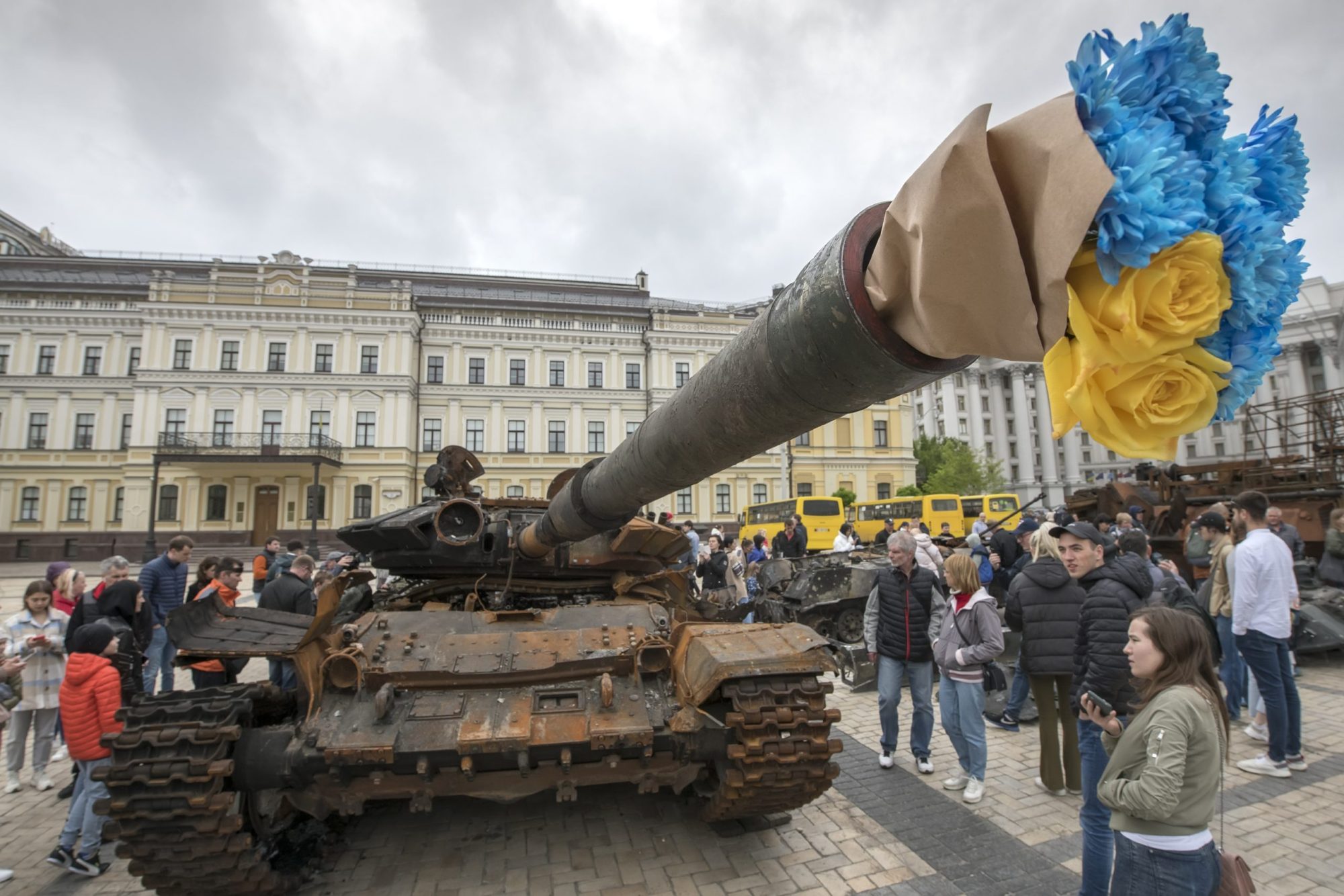
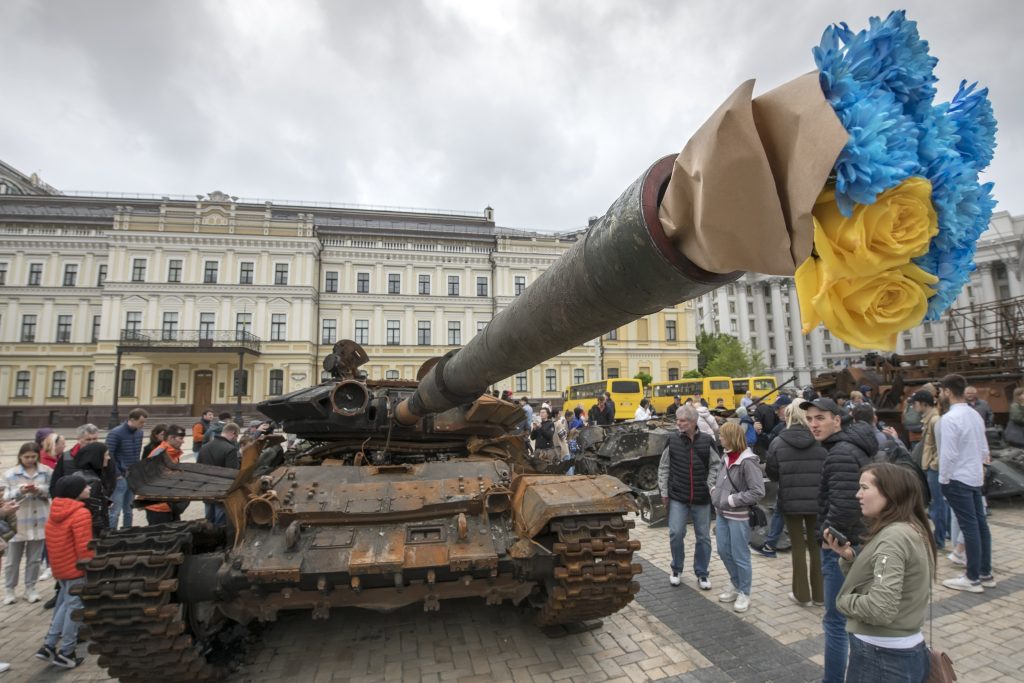
Image: A bouquet of blue and yellow flowers sticking out of the barrel of a destroyed Russian tank displayed for Ukrainians to see at Mykhailivska Square in downtown Kyiv, Ukraine, May 22, 2022 (Photo by Maxym Marusenko/NurPhoto)

WP Radio
WP Radio
OFFLINE LIVE