An NYPD officer fired one shot during a gunpoint carjacking investigation near Avenue O and East 15th Street in Midwood, Brooklyn, shortly after 8:30 p.m.
A personal friend of Louis Cartier, Grand Duchess Vladimir (Maria Pavlovna of Russia) became one of the best clients of the iconic French jewelry before the Russian Revolution….
In one such story from this year, Desire said the mother of a female victim — who was in her 30s and died in the South Tower of the World Trade Center — asked him if he thought he would be able to identify her daughter’s remains before she herself passed on.
“Shecameand said, ‘Mark,I’mgettingupthere.Idon’thavemuchtimeleft.Doyouthinkyou’llfindmydaughterbeforeIpass?’” Desire told amNewYork in an interview.
Desire said that while he could not predict what would happen, he could commit to continuing to work on identifying the 40% of 9/11 victims in the OCME repository whose remains are still unidentified a quarter century after the tragedy.
“Sheunderstood,” he said. “Andshesaid, ‘Well,canyoupromisethatafter I die,ifIcan’tholdherbefore … Canyouburyhernexttome?’”
Desire said her story is just one example of the many that have driven him and his team to tirelessly pursue identifying all of the 2,753 victims who died in the Twin Towers, which were brought down when terrorists deliberately crashed two commercial airplanes into them on Sept. 11, 2001.
Over the years, Desire and his team have successfully identified 1,651 victims, 60% of those who died at the World Trade Center site, and have recovered nearly 22,000 remains, 14,968 (68%) of which it has linked to specific victims — according to OCME data.
However, even with all of that progress, OCME is still working to give the victims’ families, who have not yet been identified, closure by identifying their remains. The unidentified remains are currently stored in a repository inside the 9/11 Memorial and Museum that is managed by OCME.
Keeping a promise to 9/11 victims’ families a quarter-century later
Mark Desire, the director of forensic biology at the city’s Office of the Chief Medical Examiner (OCME), has countless stories to tell from working with 9/11 victims’ families.Courtesy of the OCME
While Desire has been working on 9/11 identifications ever since the morning of the attacks, he said that he is the only one left of his original team.
“Alloftheteammembersthatareworkingonthisnow,manywereindiapersbackin2001.Idon’tthinksomeweren’tevenborn;theywerekids,” Desire told amNewYork in an interview. “Buttobeabletoworkonthis,theyfeelashonoredandhumbledasIdo.”
But even with all of the years that have passed and an entirely new team, Desire said his office’s commitment to identifying every single victim is as great today as it was in September 2001. Oh
“Thatpromisewemade25yearsago, that’sapromisekept,” he said. “Wehavenotturnedourbacksonthis,onthosefamilies.”
Once they have made a positive identification, OCME turns the remains over to the victim’s family, according to Mayor Zohran Mamdani’s office. Desire said that in lieu of remains, his office has at times returned personal items used for DNA testing to families, such as a firefighter’s boots or helmet, for them to bury in the meantime.
It has taken 25 years to identify just over half of World Trade Center victims’ remains, Desire said, because of the extensive damage the human matter underwent during the attacks. The jet fuel, scorching inferno, water used to extinguish the fires, and chemicals from the buildings were among a mix of elements that severely damaged victims’ DNA, he said.
“Thefiresdownthere,thewatertoputoutthefiresthatdestroysDNA,” Desire said. “SunlightdestroysDNA.Mold,bacteria,thechemicalsinthosebuildings — itwasallthere.Andeverysingleoneofthosethingsmakeourjobalmostimpossibleattimesbecause of thelimitsoftechnology.”
Charles Wolf, whose wife Katherine was killed on 9/11, said he does not believe his wife will ever be identified because she worked on a floor of the World Trade Center’s North Tower that was hit by the plane.
“There’snothingofmywifeeverfoundbecausethefirstplane hitherofficedirectlyat450milesanhour,” he said. “Idon’tthinkanybodywasfoundinthatarea.”
While he does not think OCME will ever be able to ID his wife, he would be “shattered” if it somehow did.
Charles Wolf holding a photo of his wife, Katherine Wolf, who was killed inside of the north tower of the World Trade Center in the Sept. 11, 2001 terror attacks. Tuesday, Sept. 8, 2026.Photo by Ethan Stark-Miller
But OCME has not let the challenges of working with such badly damaged DNA samples stop it, Desire said.
Instead, Desire’s office has developed and sought out new scientific methods and technology that have helped it identify remains it previously could not. He said that often means his team tries to identify the same remains repeatedly over several years, sometimes as many as ten times, until it is able to push the science to a point that yields a positive result.
For instance, OCME has used a variety of identification methods over the years besides DNA, including dental X-rays, photos, fingerprints, and personal effects.
The victim they identified only as a woman who was killed at the World Trade Center site on 9/11, with other details withheld at the request of her family, according to the mayor’s office.
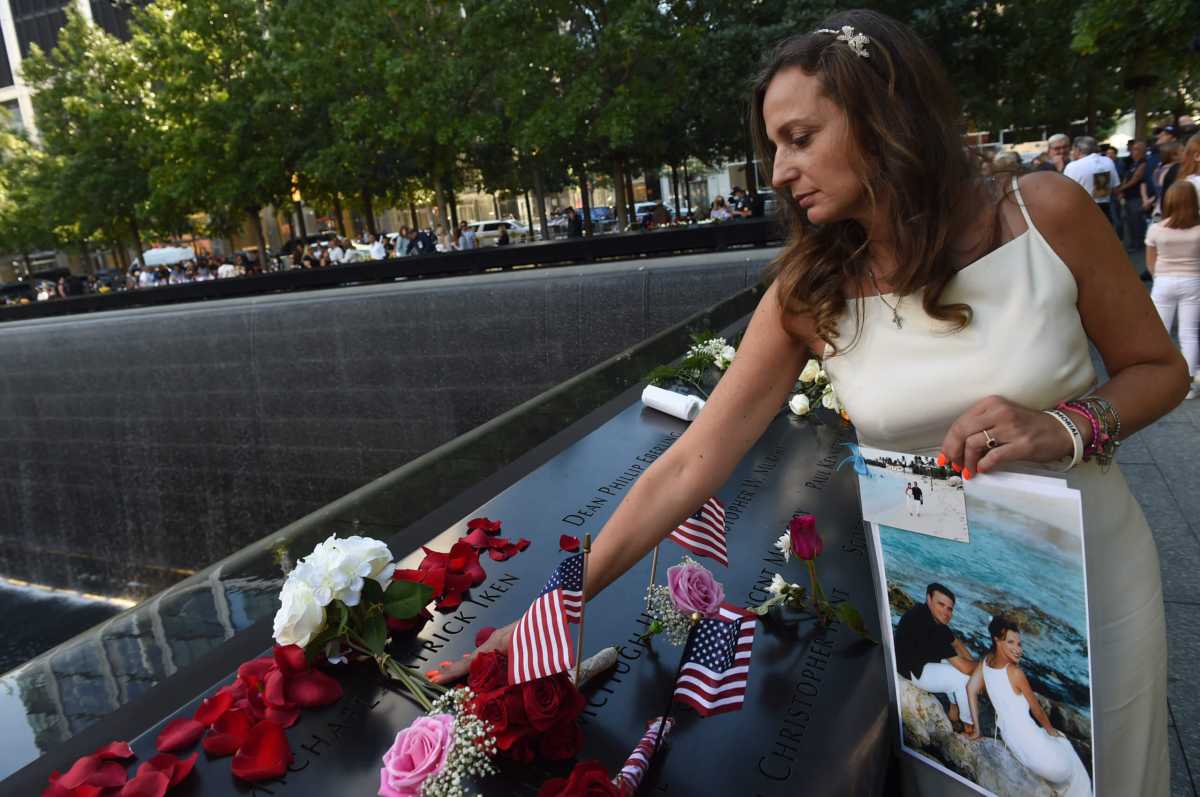
Wearing her wedding dress to the 20th anniversary 9/11 memorial last year, Monica Iken mourns the loss of her newlywed husband, Michael Patrick Iken, a bond trader lost on 9/11. She remarried and has two children.File photo/Todd Maisel
Monika Iken-Murphy, whose husband Michael Iken a bond broker who was killed in the World Trade Center’s South Tower, said she’s holding out hope that the FIGG can help identify him. She said that Michael never knew who his father, so there is a possibility that the genealogy research could turn up relatives they don’t know who can help identify his remains.