
Day: September 9, 2026
Global news photos featuring earthquake recovery efforts, sports, entertainment, science, politics and major events from around the world.
The post Our world in photos: September 9 appeared first on Brooklyn Eagle.
The post Our world in photos: September 9 first appeared on The Ocean Avenue News – oceanavenuenews.com.

The Brooklyn Democratic Party and reformers brought their heated battle over party leadership to court on Tuesday.
In a packed courtroom, Judge Jill Epstein heard arguments on controversial changes to party bylaws that would likely allow sitting chair Rodneyse Bichotte Hermelyn maintain control of the party.
Bichotte Hermelyn’s position had been at risk after district leaders aligned with reform group New Kings Democrats won a majority of District Leader seats in the June primary. The reformers planned to vote longtime district leader Julio Peña III into power at the party’s organizational meeting later this fall.
Late last month, Bichotte Hermelyn called a closed-door meeting of the outgoing executive committee — including several lame duck members who either lost their elections or opted not to run again — to vote on a series of bylaw amendments, including one that added dozens of voting positions to the party’s executive committee, nullifying the reformers’ newfound majority. The amendments passed by a slim margin, 21-19, with one abstention.
Reformers immediately filed suit, hoping to get the new rules thrown out.
Mark Hanna, a longtime District Leader and election attorney representing the reformers, argued that both the meeting and the vote were “unlawful,” and violated both state election law and Brooklyn Democratic Party bylaws.
His argument was predicated on a state election law that says county committee members — a.k.a. district leaders — “shall hold office until the next election at which members of the committee are elected.”
A party bylaw in effect at the time of the Aug. 25 meeting also stipulates that “only persons elected as State Committee members … are authorized to vote” on the executive committee. The suit argues that the outgoing executive committee members, having lost their positions on the State Committee, were not eligible to vote.
“This is something they can’t do,” Hanna said. “They don’t have voting authority, and both the state laws and bylaws provide for that.”
Per state law, county committees are required to have an organizational meeting to elect new leadership between Sept. 17-Oct. 7.
“Until such organization meeting, the existing county committee shall exercise all legal authority,” the law reads. “Upon the conclusion of such organization meeting, the new county committee shall assume all legal authority vested in the previously organized county committee.”
The line stipulating that the existing committee maintains legal authority was added in 2019, when the primary election was moved from September to June, meaning newly-elected district leaders did not formally take office for several months after winning their elections.
The Brooklyn Democratic Party says that law means outgoing executive committee members were within their rights to cast their votes at the Aug. 25 meeting.
It was all “properly done,” said party lawyer Amy Marion, “because pursuant to law they had authority [to vote.]”
Hanna disagreed, citing a 2024 appellate court decision handed down after outgoing Assembly Member Eddie Gibbs sued the Manhattan Democratic Party for holding an election after the primary but before the organizing meeting.
The court overturned that election, citing past cases where the court ruled that “Upon the election of their successors at the primaries, the outgoing members were no longer empowered to ‘exercise functions in substantial matters.’”
Though the existing committee holds legal authority until the organizing committee, Hanna argued, they should only act in emergency situations, or to fill sudden vacancies.
“It doesn’t mean they should act in all ways … or [make] substantial changes,” he said.
The reformers’ lawsuit also claims that the Aug. 25 meeting was called without a majority vote required by the party’s bylaws, and was therefore a public meeting subject to Democratic State Committee rules, “which require that all public meetings at all levels of the Democratic Party of New York be open to all party members and that the time and place for all public meetings be publicized fully and in such manner as to assure timely notice to all interested persons.”
The meeting was held “essentially in secret,” Hanna said, and was not open to party members.
“They don’t want people to know the kinds of things that are going on in there,” he said.
Multiple reports state that the meeting was closed to the public and to press, and people inside taped pieces of paper to the windows to prevent people outdoors from peeking in during the vote.
Marion disputed the allegations of a “cloak and dagger secret meeting.”
“That is not what happened here at all,” she said, adding that the vote was “expanding democracy” by allowing more party representatives to vote.
She said it was “improper” for so many outside elected officials — including House Minority Leader Hakeem Jeffries and Mayor Zohran Mamdani — to publicly voice opposition to Bichotte Hermelyn’s rule changes, and accused the reformers of “politicizing” the case by including the pols’ quotes in their court filings.
Epstein, whose began her 14-year Supreme Court term in January after winning the support of the Brooklyn Democratic Party, said that she does not care about what politicians have said, and that their opinions will not influence her decision.
“The only thing I’m going to apply is the law,” she said.
Marion noted that the party had filed a motion to dismiss the reformers’ lawsuit altogether on Sept. 7, a day before the twice-delayed hearing.
The suit, she said, left off the names of a number of people whose votes and voting rights would be impacted by the decision, including people who were newly granted the right to vote in the amended rules. Those people are entitled to appear in court, Marion said.
She pointed to a 2022 case where an appellate court tossed out a ruling against the Brooklyn Democratic Party because the original lawsuit “challenged the authority and actions of the Executive Committee … but failed to join the Executive Committee.”
Marion argued that that the reformers were asking Epstein to “legislate from the bench” by hearing the case.
“This issue is very easily decided by your honor dismissing because necessary parties were not named,” she told Epstein.
Hanna said all necessary parties are included. The suit individually names outgoing committee members who took part in the vote, he said, but not those who were re-elected. However, he said, the suit names the Kings County Democratic County Committee and the Executive Committee — which includes all members of those committees, even if they are not individually named.
A party divided
Epstein did not issue a ruling on Tuesday, but is expected to make a decision within the next several days. No matter which way she rules, the case is expected to head to the appeals court in the next few weeks. The issue must be settled before Oct. 7 deadline to hold the organizational meeting.
Paul Newell, a lawyer helping to represent the reformers, said the case has significant legal implications. If the new rules are upheld, Bichotte Hermelyn will have significant control over who is chosen to fill the new voting positions and is likely to have influence over a process that will add 21 new voting members later this year, according to New York Focus.
“If a chair can appoint more members of the governing body than are actually elected by the voters of Brooklyn, it is fundamentally impossible for Brooklyn Democrats to ever govern their party ever again,” Newell said. “This will be the permanent end of small-D democratic governance of the Democratic Party.”
The case has split the party. At a rally last week, newly-elected district leader Akel Williams said it was a “travesty” that they had to go to court “simply because our party leader and some other folks in leadership decided that they wanted to steal the will of the voters.”
But, after the hearing, district leader Anthony Jones, who supports Bichotte Hermelyn, led a group of people in a chant of “We are the community!”
He believes the judge will rule in the party’s favor.
“I think that the rules are good. This is what the community looks like, and we want to make sure that all the representatives of the community, by increasing the numbers, we’re going to be able to get stay-at-home moms, stay-at-home dads, senior citizens, people from different ethnicities and different backgrounds,” he said.
Jones said the New Kings Democrats create “havoc and disunity,” and are unwilling to work with other members of the party.
“One of the things I want to say to New Kings Democrats: Respect Mommy,” he said, apparently referring to Bichotte Hermelyn.
The post Brooklyn Democratic Party, reformers battle over rule change in court first appeared on The Ocean Avenue News – oceanavenuenews.com.
U.S. Reps. Jerry Nadler and Nydia Velázquez are criticizing Republican gubernatorial candidate Bruce Blakeman after he endorsed a congressional candidate who has said “9/11 was an inside job,” while other campaign associations involving 9/11 conspiracy theories are also drawing scrutiny.
The criticism comes days before New York marks the 25th anniversary of Sept. 11. Blakeman, the Republican nominee challenging Democratic Gov. Kathy Hochul in November, has made Mayor Zohran Mamdani’s presence at Friday’s Ground Zero ceremony an issue in the governor’s race, calling for attendees to peacefully turn their backs on the mayor.
City & State first reported Wednesday that Blakeman filmed an endorsement for Joel Anabilah-Azumah, the Republican and Conservative candidate challenging Democratic Rep. Yvette Clarke in Brooklyn.
Anabilah-Azumah wrote on X in 2024 that “9/11 was an inside job.”
“You don’t have to believe it, but that is what happened, and history is pretty clear on that,” he wrote.
In the endorsement video reviewed by amNewYork, Blakeman said Anabilah-Azumah would make “a great member of Congress” and added, “We need fighters like that in Congress.”
Velázquez said she had spent more than two decades fighting for 9/11 victims and their families to get the care they need.
“I never thought I’d see someone like Bruce Blakeman running for governor while associating with 9/11 conspiracy theorists,” she said. “These were no casual meet-and-greets: Blakeman filmed campaign endorsements and videos with these extremists. New Yorkers deserve better than this.”
Nadler, who represented Ground Zero in Congress, called it “downright appalling” that Blakeman would “campaign with, and seek endorsements from” people who have promoted 9/11 conspiracy theories.
Blakeman’s campaign had not responded to amNewYork’s requests for comment as of Wednesday afternoon.
Other controversies surrounding Blakeman campaign
The Blakeman campaign had faced questions involving Marcus C. Williams, chair of the Rochester City Republican Committee, before the latest endorsement came to light.
The Judge Street Journal reported in May that Blakeman’s running mate, Todd Hood, had interviewed Williams and detailed several of Williams’ past posts, including one in which he shared a video containing conspiracy claims about 9/11 and wrote that although he did not agree with everything in it, “99% of this here is on point.”
The outlet reported again in August that Blakeman himself had appeared in a campaign video with Williams. In the video, reviewed by amNewYork, Blakeman told him, “We’re gonna win because of people like you, Marcus, and the Rochester City Republicans.”
Politico subsequently reported on the interaction and obtained responses from Williams and the Blakeman campaign. Williams said his “99%” wording had been “imprecise” and that he rejected the video’s conspiracy claims about who planned or carried out the attacks. Blakeman’s campaign called Democratic criticism of the episode a “guilt-by-association” attack.
Blakeman has publicly amplified support from Cafecito Break, a Brooklyn-based media and podcast outlet that has previously promoted Richard Gage, a proponent of the theory that the World Trade Center towers were brought down by controlled demolition.
On Aug. 25, Blakeman quote-posted Cafecito Break’s support for his candidacy, writing that “people of all political parties and walks of life are voting for me in November” and directing followers to his campaign’s coalition page.
Cafecito Break promoted a December 2023 interview with Gage under the title “Make The Truth About 9/11 Mainstream,” describing him as an “Architect for Truth.”
Gage continues to promote the controlled-demolition theory, including in an Aug. 14 post claiming flashes visible in footage of the collapse were evidence of explosions. The National Institute of Standards and Technology found no corroborating evidence that explosives brought down the towers.
Blakeman’s nephew, New York state court officer Thomas Jurgens, was killed while responding at the South Tower on Sept. 11, 2001.
He is among several Republicans and some relatives of 9/11 victims who have said Mamdani, New York City’s first Muslim mayor, should stay away from Friday’s ceremony. The effort to exclude Mamdani has drawn pushback from Democrats and other 9/11 families, while some of the rhetoric surrounding his attendance has been explicitly anti-Muslim.
Former Mayor Rudy Giuliani, for example, has invoked Mamdani’s Muslim faith while arguing he should not attend and compared him to the 9/11 hijackers.
The post 2026 Governor’s Race: Blakeman under fire after endorsing candidate who called 9/11 an ‘inside job’ first appeared on The Ocean Avenue News – oceanavenuenews.com.

Brooklyn and Queens transit riders can finally see the MTA’s vision for its Interborough Express light rail project coming into focus, according to Gov. Kathy Hochul and the MTA.
The governor and the agency released new renderings on Wednesday for how the new stations will look along the line, to be created along freight rail lines between Bay Ridge, Brooklyn, and Jackson Heights, Queens.
The visualizations offer the most extensive sense to date of what the $5.5 billion undertaking, often referred to as the IBX, could eventually look like. They show modern glass and steel outdoor stations, outfitted with multiple elevators, digital displays, and connections to the subway system.
Once completed, the MTA says the IBX will be able to move passengers from one end to the other — between the Brooklyn Army Terminal in Brooklyn and Roosevelt Avenue in Queens — in just 32 minutes.
“For too many commuters, traveling between New York’s two largest boroughs can be lengthy, inconvenient and inaccessible — that’s why the IBX promises to change everything for Brooklyn and Queens, and we aren’t wasting any time advancing this transformational project,” Hochul said in a statement.
The project, which the MTA estimates will have 160,000 daily riders, involves building 18 new light rail stations along the CSX and Long Island Rail Road freight lines with the intent of providing a transportation option to areas underserved by public transit.
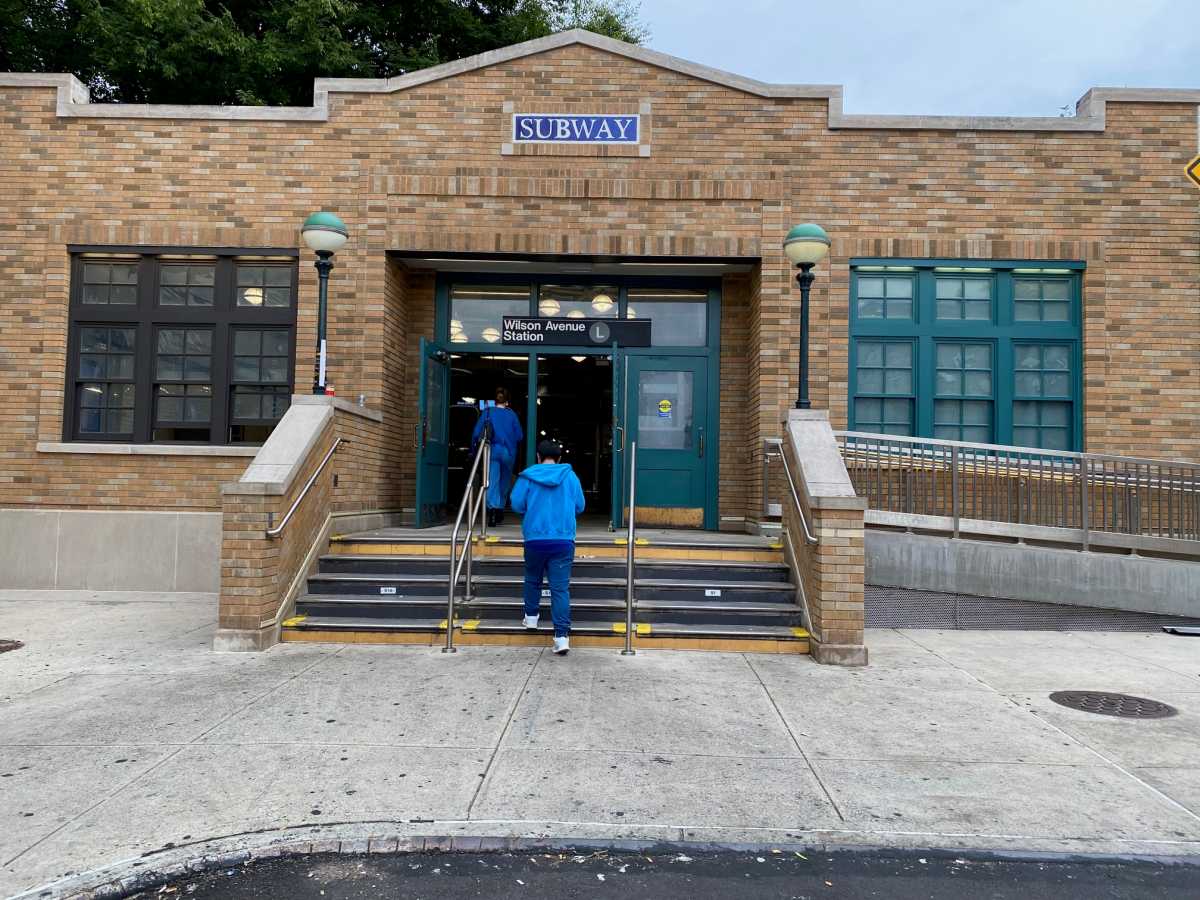
The MTA has pledged to make all 18 IBX stations fully accessible under the Americans with Disabilities Act (ADA) as well as the 17 subway stations they will connect to. According to the agency, it is already in the process of making ADA upgrades at three of the four subway stations that will connect to the IBX but are not currently accessible. Those include Broadway Junction A, C, J, Z, and L, Junius Street on the 3, and Avenue I on the F.
The MTA will upgrade the fourth and final station, Wilson Avenue on the L, via its $68 billion 2025-2029 Capital Plan, with plans to award a construction contract for the work by the middle of next year.
“By building the IBX as a fully accessible rail system, riders will be able to travel between Brooklyn and Queens faster than ever before,” said Quemuel Arroyo, the MTA’s chief accessibility officer, in a statement.
Hochul’s office and the transit authority also announced they will be releasing a draft environmental impact statement for the project before the end of this year, sooner than initially planned.
“By pushing forward on design and accelerating accessibility upgrades at future subway connections, my administration is bringing all 900,000 New Yorkers who live near planned IBX line one stop closer to reduced travel times and an even more reliable public transit experience,” she said.
The draft environmental impact statement will give the most detailed look yet into how the IBX will affect the communities that it will run through, a little over a year after it kicked off the project’s design phase.

The governor and MTA will follow the document’s release by holding another batch of public meetings in which residents living along the IBX corridor can share input on the project.
The news comes as the MTA has held 30 pop-up events up and down the planned IBX route throughout the summer, which yielded over 7,000 interactions with community residents, according to Hochul’s office.
The renderings have already drawn some praise.
In a statement, President and CEO of the New York Building Congress Carlo Scissura said the renderings are an “inspiring look into the possible future of a more connected New York City.”
“But they will remain just drawings on paper until we devote the resources needed to transform them into steel and stone, allowing real New Yorkers to be whisked from Bay Ridge to Jackson Heights,” he added. “Now it’s time to talk turkey on funding the next steps, gathering crucial public input, and keeping the ball moving on the next great infrastructure project for New York.”
The post Hochul, MTA unveil new IBX renderings, say project is moving faster than expected first appeared on The Ocean Avenue News – oceanavenuenews.com.
For dozens of Brooklyn children, the start of the school year came with a new backpack, a bag full of supplies and a night under the lights at Maimonides Park.
Brooklyn FC teamed up with The Salvation Army of Greater New York on Aug. 29 to help local families get ready for the new school year, inviting children and their parents to the club’s match against Sporting JAX in Coney Island.
As part of the partnership, 50 children from communities across Brooklyn — including Sunset Park and Brownsville — received backpacks filled with essential school supplies.
“We know that preparing for a new school year comes with a lot of added expenses for families. This partnership with Brooklyn FC allowed us to provide children with essential school supplies while also giving them an experience that brought families together,” Rebecca Smith, divisional director of philanthropy for The Salvation Army of Greater New York, said in a statement to Brooklyn Paper. “The children were bursting with excitement as they walked into the stadium wearing their new backpacks ”
The giveaway came as families continue to contend with the cost of everyday necessities, making back-to-school expenses such as notebooks, pencils and backpacks another strain on household budgets.
But organizers aimed to make the event about more than supplies. Children were invited to bring their families to Maimonides Park for an evening of soccer and community, pairing practical back-to-school support with a memorable experience.
More than 100 community members ultimately attended the event, creating an evening centered on families and the start of a new school year.
For at least one child, the night also marked a first: He told organizers it was his first time attending a professional soccer game and said he was so excited that he couldn’t wait to tell all of his friends about the experience.
For more information on The Salvation Army’s efforts, click here.
The post Brooklyn FC, Salvation Army team up to give local kids backpacks — and a night at the soccer game first appeared on The Ocean Avenue News – oceanavenuenews.com.

Brooklyn Supreme Court Justice Jill Epstein will rule on the proposed bylaw changes. brooklyneagle.com/413944/bro…