New York City has a long and eventful history. Over 400 years, we have had our ups and downs. But throughout, New Yorkers’ resiliency has prevailed and our city’s fundamental values have remained constant. We are stronger because of our diversity. Every single person who decides to build their life here becomes part of our city’s economy and vibrant culture. We are all New Yorkers together: anything that affects one of us, affects us all.
We know that the present moment is one of great change and that there may be heightened anxiety among many of our communities. I want to reassure you: our city’s government and its hundreds of thousands public servants are here for you, working around the clock. Please continue to make use of the many resources that New York City offers.
To our immigrant communities: continue to send your children to school, seek medical care, and report crimes for the safety and wellbeing of yourself, your family, and New Yorkers at large.
New York City’s commissioner at the Mayor’s Office of Immigrant Affairs (MOIA) is working directly with immigrant communities to make sure they know what their rights are when dealing with federal immigration enforcement. Please see MOIA’s website for help with questions you may have and to familiarize yourself with guidance.
Our city is a place where all New Yorkers can be themselves — regardless of where you come from, the language you speak, your religion, gender, or sexual identity. We stand with our immigrant communities, as well as our entire LGBTQ+ community, including trans and gender nonconforming New Yorkers. For more information and support for yourself or your loved ones, please see our Unity Project.
In addition to teaching our kids to read and write, New York City Public Schools helps foster respect and acceptance among our youth through our inclusive curriculum. Our schools offer instruction to young people regardless of immigration status. You can apply for 3-K and Pre-K as well as entrance to other grades now. As the summer approaches, we are continuing with our Summer Youth Employment Program, which offers paid work experience to youth between the ages of 14 and 24. The deadline to apply is February 28. Please apply now.
Our city’s strength and resiliency is also affected by the health of each and every New Yorker. As we saw during the COVID-19 pandemic, vaccines help prevent the spread of disease and keep us all safe. Regardless of insurance or immigration status, New Yorkers of all ages can receive key immunizations or low or no cost. These include vaccines for COVID-19, the flu, polio, and measles. Make an appointment today and keep your loved ones and our city safe.
Women’s health care continues to remain a priority. For those who need reproductive care, safe, confidential, and legal abortion services are available by calling 1-877-692-2482 or by visiting the Health Department’s Abortion Access Hub.
Don’t forget that the many changes going on around us can be stressful. That is why our city offers free online therapy for teens ages 13 to 17 through TalkSpace. And New Yorkers of all ages can call 988 to receive free, confidential mental health care for anxiety, depression, crisis counselling, substance use, and more.
Among the many reasons New York City remains the greatest city in the world is our diversity, our respect for each other, and our tolerance for those who are different from us. I want to remind you that discrimination is illegal in New York City. Our state constitution and City Charter forbids discrimination on the basis of gender, race, age, sexual orientation, race, ethnicity, origin, creed, military status, citizenship, religion, or disability.
Please be kind and respectful toward your neighbors and expect the same kindness and respect for yourself. I have faith in our great city to become even stronger and more resilient as we continue to be a beacon of hope and a place where people from all over the world and all walks of life come to build a new life.
New York’s CityFHEPS housing voucher program has grown into a fiscal albatross that is barely making a dent in keeping vulnerable low-income residents in their homes — and draining the city coffers of billions of dollars, according to a nonprofit’s report released Monday.
The Citizens Budget Commission (CBC) — a nonpartisan nonprofit that examines city and state public policy — says CityFHEPS is proving that City Hall cannot “voucher its way out” of the affordability crisis gripping the city and that another more effective solution must be found.
The CBC report comes out at a time when the Adams administration, the City Council and the Legal Aid Society are in a protracted legal battle over the expansion of CityFHEPS. The Council approved the expansion in 2023, overriding a veto from Mayor Eric Adams, who said the costs to expand CityFHEPS were too great.
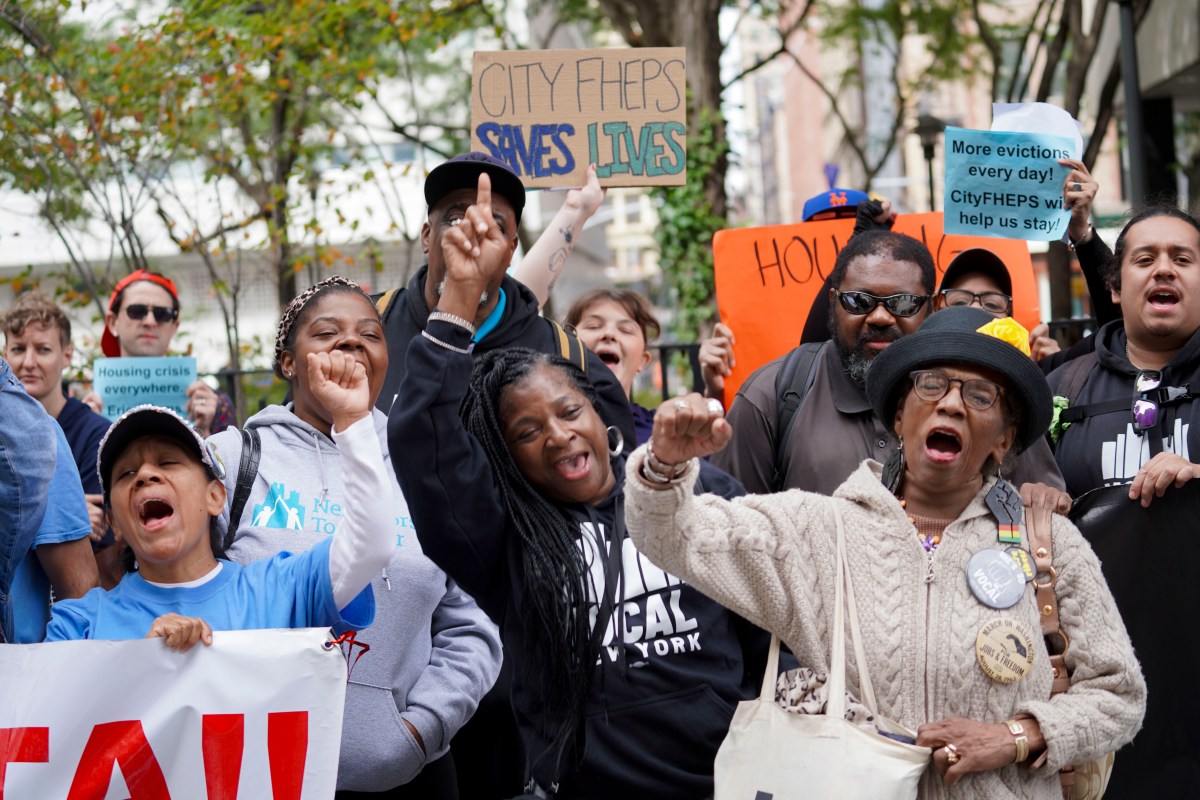
New Yorkers rallied on Oct. 1, 2024 as the City Council and Legal Aid Society appealed a court ruling blocking efforts to force City Hall to expand CityFHEPS housing voucher eligibility, as required under a City Council law enacted in February.Gerardo Romo / NYC Council Media Unit
The ballooning costs
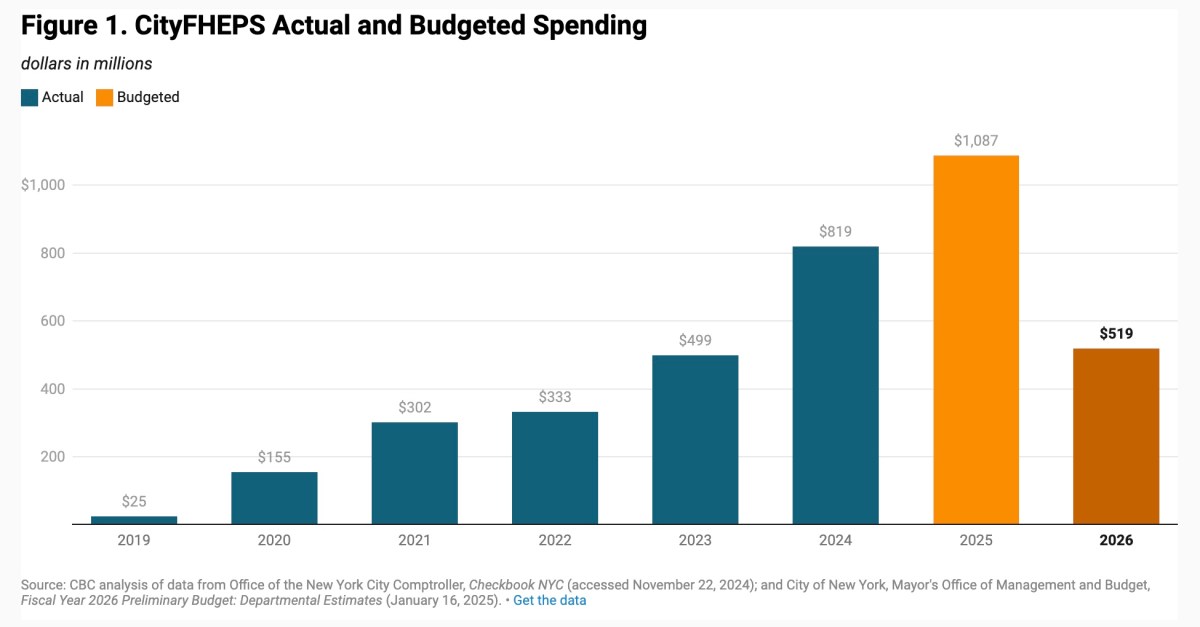
CityFHEPS started out in 2019 as a consolidated version of several city-funded rental subsidy programs designed to reduce the homeless shelter population, keep families vulnerable to falling into homelessness in their homes, and reduce city expenses. At the onset, the city invested just $25 million in the program.
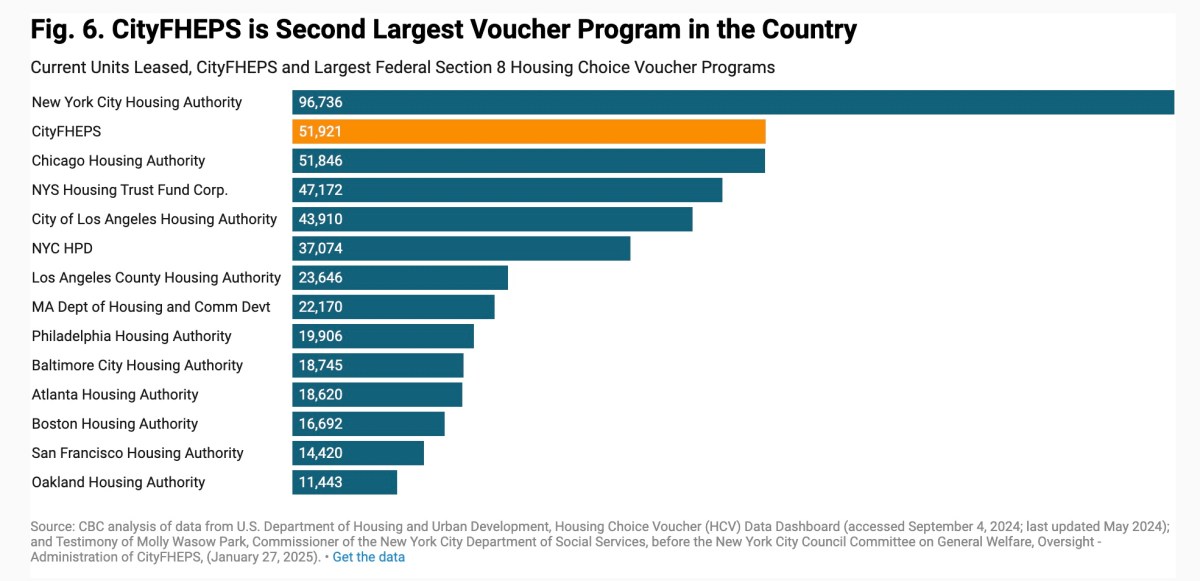
Six years later, however, CityFHEPS’ cost has exponentially ballooned to $1.1 billion in fiscal year 2025—more than double the cost of the program just two years ago and a staggering 44 times larger than the amount originally allocated for the program in 2019. CityFHEPS, in fact, has grown to become bigger than all other federally funded housing programs in all other major U.S. cities except for the New York City Housing Authority, the Big Apple’s public housing system.
“People don’t appreciate how large this program has gotten so quickly,” said Sean Campion, CBC’s director of housing and economic development studies, who authored the report on CityFHEPS vouchers. “That, you know, even before any expansion comes into place, it’s already bigger than pretty much any other city’s federally funded Section 8 voucher program.”
Source: Citizens Budget Commission
In an interview with amNewYork Metro, he explained that the program’s skyrocketing costs reflect the city’s adoption of it as a strategy to help ease homelessness, but it quickly evolved into a regular subsidy regularly renewed for many recipients.
“The city wanted to use this as a strategy, to get people to move out of shelter and into permanent housing,” Campion said. “So this sort of became a primary policy tool to do that, and they’ve been steadily increasing the number of people who are leaving shelter with the subsidy.”
‘Cheaper than shelter beds’
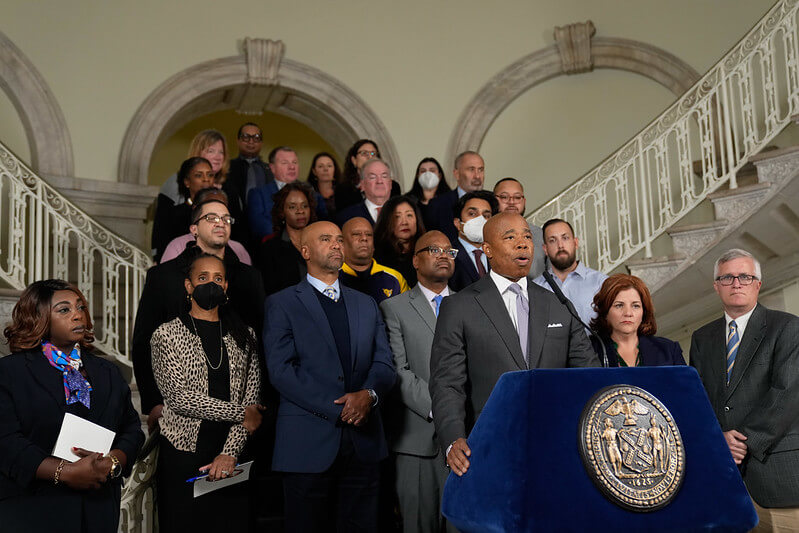
Mayor Eric Adams announced reforms to CityFHEPS vouchers and new pilot program to get more homeless individuals into permanent housing. Monday, Nov. 14, 2022.Photo courtesy of Michael Appleton/Mayoral Photography Office
Some 52,000 families hold CityFHEPS housing vouchers today; the city pays $54.80 per day per voucher, which the CBC acknowledges is “cheaper than shelter beds on a nightly basis.” Yet the report points out that cumulative costs are much higher when factoring in households that wind up back in shelter. On average, the city pays $20,000 per household annually for CityFHEPS vouchers for up to five years, or even longer as the agency so chooses.
The city’s Department of Social Services (DSS), which administers CityFHEPS, issued a statement Monday afternoon criticizing the CBC report as painting a skewed view of the housing voucher program, claiming that it failed “to acknowledge the critical role of CityFHEPS in mitigating the impact of an affordability crisis coupled with the premature expiration of federal and state anti-poverty initiatives on the post-pandemic recover for low-income New Yorkers.
The DSS spokesperson further contended that the shelter population would be even higher without CityFHEPS, adding that last year alone, more than 31,000 New Yorkers used the vouchers to obtain permanent housing or remain in their homes — a 46% increase from the previous year.”
“The fact that the majority of New Yorkers are relying on CityFHEPS to move out of shelter is a testament to the city’s vital investments and robust reforms to expedite placements,” the spokesperson added. “It is unfortunate that the report attempts to devalue a vital resource which is clearly delivering for vulnerable New Yorkers and effectively addressing homelessness instead of calling on other levels of government to bolster the city’s investments in cost-effective rehousing solutions.”
While Campion acknowledged that CityFHEPS has proven beneficial for many recipients, it is still hard for the CBC or other groups to truly gauge the program’s effectiveness — because the city has not been fully transparent with data about the number of vouchers issued, renewal rates, and other measurable information.
“There’s no transparency into the program other than the total cost. We don’t really know enough about how it’s being used and who benefits from it,” he said.
Even now, Campion noted, the city has underbudgeted CityFHEPS for fiscal year 2026 at $519 million — half the total projected to be spent in FY2025.
On an ‘unsustainable’ path
Source: Citizens Budget Commission
Moreover, City Hall is solely responsible for CityFHEPS’ costs. In contrast, the federal government funds traditional Section 8 housing vouchers, and the city’s shelter operations costs are shared in part with the state and federal governments.
While the price tag has soared, the CBC report found that vouchers have not reduced demand for shelter space, nor have they reduced shelter expenses for city government. Worse still, CityFHEPS have done little to make New York City more affordable for those on the cusp of falling into homelessness; average one-bedroom rents in the city have soared to $4,250 a month, according to RentHop; two- and three-bedroom units can cost in excess of $6,000 monthly.
Meanwhile, the homeless shelter population in the city has grown since 2019. The Department of Homeless Shelters reported that 65,864 resided in its facilities in 2019; six years later, that shelter population grew to 102,146 in October 2024. The latter figure excludes the migrants provided shelter on an emergency basis.
Campion says CityFHEPS, as presently constituted, is unsustainable for city government, and its exploding costs will eventually lead to cuts in other city functions if left unaddressed. While there is likely a place for these housing vouchers in the city budget, he stressed that CityFHEPS must be part of a broader, multi-pronged solution to the city’s housing affordability crisis — including more home construction, financial incentives to spur affordable housing development, zoning changes to make building easier and other ideas that go even beyond the recently-approved “City of Yes for Housing” plan.
“Vouchers are very beneficial for people who get them, but the city has to be able to afford to pay the cost of it,” he said. “And part of the argument for expanding it is that it could potentially save the city money, and part of what we find is that that’s not. That’s not the case. Vouchers are beneficial, but they have a pretty high cost, and the growth trajectory of the program now isn’t sustainable.
In response to the CBC report, a City Council spokesperson told amNewYork Metro that it largely agreed with the conclusion that CityFHEPS “is a necessary part of the solution to the housing crisis” but that it cannot be the only one. The Council again criticized the Adams admininstration for refusing to expand the program as required in the 2023 law it approved, but noted that “without these reforms and additional efforts by this administration to eliminate bureaucratic obstacles, New York City continues to experience record-high homelessness.”
“The city unquestionably needs more support for housing vouchers and shelter funding from our state partners, for which the Council has advocated,” the Council spokesperson added. “As our city continues to face a housing shortage, rising evictions and persistent homelessness, it will be critical for all levels of government to participate in addressing these issues.”