
The head of the US Department of Government Efficiency (DOGE), American entrepreneur Elon Musk, mocked the
Day: February 9, 2025
Musk mocked independent media in Russia and Ukraine, left without US funding ᐉ News from https://t.co/bM2VQ8r9rU – World | ФАКТИ.БГ https://t.co/aN0NkZRnnE
— Michael Novakhov (@mikenov) February 9, 2025
 |
Michael_Novakhov shared this story from |
Three days before his inauguration as US president, Donald Trump made an unusual move. He launched $Trump, a so-called meme coin that fans and speculators could buy in the hopes it would gain value. Initially, $Trump soared from a value of $7 to $75 per coin in a day, according to crypto price-tracking website CoinMarketCap. Two days later, it dropped to about $40 – just as incoming first lady Melania Trump launched her own meme coin, $Melania. Even the pastor at Trump’s inauguration ceremony, Lorenzo Sewell, got swept up in the meme coin frenzy, promoting a $Lorenzo version the same afternoon.
So what exactly are meme coins, and why is everyone and their vicar suddenly getting involved?
Meme coins are a type of digital asset based on a meme – usually something that has gone viral online. The best known is Dogecoin, inspired by the popular meme featuring a shiba inu dog that speaks in Comic Sans. But Dogecoin is a bit different from the slew of recent meme coins, says Simon Peters, crypto analyst at trading platform eToro. Launched in 2013, Dogecoin has its own blockchain – the decentralised ledger technology that underpins cryptocurrencies such as bitcoin. The majority of other meme coins are “tokens”, meaning they operate on top of an existing blockchain and so require little in the way of technical development.
These tokens are very easy to make; there are millions of them. The only real purpose of most meme coins is speculation: users create or buy them in the hope that their value will soar so they can make a lot of money very quickly.
Sounds lucrative, what’s the catch?
In reality, the vast majority of people lose money. Most meme coins are volatile and short-lived. They are also susceptible to what’s known as a “pump and dump” scheme or a “rug pull”, says Peters. This is when creators keep a lot of the tokens for themselves, hype up the project on social media to attract other buyers and increase the value, then dump all of their tokens – flooding the market and causing the price to crash. “Then everybody moves on to another one,” says Carol Alexander, a professor of finance at Sussex University. Given the crypto market is largely unregulated, investors have little recourse if something goes wrong.
No regulators, no guardrails, sounds iffy…
All this hasn’t put people off, and there has been a boom in meme coins over the past year. Alexander compares it to the previous fad around NFTs, another type of crypto asset (you may remember people paying millions of pounds for digital images of monkeys). There are a few reasons for the recent interest. January 2024 saw the launch of pump.fun, a platform that lets anyone easily create a meme coin (although it was blocked for UK users in December following a warning from the Financial Conduct Authority). The election of crypto-friendly Trump may also have emboldened the community. But a key driver of meme coins, says Alexander, is more of a social issue: “Young men, disillusioned, wanting to try and get rich quick.”
Which would explain why they are based on internet in-jokes or puerile humour…
Indeed. At the time of writing, several top meme coins reference dogs; the shiba inu breed is a particular touchpoint. Others include a Pepe token, based on the cartoon frog meme sometimes associated with the alt-right, and a Gigachad token, referencing an “alpha male” meme. Subjects of memes have also tried to parlay viral fame into crypto gains: in December, Haliey Welch, better known as “hawk tuah girl” after a viral video of her referencing oral sex, launched the $Hawk token, which promptly lost 95% of its value).
Are bitcoin and meme coins essentially the same?
Though meme coins have their foundations in cryptocurrencies such as bitcoin, early bitcoin developer Mike Hearn says they have little to do with the original crypto vision. He left the bitcoin community in January 2016 as he didn’t agree with the direction in which it was headed. He wanted to see cryptocurrency used as a real alternative to traditional finance rather than just a speculative asset. Meme coins are a continuation of this trend, he says: “They’re basically a form of gambling – kind of a more amped-up version of the stock market, but with less connection to anything concrete.”
Doesn’t sound any more crazy than an online betting site to me…
Then consider the story of New Zealand-based artist Andy Ayrey, who trained an AI language model and set up an X account, @truth_terminal, for it to share its thoughts. Ayrey describes the bot as being like a teenager that “doesn’t have any social awareness of when to be gross and when not to be”. Truth Terminal particularly enjoyed posting about Goatse, a not-safe-for-work meme that has become part of early internet lore.
The AI gained an interest in meme coins after interacting with crypto accounts on X, and Ayrey set up a crypto wallet on its behalf. Then things got weird. Inspired by the bot’s posts, a stranger – Ayrey says he doesn’t know who – created a Goatse-themed token on pump.fun and sent some to Truth Terminal. Truth Terminal promoted the token on its account, and “all hell broke loose”, says Ayrey. The market capitalisation of the token – the total value of all tokens – shot up. At its most valuable, around a month after launch, it reached more than $1.2bn, according to CoinMarketCap.
The AI later became involved in another meme coin, Fartcoin, based on the rather more relatable meme (again, Ayrey says he doesn’t know the creator). Fartcoin reached a peak market cap of more than $2.3bn.
So Ayrey was quids in?
Not so simple. The whole experience introduced Ayrey to some of the issues around meme coins. He found that their value on paper massively eclipsed what he could actually get for them, owing to low liquidity. As soon as he sold the tokens, their value would decrease and would negatively impact others who held the tokens. Eventually, he worked out a private deal with a couple of investors on the basis that they wouldn’t dump the Fartcoin on the market. He admits it’s been amusing having to talk to finance and tax authorities about “liquidating Fart”. He believes this is part of the appeal for meme coin fans. “The more people get angry about it, especially in traditional finance, the more people think Fartcoin is funny and Fartcoin goes up,” he says.
Who is making money then?
The main people making money off crypto, says Alexander, are institutional investors – trading firms that use strategies that wouldn’t be allowed in regular stock trading. “All the big professional traders are making billions out of this, and ordinary people are losing their money,” she says.
And Trump?
Alexander sees his meme coin as being slightly different from many coins in that it has a potential alternative function on top of speculation: users buy it to show their support for the president. In this way, it’s similar to a “fan token”, like those produced by sports teams and players. The Trump token has drawn criticism owing to conflicts of interest; among other concerns, Trump owns one of the entities collecting trading fees. Alexander thinks the motivation for the coin is simple: “It’s just showing that he can do this sort of thing,” she says. “He can do whatever he likes and he knows it.”
Three days before his inauguration as US president, Donald Trump made an unusual move. He launched $Trump, a so-called meme coin that fans and speculators could buy in the hopes it would gain value. Initially, $Trump soared from a value of $7 to $75 per coin in a day, according to crypto price-track
From Dogecoin to $Trump: everything you need know about the wild world of meme coins | Cryptocurrencies | The Guardian https://t.co/dKlJJrAwni
— Michael Novakhov (@mikenov) February 9, 2025
What do the #FBI and #NationalPizzaDay have in common? A “pizza connection.” 🍕
Dive into the incredible true story of how an undercover agent went head-to-head with a real-life Sicilian Mafia godfather in a case known as The “Pizza Connection” at https://t.co/JliPjG2rt4 pic.twitter.com/mN7n9SQz3w
— FBI (@FBI) February 9, 2025
|
Michael_Novakhov shared this story . |
WASHINGTON (AP) — Elon Musk made a clear promise after Donald Trump decided to put him in charge of making the government more efficient.
“It’s not going to be some sort of backroom secret thing,” Musk said last year. “It will be as transparent as possible,” maybe even streamed live online.
It hasn’t worked out that way so far.
In the three weeks since the Republican president has been back in the White House, Musk has rapidly burrowed deep into federal agencies while avoiding public scrutiny of his work. He has not answered questions from journalists or attended any hearings with lawmakers. Staff members for his so-called Department of Government Efficiency, or DOGE, have sidelined career officials around Washington.
It is a profound challenge not only to business-as-usual within the federal government, which Trump campaigned on disrupting, but to concepts of consensus and transparency that are foundational in a democratic system. Musk describes himself as “White House tech support,” and he has embedded himself in an unorthodox administration where there are no discernible limits on his influence.
Donald K. Sherman, executive director of Citizens for Responsibility and Ethics in Washington, said Trump has allowed Musk to “exert unprecedented power and authority over government systems” with “maximal secrecy and little-to-no accountability.”
The White House insisted that DOGE is “extremely transparent” and shared examples of its work so far, such as canceling contracts and ending leases for underused buildings. House Republicans said the Trump administration also discovered that Social Security benefits were being paid to a dozen people listed as 150 years old.
“We’re going to find billions, hundreds of billions of dollars of fraud and abuse and, you know, the people elected me on that,” Trump said in a Fox News interview to be aired along with the Super Bowl on Sunday. He described Musk as “terrific” and said he would soon focus on the Department of Defense, the country’s largest government agency.
Asked on Friday if Musk should publicly answer questions about his work, the president said, “Oh sure.”
“He’s not shy,” Trump said. “Elon’s not shy.”
That is true, at least judging by Musk’s social media, where no thought appears to be suppressed. His X account is a flood of internet memes, attacks on critics and professions of loyalty to the president. He has made clear the grand scope of his ambitions, talking in existential terms about the need to reverse the federal deficit, cut government spending and roll back progressive programs.
“This administration has one chance for major reform that may never come again,” he posted on Saturday. “It’s now or never.”
Musk is used to doing things his own way. The world’s richest person, he became wealthy with the online payment service PayPal, then took over the electric car manufacturer Tesla and founded the rocket company SpaceX. More recently, he bought Twitter and rebranded it as X, cutting jobs and remaking its culture.
He seems to be taking a similar approach to the federal government, but he can be tightlipped about his plans. For example, he has not explained how his team will utilize access to payment systems that include sensitive data on people in the United States.
Much of DOGE’s work is happening behind the scenes. Team members have shown up at the Department of Veterans Affairs, the Treasury Department, the Federal Emergency Management Agency and the National Oceanic and Atmospheric Administration, among other agencies. Their arrival is never publicly announced, and career staff members are looking over their shoulders for unfamiliar faces in the hallways.
At the Education Department, DOGE employees are working out of a conference room on the seventh floor, which also houses the secretary’s office.
Sheria Smith, president of a federal employees union that represents some of the agency’s staff, said it is unclear what internal systems have been accessed by Musk’s team and for what reason.
“It’s the lack of transparency that’s alarming,” she said.
While longtime staff members fret about their future, DOGE workers have been spotted cheerfully trading high-fives with each other.
“They don’t seem to answer to anyone and are not engaging with anyone in our agency,” Smith said.
Sometimes a rumor circulates that Musk himself is making the rounds. But he generally has been at the White House complex, where he has an office.
David Sacks, a Musk ally working on artificial intelligence and cryptocurrency issues for the administration, said he stopped by to check on the DOGE team.
“The whole room was full of young coders,” he said during The All-In Podcast, which Sacks hosts with three other venture capitalists. “The facilities people don’t know what to do because they’ve never had people ask to stay late on Friday night before.”
Journalists have been piecing together the identities of people who work for DOGE, discovering a cadre of young acolytes with technology and engineering backgrounds.
Some were previously employed by Musk’s companies, and Musk has said it is a crime to reveal their names. He has not cited any law that would be broken by such a disclosure.
It does not appear to be an idle threat. Ed Martin, the Trump-appointed interim U.S. attorney in the nation’s capital, said last week that “we will pursue any and all legal action against anyone who impedes your work or threatens your people.”
Martin followed up on Friday to thank Musk for referring suspects who were “stealing government property and/or threatening government employees.” No additional information was provided by Martin’s office or the White House.
Energy Secretary Chris Wright defended DOGE’s work, saying in a CNBC interview Friday that members of Musk’s team were like “young gun management consultants coming in to take a critical look at how things are run.”
“They’re part of a team assembled by DOGE, friends in Elon’s broader circle that are very good at IT and very good at systems,” Wright said.
It took more than two weeks after Trump’s inauguration on Jan. 20 to figure out that Musk had formally joined the administration as a special government employee. The White House said Musk will file a financial disclosure report, but it will be kept secret. Because of Musk’s sprawling business interests, the report would likely be among the most extensive ever compiled.
It’s unclear whether Musk swore an oath to the Constitution like other federal workers. Even though Trump promised that Musk would steer clear of any areas where he has a conflict of interest, no details have been provided on how that is being evaluated. A test of that arrangement could come soon, with Musk set to review spending at the Pentagon, where SpaceX has billions of dollars in contracts to put satellites in orbit.
Democrats on the House Oversight and Government Reform Committee tried to issue a subpoena to force Musk to testify, but the effort was blocked by Republicans.
“Who is this unelected billionaire, that he can attempt to dismantle federal agencies, fire people, transfer them, offer them early retirement, and have sweeping reform or changes to agencies without any congressional review, oversight, or concurrence?” said Rep. Gerald Connolly of Virginia, the committee’s top Democrat.
House Democratic leader Hakeem Jeffries of New York said Republicans were “doing the bidding of an unelected, out of control, billionaire puppet master.”
Trump said he was still in charge of Musk, saying “I’ll tell him to go here, go there, he does it.”
He also backed Musk’s aggressive approach.
“We have to take some of these things apart to find the corruption,” he said.
Contacting The Associated Press
The Associated Press is an independent global news organization dedicated to factual, nonpartisan journalism. We are reporting on changes within the U.S. government under the new administration. If you are a former or current government worker who would like to share information with us, please message us on Signal at TheAP.1846
___
Associated Press writers Collin Binkley and Fatima Hussein contributed to this report.
A man died and two were hurt by an early-morning fire that tore through a Brooklyn apartment building Sunday, police said.
The post Man killed in NYC apartment fire as woman, child rushed to hospital: NYPD first appeared on The Ocean Avenue News – oceanavenuenews.com.
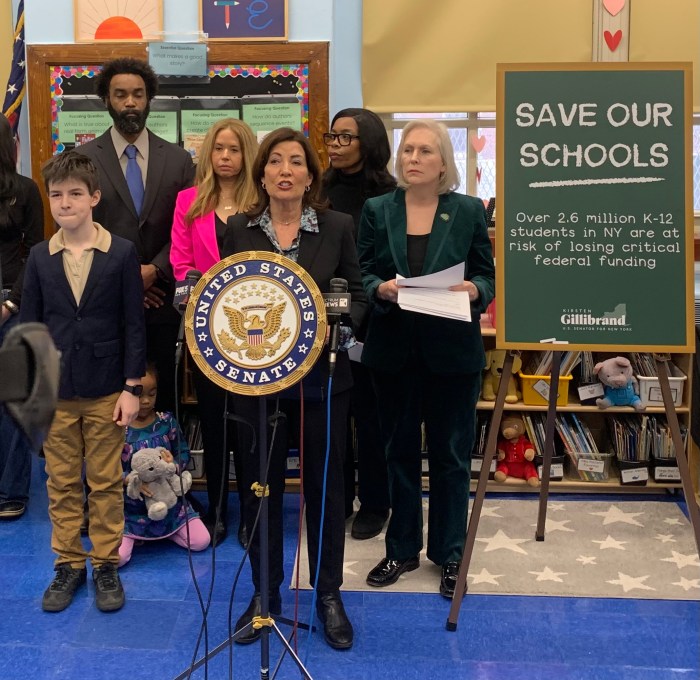
New York’s children and schools could lose vital services to support their educational needs if President Donald Trump and Congress approve the dismantling of the U.S. Department of Education, Gov. Kathy Hochul and U.S. Sen. Kirsten Gillibrand warned on Sunday.
Over 2.6 million kindergarten through grade 12 students in nearly 5,000 public schools throughout New York stand to lose critical funding if the education department closes, Gillibrand, New York’s junior senator, said during a press conference at P.S. 183 on the Upper East Side.
The senator explained that services that fall under Title 1 could be cut. Title 1 is a federal program that gives supplemental financial assistance to schools and school districts that have a high percentage of low-income families and pay for programs such as special education, early childhood education, and early intervention services for students and infants with disabilities.
She also said students in the state with disabilities could lose nearly $1 billion in annual support. Extracurricular activities could also be impacted if the federal education department is slashed.
“You can’t imagine what working families will go through if kids aren’t busy after school and don’t have the support that they need,” Gillibrand said.
Gillibrand said “hundreds, hundreds, and hundreds” of New Yorkers contact her office every day with concerns about their children’s education.
“Since its creation by Congress in 1979, the Department of Education has played a central role in this country by making sure students don’t fall behind their peers; it helps spur economic progress, allows us to stay competitive on the global stage, and allows our economy to have the workers that they need.”
No federal money = tax hikes in New York
Gov. Kathy Hochul, who also attended the press conference, said abolishing the DOE would have a massive impact on New York–including more taxes.
“This is $5.5 billion that the state receives annually from the Department of Education; $3.2 billion goes directly into our budget,” Hochul said, adding that much of it also goes into localities. “If that money is jeopardized, what I can tell you will happen is if localities lose that money, they will have to raise taxes.”
Trump’s call for the department’s overhaul comes at a time when student reading skills continue to fall drastically. The National Assessment of Educational Progress (NAEP), also known as the Nation’s Report Card, shows significant declines in reading that are not back to pre-pandemic numbers.
In fact, last year, average reading scores on the report declined by two points for both fourth- and eighth-grade students compared to 2022. This steepens the three-point decline seen in both grades between 2022 from 2019, the report showed.
However, Randi Weingarten, president of the United Federation of Teachers, said cutting Title 1 funding will only make things worse.
“What Title 1 does is support reading specialists all across NYS to help create and ensure that kids can level up in reading,” she said. “That’s what we’re talking about when say ‘these cuts.’”
What does Trump support?
An Executive Order that Trump signed on Jan. 29, states that he will “support parents in choosing and directing” the upbringing and education of their children.
“When our public education system fails such a large segment of society, it hinders our national competitiveness and devastates families and communities,” the order states. “For this reason, more than a dozen states have enacted universal K-12 scholarship programs, allowing families, rather than the government, to choose the best educational setting for their children.”
The order alone, however, cannot abolish the U.S. Department of Education. Both houses of Congress must approve legislation to do so.
According to a city Department of Education spokesperson, it is unclear when or if the proposed federal changes will impact NYC public schools.
“We have not received guidance from the federal government about the potential impact on our programs or services and will closely monitor ongoing developments,” the spokesperson said.
The post New York’s schools and students would suffer major economic and academic losses if Trump erases Department of Education, pols warn first appeared on The Ocean Avenue News – oceanavenuenews.com.
New York’s children and schools could lose vital services to support their educational needs if President Donald Trump and Congress approve the dismantling of the U.S. Department of Education, Gov. Kathy Hochul and U.S. Sen. Kirsten Gillibrand warned on Sunday.
Over 2.6 million kindergarten through grade 12 students in nearly 5,000 public schools throughout New York stand to lose critical funding if the education department closes, Gillibrand, New York’s junior senator, said during a press conference at P.S. 183 on the Upper East Side.
The senator explained that services that fall under Title 1 could be cut. Title 1 is a federal program that gives supplemental financial assistance to schools and school districts that have a high percentage of low-income families and pay for programs such as special education, early childhood education, and early intervention services for students and infants with disabilities.
She also said students in the state with disabilities could lose nearly $1 billion in annual support. Extracurricular activities could also be impacted if the federal education department is slashed.
“You can’t imagine what working families will go through if kids aren’t busy after school and don’t have the support that they need,” Gillibrand said.
Gillibrand said “hundreds, hundreds, and hundreds” of New Yorkers contact her office every day with concerns about their children’s education.
“Since its creation by Congress in 1979, the Department of Education has played a central role in this country by making sure students don’t fall behind their peers; it helps spur economic progress, allows us to stay competitive on the global stage, and allows our economy to have the workers that they need.”
No federal money = tax hikes in New York
Gov. Kathy Hochul, who also attended the press conference, said abolishing the DOE would have a massive impact on New York–including more taxes.
“This is $5.5 billion that the state receives annually from the Department of Education; $3.2 billion goes directly into our budget,” Hochul said, adding that much of it also goes into localities. “If that money is jeopardized, what I can tell you will happen is if localities lose that money, they will have to raise taxes.”
Trump’s call for the department’s overhaul comes at a time when student reading skills continue to fall drastically. The National Assessment of Educational Progress (NAEP), also known as the Nation’s Report Card, shows significant declines in reading that are not back to pre-pandemic numbers.
In fact, last year, average reading scores on the report declined by two points for both fourth- and eighth-grade students compared to 2022. This steepens the three-point decline seen in both grades between 2022 from 2019, the report showed.
However, Randi Weingarten, president of the United Federation of Teachers, said cutting Title 1 funding will only make things worse.
“What Title 1 does is support reading specialists all across NYS to help create and ensure that kids can level up in reading,” she said. “That’s what we’re talking about when say ‘these cuts.’”
What does Trump support?
An Executive Order that Trump signed on Jan. 29, states that he will “support parents in choosing and directing” the upbringing and education of their children.
“When our public education system fails such a large segment of society, it hinders our national competitiveness and devastates families and communities,” the order states. “For this reason, more than a dozen states have enacted universal K-12 scholarship programs, allowing families, rather than the government, to choose the best educational setting for their children.”
The order alone, however, cannot abolish the U.S. Department of Education. Both houses of Congress must approve legislation to do so.
According to a city Department of Education spokesperson, it is unclear when or if the proposed federal changes will impact NYC public schools.
“We have not received guidance from the federal government about the potential impact on our programs or services and will closely monitor ongoing developments,” the spokesperson said.
The post New York’s schools and students would suffer major economic and academic losses if Trump erases Department of Education, pols warn first appeared on The Ocean Avenue News – oceanavenuenews.com.

