Attention DOGE and Elon Musk: Here’s how the federal government spends Americans’ tax dollars | CNN Politics
Visit
Images may be subject to copyright. Learn More
Share
Save
 The Brooklyn Times - bklyntimes.com
Tweets – Michael Novakhov (@mikenov) / Twitter
Brooklyn Borough President Antonio Reynoso has given his approval with conditions to the Atlantic Avenue Mixed-Use Plan, a sweeping rezoning proposal aimed at transforming a stretch of Atlantic Avenue and surrounding blocks in central Brooklyn.
While endorsing the plan’s goals of expanding housing, job opportunities, and infrastructure improvements, Reynoso supported local residents’ calls for the need for stronger tenant protections, deeper affordability requirements, and safeguards for manufacturing space.
The decision came after a Jan. 19 hearing held by the borough president, at which seven residents spoke about the plan and Reynoso’s staff asked questions of reps from City Planning, Transportation, Housing Preservation and Development, and the Department of Small Business Services.
Reynoso’s stance aligns with concerns voiced by those who spoke at the hearing and local community boards 3 and 8. The community boards also backed the proposal but pushed for modifications to ensure that long-time residents and businesses aren’t displaced in the process.
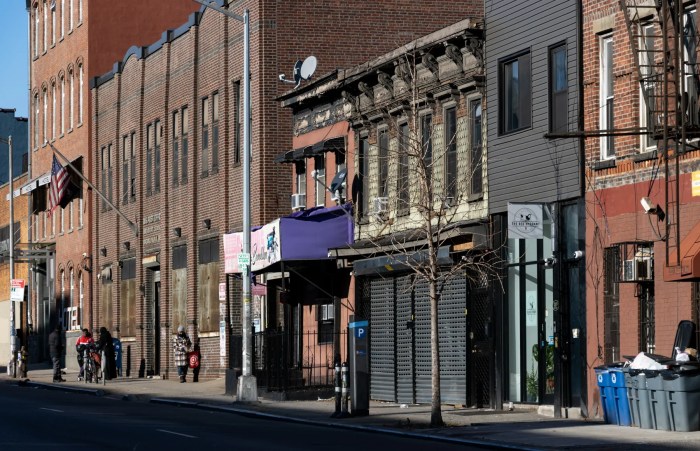
Reynoso outlined a series of conditions around manufacturing protections, affordable housing commitments, and infrastructure and transit upgrades. The rezoning must require ground-floor manufacturing uses in designated zoning areas, prevent displacement of existing industrial tenants, and establish an Industrial Business Service Provider to support growth, he said. (The latter are part of a city program and offer trained specialists to help businesses thrive.)
In regards to affordable housing, the city must explore ways to deepen affordability, including a new Mandatory Inclusionary Housing option with lower income thresholds and an expansion of affordable housing on publicly owned sites, he added. He also recommended looking into measures like a tenant displacement registry and relocation assistance legislation.
He said the Department of Transportation must commit to a “road diet” reducing Atlantic Avenue to four lanes, increase metered parking to manage congestion, and prioritize safety improvements at key intersections. Subway upgrades will also be required to accommodate the anticipated population growth, he added.
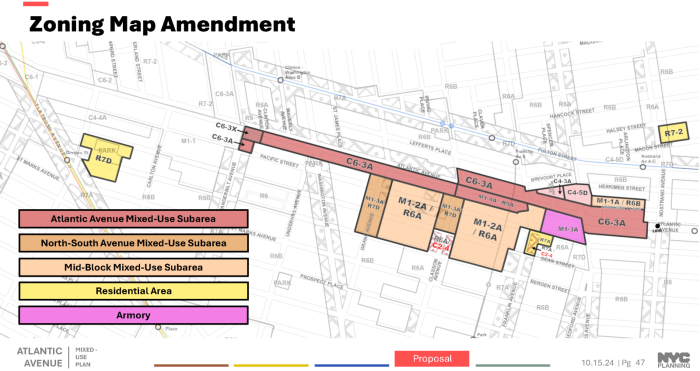
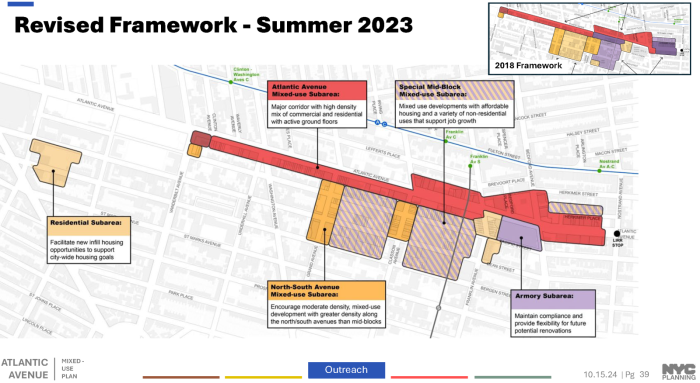
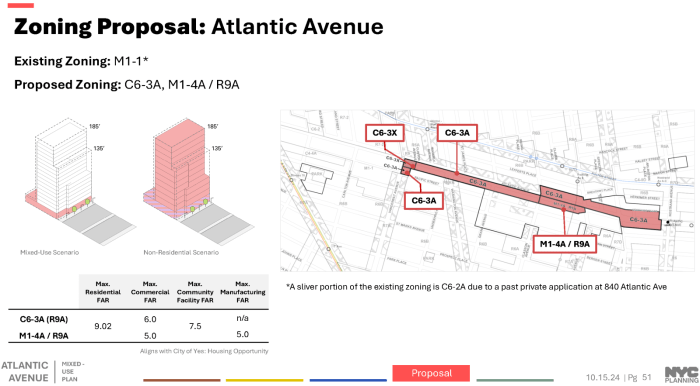
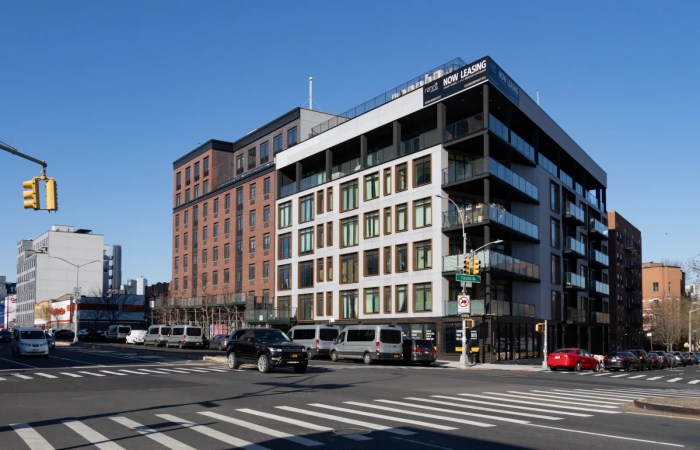
In total, the Atlantic Avenue Mixed-Use Plan would rezone approximately 21 blocks along Atlantic Avenue, stretching from Vanderbilt Avenue in Prospect Heights to Nostrand Avenue in Crown Heights. The goal is to promote a mix of housing, commercial, and industrial uses while making the corridor more pedestrian friendly and economically vibrant, according to the Department of City Planning, which is behind the rezoning application.
The rezoning has the potential to bring nearly 4,600 new apartments — including more than 1,400 permanently affordable units — and more than 921,000 square feet of new space for offices, retail, community services, and light industrial businesses, according to Department of City Planning estimates. The non-residential component could add an estimated 2,800 new jobs, according to documents included in the rezoning application.
The existing M1 industrial zoning along Atlantic Avenue would be replaced with C6-3A mixed-use districts, permitting higher-density development with mandatory affordable housing requirements. Developers along Atlantic Avenue could receive a 20 percent floor area bonus for incorporating publicly accessible open spaces, while elsewhere in the rezoned area, height incentives would encourage mixed-use developments that combine residential and non-residential uses. Additionally, new building designs would be required to incorporate setbacks and improve the streetscape along Atlantic Avenue.
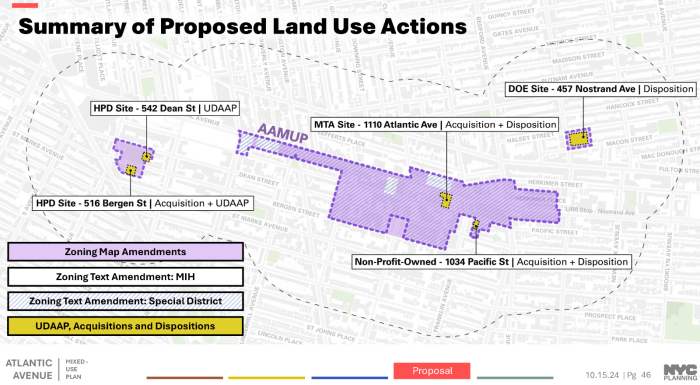
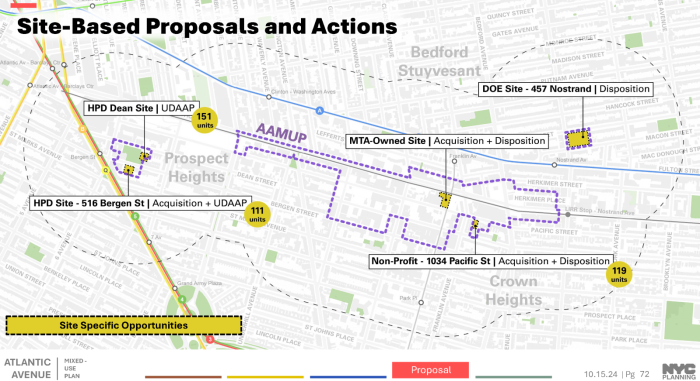
North-south corridors including Bedford, Grand, and Classon avenues would be rezoned to encourage mixed-use buildings, while midblock areas on Dean, Bergen, and Pacific streets would see height incentives for projects that combine residential and non-residential uses. The Bedford Atlantic Armory site would also be rezoned to allow for future community-oriented uses.
City officials say the plan is designed to address Brooklyn’s housing shortage while reinforcing Atlantic Avenue as a commercial corridor. Several city-owned lots are slated for redevelopment into affordable housing as part of the plan. These are:
The rezoning also calls for improving pedestrian safety, adding open spaces, and enhancing transit access.
The city has been engaging with residents and stakeholders on the proposal for over a decade, and the current plan is based largely on work done by Community Board 8, which created its own M-CROWN rezoning proposal. Formal outreach for DCP’s updated plan ramped up in 2022, and it is now moving through the city’s Uniform Land Use Review Procedure, with the City Planning Commission and City Council set to weigh in on the final details in the coming months.
At the borough president’s hearing, community members raised concerns about the rezoning’s impact on tenant displacement, legal protections for renters, and how the rezoning would affect affordability and manufacturing space.
Sarah Lazur, a member of the Crown Heights Tenant Union and Community Board 8, said that the rezoning would intensify displacement pressures in an area already facing high eviction rates.
“Since just 2020, we’ve had almost 6,000 new eviction cases in just the two zip codes in this area,” Lazur said, adding that many tenants face these legal battles without representation. Right to Counsel, a program designed to provide free legal assistance to tenants, has not been enough, she argued, and additional funding is necessary to protect renters from losing their homes.
“Defending all those people who are facing eviction just in the last four years would have cost $26 million,” she said, adding the city should commit at least $3 million annually to Right to Counsel and affirmative work to help people stay in their homes. “It is crucial that you not leave us defenseless,” she said.
Mimi Mitchell, also of Community Board 8 and the Crown Heights Tenant Union, criticized the city for failing to address tenant displacement in its presentation at the borough president’s hearing and overall in its plan, saying “that is the biggest thing that we’re facing in this neighborhood.”
“These are people who elected these officials. These are people who actually created this neighborhood to make it so desirable. These are people who kept it going all of these years. What protection are we really, really giving them? What are we really doing for them? Absolutely seems like nothing.”
Mitchell urged Reynoso and the city to ensure further protections were added to the plan, especially for rent-stabilized tenants whose landlords are trying to push them out. “What is the city going to do? What is HPD going to do? What is Antonio Reynoso going to do to further protect our tenants? We are seriously being harassed.”
Gib Veconi, a longtime facilitator of the Atlantic Avenue rezoning process who spoke on behalf of the Prospect Heights Neighborhood Development Council, said the group takes issue with certain zoning designations proposed in the plan. Specifically, he criticized the inclusion of R7D zoning for certain blocks in Prospect Heights, arguing that the increased height allowances would be out of character with the surrounding area.
While he said he supports affordable housing development on publicly owned sites in the neighborhood, he argued that other areas should be rezoned with lower density requirements unless developers commit to fully affordable housing.
Additionally, Veconi pushed for stronger affordability requirements under Mandatory Inclusionary Housing, calling for the removal of MIH options one and two in favor of the deep affordability option. He also said he supports Community Board 8’s recommendation for a new housing preference in the housing lottery system for displaced residents.
“Community Board 8 is actually calling for a new class of preference for people who have been displaced from Community Board 8 to be able to move back. Community Board 8 has one of the highest rates of displacement in New York City” Veconi said. “This represents an opportunity for displaced people to return to the community district.”
Veconi also said that the plan does not do enough to preserve manufacturing space and that it has to be added back in.
Other speakers voiced concerns that the rezoning will strain what they said is already overwhelmed public infrastructure, particularly the C train, which they said is overcrowded and at capacity. DOT’s response to add train cars wouldn’t be sufficient to handle the expected population surge, speakers said.
Traffic congestion and the influx of construction vehicles also came up, with some locals concerned thoroughfares like Atlantic Avenue could become jammed up and force detours onto smaller residential side streets. Longterm, there are also concerns about the possible loss of traffic lanes and the addition of protected bike lanes without plans for mitigating the impact.
There were calls for more investment in open space and climate resiliency, with residents urging the city to ensure that green spaces and environmental protections are prioritized alongside new development. The borough president’s hearing followed hearings held in December by both Community Board 3 and Community Board 8, which both approved the rezoning, albeit with some major conditions.
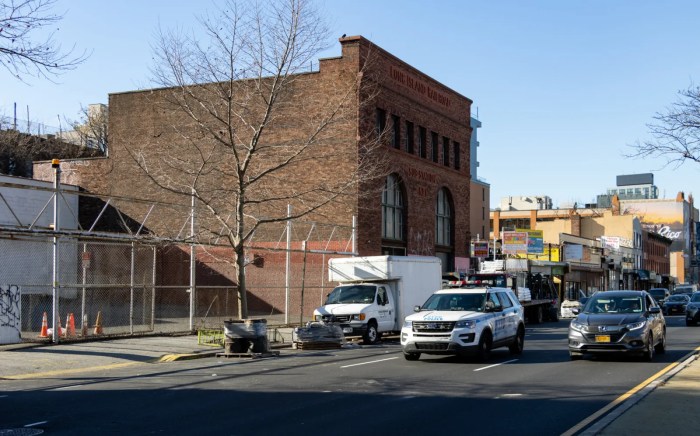
Community Board 3, which covers a small section of the rezoned area to the north of Atlantic Avenue, said in its conditional approval that along Atlantic Avenue building heights should be limited to 12 stories, and 1029-1031 Atlantic Avenue should be removed to protect the Lefferts Place Community Garden. At 457 Nostrand Avenue, the building height should remain below the spire of Girls’ High School, with most units being one-bedroom or family-sized, studio apartments kept to a minimum, and an average affordability of 40 percent AMI, the board wrote. A public plaza or green space should be added along Halsey Street, and underground parking should be considered.
The board also said parks and open spaces within a half-mile of the project should be upgraded in partnership with city agencies, and developers should be encouraged to create privately owned public spaces, with plazas developed at key intersections. Open space should also be included on the northern side of Lefferts Place near the elevated shuttle.
Other recommendations include introducing a commercial overlay on Franklin Avenue between Hancock Street and Fulton Street and reopening the Classon Avenue entrance to the Franklin Avenue station.
Community Board 8, meanwhile, conditionally approved the plan with more than two dozen specific conditions aimed at ensuring affordability, preventing displacement, supporting local businesses, and improving infrastructure. The board emphasized the need for deeply affordable housing, tenant protections, and a community oversight body to monitor commitments. They also called for dedicated workforce development programs, funding for displaced businesses, and restrictions on large retail stores.
Zoning changes were recommended to preserve light-industrial and cultural uses, while environmental measures focused on carbon neutrality, tree canopies, and rain gardens. Transportation improvements, including accessibility upgrades for subway stations and enhanced pedestrian safety, were also key to the approval. (The complete list of Community Board 8’s conditions can be found in a document in the rezoning application.)
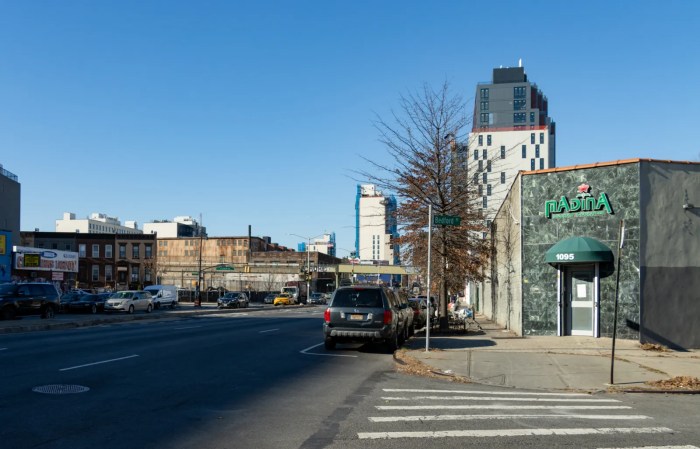
Reynoso backed many of the community boards’ conditions in his approval, saying manufacturing space has to be mandated to protect industrial jobs and promote economic equity. He said mixed-use zoning has led to declines in industrial land, particularly in neighborhoods with strong residential demand, and the city had to require—not just encourage—manufacturing space on key sites. He also called for financial incentives and a dedicated Industrial Business Service Provider to ensure that manufacturing tenants can remain in the area.
Regarding housing, Reynoso urged the city to go further with affordability by adding a deeper affordability option under Mandatory Inclusionary Housing, expanding affordable housing on public land, and creating a tenant displacement registry to prioritize at-risk renters for new affordable units. He also said new tenant relocation assistance legislation modeled on a Seattle program can support low-income residents forced out by redevelopment.
Reynoso, a major advocate of reducing car ownership in Brooklyn and bettering the borough’s public transit and bike network, is also pushing for transit and streetscape improvements along Atlantic Avenue, which he calls a dangerous six-lane truck route that divides neighborhoods. His conditions include a road diet to reduce lanes, better pedestrian infrastructure, subway capacity upgrades, and beautification projects under the Franklin Avenue shuttle tracks.
Following the borough president’s approval with conditions, City Planning will now work on a final environmental impact statement. That will be followed by a City Planning Commission review, where the public will get another chance to testify on the proposal. DCP said it expects the final EIS to be released in March.
As with all rezonings, the local council member’s position will weigh heavily on the city council’s final decision. In a statement to Brooklyn Paper’s sister publication Brownstoner, Council Member Crystal Hudson, who represents most of the area proposed for the rezoning, said she is proud the plan is finally moving through the formal review process and that the borough president’s recommendation reflects the community’s goals of expanding affordable housing and making the streets safer and more attractive.
“He rightly points out that we need to ensure this plan has strong incentives to ensure the mixed-used character of this neighborhood is actualized, specifically by strengthening manufacturing requirements,” she said. “Over the next few months, I will continue to work to secure commitments from the administration to maximize affordable housing opportunities, secure funding for resources to protect tenants and homeowners, deliver a robust redesign of Atlantic Avenue that incorporates street safety improvements, and provides workforce opportunities to support the manufacturing businesses that will define the mixed-use character of this important corridor. I look forward to continuing to work with all stakeholders, including Borough President Reynoso, to ensure AAMUP delivers on these goals.”
This story first appeared on Brooklyn Paper’s sister site Brownstoner
The post Reynoso endorses Atlantic Avenue plan, calls for stronger tenant protections first appeared on The Ocean Avenue News – oceanavenuenews.com.
DOGE and FBI – Google Search https://t.co/WwakSkAfxd https://t.co/nXwbkbuFL5
— Michael Novakhov (@mikenov) February 5, 2025
DOGE and Cybersecurity – Google Search https://t.co/kl9VAZ2HdY https://t.co/moEAR49D8H
— Michael Novakhov (@mikenov) February 5, 2025
A collection of topical political cartoons from various artists curated by the Brooklyn Eagle editorial staff.
The post Cartoon Sketchbook: February 5 appeared first on Brooklyn Eagle.
The post Cartoon Sketchbook: February 5 first appeared on The Ocean Avenue News – oceanavenuenews.com.
New Yorkers who are tired of reckless e-bike drivers might get some relief if a new bill introduced last week passes through the City Council.
Mayor Eric Adams gave a proposal to the 51-member council to hold third-party delivery companies responsible for the safe use of micromobility devices—like e-bikes—by their workers.
If passed into law, the bill would make it harder for food-delivery services such as Uber Eats, GrubHub and many others to operate in the city without a license. Right now, it is unclear which government agency would issue the licenses.
The bill would also mandate that delivery companies adhere to safety regulations that protect pedestrians and drivers in order to do business in NYC. These safety measures include ensuring that drivers use safe devices and certified batteries, follow traffic rules, and complete safety training.
To help enforce the law, companies would assign each bicycle operator an ID number and an ID card that shows the name and other information about the business they work for.
The mayor’s office said the bill introduces “a new approach” to regulating these tiny but mighty e-devices into the controversial conversation.
“New Yorkers should not have to worry about e-bikes and mopeds speeding down our sidewalks or running red lights on our streets as they nearly mow down pedestrians,” a spokesperson for Adams said. “This legislation will get at the root of the problem to keep both pedestrians and e-bike riders safe — bringing long-overdue regulations to the app-based delivery industry that profits off of unsafe speed and chaos.”
amNewYork Metro contacted several third-party delivery companies, including Uber Eats and GrubHub, for comment on the bill, but they did not respond.
Meanwhile, representatives at Transportation Alternatives, a major public transit advocacy group in NYC, applauded the legislation and said regulating the delivery app industry is long overdue.
“New Yorkers have been clamoring for a comprehensive approach to safe and professionalized delivery work that keeps cyclists and pedestrians safe, and at Transportation Alternatives, we’ve been putting forward proactive, comprehensive solutions,” said Ben Furnas, executive director of the group. “The same-day app delivery industry is in a race to the bottom where the main winners are a couple of Silicon Valley CEOs, and it’s past time to seriously regulate the industry.”
He added that the legislation will help delivery workers, too.
All delivery workers on our roads deserve safe and dignified working conditions, whether they’re delivering a package, a passenger, or a pizza, and all New Yorkers deserve safe and pleasant streets and sidewalks,” Furnas said. “We’re excited to see our efforts come to fruition through this new proposal. We look forward to reviewing the details and hope to see the City Council call a hearing soon to advance this new legislation.”
Adams is not the first politician to propose legislation to regulate e-bikes.
Last year, Queens City Council Member Robert Holden attempted an e-bike crackdown when he introduced a bill requiring the devices to be registered with the NYC Department of Transportation. That bill has yet to be turned into law.
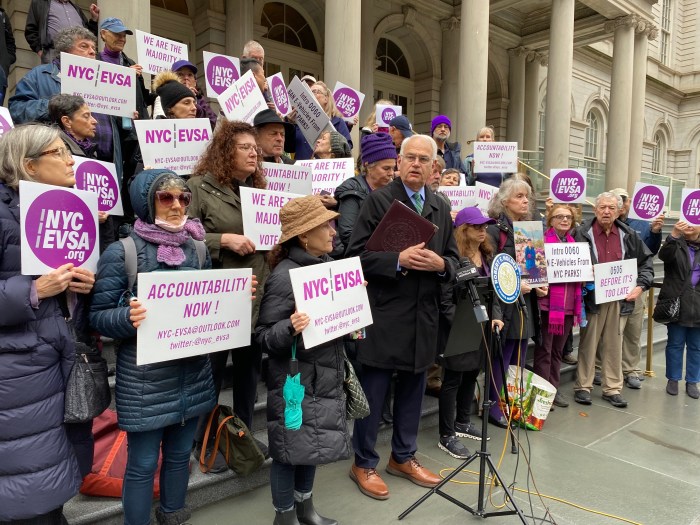
Many New Yorkers support Holden’s bill, Priscilla’s Law, and even attended a rally at City Hall about it on Dec. 11.
Janet Schroeder, co-founder of the NYC E-Vehicle Safety Alliance (EVSA), said her group is not against e-vehicles but wants more rider accountability.
“We are pro-safety for all,” she said at the rally. “We are an unpaid and unfunded group of volunteers that represent the majority voice in our city. Our only agenda is safety for all New Yorkers. Priscilla’s Law requires visible license plates on e-vehicles, which will create accountability for riders because consequence is what shapes behavior.”
But Adams’ bill has even more detail and also establishes penalties for delivery companies who fail to meet safety requirements. Fines would range, depending on the violation, and would be charged to the third-party company, per language in the bill
“It will build on the work our administration has already done to curb deadly e-bike fires and raise wages for delivery workers, creating a safer, stronger industry for all,” the mayor’s spokesperson said about the bill. “We are excited to work with the City Council to pass this legislation and keep New Yorkers safe.”
The post Bite the dust: Food-delivery services could face uphill battle if new e-bike mandates pass City Hall first appeared on The Ocean Avenue News – oceanavenuenews.com.
Heads up New Yorkers, snow & mixed precipitation, including freezing rain, is expected across much of the state early Thursday morning into the evening.
Morning commutes will be slippery and hazardous. Check road conditions beforehand at https://t.co/3S0JtINbFT and use caution. pic.twitter.com/6PP0GYwZwo
— NYS Div. of Homeland Security & Emergency Services (@NYSDHSES) February 5, 2025
When our kids are in class, they should be focused on reading and math – not memes and apps.
My plan to restrict smartphone use in schools will give kids across New York the distraction-free environments they need to succeed.https://t.co/0WlDRx2Ezv
— Governor Kathy Hochul (@GovKathyHochul) February 5, 2025
Acting #FBI Director Brian Driscoll provides an update on the vital work being carried out by the dedicated men and women of the FBI, both across the United States and globally, to protect the safety and security of the American people. Learn more: https://t.co/ZnruVdGspz
— FBI Chicago (@FBIChicago) February 5, 2025
Advertisements – Advertising at The News And Times – advertising-newsandtimes.com | WE CONNECT!
Audio | Video | Top News | On Twitter | Security | FBI | Capitol Riot | JOSSICA | Trump | Russia | Putin | Russia – Ukraine War | Covid-19 | Brooklyn NY | Puerto Rico | World
September 26, 2026 4:22 pm
The News And Times | Featured Posts | All Articles | Current News | Selected Articles | Shared Links | Opinions | In My Opinion | Sites | Blogs | Links | Twitter | Facebook

Contact Form | Blogs | Sites | News Reviews | Links | Advertising
All The News That’s Fit To Web