The balanced and balancing foreign policy pursued by the Republic of Armenia is reaching its primary milestone, Prime Minister Nikol Pashinyan said in a post on social media.
“Our relations with the Islamic Republic of Iran are more substantive than ever before. These relations are based on natural interests, which is the most reliable basis for cooperation and guarantee for stability.
Our relations with Georgia are in the orbit of strategic partnership, opening new prospects and potential for development.
A visible basis for mutual understanding has been formed with Turkiye.
The Republic of Armenia has proposed constructive solutions to all existing issues in relations with Azerbaijan. Armenia has not merely introduced proposals, but solutions. In this context, all efforts to provoke escalations in the region lack legitimacy and basis, which means that attempts to escalate the region will not succeed.
Our relations with the Russian Federation are more pragmatic than ever before, focusing on concrete issues without emotional packaging. We are determined to develop these relations based on mutually beneficial cooperation and sovereignty.
Our friendship with France has strengthened and evolved.
Our relations with the European Union are closer than ever before, which is recorded also in Brussels.
A strategic partnership has been launched with the United States of America.
Our relations with India have gained new weight and meaning.
Our relations with China are evolving and deepening.
New opportunities for partnership have been created in the Middle East.
This positioning creates a solid foundation for successfully serving the agenda of Armenia’s independence, sovereignty, and statehood’s perpetuity, which will be implemented in the upcoming stages of balanced and balancing foreign policy,” the Prime Minister said.
As President-elect Donald Trump prepares to take office for a second time next week, migrants, elected officials and immigration groups have voiced their concerns about what a Trump presidency means for New York’s sizeable undocumented immigrant population.
Throughout his campaign, Trump promised to carry out the “largest-ever” deportation program in US history, running on a campaign plank to deport an estimated 11 million undocumented immigrants. In the weeks since his election, Trump has doubled down on his campaign promises, stating that his plan to deport undocumented migrants has no “price tag” and confirming that he would declare a national emergency and use “military assets ” to carry out the deportation program.
For a large section of Queens’ population, such promises have wrought fear and uncertainty, fears enhanced by Mayor Eric Adam’s meeting with Trump’s “border czar” Tom Homan in Manhattan last month and his assertion earlier this week that he would work with the Trump administration to develop a “realistic and compassionate” national strategy on immigration.
By far the most diverse county in New York City, Queens County boasts a large undocumented population, estimated to be above 235,000 people, while 2020 census data found that over 47% of the 2.28 million people living in Queens were foreign-born.
Although New York City is a sanctuary city and limits cooperation with federal agencies such as US Immigration and Customs Enforcement (ICE), numerous undocumented migrants have expressed fears about the incoming Trump Administration, while elected officials and immigration organizations have voiced concerns about the impact that large-scale deportations would have on Queens and the impact that anti-immigrant rhetoric would have on vulnerable members of the immigrant community.
Meanwhile, Adams has repeatedly said that he supports a conservative-pushed rollback of New York’s sanctuary city laws introduced by the de Blasio administration. Adams has since clarified that New York will remain a sanctuary city although he repeated that he remains opposed to policies that prevent the NYPD from cooperating with detainer requests from ICE.
Speaking after his meeting with Homan, Adams said he would cooperate with the incoming administration to clamp down on undocumented migrants who have committed crimes.
“We’re going to protect the rights of immigrants in the city that are hard-working, giving back to the city in a real way. We’re not going to be a safe haven for those who commit repeated violent crimes against innocent migrants, immigrants and long-standing New Yorkers,” Adams told reporters last month.
State Sen. Kristen Gonzalez, representing parts of Long Island City and Astoria as well as parts of Brooklyn and Manhattan, said she has witnessed a significant level of fear among her constituents and called on Albany to prepare for the Trump Administration by passing legislation to further limit cooperation with federal agencies.
Gonzalez emphasized the proposed New York for All Act, which seeks to bar local law enforcement and state agencies from collaborating with federal immigration authorities on enforcement, calling it an essential step toward protecting New York’s undocumented population.
“We’re dealing with a lot of the fear of what a Trump presidency means for New York, and I think the best way for us to combat that is by being prepared,” Gonzalez said. “So, from an Albany perspective, passing bills like New York for All to ensure the state isn’t cooperative with ICE and ensuring that we’re maintaining our sanctuary city and state status are important [steps].”
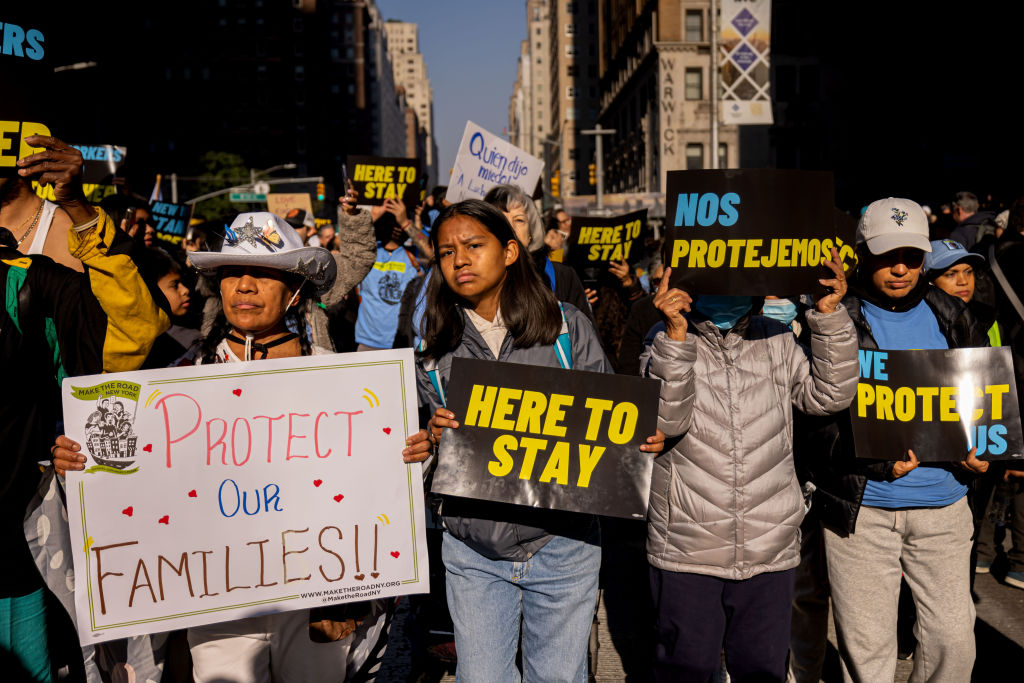
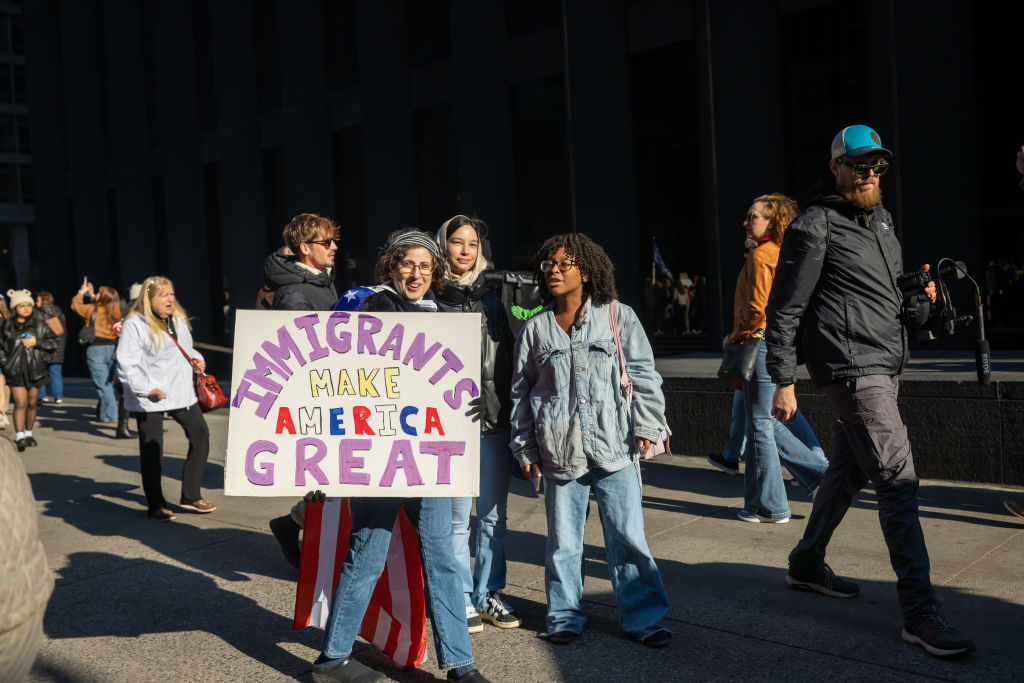
Detractors of President-elect Donald Trump protested in November against his planned immigration policies. (Photo by Michael Nigro/Pacific Press/LightRocket via Getty Images)
Marlene Galaz, director of immigrant rights policy at the New York Immigration Coalition (NYIC), described Trump’s policies as a “cruel and inhumane” approach to the US immigration system.
Galaz added that NYIC is “prepared to take Trump at his word” over his election promises, stating that immigrant communities are living in fear of a return to the policies that marked Trump’s first term in office. Trump oversaw roughly 1.5 million deportations between 2017 and 2021 and authorized immigration raids at businesses, while he also signed an executive order in 2017 banning people from traveling to the US from six majority-Muslim countries.
Trump, however, deported less people than Obama, who deported some 2.9 million people during his first term in office and a further 1.9 million during his second term, earning the nickname “deporter-in-chief.”
Nevertheless, Galaz is getting ready for Trump.
“We are truly preparing to face some of the issues that we saw during his previous administration,” Galaz said. “The mass separation and deportation of families, which is a threat to not just the life of American families, but to our democracy and our economy.”
On the other hand, Vickie Paladino, a Republican Council Member representing parts of College Point, Flushing, Bayside and Whitestone, said the issue of undocumented immigration was “huge” to the people of New York. Speaking to Fox News before the presidential election, Paladino said the issue would “change people’s minds” at the polls. A CNN exit poll released on election day found that immigration was a top priority for 20% of voters across the country, the second-most prominent issue in the election after the economy.
“We have turned New York City into a third-world country,” Paladino told Fox last October, labelling the influx of migrants into the city as an “invasion.”
Galaz, however, said the anti-immigrant rhetoric associated with Trump’s campaign and presidency could build a climate of distrust among undocumented populations, dissuading people from reporting crimes or seeking medical aid. She said anti-immigrant messaging can also lead to a rise in violence against migrant populations, pointing to a rise in threats of violence against the Haitian community in Ohio after the Trump campaign falsely accused Haitian migrants of eating cats and dogs earlier this year.
“The very recent comments on Haitian immigrants had an actual effect on people,” Galaz said. “They were harassed. They were chased. And it does have a real effect. I am hoping that violence against immigrants doesn’t increase, but we have seen that when vulnerable members of a society get scapegoated, the threat of violence is very real.”
Gonzalez, meanwhile, is concerned that rhetoric against undocumented immigrants expressed at the highest levels of government will directly impact local communities and called for building connections between immigrant communities and the NYPD so that any attacks or hate crimes can be reported.
She also called for preventative measures to be introduced to prevent what she deems as “hateful” rhetoric from being repeated by members of the public.
For example, in a rally before the election, Trump promised to “rescue” the Denver suburb of Aurora from thousands of Venezuelan immigrants. The president-elect labeled the Venezuelan community of Aurora as an “army of illegal alien gang members and migrant criminals from the dungeons of the third world.” In separate campaign rallies, Trump amplified debunked claims, such as accusing Haitian migrants of eating pets in Springfield, Ohio, while he also labeled undocumented immigrants as “animals” and “blood-thirsty criminals” and at various points throughout his campaign.
“While it’s true that we’re seeing hateful rhetoric in the highest forms of leadership and from our future president,” Galaz said. “We can combat that with a lot of political education on the ground, with a lot of tolerance education, and by ensuring that we’re building with the community so that they feel safe and they have everything they need to feel protected.”
Assembly Member Catalina Cruz, who represents New York’s 39th Assembly District, which includes parts of Corona, Elmhurst, and Jackson Heights, also believes anti-immigrant sentiment at the top level of government will translate into a rise in vitriol toward immigrant communities.
“We saw it throughout the campaign,” Cruz said. “I don’t suspect that him having been elected, is going to make things any better or easier.”
Elected officials and immigration organizations believe that Trump’s deportation policies would prove detrimental to the city of New York if the president-elect does achieve his goal of carrying out the largest deportation program in US history.
“These are people who contribute to the economy,” Galaz said. These are people who contribute to the vitality of our communities. They are business owners.”
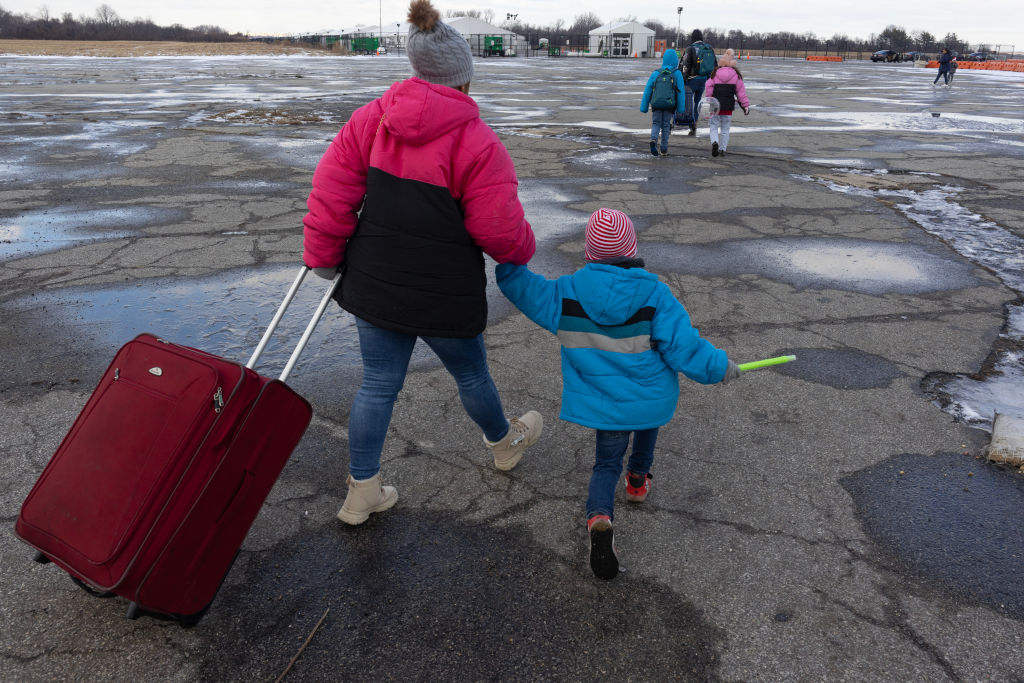
Migrant families come and go from the Floyd Bennett Field migrant shelter; now, migrants and their supporters are concerned that it will be an easy target under President Trump to round up and deport migrant families. (Photo by Andrew Lichtenstein/Corbis via Getty Images)
Undocumented immigrants living in Queens expressed fears over the second Trump Administration, voicing concerns about a loss of livelihood and potential deportation as well as a rise in anti-immigrant sentiment.
An Ecuadorian woman who crossed the border without papers two years ago and now works as a subway vendor said she fears selling goods in the subway after Jan. 20 because she believes there will be a crackdown on undocumented migrants working in the subway system once Trump takes office. The woman, who asked to remain anonymous, said she expects her life to change once Trump takes office and fears a loss of her livelihood, stating that she will no longer operate in the subway system because she has heard rumors that the Trump administration will target vendors.
“We’re worried,” the woman said. “Especially with the winter, we don’t know what we’re going to do if we cannot do this type of work.”
A man who also came to the US from Ecuador and asked to remain anonymous said he fears a return to Ecuador because he had to borrow money to travel to the US and has not yet made enough money to repay the loan.
“We are scared because we have to pay and we don’t have money yet,” the man said.
Not all immigrants are concerned about Trump’s second term in office, however. Trump flipped a number of election districts in predominately immigrant neighborhoods of Queens.
Trump made huge inroads in election districts with a significant Latino population, including parts of Jackson Heights, Elmhurst and Corona. Much of the area is located along or near the Roosevelt Avenue Corridor, which has seen growing dissatisfaction among residents due to a rise in crime and prostitution along the avenue, culminating in a number of protests aimed at elected Democrats.
Mauricio Zamora, a Corona resident and activist who has attended multiple public safety rallies in the area, came to the US as an undocumented migrant from Costa Rica around 30 years ago before eventually obtaining legal status through marriage. Zamora voted Democrat in the 2016 and 2020 presidential elections before flipping “100%” to Trump in 2024.
Zamora said his and Corona’s shift to the right during the recent election was a protest vote against local elected Democrats and against the rise in crime in the area over the past few years.
He accused the Biden administration of “opening the borders” and allowing individuals with criminal pasts to enter the US. Zamora claims that the vast majority of undocumented immigrants living in the area are hard workers and good neighbors but said a number of immigrants who have recently arrived in the area do not respect the law or the neighborhood.
Zamora said he voted for Trump because he believes that the President-elect will focus on deporting migrants who have committed crimes. He does not believe that Trump’s election promises to deport millions of undocumented immigrants are possible.
“He said he was going to deport people without documents who have broken the law,” Zamora said, reflecting dissatisfaction with a rise in crime in the local area.
Meanwhile, immigration groups and attorneys have also warned that asylum seekers and migrants with temporary visas will face difficulty during Trump’s second term in office.
Detractors of President-elect Donald Trump protest against his planned immigration policies.(Photo by Michael Nigro/Pacific Press/LightRocket via Getty Images)
Galaz accused Trump of targeting the asylum system in the past, stating that she expects the President-elect to appoint judges who will vilify asylum seekers and make it more difficult for people to enter the asylum system. Queens is home to a vast number of newcomers—many classified as asylum seekers—with around 66 migrant shelters located throughout the borough.
A 2020 Human Rights Watch report noted that Trump’s asylum policies created “insurmountable procedural barriers, evidentiary burdens, and qualification standards” for those seeking asylum, raising the bar to ensure that applicants would have to prove that a “gun was held to their heads” in order to qualify for asylum.
Gonzalez said the US asylum system is already so complex that it prevents huge numbers of migrants from applying for asylum and expects to see even fewer people applying for asylum once Trump takes office. A recent report by the American Immigration Council states that those seeking asylum in the US must “navigate a difficult and complex process that can involve multiple government agencies.”
“Unfortunately, seeking asylum or claiming asylum is incredibly difficult, and there are only a small percentage of those cases that are successful,” Gonzalez said. “It still was incredibly difficult even under the Biden presidency, but I’m sure it’s going to become increasingly difficult when Trump returns to Office.”
Immigration attorneys have also predicted a rise in difficulties for migrants on work visas living in Queens.
A Manhattan-based immigration attorney, who asked to remain anonymous out of fear of retribution, pointed to the fact that H1-B visa approval rates dropped from 97% under the Obama administration to 75% under Trump’s presidency. The visa, which is awarded to foreign nationals who perform services in a specialty occupation, is one of the most sought-after work visas and is the largest work visa category in the United States.
“It’s still a high success rate, but it definitely did change,” the attorney said.
Trump also altered the renewal process for O1-B visa renewals, the attorney noted. The visa, which is issued to non-nationals of “extraordinary ability,” is valid for three years when it can be renewed. Under previous administrations, United States Citizenship and Immigration Services (USCIS) granted renewal deference to anyone applying for a visa extension because they had already proved that they met the standard with their original application.
However, the attorney noted that Trump implemented changes requiring anyone applying for a renewal to prove they met the same standard the second time.
Galaz also believes that the Trump administration will aim to target the documented migrant population during his next term in office.
“We are really going to see an attack on all immigrants,” she claimed. “It’s not only the undocumented population that we are concerned about, but rather all immigrants.”
Galaz, however, believes that Trump will not have the capacity to deport tens of millions of undocumented immigrants in just four years but said NYIC remains concerned about the number of people who will be detained and deported during Trump’s second term in office.
“The fact that their numbers are unrealistic doesn’t mean that it’s not going to have a real impact on people. What we’re really concerned about also is the chilling effect that this is going to have on our communities.”
Detractors of President-elect Donald Trump protested against his planned immigration policies when he was elected in November. (Photo by Michael Nigro/Pacific Press/LightRocket via Getty Images)
Meanwhile, Make the Road New York, a non-profit advocating for immigrant communities, issued a statement shortly after the election stating that the US has long represented a safe haven for immigrants and said Trump’s victory represented a betrayal of long-standing American values.
“Ours is a country that—since its earliest days—has served as a haven for anyone coming in search of a better life for themselves and their families. To see that value betrayed is a slap in the face of generations of immigrants who have made this nation what it is,” Theo Oshiro, co-executive director of Make the Road NY said in a statement following the election.
Make the Road and other immigration groups also expressed outrage this week following the Mayor’s assertion that undocumented immigrants are not entitled to legal protections under the constitution.
Natalia Aristizabal, deputy director of Make the Road, issued a statement Friday accusing Adams of “cozying up” to the incoming Trump Administration.
“Generations of immigrants have made New York the city that it is—full of diversity and beautiful, vibrant neighborhoods,” Aristizabal said in a statement. “These are our neighbors, our colleagues, and our friends. For Mayor Adams to paint undocumented immigrants as criminals is dangerous and offensive, especially from someone with a law enforcement background.”
Before Adams made his assertion, Gonzalez expressed her belief that the Mayor would pose a challenge to efforts aimed at protecting undocumented communities in Queens and across New York City.
“I imagine Eric Adams being a stumbling block, and I do believe that right now we need to be very clear that that is not the direction we want our city going in,” Gonzalez said. “We want to see our city continue to be a sanctuary. We want to see our city continue to protect immigrant communities, and now is the time for folks who are willing and able to get organized and make sure that we’re building collisions to push Adams on this.”
US sanctions Ivanishvili Daniel Fried, a diplomat and former coordinator for sanctions policy at the U.S. State Department, spoke to Voice of America about the significance of U.S. sanctions against Bidzina Ivanishvili, the honorary chairman of the ruling Georgian Dream party and the de facto ruler
Несмотря на заверения Европейской комиссии в надежности поставок газа, в хранилищах ЕС находится на 16% меньше газа, чем в начале 2023 года. Только в Португалии объем газовых хранилищ превышает 100 %.ЧИТАТЬ ДАЛЕЕ : https://ru.euronews.com/2025/01/15/europe-in-motion-gas-storageПодписывайтесь: https://www.youtube.com/c/евроньюс?sub_confirmation=1Прямой эфир euronews: https://www.youtube.com/c/евроньюс/liveEuronews можно смотреть на YouTube на 12 языках: https://www.youtube.com/user/euronewsnetwork/channels#EuropeInMotion
Germany stands at a crossroads, a nation once synonymous with democratic stability now grappling with the tremors of political upheaval. The dissolution of the Bundestag and the call for snap elections on February 23 are more than procedural anomalies—they are harbingers of a deeper crisis, a recko
As Donald Trump assumes once more the presidency in the United States, most of the foreign policy discussion revolves around Ukraine, the Middle East, China and other big stories. Indeed, even before assuming office his first order of global business appears to have been Gaza. So it may surprise som
Армения вручила России ноту протеста | США исключили Кубу из “черного списка”Наши новости в социальных сетях:https://www.youtube.com/user/wcbcazhttps://www.facebook.com/cbctvazhttps://t.me/cbctvazhttps://www.instagram.com/cbc.az/https://twitter.com/cbctvazhttps://www.tiktok.com/@cbcazerbaijanweb: https://cbctv.azCBC Азербайджан – международный круглосуточный канал на русском языке. Вещает от европейской части России до полуострова Индостан, от Балканского полуострова до восточной границы Китая #новости #политика
Узнавайте о самых важных событиях в Европе и за ее пределами – последние новости, срочные новости, мир, бизнес, развлечения, политика, культура, путешествияЧИТАТЬ ДАЛЕЕ : https://ru.euronews.com/2025/01/15/novosti-dnya-15-yanvarya-vechernij-vypuskПодписывайтесь: https://www.youtube.com/c/евроньюс?sub_confirmation=1Прямой эфир euronews: https://www.youtube.com/c/евроньюс/liveEuronews можно смотреть на YouTube на 12 языках: https://www.youtube.com/user/euronewsnetwork/channels#TopNewsStoriesToday
By Zeev (Vladimir) Khanin and Alex Grinberg The Trump administration, which begins its work on January 20th, places the security of Israel, its primary ally in the Middle East, at the forefront. Statements from Trump’s close associates clearly indicate that his doctrine includes provisions for exp
#SouthCaucasus#SouthCaucasusNews Russian Investigative Committee orders examination into AZAL plane crash https://t.co/wh8l9raTud BAKU, Azerbaijan, January 15. The Russian Investigative Committee has appointed an expert examination to assess the actions of the air defense…
Michael_Novakhov shared this story
from Trend – News from Azerbaijan, Georgia, Kazakhstan, Turkmenistan, Uzbekistan, Iran and Turkey..
Germany stands at a crossroads, a nation once synonymous with
democratic stability now grappling with the tremors of political
upheaval. The dissolution of the Bundestag and the call for snap
elections on February 23 are more than procedural anomalies—they
are harbingers of a deeper crisis, a reckoning with forces that
threaten the very fabric of its post-war order. At the heart of
this turbulence lies the “Alternative for Germany” (AfD), a party
born from rebellion and metastasized into a specter of radicalism.
Polling in second place nationally and dominant in the East, the
AfD has become a force impossible to ignore but equally impossible
to embrace.
This is not the Germany of Angela Merkel’s pragmatism, where
compromise was the cornerstone of governance. That era, for all its
successes, left a vacuum—a void where conservatism lost its
identity and the far-right found its stage. The AfD rose from this
fissure, offering disenchanted voters a mirage of “authenticity.”
Their promise? A return to a “real Germany,” one unburdened by
globalism, migration, and European entanglements. Their methods?
Radical policies and rhetoric designed not to govern but to
fracture the system.
What began in 2013 as an academic critique of the eurozone, led
by Bernd Lucke and his cadre of economists, has transformed into a
cauldron of extremism. The AfD of today is unrecognizable from its
origins, having shed its moderate skin through purges, power
struggles, and the ascension of figures like Björn Höcke, whose
rhetoric blurs the line between nationalism and outright
fanaticism. From advocating Germany’s exit from the EU to demanding
pre-detention camps for asylum seekers, the AfD has crafted a
platform not of solutions but of provocations. It thrives on
opposition, positioning itself as the sole voice of “the people”
against an elite they decry as traitorous.
Yet, for all its noise, the AfD is trapped in a paradox of its
own making. Its very radicalism ensures its isolation. No
mainstream party will risk a coalition, and even insurgent forces
like Sahra Wagenknecht’s bloc keep their distance. The AfD’s
strategy is clear: remain an outsider, a disruptor. But this path
has limits. Opposition may amplify their rhetoric, but it offers no
pathway to governance, no blueprint for uniting a fractured
nation.
The party’s rise is a mirror held up to Germany itself,
reflecting a society struggling with identity and direction. Angela
Merkel’s CDU, once a bastion of center-right stability, ceded its
ideological territory to the extremes. Traditional parties, mired
in cautious centrism, failed to answer the questions posed by
globalization, migration, and economic inequality. Into this void
stepped the AfD, offering answers that resonate not because they
are right, but because they are loud.
This loudness has consequences. The AfD’s electoral success
comes at the cost of its integrity, as scandals and internal rifts
pile up. German intelligence monitors the party for undermining
democratic principles, a shadow that looms over its ambitions.
Former allies like Jörg Meuthen denounce it as a “radical cult,”
while founder Bernd Lucke laments that his creation, meant to
critique EU fiscal policy, has mutated into a force bent on
dismantling the republic itself.
The AfD’s strategy—radicalization without governance—can only
take it so far. Their influence on Germany’s political landscape is
undeniable, but influence is not power. The Bundestag, fractured
and fragile, may echo with their defiance, but it will not yield to
their control. For Germany, the AfD’s ascent is not just a
challenge but a test. Can the country’s democratic institutions
weather this storm? Or will the winds of radicalism erode the
foundations of what has long been Europe’s anchor of stability?
The answer lies not just in the party’s trajectory but in
Germany’s response. A failure to address the underlying discontent
that fuels the AfD risks prolonging their rise, turning protest
into permanence. But the party’s refusal to moderate, its
insistence on conflict over compromise, ensures that it remains a
movement of resistance rather than governance. The AfD may shake
the system, but it cannot replace it. Its ascent has a ceiling, and
that ceiling is the very democracy it seeks to undermine.
A Symbol of Division: The AfD and Germany’s Identity Crisis
The rise of the “Alternative for Germany” (AfD) is more than a
political phenomenon; it is a mirror reflecting a deeper fracture
within German society. The party’s embrace of nationalism,
rejection of European values, and opposition to globalization is
not just a platform—it’s an ideology that draws lines between “us”
and “them,” creating a nation divided against itself. Germany
stands at a crossroads: to uphold its democratic traditions or to
yield to radicals for whom compromise is defeat and division is a
tool for power.
The February snap elections will not deliver a triumph for the
AfD. Its ultra-radicalism makes it untouchable for other parties,
ensuring its continued role in opposition. But even without
governing power, the AfD’s impact on Germany’s political landscape
is profound. The question is whether Germany’s democracy can
withstand the pressure of these radical winds, or if the fractures
they expose will continue to widen.
Alice Weidel, the AfD’s co-chair and chancellor candidate, is a
figure of stark contradictions. An openly gay woman, she speaks in
favor of same-sex unions, supports attracting skilled migrants, and
doesn’t entirely dismiss Germany’s EU membership. At first glance,
she seems like a harbinger of change, a voice of moderation in a
party notorious for its extremism. But this façade of
progressiveness fades against the backdrop of the AfD’s unyielding
radical core.
Weidel’s polished image clashes with the rhetoric of her
co-chair, Tino Chrupalla, whose anti-immigrant and pro-Putin stance
underscores the party’s far-right foundation. The AfD’s electoral
platform, unveiled before the elections, lays bare its true
intentions: leaving the European Union, reinstating the Deutsche
Mark, resuming Russian gas imports, lifting sanctions on Russia,
and detaining asylum seekers at the border. These proposals
obliterate any notion of a rebrand, anchoring the party firmly in
its extremist identity.
Radicalism Through Scandal
The AfD’s 2024 campaign has been riddled with scandals that
would sink most political movements. Revelations of secret meetings
to plan mass deportations, divisive comments on migrants’ loyalty,
and leaders’ controversial remarks about SS crimes during World War
II should have shattered its base. Yet, the party’s supporters
remain steadfast. In regions like Thuringia, Saxony, and
Brandenburg, the AfD’s numbers remain robust, even climbing.
Why do such scandals fail to erode trust? For AfD voters,
radicalism is not a liability but a virtue. These voters see the
party not just as a political force but as a crusader against the
perceived decay of national values. For them, compromise equates to
surrender, and the AfD’s confrontational stance is a declaration of
war on a system they feel has abandoned them.
Alice Weidel: The Contradictions Within
Weidel, despite her perceived moderation, does not stray from
the party line. Her response to the Magdeburg terrorist
attack—blaming “Islamists” even when the perpetrator had ties to
the AfD—reveals that moderation is a tool, not a principle.
Weidel’s allegiance to the party’s radical platform, including
homophobic policies and anti-liberal rhetoric, solidifies her as a
loyalist to the AfD’s extremist agenda.
Unlike European counterparts like Giorgia Meloni or Marine Le
Pen, who have sought to soften their parties’ edges to appeal to
broader electorates, the AfD chooses confrontation over
conciliation. It is a strategy that keeps its core intact but
alienates potential allies and moderates. For the AfD, radicalism
is not a stepping stone—it is the destination.
The AfD’s rise signals more than a shift in voter preferences—it
marks a critical test for Germany’s democratic resilience. The
party’s rejection of compromise and its embrace of division
challenges the post-war political order that has long anchored
Germany’s stability. Its supporters see it as the sole defender of
their interests, while its detractors view it as a direct threat to
democratic principles.
The party’s future remains a paradox. It grows stronger as a
disruptive force, yet its very radicalism ensures it remains
isolated from true power. As Germany heads into elections, the
AfD’s strategy of polarization will continue to fracture the
political landscape. The question is whether the country’s
democratic institutions can adapt to counter the discontent fueling
its rise—or risk being undermined by the very system they were
built to protect.
The AfD may never govern, but its influence is undeniable. It
has reshaped German politics, forcing the nation to confront
uncomfortable truths about its identity, unity, and future. Whether
Germany chooses to reaffirm its democratic path or succumbs to the
fractures the AfD exposes will define not just this election, but
the trajectory of a nation caught between its past and an uncertain
future.
Alice Weidel’s journey within the “Alternative for Germany”
(AfD) is a study in transformation and pragmatism. In 2017, she
vehemently condemned Björn Höcke, the leader of the party’s
extremist faction, and even advocated for his expulsion. But by
2020, her stance shifted dramatically. She voted against dissolving
Höcke’s ultra-right group, “The Wing,” marking a turning point in
her career. This decision aligned her with the party’s most radical
elements, ensuring her survival in a factionalized and increasingly
hardline organization.
By 2024, Weidel’s calculated reconciliation with Höcke
culminated in a public display of unity during a joint appearance
in Erfurt. This move solidified her leadership and positioned her
as the party’s chancellor candidate, but it also underscored the
myth of her moderation. Despite attempts to portray her as the face
of AfD’s “rebranding,” Weidel’s actions reveal a steadfast loyalty
to the party’s radical core.
The AfD’s popularity has reached unprecedented levels,
stabilizing at 17–19% nationally and soaring to 30% in Germany’s
eastern states. It now confidently occupies second place in polls,
surpassing the Social Democrats (SPD). This success stems from its
ability to channel voter frustration into a cohesive message of
nationalism, anti-globalization, and opposition to the political
establishment.
The party’s draft platform for the 2025 elections leaves no
doubt about its radical intentions:
Germany’s withdrawal from the EU and abandonment of the
euro;
Resumption of Russian gas imports and the lifting of sanctions
on Russia;
Preemptive detention of asylum seekers at the border;
A refusal to condemn Russia’s war against Ukraine.
Unlike European counterparts such as Giorgia Meloni or Marine Le
Pen, who have tempered their rhetoric to appeal to broader
audiences, the AfD embraces confrontation. Its platform is not a
bid for mainstream acceptance but a declaration of ideological
warfare.
Björn Hö and offering radical solutions that resonate with a
significant portion of the electorate.
However, collaboration with the AfD remains politically toxic.
Even anti-establishment movements like the “Sahra Wagenknecht Bloc”
avoid alliances with the AfD to preserve their credibility.
Attempts to legitimize a party so deeply associated with extremism
risk alienating broader voter bases and undermining the democratic
system.
The AfD’s Role as a Disruptive Force
While excluded from power, the AfD continues to shape Germany’s
political landscape. Its presence in the Bundestag amplifies its
message and forces traditional parties to address issues it has
monopolized, such as migration and national sovereignty. In a
fragmented political environment, the AfD could act as a
coalition-breaker, complicating efforts to form stable
governments.
This scenario raises the risk of pragmatic, albeit unofficial,
alliances driven by necessity rather than ideology. Such
developments could further destabilize Germany’s political
equilibrium, reinforcing the AfD’s role as a disruptive force.
The AfD’s rise challenges the foundations of Germany’s
democracy. It reflects a society grappling with questions of
identity, governance, and the limits of tolerance. The party’s
strategy of radicalization appeals to those disillusioned with the
status quo but alienates potential allies and moderates.
As the February elections approach, Germany faces a pivotal
moment. Will the country’s democratic institutions adapt to counter
the forces driving the AfD’s ascent, or will this far-right
movement continue to erode the political consensus that has defined
post-war Germany? The answer will not only determine the AfD’s
future but also shape the trajectory of German democracy in the
years to come.
The rise of the “Alternative for Germany” (AfD) underscores a
profound and growing fracture within Germany’s political and social
fabric. While the party remains isolated at the federal level, its
strongholds in Thuringia, Saxony, and Brandenburg reveal a durable
base of support that threatens national cohesion. These regional
victories highlight the widening divide between Germany’s eastern
and western states, underscoring the stark cultural and political
rifts that challenge the country’s unity.
Despite its successes, the AfD is acutely aware of its
limitations. In its current incarnation, the party is unfit to lead
Germany. Its radicalism, while galvanizing its core supporters,
precludes broader appeal or coalition-building. Yet, paradoxically,
this extremism is also its lifeblood. By embracing a protest vote
fueled by disillusionment with traditional parties, the AfD has
carved out a space as the second-largest political force in
Germany—a position it could maintain for years without
fundamentally altering its strategy.
The AfD’s strategy of radicalism ensures its status as an
“anti-system” force—a party of protest rather than governance. This
approach allows it to remain a disruptive presence, amplifying
grievances and reshaping political discourse without the burden of
responsibility. However, this self-imposed isolation comes at a
cost. While it solidifies the party’s identity among its base, it
also limits its capacity to achieve meaningful power or enact its
platform.
A rejection of radicalism, akin to the moderation embraced by
right-wing movements in Italy or France, could open doors to
coalition politics and broaden the AfD’s appeal. Yet such a shift
would risk alienating its core supporters, for whom extremism is
not a flaw but a feature. For now, the AfD thrives as a loud but
isolated voice, railing against the very structures it seeks to
undermine.
The Double-Edged Sword of Isolation
The political quarantine imposed on the AfD by mainstream
parties is often framed as a defense of democracy. But this
isolation is not without risks. Over time, it could deepen the
crisis of trust in the political system. If traditional parties
fail to address societal demands—on migration, globalization, or
economic disparity—protest sentiments will only grow, further
empowering radical forces like the AfD.
The February 23 elections will test Germany’s ability to
navigate this precarious moment. Will the country’s leaders forge
compromises to stabilize the political landscape, or will they
allow fragmentation to continue? The AfD, with its role as a
disruptor, is poised to exploit any missteps, turning systemic
weaknesses into political capital.
At the heart of the AfD’s rise lies a deliberate embrace of
radicalism. Rejecting moderation, the party positions itself as a
force of confrontation, challenging established norms and
structures. Its rhetoric and policies resonate with voters who feel
left behind by globalization and disillusioned with the compromises
of mainstream politics. For these supporters, the AfD represents
not just a political alternative but a vehicle for reclaiming
national identity and sovereignty.
This strategy, however, is a double-edged sword. While it
consolidates the party’s base, it also isolates the AfD from
broader political legitimacy. Unlike European counterparts who have
softened their positions to gain mainstream acceptance, the AfD
chooses conflict over consensus, ensuring its outsider status even
as its popularity grows.
The AfD’s ascent is not a triumph of democracy but a challenge
to its resilience. Once a symbol of stability, Germany now finds
itself at a crossroads. The AfD embodies the dissatisfaction of a
segment of society, but its success poses a stark question: can
Germany’s democratic institutions withstand the pressures of
radicalism, or will they falter under the weight of growing
division?
The party’s future is deeply entwined with its past. Its
reliance on radicalism, rejection of compromise, and pursuit of
power at all costs define its identity but also limit its
potential. The February elections will not only determine the AfD’s
immediate trajectory but also serve as a litmus test for Germany’s
democratic endurance.
Germany faces a battle for its political soul. Will the nation
reaffirm its commitment to democratic principles, or will it yield
to the forces of division and extremism? The stakes are nothing
less than the future of Europe’s most pivotal democracy. The answer
lies not only in the AfD’s ambitions but in Germany’s collective
resolve to meet the challenges it represents.
Germany stands at a crossroads, a nation once synonymous with
democratic stability now grappling with the tremors of political
upheaval. The dissolution of the Bundestag and the call for snap
elections on February 23 are more than procedural anomalies—they
are harbingers of a deeper crisis, a recko
Michael_Novakhov shared this story
from Begin-Sadat Center for Strategic Studies.
By Zeev (Vladimir) Khanin and Alex Grinberg The Trump administration, which begins its work on January 20th, places the security of Israel, its primary ally in the Middle East, at the forefront. Statements from Trump’s close associates clearly indicate that his doctrine includes provisions for expanding the Abraham Accords. In this context, the Israeli leadership and national diplomacy—both governmental and public—should judiciously direct Washington’s attention to those actors in the geopolitical landscape of the Eastern Mediterranean and Western Asia who have long-established strategic partnerships with Jerusalem and can positively impact the role of the Jewish state in Trump’s envisioned “new Middle East”.
Azerbaijan deserves special attention as it holds the longest and most comprehensive partnership with Israel among Muslim nations. During a December 2024 meeting with the President of Azerbaijan, leaders of the American Israel Public Affairs Committee (AIPAC) acknowledged that the U.S. had not fully appreciated Azerbaijan’s longstanding support for Israel and contributions to regional stability. “For the Trump administration and the State of Israel, Azerbaijan holds significant value,” noted the Maariv, covering the meeting.
As Mark Fish acknowledges in The Jerusalem Post: “The arrival in Baku of both the current and incoming leaders of AIPAC demonstrates a clear recognition of Azerbaijan’s pivotal role in regional stability and its unwavering support for Israel. It also reflects an acknowledgment that past U.S. administrations did not fully appreciate the value of engaging with Azerbaijan”.
In its turn, Maariv emphasized that, against the backdrop of the weakening of Iranian influence in the Middle East, “the leader of Azerbaijan is capable of contributing to a reduction in tensions in a region that the American administration views as being of high strategic importance“.
Indeed, as Songer Cagatay of The Washington Institute for Near East Policy (WINEP) noted in 2005: “Washington has many reasons to further improve its relationship with Azerbaijan and to support that country in the international arena. In this context, it should applaud the Azerbaijani friendship with Israel”. Given the changed geopolitical realities, there are now more reasons to “improve relations with Azerbaijan”. Therefore, when shaping its policy in the South Caucasus, the Trump administration should consider the following factors:
Azerbaijan is the only country in the world that has maintained a 30-year-long military-strategic partnership with the U.S.’s key ally in the Middle East while bordering two of America’s geopolitical rivals—Russia and Iran.
Azerbaijan shares a 765 km border with Iran, with Tehran just 365 km away, and ethnic Azerbaijanis, Iran’s largest minority, comprise approximately 20% of Iran’s population (17.7 million).
Azerbaijan is an important hub for regional transit trade. In November 2024, the Israeli ambassador to Baku stated: “Israeli companies are now recognizing the strategic importance of Azerbaijan, not only as a partner but also as a crossroads between East and West – the Middle Corridor – serving as a gateway to Central Asia”.
Azerbaijan is the largest country in the South Caucasus in terms of territory, population, economy, and military power.
Since the 1990s, Azerbaijan, a secular, Muslim-majority state, has been a discreet pillar of Israel’s regional security, key to U.S. interests.
According to Globes, these relations “have flourished since 1992” and are “the most stable” among all that the Jewish state maintains in the Muslim world. As reported by Haaretz, in 1998 Azerbaijan was already designated as a “key state” in internal documents of Israel’s MFA. In 2009, Deputy Director-General of the MFA, Pinhas Avivi, declared: “Relations between Israel and Azerbaijan are of a strategic nature“. In 2011, Infrastructure Minister Uzi Landau remarked: “Israel needs a strong Azerbaijan”. In 2013, the Globesemphasized: “Israel views Azerbaijan as an important ally and a true friend…“. In 2022, Foreign Minister Yair Lapid stated: “Azerbaijan is an important partner for Israel”, while former Israeli Ambassador to the UN, Danny Danon, noted: “Azerbaijan is one of our most important allies in Asia…“.
In December 2023, Ynet noted that “Azerbaijan is the only Muslim country in the world supporting Israel in the war” (against Hamas and Hezbollah). In February 2024, INN reported, citing government sources in Jerusalem and leaders of the Jewish diaspora, that despite pressure from other Muslim countries, President Aliyev unequivocally stands with the Jewish state amid the war. Around the same time, Srugimreferred to Azerbaijani leader as a “friend of Israel“, emphasizing his special role in advancing bilateral relations. In July, representatives of both countries’ leadership, including Azerbaijan’s Minister of Defense, held talks on “strengthening regional cooperation”. Ynethighlighted that despite pressure on Baku, the intensification of the partnership occurred precisely during the height of the war (while all moderate Muslim countries distanced themselves from the Jewish state).
Even when most of the Western airlines suspended flights to Israel, Azerbaijan’s state-owned airline continued operating flights with only brief interruptions, and Israeli tourist flow to Azerbaijan increasedby 50%. In October, Foreign Minister Eli Cohen once again reaffirmed that relations with this Muslim-majority country are “of strategic importance“. In November, Ynet noted that, against the backdrop of Yerevan’s anti-Israel stance and its ties with Tehran, Jerusalem intends to further strengthen its ties with Baku.
Azerbaijan holds the longest and most comprehensive partnership with Israel among Muslim nations. “Here is an example of how Muslims and Jews work together to ensure a better future for both,” PM Netanyahu stated in 2016.
The following facts demonstrate Azerbaijan’s special importance for the national security and regional defense capabilities of the Jewish state:
Since the 1990s, Azerbaijan has been key to Israel’s energy security. A senior Israeli intelligence source told Israel Hayom that Azerbaijani supplies were crucial even before Arab relations normalized (1994) and Israel discovered major gas fields (1999–2009). Azerbaijan’s energy bolstered Israel’s economy in the 1990s and 2000s, remaining its sole reliable partner in the Muslim world during the Second Intifada (2000–2004). The Israeli ambassador to Baku noted: “We believe that true friendship is tested in times of need, and I think this friendship between our countries has been proven in those critical times”. Israel Hayomreported in 2019 that Azerbaijan is the source of over 60% of the gasoline that Israelis consume. In 2021, Foreign Minister Gabi Ashkenazi stated: “Azerbaijan is an ally, a friend, and the largest supplier of energy resources to Israel“. In 2022, the Zman.co.ilstated: “Most of the fuel in Israel comes from Azerbaijan — from gasoline for private cars to jet fuel for the Air Force’s fighter jets“. As Ynetnoted in 2024, during the height of the war (when Israel’s armed forces particularly needed uninterrupted fuel supplies), Azerbaijan increased its oil exportsto the Jewish state by 55%.
Azerbaijan is a key Israeli partner against Iran, with both viewing the Ayatollah regime as an existentialthreat and cooperating for many years. “We share a common dangerous enemy—the Iranian tyranny that threatens the destruction of both our peoples”, Knesset members stated in 2023 in a collective message to their Azerbaijani counterparts.
It is symbolic that the foundation of this partnership to counter the Iranian threat was laid 30 years ago in the U.S. In October 1995, during a meeting in New York with Israeli Prime Minister Yitzhak Rabin, President Heydar Aliyev emphasized that his “country has a very long and tense border with Iran” and requested assistance in the field of security[1]. In 1997, Prime Minister Benjamin Netanyahu visited Azerbaijan, where he held talks with Heydar Aliyev. This meeting gave a significant impetus to the strategic partnership between the two countries.
“Particularly since Ilham Aliyev became Azerbaijan’s president in October 2003, Iran has engaged in a campaign of intimidation toward the country. A group of high-level Iranian military officers visited Baku in August 2004, urging Azerbaijan to cease security cooperation with Israel and stop receiving Israeli military and intelligence officers…” noted WINEP. In June 2006, Infrastructure Minister Binyamin Ben-Eliezer stated: “Azerbaijan is a Muslim country with a large Shia population, bordering Iran. The location of this country is of great interest to us“. Government sources in Jerusalem clarified this statement in the context of the potential use of Azerbaijani territory in the event of an American or U.S.-Israeli operation against Iran. In December 2006, Brigadier General (Res.) Oded Tira emphasized: “We should also coordinate with Azerbaijan the use of airbases in its territory and also enlist the support of the Azeri minority in Iran“. In 2008, Foreign Minister Tzipi Livni stated: “There are very close ties between Israel and Azerbaijan in strategically important areas such as security and intelligence sharing“. In 2009, U.S. Deputy Ambassador to Baku Donald Lu, describing the security cooperation between Israel and Azerbaijan, quoted Aliyev in a document sent to the State Department. In a private conversation, Aliyev stated that these relations resemble an iceberg: “Nine-tenths of it is below the surface“.
In February 2012, the Associated Pressnoted that Azerbaijan had become an important base for Israeli intelligence. At the same time, The Times, citing a Mossad operative in Baku, reported that dozens of Israeli intelligence operatives were active in Azerbaijan. “Last year, we increased our presence, and this has brought us much closer to Iran,” the operative told the publication. In March 2012, Foreign Policy Magazinereported: “If Israeli jets want to land in Azerbaijan after an attack, they’d probably be allowed to do so. Israel is deeply embedded in Azerbaijan, and has been for the last two decades“.
The visit of Israel’s Defense Minister to Baku in 2014 “served as proof of the high level of military coordination between the two countries“. At the time, he confirmed that Azerbaijan and Israel are “engaged in broad-based strategic cooperation“. In 2015, The Institute for National Security Studies (INSS)emphasized that the Iranian threat serves as a unifying factor, as both countries view it as an “existential threat“. “Mossad has a large and significant presence in Azerbaijan,” reported a prominent Israeli intelligence analyst in 2016. “Intelligence cooperation between the two countries makes it very difficult for the ayatollahs’ regime,” statedIsrael Hayom in 2021.
The Second Karabakh War (2020) solidified Israel’s regional position In the war, Azerbaijan reclaimed much of its territory—which had been occupied for 30 years with the tacit support of Iran, extending its border with Iran by 100 km. “During the war between Azerbaijan and Armenia, Israel sided with Azerbaijan, while Iran supported Armenia,” reportedGlobes. “The Iranians’ aspirations to ensure the success of the Armenians and to maintain the minimum length of the common border with Azerbaijan were effectively countered by Baku, which is relying on Israeli weapons on a large scale…,” notedIsrael Hayom. “The Iranians did not like what happened during this war because it complicated their situation,” stated in February 2021 the former head of the AMAN Military Intelligence Analysis Directorate, Yossi Kuperwasser. “The effectiveness of the deep friendship between the two countries became evident to the entire world during the Second Karabakh War, in which Azerbaijan achieved a brilliant victory through Israeli arms,” emphasizedIsrael Hayom. The Azerbaijani Foreign Minister added: “During the war, Azerbaijan received genuine support from its Israeli friend“.
The members of the Azerbaijani parliament noted in a collective address to the Members of the Knesset: “The Azerbaijani people appreciate and will never forget Israel’s consistent support for Azerbaijan’s justified position during the 44-day patriotic war“. “The outcomes of the Second Karabakh War heightened tensions between Iran and Azerbaijan”, observed INSS. The Ayatollah regime attempted to pressure Baku. In 2021-2022, the Islamic Revolutionary Guard Corps held two drills near Azerbaijan’s border simulating troop deployment, while Tehran and its proxies ranintimidation propaganda campaigns aimed at Azerbaijan’s leadership. They claimed that “Aliyev is a puppet of the Zionist regime” and that “the government has been in the hands of Zionists for 30 years“.
The deputy speaker of the Iranian parliament issued a clear warning to Azerbaijan’s leader: “Read some modern history to learn about the fate of leaders who trusted America and Zionism“. Blatantly antisemitic propaganda was also employed: Aliyev was depicted in a grotesque image as a religious Jew. Against this backdrop, in October 2022, Defense Minister Benny Gantz visited Baku and emphasized the “importance of the strategic relationship” between the two countries. A month later, Azerbaijan announced the opening of its embassy in Israel. In 2023-2024, Iranian provocations, subversive activities, and attempts to intimidate Azerbaijan continued, including those aimed at its relations with Israel.
Azerbaijan works to normalize Turkey-Israel relations and mediates during crises between them “President Aliyev, who has previously proved his mediation capabilities between Turkey and Israel, is likely to play a similar role again in the coming years (under the Trump administration),” Maarivreported in December 2024. During the 2008-2010 Turkey-Israel crisis, Azerbaijan worked to restore dialogue. In June 2012, the IzRus website, focused on Israeli foreign policy in the former Soviet Union, reported, referring to “diplomatic sources in Jerusalem“: “Officials in Baku are trying hard to reconcile the opposing sides“.[2] That same year, INSS noted: “As Israeli-Turkish relations worsened, Turkey tried to pressure Azerbaijan to cool relations with Israel. President Aliyev’s regime has so far refused Turkey’s entreaties”.In 2018, the leader of Azerbaijan mediated between Ankara and Jerusalem, increasing efforts after the 2020 Karabakh War, when Azerbaijan relied on both partners’ support.
“Armenia’s military actions are supported by Iran and Russia, while Azerbaijan is supported by Israel and Turkey,” emphasized Globes in 2020. “Azerbaijan is one of the few arenas where Israel and Turkey have a common strategic interest…” In December 2020, NewsWalla cited governmental sources in Jerusalem, reporting that Aliyev, in his communication with Erdogan, was making efforts to normalize relations between Turkey and Israel. In 2021, the Assistant to the Azerbaijani President confirmed: “We are interested in ensuring that our allies also maintain friendly relations with each other”.
The attempted normalization between Turkey and Israel in November 2021 – March 2022 took place with the tacit participation of Azerbaijan, namely its Foreign Intelligence Service (XKX), which maintains close ties with Mossad and MİT. “The fact that both Ankara and Jerusalem are perceived as important allies of Baku and that Azerbaijan’s victory in the Second Nagorno-Karabakh War is attributed in part to the assistance received from these two countries were among the factors that contributed to the warmer relations between Turkey and Israel over the past year”, noted INSS in the fall of 2022. In October 2022, during Benny Gantz’s Baku visit, Azerbaijan urged renewing Israel-Turkey military ties, leading to the first Israeli Defense Minister’s Ankara visit in 12 years.
Azerbaijan exemplifies Muslim-Jewish symbiosis and fosters Israel-Muslim ties A century before the Abraham Accords, Azerbaijan became the first modern Muslim state to showcase such cooperation, evident in Jewish representation in its parliament[3], senior government[4] roles, and leadership of state institutions[5] during the Azerbaijan Democratic Republic (1918–1920).Azerbaijan is the only Muslim country with a large Jewish settlement (over 3,000 residents). It is also the only place in the Muslim world where street names are displayed in Hebrew. As it was reported by Israel Hayom, “Azerbaijan is the only Muslim country in the world where, during celebrations and marches commemorating military victories, local residents display Israeli flags”. In December 2024, AIPAC leaders reminded that after Hamas’s invasion of southern Israel on October 7, 2023, Azerbaijani citizens brought flowers and lit candles outside the Israeli embassy to honor the victims. Expressions of sympathy and solidarity with Israelis were even voiced by members of Azerbaijan’s parliament.
This uniquely positive attitude towards the Jewish state, unparalleled in the Muslim world, reflects Azerbaijan’s exceptional relationship with Israel.As early as 2009, the Israeli ambassador in Baku noted that Azerbaijan could serve as a model for other Muslim countries in terms of relations with Israel[6]. In 2012, Foreign Minister Avigdor Lieberman stated that Azerbaijan could act as a mediator between Israel and the Arab world. In 2020, Dr. Baram from the Truman Research Institute at the Hebrew University of Jerusalem emphasized that: “…Azerbaijan has played a behind-the-scenes role in facilitating Israel’s relations with Gulf states and moderate Muslim countries. I myself witnessed meetings in Baku between Israelis and senior figures from the Arab world years before they became official in Israel”. Immediately after the signing of the Abraham Accords, Baku became one of the first venues for establishing contacts between Israeli and UAE diplomats. In 2023, President Herzog, addressing President Aliyev, stated: “It is no secret that your country is a Muslim nation, with the majority of its population being Shia. Despite this, the love and affection between our peoples is an example of how we can change the world and move forward”. As Maariv underlined in December 2024, Azerbaijan serves as a “successful model of coexistence” between Muslims and Jews.
[1] Maariv 24.10.95 (saved in the printed version).
[2] Publication of the Israeli Russian-language site IzRus (saved in the printed version)
[3] Address-calendar of the Republic of Azerbaijan for 1920. Baku, 1920. Part IV. pp. 2, 45; Azerbaijan Democratic Republic (1918-1920). Baku, 1998. p. 55;
[4] Address-calendar of the Republic of Azerbaijan for 1920. Baku, 1920. Part IV. pp. 3,13.
[5] Address-calendar of the Republic of Azerbaijan for 1920. Baku, 1920. Part IV. pp. 17.
[6] Haaretz, 28.06.09 (saved in the printed version)
Capt. (res.) Alexander Grinberg, Former IDF Military Intelligence & Research Fellowship, Expert on Iran in IDF Military Intelligence










 Trend – News from Azerbaijan, Georgia, Kazakhstan, Turkmenistan, Uzbekistan, Iran and Turkey..
 Begin-Sadat Center for Strategic Studies.

