НЬЮ-ЙОРК – Мэр Нью-Йорка Эрик Адамс сегодня объявил, что с начала его правления и благодаря усилиям Управления по восстановлению окружающей среды (OER) город успешно очистил […]
– Мэр Нью-Йорка Эрик Адамс сегодня объявил, что с начала его правления и благодаря усилиям Управления по восстановлению окружающей среды (OER) город успешно очистил 165 акров […]
НЬЮ-ЙОРК – Мэр Нью-Йорка Эрик Адамс сегодня объявил, что — благодаря успешным стратегиям администрации по управлению просителями убежища, которые продолжают сокращать число людей, находящихся на […]
Федеральный судья в Северном округе Техаса постановил в январе 2022 года, что FDA должно ускорить публикацию документов, связанных с лицензированием вакцины Pfizer от COVID-19. Это […]
Though NYC remains under a drought warning, Mayor Eric Adams lifted the public fireworks and open flames ban on Monday after several recent rainfalls slightly improved the Big Apple’s arid situation.
Hizzoner instituted the temporary ban on Nov. 18 as the city went through a historic dry spell that saw hundreds of brush fires break out across the five boroughs. But in recent weeks, the city has had a good amount of rainfall that saturated the bone-dry landscape. Between Nov. 21 and 30, Central Park recorded 2.84 inches of rain — a practical embarrassment of riches compared to the 0.01 inches of precipitation measured in all of October 2024.
With the temporary ban shelved, New Yorkers can once again grill in New York City parks. Those holding permits for fireworks displays or open flames can now update their permits to proceed. The ban, however, previously led to the cancellation of several planned New Year’s fireworks shows.
‘Not out of the woods yet’
Still, Mayor Adams warned that the city is “nowhere near out of the woods yet” when it comes to ending the drought, and all New Yorkers should take measures to conserve water.
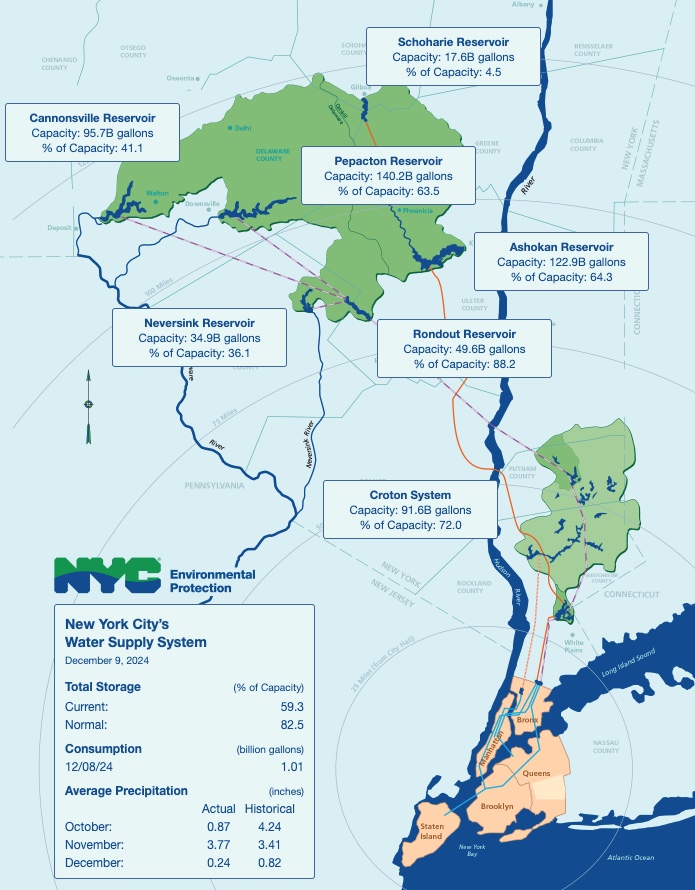
Proof of that can be found in the upstate reservoirs supplying New York water. As of Dec. 9, according to the Department of Environmental Protection (DEP), the city’s water supply is at just 59.3% capacity, more than 23% below the 82.5% normal capacity. Even though 3.77 inches of rain fell in the city watershed in November, the watershed’s total rainfall between Sept. 1 and Dec. 9 (6.24 inches) is about 7 inches below normal (13.19 inches).
The Ashokan Reservoir, a source of water for New York City, during the ongoing drought on Tuesday, Nov. 12, 2024, in Shokan, NY.Jim Franco/Albany Times Union via Getty Images
According to Mayor Adams, it will take more than a foot of rain to restore normalcy to the reservoirs. Some of the basins are at dangerously low levels; the DEP reported that the Schoharie Reservoir, which has a capacity of 17.6 billion gallons of water, is currently at just 4.5% capacity (792 million gallons).
The largest reservoir in the city’s water system, the Pepacton Reservoir, is currently at just 63.5% of its 140.2 billion capacity (89.02 billion gallons).
Map courtesy NYC Department of Environmental Protection
New Yorkers use an average of about 1.1 billion gallons of water daily, and the mayor insisted that everyone do their part to ensure they do not use one drop more than they need.
“[W]e need you to use the utmost levels of caution to prevent fires and keep our parks safe,” Mayor Adams said in a Dec. 9 statement. “And the rain we’ve received isn’t nearly the additional foot of rain we’d need to replenish our upstate reservoirs, so we need all New Yorkers to continue conserving water whenever you can.”
More rainy relief is on the way to New York. The National Weather Service forecasts a good soaking for Wednesday, with between 1 and 2 inches possible and highs reaching the low 60s. The rain could be heavy at times. After that, temperatures will tumble down to a more December-like 33 degrees on Thursday, with sunny and breezy skies.
The city offered these tips to help conserve water:
Take shorter showers; doing so saves 5 to 7 gallons of water per minute. If you’re taking a bath, fill the tub only halfway; that will save between 10 and 15 gallons.
Don’t run the tap while shaving, washing hands or brushing teeth. That will save between 2 and 3 gallons of water per minute.
Don’t flush the toilet unless you have to; toilets account for about 30% of a home’s water consumption, and each flush uses about 1.6 gallons.
Look for leaky faucets and fix them.
Run dishwashers and washing machines when they are at full capacity; use short cycles if available. If you wash dishes in the kitchen sink, turn off the water while doing so.
Use low-flow toilets and showerheads, and faucet aerators, to further conserve water.
Instead of hosing down a sidewalk or driveway, sweep them with a broom.
For more information and water conservation tips, visit nyc.gov/dep.
A Brooklyn driver caused major chaos for LIRR commuters on Dec. 8 after allegedly driving his car down the train tracks, delaying or suspending service on multiple branches.
Basilio Hidalgo, 40, drunkenly drove onto the LIRR tracks near the Elmont-UBS Arena station around 5 p.m. and continued down the tracks for half a mile to the Bellerose Station, MTA officials said. The car’s front two tires caught on fire and had to be put out by the local Floral Park Fire Department.
Hidalgo’s alleged actions significantly damaged the tracks, delaying trains on the Ronkonkoma, Port Jefferson, and Oyster Bay branches and suspending service entirely on the Hempstead Branch while an on-scene investigation took place.
Crews work to remove a car from the LIRR tracks near Bellerose Station after a Brooklyn driver allegedly drove onto the rails, causing extensive delays and track damage on Dec. 8.MTA
Hidalgo was arrested at the scene and taken into police custody. The car was removed from the tracks by 8:30 p.m., and Hempstead Branch service was restored shortly after.
The MTA Police Department is leading the investigation, which is still in its early stages. Responding agencies included the LIRR Fire Marshall, Nassau County Emergency Services, the Floral Park Fire Department, and the Floral Park Police Department.
A version of this story first appeared on Brooklyn Paper’s sister site Long Island Press
The controversial “City of Yes for Housing Opportunity” passed in the City Council by a slim margin last week, earning equal amounts of praise and criticism from lawmakers and residents around New York City.
City of Yes will update some of the city’s old zoning regulations, easing the construction of new housing in areas where it has historically been prohibited. Officials estimate it will bring 80,000 units to the five boroughs over the next 15 years.
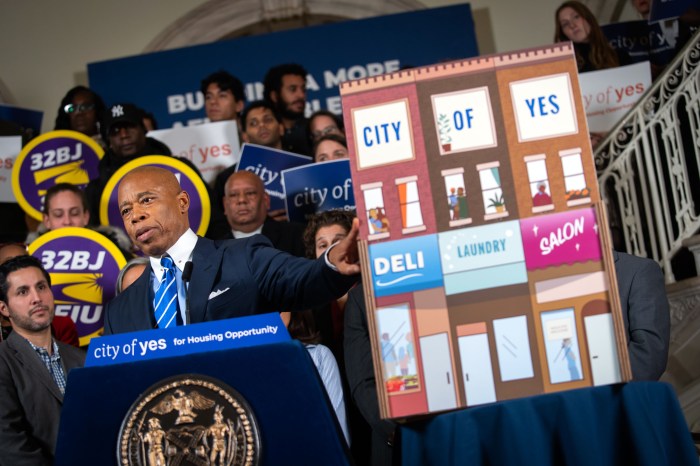
Mayor Eric Adams celebrated the passage of City of Yes on Dec. 5. Photo courtesy of Michael Appleton/Mayoral Photography Office
The proposal — which was amended late last month in order to gain more support from various council members — passed 31-20 in the City Council on Dec. 5.
“Today, the greatest city in the world has been and has decided to become a City of Yes,” Mayor Eric Adams said after the vote. “This image represents the future. A little more housing in every neighborhood to lift our city out of crisis.”
A tight vote from the Brooklyn delegation
Support for City of Yes was split among the Brooklyn delegation. Nine of the borough’s 16 council members voted in favor of City of Yes, and seven against.
Council members Alexa Avilés, Justin Brannan, Jennifer Gutiérrez, Shahana Hanif, Crystal Hudson, Rita Joseph, Sandy Nurse, Chi Ossé, and Lincoln Restler voted “aye,” while Chris Banks, Farah Louis, Darlene Mealy, Mercedes Narcisse, Inna Vernikov, Kalman Yeger, and Susan Zhuang voted “nay.”
Their votes largely reflected the will of their districts, or at least of the community boards within those districts. Of Brooklyn’s 18 community boards, 11 disapproved “City of Yes for Housing Opportunity,” and six approved. The results of the vote in Bed-Stuy’s Community Board 3 are not available online.
Brooklynites, too, were split on the amended proposal: some, Brooklyn Paper reported last month, felt that even if it wasn’t perfect, City of Yes would provide at least some new affordable homes. Others worried it would displace longtime Black and brown residents who live in low-density neighborhoods or single-family homes by allowing developers to build much larger buildings, driving up rents and driving out existing residents.
All four community boards in Banks’ District 42 — which includes parts of Brownsville, East New York, Canarsie, and East Flatbush — voted against City of Yes, and so did Banks.
“It’s not enough just to say that New York City is in a housing crisis,” Banks said at the Dec. 5 council hearing. “The real crisis is regarding a lack of affordability and a path to homeownership.”
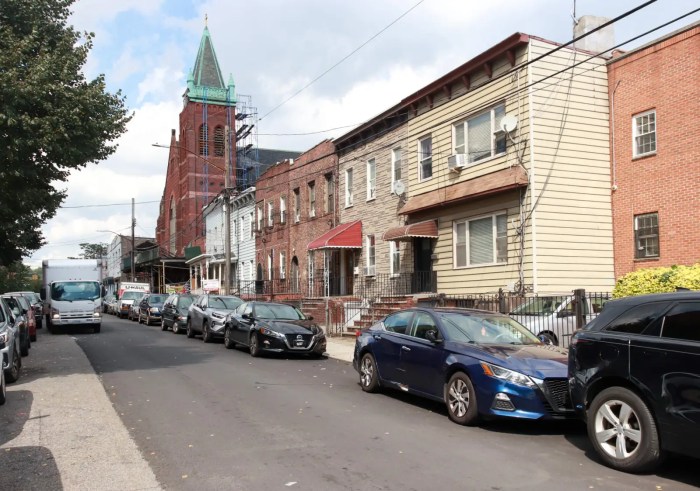
New Jersey Avenue in East New York, where an old church is being turned into affordable housing. Photo by Susan De Vries
The district has seen a significant increase in affordable housing over the last 15 years, he said, but it’s still “nearly impossible” for his constituents to become homeowners — and he felt City of Yes wouldn’t do enough to address the issue.
And while the council amended changes to parking mandates, Banks said City of Yes could still allow developers to build new housing without new parking, straining the already-limited supply in parts of his district without easy access to public transportation.
Ultimately, he said, his constituents felt the proposal could “irreparably change the neighborhood” and open the floodgates for developers to build without concern for longtime residents.
Parking was a major hangup for Mealy, who said that with City of Yes, “developers have absolute power to not do any parking whatsoever.”
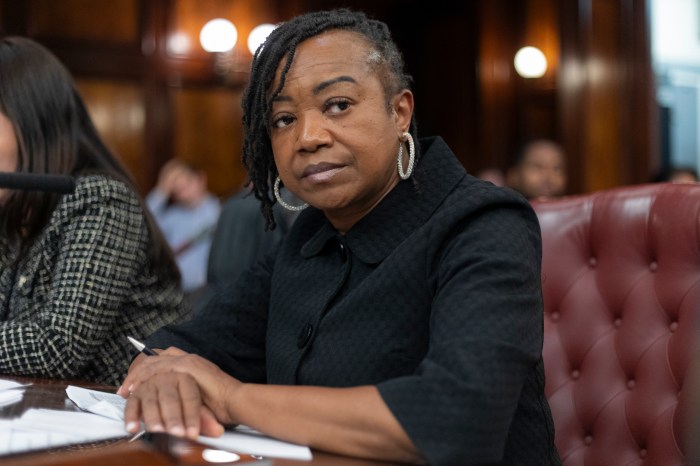
Council Member Darlene Mealy said she was concerned about parking, a common refrain among City of Yes’ opponents. Photo courtesy of Emil Cohen/City Council Media Unit
“I feel this body has taken our own power away from ourselves,” she continued. “We can’t negotiate with the developers, they can do whatever they want.”
Yeger agreed with Banks, and said City of Yes for Housing Opportunity was too broad for a city as large as New York. He was also doubtful of the $5 million investment for housing and infrastructure promised by City Hall and Gov. Kathy Hochul as part of the amended City of Yes — calling it a “phantom $5 million.”
“We can disapprove this one, vote for an actual plan that does this in a real way, and does it in conjunction with the city budget so we can actually achieve the monies we think we’re getting,” he said.
‘Yes’ voters say all nabes need to help end the housing crisis
The seven Brooklyn reps who voted “yes” slammed their colleague’s critiques as they voiced their support for the initiative.
Hudson, who sits on the council’s Land Use committee and voted to send the amended City of Yes proposal to the full council last month, said “some communities are doing their part to address the housing crisis, and others are not. And that’s the real controversy.”
Housing construction has been uneven in the city. Between 2010 and 2020, roughly 185,000 new units were completed in multifamily buildings across New York City, according to the Furman Center. But they weren’t evenly distributed.
High-rise residential buildings in Greenpoint.Photo courtesy of Kidfly182/Wikimedia Commons
More than 15,000 new units were built in Greenpoint and Williamsburg during that time, but only 231 in Bay Ridge. Roughly 20,000 new low-income units opened in the Bronx and 15,000 in Brooklyn; while Queens and Staten Island got fewer than 5,000 each.
Data also show that while low-density districts take up more than 44% of the total land across New York City, they house just 28.4% of all New York City residents.
City of Yes is the “bare minimum” to allow for the creation of new housing in the five boroughs, Hudson said, including accessory dwelling units where older New Yorkers could age in place near their families.
“It gives communities and developers alike new options to consider when planning a new project,” she said. “Let me be clear, these options are just that, options … nothing requires developers or homeowners to build anything.”
The 80,000 new units promised by city officials works out to about 100 new units per council district per year, Restler said. His district has seen enormous growth since the 2004 Williamsburg-Greenpoint rezoning.
“Come to the 33rd District today, there are dozens of projects underway that are bigger than 100 units right now,” he said, “My district has generated more new housing than any other council district in New York City over the last 15 years. We are doing our part, it has not been easy, but it has been necessary.”
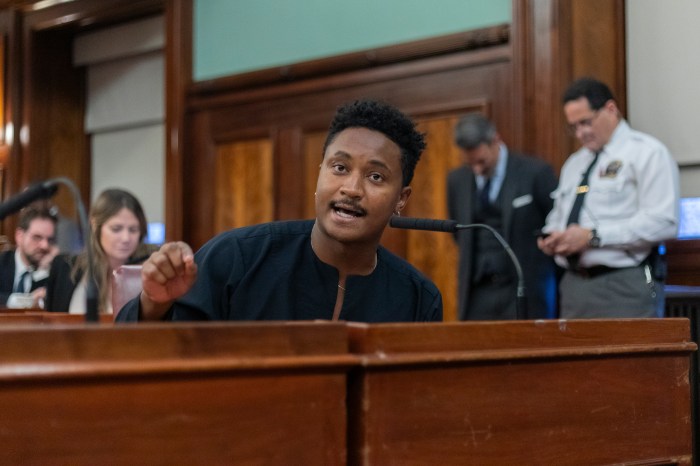
Council Member Chi Ossé criticized his colleagues who voted against the measure. Photo courtesy of Emil Cohen/City Council Media Unit
Fresh off a win after the council passed his FARE Act nearly unanimously last month, Ossé said members voting against City of Yes have previously opposed other measures to protect tenants and end the housing crisis.
In recent decades, the city has added more jobs than homes, Ossé said, and an influx of new residents are competing with longtime New Yorkers for limited housing stock — driving up prices and in some cases, forcing people out of their homes.
“We cannot as a body and government sit idle and let this city become more and more unaffordable because of those who have continued to say no for decades,” he said.