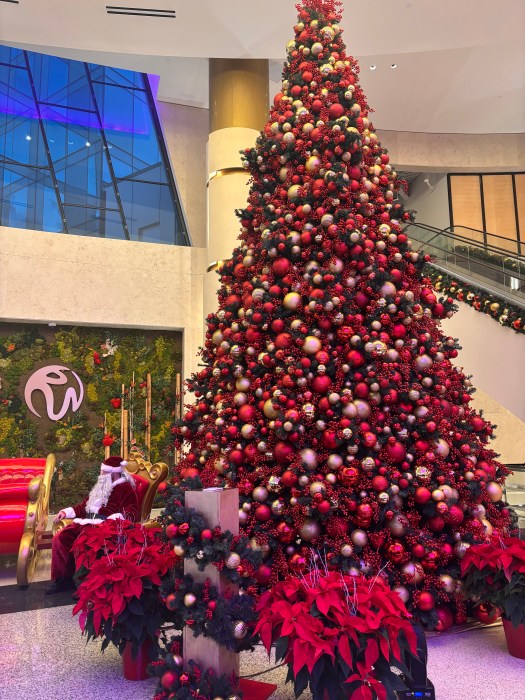
Resorts World New York City (RWNYC) marked its 13th anniversary with its annual holiday tree lighting ceremony, featuring a 40-foot Christmas tree, Menorah, and Kwanzaa candles. The event highlighted the evolution of RWNYC from a casino into a full-fledged entertainment destination, complete with a hotel, diverse dining options, and community-focused initiatives.
Michelle Stoddart, senior vice president of Community Development and Public Affairs at RWNYC, reflected on her tenure with the company. “We’ve grown tremendously, and it’s fulfilling to see how we’ve embraced the community and contributed to its development,” she said.
The ceremony included live caroling, visits from Santa Claus, and festive treats such as hot chocolate and cookies. Local officials and community board members joined the festivities, which also served as the kickoff for RWNYC’s “13 Days of Christmas.”
This milestone campaign features partnerships with local organizations, including toy distributions with the Boys and Girls Club of Metro Queens, support for the Jamaica YMCA, and sponsorship of the Winter Wonderland at Roy Wilkins Park, which opened on Dec. 7.
“Our goal is to bring holiday joy to those we serve,” Stoddart said. “From fulfilling children’s wish lists to sponsoring community events, we’re committed to making a meaningful impact.”
Resorts World New York City’s 40-foot Christmas tree lit up the venue on Tuesday, marking the start of the holiday season in Queens, N.Y.Photo by Tracey Khan
In addition to its holiday programming, RWNYC recently spearheaded Thanksgiving outreach efforts. Partnering with Chef JJ Johnson, Jamaica Hospital, and ReThink Food, RWNYC distributed over 4,000 hot meals and 30 turkeys to underserved families in Queens, Brooklyn, and Nassau County.
“This is a special time of year, and we’re grateful to celebrate with the community that has supported us for 13 years,” said Robert DeSalvio, president of Genting Americas East, which oversees RWNYC. “Our holiday programming reflects our commitment to bringing people together and showing appreciation for their support.”
DeSalvio and Santa Claus ceremonially switched on the tree’s lights during the tree lighting, officially launching the season’s festivities.
RWNYC continues establishing itself as a cornerstone of the Queens community, blending entertainment, philanthropy, and seasonal celebrations.
As New York City’s only casino hotel, RWNYC offers a comprehensive gaming, dining, and entertainment experience. Its 400-room Hyatt Regency JFK Airport hotel, diverse dining options, and long-standing community investments underscore its vital role in the city’s cultural and economic fabric.
The painfully slow bus service in Brooklyn on Flatbush Avenue is causing more problems than just a delayed commute, according to a new report released on Tuesday.
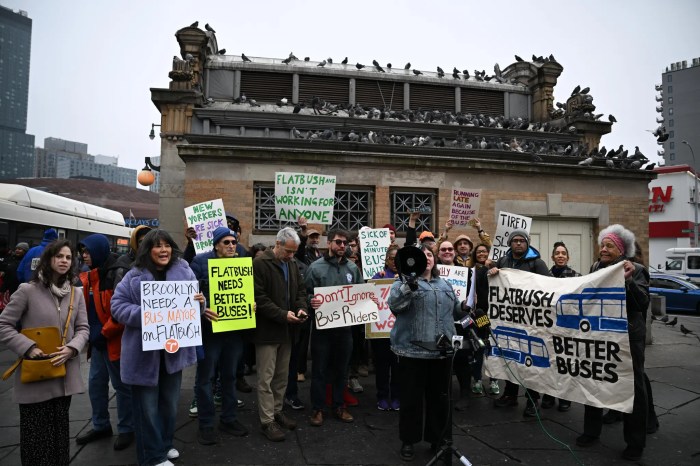
Riders Alliance, an advocacy group for better public transit, rallied with local politicians and other transportation stakeholders at Times Plaza in Flatbush to announce the alarming findings of its Better Buses for Flatbush Avenue report, which surveyed 1,800 Brooklynites in the area throughout the summer.
The report found that bus delays cause a trickle-down effect of problems and stresses.
Notably, the report found that delays have hurt 91% of city bus riders in and around Flatbush. Two out of three riders have endured long waits in inclement weather, and half of those who responded to the survey admitted to paying for car service because the bus was too late.
Advocates and riders rallied for improved service. Photo by Lloyd Mitchell
Perhaps even more alarming, the report shows one of three riders said they have been fired, reprimanded or docked pay at work because of bus delays.
The reason for the delays, according to Danny Pearlstein of the Riders Alliance, is constant traffic and double parking that both he and other advocates say bus lanes would fix.
Pearlstein said he and his team conducted the study with researchers from the Pratt Center for Community Development. They wanted to collect as much real data as possible to help prompt change from city officials.
Some of that data includes what riders say they need from the city Department of Transportation. Approximately 87% of riders in the survey said they want bus lanes, and 85% said they would spend more money on Flatbush Avenue if the buses were more reliable — a likely silver lining for local businesses.
But opponents sometimes say “no” to bus lanes because of the possibility of less parking. They are also concerned traffic patterns will change, and not necessarily for the better.
Pearlstein suspects otherwise.
“We anticipate business would improve, and this is exactly what we’ve seen throughout the city,” he said.
The city plans to build a new bus lane on Flatbush Avenue. Image courtesy of NYC DOT
“By redesigning Flatbush Avenue, we can speed up bus service to improve the lives of bus riders currently stuck on one of the most congested corridors in Brooklyn—while also enhancing pedestrian safety,” a DOT spokesperson said. “We look forward to continued public outreach, design refinement, and completing our traffic analysis in consultation with the community. This process will help inform the best way to make Flatbush Avenue work best for all New Yorkers using the corridor.”
Alexa Sledge, a spokesperson for the nonprofit Transportation Alternatives, said the avenue’s current design is not working for local bus riders.
“Everyone deserves the freedom to get around our city safely, quickly, and affordably, but the current street design on Flatbush Avenue is trapping bus riders in traffic and creating dangerous situations for pedestrians,” Sledge said. “More than 130,000 Brooklyn bus riders are riding on buses traveling less than 7 mph, stealing hours of our time and making us late to work, to school and to the doctor.”
She also said that redesigning Flatbush Avenue and implementing better bus service would improve pedestrian safety.
“We need faster buses and safer intersections on Flatbush Avenue, and that looks like dedicated bus lanes and pedestrian infrastructure,” she added.
Flatbush Avenue: A busy Brooklyn corridor
More than 132,000 people board 12 MTA bus routes along Flatbush Avenue. The B41 alone serves over 28,000 average daily riders, according to city statistics.
Many of the nearly 1 million residents in Flatbush and nearby, specifically in Brooklyn Community Boards 2, 6, 8, 9, 14, 17 and 18, do not have private cars, making them heavily dependent on reliable public transportation.
For the survey, researchers mostly spoke to people living in the main neighborhood of Flatbush.
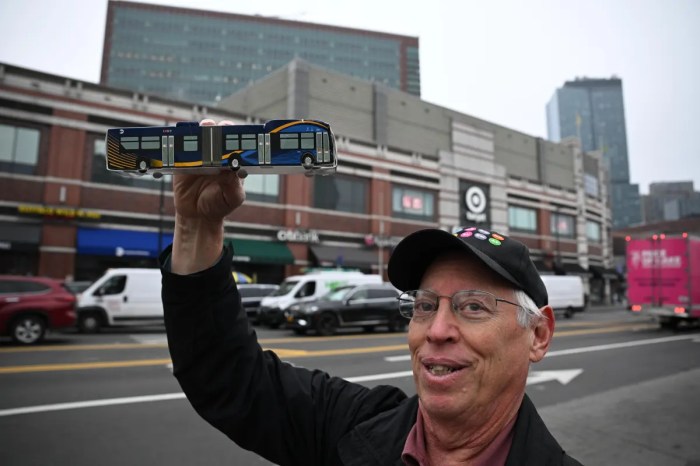
A rallygoer shows off a model bus at the Dec. 10 protest. Photo by Lloyd Mitchell
“But what we anticipate is that bus improvements will come in three phases,” Pearlstein explained. “The first one is north of Grand Army Plaza in Downtown Brooklyn, where the buses move the slowest. And the buses there are primarily serving people who live to the south, because people who live right in the neighborhood aren’t getting on the Flatbush Avenue buses.”
People coming into Downtown areas from the south — or leaving it to go south — are experiencing the worst delays, Pearlstein said.
“They’ll benefit the most from bus priority,” he added.
DOT officials said they are conducting outreach for bus priority on the corridor north of Grand Army Plaza, including presenting plans to community boards, which started in June and will continue.
This story first appeared on Brooklyn Paper’s sister site amNewYork.