
Categories
Michael Novakhov - SharedNewsLinks℠

When Church and State Are Anything but Separate – The American Interest


Michael_Novakhov
shared this story
from Comments on: When Church and State Are Anything but Separate.

Belief is not simply a quaint feature of the human condition but a complex operating system that holds the key to understanding the Middle East.

America’s official creed turned 61 on July 30. On that date in 1956, President Dwight D. Eisenhower signed Public Law 851, resolving that “In God we trust” shall henceforth be the motto of the United States, even though the phrase had already begun to appear on U.S. currency almost a hundred years earlier. The chances of such an innovation happening today are slim to nil.

Few things are more controversial in America today than the subject of God-talk in the public square. The courts have thus far rejected First Amendment petitions to expunge the loaded language from our wallets, but only by positing that the God of the Treasury is a secular impostor. In 1984, Justice William Brennan invoked “ceremonial deism”—a dictum first conceived by Yale Law School dean Eugene Rostow—to suggest that references to the Divine on legal tender or in the Pledge of Allegiance should be “protected from Establishment Clause scrutiny chiefly because they have lost through rote repetition any significant religious content.”

For guardians of the U.S. Constitution, “Thou shalt preserve the separation between church and state” is the 11th commandment. It ensures that no single religious tradition is given preference over all others, providing for all citizens to be treated equally before the law. America’s fidelity to this principle, however inspired, may have stunted its ability to fully fathom world events.

Here’s a news flash: God never left the Middle East. This isn’t to say that he’s deserted the United States, which—despite the growth of the “Nones”—remains in many ways a deeply religious land. But over in the Middle East, religion is intertwined profoundly with national identity. It’s not relegated to the realm of personal choice, a private matter seldom discussed in polite company, but a completely public affair. And turning the American model on its head, both synagogue and mosque are very much connected to the apparatus of state throughout the region.

The July 14 shooting on the Temple Mount in Jerusalem, where three Arab Israeli gunmen killed two Druze policemen, has ignited passions across the region. The site, which is under the control of Israel, is administered by the Islamic waqf (religious trust). The introduction of metal detectors to screen visitors for weapons—standard practice at venues around the world—was sufficient pretext for the Palestinian Authority to suspend security coordination with Israel.

The outbreak of nationalist violence at one of humanity’s most sacred shrines—home to both ancient Jewish temples and the present-day Haram al-Sharif mosque—has once again focused global attention on the tangible and explosive nexus between faith and politics. Nothing could better epitomize the volatility of mixing sanctity with earthly dominion.

In the Middle East, loyalty to country—a relative term where borders have proven fluid historically—continues to play second fiddle to deeper spiritual ties. We’re not talking about some perfunctory expression of tribal solidarity either. A 2012 Pew Research Center survey found that a staggering 97 percent of the world’s Muslims subscribe to the shahadah, according to which “there is no God but Allah, and Muhammad is his messenger.” (Pointedly, the poll excluded North America and Western Europe.) And 93 percent of them observe the daytime fast throughout the holy month of Ramadan.

Meanwhile, in Israel, where 93 percent of Jews profess to taking pride in their Jewish identity, a plurality of them describe themselves as Jewish first and Israeli second. Notwithstanding a robust debate about whether “being Jewish” is foremost a religious or national attribute, the facts speak for themselves: at least 90 percent of Israeli Jews claimed that it was “important” or “very important” for them to circumcise their male infants, celebrate a bar mitzvah, and say the kaddish mourning prayer for their parents. Just over three quarters (76 percent) of them maintain the dietary laws of kashrut in their homes. These levels of ritual performance vastly outpace comparable figures for their co-religionists in the United States.

But personal observance is only half the story. In the United States, questions of devotion and praxis are confined largely to domestic affairs. Access to abortions, school prayer, and discrimination against the LGBT community are typical examples of this. To the God-fearing masses of the Middle East, where religion and state have a symbiotic relationship, they are also a core driver of foreign policy, impacting forcefully on the security and economics of the entire planet.

President Donald Trump and his Russian counterpart, Vladimir Putin, have been engaged in trying to broker a ceasefire in Syria. Secretary of State Rex Tillerson just recently returned from a failed round of shuttle diplomacy in the Persian Gulf, where he attempted to conciliate a Saudi-led consortium of four Arab states and their rival in Qatar; his two envoys have just arrived in the region to pick up where he left off. And the tenuous nuclear deal with Iran remains under administration review. At the heart of all these Middle Eastern conflicts lies a civilizational struggle for primacy between opposing versions of Islam.

In Syria, Iraq, Yemen and other quarters of the region, the Islamic Republic of Iran (note the official appellation) employs its assets and proxies to promote its vision: exporting the Islamic Revolution. Employing their own form of “replacement theology,” its leaders aim to expand the influence of their Shi‘a brand at the expense of Mecca-centered Sunni Islam. Geopolitically, through the deployment of Hizballah in Syria and Lebanon, and its de facto alliance with Moscow, Tehran supports this objective by maneuvering to keep Bashar Assad in power and preserve its beachhead on the Mediterranean. Riyadh and its Sunni allies are pushing back, not only against Iran, but also against its satellites; thus, their bitter resistance to Qatari sponsorship of the Muslim Brotherhood and the Al-Jazeera network, which threaten to undermine their regimes and ideology. This power struggle over which doctrinal interpretation will prevail will define the future of the Arab world. The demands it places on the resources and bandwidth of the United States and its Western allies are enormous.

No less consequential is Muslim hostility toward the Jewish state of Israel, whose security repeated U.S. administrations have pledged to uphold. Ayatollah Ali Khamenei, the Supreme Leader of Iran—a nation once friendly with Israel—has called for the destruction of Israel, allegedly based on “well-established Islamic principles.” Saudi textbooks have branded Jews as “apes” and “swine,” and Qatar’s largest mosque hosted a sermon calling for Jerusalem’s Al-Aqsa mosque to be saved from “the claws of the Jews;” they’ve had no kind words for Christians either. Israel has found common cause with a number of Sunni Muslim states in opposing Iranian expansionism, but contagious racial sentiments continue to incite fundamentalist violence against Western targets.

Israel, meanwhile, is awash in religious discord of another sort. Recent government decisions concerning prayer arrangements at the Western Wall and religious conversion standards have sparked divisions between Judaism’s different denominations. The fallout has unleashed talk within the U.S. Jewish community of possible repercussions that could affect Israel’s standing abroad. If steadfast friends of Israel in the United States were ever to withhold their support, it could potentially trigger changes in congressional voting patterns on issues such as foreign aid.

The devil, if you’ll allow me to mix metaphors, is in the heavenly details. Belief is not simply a quaint feature of the human condition but a complex operating system that holds the key to understanding the Middle East. If diplomats and other professionals involved in international affairs are to be effective, they need to get up to speed. Cross-cultural literacy, the bread-and-butter of navigating relationships, implies more than just a bemused, superficial understanding of religious customs; it’s about engaging in reflective dialogue, not just knowing whose hand you’re allowed to shake and when. Never before has it been so important that practitioners develop a nuanced appreciation of religious canons and motivations. In too many cases, these are the powers behind the true game of thrones.
Categories
Brooklyn

@GovKathyHochul: New Yorkers: Election Day is just three weeks away! Not registered to vote yet? Not a problem – you can register online, in-person, or by mail until October 26. Learn more: elections.ny.gov/register-vote

Categories
Brooklyn News - The Ocean Avenue News

JPMorgan Chase showcases impact on New York City communities during tour of Brooklyn Navy Yard

The chairman and CEO of JPMorgan Chase toured New York City earlier this month, engaging in roundtable discussions with community leaders in Harlem, Jackson Heights, Bed-Stuy and the Brooklyn Navy Yard. The tour emphasized JPMorgan Chase’s contributions to local communities.

Jamie Dimon attended an Oct. 2 ribbon-cutting ceremony for JPMorgan Chase’s new community branch on Fulton Street in Bed-Stuy before joining Brooklyn Navy Yard (BKNY) executives and Brooklyn Workforce Innovations (BWI) representatives for a roundtable discussion. The session focused on how BKNY and BWI create job opportunities and provide skill training for low-income New Yorkers.

JPMorgan Chase has been a long-term supporter of BKNY and BWI, helping to drive economic growth through financial and philanthropic investments.

The bank committed $10 million in state Historic Tax Credit equity to finance the renovation of Building 127, a 94,000-square-foot structure built in 1904. Once completed, the building will house manufacturing and office space.

BKNY has played a significant role in American history since the early 1800s, initially serving as a U.S. Navy shipyard that built battleships like the USS Arizona and USS Maine. Today, it operates as a dynamic industrial park, home to over 550 businesses that provide jobs for more than 13,000 New Yorkers.

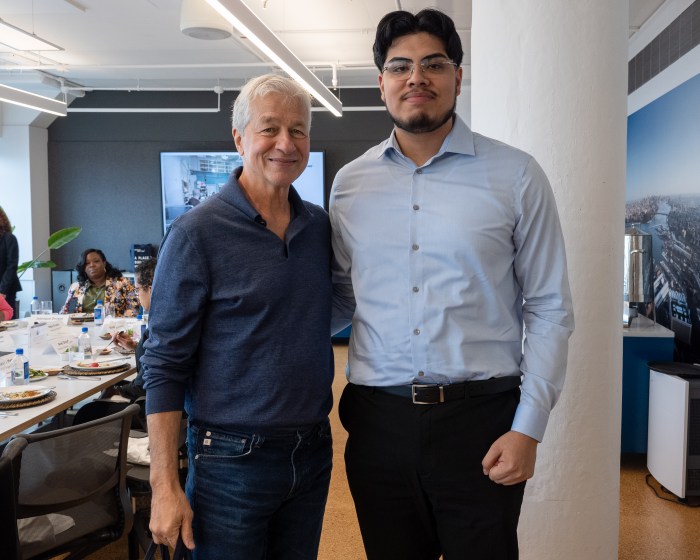
CEO of JPMorgan Chase Jamie Dimon (left) and BWI alumnus Jose Cervantes attend a roundtable discussion at the Brooklyn Navy Yard.Photo by Gabriele Holtermann

During the roundtable, Lindsay Greene, president and CEO of Brooklyn Navy Yard, shared that BKNY businesses generate $2 billion annually, with average wages ranging from $25 to $40 per hour.

“We are continuing the legacy that the Navy built in being a center of innovation and inclusivity and opportunities,” Greene told Dimon.

JPMorgan Chase has also committed approximately $1.6 million in philanthropic capital to BWI, a nonprofit workforce development organization.

Founded in 2000, BWI supports low- and moderate-income New Yorkers through training programs like KindWork, a free seven-week course covering professional communication, career coaching, and job placement services.

On average, 90% of BWI graduates secure full-time employment in sectors like tech, commercial driving and woodworking, earning more than $40,000 annually with health benefits and paid time off — and 70% of graduates remain employed with their placement organization after one year, surpassing the tech industry average.

Since its founding, BWI has launched over 11,000 careers. This year, 900 New Yorkers are participating in BWI’s training programs, according to BWI Executive Director Aaron Shiffman.

“We think in sectors. We also think in customized training verticals. The philanthropy of JPMorgan Chase has been instrumental in supporting us for a quarter of a century,” Shiffman said.

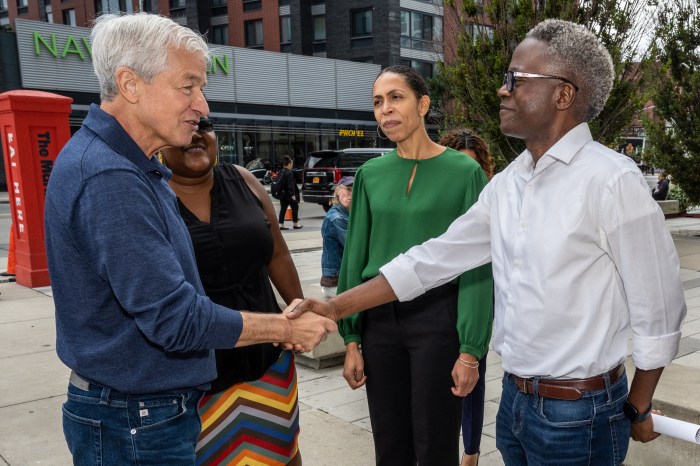
CEO of JPMorgan Chase Jamie Dimon arrives at Brooklyn Navy Yard.Photo by Gabriele Holtermann

Jose Cervantes Escamilla, a BWI alumnus, credits the organization with providing the tools needed to find career-ladder employment. He now works for Alma, an online mental healthcare platform.

“I’ve worked as an operations associate for two years now, and it’s been a really good learning opportunity in my transition into tech, specifically during this time when market forces are unpredictable,” Cervantes Escamilla said.

Tim Berry, global head of corporate responsibility at JPMorgan Chase, said the company is committed to powering economic growth in Brooklyn by supporting BKNY and BWI. The bank has also pledged $3 million to the City University of New York (CUNY) to support long-term career outcomes for students through CUNY’s Community College Network.

“In a lot of ways, our role is to help clients and community partners deliver the capital, resources, and skills training New Yorkers need to participate in the local economy,” Berry said. “We’re proud of our work together and will stay focused on building up small businesses and creating accessible pathways to meaningful careers at the Navy Yard, across Brooklyn, and in every community we serve.”

The post JPMorgan Chase showcases impact on New York City communities during tour of Brooklyn Navy Yard first appeared on The Ocean Avenue News.

Categories
Brooklyn News - The Ocean Avenue News

Brooklyn home prices surge despite fewer sales as rents dip amid bidding wars

Home prices just keep rising in Brooklyn as the number of sales drop but listing inventory is starting to increase as interest rates notch down, third-quarter reports out this week found. Separately, rents dipped slightly although rental bidding wars made up a quarter of signed leases, September reports showed.

The median closed-sale price for all types of homes in the borough rose 2.6% to $975,000 in the quarter vs. the same period a year earlier, according to Miller Samuel’s report for Douglas Elliman. The average sale price clocked in at $1,244,397, an increase of 1.8 percent during the same period.

Co-op sale prices surged while condo prices declined, in a reversal of recent trends. Townhouses (defined as one- to three-family houses) also jumped, rising to an average price per square foot of $635 — a record increase of 25.2 percent for the quarter compared to the same time a year ago.

The biggest gains seen were for properties valued between $1 and $4 million, said Douglas Elliman President and CEO for the Northeast Region Richard Ferrari in an online letter accompanying the report. “Cash sales accounted for two-thirds of all condo closings,” he added.

Prospect Lefferts Gardens.Photo by Susan De Vries

Certain areas fared better than others: Indicators dipped a hair in southern Brooklyn, while they were largely positive in north, northwest, and east Brooklyn. Standing out was the price per square foot for townhouses in northwest Brooklyn, which rose a whopping 48.7% to $1,921 year over year. However, the number of sales was not large at only 108.

Meanwhile, in the rental market, renters may be finally getting a bit of a break, with average rents notching down 2.4 percent to $4,063 vs. the same time last year. Lease signings rose 213.2% to 3,928, according to Miller Samuel’s September rental report for Douglas Elliman.

The average rent for a one-bedroom now stands at $3,269, an increase of 2% compared to a year earlier, while the average price per square foot for a one-bedroom squeaked down 0.2 % to $57.82. A two-bedroom now averages $4,202 per month, and a three-bedroom $5,101, dropping 2.3% and 15.6% over the year, respectively.

Brooklyn is still hot, concluded Corcoran SVP, General Sales Manager, NY Michael Sorrentino in the firm’s third-quarter sales report. “Lower mortgage rates are encouraging buyers to jump back in, and with inventory up 15% annually, they have more options than before.”

This story first appeared on Brooklyn Paper’s sister site Brownstoner

The post Brooklyn home prices surge despite fewer sales as rents dip amid bidding wars first appeared on The Ocean Avenue News.

Categories
The Brooklyn News And Times Blog

Your Last Payment for ChatGPT Was Declined

ChatGPT by OpenAI

Hello,

We regret to inform you that your latest subscription payment for ChatGPT was unsuccessful. This means we were unable to process your monthly payment.

To avoid an interruption in service, please update your payment information as soon as possible. If we do not receive your payment within the next 7 days, your subscription will be canceled, and you will lose access to ChatGPT.

If you have already updated your payment information, please disregard this email. For any questions or assistance, feel free to contact our support team at support@openai.com.

Thank you for choosing ChatGPT, and we appreciate your prompt attention to this matter.

Best regards,
The OpenAI Team

You are receiving this email because you have an active subscription to ChatGPT by OpenAI.

© 2024 OpenAI, Inc. All rights reserved.

Categories
Brooklyn News - The Ocean Avenue News

Your Last Payment for ChatGPT Was Declined

ChatGPT by OpenAI

Hello,

We regret to inform you that your latest subscription payment for ChatGPT was unsuccessful. This means we were unable to process your monthly payment.

To avoid an interruption in service, please update your payment information as soon as possible. If we do not receive your payment within the next 7 days, your subscription will be canceled, and you will lose access to ChatGPT.

If you have already updated your payment information, please disregard this email. For any questions or assistance, feel free to contact our support team at support@openai.com.

Thank you for choosing ChatGPT, and we appreciate your prompt attention to this matter.

Best regards,
The OpenAI Team

You are receiving this email because you have an active subscription to ChatGPT by OpenAI.

© 2024 OpenAI, Inc. All rights reserved.

The post Your Last Payment for ChatGPT Was Declined first appeared on The Ocean Avenue News.

Categories
The Brooklyn News And Times Blog

Your Last Payment for ChatGPT Was Declined

ChatGPT by OpenAI

Hello,

We regret to inform you that your latest subscription payment for ChatGPT was unsuccessful. This means we were unable to process your monthly payment.

To avoid an interruption in service, please update your payment information as soon as possible. If we do not receive your payment within the next 7 days, your subscription will be canceled, and you will lose access to ChatGPT.

If you have already updated your payment information, please disregard this email. For any questions or assistance, feel free to contact our support team at support@openai.com.

Thank you for choosing ChatGPT, and we appreciate your prompt attention to this matter.

Best regards,
The OpenAI Team

You are receiving this email because you have an active subscription to ChatGPT by OpenAI.

© 2024 OpenAI, Inc. All rights reserved.

Categories
Brooklyn News - The Ocean Avenue News

Brooklyn rapper and 9/11 first responder Ka ‘unexpectedly’ dead at 52

Brooklyn-born rapper and producer, Ka — who was also a 9/11 first responder — unexpectedly died over the weekend. He was 52.

The post Brooklyn rapper and 9/11 first responder Ka ‘unexpectedly’ dead at 52 first appeared on The Ocean Avenue News.

Categories
Brooklyn News - The Ocean Avenue News

Brooklyn rapper and 9/11 first responder Ka ‘unexpectedly’ dead at 52 – New York Post

The post Brooklyn rapper and 9/11 first responder Ka ‘unexpectedly’ dead at 52 – New York Post first appeared on The Ocean Avenue News.

Categories
Brooklyn

@GovKathyHochul: Today’s the first day of the Medicare open enrollment period! New York’s Medicare Savings Program is helping older adults save thousands on health care costs. See if you’re eligible: aging.ny.gov/health-insuran… cbsnews.com/newyork/news/n…

WP Radio
WP Radio
OFFLINE LIVE