Поскольку администрация Байдена-Харриса объявляет о новом финансировании для улучшения ресурсов пресной воды и борьбы с последствиями изменения климата, инициатива направлена на решение критических проблем, с […]
В недавнем отчете администрация Байдена подчеркнула, как Закон о доступном медицинском обслуживании (ACA) предоставил медицинскую страховку более чем 4,2 миллионам предпринимателей, способствуя рекордному росту числа новых бизнес-заявок. […]
Спикер Ассамблеи Карл Хисти объявил о повторном назначении Долли Карабальо в Комиссию по этике и лоббированию, что вызвало бурные дебаты среди законодателей. Поскольку опасения по […]
21 New York schools have been named National Blue Ribbon Schools by @usedgov!
This award represents the hard work of our teachers, staff, and communities to give their students an outstanding education. Congratulations! https://t.co/kGQnf30Z0m
Access to reliable internet connectivity in underserved NYC communities is improving as a result of continued public and private partnerships, industry experts said at a community panel discussion on Tuesday.
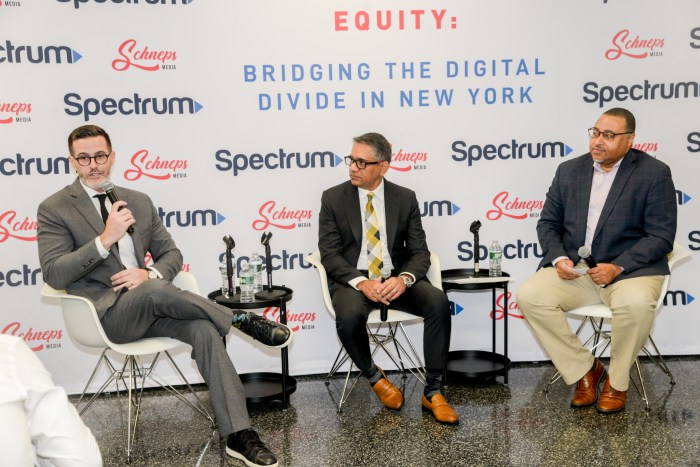
Among the panelists were: Dr. Larry Johnson, president of Guttman Community College; Rodney Capel, vice president of state government affairs at Spectrum; Intekhab Shakil, NYC Department of Education (DOE) Chief Technology Officer; Brett Sikoff, executive director of franchise administration and broadband at NYC’s Office of Technology and Innovation (OTI). Joshua Schneps, CEO of Schneps Media, served as panel moderator.
The panelists cited the COVID-19 pandemic as a wake-up call to address the disparity among public school children who could not access reliable internet connection when classes went remote.
“We were still trying to make sure that the most vulnerable communities had access to education, and what we realized is that we sent students home with devices, but what we did not take into consideration was that they did not have access to the internet to continue their studies,” said Johnson.
Schneps underscored the prevalence of children and adults without broadbandinternet during the pandemic.
“During COVID, I saw a tremendous number of people sitting outside our libraries, outdoors. And it was evening time. And I was questioning, what are all these groups of people doing sitting outside?” he said. “It took me a little while to figure out that they were there for access to Wi-Fi.”
Panelists Brett Sikoff, Intekhab Shakil and Rodney Capel discuss the digital divide in NYC. Photo credit: Ralph De Pas
In 2022, Mayor Eric Adams launched Big Apple Connect at the start of the school year. The initiative, funded with city rather than federal dollars, was established to provide New York City Housing Authority (NYCHA) residents—both students and non-students—with free, fast, reliable and safe internet access from service providers including Spectrum.
Michael J. Garner, NYC’s chief business diversity officer, said the digital divide exists “because of the lack of equity” in communities of color.
“One thing Mayor Adams has done is that he afforded free broadband to all of the residents of the New York City Housing Authority. That’s over 600,000 citizens,” Garner said. “We need to bridge the gap between a tale of two cities, which we are balancing as one city, and broadband is going to go a long way in bridging that divide.”
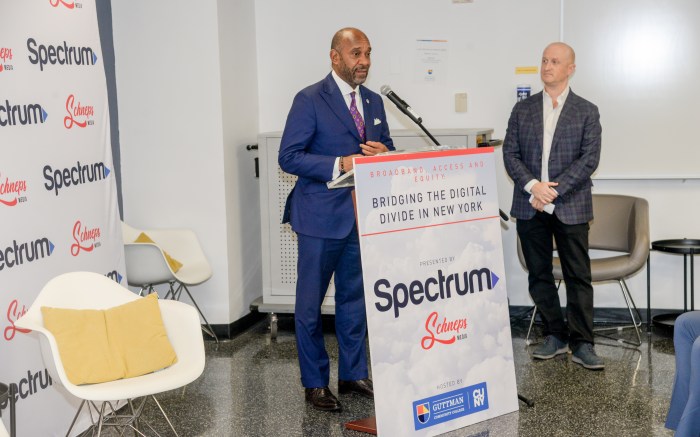
Michael Garner, NYC’s chief business diversity officer, left, and Joshua Schneps, CEO of Schneps Media. Photo credit: Ralph De Pas
Zeroing in on children, a NYS Education Department survey at the end of 2020 showed that many students did not have access to the adequate internet required for learning remotely, the NYC Council reported.
As Big Apple Connect provides the internet at home, the DOE now provides devices such as tablets and laptops that students can essentially “rent out” from their schools on days when remote learning is in session.
“Right now, we have provided access to the schools to go ahead and procure their own devices. We manage what device to be procured,” Shakil of the DOEsaid, adding that his office ensures security parameters on the devices are assessed. “The schools are close to the community. They know what kinds of devices, what kind of internet connectivity is required by the students, by the family.”
But more still needs to be done to get New Yorkers connected, the experts agreed.
Sikoff of OTI discussed the internet enhancements his office is making within the city through Big Apple Connect, which is available in 220 NYCHA developments, but said there is more work to do.
“There is a lot more work to do,” he said. “Clearly, Big Apple Connects is not the only solution for the city of New York, but it’s a great one for public housing residents.”
Another initiative put forth to improve internet access in the city includes OTI’s Connecting Communities program, which provides funding and administrative support to city agencies such as NYC Aging and public library systems. The program features connectivity, access to devices and skills training to New Yorkers in need of these services.
Sikoff also discussed borough-wide Gigabit Centers, which provide access to the internet, devices, and digital skills training for both kids and adults.
“We worked with private companies to establish Gigabit Centers in each borough so that every borough has access to a facility where there is high-speed internet and devices,” he said.
Throughout the event, experts agreed that these solutions and future initiatives will help continue to connect Big Apple residents to reliable internet, regardless of where they live.
“It’s so clear that every New Yorker needs to be connected, whether it’s to do their work or study, or to even do just everyday things that are needed,” Schneps said.