Categories
Audio Sources - Full Text Articles

Lula takes reins of Brazil, slams Bolsonaro“s anti-democratic threats

2023-01-01T20:12:51Z

The usually calm capital of Brazil readies for leftist Luiz Inacio Lula da Silva’s inauguration on Saturday (December 31).

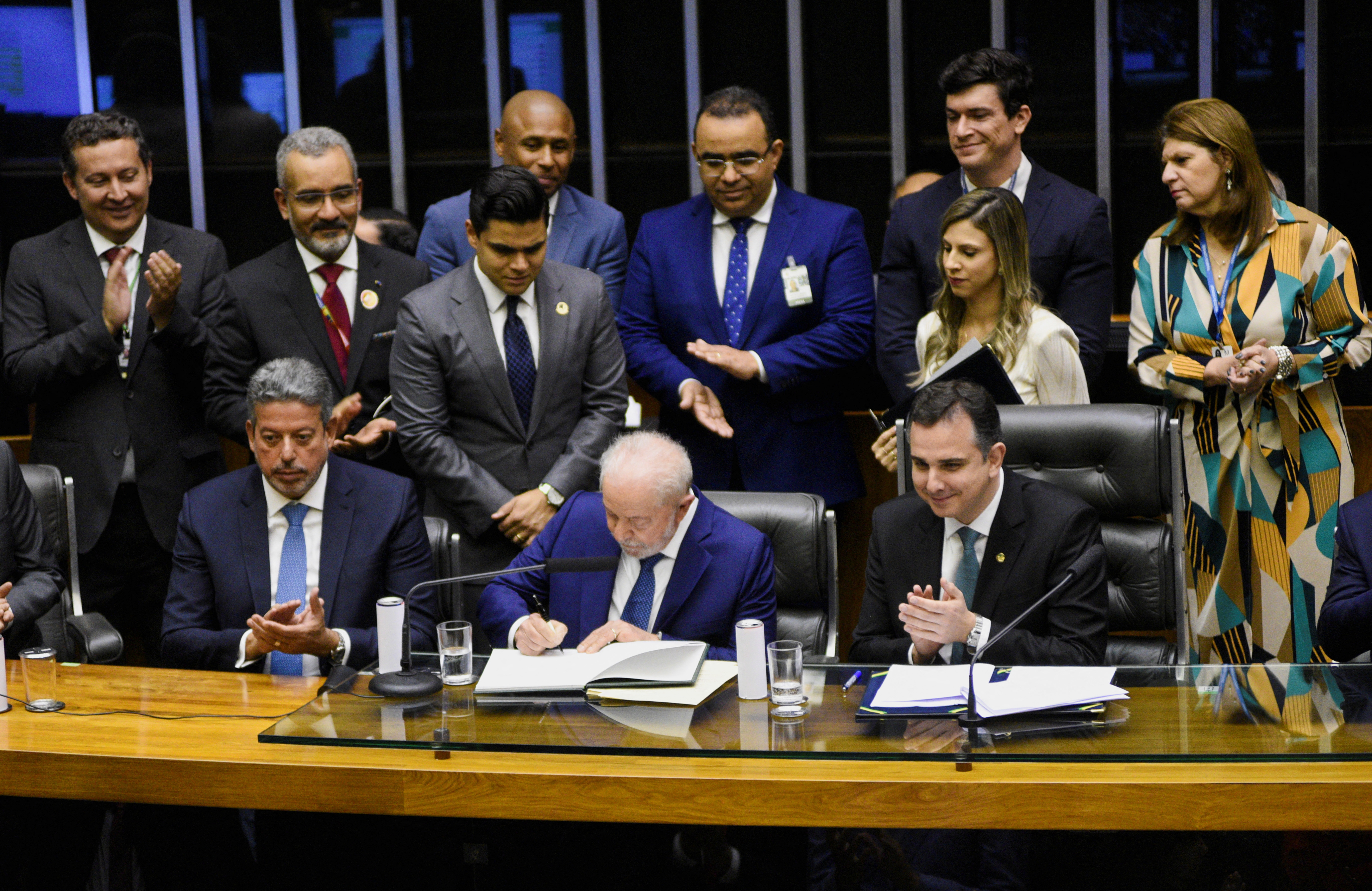
Luiz Inacio Lula da Silva was sworn in as Brazil’s president on Sunday, delivering a searing indictment of far-right former leader Jair Bolsonaro and vowing a drastic change of course to rescue what he called a ruined nation.

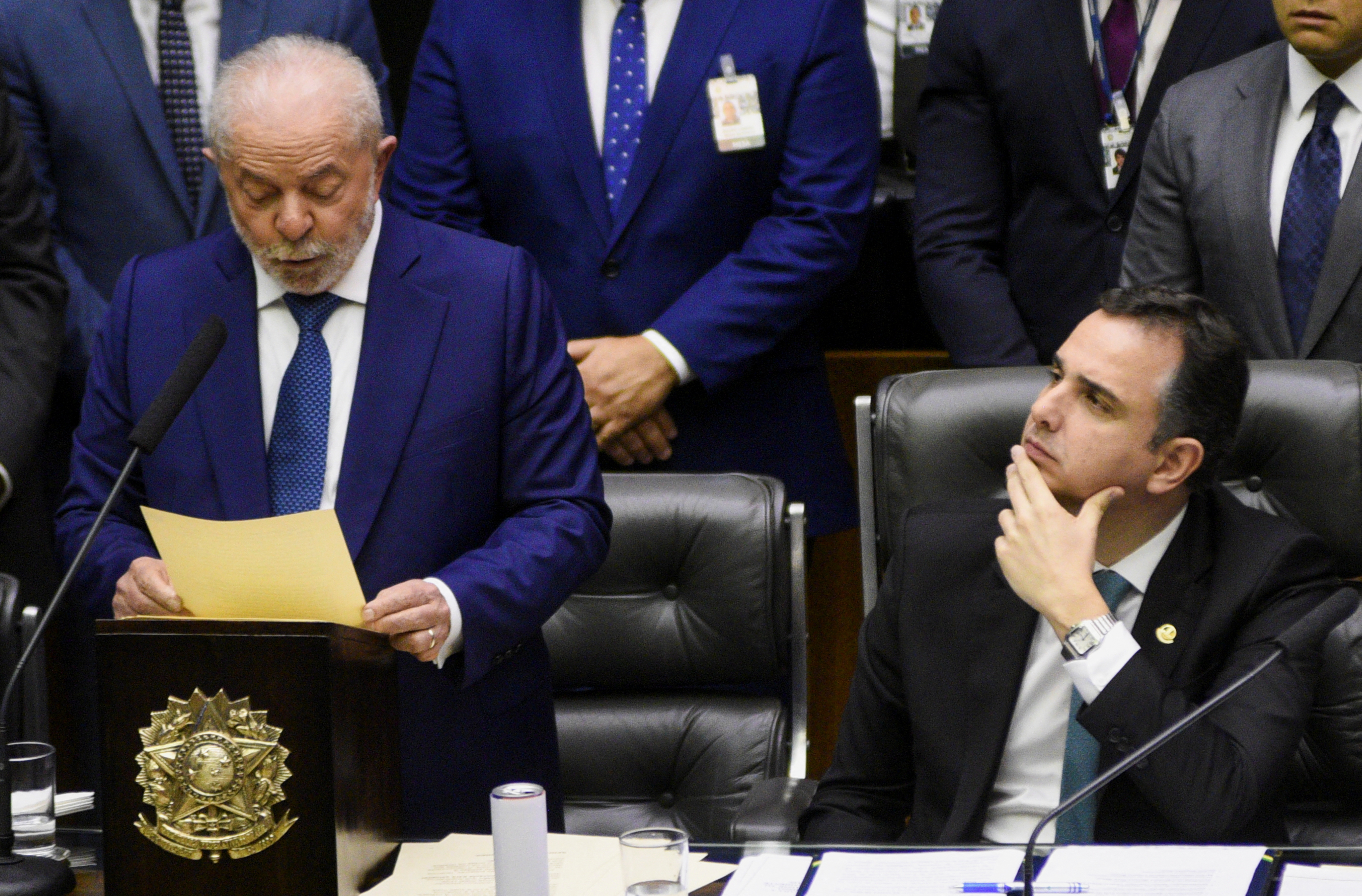
In a speech to Congress after officially taking the reins of Latin America’s biggest country, the leftist said democracy was the true winner of the October presidential vote, when he ousted Bolsonaro in the most fraught election for a generation.

Bolsonaro, who left Brazil for the United States on Friday after refusing to concede defeat, rattled the cages of Brazil’s young democracy with baseless claims of electoral weaknesses that birthed a violent movement of election deniers.

“Democracy was the great victor in this election, overcoming … the most violent threats to freedom to vote, and the most abject campaign of lies and hate plotted to manipulate and embarrass the electorate,” Lula told lawmakers.

He delivered a veiled threat to Bolsonaro, who faces mounting legal risks for his anti-democratic rhetoric and his handling of the pandemic now that he no longer has presidential immunity.

“We do not carry any spirit of revenge against those who tried to subjugate the nation to their personal and ideological designs, but we will guarantee the rule of law,” Lula said, without mentioning his predecessor by name. “Those who erred will answer for their errors.”

He also accused Bolsonaro’s administration of committing “genocide” by failing to respond properly to the COVID-19 virus that killed more than 680,000 Brazilians.

“The responsibilities for this genocide must be investigated and must not go unpunished,” he said.

Lula’s plans for government provided a stark contrast to Bolsonaro’s four years in office, which were characterized by backsliding on environmental protections in the Amazon rainforest, looser gun laws and weaker protections for indigenous peoples and minorities.

Lula said he wants to turn Brazil, one of the world’s top food producers, into a green superpower. He reinforced his commitment to ending deforestation in the Amazon, which surged to a 15-year high under Bolsonaro, while also enlisting its indigenous inhabitants to help protect the forest.

He said he will revoke dozens of Bolsonaro’s executive orders loosening firearms laws, which prompted a sharp rise in gun ownership.

“Brazil does not want more weapons, it wants peace and security for its people,” he said.

Lula’s inauguration took place amid heightened security.

Some of Bolsonaro’s supporters have protested that the election was stolen and called for a military coup to stop Lula returning to office in a climate of vandalism and violence.

On Christmas Eve, a Bolsonaro supporter was arrested for making a bomb that was discovered on a truck laden with aviation fuel at the entrance to Brasilia airport, and confessed he was seeking to sow chaos to provoke a military intervention.

Bolsonaro has seen his support among many former allies evaporate due to the anti-democratic protests.

On Saturday night, then-acting President Hamilton Mourao, who was Bolsonaro’s vice president, criticized his former boss in a thinly veiled dig for allowing anti-democratic sentiment to thrive after his defeat at the polls.

“Leaders who were supposed to reassure and unite the nation … allowed silence or inopportune and deleterious protagonism to create an atmosphere of chaos and social disintegration,” Mourao said in a speech late on Saturday.

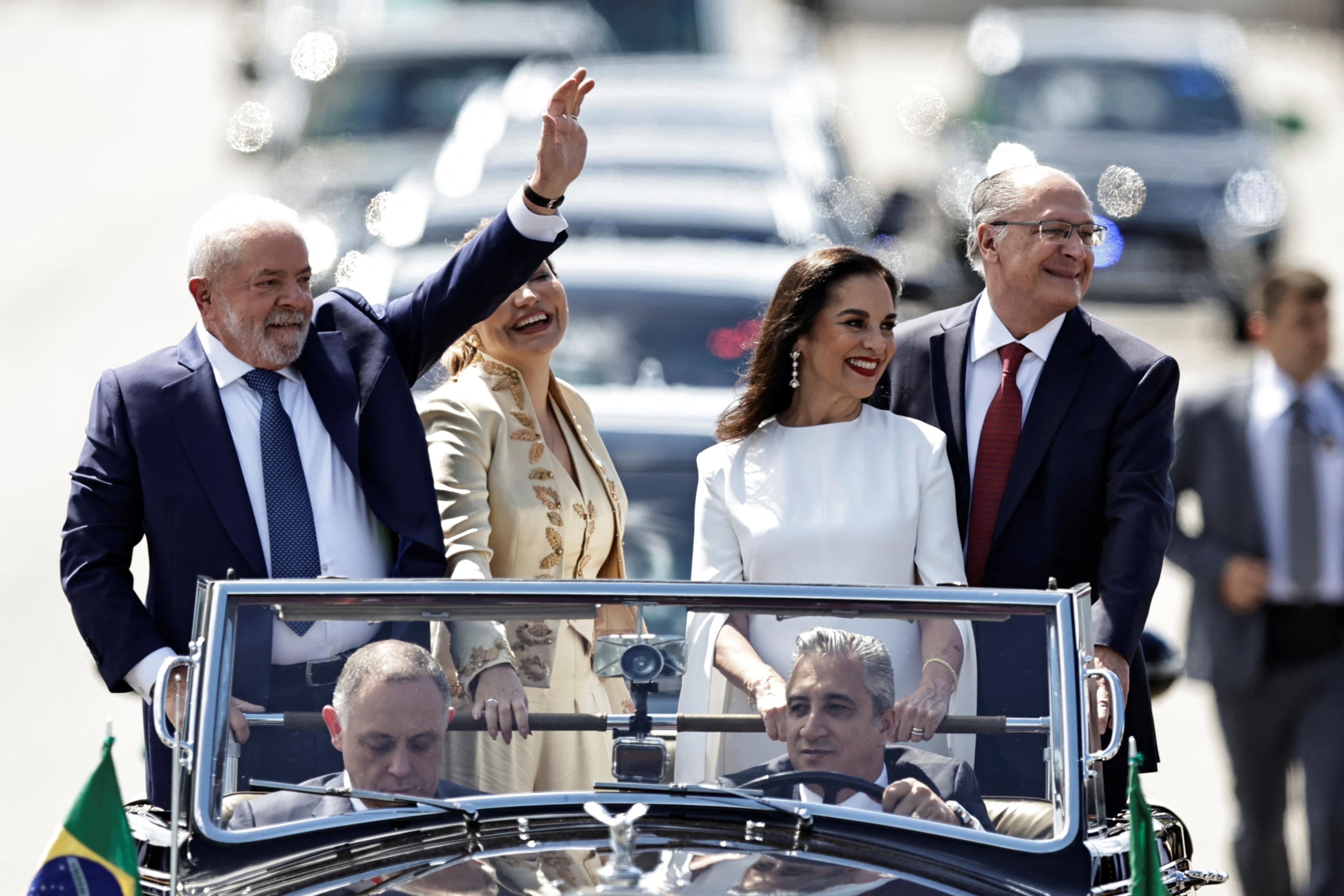
After the swearing-in, Lula left Congress in an open-top Rolls-Royce. He then arrived at the Planalto palace, where he walked up its ramp with a diverse group that included his wife, Chief Raoni Metuktire of the Kayapó tribe, a young Black boy and a disabled man. Lula was then handed the presidential sash – a hugely symbolic act in Brazil that Bolsonaro had repeatedly said he would never do – by a Black woman.

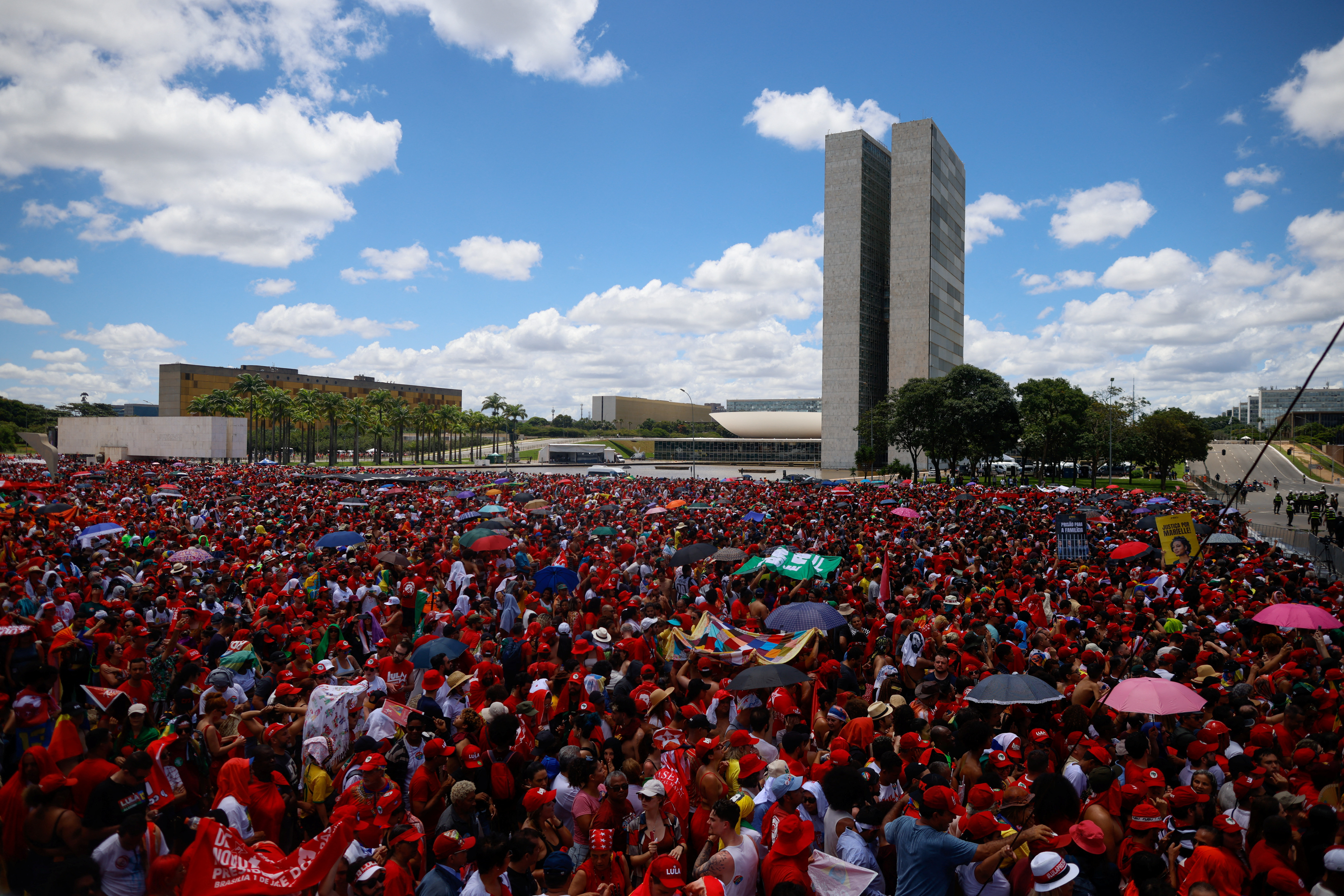

Tens of thousands who had gathered to celebrate on Brasilia’s esplanade cheered as Lula wiped away tears.

Lula’s election victory marked a stunning political comeback, winning an unprecedented third presidential term after a hiatus that saw him spend a year and a half behind bars on corruption convictions that were later overturned.

His 580 days in prison reinforced his sense of social justice and convinced him of the need to prioritize ending poverty over boosting profits, allies said. read more

In his previous years as Workers Party (PT) president from 2003-2010, the former union leader lifted millions of Brazilians from poverty during a commodity boom that buoyed the economy.

Now, he faces the daunting challenge of improving Brazil’s stagnant economy while also uniting a country that has become painfully polarized under Bolsonaro.

“A lot is expected of Lula. He’ll have the difficult mission to restore normality and predictability in Brazil, and above all to rapidly deliver results that improve the quality of life for its inhabitants,” said Creomar de Souza, director of Dharma Political Risk consultancy in Brasilia.

Related Galleries:
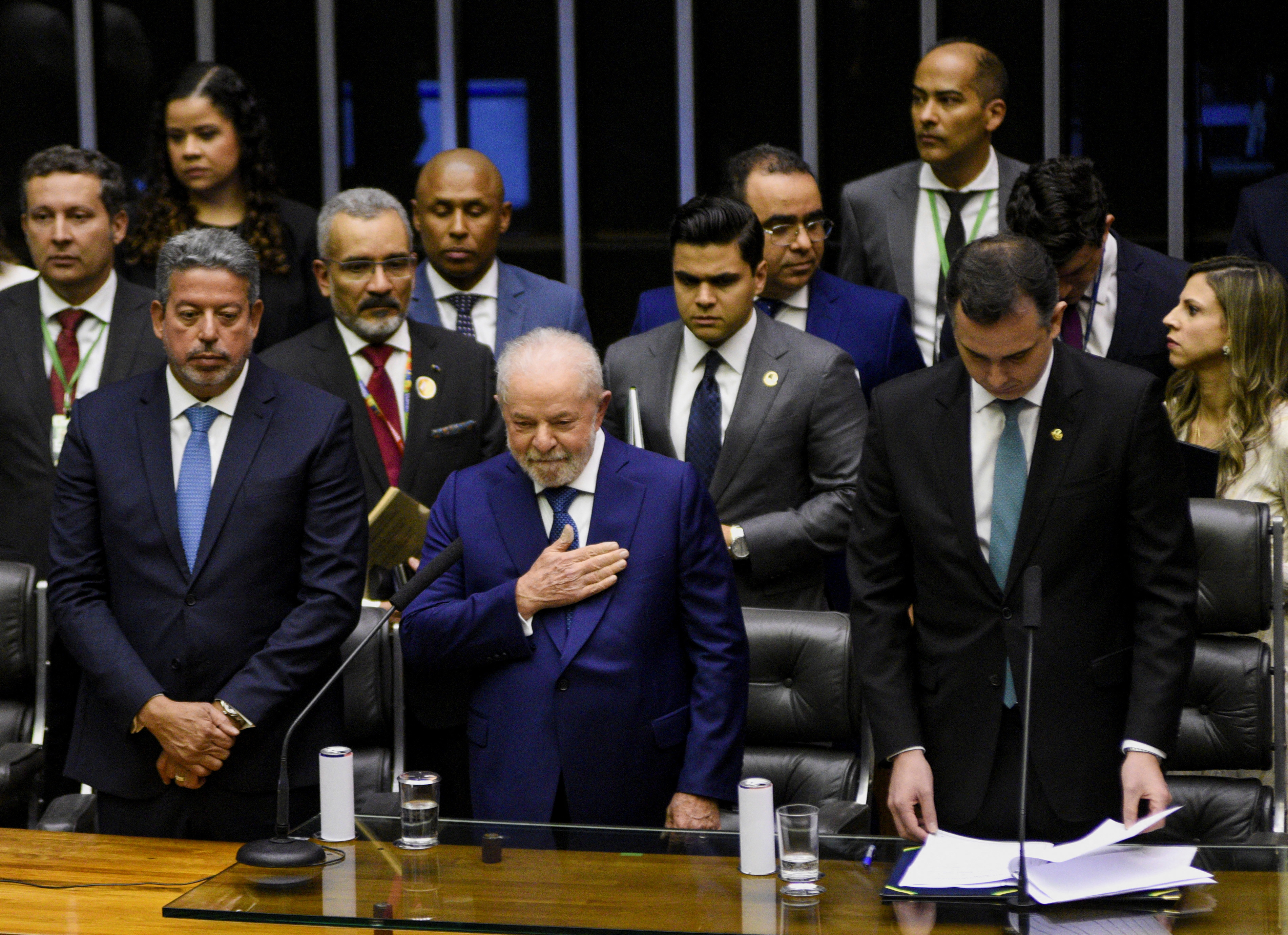
Brazil’s new President Luiz Inacio Lula da Silva gestures as he is sworn in at the National Congress, in Brasilia, Brazil, January 1, 2023. REUTERS/Jacqueline Lisboa

Rodrigo Pacheco, President of Brazil’s Federal Senate, and Arthur Lira, President of Brazil’s Chamber of Deputies, applaud after Brazil’s new President Luiz Inacio Lula da Silva was sworn in, at the National Congress, in Brasilia, Brazil, January 1, 2023. REUTERS/Jacqueline Lisboa

Rodrigo Pacheco, President of Brazil’s Federal Senate, listens as Brazil’s new President Luiz Inacio Lula da Silva delivers a speech after being sworn in at the National Congress, in Brasilia, Brazil, January 1, 2023. REUTERS/Jacqueline Lisboa NO RESALES. NO ARCHIVES

The motorcade of Brazil’s President elect Luiz Inacio Lula da Silva is seen near the Planalto Palace in Brasilia, Brazil, January 1, 2023. REUTERS/Ueslei Marcelino

Supporters of Brazil’s President elect Luiz Inacio Lula da Silva gather outside the Planalto Palace ahead of Lula’s swear-in ceremony, in Brasilia, Brazil, January 1, 2023. REUTERS/Adriano Machado

Supporters of Brazil’s President elect Luiz Inacio Lula da Silva gather outside the Planalto Palace ahead of Lula’s swear-in ceremony, in Brasilia, Brazil, January 1, 2023. REUTERS/Adriano Machado

Supporters of Brazil’s President elect Luiz Inacio Lula da Silva are sprayed with water during hot weather, as they gather outside the Planalto Palace ahead of Lula’s swear-in ceremony, in Brasilia, Brazil, January 1, 2023. REUTERS/Adriano Machado
Categories
Audio Sources - Full Text Articles

Blinken discussed U.S.-China relationship in call with China“s Qin

2023-01-01T19:59:28Z

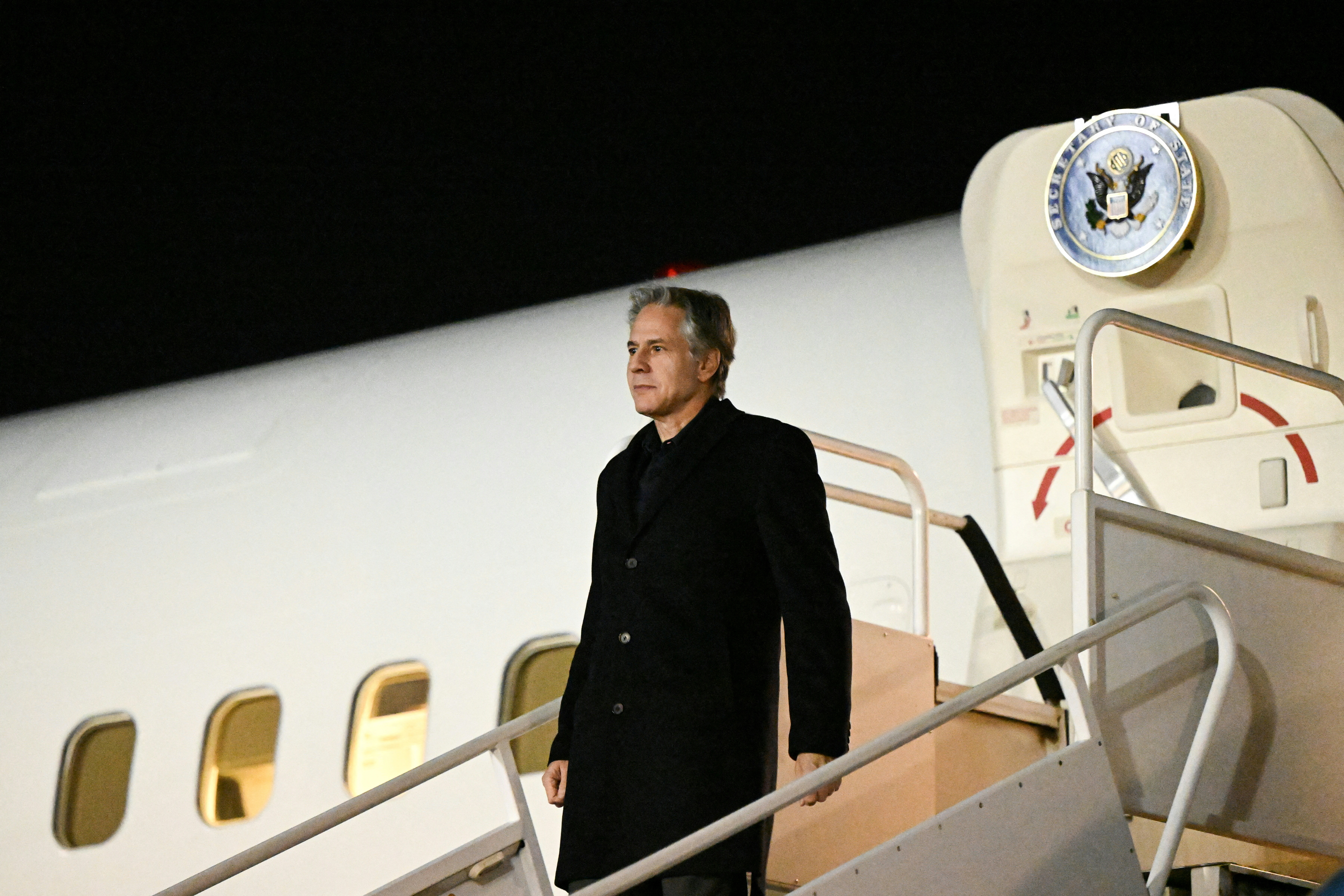
US Secretary of State Antony Blinken arrives at Henri Coanda airport, in Bucarest, Romania, on November 29, 2022, ahead of a NATO meeting. Daniel MIHAILESCU/Pool via REUTERS

U.S. Secretary of State Antony Blinken spoke with incoming Chinese Foreign Minister Qin Gang over the phone on Sunday, Blinken said on Twitter, after China last week appointed its ambassador to the United States to be its new foreign minister.

Blinken said he discussed the U.S.-China relationship and maintaining open lines of communication in his phone call with Qin.

China on Friday appointed Qin, its ambassador to the United States and a trusted aide of President Xi Jinping, to be its new foreign minister, as Beijing and Washington seek to stabilize rocky relations.

Qin, 56, replaces Wang Yi, who had been foreign minister for the past decade. Wang, 69, was promoted to the politburo of the Chinese Communist Party in October and is expected to play a bigger role in Chinese foreign policy.

Though Qin sounded optimistic about U.S.-China relations during his relatively brief, 17-month stint as ambassador in Washington – his predecessor had held the post for eight years – his tenure nonetheless coincided with deteriorating ties between the two superpowers.

Wang’s stint as foreign minister saw a sharp rise in tensions between Beijing and Washington on a wide range of issues ranging from trade to Taiwan.


Categories
Audio Sources - Full Text Articles

Global economy faces tougher year in 2023, IMF“s Georgieva warns

2023-01-01T20:00:44Z

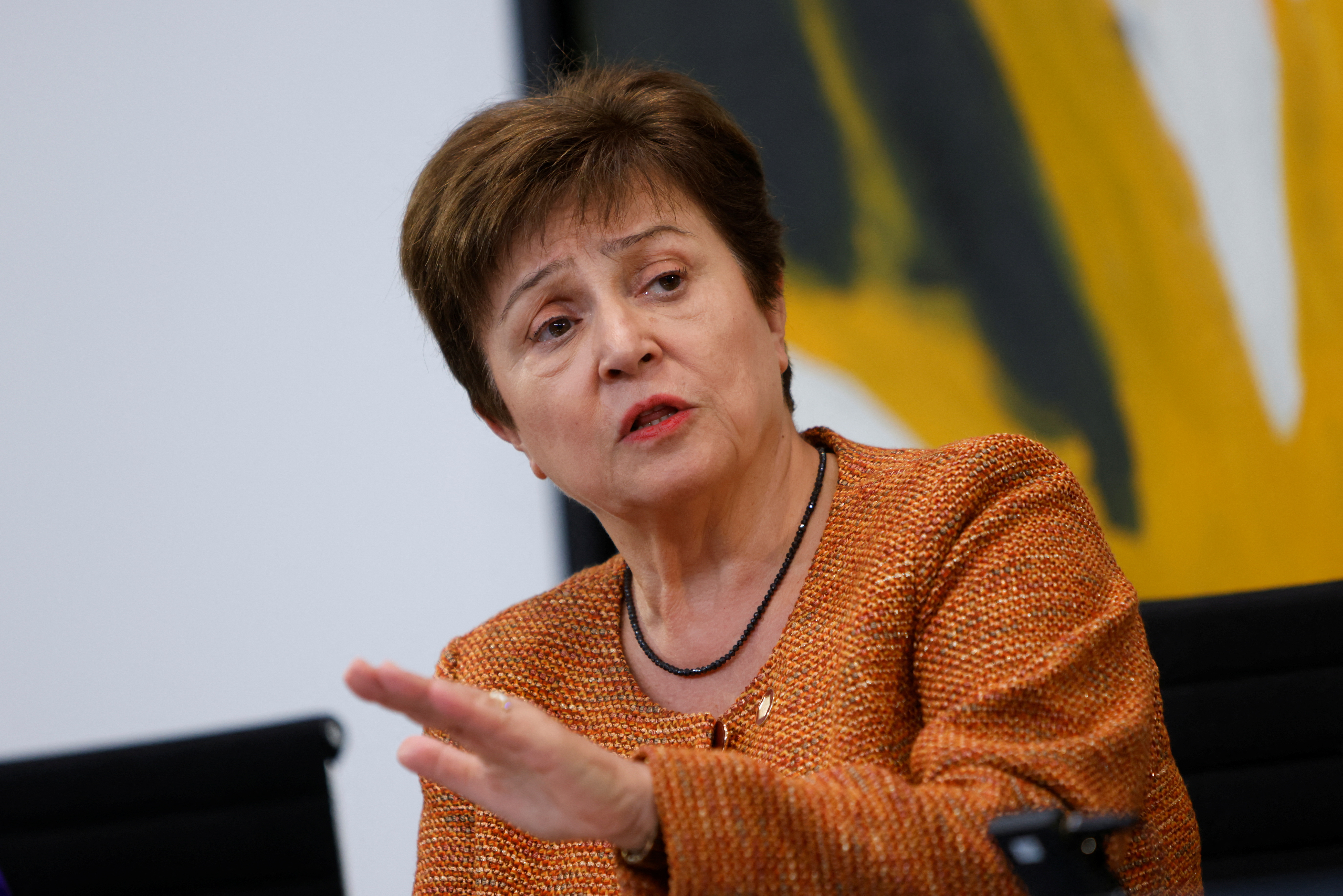
International Monetary Fund (IMF) Managing Director Kristalina Georgieva attends a news conference following a meeting at the Federal Chancellery in Berlin, Germany November 29, 2022. REUTERS/Michele Tantussi

For much of the global economy, 2023 is going to be a tough year as the main engines of global growth – the United States, Europe and China – all experience weakening activity, the head of the International Monetary Fund said on Sunday.

The new year is going to be “tougher than the year we leave behind,” IMF Managing Director Kristalina Georgieva said on the CBS Sunday morning news program “Face the Nation.”

“Why? Because the three big economies – the U.S., EU and China – are all slowing down simultaneously,” she said.

In October, the IMF cut its outlook for global economic growth in 2023, reflecting the continuing drag from the war in Ukraine as well as inflation pressures and the high interest rates engineered by central banks like the U.S. Federal Reserve aimed at bringing those price pressures to heel.

Since then, China has scrapped its zero-COVID policy and embarked on a chaotic reopening of its economy, though consumers there remain wary as coronavirus cases surge. In his first public comments since the change in policy, President Xi Jinping on Saturday called in a New Year’s address for more effort and unity as China enters a “new phase.”

“For the first time in 40 years, China’s growth in 2022 is likely to be at or below global growth,” Georgieva said.

Moreover, a “bushfire” of expected COVID infections there in the months ahead are likely to further hit its economy this year and drag on both regional and global growth, said Georgieva, who traveled to China on IMF business late last month.

“I was in China last week, in a bubble in a city where there is zero COVID,” she said. “But that is not going to last once people start traveling.”

“For the next couple of months, it would be tough for China, and the impact on Chinese growth would be negative, the impact on the region will be negative, the impact on global growth will be negative,” she said.

In October’s forecast, the IMF pegged Chinese gross domestic product growth last year at 3.2% – on par with the fund’s global outlook for 2022. At that time, it also saw annual growth in China accelerating in 2023 to 4.4% while global activity slowed further.

Her comments, however, suggest another cut to both the China and global growth outlooks may be in the offing later this month when the IMF typically unveils updated forecasts during the World Economic Forum in Davos, Switzerland.

Meanwhile, Georgieva said, the U.S. economy is standing apart and may avoid the outright contraction that is likely to afflict as much as a third of the world’s economies.

The “U.S. is most resilient,” she said, and it “may avoid recession. We see the labor market remaining quite strong.”

But that fact on its own presents a risk because it may hamper the progress the Fed needs to make in bringing U.S. inflation back to its targeted level from the highest levels in four decades touched last year. Inflation showed signs of having passed its peak as 2022 ended, but by the Fed’s preferred measure, it remains nearly three times its 2% target.

“This is … a mixed blessing because if the labor market is very strong, the Fed may have to keep interest rates tighter for longer to bring inflation down,” Georgieva said.

Last year, in the most aggressive policy tightening since the early 1980s, the Fed lifted its benchmark policy rate from near zero in March to the current range of 4.25% to 4.50%, and Fed officials last month projected it will breach the 5% mark in 2023, a level not seen since 2007.

Indeed, the U.S. job market will be a central focus for Fed officials who would like to see demand for labor slacken to help undercut price pressures. The first week of the new year brings a raft of key data on the employment front, including Friday’s monthly nonfarm payrolls report, which is expected to show the U.S. economy minted another 200,000 jobs in December and the jobless rate remained at 3.7% – near the lowest since the 1960s.

Read more:

US STOCKS-Wall St ends 2022 with biggest annual drop since 2008

GRAPHIC-How 2022 shocked, rocked and rolled global markets

Categories
Audio Sources - Full Text Articles

President Biden’s big push on federal judges

Help support Palmer Report! Our articles are all 100% free to read, with no forced subscriptions and nothing hidden behind paywalls. If you value our content, you’re welcome to pay for it:

Pay $5 to Palmer Report:

Pay $25 to Palmer Report:

Pay $75 to Palmer Report:


Judicial appointments have been a steady bright spot in the sky since President Joe Biden took office on January 20, 2021. Together with a Senate under Democratic control, Biden has maintained a pipeline of fresh faces bringing a high level of quality and diversity to the federal bench. As 2022 ends, it’s heartening to reflect on the remarkable progress as well as what lies ahead.

To date, Biden has nominated 142 federal judges. Of these, 97 judges with lifetime tenure have been confirmed, including Supreme Court Justice Ketanji Brown Jackson, 28 circuit court judges, and 68 district court judges. This figure surpasses President Barack Obama’s and Donald Trump’s confirmed judges, at 62 and 85, respectively, at the same point in their presidencies.

—

Click here to support Palmer Report! Our articles are all 100% free to read, with no forced subscriptions and nothing hidden behind paywalls. If you value our content, you’re welcome to pay for it:

Pay $5 to Palmer Report:

Pay $25 to Palmer Report:

—

Sign up for the Palmer Report mailing list

—

Follow Palmer Report on Facebook • Twitter • Post • Mastodon

—


One reason for the quick pace of progress is the procedural rule changes that Republicans put in place that stopped allowing senators to object to nominees in their states with “blue slips” and shortened post-cloture debate time over nominees from 30 hours to only two. Although the Democrats will no longer control the House of Representatives, holding the Senate is what matters for confirming judicial nominations. Plus, gaining an additional seat (creating a 51-49 majority) means contested nominees won’t have trouble clearing certain procedural hurdles with a deadlocked committee.


With each new judicial nomination announcement, the White House has pointed out how the nominees will help the federal bench better reflect America’s diversity. Since Biden’s inauguration, three out of every four judges confirmed by the Senate have been women and two-thirds were people of color. In addition, a record 11 former public defenders have been named to the circuit courts.

As Senate Majority Leader Chuck Schumer tweeted on Thursday, “Historic—This Senate Democratic Majority confirmed 97 diverse, well-qualified federal judicial nominees. And we will keep going!” Indeed, they will, because that’s what happens when we all stand up to defeatism and make sure to vote. Through our small contributions, we collectively change the world.

Support Palmer Report! Our articles are all 100% free to read, with no forced subscriptions and nothing hidden behind paywalls. If you value our content, you’re welcome to pay for it:

Pay $5 to Palmer Report:

Pay $25 to Palmer Report:

Pay $75 to Palmer Report:

Write for the Palmer Report Community Section.

Help support Palmer Report! Our articles are all 100% free to read, with no forced subscriptions and nothing hidden behind paywalls. If you value our content, you’re welcome to pay for it:

Pay $5 to Palmer Report:

Pay $25 to Palmer Report:

Pay $75 to Palmer Report:

The post President Biden’s big push on federal judges appeared first on Palmer Report.

Categories
Audio Sources - Full Text Articles

Classmate: Accused Idaho killer got ‘chatty’ after students’ deaths

(NewsNation) — A classmate who knew the alleged Idaho killer said Bryan Kohberger’s behavior changed noticeably in the days after the deaths of the four college students.

In an exclusive, 22-minute interview with NewsNation, graduate student Benjamin Roberts said he remembered Kohberger as typically being stressed and exhausted.

“I did notice he was showing up to class a little late sometimes, he always had a coffee in hand, he always seemed to be just perpetually exhausted,” said Roberts, who was also a graduate student studying criminal justice at Washington State University.

“Bryan seemed like he was on the knife’s edge between exhaustion and worn out and at the time it was extremely difficult to tell which was which,” Roberts said.

However, after the deaths of Kaylee Goncalves, Madison Mogen, Xana Kernodle and Ethan Chapin, Roberts said Kohberger became chattier and more social.

“He did seem to get a little chattier going into the later parts of the term,” Roberts said.

The full interview with Roberts will air tonight on NewsNation Prime at 6 p.m. Central/7 p.m. Eastern. Find NewsNation on your cable or satellite provider by using our Channel Finder.

Roberts said the kind of stress and exhaustion he typically saw in Kohberger can be typical for grad students. It didn’t raise any red flags because he said Kohberger didn’t appear to be falling apart in other ways.

The WSU campus in Pullman, Washington is just a 15-minute drive from Moscow, Idaho and Roberts said he and others made the short drive between the communities for many reasons. Authorities seized a computer and other evidence from Kohberger’s apartment on Friday after his arrest.

Overall, Roberts described Kohberger as awkward. He said he was the kind of person who wanted to make sure everyone knew he was the smartest person in the room.

“He had to make absolutely sure you knew he was smart, he had this intellectual capacity,” Roberts said.

Roberts doesn’t recall Kohberger talking specifically about the Idaho case.

Roberts said he pulled back from Kohberger then, too busy with his own workload for more socializing. He said it’s been unnerving to have a crime like that committed so close to his school and to have someone he was in class with be the alleged killer.

“There’s something heavy about that,” he said.

Categories
Audio Sources - Full Text Articles

13-year-old boy twice comes under enemy fire in Kherson region

630_360_1654768443-794.jpg

A boy, 13, has 2 times come below enemy fireplace in the Kherson location. At initially, he was hurt in Russia’s shelling of the village of Naddniprianske, and the 2nd time was as he was taken to intensive treatment in children’s clinic.

The pertinent assertion was designed by Kherson Regional Military services Administration Head Yaroslav Yanushevych on Telegram, an Ukrinform correspondent reviews.

“Yaroslav, 13. This boy 2 times came under rashists’ fire in the course of the New Year holiday seasons,” Yanushevych wrote.

On December 31, 2022, Russian troops attacked the village of Naddniprianske, which is located not far from the metropolis of Kherson. Yaroslav and his sister had been returning residence and came less than enemy fire. The boy was taken to hospital in critical ailment.

On January 1, 2023, Russian invaders struck Kherson Regional Children’s Clinical Healthcare facility. At that second, Yaroslav was at the intensive care unit, and windows have been blown out there.

The boy was evacuated to the city of Mykolaiv, the place medical doctors carry on battling for his daily life.

mk

Source link

The post 13-year-old boy twice comes under enemy fire in Kherson region appeared first on Ukraine Intelligence.

Categories
Audio Sources - Full Text Articles

Ukraine, hit by fresh Russian missiles, faces grim New Year

KYIV, Ukraine (AP) —

Ukrainians had a grim start to 2023 on Sunday, with yet more sirens and fresh missile attacks on their territory, as the death toll from Russia’s massive New Year Eve assault across the country climbed to at least three.

Night-time shelling that battered parts of the southern city of Kherson killed one person, wounded another and blew out hundreds of windows in a children’s hospital, according to deputy presidential chief of staff Kyrylo Tymoshenko.

Meanwhile, a 22-year-old woman injured in a rocket attack in eastern Khmelnytskyi later died of her wounds, the city’s mayor Oleksandr Symchyshyn said.

Multiple blasts rocked Kyiv and other areas of Ukraine on Saturday and through the night, injuring dozens, a sign that the pace of Russia attacks had picked up. Ukrainian officials claimed Russia was now deliberately targeting civilians, seeking to create a climate of fear and dent morale.

The blasts came just 36 hours after Russia launched a barrage of missiles on Thursday to damage energy infrastructure facilities, an unusally quickened rhythm that alarmed Ukrainian officials.

First lady Olena Zelenska expressed outrage that such massive missile attacks could come just before New Year’s Eve celebrations.

“Ruining lives of others is a disgusting habit of our neighbors,” she said.

On Saturday in Kyiv, an AP photographer at the scene of the explosions saw the body of a woman as her husband and son stood nearby. Kyiv Mayor Vitali Klitschko said two schools were also damaged, including a kindergarten.

Some Ukrainians defied the danger, however, to return to the country to reunite with families for the holidays.

Categories
Audio Sources - Full Text Articles

Here’s why astronauts age slower than the rest of us here on Earth

astronaut in spacesuit on spacewalk above earthAstronaut Matthias Maurer of ESA (European Space Agency) is pictured on the International Space Station’s truss structure during a spacewalk on March 23, 2022.

NASA

  • Time can appear to move faster or slower to us relative to others in a different part of space-time. 
  • That means astronauts on the International Space Station get to age just a tiny bit slower than people on Earth.
  • Astronauts on long missions “may be vulnerable to unique stressors that can impact human aging,” a study found.

Time feels like one of the only constants in life — it passes day after day at the same pace.

Then Albert Einstein had to go and ruin that for us.

We’ve all heard the phrase that “time is relative,” but it can be difficult to wrap the mind around what that actually means.

The phrase came from Einstein’s Theory of Relativity that joined space and time and created the idea of a fabric that permeates the whole universe: “space-time.”

We all measure our experience in space-time differently. That’s because space-time isn’t flat — it’s curved, and it can be warped by matter and energy.

So depending on our position and speed, time can appear to move faster or slower to us relative to others in a different part of space-time. And for astronauts on the International Space Station, that means they get to age just a tiny bit slower than people on Earth. 

That’s because of time-dilation effects. First, time appears to move slower near massive objects because the object’s gravitational force bends space-time.

curved space time

Public Domain

The phenomenon is called “gravitational time dilation.” In a nutshell it just means time moves slower as gravity increases.

That’s why time passes slower for objects closer to the center of the Earth where the gravity is stronger.

That doesn’t mean you could spend your life in a basement, just to outlive the rest of us here on the surface. The effect isn’t noticeable on such a small scale. If you became a basement hermit, then across your entire lifetime you’d only age a fraction of a second slower than everyone else above ground.

But this concept gets pretty crazy when you start thinking about it:

  • A watch strapped to your ankle will eventually fall behind one strapped to your wrist.
  • Your head technically ages more quickly than your feet.
  • Time passes faster for people living on a mountain than those living at sea level.

Time gets even weirder though.

The second factor is something called “relative velocity time dilation” where time moves slower as you move faster.

The classic example of this is the twin scenario. One twin blasts off in a spaceship traveling close to the speed of light, and one twin stays behind on Earth. When the space-traveling twin returns to Earth, she’s only aged a couple years, but she’s shocked to find that her Earth-bound sister has aged over a decade.

Of course no one has performed that experiment in real life, but there’s evidence that it’s real. When scientists launched an atomic clock into orbit and back — while keeping an identical clock here on Earth — it returned running ever so slightly behind the Earth-bound clock.

Then time gets even more complicated because gravitational time dilation and relative velocity time dilation can happen at the same time. A good way to think about it is to consider the astronauts living on the International Space Station.

Currently, an international crew of seven live and work aboard the ISS, orbiting Earth about every 90 minutes, according to NASA.

They’re floating about 260 miles above, where Earth’s gravitational pull is weaker than it is at the surface. That means time should speed up for them relative to people on the ground. But the space station is also whizzing around Earth at about nearly five miles per second.

That means time should also slow down for the astronauts relative to people on the surface.

You’d think that might even out, but actually their velocity time dilation has a bigger effect than their gravitational time dilation, so astronauts end up aging slower than people on Earth.

The difference isn’t noticeable though — after spending six months on the ISS, astronauts have aged about 0.005 seconds less than the rest of us.

That means that when former NASA astronaut Scott Kelly returned home in 2016 from his history-making, year-long stay on the ISS, he technically was 0.01 second younger than his twin astronaut brother — and now US senator — Mark Kelly who stayed on Earth.

So the next time you find yourself wishing the weekend would last longer, stay low to the ground and move really fast. It won’t feel like your weekend got any longer, but technically you may gain a teeny, tiny fraction of a fraction of a second.

Remember, time is relative.

Read the original article on Business Insider
Categories
Audio Sources - Full Text Articles

Five ways to prepare for an uncertain 2023 economy

(The Hill) – For the U.S. economy, 2022 was a wild and somewhat painful year. And 2023 could be even more intense.

A year of stubbornly high inflation, rapid interest rate hikes and war-driven energy shock have weakened the U.S. economy. While the job market remains remarkably strong, many economists say the U.S. is likely to slip into a recession at some point next year.

And even if the nation avoids a recession, Americans will still contend with higher prices, high-interest rates and the unknown impacts of the Fed’s fight against inflation. Political standoffs over government funding, entitlement programs and the federal debt limit also risk tipping the economy into more pain.

Plan for high inflation

Inflation has slowed significantly after peaking this summer at four-decade highs, bringing some minor relief to cash-strapped shoppers. Easing supply chain issues, slower consumer spending and lower fuel costs should help make some goods more affordable next year than last, all while the strong US dollar helps make imports cheaper.

Even so, prices still rose 7.1 percent annually as of November, according to the consumer price index (CPI), an inflation rate well above pre-pandemic norms.

Economists at Goldman Sachs expect prices for goods to fall from current levels next year enough to achieve a negative inflation rate, thanks largely to “more moderate commodity price inflation, falling transportation costs, and downward pressure on import prices,” they wrote in a Monday analysis.

But prices for many services — especially housing and health care — are likely to keep rising after skyrocketing through much of last year, they said.

“We expect a more limited decline on the services side, with core services [inflation] from 5 percent to a still high 4.5 percent by December 2023,” the Goldman Sachs economists wrote.

Federal Reserve Chair Jerome Powell has also warned that the U.S. is far off from price stability and even slower inflation in 2023 will still be hard for many households to stomach.

“There’s an expectation that the services inflation will not move down so quickly, so that we’ll have to stay at it,” Powell said during a press conference earlier this month.

“We may have to raise rates higher to get to where we want to go.”

Brace for higher interest rates

Even if inflation keeps falling, the Fed has made clear it won’t stop hiking interest rates in the beginning of next year and plans to keep them high for the foreseeable future.

Fed officials expect to hike their baseline interest rate range up to a span of 5 to 5.25 percent by the end of 2023, up from the current range of 4.25 to 4.5 set earlier this month, according to their latest projections. They also don’t expect to cut rates until 2024, though a steep recession could force the Fed to change plans.

“We are doubtful that the goods-driven decline in inflation that we expect in 2023 would be sufficient to give the [Fed] confidence that inflation is moving down in a sustained way, which Powell has said is the criterion for cutting,” economists at Goldman Sachs explained.

“But more than that, we remain skeptical that the [Fed] will cut just for the sake of returning to neutral,” they wrote. 

Job security can be valuable in a recession

A historically strong job market has helped the U.S. economy power through high inflation and defy previous predictions of a slowdown. It has also allowed millions of employed Americans to find new jobs, often with better pay or career opportunities, thanks to a glut of job openings and much smaller workforce. 

Economists are increasingly fearful a recession could force thousands — if not millions — of Americans out of their jobs next year. The Fed has projected the jobless rate to rise to 4.6 percent by the end of 2023 as the economy slows under higher interest rates intended to make it weaker.

“Though the economy has not yet suffered a recession, growth has sharply slowed and is weaker than the third-quarter data suggest,” Scott Hoyt, Moody’s Analytics senior director, wrote in an analysis last week.

If the U.S. hits a recession in 2023, recent hires without seniority could find themselves among the first to be laid off. Firms in industries that are hit hard by high interest rates may also face financial pressure, which could threaten jobs in sectors such as technology and real estate. 

“I don’t think anyone knows whether we’re going to have a recession or not and, if we do, whether it’s going to be a deep one or not. It’s just, it’s not knowable,” Powell said.

Don’t expect the stock market to roar back

Stocks are set to close 2022 with steep losses after setting new record highs toward the end of last year. The Dow Jones Industrial Average is down roughly 9 percent since the start of 2022, while the Nasdaq composite and S&P 500 index have plunged 35 percent lower and 20 percent lower, respectively, over the past 12 months.

The persistence of high inflation, the outbreak of the war in Ukraine and the upward climb of interest rates sapped confidence from the market and momentum from stocks after posting double-digit percentage gains throughout the pandemic.

While 2023 may be calmer, many investment experts see the market bouncing somewhere in between the record highs set in 2021 and the nadir of the past year’s selloff.

“Even in relatively calm years, the market still experiences some ups and downs. For 2023, hopefully, the market’s inevitable waves will prove to be manageable. But I believe we need to brace for the possibility that they will be more treacherous,” Jurrien Timmer, director of global macro for Fidelity Management and Research.

Wall Street will be fixated on when the Fed plans to stop hiking rates and whether the economy will weaken enough to force them to the Fed to curtail its strategy. Fights over government funding and the debt ceiling will also shake confidence among investors, particularly if the U.S. gets close to a potentially catastrophic default on the national debt.

Categories
Audio Sources - Full Text Articles

Kohberger ‘eager to be exonerated’ of Idaho stabbing charges

(NewsNation) — Bryan Kohberger, accused of fatally stabbing four University of Idaho students, will not fight his extradition back to Idaho, according to his public defender, who also said Kohberger is “eager to be exonerated of these charges.”

“Mr. Kohberger has been accused of very serious crimes, but the American justice system cloaks him in a veil of innocence,” Jason LaBar, the chief public defender for Monroe County, Pennsylvania, said in a statement. “He should be presumed innocent until proven otherwise — not tried in the court of public opinion.”

Latah County, Idaho, prosecutor Bill Thompson said the factual basis for Kohberger’s charges is laid out in the probable cause affidavit, which under state law must remain sealed until Kohberger is extradited to Latah County and officially served the warrant.

Sources confirmed to NewsNation that Kohberger was on suicide watch in the Pennsylvania jail where he was being held and had asked officers at one point whether anyone else was arrested. Sources said Kohberger had a “quiet, blank stare” throughout the process.

I am told when Idaho quadruple homicide suspect Bryan Christopher Kohberger was in custody — he “asked if anyone else was arrested.”
I’m told he had a “quiet, blank stare.”

— Brian Entin (@BrianEntin) December 30, 2022

Kohberger was getting his Ph.D. in criminal justice at Washington State University in Pullman, Washington, which is about a 15-minute drive from Moscow, where the killings happened.

Before moving to Washington, he grew up and studied in Pennsylvania, where he got his bachelor’s degree in psychology at DeSales University in 2020, followed by a master’s degree from its criminal justice program. A spokeswoman for the school said they are devastated by the senseless tragedy.

One of the professors who reportedly taught Kohberger at DeSales is a world-renowned professor of forensic psychology. Katherine Ramsland has appeared in more than 200 crime documentaries and written almost 70 books, including “The Psychology of Death Investigations” and “The Mind of a murderer,” and she even worked with the BTK serial killer, Dennis Radder, on his autobiography, according to the university website.

“(H)ave I come face to face with psychopaths? Absolutely.” Ramsland said on the “Coptales and Cocktails” podcast in April.

Lehigh Valley News said Ramsland confirmed to them that Kohberger was a student of hers. She told NewsNation, “I cannot make media statements about him at this time.”

NewsNation has obtained this photo of Kohberger taken during a group project at DeSales University in 2019.

Students who studied with him told NewsNation they’ve been told to talk only to police because they could potentially be called as character witnesses in the case. They did say he was “controlling” during the project.

Kohberger had no recorded criminal history. His court date is set for Tuesday in Monroe County. If he does follow through and waive his extradition hearing, he will likely be on his way to Idaho sometime next week.

Moscow Police Chief James Fry said Friday during a news conference that his department had combed through 19,000 tips and interviewed 300 people over the course of their investigation. Investigators have not released any official information about the suspect’s motive or connection to the victims, and as of Friday, the murder weapon had not been located, according to Moscow police.

The four university students found dead on Nov. 13 were 21-year-old Kaylee Goncalves; Madison Mogen, 21; Xana Kernodle, 20; and 20-year-old Ethan Chapin.

WP Radio
WP Radio
OFFLINE LIVE