Categories
Audio Sources - Full Text Articles

India hikes spending, shuns “outright populism“ in last pre-election budget

2023-02-01T13:17:58Z

India announced on Wednesday one of its biggest ever increases in capital spending for the next fiscal year to create jobs but targeted a narrower fiscal deficit in its last full budget ahead of a parliamentary election due in 2024.

Prime Minister Narendra Modi’s party has been under pressure to create jobs in the populous country where many have struggled to find employment, although the economy is now one of the world’s fastest-growing.

“After a subdued period of the pandemic, private investments are growing again,” Finance Minister Nirmala Sitharaman said as she presented the 2023/24 budget in parliament.

“The budget makes the need once again to ramp up the virtuous cycle of investment and job creation. Capital investment is being increased steeply for the third year in a row by 33% to 10 trillion rupees.”

The capital spending increase to about $122.3 billion, which would amount to 3.3% of gross domestic product (GDP), will be the biggest such jump after an increase of more than 37% between 2020/21 and 2021/22.

Total spending will rise 7.5% to 45.03 trillion rupees ($549.51 billion) in the next fiscal year starting on April 1.

Sitharaman said the government would target a fiscal deficit of 5.9% of GDP for 2023/24 compared with 6.4% for the current fiscal year and slightly lower than a Reuters poll of 6%. The aim is to lower the deficit to 4.5% by 2025/26.

Brokerage Nomura said the budget “prudently pushes for growth, without rocking the macro boat”.

“In the event, the government has presented a good budget. It has pushed for growth via public capex and continued on the path towards fiscal consolidation, without offering much in terms of outright populism.”

Capital Economics said the “absence of a fiscal blowout”, a recent drop in inflation and signs of moderating growth could convince India’s central bank to slow the pace of rate hikes next week.

It said there was still a chance of fiscal slippage as campaigning kicks off for the election, in which Modi is widely projected to win a third straight term.

The finance ministry’s annual Economic Survey, released on Tuesday, forecast the economy could grow 6% to 6.8% next fiscal year, down from 7% projected for the current year, while warning about the impact of cooling global demand on exports.

Sitharaman said India’s economy was “on the right track, and despite a time of challenges, heading towards a bright future”.

Her deficit plan will be aided by a 28% cut in subsidies on food, fertiliser and petroleum for the next fiscal year at 3.75 trillion rupees. The government cut spending on a key rural jobs guarantee programme to 600 billion rupees – the smallest in more than five years – from 894 billion rupees for this fiscal year.

The government’s gross market borrowing is estimated to rise about 9% to 15.43 trillion rupees next fiscal year.

Moody’s Investors Service said the narrower fiscal deficit projection pointed to the government’s commitment to longer-term fiscal sustainability, but that a “high debt burden and weak debt affordability remain key constraints that offset India’s fundamental strengths”.

Among other moves to stimulate consumption, the surcharge on annual income above 50 million rupees was cut to 25% from 37%.

Indian shares reversed earlier gains to close lower on Wednesday, led by a fall in insurance companies after the budget proposed to limit tax exemptions for insurance proceeds, while Adani Group shares tumbled again as it struggles to repel concerns raised by a U.S. short seller.

Since taking office in 2014, Modi has ramped up capital spending including on roads and energy, while wooing investors through lower tax rates and labour reforms, and offering subsidies to poor households to clinch their political support.

A lack of jobs for young people, and meagre wages for those who do find work, has been one of the main criticisms of Modi.

Sitharaman also said the government was allocating 350 billion rupees for energy transition, as Modi focuses on green hydrogen and other cleaner fuels to meet India’s climate goals.

($1 = 81.7725 Indian rupees)

Related Galleries:

Commuters travel in an overcrowded train near a railway station in Ghaziabad, on the outskirts of New Delhi, India, February 1, 2023. REUTERS/Anushree Fadnavis

India’s Finance Minister Nirmala Sitharaman holds up a folder with the Government of India’s logo as she leaves her office to present the federal budget in the parliament, in New Delhi, India, February 1, 2023. REUTERS/Adnan Abidi

India’s Finance Minister Nirmala Sitharaman holds up a folder with the Government of India’s logo as she leaves her office to present the federal budget in the parliament, in New Delhi, India, February 1, 2023. REUTERS/Adnan Abidi

India’s Finance Minister Nirmala Sitharaman holds up a folder with the Government of India’s logo as she leaves her office to present the federal budget in the parliament, in New Delhi, India, February 1, 2023. REUTERS/Adnan Abidi

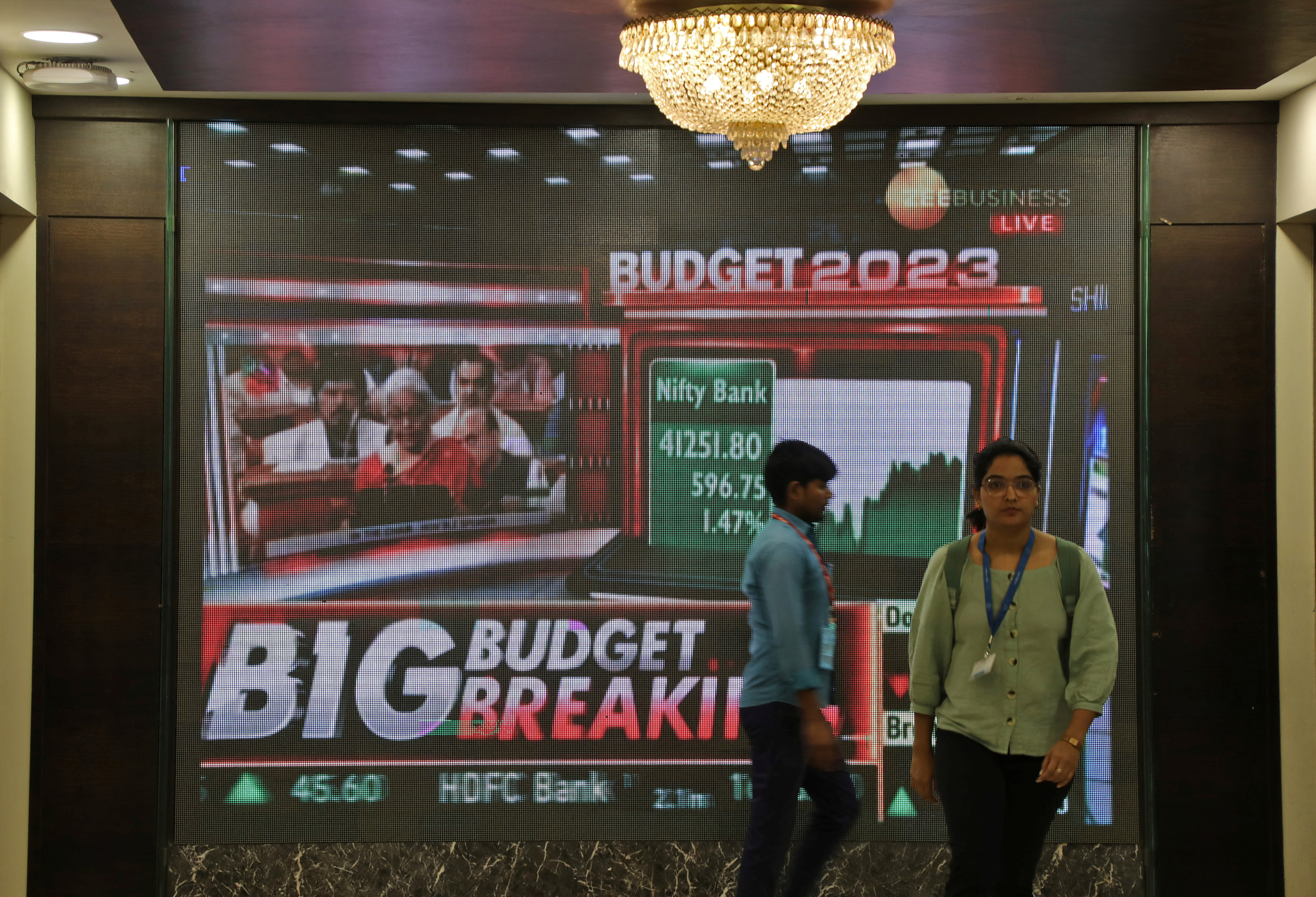
People walk past a telecast of India’s Finance Minister Nirmala Sitharaman presenting the budget, inside the Bombay Stock Exchange (BSE) building in Mumbai, India, February 1, 2023. REUTERS/Niharika Kulkarni

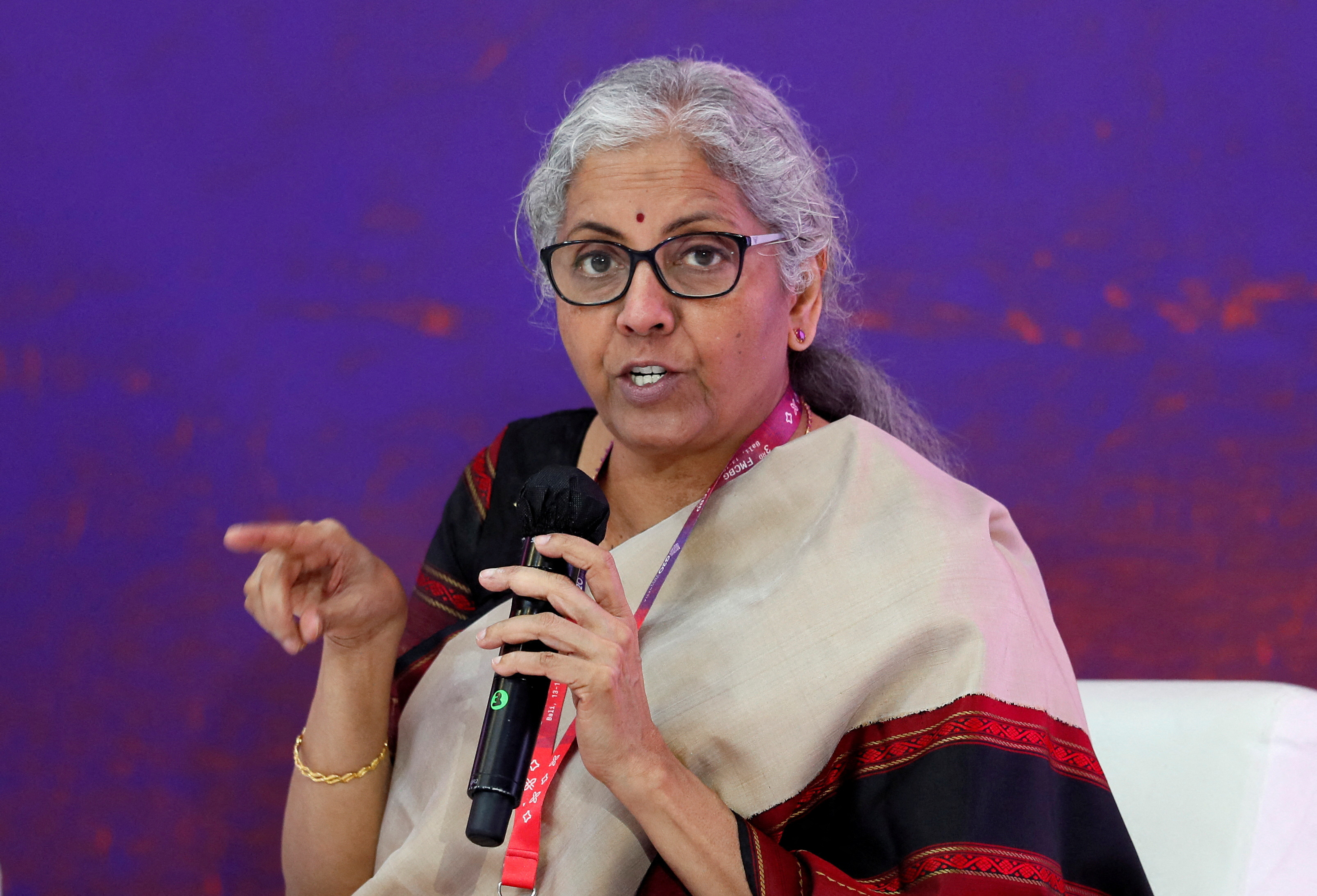
Indian Finance Minister Nirmala Sitharaman speaks during a side event on the G20 Finance Ministers and Central Bank Governors Meeting in Nusa Dua, Bali, Indonesia, 14 July 2022. Made Nagi/Pool via REUTERS/File Photo
Categories
Audio Sources - Full Text Articles

Adani loses Asia“s richest crown as stock wipeout reaches $86 billion

2023-02-01T12:59:44Z

Indian tycoon Gautam Adani lost his title of Asia’s richest person on Wednesday as a rout in his conglomerate’s biggest companies deepened to $84 billion in the wake of a short-seller report. Julian Satterthwaite reports.

Shares in Indian tycoon Gautam Adani’s conglomerate plunged again on Wednesday as a rout in his companies deepened to $86 billion in the wake of a U.S. short-seller report, with the billionaire also losing his title as Asia’s richest person.

Wednesday’s stock losses saw Adani slip to 15th on Forbes rich list with an estimated net worth of $75.1 billion, below rival Mukesh Ambani, the chairman of Reliance Industries Ltd (RELI.NS) who ranks ninth with a net worth of $83.7 billion.

Before the critical report by U.S. short-seller Hindenburg, Adani had ranked third.

The losses mark a dramatic setback for Adani, the school-dropout-turned-billionaire whose fortunes rose rapidly in recent years in line with stock values of his businesses that include ports, airports, mining, cement and power. Now, the tycoon is fighting to stabilise his companies and defend his reputation.

The share slides come just a day after the Adani Group managed to muster support from investors for a $2.5 billion share sale for flagship firm Adani Enterprises (ADEL.NS), in what some saw as a stamp of investor confidence at a time of crisis.

The report by Hindenburg Research last week alleged improper use by the group of offshore tax havens and stock manipulation. It also raised concerns about high debt and the valuations of seven listed Adani companies.

The group has denied the allegations, saying the short-seller’s narrative of stock manipulation has “no basis” and stems from an ignorance of Indian law. It has always made the necessary regulatory disclosures, it added.

Shares in Adani Enterprises, often described as the incubator of Adani businesses, plunged 28% on Wednesday, bringing its losses since the Hindenburg report to more than $18 billion. Adani Ports and Special Economic Zone (APSE.NS) dropped 19%. Both stocks marked their worst day ever.

“The kind of fall that we are seeing in Adani stocks is scary,” said Avinash Gorakshakar, head of research at Mumbai-based Profitmart Securities.

Adani Power (ADAN.NS) and Adani Wilmar (ADAW.NS) fell 5% each, and Adani Total Gas (ADAG.NS) slumped 10%, with all three falling by their daily price limits. Adani Transmission (ADAI.NS) was down 3% and Adani Green Energy (ADNA.NS) 5.6%.

Adani Total Gas, a joint venture with France’s Total (TTEF.PA), has been the biggest casualty of the short seller report, losing about $27 billion.

Dollar bonds issued by Adani entities also resumed their slide on Wednesday. The U.S. dollar-denominated bonds of Adani Ports maturing in February 2031 led the losses, falling 3.59 cents to 67.58 cents.

Underscoring the nervousness in some quarters, Bloomberg reported that Credit Suisse (CSGN.S) had stopped accepting bonds of Adani group companies as collateral for margin loans to its private banking clients.

Deven Choksey, managing director of KRChoksey Shares and Securities, said this was a big factor in Wednesday’s share slides.

Credit Suisse had no immediate comment.

After losing $86 billion in recent days – equivalent to 16% of India’s annual budget spend of $550 billion announced on Wednesday – the seven listed Adani Group entities now have a combined market capitalisation of about $131 billion.

“There was a slight bounce yesterday after the share sale went through, after seeming improbable at a point, but now the weak market sentiment has become visible again after the bombshell Hindenburg report,” said Ambareesh Baliga, a Mumbai-based independent market analyst.

“With the stocks down despite Adani’s rebuttal, it clearly shows some damage on investor sentiment. It will take a while to stabilise,” Baliga added.

Asked whether he was concerned about wider losses on India’s equity markets because of the plunge in Adani Group shares, Economic Affairs Secretary Ajay Seth said the government “does not comment on issues related to a particular company”.

India’s benchmark Nifty index has fallen 2.7% since the Hindenburg report. Data also shows that foreign investors sold a net $1.5 billion worth of Indian equities after the Hindenburg report – the biggest outflow over four consecutive days since Sept. 30.

Scrutiny of the conglomerate is stepping up, with an Australian regulator saying on Wednesday it would review Hindenburg’s allegations to see if further enquiries were warranted.

India’s markets regulator, which has been looking into deals by the conglomerate, will add Hindenburg’s report to its own preliminary investigation, sources have told Reuters. The regulator has not commented on the Adani-Hindenburg saga.

Indian credit rating agency ICRA Ltd, a unit of Moody’s Investors Service, said on Wednesday it was monitoring the impact of the developments on its rated portfolio in Adani Group. It added that while the group’s large debt-funded capital spending plan was a “key challenge”, some of it was discretionary in nature and could be deferred, depending on the liquidity position.

India’s state-run Life Insurance Corporation (LIC) (LIFI.NS)said on Monday it would seek clarifications from Adani’s management on the short seller report. LIC owned a 4.23% stake in Adani Enterprises as of end-December and more than 9% in Adani Ports and Special Economic Zone. The insurance giant was also a key investor in Adani’s recent share sale.

Shares in cement firms ACC (ACC.NS) and Ambuja Cements (ABUJ.NS), which Adani Group bought from Switzerland’s Holcim (HOLN.S) for $10.5 billion last year, fell 6.2% and 16.7%, respectively.

Hindenburg said in its report it had shorted U.S.-bonds and non-India traded derivatives of the Adani Group.

Related Galleries:

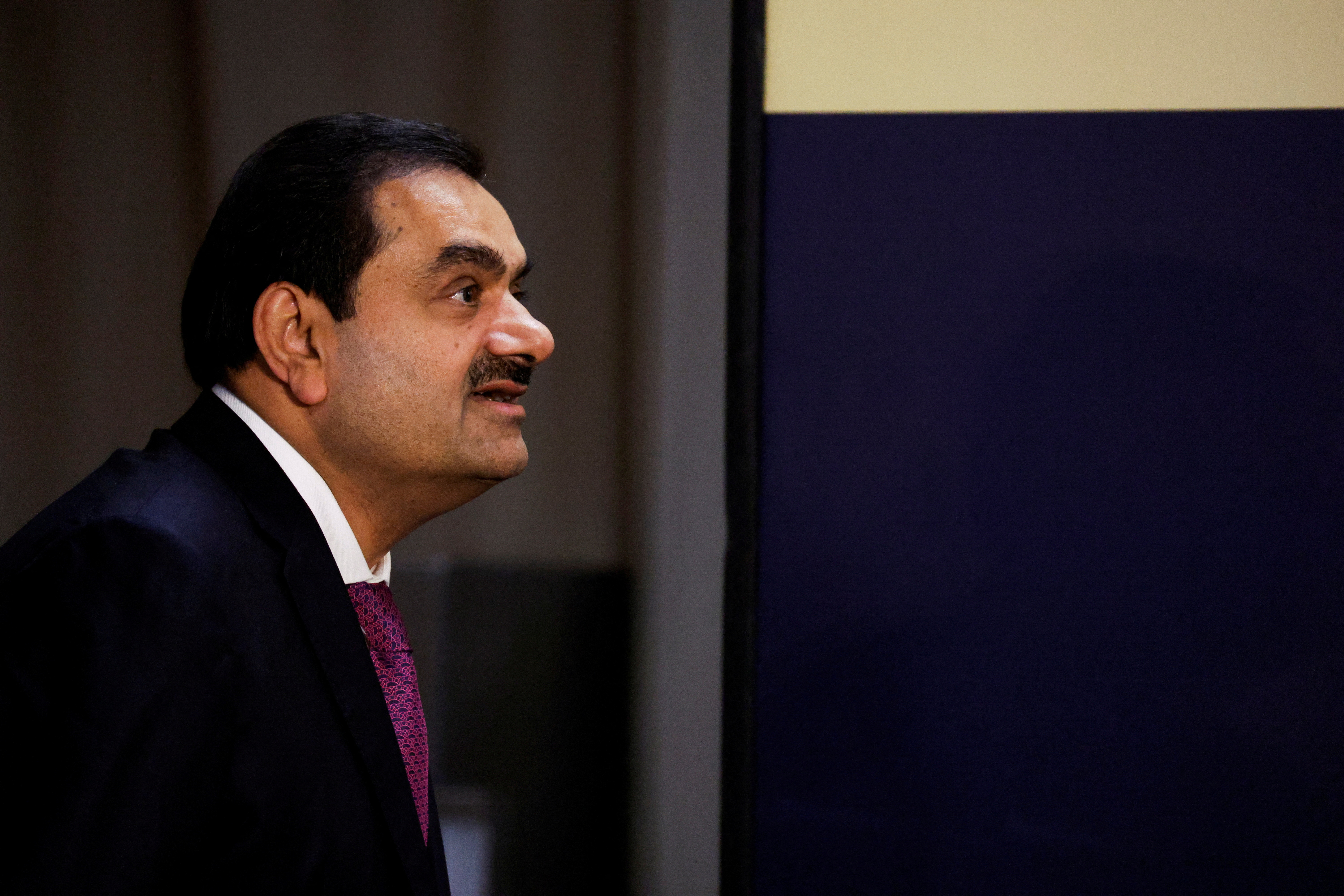
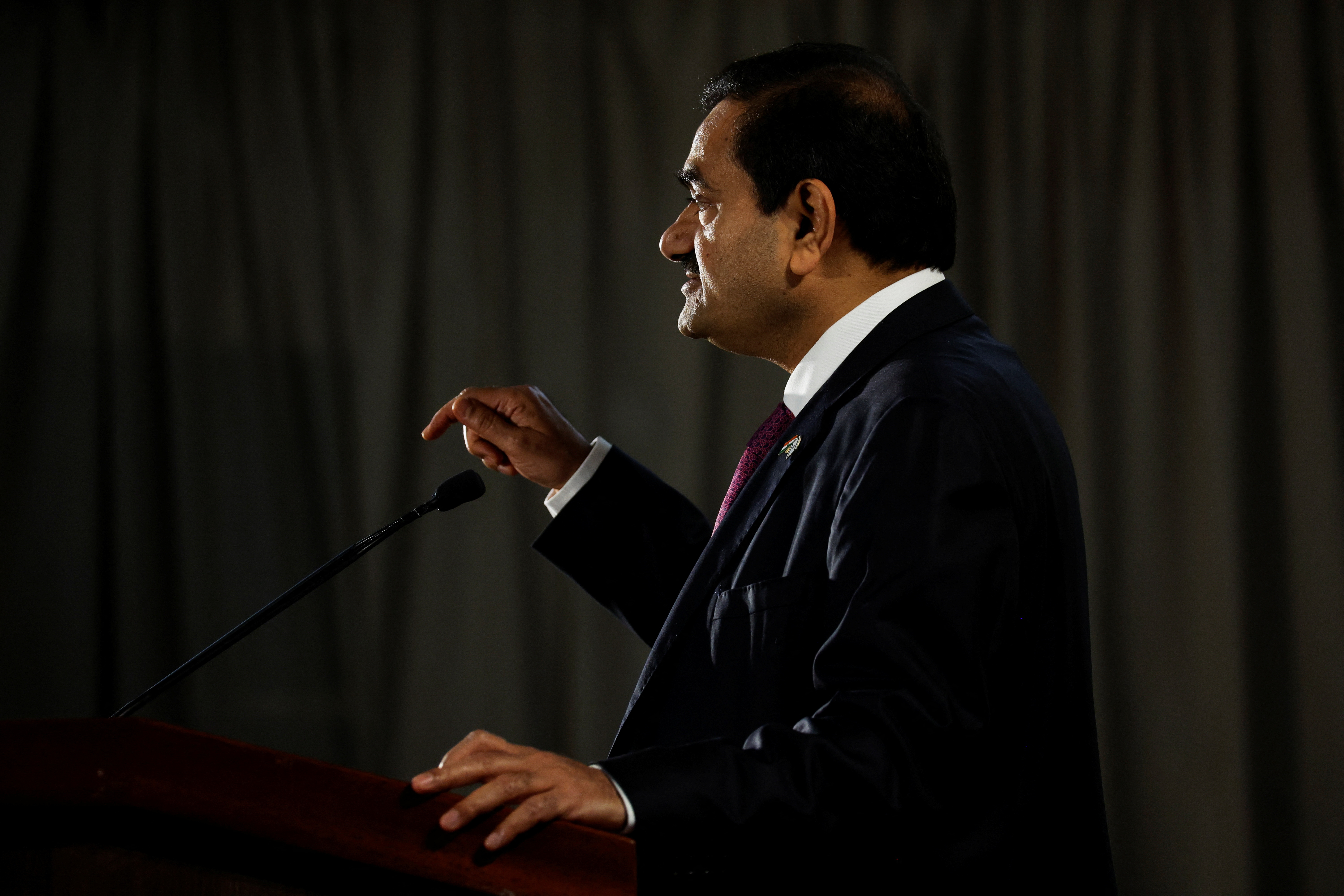
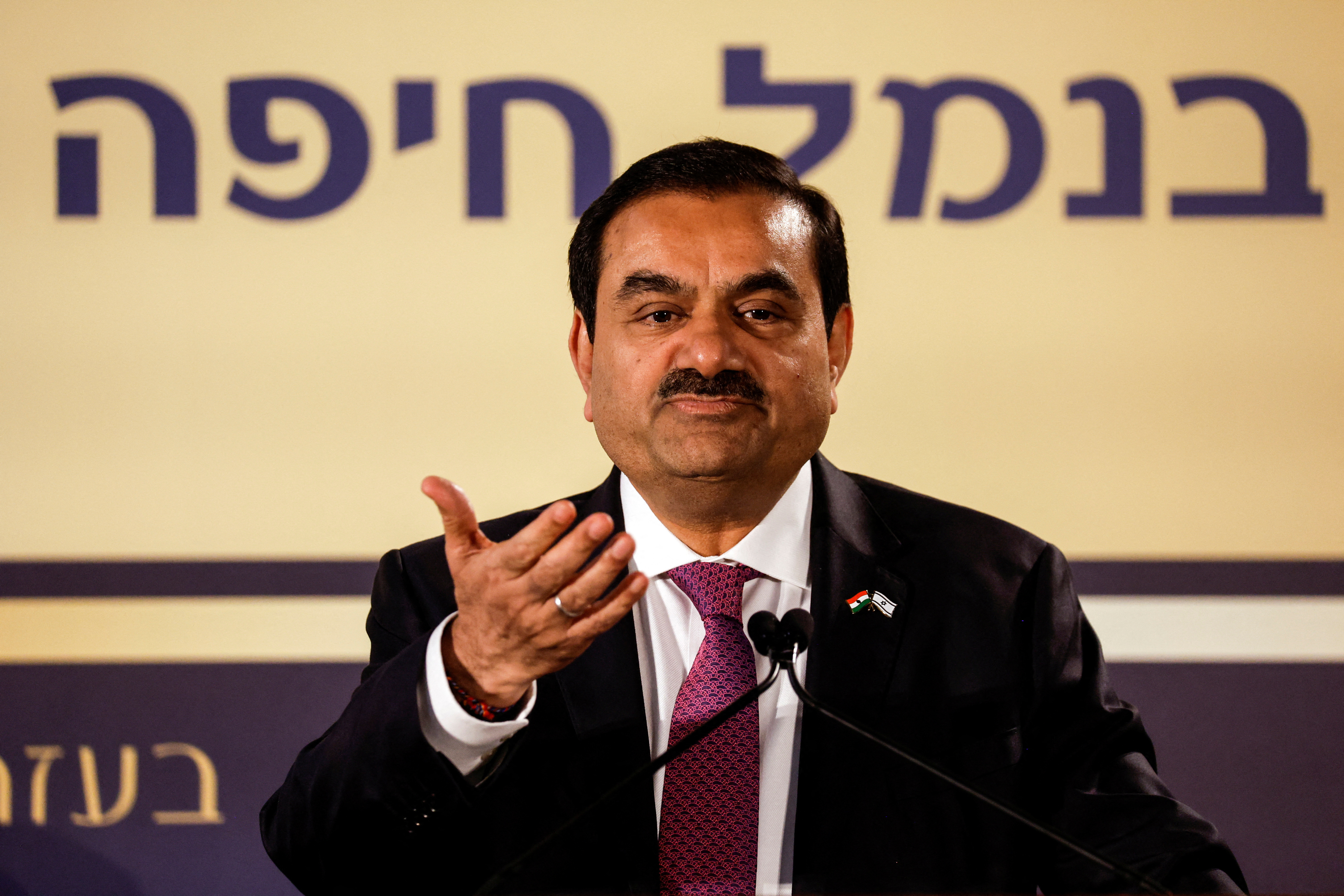
Indian billionaire Gautam Adani speaks during an inauguration ceremony after the Adani Group completed the purchase of Haifa Port in Haifa port, Israel January 31, 2023. REUTERS/Amir Cohen/File Photo

Indian billionaire Gautam Adani speaks during an inauguration ceremony after the Adani Group completed the purchase of Haifa Port earlier in January 2023, in Haifa port, Israel January 31, 2023. REUTERS/Amir Cohen

Indian billionaire Gautam Adani is seen on a screen as he addresses delegates during the Bengal Global Business Summit in Kolkata, India April 20, 2022. REUTERS/Rupak De Chowdhuri

Indian billionaire Gautam Adani speaks during an inauguration ceremony after the Adani Group completed the purchase of Haifa Port earlier in January 2023, in Haifa port, Israel January 31, 2023. REUTERS/Amir Cohen

Adani logo and decreasing stock graph is seen in this illustration taken January 31, 2023. REUTERS/Dado Ruvic/Illustration
Categories
Audio Sources - Full Text Articles

EU Sets Out Options to Compete With U.S. Green Subsidies

social

Categories
Audio Sources - Full Text Articles

Missing Radioactive Capsule Found in Australian Outback

social

Categories
Audio Sources - Full Text Articles

Court Ruling Highlights Improving South Korea-Japan Ties

social

Categories
Audio Sources - Full Text Articles

OPEC+ Ministers Set to Stay the Course Amid China Covid Woes

social

Categories
Audio Sources - Full Text Articles

Ukraine Braces for Major Russian Offensive

social

Categories
Audio Sources - Full Text Articles

EU official pushes Musk for Twitter’s progress on new rules

LONDON (AP) — A top European Union official told Elon Musk that Twitter needs to make progress in preparing for a new law aimed at curbing hate speech, misinformation and other harmful content, adding pressure on the company to ensure it complies.

EU Commissioner Thierry Breton and Musk held a video call on Tuesday to assess Twitter’s readiness for Europe’s new rules, known as the Digital Services Act, that are set to take effect later this year.

Breton, who oversees the EU’s digital policy, told Musk that he’s “vigilant” about the resources and tools that Twitter is devoting to tackle trust and safety issues across the 27-nation bloc, including in all its languages, according to a readout of the meeting.

Breton noted that Twitter has committed to complying with the new EU regulations, which will start applying to the biggest online platforms by September.

“The next few months will be crucial to transform commitments into reality,” Breton said. “We need to see progress towards full compliance with the DSA. My team will follow closely the work by Twitter and by all other online platforms.”

Musk tweeted that he had a “good meeting” with Breton. “The goals of transparency, accountability & accuracy of information are aligned with ours,” he wrote.

Breton had warned Musk in a previous call in November that the company needs to comply with Europe’s new rules.

The Digital Services Act is part of the EU’s overhaul of digital rules aimed at reining in the power of online platforms and social media companies and cleaning up toxic content. Violations could result in fines worth up to 6% of a company’s annual global revenue — amounting to billions — or even a ban on operating in the EU.

Categories
Audio Sources - Full Text Articles

Why Your Twitter Feed Is Full of People You Don’t Follow

If you’ve signed into Twitter in the last month or so, you may have noticed that your newsfeed feels a little different.

You’re probably seeing lots more tweets from accounts you don’t follow. Some of those might be tweets that people in your network have “liked.” Others might be those Twitter says are “based on your likes.” What you’re probably seeing far fewer of are tweets from accounts that you, you know, actually chose to follow yourself.

This is Twitter’s new “For You” page, a name lifted from TikTok, which signifies the same thing it does on the short form video app: a feed of posts that some opaque algorithm, somewhere, decides you might enjoy.

[time-brightcove not-tgx=”true”]

It is possible to toggle back onto a newsfeed that predominantly shows accounts you follow, but this feed is reverse chronological, meaning it shows you the newest tweets first. Twitter’s old default, showing you tweets from accounts you follow with a bias for the ones dominating the conversation in your network that day, is nowhere to be seen. (While that algorithm would occasionally surface new tweets it thought you may like, these were fewer and further between than Twitter’s new For You page.)

Three months into Elon Musk’s ownership of Twitter, the platform appears to be experimenting with new ways to boost user numbers and engagement. In a pitch last year to investors who funded his acquisition, Musk reportedly promised to increase Twitter’s revenue five-fold. But on the surface, with an exodus of advertisers and a lackluster subscription offering, Twitter’s financial situation appears little better than it was before Musk’s acquisition of the company. A change to Twitter’s fundamental newsfeed algorithm might be Musk’s latest roll of the dice. The short-form video app TikTok’s recommendation algorithm is famous for its addictive properties; if Twitter can do the same for tweets, it would mean more eyeballs on ads and more dollars in the bank.

The addition of the For You page marks perhaps the most significant change to Twitter’s platform dynamic in years. It’s already having an impact on how users interact with the platform, and with each other. And in classic Twitter fashion, the For You page has birthed a new breed of Twitter celebrity, too: the menswear guy.

Starting around ten days ago, this California-based fashion writer (whose real name, coincidentally, is Derek Guy,) began appearing in the feeds of thousands, perhaps millions, of Twitter users. He runs a moderately successful Twitter account on which he tweets about—you guessed it—men’s fashion. He has opinions about the proper tailoring of suit jackets, he’ll write threads with useful tips like how to shrink an oversized sweater, and sometimes he’ll make jokes about celebrities’ sartorial choices.

Guy’s account is harmless and good-natured. But it’s not what many users signed up for. “Why is Twitter so determined to make me follow the menswear guy?” one user wrote, in a tweet last week that has been viewed over 1 million times.

In an interview, Guy told TIME he appreciated the newfound exposure, (his account has gained around 20,000 followers in the last couple of weeks,) but said he was slightly uncomfortable with the way it had come about. “That makes me feel weird,” he said of the viral tweet complaining about his account. “I’m not doing anything to push myself onto people’s timelines, and I don’t mean to annoy anybody. I’m just tweeting like everybody else.”

Previously, users would become Twitter-famous for committing some terrible crime like drinking coffee outside every morning, their tweet(s) prompting a cycle of discourse where some critics pelted them with abuse, other users sprang to their defense, and still others sh-tposted about the whole thing. That dynamic was never healthy. But Twitter’s new formula for virality might be eroding the platform’s core appeal, according to some critics. “It’s increasingly difficult to use Twitter to find out what’s going on,” wrote Max Tani, a media reporter at the news outlet Semafor, in a tweet. “The ‘following’ tab is something boring someone just tweeted, the ‘for you’ tab is some prompt tweet, a screenshot of a viral TikTok, or multiple tweets from the menswear guy. Not good!”

Categories
Audio Sources - Full Text Articles

Exclusive: John Fetterman Is Using This Assistive Technology in the Senate to Help With His Stroke Recovery

The 164-year-old Senate chamber was not designed for wires and screens. Senators aren’t even allowed to use their phones when they’re inside. But to help with freshman Senator John Fetterman’s stroke recovery, the chamber just got a digital upgrade.

As Fetterman learns how to do his new job while struggling with lingering auditory processing issues resulting from the stroke, he’s relying on some extra tech. The new assistive technology installed in his workspaces requires some adjustment from colleagues in an institution known for its stagnancy. But in securing the devices that are helping him begin a new job during a very public recovery process, advocates say Fetterman is forging a path for people with disabilities and health challenges to make it in public office.

[time-brightcove not-tgx=”true”]

The auditory processing issues that sometimes make it difficult for Fetterman to communicate became a focus during his Senate campaign last fall. Opponents criticized the Pennsylvania Democrat’s October interview with NBC, during which he relied on closed-captioning technology to understand the reporter’s questions and sometimes mixed up words, and slammed his shaky debate performance. Though Fetterman provided some information from his doctor in the months leading up to the election, he would not release his full medical records, and critics questioned his ability to function in the Senate. Voters were less concerned: Fetterman handily beat Republican Dr. Mehmet Oz in one of the most competitive races in the country.

Soon after the election, the Office of Congressional Accessibility Services began talking with Fetterman about what accommodations he would need when he arrived. Primarily, he required the same sort of technology he used on the campaign trail, which allows him to read what people say in real time, much like the closed-captioning that TV viewers might use.

According to information shared exclusively with TIME, the Sergeant at Arms (SAA) has installed a permanent live caption display monitor at Fetterman’s desk in the Senate chamber that can be raised or lowered depending on whether he’s sitting or standing. There’s a similar monitor with a custom desk stand that can be placed on the dais when he takes shifts presiding over the Senate. Both wired screens will work without internet if needed, relying on the Senate Office of Captioning Services’ stenotype machines, caption encoding hardware, and staff in the Capitol itself. The SAA has further plans to improve the set-up at Fetterman’s desk with a monitor stand that blends better with the desk’s antique woodwork and can be electronically adjusted.

The SAA has also come up with a plan for Fetterman’s work during committee hearings and elsewhere around the Capitol. In those cases, Fetterman can read a live transcript of the proceedings that appears on his wireless tablet. All of the captions will be produced by professional broadcast captioners rather than artificial intelligence in order to improve accuracy. The work builds on a request from last Congress, when Senate leadership asked the SAA to move toward providing closed captioning for all Senate hearings. SAA plans to upgrade its capabilities to do so, starting with the committees Fetterman serves on. He will participate in his first committee hearings on Feb. 1.

The SAA worked with the office of the Secretary of the Senate, the Senate Rules Committee, and Senate leadership to get Fetterman’s assistive technology in place, although doing so did not require any rules changes, since the SAA has the authority to provide Americans With Disabilities Act (ADA) accommodations to Senators and staff who need them.

“I am proud of the work our team has done to support Senator Fetterman and am grateful to the many Sergeant at Arms professionals who worked quickly to develop and implement these innovative solutions,” Senate Sergeant at Arms Karen Gibson tells TIME in a statement.

Fetterman’s office did not make the Senator available for an interview for this story. Since the election, Fetterman has not talked much to reporters in impromptu settings around the Capitol, and he did not respond to a question from TIME on his way to the floor this week. A member of Fetterman’s staff says they are working on accommodations for Fetterman to interact with reporters in the Senate halls.

“I do think that John Fetterman—his example personally, and the example the Senate is setting—will be really helpful to a lot of people,” says Maria Town, President and CEO of the American Association of People with Disabilities. “It’s going to take many, many people, both people with disabilities and non-disabled people, actually saying, ‘Okay, we can make this happen in our workplace, in our church, in our community centers.’”

New colleagues adjust

When Fetterman arrived in the Senate for orientation late last year, Pennsylvania Democrat Bob Casey noticed that some of the other lawmakers weren’t sure how to interact with his state’s newest Senator.

“They were coming up to talk to him and, in a room where there’s a lot of other competing voices and noise, I just think people didn’t realize,” Casey says, referring to the fact that closed-captioning technology can work less well in such settings. “What I made sure that I did one day at a caucus meeting is to stand up and explain that to people, so that when they next saw John, they would be more aware that he has an accommodation. But it may not work in every instance.”

Before desks got reshuffled, Senator Tammy Duckworth, an Illinois Democrat, sat next to Fetterman on the Senate floor. She found it easy to converse with him. “He’s got his iPad and he just reads speech-to-text,” she says. “He’s been very engaged.”

Duckworth, who lost her legs while serving in the Army in Iraq and uses a wheelchair, became the first disabled woman elected to the Senate in 2016. She says accessibility has improved since she first arrived, with the addition of a lift in the chamber that lets her preside over the Senate and a new ramp into the cloakroom.

Disabled senators have gotten other accommodations in the past, as well. Then-Senator Tim Johnson was able to use an electric scooter and have his desk moved when he returned to the Senate floor in 2007 following a brain hemorrhage. Reporters were sensitive to then-Senator Tom Harkin’s request to speak into his “good ear” by the end of his tenure in 2015. In an institution where the average age is nearly 64 and the oldest members are nearing 90, some lawmakers get subtle accommodations for their needs as they age, others point out.

“We adjust,” says Massachusetts Democrat Elizabeth Warren. “This just means the Senate caucus looks a little more like the rest of American people who have different challenges, but who are out there doing their jobs every day.”

Fetterman’s auditory processing difficulties are sometimes invisible. He can hold a Zoom meeting like any other Senator, says Warren. During a vote this week, he could be seen on the Senate floor exchanging a few words with another lawmaker without appearing to read from a device.

Though stroke victims’ recoveries tend to plateau as time goes on, Fetterman’s colleagues say his condition is still changing. “My sense is he seems to be less reliant than he was maybe a month or two ago,” Casey says about Fetterman’s assistive technology. Fetterman’s team last released information from his doctor in October.

Senator Ben Ray Luján, a New Mexico Democrat, just marked the one-year anniversary of his own stroke, which he sustained in office and caused him to spend a month away from the Capitol. Over the past several months, he says he and Fetterman have discussed their recoveries. “You always work to get better,” Luján says. “I’ve seen that with John… Every time I’ve spoken to him, he’s been stronger and stronger.”

WP Radio
WP Radio
OFFLINE LIVE