
Biden’s second home searched by FBI for classified documents The Center Square
Month: February 2023
Two years ago, Myanmar’s military seized power in a coup. It was a major setback for the country, which had begun to slowly move toward democracy and free elections after decades of military rule. For other countries and organizations like the United Nations – the coup raised some big, and still open, questions about whether and how to interact with the military junta, particularly amid efforts to hold Myanmar’s leaders accountable for grave crimes, including acts of genocide, against the Rohingya and other ethnic groups.
The junta has announced that it plans to hold “elections” in August, but most experts believe that free and fair elections are impossible under current conditions, and that the elections are merely an effort by the military to deepen its control over the country.
On the two-year anniversary of the coup, we speak with Akila Radhakrishnan and Angela Mudukuti from the Global Justice Center, a nonprofit organization that advances gender equity and human rights. Global Justice Center has worked closely with organizations in Myanmar since 2005. Akila is Global Justice Center’s President and an expert on the role that gender plays in genocide. Angela Mudukuti, is a Zimbabwean lawyer and the Senior Legal Adviser at the Global Justice Center. She has worked for a number of organizations including the International Criminal Court (ICC) and her experience includes working on universal jurisdiction and precedent-setting cases before South African courts including seeking the arrest of the former president of Sudan during his visit to South Africa.
Listen to the podcast (transcript available as well) by clicking below.

The post The Just Security Podcast: Two Years After the Myanmar Coup appeared first on Just Security.
By Matt Kasman, Ross A. Hammond
State public health departments are on the front lines of ensuring effective responses to challenging problems. In order to be successful at this, accurate information about which activities are supported by relevant evidence must be available to and used by decisionmakers. The extent to which this occurs is driven by a complex interplay of organizational structure, capacity, culture, and priorities. Adjusting any of these can be costly, time-consuming, and risks unintended negative consequences. Thus, in conjunction with our colleagues at the Prevention Research Center at Washington University, we used a sophistical computational simulation model to identify ways that state public health departments can make changes that increase their effectiveness.
State public health departments serve an essential role in responses to myriad issues, from the ongoing opioid crisis to chronic diseases such as diabetes. However, recently they have faced increasing challenges both in terms of the magnitude of the problems that they confront as well as the politicization of their work; this has been especially highlighted by the recent “stress test” of the COVID-19 pandemic.
As the United States works to invest in and support critical public health infrastructure to face current and future challenges, there are opportunities to revisit how such departments are structured and managed. Empirical evidence from the last decade shows significant room for improvement in allocation of resources due to what we refer to as “mis-implementation,” i.e., the ending of activities whose effectiveness is supported by evidence or the continuation of activities that are not. In a study recently published in the American Journal of Preventive Medicine, we examine why this might occur and how incidences of mis-implementation might be meaningfully reduced as part of the rebuilding of public health capacity in our country.
Research by ourselves and others indicates that premature termination of activities supported by evidence is primarily due to lack of funding. Overall funding is largely beyond the control of public health officials in the short to medium term. The reasons underlying continuation of ineffective programs are less clear, and a central focus of our new study. Discontinuing ineffective activities can free up room in budgets for things that have positive impact and make public health more efficient.
We developed a computational simulation of a representative public health department, examining how organizational structure, training, information sharing, and leadership practices shape decision-making around which programs to continue. This animation illustrates the computational model that we use and its key findings:
Based on computational simulation results, there is only minor motivation to invest in evidence-based assessment training or collaborative communication strategies beyond the levels of these currently found in health departments. However, a large increase in the effectiveness of active programs and interventions can be obtained by changing the way that leadership makes continuation decisions. Most of this gain comes from simply removing intervention longevity from consideration during the decision-making process. That is, beyond other considerations, there is a tendency to continue programs that have been active for longer based on an implicit or explicit assumption that this is itself evidence of effectiveness. Instead, it would be useful for leadership to always view interventions with “fresh eyes” when they decide whether to continue them.
Fortunately, there is an expansive array of training resources that can help leaders avoid the “sunk cost fallacy” when making decisions that drive inefficient organizational inertia. Based on our research, we recommend that health departments allocate time and resources to this relatively easy and potentially highly impactful adjustment.
The Brookings Institution is financed through the support of a diverse array of foundations, corporations, governments, individuals, as well as an endowment. A list of donors can be found in our annual reports published online here. The findings, interpretations, and conclusions in this report are solely those of its author(s) and are not influenced by any donation.



By Sarah Reber, Nora Gordon
Title I of the Elementary and Secondary Education Act of 1965 (ESEA) directs funds to local school districts as a function of the number or percentage of economically disadvantaged children living in the district. In fiscal year (FY) 2021, Congress appropriated $16.5 billion through Title I. Congress also relied on the distribution of Title I funding from earlier years to determine the amounts of COVID relief districts received from nearly $200 billion in Elementary and Secondary School Emergency Relief (ESSER) funding. The use of Title I allocations to distribute so much money through ESSER shone a light on the substantial differences in allocation amounts even among school districts with similar poverty rates, both within and between states.
In a series of three reports, published by All4Ed, we explain each of the program’s four formulas and take a deep dive into how Title I funds are allocated.
Title I started with a single simple formula in 1965, but it now uses four separate formulas to allocate funds, and it can be difficult to understand why some districts get more funding than others. How the Formulas Work explains the process by which Title I funds are allocated to school districts overall, the history of the four formulas, and how they differ from each other.
Changes to the formulas that allocate Title I funds require a reauthorization of ESEA, which is supposed to happen every five years but has taken much longer in recent decades. However, with each year’s appropriations, Congress can influence which types of districts receive more or less funding by changing how new Title I funding is divided among the existing four formulas. How the Formulas Benefit Different Types of Districts shows which types of districts would benefit most from additional funding through each of the four formulas.
The Education Finance Incentive Grant—one of Title I’s four formulas—is meant to encourage state governments to spend more on education overall and to allocate funding more fairly across districts within states. Title I’s Education Finance Incentive Grant Program Is Unlikely to Increase Effort and Equity in State Policy explains how EFIG works and why the incentives in the EFIG formula are unlikely to achieve the stated goals.
The research described in this article was commissioned by All4Ed, a 501(c)3 nonprofit advocacy organization. The authors did not receive financial support from any firm or person for this article or, other than the aforementioned, from any firm or person with a financial or political interest in this article. The authors are not currently an officer, director, or board member of any organization with a financial or political interest in this article.
The Brookings Institution is financed through the support of a diverse array of foundations, corporations, governments, individuals, as well as an endowment. A list of donors can be found in our annual reports published online here. The findings, interpretations, and conclusions in this report are solely those of its author(s) and are not influenced by any donation.

2023-02-01T16:11:02Z
Indian tycoon Gautam Adani lost his title of Asia’s richest person on Wednesday as a rout in his conglomerate’s biggest companies deepened to $84 billion in the wake of a short-seller report. Julian Satterthwaite reports.
India’s market regulator is examining a rout in the shares of billionaire Gautam Adani’s companies, a source with direct knowledge told Reuters, as the losses triggered by a scathing U.S. short-seller report ballooned on Wednesday to $86 billion.
The Securities and Exchange Board of India (SEBI) is also looking into several of the allegations made by Hindenburg Research, and into any potential irregularities in a key share sale by the flagship Adani Enterprises (ADEL.NS) on Tuesday, the source said, speaking on condition of anonymity.
Spokespeople for SEBI and Adani Group did not immediately respond to requests for comment.
Among several allegations, Hindenburg accused Adani Group last week of using offshore tax havens and stock manipulation. It also raised concerns about high debt and the valuations of the seven listed Adani companies.
The group has denied the allegations, saying the short-seller’s narrative of stock manipulation has “no basis” and stems from an ignorance of Indian law. It has always made the necessary regulatory disclosures, it added.
On Tuesday, Adani Group mustered support from investors for a $2.5 billion share sale for Adani Enterprises, in what some saw as a stamp of investor confidence at a time of crisis.
But the meltdown in Adani group stocks and bonds resumed on Wednesday, with shares in Adani Enterprises plunging 28% and Adani Ports and Special Economic Zone (APSE.NS) dropping 19%, the worst day on record for both.
The losses mark a dramatic setback for Gautam Adani, the school-dropout-turned-billionaire whose fortunes rose rapidly in recent years in line with stock values of his businesses that include ports, airports, mining and cement.
Now, the tycoon – who slipped out of top 10 on the Forbes rich list on Wednesday – is fighting to stabilise his companies and defend his reputation.
Underscoring the nervousness in some quarters, Bloomberg reported that Credit Suisse (CSGN.S) had stopped accepting bonds of Adani group companies as collateral for margin loans to its private banking clients. Credit Suisse had no immediate comment.
Deven Choksey, managing director of KRChoksey Shares and Securities, said this was a big factor in Wednesday’s share slides.
After losing $86 billion in recent days – equivalent to 16% of India’s annual budget spend of $550 billion announced on Wednesday – the seven listed Adani Group entities now have a combined market capitalisation of about $131 billion.
Indian credit rating agency ICRA Ltd, a unit of Moody’s Investors Service, said on Wednesday it was monitoring the impact of the developments on its rated portfolio in Adani Group.
It added that while the group’s large debt-funded capital spending plan was a “key challenge”, some of it was discretionary in nature and could be deferred, depending on the liquidity position.
An Australian regulator said on Wednesday it would also review Hindenburg’s allegations to see if further enquiries were warranted.
Wednesday’s stock losses saw Adani slip to 15th on Forbes rich list with an estimated net worth of $75.1 billion, below rival Mukesh Ambani, the chairman of Reliance Industries Ltd (RELI.NS) who ranks ninth with a net worth of $83.7 billion.
Before Hindenburg’s report, Adani had ranked third.
Asked whether he was concerned about wider losses on India’s equity markets because of the plunge in Adani Group shares, Economic Affairs Secretary Ajay Seth said the government “does not comment on issues related to a particular company”.
India’s benchmark Nifty index has fallen 2.7% since the Hindenburg report. Data also shows that foreign investors sold a net $1.5 billion worth of Indian equities after the report – the biggest outflow over four consecutive days since Sept. 30.
Shares in Adani Power (ADAN.NS) and Adani Wilmar (ADAW.NS) fell 5% each on Wednesday, and Adani Total Gas (ADAG.NS) slumped 10%, with all three falling by their daily price limits. Adani Transmission (ADAI.NS) was down 3% and Adani Green Energy (ADNA.NS) down 5.6%.
Adani Total Gas, a joint venture with France’s Total (TTEF.PA), has been the biggest casualty of the short seller report, losing about $27 billion.
Shares in cement firms ACC (ACC.NS) and Ambuja Cements (ABUJ.NS), which Adani Group bought from Switzerland’s Holcim (HOLN.S) for $10.5 billion last year, fell 6.2% and 16.7%, respectively.
Dollar bonds issued by Adani entities also resumed their slide on Wednesday. The U.S. dollar-denominated bonds of Adani Ports maturing in February 2031 led the losses, falling 3.59 cents to 67.58 cents.
Hindenburg said in its report it had shorted U.S.-bonds and non-India traded derivatives of the Adani Group.
Related Galleries:
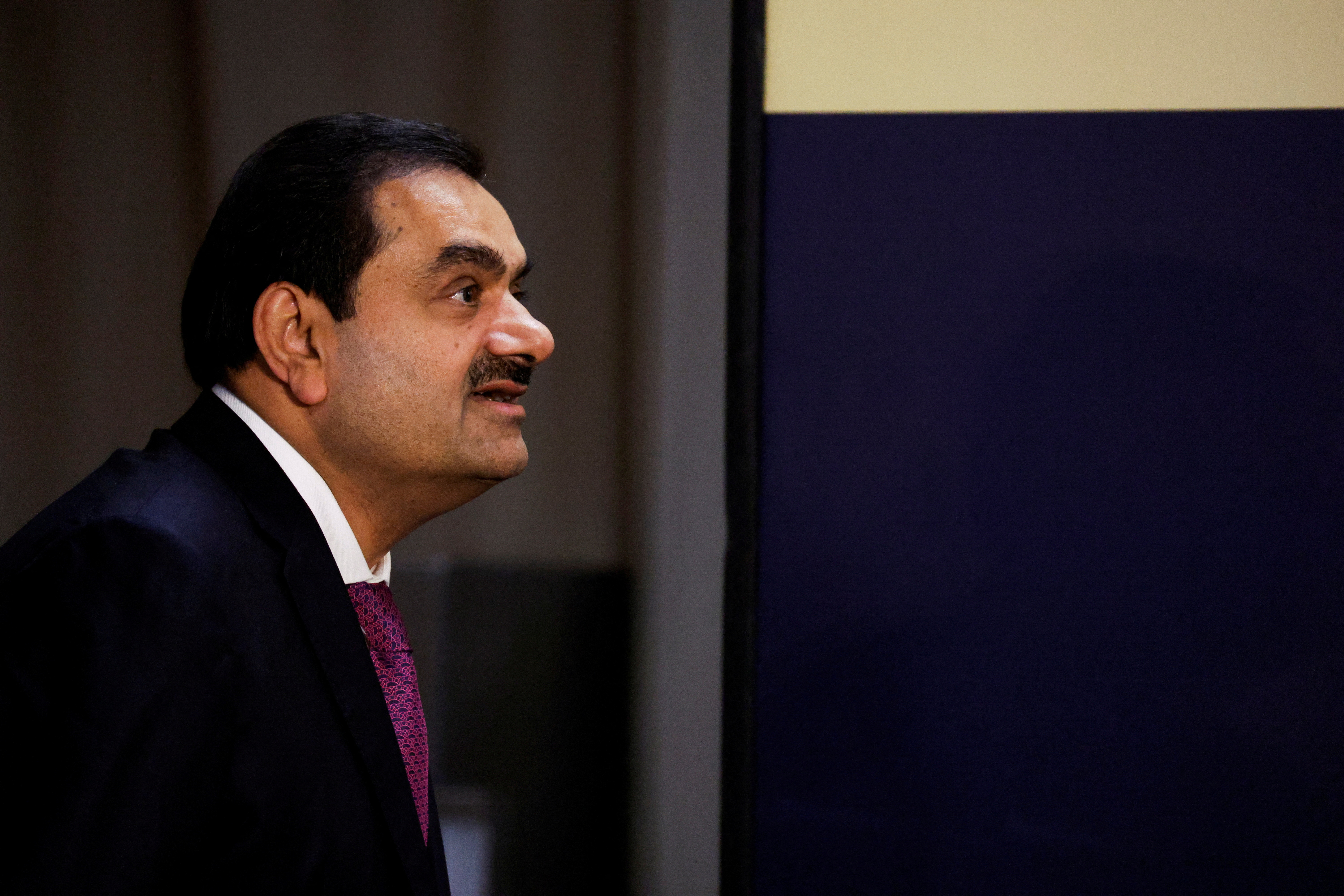
Indian billionaire Gautam Adani speaks during an inauguration ceremony after the Adani Group completed the purchase of Haifa Port in Haifa port, Israel January 31, 2023. REUTERS/Amir Cohen/File Photo
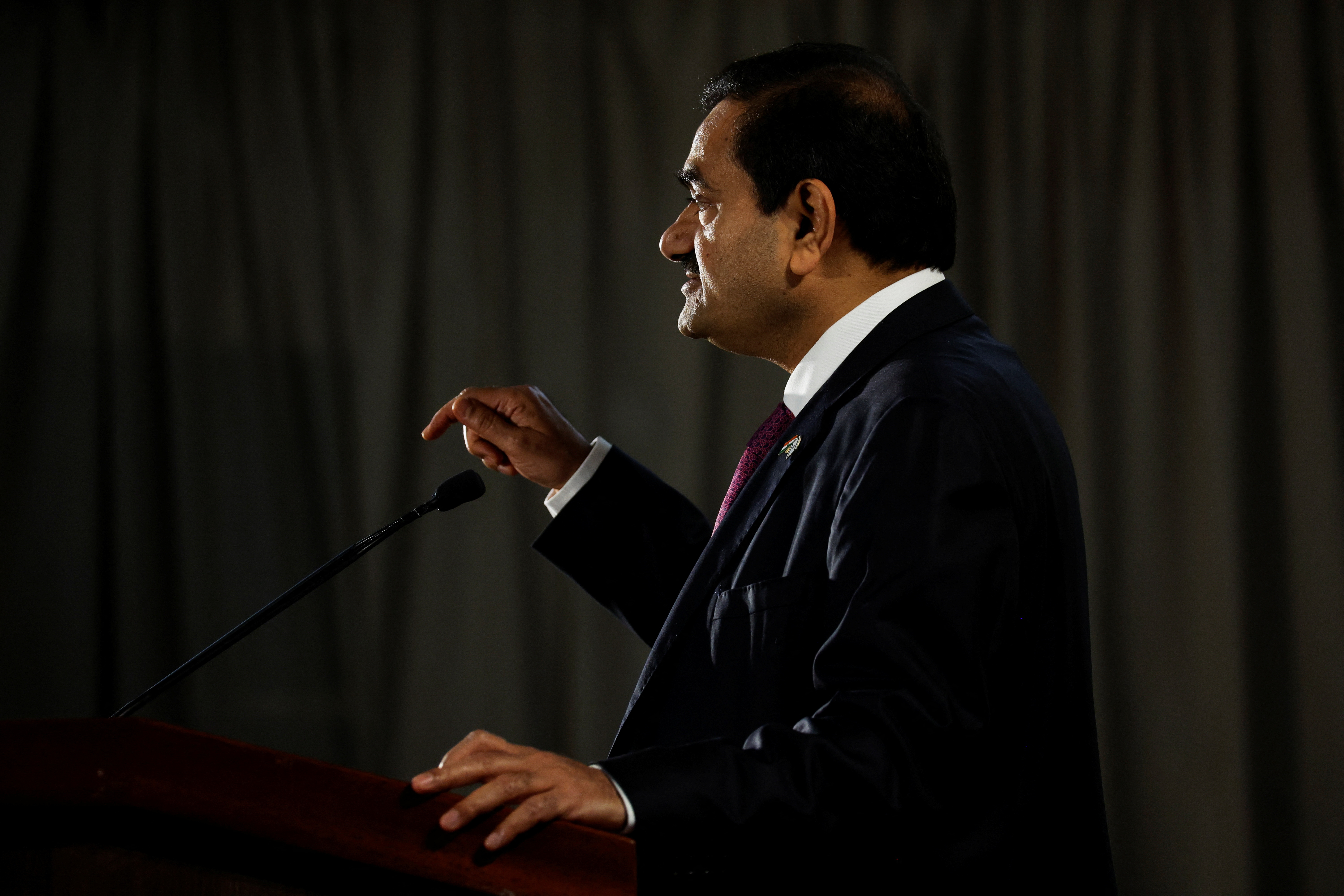
Indian billionaire Gautam Adani speaks during an inauguration ceremony after the Adani Group completed the purchase of Haifa Port earlier in January 2023, in Haifa port, Israel January 31, 2023. REUTERS/Amir Cohen
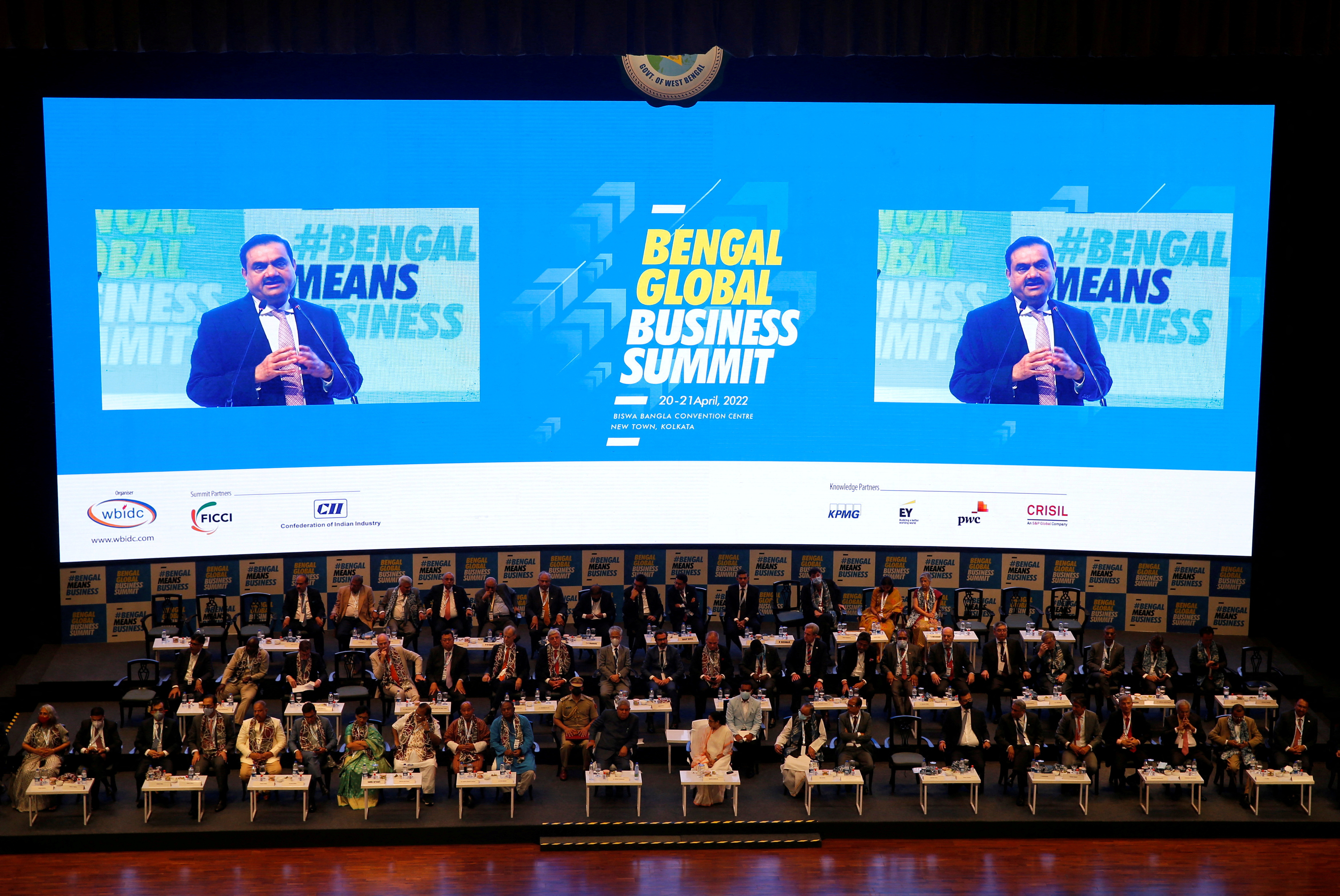
Indian billionaire Gautam Adani is seen on a screen as he addresses delegates during the Bengal Global Business Summit in Kolkata, India April 20, 2022. REUTERS/Rupak De Chowdhuri
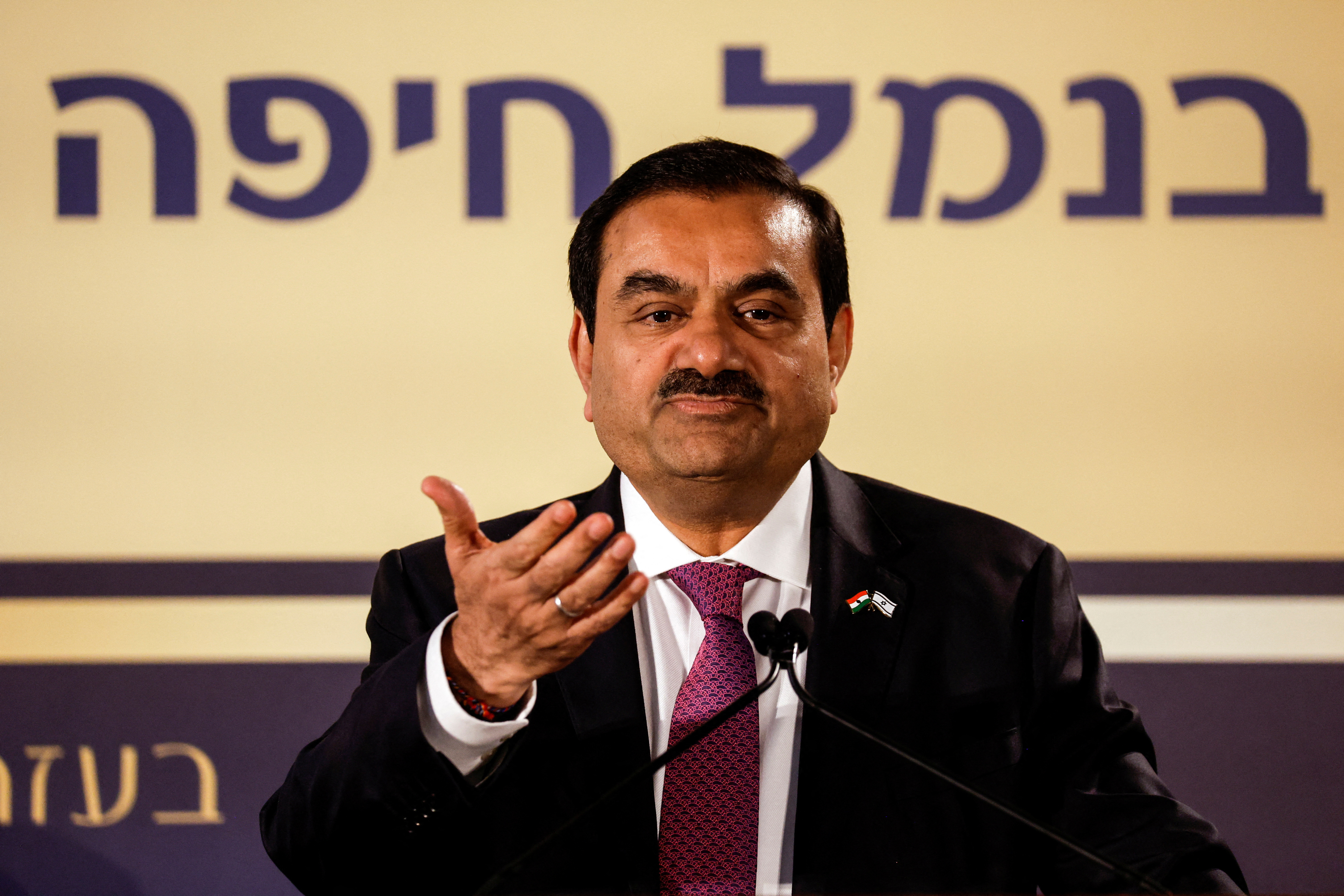
Indian billionaire Gautam Adani speaks during an inauguration ceremony after the Adani Group completed the purchase of Haifa Port earlier in January 2023, in Haifa port, Israel January 31, 2023. REUTERS/Amir Cohen
Adani logo and decreasing stock graph is seen in this illustration taken January 31, 2023. REUTERS/Dado Ruvic/Illustration
2023-02-01T16:16:30Z
Rookie offensive lineman Josh Sills of the Super Bowl-bound Philadelphia Eagles has been indicted on rape and kidnapping charges, Ohio Attorney General Dave Yost announced on Wednesday.
The 25-year-old Sills was indicted by a Guernsey County Common Pleas Court grand jury on one count of rape and one count of kidnapping, both first-degree felonies.
The indictment alleges that in December 2019 Sills engaged in sexual activity that was not consensual and held a victim against her will. The crime was immediately reported, and the Guernsey County Sheriff’s Office conducted an investigation.
According to Yost’s office, the case was presented to a grand jury and is being prosecuted by the Special Prosecutions Section of the Attorney General’s Office.
The Eagles did not immediately respond to a request for comment from the team or Sills.
Sills began the 2022 National Football League campaign as one of three undrafted rookies to earn an opening day roster spot. He appeared in one game this season in October, taking part in four special teams plays.
Sills has been issued a summons to appear in Guernsey County Common Pleas Court on Feb. 16, four days after the Eagles are scheduled to face the Kansas City Chiefs in the Super Bowl in Glendale, Arizona.

