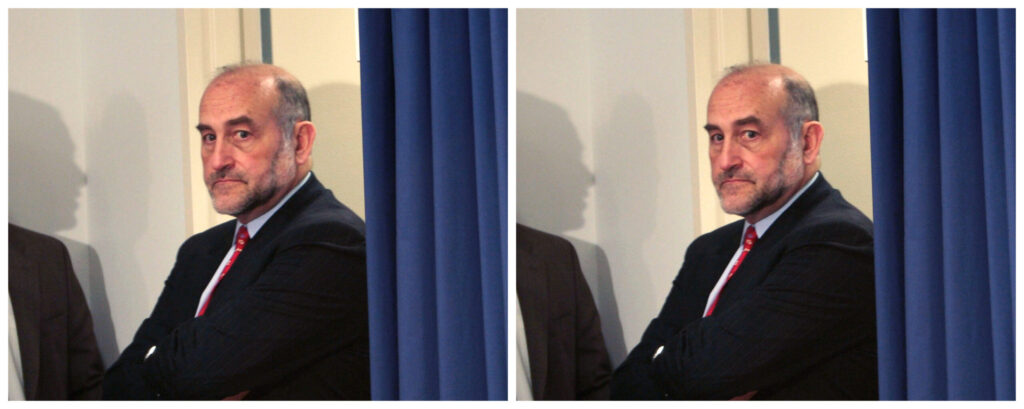
On Feb. 23, 2022, veteran defense lawyer and prosecutor Mark Pomerantz resigned from the Manhattan District Attorney Office where he had helped lead a criminal investigation over the past year into former president Donald Trump’s finances and business practices. His resignation letter, which was shortly thereafter anonymously provided to the New York Times, set off an outcry in some quarters against Manhattan DA Alvin Bragg.
The resignation letter asserted that Bragg’s predecessor, Cy Vance, had directed the office to seek an indictment of Trump and that Bragg had decided to effectively drop the case. Now, one year later, Pomerantz has released a book containing his account of his year in the DA’s office. But many of the assertions in the book, rather than support Pomerantz’s resignation letter, cast a very different impression of his prior claims.
Below, I have annotated the verbatim resignation letter (adding underlining for the passages I comment on). I draw primarily from his own book, and also include some key news reports (especially reporting subsequent to the resignation letter) and other public statements from Pomerantz and Vance.
Aside: There may well be a strong case to indict Trump for financial crimes under New York State law (e.g., for false statements to banks and falsified business records), as detailed in a Brookings Institution report.
“February 23, 2022
Dear Alvin,
I write to tender my resignation as a Special Assistant District Attorney and to explain my reasons for resigning.
As you know from our recent conversations and presentations, I believe that Donald Trump is guilty of numerous felony violations of the Penal Law in connection with the preparation and use of his annual Statements of Financial Condition. His financial statements were false, and he has a long history of fabricating information relating to his personal finances and lying about his assets to banks, the national media, counterparties, and many others, including the American people. The team that has been investigating Mr. Trump harbors no doubt about whether he committed crimes — he did[1].
[1] This statement is misleading.
First, the statement suggests the entire investigative team thought they had a case. It omits that many members of the team did not think they could prove Trump committed crimes, and many did not think the New York state criminal charges advanced by Pomerantz applied to Trump’s conduct. Some of these dissenting views were reported by the media subsequent to the resignation letter. In his book, Pomerantz now acknowledges facts that make the resignation letter misleading:
- At an important meeting, held on Dec. 10, 2021, with the internal legal team, Pomerantz writes in his book: “Many of the lawyers were relentlessly negative.” (p. 191) “There were references to our case as ‘weak,’ and one lawyer opined that it had ‘many fatal flaws.’ … Another person … expressed a view that the case might be ‘way out there.’ Another voice opined that, while the legal theory was legitimate, ‘it’s not the strongest case in the world.’ Several … thought we were outside the ‘heartland’ of the statutory definition of ‘scheme to defraud.’” (pp. 191-92) Indeed, Pomerantz writes that he abandoned this theory of the charges, as he did an earlier “novel theory” of his that the DA could potentially charge Trump for money laundering — with Trump as the victim of extortion — an idea that he recognized may have cost him credibility inside the office (p. 61).
- In his book, Pomerantz appears to allude to the fact that lawyers left the investigation because they did not agree with the direction he was taking it. He writes, “It was common knowledge in the office that there had been ‘defectors’ from the Trump investigation” (p. 209) According to the New York Times, in late 2021, “three career prosecutors in the district attorney’s office opted to leave the investigation, uncomfortable with the speed at which it was proceeding and with what they maintained were gaps in the evidence.” One upshot: any appearance of agreement among the investigative team by the time of the Feb. 23, 2022 letter was in part because dissenters had left. (However, even by that date many appeared to still disagree with bringing an indictment on the basis of the existing evidence and legal theories.)
- The following is not mentioned in the book: “In mid-January, a career prosecutor in the office circulated two memos to Mr. Bragg’s aides detailing potential difficulties in making the case,” according to the New York Times.
- On Feb. 16, 2022, Pomerantz writes that Bragg told him “that the consensus among the group of prosecutors with whom he had been speaking was not to go forward.” (p. 230) Notably the New York Times had already reported that Bragg canvassed members of the office: “Either way, they needed an answer, and Mr. Bragg promised to deliver one within a week. In the ensuing days, he called numerous members of the team and peppered them with questions.”
- In addition to the internal lawyers, Vance’s office convened a group of outside advisors for a “summit” meeting on Dec. 9, 2021 to assess their case. Even on Pomerantz’s own telling, the meeting persuaded him and Carey Dunne at this late date to drop their theory of the case as a scheme to defraud and switch instead to falsification of business records that would not require proof of financial loss (pp. 189-90). And he writes, in muted terms, that “the outside experts seemed to agree with us” and “the sense of the group seemed clear: we had a case, but it was not without issues.” Pomerantz also acknowledges that “the conversation with the ‘brain trust’ had left [Dunne] ‘on the fence’ about charging Trump.” (p. 190) Notably, the New York Times reported (after Pomerantz’s resignation letter): “There are differing accounts of how well the brain trust responded to the evidence, with one participant calling the reaction ‘mixed at best,’ but another saying that there was agreement that the prosecutors had credible evidence to support charges and that no one recommended against a case.” (emphasis added)Note: According to the New York Times, Bragg “was not aware of the Dec. 9 meeting.” Pomerantz admits in his book that they affirmatively decided to exclude Bragg and his team, but then Pomerantz faults Bragg for not getting up to speed quickly (p. 177).
Second, it is unclear what Pomerantz means by the investigative team’s confidence that Trump “committed crimes.” Indeed, Pomerantz may even mean federal crimes, and not the state crimes that the DA’s Office was investigating. In his book, Pomerantz writes this most puzzling statement:
“Everyone [on the investigation team] then affirmed that they thought he had committed serious criminal conduct, but they were concerned whether it fit within the strictures of New York’s Penal Law.” (p. 193).
This is not just an inartful wording of a sentence in the book. Pomerantz made a similar statement in a podcast interview at Columbia Law School in July 2022 (“The view of the investigative team was that Trump had committed crimes, and I don’t think there were dissents from that view. The problem was fitting his conduct within the pigeonholes of the New York penal law.”).
It is difficult to fathom what those statements mean coming from an experienced defense lawyer and prosecutor. The investigators thought Trump committed crimes, but they didn’t know whether it fit the penal code? That is what defines criminal conduct. It is also notable that the team, according to Pomerantz, expressed this ambivalence at a major meeting on Dec. 10, 2021, basically the endpoint of the investigation under Vance. Finally, the Pomerantz statement fails to address whether people agreed that the evidence was sufficient to charge: prosecutors and defense lawyers may frequently believe someone committed a crime, but as we all know that belief is no basis on which to make a charging decision which requires sufficient admissible proof.
In late 2021, then-District Attorney Cyrus Vance directed a thorough review of the facts and law relating to Mr. Trump’s financial statements. Mr. Vance had been intimately involved in our investigation, attending grand jury presentations, sitting in on certain witness interviews, and receiving regular reports about the progress of the investigation. He concluded that the facts warranted prosecution[2-a], and he directed the team to present evidence to a grand jury and to seek an indictment of Mr. Trump and other defendants as soon as reasonably possible[2-b].
[2-a] This is consistent with and reflected in the book.
[2-b] This is not consistent with or reflected in the book.
The book states that Vance came around to favoring indictment in the middle of his final month in office (on or around Dec, 13, 2021). It would have been controversial, if not outrageous, for Vance to tie the hands of the incoming DA with such a directive.
Based on the book and other remarks by Pomerantz and Vance subsequent to the resignation letter, it appears that Vance issued no directive. The book only says that “on Sunday evening, December 13, Carey sent an email to the team announcing that the decision had been made to go forward.” But that’s not the same thing. More importantly, instead of saying Vance directed the team to seek an indictment (which is what the resignation letter claims), the book says that Vance and Pomerantz “knew that the new administration arriving in three weeks would have to ratify the decision.” (p. 194). In the same vein, subsequent to his resignation letter, Pomerantz said in the July 2022 Columbia Law School podcast interview:
“The district attorney [Vance], most importantly, thought that the case should go forward and that it was likely that we would obtain a conviction if it did go forward. Of course, when that decision was made toward the end of 2021, everybody understood that there would be—by that point, it was clear there was going to be—a new district attorney, and that decision would have to, in effect, be ratified by the incoming administration and the incoming district attorney. … Bragg acknowledged that the decision whether to go forward with the prosecution could well be the most significant legal judgment he would have to make.” (emphasis added)
Vance has also made statements to the press that indicate he did not direct the team to seek an indictment but instead left that momentous decision to his successor (CBS News; Bloomberg Law; see also New York Times (“It took nearly 18 months and two trips to the Supreme Court for Mr. Vance’s office to obtain the records. As a result, the ultimate decision of whether to pursue charges fell to Mr. Bragg.”) and NBC News).
This work was underway when you took office as District Attorney. You have devoted significant time and energy to understanding the evidence we have accumulated with respect to the Trump financial statements, as well as the applicable law[3].
[3] This favorable statement in the resignation letter is entirely inconsistent with how Pomerantz described Manhattan’s first Black district attorney in his book. There appears to be a paper trail on this discrepancy.
As recounted in the book, in an email to Bragg on Jan. 27, 2022, Pomerantz dressed down his boss. He wrote:
“You have been distracted. But, with all due respect, it is not appropriate for us to be told that it is virtually impossible to get a meeting with you to review Donald Trump’s culpability, and for you to come to that meeting late, spend most of the meeting looking at your phone, and then leave before we were finished.” (p. 219)
Pomerantz also uses the following language to describe the DA:
- “In my mind, it was vastly better for Alvin to try to ‘lateral’ our investigation to the United States attorney than simply ‘take a knee’ by keeping the case in the district attorney’s office to die a lingering death.” (p. 243)
- On a Zoom conversation with the new leadership on Dec. 27, 2021: “Alvin did not take charge of the discussion and he dropped off after an hour.” (pp. 200-01)
- Soon after Jan. 1, 2022, “we [Pomerantz and Carey Dunne] now understood that the process of educating the new team would be far slower and more painful than we anticipated.” (p. 201)
- “The new regime had not jumped in to embrace the investigation or to learn the facts.” (p. 201)
- “The lack of interest prior to and during the holidays, and the lack of any apparent sense of urgency, left me and Carey feeling that the whole investigation, and us along with it, had been pushed off to the side of Alvin’s agenda.” (p. 202-03)
- “The dialogue we had on that call struck me as superficial and negative in tone. … I knew that the new group could not possibly have delved into these complicated facts, let alone mastered them, when we spoke in early January.” (p. 203)
- “I was finishing law school when Alvin was a toddler.” (p. 208)
- At Jan. 11, 2022 meeting, “It seemed that we were starting from the very beginning to educate people about the case. I was frustrated that we had lost valuable time and lamented that Alvin had made no effort to get briefed about the Trump investigation during the weeks that had gone by since he had been elected.” (p. 209)
- In an email to Dunne on or after Jan. 24, 2022: “[E]ither they haven’t seen the ball since the kickoff or they truly don’t think there is any case against [Trump], a determination they have made without making a serious and intensive effort to understand that case.” (p. 216)
- On Jan. 26-27, 2022, “I also thought about Alvin’s relative youth and wondered if he was in over his head;” “I felt that … Alvin had not really understood the work that had gone into the case or the evidence that we had put together.” (p. 218)
- “I believe he waited too long to get his arms around the case, and there was too much to absorb in a very compressed time period. He jumped into very deep water, and immediately was in over his head.” (p. 265)
Note: It is worth noting the discrepancy with how Pomerantz describes the “patrician” Cy Vance (see note [4] below) in unfailingly positive terms, despite Vance’s responsibility in overseeing for years an investigative team that Pomerantz and Vance describe as inept.
You have reached the decision not to go forward with the grand jury presentation and not to seek criminal charges at the present time[4]. The investigation has been suspended indefinitely. Of course, that is your decision to make. I do not question your authority to make it, and I accept that you have made it sincerely. However, a decision made in good faith may nevertheless be wrong. I believe that your decision not to prosecute Donald Trump now, and on the existing record, is misguided and completely contrary to the public interest. I therefore cannot continue in my current position.
[4] This statement has a material omission. See also text in the resignation letter accompanying note [9].
It is Pomerantz who apparently forced Bragg to make the decision one way or another at this point in time, fewer than two months into Bragg’s coming into office. As Andrew Weissmann wrote in his review of Pomerantz’s book:
“Pomerantz is unfailingly polite about Vance. But if his criticisms generally about the work of the office are accurate, then the state of the long-running investigation is on Vance, not on Bragg, who was on the job for less than two months before Pomerantz resigned. Yet Bragg is scathingly faulted for not promptly greenlighting charges against Trump, charges that many had said were not ready for prime time.”
And Pomerantz then gave Bragg a “brash ultimatum,” as Weissmann describes it (in understated terms). Pomerantz told Bragg he would resign if the new DA did not greenlight the indictment of Trump, and spelled out to Bragg the media fallout that would occur if the information about Vance’s views (revealed in Pomerantz’s resignation letter) came to light, which it did shortly thereafter.
In my view, the public interest warrants the criminal prosecution of Mr. Trump, and such a prosecution should be brought without any further delay. Because of the complexity of the facts, the refusal of Mr. Trump and the Trump Organization to cooperate with our investigation, and their affirmative steps to frustrate our ability to follow the facts, this investigation has already consumed a great deal of time. As to Mr. Trump, the great bulk of the evidence relates to his management of the Trump Organization before he became President of the United States. These facts are already dated, and our ability to establish what happened may erode with the further passage of time. Many of the salient facts have been made public in proceedings brought by the Office of the Attorney General, and the public has rightly inquired about the pace of our investigation. Most importantly, the further passage of time will raise additional questions about the failure to hold Mr. Trump accountable for his criminal conduct.
To the extent you have raised issues as to the legal and factual sufficiency of our case and the likelihood that a prosecution would succeed, I and others have advised you that we have evidence sufficient to establish Mr. Trump’s guilt beyond a reasonable doubt, and we believe that the prosecution would prevail if charges were brought and the matter were tried to an impartial jury[5]. No case is perfect. Whatever the risks of bringing the case may be, I am convinced that a failure to prosecute will pose much greater risks in terms of public confidence in the fair administration of justice. As I have suggested to you, respect for the rule of law, and the need to reinforce the bedrock proposition that “no man is above the law,” require that this prosecution be brought even if a conviction is not certain.
[5] In a long email to the District Attorney, sent between Feb. 16-19, 2021, Pomerantz described the strength of this case quite differently. He wrote: “I know the case against Donald Trump is not an easy one, and there is a big risk that it will not end in a conviction. … I believe the prosecution would prevail, but a lot of uncertainty is baked into the situation.” (emphasis added)
I also do not believe that suspending the investigation pending future developments will lead to a stronger case or dispel your reluctance to bring charges. No events are likely to occur that will alter the nature of the case or dramatically change the quality or quantity of the evidence available to the prosecution[6]. There are always additional facts to be pursued. But the investigative team that has been working on this matter for many months does not believe that it makes law enforcement sense to postpone a prosecution in the hope that additional evidence will somehow emerge[7]. On the contrary, I and others believe[8] that your decision not to authorize prosecution now will doom any future prospects[9] that Mr. Trump will be prosecuted for the criminal conduct we have been investigating.
[6] This statement is open to dispute. Top legal experts have thought the District Attorney could potentially flip longtime Trump Organization CEO Allen Weisselberg and other senior executives (see Andrew Weissmann’s analysis published in Just Security in August 2022). And, indeed, that is reportedly Bragg’s exact ongoing strategy in threatening Weisselberg with more serious charges as the 75 year old begins serving his five-month sentence at Rikers Island.
[7] This statement is misleading. As discussed at length above (see [1]), many on the investigative team thought there was not a sufficient basis to pursue a prosecution at that point. If they thought Bragg should not postpone the prosecution in the hope of more evidence emerging, it’s because they thought the case should die then.
[8] This construction of the two sentences may have misled reporters and others at the time. It sounds like the “I and others” are the same group as the “the investigative team.” The New York Times, for example, mistakenly reported, “As of late December, the team investigating Mr. Trump was mostly united around Mr. Vance’s decision to pursue charges.” That was false, according to the book.
[9] This statement has a material omission. See discussion at [4].
I fear that your decision means that Mr. Trump will not be held fully accountable for his crimes. I have worked too hard as a lawyer, and for too long, now to become a passive participant in what I believe to be a grave failure of justice. I therefore resign from my position as a Special Assistant District Attorney, effective immediately.
Sincerely,
Mark F. Pomerantz
The post Pomerantz vs. Pomerantz: An Annotation of His Leaked Resignation Letter in Manhattan DA Trump Investigation appeared first on Just Security.