Categories
Audio Sources - Full Text Articles

Adani sell-off extends; India“s opposition lawmakers launch protests

2023-02-06T06:55:20Z

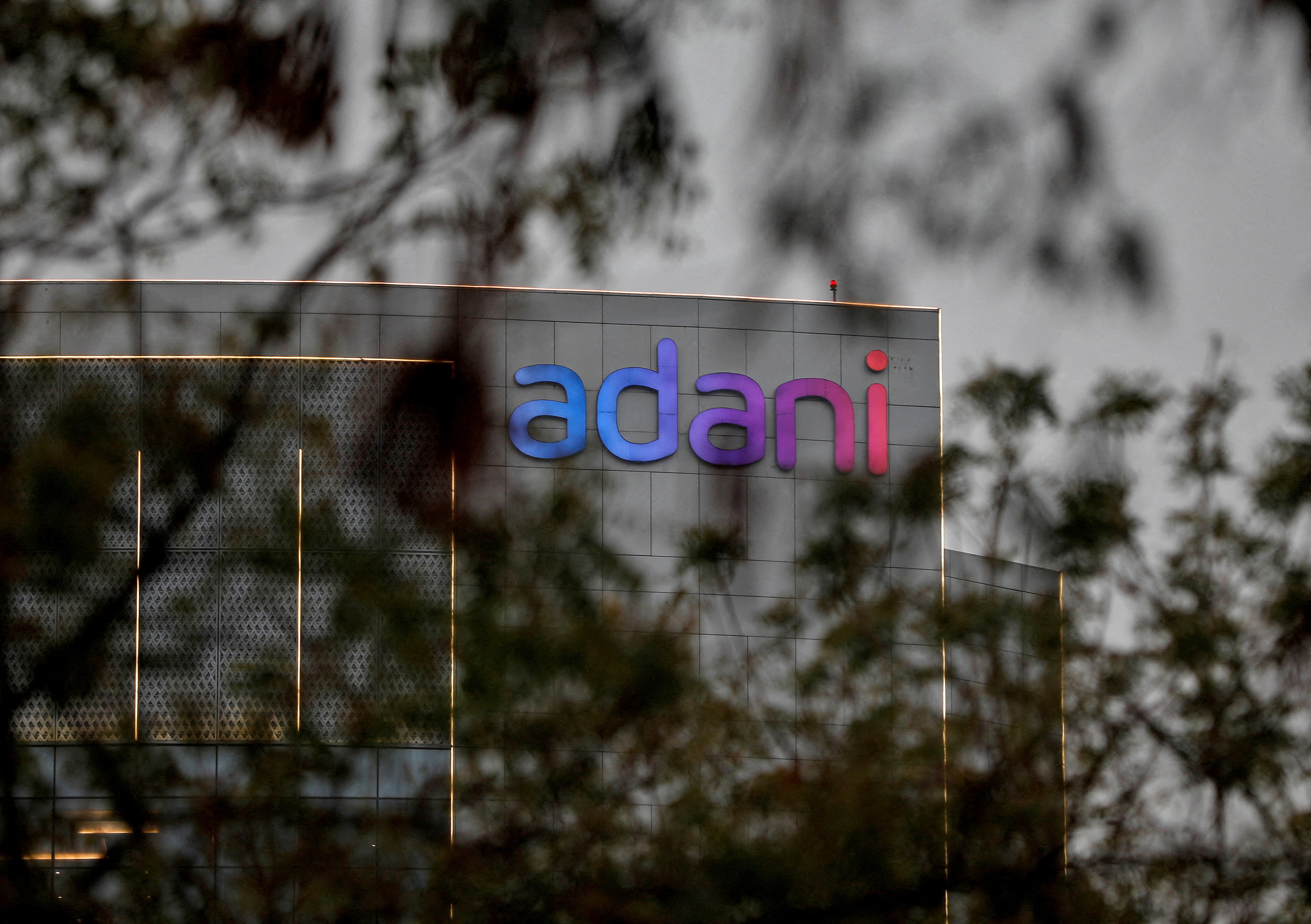
The logo of the Adani Group is seen on the facade of its Corporate House on the outskirts of Ahmedabad, India, January 27, 2023. REUTERS/Amit Dave

Lawmakers of India’s main opposition party kicked off planned protests at some state-run companies on Monday over the crisis at Adani group, whose seven listed firms saw another sell-off that drove their market loss to $112 billion in under two weeks.

Members of the Congress party plan to protest outside several offices of state-owned insurer Life Insurance Corporation (LIC) (LIFI.NS) and State Bank of India (SBI) (SBI.NS), both of which have exposure to Adani group companies.

At one of the protest sites in Mumbai, people held up banners with the words “Save SBI”, television footage showed.

The crisis was triggered by U.S.-based short-seller Hindenburg Research’s Jan. 24 report that accused the Adani group of stock manipulation, unsustainable debt and use of tax havens.

The Adani group, one of India’s top conglomerates, has rejected the criticism and denied wrongdoing in detailed rebuttals, but that has failed to arrest the unabated fall in its shares.

In the brutal fallout of Hindenburg’s report, Adani group flagship company Adani Enterprises Ltd (ADEL.NS) was forced to abandon a $2.5 billion share sale last week, and group chairman Gautam Adani lost his crown as Asia’s richest person and slipped down the global rankings of the wealthy.

Gautam Adani and India’s Prime Minister Narendra Modi are from the same state. Adani has denied allegations by Modi’s opponents that he had benefited from their close ties, and Modi’s government has denied allegations of favouring Adani.

As the Adani shares spiralled lower and cast a pall over Indian markets last week, lawmakers disrupted parliament and demanded an inquiry.

The stock market rout triggered a series of credit ratings warnings on Friday with Moody’s saying the group may struggle to raise capital, and S&P cutting its outlook on two group companies.

Even attempts by regulators and the government to calm spooked investors do not appear to be working.

The Reserve Bank of India said on Friday the country’s banking system remains resilient and stable. India’s market regulator said on Saturday the country’s financial markets remain stable and continue to function in a transparent and efficient manner.

SBI said on Friday it was not concerned about the exposure to the Adani group, but further financing to its projects would be “evaluated on its own merit”.

India’s divestment secretary Tuhin Kanta Pandey told Reuters on Friday that LIC shareholders and customers should not be concerned about its exposure to the Adani group.

LIC has a 4.23% equity stake in the flagship Adani Enterprises, while its other exposures include a 9.14% stake in Adani Ports and Special Economic Zone (APSE.NS).

Shares of Adani Enterprises sank 9.6% on Monday, taking its market capitalisation losses to nearly $28 billion since the release of the short-seller’s report.

Adani Transmission Ltd (ADAI.NS) dropped 10%, while Adani Green Energy Ltd (ADNA.NS), Adani Total Gas Ltd (ADAG.NS), Adani Power (ADAN.NS), and Adani Wilmar (ADAW.NS) fell roughly 5%.

Adani Ports was the only stock to buck the trend, rising 1.2%.

Categories
Audio Sources - Full Text Articles

China Is Not Happy About the United States Shooting Down Its Balloon

BEIJING — China on Monday accused the United States of indiscriminate use of force when the American military shot down a suspected Chinese spy balloon Saturday.

Read More: The Chinese Balloon Was Shot Down By the U.S. Military. Here’s How It Went Down

The U.S. shot down a balloon off the Carolina coast after it traversed sensitive military sites across North America. China insisted the flyover was an accident involving a civilian aircraft.

Read More: China Has an Extensive Satellite Network. Here’s Why It Would Use a Balloon to Spy

Vice Foreign Minister Xie Feng said he lodged a formal complaint with the U.S. Embassy on Sunday over the “U.S. attack on a Chinese civilian unmanned airship by military force.”

[time-brightcove not-tgx=”true”]

The presence of the balloon in the skies above the U.S. dealt a severe blow to already strained U.S.-Chinese relations that have been in a downward spiral for years. It prompted Secretary of State Antony Blinken to abruptly cancel a high-stakes Beijing trip aimed at easing tensions.

Read More: How an Alleged Spy Balloon Derailed an Important U.S.-China Meeting

Xie repeated China’s insistence that the balloon was a Chinese civil unmanned airship that blew into U.S. mistake, calling it “an accidental incident caused by force majeure.”

Read More: The Chinese Balloon Looks Nothing Like a Weather Balloon, Experts Say

China would “resolutely safeguard the legitimate rights and interests of Chinese companies, resolutely safeguard China’s interests and dignity and reserve the right to make further necessary responses,” he said.

U.S. President Joe Biden issued the shootdown order after he was advised that the best time for the operation would be when it was over water, U.S. officials said. Military officials determined that bringing down the balloon over land from an altitude of 60,000 feet (18,000 meters) would pose an undue risk to people on the ground.

“What the U.S. has done has seriously impacted and damaged both sides’ efforts and progress in stabilizing Sino-U.S. relations since the Bali meeting,” Xie said, referring to the recent meeting between Biden and his Chinese counterpart Xi Jinping in Indonesia that many hoped would create positive momentum for improving ties that have spiraled to their lowest level in years.

Categories
Audio Sources - Full Text Articles

Book excerpt: ‘October Surprise: How the FBI Tried to Save Itself and Crashed an Election,’ by Devlin Barret – The Washington Post washingtonpost.com/national-secur…

Book excerpt: ‘October Surprise: How the FBI Tried to Save Itself and Crashed an Election,’ by Devlin Barret – The Washington Post washingtonpost.com/national-secur…
Categories
Audio Sources - Full Text Articles

Like Musk, nickel-rich Indonesia has high electric vehicle ambitions

2023-02-06T06:42:29Z

A salesman speaks about the Wuling Air EV electric car to visitors at a shopping mall in Jakarta, Indonesia, February 5, 2023. REUTERS/Willy Kurniawan

Armed with the world’s largest reserves of nickel and a ban on the export of nickel ore, Indonesia is making itself indispensable for the electric vehicle industry, which uses the metal extensively.

In just three years, Indonesia has signed more than a dozen deals worth more than $15 billion for battery and electric vehicle production in the country with manufacturers including Hyundai Motor (005380.KS), LG Group (003550.KS) and Foxconn (2317.T).

Next up is the mammoth Tesla Inc (TSLA.O), the world’s most valuable automaker. President Joko Widodo has pulled out all the stops to convince CEO Elon Musk to manufacture electric vehicles or batteries in the sprawling Southeast Asian archipelago.

“I’m very confident this industry will grow quickly, will grow very fast,” the president, popularly known as Jokowi, said in an interview last week.

Indonesia has a total of 21 million tonnes in proven reserves with nickel content, according to the U.S. Geological Survey. That is nearly a quarter of the world’s reserves.

The country mined 1.4 million tonnes of nickel in January-November last year, according to the International Nickel Study Group. That’s far ahead of the second-biggest producer, the Philippines, which mined 290,000 tonnes in the same period, and more than double Indonesia’s output of 606,000 tonnes in 2018.

Jokowi banned exports of nickel ore in 2020, but allowed export of higher value nickel products – forcing companies to process and manufacture onshore.

Indonesia’s exports of processed nickel then swelled to more than $30 billion in 2022 from about $1 billion in 2015.

Indonesia is expected to account for half of the global production increase in nickel between 2021 and 2025, according to the International Energy Agency, as demand for electric vehicles surges. Each vehicle uses up to 40 kg of nickel.

“The Indonesian government is building a whole value chain for servicing electric vehicle factories,” said Victor Chin, principal consultant at metal consultancy firm CRU.

“So it only makes sense for Tesla to consider Indonesia, both for a gigafactory and also for car manufacturing,” he said.

Musk’s goal is to sell 20 million electric vehicles in 2030, more than a 15-fold increase over the 1.3 million vehicles Tesla sold in 2022. For that, it would need to build seven or eight more “gigafactories” – facilities that produce electric car batteries on a large scale – at an average of one every 12 months or so. read more

Indonesia has similarly ambitious goals – Jokowi said in the interview nickel exports can grow by 200 times from pre-export ban levels of around $1 billion if the country successfully manages to build the electric vehicle ecosystem. Brazilian mining company Vale (VALE3.SA) has predicted a 44% jump in nickel demand by 2030 from 2022 levels due to high demand for batteries meant for electric vehicles.

Jokowi did not give a timeline for the exports growth but said Indonesia was aiming to establish an integrated supply chain for electric vehicle batteries by 2027.

In other moves, Indonesia will also ban exports of copper ore and bauxite in June, both of which are used in electric vehicle production.

The nickel export ban has been challenged at the World Trade Organisation by the European Union. The WTO ruled in the EU’s favour, but Indonesia has filed an appeal.

But Indonesia’s success has already prompted other countries to emulate its steps, with the Philippines planning to tax exports of nickel ore to encourage miners to invest in processing.

The development of the industry in Indonesia is a pet project for Jokowi. He has taken it upon himself to convince Musk to invest in Indonesia, holding talks with the Tesla chief twice.

Last week, Jokowi said he has even offered Tesla a nickel mining concession and tax breaks to invest in the country, and that he was confident a deal would be finalised.

While Tesla is looking for additional manufacturing hubs, it has not commented on any firm plans in Indonesia. South Korea, Canada and Mexico have also been trying to entice the carmaker.

The company has signed nickel sourcing contracts worth about $5 billion from companies in Indonesia, a government official has said.

One area of concern for potential investors is the nickel mining industry’s environmental impact and Indonesia’s use of coal for power generation.

The process of making nickel suitable for EV batteries has a high carbon footprint and produces waste that environmentalists fear could be dumped in the ocean.

Still, global automakers are investing or sourcing from Indonesia due to limited alternatives and booming demand, analysts say.

“There is not enough nickel capacity expansion outside Indonesia. Indonesian nickel production has grown its share from less than 20% to nearly 50% in last four years,” said ANZ’s Soni Kumari.

Even buyers from the developed markets who are more conscious of sustainability credentials will be forced to buy from Indonesia, Kumari said.

“As battery-grade nickel demand continues to grow, battery and auto companies cannot just ignore (criticism) that ‘Indonesian nickel is not green enough’ when most of the future growth is going to come from Indonesia,” she said.


Categories
Audio Sources - Full Text Articles

Major earthquake strikes Turkey, Syria; about 300 dead, many trapped

2023-02-06T06:03:49Z

DIYARBAKIR/ANKARA, Turkey (Reuters) -A major earthquake of magnitude 7.8 struck central Turkey and northwest Syria on Monday, killing about 300 people and injuring hundreds as buildings collapsed across the region, triggering searches for survivors in the rubble.

?m=02&d=20230206&t=2&i=1622605383&r=LYNX

Rescuers search for survivors under the rubble of a damaged building, following an earthquake, in rebel-held Azaz, Syria February 6, 2023. REUTERS/Mahmoud Hassano

The quake, which hit in the early darkness of a winter morning, was also felt in Cyprus and Lebanon.

“I have never felt anything like it in the 40 years I’ve lived,” said Erdem, a resident of the Turkish city of Gaziantep, near the quake’s epicentre, who declined to give his surname.

“We were shaken at least three times very strongly, like a baby in a crib.”

Turkey’s disaster agency said 76 people had been killed, and 440 hurt, as authorities scrambled rescue teams and supply aircraft to the affected area, while declaring a “level 4 alarm” that calls for international assistance.

State broadcaster RTR showed rescue workers in Osmaniye province using a blanket to carry an injured man out of a collapsed four-storey building and putting him in an ambulance. He was the fifth to be pulled from the rubble, it said.

Footage on broadcaster CNNTurk showed the historic Gaziantep Castle was severely damaged.

President Tayyip Erdogan spoke by telephone with the governors of eight affected provinces to gather information on the situation and rescue efforts, his office said in a statement.

A Syrian health official said more than 230 people had been killed and some 600 injured there, most in the provinces of Hama, Aleppo and Latakia, where numerous buildings tumbled down.

“The situation is very tragic, tens of buildings have collapsed in the city of Salqin,” a member of the White Helmets rescue organisation said in a video clip on Twitter, referring to a town about 5 km (3 miles) from the Turkish border.

Home were “totally destroyed”, said the rescuer on the clip, which showed a street strewn with rubble.

President Bashar al-Assad was holding an emergency cabinet meeting to review the damage and discuss the next steps, his office said.

State television showed footage of rescue teams searching for survivors in heavy rain and sleet. Health officials urged the public to help take the injured to emergency rooms.

“Wounded people are still arriving in waves,” Aleppo’s health director, Ziad Hage Taha, told Reuters by telephone.

The Greek Orthodox Archdiocese in Aleppo posted photographs of blocks of stone that had crashed down onto its mezzanine.

In nearby countryside, rescuers carried a bloodied, wailing baby out of a collapsed building, while, in the town of Azaz, a crane prised away slabs of concrete as rescuers carried away a body wrapped in a sheet.

Many buildings in the region had already suffered damage in fighting during Syria’s nearly 12-year-long civil war.

People in Damascus, and in the Lebanese cities of Beirut and Tripoli, ran into the street and took to their cars to get away from their buildings in case they collapsed, witnesses said.

The United States was “profoundly concerned” about the quake in Turkey and Syria and was monitoring events closely, White House national security adviser Jake Sullivan said on Twitter.

“I have been in touch with Turkish officials to relay that we stand ready to provide any and all needed assistance,” he said.

The U.S. Geological Survey said the magnitude 7.8 quake struck at a depth of 17.9 km. It reported a series of earthquakes, one of 6.7 magnitude.

The region straddles seismic fault lines.

The tremor lasted about a minute and shattered windows, according to a Reuters witness in Diyarbakir, 350 km (218 miles)to the east, where a security official said at least 17 buildings collapsed.

Authorities said 16 structures collapsed in Sanliurfa and 34 in Osmaniye.

Broadcasters TRT and Haberturk showed footage of people picking through building wreckage, moving stretchers and seeking survivors in the city of Kahramanmaras, where it was still dark.

“Our primary job is to carry out the search and rescue work and to do that all our teams are on alert,” Turkish Interior Minister Suleyman Soylu told reporters.

Tremors were also felt in the Turkish capital of Ankara, 460 km (286 miles) northwest of the epicentre, and in Cyprus, where police reported no damage.

“The earthquake struck in a region that we feared. There is serious widespread damage,” Kerem Kinik, the chief of the Turkish Red Crescent relief agency, told Haberturk, issuing an appeal for blood donations.

Turkey is among the most earthquake-prone countries in the world. More than 17,000 people were killed in 1999 when a 7.6-magnitude quake struck Izmit, a city southeast of Istanbul. In 2011, a quake in the eastern city of Van killed more than 500.

Categories
Audio Sources - Full Text Articles

Children’s hospital used by Russian occupiers for military purposes in Zaporizhzhia region

630_360_1664472447-492.jpg

Russian troops keep on struggling losses and are employing a regional children’s healthcare facility for military purposes in the Zaporizhzhia region’s Vasylivka.

The applicable statement was created by the Typical Staff of the Armed Forces of Ukraine on Fb, an Ukrinform correspondent reports.

“The enemy continues to suffer losses. In the Zaporizhzhia region’s Vasylivka, the occupiers established up a military medical center for the wounded Russian navy in a regional children’s medical center. Little ones patients are no more time received there,” the report states.

A reminder that, as of February 5, 2023, Russia’s whole combat losses in Ukraine arrived at about 131,290 troops, 3,220 tanks, 6,405 armored fighting cars, 2,226 artillery programs, and so forth.

mk

Source link

The post Children’s hospital used by Russian occupiers for military purposes in Zaporizhzhia region appeared first on Ukraine Intelligence.

Categories
Audio Sources - Full Text Articles

Ukraine Army repels enemy attacks near 14 settlements, including Bakhmut

630_360_1673779258-888.jpg

In the past 24 hrs, the Armed Forces of Ukraine have repelled enemy attacks around 14 settlements in the Donetsk region, such as Bakhmut.

The relevant assertion was designed by the Standard Employees of the Armed Forces of Ukraine on Facebook, an Ukrinform correspondent reports.

In certain, Ukrainian forces repelled assaults by Russian occupiers in close proximity to these settlements as Verkhniokamianske, Vasiukivka, Paraskoviivka, Bakhmut, Ivanivske, Kamianka, Sieverne, Pervomaiske, Vesele, Nevelske, Krasnohorivka, Marinka, Pobieda and Novomykhailivka.

In accordance to the Standard Workers, Russian troops are concentrating initiatives mostly on conducing offensive actions in these instructions as Kupiansk, Lyman, Bakhmut, Avdiivka and Novopavlivka.

“During hostilities around the metropolis of Bakhmut, there was a full absence of coordination and interaction among the the servicemen of Russian profession troops and the so-referred to as Wagner Group’s mercenaries,” the report states.

Above the earlier day, Russian invaders have introduced 4 missile strikes on civil infrastructure in Kharkiv and the Donetsk region’s Druzhkivka. The enemy also opened hearth with several launch rocket techniques (MLRS) 56 instances, namely on civilian objects in Kherson. Casualties among civilians ended up documented.

The risk of Russian air and missile attacks is remaining substantial all above Ukraine.

In the Volyn, Polissia, Siverskyi and Slobozhanskyi directions, no enemy offensive groupings have been detected. The enemy shelling was recorded around the Chernihiv region’s Senkivka, the Sumy region’s Novovasylivka, Seredyna-Buda, Sopych, Boiaro-Lezhachi, Volfyne and Oleksandrivka, and the Kharkiv region’s Strilecha, Neskuchne, Ternova, Starytsia, Ohirtseve, Budarky and Rublene.

In the Kupiansk course, Russian invaders opened fire on the Kharkiv region’s Pishchane, Ivanivka, Kucherivka, Kyslivka and Kotliarivka, and the Luhansk region’s Novoselivske and Stelmakhivka.

In the Lyman direction, Russian occupiers shelled the Donetsk region’s Terny and the Luhansk region’s Makiivka, Ploshchanka, Nevske, Chervonopopivka, Kreminna, Kuzmyne and Dibrova.

In the Bakhmut route, around 25 settlements arrived under enemy hearth, which includes the Donetsk region’s Spirne, Bilohorivka, Mykolaivka, Rozdolivka, Krasna Hora, Bakhmut, Ivanivske, Stupochky, Tarasivka, Kurdiumivka, Ozarianivka and New York.

In the Avdiivka way, Russian troops introduced artillery strikes on Semenivkaa, Avdiivka, Sieverne, Vodiane, Pervomaiske, Vesele, Nevelske, Krasnohorivka, Heorhiivka, Marinka, Pobieda and Novomykhailivka.

In the Novopavlivka way, Russian invaders used tanks, mortars and artillery to attack the Donetsk region’s Vuhledar, Bohoiavlenka, Novoukrainka. Prechystivka, Zolota Nyva, Velyka Novosilka and Neskuchne.

In the Zaporizhzhia direction, about 30 settlements arrived below enemy hearth, which include the Zaporizhzhia region’s Novopil, Olhivske, Poltavka, Malynivka, Chervone, Huliaipole, Charivne, Mala Tokmachka, Novoandriivka, Stepove and Kamianske.

In the Kherson course, Russian occupiers shelled the city of Kherson and the Kherson region’s Zolota Balka, Havrylivka, Kachkarivka, Mylove, Beryslav, Vesele, Ivanivka, Mykilske, Chornobaivka, Antonivka, Dniprovske and Honcharne, i.e. about 20 settlements in complete.

Over the past day, Ukrainian air forces have launched nine strikes on enemy clusters and just one strike on Russia’s air defense missile program placement. Ukraine’s missile and artillery models hit a single Russian command submit, eight enemy personnel clusters, and one ammunition depot.

mk

Source link

The post Ukraine Army repels enemy attacks near 14 settlements, including Bakhmut appeared first on Ukraine Intelligence.

Categories
Audio Sources - Full Text Articles

Major earthquake strikes Turkey, Syria; about 200 dead, many trapped

2023-02-06T06:03:49Z

DIYARBAKIR/ANKARA, Turkey (Reuters) – A major earthquake of magnitude 7.9 struck central Turkey and northwest Syria on Monday, killing about 200 people as buildings collapsed across the snowy region, and triggering a search for survivors trapped in rubble.

?m=02&d=20230206&t=2&i=1622605383&r=LYNX

Rescuers search for survivors under the rubble of a damaged building, following an earthquake, in rebel-held Azaz, Syria February 6, 2023. REUTERS/Mahmoud Hassano

The quake, which hit in the early darkness of a winter morning, was also felt in Cyprus and Lebanon.

“I have never felt anything like it in the 40 years I’ve lived,” said Erdem, a resident of the Turkish city of Gaziantep, near the quake’s epicentre, who declined to give his surname.

“We were shaken at least three times very strongly, like a baby in a crib.”

Turkey’s disaster agency said 76 people had been killed, and 440 hurt, as authorities scrambled rescue teams and supply aircraft to the affected area, while declaring a “level 4 alarm” that calls for international assistance.

President Tayyip Erdogan spoke by telephone with the governors of eight affected provinces to gather information on the situation and rescue efforts, his office said in a statement.

Syrian state media said more than 100 people were killed and dozens injured there, most in the provinces of Hama, Aleppo and Latakia, where numerous buildings had been brought down.

“The situation is very tragic, tens of buildings have collapsed in the city of Salqin,” a member of the White Helmets rescue organisation said in a video clip on Twitter, referring to a town about 5 km (3 miles) from the Turkish border.

The rescuer on the clip, which showed a rubble-strewn street, said homes were “totally destroyed”.

Many buildings in the region had already suffered damage in fighting during Syria’s nearly 12-year-long civil war.

People in Damascus, and in the Lebanese cities of Beirut and Tripoli, ran into the street and took to their cars to get away from their buildings in case they collapsed, witnesses said.

In Turkey’s Gaziantep, Erdem also said people had fled from their shaking homes and were too scared to return.

“Everybody is sitting in their cars or trying to drive to open spaces away from buildings,” Erdem said by telephone.

The United States was “profoundly concerned” about the quake in Turkey and Syria and was monitoring events closely, White House national security adviser Jake Sullivan said on Twitter.

“I have been in touch with Turkish officials to relay that we stand ready to provide any and all needed assistance,” he said.

The region straddles seismic fault lines and is prone to earthquakes.

The tremor lasted about a minute and shattered windows, according to a Reuters witness in Diyarbakir, 350 km (218 miles)to the east, where a security official said at least 17 buildings collapsed.

Authorities said 16 structures collapsed in Sanliurfa and 34 in Osmaniye.

Broadcasters TRT and Haberturk showed footage of people picking through building wreckage, moving stretchers and seeking survivors in the city of Kahramanmaras, where it was still dark.

“Our primary job is to carry out the search and rescue work and to do that all our teams are on alert,” Turkish Interior Minister Suleyman Soylu told reporters.

The German Research Centre for Geosciences said the quake struck at a depth of 10 km (6 miles), while the EMSC monitoring service said it was assessing the risk of a tsunami.

The U.S. Geological Survey reported a series of further earthquakes following the initial tremor, which it put at a magnitude of 7.8. There was a quake measuring 6.7 in Gaziantep and another of 5.6 in the city’s Nurdag area.

Turkey’s Disaster and Emergency Management Authority put the magnitude of the quake at 7.4 near Kahramanmaras and the larger city of Gaziantep, close to the Syrian border.

Tremors were also felt in the Turkish capital of Ankara, 460 km (286 miles) northwest of the epicentre, and in Cyprus, where police reported no damage.

“The earthquake struck in a region that we feared. There is serious widespread damage,” Kerem Kinik, the chief of the Turkish Red Crescent relief agency, told Haberturk, issuing an appeal for blood donations.

Turkey is among the most earthquake-prone countries in the world. More than 17,000 people were killed in 1999 when a 7.6-magnitude quake struck Izmit, a city southeast of Istanbul. In 2011, a quake in the eastern city of Van killed more than 500.

Categories
Audio Sources - Full Text Articles

India’s aircraft carriers key to Indo-Pacific strategy

NEW DELHI (AP) — India is preparing to relaunch its INS Vikramaditya aircraft carrier after a major refit, a critical step toward fulfilling its plan to deploy two carrier battle groups as it seeks to strengthen its regional maritime power to counter China’s increasing assertiveness.

The Vikramaditya, a former Soviet carrier acquired from Russia, is expected to be launched imminently and will join India’s first domestically built carrier that was launched in September, the INS Vikrant, in undergoing outfitting and sea trials, with the plan to have both fully operational later this year.

“This is significant in terms of India’s power projection capabilities, primarily within the Indian Ocean,” said Viraj Solanki, a London-based expert on Indo-Pacific defense with the International Institute for Strategic Studies.

“This really gives India an option to display its ability to counter China within the Indian Ocean, which is the Indian navy’s priority.”

China’s People’s Liberation Army Navy has been expanding and modernizing for more than a decade and is now the world’s largest. In June, it launched its first domestically designed and built aircraft carrier, the country’s third overall, as part of a program to extend its range and power and become more of a “blue water” force that can operate globally.

At the same time, China’s People’s Liberation Army has undertaken massive investment in ballistic and cruise missile technology, and the U.S. Defense Department says it will have the ability to conduct “long-range precision strikes against land targets from its submarine and surface combatants” in the “near term.”

As Beijing increases its naval presence around Taiwan and pushes its claims in the South China Sea, the U.S., Britain and other allies have responded with regular naval exercises in the region and passages through the Taiwan Strait as they pursue a policy of a “free and open Indo-Pacific.”

China has not yet sailed an aircraft carrier into the Indian Ocean but is expected to do so within the next few years. It already has other vessels operating regularly in the region and has established its first overseas base in the Horn of Africa country of Djibouti, which gives it easy access to the Indian Ocean.

China set off alarm bells in New Delhi in August when it docked what India called a “spy ship” in Sri Lanka’s Hambantota port off of India’s southern coast, a facility that was leased to China in 2017 for 99 years.

“New Delhi sees Beijing as encroaching into its traditional sphere of influence, especially in the Indian Ocean region,” said Ridzwan Rahmat, a Singapore-based analyst with the defense intelligence company Janes.

“While a potential war with China will likely be fought inland, China’s presence in the Indian Ocean region can severely disrupt India’s sea lines of communication, which will be essential in sustaining the war effort. The Indian navy’s recent modernization track is to ensure that scenarios like these will not take root,” Rahmat said.

Like China, India has nuclear weapons and has been building nuclear-powered ballistic missile submarines as part of its “nuclear triad” of air, sea and land-based platforms. It currently has two such subs and plans for two more, as well as nuclear-powered attack submarines.

Its fleet also includes 10 destroyers, 12 frigates and 20 corvettes.

India and China clashed on their land border in 2020, with 20 Indian and four Chinese soldiers killed. The skirmish turned into a long standoff in the rugged mountainous terrain where each side has tens of thousands of military personnel.

Retired Indian navy chief Arun Prakash suggested that experience could make the seas more important in the event of a future conflict.

“The 30-month-long Sino-Indian military impasse in the Himalayas and China’s strategic posturing in the South China Sea should be clear pointers for India’s decision-makers that maritime power will have a critical role to play as an instrument of state policy in future outcomes,” Prakash wrote in December in The Indian Express.

With two carriers, India’s plan is to have one stationed on each coast, said Capt. D.K. Sharma, a retired Indian navy spokesperson who now consults on defense issues.

India’s focus has tended to be toward Pakistan in the west, but with the presence of Chinese vessels in critical shipping lanes east of India, it is prudent for the Indian navy to make its presence felt there as well, Rahmat said.

He cautioned, however, that India still lacks many of the support systems, among other things, to make its carriers effective.

“The vessels themselves may be operational but the Indian navy is still several years away from being able to project its forces credibly into the Indian Ocean region,” he said.

Indian Prime Minister Narendra Modi hailed the launch of the Vikrant as a victory in his “Make in India” campaign to become more self-reliant in defense.

The navy has been pushing for another carrier to be made at home, but political concerns coupled with the lengthy delays and massive cost overruns in the construction of the Vikrant have left many skeptical it will ever come to pass, said Indian defense analyst Rahul Bedi.

“The government doesn’t really have the money or the vision to go in for another aircraft carrier,” he said.

In its proposed 2023-24 budget presented Wednesday, the government increased defense spending by less than 2%, further calling into question major new investments in carriers. Even if it does go ahead, a third carrier would take years to build.

As it outfits the Vikrant, India is expected to decide soon on the purchase of 26 maritime strike fighters — either the French Rafale-M or American F/A-18. The Indian air force already operates a version of Dassault Aviation’s Rafale, which would make maintenance easier, while Boeing’s F/A-18 can carry more missiles.

The Vikramaditya will continue to operate Russian-made MiG-29K fighters India already owns.

India has been seeking to lessen its reliance on equipment from Russia, which currently provides about 60% of its inventory, with the war in Ukraine raising questions about their effectiveness and the availability of spare parts. The United States and other allies have been pitching themselves to New Delhi as alternatives and are increasing their cooperation with the key regional player as they intensify their own focus on the Indo-Pacific.

However, experts say that even with domestic production and diversification of acquisitions, it could take India 20 years to get past its dependence on Russian supplies and spares.

Even before the Russia-Ukraine war, India was increasing its diplomatic engagement with the Quad grouping of the U.S., India, Japan and Australia, the Association of Southeast Asian Nations, and other countries individually, Solanki said.

“This really accelerated after the June 2020 India-China clashes on the border,” he said. “That is when we’ve seen a real shift and focus to engage with the Quad, with France, to engage with the U.K. more actively, work with Europe further … and work with the ASEAN countries as well.”

___

Rising reported from Bangkok.

Categories
Audio Sources - Full Text Articles

Enemy opens fire on three communities in Sumy region, 17 explosions reported

630_360_1667727136-729.jpeg

On February 5, 2023, Russian troops opened fire on a few communities in the Sumy region, these as Esman, Seredyna-Buda and Druzhba. A total of 17 explosions have been recorded.

The suitable statement was made by Sumy Regional Armed service Administration on Telegram, an Ukrinform correspondent studies.

In specific, Russians fired a mortar bomb at the Esman local community.

Russian invaders also utilized mortars to assault the Seredyna-Buda community. A whole of four explosions had been noted.

In the Druzhba group, about 12 solitary volleys of automatic gunfire have been recorded around a single of local villages.

In accordance to Sumy Regional Military services Administration, no casualties or destructions have been noted.

mk

Source link

The post Enemy opens fire on three communities in Sumy region, 17 explosions reported appeared first on Ukraine Intelligence.

WP Radio
WP Radio
OFFLINE LIVE