Categories
Audio Sources - Full Text Articles

India’s stock regulator tried to calm jittery investors fleeing the stock market — but even that’s not helped Gautam Adani, whose companies’ shares continue to take a beating

Art school teacher Sagar Kambli gives final touches to a painting of Indian businessman Gautam Adani highlighting the ongoing crisis of the Adani group in Mumbai on February 3, 2023.Indian tycoon Gautam Adani’s business empire has been targeted by a short seller.

Indranil Mukherjee/Getty Images

  • India’s market regulator tried to assure investors the country’s markets are “stable”.
  • It acknowledged there was an “unusual price movement in the stocks of a business conglomerate” in the past week.
  • Adani Group companies have lost $110 billion in market cap amid a short seller attack.

India’s stock markets have been on a wild roller-coaster ride since tycoon Gautam Adani’s business empire came under siege from a US short seller.

The market rout in the share prices of Adani companies has gotten so bad that even India’s market regulator stepped into the fray on Saturday, to calm investor concerns. 

The conglomerate’s flagship company, Adani Enterprises was trading 1% lower after losing as much as 10% on Monday. The stock has already lost over half its market value this year so far. The shares of Adani Transmission were down 10% while those of Adani Green Energy, Adani Power, and Adani Total Gas were down 5%. 

Collectively, the rout wiped off more than $110 billion from 10 companies related to the Adani Group as of Friday, per Bloomberg. 

And it’s not just Adani stocks that are getting hammered.

Jittery investors are keeping up the pressure on Indian stocks — the Sensex is trading 0.5% lower at 1.45 p.m. local time today while the Nifty 50 was down 0.5%. The benchmark Sensex and Nifty 50 indices have already lost 0.5% and 1.4% this year so far.

It’s no surprise then that the Securities and Exchange Board of India, or SEBI, said in a statement on Saturday: “The Indian financial market as represented by Sensex and Nifty has demonstrated ongoing stability and is continuing to function in a transparent, fair and efficient manner.”

What’s strange is that SEBI acknowledged it has observed an “unusual price movement in the stocks of a business conglomerate” in the past week, but did not name the company directly. 

Shares of Adani Group companies have been unusually volatile since US short seller Hindenburg Research released a scathing report on January 24 alleging a “brazen stock manipulation and accounting fraud scheme” at the conglomerate. And even though Adani Group defended itself vigorously, Hindenburg also doubled down on its initial report.

Adding to Adani’s woes, S&P Global cut its outlook on two Adani companies — Adani Ports and Special Economic Zone and Adani Electricity — from stable to negative, according to a note seen by Insider. Moody’s meanwhile did not change its rating for Adani companies, but warned the sell-off in their shares could hit the group’s ability to raise funds in the next one to two years, according to a Friday note seen by Insider. 

Adani Enterprises — the conglomerate’s flagship company — already scrapped a $2.5 billion secondary share sale last Wednesday. It has also shelved a $122 million bond sale, Bloomberg reported on Saturday.

The fallout from the short seller’s report also spilled over into the broader Indian markets and prompted concerns about corporate governance and debt in the country.

And even while SEBI sought to shore up investor confidence in the country’s markets by saying they have been “viewed positively by investors” — Indian equities were Asia’s top performers in 2022, according to a Reuters analysis — some analysts feel that investors might want to rebalance their portfolio in favor of other Asian markets — like China. Hong Kong’s Hang Seng Index is up 7.2% this year so far while the Shanghai Composite is up 4.8%.  

The Adani Group did not immediately respond to Insider’s request for comment.

Read the original article on Business Insider
Categories
Audio Sources - Full Text Articles

A close read of Beijing’s official statement shows it doesn’t think the US violated international law by shooting down its balloon, says a legal expert who studies China

Chinese Foreign Minister Qin Gang and members of his delegation meet with Egyptian Foreign Minister Sameh Shoukry and officials on January 15, 2023 in Cairo, Egypt.Chinese Foreign Minister Qin Gang and members of his delegation meet with Egyptian Foreign Minister Sameh Shoukry and officials on January 15, 2023 in Cairo, Egypt.

Fadel Dawod/Getty Images

  • China didn’t accuse the US of violating international law when the Pentagon shot down its balloon.
  • That means Beijing doesn’t think the balloon’s fate broke such laws, a legal expert told the NYT.
  • China has aggressively accused the US of breaking international law many times in the past.

China’s response on Sunday to the US shooting down a Chinese balloon shows that Beijing doesn’t think Washington violated international law, said a legal expert who studies China.

In an official statement after an F-22 dispatched the balloon on Saturday, Beijing accused the US of breaching international norms, but didn’t make mention of international law violations — unlike in many of its previous reactions to US actions.

“The US insisted on using force, obviously overreacting and seriously violating international practices,” the statement read.

The wording in the brief statement “reflects that the Ministry of Foreign Affairs does not believe downing the balloon is a clear legal violation,” Julian Ku, a professor of law at Hofstra University who studies China’s relationship with international law, told The New York Times.

“The ministry will say if something is a violation of international law, so it is significant they did not say so here,” he said, per the outlet.

In the past, Beijing has accused the US of breaking international law even for actions like imposing visa restrictions on Chinese officials. Washington had implemented the restrictions due to human rights concerns in Xinjiang.

“It contravenes international law and basic norms governing international relations and grossly interferes in China’s internal affairs. We firmly reject it,” Foreign Ministry spokesperson Wang Wenbin said in March.

It’s not just the US that’s been on the receiving end of this particular barb. In July, Wang similarly said that Hague Tribunal rulings in support of Philippine claims over the South China Sea “seriously” violated international law. He did note that US Secretary of State Antony Blinken voiced support for the ruling.

In 2021, the foreign ministry blasted the US for signing the Uyghur Forced Labor Prevention Act, also saying it “seriously violates international law and basic norms governing international relations.”

China’s more muted response also comes as it replaced its foreign minister in January with a former US ambassador, Qin Gang. Since Qin took on the role, most of the ministry’s top-ranking spokespersons known for their aggression have moved to other government roles. Wang is still listed by the ministry as a spokesperson.

Read the original article on Business Insider
Categories
Audio Sources - Full Text Articles

Adani crisis sparks protests and arrests; sell-off losses top $110 bln

2023-02-06T09:12:55Z

The crisis engulfing the Adani group intensified on Monday as dozens of members India’s main opposition party were detained by police during protests, and parliament was suspended again due to disruptions over the saga.

Adani shares continued their freefall, with the conglomerate’s cumulative market value loss topping $110 billion.

The crisis was triggered by U.S.-based short-seller Hindenburg Research’s Jan. 24 report that accused the Adani group of stock manipulation, unsustainable debt and use of tax havens.

The Adani group, one of India’s top conglomerates, has rejected the criticism and denied wrongdoing in detailed rebuttals, but that has failed to arrest the unabated fall in its shares.

In New Delhi’s Jantar Mantar, a Mughal-era observatory that doubles up as a protest site for all causes, protesters held up banners and shouted slogans against Adani group’s billionaire founder Gautam Adani. Some broke through barricades, forcing the police to detain them.

Hundreds of members of the Congress party gathered to protest across the country, including outside several offices of state-owned insurer Life Insurance Corporation (LIC) (LIFI.NS) and State Bank of India (SBI) (SBI.NS), both of which have exposure to Adani group companies.

At Jantar Mantar some members burnt a suitcase with an SBI logo on it.

Both houses of India’s parliament were adjourned on Monday, the third consecutive day, amid sloganeering and demands to launch an inquiry.

In the brutal fallout of Hindenburg’s report, Adani group flagship company Adani Enterprises Ltd (ADEL.NS) was forced to abandon a $2.5 billion share sale last week, and group chairman Gautam Adani lost his crown as Asia’s richest person and slipped down the global rankings of the wealthy.

Gautam Adani and India’s Prime Minister Narendra Modi are from the same state. Adani has denied allegations by Modi’s opponents that he had benefited from their close ties, and Modi’s government has denied allegations of favouring Adani.

The stock market rout triggered a series of credit ratings warnings on Friday with Moody’s saying the group may struggle to raise capital, and S&P cutting its outlook on two group companies.

Even attempts by regulators and the government to calm spooked investors do not appear to be working.

The Reserve Bank of India said on Friday the country’s banking system remains resilient and stable. India’s market regulator said on Saturday the country’s financial markets remain stable and continue to function in a transparent and efficient manner.

SBI said on Friday it was not concerned about the exposure to the Adani group, but further financing to its projects would be “evaluated on its own merit”.

India’s divestment secretary Tuhin Kanta Pandey told Reuters on Friday that LIC shareholders and customers should not be concerned about its exposure to the Adani group.

Shares of Adani Enterprises sank 9.6% on Monday, taking its market capitalisation losses to nearly $28 billion since the release of the short-seller’s report.

Adani Transmission Ltd (ADAI.NS) dropped 10%, while Adani Green Energy Ltd (ADNA.NS), Adani Total Gas Ltd (ADAG.NS), Adani Power (ADAN.NS), and Adani Wilmar (ADAW.NS) fell roughly 5%.

Adani Ports and Special Economic Zone (APSE.NS) was the only stock to buck the trend, rising 1.2%.

Related Galleries:

Activists of the youth wing of India’s main opposition Congress party try to break a police barricade during a protest against what they say investments by Life Insurance Corporation (LIC) and State Bank of India (SBI) in Adani Group, in New Delhi, India, February 6, 2023. REUTERS/Adnan Abidi

Members of National Students’ Union of India (NSUI), the student wing of India’s main opposition Congress party, react as they are being detained by police during a protest demanding a probe by a Joint Parliamentary Committee (JPC) into Adani Group, in New Delhi, India, February 6, 2023. REUTERS/Anushree Fadnavis

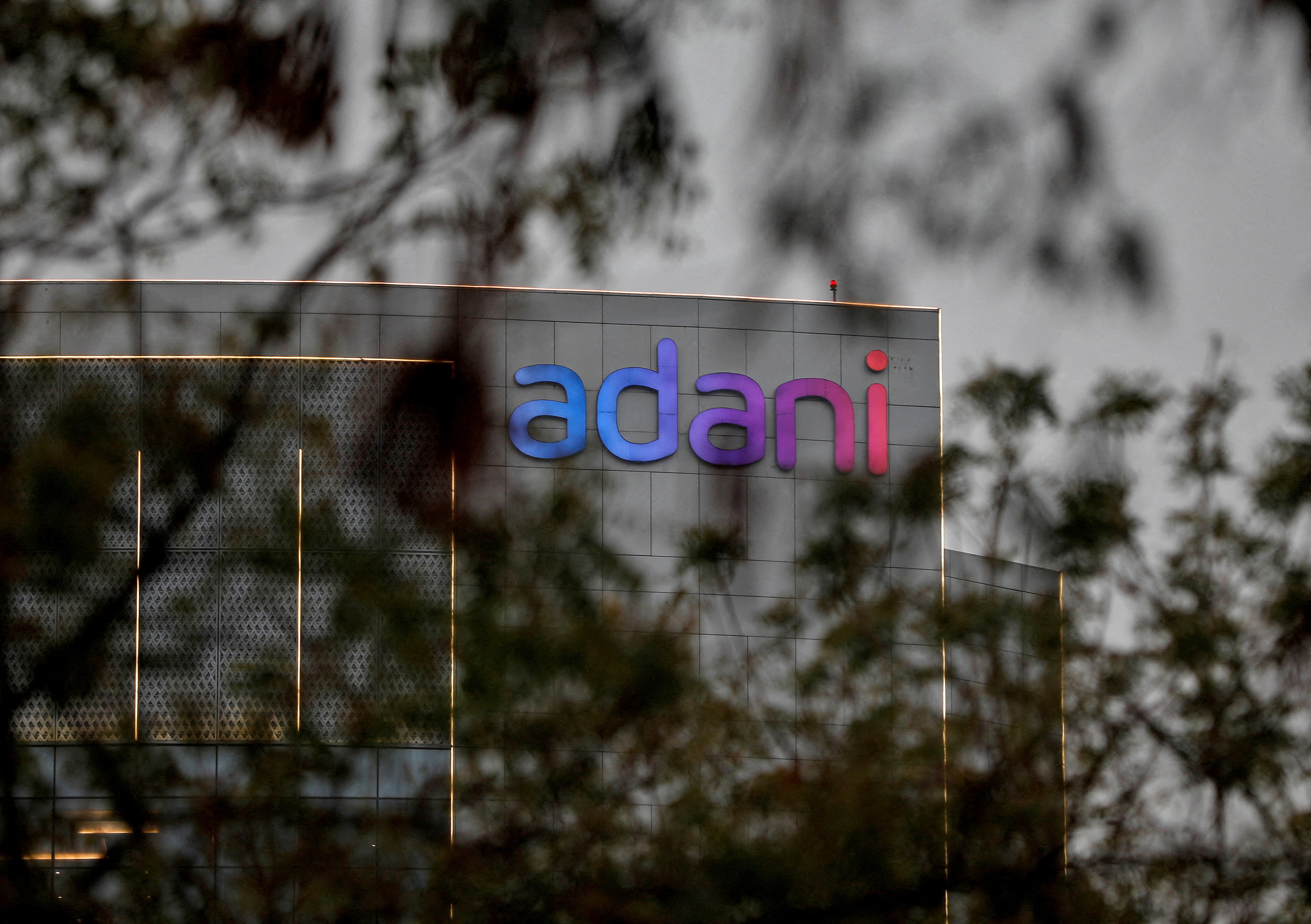
The logo of the Adani Group is seen on the facade of its Corporate House on the outskirts of Ahmedabad, India, January 27, 2023. REUTERS/Amit Dave
Categories
Audio Sources - Full Text Articles

Nissan to buy up to 15% stake in Renault EV unit under reshaped alliance

2023-02-06T09:06:32Z

Nissan (7201.T) and Renault (RENA.PA) on Monday unveiled details of their redesigned alliance, with the Japanese car maker committing to buy a stake of up to 15% in Renault’s electric vehicles unit Ampere.

The alliance junior partner Mitsubishi Motors (7211.T) will also consider investing in Ampere, which Renault aims to list, the companies said in a statement.

“Nissan’s intention is to invest up to 15% in Ampere, Renault Group’s EV & Software entity in Europe, with the aim to become a strategic investor,” the statement said ahead of a presentation in London.

The companies had already announced that under the deal to revive their long-standing alliance the French carmaker would reduce its stake in its Japanese partner to 15% from around 43% now.

Renault will transfer 28.4% of Nissan shares into a French trust, making the two more equal partners in the alliance.

Sources close to the matter said the agreement aimed to make the alliance freer and more balanced for the next 15 years.

The partnership will produce synergies from joint projects in Europe, India and Latin America, and the companies will work together in Renault’s flagship EV business, electronics and solid-state batteries.

Renault will have flexibility to sell the Nissan shares held in the trust but “it has no obligation to sell the shares within a specific pre-determined period of time,” the statement on Monday said.

When it does sell, “Nissan would benefit from a right of first offer, to its or the benefit of a designated third party.”

The two companies last month announced a sweeping remake of their 24-year-old automaking alliance, which was thrown into disarray by the ouster of its architect and former chairman, Carlos Ghosn, amid financial scandal.

That announcement came after nearly four months of intense talks complicated by concerns about the sharing of intellectual property as Renault sought tie-ups with companies outside their alliance.

Renault’s board approved the deal on Sunday night, according to a source. Nissan’s board also approved it early on Monday, the source said.

Investors and analysts will be looking for more clarity on how the trust in which Renault will place the bulk of its Nissan stake will operate.

“There is absolutely no word about what’s going to happen to those shares in the trust,” said CLSA analyst Christopher Richter. “It seems they’re all avoiding the issue of Nissan buying them back which I think would be the best thing for all parties involved.”

Richter said Renault’s brand is not seen as being a strong brand, so it may be tough for the French carmaker to raise money for Ampere.

“I wonder once this thing goes into the market how much money you would really raise, he said. “That’s why I think they’re going to push Nissan to pay too much.”

The unequal relationship between the two carmakers had long been a source of friction among Nissan executives.

While Renault bailed out Nissan two decades ago, it is the smaller automaker by sales.

CLSA’s Richter said that the revamped alliance could enable Nissan and Renault to work together on R&D, shared costs and a few shared products “with a little bit less rancor and acrimony between them,” but added that Honda (7267.T) and General Motors (GM.N) have built a partnership that includes jointly developing lower-cost EVs together without any need for a capital relationship.

“One almost wonders what’s the point of them having any stake in either one, any stake at all,” Richter said.

Related Galleries:

A Nissan logo is seen in a vehicle during the press day at the Los Angeles Auto Show in Los Angeles, California, U.S. November 17, 2022. REUTERS/Mike Blake

Renault logo is displayed at 2022 Paris Auto Show, France October 17, 2022. REUTERS/Stephane Mahe
Categories
Audio Sources - Full Text Articles

Exclusive: Huge chunk of plants, animals in U.S. at risk of extinction -report

2023-02-06T09:11:43Z

A leading conservation research group found that 40% of animals and 34% of plants in the United States are at risk of extinction, while 41% of ecosystems are facing collapse.

Everything from crayfish and cacti to freshwater mussels and iconic American species such as the Venus flytrap are in danger of disappearing, a report released on Monday found.

NatureServe, which analyses data from its network of over 1,000 scientists across the United States and Canada, said the report was its most comprehensive yet, synthesizing five decades’ worth of its own information on the health of animals, plants and ecosystems.

Importantly, the report pinpoints the areas in the United States where land is unprotected and where animals and plants are facing the most threats.

Sean O’Brien, president of NatureServe, said the conclusions of the report were “terrifying” and he hoped it would help lawmakers understand the urgency of passing protections, such as the Recovering America’s Wildlife Act that stalled out in Congress last year.

“If we want to maintain the panoply of biodiversity that we currently enjoy, we need to target the places where the biodiversity is most threatened,” O’Brien said. “This report allows us to do that.”

U.S. Representative Don Beyer, a Democrat who has proposed legislation to create a wildlife corridor system to rebuild threatened populations of fish, wildlife and plants, said NatureServe’s work would be critical to helping agencies identify what areas to prioritize and where to establish migration routes.

“The data reported by NatureServe is grim, a harrowing sign of the very real problems our wildlife and ecosystems are facing,” Beyer told Reuters. “I am thankful for their efforts, which will give a boost to efforts to protect biodiversity.”

Among the species at risk of disappearing are icons like the carnivorous Venus flytrap, which is only found in the wild in a few counties of North and South Carolina.

Nearly half of all cacti species are at risk of extinction, while 200 species of trees, including a maple-leaf oak found in Arkansas, are also at risk of disappearing. Among ecosystems, America’s expansive temperate and boreal grasslands are among the most imperiled, with over half of 78 grassland types at risk of a range-wide collapse.

The threats against plants, animals and ecosystems are varied, the report found, but include “habitat degradation and land conversion, invasive species, damming and polluting of rivers, and climate change.”

California, Texas and the southeastern United States are where the highest percentages of plants, animals and ecosystems are at risk, the report found.

Those areas are both the richest in terms of biodiversity in the country, but also where population growth has boomed in recent decades, and where human encroachment on nature has been harshest, said Wesley Knapp, the chief botanist at NatureServe.

Knapp highlighted the threats facing plants, which typically get less conservation funding than animals. There are nearly 1,250 plants in NatureServe’s “critically imperiled” category, the final stage before extinction, meaning that conservationists have to decide where to spend scant funds even among the most vulnerable species to prevent extinctions.

“Which means a lot of plants are not going to get conservation attention. We’re almost in triage mode trying to keep our natural systems in place,” Knapp said.

Vivian Negron-Ortiz, the president of the Botanical Society of America and a botanist with the U.S. Fish and Wildlife Service, who was not involved in the NatureServe report, said there is still a lot scientists do not know and have not yet discovered about biodiversity in the United States, and that NatureServe’s data helped illuminate that darkness.

More than anything, she sees the new data as a call to action.

“This report shows the need for the public to help prevent the disappearance of many of our plant species,” she said. “The public can help by finding and engaging with local organizations that are actively working to protect wild places and conserve rare species.”

John Kanter, the senior wildlife biologist with the National Wildlife Fund, said the data in the report, which he was not involved with, was essential to guiding state and regional officials in creating impactful State Wildlife Action Plans (SWAPs), which they must do every 10 years to receive federal funding to protect vulnerable species.

Currently $50 million in federal funding is divided up among all states to carry out their SWAPs. The Recovering America’s Wildlife Act, whose congressional sponsors say will be reintroduced soon, would have increased that to $1.4 billion, which would have a huge impact on the state’s abilities to protect animals and ecosystems, Kanter said, and the NatureServe report can act as roadmap for officials to best spend their money.

“Our biodiversity and its conservation is like a ‘nature savings account’ and if we don’t have this kind of accounting of what’s out there and how’s it doing, and what are the threats, there’s no way to prioritize action,” Kanter said. “This new report is critical for that.”

Read more:

GRAPHIC-The collapse of insects

Penguins offer varied clues to Antarctic climate change

ANALYSIS-U.N. nature deal can help wildlife as long as countries deliver

Related Galleries:

A Venus flytrap is seen at the meat-eating plant exhibition “Dejate Atrapar” (Let Yourself Get Caught), in Bogota, Colombia July 19, 2018. REUTERS/Luisa Gonzalez

Endangered Key Deer are pictured in a puddle following Hurricane Irma in Big Pine Key, Florida, U.S., September 25, 2017. REUTERS/Carlo Allegri

An Arizona hedgehog cactus, an endangered variety, is seen in the Oak Flat recreation area outside Superior, Arizona, June 13, 2017. REUTERS/Nancy Wiechec

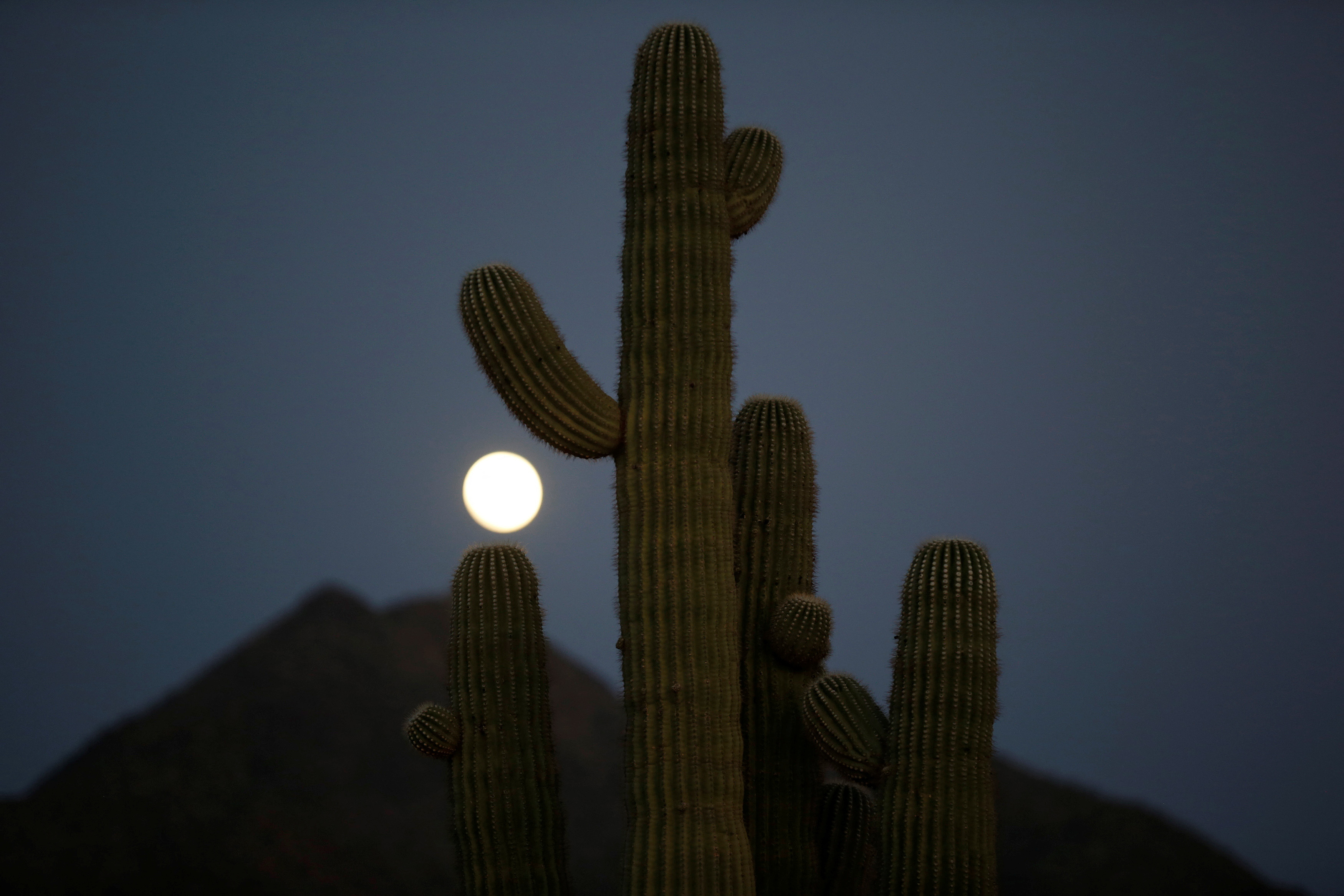
A full moon rises over a cactus in Phoenix, Arizona February 2, 2015. REUTERS/Lucy Nicholson

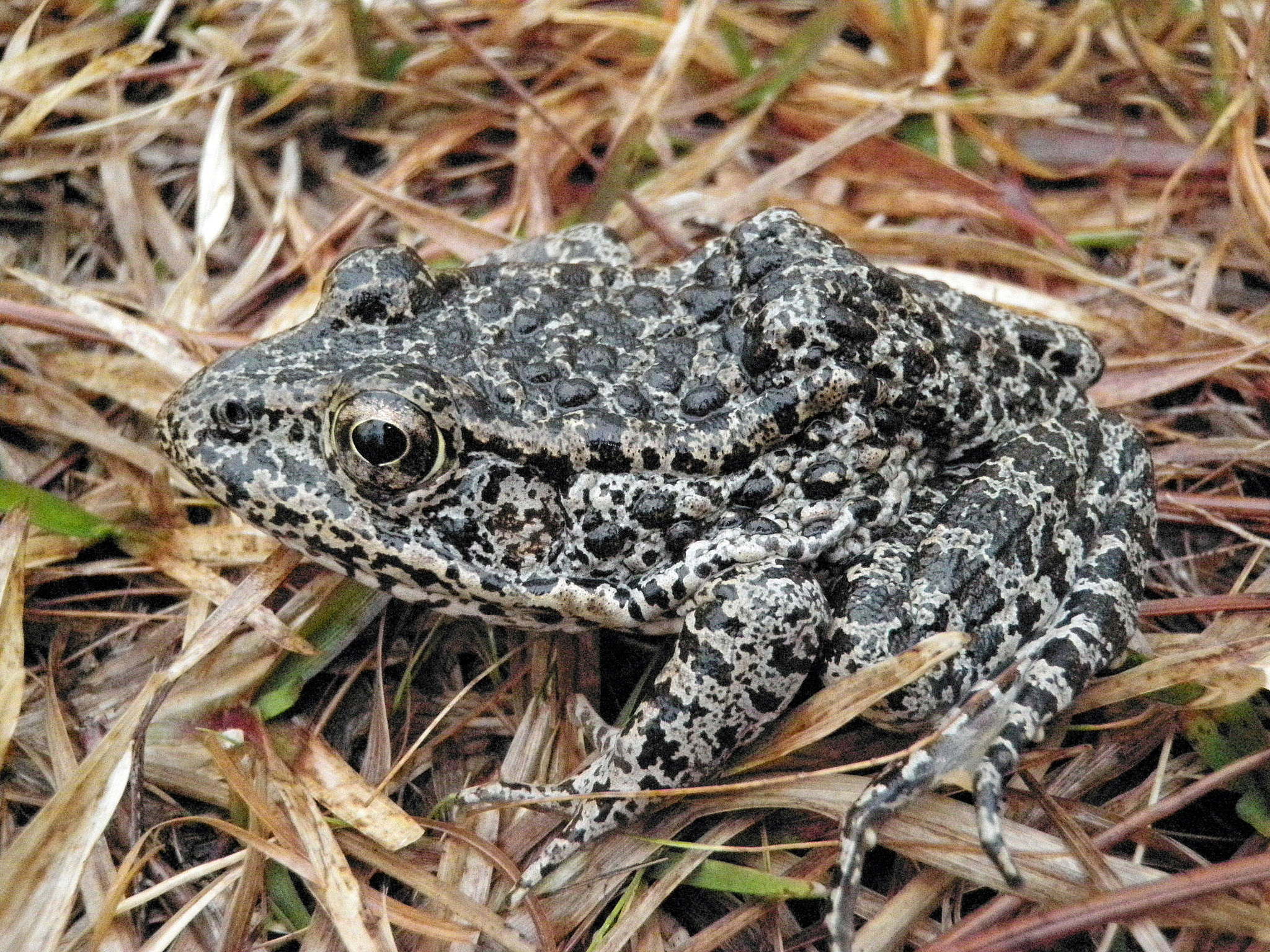
The endangered dusky gopher frog, a darkly colored, moderately sized frog with warts covering its back and dusky spots on its belly, is shown in this undated handout photo obtained by Reuters January 22, 2018. U.S. Fish and Wildlife Service/Handout via REUTERS
Categories
Selected Articles

Putin has never threatened me or Germany: Scholz – Anadolu Agency | English

Putin has never threatened me or Germany: Scholz  Anadolu Agency | English
Categories
Selected Articles

As Russia Strikes Ukrainian Civilians, Putin Tells His People the War Is Just – The New York Times

As Russia Strikes Ukrainian Civilians, Putin Tells His People the War Is Just  The New York Times
Categories
Selected Articles

The Netanyahu’s return – Modern Diplomacy

The Netanyahu’s return  Modern Diplomacy
Categories
Selected Articles

Democratic party leaders like Biden even if they don’t love him — and that may just be enough – CNN

Democratic party leaders like Biden even if they don’t love him — and that may just be enough  CNN
Categories
Selected Articles

Biden has revived democratic capitalism – and changed the economic paradigm – The Guardian

Biden has revived democratic capitalism – and changed the economic paradigm  The Guardian
WP Radio
WP Radio
OFFLINE LIVE