Categories
Audio Sources - Full Text Articles

The latest news on Russia“s war on Ukraine

2023-01-29T15:22:15Z

Ukraine’s military said its forces repelled an attack in the area of Blahodatne in the eastern part of the Donetsk region, while Russia’s Wagner private military group said it took control of the village.

* Russia accused the Ukrainian military of deliberately striking a hospital in a Russian-held area of eastern Ukraine on Saturday in what it said was a war crime that killed 14 people and wounded 24 patients and medical staff. There was no immediate response to the allegations from Ukraine. Reuters was not able to independently verify the report.

* Ukrainian President Volodymyr Zelenskiy described the situation at the front as “extremely acute“, especially in the eastern Donetsk region where Russia is stepping up an offensive.

* Tearful mourners in Kyiv commemorated a British volunteer aid worker, Andrew Bagshaw, killed while attempting a rescue mission from the eastern Ukrainian town of Soledar.

* Russian President Vladimir Putin is open to contacts with German Chancellor Olaf Scholz though has no phone call scheduled with him, a Kremlin spokesman said. Scholz, who last week approved providing Leopard 2 battle tanks to Ukrainian forces, was quoted in a published interview as saying he would speak to Putin again but the onus was on the Russian leader to withdraw troops from Ukraine “to end this horrendous, senseless war…”

* Russia’s deputy foreign minister Sergei Ryabkov will hold a meeting with Lynne Tracy, the new U.S. ambassador, early next week, RIA news agency reported.

* Zelenskiy condemned the idea of neutrality in sports at a time when his country’s athletes fight and die in war, while their Russian counterparts might be allowed to compete.

* Russia said it will not hold annual talks with Japan on renewing a pact that allows Japanese fishermen to operate near disputed islands, saying Japan had taken anti-Russian measures.

* Expedited talks are under way among Ukraine and its allies about its requests for long-range missiles that it says are needed to prevent Russia from destroying its cities, a top aide to President Zelenskiy said.

* German arms-maker Rheinmetall is ready to greatly boost output of tank and artillery munitions to satisfy strong demand in Ukraine and the West, and may start producing HIMARS multiple rocket launchers in Germany, CEO Armin Papperger told Reuters.

* Ukraine has been promised 321 heavy tanks by several countries, its ambassador to France said.

* Poland will send an additional 60 tanks to Ukraine on top of 14 German-made Leopard 2 tanks it has pledged, the Polish prime minister said in an interview with Canadian television.

* Ukraine imposed sanctions on 182 Russian and Belarusian companies, and three individuals, in the latest of a series of steps by Zelenskiy to block their links to his country.

* On a trip to Turkey and the Middle East this week, the U.S. Treasury Department’s top sanctions official will warn countries and businesses that they could lose U.S. market access if they do business with entities subject to U.S. curbs as Washington cracks down on Russian attempts to evade sanctions.

Related Galleries:

People take shelter inside a metro station during massive Russian missile attacks in Kyiv, Ukraine January 26, 2023. REUTERS/Viacheslav Ratynskyi

Zoya Mykolaivna, 84, removes debris in front of her apartment at a residential building damaged by a Russian military strike, amid Russia’s invasion of Ukraine, in Kherson, Ukraine January 25, 2023. REUTERS/Nacho Doce

Protesters gather in support of Ukraine during a meeting of European Union (EU) Foreign Ministers in Brussels, Belgium January 23, 2023. REUTERS/Johanna Geron

South Africa’s Foreign Minister Naledi Pandor and Russia’s Foreign Minister Sergei Lavrov attend a media briefing, in Pretoria, South Africa, January 23, 2023. REUTERS/Siphiwe Sibeko
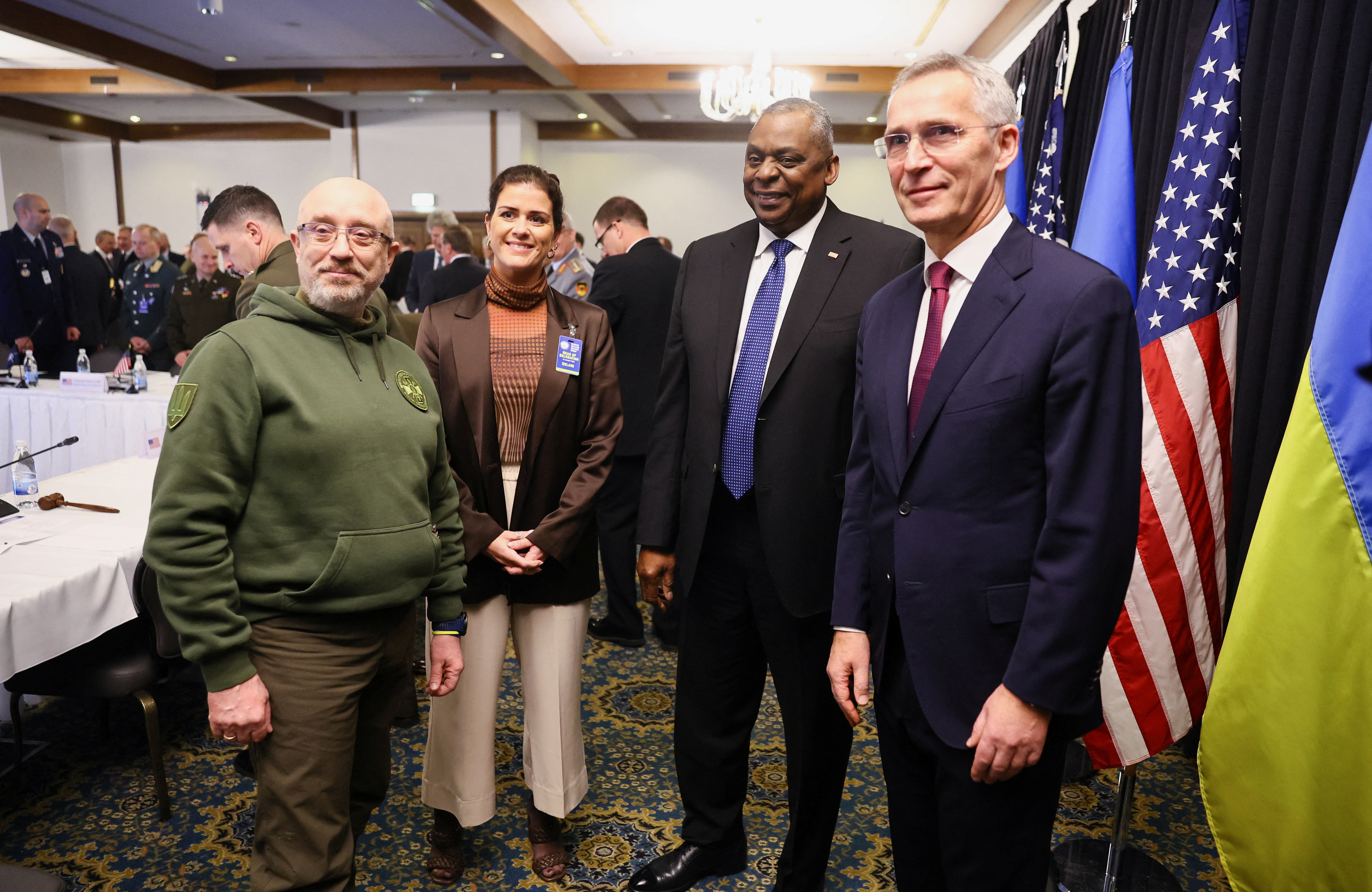
U.S. Secretary of Defense Lloyd Austin, Ukraine’s Defense Minister Oleksiy Reznikov, Iceland’s Minister of Foreign Affairs Thordis Kolbrun Reykfjord Gylfadottir and NATO Secretary General Jens Stoltenberg, meet to discuss how to help Ukraine defend itself, at Ramstein Air Base, Germany, January 20, 2023. REUTERS/Wolfgang Rattay
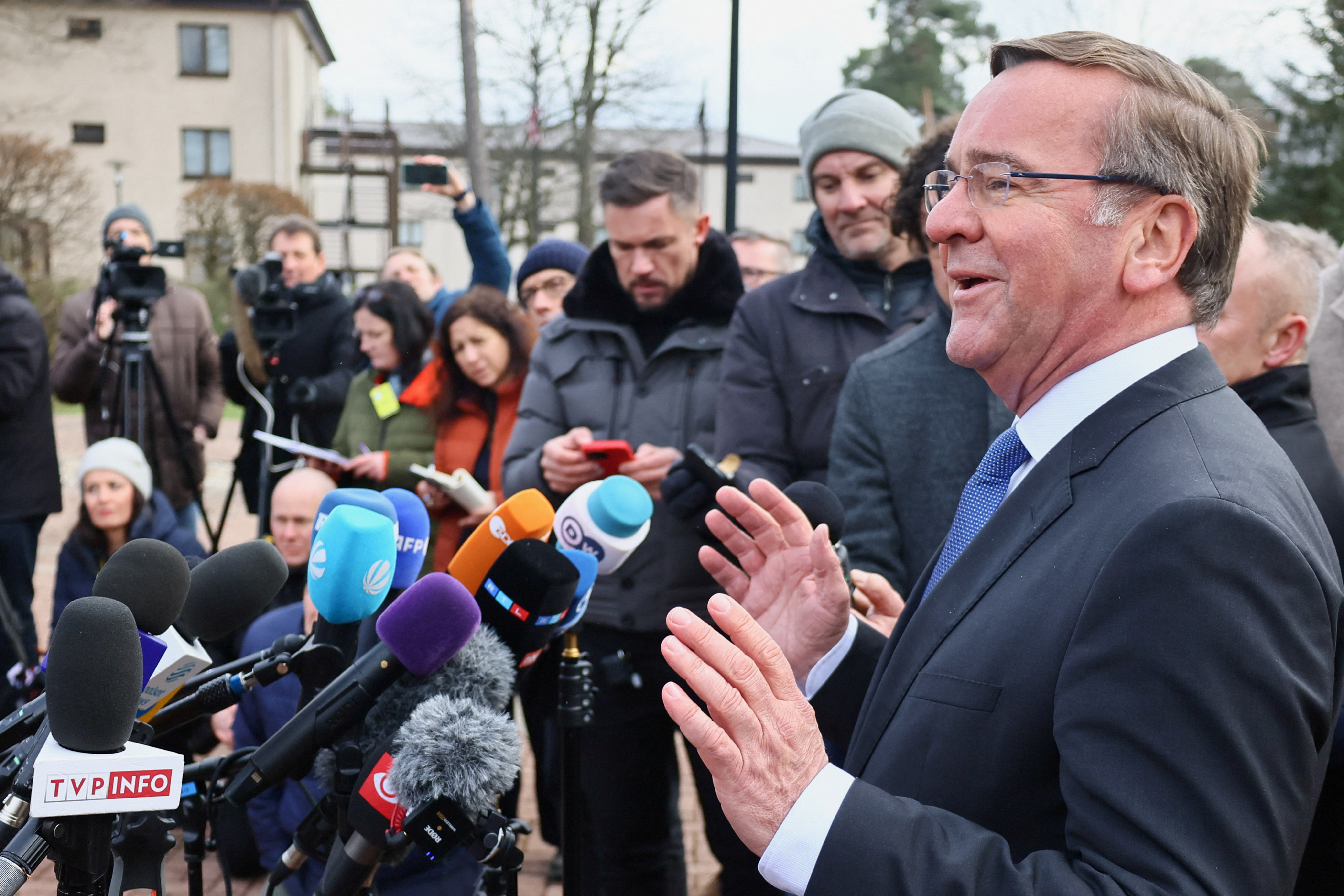
German Defence Minister Boris Pistorius speaks to the media at Ramstein Air Base, Germany, January 20, 2023. REUTERS/Wolfgang Rattay

A relative looks at the site of a helicopter crash, amid Russia’s attack on Ukraine, in the town of Brovary, outside Kyiv, Ukraine, January 19, 2023. REUTERS/Nacho Doce

An employee works on the Senator APC at vehicle manufacturer Roshel after Canada’s defence minister announced the supply of 200 Senator armored personnel carriers to Ukraine, as part of a new package of military assistance, in Mississauga, Ontario, Canada January 19, 2023. REUTERS/Carlos Osorio

A Polish Leopard 2PL tank fires during Defender Europe 2022 military exercise of NATO troops including French, American, and Polish troops, amid the Russian invasion of Ukraine, at the military range in Bemowo Piskie, near Orzysz, Poland May 24, 2022. REUTERS/Kacper Pempel

A general view of people said to be Russian soldiers seeking for shelter, in Kurdyumivka, amid Russia’s attack on Ukraine, in Donetsk region, Ukraine in this screengrab obtained from a handout drone footage on January 22, 2023. National Guard of Ukraine Press Service/Handout via REUTERS
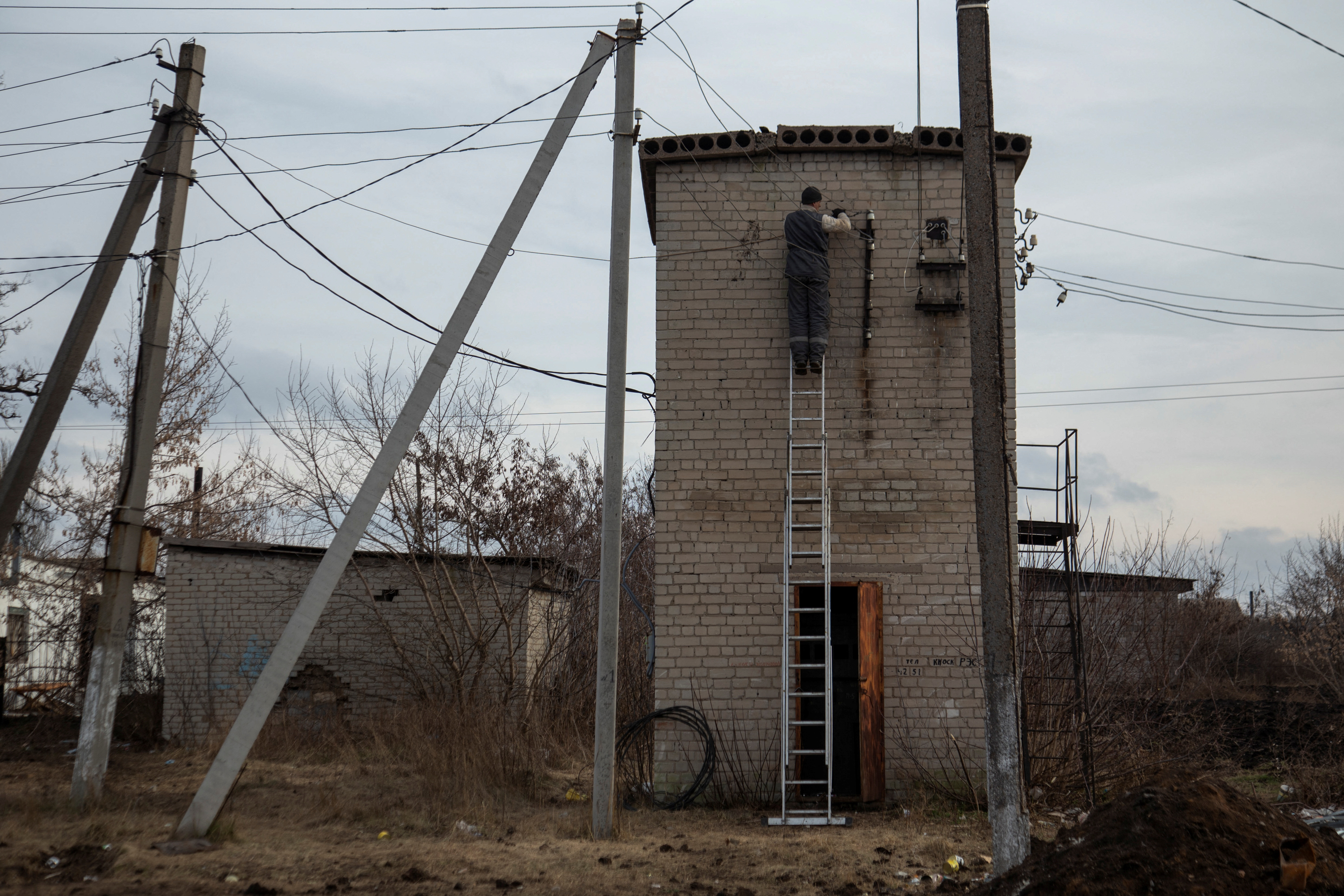
A man repairs power lines, amid Russia’s attack on Ukraine, in the village of Bilokuzmynivka, Donetsk region, Ukraine January 21, 2023. REUTERS/Oleksandr Ratushniak

Ritual workers carry bodies of victims as they walk past tributes for victims, near the site of a helicopter crash, amid Russia’s attack on Ukraine, in the town of Brovary, outside Kyiv, Ukraine, January 18, 2023. REUTERS/Nacho Doce

Emergency personnel work at the site where an apartment block was heavily damaged by a Russian missile strike, amid Russia’s attack on Ukraine, in Dnipro, Ukraine January 15, 2023. REUTERS/Clodagh Kilcoyne

Emergency personnel work at the site where an apartment block was heavily damaged by a Russian missile strike, amid Russia’s attack on Ukraine, in Dnipro, Ukraine January 15, 2023. REUTERS/Clodagh Kilcoyne
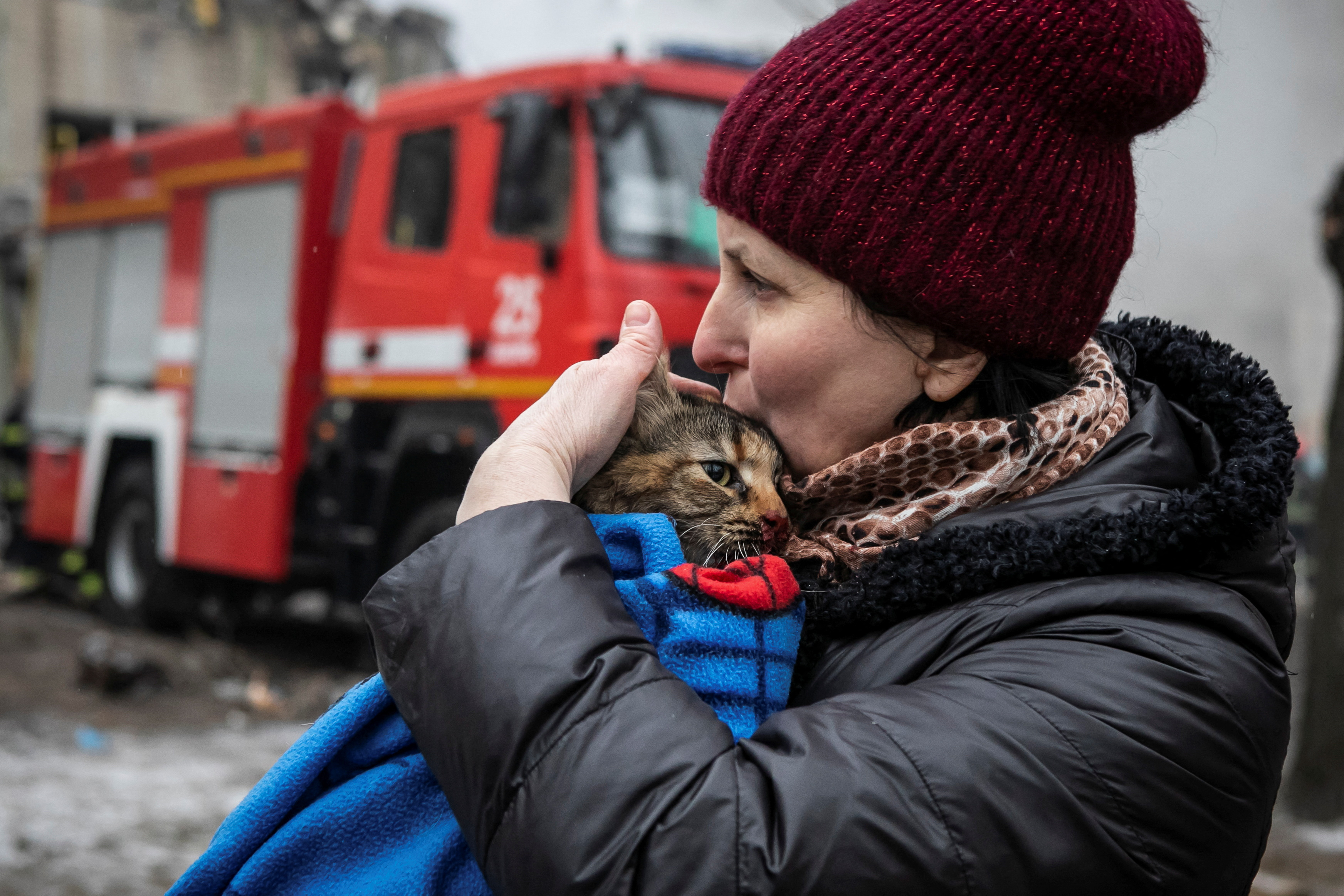
A local woman holds her cat rescued by emergency workers at the site where an apartment block was heavily damaged by a Russian missile strike, amid Russia’s attack on Ukraine, in Dnipro, Ukraine January 15, 2023. REUTERS/Yevhenii Zavhorodnii

Ukrainian servicemen fire a BM-21 Grad multiple launch rocket system towards Russian positions on a frontline near the town of Bakhmut, amid Russia’s attack on Ukraine, in Donetsk region, Ukraine January 15, 2023. REUTERS/Oleksandr Ratushniak

Natalya and Yelena, 65, who didn’t give their family names react while standing in a corridor of a temporary accommodation centre located in a local dormitory for civilians evacuated from the salt-mining town of Soledar in the course of Russia-Ukraine conflict, in Shakhtarsk (Shakhtyorsk) in the Donetsk Region, Russian-controlled Ukraine, January 14, 2023. REUTERS/Alexander Ermochenko
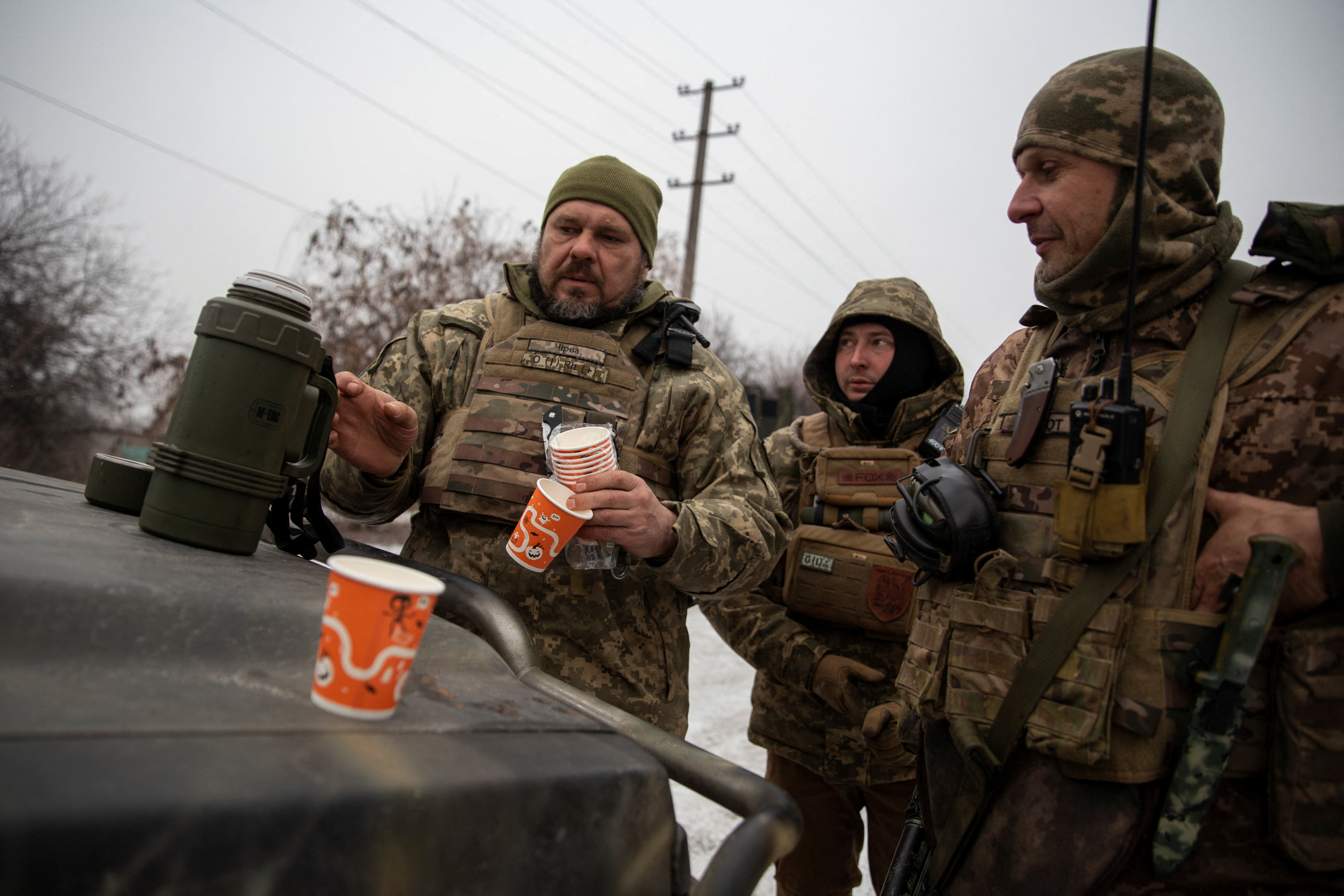
Ukrainian servicemen have coffee before moving to their position on a frontline near the town of Bakhmut, amid Russia’s attack on Ukraine, in Donetsk region, Ukraine January 15, 2023. REUTERS/Oleksandr Ratushniak

A woman pushes a stroller loaded with a sack of coal for heating her house, amid Russia’s attack on Ukraine, in the village of Nykyforivka, Donetsk region, Ukraine, January 15, 2023. REUTERS/Oleksandr Ratushniak

People take shelter inside a metro station during massive Russian missile attacks in Kyiv, Ukraine January 14, 2023. REUTERS/Viacheslav Ratynskyi

People dance to music as they take shelter inside a metro station during massive Russian missile attacks in Kyiv, Ukraine January 14, 2023. REUTERS/Clodagh Kilcoyne

Emergency personnel work at the site where an apartment block was heavily damaged by a Russian missile strike, amid Russia’s attack on Ukraine, in Dnipro, Ukraine January 15, 2023. REUTERS/Clodagh Kilcoyne

Emergency personnel work at the site where an apartment block was heavily damaged by a Russian missile strike, amid Russia’s attack on Ukraine, in Dnipro, Ukraine January 15, 2023. REUTERS/Clodagh Kilcoyne

A satellite view shows a closer view of exploding munitions, in Bakhmut, Ukraine, January 3, 2023. Satellite image 2023 Maxar Technologies./Handout via REUTERS

A satellite view shows destroyed apartment buildings and homes, in Soledar, Ukraine, January 10, 2023. Satellite image ?2023 Maxar Technologies./Handout via REUTERS

Categories
Audio Sources - Full Text Articles

EU says over 10 search and rescue teams mobilised to Turkey after earthquake

2023-02-06T11:53:03Z

Rescuers search for survivors under the rubble following an earthquake in Diyarbakir, Turkey February 6, 2023. REUTERS/Sertac Kayar

More than 10 search and rescue teams from the EU have been mobilised in the wake of the major earthquake that has hit Turkey, a spokesperson for the European Commission told reporters on Monday.

“Urban Search and Rescue teams have been quickly mobilised from Bulgaria, Croatia, Czechia, France, Greece, Hungary, Malta, the Netherlands, Poland, Romania to support the first responders on the ground,” the European Commission said in a statement.

Italy, Spain and Slovakia have offered their rescue teams to Turkey as well.

The EU said it was also ready to support those affected in Syria, but said it had not yet received a request from the country to activate the EU’s Civil Protection Mechanism, which coordinates assistance from EU and other European countries.

Categories
Audio Sources - Full Text Articles

Norway plans $7 billion in aid to Ukraine over five years

2023-02-06T11:23:01Z

Norway’s Prime Minister Jonas Gahr Stoere arrives for meeting with Ukraine’s President Volodymyr Zelenskiy, as Russia’s attack on Ukraine continues, in Kyiv, Ukraine July 1, 2022. Ukrainian Presidential Press Service/Handout via REUTERS

Norway’s prime minister proposed on Monday that his country, a major petroleum exporter, should provide some 75 billion Norwegian crowns ($7.3 billion) in aid to Ukraine over five years.

“We aim to secure a unified agreement on this in parliament,” Labour Party Prime Minister Jonas Gahr Stoere told a news conference after meeting Norwegian opposition leaders.

The Nordic country has seen its government income swell to record levels following Russia’s invasion of Ukraine as the price of gas sold to Europe soared last year.

Stoere, faced with criticism from some countries and parts of the opposition at home for indirectly profiting from the war, announced in late 2022 a plan to give multi-year aid to Ukraine, without saying how much.

In 2023, half the aid would fund military requirements while the rest would go to humanitarian needs, although this split could change in coming years, he said.

Norway should also give 5 billion crowns extra this year in aid to poor countries suffering from soaring global food prices in the wake of the Ukraine war, Stoere said.

Stoere’s minority government must seek parliament’s approval for the funds, which will increase the annual spending of Norway’s sovereign wealth fund, the world’s largest with assets of close to $1.4 trillion.

The main opposition Conservative Party said it expected to back the plan, which is subject to final negotiations in coming weeks.

In 2022, Norway became Europe’s largest gas supplier due to a drop in Russian gas flows. It is also Europe’s second-largest oil producer after Russia.

Inflows to the Norwegian wealth fund swelled last year from the state’s petroleum revenues to the tune of 1.1 trillion crowns or $108 billion – nearly three times the previous record, set in 2008.

($1 = 10.2835 Norwegian crowns)

Categories
Audio Sources - Full Text Articles

Family of 3 found dead in apparent suicide pact were ‘hell-bent’ on Trump winning, thought it could be ‘the end’ if he lost: reports

The home of the Daub familyThe Daub family’s home in York, Pennsylvania.

Google Maps

  • A family of three was found shot dead in their Pennsylvania backyard last week.
  • Police are describing it as a suicide pact, citing handwritten documents left behind.
  • A family friend said they were conservative Christians who were “hell-bent” on Donald Trump winning in 2020.

A family of three from Pennsylvania was found shot dead in their backyard last week in what police are calling a suicide pact, according to NBC News.

Police discovered the bodies of Morgan Daub, 26, and her parents James Daub, 62, and Deborah Daub, 59, in York County, Pennsylvania, after neighbors requested a welfare check, NBC News reported.

The West Manchester Township Police Department said it appeared to be a “joint decision” to end their lives, citing notes found inside the family home, the news outlet said.

The police department added that it believes that Deborah Daub killed her husband, and was then killed by his daughter, who died by suicide, adding that there is no evidence that anybody else was involved, according to NBC News.

The lead detective in the case, Timothy Fink, told local media outlet York Dispatch that the department reached this conclusion from handwritten notes left behind by the family members, but added: “We may never know with certainty exactly who fired each shot.”

An investigation into the deaths has concluded for now, Fink said, per York Dispatch.

According to those who knew the family, and who spoke to NBC News, they were Christian conservatives who were outspoken in their political beliefs.

Deborah Daub and her daughter were “huge” supporters of former President Donald Trump, said Bret Stabley, who knew the family as they frequented his store, per NBC News.

The family “was never shy about letting anybody know what their beliefs were,” Stabley said, according to NBC News. 

A neighbor, who asked to remain anonymous, told the media outlet that the family’s front yard was “littered” with pro-Trump banners and, later, anti-abortion signs.

Stabley told NBC News that Deborah Daub and her daughter were “hell-bent on Trump winning” the 2020 election, adding: “Like this could be the end if he doesn’t.”

He said he stopped seeing them after Trump’s election loss.

Stabley also said that Morgan, the daughter, was “very meek,” had been homeschooled, and often had her mother speak on her behalf, according to NBC News.

In an interview with The Christian Post, a childhood friend described Morgan as having grown up in a “very uptight Christian household,” adding that she wasn’t allowed to use social media, have a boyfriend, or go out with her friends. 

The lead detective, Fink, also said that documents left behind at the family’s home showed that Morgan had told her mother that she was having “auditory hallucinations” that weren’t improving, per York Dispatch.

Read the original article on Business Insider
Categories
Audio Sources - Full Text Articles

A laid-off Twitter manager said the company wanted to make people’s lives better, but that ‘went to garbage’ after Elon Musk’s takeover

Elon MuskA laid-off Twitter manager told The BBC that he’s “worried” about the company’s future under the ownership of Elon Musk.

Carina Johansen/Getty Images

  • A former Twitter manager says the company’s plans “went to garbage” after Elon Musk bought it.
  • Amir Shevat told the BBC he was worried about Twitter’s future. He was laid off in November.
  • The number of ex-staff suing Twitter “goes up daily,” a lawyer fighting the company told the broadcaster.

A laid-off Twitter manager told the BBC that he’s “worried” about the company’s future under the ownership of Elon Musk.

“We wanted to make people’s lives more pleasant and more productive,” Amir Shevat told the broadcaster. “And all of that went to garbage when Elon bought the company.”

Twitter says that its mission is to “use the positive power of Twitter to strengthen our communities through our platform, people, and profits.” It says this includes defending civil liberties, tackling hate speech, and promoting equality.

Musk, who bought Twitter for $44 billion in late October, is under fire from its users, staff, advertisers, and tech analysts over his leadership of the company. 

In his less than four months since taking control of Twitter, Musk has introduced sweeping changes to the platform. This includes revamping Twitter Blue, the site’s paid subscription service, and allowing controversial figures like conservative satire site The Babylon Bee and former president Donald Trump back onto the platform.

Advertisers have fled the site over concerns about content moderation, with some reports suggesting a rise in hate speech, and Musk has seemingly introduced and subsequently scrapped new policies on a whim.

Musk, for his part, has claimed that Twitter has added record numbers of daily active users since he took over.

In December, he said he would step down as CEO once he finds someone “foolish enough” to replace him after a poll on the site.

One of Musk’s first moves as CEO was to fire four of the company’s top execs. A week later, on November 4, he laid off around half of Twitter’s workforce. Musk said that he had “no choice” but to lay off thousands of workers, claiming that the company was losing more than $4 million a day. Since then, more staff have been fired or laid off or have chosen to quit.

Shevat was one of the employees laid off on November 4. The then-head of product for Twitter’s developer platform led a team of around 150 employees, the majority of whom were also laid off, he previously told Insider. Shevat said that his team realized they had been let go when they were unable to access their company accounts. Shevat himself found out he’d lost his job after being locked out of his Slack account and work emails on his phone.

Affected staff were sent an email saying that they were being laid off as part of a “workforce reduction to help improve the health of the company.”

Shevat told the BBC that Twitter should have laid off staff “in a legal way, empathetic way and a highly communicative way.”

“And in all of these Elon, in his leadership, failed,” he said. The way Musk had treated Twitter staff was “unjustifiable,” he added.

Shevat has entered an arbitration process against the company. Many Twitter employees signed arbitration agreements as part of their employment contracts, which said they would bring legal disputes against the company in arbitration rather than in court and included a class-action waiver.

Shevat’s attorney, Lisa Bloom, told the BBC that she was representing around 100 of Twitter’s laid-off workers in the US and that “the number goes up daily.” Shannon Liss-Riordan, a lawyer also representing laid-off Twitter workers, has been an outspoken critic of how Musk treated his staff and said in mid-January that she’s already filed 500 individual demands for arbitration on behalf of former workers.

Read the original article on Business Insider
Categories
Audio Sources - Full Text Articles

Adani cut its UK audit bill in half by dumping a Big 4 firm for a much smaller rival, filings show as scrutiny of its safeguards deepens

Gautam Adani sitting at a conference summitChairman and founder of the Adani Group Gautam Adani seen during the News18 Rising India Summit on February 25, 2019 in New Delhi, India.

Sanjeev Verma/Hindustan Times via Getty Images

  • Short-seller Hindenburg has attacked Adani’s use of small auditors in a report alleging fraud.
  • The Indian conglomerate dropped Deloitte for the 12th largest auditor in the UK, per Accountancy Age.
  • Adani stocks have lost about $118 billion in value amid a weekslong rout after the short-seller’s bombshell attack.

Adani Group cut its audit bill in the UK nearly in half by dropping Big 4 accounting group Deloitte for the country’s 12th largest firm.

Corporate filings first analyzed by the Financial Times and seen by Insider show the embattled Indian conglomerate, in turmoil following a report by short-seller Hindenburg into its business practices, used Deloitte for audits of its 10 UK-listed companies under Adani Energy Holdings Limited in 2021.

Last year, the group switched to Crowe UK to handle its audits. Adani’s audit bill subsequently dropped from £257,000 (around $309,000) in 2021 to £143,000 (around $172,000) in 2022. 

Crowe UK audited Adani’s UK-listed renewable energy companies after the Indian group switched from Deloitte, following its acquisition of the group of power plants for $3.5 billion from SoftBank Group and Bharti Enterprises in 2021.

According to its website, Crowe UK is the country’s ninth-largest accounting firm by a measure of fee income. A ranking by trade publication Accountancy Age listed Crowe as the 12 biggest firm in the UK. The global arm of Crowe sits outside the world’s top six accountancy firms in Accountancy Age’s international ranking.

This clashes with Adani’s 413-page rebuttal to Hindenburg’s report, where it said its portfolio companies “follow a stated policy of having global big 6 or regional leaders as Statutory Auditors.”

Hindenburg has accused the Indian conglomerate of stock market manipulation and fraud and highlighted several unusual business practices, as it revealed it held a short position on Adani stocks.  

One of the “key accounting red flags” outlined by Hindenburg in its scathing report into Adani was the group’s use of a small audit firm made up of several employees in their early twenties to audit the accounts of Adani Enterprises and Adani Total Gas, which were at one point worth a combined $100 billion in market value. 

The revelations have prompted one of Adani’s partners, France-based TotalEnergies, to say the Indian giant had asked a Big 4 accounting firm for a “general audit” of its accounts, as it scrambles to recover from a crisis that has wiped out more than $118 billion in the groups’ collective market value in the last fortnight.

Crowe UK and Adani Group didn’t immediately respond to Insider’s requests for comment. 

Read the original article on Business Insider
Categories
Audio Sources - Full Text Articles

Elon Musk says his last 3 months were ‘extremely tough’ because he had to ‘save Twitter from bankruptcy’

An image of new Twitter owner Elon Musk is seen surrounded by Twitter logos in this photo illustration.Elon Musk acquired Twitter on October 27.

Getty Images

  • Elon Musk said Sunday he’d had an “extremely tough” three months. 
  • He said he’d had to “save Twitter from bankruptcy” while “fulfilling essential Tesla & SpaceX duties.”
  • Musk was responding to a report in The Wall Street Journal about his workload, health, and sleep.

Elon Musk has said he’s had an “extremely tough” three months trying to juggle his duties at Twitter, Tesla, and SpaceX.

The billionaire tweeted Sunday that he’d had to “save Twitter from bankruptcy” while “fulfilling essential Tesla & SpaceX duties,” adding: “Wouldn’t wish that pain on anyone.”

Musk completed his $44 billion acquisition of Twitter in October, having tried for months to back out of the deal. Since taking control of the company, he’s laid off thousands of employees as he seeks to cut costs across the board.

Musk, who said previously that Twitter was losing more than $4 million a day, said Sunday the company was now “trending to breakeven if we keep at it.” However, he added that Twitter was not “financially healthy yet.”

Musk was responding to a report in The Wall Street Journal about the state of his health, his extreme workload, and the amount of sleep he gets.

He said previously his workload increased from 80 hours per week to more than 120 hours per week after taking over Twitter. “Go to sleep, I wake up, work, go to sleep, work, do that seven days a week,” he told billionaire investor Ron Baron in an interview in November 2022.

Employees have said Musk regularly sleeps in Twitter’s San Francisco headquarters, where he’s turned some office space into bedrooms for staff.

Musk has had issues with his back and neck. In 2020, he responded to a Twitter user who asked about a scar on his neck, saying he’d had two spinal cord surgeries.

Musk has promised to eventually bring in another executive to serve as Twitter CEO and has played down concerns about the time he has to work on his other businesses.

Representatives for Musk did not immediately respond to Insider’s request for comment.

Read the original article on Business Insider
Categories
Audio Sources - Full Text Articles

Tech CEOs screwed up, and it’s time to hold them accountable

Happy first-Monday-of-the-month. I’m Matt Weinberger, deputy editor of Insider’s tech analysis team, filling in for Diamond Naga Siu. 

This particular Monday comes with something of a hangover in the tech industry, after a week that saw Meta, Alphabet, Apple, and Amazon report earnings that showed just how much of a toll the economy has taken on Silicon Valley. 

The tech CEOs have struck a tone of contrition, apologizing for over-hiring and losing focus at the height of the pandemic, even as they all lay off workers (all except Apple, that is) and call for a renewed drive towards efficiency. But where does the buck really stop?  

My friend Ed Zitron argues in a column for Insider that workers are taking the fall and losing their livelihoods for what’s ultimately those CEOs’ fault: “Any executive who participates in decision-making that leads to hundreds or thousands of people losing their jobs should be the one leading them out the door,” he writes. 

The one thing that everybody seems to agree on is that it’ll get darker before the next dawn in Silicon Valley, so expect a lot more conversation over how and why we got here. 

Here’s what you want to know as we enter the first full week of February:


If this was forwarded to you, sign up here. Download Insider’s app here.


CEO of Alphabet and Google Sundar Pichai in Warsaw, Poland on March 29, 2022Sundar Pichai, CEO of Alphabet and Google

Mateusz Wlodarczyk/NurPhoto via Getty Images

1. Is it time for CEOs to start losing their jobs? Ed Zitron argues for Insider that the thousands of tech workers who lost their jobs in recent months are actually just taking the fall for the real problem in Silicon Valley — CEOs who aren’t up to the task of leadership.

  • “As the sole person in charge, they’re responsible for misjudging the macroeconomy, making terrible investments, and then following along with the industry in a shortsighted attempt to please Wall Street,” Ed writes.
  • CEO pay has skyrocketed over the years, but accountability of these top execs hasn’t kept pace, he writes. It means they share in the upsides of their companies’ growth, but rarely face consequences when something goes wrong.
  • He praised the CEOs of Apple and Intel for recently taking pay cuts as their companies hit tougher times. But says that there needs to be more serious consequences for chief executives who fumble tough situations, up to and including losing their jobs.

Read more about the tech CEO screw-up here.


In other news:

Elon Musk in 2020

Yasin Ozturk/Getty Images

2. Elon Musk secures a favorable verdict. Late Friday afternoon, a federal jury officially ruled that the Tesla CEO’s infamous “funding secured” tweet didn’t harm shareholders, making him not liable for damages.

3. Robots are a programmer’s best friend. OpenAI has a tool called Codex that writes code all on its own. But experts tell Insider’s Tom Maxwell that there’ll always be a good career for any human who knows how to program. Read more about how robots are helping programmers, not replacing them.

4. The most normal Amazon shopper. New data shows that Amazon’s typical retail customer is a white, college-educated woman who lives in the Southeast United States and makes about $80,000 a year. Now you know. Read more here.

5. Robots may be a Wall Street worker’s best friend, too. To go back to OpenAI again, here’s Insider’s look at how ChatGPT could shake up financial services. Industry insiders say that ChatGPT represents a powerful productivity-enhancing tool for portfolio managers, fraud investigators, and anyone else who works with money. 

6. Twitter wants $100 from developers. Twitter CEO Elon Musk says that it’s considering charging developers $100 a month for access to the social network’s API, which lets third-party software access the platform’s data. Musk says it’d help guard against “bad” bots, but it remains to be seen how those developers will respond. Read the full story.

7. “As cities move to ban gas stoves, I tried going all-electric in the kitchen.” Insider’s Adam Rogers set out to answer one simple question: How well does induction actually cook? The results left him fired up. Read the full story. 

8. Bill Gates says vaccines > Mars. The Microsoft cofounder and philanthropist says that Elon Musk’s self-appointed mission to go to Mars isn’t as good a use of money as investing in saving lives via spreading vaccine availability. No shade, though, as Gates also says that he thinks Musk’s Tesla has had a positive impact on the world.


Odds and Ends:

AI tool replaced ex with a snake

Picsart

9. Raise the red flag with AI. A new app called Picsart promises to use AI to literally turn your lyin’, cheatin’, snake of an ex into a snake (or a dog, or a literal red flag) in your old photos. It seems like a good way to make a statement on social media, at the very least. Read more.

10. A Tesla loses its steering wheel. A Tesla driver says that the steering wheel on his brand-new Model Y fell off while he was driving on a New Jersey highway. Thankfully, nobody was hurt, but the driver is calling on Tesla to take accountability.


What we’re watching today:

  • Activision Blizzard, the video game giant that Microsoft is fighting American and European regulators to acquire, reports earnings after the bell.
  • Pinterest and Take Two Interactive Software (the publishers of “Grand Theft Auto V,” among other hit games) also report on Monday.

Curated by Matt Weinberger in San Francisco. (Feedback or tips? Email mweinberger@insider.com or tweet @gamoid.) Edited by Hallam Bullock (tweet @hallam_bullock) in London.

Read the original article on Business Insider
Categories
Selected Articles

Book excerpt: ‘October Surprise: How the FBI Tried to Save Itself and Crashed an Election,’ by Devlin Barret – The Washington Post washingtonpost.com/national-secur…

Book excerpt: ‘October Surprise: How the FBI Tried to Save Itself and Crashed an Election,’ by Devlin Barret – The Washington Post washingtonpost.com/national-secur…

The post Book excerpt: ‘October Surprise: How the FBI Tried to Save Itself and Crashed an Election,’ by Devlin Barret – The Washington Post washingtonpost.com/national-secur… first appeared on The Brooklyn Radio – bklynradio.com.

Categories
Audio Sources - Full Text Articles

Pet Food Makers Think Beyond Animal Meat

For Glenn Rankin, eating dog food is just part of a day’s work.

As managing director of British startup Yora Pet Foods, Rankin’s job is figuring out how to lure dogs — or at least, their grocery-shopping owners — away from traditional pet fare that contains animal meat. His company’s kibble, made from black soldier fly larvae, “tastes a bit like Stilton [cheese] on biscuits.” (Gizmo, Rankin’s five-year-old labrador, who switched from chicken-based pet food to an insect-based diet in 2020, was unable to comment.)

After cosmetic raw material; dog and cat food produced from fly in Izmir
Mehmet Emin Menguarslan—Anadolu Agency/Getty ImagesFood for dogs and cats, produced from eco-friendly black soldier flies, in Izmir, Turkiye, on Jan. 21, 2023.

[time-brightcove not-tgx=”true”]

Livestock is responsible for roughly 14.5% of global greenhouse gas emissions, according to the United Nations. A lot of that is for human food, and some of that is for pet food. How much? Looking at just the US (the world’s largest market of pet owners), one 2017 study found that if the nation’s 163 million pet dogs and cats formed their own country, its meat consumption would rank fifth in the world. Another study, from 2020, found that the global production of pet food emits annual greenhouse gases on par with the Philippines.

Read More: A New Study Ranks the Climate Pawprint of Different Types of Pet Food

For a handful of startups including Yora, the solution is simple: Change what the world’s pets are eating. Since 2015, Yora has been developing insect-based alternatives, which it now sells in more than two-dozen countries. Rankin says sales almost doubled in 2022, to £2.2 million ($2.7 million) from a year earlier.

Vegan dogs and death threats

Bugs aren’t the only option on the menu. Shortly after Wild Earth co-founder Ryan Bethencourt introduced his plant-based dog food on US reality show Shark Tank in 2019, “I got death threats,” he says. The overwhelming theme of the feedback, including from the show’s judges, was that dogs need to eat meat. Billionaire entrepreneur Mark Cuban was the only “Shark” to invest in Wild Earth, “betting” $550,000 in exchange for a 10% stake.

That gamble may look like less of one now. Last year, Berkeley, California-based Wild Earth sold $12 million worth of plant-based dog food in the US, up 2,300% from 2019, according to Bethencourt. The company’s 14 products include peanut butter dog treats as well as dog food made from dried yeast and vegetables. Bethencourt says internal surveys show that Wild Earth’s customer base is evolving, too: It’s no longer dominated by vegetarians and vegans.

San Francisco-based V-Dog, New York’s Bramble Pets, and Gather, a brand created by pet food producer Petcurean in Chilliwack, Canada, are all selling similar products. Globally, sales of vegan dog food hit $12 billion in 2021, according to consultancy Future Market Insights, and are projected to see 7% growth over the next decade. Similar growth is expected for insect-based pet food — global sales there hit an estimated $7 billion in 2021 — though both remain minor compared to $105 billion in annual global pet food sales.

Read More: Hold That Bone: More Owners Are Making Their Dogs Go Vegan

The industry’s biggest players are also signaling interest in protein alternatives. Nestle SA’s Purina is experimenting with dog food made from Asian carp, an invasive freshwater fish prevalent in American waterways. Mars Inc., which owns pet food brands such as Pedigree and Royal Canin, in 2021 added an insect-based cat food line called Lovebug. (Nestle has also pledged to pack all of its pet food using reusable or recyclable materials by 2025, and Mars aims to power its entire operation with renewable energy.)

Ironically, traditional pet food itself addresses an environmental problem: food waste. Most regular dog and cat food is made with off-cuts and meat byproducts that humans won’t eat. To that end, one huge question mark around “climate-friendly” pet food is the degree to which it is, in fact, climate-friendly — or at least more so than the status quo.

Despite a handful of claims made by individual companies with a vested interest in pushing pet-food alternatives, experts say third-party studies are needed to understand those alternatives’ true emissions impact. The sector’s cheerleaders need only look at the dubious history of “organic” labeling on human food to see how easily eco-conscious signaling can be abused.

Read More: Why Consumers Don’t Trust ‘Organic’ Labels

“[We] need some standards for what is climate-friendly,” says Mark Finke, a pet care consultant in Phoenix. “Otherwise, it runs the risk of simply being, however well-intentioned, a slogan or a tagline on a package.”

Peter Alexander, a researcher at the University of Edinburgh who has studied the environmental impact of pet food production, says this tension “mimics the same narrative in human food… Using insects is potentially an option, but it depends on what those insects are themselves consuming,” he says. “Similarly with cell-based meat alternatives, as there is a lot of energy use and infrastructure with associated costs and emissions, as well as questions about the production of the medium in which the cells are cultured.”

For now, those questions aren’t stopping one biochemist’s quest to make lab-grown mice meat for cats.

The other lab rats

Shannon Falconer, co-founder of Vienna-based Because Animals, knows all about skeptical consumers. The startup, which employs people in Austria and the US, once created yeast-based cookies for dogs and supplements made from probiotics for cats, but neither product took off with pet owners. So Falconer decided to apply her biochemistry background to a different solution: making meat-based pet food, but growing that meat from animal cells in a bioreactor. First up, mice.

Cell-based protein gets a lot of hype because of its potential to reduce the greenhouse gas emissions needed to make animal meat, but that potential comes with a lot of big ifs — if the costs came down significantly, if cultivated meat’s energy-intensive production could be powered by renewables and, perhaps most important, if regulators approved it for commercial sale. (So far, the only cultivated meat sold to humans is cell-grown chicken made by San Francisco-based Eat Just, which is available in small amounts in Singapore.) Despite those hurdles, more than 100 companies around the world are working on creating lab-grown beef, oysters and even foie gras for human consumption, with limited success.

Read More: Cultivated Meat Passes the Taste Test

When it comes to pet food, though, Falconer says the economics of cultivated meat make more sense; she even says it’s “both faster and cheaper to make,” as animals are less discerning when it comes to perfecting meat’s look, taste and texture. Growing mice cells for a can of Because Animals cat food takes about 25 days, she says, adding that each can could be sold at a price point “very, very close” to premium meat-based cat food (though she declined to provide exact pricing).

Wild Earth, too, is developing a new pet food made from lab-grown chicken.

But the regulatory hurdles remain. No country in the world has approved cultivated meat as an ingredient for commercial pet food production. (Falconer says Because Animals is targeting the European and US markets, and aims to submit its first application for government review this year.) Current trends also make price parity hard to imagine. Pet food made from insect protein costs roughly five times more than traditional pet food, Rankin says. And while Wild Earth’s plant-based dog food is priced similarly to conventional premium products, it’s about 20% more expensive than average brands.

Convincing pet “parents”

Part of what’s drawing attention to pet-food alternatives is the size of the market: The global ranks of pets are growing. In China alone, where pet ownership has only recently become more popular, families added 42 million dogs and cats from 2017 to 2022, according to Euromonitor International. As with human food consumption, a diversity of palates can also impact the potential of protein alternatives: South Korea, where boiled silkworm pupae are a popular street snack, is the biggest overseas market for Yora’s insect-based pet food.

Read More: They’re Healthy. They’re Sustainable. So Why Don’t Humans Eat More Bugs?

But among the many wrinkles the alt-pet-food market still needs to work through, chief among them may be convincing humans. Unlike cats, dogs can theoretically thrive without meat — but in reality it’s easy to get the balance of essential nutrients wrong. “[The] jury is still very much out as to whether we should be feeding our pets a vegan diet,” the British Veterinary Association noted in a recent commentary.

“Most consumers perceive that their dogs should have meat,” Finke agrees. “Lots of consumers look at ingredient statements. If meat isn’t the first ingredient, they will not necessarily believe it’s in the best interest of the health of their pet.”

WP Radio
WP Radio
OFFLINE LIVE