
Categories
Audio Sources - Full Text Articles

Mark Zuckerberg is finally embracing his new role as Meta’s Chopper-in-Chief. Here are the plans he just laid out to further cut costs in 2023.

Mark Zuckerberg wearing sunglasses

Alex Kantrowitz

  • The CEO said growth will probably not “go back to the way it was before.”
  • Meta has entered a new era, Zuckerberg tells analysts on a conference call.
  • The company is canceling multiple data center projects.

Mark Zuckerberg caught the cost-cutting bug.

During a call with Wall Street analysts discussing Meta‘s fourth-quarter results, Zuckerberg said his new push for “efficiency” in 2023 was inspired by how much better the company seemed to perform in the wake of November’s mass layoffs and other moves, like closing offices. The improvement was “unexpected,” he added, and made him realize the company has entered a new era.

“For the first 18 years, I think we grew it, you know, 20%, 30% compound or a lot more every year, right? And, and then obviously that changed very dramatically in 2022, where our our revenue was negative for the first time in the company’s history,” he said. “We don’t anticipate that that’s gonna continue, but I also don’t think it’s gonna necessarily go back to the way it was before.”

“It’s been a rapid phase-change, to take a step back and say, ‘Ok, we can’t treat everything like it’s hyper growth,'” he added. “We have a lot of things now that a lot of people use and that support a large amount of business and we should operate somewhat differently.”

To that end, Meta, formerly known as Facebook, is planning to further cut costs this year. Zuckerberg brought up last year’s 11,000 layoffs, and made it clear that move “was the beginning of our focus on efficiency and there would be additional steps.”

Closing and merging offices

One of the additional steps is the closing and “consolidation” of more offices. It cost the company $2.2 billion last year to exit a number of major leases as Meta decided to continue allowing remote work on a full-time basis. Desk sharing is being implemented this year as offices in California, Seattle and New York are set to close. The office space dedicated to Instagram in San Francisco is going to close this year, for instance, set to be combined with the main Facebook office building also in San Francisco. 

Susan Li, Meta’s new CFO, said during the call that the company would see another $1 billion in charges related to lease exits this year. She also noted that “further costs from restructuring efforts” are possible.

Employees are bracing for more layoffs 

That could come from a new round of layoffs. Employees are bracing for another 5% to 10% cut to headcount as performance reviews wrap up and Zuckerberg talks about wanting to “flatten” the reporting structure. He said on Wednesday the company is “removing some layers of middle management” and noted that Reality Labs, which is building a metaverse, is not safe from more cuts. Many managers have already lost their jobs, as Insider reported. Layoffs in the fourth quarter cost the company $975 million, according to Wednesday’s disclosure.

“What makes you a better company over time is being able to execute and do more because you’re operating more efficiently,” Zuckerberg said. “We’re in a different environment now where a lot of what we do, it makes sense to focus on the efficiency a lot more than we had previously and make sure we can work effectively. For what it’s worth, I think it’ll be a more fun place for people to work because they can get more stuff done.”

Canceling multiple data center projects

Meta has also been canceling multiple data center projects, and incurred $1.3 billion in charges related to that. This effort is continuing into 2023. Li said the same operational “scrutiny” being applied to other areas of the company is going toward data centers as well.

The building and maintenance of data centers is typically a huge expense for any big tech company, despite many tax incentives handed out by state governments to host them. Meta is undertaking an entirely new architecture for its data centers, Li said, that will give the company the capacity to use them for AI and non-AI needs and workloads. The company did not disclose which current data centers are being closed or affected by the design changes. Although, the goal is for data centers to simply cost the company less money.

“It will be cheaper and faster to design,” Li said of the new center architecture. “And we are going to optimize our overall approach to building data centers.”

Are you a Facebook, Twitter, or Snap employee with insight to share? Got a tip? Contact Kali Hays at khays@insider.com or through secure messaging app Signal at 949-280-0267. Reach out using a non-work device. Twitter DM at @hayskali.

Read the original article on Business Insider
Categories
Audio Sources - Full Text Articles

Trump probably won’t win his $50 million lawsuit against Bob Woodward with experts saying the suit ‘turns the First Amendment on its head’

Washington Post reporter Bob Woodward and former President Donald Trump.Washington Post reporter Bob Woodward and former President Donald Trump.

William B. Plowman/NBC NewsWire via Getty Images and Anna Moneymaker-Pool/Getty Images

  • Former President Trump claims he owns the audio rights to interviews conducted by Bob Woodward.
  • But legal experts say it’s unlikely a court will agree with Trump, who claims he’s owed $50 million.
  • It’s “a huge reach,” one lawyer told Insider.

Donald Trump wants to get paid or, at the very least, he wants to let everyone know that he’s mad.

In a lawsuit filed last month, lawyers for the former president argued that he’s due a hair under $50 million from journalist Bob Woodward and his publisher, Simon & Schuster, over the release of an audiobook containing more than 8 hours of interviews conducted while he was still in the White House.

“The case centers on Mr. Woodward’s systematic usurpation, manipulation, and exploitation of audio of [former] President Trump,” states the complaint, filed with a federal court in Florida. Woodward, the suit alleges, was entitled to use that audio for a written book — emphasis on “a,” and “written” — but when that book did not sell as well as he’d hoped, the suit claims (“‘Rage’ was a complete and total failure”), he broke his word and packaged the recordings as a separate work. 

The lawsuit hinges on an alleged promise that does not appear to have been made in writing. To support the case that The Washington Post journalist violated a contract with the former president, the lawsuit quotes a December 2019 exchange at Mar-a-Lago in which Trump, asked to speak on the record, responds: “For the book only, right? Only for the book.” Woodward responds in the affirmative.

But the next line, from Trump and quoted in his own lawsuit, points to the ambiguity of that verbal agreement, indicating that the underlying issue was not whether The Washington Post journalist intended to publish one book (or two, or three), but whether he intended to use the material for articles in a newspaper: “So there’s no stories coming out, okay.”

Experts consulted by Insider suggest that the suit, while not nearly as flimsy as the former president’s election-related litigation, is unlikely to succeed — and might just be a way to lend weight to a grievance, legitimate or not, that has no legal remedy.

“It’s a press release designed as a complaint,” Lloyd J. Jassin, a lawyer who specializes in copyright disputes, said in an interview. Trump styles himself as a savvy businessman — his lawsuit lists all his best-selling books on how to get rich — and yet he got burned by a reporter. 

“There’s no detriment to him other than injury, in my opinion, to his ego and image,” Jassin said.

A Trump win could make reporting harder

Woodward’s book “Rage,” based on his 20 interviews with Trump, was published by Simon & Schuster in October 2020, selling more than 600,000 copies in its first week — a blockbuster for any other author, but somewhat below expectations for the two-time Pulitzer Prize winner. The audiobook didn’t go on sale for another two years — after, Woodward says, he decided its release served the public interest.

“You see who this man is, what he cares about, the self-focus, the absence of being concerned about the people out there,” Woodward explained in an interview on MSNBC. “This is while he was president in 2020. All this, it is an amazing portrait of a man.”

Trump, per his lawsuit, believes he should have had veto power.

“If Woodward intended to create an oral history in which he could claim rights,” the complaint states, “then according to best industry practices, he would have had [former] President Trump as the participant sign over his rights as part of the standard procedures of conducting the interview, after each recording or at the end of the last interview. Woodward did not adhere to this standard and, as such, relinquished any such rights.”

Journalists, however, do not typically ask sources to sign anything before an interview, much less documents outlining potential revenue sharing.

Art Neill, clinical professor and director of the New Media Rights Program at California Western School of Law, said it’s unlikely that a judge will want to, among other things, establish a precedent imposing a laborious new requirement on newsgathering.

“A decision in his favor would create more friction, day to day, for journalists who would have to go even further in terms of thinking about what kind of contracts and releases they’re going to get signed by sources,” Neill said. 

To even get to that point, Trump would need to show not only that he had ownership over the interview, but that the two parties explicitly agreed to not release the audio. 

Even if Woodward had lied by omission that would likely not be enough for a court to step in and assert that an ambiguous contract had been violated, with the remedy being that a politician — who is once again running for the highest office — is entitled to a share in the revenue generated by a reporter’s interview. A judge would also have to rule that, copyright and contract law aside, there is no “fair use” justification for a reporter publishing a president’s remarks.

“That’s a huge reach,” Neill said.

A free press and the public interest

Trump, famously, did not distinguish between himself, the oft-licensed brand, and the office of the presidency. That much is evident in his lawsuit, which asserts personal ownership over statements he made in the White House while being paid a taxpayer-funded salary, complaining that Woodward and his publisher released their audiobook “solely for their own financial gain and without any accounting or recompense to him.” 

But the argument for monetary damages is undermined, in part, by something else the lawsuit appears to acknowledge. The complaint argues that what is billed by Woodward and his publisher as “raw” audio was in fact lightly edited, implying malice and providing a transcript noting the words that were omitted from the final product — something that could only be done if one had access to the original recording. 

Trump could have published and sold this audio himself, then, at least in part. But why would he? The release was generally considered embarrassing for the former president, showing that he publicly downplayed the severity of COVID-19 in order, as he put it, not to “panic the people,” and intervened to protect a Saudi crown prince — “I saved his ass” — from being sanctioned over the murder of a US citizen.

Trump, of course, is also not a normal person. He is, rather, a former head of state and, at the time he was speaking with a famous journalist, he was an American president opining on both domestic and foreign policy, often speaking from the Oval Office, in the middle of a pandemic. 

A publisher’s chief interest may be making money (it could even be an author’s), but experts say that would not alter the fact that there is, inherently, a public interest served by releasing what a powerful politician has to say about matters of life and death. Some have even argued that the former president’s remarks should have been released sooner, not saved for a book at all.

In a joint statement, Woodard and Simon & Schuster said they are confident Trump’s lawsuit is “without merit.”

“All these interviews were on the record and recorded with President Trump’s knowledge and agreement,” the parties told Insider. “Moreover, it is in the public interest to have this historical record in Trump’s own words. We are confident that the facts and the law are in our favor.”

Free speech advocates are not universally concerned with the case. The American Civil Liberties Union and the Foundation for Individual Rights and Expression both declined to comment. But some do fear that any ruling in the former president’s favor, however unlikely, would set a troubling precedent, enabling a politician to dictate how and when their own words, while in office, can be made public.

“A sitting president knowingly sat down for recorded interviews with one of the most accomplished journalists of our age and talked about matters of great public interest,” Seth D. Berlin, an attorney with the firm Ballard Spahr who has represented media clients in copyright and other disputes, told Insider. “Filing a lawsuit over publishing those interviews turns the First Amendment on its head.”

Have a news tip? Email this reporter: cdavis@insider.com

Read the original article on Business Insider
Categories
Audio Sources - Full Text Articles

Vladimir Putin’s surreal threat

robert-harrington.jpg

Help support Palmer Report! Our articles are all 100% free to read, with no forced subscriptions and nothing hidden behind paywalls. If you value our content, you’re welcome to pay for it:

Pay $5 to Palmer Report:

Pay $25 to Palmer Report:

Pay $75 to Palmer Report:


Help fund Palmer Report here

Pay $5 to Palmer Report:

Pay $25 to Palmer Report:

Pay $75 to Palmer Report:


The phone call was almost surreal. It was like a scene out of “Dr. Strangelove.” Or maybe “Groundhog Day,” because the call took place on February second.

First, recall that Russian president Vladimir Putin’s vicious and unprovoked assault on the sovereign nation of Ukraine did not happen out of the blue. NATO leaders knew something serious was going down and the rest of the world was alerted to the imminent danger of Russian troops massing on the Russian-Ukrainian border.

So in an effort to head off a conflict, the then British Prime Minister Boris Johnson got the Russian president on the phone. They spoke for a few minutes.

Putin’s English is actually superb, a thing he usually tries to hide to his advantage by employing translators when speaking with western leaders. That way Putin can later “carefully misunderstand” anything he wants to. He also likes to eavesdrop on conversations in English when he thinks the speakers don’t think he’s istening.

That day Putin spoke directly to Johnson. Putin spoke in an oddly friendly and offhand manner. It was later clear to the prime minister that Putin was enjoying himself.

At first Johnson struck a friendly note. He didn’t think that Putin needed to worry. He told Putin that Ukraine would not be joining NATO any time soon. He then added that a war with Ukraine could involve NATO troops, and would be an “utter catastrophe” for Russia. It was at that point Putin said words to the effect, “Boris, I don’t want to hurt you but, with a missile, it would only take a minute.”

The extraordinary threat was unheard of in conversations between world leaders. Putin in effect threatened Johnson with nuclear war for telling him what he didn’t want to hear. He was, in essence, telling the British PM that he would destroy the lives of millions of people if he didn’t get his way. The prime minister was stunned. Nine days later, Russia invaded Ukraine.

Since the invasion, Putin has occasionally warned other countries that may try to interfere that Russia’s response would be immediate. He has clearly hinted that the use of nuclear weapons is on the table, without actually coming out and saying it in so many words.


Moscow denies that Putin said any such thing to Johnson during that conversation nearly a year ago. Of course, Putin has long established himself as a pathological liar, so his denials mean little. It’s unfortunate that Johnson is himself a man notoriously casual about the truth.

But in this case such a remark is consistent with the kind of man Vladimir Putin has shown himself to be, and the kind of thing he has demonstrated that he’s quite capable of. And, as ever, ladies and gentlemen, brothers and sisters, comrades and friends, stay safe.

Help fund the Ruben Gallego 2024 Senate campaign here

Help fund Palmer Report here

Pay $5 to Palmer Report:

Pay $25 to Palmer Report:

Pay $75 to Palmer Report:

Help fund the Ruben Gallego 2024 Senate campaign here

Help fund Palmer Report here

Pay $5 to Palmer Report:

Pay $25 to Palmer Report:

Pay $75 to Palmer Report:

The post Vladimir Putin’s surreal threat appeared first on Palmer Report.

Categories
Audio Sources - Full Text Articles

GOP-led states call on court to shut down DACA

A coalition of nine Republican-led states on Tuesday asked a federal court in Texas to end the Deferred Action for Childhood Arrivals (DACA) program, which shields “Dreamers” from deportation.

The DACA program was implemented under the Obama administration in 2012 as a way to protect undocumented immigrants who were brought into the U.S. as children. Since its inception, it has faced regular legal challenges from conservative groups and states.

This coalition, which is led by Texas, is calling on the Southern District federal court to declare DACA “unlawful” and “unconstitutional,” according to court documents filed on Tuesday. The filings state that DACA should be prevented from accepting any new applicants and, in two years, prevented from approving renewal requests from existing Dreamers.

The Southern District court, at the request of the same group of states, had previously blocked new applications for the program, ruling that “with the creation of DACA and its continued operation,” the Department of Homeland Security (DHS) violated the Administrative Procedure Act.

However, the judge in question, Andrew Hanen, still allowed for current Dreamers to renew their status in the 2021 ruling.

Hanen’s ruling at the time was based largely on the fact that the DACA program was created by a memo under the Obama administration and that it was not a formal rule. In August, DHS issued a final regulation to replace the memo and codify the DACA program and allow new applicants starting in October.

The group of states has now asked Hanen to review the Biden administration’s new regulation, claiming that this new move is also unlawful for the same reasons the initial memo was.

“The Final Rule—as the latest manifestation of the DACA program—is substantively unlawful for the same reasons as the DACA Memorandum. The Court should declare it unlawful and unconstitutional, vacate it in its entirety, and permanently enjoin its implementation (with a prudent transition for existing DACA recipients)” the filing concludes.

As of September, there are nearly 600,000 active DACA recipients whose benefits could be at risk if the program is struck down, according to federal data.

Categories
Audio Sources - Full Text Articles

NYC migrants face freezing temperatures amid shelter battle

NEW YORK (NewsNation) — It has been three days since some migrants in New York City started resisting an effort by the mayor to relocate them out of a hotel and into a shelter, instead opting to sleep on the sidewalk.

But now, migrants are up against some of the coldest nights of the winter season so far and it’s only going to get worse as the week goes on.

On Monday, police and workers with the city’s Office of Immigrant Affairs reached a deal with the men, allowing them to sleep on the sidewalk but not allowing them to go back inside the Watson Hotel where they had been staying.

That begs the question of whether the migrants, most of whom came from Venezuela, will be able to manage living in the freezing cold.

City officials said this was the migrants’ choice because they could be staying in a warm place with hot meals and a place to use the bathroom.

But the migrant men standing their ground said they have no interest in going to the Brooklyn cruise terminal where the city has set up a facility.

On Sunday, city officials moved male migrants out of the Watson Hotel to make room for migrant families with women and children. Last week, Mayor Eric Adams announced the city plans to move groups of asylum-seekers from the Watson Hotel in Hell’s Kitchen to the Brooklyn Cruise Terminal.

Representatives said the city has maxed out hotel spaces for migrants so it had to make changes. The men were taken to the Brooklyn cruise terminal where the city has set up one thousand cots.

Many are refusing to go to the shelter, calling the new accommodations “inhumane.” They’ve shared videos that show side-by-side cots and claim there are only four bathrooms for all 1,000 of them. They also report the building lacks heat and water.

Some have even compared the location to a prison camp or detention center — a claim city officials called ridiculous.

The city said the location is temperature-controlled, food is provided and the migrants can receive free bus and ferry passes to take them where they would like to go.

“The initial reports that asylum seekers heard was that we were setting up detention centers,” Manuel Castro, the commissioner of the NYC Mayor’s Office of Immigrant Affairs, said. “Again, no one is being detained or forcefully moved. They have the choice to go to a regular homeless services system.”

City officials were able to convince some of the men who had been staying at the hotel that the Brooklyn location is safe, so they boarded city buses and took the nearly 45-minute ride to the Red Hook section of Brooklyn.

Many of the men who did go to the Brooklyn shelter returned almost immediately, saying they would rather stay on the streets than in the shelter.

“The conditions are so bad we have to cross the street to take a shower,” Labrador, a migrant who declined to give his first name, said. “We need to come back to our beds, which are all together like a jail.”

Labrador was among the 1,000 mostly male migrants who have been staying at the Watson Hotel for weeks. He came to America 10 months ago from Venezuela and was staying at an apartment he could not afford in Brooklyn.

A city official also said on Tuesday the plan was never to have the men stay there long-term, and they made that clear to the men, so officials are a little surprised by the strong resistance to leave.

Democrat Shana Hanif, a New York City council member, said the migrants are concerned that once they’re all gathered inside the Brooklyn facility that Immigration and Customs Enforcement (ICE) agents will show up and arrest them all.

In their minds, they believe they’re being detained for arrest and deportation, but the city said that isn’t true.

More than 42,000 asylum-seekers have arrived in New York City since last spring, and the mayor’s office says the city has surpassed its moral obligations to provide shelter, food, health care and other services.

They said the facilities at Brooklyn Cruise Terminal will provide the same services as every other humanitarian relief center in the city.

  • Migrants camp outside a hotel where they had previously been housed, as they resist efforts by the city to relocate them to a Brooklyn facility for asylum seekers, in the Hells Kitchen neighborhood of New York on January 31, 2023. – The Brooklyn facility is the city’s fifth relief center amid a continued influx of asylum seekers, according to local media. (Photo by Ed JONES / AFP) (Photo by ED JONES/AFP via Getty Images)
  • TOPSHOT – Migrants camp outside a hotel where they had previously been housed, as they resist efforts by the city to relocate them to a Brooklyn facility for asylum seekers, in the Hells Kitchen neighborhood of New York on January 31, 2023. – The Brooklyn facility is the city’s fifth relief center amid a continued influx of asylum seekers, according to local media. (Photo by Ed JONES / AFP) (Photo by ED JONES/AFP via Getty Images)
  • Migrants camp outside a hotel where they had previously been housed, as they resist efforts by the city to relocate them to a Brooklyn facility for asylum seekers, in the Hells Kitchen neighborhood of New York on January 31, 2023. – The Brooklyn facility is the city’s fifth relief center amid a continued influx of asylum seekers, according to local media. (Photo by Ed JONES / AFP) (Photo by ED JONES/AFP via Getty Images)
  • Migrants camp outside a hotel where they had previously been housed, as they resist efforts by the city to relocate them to a Brooklyn facility for asylum seekers, in the Hells Kitchen neighborhood of New York on January 31, 2023. – The Brooklyn facility is the city’s fifth relief center amid a continued influx of asylum seekers, according to local media. (Photo by Ed JONES / AFP) (Photo by ED JONES/AFP via Getty Images)
  • Migrants camp outside a hotel where they had previously been housed, as they resist efforts by the city to relocate them to a Brooklyn facility for asylum seekers, in the Hells Kitchen neighborhood of New York on January 31, 2023. – The Brooklyn facility is the city’s fifth relief center amid a continued influx of asylum seekers, according to local media. (Photo by Ed JONES / AFP) (Photo by ED JONES/AFP via Getty Images)
  • The Statue of Liberty is seen in the background of the Brooklyn Cruise Terminal in the Red Hook neighborhood of the Brooklyn borough of New York City on January 25, 2023. – New York Mayor Eric Adams announced January 21, 2023, that the Terminal will be turned into a Emergency Humanitarian response and relief center and will house approximately 1,000 single male asylum seekers until the cruise season begins this spring. (Photo by ANGELA WEISS / AFP) (Photo by ANGELA WEISS/AFP via Getty Images)
  • A person walks past the Brooklyn Cruise Terminal in the Red Hook neighborhood of the Brooklyn borough of New York City on January 25, 2023. – New York Mayor Eric Adams announced January 21, 2023, that the Terminal will be turned into a Emergency Humanitarian response and relief center and will house approximately 1,000 single male asylum seekers until the cruise season begins this spring. (Photo by ANGELA WEISS / AFP) (Photo by ANGELA WEISS/AFP via Getty Images)


Categories
Audio Sources - Full Text Articles

Republican U.S. lawmaker meets with TikTok, but unpersuaded

2023-02-02T01:28:30Z

TikTok app is seen on a smartphone in this illustration taken, July 13, 2021. REUTERS/Dado Ruvic/Illustration

U.S. Republican Representative Mike Gallagher met with TikTok on Wednesday about the Chinese-owned short video app’s U.S. data security plans but still plans to seek to ban TikTok in the United States, a spokesperson for the lawmaker said.

Gallagher, the Republican chair of a U.S. House of Representatives select committee on China, met with Will Farrell, interim security officer at TikTok U.S Data Security (USDS).

The lawmaker “appreciated their time but found their argument unpersuasive,” Gallagher spokesperson Jordan Dunn said.

Gallagher “still plans to introduce his legislation with Rep. (Raja) Krishnamoorthi in the coming weeks,” Dunn said.

TikTok’s presentation “Protecting U.S. National Security Interests” – which has been viewed by Reuters – offers a detailed look at the app’s efforts to demonstrate the data security for TikTok’s more than 100 million U.S. users.

TikTok did not immediately comment on the meeting with Gallagher.

The U.S. government’s Committee on Foreign Investment in the United States (CFIUS), a powerful national security body, in 2020 ordered Chinese company ByteDance to divest TikTok because of fears that user data could be passed onto China’s government.

CFIUS and TikTok have been in talks for more than two years aiming to reach a national security agreement.

Reuters first reported in December that TikTok had adopted several measures aimed at addressing U.S. government concerns, including an agreement for Oracle Corp (ORCL.N) to store data of the app’s U.S. users and a United States Data Security division to oversee data protection and content moderation decisions.

TikTok has spent $1.5 billion on hiring and reorganization costs to build up the Data Security unit, Reuters also reported.

TikTok personnel in the unit will be vetted and the company governed by an independent board and its content systems overseen by CFIUS-approved third parties, the presentation said.

For three years, TikTok has been seeking to assure Washington that the personal data of U.S. citizens cannot be accessed and its content cannot be manipulated by China’s Communist Party or anyone else under Beijing’s influence.

On Monday, the company confirmed TikTok CEO Shou Zi Chew will appear before the U.S. Energy and Commerce Committee on March 23.

TikTok said on Monday it hopes “by sharing details of our comprehensive plans with the full committee, Congress can take a more deliberative approach to the issues at hand.”

The House Foreign Affairs Committee plans to hold a vote this month on a bill aimed at blocking the use of TikTok in the United States.

Categories
Audio Sources - Full Text Articles

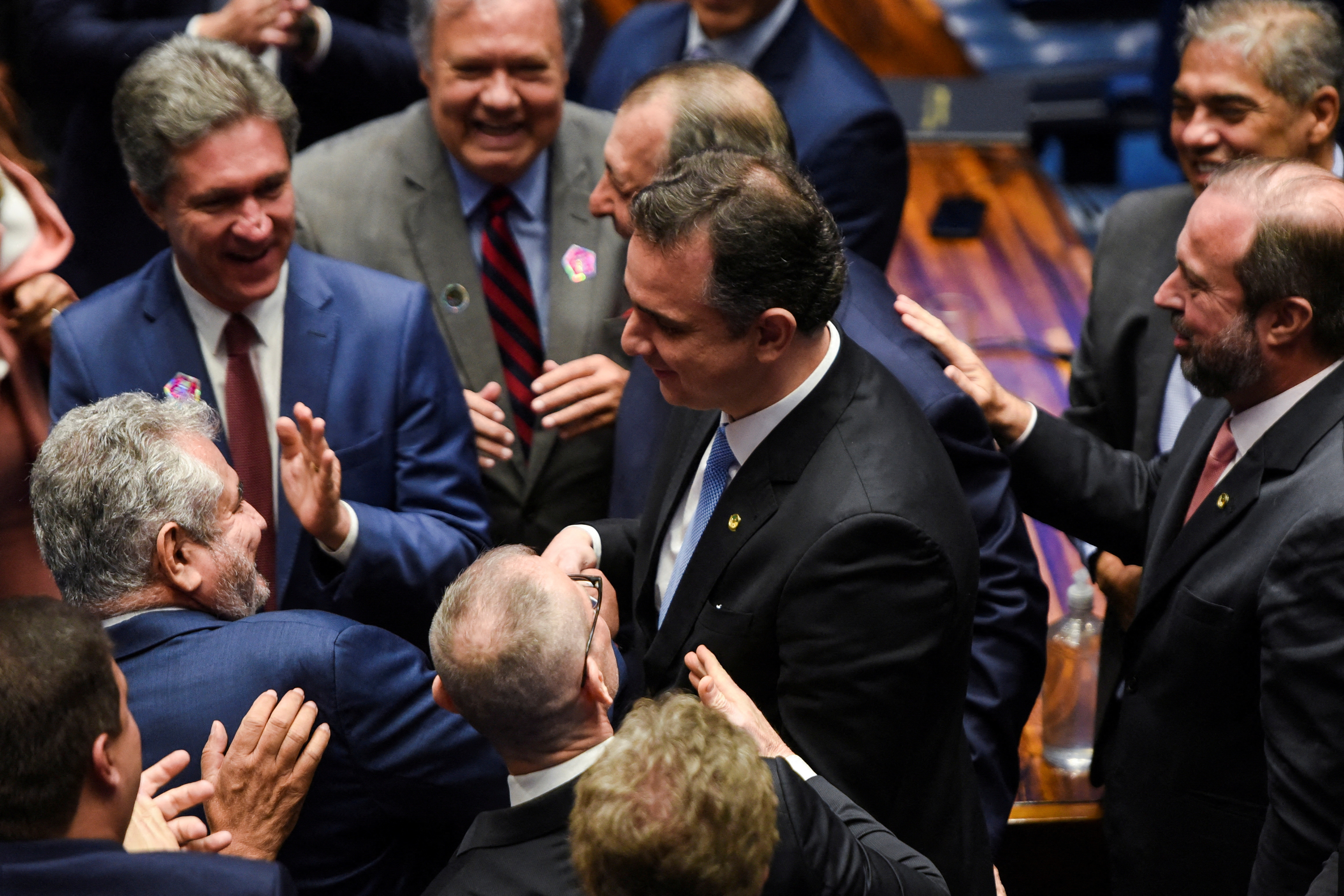
Brazil“s Congress re-elects leaders in victory for Lula

2023-02-02T01:47:10Z

Brazil’s Congress on Wednesday re-elected the leaders of both chambers who were backed by leftist President Luiz Inacio Lula da Silva, a victory that will help him advance his legislative agenda and curb the influence of his right-wing opponents.

Senator Rodrigo Pacheco defeated an ally of far-right former President Jair Bolsonaro, winning 49 votes in the 82-member chamber to continue as Senate president.

Lula’s center-left coalition celebrated the vote count that would allow his government to push through constitutional amendments, such as those needed to change Brazil’s tax regime and create a new fiscal anchor to balance government accounts.

Pacheco held his leadership job despite attempts made by Bolsonaro to back senator Rogerio Marinho. Bolsonaro, who had remained silent in reclusion in Florida, spoke by telephone on Monday to a meeting of his party, the Liberal Party (PL), to boost his former Cabinet minister’s campaign.

In the lower house, Speaker Arthur Lira of the center-right Popular Party (PP) won re-election by a wide margin, with the support of Lula’s Workers Party and its coalition partners, along with some of Bolsonaro’s allies.

Lira, who won 464 votes in the 513-seat house, had been an ally of Bolsonaro, but was quick to recognize Lula’s narrow election victory in October and congratulate him, starting a dialogue during the presidential transition.

Control of either chamber by the opposition could have hampered approval of Lula’s priorities, starting with temporary decrees he has signed that extend social welfare payments for poor families and reduce taxes on fuels.

All legislation must cross Lira’s desk to get started in Congress, including impeachment motions, which Bolsonaro allies are already planning against Lula.

In their victory speeches, both congressional leaders strongly defended Brazil’s democratic system, which came under attack from Bolsonaro supporters who stormed government buildings on Jan. 8 calling for a military coup to restore their leader who left the country without conceding defeat by Lula.

Pacheco, who rejected Bolsonaro’s criticism of Brazil’s electronic voting system, said the divided country needs pacification and political harmony.

But he added: “Pacification does not mean remaining silent before anti-democratic acts,” referring to the riots and calling for accountability.

Lira condemned the violence by Bolsonaro supporters.

“In today’s Brazil there is no more space for those who attack the institutions that symbolize our democracy. This chamber will not accept, defend or endorse any act, speech or demonstration that violates democracy,” he said.

Related Galleries:

President of Brazil’s Federal Senate Rodrigo Pacheco votes during a session to elect the new senate president in Brasilia, Brazil February 1, 2023. REUTERS/Ton Molina

President of Brazil’s Federal Senate Rodrigo Pacheco is greeted after being re-elected as the senate president in Brasilia, Brazil February 1, 2023. REUTERS/Ton Molina

President of Brazil’s Federal Senate Rodrigo Pacheco gestures after being re-elected as the senate president in Brasilia, Brazil February 1, 2023. REUTERS/Ton Molina

Brazil’s President Luiz Inacio Lula da Silva holds a joint news conference with German Chancellor Olaf Scholz at the Planalto Palace, in Brasilia, Brazil January 30, 2023. REUTERS/Ueslei Marcelino
Categories
Audio Sources - Full Text Articles

Saved Web Pages – Daily Report at 9 p.m. [Inoreader digest]

1636973850.png

Saved Web Pages – Daily Report at 9 p.m.

created by Michael Novakhov  •  Feb 01 2023

The most notable news articles in full text version.
Current Page:
https://www.inoreader.com/stream/user/1006407045/tag/web-pages/view/html

Continue reading the main storyHint: It’s not Peter Strzok. Peter Strzok testified on Thursday before…
nytimes.com 1h

Igor Krasnov told Putin there were “more than 9,000 citizens who were illegally mobilized” when Russia…
ca.finance.yahoo.com 7h

В.Путин: Игорь Викторович, мы с Вами в постоянном контакте находимся, очень часто…
kremlin.ru 7h

You can unsubscribe from those emails at any time.

Inoreader. Take back control of your news feed. Follow us on Twitter and Facebook.
Innologica Ltd. 35 Akad. Boris Stefanov str., 1700 Sofia, Bulgaria

The News And Times Information Network – Blogs By Michael Novakhov – thenewsandtimes.blogspot.com
Categories
Audio Sources - Full Text Articles

Meta’s layoffs were expensive — it may have spent more than $88,000 per employee to cut 11,000 from the ranks

Facebook founder and CEO Mark Zuckerberg at the company's first conference dedicated to messagingFacebook CEO Mark Zuckerberg cut 13% of the company’s workforce in November.

Facebook/Meta

  • In November 2022, Meta laid off more than 11,000 employees, or 13% of its workforce.
  • The layoffs were the most significant job cuts in the company’s history.
  • It’s possible the company spent around $88,000 a person in cutting those employees.

The numbers are in, and Meta’s mass layoffs announced in November cost the company a pretty penny.

On Wednesday, Myles Udland— now the Head of News at Yahoo Finance and a former markets correspondent for Insider — laid out part of Meta’s balance sheet in a tweet:

—Myles Udland (@MylesUdland) February 1, 2023


Udland estimated that Meta shelled out approximately $88,000 a person to cut more than 11,000 employees out of its workforce in November. 

The number comes from dividing the $975 million that the company paid in “Severance and Other Personnel” costs by 11,000, approximately the number of employees the company cut in November. The result comes out to around $88,636 a person, adding room for the “more than” 11,000.  

The calculation was subsequently confirmed by Daniel Ives, managing director and senior equity analyst at investment firm Wedbush Securities. 

The cost of cutting those employees is particularly significant amid rising concerns that Meta is preparing for an additional round of layoffs this year. 

In the company’s fourth-quarter earnings release posted Wednesday, CEO Mark Zuckerberg warned that Meta’s management theme for 2023 was ‘Year of Efficiency.’

Meta did not immediately respond to Insider’s request for a comment. 


Read the original article on Business Insider
Categories
Audio Sources - Full Text Articles

Meta CEO Mark Zuckerberg makes a U-turn on metaverse spending as Reality Labs is hit with a new ‘efficiency’ mantra

Mark Zuckerberg at Facebook's first ever retail location Meta StoreMark Zuckerberg at Facebook’s first ever Meta Store

Facebook/Meta

  • Meta CEO Mark Zuckerberg for months has defended losing tens of billions on his metaverse ambitions.
  • Zuckerberg’s tone has shifted to one of cost-cutting and “efficiency.”
  • Metaverse spending will continue, although “we’re constantly shifting how we execute,” he said.

Meta CEO Mark Zuckerberg has gone in a few months’ time from pushing the metaverse as the future of his company to it being just another long term project.

The Reality Labs division, tasked with building the metaverse, lost $13.7 billion this year, according to Wednesday’s disclosure. Zuckerberg said Meta will focus on “efficiency” going forward, he said on a call with Wall Street analysts discussing its fourth quarter financial results. He added that last year’s layoffs and an ongoing reorganization “surprised” him as they not only cut costs, but also improved communication and progress on future products.

“By reducing layers of management, it’s made information flow through the company better, and it will help us make better products and attract and retain better people,” Zuckerberg said on the call. “That was honestly a little surprising to me – that as we started digging into this, the company felt better to me.”

Susan Li, Meta’s new CFO, said on the call that losses from Reality Labs will “continue” in 2023 because it is a “long duration investment.” Still, Reality Labs would be subject to the same push for efficiency as other parts of the company, Zuckerberg said.

Previously, Zuckerberg has said several times over the last year that spending on the metaverse was about fortifying the future of Meta, formerly known as Facebook, as well as the “future of the internet,” and that building the metaverse would prove historic.

And in October, Zuckerberg struck a defiant tone on spending while discussing third quarter earnings, particularly that going toward the metaverse. David Wehner, the then-CFO who is now chief strategy officer, said spending on the Reality Labs division would increase “significantly” in 2023.

“I think people are going to look back, decades from now, and talk about the importance of the work that was done here,” Zuckerberg said last fall.

Such boasting of the metaverse and the Reality Labs division was nowhere to be found during Wednesday’s discussion of the year ahead. Instead, praise went to the growth of business messaging and AI investments that have started to improve Meta’s advertising business and user targeting capabilities. Meta’s stock rose in after-hours trading by nearly 20%, to its highest level in seven months. 

While Zuckerberg fell short of saying outright that the company will pull back spending on the metaverse, which investors have demanded for months, he did say moves toward efficiency are happening, including to Reality Labs.

“We’re looking at the signals and learning what makes sense to do going forward,” Zuckerberg said. “We’re constantly shifting how we execute. Other things like flattening the org structure, those are going to affect the whole company, both in Reality Labs and Family of Apps. We want the work to be more efficient.”

Are you a tech employee or someone else with insight to share? Contact Kali Hays at khays@insider.com, on secure messaging app Signal at 949-280-0267, or through Twitter DM at @hayskali. Reach out using a non-work device.

Read the original article on Business Insider
WP Radio
WP Radio
OFFLINE LIVE