
A Close Rudy Giuliani Associate Alerted FBI’s Assistant Director to Charles McGonigal’s Alleged Albanian Graft – emptywheel emptywheel.net/2023/01/30/a-c…
Month: January 2023
UNITED STATES : Former FBI official Charles McGonigal’s indictment: what went on behind the scenes intelligenceonline.com/corporate-inte…
Spencer Platt/Getty Images
- When Russia attacked Ukraine in February 2022, their militaries operated many of the same tanks.
- Ukraine upgraded many of its tanks before the war, but Russia also had newer, higher-quality tanks.
- As the war approaches its one-year mark, several countries have pledge to give Ukraine new tanks.
A rare video from the frontlines shows one of Ukraine’s upgraded Soviet-era tanks outperforming one of its newer Russian adversaries.
In the footage, published online in December, a Ukrainian T-64BV and a Russian T-72B3 tank fought a deadly duel in the east of the country. Despite being older, the Ukrainian armor took out its Russian adversary with a single long-distance shot.
A Ukrainian drone recorded the fight. On the outskirts of a destroyed town, the Ukrainian tank is advances down a road, straight toward the Russian tank.
—Rob Lee (@RALee85) December 11, 2022
Without stopping, the Ukrainian tank fires a round at its adversary. After a direct hit, the Russian T-72B3 explodes.
In technical terms, the tanks Russia has deployed are often newer and more advanced than the Ukrainian tanks they’re facing, but the victory of the Ukrainian crew is a testament not only to the quality of their training but to the skill of their engineers and mechanics, who upgraded many of the older, Soviet-designed models into the tanks Ukraine is now fielding.
Update or buy new?
A tank turret is repaired at the Kyiv Panzer factory in August 2015.
NurPhoto/NurPhoto via Getty Images
As Kyiv sought to modernize its military following Russia’s 2014 attack, it had to decide between purchasing a battalion of new armor — about 50 tanks — or modernizing as many as four battalions of older tanks, which could be done for the same price, according to a Royal United Services Institute report on the first several months of the war.
It chose the latter and updated part of its T-64 and T-72 fleets. The modernization packages included digital radios, internal communications, navigation systems, thermal sights, and modified dynamic protection, among other upgrades. Since then, the West has helped Ukraine modernize more of its aging Soviet-era tanks.
When the war began, however, the 2,800 “combat-ready tanks” in Russia’s invasion force vastly outnumbered the Ukraine military’s total of about 900 tanks, according to the report.
Ukrainian troops perform maintenance on tanks near the frontline in Donbas on January 18.
Diego Herrera Carcedo/Anadolu Agency via Getty Images
Many of the tanks in those two forces were the same models and had similar vulnerabilities — one of which was demonstrated vividly in the early months of the war.
Soviet- and Russian-made tanks are designed for a crew of three — driver, gunner, and commander. Instead of a loader they have an automated loading system, which stores ammunition in the turret.
With limited protection in the turret and rounds stored elsewhere in the tank, enemy fire can more easily detonate the tank’s ammunition, causing a “jack-in-the-box” effect that sends the turret flying sky-high.
Western tanks are designed with a sealed ammunition storage space and have fourth crew member who loads rounds into the gun.
More victories, better weapons
Ukrainian troops inspect a destroyed Russian tank near Kupiansk in the Kharkiv region in December.
SERGEY BOBOK/AFP via Getty Images
Ukraine’s requests for newer, more advanced Western-made tanks to replace its older, Soviet-era tanks — some of them older than the troops using them — are longstanding, but before the war, there were financial and logistical limits on the kinds of weapons Ukraine could acquire.
When the war began, pressure from Russia led Kyiv and its supporters to focus on weapons that were familiar to Ukrainian troops and could be used right away, such as Soviet-origin Mi-17 helicopters and T-72 tanks, or that would be easier to integrate, such as M113 armored personnel carriers, older air-defense systems, and low-tech drones.
But in late summer and the fall, Ukraine took the initiative, forcing Russian troops into retreat. The battlefield has largely stabilized, and Ukraine can now afford to send some troops to train for more complicated operations using more complex weapons.
Ukrainian troops this month began training for combined-arms operations — which require coordination between aircraft, ground troops, artillery, and armored forces — and have begun or will soon begin training on other weapons, including the US-made Patriot air-defense system and Western armored vehicles.
A Bradley armored vehicle headed to Ukraine is loaded onto a ship in North Charleston, South Carolina on January 25.
US Transportation Command/Oz Suguitan
US-made Abrams, German-designed Leopards, and British-built Challenger 2 tanks are some of the more than 300 heavy tanks that have been promised to Ukraine in recent weeks.
Despite growing arguments about the relevance of tanks on modern battlefields, both Russia and Ukraine have employed tanks effectively and routinely rely on tanks to break their adversary’s defenses, even with the proliferation of anti-tank weapons.
Ukraine claims to have destroyed or captured more than 3,000 Russian tanks, though Oryx, an open-source investigation outlet, has only visually verified about 1,600 of those.
As of January 25, the US has committed more than $27.1 billion in security assistance to Ukraine since Russia attacked on February 24, 2022 — a total of less than 5% of the US defense budget that has helped destroy thousands of Russian tanks, armored vehicles, and artillery pieces.
Stavros Atlamazoglou is a defense journalist specializing in special operations, a Hellenic Army veteran (national service with the 575th Marine Battalion and Army HQ), and a Johns Hopkins University graduate. He is working toward a master’s degree in strategy and cybersecurity at Johns Hopkins’ School of Advanced International Studies.
Read the original article on Business Insider
Liane Hentscher/HBO
- Elon Musk and Jeff Bezos both love HBO’s video-game TV series “The Last of Us.”
- Bezos tweeted that Sunday’s episode was “unbelievably good story telling,” and Musk responded in agreement.
- The rivalry between the two billionaires stretches back over a decade.
Billionaires Elon Musk and Jeff Bezos have found at least one thing to agree on: They both think HBO’s new series “The Last of Us” is great TV.
“Episode 3 of Last of Us is unbelievably good story telling,” Bezos, the Amazon founder and chairman, tweeted on Tuesday. “I am in awe of @Nick_Offerman performance. Incredible.”
“Great game, great show,” Twitter owner Musk responded.
“The Last of Us” is an adaptation of the 2013 video game of the same name. Set 20 years after a fungal pandemic, the show stars Pedro Pascal as Joel, who must escort a teenage girl Ellie, played by Bella Ramsey, across a post-apocalyptic US.
The show has gained widespread acclaim, with a 96% Rotten Tomatoes critic score. It’s a hit with audiences, too: HBO said the first two episodes are averaging over 21 million viewers each since the series premiered two weeks ago.
The most recent episode, which Bezos lauded, has received a particularly strong reaction. While the episode was watched by over 6 million viewers on Sunday night and has garnered a positive response from critics, it has been review-bombed by angry fans who don’t like its depiction of a same-sex relationship.
Musk is an avid video-game fan, and in 2020 tweeted his favorite games of all time. The list didn’t include “The Last of Us,” which a Twitter user pointed out. Musk responded that he would play the game, adding that since he plays on a PC, he “missed some of console exclusives.”
Bezos’ Amazon has dabbled in making video games, with largely underwhelming results, including the online multiplayer game “New World.” But the company is also in the business of making video-game TV shows for its Prime Video streaming service and has several in the works, including “God of War” and “Fallout.”
The agreement on “The Last of Us” is a rare break in the rivalry between Bezos and Musk.
The feud between the billionaires has stretched over a decade and largely centers around their visions for space travel.
Musk has regularly taken jabs at Bezos. And in 2020, he suggested Amazon was a monopoly and tweeted it was “time to break up” the company.
Read the original article on Business Insider
Getty Images
- Homebuilder stocks surged on Tuesday after a slew of earnings showed improving demand from home buyers.
- The demand from home buyers comes despite the average mortgage rate hovering above 6%.
- “We saw buyer demand improve as the fourth quarter progressed and can confirm the strength continued through the month of January,” PulteGroup said.
A string of earnings beats sent homebuilder stocks surging on Tuesday as the results show that there is still demand from consumers to buy a home.
Despite near record high home prices and the average mortgage rate still being above 6%, PulteGroup CEO Ryan Marshall said demand is improving in the company’s fourth-quarter earnings call.
“Despite the higher rate environment dominating the national conversation, we saw buyer demand improve as the fourth quarter progressed and can confirm the strength continued through the month of January,” Marshall said.
Shares of PulteGroup surged as much as 10% to a new 52-week high in Tuesday trades. Better-than-expected results from homebuilder NVR also helped boost the sector on Tuesday. Shares of Lennar and Toll Brothers jumped about 3% and 4%, respectively. Shares of NVR jumped as much as 7%.
And according to Marshall, the encouraging demand environment could continue through the year, especially if mortgage rates start to decline.
“We’ll have to see how things progress from here, but I think this improvement attests to the ongoing desire for homeownership that exists in this country,” Marshall said.
The encouraging results from the homebuilders is exactly what bullish stock market investors want to see as they gauge whether a “soft landing” in the economy is possible. Many economists see the stability of the housing market as key to whether the financial health of the consumer holds up.
One encouraging sign that there could be a continued rebound in the housing market is the fact that homebuilder sentiment jumped in January for the first time in a year. That, combined with a gradual decline in the average 30-year fixed mortgage rate from a peak above 7% to about 6.1% today, could fuel the next leg of growth.
“Mortgage rates continue to tick down and, as a result, home purchase demand is thawing from the months-long freeze that gripped the housing market. Potential homebuyers remain sensitive to changes in mortgage rates, but ample demand remains, fueled by first-time homebuyers,” FreddieMac said.
Read the original article on Business Insider
Shutterstock
- The success of ChatGPT has sparked a rally in artificial intelligence stocks.
- Shares of AI tech suppliers like Nvidia and Ambarella have jumped since the launch of ChatGPT.
- Here’s a list of five AI stocks that have surged since OpenAI launched ChatGPT on November 30.
Everyone is talking about ChatGPT, and investors are trading on the hype, sending both notable and under-the-radar artificial intelligence stocks soaring since the bot launched.
On November 30, OpenAI unveiled ChatGPT, and since then it has shown a capacity for a range of tasks, such as writing stock stories, layoff emails, and even dating-app messages.
The buzz has exploded, and OpenAI is getting a reported $10 billion investment from Microsoft. While OpenAI isn’t traded on public markets, artificial intelligence stocks that are public have been riding the wave.
Here’s a list of five AI stocks that have seen a surge since November 29, the last trading day before ChatGPT launched.
Nvidia
Ticker: NVDA
Percent gain: 23%
Nvidia, best known for its design and production of graphics-processing chips, is embedded in the artificial intelligence craze, and the firm’s technology is used for various AI integrations from self-driving cars to robots.
The Nvidia stock rally has also made founder and CEO Jensen Huang considerably richer as his wealth has grown by more than $5 billion so far this year, Bloomberg data shows.
Wall Street is also bullish. Citigroup analysts recently estimated that a boom in ChatGPT usage could translate to $3 billion-$11 billion in sales for Nvidia in the next 12 months. “We believe Nvidia has in ChatGPT a potentially meaningful compute demand driver,” the bank said.
Meanwhile, analysts at Bank of America said Nvidia is a top potential winner from generative AI growth, and Wells Fargo said new chips from Nvidia are poised to gain from greater computing needs of AI tools like ChatGPT.
Ambarella
Ticker: AMBA
Percent gain: 26%
Ambarella is another chip company that serves the AI market. It designs semiconductors that are used in everything from entertainment consoles in cars to cellphones.
It also specializes in “system on a chip” semiconductors that combine multiple central processors on one logic board to provide artificial intelligence computing.
Ambarella chips are used in self-driving functions, and the company recently partnered with German auto supplier Continental on an autonomous driving venture.
Mobileye
Ticker: MBLY
Percent gain: 39%
Mobileye was spun off by Intel and focuses on self-driving technology and driver-assistance systems, including chips and cameras. Volkswagen, Ford, and GM are among its customers. The company has a near-fully autonomous system called SuperVision, and its Chauffeur product is designed to convert a car into a Level 4 self-driven vehicle.
Last week, the company beat quarterly forecasts and gave an upbeat 2023 revenue projection. CEO Amnon Shashua touted roughly $17 billion worth of bookings that extends through 2030.
“We expect SuperVision to be a very large growth driver in 2023 and beyond,” he told analysts on an earnings call.
C3.ai
Ticker: AI
Percent gain: 61%
C3.ai is an artificial intelligence software suite provider, and has the success of ChatGPT to thank for its recent stock surge. Shares soared roughly 28% on Tuesday alone on news that it would integrate ChatGPT into its product suite.
“The C3 Generative AI Product Suite integrates the latest AI capabilities from organizations such as Open AI, Google, and academia, and the most advanced models, such as ChatGPT and GPT-3 into C3 AI’s enterprise AI products,” C3.ai said in a Tuesday press release.
Alteryx
Ticker: AYX
Percent gain: 28%
Alteryx’s software is best known for data and analytics, and the firm is also focused on furthering automation. The firm specializes in artificial intelligence integration, although on a smaller scale compared peers like Google and Meta.
The company will report quarterly results on February 9.
Read the original article on Business Insider

I know of two journalists who had reported on parts of the charges against former FBI Special Agent in Charge Charles McGonigal before he was indicted: In December 2021, Scott Stedman (with an assist from Wendy Siegelman) reported on the relationship between McGonigal, Oleg Deripaska, Sergey Shestakov, and Yevgenyi Fokin that was disclosed in a November 29, 2021 FARA filing.
And in September 2022, Mattathias Schwartz reported on a subpoena that (this was made more clear later) had been served ten months earlier, in November 2021. In the story, Schwartz claimed the documents he had in hand showed that McGonigal was under investigation for his Deripaska ties, which he only substantiated with a link to the FARA filing. The story itself pertained entirely to the Albanian side of the investigation, based off that subpoena, part of which he published.
Schwartz published that story a month after he won a lot of attention for getting Paul Manafort to confirm on the record the cover story someone had fed a NYT team including Maggie Haberman and Ken Vogel in February 2019: that Manafort had shared (just) campaign data with Konstantin Kilimnik. When first published in 2019, that cover story successfully distracted attention from outlines of a more substantive exchange pitched by Deripaska associate Kilimnik at an August 2, 2016 cigar bar meeting (and, indeed, from Deripaska’s involvement generally).
Manafort’s calendar showed that before he went to that meeting on August 2, 2016, he met with Trump and Rudy Giuliani. And while Manafort was serving his abbreviated prison term, Rudy reportedly consulted with him about his efforts to dig up dirt helpful to Trump.
In the wake of McGonigal’s indictments, Schwartz wrote a story about the person that he all but confirms was the one who received the subpoena: Allison Guerriero, who had a year-plus long affair with McGonigal that started sometime before October 2017 and lasted until late 2018, past the time McGonigal retired from the FBI in September 2018. According to the story, their relationship covered the most important period of the corruption described in the two indictments against McGonigal (meetings with Albania in the the DC indictment start in August 2017 and end in August 2018; favors for a Deripaska agent described in the SDNY indictment start in spring 2018; the favors continued through 2021, at which point the investigation into Deripaska had become overt).
In fact, Schwartz suggests that Guerriero may have tipped off FBI’s Assistant Director William Sweeney to McGonigal’s corruption in a drunken act of revenge after the affair ended.
In late 2018, McGonigal and Guerriero broke up. She remembers receiving an anonymous and hostile note in the mail. Soon after, McGonigal told her he was still married and had no plans to divorce his wife. “I was shocked,” she said. “I was very much in love with him, and I was so hurt.” She started drinking heavily to cope. A few months later, Guerriero, after a bout of drinking, dashed off an angry email to William Sweeney, who was in charge of the FBI’s New York City bureau, and who, she recalls, had first introduced her to McGonigal. She remembers telling Sweeney in the email that he should look into their extramarital affair, and also McGonigal’s dealings in Albania. McGonigal had already befriended Albania’s prime minister and traveled to the country extensively, dealings that would appear later in one of his indictments. Guerriero told Insider that she had deleted the email.
As Schwartz describes it, Guerriero told Sweeney he should look at not just McGonigal’s ties to Albania but also their affair, which is a nutty thing to say to an FBI official.
It’s a weird claim, because elsewhere, the story implies that Guerriero believed McGonigal’s stories about why he had bags of cash lying around, including a bag of cash that (Schwartz convincingly argues) is likely the one McGonigal is accused of receiving in a parked car on October 5, 2017.
That day in October wasn’t the only time that Guerriero remembers McGonigal carrying large amounts of cash. After he brushed her curiosity aside, she tempered her suspicions. She told herself it was probably “buy money” for a sting operation, or a payoff for one of McGonigal’s informants.
The story never describes that Guerriero learned of McGonigal’s ties to Albania, much less how or when she learned about them. And yet one takeaway from the story is that she might be the source of the entire investigation into her former boyfriend.
If she did send that email, it’s virtually certain an Assistant Director of the FBI would not delete it.
Schwartz describes Guerriero as,
a former substitute kindergarten teacher who volunteered for law-enforcement causes and was working as a contractor for a security company while living at home with her father.
The Facebook page for the charity for which she works shows the kind of NY law enforcement people she networks with.
Which partly explains the really remarkable detail about Guerriero. She’s close enough with Rudy Giuliani — who was himself being cultivated by Russian assets during the same period that McGonigal was — that the by-then discredited mayor put her up in his guest room after she suffered a burn injury in 2021.
Guerriero’s troubles worsened in early 2021, when she was badly burned during a fire at her father’s house. She asked friends for help through a GoFundMe. Former Mayor Rudy Giuliani of New York City, whom she knew from law-enforcement circles, let her stay in a guest bedroom. Since then, Guerriero has been a frequent on-air caller for Giuliani’s radio shows. She maintains that the 2020 election was marred by widespread voter fraud, a belief pushed by Giuliani that has been repeatedly debunked. “Whatever Giuliani says about the 2020 election is what I believe,” she said.
What a small world, that the woman who may have triggered the investigation into McGonigal was staying with Rudy as the investigation developed? Presumably, for example, some of Guerriero’s communications with Rudy would have been found on his phones after they were seized in April 2021 (though the investigation into McGonigal was already very advanced by the time the FBI actually started getting any communications from Rudy’s phones in November 2021, and emails with Guerriero would be out of scope of any known or suspected warrant targeting Rudy).
Schwartz doesn’t pursue the fact that McGonigal has such close ties to Rudy, though the connection would be even more interesting if McGonigal’s role in the Trump Russian investigation were as central as Schwartz presented it (he’s not alone in overstating McGonigal’s known role).
But there are two additional reasons the detail is particularly interesting.
First, as noted, Schwartz published part of the subpoena that, this second story clarifies, Guerriero received in November 2021.
Regardless, by November 2021, the FBI was looking into McGonigal. Two agents showed up at Guerriero’s door, she says, showed her a picture of McGonigal with the Albanian prime minister, and interviewed her about their interactions. She also received a grand-jury subpoena requesting all of her communications with McGonigal as well as information about any “payments or gifts” he may have given her.
It tracks the DC indictment closely (and was sent by the LA-based team investigating it). Four bullets ask for information about the Albanians that are the central focus of the indictment. Bullet f references McGonigal’s ties to Kosovo, which show up in ¶28 of the indictment. Bullet h and i ask for information on the Bosnians who appear in ¶¶45, 46 and 48 of the indictment; bullet j asks for information about the alleged access peddling to the UN described in ¶¶50-52 of the indictment.
But the subpoena — bullet g — asks about another country, Montenegro, where much of Deripaska and Manafort’s long history began and where Deripaska was still allegedly interfering as late as 2016. If Montenegro shows up in the indictment at all, it’s only as one of the other locations in Europe to which McGonigal was traveling with his Albanian contact (for example, a spring 2018 trip described in ¶44). That may simply reflect Montenegro’s relative import in McGonigal’s paid travel, the quality of evidence, or maybe DOJ didn’t want to include it for some other reason. But if Montenegro were a key part of McGonigal’s Balkans travels — on which, ¶22 of the indictment makes clear, he worked to persuade Albania not to sign oil contracts with Russian front companies — it would put him in a country where Deripaska likely still has a rich network of sources.
In any case, the only other thing that doesn’t map directly from the subpoena to the indictment are any payments or gifts McGonigal gave to Guerriero. The DC indictment never explained why, “no later than August 2017,” McGonigal allegedly asked his Albanian contact if he could provide him money, but Schwartz’ story reveals that the indicted former SAC was giving Guerriero gifts of cash and taking her to high-end restaurants during their affair, which started at least by October 2017 (her subpoena asked for records going back to April 2017). The indictment never mentions her, but the affair with her may explain part of McGonigal’s urgent need for cash in September 2017, something that would make McGonigal ripe to compromise by anyone who learned of it.
As I noted earlier, there’s one more remarkable player in this little network that includes Rudy Giuliani: Seth DuCharme, who spent much of the last year of the Trump Administration implementing Bill Barr’s bureaucratic efforts to ensure that Rudy Giuliani would not be prosecuted for his efforts to obtain benefit for Trump — including, but not limited to, dirt on Hunter Biden — from people that included several suspected Russian agents. DuCharme, who works at Rudy’s former firm, Bracewell, is part of the team representing McGonigal.
And to the extent that Guerriero is one of the witnesses from whom DOJ learned the specifics about how much cash McGonigal received in bags in parked cars (though, again, Schwartz’ story is inconsistent about whether she knew none of that or whether she knew enough to tip off William Sweeney) it would be part of DuCharme’s job to discredit Rudy’s former houseguest as a witness. He would do so, presumably, by pointing to all the things Guerriero told Schwartz she regrets, including harassment of McGonigal’s family that was serious enough to merit restraining orders in two states.
By her own account, Guerriero contacted one of McGonigal’s children despite being prohibited from doing so by a court order, an incident that led to her spending the night in a New Jersey jail. The court order stemmed from a 2019 police report, obtained by Insider, that McGonigal’s wife, Pamela, filed with the Montgomery County Police Department in Maryland. The report states that McGonigal and Guerriero “had a relationship” and that Guerriero had repeatedly harassed her with unwelcome emails and phone calls — including 20 calls in one day — despite her asking Guerriero to stop.
Guerriero confirmed that her contact with the McGonigal family led to a separate restraining order issued in New Jersey. “I am ashamed and embarrassed and sorry for my actions during the time that I was drinking,” she said.
In Schwartz’ story, Guerriero doesn’t say she regrets that email to Sweeney, which could well have sparked this entire investigation. She regrets the harassment of McGonigal’s family, which might come out if she were called as a witness.
All of which may provide insight into why the DC case against McGongial is charged as it is. Among the overt acts of which McGonigal is accused in DC are:
- Networking with representatives of the government of Albania in late 2017 and early 2018 during the period when he used information from them to launch an investigation against the US citizen lobbyist for their rival.
- Proposing that his prime Albanian contact be paid $500,000 (which may have been meant as repayment of money the Albanian gave McGonigal in 2017) to set up a high level UN meeting for some Bosnians.
Both of these overt acts could be charged under FARA and the Albanian tie, at least, could well have been charged under 18 USC 951. But McGonigal would likely offer the same kind of defense that Tom Barrack did in his EDNY trial: when McGonigal counseled the Albanian Prime Minister not to sign oil contracts with Russian on September 9, 2017, he could easily argue, he did so because he was genuinely opposed to Russian influence and not because he was seeking a benefit for his key Albanian contact.
Instead, DOJ charged him with inadequate disclosure to the FBI on forms FD-772b and OGE-278, with each inadequate disclosure charged as a false statement under either 18 USC 1001 or 1519 (though I don’t understand why McGonigal would not immediately challenge the three of the charges tied to filings submitted more than five years ago, especially if FBI had notice of all this in 2018). The 1001 charges would normally only get a few months sentence, though with a sentencing enhancement for abusing his official position, and by treating each inadequate disclosure as a separate crime, potential exposure could easily add up to years, or, with a plea deal, it could be pitched as “process crimes” meriting just months of prison time.
Charging it that way not only gives DC USAO more flexibility in plea discussions.
It would also make it a “paper case,” something that depends largely on documentation rather than the credibility of a witness like McGonigal’s primary Albanian contact (who seems to have told FBI that the cash payments were loans, not payments) or Guerriero. For each false form McGonigal submitted, DOJ will only have to show where he traveled, how his travel was paid, and that he didn’t properly disclose it. It would rely on travel records and bank statements and not the testimony of a witness who harassed McGonigal’s family out of jealousy.
I don’t want to make too much of Schwartz’ revelation that a key witness against McGonigal was staying in Rudy’s guest room as the investigation developed. Drunken jealousy is all the motive you need to explain her actions (though not, perhaps, inconsistencies about how much of the Albanian graft she knew about).
But once you throw Rudy and Montenegro into the mix, the trajectory on which McGonigal traveled, from arguing against Russian oil contracts in September 2017 to thinking he could manage ties to Deripaska in spring of 2018, gets a lot more interesting.

Hong Kong on Wednesday made possession, consumption, and distribution of cannabidiol, or CBD, illegal.
While some governments across the world have legalized or moved toward decriminalizing cannabis, including Thailand last year, cannabis itself remains illegal in most countries, with related offenses often punishable by long prison sentences.
Still, products containing the cannabis-derived compound CBD have become increasingly popular in recent years, touted to have therapeutic benefits. And it’s long existed in a legal gray area for regulators. As of last February, the global market for CBD was estimated to reach $48 billion by 2028.
[time-brightcove not-tgx=”true”]
In Hong Kong, a growing market had emerged for products containing CBD, ranging from skincare to food and beverage items. Months before the ban, one could, for example, walk into a specialty cafe and buy CBD-infused chocolate chip cookies or get a few drops of the compound in their smoothie or coffee.
But local authorities have argued that the science behind CBD’s supposed therapeutic qualities is not absolute and that its use may actually have harmful side effects. As of Feb. 1, CBD has been categorized as a “dangerous drug,” along with the likes of heroin, cocaine, and methamphetamine.
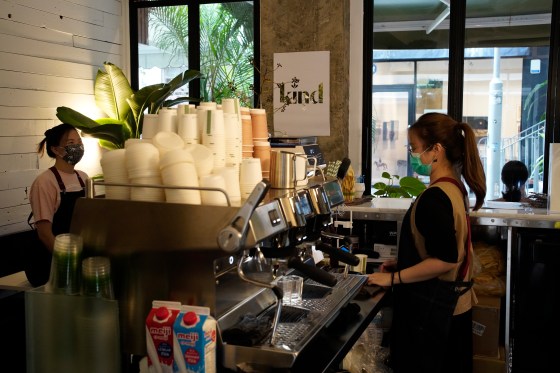
Vincent Yu—APEmployees work at the Found Cafe—which served CBD-infused coffee, tea, biscuits and other sweets—in Hong Kong on Sept. 13, 2020. The substance is now illegal in the city.
What exactly is CBD and why is it banned?
Cannabidiol (abbreviated CBD) is one of the chemical compounds found in the cannabis plant or hemp. In Hong Kong and elsewhere, the cannabis plant itself is considered a dangerous drug—more commonly referred to as marijuana, weed, or pot. But that’s because another compound from the plant, called tetrahydrocannabinol (or THC), has psychoactive properties and, the U.S. Centers for Disease Control argues, may cause addiction.
An expert panel from the World Health Organization found in 2017, however, that on its own, CBD appears to be neither harmful nor prone to abuse—though it still does not recommend the compound for medical use.
Some studies have even found that CBD use has therapeutic value, particularly for people suffering from seizures and clinical anxiety.
But Hong Kong narcotics officials argue that these studies have not been authoritatively proven. They also cite expert opinion that pure CBD is difficult to extract from cannabis plants, and they say that, of CBD products they seized, around a third contained THC.
How is CBD regulated in other parts of Asia?
When Thailand legalized cannabis products, including CBD, nationwide last year, some commentators speculated that it could be the beginning of a broader drug policy liberalization for Asia, where strict rules are predominant.
But Hong Kong’s new ban is more in line with the policies of other countries in the region, with few exceptions.
In Singapore, for example, which is notorious for its zero-tolerance approach to drugs, CBD is considered a cannabis product, and even its use by Singaporean citizens or permanent residents while abroad is prosecutable.
And in China, reportedly the world’s largest hemp-cultivating country, CBD was made completely illegal in 2022.
That said, some countries in the region allow CBD use under certain circumstances.
South Korea, for example, eased restrictions on the use of medical cannabis, including some CBD products, in 2018, but with strict safeguards like an application process and the submission of prescriptions and medical records.
Japan, where violating cannabis-possession laws can lead to imprisonment for up to 10 years, allows using CBD that isn’t derived from parts of the plant other than the stalk and the seed. Also, local paper Yomiuri Shimbun reported in October that Japan’s health ministry is eyeing amendments to cannabis control legislation to make way for CBD drugs for patients with intractable epilepsy.
What does this mean for the future of CBD regulation elsewhere?
Debate is ongoing about how to regulate CBD without undermining the potential benefits.
Fung Sai-fu, an instructor at the department of social and behavioral sciences at City University of Hong Kong, believes legislation restricting CBD is needed, citing potential traces of THC sometimes found in CBD products. “There is no clear scientific evidence to support CBD with those advertised health benefits,” he adds.
On the other hand, Gloria Lai, an Asia regional director for the International Drug Policy Consortium, tells TIME that criminalizing CBD is “problematic,” given the potential benefits and the absence of proven risks to its use, like dependence or overdose. “It can potentially result in a ‘moral panic’ amongst other countries, resulting in them taking similar measures,” Lai said.
Lai referred to the European Union Court of Justice’s decision in 2020 that says CBD extracted from cannabis plants should not be considered a drug under the 1961 U.N. Single Convention on Narcotic Drugs.
In the U.S., regulators are still grappling with the uncertainty surrounding CBD. While CBD sourced from cannabis plants is federally illegal, CBD extracted from hemp containing no more than 0.3% THC on a dry weight basis is allowed. (States may have varying laws on cannabis and its derivative products.)
Just last week, the FDA, after rejecting petitions to allow CBD to be marketed as a dietary supplement, said that “a new regulatory pathway for CBD is needed that balances individuals’ desire for access to CBD products with the regulatory oversight needed to manage risks.” The agency added that it has plans to work with Congress on these rules.
The last new Boeing 747 left the company’s factory on Tuesday, marking the end of an era for the iconic airplane that captured the world’s attention and brought more affordable air travel to millions of passengers.
With its impressive size and graceful appearance, the 747, known as the “Queen of the Skies,” has been one of the most recognizable and versatile aircraft since its first flight in 1969. It transported NASA’s space shuttles and was the base for the U.S. president’s Air Force One aircraft, making the 747 a symbol of American innovation.
[time-brightcove not-tgx=”true”]
The dependable four-engine plane revolutionized the aviation industry and the air travel experience itself by carrying up to 500 passengers in a single trip, creating a more spacious and comfortable cabin and allowing airlines to offer long-haul tickets at a lower cost.
But despite its popularity, by the 2010s the world began to shift toward more efficient and smaller two-engine airplanes that could fly longer distances. These planes made it possible for airlines to offer direct international routes between smaller cities due to their more compact size.
Boeing introduced a more advanced two-engine 777 aircraft in the mid-90s, and faced heightened competition a decade later from the bigger Airbus A380, which could seat 250 more passengers. Demand for the 747 dropped, except for cargo operations. In the early 2010s, Boeing introduced the final model, the 747-8, which included around 50 passenger configurations and over 100 cargo configurations.
While some airlines continue to use the plane for passenger flights, the 747 will likely be phased out for most passenger routes and used primarily for delivering cargo. The final 747 produced was handed over to Atlas Air, which offers airplanes and crews for both cargo and passenger operations. It will be chartered by Kuehne+Nagel, a transport company and an Atlas customer, for use by its subsidiary, Apex Logistics.
But the awe-inspiring legacy of the iconic aircraft will continue: the 747 planes will still be used as Air Force One for years to come. Replacements for the current Air Force One aircraft are being built using Boeing 747-8 frames.

Wally McNamee—CORBIS/Getty ImagesPresidential advisers Steve Rabinowitz and Dee Dee Myers talk on cell phones on the tarmac next to Air Force One, on April 30, 1993.

Peter Parks—AFP/Getty ImagesPeople watch as the last Qantas Boeing 747 airliner prepares to take off from Sydney airport to the US on July 22, 2020. The downturn in the airline industry following travel restrictions imposed by the COVID-19 outbreak forced Qantas to retire its grounded 747s after flying with the Australian carrier for almost 50 years.

Lucy Nicholson—ReutersOld airplanes, including Boeing 747-400s, are stored in the desert in Victorville, California March 13, 2015. In the last year, there were zero orders placed by commercial airlines for new Boeing 747s or Airbus A380s, reflecting a fundamental shift in the industry toward smaller, twin-engine planes.

Thomas Frey—picture alliance/Getty ImagesAn Atlas Air Boeing 747-8 cargo plane is loaded with freight for Zhengzhou Airport in Lautzenhausen, Germany, in May 2014.

Jovelle Tamayo—The New York Times/ReduxThe Boeing factory, where the last 747 jumbo jet was built, in Everett, Wash., Sept. 28, 2022. The “Queen of the Skies” brought air travel to the masses, but its half-century run is coming to an end.