Categories
Audio Sources - Full Text Articles

A Florida GOP congressman sent his colleagues inert grenades as a welcome gift to the House

Rep.-elect Cory Mills, R-Fla., attends a news conference in the Capitol Visitor Center on a resolution requesting information from the Biden administration on Ukraine funding, on Thursday, November 17, 2022.Rep. Cory Mills.

Tom Williams/CQ-Roll Call, Inc via Getty Images

  • Florida congressman Cory Mills gifted his colleagues inert grenades.
  • The grenades, Mills said, were made for an MK19 grenade launcher.
  • “These are manufactured in the Sunshine State and first developed in the Vietnam War,” Mills wrote.

A GOP congressman from Florida gifted his colleagues inert 40mm grenades to celebrate being named to the House Armed Forces and Foreign Affairs Committees.

Rep. Cory Mills on January 20 sent a letter welcoming his colleagues “to a mission-oriented 118th Congress,” along with a dummy grenade. Mills said he was “eager to get to work for the American people” and was honored to serve on the committees.

“In that spirit, it is my pleasure to give you a 40mm grenade, made for an MK19 grenade launcher,” Mills wrote. ‘These are manufactured in the Sunshine State and first developed in the Vietnam War.” 

The letter to his colleagues assured them in a postscript that “these Florida manufactured 40mm grenades are inert.” 

—Morgan Phillips (@_phillipsmorgan) January 26, 2023


Mills’ letter was posted to Twitter on Thursday by Daily Mail reporter Morgan Phillips.

“Per the letter, the grenades are inert, and were cleared through all security metrics,” Mills’ spokesman Juan Ayala said in an email to The Washington Post. “I just wish they tagged our official account.”

It’s unclear how many grenades Mills gifted to his colleagues. Representatives for the congressman did not immediately respond to Insider’s request for comment.

Mills, a congressman backed by former President Donald Trump, in November won his seat in Florida’s 7th Congressional district.

In May, Mills bragged about supplying law enforcement agencies with tear gas used against Black Lives Matter protesters. Mills has also parroted Trump’s claims that the election was rigged, per the Orlando Sentinel.

Read the original article on Business Insider
Categories
Audio Sources - Full Text Articles

House GOP seeks new restrictions on use of US oil stockpile

WASHINGTON (AP) — For the second time this month, House Republicans are seeking to restrict presidential use of the nation’s emergency oil stockpile — a proposal that has already drawn a White House veto threat.

A GOP bill set for a vote Friday would require the government to offset any non-emergency withdrawals from the Strategic Petroleum Reserve with new drilling on public lands and oceans. Republicans accuse President Joe Biden of abusing the reserve for political reasons to keep gas prices low, while Biden says tapping the reserve was needed last year in response to a ban on Russian oil imports following President Vladimir Putin’s invasion of Ukraine.

Biden withdrew 180 million barrels from the strategic reserve over several months, bringing the stockpile to its lowest level since the 1980s. The administration said last month it will start to replenish the reserve now that oil prices have gone down.

White House press secretary Karine Jean-Pierre attacked the latest GOP proposal, which follows a bill approved two weeks ago that would prohibit the Energy Department from selling oil from the strategic reserve to companies owned or influenced by the Chinese Communist Party.

“House Republicans will vote to raise gas prices on American families … and help Putin’s war aims by interfering with our ability to release oil,″ Jean-Pierre said, referring to the current GOP bill. “These extreme policies would subject working families to immense financial pain and balloon our deficit, all just to benefit the wealthiest taxpayers and big corporations.″

Energy Secretary Jennifer Granholm, appearing with Jean-Pierre at the White House, said the bill would make it ”harder to offer Americans relief in the future” from oil disruptions that could raise prices.

Republican Rep. Cathy McMorris Rodgers, who chairs the House Energy and Commerce Committee and sponsored the GOP bill, accused Granholm and the White House of multiple misleading claims, including an erroneous assertion that the bill could affect use of the reserve during a presidentially declared emergency.

“At a time when gas prices are on the rise, Secretary Granholm and the Biden administration need to be transparent with the American people about their efforts to cover up how they’ve abused the Strategic Petroleum Reserve as an election-year gimmick,″ McMorris Rodgers said.

“Republicans want durable, long-lasting relief at the pump. The best way to do this is by unleashing American energy,″ which her legislation helps accomplish, added McMorris Rodgers, of Washington state.

The heated rhetoric is part of a larger fight over oil drilling and climate change. Republicans say restrictions on oil leasing imposed by the Biden administration hamper U.S. energy production and harm the economy, while Democrats tout a sweeping climate law approved last year as a crucial step to wean the nation off fossil fuels such as oil, coal and natural gas. The measure authorizes billions in spending to boost renewable energy such as wind and solar power and includes incentives for Americans to buy millions of electric cars, heat pumps, solar panels and more efficient appliances.

Biden, citing the dangers of climate change, canceled the controversial Keystone XL oil pipeline in his first days in office and suspended new oil and gas leases on federal lands. The moratorium has since been lifted, under court order, but Republicans complain that lease sales for new drilling rights are still limited.

Biden campaigned on pledges to end new drilling on public lands, and climate activists have pushed him to move faster to shut down oil leasing. Fossil fuels extracted from public lands account for about 20% of energy-related U.S. greenhouse gas emissions, making them a prime target for emissions reductions intended to slow global warming.

“Whether on land or at sea, oil drilling poses an unacceptable risk for our wildlife, wild places and waterways,″ said Lisa Frank of Environment America, an advocacy group. “When we drill, we spill. At a time when we should be moving away from this destructive, dangerous practice — and expanding use of renewable power — this bill doubles down on the outmoded energy of the past.″

Frank urged lawmakers to reject the GOP bill and instead move to permanently ban new drilling off U.S. coasts and in Alaska’s Arctic National Wildlife Refuge.

Conservative and industry groups support the bill.

“We can continue making the Strategic Petroleum Reserve the nation’s sole response to future disruptions, or we can also utilize more of the vast oil supplies sitting beneath the lands and offshore areas currently kept off limits by the president,″ the Competitive Enterprise Institute and other conservative groups said in a letter to Congress.

The Treasury Department estimates that release of oil from the emergency stockpile lowered prices at the pump by up to 40 cents per gallon. Gasoline prices averaged about $3.50 per gallon on Thursday, down from just over $5 per gallon at their peak in June, according to the AAA auto club.

Morris Rodgers accused Biden of using the reserve to “cover up his failed policies” that she said are driving up energy prices and inflation. Average gas prices are up more than 30 cents from a month ago and are higher than when Biden took office in January 2021, she and other Republicans noted.

“Millions of Americans are paying more at the pump as a result of the Biden administration’s radical ‘rush-to-green’ agenda that has shut down American energy,″ McMorris Rodgers said.

Granholm, citing thousands of unused leases by oil companies, said GOP claims of obstructionism on drilling were off-base. “There’s nothing standing in the way of domestic oil and gas production,″ she said, a claim McMorris Rodgers disputed.

“There are plenty of barriers to unleashing domestic oil and gas production, including burdensome regulations and this administration’s discouragement of financial investment in domestic oil and gas industries,″ she said, noting that U.S. oil production is well below its 2019 peak of 13 million barrels of oil a day.

Categories
Audio Sources - Full Text Articles

India“s Adani kicks off $2.45 bln share sale while under short-seller attack

2023-01-27T05:18:36Z

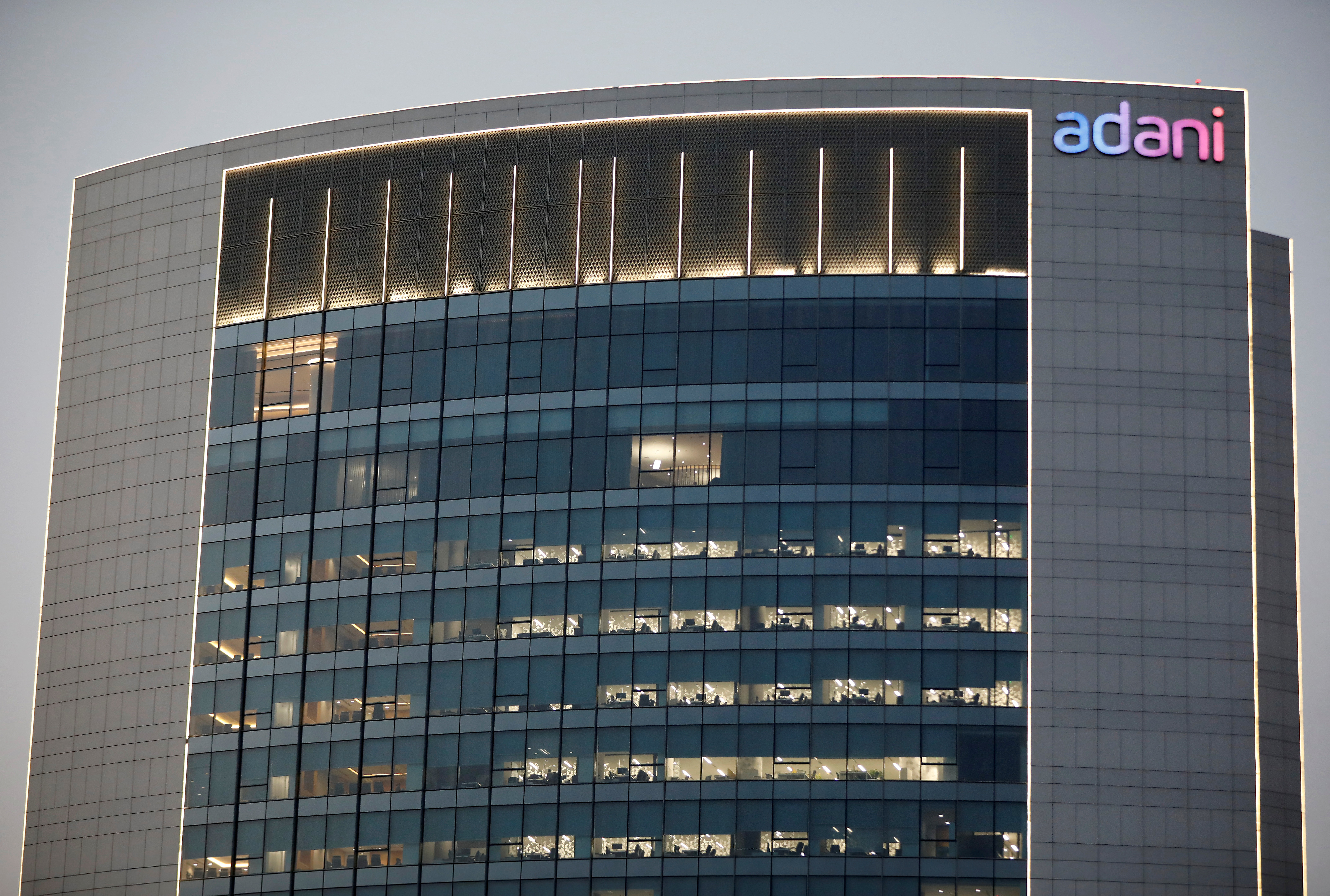
The logo of the Adani Group is seen on the facade of one of its buildings on the outskirts of Ahmedabad, India, April 13, 2021. REUTERS/Amit Dave

India’s Adani Enterprises Ltd (ADEL.NS) began a record $2.45 billion secondary share sale for retail investors on Friday, as a heavy selloff in Adani group companies intensified after an attack by a U.S.-based short seller.

The Adani conglomerate – controlled by one of the world’s richest men Gautam Adani – lost $11 billion in market capitalisation on Wednesday in India and saw falls in its U.S. bonds after Hindenburg Research flagged concerns in a report about debt levels and the use of tax havens.

Adani Group has dismissed the report as baseless.

Adani Enterprises aims to use the share sale proceeds for capital expenditure and to pay debt. The anchor portion of the sale saw participation from investors including the Abu Dhabi Investment Authority on Wednesday.

Bidding for the Adani Enterprises share sale for retail investors started on Friday and will close on Jan. 31. The firm has set a floor price of 3,112 rupees ($38.22) a share and a cap of 3,276 rupees.

But shares of seven listed group companies plunged on Friday, taking their cumulative market capitalization loss since Wednesday to around $30 billion, as of 0438 GMT.

Adani Enterprises dropped up to 6.2% and was last down 3.4% at 3,271 rupees.

Adani Transmission Ltd (ADAI.NS) tumbled as much as 19.2% in early trading and Adani Total Gas (ADAG.NS) sank 19.1% in the biggest daily drop since mid-March 2020, while Adani Green Energy (ADNA.NS) sank 15.8%, before paring some losses.

In its report, Hindenburg said key listed Adani Group companies had “substantial debt”, putting the conglomerate on a “precarious financial footing”, and that “sky-high valuations” had pushed the share prices of seven listed Adani companies as much as 85% beyond actual value.

Billionaire U.S. investor Bill Ackman said on Thursday that he found the Hindenburg report “highly credible and extremely well researched.”

Hindenburg said it held short positions in Adani through its U.S.-traded bonds and non-Indian-traded derivative instruments, meaning it is betting that their price would fall.

Adani Group has repeatedly faced and dismissed concern about debt levels. It defended itself in a presentation titled “Myths of Short Seller” on Thursday, saying deleveraging by promoters – or key shareholders – was “in a high growth phase”.

“I don’t see much effect of the Hindenburg report,” Esquire Capital Investment Advisors Chief Executive Samrat Dasgupta told Reuters. The Adani Enterprises share sale “should sail through successfully.”

Jefferies in a client note said Adani Group had shared details of debt and leverage levels, and that it does not “see material risk arising to the Indian banking sector”.

Adani Group’s consolidated gross debt stood at 1.9 trillion rupees ($23.34 billion), Jefferies said.

Adani has said its debt is at a manageable level and that no investor has raised any concern.

Adani Enterprises’ net profit for the period ended Sept. 30, 2022 doubled to 9 billion Indian rupees ($110.31 million) while its total income nearly tripled to 795 billion Indian rupees, according to its share sale prospectus.

The company’s total liabilities as of Sept. 2022 stood at 869 billion rupees ($10.64 billion), the prospectus showed.

Categories
Audio Sources - Full Text Articles

Indian shares fall as financials slide; Adani stocks tumble

2023-01-27T04:58:54Z

A bird flies past the Bombay Stock Exchange (BSE) building in Mumbai, India, January 31, 2020. REUTERS/Francis Mascarenhas

Indian shares opened lower on Friday as financials sustained the slide on risk aversion due to Hindenburg’s report on the books of Adani group companies, which offset easing concerns of recession in the U.S.

The Nifty 50 index (.NSEI) was down 1.14% at 17,683.40 as of 10:15 a.m. IST, while the S&P BSE Sensex (.BSESN) fell 1.25% to 59,451.92.

The Nifty financial(.NIFTYFIN) index, which fell 2.13% in the previous session, has lost 2.25% as of 10:15 a.m. IST, dragging the markets down, while oil & gas stocks (.NIFOILGAS) declined over 3.5% with an uptick in crude prices.

Rising oil prices pose a risk to India, one of the largest importers of the commodity.

Stocks of seven Adani companies tumbled between 2% and 17% after falling between 1.5% and 9% on Wednesday when Hindenburg, a well-known U.S. short-seller, said in a report that key listed companies in the group controlled by billionaire Gautam Adani had “substantial debt.”

Adani Ports (APSE.NS) and Adani Enterprises (ADEL.NS) were the top losers on Nifty 50 on Friday, ahead of a 200 billion rupees ($2.45 billion) follow-on public offer (FPO) of flagship Adani Enterprises (ADEL.NS), which begins later in the day and ends on Jan. 31.

The slide in financials and oil stocks overshadowed the positive macro data from the United States. The world’s largest economy grew faster than expected in the fourth quarter as consumers boosted spending on goods, data showed.

Wall Street overnight ended in the positive territory as strong U.S. economic data eased recession worries. In other Asian markets, MSCI’s broadest index of Asia-Pacific shares outside Japan (.MIAPJ0000PUS) were up 0.10%.

Investors will shift focus to the Union budget on Feb. 1, with the government’s fiscal consolidation path and borrowing calendar for fiscal 2024 set to be triggers.

On the flipside, auto stocks (.NIFTYAUTO) advanced over 2%, led by gains in Bajaj Auto and Tata Motors after strong third quarter earnings reports.

($1 = 81.6500 Indian rupees)

Categories
Audio Sources - Full Text Articles

Asian equities hit 9-month high as recession fears wane

2023-01-27T05:16:57Z

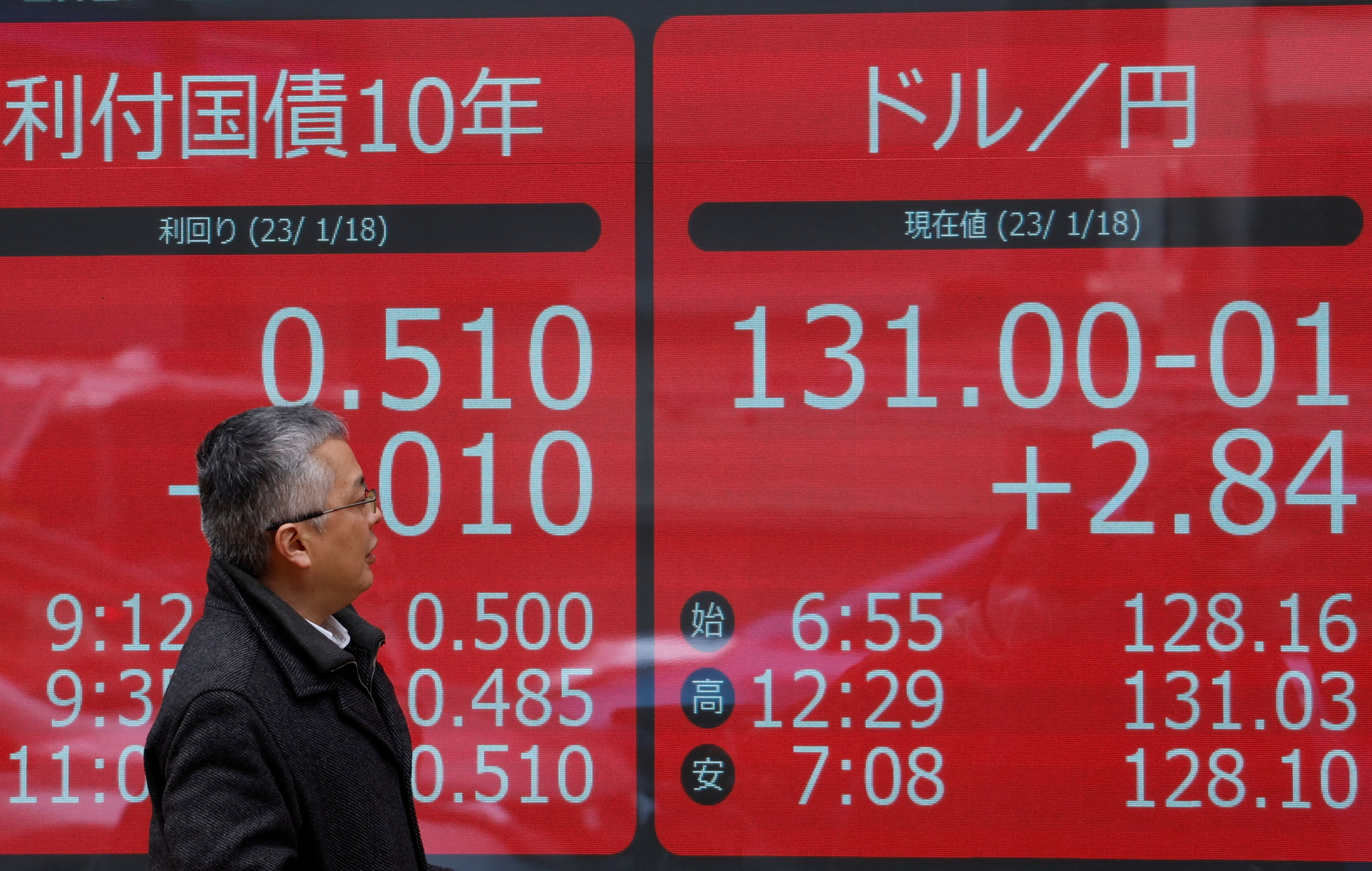
A man looks at electric monitors displaying Japan’s 10-year government bond yield on gilts and the exchange rate between the Japanese yen against the U.S. dollar outside a brokerage in Tokyo, Japan January 18, 2023. REUTERS/Issei Kato

Asian stocks rose on Friday and were poised for their fifth straight week of gains after data highlighted a resilient U.S. economy, boosting investor sentiment ahead of next week’s slate of central bank policy meetings.

MSCI’s broadest index of Asia-Pacific shares outside Japan (.MIAPJ0000PUS) rose as much as 0.55% to hit an almost nine-month high of 562.10, and was last at 559.39.

The index, which fell nearly 20% last year, is up nearly 11% so far this month and is on course for its best-ever January performance. Japan’s Nikkei (.N225) rose 0.05%.

European stock futures indicated that stocks were set to rise, with the Eurostoxx 50 futures up 0.3%, German DAX futures 0.28% ahead and FTSE futures up 0.16%.

The U.S. economy grew faster than expected in the fourth quarter as consumers boosted spending on goods, data showed, but it could be the last quarter of solid GDP growth before the lagged effects of the Federal Reserve’s jumbo interest rate hikes are fully felt.

A separate report showed that labour market remains tight and could lead the Fed to keep interest rates higher for longer.

Ashwin Alankar, head of Global Asset Allocation at Janus Henderson Investors, said the headline GDP suggested robust economic activity and if a recession were to materialize it would be a shallower one.

“Overall GDP data was a ‘tale-of-two cities’ – good overall growth stemming from less-than-ideal drivers and prices mitigating but at a rate that is worrisome.”

Thursday’s set of data has raised investor hopes of a soft landing – a scenario in which inflation eases against a backdrop of slowing but still resilient economic growth.

Futures are pricing in a 94.7% probability of a 25-basis-point hike next Wednesday and see the Fed’s overnight rate at 4.45% by next December, or lower than the 5.1% rate Fed officials have projected into next year.

Data on U.S. personal consumption expenditures (PCE) due at 1330 GMT will provide further clues on inflation.

“The disinflation impulse is likely to stretch further, as has been evident from CPI (Consumer Price Index) releases lately, likely continuing to build a case for a 25 basis point rate hike by the Fed next week,” Saxo strategists said.

Next week will also feature Bank of England and European Central Bank meetings that will indicate the monetary policy path those central banks are likely to take.

Hong Kong’s Hang Seng Index (.HSI) was little changed after surging more than 2% on Thursday. Mainland China markets are due to resume trading on Monday after the Lunar New Year holiday.

Elsewhere in Japan, core consumer prices in Tokyo, a leading indicator of nationwide trends, rose 4.3% in January from a year earlier, marking the fastest annual gain in nearly 42 years.

The Japanese yen strengthened 0.1% to 134.04 per dollar as the data reinforced market expectations that quickening inflation could nudge the Bank of Japan to move away from its ultra-easy policy.

“We still think the policy change is a long way off,” ING regional head of research Robert Carnell said. “The spring salary negotiations are key to watch as wage growth is a prerequisite for sustainable inflation.”

The dollar index , which measures the U.S. currency against six other peers, rose 0.23%, while the euro fell 0.22% to $1.0866.

Sterling was last trading at $1.23805, down 0.25% on the day.

Oil prices rose on expectations of a boost to demand from China’s reopening and after the strong U.S. data. U.S. West Texas Intermediate crude rose 0.41% to $81.34 per barrel and Brent was at $87.83, also up 0.41% on the day.

Categories
Audio Sources - Full Text Articles

US company gets $120 million boost to make ‘green steel’

The manufacture of “green steel” moved one step closer to reality Friday as Massachusetts-based Boston Metal announced a $120 million investment from the world’s second-largest steelmaker, ArcelorMittal.

Boston Metal will use the injection of funds to expand production at a pilot plant in Woburn, near Boston, and help launch commercial production in Brazil. The company uses renewable electricity to convert iron ore into steel.

Steel is one of the world’s dirtiest heavy industries. Three-quarters of world production uses a traditional method that burns through train loads of coal to heat the furnaces and drive the reaction that releases pure iron from ore.

Making steel releases more climate-warming carbon dioxide than any other industry, according to the International Energy Agency — about 8% of worldwide emissions. Many companies are working on alternatives.

The financial package by global steel giant ArcelorMittal is the biggest single investment made to date by the firm’s carbon innovation fund. Microsoft is another investor.

Tadeu Carneiro, CEO of Boston Metal, said its technology is “designed to decarbonize steel production at scale” and would “disrupt the industry.”

The company’s technology was developed at the Massachusetts Institute of Technology. Professors Donald Sadoway and Antoine Allanore, experts in energy storage and metallurgy respectively, are the founders.

Instead of burning coal, their process runs electricity through iron ore in a metal box or “cell” the size of a school bus to separate the iron from the oxide. Operators then collect the liquid iron from the bottom, Carneiro said. Boston Metal said it can eliminate all carbon dioxide from its steel production and hopes to ramp up production to millions of tons by 2026. As a bonus, it said, it is able to extract metals from slag normally considered waste.

Steel is in the early stages of a transition to cleaner processes that have less impact on the climate. Many major European steelmakers have announced alternatives to traditional coal-fired steelmaking and some automakers are buying the cleaner steel to fulfill promises to shareholders and customers.

By far the most steel is made in Asia. Both China and Japan have made moves in the direction of cleaner steel.

In the United States, most steel is already cleaner, because it is made by melting down old steel, for example junked cars. That can be done in electric kilns and emits a fraction of the climate-changing gases as virgin steel production.

It will be years before steel is cleaned up on a mass scale, Carneiro said. “It takes time to develop and scale up and get traditional and conservative industries to change things.”

Several industry alliances are working to speed things up. A non-profit called ResponsibleSteel, for example, brings together stakeholders from up and down the supply chain — mining to finished steel products — to cooperate on cleaning up steel.

In related news, on Thursday, U.S. steelmaker Nucor announced it will start making heavy grade steel at a new $1.7 billion mill in Brandenburg, Kentucky, using electric furnaces to make new steel from scrap. The company says the product is intended for the offshore wind industry.

Offshore wind is key to many plans to address climate change, because it partially replaces fossil fuel-burning electricity. It will require massive amounts of steel as turbines are built miles offshore from U.S. coastlines. Nearly 90% of an offshore turbine’s weight is steel, and each one, including the foundation, requires roughly 180 tons of steel per megawatt, according to the industry group American Clean Power.

————

Associated Press writer Jennifer McDermott in Providence, R.I. contributed.

———

Associated Press climate and environmental coverage receives support from several private foundations. See more about AP’s climate initiative here. The AP is solely responsible for all content.

Categories
Audio Sources - Full Text Articles

Yermak discusses Ukraine’s Peace Formula with G7 and EU ambassadors

As element of the typical dialogue, Head of the Business office of the President of Ukraine Andriy Yermak experienced a assembly with the ambassadors of the G7 nations around the world and the Head of the Delegation of the European Union.

“Yermak congratulated the representative of Japan on the commencing of Tokyo’s G7 Presidency and expressed hope for ongoing active cooperation with the G7 countries,” the press provider of the President’s Business office informs.

As famous, the Head of the President’s Business office briefed the interlocutors on the problem on the frontline and expressed gratitude to the G7 states for the historic choices accredited the working day right before to offer Ukraine with a lot-wanted significant armored automobiles.

In the context of the approaching anniversary of the commencing of Russia’s whole-scale aggression in opposition to our country, the meeting participants coordinated joint steps of the G7 international locations and Ukraine for the close to future.

In unique, in accordance to the Head of the President’s Workplace, a exclusive session of the UN Normal Assembly may possibly be held by that day to look at a resolution in help of the Peace Formulation proposed by President Volodymyr Zelensky for the duration of his speech at the current G19 Summit in Indonesia.

“It is crucial for this document to be adopted by the highest possible amount of votes. Therefore, Ukraine counts on the guidance of the G7 nations in its adoption and assistance in mobilizing assistance from other nations,” Yermak emphasised.

The functions also mentioned preparations for the G7–Ukraine summit.

In addition, the interlocutors paid out interest to examining the efficiency of compliance with the sanctions imposed on the aggressor point out and agreeing on even more joint actions in this region.

The conference participants talked over possible new formats for informing the worldwide local community, such as ambassadors and representatives of associate nations around the world, about the hottest developments of the Yermak-McFaul expert group on sanctions towards Russia.

Ambassador Remarkable and Plenipotentiary of Japan to Ukraine Kuninori Matsuda thanked Andriy Yermak for informing about the safety circumstance in Ukraine and the developments in strengthening the sanctions strain.

He assured that the G7 international locations would continue on to help Ukraine on its route to victory.

As described, in November 2022, President Volodymyr Zelensky proposed a peace components and outlined 10 required ailments for ending the war in Ukraine. In distinct, he pointed out radiation, nuclear, food items, and power safety, launch of all prisoners and deportees, implementation of the UN Constitution and restoration of the territorial integrity of Ukraine and the planet purchase, withdrawal of Russian troops and cessation of hostilities, restoration of justice, struggle against ecocide, avoidance of escalation, consolidation of the close of the war.

Image credit rating: President’s Workplace

ol

Source link

The post Yermak discusses Ukraine’s Peace Formula with G7 and EU ambassadors appeared first on Ukraine Intelligence.

Categories
Audio Sources - Full Text Articles

Analysis: India“s rapid take-up of electric vehicles prompts rethink about long-term fuel needs

2023-01-27T04:45:50Z

The rapid take-up of electric vehicles in India’s fledgling market has prompted a major rethink about the country’s long-term fuel needs as refiners in Asia’s third-largest economy hasten their shift away from oil production.

India, one of the world’s fastest growing oil markets, has lagged major economic peers in Europe and Asia in the adoption of EVs but sales are now picking up and investment in the production of new autos and energy infrastructure is accelerating.

The faster-than-anticipated industry growth means India’s gasoline consumption will peak sooner than previously thought, some analysts and industry participants say, forcing top oil firms to expedite transition plans to alternative business lines, notably increased petrochemical manufacturing.

“We were anticipating that peak gasoline demand will be around 2040-2045 earlier, but going by the trend and the speed with which we are developing the ecosystem around EVs, the peak demand would be mid-2030s,” Debasish Mishra, Partner, energy, resources and industrials, Deloitte India told Reuters. He expects diesel demand to peak around the same time as petrol.

Slowing fuel demand will be quite visible by around 2030 as EV technologies stabilise, compared with an earlier projection of 2040s, an industry source at an India-based refinery told Reuters, adding that heavy trucking sector will see changes a little later.

“Refiners are already investing in petrochemical integration to cope with the potential loss in fuel demand,” said the source who declined to be named because he is not authorised to speak to the media.

Currently, around 90% of Indian petrochemical demand is met by China, he said, so a shift by Indian refiners towards domestic chemical needs could dramatically change supply dynamics.

Indian refiners are investing billions of dollars to raise petrochemical capacity. Indian Oil Corp (IOC.NS), the country’s top refiner, is raising petrochemical capacity at its Panipat refinery by 13% and building new plants linked to its Paradip and Gujarat refineries.

Reliance Industries Ltd (RELI.NS), operator of the world’s biggest refining complex, plans to invest 750 billion rupees ($9.38 billion) to expand its chemical business, while Essar Group plans to set up a 400 billion rupee petrochemical complex in east India.

Nayara Energy (ESRO.M3) expects 15-20 new integrated petrochemical plants will start in the next decade.

EVs, TRUCKS

China currently dominates global EV production and domestic adoption of new energy vehicles is well advanced. The China Passenger Car Association expects sales of new energy cars, mainly EVs, to hit 8.5 million units this year, or 36% of all new sales.

Despite new momentum in India, the question for the country is whether it will be enough to ultimately shake its fossil fuel dependency.

“Limited charging infrastructure, low domestic EV production and high EV battery costs remain some of the key hurdles in maintaining strong EV uptake in the long run,” said Dylan Sim, oil market analyst at FGE.

India’s progress is modest by global comparisons, however, last year registered EVs tripled to 1.01 million from 2021, most of them two- and three-wheelers.

While EVs make up just 1% of the 3 million cars sold each year, New Delhi wants to grow this to 30% by 2030 and has introduced a range of policies to get there, including tax breaks for consumers.

India’s state refiners, which dominate fuel retailers, plan to set up EV charging facilities at more than 22,000 fuel stations and highways by 2024.

The private sector is also providing EV bulls hope.

Gurugram-headquartered ride-hailing service Blusmart, which owns a fleet 3,000 EVs, has seen brisk growth.

Its co-founder Punit Goyal told Reuters it now provides 500,000 monthly trips, up from about 35,000 when it started in 2019.

Local automakers like Tata Motors and Mahindra & Mahindra have made big investments while foreign players like Kia and BYD have announced premium models for the Indian market.

About 40% of India’s fuel demand is for diesel, which is mostly used by trucks.

Chetan Maini, chairman of Sun Mobility, which provides electric mobility solutions, said India’s smaller trucks, including three-wheelers, are likely to be early adopters in the transition given the cost advantage for e-commerce and delivery firms.

His company currently has 80 battery swapping stations in Delhi for two- and three-wheelers and plans to set up 200 by March.

“A large opportunity by 2030 is going to be on the trucking side because the cost economics will work out really well,” Maini said.

Related Galleries:
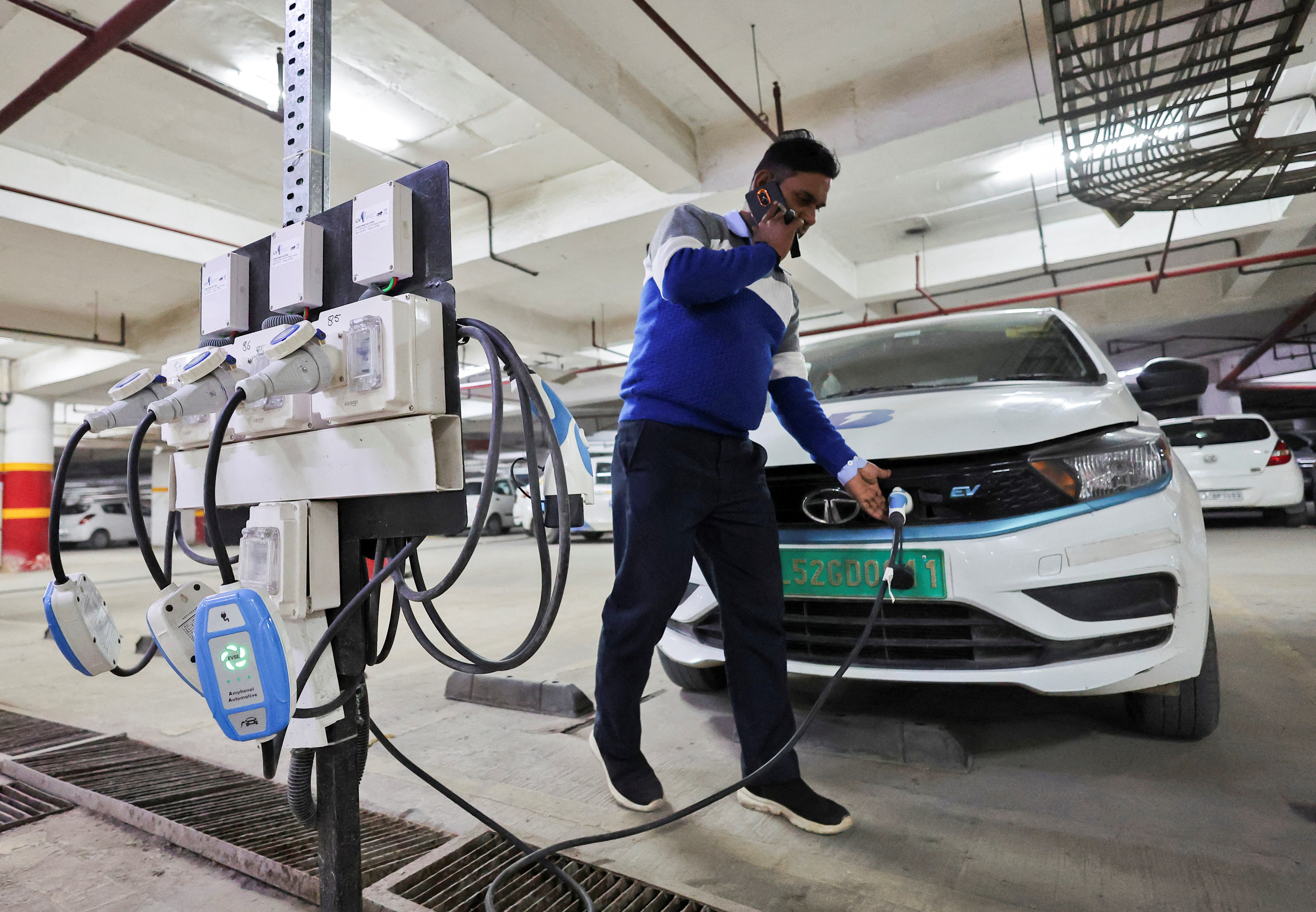
A man charges an electric vehicle (EV) at the charging hub of Indian ride-hailing BluSmart Electric Mobility in Gurugram, India, December 9, 2022. REUTERS/Anushree Fadnavis

A man sits on his electric scooter as he waits to swap his battery at a Sun Mobility battery swapping station in New Delhi, India, December 6, 2022. REUTERS/Anushree Fadnavis
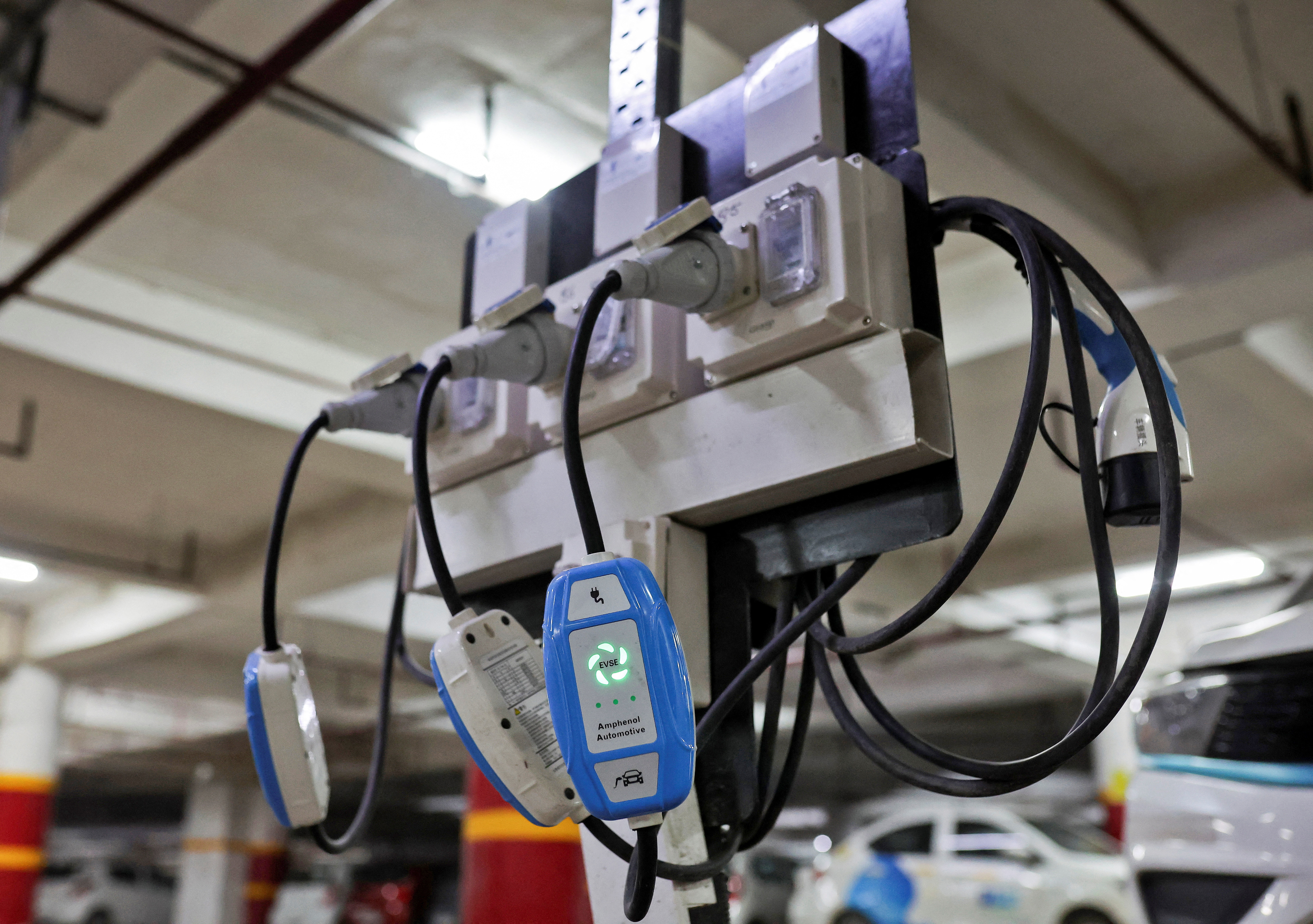
Electric chargers or smart chargers are seen at the charging hub of Indian ride-hailing BluSmart Electric Mobility in Gurugram, India, December 9, 2022. REUTERS/Anushree Fadnavis
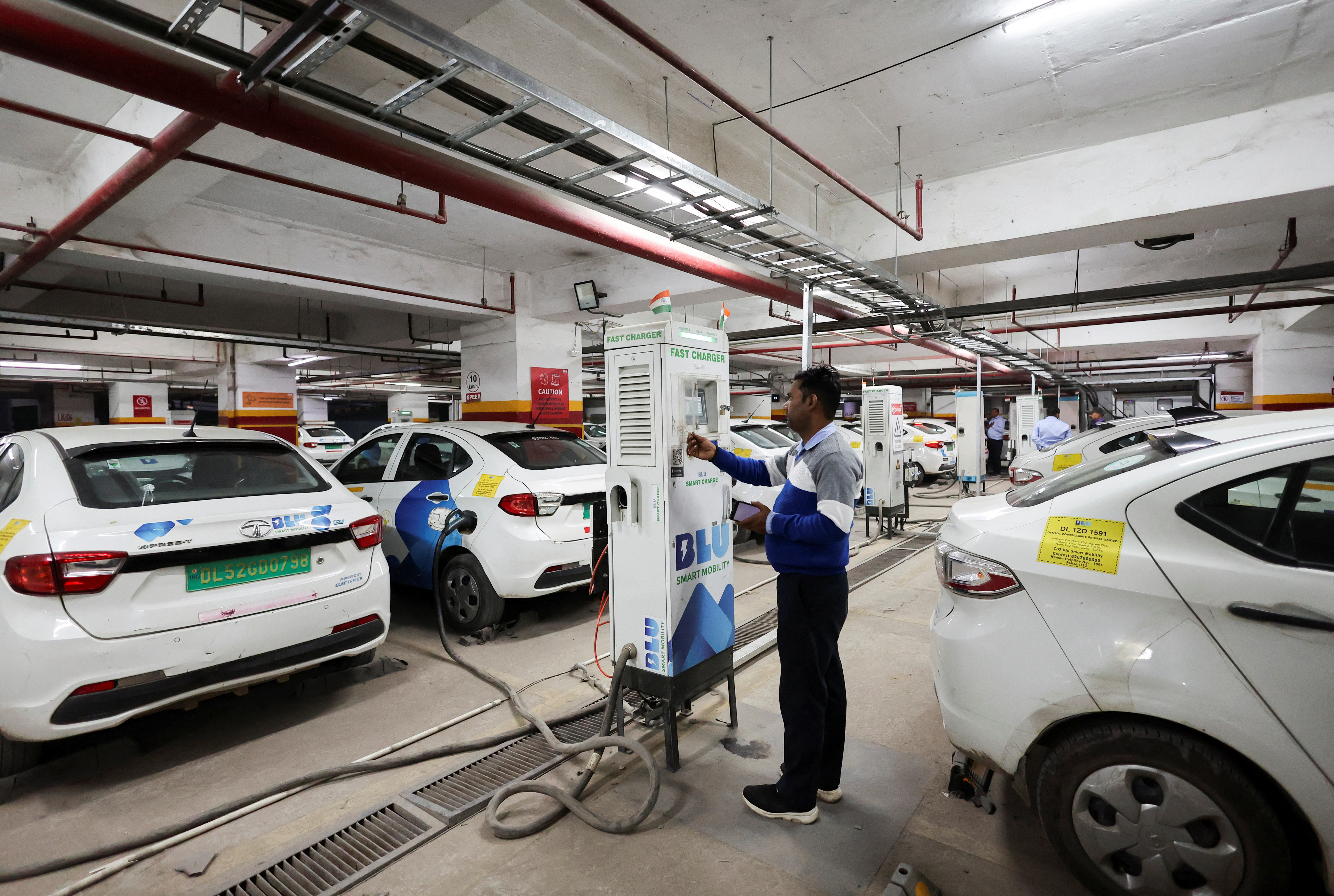
A man charges an electric vehicle (EV) at the charging hub of Indian ride-hailing BluSmart Electric Mobility in Gurugram, India, December 9, 2022. REUTERS/Anushree Fadnavis

An Indian ride-hailing BluSmart Electric Mobility car is seen at its office in Gurugram, India, December 9, 2022. REUTERS/Anushree Fadnavis

Categories
Audio Sources - Full Text Articles

ICC prosecutor gets approval to reopen Philippines drug war probe

2023-01-27T04:46:08Z

Philippine National Police (PNP) Chief Ronald dela Rosa with police Senior Superintendent Graciano Mijares (R), newly-appointed head of the PNP drug enforcement group, during the re-launch of police anti-narcotics operations at a news conference inside the police headquarters in Quezon city, metro Manila, Philippines March 6, 2017. REUTERS/Romeo Ranoco/File Photo

The chief enforcer of former Philippine President Rodrigo Duterte’s brutal ‘war on drugs’ said on Friday he would cooperate with an International Criminal Court (ICC) investigation if the government decided to participate.

The ICC on Thursday said it had granted its prosecutor’s request to reopen an investigation into drug war killings and other suspected rights abuses. The court suspended the probe in November 2021 at Manila’s request after the country said it was implementing its own investigations and prosecutions.

“If the Philippine government would cooperate, then, I am a part of the…government, so I will cooperate,” Ronaldo dela Rosa, a former police chief who is now a senator told ANC News channel.

Dela Rosa, who oversaw Duterte’s anti-narcotics crackdown, which resulted in the deaths of more than 6,200 people, mostly small-time drug dealers, said he saw no problem if the government cooperated. “All my action will be in consonance with the decision of this government.”

There was no immediate comment from the office of President Ferdinand Marcos and the justice ministry.

Marcos in August said he had no intention of rejoining the ICC after Duterte, whose daughter is the country’s current vice president, pulled out of the court in 2019. Duterte said at the time the ICC had no right to meddle in his country’s affairs.

In a statement, the ICC said it was “not satisfied that the Philippines is undertaking relevant investigations that would warrant a deferral of the investigation.”

The court said that the actions by Philippine authorities did not amount to “tangible, concrete and progressive investigative steps in a way that would sufficiently mirror the Court’s investigation”.

Human Rights Watch said the ICC investigation was the only credible path to justice for victims and their families.

“As the court’s judges agreed, Philippine authorities are not ‘undertaking relevant investigations’ into these crimes or ‘making a real or genuine effort’ to carry these investigations out,” Human Rights Watch said in a statement. “The ICC offers a path forward to fill the accountability vacuum.”

Rights groups and critics say law enforcers summarily executed drug suspects. Police say those killed were armed and had violently resisted arrest. Meanwhile, the families of many drug war victims are still seeking justice in long, drawn-out cases.

In a rare conviction, a Philippine court in 2018 sentenced three police officers to up to 40 years in jail for the murder of a 17-year-old high school student. The teenager’s death featured in a report by a former ICC prosecutor.

Categories
Audio Sources - Full Text Articles

Gaza militants fire rockets, Israel strikes in Gaza

2023-01-27T04:43:53Z

Palestinian militants on Friday fired two rockets from the Gaza Strip towards southern Israel that were intercepted by missile defenses, and Israel then carried out strikes in Gaza.

The cross-border fire came after an Israeli raid in the occupied West Bank on Thursday that led to the largest single death toll in years of fighting.

The overnight rockets triggered sirens in Israeli communities near the border with Gaza, warning residents to take shelter. There were no reports of injuries.

Israel’s Channel 12 aired footage of Israeli interceptor missiles being launched into the night sky above the city of Ashkelon, about 12 km (7 miles) north of Gaza, which is controlled by the Islamist militant group Hamas.

A few hours later, Israel’s military said it had carried out strikes in Gaza. Palestinian witnesses said Israeli aircraft had targeted a Hamas training camp. No injuries were reported.

Tensions flared after Israeli commandos killed seven gunmen and two civilians during the raid on the flashpoint town of Jenin. Hamas and the smaller militant group Islamic Jihad promised a response, but there was no immediate claim for the rocket fire.

After the Jenin violence, the Palestinian Authority said it was ending its security coordination with Israel, an arrangement that is widely credited with helping to keep order in the West Bank and preventing attacks against Israel. It has frozen the cooperation numerous times in protest.

Prime Minister Benjamin Netanyahu said Israel was not looking to escalate the situation, though he ordered security forces to be on alert.

U.S., U.N. and Arab officials spoke with Israel and Palestinian factions to try to keep the clash in Jenin, among areas of the West Bank that have seen intensified Israeli operations, from sparking a broader confrontation.

Violence has surged since a series of lethal Palestinian street attacks in Israel last March and April. The attendant diplomatic stalemate has helped rally Palestinian support for Hamas and Islamic Jihad, which refuse coexistence with Israel – where Netanyahu’s new hard-right government includes members opposed to Palestinian statehood.

Related Galleries:

Smoke and flames rise during Israeli airstrikes in Gaza City, January 27, 2023. REUTERS/Arafat Barbakh

Flames rise during Israeli airstrikes in Gaza City, January 27, 2023. REUTERS/Arafat Barbakh
WP Radio
WP Radio
OFFLINE LIVE