Categories
Audio Sources - Full Text Articles

Cutting IRS funding is a gift to America’s wealthiest tax evaders

By Vanessa Williamson

In their first act of legislative business, the new House Republican majority voted to cut funding for the Internal Revenue Service (IRS). The vote was a symbolic effort to repeal the $80 billion increase in funding the revenue agency received last year as part of the Inflation Reduction Act. Cutting IRS funding is a terrible idea. A well-funded IRS can distribute emergency aid quickly, serve taxpayers efficiently, and help ensure that millionaires have to follow the tax laws just like everyone else. It’s an essential investment in good government.

The IRS has been persistently underfunded for decades, but the years since 2010 have been particularly tough. Tax law expert Chye-Ching Huang notes that the enforcement budget of the IRS dropped by nearly a quarter in less than ten years. In 2017, the IRS employed less than 10,000 revenue agents—the last time that was true was 1953: the Brooklyn Dodgers were in the World Series, the median housing price was about $8,000, and the IRS was handling over 100 million fewer individual income tax returns a year. The IRS is also “overwhelmingly reliant” on antiquated technology, the U.S. Taxpayer Advocate notes, “systems that are at least 25 years old, use obsolete programming languages (e.g., COBOL), or lack vendor support, training, or resources to maintain.”

It is worth noting how much the IRS has managed to achieve despite its perpetually inadequate resources. When COVID struck, for example, only the IRS had the capacity to send millions of emergency checks to keep American households afloat. As my Tax Policy Center colleague Howard Gleckman has said, the IRS “did an extraordinary job in getting these checks out in very difficult circumstances.”

But the budgetary toll of persistent underfunding is unmistakable. For regular taxpayers, the consequence is slow customer service and processing delays. Some politicians have irresponsibly suggested that every new IRS employee will be a gun-toting enforcement agent. Actually, the IRS desperately needs employees to process refunds and answer tax filers’ phone calls. Out of the 282 million phone calls the IRS received in 2021, only 11% or 32 million were actually answered. Nearly half the new IRS money is going to taxpayer services and modernization, which will make the agency more responsive and efficient for taxpayers.

About $45 billion of the $80 billion in new funding is going to enforcement, and that is great news. For the wealthiest and most sophisticated tax filers, a cash-strapped IRS has meant a tax evasion free-for-all. Currently, the tax gap, which is the amount in taxes that are owed but not paid, comes to nearly $7 trillion over a decade. Three fifths of the tax gap is due to underreporting of income by the top 10% of taxpayers, and more than a quarter comes from the top 1%.

But the IRS has been left without the resources to hire and support the kind of tax experts who can catch wealthy tax cheats. The lack of staff was highlighted recently when it was revealed that the audit of former president Donald Trump was staffed by exactly one revenue agent. But Trump wasn’t the only one whose taxes were going without thorough examination. Audits of millionaires have dropped 61% in less than a decade. For those making more than $5 million, the audit rate has dropped 87%.

At the same time, responding to a push from Congress, the IRS has focused instead on a much cheaper form of audit, targeting recipients of the Earned Income Tax Credit—i.e. low-income, working families. As a result, the EITC recipients are audited at the same rate as the top 1% of earners. As law professor Dorothy Brown explains, the consequence of high levels of EITC audits is a serious racial disparity in tax policing.

Treasury Secretary Janet Yellen has insisted that the new funding not be used to increase audit rates on those earning less than $400,000 a year. So, the new funding will help rebuild the capacity of the IRS to audit the wealthy, making the tax system far fairer. And, of course, closing the tax gap raises revenues—it’s a policy that more than pays for itself. The IRS investments are expected to raise $124 billion.

The Republican effort to repeal the IRS’s $80 billion funding increase will not move forward in the Democrat-controlled Senate. But the IRS might yet see its funding decline, if the House Republicans negotiate a cut in the budget fights later this year. If that happens, it is bad news for the millions of American households who pay their taxes honestly, and great news for the country’s richest tax evaders. Funding the IRS will shore up an essential government service, making tax filing easier and tax enforcement fairer.
2023-01-23T154411Z_2135759399_RC2EWY97LV
fblike20.png pinterest20.png twitter20.png email20.png rss20.png  
Categories
Audio Sources - Full Text Articles

U.N. condemns M23 rebel offensive on Congo town, hundreds flee

2023-01-26T18:49:58Z

Congolese police talk to demonstrators calling on authorities to enforce an agreed withdrawal of M23 rebels from occupied territory in the region, within Goma in the North Kivu province of the Democratic Republic of Congo January 18, 2023. REUTERS/Djaffar Sabiti/File Photo

The United Nations peacekeeping mission in Democratic Republic of Congo on Thursday condemned an offensive by M23 rebels in the east of the country that forced 450 people, including women and children, to seek refuge around its base in Kitshanga town.

“The M23 must cease all hostility and withdraw from occupied areas, in accordance with the roadmap set out in the Luanda mini-summit,” the mission known by its acronym MONUSCO, said on Twitter.

The attack on Kitshanga is a new offensive by rebels who have seized large areas of eastern Congo’s North Kivu province in a rapid onslaught since May that threatened the provincial capital, Goma.

The insurgency has inflamed regional tensions with Congo accusing neighbour Rwanda of backing and sponsoring the Tutsi-led rebellion. United Nations experts and Western powers have accused Rwanda of backing the M23.

The government of Rwanda has denied any involvement.

Regional leaders brokered an agreement in November under which the rebels were meant to withdraw from recently seized positions by Jan. 15 as part of attempts to end the fighting that has displaced at least 450,000 people.

But a U.N. internal report said the rebels were flouting the ceasefire and withdrawal.

Two witnesses who fled Kitshanga and joined the throng of refugees at the MONUSCO base, said the rebels had taken control of the town.

“The army withdrew. I’m at the MONUSCO base,” said a Kitshanga-based journalist, requesting anonymity for security reasons.

A spokesman for Congo’s government, and army did not immediately respond to a request for comment.

The M23 said in a statement that it was obliged to intervene to protect Tutsis in Kitshanga and other areas.


Categories
Audio Sources - Full Text Articles

U.S. CDC still looking at potential stroke risk from Pfizer bivalent COVID shot

2023-01-26T18:31:45Z

A vial of the Pfizer-BioNTech coronavirus disease (COVID-19) booster vaccine targeting BA.4 and BA.5 Omicron sub variants is pictured at Skippack Pharmacy in Schwenksville, Pennsylvania, U.S., September 8, 2022. REUTERS/Hannah Beier/

New data from one U.S. Centers for Disease Control and Prevention (CDC) database shows a possible stroke risk link for older adults who received an updated Pfizer (PFE.N)/BioNTech (22UAy.DE) COVID-19 booster shot, but the signal is weaker than what the agency had flagged earlier in January, health officials said on Thursday.

U.S. Food and Drug Administration officials said they had not detected a link between the shots and strokes in two other safety monitoring databases.

The new data was presented at a meeting of outside experts that advise the FDA on vaccine policy.

Earlier this month, U.S. health officials said they had detected the possible link to ischemic strokes in people over age 65 who received the newer booster shots in its Vaccine Safety Datalink (VSD) database. They said at the time it was very unlikely to represent a true clinical risk.

Dr. Nicole Klein of healthcare company Kaiser Permanente, which maintains VSD data for the CDC, said the rate of strokes observed in the database had slowed in recent weeks, but the signal was still statistically significant, meaning likely not by chance.

Most of the confirmed cases had also received a flu vaccine at the same time, which might be a factor, she said.

FDA scientist Richard Forshee said the agency plans to study whether there is any increased risk of stroke from receiving the two shots at the same time.

Both agencies still recommend older adults receive the booster shots, now tailored to target Omicron variants as well as the original coronavirus.

Dr. Walid Gellad, professor of medicine at University of Pittsburgh, said the issue required further investigation.

“Sometimes signals are not clear,” Gellad said in an email. “It makes sense to look into it more, and it doesn’t make sense to change practice given the known benefits (of getting the booster) in this age group.”


Categories
Audio Sources - Full Text Articles

National Archives asks former U.S. presidents, VPs to check for classified documents- CNN

2023-01-26T18:40:06Z

The National Archives building is seen in Washington on March 4, 2012. REUTERS/Gary Cameron (UNITED STATES)

The National Archives asked former U.S. presidents and vice presidents on Thursday to re-check their personal records for any classified documents or other presidential records after the discovery of such documents in the possession of former President Donald Trump, President Joe Biden and former Vice President Mike Pence, CNN reported.

The National Archives and Records Administration, or NARA, sent a letter to representatives of former presidents and vice presidents from the last six presidential administrations covered by the Presidential Records Act (PRA), the report added.

The letter cited by CNN requested that the former leaders check their files to ensure that material thought to be personal does not inadvertently contain presidential records that are required by law to be turned over to the National Archives. The Archives did not respond to a request for comment.

“We request that you conduct an assessment of any materials held outside of NARA that relate to the Administration for which you serve as a designated representative under the PRA, to determine whether bodies of materials previously assumed to be personal in nature might inadvertently contain presidential or vice presidential records subject to the PRA, whether classified or unclassified,” CNN quoted the letter as saying.

Documents marked as classified were discovered at Pence’s Indiana home last week. Biden, whose documents dated from his time as vice president and senator, and Trump, who resisted turning over the items, leading to an FBI raid, are both facing special counsel investigations by the Justice Department over improper handling of classified materials.

Trump’s handling of the records is also under federal criminal investigation.

A spokesman for former President Barack Obama told Reuters when asked about possible classified documents that his office had been given a “clean bill of health” by the National Archives.

The administration of George W. Bush “turned all presidential records over – both classified and unclassified – upon leaving the White House,” Bush spokesman Freddy Ford told Reuters.

Former President Jimmy Carter did not receive a letter from the National Archives, since the Presidential Records Act took effect after he left office.

The National Archives has come under criticism from Republicans who say it has not been transparent in the documents cases. The Oversight Committee of the House of Representatives, now controlled by Republicans, has scheduled a Jan. 31 transcribed interview with the Archives’ general counsel, a committee aide said.

Categories
Audio Sources - Full Text Articles

U.S. FDA calls for new regulatory framework for use of cannabis compound CBD

2023-01-26T18:45:20Z

The U.S. Food and Drug Administration said on Thursday it does not intend to make any new guidance on the use of the popular cannabis compound CBD in food and supplements, saying the United States needs to develop a new framework to ensure its safe use.

The health regulator said it would work with Congress to develop a new, cross-agency regulatory framework. The FDA denied three citizen petitions that had requested the agency to provide guidance.

The agency said the current safety standards for dietary supplements or food additives are not appropriate for cannabidiol, based on data and studies it has reviewed and conducted.

“We have not found adequate evidence to determine how much CBD can be consumed, and for how long, before causing harm,” FDA Principal Deputy Commissioner Janet Woodcock said.

Cannabidiol is a non-psychoactive compound derived from cannabis. Long-term use of the compound has raised several safety concerns including potential harm to the liver and to the male reproductive system.

The FDA has generally pursued limited enforcement activity regarding CBD, focusing primarily on food and beverage products that make unsubstantiated health claims.

The FDA said that available data did not show how CBD products could meet the safety standard for substances in animal food, and it did not intend to provide new rules allowing the use of the compound in animal food either.

“A new regulatory pathway for CBD is needed that balances individuals’ desire for access to CBD products with the regulatory oversight needed to manage risks,” the agency said.

Cannabis products, excluding Jazz Pharmaceuticals Plc’s (JAZZ.O) epilepsy drug Epidiolex, are illegal at the federal level in the United States, although some states allow their use.

Related Galleries:

A baker sells marijuana cookies at the medical marijuana farmers market at the California Heritage Market in Los Angeles, California July 11, 2014. The first-ever cannabis farmer’s market in Los Angeles began on July 4 and opens weekly from Friday to Sunday. REUTERS/David McNew/File Photo

A member of the media aims his camera at cannabis products for legal sale at Smacked LLC, the first Conditional Adult-Use Retail Dispensary (CAURD), owned by an entrepreneur previously criminalized by cannabis prohibition, in the Greenwich Village area of New York City, U.S., January 24, 2023. REUTERS/Shannon Stapleton
Categories
Audio Sources - Full Text Articles

Southwest Airlines warns of quarterly loss after holiday meltdown

2023-01-26T18:42:35Z

A Southwest Airlines jetliner departs from Chicago Midway International Airport in Chicago, Illinois, U.S., December 27, 2022. REUTERS/Kamil Krzaczynski

Southwest Airlines Co (LUV.N) on Thursday warned of a loss in the current quarter as passengers shunned the carrier in the immediate aftermath of a tech meltdown that forced it to scrap thousands of flights between Christmas and New Year’s Eve.

The forecast heaps more pain on the largest U.S. domestic carrier, which is facing regulatory scrutiny over its flight scheduling and handling of more than 16,700 cancellations that disrupted travel plans for about 2 million customers during a busy holiday season.

Analysts on average had expected the company to post a profit of 19 cents a share in the first quarter, Refinitiv IBES data shows.

Southwest, which also reported a loss in the fourth quarter, estimates a revenue hit of between $300 million and $350 million in the first quarter.

The Dallas-based carrier also expects non-fuel operating costs in the March quarter to be higher than its previous estimate, in part due to extra pay it has offered to workers for dealing with the December meltdown.

“Thus far in January 2023, the company has experienced an increase in flight cancellations and a deceleration in bookings, primarily for January and February 2023,” Southwest said. But current booking trends for March were encouraging, it added.

The company’s shares were down about 4.5% at $35.18 in midday trading.

Operating revenue for the first quarter, when travel demand tends to slow after the holiday season, is expected to rise 20% to 24% against a period last year which was hit by the pandemic.

The company’s under-fire chief executive, Bob Jordan, on Thursday again apologized for the mass cancellations, which were attributed to Southwest’s outdated crew scheduling software.

The software buckled under the weight of reassignments that had to be done after severe winter weather left the carrier’s crew stranded all over the country.

Jordan, who took the airline’s helm last February, told Reuters this month that the company was looking at all options to prevent a repeat.

Southwest has hired consultancy Oliver Wyman to investigate the disruption and is working with General Electric Co (GE.N) to automate its crew scheduling systems in order to make it more reliable.

The company’s board has set up a new Operations Review Committee to oversee management following the systems collapse.

In a statement, Jordan said Southwest is “reexamining the priority” of technology and other investments planned in 2023.

Southwest expects to spend about $1.3 billion this year on technology investments, upgrades, and system maintenance.

Christopher Raite, senior analyst at research firm Third Bridge, said the carrier has the balance sheet to fund the investments, but it needs to execute its plans.

He said while a recessionary economic environment tends to make companies de-prioritize spending on technology, Southwest cannot afford to do that.

Southwest retained its capacity growth forecast for the first quarter, but revised upward estimates for the full year. Cowen analyst Helane Becker called the forecast “a cause for future concern,” citing the carrier’s operational issues in the past.

The meltdown led to an adjusted loss of $226 million, or 38 cents a share, in the quarter through December, robbing it of the gains from booming holiday travel demand.

Rival carriers United Airlines (UAL.O) and Delta Air Lines (DAL.N) American Airlines (AAL.O) have all reported higher-than-expected earnings for the quarter.

Southwest said it suffered a revenue hit of $410 million and saw about a $390 million jump in operating expenses last quarter due to the flight cancellations.

For 2023, it still expects “solid” profit with year-over-year margin expansion.

Categories
Selected Articles

FBI Director weighs in on classified documents, says rules are ‘there for a reason’ – Fox News

FBI Director weighs in on classified documents, says rules are ‘there for a reason’  Fox News
Categories
Audio Sources - Full Text Articles

Clean Energy Investment Sets $1.1 Trillion Record, Matching Fossil Fuels For the First Time

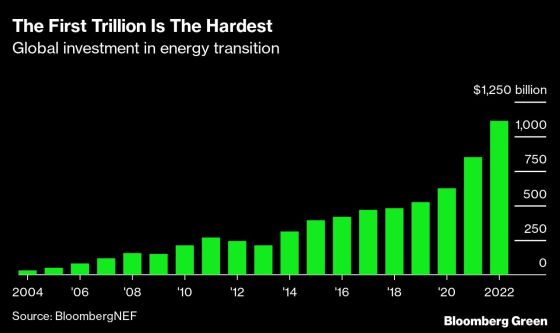
Last year was a double milestone for decarbonizing the world’s energy system. It was the first year when investment in the energy transition equaled global investment in fossil fuels, according to the latest data release from clean energy research group BloombergNEF.

The money flowing into the upstream, midstream and downstream segments of oil and gas, and into fossil fuel-fired power generation without emissions reduction technology, was $1.1 trillion last year. Likewise, annual investment in renewable energy, electrified transport and heat, energy storage and other technologies reached $1.1 trillion.

But 2022 was also a milestone in another sense — as the first year when investment in decarbonizing energy surpassed $1 trillion. The year-on-year increase of more than $250 billion from 2021 was the largest jump yet.

[time-brightcove not-tgx=”true”]

The First Trillion Is The Hardest | Global investment in energy transition

Renewable energy and electrified transport reaped most of those dollars. Those sectors were buoyed by soaring installations of wind and solar — with more than 350 gigawatts of assets built — and sales of 10-million-plus electric vehicles globally.

Cars In Hot Pursuit | Investment in renewable energy and electrified transport

Although renewable energy saw record investment in 2022, electrified transport is growing at a faster rate. Passenger EVs account for the bulk of the transport dollars invested ($380 billion) but by no means all of that sector’s capital flow last year. Public charging infrastructure saw an influx of $24 billion, while nearly $23 billion was spent on electric 2- and 3-wheelers. Electric buses got $15 billion, and commercial electric vehicles such as trucks received $8 billion.

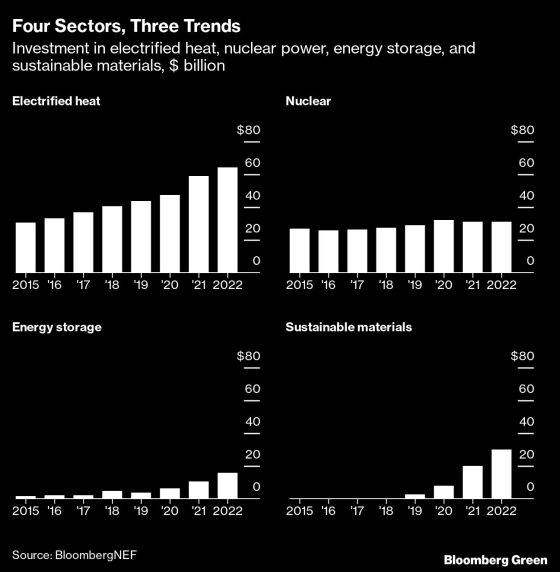
BNEF tracks six other sectors in the energy transition, and all but one of them (nuclear) also set annual investment records last year.

Four Sectors, Three Trends | Investment in electrified heat, nuclear power, energy storage, and sustainable materials, $ billion

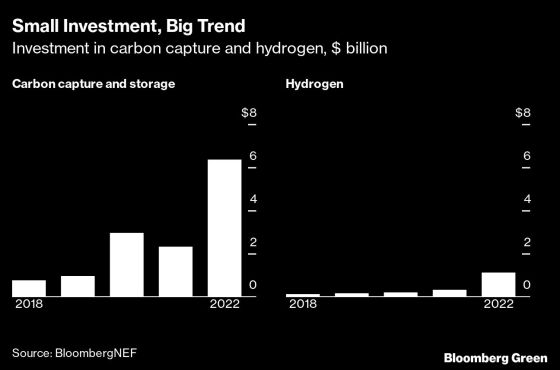
The two smallest sectors for investment, shown below, are also worth noting. Carbon capture received $6.3 billion in 2022 and hydrogen a little over $1 billion. However, both grew significantly in relative terms: Carbon capture investment almost tripled while hydrogen investment more than tripled. Both technologies have made big promises in the past half-decade, and investment is now following. But there will need to be orders of magnitude more use of them to have a substantial climate impact.

Small Investment, Big Trend | Investment in carbon capture and hydrogen, $ billion

Inflation did play a role in the increase in invested dollars last year — but not that much of a role, given that inflation in the range of 8% is less than a third of the total year-on-year dollar increase. Inflation drove up costs of components, construction and financing for energy across the board. Yet expansion in nearly every sector increased total dollars invested much more.

A trillion dollars invested in a year is something. It is also short of what is needed. In order to get on track for net zero emissions in 2050, the world would need to immediately triple this $1.1 trillion spend — and add hundreds of billions of dollars more for the global power grid.

Decarbonization is a game of decades and a game of dollars. Since 2004, the world has invested $6.7 trillion in the energy transition. It took eight years, from 2004 through 2011, to reach the first $1 trillion. It took less than four years to reach the next trillion, and a little less than one more year to reach the latest trillion. One dollar out of every six invested over the last 18 years flowed in 2022.

To paraphrase the late energy investor T. Boone Pickens, the first trillion was the hardest. The most recent trillion was the fastest — but if we are to achieve the deepest decarbonization possible, it will also be slower than every trillion that comes after it.

Nat Bullard is a senior contributor to BloombergNEF and Bloomberg Green. He is a venture partner at Voyager, an early-stage climate technology investor.

Categories
Selected Articles

Swedish intel agent gets life for spying for Russia – FRANCE 24 English

Swedish intel agent gets life for spying for Russia  FRANCE 24 English

The post Swedish intel agent gets life for spying for Russia – FRANCE 24 English first appeared on Advertising at The News And Times.

Categories
Selected Articles

U.S. says it “hacked the hackers“ to bring down ransomware gang, helping 300 victims

2023-01-26T17:47:45Z The J. Edgar Hoover Federal Bureau of Investigation Building is seen in Washington, U.S., February 2, 2018. REUTERS/Aaron P. Bernstein The FBI revealed on Thursday it had secretly hacked and disrupted a prolific ransomware gang called Hive, a maneuver that allowed the bureau to thwart the group from collecting more than $130 million in […]

The post U.S. says it “hacked the hackers“ to bring down ransomware gang, helping 300 victims first appeared on The Brooklyn Radio – bklynradio.com.

WP Radio
WP Radio
OFFLINE LIVE