Categories
Audio Sources - Full Text Articles

The UAE Has Donated Millions to the Atlantic Council. They Just Got a Glowing Op-Ed From the Think Tank’s Chief.

The Atlantic Council’s chief executive officer, Fred Kempe, this month lavished praise on the “resource-rich, renewables-generating” United Arab Emirates in a Jan. 14 op-ed for CNBC praising the oil-rich Gulf nation’s “utopian” plan to fight climate change.

What he failed to mention were the Middle Eastern monarchy’s sizable donations—which have in some years topped $1 million—to the Atlantic Council. He also omitted the more troubling aspects of the UAE’s governance. The country has a documented record of human rights abuses, according to the State Department, including torture, arbitrary detention, and “undue restrictions on free expression and the press.”

In the piece, Kempe celebrated the United Nations’ decision to hold its annual climate change summit in Abu Dhabi and praised the UAE’s selection of Sultan Ahmed Al-Jaber, an Emirati government minister and the head of the state-owned Abu Dhabi National Oil Company, to oversee the global summit. Kempe called Al-Jaber an “ideal choice” to lead the conference, rebuffing climate activists who criticized Al-Jaber’s selection because of his role as head of one of the Gulf region’s largest oil producers.

After the Washington Free Beacon contacted the Atlantic Council for comment, CNBC attached a lengthy editor’s note to the article noting that “the obvious conflict of interest” was “not disclosed” and that the Abu Dhabi National Oil Company is a major sponsor of the Atlantic Council’s annual energy conference. The UAE embassy in 2021 gave more than $1 million to the Atlantic Council, while the UAE’s Ministry of Foreign Affairs and International Cooperation gave between $100,000 and $250,000, according to donor records.

In a statement to the Free Beacon, an Atlantic Council spokesman said the think tank “regret[s] that proper disclosures were not made.”

“That was an oversight. The piece has been updated to clarify the nature of the relationship,” the spokesman said.

The Atlantic Council, which paid Kempe roughly $700,000 in 2019, has promoted the UAE in other ways. In October, the think tank funded a junket for congressional aides to Abu Dhabi to meet with Emirati officials and energy industry executives, the Free Beacon reported. The Atlantic Council has hosted Emirati officials at forums and other events both in Washington, D.C., and Abu Dhabi. Kempe interviewed Al-Jaber at an Atlantic Council event in April 2021.

The think tank has come under scrutiny before over its other foreign entanglements. Burisma Holdings, the Hunter Biden-linked Ukrainian energy firm, contributed $300,000 to the Atlantic Council as part of the company’s attempts to repair its public image in the wake of corruption scandals. Atlantic Council officials accepted the donation even after State Department officials had warned them about Burisma’s corruption. Two of Burisma’s lobbyists, Sally Painter and Karen Tramontano, served on the Atlantic Council’s board of directors at the time.

The Turkish government, a longtime Atlantic Council donor, has pressured the think tank to shape its research and programming in ways favorable to Ankara, sources have told the Free Beacon.

The post The UAE Has Donated Millions to the Atlantic Council. They Just Got a Glowing Op-Ed From the Think Tank’s Chief. appeared first on Washington Free Beacon.

Categories
Audio Sources - Full Text Articles

D.C. Council Overrides Mayor’s Veto, Lightens Sentencing for Carjackings and Gun Crimes

The D.C. Council on Tuesday voted to override Democratic Mayor Muriel Bowser’s veto of an update to the district’s criminal code which will reduce sentences for carjackings, robberies, and gun-related felonies in the nation’s capital.

The all-Democratic council voted 12-1 against Bowser, who vetoed what she called “a complete overhaul of our criminal code” that would make the district less safe. The revised code shrank some sentence lengths for gun charges to less than five years. Councilmember Trayon White (D.), who has accused Jews of manipulating the weather, cast the only vote siding with the mayor.

In 2021, D.C. had its highest murder rate in more than 18 years, with 226 killings recorded. There has also been a rash of carjackings over the past five years, affecting city council candidates and pro-athletes alike.

Even the liberal Washington Post editorial board warned that the revised code would make the city “more dangerous” in a Sunday editorial.

In a Jan. 4 letter announcing her veto, Bowser noted that convicted violent felons who go on to commit other crimes with guns face a maximum sentence of just 4 years, as opposed to the previous 15 years. Armed robbers no longer face sentence enhancements for felony gun possession. The mayor also urged the council to raise penalties that had been reduced for carjackers and burglars.

Councilmember Brooke Pinto (D.) opposed Bowser’s decision last week arguing the opposite: that the new code is safer as well as “more just, equitable, and clear.” Fellow member Charles Allen (D.) accused the council’s critics of promoting “misinformation” about the code, ABC 7 News reported.

Pinto tried at one point to beef up charges for illegal gun possession through an amendment, but was voted down. “It is not a good message from this council to say we are going to reduce penalties for guns,” she said in November before voting to pass the code without the amendment, according to DCist.

The D.C. chapter of Black Lives Matter slammed Bowser for her veto, calling the move “performative distraction.”

“She cares about spotlights, murals and opportunities to misdirect and misinform,” the group said on Twitter.

The criminal code changes, which the council had unanimously approved in November, will now be sent to Congress for review. If Congress approves the plan in the next 60 days, it will go to President Joe Biden for his signature. The earliest the code could take effect then would be October 2025.

Update 2:57 p.m.: This piece has been updated with additional information.

The post D.C. Council Overrides Mayor’s Veto, Lightens Sentencing for Carjackings and Gun Crimes appeared first on Washington Free Beacon.

Categories
Audio Sources - Full Text Articles

Scenarios: Mnangagwa likely to save presidency amid risks of violence in Zimbabwe after elections

Zimbabwe’s 2023 Elections are highly likely to be followed by bloodbath, with government party pressing on opposition and ZANU-PF stepping aside from democracy standards. 

The President Emmerson Mnangagwa will likely win Zimbabwe’s 2023 elections, but it’ll cause security and political crisis in the state, so as rising foreign influence there.

Zimbabwe’s main political parties have started preparing for the country’s general elections in 2023 as they hold rallies and campaign activities in cities and towns to whip up their support bases.

The Zimbabwe Electoral Commission has yet to announce the exact date for the vote, but it has revealed that it would be held in either July or August 2023. After last elections took place on July 31, 2018.

The main political parties for the 2023 elections remain the Zanu-PF, which has been in power since independence in 1980, and the opposition Citizens Coalition For Change (CCC), formed early this year and led by Nelson Chamisa.

Some institutions, like The British parliament, for example, expressed concern over the lack of signs that Zimbabwe’s 2023 elections would be credible, saying there was a shortage of meaningful political, economic, and human rights reforms.

In its latest report, the Zimbabwe Human Rights non-governmental organisation (ZHRNGO Forum) revealed thatviolence was once again showing its ugly head, as protagonists employ dirty tactics to gain both political and electoral advantage. A total of 1,901 politically motivated cases have been recorded so far, as calls for solutions to the deepening polarisation and political intolerance escalate ahead of the 2023 general elections.

However, the country is already in election mode and merely waiting for presidential proclamation of official dates.

The ruling Zimbabwe African National Union-Patriotic Front (ZANU-PF) has ramped up its campaign. The political and electoral playing field remains deeply uneven and stacked in favour of the ruling party.

ZANU-PF’s campaign is a mix of state events and party activities, with the national broadcaster doing the party’s bidding. Meanwhile, Nelson Chamisa’s political opposition, Citizens Coalition for Change (CCC) – which put up a spirited performance during the recent by-elections – is trying to establish itself while simultaneously preparing for the 2023 polls.

 An analysis of the political terrain after the by-elections shows that ZANU-PF’s position as the ruling party is safe so far.

The CCC’s performance was impressive. It showed political prowess to turn the tide in the by-elections, winning 19 of the 28 seats up for grabs. However, its candidates were previous holders of 21 of 28 seats. In effect, the party managed to return 19 seats and lost two.

The public broadcaster continues to be partial to the ruling party, which enjoys unlimited coverage in the public print, radio and television stations. This matters because internet penetration and mobile data coverage are low in Zimbabwe, making the public broadcaster the main source of information with the widest audience.

Opposition parties cannot afford to base their electoral position on political posturing – they need solid groundwork. A comprehensive strategy should look at the overall political environment and honestly assess the opposition’s chances of unseating the ruling party. Carefully articulated messages and localised campaigns are needed to make inroads in ZANU-PF power bases.

Recent brutal attack on Zimbabwe opposition supporters was clearly intended to harass and intimidate them ahead of elections expected later this year. Ruling-party youth beat and kicked older supporters of the Citizens Coalition for Change (Triple C). The video, which has gone viral on social media, showed some elderly members of the Triple C being assaulted over the weekend in Murehwa about 100 kilometers east of Harare.

Fadzayi Mahere, Triple C spokeswoman, has accused the ruling Zanu-PF party of masterminding the violence and blamed the Zimbabwe Electoral Commission and the police for failing to stop it.

There is no doubt that many young people have lost interest and confidence in elections as a mechanism for political change and find it meaningless to vote because almost all of the elections are invariably characterised by violence and allegations of electoral fraud. 

The ruling party uses food and land distribution to win votes (mostly in rural areas), on the other hand, the opposition banks on popular anger and disillusionment rather than on its mobilisation prowess.

ZANU PF has three scenarios for the 2023 elections:

The most likely scenario:  ZANU PF will win the elections with relatively as little controversy and dispute as possible.

In this scenario, polling figures (both from polling stations and constituencies, V11 and V23) tally as perfectly as possible with those announced by the national command center – and, hopefully limit any rigging allegations. In this way, President Emmerson Dambudzo Mnangagwa and his ruling ZANU PF party hope for acceptance and legitimacy by the local, but especially international community – as he seeks to be recognized as truly and democratically elected leader.

The flagship of his administration is the ‘engagement and re-engagement policy’ – which Mnangagwa is pinning his hopes on for the removal of targeted sanctions and the pariah state tag. This is what Mnangagwa hopes for. 

However, there is a huge hurdle – the ever-growing support and strength of the opposition CCC party.

Mnangagwa would want to weaken the opposition before the 2023 elections. 

In order, to achieve this goal he has tried, and continues to try, so many sinister plots – including exploiting internal power struggles witnessed following the death of then MDC-T leader Morgan Richard Tsvangirai (leading to people as Thokozani Khupe and Douglas Mwonzora being Mnangagwa’s running dogs), abuse of state institutions (courts, ZEC, law enforcement), persecution of senior CCC officials and violence onslaught on supporters, and now buying opposition MPs loyalty via the notorious US$40,000 loans.

However, Mnangagwa is busy with his vote buying in rural areas – through the partisan distribution of government taxpayer-funded assistance.

So ZANU PF hopes to win, in a relatively acceptable manner. 

Less likely scenario: Flagrant rigging of elections. Results announced by the electoral commission after the 2023 elections are doctored and far different from those at the polling stations (V11) and constituencies (V23). This has happened before in 2008 and 2018.

In this regard, as much as ZANU PF would want to avoid this, the risk is far more acceptable for the party than losing power. 

The main riskis conducting another disputed election – which will not be accepted by both the opposition and the international community – leading to Mnangagwa’s continued questioned legitimacy, and targeted sanctions remaining.

That is a risk President’s party is willing to take, as the consequences of relinquishing power are too ghastly for the ruling elite to fathom – since there is just too much at stake, with the fear of facing the consequences of their corruption and brutal massacres, and prospects of life off the gravy train. 

They would rather be perceived as a pariah regime that retained power by rigging elections – than the alternative. 

The most unlikely scenario: ZEC will announce Nelson Chamisa and his CCC winners of the presidential elections.

This scenario is unlikely to happen, considering that ZEC’s impartiality is already questionable.

Categories
Audio Sources - Full Text Articles

From Jewish space lasers to homeland security: Marjorie Taylor Greene snags key committee assignment two years after her removal

GettyImages-1454752823.jpg

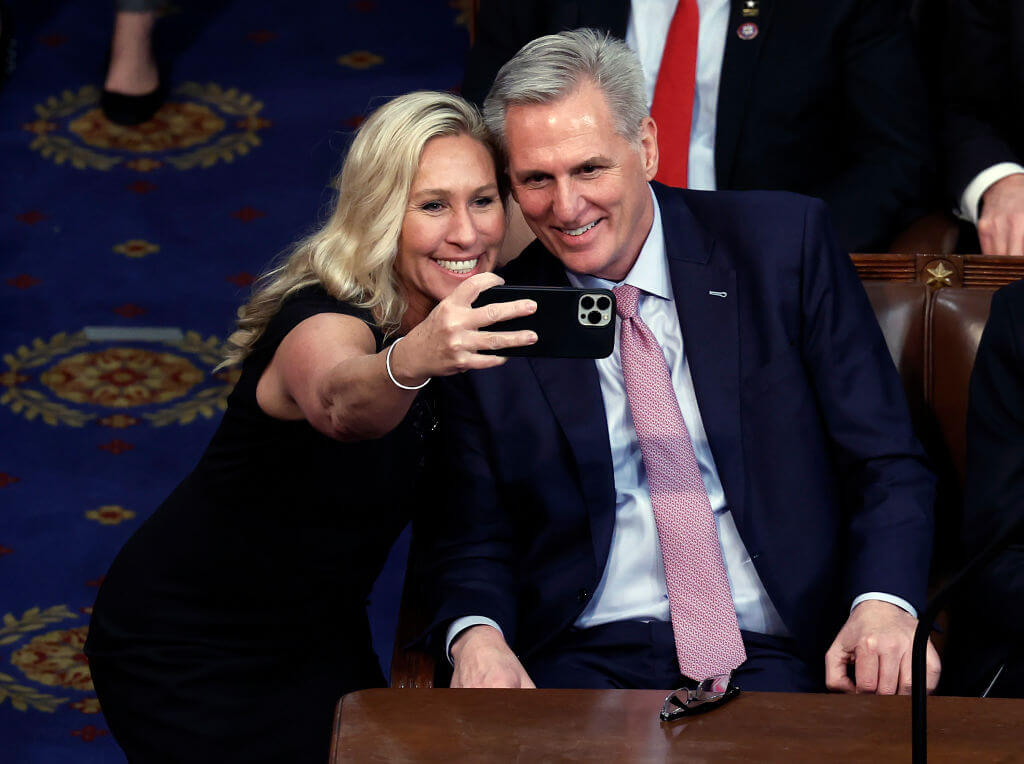
Rep. Marjorie Taylor Greene was assigned to the Homeland Security committee just two years after the then Democratic-controlled House voted to remove her from all Congressional committees for embracing far-right conspiracy theories.

The House Steering Committee on Tuesday announced her placement on Homeland Security, which has jurisdiction over borders. As a member, she would likely play a leading role should Congressional Republicans make good on their threat to impeach Homeland Security Secretary Alejandro Mayorkas, a Jewish member of Biden’s cabinet. 

Greene, who staunchly supported Rep. Kevin McCarthy in his successful bid for House speaker, has been accused several times of making antisemitic remarks — including suggesting that a Jewish-funded space laser had sparked wildfires in California in 2018. She also promoted QAnon conspiracy theories and embraced the Nation of Islam — a group whose leaders have regularly trafficked in antisemitic tropes — in her fight against coronavirus vaccinations. 


Her controversial statements led the House, with the support of 11 Republican members, to revoke her committee assignments in February 2021. McCarthy called it a “partisan power grab” and vowed to reward Greene with a key committee membership if Republicans won back control of the House in the midterm elections, which they did. 

Greene survived a Republican primary in May and has moderated her rhetoric in recent months. 


In an interview with Fox News last week, Greene said she never campaigned on QAnon and “like a lot of people today, I have easily gotten sucked into some things I’d seen on the internet. But that was dealt with quickly early on.”

The post From Jewish space lasers to homeland security: Marjorie Taylor Greene snags key committee assignment two years after her removal appeared first on The Forward.

Categories
Audio Sources - Full Text Articles

Biden and Dutch PM discuss semiconductor dispute, Patriots for Ukraine

2023-01-17T20:50:18Z

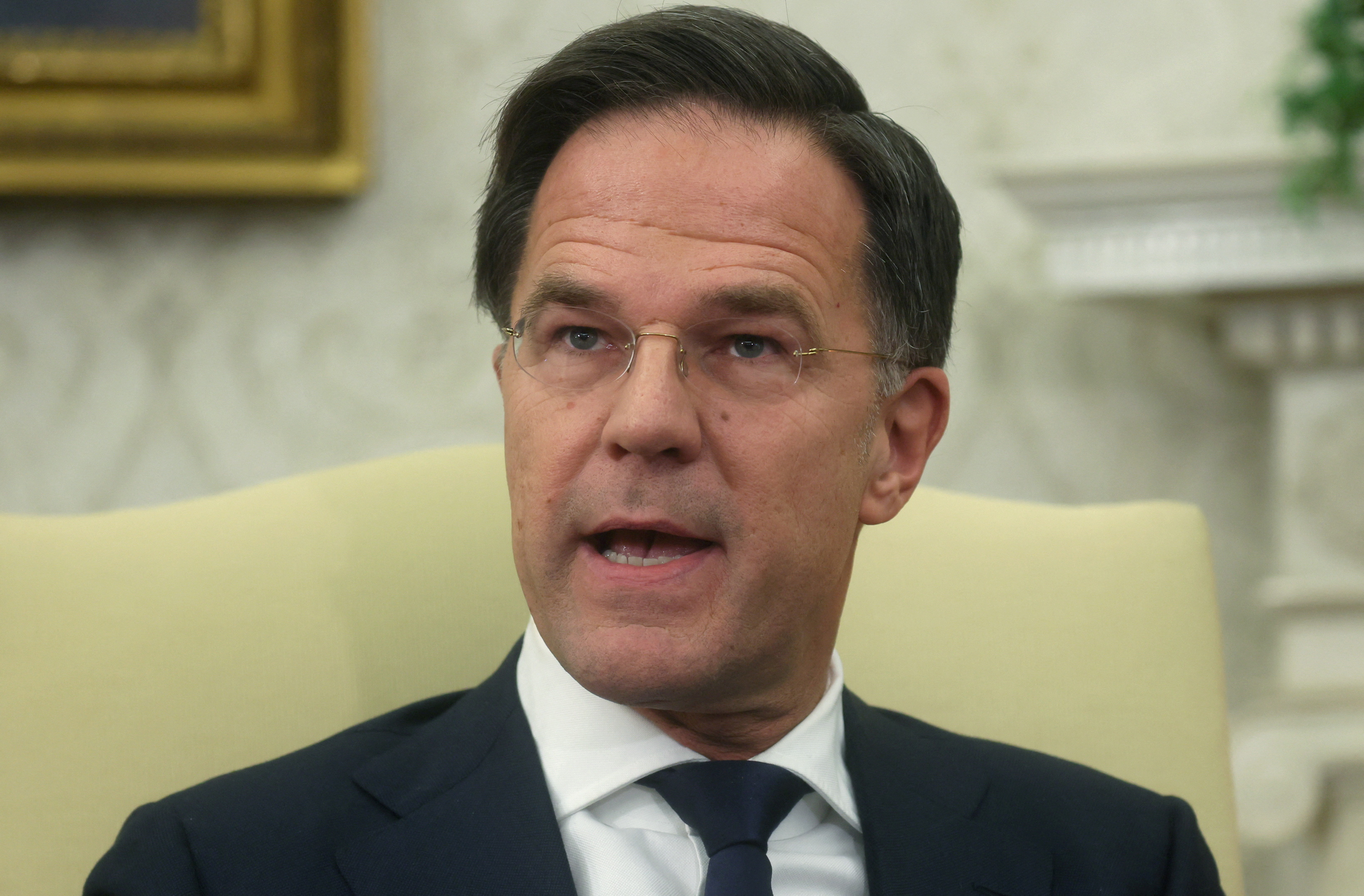
Dutch Prime Minister Mark Rutte delivers a statement as he and U.S. President Joe Biden hold a bilateral meeting in the Oval Office at the White House in Washington, U.S., January 17, 2023. REUTERS/Leah Millis

U.S. President Joe Biden and Dutch Prime Minister Mark Rutte held wide-ranging talks on Tuesday that included a discussion on Dutch concerns about new U.S. restrictions on exporting chip-making technology to China.

“It did come up in their conversation,” White House press secretary Karine Jean-Pierre told reporters after the talks.

Rutte told Biden of Dutch plans to offer the Patriot missile defense system to Ukraine, working together with Germany on an initiative to help Ukraine defend itself from a barrage of missile attacks from Russia.

“I think that it’s important we join that and I discussed it also this morning with Olaf Scholz of Germany,” Rutte said.

Biden told Rutte he looked forward to discussing ways to strengthen the supply chain as he welcomed the prime minister to the White House. Biden also thanked Rutte for being “very very stalwart” on its support for Ukraine.

Rutte said the Netherlands has decided to spend an additional 2.5 billion euros ($2.70 billion) supporting Ukraine, an announcement the government made previously.

Trade Minister Liesje Schreinemacher said on Sunday the Netherlands would not summarily accept demands by the United States on chip technology.

Jean-Pierre did not have details of the conversation between Biden and Rutte on chips but said: “We don’t push any of our allies or our partners, we consult with each one of them closely and they make their own decisions.”

A White House statement on the talks said Biden and Rutte “discussed the importance of secure supply chains and critical technologies to our national security and economic prosperity.”

The United States in October adopted sweeping measures to hobble China’s ability to make its own chips, and U.S. trade officials said at the time they expected the Netherlands and Japan to implement similar rules soon.

The Netherlands’ largest company is ASML Holding, a supplier to the semiconductor industry.

Rutte told reporters on Friday that he did not feel pressure from Washington to adopt more restrictions on semiconductor exports to China.

“This is a terrain where we’re a world player and we can conduct discussions about it without immediately talking in terms … of being ‘put under pressure’. I don’t experience it like that at all,” he said.

($1 = 0.9267 euros)

Categories
Audio Sources - Full Text Articles

Texas electrical grid still at risk in extreme weather – Dallas Fed

2023-01-17T20:42:12Z

The Texas electrical grid is still vulnerable to severe weather despite safeguards instituted after a deadly February 2021 deep freeze that brought widespread rotating power outages, the Dallas Federal Reserve said on Tuesday.

Since the freeze roughly two years ago, which brought sub-zero temperatures that caused key components of the state’s electrical system to fail, Texas has introduced new regulations, standards to weatherize its grid and made operational changes.

The Federal Reserve Bank of Dallas called for increased enforcement of those updated standards, more to incentives to boost thermal power generation and Texas’ so-called enhanced demand-response programs, which can include paying large power customers to curtail electricity use during peak demand.

The moves “would help ensure the power grid stands up to future demand growth and the challenges of extreme weather,” Garrett Golding, a senior business economist at the Dallas Fed, said in a note.

The state’s grid, which is primarily operated by Electric Reliability Council of Texas and overseen by the Public Utility Commision of Texas, avoided rolling blackouts during severe cold weather last month.

Still, some power plants and natural gas facilities failed during the recent winter storm, putting the electrical system at risk as demand surged to 73,000 megawatts, close to its record high set the 2021 freeze, the note said.

ERCOT and the Texas PUC were not immediately available for comment.

Natural gas production also dropped by about 25% during the December winter storm as wells froze in even though temperatures were roughly 10 degrees Fahrenheit warmer than February 2021 weather, the note said.

“The cold snap last month demonstrated that progress has been made, but it also exposed the remaining vulnerabilities as electricity demand increases and extreme weather becomes more common,” Golding wrote.

Related Galleries:

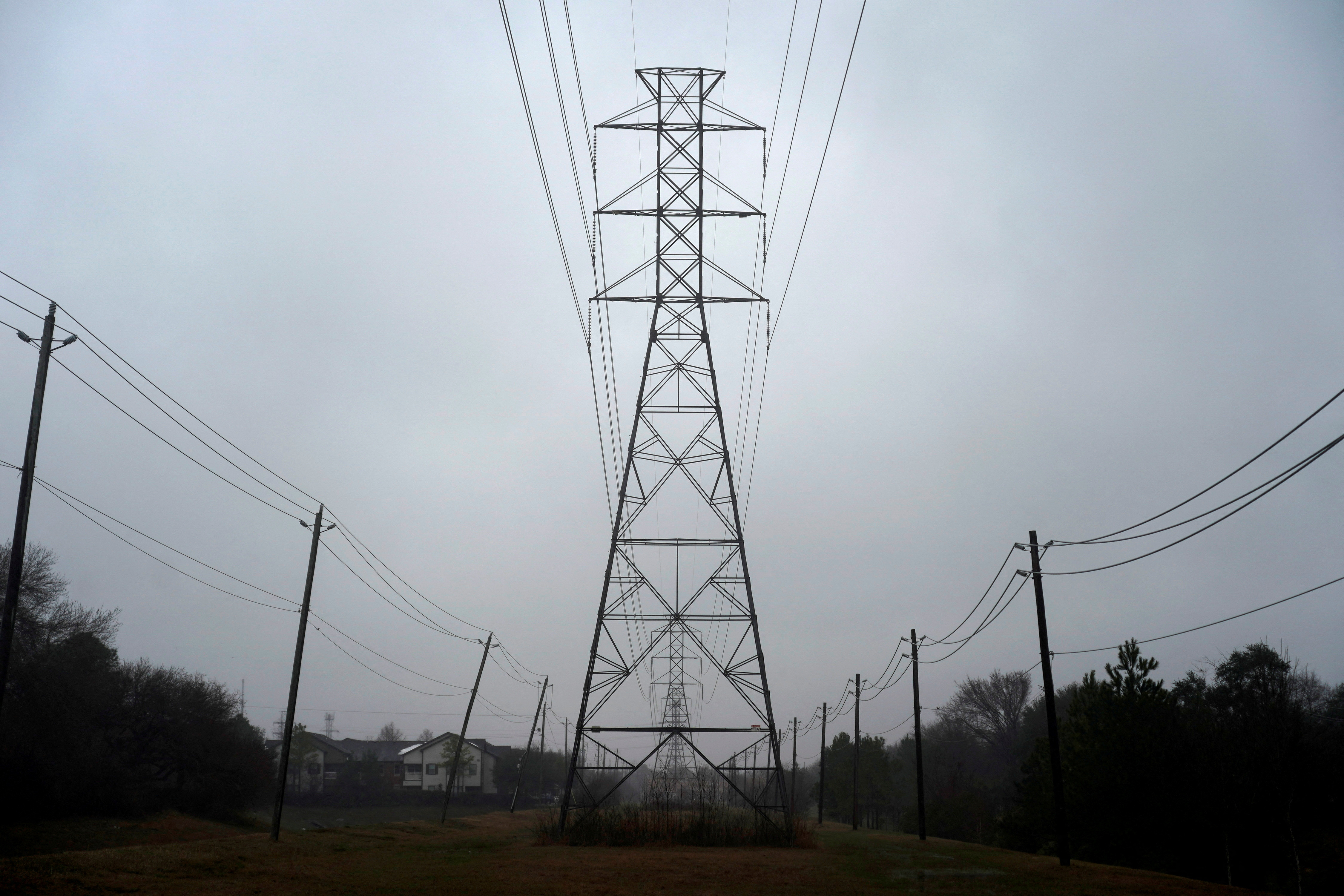
Power lines are seen after winter weather caused electricity blackouts in Houston, Texas, U.S. February 17, 2021. REUTERS/Go Nakamura/File Photo

Reliability coordinators monitor the state power grid during a tour of the Electric Reliability Council of Texas (ERCOT) command center in Taylor, Texas August 14, 2012. REUTERS/Julia Robinson
Categories
Audio Sources - Full Text Articles

White House accuses Republicans of hypocrisy on Biden documents

2023-01-17T20:48:25Z

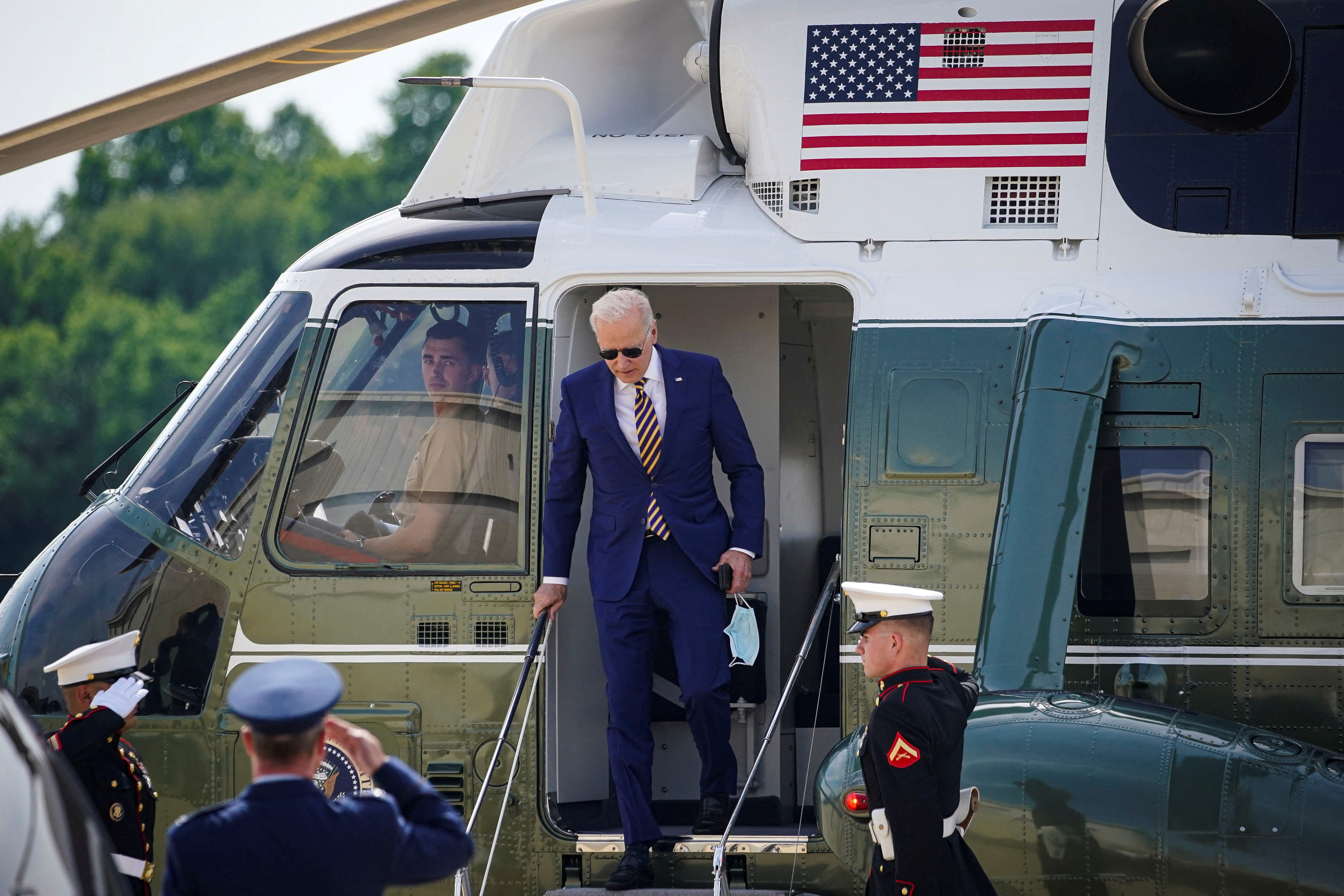
U.S. President Joe Biden arrives on Marine One for a weekend trip to his home in Wilmington at Delaware Air National Guard Base in New Castle, Delaware, U.S., June 18, 2021. REUTERS/Al Drago/File Photo

The White House said on Tuesday it would respond in “good faith” to inquiries from lawmakers about the improper storage of classified documents at President Joe Biden’s home and former office while accusing Republicans of hypocrisy in how they were pursuing the issue.

On Saturday, the Democratic president’s counsel said five additional pages with classified markings were discovered at Biden’s Wilmington, Delaware, home, and that those documents were immediately handed to Justice Department officials.

Aides previously found another batch of classified documents at his residence, and at a Washington think tank where he had an office after his time as vice president in the Obama administration. U.S. Attorney General Merrick Garland has named a special counsel to probe the issue.

The White House has largely been on the defensive since the initial revelations that the documents had been found. Nothing about the matter was disclosed to the public until early January. Biden’s lawyers made their initial discovery of classified material at the start of November, before the midterm elections that determined which party controls Congress.

That has led to accusations from Republicans that Biden’s team is not being forthcoming about the discoveries.

The department is separately probing Trump’s handling of highly sensitive classified documents that he retained at his Florida resort after leaving the White House in January 2021.

White House spokesman Ian Sams on Tuesday sought to compare the issue to the drawn-out drama that led to the election of Republican leader Kevin McCarthy as speaker of the House of Representatives earlier this month.

“They’re faking outrage about disclosure and transparency at the same time, for example, that they will not ask their speaker to release the secret deals that he made in order to get support from the far-right extreme MAGA members of his caucus,” Sams told reporters, referencing former President Donald Trump’s “Make America Great Again” slogan.

“We’re learning drip by drip, bit by bit, the kinds of things he gave away in those negotiations and the serious impact they have on the American public,” Sams said.

To get the speaker role, McCarthy agreed to major concessions, including a rule that means that any of the 435 House members could force a vote for his removal at any time.

McCarthy has said more data was needed about the Biden documents, including whether there were “more out there.”

The briefing by Sams, a spokesman who works with the White House counsel’s office, appeared designed in part to reclaim the offensive in the midst of Republican criticism and questions about the time it took to inform the public about the documents.

Sams said regular disclosures during a Department of Justice (DOJ) investigation posed risks that answers may be incomplete. He said some questions may not be answered until the special counsel’s probe was complete.

“We understand that there’s a tension between the need to be cooperative with an ongoing DOJ investigation and the rightful demands for additional public information, and so we’re trying to strike that balance,” Sams said.

Asked whether the Justice Department had asked the White House not to disclose specific things to the public, Sams said he would not characterize conversations between the agency and Biden’s attorneys.

Sams said the White House had received a “few letters” from the Republican-led House Oversight Committee on the issue, is reviewing them and will make a determination about its response in due course.

“Our commitment is to work in good faith with Congress. When they make a request, we’re going to operate in good faith,” he said. “We just expect that the members of Congress have the same good faith.”

Biden was asked by a reporter last week about the wisdom of storing important material next to his Corvette sports car. He noted that they were both in a locked garage.

The White House reiterated on Tuesday Biden’s commitment to cooperating with the Justice Department’s investigation.

Sams criticized Republicans for having different responses to the document disclosures about Trump and about Biden.

“These are the same Republicans who didn’t make a peep,” about Trump’s handling of classified material, Sams said. “And if they did make a peep, they often defended it.”

Categories
Audio Sources - Full Text Articles

Biden, Kishida held “very productive“ talks on China export controls

2023-01-17T20:52:09Z


U.S. President Joe Biden and Japanese Prime Minister Fumio Kishida walk through the colonnade of the White House on their way to the Oval Office, in Washington, U.S., January 13, 2023. Mandel Ngan/Pool via REUTERS

U.S. President Joe Biden and Japanese Prime Minister Fumio Kishida held “very productive” talks last week on semiconductor-related export controls on China, White House Indo-Pacific coordinator Kurt Campbell said on Tuesday.

The Biden administration in October published a sweeping set of export controls, including measures tightly restricting Chinese access to U.S. chipmaking technology, as part of an effort to slow Beijing’s technological and military advances.

But it has not yet convinced key allies to put in place similar equipment curbs seen as essential to making the restrictions effective, since Japanese and Dutch firms Tokyo Electron Ltd (8035.T) and ASML Holding NV (ASML.AS) also are top producers of chipmaking equipment.

Campbell told a think-tank event that Biden had broached the issue with Kishida during their meeting on Friday in Washington, where the two leaders hailed their countries’ long-standing alliance amid concern about security threats from Beijing.

“I think it would be fair to say that when President Biden raised the issue with Prime Minister Kishida, he indicated that he was studying it carefully and that he would be responding appropriately,” Campbell told the Center for Strategic and International Studies event.

“And I think we are satisfied and believe that the consultations have been very productive.”

Japan’s Ambassador to the United States, Koji Tomita, said at the same event it was a complicated issue that required coordination with industry, but that both Japan and the United States expected progress in coming weeks.

“I think we are making very careful progress, looking at both technical as well as the economic side of this issue. But as Kurt said, I think we are looking forward to making progress, solid progress, on this issue in the coming weeks,” Tomita said.

Dutch Prime Minister Mark Rutte visited the White House on Tuesday, where he was expected to discuss export policy with Biden.

A White House statement said the two “discussed the importance of secure supply chains and critical technologies to our national security and economic prosperity.”

The Netherlands’ top trade official said at the weekend that the European Union country would not summarily accept new U.S. restrictions on exporting chip-making technology to China, and was consulting with European and Asian allies.

Categories
Audio Sources - Full Text Articles

Greta Thunberg released after brief detention at German mine protest, police say

2023-01-17T20:32:28Z

Climate activist Greta Thunberg was among others detained during protests against the demolition of the coal village of Luetzerath on Tuesday (January 17).

Climate campaigner Greta Thunberg was detained alongside other activists on Tuesday during protests against the demolition of a village to make way for a coal mine expansion but was released after an identity check, according to police.

Thunberg was held while protesting at the opencast coal mine of Garzweiler 2, some 9 km (5.6 miles) from the village of Luetzerath, after police warned that the group would be removed by force if they did not move away from the edge of the mine.

The village in the western state of North Rhine-Westphalia is being cleared to allow for the expansion of the mine. The mine’s owner, RWE (RWEG.DE), agreed with the government that it could demolish Luetzerath in exchange for its faster exit from coal and the saving of five villages originally slated for destruction.

Activists have said Germany should not be mining any more lignite, or brown coal, and should focus on expanding renewable energy instead.

Riot police backed by bulldozers removed activists from buildings in the abandoned village last week, with only a few left in trees and an underground tunnel by last weekend, but protesters including Thunberg remained at the site staging a sit-in into Tuesday.

“We are going to use force to bring you to the identity check, so please cooperate,” a policeman said to the group, according to Reuters footage.

“Greta Thunberg was part of a group of activists who rushed towards the ledge. However, she was then stopped and carried by us with this group out of the immediate danger area to establish their identity,” a spokesperson for Aachen police told Reuters, adding that one activist had jumped into the mine.

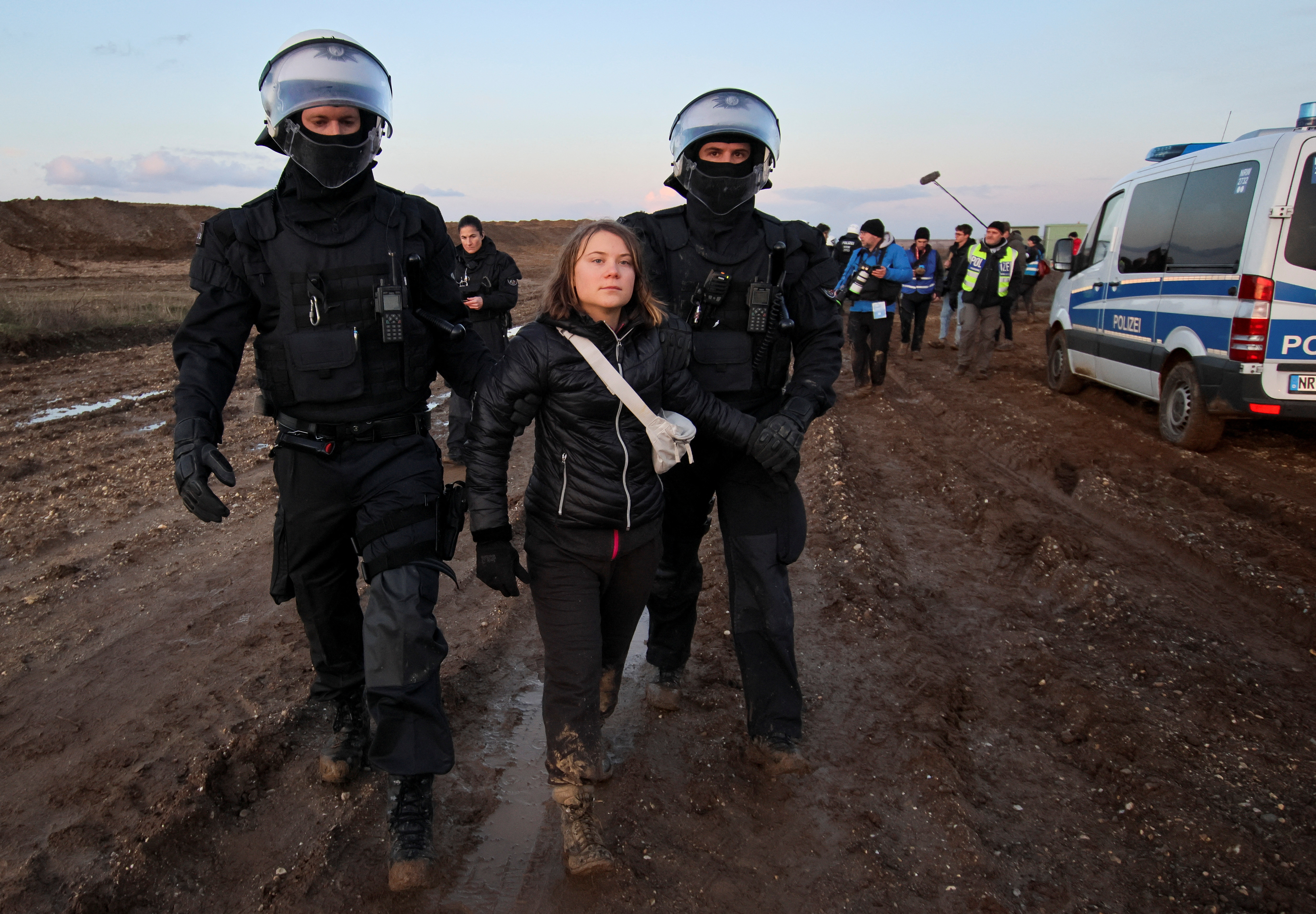
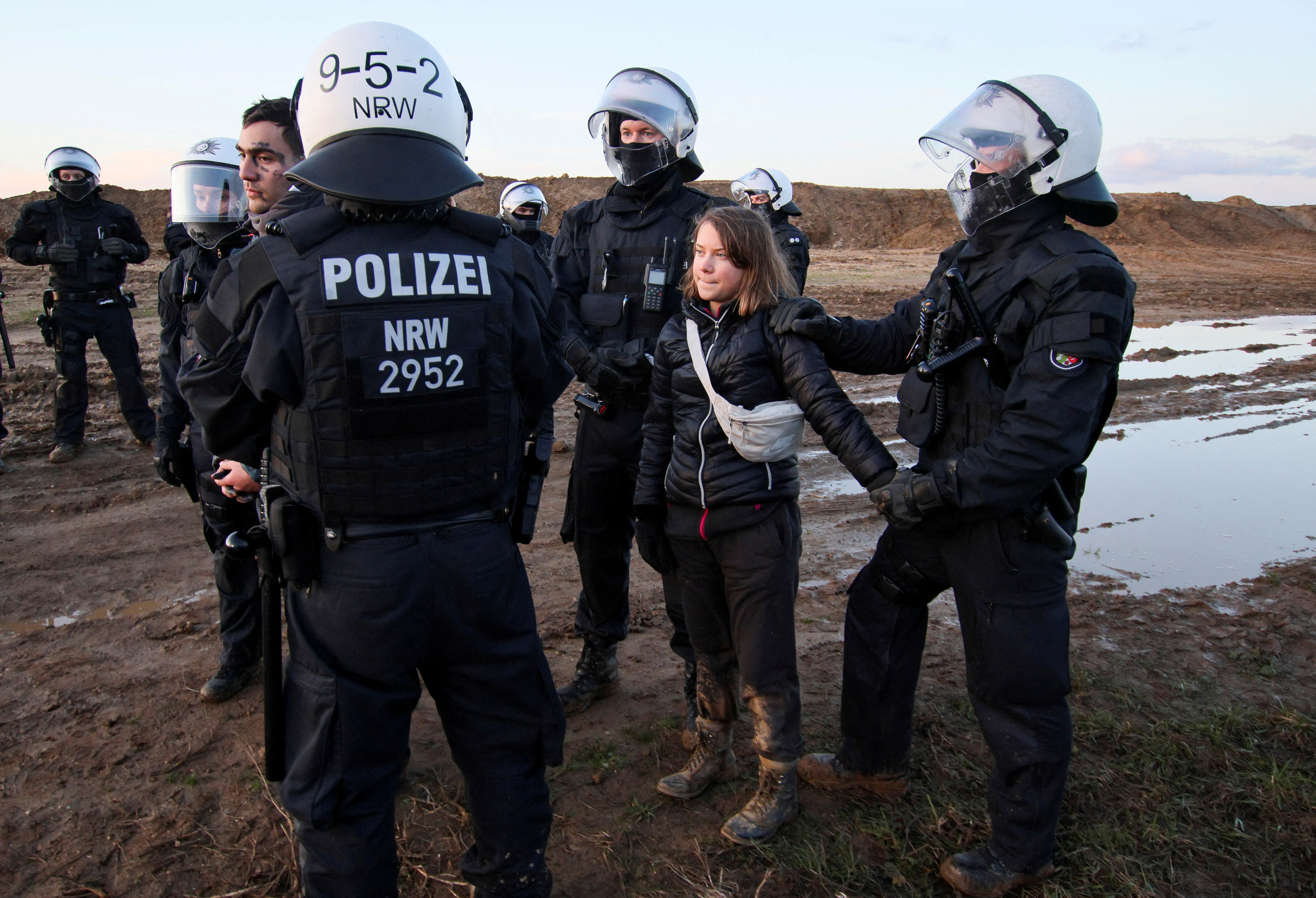
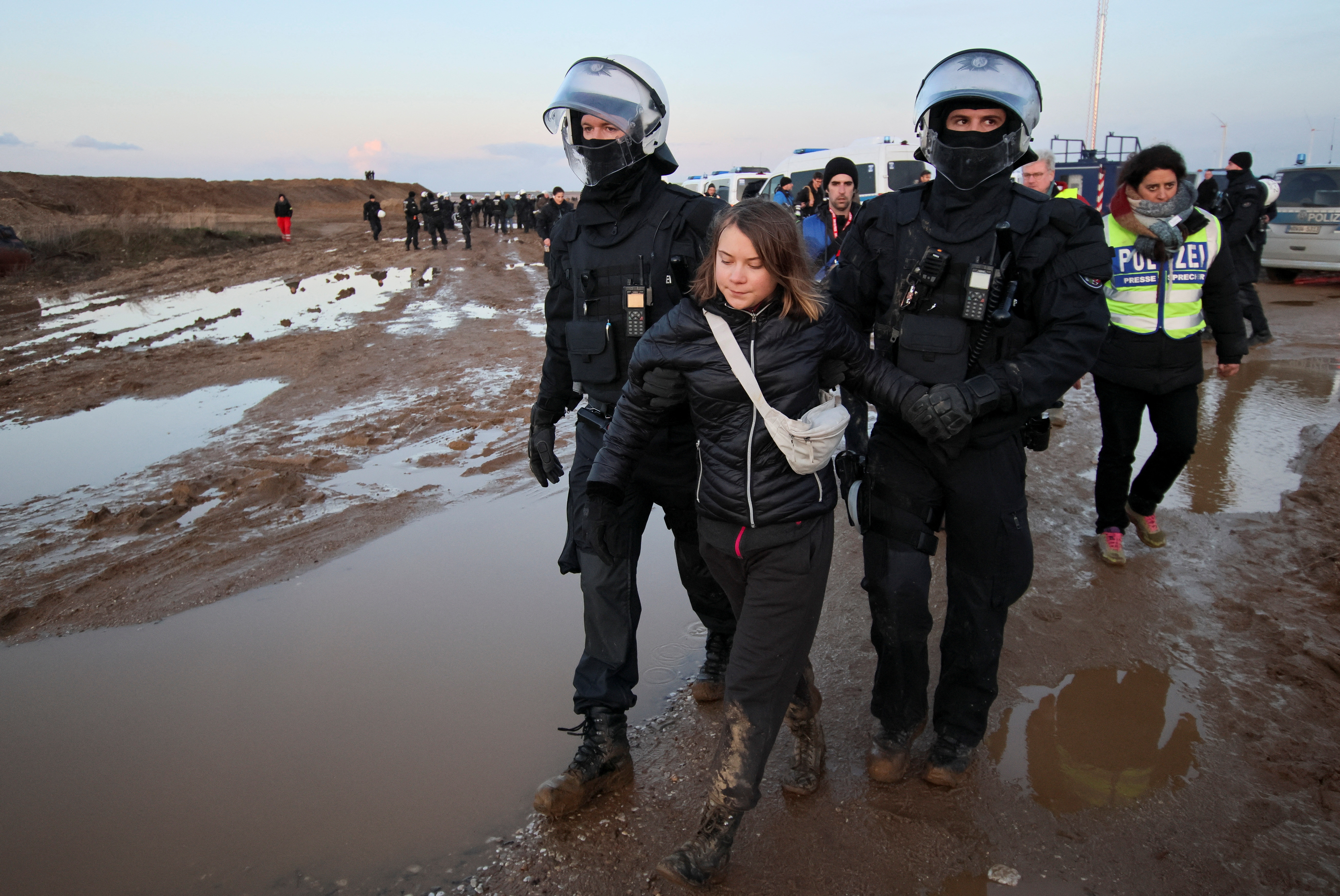
Thunberg was carried away by three police officers and held by one arm at a spot away from the edge of the mine and was then escorted back towards police vans.

The Swedish climate activist addressed the around 6,000 protesters who marched towards Luetzerath on Saturday, calling the expansion of the mine a “betrayal of present and future generations.”

“Germany is one of the biggest polluters in the world and needs to be held accountable,” she said.

Related Galleries:

Police officers detain climate activist Greta Thunberg on the day of a protest against the expansion of the Garzweiler open-cast lignite mine of Germany’s utility RWE to Luetzerath, in Germany, January 17, 2023 that has highlighted tensions over Germany’s climate policy during an energy crisis. REUTERS/Wolfgang Rattay

Police officers detain climate activist Greta Thunberg on the day of a protest against the expansion of the Garzweiler open-cast lignite mine of Germany’s utility RWE to Luetzerath, in Germany, January 17, 2023 that has highlighted tensions over Germany’s climate policy during an energy crisis. REUTERS/Wolfgang Rattay

Police officers detain climate activist Greta Thunberg on the day of a protest against the expansion of the Garzweiler open-cast lignite mine of Germany’s utility RWE to Luetzerath, in Germany, January 17, 2023 that has highlighted tensions over Germany’s climate policy during an energy crisis. REUTERS/Wolfgang Rattay

Climate activist Greta Thunberg sits in a bus with other activists on the day of a protest against the expansion of the Garzweiler open-cast lignite mine of Germany’s utility RWE to Luetzerath, in Germany, January 17, 2023 that has highlighted tensions over Germany’s climate policy during an energy crisis. REUTERS/Wolfgang Rattay

Climate activist Greta Thunberg protests against the expansion of the Garzweiler open-cast lignite mine of Germany’s utility RWE to Luetzerath, Germany, January 17, 2023 that has highlighted tensions over Germany’s climate policy during an energy crisis. REUTERS/Wolfgang Rattay
Categories
Audio Sources - Full Text Articles

A short history of kosher kitchens at official government residences

Untitled-design.jpg

Pennsylvania Gov. Josh Shapiro, who was sworn in Tuesday, plans to have a kosher kitchen in the governor’s mansion in Harrisburg. It’s the rare example of a kitchen in an official U.S. government residence that will be all kosher, all the time.

But there have been many occasions over the years where kitchens in official government residences were temporarily made kosher, or kashered, for a Jewish holiday or to accommodate Jewish guests.

Jewish food writer Joan Nathan wrote in Tablet that when Franklin Delano Roosevelt was governor of New York, from 1929 to 1932, two Jewish men regularly came to lunch at the executive mansion in Albany.

“When it came to the attention of the governor and his wife, Eleanor, that these men abstained from everything offered them except for fruit, dessert, and coffee, Mrs. Roosevelt realized she should serve dairy and vegetables in a new set of dishes especially reserved for these occasions,” Nathan wrote.

Rozanne Gold’s reminiscences about her work as a chef for New York City’s Mayor Ed Koch included helping to “blowtorch the kitchen” at the mayor’s residence, Gracie Mansion, to kasher it for Prime Minister Menachem Begin and his entourage around the time of the Camp David peace agreements.

Going kosher at the White House

Nathan recalled that the Carter administration ordered 50 kosher meals from a local caterer for a 1979 Camp David Peace Treaty dinner. The first entirely kosher state dinner apparently took place a year later for 180 guests, including Begin. The menu included kosher wine from California and non-dairy desserts without the butter that ordinarily enriches deluxe sweets.

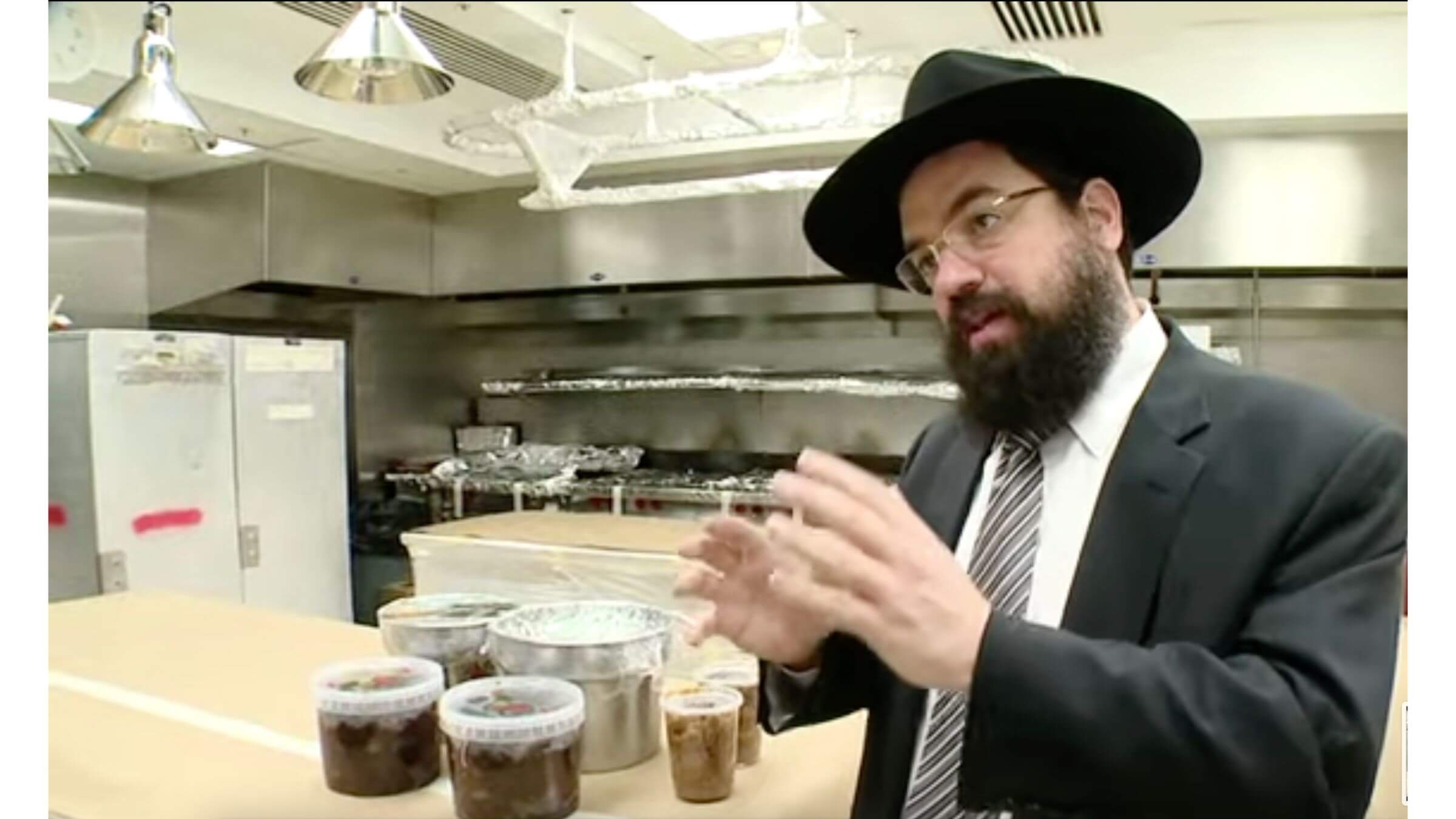
George W. Bush was the first U.S. president to host a Hanukkah party, with, of course, kosher latkes, while the Obamas held two Passover seders at the White House. Such events are practically routine at the White House now; there’s even an official WhiteHouse.gov video starring Rabbi Levi Shemtov, a Chabad rabbi, supervising the kashering process.

“A kosher kitchen,” he explains in the video, involves “a total separation of milk and meat and only kosher ingredients as well as utensils only being used for kosher.” Surfaces are cleaned with boiling water and wrapped in tin foil and plastic wrap to avoid contamination.

In an email to the Forward, Shemtov said other kosher kitchens at sites connected to U.S. government officials include the private kitchen at the embassy in Cairo when Daniel C. Kurtzer was ambassador; the embassy in Prague when Norm Eisen was ambassador, and the European Union in Brussels when Stuart Eizenstat was ambassador. In fact, Shemtov added, the EU kitchen “once served a non-kosher item and he had to personally purchase a whole new set of State Department china.”

Chana Pollack, the Forward’s archivist, contributed to this report.

The post A short history of kosher kitchens at official government residences appeared first on The Forward.

WP Radio
WP Radio
OFFLINE LIVE