Categories
Audio Sources - Full Text Articles

Magic Leap CEO says Apple becoming a rival in augmented reality would actually be a good thing

Peggy Johnson, Executive Vice President, Business Development, Microsoft, on Centre Stage during day one of Collision 2019 at Enercare Center in Toronto, Canada.Peggy Johnson is the CEO of Magic Leap, and could soon be competing against Apple if it launches a headset as expected.

Stephen McCarthy/Sportsfile via Getty Images

  • Magic Leap’s CEO said more money coming into the augmented reality space from competitors is “good.”
  • Under CEO Peggy Johnson, the company has pivoted to building enterprise-focused AR headsets.
  • Apple is rumored to be readying its own headset, which would compete against Magic Leap and Microsoft.

DAVOS, Switzerland — Having more competition, including one day Apple, enter the augmented reality space is “a good thing,” Magic Leap CEO Peggy Johnson told Insider’s Cadie Thompson.

Apple is reportedly gearing up to launch its own headset this year, which would compete against other offerings from Magic Leap and Microsoft.

“I think anytime more money is coming into the space is a good thing,” the AR tech company CEO said during an interview at the World Economic Forum in Davos, Switzerland. “The company’s over 12 years old, so we’ve been carrying all of the water for a long time, for years, and so it’s good to have others in this space, even competitive in nature. It’s a positive for the space overall.”

Johnson said more companies entering the AR space “brings more” momentum, energy, and developers, and that Magic Leap is focused on developing the 3D imagery ecosystem.

Under Johnson, Magic Leap has pivoted toward building its Magic Leap 2 AR headset for enterprise use rather marketing it at consumers. In its Early Access Program, Magic Leap worked with companies including Cisco, NeuroSync, and Brainlab to “refine and improve” its headset to be used for training, communication, and remote assistance, in settings like clinics, industrial environments, retail stores, and even defense.

But AR technology is cutting-edge, and that means it’s not cheap. The Magic Leap 2 was made commercially available in the US, Canada, UK, EU, and Saudi Arabia last September, and has three editions ranging between $3,299 and $4,999 USD. Microsoft’s Hololens 2 ranges from $3,500 to $5,200.

Apple is currently planning on announcing its long-rumored AR and VR headset this year, and will likely retail to consumers for somewhere between $2,000 and $3,000, Bloomberg reported. The headset is reported to look somewhat like ski goggles, and include auto-adjusting lenses and a physical dial to switch between virtual reality and the real world.

If Apple’s AR/VR headset does come out this year, it will be the company’s newest product group since the Apple Watch in 2015.

Johnson pointed out that Apple is more consumer-focused, while Magic Leap is enterprise-focused, but said at some point, “we’ll come circle back to consumer.” She said it will take time for the headset itself to shrink in size to be more acceptable for consumer use the way mobile phones developed. 

Read the original article on Business Insider
Categories
Audio Sources - Full Text Articles

Apple’s new MacBook Pro laptops promise speedy performance and nearly 24 hours of battery life — here’s how to preorder

When you buy through our links, Insider may earn an affiliate commission. Learn more.

A person using a MacBook Pro 2023 modelThe 2023 MacBook Pro uses Apple’s new M2 Pro and Max chips.

Apple

  • Apple has announced new MacBook Pros with next-gen M2 chips and the best battery life yet on a Mac.
  • You can choose between 14- and 16-inch models with an M2 Pro or M2 Max processor.
  • MacBook Pro preorders start at $1,999; they’ll ship January 24 and arrive in stores that same day.

Apple has updated its MacBook Pro computers for 2023 with new processors, improved graphical performance, and better battery life. Preorders are available now and will ship on January 24.

The new 14-inch Mac Book Pro starts at $1,999, while the 16-inch  MacBook Pro starts at $2,499. MacBook Pro models can be customized with different amounts of memory, storage space, and processing power, so the final price will vary.

The 2023 MacBook Pros will use the latest Apple silicon processors: the M2 Pro and M2 Max. The company began using Apple silicon in Mac devices in 2020 with the M1 chip, generating better performance than competing Intel processors.

Other MacBook Pro upgrades include support for Wi-Fi 6E, compatibility with 8K monitors, and faster refresh rates on 4K displays. Apple is also promising up to 22 hours of battery life, the best we’ve seen so far in a Mac. Here’s a full breakdown of the new MacBook Pro’s key improvements.

The 2023 MacBook Pro’s M2 chips promise a big performance boost

The new 14- and 16-inch MacBook Pro models will utilize Apple’s M2 Pro and M2 Max processors, which provide an upgrade over the previous M1 Pro and M1 Max models. Likewise, the new processors are also more powerful than the standard M2 chip introduced in the 13-inch MacBook Pro and iPad Pro last year

With these new chips under the hood, Apple says that the 2023 MacBook Pro can run up to six times faster than a 2019 MacBook Pro using an Intel i9 processor. And thanks to the processor’s power efficiency, the new MacBook Pros are rated for up to 22 hours of battery life. 

The M2 Pro configurations come with 10- or 12-core CPUs, and 16- or 19-core GPUs. Apple says the M2 Pro can process images up to 40% faster than the M1 Pro chip, and up to 80% faster than an i9 MacBook Pro.

Meanwhile, the M2 Max has twice the memory bandwidth of the M2 Pro, delivering even better performance for tasks like video rendering. MacBook Pro configurations with an M2 Max feature a 12-core CPU and up to a 38-core GPU.

Improved display ports and Wi-Fi connectivity

In addition to the improved processors, the new MacBook Pro features upgraded HDMI ports that will work with 8K monitors and also provide better refresh rates on 4K TVs and other displays.

The MacBook Pro also has three Thunderbolt 4 ports, an SD card reader, and Apple’s MagSafe 3 charging port. And, like the latest iPad Pro, the new MacBook Pro adopts Wi-Fi 6E, allowing for faster wireless internet connections. However, to make full use of Wi-Fi 6E, you’ll need a compatible router.

MacBook Pro 2023

Apple

The new 14- and 16-inch MacBook Pros with M2 Pro and M2 Max processors replace the M1 Pro and M1 Max versions released in 2021. The new models carry the same suggested price as the old ones, but we expect retailers to start discounting the 2021 MacBook Pros soon.

14-inch Apple MacBook Pro with M2 Pro (512GB)

16-inch Apple MacBook Pro with M2 Pro (512GB)

Read the original article on Business Insider
Categories
Audio Sources - Full Text Articles

White House defends its delayed, limited document disclosure

WASHINGTON (AP) — The White House brushed aside criticism Tuesday of its fragmented disclosures about the discovery of classified documents and official records at President Joe Biden’s home and former office, saying it may withhold information to protect the Justice Department’s investigation.

Ian Sams, a spokesperson for the White House counsel’s office, told reporters that the White House was releasing information as it deemed it “appropriate.” Responding to criticism of the piecemeal disclosures, Sams said the White House was trying to be mindful of the “risk” in sharing information “that’s not complete.”

“We’re endeavoring to be as transparent and informative to you all in the media, to the public as we can consistent with respecting the integrity of an ongoing Justice Department investigation,” he said.

The discovery of the documents in Biden’s possession complicates a federal probe into former President Donald Trump, who the Justice Department says took hundreds of records marked classified with him upon leaving the White House in early 2021 and resisted months of requests to return them to the government.

While the two cases are different — Biden for example, willingly turned over the documents once found — it still has become a political headache for a president who promised a clean break from the operations of the Trump administration.

On Saturday, the White House disclosed that Biden attorneys found classified documents and official records on four separate occasions — on Nov. 2 at the offices of the Penn Biden Center in Washington, on Dec. 20 in the garage of the president’s Wilmington, Delaware home, and on Nov. 11 and 12 in the president’s home library.

White House Press Secretary Karine Jean-Pierre had said before the additional discovery that Americans could assume the investigation had completed. On Tuesday, she referred questions to the Justice Department or White House counsel’s office on whether more documents existed and whether they would be disclosed if discovered.

“The president and his team rightfully took action,” she said of the turning over the documents after they were discovered.

After the initial disclosure, the president said he was “briefed about this discovery and surprised to learn that there are any government records that were taken there to that office.”

He said that he takes the handling of classified documents very seriously. Biden has not commented publicly on the further existence of documents. Jean-Pierre said that president was focused on his job.

“He wants to make sure that he’s continuing to deliver for the American people,” she said.

Attorney General Merrick Garland last week appointed Robert Hur, a former Maryland U.S. attorney, to serve as special counsel to oversee the Justice Department’s inquiry into the documents.

Separately, Secretary of State Antony Blinken, who was managing director of the Penn Biden Center for two years, echoed Biden by saying he was surprised government records were located at the institute’s office.

“I had no knowledge of it at the time,” he told reporters on Tuesday. “The White House, of course, has indicated that the administration is cooperating fully with the review that the Justice Department has undertaken, and I, of course, would cooperate fully with that review myself.”

Among the questions still unanswered by the White House or Biden’s private attorneys: Exactly how many documents were found; whether there may be other documents out there, what was contained in them and why the public wasn’t notified until months after they were discovered.

Sams referred those questions to the Justice Department, insisting that neither the White House nor Biden’s personal attorneys are aware of the contents.

—

AP writer Matthew Lee contributed.

Categories
Audio Sources - Full Text Articles

Smartphones help homeless veterans access housing, health care

(NewsNation) —  In the early days of the pandemic, support workers for unhoused veterans faced a huge problem: Their work had always been done in person. 

“How we were engaging our veterans: visiting them in their apartments to provide case management, going to shelters, outreach to tent encampments,” said Jennifer Nemeth, business operations and staffing coordinator for the Department of Veterans Affairs Homeless Programs Office.

Since they needed to reach people without a permanent address but couldn’t do it face-to-face, they gave them smartphones. 

Since early 2020, more than 60,000 phones have been given to unhoused veterans, complete with a data plan and telehealth apps. The Homeless Programs Office found it not only significantly increased how many people were using an under-utilized telehealth program, but it also helped them find jobs, food and other necessities. 

That, in turn, directly supported other programs leading to the large reduction of homeless veterans in recent years.

“Approximately the number of seats at Fenway Park, that’s how many veterans we put in permanent housing placement,” Nemeth said. “Telehealth services lent a hand in that.”

NewsNation spoke with Nemeth about how the “telehomeless” program worked and what it can tell us about getting more veterans into homes.

This interview has been edited for length and clarity.

NewsNation: What challenges were there in implementing the program? 

Nemeth: COVID-19 was so new to the world at the time. And so a lot of our staff were concerned that they were losing track of the homeless and at-risk veterans. 

You’re handing a smartphone to somebody who may be coming off incarceration, that needs our help finding permanent housing. Or you’re handing it to a veteran who has always had a flip phone. There’s a technology component that has to be taught.

NewsNation: How do you know it has been successful? 

Nemeth: We’ve distributed over 64,500 phones to our community of homeless and at risk veterans, which has tremendously increased the use of our telehealth services. We went from 2,720 telehealth visits in 2019 compared to 149,000 today.

It’s most rewarding to see and hear about a veteran contacting their daughter for the first time in 11 years through FaceTime, to be able to know that they applied for job applications through apps online, that they were quarantined and could order their groceries delivered to their door — these are things that they did not have access to before.

NewsNation: What else have you found helpful through the video sessions?

Nemeth: There’s something telling about being able to have a VA video connect visit with our veterans that are in their apartments. You have that visit where you can say, “Hey, listen, I see you didn’t wash your dishes. Is everything OK? What’s going on?”

NewsNation: What are some of the other areas having a smartphone helps besides health care? 

Nemeth: We were able to make sure that veterans have access to food, make sure that they have access to employment opportunities, to be able to reach out to social services, connections to their landlords — those are all things that are built into part of our treatment plans for our vets.

We look at these devices as much as cardiology looks at a heart monitor. This is our lifeline to our veterans — making sure that they’re successful in their treatment plan goals. Really giving our vets this competence to be able to communicate in today’s society.

NewsNation: What’s left to work on? 

Nemeth: If I had to wave a magic wand, it would ensure homeless veterans had wi-fi and data plans forever, but it doesn’t work like that. The VA provides a one-year prepaid plan, and we work with them to make sure that they can secure a self-pay plan once the time limit comes to an end. 

Categories
Audio Sources - Full Text Articles

Morgan Stanley, Goldman show starkly different quarterly results

2023-01-17T22:43:51Z

The financial fortunes of Wall Street’s investment banking titans split as Morgan Stanley (MS.N) benefited from higher wealth management revenue while Goldman Sachs (GS.N) suffered from higher costs and an increase in rainy day funds.

Goldman reported a profit of $3.32 per share in the fourth quarter, missing the Wall Street estimate of $5.48, according to Refinitiv IBES data, sending its shares down 6.5%.

Morgan Stanley’s shares rose 6% after it reported $1.31 per diluted share on an adjusted basis, well above analysts’ estimates of $1.19 per share, according to Refinitiv IBES data.

The banks’ releases wrap up a mixed fourth-quarter earnings period for the big U.S. banks.

“This round goes to Morgan Stanley, as they appear to be one of the stand-out bank earnings,” said Edward Moya, senior market analyst Americas at OANDA.

Morgan Stanley’s wealth management business saw revenue climb 6% in the quarter as interest income increased amid the U.S. Federal Reserve’s interest rate hikes through most of last year.

Goldman’s results also included a net loss of $660 million at its platform solutions unit, which houses transaction banking, credit card and financial technology businesses, as provisions for credit losses grew while the business was expanding.

Goldman is curbing its consumer banking ambitions as Chief Executive Officer David Solomon refocuses the bank’s resources on strengthening its core businesses such as investment banking and trading.

Even so, Goldman Sachs’ full-year results were still resilient in the face of difficult market conditions, said David Fanger, senior vice president at Moody’s Investors Service.

Both banks reported a plunge in investment banking revenue as Wall Street dealmakers handling mergers, acquisitions and initial public offerings faced a sharp drop in their businesses in 2022.

Goldman Sachs’ Chief Executive David Solomon confirmed that the bank was cutting 6% of its headcount, or around 3,200 jobs, and was making changes to its consumer business to navigate an uncertain outlook for 2023.

“We tried to do too much too quickly,” he said about the bank’s consumer business. “We didn’t execute perfectly on some so we’ve taken a hard look at those, and you make adjustments.”

UBS analysts wrote in a note Morgan Stanley’s fourth-quarter core trends were encouraging and cleared the low bar.

Revenue from Morgan Stanley’s investment banking business fell 49% to $1.25 billion in the fourth quarter, with revenue declines across the bank’s advisory, equity and fixed income segments.

The investment banking business slowdown weighed on the company’s net revenue, pulling it down 12% to $12.7 billion.

“I am highly confident that when the Fed pauses, deal activity and underwriting activity will go up,” Chief Executive Officer James Gorman told analysts in a call.

Still, Chief Financial Officer Sharon Yeshaya told Reuters earlier on Tuesday that the bank is comfortable with its headcount after recent layoffs. Morgan Stanley had cut 2% of its headcount in December, or about 1,600 jobs, a source had told Reuters.

Trading has been a surprise bright spot for Morgan Stanley, with the unit’s revenue jumping 26% in the fourth quarter, as clients look to hedge against market risks by rejiggering portfolios toward more defensive assets.

Looking ahead, Gorman said the bank’s wealth and investment management businesses are expected to become an increasingly larger portion of the firm’s pre-tax profit in the coming years.

The wealth management unit has also helped the bank keep its funding cost lower amid a rate hiking cycle, the CEO added.

Mark-to-market losses on corporate loans came in at $876 million, as interest rates rose. It includes debt to Twitter, the CFO said. Morgan Stanley is among a group of banks that provided a $13 billion loan to finance Elon Musk’s acquisition of the social media company.

Updating Morgan Stanley’s outlook, the CFO said the bank’s net interest income, or the money banks bring in from interest payments, has not peaked, although it is likely to reduce its growth rate this year.

Related Galleries:

A file photo showing the logo of Morgan Stanley is seen in New York January 9, 2013. REUTERS/Shannon Stapleton

A trader works at the Goldman Sachs stall on the floor of the New York Stock Exchange, April 16, 2012. REUTERS/Brendan McDermid
Categories
Audio Sources - Full Text Articles

Why the Debt Ceiling Matters and What Happens if Congress Refuses to Raise It

Less than two weeks after his chaotic ascent, Speaker of the House Kevin McCarthy is already facing down a potential crisis. In a letter sent to McCarthy on Friday, Treasury Secretary Janet Yellen warned that the U.S. is expected to hit its $31.4 trillion debt limit on Thursday, January 19, and outlined a plan to delay the resulting default until the summer.

It is the first such debt limit fight since Republicans took control of the House, and McCarthy has signaled that he plans to leverage the negotiations to secure deep spending cuts, which President Joe Biden and a Senate controlled by Democrats strongly oppose.

[time-brightcove not-tgx=”true”]

Although Yellen appears to have bought lawmakers some time, hitting the limit would prevent the government from making the payments it has committed to and throw the global economy into a tailspin. If McCarthy is not able to wrangle his unruly conference and reach an agreement with Democrats to raise the debt ceiling in the coming months, millions of Americans are likely to face financial hardship.

What is the debt ceiling?

The debt ceiling is the amount of money the U.S. is allowed to borrow to pay for all of its commitments. The U.S. government borrows huge sums of money to cover its expenses. Congress created the debt ceiling decades ago to avoid the hassle of having to approve each new debt individually. Lawmakers have raised the debt ceiling dozens of times since then.

Despite some of the political messaging around the debt ceiling, Congress is not authorizing new spending when it raises it. Instead, lawmakers are allowing the government to take on enough debt to fulfill the spending obligations it has already made. Those expenses include Social Security and Medicare benefits, tax refunds, salaries for government employees, veteran’s benefits, and interest on existing debt.

What would happen if the U.S. defaulted on its debt?

If lawmakers are unable to raise the debt limit in time, the U.S. would only be able to use incoming cash to pay its obligations, which would create a significant shortfall. Every program funded by the government would be at risk.

“Anybody could pick their favorite program,” says Maya MacGuineas, the president of the bipartisan Committee for a Responsible Federal Budget. “Whether someone loves defense spending or food stamps or environmental research, there will be a pause on paying for all of those things.”

Americans who aren’t directly dependent on government payments would also feel the effects if the U.S. defaults. In the past, even flirting with a default has caused economic turmoil. During a battle over the debt ceiling in 2011, the credit ratings agency Standard & Poor’s downgraded the United States’ top credit rating for the first time ever, with stock prices dropping significantly the next business day. The upcoming fight could go even farther, with The Washington Post reporting that House Republicans are preparing a contingency plan for prioritizing payments if lawmakers don’t raise the debt limit in time.

“Failure to meet the government’s obligations would cause irreparable harm to the U.S. economy, the livelihoods of all Americans, and global financial stability,” Yellen wrote in her letter.

The U.S. has never defaulted for failing to raise the debt limit in time, which means the consequences are unpredictable, but economists agree they would be dire. Were the U.S. to actually default, Treasury securities, widely considered to be among the most reliable investments in the world, would no longer be regarded as such, leading investors to demand higher interest rates to loan money to the US government. Those rates would carry over to consumers preparing to take on mortgages, car loans, or credit card debt. Stock prices would likely plummet, causing retirement savings to evaporate. Those consequences would almost certainly trigger a recession. While many analysts were already predicting a recession this year as the Federal Reserve grapples with record-high inflation, a recession set off by a U.S. default could be considerably more severe.

When could the debt limit start affecting Americans’ wallets?

Although Yellen wrote that the U.S. is expected to reach the debt limit on Thursday, the real crisis is likely some months away. That’s because she has invoked “extraordinary measures,” which will allow the Treasury to keep its debt below the limit while it waits for Congress to reach a more permanent solution. In recent years, Treasury secretaries have repeatedly used such measures, which involve temporarily suspending investments in certain retirement savings plans for government employees. Yellen herself used extraordinary measures in August 2021 to help the government avoid defaulting before President Biden signed a $2.5 trillion debt limit increase that December.

In her letter to McCarthy, Yellen predicted that extraordinary measures would keep the government afloat at least until early June. But she also warned that the Treasury is only estimating exactly how long it can continue paying America’s debts.

“The period of time that extraordinary measures may last is subject to considerable uncertainty due to a variety of factors, including the challenges of forecasting the payments and receipts of the U.S. government months into the future,” Yellen wrote.

Barring an unprecedented workaround, Congress will have to vote soon to either suspend or increase the debt limit. With Republicans now in control of the House, that will be easier said than done.

As part of the deal that allowed McCarthy to secure enough votes to become Speaker of the House this month, some right-wing lawmakers have demanded any increase in the debt limit come with deep spending cuts. Others hope to use the issue, a rare must-do item on the legislative agenda, as a bargaining chip to enact conservative policies. McCarthy said Tuesday he hoped to begin negotiations with other leaders and the president as soon as possible. But congressional Democrats and the White House say they will insist on a no-strings-attached debt limit increase.

“This is not political gamesmanship,” Karine Jean-Pierre, the White House press secretary, told reporters on Friday. “This should be done without conditions. And that’s how we see this process moving forward.”

As it has in the past, a protracted stalemate could hurt the economy in the lead up to the debt ceiling deadline, even if lawmakers eventually reach an agreement. With both sides digging in their heels, the stage is set for another drawn-out congressional standoff in the months to come.

“I’ve seen very few deals that are difficult that Congress has done in advance of when they need to,” MacGuineas says. “I think nobody’s going to want to compromise until they feel that they have no other choice but to do so. Instead, I think we will do this at the last minute possible with all sides acting as though they’re unwilling to compromise, which is the very crux of governing.”

Categories
Audio Sources - Full Text Articles

How a would-be revolution led to an exodus of Polish Jews

Three men’s shirts, a crystal vase, some books. 

These are some of the meager personal possessions which Hania and her family want to take with them as they leave Poland for Israel. For this service, they must bribe the police officers inspecting their luggage. The bottle of liquor and pile of cash Hania’s mother places pragmatically on the table secure most of their stuff. When it comes to objects of artistic rather than monetary value, however, the officer proves implacable. Hania has to leave behind a prized copy of Forefather’s Eve, a play by the revered Polish poet Adam Mickiewicz; her father surrenders a sketch of his hometown. 

This degrading episode occurs at the end of Krzysztof Lang’s March ’68. But it feels like the centerpiece of a film that, while couched as a story of star-crossed lovers, is really about the power of art to inspire political courage — and its futility in effecting real political change. Running this week at the New York Jewish Film Festival, March ’68 chronicles the largely unsuccessful student uprisings that rocked Poland in 1968 and led to an antisemitic campaign against the country’s tiny Jewish population. Insignificant as they seem, the play and the sketch represent Hania and her father’s identification as Poles, not to mention the fortitude required to maintain that identity in a country that has repeatedly indicated they are not welcome. As much personal solace as these objects provide, they can purchase no safety or belonging for their owners.

The film’s story begins just a few months earlier, in the midst of a gray-toned yet benign Eastern Bloc winter, when aspiring thespian Hania (Vanessa Aleksander) meets technology student Janek (Ignacy Liss) at a production of Forefather’s Eve. (Lang, who would have been about Janek’s age in 1968, also studied chemistry at the University of Warsaw.) Hania is half Jewish; her father Jerzy, a surgeon who survived the Warsaw Ghetto, has recently been fired over a false allegation that he organized a “drinking binge” after Israel’s victory in the 1967 war. Janek’s father is an ambitious apparatchik with midcentury modern furnishings and French cognac to demonstrate his place on the party ladder. He might not have denounced Jerzy himself, but his job is to organize the denouncers. 

To Hania and Janek, these family differences mean nothing — until they join in the idealistic demonstrations of the film’s titular month and year. 

Catalyzed in real life as in the film by a government ban on Forefather’s Eve, those protests were part of the dissent movement against Soviet satellite regimes, notably the Prague Spring in nearby Czechoslovakia. To derail the demonstrations, the government declared them the work of “Zionist” infiltrators. Poland’s leaders would go on to purge Polish Jews from positions in government and public service, and to expel at least 13,000 from the country. Among them is Hania’s (fictional) family.

March ’68 is one of few depictions of this historical moment to reach the American market. But we learn about the protests only gradually, since the film fritters away much of its time on the fairly textbook logistics of Hania and Janek’s love affair. The first of its two hours is devoted to lingering glances, besotted photography sprees, and the sensual exchange of contraband western publications. A viewer with any knowledge of the events of 1968 can see that this relationship is doomed, which makes the lovers’ obliviousness seem less like bliss and more like plain old ignorance. The orchestrated backlash against Jews and the humiliations heaped on families like Hania’s are crammed into the film’s second half, with neighbors cropping up to make antisemitic remarks and explain the restrictions placed on emigrants by the Polish government. 

The film is far more compelling in its exploration of the way art sparks and then fails this would-be revolution. At a time of many different repressions, it takes an affront on an 18th-century writer to get people into the streets. March ’68 illustrates gracefully how demands for more productions of Forefather’s Eve turn into calls for democracy, and how the protests emanate outwards from art students to science geeks like Janek and workers outside the campus world. Limits on artistic freedom, the film seems to argue, can create outrage when seemingly more pressing material problems cannot. 

Janek especially develops his artistic consciousness in tandem with his sense of self as a dissident. At the beginning of the film, he receives a camera from his father, which he uses to take moody snapshots of Hania. When the lovers start attending protests, he takes pictures of police beating students, offering proof of injustice through art when almost all forms of media are controlled by the state. At first, Janek only cares about the ban on Forefather’s Eve because Hania does; his growing ability to capture the protests makes him more invested in their outcome. 

A still photo from 'March '68.'As a result of the persecution faced by his Jewish girlfriend and her family, Janek becomes a political dissident. Courtesy of Menemsha Films

While sympathetic to its youthful idealists, March ’68 is strikingly cynical about the prospect of changing the world through art. As portrayed in the film, the students are easily manipulated by their government, which often deploys its own forms of art against liberalization. (In its depiction of an intelligentsia surveilled far beyond its own comprehension, March ’68 recalls the German thriller The Lives of Others.) Film reels give security forces updates on the protests. News broadcasts inciting suspicion of Jews, which Jerzy watches with increasing trepidation, constitute their own form of theater. 

And at the very moment when the family submits their possessions for inspection, a propaganda filmmaker circles them with a video camera. “We’ll show what the Yids skimmed off and are now trying to smuggle out,” he gloats.

As the lovers bid goodbye at the train station, Hania gives Janek the Jewish star armband her father wore in the ghetto. In its own horrible way, the armband too is a piece of art, and the symbolism of parting with it could not be clearer: If Hania has to relinquish her Polish identity, she’s also going to abandon the marginal, persecuted position Jews occupy in this society. 

For Janek, the meaning of the star is a little murkier. In the film’s final moments, he dons the armband and glares meaningfully at his father, who has been following him around in a menacing black sedan and is thus conveniently available to make enigmatic eye contact. Maybe he’s engaging in a kind of performance art, in which the proverbial senator’s son challenges Polish nationalism by assuming the mark of the oppressed. Maybe, like today’s anti-vaxxers, he’s just co-opting a symbol of persecution into a petty spat. 

Whatever his intentions, we can only hope the armband gives him some comfort. That, the film suggests, is about as much as art can do. 

March ’68 premiered at the New York Jewish Film Festival on Jan. 16. 

The post How a would-be revolution led to an exodus of Polish Jews appeared first on The Forward.

Categories
Audio Sources - Full Text Articles

Progress on diversity in the doctoral pipeline is slow

By Dick Startz

In recent years one of the most often heard quotes from Dr. King has been:

“I have a dream that my four little children will one day live in a nation where they will not be judged by the color of their skin but by the content of their character.”

Some parties focus only on the second part of the quote, using it as support for color-blind policies—including ending affirmative action. Perhaps less discussed is whether the dream has come to fruition.

While only 2% of the adult U.S. population holds a doctorate, those that do wield considerable influence on education, from early childhood through postsecondary studies. About 10% of public school principals hold a doctorate as do more than half of superintendents. On college and university campuses, who teaches students especially matters–research shows that students of color benefit from having a professor, law school instructor, or teaching assistant “like me”, with associated improvements in student performance and persistence in educational attainment.  Outside of education, racial match affects health outcomes for children and their families, with Black patients reporting longer and more participatory appointments from a same-race doctor.

Yet the racial composition of those earning doctorates looks very different from the racial composition of the general population, raising questions of whether the benefits of racial representation in doctorate-level professions can be realized. Here I focus on whether American doctoral programs have yet achieved rough racial and ethnic parity. (For a report that university faculty have not reached parity, see “Faculties So White” in Inside Higher Ed)

The short answer is “no.” Figure 1 shows the shares of doctorates (among Americans) going to different groups relative to the same group’s share in the resident population (age 25 and over). If the relative share is 100, then the group has parity.

Before going into detail, some caveats are in order. Discussions of diversity in universities center on the term “underrepresented minorities,” abbreviated here as URMs. This usually means Black, Hispanic, and Native Americans, and excludes Asian-Americans even though they are also a minority. Historically, no multiracial data was collected, although sometimes it is now. These groups are all so broad that treating them as homogenous often makes little sense. Not only is there heterogeneity within a group, there is also considerable heterogeneity across time—particularly because of changes in immigration patterns. The data counts doctorates for American citizens and permanent residents, excluding those studying on a student visa. And while I am using the official government data, that data is surely imperfect.

So, with these caveats in mind, we should be looking for large differences between groups and for large changes over time; small differences might not signify much. As you can see in Figure 1, the differences are not small, unfortunately.

Remembering that a score of 100 means parity, the unsurprising result is that the relative share of doctorates going to the white majority group (in blue) has been consistently just over parity for decades. Asian-Americans earn doctorates at a rate much higher than their share in the population (i.e., they are clearly not underrepresented among doctoral earners).

What about URMs?

Decades back, Native Americans (yellow line) received only three quarters of the number of doctorates one might expect. That rate improved greatly over time, even meeting parity for about a decade, and then fell back to half the number needed for parity by 2020. Native Americans make up a small fraction of the U.S. population, which means that small numbers might lead to some data inaccuracies but not a factor of two.

Hispanics (navy blue line) receive far less than a parity share of doctorates. There has been some small, slow improvement with the Hispanic ratio going from about two fifths to about three fifths of the parity rate.

Decades back, Black doctoral earners (dark orange line) also amounted to only about two fifths of parity. There has been significant but incomplete improvement in the share of doctorates awarded to Black people, now at about four fifths of what one might expect.

So, both Black and Hispanic Americans receive well below their share of doctorates, but the share is increasing. We can ask: “How long will it take for URM groups to reach parity, given historical rates of improvement?” As a rough calculation, the Black share rose from 43% to 79 %in 39 years—a rate of almost 1 percentage point a year—with a remaining gap of 21 percentage points. Thus, if we assume similar trends in doctoral attainment and in demographic growth in the coming years, the answer is another 22 years for Black doctorates. The same calculation among Hispanics suggests it would take 90 years to reach parity. These outcomes cut against arguments for abandoning affirmative action today.

I turn now to a more focused look at doctorates that are most relevant for the nation’s research mission and for staffing universities. In Figure 2, I focus on research doctorates—i.e., professional degrees like Juris Doctors and Doctors of Medicine are excluded. I show the distribution across STEM fields (science technology, engineering, and math), education, social sciences, the humanities, and all others, with the proviso that the government counts economics and psychology degrees here as social sciences even though many degrees in these fields are officially classified as STEM. (I have omitted Native Americans because the numbers are so small.)

Two related facts about URM doctorates stand out in Figure 2. Black research doctorates are much less likely to be in STEM fields than is true for other groups. In particular, Black research doctorates are disproportionately in education. Black doctoral candidates earn about 16% of the research doctorates in education and about 16 percent of the research doctorates in STEM fields. Compare this to the fields chosen by Asian candidates, who earn only 5% of the degrees in education but more than half of the STEM degrees.

URM doctoral degrees are particularly sparse in social science fields, a pattern that also holds in my discipline, economics. The American Economic Association’s Committee on the Status of Minority Groups in the Economics Profession (CSMGEP) reports that in the most recent year only 12% of STEM doctorates awarded to Americans went to URMs. In the most recent year on record, out of the 1,219 economics doctorates awarded in the United States, two went to Native Americans. And five went to Black women.

One explanation for the dearth of URM doctorates is the “pipeline.” The claim is that it is difficult to recruit URM doctoral students because there are few URM students earning bachelor’s degrees. There is some truth to this: In the most recent data, URMs received 21% of STEM bachelor’s degrees and make up about 29 percent of the adult population, yet they receive just 12% of STEM doctorates. In other words, it is true that URM bachelor’s degrees are below their population share, but URM doctoral degrees are much lower. Much progress has been made on URM bachelor’s degree attainment in recent decades, but only some of this progress has carried over into doctoral degree attainment.

One explanation sometimes offered for low representation numbers is that it takes time for the pipeline to grow. The idea is that as there are more minority undergraduate degrees, then more doctoral degrees will be earned too, but with a bit of a lag. However, there continues to be greater attrition along the path from undergraduate to doctorate for URMs than for others. In Figure 3, I show the ratio of doctorates to bachelor’s degrees granted 6 years earlier, using 6 years as roughly the time it takes to earn a doctorate (time-to-degree varies considerably across disciplines, and of course not all doctoral candidates proceed directly from college to a graduate degree). If the pipeline argument explained all, then the data in Figure 3 would be along the 100-point horizontal line. The URM data is below that line—and upward progress is difficult to discern. The downward sloping trendline for American Indians is especially discouraging and should raise alarms for higher education institutions serving native student populations. This means that improvements in the pipeline will not mechanically bring us to doctoral parity.

We need to stop blaming the pipeline, as it’s evident that representation in the pipeline is not the primary bottleneck in doctoral degree completion, but it’s attracting racially diverse individuals into doctoral programs. However, there are interventions and policies that can increase doctoral diversity. Money and attention matter. Larger fellowship packages and financial support significantly increased Black applications and enrollment in one education doctoral program. At the City University of New York (CUNY), administrators focus on exposing undergraduates to graduate school opportunity and providing them with application preparation support and access to research opportunities to develop their potential graduate interests. Focusing on education doctorates, “Grow Your Own” programs focus on building the diversity of prospective school leaders through coordinated pathways and mentorship. In economics, the American Economic Association has long run a successful summer training program to help undergraduates prepare for graduate admissions and for graduate school.

The representation of underrepresented minority groups at the doctoral level has improved—indeed, it has improved substantially. However, representation remains well below parity in the population and there seems to be little reason to believe “benign neglect” will resolve the issue. Regardless of any future Supreme Court decisions, affirmative steps to attract underrepresented groups into programs at the highest levels of education—especially in STEM areas—continue to be needed.


2009-02-16T120000Z_1295280925_GM1E52G0MR
fblike20.png pinterest20.png twitter20.png email20.png rss20.png  
Categories
Audio Sources - Full Text Articles

Ukraine“s allies must intensify support to break “ossification“ of front line – Britain

2023-01-17T00:05:15Z

WASHINGTON (Reuters) -Ukraine’s allies must intensify their military support to Kyiv to help them break a hardening of the front lines and avoid a devastating, prolonged, World War One-style battle of attrition, Britain’s foreign minister said on Tuesday.

?m=02&d=20230117&t=2&i=1620305493&r=LYNX

FILE PHOTO: Britain’s Foreign Secretary James Cleverly attends a press conference after the first UK-Germany Strategic Dialogue meeting, which will agree cooperation on joint priorities, at Lancaster House, in London, Britain, January 5, 2023. Kin Cheung/Pool via REUTERS

“We have started to see a slowing — an ossification — of the line of contact,” James Cleverly told a small group of reporters in Washington.

“What we see when you it when you have these kind of brutal, attritional conflicts is this huge loss of life. And that cannot be what any of us want to see — which is why we think that now is the right time to intensify our support for Ukraine.”

Cleverly’s remarks came ahead of this week’s gathering of top defense officials from dozens of countries at the U.S. Ramstein Air Base in Germany to coordinate military aid for Kyiv.

They follow Britain’s weekend announcement it will supply Ukraine with 14 Challenger 2 main battle tanks – the first modern Western tanks to be promised to Kyiv – and other heavy weaponry.

The British decision has intensified pressure on Germany to send Leopard 2 tanks to Ukraine.

“We can’t allow this to drag on to become a kind of First World War-type attritional stalemate,” Cleverly said. Since the start of Russia’s invasion of Ukraine on Feb. 24, the United States and its allies have given tens of billions of dollars’ worth of weaponry, including rocket systems, drones, armored vehicles and communications systems.

Still, Ukraine says it needs more aid to defeat Russia on the battlefield.

Ukraine’s top general, Valeriy Zaluzhnyi, said he had outlined his forces’ “urgent needs” in a first personal meeting on Tuesday in Poland with the chairman of the U.S. Joint Chiefs of Staff, Army General Mark Milley.

Russia largely has been bolstering defensive lines in southern Ukraine and in the eastern Donbas region, where it recently made advances in a monthslong bloody slog to capture the city of Bakhmut.

“The message we’re sending to (Russian President Vladimir) Putin and frankly to anyone else that cares to be watching is that we made a commitment to support Ukrainians until they are victorious,” Cleverly said earlier on Tuesday, speaking at a separate event at the Center for Strategic and International Studies in Washington.

Cleverly told reporters that Russia would likely need to look for ways to generate additional forces to deploy to Ukraine, given the high loss of Russian lives in the conflict.

“With regard to the mobilization, I think it is inevitable that we will see other forms of mobilization,” he said, without elaborating on what that might look like.

“The sad truth of the matter is we are seeing very, very poorly equipped troops; very, very poorly trained, very, very poorly motivated, and abysmally led (troops), being recruited, sent to the front and killed almost as soon as they got there.”


Categories
Audio Sources - Full Text Articles

Mexican mayor doubles down on accusation of alleged femicide cover-up

2023-01-17T22:03:54Z

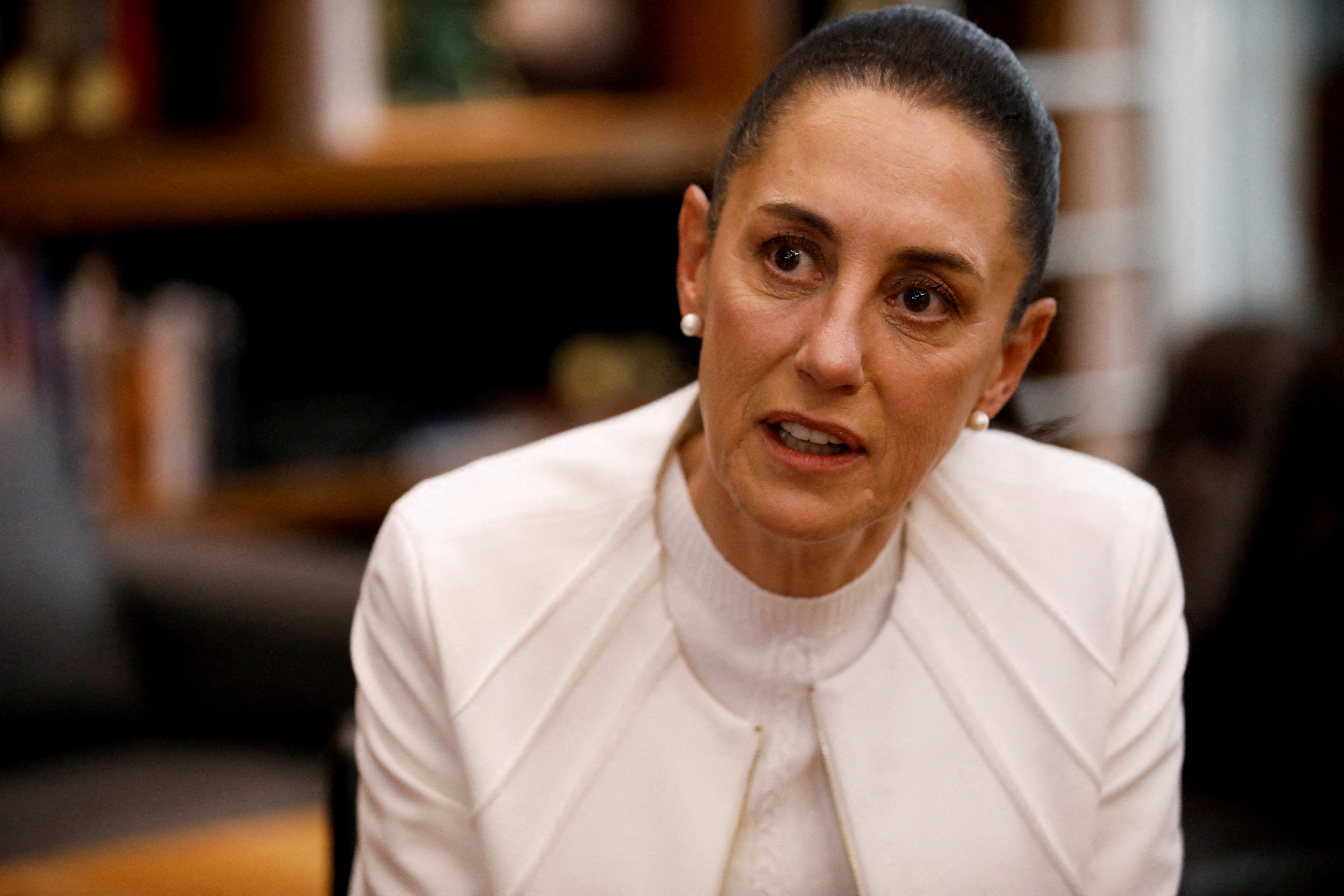
Mexico City’s Mayor Claudia Sheinbaum speaks during an interview with Reuters in Mexico City, Mexico September 22, 2022. REUTERS/Raquel Cunha/File Photo

Mexico City’s mayor renewed her criticism of a nearby state prosecutor for allegedly covering up the killing of a 27-year-old woman, a day after federal prosecutors issued an expert opinion saying the victim died from a blow to the head and not a result of alcohol intoxication as originally reported.

“Today, I again accuse Morelos’ state prosecutor of covering up Ariadna’s femicide,” she said, adding that punishment must be meted out for those who “willfully concealed the truth.” Claudia Sheinbaum, the mayor of Mexico’s sprawling capital city, wrote on Twitter Tuesday morning.

She also called for the prosecutor’s office to be sanctioned, without elaborating further.

Ariadna Lopez’s body was found off a Morelos highway in late October a day after she was reported missing from Mexico City some 50 miles (80 km) away, in a case that sparked mass outrage.

The case highlights Mexico’s longstanding problem with deadly violence against women, including femicide, or the murder of women or girls on basis of their gender.

Morelos prosecutors within days concluded she died when her oxygen supply was cut off as a result of alcohol intoxication, despite family members pointing to visible bruises on Lopez’s body.

A second autopsy from Mexico City forensic experts in November concluded blunt force trauma was responsible for her death, while an investigation found footage from the apartment where she was last seen that showed a person carrying a woman’s body to a car. Two suspects were later detained by police.

Federal prosecutors on Monday issued an expert opinion concluding Lopez died from a blow to the head, saying they could not support the assessment of the Morelos prosecutor’s office.

In a Tuesday statement, the prosecutor’s office in Morelos defended its autopsy and dismissed federal officials’ conclusion that head trauma was the cause of death as “a respectable opinion” but not legally binding.

It added it had not been formally asked to provide information, but highlighted that its forensic team was made of “professional women” who took gender into account.

The prosecutor’s office in Morelos told Reuters on Tuesday denied cover-up allegations, adding it was up to the judicial system to decide which autopsy should prevail.

The federal prosecutors advised that a criminal investigation should continue under Mexico City authorities.

Morelos is known for high rates of violence against women in a country which averages about 20 women killed each day. According to government data, very few cases result in sentences, while many of those that do cite lesser offenses that do not conclude the killing was intentional.

More than 70 cases of femicide were reported last December alone, according to official data.

WP Radio
WP Radio
OFFLINE LIVE