Categories
Audio Sources - Full Text Articles

The Fed has won its war against inflation and needs to end its interest-rate increases, says JPMorgan Asset Management’s investment chief

JPMorgan logo

(Photo by MICHEL EULER/POOL/AFP via Getty Images)

  • The Fed can claim victory in its war against inflation and needs to stop hiking interest rates, according to JPMorgan’s David Kelly.
  • “I think they need to stop. This is a war that they’ve won, and they’re in danger of tipping the economy into recession,” he said. 
  • Kelly expects three consecutive rate increases of 25 basis points each by May and sees borrowing costs staying there till year-end. 

The Federal Reserve has won its war against inflation and needs to end its interest-rate increases to prevent a recession, according to JPMorgan Asset Management’s investment chief.

The likelihood, however, is that the US central bank isn’t yet done with monetary tightening, David Kelly told Bloomberg Thursday, adding more rate hikes are expected from February onward. 

“I think they need to stop. This is a war that they’ve won, and they’re in danger of tipping the economy into recession. I think they’re making the fiscal problem worse, so I wish they would be done,” Kelly said. 

US inflation has been on a steady decline since mid-2022, with the annual rate for December coming in at 6.5% — the slowest pace in more than a year.

That has stoked optimism that price pressures are cooling in response to the Fed’s most aggressive monetary tightening campaign since the 1980s. The central bank has boosted its benchmark rate close to 4.5%, from almost zero last March.

Despite the decline in inflation, market consensus is that the Fed will raise rates by 25 basis points at its February 1 meeting, Kelly pointed out. The institution is likely to announce three such increases by May before maintaining rates at those levels through year-end, according to him. 

“That’s what they want to do. The question is, will the economy be strong enough to allow them to hold rates at that relatively high level,” Kelly said. 

He added it’s too early to tell whether the US economy is resilient in the face of the rate hikes. “What we know for sure is the economy is going to be growing slowly,” Kelly said. 

“We’ve got a very low savings rate and I think that’s a big problem because what’s happened is, consumers have been living beyond their means for the last few years because of government handouts and if they try to normalize that savings rate – if they stop increasing their borrowing as much – that’s going to slow consumer spending,” he added. 

Read the original article on Business Insider
Categories
Audio Sources - Full Text Articles

Russia“s war on Ukraine latest: Russia says it has taken control of salt town

2023-01-13T11:38:10Z

Russia said on Friday that its forces had taken control of the salt-mining town of Soledar in eastern Ukraine, claiming to have made its first big battlefield gain after half a year of military setbacks.

Reuters was not immediately able to verify the situation.

* Ukraine’s Deputy Defence Minister Hanna Malyar said earlier that Ukrainian forces were holding out after a “hot” night of battles in Soledar.

* Moscow’s February invasion of Ukraine has resulted in more than 50,000 reports of alleged war crimes, Ukraine’s top war crimes prosecutor Yuriy Belousov said, as grim details of the alleged torture emerged.

* France is hoping to deliver ‘AMX 10-RC’ light combat tanks to Ukraine in two months’ time, French armed forces minister Sebastien Lecornu said.

* A Russian foreign ministry official said Belarus may enter the conflict in Ukraine if Kyiv decides to “invade” either country. Russia used Belarus as a springboard to invade Ukraine in February 2022, and since October has deployed troops in Belarus for joint military drills. But the border area is now heavily waterlogged, making an imminent Russian attack unlikely.

* Kremlin-watchers are examining Russia’s latest switch of battlefield leadership after Valery Gerasimov, chief of the military’s general staff, was unexpectedly given direct command of the invasion.

* A close ally of Russian President Vladimir Putin suggested confiscating property and assets of Russians who discredit the country’s armed forces and oppose the war in Ukraine.

* China’s exports and imports with Russia hit a new high of 1.28 trillion yuan in 2022, Lyu Daliang, spokesperson of the General Administration of Customs, told a news briefing in Beijing. Trade with Russia accounted for 3% of China’s total for the year, he added.

Related Galleries:

A satellite view shows a closer view of exploding munitions, in Bakhmut, Ukraine, January 3, 2023. Satellite image 2023 Maxar Technologies./Handout via REUTERS

A satellite view shows destroyed apartment buildings and homes, in Soledar, Ukraine, January 10, 2023. Satellite image ?2023 Maxar Technologies./Handout via REUTERS
Categories
Audio Sources - Full Text Articles

Russia says its forces capture Soledar in east Ukraine

2023-01-13T11:45:15Z

Ukrainian servicemen stationed near Soledar said on Thursday (January 12) they are holding their positions. Reuters was unable to verify conditions on the ground.

Russia said on Friday that its forces had taken control of the salt-mining town of Soledar in eastern Ukraine overnight after days of relentless fighting, claiming Moscow’s first big battlefield gain after half a year of military setbacks.

Reuters could not immediately verify the situation in the town. Earlier on Friday, Kyiv said fighting was still continuing there after what it described as a “hot” night.

Russia said the capture of Soledar would make it possible to cut off Ukrainian supply routes to the larger nearby city of Bakhmut, and trap remaining Ukrainian forces there. Russia has been trying to seize Bakhmut for months in brutal warfare.

“The capture of Soledar was made possible by the constant bombardment of the enemy by assault and army aviation, missile forces and artillery of a grouping of Russian forces,” Moscow’s defence ministry said.

Kyiv says Russia threw wave upon wave of soldiers and mercenaries into a pointless fight for a bombed-out wasteland at Soledar and U.S. officials said a Russian victory there, or even in Bakhmut, would make little difference to the overall war.

Soledar, with a pre-war population of just 10,000, sits above cavernous salt mines. Bakhmut, ten times larger, is a substantial provincial district hub.

“Even if both Bakhmut and Soledar fall to the Russians, it’s not going to have a strategic impact on the war itself,” U.S. National Security Council spokesman John Kirby told reporters at the White House on Thursday, “and it certainly isn’t going to stop the Ukrainians or slow them down.”

The Wagner ultra-nationalist mercenary company run by an ally of President Vladimir Putin had claimed to have captured Soledar on Wednesday, but until now Russia’s defence ministry had stayed silent.

“The night in Soledar was hot, battles continued,” Ukraine’s Deputy Defence Minister Hanna Malyar wrote on the Telegram messaging app.

“The enemy threw almost all the main forces in the direction of Donetsk and maintains a high intensity of offensive. Our fighters are bravely trying to maintain the defence,” she said, referring to the Donetsk region which includes Soledar.

“This is a difficult phase of the war, but we will win. There is no doubt.”

Outside Soledar on Thursday, Ukrainian soldiers were dug into well-fortified trenches in the wintry woods. Explosions echoed in the distance.

A 24-year-old soldier using the call-sign BUK, told Reuters the intensity of shelling had risen by around 70 percent, but forces were still holding their positions.

“The situation is difficult but stable. We’re holding back the enemy … we’re fighting back.”

Ukrainian officials said on Thursday more than 500 civilians were trapped inside Soledar, including 15 children.

In an overnight video address, Ukrainian President Volodymyr Zelenskiy thanked two units in Soledar he said were “holding their positions and inflicting significant losses on the enemy.” He did not give more details.

The front lines in Ukraine have barely budged for two months since Russia’s last big retreat in the south. Meanwhile, the battles around Bakhmut and Soledar became what both sides called a “meat grinder” – a brutal war of attrition claiming the lives of thousands of soldiers needed for decisive battles ahead.

The new year has brought important pledges of extra Western weapons for Ukraine, which is seeking armour to mount mechanised battles against Russian tanks. Last week, France, Germany and the United States pledged to send armoured fighting vehicles.

In recent days, the focus has been on main battle tanks, which Western countries have yet to provide. On Friday, Finland joined Poland in promising to send German-made Leopard tanks to Ukraine as part of a Western coalition. That requires the permission of Berlin, which has so far been hesitant but has lately signalled a willingness to allow it.

Putin launched the invasion on Feb. 24, saying Kyiv’s ties with the West threatened Russia’s security, and Russia has since claimed to have annexed four Ukrainian provinces. Ukraine and its allies call it an unprovoked war to seize territory, and Kyiv says it will fight until it recaptures all its land.

Related Galleries:

Ukrainian army, of the 43rd Heavy Artillery Brigade fire a German howitzer Panzerhaubitze 2000, as Russia’s attack on Ukraine continues, near Soledar, Ukraine, January 11, 2023. REUTERS/Clodagh Kilcoyne/File Photo

A satellite view shows a destroyed school and buildings in south Soledar, Ukraine, January 10, 2023. Satellite image 2023 Maxar Technologies./Handout via REUTERS

A rescuer and a dog warm up next to a wood stove inside a State Emergency Service station in the town of Bakhmut, amid Russia’s attack on Ukraine, in Donetsk region, Ukraine January 11, 2023. Radio Free Europe/Radio Liberty/Serhii Nuzhnenko via REUTERS

A woman warms up inside a State Emergency Service station in the town of Bakhmut, amid Russia’s attack on Ukraine, in Donetsk region, Ukraine January 11, 2023. Radio Free Europe/Radio Liberty/Serhii Nuzhnenko via REUTERS

Russian President Vladimir Putin and Chief of the General Staff of Russian Armed Forces Valery Gerasimov attend an annual meeting of the Defence Ministry Board in Moscow, Russia, December 21, 2022. Sputnik/Mikhail Kuravlev/Kremlin via REUTERS/File Photo

A satellite view shows a smoldering building, in Soledar, Ukraine, January 3, 2023. Satellite image 2023 Maxar Technologies./Handout via REUTERS

People in military uniform, claimed to be soldiers of Russian mercenary group Wagner and its head Yevgeny Prigozhin, pose for a picture believed to be in a salt mine in Soledar in the Donetsk region, Ukraine, in this handout picture released January 10, 2023. Press service of “Concord”/Handout via REUTERS

A satellite view shows apartment buildings and homes, in Soledar, Ukraine, August 1, 2022. Satellite image 2023 Maxar Technologies./Handout via REUTERS

A satellite view shows destroyed apartment buildings and homes, in Soledar, Ukraine, January 10, 2023. Satellite image ?2023 Maxar Technologies./Handout via REUTERS

Chief of the General Staff of Russian Armed Forces Valery Gerasimov attends an annual meeting of the Defence Ministry Board in Moscow, Russia, December 21, 2022. Sputnik/Sergei Fadeichev/Pool via REUTERS

A tank fires a round, amid Russia’s attack on Ukraine, in Soledar, Donetsk region, Ukraine, in this screen grab released on January 8, 2023 and obtained from a social media video by Reuters on January 10, 2023. State Border Guard Service Of Ukraine/via REUTERS/File Photo

An elderly woman walks near debris of a destroyed building purported to be a vocational college used as temporary accommodation for Russian soldiers, dozens of whom were killed in a Ukrainian missile strike as stated previously by Russia’s Defence Ministry, in the course of Russia-Ukraine conflict in Makiivka (Makeyevka), Russian-controlled Ukraine, January 10, 2023. REUTERS/Alexander Ermochenko

Ukrainian members of the military fire an anti-aircraft weapon, as Russia’s attack on Ukraine continues, in the frontline city of Bakhmut, Ukraine, January 10, 2023. REUTERS/Clodagh Kilcoyne

Local residents remove debris and carry belongings out of a shop destroyed in recent shelling in the course of Russia-Ukraine conflict in Donetsk, Russian-controlled Ukraine, January 10, 2023. REUTERS/Alexander Ermochenko

Local resident Anatoly stands inside his house heavily damaged in recent shelling in the course of Russia-Ukraine conflict in Donetsk, Russian-controlled Ukraine, January 10, 2023. REUTERS/Alexander Ermochenko

Local residents remove debris and carry belongings out of a shop destroyed in recent shelling in the course of Russia-Ukraine conflict in Donetsk, Russian-controlled Ukraine, January 10, 2023. REUTERS/Alexander Ermochenko

Smoke rises from strikes on the frontline city of Soledar, as Russia’s attack on Ukraine continues, as seen from Bakhmut, Ukraine, January 5, 2023. REUTERS/Clodagh Kilcoyne

General view of railway lines, as Russia’s attack on Ukraine continues, in Siversk, Ukraine, January 9, 2023. REUTERS/Clodagh Kilcoyne

Local residents look through items at a site of the local market, heavily damaged by a Russian missile strike, amid Russia’s attack on Ukraine, in the Shevchenkove town, Kharkiv region, Ukraine January 9, 2023. REUTERS/Sofiia Gatilova

Ukrainian servicemen stand next to a 2S3 Akatsiya self propelled howitzer at their position in a frontline, amid Russia’s attack on Ukraine, in Donetsk region, Ukraine January 8, 2023. REUTERS/Anna Kudriavtseva

Ukrainian firefighters work at the site of a local market, heavily damaged by a Russian missile strike, amid Russia’s attack on Ukraine, in the Shevchenkove town, Kharkiv region, Ukraine January 9, 2023. REUTERS/Sofiia Gatilova

A firefighter works at a site of a market hit by Russian missiles, amid Russia’s attack on Ukraine, in the town of Shevchenkove, Kharkiv region, Ukraine January 9, 2023. Governor of Kharkiv region Oleh Sunehubov via Telegram/Handout via REUTERS

People return to their shelters after gathering water, as Russia’s attack on Ukraine continues, in Siversk, Ukraine, January 9, 2023. REUTERS/Clodagh Kilcoyne

Olha, 60, resident of Soledar waits in a temporary sleeping accommodation before being transported to an evacuation train where she will get out in Dnipro, as Russia’s attack on Ukraine continues, in Kramatorsk, Ukraine, January 8, 2023. REUTERS/Clodagh Kilcoyne

General view of damage from a strike, as Russia’s attack on Ukraine continues, in Siversk, Ukraine, January 9, 2023. REUTERS/Clodagh Kilcoyne

Categories
Audio Sources - Full Text Articles

US Defence Secretary meets German defence minister in Berlin on Jan 19: spokesperson

2023-01-13T11:37:31Z

U.S. Defense Secretary Lloyd Austin speaks during a news briefing after participating a virtual Ukraine Defense Contact Group meeting at the Pentagon in Arlington, Virginia, U.S., November 16, 2022. REUTERS/Tom Brenner

The United States Secretary of Defence Lloyd Austin will meet German Defence Minister Christine Lambrecht in Berlin on January 19, a spokesperson for Germany’s defence ministry told Reuters on Friday.

Washington and Berlin have coordinated sending aid and military hardware to support Ukraine in the war against Russia. Last week they jointly agreed to send infantry fighting vehicles. Allies have also proposed sending German-built Leopard battle tanks to Ukraine.

Categories
Audio Sources - Full Text Articles

Biden political future clouded by classified document probe

NEW YORK (AP) — Virtually everything was going right for President Joe Biden as he opened the year.

His approval ratings were ticking up. Inflation was slowing. And as Democrats united behind his likely reelection campaign, Republicans were at war with themselves after a disappointing midterm season.

But on Thursday, Biden’s political outlook veered into more uncertain territory after Attorney General Merrick Garland appointed a special counsel to investigate the Democratic president’s handling of classified documents.

Democrats publicly and privately conceded that the stunning development was at best an unwelcome distraction at an inopportune time that muddies the case against Donald Trump. The Republican former president is facing a special counsel of his own and is under federal criminal investigation for his handling of classified documents and other potential transgressions.

There are major differences between the two cases. Most notably, there is no suggestion that Biden purposefully tried to prevent the documents discovered at his home or office from being turned over or that he was even aware of their presence. Trump, who is being probed for potentially obstructing investigators, also had far more classified documents in his possession.

But Thursday’s appointment of a special counsel nonetheless thrusts legal uncertainty over the sitting president and could revive debate among Democrats about the wisdom of him seeking a second term.

“No one’s going to say this is helpful,” veteran Democratic strategist James Carville said. “It’s pretty evident that’s not the case.”

As Democrats recoiled into a defensive posture, Trump’s would-be Republican rivals in 2024 acknowledged that the contours of the upcoming race had shifted.

Trump “is the luckiest man in American politics,” said John Bolton, who served as national security adviser under Trump and is considering a Republican White House bid. “This ought to be disqualifying to both of them.”

Thus begins a messy election season in which the current and former presidents of the United States are both under investigation by special counsels as they gear up for a potential rematch in 2024. Many voters in both parties were already calling for a new generation of leadership to emerge in the nascent presidential contest. Such calls are now growing louder.

“On many political fronts, Biden’s touted 2024 campaign is potentially vulnerable,” said Norman Soloman, a progressive Democrat who leads the so-called Don’t Run Joe campaign, which is already running television ads against Biden in key states. “Democrats and the country as a whole would be much better off this year and next if he’s not running for president.”

The 80-year-old president has already indicated he plans to seek a second term, but he has yet to make a final decision. His allies believe he is likely to make a formal announcement after the end of March.

So far, at least, no high-profile Democrats appear willing to challenge Biden in a prospective presidential primary contest. Privately, however, some Democratic officials believe the new federal probe may help motivate an insurgent candidate.

One of Biden’s potential challengers, Vermont Sen. Bernie Sanders, recently told The Associated Press that he would make a decision about his 2024 intentions “at the appropriate time.” Nina Turner, who chaired Sanders’ 2020 presidential campaign, said after Thursday’s announcement that she hopes a “freedom-fighting progressive” mounts a primary challenge against Biden in 2024.

“The American people certainly deserve better choices — Republicans and Democrats,” Turner said, applauding the government’s decision to review Biden’s handling of classified documents in the same way it’s investigating Trump. “We shouldn’t have these men shoved down our throats.”

Garland’s appointment of a special counsel followed Biden’s acknowledgement Thursday morning that documents with classified markings from his time as President Barack Obama’s vice president were found in the garage of his Delaware home and in his personal library, in addition to documents already discovered in a locked closet at an office he used after leaving the White House.

Garland said Biden’s lawyers informed the Justice Department on Thursday morning of the discovery of a classified document at Biden’s home, after FBI agents first retrieved other documents from the garage in December.

Speaking to reporters Thursday, Biden said he was cooperating “fully and completely with the Justice Department’s review.”

“People know I take classified documents and classified material seriously,” Biden said. He added: “My Corvette’s in a locked garage.”

To be clear, there are stark differences between the cases, including the volume of documents discovered and the gravity of the ongoing grand jury investigation into the matter at Mar-a-Lago, Trump’s Palm Beach, Florida, home.

Roughly 300 records with classification markings were recovered from Mar-a-Lago, a private club that hosts constant events. The search of Trump’s property was the culmination of months of back-and-forth between the government and Trump’s representatives, who repeatedly resisted efforts to return the missing documents. And the Justice Department says classified documents were “likely concealed and removed” from a storage room as part of what they allege was an effort to obstruct the federal investigation.

A warrant for the search showed the FBI was investigating crimes including the willful retention of national defense information and efforts to obstruct the federal probe.

Trump has nonetheless seized on the news, seeking to use it to undermine the investigation into his actions.

“It’s over,“ Trump said in an interview with conservative talk radio host Mark Levin on Thursday evening. ”When all of these documents started coming out and Biden had them, it really changed the complexion and the intensity that they were showing to me because, you know, what they did is – I don’t say far worse, I did nothing wrong — what they did is not good. What they did is bad.”

Some Democrats were hopeful, but not certain, that voters might distinguish between Biden’s cooperative approach involving a small trove of documents he apparently possessed by mistake and what federal prosecutors described as Trump’s willful obstruction of hundreds of government secrets.

“It’s all the difference in the world between having something you don’t know you have and having something you know you have and aren’t supposed to have,” Carville said. “Is that going to get lost among a third of the country? Probably so.”

Bolton, a fierce Trump critic, predicted that the significant legal differences between the two cases would “get lost in the fog.” Now, he finds it hard to believe that Trump can be prosecuted for the Mar-a-Lago documents, regardless of the circumstances.

“I don’t see how a criminal case goes forward at this point,” Bolton said. “I just think it’s such a cloud over the prosecution.”

While the ground may have shifted, Trump’s legal challenges aren’t going to disappear.

Two months ago, Garland appointed former Justice Department public corruption prosecutor Jack Smith to lead investigations into the classified documents discovered at Mar-a-Lago as well as key aspects of a separate probe involving the Jan. 6, 2021, insurrection and efforts to undo the 2020 election.

Federal prosecutors have been especially focused on a scheme by Trump allies to elevate fake electors in key battleground states won by Biden as a way to subvert the vote. They issued subpoenas to multiple state Republican Party chairmen.

Democratic strategist Josh Schwerin described the latest development as “certainly not ideal.”

“I think everyone would wish this hadn’t happened, including the president,” he said. “But it’s important to keep all of this in context: Everyone views President Biden as a far more responsible figure than Donald Trump. And that cannot be forgotten.”

Categories
Audio Sources - Full Text Articles

Speaker McCarthy’s tidy 1st week disguises trouble ahead

WASHINGTON (AP) — Chaos? In the House of Representatives?

Republican Kevin McCarthy wrapped his first full week as House speaker in the most outwardly orderly way, with hardly a hint of the chaotic, rebellious fight it took for the Republicans to arrive here, having barely installed him as the leader with the gavel.

The House Republicans marched through the early days of the session like a spunky new business — in by noon, out by dinnertime, the lawmakers rapid-fire voting without much public drama in between. They approved their House rules and sent six Republican bills quickly to passage, including one to gut funding for the Internal Revenue Service.

The Republican committee chairmen were named, members were appointed to the panels and the Oversight committee launched its first requests for financial documents as it probes President Joe Biden and his family.

And when House Republicans met for the first time behind closed doors after the rowdy public spectacle that broke history records and almost came to fistfights to elect McCarthy as speaker, it was a “lovefest,” as one Republican lawmaker put it.

“That’s just the first five days, and we’re just getting started,” McCarthy said Thursday at his first press conference as speaker.

But the semblance of House GOP unity is all but certain to be temporary, a momentary reprieve after the grudging, grueling effort by Republicans to seize the majority from Democrats and elect the embattled McCarthy as the new speaker.

The daunting political math confronting McCarthy remains the same: With a 222-seat majority, he can only lose a few detractors on any issue unless he reaches across the aisle for help and backing from Democrats for the 218 votes typically needed to pass legislation.

While the first bills the House Republicans easily approved were essentially GOP favorites, designed to unite their side of the aisle and even pull in some Democratic support, the next legislative lifts are expected to be more vigorous and politically risky.

McCarthy has made a deal with conservatives that the next government funding bill will be held to fiscal 2022 levels, which means a substantial 8% cut of discretionary accounts — or more if the defense budget is spared.

“We’ve got to change the way we are spending money,” McCarthy said Thursday.

Even more, Congress will be asked this summer to raise the federal debt ceiling to allow more borrowing to pay off the government’s current bills, always a difficult vote for lawmakers and one that the Treasury Department says is coming sooner than expected.

In refusing to allow the federal government to take on more debt unless changes are made to federal spending, House Republicans are heading for a risky showdown that echoes the debt ceiling debate of 2011. That was a months-long political drama that resulted in a downgrade of the U.S. credit rating for the first time in modern memory after the newly-elected tea party class of House Republicans demanded federal spending cuts.

“Come on. Is this how House Republicans are starting the new term: cutting taxes for billionaires, raising taxes for working families, and making inflation worse?” Biden said Thursday in remarks near the White House.

“Well, let me be clear: If any of those bills make it to my desk, I will veto them,” he said. “I’m ready to work with Republicans, but not this kind of stuff.”

Downtown, the U.S. Chamber of Commerce CEO Suzanne Clark said in remarks Thursday that there is “almost a level of despair” among the business community about government gridlock and the inability to solve big issues such as the shortage of workers and immigration reform.

In the Senate, where Democrats still hold a slim 51-seat majority, Majority Leader Chuck Schumer vowed to hold the line as “a firewall to this extreme MAGA Republican agenda,” a reference to former President Donald Trump’s Make American Great Again slogan.

It was Trump’s 11th hour push for McCarthy as voting was underway late last week that both men, who are on-again-off-again allies, said was responsible for making the California Republican the new House speaker.

McCarthy won the speaker’s gavel only by making concessions to hard-right Republicans in the House Freedom Caucus that now hang over his leadership, including the ability of any single lawmaker to make a motion to vacate the chair — essentially calling a vote to oust McCarthy from office.

The tenuous Republican hold on power is complicated by the presence of Rep. George Santos, the newly elected Republican from New York, who faces calls for his ouster over the lies he has admitted to telling about his education, work experience and other aspects of his life. Instead, McCarthy said the Ethics Committee will investigate. “And if something is found out, it will be dealt with,” McCarthy said.

But many House Republicans emerged confident that the messy, bitter fight made them — and McCarthy — stronger, not weaker, as they press ahead in their new majority to govern.

“You always come out better on the back side of it,” said Rep. Byron Donalds, R-Fla., who was nominated repeatedly by his colleagues as an alternative GOP choice for speaker. “And now we’re back to business.”

Said Rep. Scott Perry, the chairman of the Freedom Caucus, “I feel pretty positive — Republicans are in charge and we’re whupping up on the left and it’s awesome.”

Republican Rep. Bob Good, R-Va., one of the chief holdouts in speaker’s fight, said the public display put McCarthy in a stronger negotiating position moving forward by showing what the speaker is up against.

“Our speaker is empowered to be in a stronger position in negotiations with the Senate in the White House, because he can say, ‘When my folks say no, they mean no.’”

Standing in gilded Statuary Hall rather than the Capitol’s usual press briefing studio in the basement, McCarthy compared his new Republican majority to the early American lawmakers. They convened in this room when the Congress was relocated from Philadelphia.

As tourists milled about Thursday afternoon, pausing to listen and take photos, McCarthy noted he was reopening the Capitol to visitors. Democrats under Speaker Nancy Pelosi had kept the building partly closed during the COVID-19 crisis and in the aftermath of the Jan. 6, 2021, Capitol attack by Trump’s supporters.

__

Associated Press writer Josh Boak contributed to this story.

Categories
Audio Sources - Full Text Articles

Jewish groups sound alarm ahead of synagogue hostage standoff anniversary

GettyImages-1237799762-1.jpg

This article originally appeared on Haaretz, and was reprinted here with permission. Sign up here to get Haaretz’s free Daily Brief newsletter delivered to your inbox.

U.S. Jewish groups are sounding the alarm on the effects of rising antisemitism on American Jews’ sense of safety ahead of the one-year anniversary of a hostage standoff at a Texas synagogue.

The American Jewish Committee, which is to release a survey comparing U.S. Jews’ and other U.S. adults’ opinions on the state of antisemitism in the U.S., said 87 percent of U.S. Jews felt less safe after the incident. The incident a year ago saw a gun-wielding man take hostages at Congregation Beth Israel in Colleyville, a suburb of Dallas. The standoff ended after Rabbi Charlie Cytron-Walker managed to help his fellow hostages escape.

“The Colleyville attack clearly reverberated throughout the Jewish community,” said AJC CEO Ted Deutch. “No Jew should ever feel unsafe anywhere, anytime in America simply because they are Jewish. As we have seen on a local and national level, these antisemitic incidents don’t happen in a vacuum. They are rooted in an age-old hatred that cannot go unchecked.”

AJC’s also found that younger Jews are more concerned about their physical safety than older Jews, and that Jewish adults belonging to a religious denomination are more concerned about their physical safety than secular Jews. Furthermore, the survey found that U.S. Jews were acutely more aware of the Colleyville incident than other U.S. adults, despite significant media coverage of the incident.

The Anti-Defamation League, in its own findings, stated that 85 percent of Americans believe in at least one anti-Jewish trope and 20 percent believe in at least six tropes. These are the highest levels the ADL has measured in decades.

“Those of us on the front lines have expected such results for a while now — and yet the data are still stunning and sobering: there is an alarming increase in antisemitic views and hatred across nearly every metric — at levels unseen for decades,” said ADL CEO Jonathan Greenblatt.

The findings come as second gentleman Doug Emhoff, who has become the face of the Biden administration’s efforts to combat antisemitism, announced he will travel to Poland and Germany later this month as part of his efforts and to support Holocaust remembrance.

Emhoff, the first Jewish spouse of a U.S. president or vice president, will begin his trip in Krakow, from where he will visit the Auschwitz-Birkenau Memorial and Museum to commemorate International Holocaust Remembrance Day, January 27, alongside U.S. special antisemitism envoy Deborah Lipstadt.

The vice president’s husband, who will also meet with Congressional leaders focusing on combating antisemitism prior to his trip, will then head to Berlin, where he and Lipstadt will attend a convening of special envoys and coordinators working to combat antisemitism. Emhoff will also meet with local Jewish communities and officials and visit historical and cultural sites in both Krakow and Berlin.

Over the past several weeks, U.S. President Joe Biden has reaffirmed his administration’s commitment to fighting antisemitism, establishing an interagency group after U.S. Jewish leaders raised concerns during a meeting headed by Emhoff.

Antisemitism has spiked in recent months following Elon Musk’s Twitter takeover, with conspiracy theories platformed by celebrities like Kanye West and Kyrie Irving, as well as Donald Trump’s association with avowed Holocaust denier Nick Fuentes, dominating headlines.

The post Jewish groups sound alarm ahead of synagogue hostage standoff anniversary appeared first on The Forward.

Categories
Audio Sources - Full Text Articles

Why hasn’t Harry given up his ridiculous title yet? | Arwa Mahdawi

I don’t think anyone should be going around calling themselves Duke or Duchess in 2023. Unless they are a stripper or a dog

I’m afraid it’s the law now, OK? I’ve valiantly resisted for as long as I could, but the time has come: I simply have to write about Harry and Meghan. It is basically illegal not to have at least one opinion about the royals who apparently hate being royals but are still milking their royal connections for all they’re worth. And don’t roll your eyes, you’re a glutton for this stuff too. Everyone loves to see obscenely privileged people airing their dirty laundry. There is a reason that Harry’s memoir has become the UK’s fastest-selling nonfiction book and that reason is not the quality of the writing.

Don’t worry I’m not going to pull a Piers Morgan or Jeremy Clarkson here and start seething with unhinged rage about Harry and Meghan. I’m not the Sussexes biggest fan but the only royal I can muster up enough energy to get really outraged about is Prince Andrew. You remember him? He hasn’t been in the news very much lately since Harry’s been hogging all the headlines but he’s the guy that got stripped of royal duties over his relationship with the convicted sex offender Jeffrey Epstein. He’s the guy that Ghislaine Maxwell recently called her “dear friend.” He’s a nasty piece of work and yet Britain is now so caught up in Harry hatred that a recent YouGov poll has found that Brits over the age of 65 dislike the Sussexes more than disgraced Prince Andrew.

Arwa Mahdawi is a Guardian columnist and the author of Strong Female Lead

Continue reading…

Categories
Audio Sources - Full Text Articles

Investor Peltz, corporate doctor, pushes Disney to take bitter pill

2023-01-13T11:15:34Z

Nelson Peltz founding partner of Trian Fund Management LP. speak at the WSJD Live conference in Laguna Beach, California October 25, 2016. REUTERS/Mike Blake/File Photo

Billionaire activist investor Nelson Peltz often presents himself as a partner with constructive advice for corporations and in 2019 Walt Disney Co Chief Executive (DIS.N) Bob Iger was eager to hear his ideas.

But in 2023, Iger, who came out of retirement in November to again lead the media giant after a 66% decline in quarterly profit, does not want Peltz as a Disney director. Still, the fund manager has a compelling case to push for change, with Disney’s stock price down 36% over the last 52 weeks.

Weeks of discussion last year ended with Disney denying Peltz’s request for a board seat leaving the parties embroiled in what bankers and lawyers say may become one the most expensive and explosive proxy contests in recent history.

Longtime Disney CEO Iger returned late last year to help stanch losses from the fledgeling streaming service Disney+. Three years ago, Iger had invited Peltz to speak to Disney’s board about his philosophy, Peltz’s firm Trian Fund Management said and a source close to Disney confirmed. At that time Trian did not own Disney stock.

Then Trian amassed a 0.5% stake in Disney last year and Peltz wanted a bigger voice and vote after criticizing capital spending, past acquisitions and a bungled succession plan.

When he requested a board seat, Disney balked and instead offered an “information sharing agreement.” This would let Peltz speak with the management team and the board but not have a vote as a director.

Iger and other directors agree Disney needs to cut costs, and many cuts have already been announced. They say they want to continue the dialogue with Peltz but expressed concern that had not made concrete suggestions to address the problems he identified, people familiar with the company’s thinking said.

Media analyst Michael Nathanson agreed with Peltz and wrote in a note that “many of Disney’s wounds are self-inflicted,” but expressed confidence in Iger’s ability to “make the difficult decisions” required to improve Disney’s long-term profitability.

Peltz and his colleagues mostly negotiate for changes out of the limelight and have been invited by 15 companies, including Unilever Plc (ULVR.L) and Invesco Ltd, to join the board. Peltz himself has served on 11 boards. At three — Procter & Gamble, H.J. Heinz and DuPont de Nemours — Trian waged boardroom battles that went to a vote where all investors got a say on whether Trian should have a seat.

While those three companies worked hard to keep Trian out, their CEOs later lauded the firm’s collaborative efforts and insights. Mostly Peltz’s medicine worked as Trian said companies where he was on the board outperformed the broader S&P 500 stock index by 9% during his tenure.

For Disney, however, Peltz may be an especially aggravating activist, arriving shortly after Third Point’s billionaire founder Daniel Loeb showed up again last year. Disney and Loeb engaged in conversations and the two sides quickly agreed to add media executive Carolyn Everson to the Disney board.

Many times activist investors push corporations for changes the company may already be considering. But they want management to act faster and more broadly.

Indeed Peltz may be betting the playbook he used at P&G will work at Disney too. This includes updating aging brands, simplifying bureaucracy and bringing along binders of information and data to find new ways of doing things.

With Disney’s stock swooning, investors are unhappy and may be ready to back Peltz in a vote, investors and advisers who are not permitted to speak publicly said on Thursday.

Firms including T.Rowe Price, Legal & General Investment Management, Nuveen and Dimensional Fund Advisors are invested in Disney and are invested in P&G as well where they saw shares climb with Peltz on the board.

In his current battle, Peltz may be helped by new U.S. regulations that allow investors to see all director candidates on a so-called universal proxy card. Bankers and lawyers say this process may make it easier for activists like Peltz to win at least one board seat at an election. This is because investors can now pick and choose instead of selecting either all of the activist’s choices or the company choices.

“Even though Disney has publicly rebuffed Peltz’s agenda, this proxy battle is likely to cause more ripples,” said Paul Verna, principal analyst at Insider Intelligence. “In the current climate, with Disney’s stock underperforming the market and a slew of unfavorable economic conditions and business dynamics, Peltz may have more leverage to force Disney’s hand.”

Categories
Audio Sources - Full Text Articles

Analysis: U.S. House Republicans favor message over substance in early legislation

2023-01-13T11:07:00Z

Republicans who control the U.S. House of Representatives wasted no time this week using their new majority to pass political messaging bills that appeal to conservative voters on hot-button issues, but often involved more hyperbole than substance.

After a historic struggle to elect Kevin McCarthy as their speaker, House Republicans used their first legislative week to pass bills on taxes, abortion and energy security that have little to no chance of getting through the Democratic-controlled Senate or being signed into law by Democratic President Joe Biden.

The bills are meant to provide a political benefit, as Republicans seek to fulfill 2022 campaign promises and formulate plans to capture the Senate and White House in 2024.

“The American public made a decision, where they fired the Democrats and they put us in charge,” McCarthy told reporters.

“We continue to keep that commitment,” he said. “You’ll watch it week after week after week.”

Republicans also set up committees to investigate Biden’s Justice Department and scrutinize U.S.-China competition.

The use of messaging bills is an age-old tactic embraced by Republicans and Democrats alike. In the run-up to the November midterm elections, House Democrats approved legislation on abortion rights and election reform, knowing the bills would never pass the narrowly split Senate.

Democrats characterized the legislation as an effort to protect the wealthy, obstruct federal probes of Republican former President Donald Trump and restrict abortion access.

“That’s this week in extreme MAGA-Republican land,” said House Democratic leader Hakeem Jeffries.

Messaging bills could play a central role as the Republican Party girds itself for political showdowns over spending and the debt ceiling.

“The real purpose for the House Republican conference is to hold down spending and try to limit the debt,” said Republican strategist Charles Black. “All that’s going to take negotiations with the Senate and the White House.”

“But I suspect that they feel the best way to negotiate is to take a hard-line position and pass it through the House before you go negotiate,” he added.

The week began with Republicans taking aim at Democratic funding for the Internal Revenue Service intended to help reclaim an estimated $500 billion in annual unclaimed taxes.

The House, in a party-line vote, passed a bill to rescind $72 billion in new IRS funding last year, which No. 2 House Republican Steve Scalise said would target people earning less than $400,000 and break Biden’s promise not to raise taxes on that income group.

The claim, repeated widely by Republicans, was based on a Congressional Budget Office report that reached the opposite conclusion, saying audit rates for taxpayers with income less than $400,000 would actually remain close to recent levels.

Also missing from Republican rhetoric was a separate CBO finding that said their bill would add more than $114 billion to the federal deficit.

On Thursday, 113 Democrats joined Republicans in voting on a bill that sponsors said would ban sales of oil to Beijing from the U.S. Strategic Petroleum Reserve, even though oil experts said it would have little effect.

The bill is part of a larger strategy by Republicans to blame Democratic “green” energy policies for higher U.S. gasoline prices and to accuse Biden of trying to compensate by draining the nation’s emergency oil reserve and selling some of it China.

In March, Biden announced a record sale of 180 million barrels from the reserve.

Chinese buyers purchased some of the SPR oil directly and more found its way to China through the global market.

Industry experts said the restrictions were unlikely to stop oil from reaching China on the global market.

“They can establish who the designated buyers are. But they can’t follow where the barrels go after that,” said Kevin Book, an analyst at the nonpartisan, Washington-based research group ClearView Energy Partners LLC.

The legislation also does not address U.S. oil industry exports to China, which dwarf SPR volumes as a result of 2015 reforms that Republicans supported.

Another Republican messaging bill sought to protect the welfare of infants born during abortion procedures, a rare occurrence that experts say legislators have long used to underscore their opposition to abortion.

Experts say there are no reliable statistics on so-called born-alive abortions. Data compiled by the Centers for Disease Control and Prevention estimate that fewer than 1% of abortions in 2020 took place after 20 weeks of pregnancy.

After the U.S. Supreme Court’s decision to overturn national abortion rights mobilized female voters against Republicans in November, the abortion birth legislation came under fire from within the party.

“We’re only playing lip service to the pro-life movement,” said Representative Nancy Mace of South Carolina, who advocated instead for expanded access to birth control but still voted for the bill.

Related Galleries:

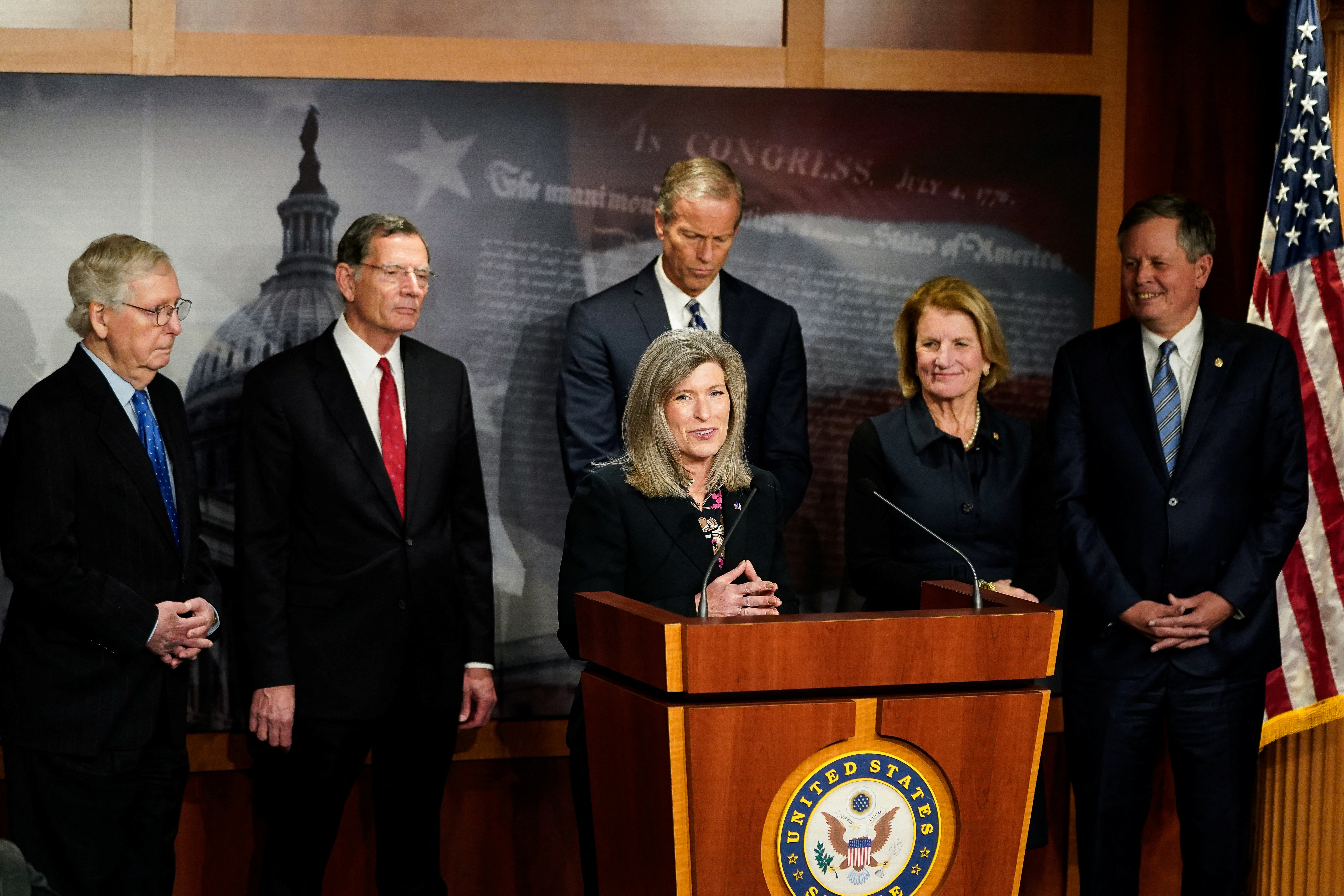
U.S. Senator Joni Ernst (R-IA) speaks during a news conference following Senate Republican leadership elections that included the re-election of U.S. Senator Mitch McConnell (R-KY) as minority leader and Ernst as policy chair at the U.S. Capitol in Washington, U.S., November 16, 2022. REUTERS/Elizabeth Frantz

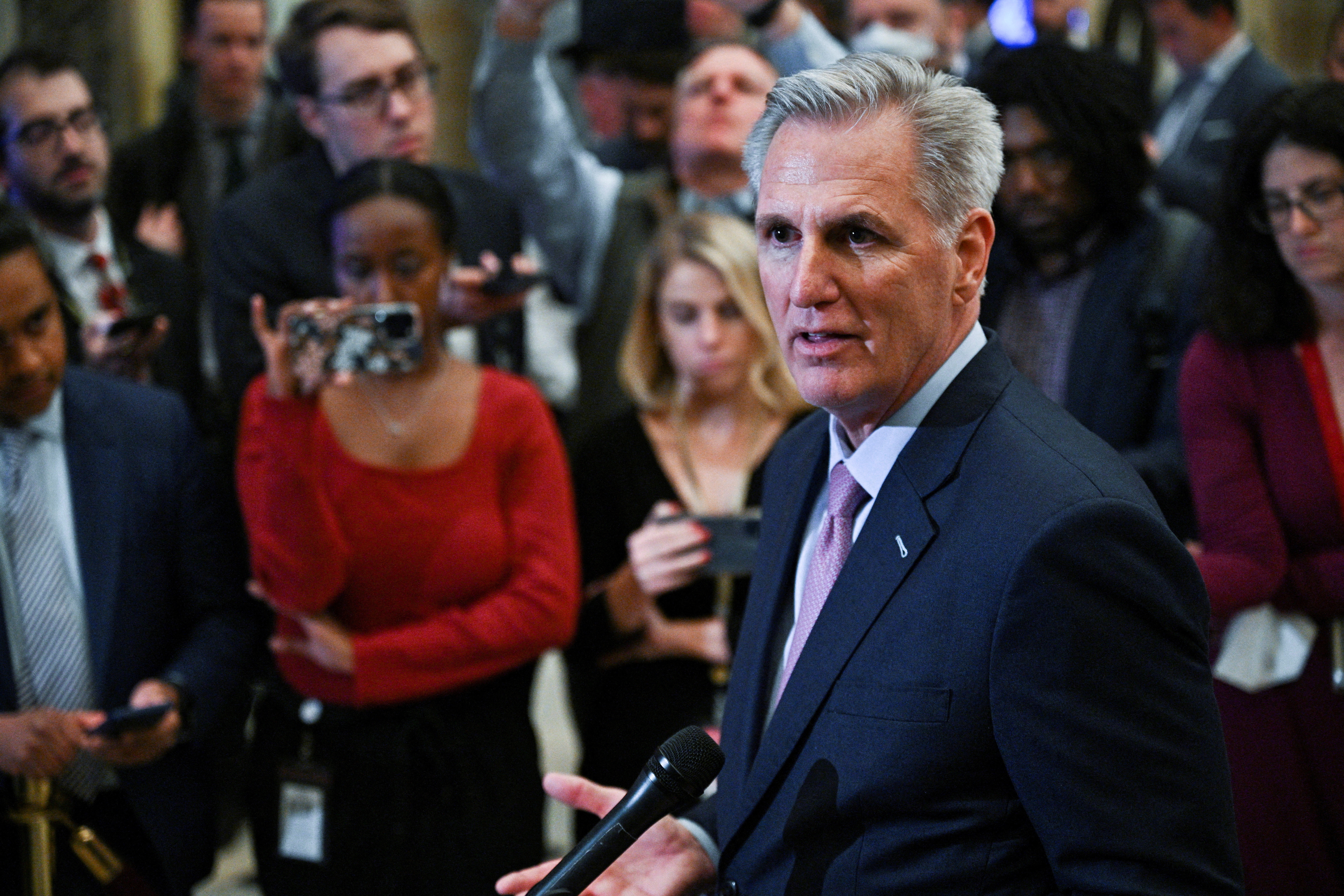
New U.S. Speaker of the House Kevin McCarthy (R-CA) speaks with reporters in Statuary Hall after being elected Speaker of the U.S. House of Representatives in a late night 15th round of voting in the fourth session of the 118th Congress at the U.S. Capitol in Washington, U.S., January 7, 2023. REUTERS/Jon Cherry


WP Radio
WP Radio
OFFLINE LIVE