Categories
Audio Sources - Full Text Articles

Scale of alleged torture, detentions by Russian forces in Kherson emerges

2023-01-12T11:19:29Z

Oksana Minenko, a 44-year-old accountant who lives in the Ukrainian city of Kherson, said she was repeatedly detained and tortured by occupying Russian forces.

Her husband, a Ukrainian soldier, died defending Kherson’s Antonivskyi bridge on the first day of full-scale war, she said. During several interrogations in the spring, Russian forces submerged her hands in boiling water, pulled out her fingernails and beat her in the face with rifle butts so badly she needed plastic surgery, according to Minenko.

“One pain grew into another,” said Minenko, speaking while at an improvised humanitarian aid centre in early December with scarring visible around her eyes from what she said was an operation to repair the damage. “I was a living corpse.”

The methods of the alleged physical torture administered by occupying Russian forces have included electric shocks to genitals and other parts of the body, beatings and various forms of suffocation, according to interviews with more than a dozen alleged victims, members of Ukrainian law enforcement and international prosecutors assisting Ukraine.

Prisoners were also held in overcrowded cells without sanitation or sufficient food or water for periods of up to two months, some of the people said.

Reuters wasn’t able to independently corroborate individual accounts shared by Minenko and other Kherson residents but they fit with what Ukrainian authorities and international human rights specialists have said about conditions and treatment during detention, including detainees being blindfolded and bound, subject to beatings and electric shocks and injuries, including severe bruising and broken bones, forced nudity and other forms of sexual violence.

“This was done systematically, exhaustingly” to obtain information about the Ukrainian military and suspected collaborators or to punish those critical of the Russian occupation, according to Andriy Kovalenko, the Kherson region’s chief war crimes prosecutor.

The Kremlin and Russia’s defence ministry didn’t respond to Reuters’ questions, including about alleged torture and unlawful detentions. Moscow, which has said it is conducting a “special military operation” in Ukraine, has denied committing war crimes or targeting civilians.

According to the most comprehensive figures to date on the scale of alleged torture and detentions, shared exclusively with Reuters by Ukraine’s top war crimes prosecutor, the country’s authorities have opened pre-trial investigations involving more than a thousand people in the Kherson region who were allegedly abducted and illegally detained by Russian forces during their months-long occupation.

The scale of alleged crimes in the Kherson region now emerging appears to be much greater than around the capital of Kyiv, say members of Ukrainian law enforcement, which they attribute to the fact that it was occupied for so much longer.

Ukraine’s top war crimes prosecutor, Yuriy Belousov, said authorities have identified ten sites in the Kherson region used by Russian forces for unlawful detentions. Around 200 people who were allegedly tortured or physically assaulted while held at those sites and about another 400 people were illegally held there, he said. Ukrainian authorities say they expect the figures to grow as the investigation continues following Russia’s mid-November withdrawal from Kherson city, the only regional Ukrainian capital it captured during its nearly year-long war against its Western neighbour.

Nationwide, authorities have opened pre-trial investigations into alleged unlawful detentions of more than 13,200 people, Belousov said. They have launched 1,900 probes into allegations of ill-treatment and illegal detention, he said.

Russia has accused Ukraine of carrying out war crimes and the West of ignoring them, including alleging that Ukrainian soldiers had executed Russian prisoners of war. The United Nations in November said it had found evidence that both sides had tortured prisoners of war, with a U.N. official saying Russian abuse was “fairly systematic.” Kyiv has previously said it would investigate any alleged abuses by its armed forces.

Minenko believes her alleged tormentors targeted her because her husband had been a soldier. During his burial a week after his death, Russian forces turned up at the cemetery and made Minenko kneel next to his grave, firing their automatic weapons in mock execution, she said.

According to Minenko, on three occasions in March and April men in Russian military uniforms with their faces covered by balaclavas came to her home at night, interrogated her and took her into detention. On one occasion, the men forced her to undress and then beat her while her hands were tied to the chair and her head was covered.

“When you have a bag on your head and you’re being beaten, there is such a vacuum, you cannot breathe, you cannot do anything, you cannot defend yourself,” Minenko said.

Moscow’s February invasion of Ukraine plunged Europe into its biggest land war since World War Two. Having begun its occupation of Kherson city in March, Russia withdrew its forces in November saying it was futile to waste more Russian blood there.

Of more than 50,000 reports of war crimes that have been registered with Ukrainian authorities, Belousov said more than 7,700 have come from the Kherson region. More than 540 civilians remain missing from the region, he added. Some people have been taken to Russian-held territory in apparent forced deportations, including children, according to Kovalenko, the regional prosecutor.

Belousov said authorities have found more than 80 bodies, the majority of whom were civilians, with more than 50 of those people having died as a result of gunshot wounds or artillery shelling. Belousov added that hundreds of bodies of civilians had been found in other areas that Russian forces had withdrawn from. That includes more than 800 civilians in the Kharkiv region, where investigators have had longer to probe after Ukraine retook a vast tract of territory in September.

Ukrainian authorities have also identified 25 locations in the Kharkiv region they described as “torture camps,” according to a Jan. 2 Facebook post by Kharkiv’s regional police chief, Volodymyr Tymoshko.

Some of the thousands of alleged war crimes committed by Russian forces could be escalated to overseas tribunals if they are deemed sufficiently serious. The Hague-based International Criminal Court (ICC) has opened an investigation into alleged war crimes in Ukraine.

The numbers that are emerging on the scale of alleged detentions and torture, “point to widespread and grave criminality in Russian-occupied territory,” said British lawyer Nigel Povoas, lead prosecutor with a Western-backed team of legal specialists assisting Kyiv’s efforts to prosecute war crimes.

Povoas said there appears to have been a pattern to inflict terror and suffering across Ukraine, which reinforces “the impression of a wider, criminal policy, emanating from the leadership” to target the country’s civilian population.

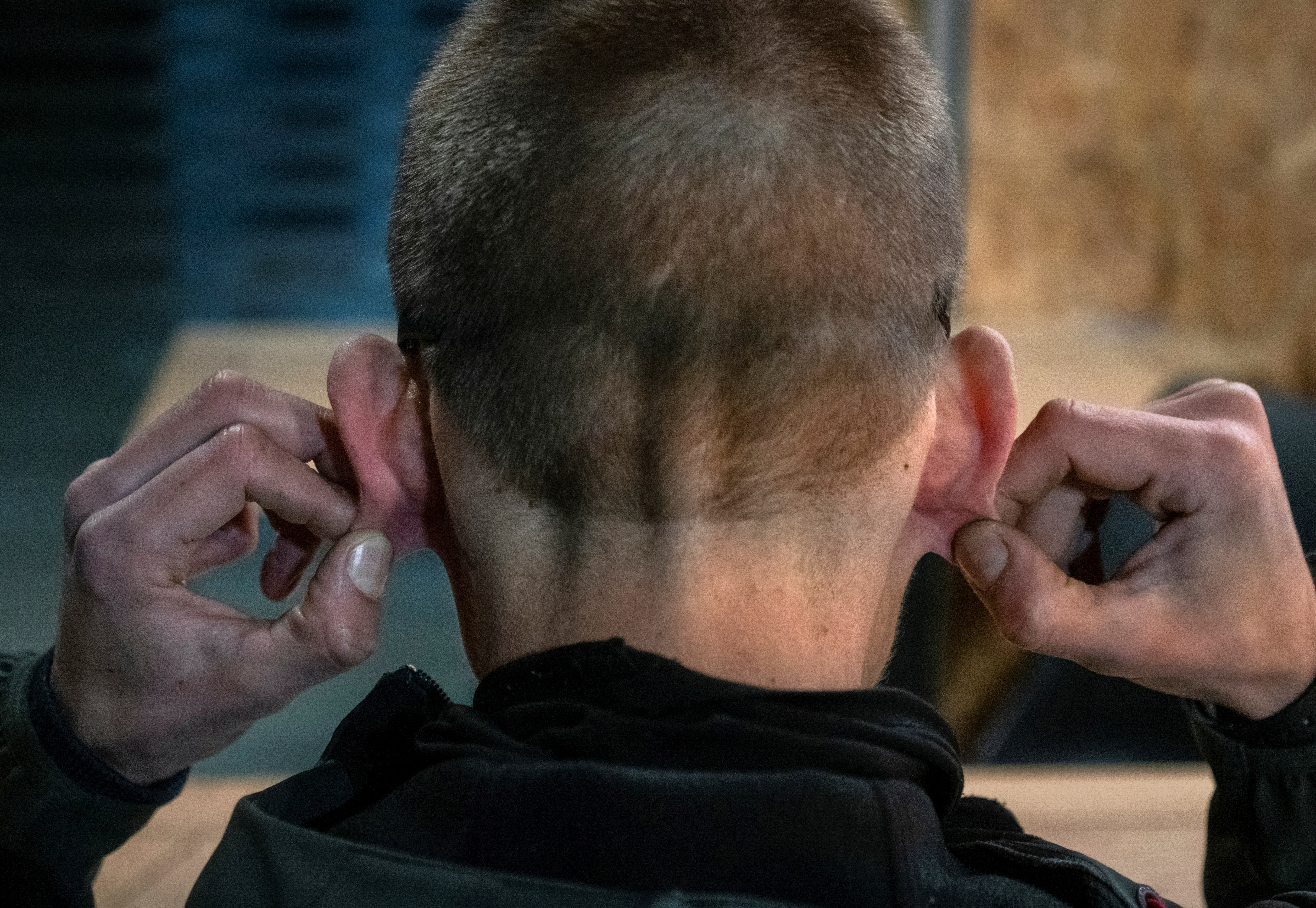
One 35-year-old man from Kherson city said that during a five-day detention in August, Russian forces beat him, made him undress and administered electric shocks to his genitals and ears. When the current hits “it’s like a ball flying into your head and you pass out,” said the man, who asked to be identified only by his first name Andriy due to fear of reprisals.

He said his captors interrogated him about Ukraine’s military efforts, including the storage of weapons and explosives, because they suspected him of having links to the resistance movement. Andriy told Reuters he knew people who served in the Ukrainian military and territorial defence forces but wasn’t a member himself.

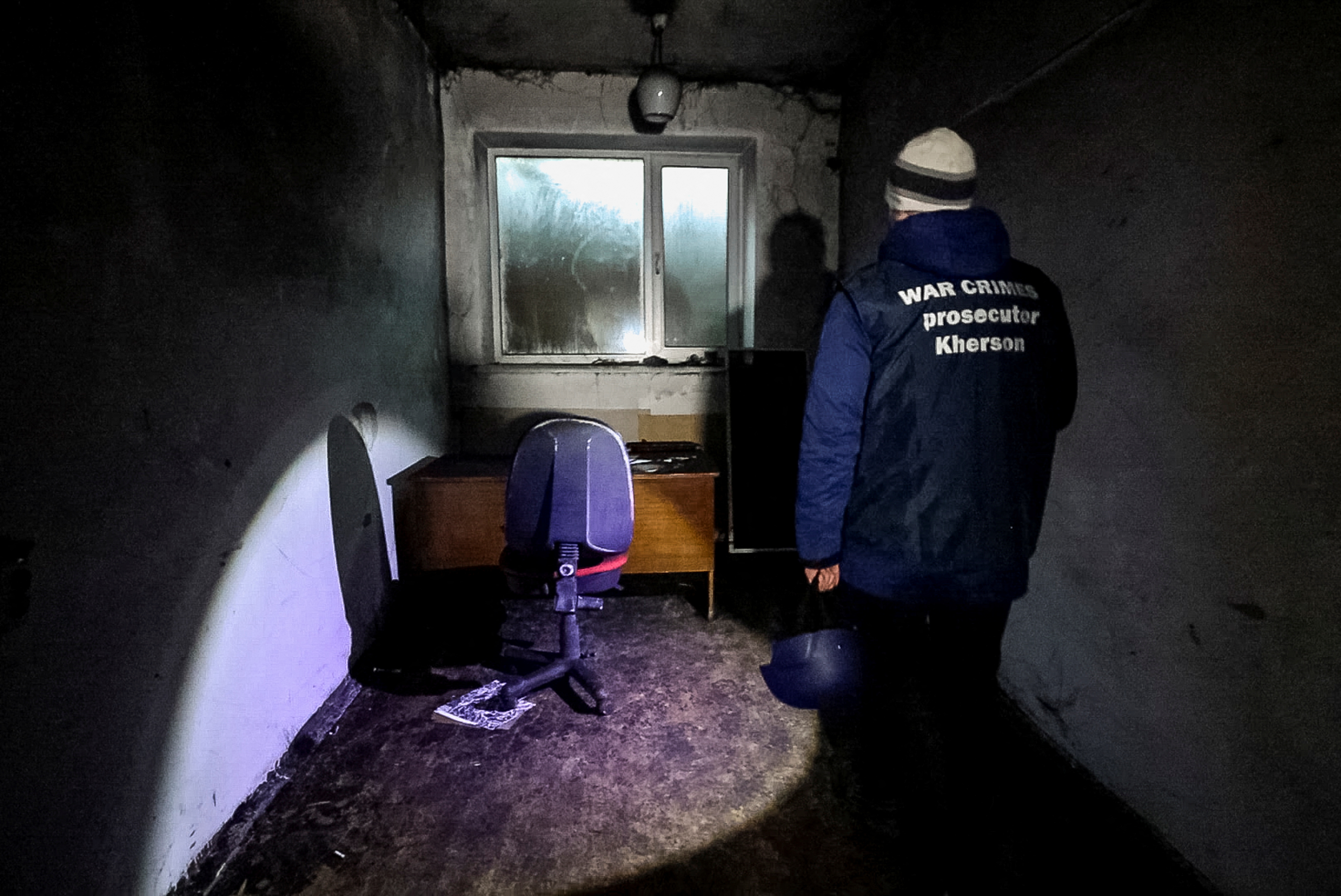
One of the largest detention facilities in the region was an office building in Kherson city, according to Ukrainian authorities. They say more than 30 people are known to have been held in just one of the rooms in the warren-like basement that was used for detention and torture during the Russian occupation. An investigation to establish the total number of people held is ongoing, authorities said.

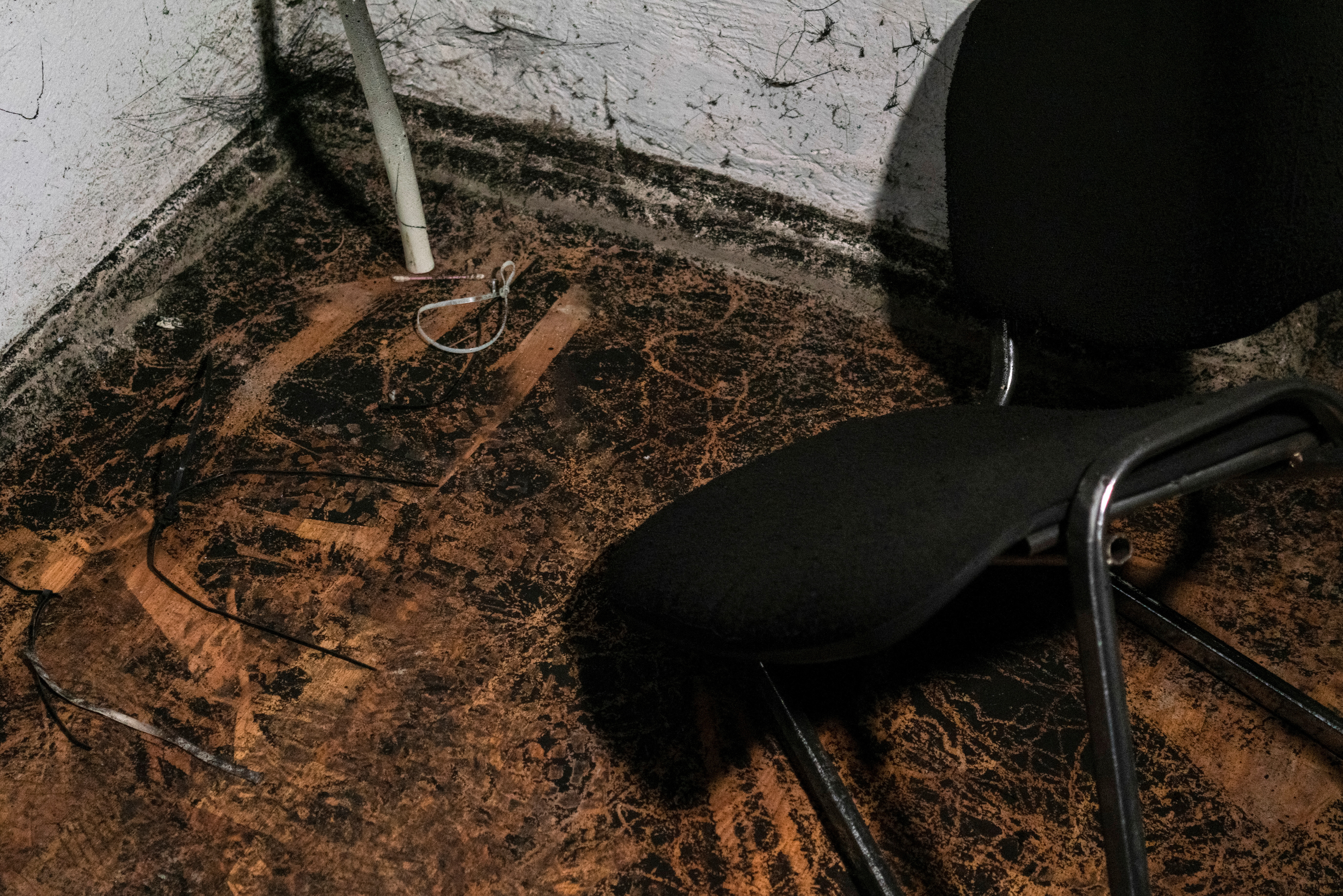
During a December visit to the building’s basement, the smell of human excrement filled the air, bricked-up windows blocked the light and lying visible were signs of what Ukrainian authorities say were tools of torture by Russian forces such as metal pipes, plastic ties for ligatures and a wire hanging from the ceiling allegedly used to administer electric shocks. Scratched on the wall were notches, which authorities said were made by detainees possibly to count the number of days held, as well as messages. One read: “For Her I Live.”

Another location in the city where people were allegedly interrogated and tortured was a police building that locals have referred to as “the hole,” according to Ukrainian authorities and more than half a dozen Kherson residents Reuters spoke to.

Liudmyla Shumkova, 47, said she and her 53-year old sister were held captive at the site, on No. 3 Energy Workers’ Street, for most of the more than fifty days they spent in detention this summer. She said the Russians asked them about her sister’s son because they believed he was involved in the resistance movement.

Shumkova, who works as a lawyer in the health sector, said about half a dozen people packed into a cell with just a small window for light and as little food as one meal a day. She said she wasn’t physically tortured but fellow detainees were, including a female police officer she shared a cell with. Men received particularly harsh torture, she said. “They screamed, it was constant, every day. It could last for 2 or 3 hours.”

INVESTIGATION CONTINUES

Investigators continue to try to identify those responsible for the alleged war crimes, including the possible role of senior military leadership. When asked whether authorities had initiated criminal proceedings against alleged perpetrators of torture, Belousov, the war crimes chief, said more than 70 people had been identified as suspects and 30 people had been indicted.

Belousov, who didn’t name the individuals, said most of the suspects are lower-ranking military officials but some are “senior officers, in particular colonels and lieutenant colonels” as well as senior figures in pro-Russian Luhansk and Donetsk military-civilian administrations. Representatives of the pro-Russian Luhansk People’s Republic and Donetsk People’s Republic didn’t respond to questions about whether their forces were involved in unlawful detentions or torture.

The Kremlin and Russian defence ministry didn’t respond to questions about alleged perpetrators.

On a cold December day in the village of Bilozerka in the Kherson region, war crimes investigators pored over a courthouse Ukrainian authorities say was used by Russian forces to detain and torture individuals as well as a nearby school that was turned into a barracks for around 300 Russian soldiers. The now deserted school building, where walls were painted with the “Z” symbol that has become an emblem of support for Russia in the war, was littered with debris including gas masks and medical kits, Russian literature and bullets fired into a brick wall.

At the courthouse, a small team of investigators dusted for fingerprints and collected DNA samples. In an adjacent garage, they had placed numbered yellow markers to identify evidence. A desk chair lay upturned and nearby lay plastic ties littered as well as a gas mask attached to a tube and pouch for liquid, which two prosecutors said resembles improvised torture devices allegedly used by occupying Russians to create a sensation of drowning.

The Kremlin and Russian defence ministry didn’t respond to questions about methods of alleged torture.

Related Galleries:
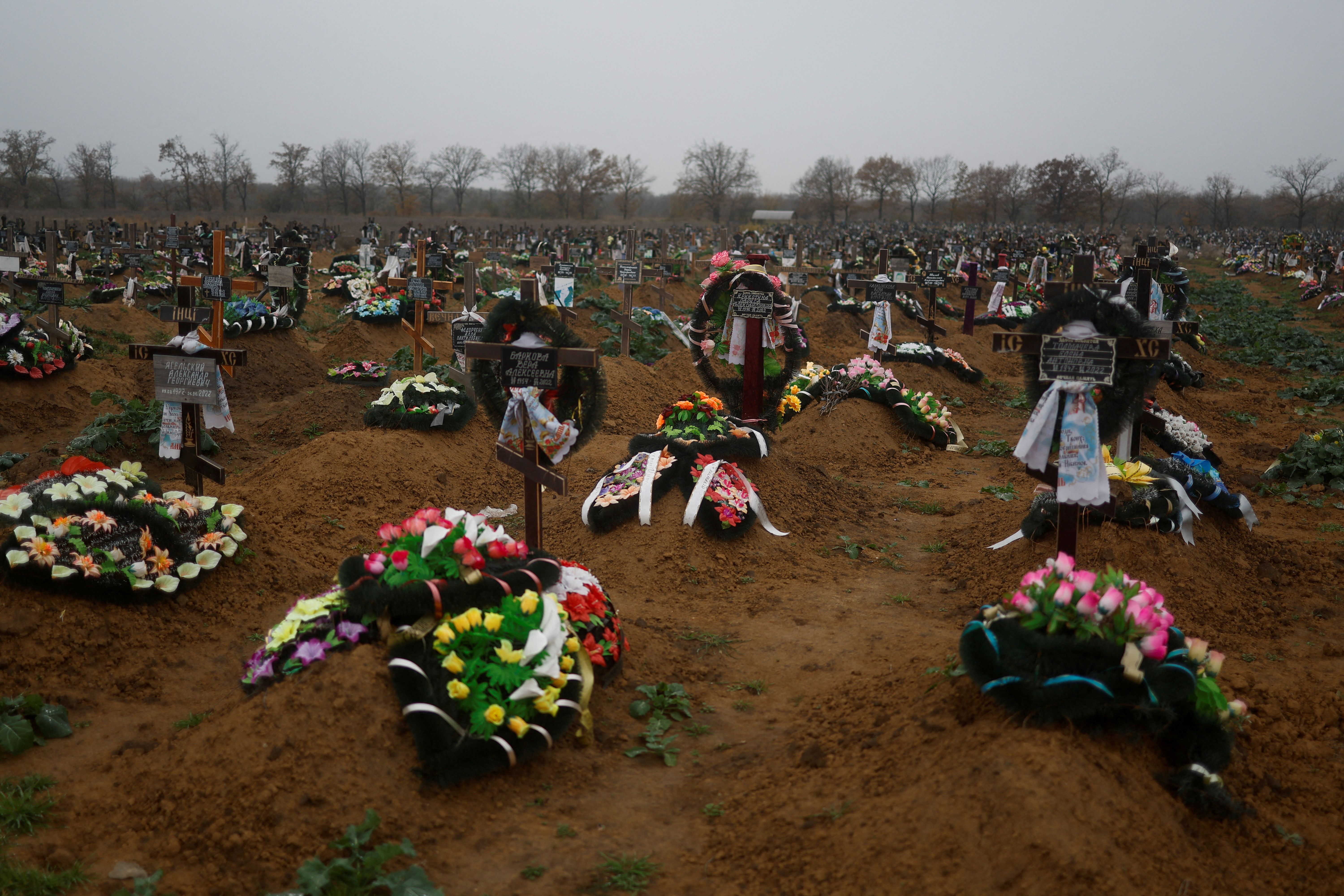
Graves of people who died during a Russian occupation are seen at the city’s cemetery after Russia’s retreat Kherson, Ukraine November 17, 2022. REUTERS/Valentyn Ogirenko

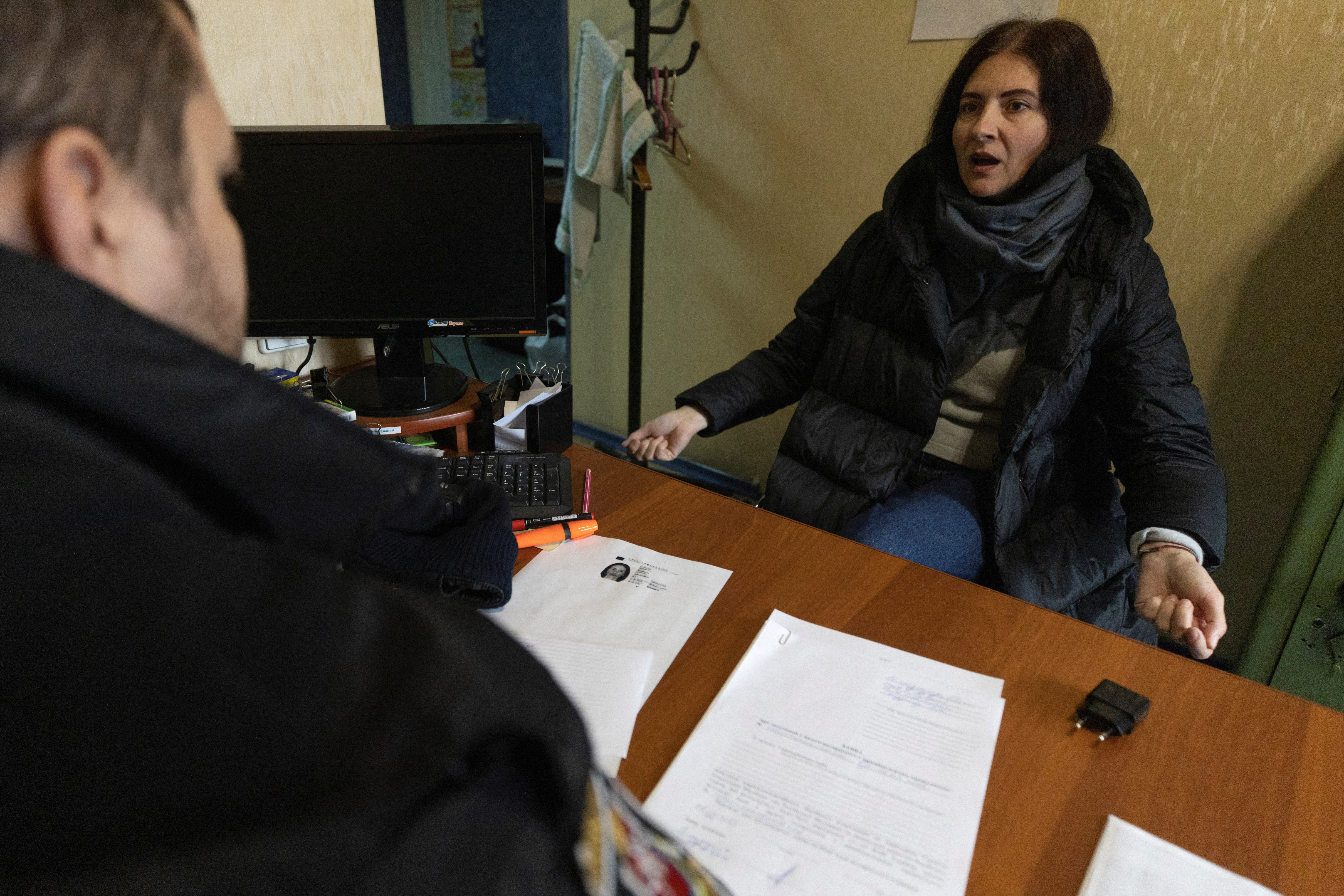
Liudmyla Shumkova, who says she spent 54 days in a Russian captivity, speaks to a warcrime investigator, amid Russia’s attack on Ukraine continues, in Kherson, Ukraine December 8, 2022. REUTERS/Anna Voitenko/File Photo

Plastic ties for tortures and a broken chair are seen inside a basement of an office building, where prosecutors say 30 people were held two months during a Russian occupation, amid Russia’s attack on Ukraine, in Kherson, Ukraine, December 10, 2022. REUTERS/Anna Voitenko

Andrii, 35-year-old, shows how he was subjected to electric shocks to his genitals and ears by occupying Russian forces, as he speaks with Reuters, as Russia’s attack on Ukraine continues, in Kherson, Ukraine, December 9, 2022. REUTERS/Anna Voitenko

Oksana Minenko, 44-year-old, who says she was repeatedly detained and tortured by occupying Russian forces, speaks during an interview with Reuters, as Russia’s attack on Ukraine continues, in Kherson, Ukraine, December 11, 2022. REUTERS/Anna Voitenko

Oksana Minenko, 44-year-old, shows how she was tortured by occupying Russian forces as he speaks with Reuters, as Russia’s attack on Ukraine continues, in Kherson, Ukraine, December 11, 2022. REUTERS/Anna Voitenko

A war crime prosecutor inspects a basement of an office building, where prosecutor’s office says 30 people were held for two months during the Russian occupation, amid Russia’s attack on Ukraine, in Kherson, Ukraine December 20, 2022. REUTERS/Anna Voitenko
Categories
Audio Sources - Full Text Articles

New economic “regime“ challenges central bankers to keep pace

2023-01-12T11:11:52Z

For roughly 30 years Federal Reserve policymakers and other central bankers enjoyed a world where market interest rates were falling, inflation was low, globalization effectively expanded the supply of labor, and, at the margin, markets for goods and services were becoming more open and stable.

Those trends have now been challenged if not upended altogether by the COVID-19 pandemic in a disruption that risks leaving policymakers adrift about what to expect.

The U.S. central bank is already adjusting to one unanticipated set of changes – an outbreak of inflation coupled with stalled growth in the U.S. labor force. But it may be just the beginning of a lengthy reckoning about how economic dynamics have shifted, challenging central bankers to keep pace and delve deeper into areas that have not typically been their province, such as the economics of industrial organization and the supply side.

Economists sometimes describe the sorts of changes that may be underway in terms of a new economic “regime,” but “identification becomes something of an art form,” Atlanta Fed President Raphael Bostic said last Friday on a panel at the annual meeting of the American Economic Association (AEA) in New Orleans.

“You have to identify the regime change … Then you have to understand the transition dynamics … and have a clear vision and insight into all of those … Trying to develop a single or unitary view that represents a consensus becomes a very, very difficult challenge.”

Bostic said he already regards the U.S. labor market as likely having changed for good, leaving the economy with a seemingly embedded shortage of workers and a population making different choices about labor, leisure and retirement than it did before.

But the structural rift may be far deeper.

The AEA’s agenda in New Orleans included what may prove tip-of-the-iceberg debates about a global economy not only adjusting to the pandemic, but to new geopolitical risks stemming from Russia’s invasion of Ukraine and China’s uncertain position in the post-pandemic world.

Supply chains built around relatively frictionless global trade may be recast along more expensive lines by manufacturers reluctant to count as heavily on China or desiring more resilience overall; financial markets built around anchored low interest rates and a global glut of savings may have to accommodate higher debt levels and interest rates; adaptation to climate change, whether to mitigate damage or move to lower-carbon alternative power sources, may be another force fueling higher prices.

“We may well be at a turning point in the global economy,” Kenneth Rogoff, a former chief economist at the International Monetary Fund who teaches at Harvard University, said in a panel session at the AEA meeting on Saturday. “Markets calibrated to … Chinese growth and low interest rates may prove fragile.”

Even just the past year saw unprecedented joint losses in major stock and bond indexes, a correlated downturn that challenged the basics of portfolio management and ought to trigger deep rounds of new research about how to prepare for future crises, Kristin Forbes, a Massachusetts Institute of Technology professor and former member of the Bank of England’s Monetary Policy Committee, said on the same panel with Rogoff.

Like recessions, which are typically identified only well after they have started, other economic turning points aren’t always apparent in the moment.

A shift to higher productivity in the 1990s wasn’t broadly captured in data at the time, though then-Fed chief Alan Greenspan insisted it was underway and argued, correctly, that inflation would stay lower than expected and require lower interest rates as a result.

By contrast, former Fed Governor Randall Kroszner said the profession missed how changes in U.S. mortgage markets had allowed broader risks to the financial system to accumulate and eventually break it.

“Policy has to be made in real time,” Kroszner, a professor of economics at the University of Chicago Booth School of Business, told Reuters in an interview. “It is extremely important to have a sense of humility and realize the models you may be using, the data you are relying on, may not be appropriate going forward.”

Even when it becomes clear changes are underway, it can take time for institutions like the Fed to adapt.

It was long suspected, for example, that the so-called neutral rate of interest – the point at which economic activity is neither constrained nor stimulated – was falling, theoretically allowing the Fed’s policy interest rate to be kept lower as well.

But as evidence of that accumulated following the 2007-2009 recession, it was only embodied into Fed policy in 2020 under a new approach that leaned against premature interest rate increases.

That happened just in time for what may prove another shift in another direction as the Fed now confronts a world that, instead of a chronic shortage of demand and weak inflation, may be characterized by constrained supply and prices too hot for comfort.

Fed officials have begun tossing out new research lines and theoretical frames to put around inflation, for example.

In an essay last week, Minneapolis Fed President Neel Kashkari compared recent inflation to the “surge pricing” models used by tech firms like Uber Technologies (UBER.N). Fed Governor Lisa Cook, speaking on a panel at the AEA meeting last week, laid out the preliminary makings of an agenda to overhaul how the Fed understands pricing dynamics and the implications for monetary policy.

That would include the use of “real-time and other novel indicators” to improve inflation forecasting, she suggested. “When the economy is disrupted by a once-in-a-century event, there is no such thing as too much data and too much analysis.”

Behind it all: An emerging focus on the supply side of the economy, something monetary policymakers usually consider a “given” since their main tool, interest rates, operate to encourage or discourage aggregate demand, or spending.

The economy’s ability to supply goods and services may be beyond policymakers’ immediate influence, dependent more on things like regulatory policy, immigration or, more fundamentally, the quality of the country’s education system and the skills of the people who emerge from it.

But the pandemic has shown, Bostic said, that policymakers can’t ignore it.

“We learned that supply shocks can endure for quite some time in a way that I don’t think our conceptual frameworks really embraced,” Bostic told reporters in Atlanta on Monday. At the top of the list to deal with the emerging economy, “I think we do need to understand how goods get made and how our systems make it easier or harder.”

Related Galleries:

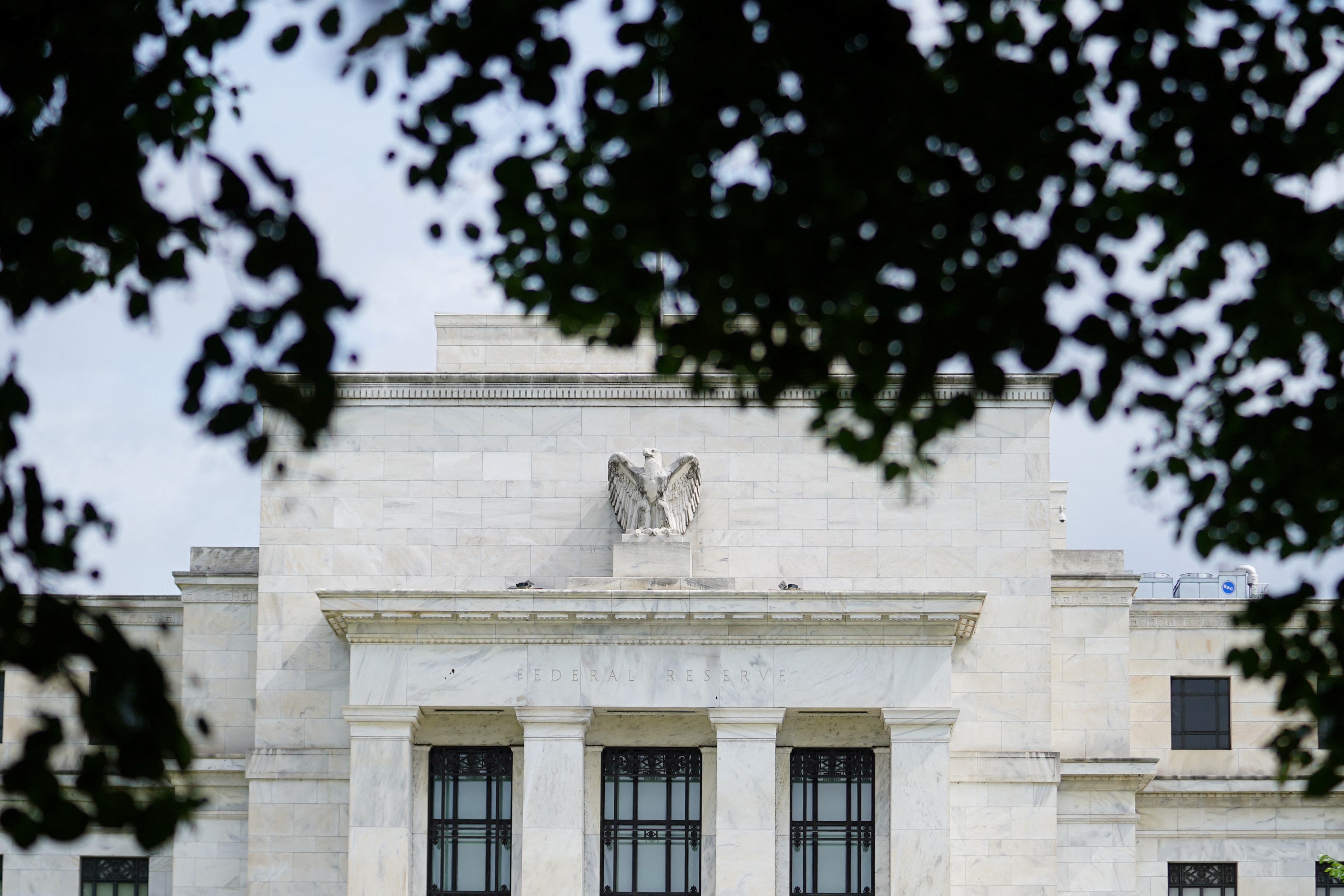
The U.S. Federal Reserve building is pictured in Washington, March 18, 2008. REUTERS/Jason Reed/File Photo

Former Federal Reserve Chair Alan Greenspan speaks at a Brookings Institution forum in Washington on April 8, 2015. REUTERS/Yuri Gripas/File Photo

The exterior of the Marriner S. Eccles Federal Reserve Board Building is seen in Washington, D.C., U.S., June 14, 2022. REUTERS/Sarah Silbiger
Categories
Audio Sources - Full Text Articles

Explainer: Why weeks of rain in California will not end historic drought

2023-01-12T11:07:06Z

California has been deluged since Dec. 26 by seven atmospheric rivers that have dumped up to 30 inches (76 cm) of rain over some areas, but the drought that has gripped the western United States remains far from over.

Virtually none of the storms has reached the Colorado River basin, which means the river that provides drinking water to 40 million people in seven states will continue to be endangered.

Even with more atmospheric rivers in the immediate forecast, and larger and more frequent ones predicted in the future, California cannot solve its long-term water crisis without major infrastructure investments to capture more storm water, restore flood plains and recycle wastewater.

Meanwhile, California’s $50 billion agricultural industry continues to consume 80% of the state’s supply.

Climate change means climate extremes. As California experiences more severe droughts and heat waves, its occasional wet years are expected to be excessively rainy. But the state’s water infrastructure, mostly built in the 20th Century when the population was barely half of today’s 40 million, is ill-equipped for the new situation.

On Dec. 14, the Metropolitan Water District of Southern California declared a drought emergency for all 19 million people in the region. A few weeks later, the state was underwater with major flooding.

Despite a deluge that by one estimate has been expected to dump more than 20 trillion gallons (80 trillion liters), the state’s major reservoirs remain well below their historic average. The largest reservoirs, at Shasta and Oroville, are still at 42% and 47% of capacity, according to state data.

The shortfall underscores the severity of the drought. A report published in the journal Nature last year found 2000 to 2021 to be the driest 22-year period for southwestern North America in at least 1,200 years.

The state’s infrastructure, largely a network of cement canals, lacks the capacity to capture excess stormwater.

Irrigation and flood control projects were largely designed to convey water as quickly as possible in straight lines. That deprives flood plains of water taking a natural meandering path that would better protect adjacent cities from floods while also helping recharge the aquifer below.

With temperatures rising, snowpack in the mountains is melting more rapidly each spring, and the state lacks enough storage capacity to conserve the runoff.

California Governor Gavin Newsom plans to ramp up infrastructure spending, including $8.6 billion budgeted for drought and flood management next year. Billions more are available under a major U.S. infrastructure law signed by President Joe Biden in 2021.

But until that money is converted to projects, excess stormwater will continue to drain into the Pacific Ocean.

Arid Southern California relies on two external sources to slake its thirst: aqueous Northern California, through massive state and federal conveyance systems; and the Colorado River, under a century-old compact that assigns its water to seven states, with California receiving the largest allotment.

But the compact was written after an unusually wet period, assigning the states more water than the river can now provide. Even as the Colorado River basin faces its own drought, and the atmospheric rivers provide no relief, the Colorado River suffers more from overuse than from a lack of precipitation.

The U.S. Bureau of Reclamation has warned the seven states in the compact – Arizona, California, Colorado, Nevada, New Mexico, Utah and Wyoming – that they must negotiate a new agreement to reduce consumption 15% to 30% by Jan. 31 or else face mandatory cuts imposed by the federal government.

Related Galleries:

A resident walks along a flooded street, after “atmospheric river” rainstorms slammed northern California, in the coastal town of Aptos, U.S., January 5, 2023. REUTERS/Carlos Barria

A view of flooding from the rainstorm-swollen Sacramento and American Rivers, near downtown Sacramento, California, U.S. January 11, 2023. REUTERS/Fred Greaves

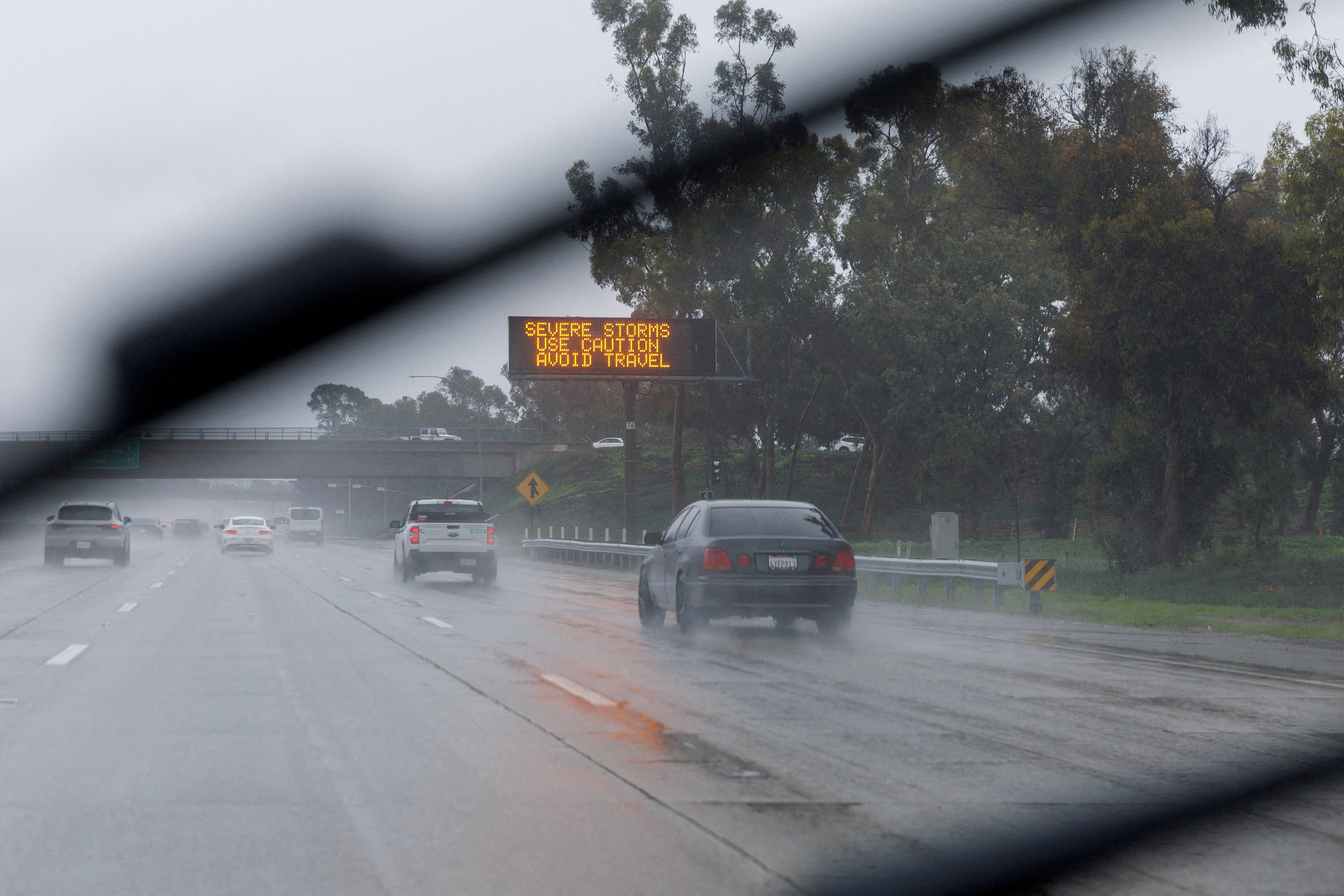
A freeway sign board informs drivers of severe weather as they travel along the interstate I5 highway near Irvine, California, U.S., January 10, 2023. REUTERS/Mike Blake

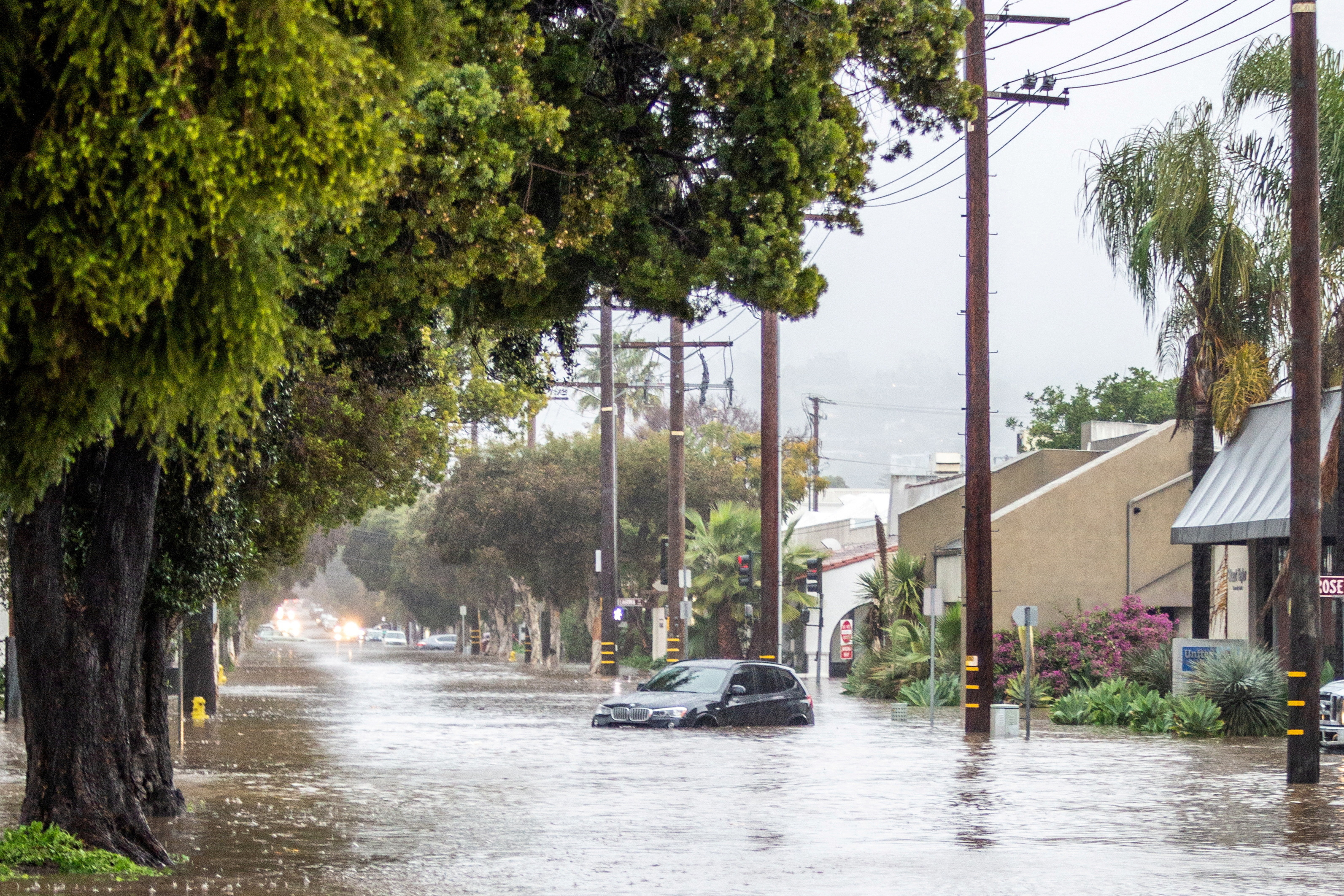
Abandoned cars are left in a flooded street in east Santa Barbara, California, U.S. January 9, 2023. REUTERS/Erica Urech

A view of a fallow field and a dry irrigation canal next to a cultivated field in Palo Verde, California, U.S., September 19, 2022. REUTERS/Aude Guerrucci
Categories
Audio Sources - Full Text Articles

Second Gentleman Emhoff to tour Auschwitz-Birkenau memorial on Holocaust Remembrance Day

GettyImages-1447441277.jpg

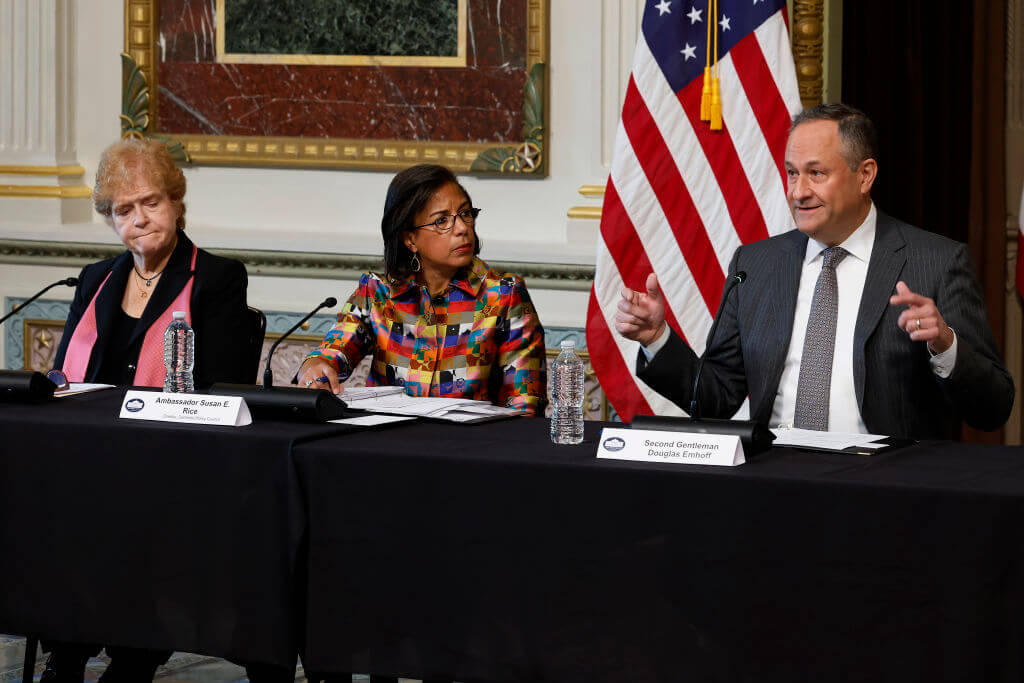
Second Gentleman Doug Emhoff will visit Auschwitz for International Holocaust Remembrance Day later the month, the White House announced Thursday morning.

Emhoff, the Jewish husband of Vice President Kamala Harris, will be joined by Ambassador Deborah E. Lipstadt, the State Department’s special envoy to monitor and combat antisemitism. They will participate in a wreath-laying ceremony at the Auschwitz-Birkenau memorial in Poland and tour the museum on site.

Liza Acevedo, Emhoff’s communications director, said the purpose of the trip is “to advance the Biden-Harris Administration’s efforts to combat antisemitism around the world and support Holocaust remembrance.”

Emhoff headlined last month a roundtable with Jewish leaders to discuss ways to tackle the rise of antisemitism. It was followed with the launch of a White House task force to draft such a strategy. In speeches to Jewish audiences, Emhoff has repeatedly said that representing the U.S. administration as a Jewish person has been extremely “meaningful” to him.

The Second Gentleman will also join Lipstadt on her visit to Germany to meet with a group of antisemitism envoys from other countries, the third such gathering since Lipstadt first hosted the group of envoys at the United Nations in New York last June.

The White House said that in both countries, Emhoff will visit historical and cultural sites and meet with local Jewish leaders and civil society representatives.

The post Second Gentleman Emhoff to tour Auschwitz-Birkenau memorial on Holocaust Remembrance Day appeared first on The Forward.

Categories
Audio Sources - Full Text Articles

US spies lag rivals in seizing on data hiding in plain sight

WASHINGTON (AP) — As alarms began to go off globally about a novel coronavirus spreading in China, officials in Washington turned to the intelligence agencies for insights about the threat the virus posed to America.

But the most useful early warnings came not from spies or intercepts, according to a recent congressional review of classified reports from December 2019 and January 2020. Officials were instead relying on public reporting, diplomatic cables and analysis from medical experts — some examples of so-called open source intelligence, or OSINT.

Predicting the next pandemic or the next government to fall will require better use of open source material, the review found.

“There is little indication that the Intelligence Community’s exquisite collection capabilities were generating information that was valuable to policymakers,” wrote the authors of the review, conducted by Democrats on the House Intelligence Committee.

That echoes what many current and former intelligence officials are increasingly warning: The $90 billion U.S. spy apparatus is falling behind because it has not embraced collecting open-source intelligence as adversaries including China ramp up their efforts.

This doesn’t diminish the importance of traditional intelligence. Spy agencies have unique powers to penetrate global communications and cultivate agents. They scored a high-profile success when the Biden administration publicized ultimately correct intelligence findings that Russian President Vladimir Putin intended to invade Ukraine.

But officials and experts worry that the U.S. hasn’t invested enough people or money in analyzing publicly available data or taking advantage of advanced technologies that can yield critical insights. Commercial satellite imagery, social media and other online data have given private companies and independent analysts new powers to reveal official secrets. And China is known to have stolen or acquired control over huge amounts of data on Americans, with growing concerns in Washington about Beijing’s influence over widely used apps like TikTok.

“Open source is really a bellwether for whether the intelligence community can protect the country,” said Kristin Wood, a former senior official at the CIA who is now chief executive at the Grist Mill Exchange, a commercial data platform. “We collectively as a nation aren’t preparing a defense for the ammunition that our adversaries are stockpiling.”

Intelligence agencies face several obstacles to using open source intelligence. Some are technological. Officers working on classified networks are often not able to easily access the unclassified internet or open data sources, for example. There are also concerns about civil liberties and protecting First Amendment rights.

But some experts also question whether agencies are held back by a reflexive belief that top-secret information is more valuable.

Rep. Jim Himes, a Connecticut Democrat and longtime Intelligence Committee member, said he believed there needed to be “some cultural change inside places like the CIA where people are doing what they’re doing for the excitement of stealing critical secrets as opposed to reviewing social media pages.”

In one 2017 test held by the National Geospatial-Intelligence Agency, a human team competed against a computer programmed with algorithms to identify Chinese surface-to-air missile sites using commercial imagery.

Both the humans and the computer identified 90% of the sites, Stanford University professor Amy Zegart wrote in the book “Spies, Lies, and Algorithms,” but the computer needed just 42 minutes — and it took the human team 80 times longer.

Reports created using commercial satellites, online posts and other open sources — like the daily analyses on Russian and Ukrainian military tactics published by the Institute for the Study of War — are widely read by lawmakers and intelligence officials.

“There is a lot of open-source capability that the U.S. intelligence community can pretty much rely on to be there,” said Frederick Kagan, a senior fellow at the American Enterprise Institute who oversees the creation of those reports. “What it needs to do is figure out how to leverage that ecosystem instead of trying to buy it.”

Most of the 18 U.S. spy agencies have open-source programs, from the CIA’s Open Source Enterprise to a 10-person program in the Department of Homeland Security’s intelligence arm. But top officials acknowledge there isn’t consistency across those programs in how they analyze open-source information or how they use and share it.

“We’re not paying enough attention to each other and so we’re not learning the lessons that different parts of the (intelligence community) are learning, and we’re not scaling solutions,” said Avril Haines, the U.S. director of national intelligence, at an industry event last year sponsored by the Potomac Officers Club. “And we’re not taking advantage of some of the outside expertise and information and work that could be taken advantage of.”

The Open Source Enterprise headquartered at the CIA is the successor to the Foreign Broadcast Information Service, where for generations employees monitored broadcasts to translate them for analysts.

Much of that work was transformed in the last decade. Where people once had to travel long distances to pick up tapes of radio broadcasts in remote places or areas where Americans weren’t welcome, sensors now transmit more signals automatically. And machine translation has largely taken the place of people who had to listen to the tapes and transcribe them.

But officials acknowledge they have to do more.

Haines has begun multiple open-source reviews since becoming director of national intelligence and is expected to finalize recommendations this year. Some people involved in those reviews have suggested that the Open Source Enterprise no longer be designated as leading OSINT efforts across the spy agencies, said people familiar with the reviews who spoke on condition of anonymity to discuss internal government deliberations.

Three people familiar with Open Source Enterprise say the center had cut its budget for multiple years running prior to last year. They argue that’s a sign that open-source work has not always been prioritized at a consistent level.

The CIA recently appointed new leadership for the Open Source Enterprise and in 2021 created a “mission center” dedicated to technology.

“We recognize the importance of open source is only growing as the sheer volume of data openly available increases,” the agency said in a statement. “CIA is working not just to keep pace with this trend, but to get ahead of it — and ahead of our adversaries who also utilize open-source information.”

There’s no consensus on whether the U.S. should create a new open-source agency or center. Supporters say a new organization could focus on adopting advanced technologies and creating more useful products, while opponents question whether it would be unnecessary bloat and take away resources from other agencies.

Carmen Medina, a retired CIA deputy director of intelligence, now studies how spy agencies can incorporate outside ideas and encourage employees to be more creative and intuitive.

She suggests a pilot program in which a cell of open-source analysts would compete for a number of years against the regular output of people with top-secret clearances.

Medina and others who have worked in top positions and briefed White House officials think that on most days, an open-source group would be competitive and might even produce better analysis using information that’s broadly available.

“You can’t make sense of the world today by just packaging tidbits,” she said. “I’ve come to believe that almost all of the time, the open source way of thinking about it is correct.”

Categories
Selected Articles

XBB.1.5 likely to be the next major COVID subvariant – DW – 01/05/2023

64294606_6.jpg

Yet another new coronavirus subvariant is here: XBB.1.5. The subvariant is spreading rapidly in the United States, responsible for 41% of positive COVID-19 cases at the end of December.

“At the start of December, about 2% of cases in the US were caused by XBB.1.5. Now in early January it’s probably over 50%. That is an astonishing rate of growth,” Paul Hunter, an epidemiologist at the University of East Anglia, UK, told DW.

XBB.1.5 has already spread from the United States. Cases have been detected in several European countries, including the UK, Germany and France. India and Singapore have also reported cases.

“It is likely XBB.1.5 will become the dominant variant in Europe, perhaps even by the end of January. But we’ll be able to manage it; there’s no doubt about that,” said Hunter.

XBB.1.5 transmits more easily

XBB.1.5 is a subvariant of omicron, which is currently the dominant coronavirus variant globally. XBB.1.5 is a “recombinant” subvariant of omicron, meaning it contains genetic material from different coronavirus subvariants.

“Since we first discovered XBB some months back, it’s been evolving. XBB.1.5 has evolved escape mutations, meaning the virus is better at evading immunity,” Hunter said.

XBB.1.5 is still neutralized by immune cells, Hunter said, but the immune system doesn’t recognize it as well.

“It takes longer for the immune system to decide which antibodies to produce to stop XBB.1.5 virus particles’ reproducing. That’s important because how sick you get depends on how much virus is circulating in your body,” said Hunter.

With a slower immune response, XBB.1.5 has more time to reproduce, increasing the likelihood of developing COVID-19 symptoms.

Two women wear masks in Athens, GreeceMasks help to reduce the spread of the XBB.1.5 COVID-19 subvariantImage: Angelos Tzortzins/AFP

Is XBB.1.5 more dangerous?

Early indications in the United States suggest that XBB.1.5 is not more deadly than other omicron subvariants.

“Credible sources in the US tell us people with XBB.1.5 variant do not have more severe COVID symptoms,” Hunter said.

Experts are concerned that, if XBB.1.5 spreads rapidly, the number of people with severe symptoms similar to those from other omicron subvariants will rise from sheer weight of infections.

According to Michael Head, an epidemiologist at the University of Southampton in the United Kingdom, the spread of the new subvariant comes at a bad time for health services.

“There are already high circulating levels of most respiratory viruses, including COVID-19 and influenza, this winter. There will be consequences on other areas of health [from XBB.1.5], for example routine surgery where operations will be postponed to address current health care demands,” Head said.

The World Health Organization and other health institutions are keeping a close eye on infection and hospital data to track the subvariant’s impact on patients.

School children in Nepal queue for a dose of COVID-19 vaccineVaccines help protect against severe COVID-19 symptoms from XBB.1.5Image: Navesh Chitrakar/REUTERS

Vaccines effective against XBB.1.5

Because XBB.1.5 is a subvariant of omicron, vaccination and/or prior COVID-19 infection will still provide systemic immunity to XBB.1.5.

“Vaccines still give us the same protection from severe COVID disease if you get XBB.1.5. However, it might be that we are slightly less protected from XBB.1.5 being transmitted,” Hunter said.

According to experts, COVID-19 is here to stay, meaning that subvariants such as XBB.1.5 are likely to keep emerging.

“A high vaccination uptake is crucial to minimizing the impact of COVID-19 as a public health problem. But, in the longer term, we really do need a ‘second generation’ vaccine that protects against infection and illness from all coronavirus variants,” Head said.

Edited by: Carla Bleiker

Categories
Audio Sources - Full Text Articles

Michael Novakhov retweeted: ACLU calls for crackdown on FBI use of intel community to spy on Americans trib.al/XnHSLdX

Michael Novakhov retweeted:

ACLU calls for crackdown on FBI use of intel community to spy on Americans

trib.al/XnHSLdX

FmQunfvWAAAwNGS.jpg:large

Categories
Audio Sources - Full Text Articles

Michael Novakhov retweeted: Путин проиграл газовую войну против Германии. Запасы газа в немецких подземных хранилищах настолько велики, что угрозы дефицита уже не будет ни этой зимой, ни следующей, уверен экономический обозреватель DW Андрей Гурков p.dw.com/p/4M1Yv?maca=r…

Michael Novakhov retweeted:

Путин проиграл газовую войну против Германии. Запасы газа в немецких подземных хранилищах настолько велики, что угрозы дефицита уже не будет ни этой зимой, ни следующей, уверен экономический обозреватель DW Андрей Гурков p.dw.com/p/4M1Yv?maca=r…

Categories
Audio Sources - Full Text Articles

Michael Novakhov retweeted: Newly empowered House Republicans are preparing to carry out investigations into the Biden administration and its policies. Right-wing lawmakers have said the ultimate goal is to impeach the president. Here’s what to know. nyti.ms/3GXIxUA

Michael Novakhov retweeted:

Newly empowered House Republicans are preparing to carry out investigations into the Biden administration and its policies. Right-wing lawmakers have said the ultimate goal is to impeach the president. Here’s what to know. nyti.ms/3GXIxUA

Categories
Audio Sources - Full Text Articles

‘They’ve Learned Nothing’: Experts Say Biden’s Latest Immigration Proposal Will Do Little To Alleviate Border Crisis

President Joe Biden is pledging to get tough on the border, but the measures he proposed won’t alleviate the crisis unless he starts enforcing the laws on the books, immigration experts say.

At the center of Biden’s plan to deter migrants from flooding to the border is a mobile phone application that allows migrants in Venezuela, Nicaragua, Haiti, and Cuba to apply for asylum from their home country. But critics say that until the Biden administration enforces federal law that mandates the detention of all migrants, even those with credible asylum claims, until they come before an immigration judge, migrants will continue to flood to the border.

Without enforcing that law, those who cross the southern border and claim a credible fear of returning home will simply be released into the United States. Biden’s proposal, which makes it easier for migrants to get into the country, sidesteps that central problem, experts say.

“This program started with Ukraine, expanded to Venezuela, and now includes three other countries. It will be expanded further and further because the Biden administration looks for any way to staunch the flow at the border that doesn’t include enforcing the laws,” a senior Department of Homeland Security official told the Washington Free Beacon. “They have learned nothing in two years and figure packing airports with immigrants will relieve the pressure amassing at the border. Something for Americans to think about as they experience long lines at customs.”

Given court backlogs, asylum seekers may not see an immigration judge for years. In the meantime, they can live in the United States, get work permits, and apply for social services in some cities and states. Even if their asylum claims are ultimately denied, the Biden administration has ground deportations to a halt, with Immigrations and Customs Enforcement removing the smallest number of illegal aliens since 2015.

Although Biden pointed to studies showing that pilot versions of the program led to a lower number of Venezuelans applying for asylum, the total number that aimed to apply is unknown due to migrants who were never detained by law enforcement. In 2022, Customs and Border Protection recorded more than half a million “known gotaways,” a jump from 2021 when there were fewer than 400,000 such cases.

When announcing the plan earlier this month, Biden said migrants who cross into the United States without using this new framework will be subjected to “new consequences,” including expedited removal. But Biden has thus far been apprehensive about using expedited removal, a power his administration has had since entering office. Law enforcement in November, for example, used expedited removal on less than 5 percent of the over 140,000 migrants apprehended on the southern border. That rate is far below years past, which averaged in the low 20s from 2012 to 2020.

Critics of the Biden administration’s plan also say allowing 30,000 migrants a month from those select countries, which comes out to hundreds of thousands annually, will overwhelm public services. Democratic mayors have bristled at Republican governors sending migrants to their cities, such as New York, Chicago, and Washington, D.C., and have claimed they cannot support such a rapid influx of outsiders.

“This is mass immigration by another means. These foreigners need to go somewhere, but this administration has no plan,” said Center for Immigration Studies director of investigations and former ICE chief of staff Jon Feere. “From public education to housing to welfare, this administration doesn’t care about the strain this will inflict on social services.”

Biden this week met with Mexican president Andrés Manuel López Obrador to discuss issues related to border security, including illegal immigration and drug trafficking. The White House gave few details on what the meeting accomplished, and a White House summary of Biden’s meeting said the two presidents “reaffirmed their commitment to implement innovative approaches to address irregular migration.”

The post ‘They’ve Learned Nothing’: Experts Say Biden’s Latest Immigration Proposal Will Do Little To Alleviate Border Crisis appeared first on Washington Free Beacon.

WP Radio
WP Radio
OFFLINE LIVE