Categories
Audio Sources - Full Text Articles

Futures rise on first trading day of 2023

2023-01-03T11:33:02Z

Traders work on the floor of the New York Stock Exchange (NYSE) in New York City, U.S., December 7, 2022. REUTERS/Brendan McDermid

U.S. stock index futures rose on Tuesday, the first trading day of 2023, as investors await a slew of economic data this week as well as minutes from the Federal Reserve’s previous meeting for clues on the path of future interest rate hikes.

Wall Street’s main indexes ended 2022 with their steepest annual losses since 2008, against the backdrop of the U.S. central bank’s fastest pace of rate hikes since the 1980s.

The benchmark S&P 500 (.SPX) shed 19.4% in 2022, marking a roughly $8 trillion decline in market cap, while the tech-heavy Nasdaq (.IXIC) fell 33.1%.

As investors return from the New Year holidays, focus is now on the likelihood of a recession following aggressive monetary policy tightening.

The head of the International Monetary Fund has also cautioned that 2023 is poised to be a tough year as the United States, Europe and China all experience weakening economic activity.

Investors will closely monitor the minutes of the Fed’s December policy meeting, when the central bank raised interest rates by 50 basis points after four straight 75-basis point increases and signaled rates could stay higher for a while.

The minutes are due to be released on Wednesday.

“What is really going to be very important for U.S. stocks this week is going to be FOMC minutes, which will probably reconfirm how serious the Fed is about fighting inflation,” Ipek Ozkardeskaya, senior analyst at Swissquote Bank, said.

Economic data due this week includes December’s nonfarm payrolls report as well as manufacturing data, which will give further clues on the strength of the economy and the labor market.

Money market participants see a 68.8% chance the central bank will raise the benchmark rate by 25 basis points to 4.50%-4.75% in February, with the rates peaking at 4.94% by June.

At 5:56 a.m. ET, Dow e-minis were up 298 points, or 0.90%, S&P 500 e-minis were up 38.5 points, or 1.00%, and Nasdaq 100 e-minis were up 129.75 points, or 1.18%.

Tesla Inc (TSLA.O) fell 2.6% in premarket trading as the electric-vehicle maker missed Wall Street estimates on deliveries for the fourth quarter of 2022.


Categories
Audio Sources - Full Text Articles

The Santos story shows the truth matters. And so does journalism.

I was a young reporter at the Los Angeles Times when Stephen Glass was exposed as a fabulist who made up sources and then whole stories for The New Republic and other magazines.

It was 1998, and I remember vividly my shock at the sheer gall and idiocy of it. Here I was stressing over whether it was OK to tweak a word of a direct quote to make it fit more smoothly in an article (short answer: no) while a peer across town was not only faking entire quotes, people and scenes but also websites and news releases to cover his tracks.

Now comes George Santos, whose audacity makes Glass’ misdeeds look like little white lies.

Santos, a 34-year-old MAGA Republican who won a Long Island House seat in November, appears to have invented his very self. He’s lied about college, jobs, housing, income, expenses, charity work and, most mysteriously and most offensively, a family history connected to the Holocaust. Unlike Glass, he seems to have made zero effort to protect his lies from being exposed, perhaps hoping that our deteriorating public discourse, rampant disinformation and growing distrust in institutions of all kinds mean people no longer care about facts.

He is wrong. The truth matters. Thankfully, real journalists who work with real quotes and real people and real websites and actual facts, first from The New York Times and then the Forward and other publications, were there to show that Santos is a fraud.

After The Times published its first investigation into Santos on Dec. 19, showing he had not graduated from Baruch College or worked at Goldman Sachs as his campaign biography claimed, we at the Forward were naturally curious: Was he lying about his Jewish background, too?

As journalists, we have the great privilege of being paid to follow our curiosities. So Andrew Silverstein, a Forward contributor and something of a genealogy buff, spent much of the next 24 hours sifting through genealogy websites, public records, Facebook posts and obituaries in three languages. On the morning of Dec. 21, we broke the story that the first line of the “About George” page on Santos’ website — “George’s grandparents fled Jewish persecution in Ukraine, settled in Belgium, and again fled persecution during WWII” — was untrue. Andrew’s reporting showed that those grandparents were actually born in Brazil, in 1927 and 1918.

Amid a sea of lies that included a fake animal-rescue charity, exaggerated wealth and false home addresses, this one felt particularly immoral. To exploit the sacred suffering of the Holocaust for political gain, as the Democrat Santos beat in November put it after our article was published, is “sick and offensive.”

It’s also inexplicable. Santos appears to have a legitimate immigration story of his own, with parents who moved to Queens from Brazil “in search of the American dream,” as the updated biography on his website now states. Why would he need to steal one from our ancestors?

Maybe because the House district he will soon represent, which includes Great Neck, is more than 20% Jewish. And to win endorsements of groups like AIPAC: as our Jacob Kornbluh reported in another exclusive earlier this week, Santos opened his pro-Israel position paper by referring to himself as “a proud American Jew.” In a campaign video Jacob uncovered, Santos said: “I’ve seen how socialism destroys people’s lives because my grandparents survived the Holocaust,” with Nazi imagery playing in the background.

Gross, gross and gross.

Santos has shrugged off his litany of lies as résumé embellishments, and said, bizarrely, that he has always considered himself “Jew-ish.” This is supposedly based on his Catholic grandmother saying she’d converted from Judaism, something for which there is no evidence, and, in any case, does not address his false claim of connection to the Holocaust. The Republican Jewish Coalition has said Santos is no longer welcome at its events.

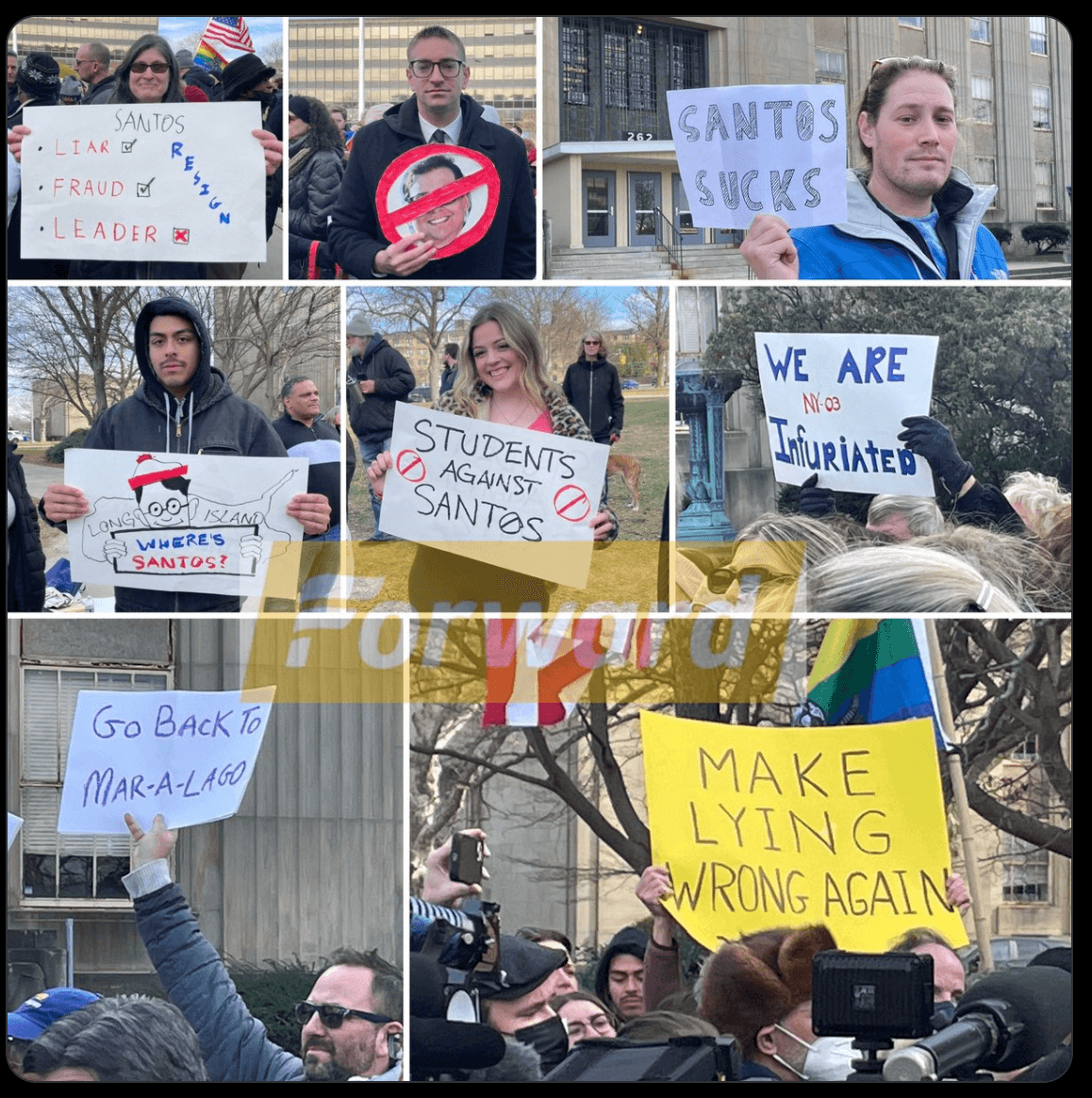
At a protest in his Long Island district on Thursday, people held homemade signs including “Make Lying Wrong Again” and “Fake Jew, Real Gonif.”

Protesters at an anti-Santos rally on Long Island on Dec. 29, 2022.Protesters at an anti-Santos rally on Long Island on Dec. 29, 2022. Photo by Jacob Kornbluh

I had not planned to write a newsletter today; I’m supposed to be off this week. But I couldn’t let the Santos story pass without comment. Because it’s a testament both to why journalism matters and to how our much our industry is struggling today. It’s a case study for why nonprofit newsrooms like the Forward and local outlets generally desperately need your support.

Many people have opined since the Santos story broke that it reflects both the decline in local journalism and a failure of the Democratic Party to invest enough in this race to do proper opposition research. The breadcrumbs were certainly there.

The Democrats put out an 87-page memo of “unsavory facts” about Santos after he won the Republican primary, but few paid attention to it. A tiny weekly on Long Island that favors Republicans reluctantly endorsed the Democrat in the race because, as its editorial said, Santos is “so bizarre, unprincipled and sketchy,” adding that he “boasts like an insecure child but he’s most likely just a fabulist — and a fake.” But as The Washington Post wrote yesterday, the journalism ecosystem in which a regional daily like Long Island’s Newsday — today a shadow of its former self — would have then investigated his bizarre and sketchy fabulism “appears to have failed completely this time.”

Well, not completely. Journalism with integrity, independent journalism based on reporting, real journalists following their curiosities to unearth the actual truth, eventually exposed Santos’ lies about the Holocaust and so much else. It may have been too late to affect the election, but it was not too little.

It’s been a heady few days here at the Forward, with The Times and CNN and the Los Angeles Blade and El País and Jezebel and Rolling Stone and so many other outlets citing our reporting. I’m proud — but also humbled, and concerned that we and others lacked the resources to jump on this story earlier. As we enter 2023, I want to make sure we can continue to follow our curiosities and fulfill our mission.

So: If you’re outraged by George Santos’ lies, if you care about the truth, I hope you’ll make an end-of-year donation to the Forward or subscribe to your local news outlet. That’s how you can show that facts matter.

The post The Santos story shows the truth matters. And so does journalism. appeared first on The Forward.

Categories
Selected Articles

Russian fury grows over strike that killed dozens of troops in eastern Ukraine

Y6IVLQHNC5I5XPF6NJW4A2G6WM.jpg

MOSCOW, Jan 3 (Reuters) – Russian nationalists and some lawmakers have demanded punishment for commanders they accused of ignoring dangers as anger grew over the killing of dozens of Russian soldiers in one of the deadliest strikes of the Ukraine conflict.

In a rare disclosure, Russia’s defence ministry said 63 soldiers were killed on New Year’s Eve in a fiery blast that destroyed a temporary barracks in a vocational college in Makiivka, twin city of the Russian-occupied regional capital of Donetsk in eastern Ukraine.

Russian critics said the soldiers were being housed alongside an ammunition dump at the site, which the Russian defence ministry said was hit by four rockets fired from U.S.-made HIMARS launchers.

Ukraine and some Russian nationalist bloggers have put the Makiivka death toll in the hundreds, though pro-Russian officials say those estimates are exaggerated.

Rallies to commemorate the dead were held in several Russian cities, including Samara, where some came from, RIA Novosti news gency reported. Mourners laid flowers in the centre of Samara.

“I haven’t slept for three days, Samara hasn’t slept. We are constantly in touch with the wives of our guys. It’s very hard and scary. But we can’t be broken. Grief unites … We will not forgive, and, definitely, victory will be ours,” RIA quoted Yekaterina Kolotovkina, a representative of a women’s council at an army unit, as telling one of the rallies.

The strike on Makiivka came as Russia was launching what have become nightly waves of drone attacks on Kyiv and other Ukrainian cities. Ukrainian President Volodymyr Zelenskiy said in his nightly video address that the attacks were aimed at “exhausting our people, our anti-aircraft defences, our energy”.

RUSSIAN STRIKES

Ukrainian officials said Russia had on Monday struck Ukraine-controlled parts of the Donetsk region, hitting the village of Yakovlivka, the city of Kramatorsk and destroying an ice rink in the town of Druzhkivka.

The governor of Ukraine’s Luhansk region, which along with neighbouring Donetsk forms the industrial Donbas claimed by Moscow, said on Tuesday Ukrainian forces had made steady advances in the direction of Russian-held Svatove and Kreminna.

“(Russian forces) are used to having a complete advantage in both artillery and shells. Now we have reached parity and our artillerymen are shooting better, hitting more ammunition depots and barracks, while firing far fewer shots,” Governor Serhiy Haidai told Ukrainian television.

Elsewhere, Ukraine’s military General Staff said a Dec. 31 strike on a Russian-held area of the southern Kherson region had killed or injured some 500 Russian troops.

Reuters could not independently confirm the battlefield accounts.

Ukraine’s presidential administration said three people had been killed and 10 wounded in Russian strikes over the past 24 hours, two of them in Kherson region and one in Donetsk region.

The governor of Donetsk, Pavlo Kyrylenko, said in a Tuesday morning update for his region that Russian forces had attacked Ukrainian positions overnight along the front line.

[1/14] Workers and emergencies’ ministry members remove debris of a destroyed building purported to be a vocational college used as temporary accommodation for Russian soldiers, 63 of whom were killed in a Ukrainian missile strike as stated the previous day by Russia’s Defence Ministry, in the course of Russia-Ukraine conflict in Makiivka (Makeyevka), Russian-controlled Ukraine, January 3, 2023. REUTERS/Alexander Ermochenko

Reuters footage showed a team of Ukrainian volunteers known as “Black Tulip” exhuming dead soldiers’ bodies near the front line in Donetsk region.

“Whenever you dig up a boy, you live through his nightmare and the horror he went through in his last moment, when he understood that this is the end,” said volunteer Oleksii Iukov, 37. “This is very, very difficult because you understand that you’re about to tell his family that their close one is gone.”

RUSSIAN FURY

Russian military bloggers said the extent of the destruction at Makiivka was a result of storing ammunition in the same building as a barracks, despite commanders knowing it was within range of Ukrainian rockets.

Igor Girkin, a former commander of pro-Russian troops in eastern Ukraine who is now one of the highest-profile Russian nationalist military bloggers, said hundreds had been killed or wounded. Military equipment stored at the site was uncamouflaged, he said.

“What happened in Makiivka is horrible,” wrote Archangel Spetznaz Z, a Russian military blogger with more than 700,000 followers on the Telegram messaging app.

“Who came up with the idea to place personnel in large numbers in one building, where even a fool understands that even if they hit with artillery, there will be many wounded or dead?” he wrote. Commanders “couldn’t care less”, he said.

Ukraine almost never publicly claims responsibility for attacks on Russian-controlled territory in Ukraine and Zelenskiy did not address the Makiivka strike in his nightly speech on Monday.

The fury in Russia extended to lawmakers.

Grigory Karasin, a member of the Russian Senate and former deputy foreign minister, not only demanded vengeance against Ukraine and its NATO supporters but also “an exacting internal analysis”.

Sergei Mironov, a legislator and former chairman of the Senate, Russia’s upper house, demanded criminal liability for the officials who had “allowed the concentration of military personnel in an unprotected building” and “all the higher authorities who did not provide the proper level of security”.

Unverified footage posted online of the aftermath of the blast at the Russian barracks in Makiivka showed a huge building reduced to smoking rubble.

Having suffered defeats on the battlefield in the second half of 2022, Russia resorted to mass air strikes against Ukrainian cities.

Ukraine said on Monday it had shot down all 39 drones Russia had launched in a third night of air strikes on civilian targets in Kyiv and other cities.

Ukrainian officials said their success proved that Russia’s tactic in recent months of raining down missiles and drones to knock out Ukraine’s energy infrastructure was increasingly failing as Kyiv beefs up its air defences.

Russia denies targeting civilians in what it calls a “special military operation” against its southern neighbour launched on Feb. 24.

Additional reporting by Pavel Polityuk in Kyiv and by other Reuters bureaux; Writing by Michael Perry and Gareth Jones; Editing by Robert Birsel and Nick Macfie

Our Standards: The Thomson Reuters Trust Principles.

Categories
Selected Articles

Russia says 63 soldiers killed by Ukrainian strike in Donetsk region

reuters-default.png?d=124

Jan 2 (Reuters) – Russia said on Monday that 63 Russian soldiers had been killed in a Ukrainian New Year’s Eve attack on their quarters, triggering furious criticism of the military leadership from lawmakers and pro-war bloggers.

Footage posted online showed a building purported to be a vocational college in Makiivka, a city in the Russian-controlled part of Ukraine’s Donetsk province, reduced to rubble.

Daniil Bezsonov, a senior Russian-backed regional official, said the college had been hit by U.S.-made HIMARS rockets around midnight, just as people would have been celebrating the start of the New Year against the backdrop of a televised speech by President Vladimir Putin.

Russia’s Defence Ministry acknowledged the attack only in the final paragraph of a 528-word daily roundup, more than 36 hours later.

Even then, it did not address some of the allegations made by pro-war bloggers, who said casualties were far higher, and that the military had not only failed to hide its soldiers from the enemy but also stored ammunition close by.

Nationalist bloggers and chat-show hosts with hundreds of thousands of followers have had licence from the Kremlin to publicise the failings of the army – a potential criminal act under a law passed shortly after the invasion of Ukraine in February.

But the open fury extended on Monday to lawmakers.

Grigory Karasin, a member of the Russian Senate and former deputy foreign minister, not only demanded vengeance against Ukraine and the Western NATO alliance, whose members have been arming it, but also “an exacting internal analysis”.

Sergei Mironov, a legislator and former chairman of the Senate, Russia’s upper house, demanded criminal liability for the officials who had “allowed the concentration of military personnel in an unprotected building” and “all the higher authorities who did not provide the proper level of security”.

“Obviously neither intelligence nor counterintelligence nor air defence worked properly,” he said in a post on Telegram.

AMMUNITION STORE

Ukraine had alleged that 400 Russians had been killed, a number dismissed as an exaggeration by Russian bloggers.

A pro-war blogger known as Rybar, with more than a million subscribers on Telegram, said that, besides around 70 confirmed dead, more than 100 had been wounded. He said about 600 people had been in the building.

Igor Girkin, a former commander of pro-Russian troops in east Ukraine who has become a high-profile critic of Russia’s military, said on Telegram that there were “many hundreds” of dead and wounded.

Like Rybar, he said ammunition had been stored at the college, potentially accounting for its extreme devastation, and that the military’s presence had not been disguised.

Archangel Spetznaz Z, another Russian military blogger with more than 700,000 followers on Telegram, wrote:

“Who came up with the idea to place personnel in large numbers in one building, where even a fool understands that even if they hit with artillery, there will be many wounded or dead?”

Reuters was unable to verify the battlefield accounts, but did confirm the location of the video from the buildings and road layout seen in the footage, although not the date that it was filmed.

A source close to the Russian-installed Donetsk leadership told Reuters the building had housed some of the 300,000 or more soldiers mobilised since September.

Many have already been sent to the front to bolster a 10-month-old campaign in which Russia has been driven out of large swathes of the Ukrainian territory it had seized, and been forced to replace many of its senior commanders.

The fact that so many of the dead were not volunteer career soldiers was likely to fuel the anger of relatives and some of the ordinary Russians whom Putin asked in his New Year address for support and sacrifices in the months ahead.

The news outlet 63.Ru, based in Samara, quoted regional governor Dmitry Azarov as saying some of those killed were from his region and advising concerned relatives to contact local recruitment centres for information.

Reporting by Reuters; Writing by Lidia Kelly, Ron Popeski and Kevin Liffey;
Editing by Gareth Jones and Angus MacSwan

Our Standards: The Thomson Reuters Trust Principles.

Categories
Selected Articles

Russian anger grows over strike that killed dozens of troops in Ukraine

Makiivka-aerial-726x450.png

Russian nationalists and some lawmakers have demanded punishment for commanders they accused of ignoring dangers as anger grew over the killing of dozens of Russian soldiers in one of the Ukraine war’s deadliest strikes.

In a rare disclosure, Russia’s defence ministry said 63 soldiers were killed on New Year’s Eve in a fiery blast that destroyed a temporary barracks in a vocational college in Makiivka, twin city of the Russian-occupied regional capital of Donetsk in eastern Ukraine.

Russian critics said the soldiers were being housed alongside an ammunition dump at the site, which the Russian defence ministry said was hit by four rockets fired from US-made HIMARS launchers.

The New Year’s Eve strike on Makiivka came as Russia was launching what have become nightly waves of drone attacks on Kyiv and other Ukrainian cities.

Ukrainian officials said Russia had on Monday (2 January) struck Ukraine-controlled parts of the Donetsk region, hitting the village of Yakovlivka, the city of Kramatorsk and destroying an ice rink in the town of Druzhkivka.

Ukraine said the Russian death toll in Makiivka was in the hundreds, though pro-Russian officials called that an exaggeration.

Russian military bloggers said the extent of the destruction was a result of storing ammunition in the same building as a barracks, despite commanders knowing it was within range of Ukrainian rockets.

Igor Girkin, a former commander of pro-Russian troops in eastern Ukraine who is now one of the highest profile Russian nationalist military bloggers, said hundreds had been killed or wounded. Ammunition had been stored at the site and military equipment there was uncamouflaged, he said.

“What happened in Makiivka is horrible,” wrote Archangel Spetznaz Z, a Russian military blogger with more than 700,000 followers on the Telegram messaging app.

“Who came up with the idea to place personnel in large numbers in one building, where even a fool understands that even if they hit with artillery, there will be many wounded or dead?” he wrote. Commanders “couldn’t care less”, he said.

Ukraine almost never publicly claims responsibility for attacks on Russian-controlled territory in Ukraine and President Volodymyr Zelenskyy did not address the Makiivka strike in his nightly speech on Monday.

But the General Staff of Ukraine’s Armed Forces reported the Makiivka attack as “a strike on Russian manpower and military equipment”. It did not mention casualties, but said 10 pieces of military equipment were destroyed.

‘Stupid losses’

The fury in Russia extended to lawmakers.

Grigory Karasin, a member of the Russian Senate and former deputy foreign minister, not only demanded vengeance against Ukraine and its NATO supporters but also “an exacting internal analysis”.

Sergei Mironov, a legislator and former chairman of the Senate, Russia’s upper house, demanded criminal liability for the officials who had “allowed the concentration of military personnel in an unprotected building” and “all the higher authorities who did not provide the proper level of security”.

Unverified footage posted online of the aftermath of the blast at the Russian barracks in Makiivka showed a huge building reduced to smoking rubble.

Some of the dead came from the southwestern Russian region of Samara, the region’s governor told Russian media, urging concerned relatives to contact recruitment centres for information.

Andrey Medvedev, deputy speaker of the Moscow City Duma and a pro-Kremlin journalist, said authorities, whether civilian or military, must value Russian lives.

“Either a person is of the highest value – and then punish for stupid losses of personnel, as for treason to the fatherland – or the country is over,” Medvedev wrote on the Telegram messaging app.

A Russian-backed military information centre in the Donetsk region said there had been 69 Ukrainian attacks on the region, including Makiivka, on Monday.

‘Banking on exhaustion’

Having suffered defeats on the battlefield in the second half of 2022, Russia resorted to mass air strikes against Ukrainian cities.

Ukraine said on Monday it had shot down all 39 drones Russia had launched in a third night of air strikes on civilian targets in Kyiv and other cities.

Ukrainian officials said their success proved that Russia’s tactic in recent months of raining down missiles and drones to knock out Ukraine’s energy infrastructure was increasingly failing as Kyiv beefs up its air defences.

Russia denies targeting civilians in what it calls a special military operation against its southern neighbour launched on 24 February.

After firing dozens of missiles on 31 December, Russia launched more than 80 Iranian-made Shahed drones on 1 January and 2 January, all of which had been shot down, Zelenskyy said, adding that Russia was planning a protracted campaign of such attacks to “exhaust” Ukraine.

“It is probably banking on exhaustion. Exhausting our people, our anti-aircraft defences, our energy,” Zelenskyy said in his nightly video address.

Ukraine, he said, had to “act and do everything so that the terrorists’ fail in their aim, as all their others have failed”.

Categories
Selected Articles

Russian anger grows over strike that killed dozens of troops in Ukraine – EURACTIV

Russian anger grows over strike that killed dozens of troops in Ukraine  EURACTIV
Categories
Audio Sources - Full Text Articles

Republican U.S. House to open in turmoil as McCarthy fights for gavel

2023-01-03T11:11:29Z

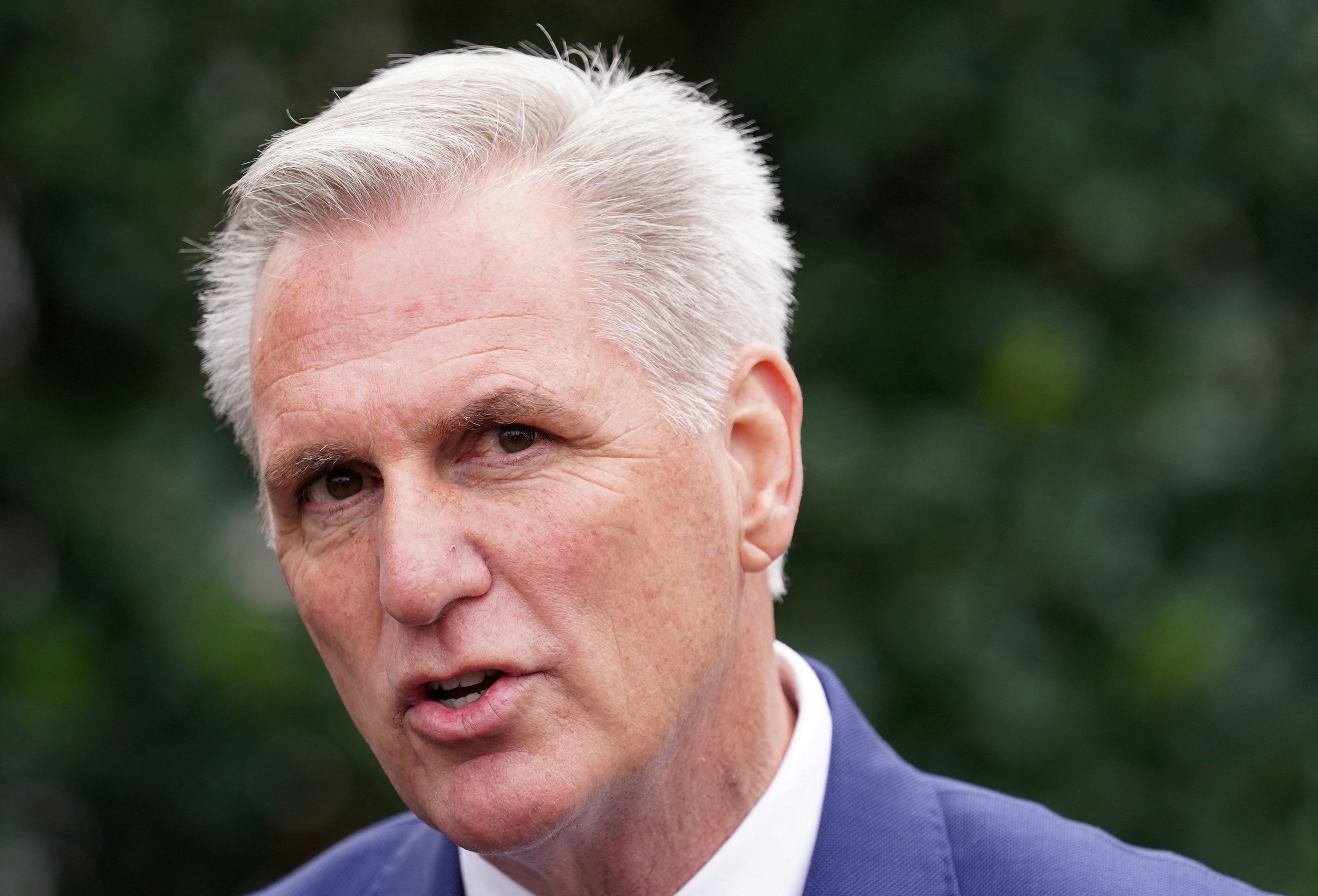
House Republican leader Kevin McCarthy speaks to reporters following a meeting with U.S. President Joe Biden and other congressional leaders at the White House in Washington, U.S., November 29, 2022. REUTERS/Kevin Lamarque/File Photo

The new Republican-held U.S. House of Representatives convenes on Tuesday for what could be a chaotic election for speaker, as top Republican Kevin McCarthy fights to overcome opposition from hardline conservatives and win the powerful position.

A protracted speaker election could undermine House Republican hopes of moving forward quickly on investigations into Democratic President Joe Biden’s administration and his family, as well as on legislative priorities involving the economy, U.S. energy independence and border security.

After four years as the Republican minority leader, McCarthy now needs at least 218 votes to succeed Democrat Nancy Pelosi as speaker. With 222 seats, the Republicans have a slim nine-seat House majority, but several party members vocally oppose him.

On Sunday evening, Republican lawmakers who were prepared to vote against McCarthy numbered in the double digits, according to a source familiar with the situation.

No Democrats are likely to vote for McCarthy, so he does not yet appear to have enough votes to secure the job that would allow him to set the House legislative agenda and put him second in line for the presidency, behind Democratic Vice President Kamala Harris.

This could set the stage for hours of votes when the 118th Congress begins meeting at midday EST (1700 GMT). McCarthy easily won his party’s backing for the speakership in November.

Asked on Monday whether he had the votes, McCarthy, who failed to win the speakership in 2015, told reporters at the Capitol: “I think we’re going to have a good day tomorrow.”

The California Republican met late on Monday with hardliners and supporters, but there was no immediate sign of a breakthrough. House Republicans are expected to meet face-to-face behind closed doors on Tuesday morning, ahead of the speaker election.

Representative Don Bacon, a McCarthy supporter, wrote on the online conservative news website Daily Caller that he could reach across the aisle to find Democratic support for an unidentified Republican candidate if hardliners did not to relent.

While Republicans have won back the House, Democrats still hold the White House and Senate. Standoffs are expected over must-pass legislation to keep the government open, fund the military and address the U.S. debt ceiling.

McCarthy faces a long-shot rival bid from hardline conservative Representative Andy Biggs. Along with Biggs, Republican Representatives Matt Gaetz, Bob Good, Matt Rosendale and Ralph Norman oppose electing him speaker.

“I won’t be voting for Kevin McCarthy tomorrow. He’s part of the problem. He’s not part of the solution,” Good told Fox News on Monday.

The record number of voting rounds to elect a House speaker is 133 over a two-month period in the 1850s. Every nominee in the last 100 years has succeeded on the first ballot.

A standoff would leave the House largely paralyzed and could force lawmakers to consider another candidate. Incoming Majority Leader Steve Scalise and conservative leader Jim Jordan are seen as possibilities.

But 15 House Republicans – elected from districts Biden won in 2020 – have warned that they will accept no one for speaker other than McCarthy.

Strategists from both parties warn that larger problems could lie ahead for Congress if the House Republicans are left too divided to negotiate with Biden and Senate Majority Leader Chuck Schumer.

“If the Republicans stick together, Democrats in the Senate will have to wrap their heads around a much more conservative product than they are accustomed (to) in order to pass anything,” said Republican strategist Josh Holmes, a former McConnell aide.

Democratic strategist Jim Manley said that if Biden and Schumer did not have a House Republican with authority to negotiate with, then very little would get done, adding: “It takes two to tango.”

The hardline Republican House Freedom Caucus is demanding rule changes that would enhance the group’s influence. Moderate Republicans have said they will accept rule changes only if doing so leads to McCarthy’s election as speaker.

But some of McCarthy opponents, including Biggs and Gaetz, have suggested they would not back him under any circumstances.

The Democrats have picked Hakeem Jeffries to serve as minority leader after Pelosi, the first woman to serve as speaker, stepped down from leadership. She will remain in office as a representative.

Categories
Audio Sources - Full Text Articles

McCarthy“s dream of being U.S. House speaker faces a political nightmare

2023-01-03T11:08:40Z

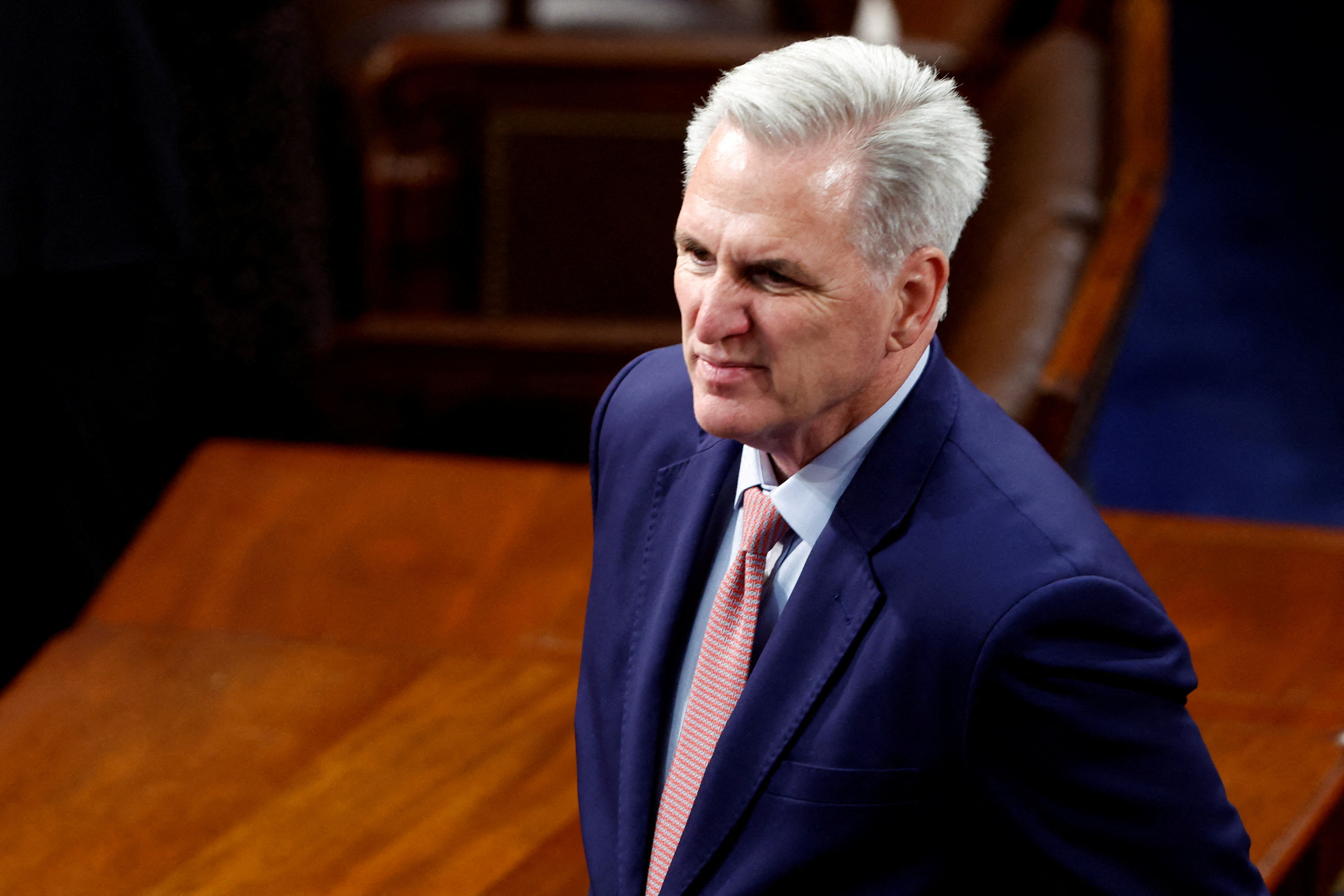
House Minority Leader Rep. Kevin McCarthy (R-CA) attends a joint meeting of the U.S. Congress in the House Chamber of the U.S. Capitol where Ukraine’s President Volodymyr Zelenskiy will deliver remarks, in Washington, U.S., December 21, 2022. REUTERS/Evelyn Hockstein/File Photo

Top U.S. House of Representatives Republican Kevin McCarthy could achieve his long-held dream of wielding the speaker’s gavel this week – if he can survive a nightmare of infighting that threatens to hobble his party’s new majority.

The 57-year-old California Republican is widely favored to replace Democrat Nancy Pelosi as House speaker, making him second in the line of succession to the presidency and a congressional power broker capable of stymieing Democratic President Joe Biden’s legislative ambitions in the run-up to the 2024 presidential election.

But the speaker’s post has proved to be a formidable challenge for Republicans in recent years, with John Boehner resigning the post in 2015 after a struggle with rebellious conservatives.

Boehner’s successor, Paul Ryan, a frequent target for conservatives, decided not to seek reelection in 2018 as then-President Donald Trump shifted the party focus from Ryan’s fiscal priorities to immigration and culture-war issues.

“Kevin deserves the opportunity to lead,” said Republican Representative Dave Joyce of Ohio, who credits McCarthy for the campaign platform that helped Republicans take control of the House in the November midterm elections.

“Kevin is great at putting people together, letting the conversations take place and building a consensus,” Joyce told Reuters. “That’s what he did to create the ‘Commitment to America’ that we ran on.”

McCarthy has spent his adult life in politics, first as a congressional staffer and then state legislator before being elected to the House in 2006. Ascending to the speakership would represent the pinnacle of his career.

But in the ever-precarious world of Republican politics, his ability to obtain the coveted gavel is an open question.

Republicans emerged from the November elections with a narrow 222-213 majority, and McCarthy is facing stiff opposition from hard-line conservatives including incoming members, staunch allies of former President Donald Trump who want outsized influence in exchange for their support.

“I’ve gotten a lot of emails from people telling me that they don’t want me to vote for Kevin McCarthy, and I do listen to what my constituents say,” Representative-elect Anna Paulina Luna said in a recent podcast interview with former Trump adviser Steve Bannon.

McCarthy’s office did not respond to repeated requests for comment on the speaker’s race.

If he succeeds, McCarthy will face an ongoing struggle to control the 435-seat chamber against the hard-line House Freedom Caucus’s efforts to move the Republican conference ever further to the right.

At the same time, McCarthy, who has been House minority leader since 2019, would need to work with a Democratic Senate and the Biden White House on must-pass legislation.

Lawmakers will gather at the U.S. Capitol on Tuesday to be sworn in as the 118th Congress. House Republicans and Democrats will then move quickly to a floor election for speaker, at which McCarthy will need support from a majority of members present to obtain the top congressional post.

McCarthy supporters hope this year’s showdown won’t end in a repeat of his 2015 bid for the speaker, when he was forced to withdraw in the face of conservative opposition. That year, the speakership went instead to a reluctant Ryan.

But already there is speculation that incoming House Majority Leader Steve Scalise or conservative leader Jim Jordan could emerge as a Republican compromise candidate.

The House Freedom Caucus is pushing for rule changes that would make it easier to control the speaker and enhance the hard-line group’s influence within the Republican conference.

McCarthy ran afoul of hard-liners when he publicly acknowledged that Trump bore responsibility for the deadly Jan. 6, 2021, attack on the U.S. Capitol, days after the violence, though he later repeatedly voiced allegiance to the former president.

Some conservatives have remained wary and discount recent efforts to appease conservatives by taking a hard line against Senate Republicans who backed last year’s $1.66 trillion omnibus spending bill and threatening U.S. Homeland Security Secretary Alejandro Mayorkas with impeachment.

“I think he’s just a shill of the establishment. I think that Kevin McCarthy is little more than a vessel through which lobbyists and special interests operate,” Republican Representative Matt Gaetz said last week in an interview with the Daily Caller, a conservative news and opinion website.

Categories
Audio Sources - Full Text Articles

Morning Bid: The year of the yen?

2023-01-03T11:09:51Z

Examples of Japanese yen banknotes are displayed at a media event in Tokyo, Japan, November 21, 2022. REUTERS/Kim Kyung-Hoon/File Photo

A look at the day ahead in U.S. and global markets from Dhara Ranasinghe, Editor, Financial Markets EMEA, Thomson Reuters.

The holidays are over and it’s back to work, so markets are no exception.

And the yen, for starters, is intent on leaving a dismal 2022 behind. It was the worst-performing major currency versus the dollar last year. Yet, on the second trading day of the new year Japan’s currency is already scaling seven-months highs.

The yen has jumped almost 7% against the greenback to around 130.70 , since the Bank of Japan last month made a surprise tweak to its bond-yield control that allows long-term interest rates to rise more. The move was aimed at easing some of the costs of prolonged monetary stimulus.

A Nikkei report on Saturday that the BOJ was considering raising its inflation forecasts in January to show price growth close to its 2% target this year and next has only fueled speculation that the world’s most dovish major central bank may well step back from its ultra-loose policy.

All this leaves the yen – you guessed it – as one of the most favored trades early in 2023. MUFG says that even after the recent rebound, the yen is still “deeply undervalued,” which leaves scope for further gains. Pictet has a year-end dollar/yen forecast of 125, implying a further gain in the value of the yen of 4% from current levels.

Japanese authorities stepped into the market in September to prop up the yen for the first time since 1998 and again in October, when it weakened to a 32-year low of 151.94 per dollar. The benefit of hindsight suggests they just needed to hold out a little longer for the yen’s recovery.

As U.S. markets reopen after Monday’s holiday, focus will likely shift back to the outlook for inflation and monetary policy. The minutes from the Federal Reserve’s December meeting are out on Wednesday and the December non-farm payrolls report is due on Friday.

The closely-watched U.S. jobs data alone means the first trading week of 2023 is unlikely to be dull.

There’s plenty going on elsewhere too.

China’s factory activity shrank at a sharper pace in December, as surging COVID-19 infections disrupted production and weighed on demand after Beijing largely removed anti-virus curbs, a survey showed on Tuesday.

U.S. stock futures point to a strong open for Wall Street shares , , European shares were more than 1.5% higher (.STOXX) while London’s blue-chip rallied over 2% (.FTSE) to its highest since last June.

Clearly, yen traders are not alone in wanting to leave a bruising 2022 in the past.

Key developments that may provide direction to U.S. markets later on Tuesday :

– U.S. December final PMI due for release.

– UK manufacturing ends 2022 on a low as orders shrink.

– Brazil markets tumble on Lula’s first full day in office.

– Inflation in key German states eases for second month.

Categories
Audio Sources - Full Text Articles

Bankman-Fried set to enter not guilty plea in FTX fraud case

2023-01-03T11:13:44Z

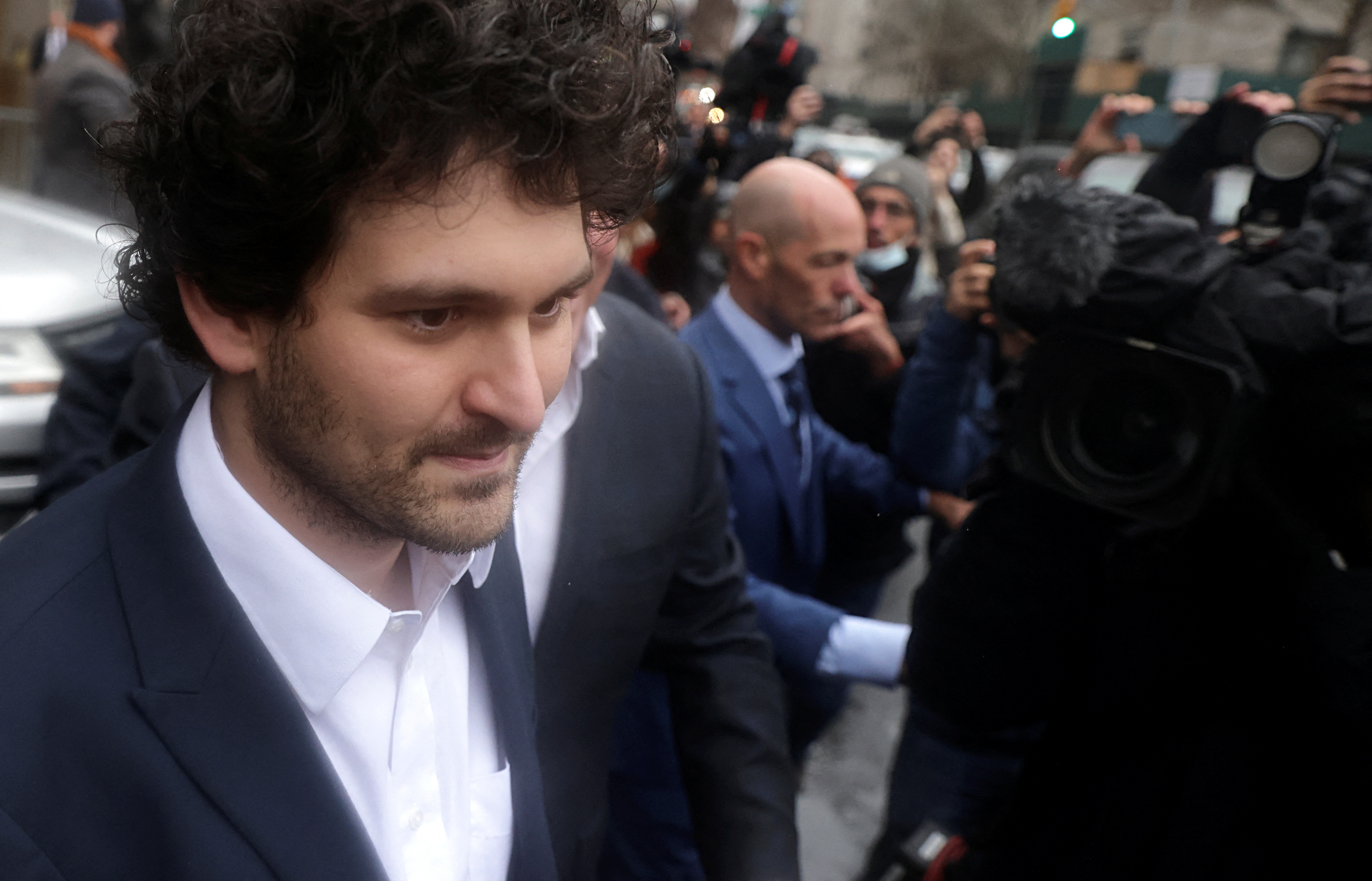
Former FTX chief executive Sam Bankman-Fried, who faces fraud charges over the collapse of the bankrupt cryptocurrency exchange, walks from the Manhattan federal court after securing bail in New York City, U.S. December 22, 2022. REUTERS/Jeenah Moon

Sam Bankman-Fried is expected on Tuesday to enter a plea of not guilty to criminal charges that he cheated investors and looted billions of dollars at his now-bankrupt FTX cryptocurrency exchange, according to a source familiar with the matter.

Bankman-Fried is accused of illegally using FTX customer deposits to support his Alameda Research hedge fund, buy real estate and make millions of dollars in political contributions, in what prosecutors have called a fraud of epic proportions.

He is scheduled to appear at 2 p.m. EST (1900 GMT) before U.S. District Judge Lewis Kaplan in Manhattan.

A lawyer for Bankman-Fried did not immediately reply to a request for comment.

It is not unusual for criminal defendants to initially plead not guilty. Defendants are free to change their plea at a later date.

Bankman-Fried has been free on $250 million bond following his extradition last month from the Bahamas, where he lived and where the exchange was based.

Since his release, Bankman-Fried has been subject to electronic monitoring and required to live with his parents, both professors at Stanford Law School in California.

The Massachusetts Institute of Technology graduate has been charged with two counts of wire fraud and six conspiracy counts, including to launder money and commit campaign finance violations. He could face up to 115 years in prison if convicted.

Bankman-Fried has admitted to making mistakes running FTX but said he did not believe he was criminally liable.

The 30-year-old crypto mogul rode a boom in the value of bitcoin and other digital assets to become a billionaire several times over and an influential political donor in the United States, until FTX collapsed in early November after a wave of withdrawals. The exchange declared bankruptcy on Nov. 11.

Bankman-Fried’s net worth, once estimated at $26 billion, was largely wiped out when the exchange collapsed. He later said that he had $100,000 in his bank account.

The prosecution case was strengthened by last month’s guilty pleas of two of Bankman-Fried’s closest associates.

Caroline Ellison, who was Alameda’s chief executive, and Gary Wang, FTX’s former chief technology officer, pleaded guilty to seven and four criminal charges, respectively, and agreed to cooperate with prosecutors.

Bankman-Fried, Ellison and Wang were also sued by the U.S. Securities & Exchange Commission and Commodity Futures Trading Commission. Ellison and Wang settled those civil cases, the regulators said.

FTX’s new chief executive, John Ray, known for his work on energy company Enron Corp’s bankruptcy, has said FTX was run by “grossly inexperienced” and unsophisticated people.

WP Radio
WP Radio
OFFLINE LIVE