Categories
Audio Sources - Full Text Articles

As Capitol police became overpowered on Jan. 6, the Pentagon sent security to the homes of military leaders, per the former Capitol police chief

Former Capitol Police Chief Steven SundFormer Capitol Police Chief Steven Sund testifying before Congress about Jan. 6

Getty Images North America

  • Former Capitol Police Chief Steven Sund is releasing his book “Courage Under Fire” on Jan. 3.
  • The Washington Post got an advanced copy and released some of the contents Sunday. 
  • The book will detail what went wrong on Jan. 6 and how it could happen again.

The country is not adequately prepared for another domestic terror attack, according to the man who helmed the Capitol Police during the Jan. 6 attack in 2021

In his new book “Courage Under Fire,” the police department’s former Chief Steven Sund claimed there was a lack of communication and a neglectful response from federal agencies — such as the Pentagon, the Department of Homeland Security, and the FBI —  responsible for protecting the US against terror.

This ultimately resulted in the violent attack on the Capitol in an attempt to halt the certification of the election, The Washington Post, which had early access to the book, reported. 

“The security and information-sharing policies and mandates put in place after September 11 failed miserably on January 6,” Sund said in the book, according to the Post.”We failed miserably to see the apparent warning signs and the danger, like a ‘gray rhino,’ charging right at us.”

Sund revealed shocking new details of the day — including how the Pentagon sent teams to protect military leaders in their homes, while a desperate Sund requested aid back at the Capitol as his department fought to protect hundreds of lawmakers and their staff. Help from the military did not come for another three hours, The Post reported, after the building was already clear. 

“The Pentagon fully understands the urgency and danger of the situation even as it does nothing to support us on the Hill,” he wrote, per The Post. “For the past several hours, we have been battling a mob at the Capitol and the fight has been televised around the world.

“We have multiple fatalities including a shooting inside the Capitol,” he continued. “We have had to secure members of Congress, the vice president and his family and the next three levels of succession to the president of the United States. And the military has made no effort whatsoever to help end this.”

He also said that the national security agencies did not give him notice of the severity of the threats they had known about, and that politics often take priority over security within the Capitol Police, something he claims is a “recipe for disaster,” according to the Post. 

The book’s revelations come as the Jan. 6 committee released new documents from its final report.

Read the original article on Business Insider
Categories
Audio Sources - Full Text Articles

Russia targets critical infrastructure in drone attacks, officials say

2023-01-02T01:58:38Z

Russia has been targeting Ukraine’s critical infrastructure in a series of drone attacks early on Monday on Kyiv and the region surrounding it, officials said.

Russia kept pounding Kyiv for the second night in a row, after firing a barrage of missiles over the capital on New Year’s Eve night and earlier in the day.

“It is loud in the region and in the capital: night drone attacks,” Kyiv Governor Oleksiy Kuleba said on the Telegram messaging app.

“Russians launched several waves of (Iranian-made) Shahed drones. Targeting critical infrastructure facilities. Air defence is at work.”

By 3 a.m. local time (0100 GMT), Ukraine’s air defence systems destroyed 16 air objects above Kyiv, the city’s military administration said. Air raid sirens were wailing by that time for more than three hours.

Earlier in the night, debris from a destroyed drone over Kyiv hit the capital’s northeastern district, wounding one, the city’s Mayor Vitali Klitschko said.

A 19-year-old man was taken to a hospital in Kyiv’s Desnianskiy district, Klitschko said on the Telegram messaging app, after drone debris hit a road there and damaged a building.

Reuters was not able to independently verify the information.

Kyrylo Tymoshenko, Ukrainian presidential aide, said drone debris hit a road in the Desnianskiy district, in Kyiv’s northeast, damaging a building next to it.

The district, located on the left bank of the Dnipro River, is chiefly a residential area and the capital’s most populous district.

Ukraine’s regional military command in the country’s east said air defence systems destroyed nine Iranian-made Shahed drones over the Dnipropetrovsk and Zaporizhzhia regions by early hours of Monday.

Related Galleries:

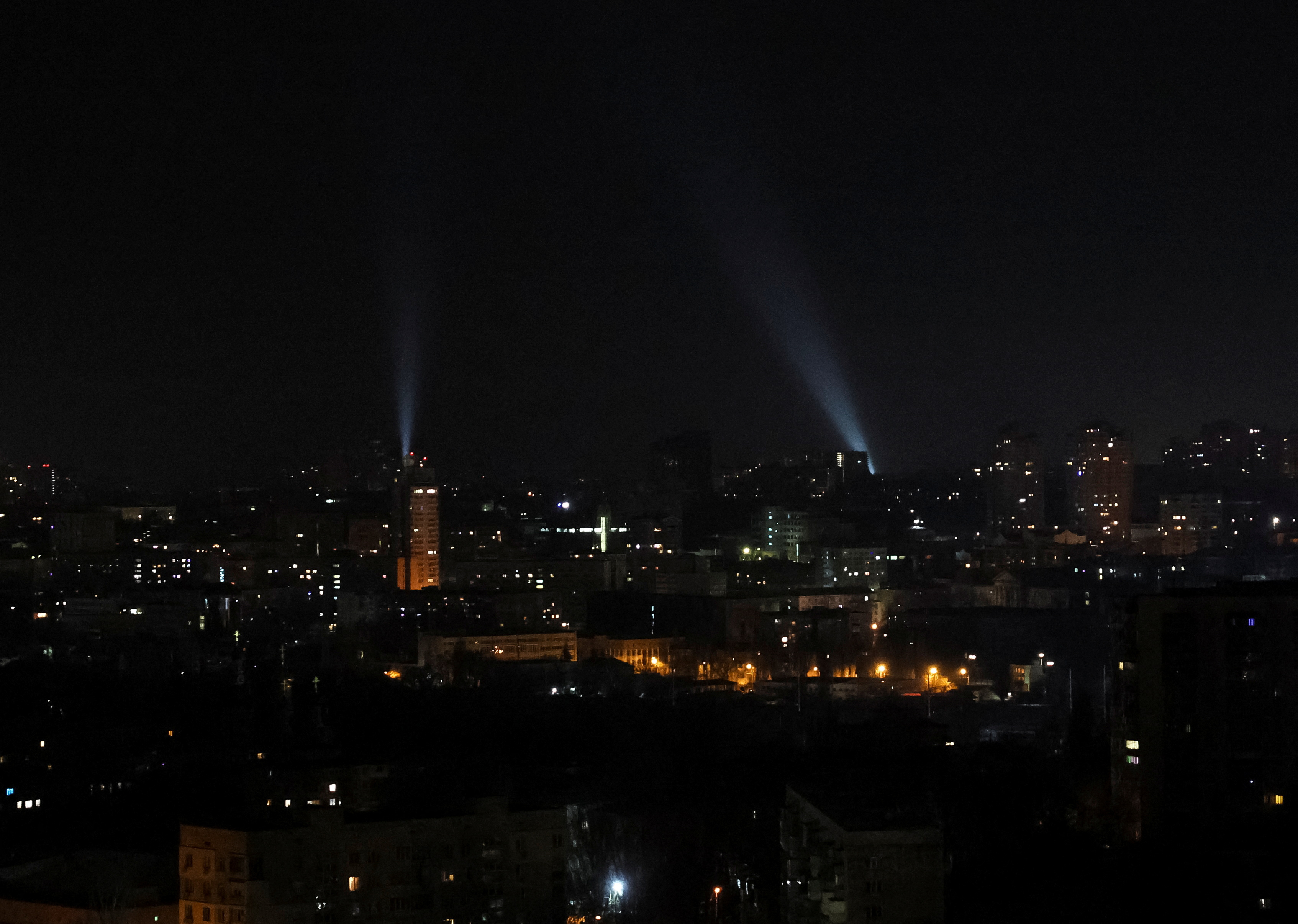
Ukrainian servicemen use searchlights as they search for drones in a sky over city during a Russian drones strike, amid Russia’s attack on Ukraine, in Kyiv, Ukraine January 1, 2023. REUTERS/Gleb Garanich

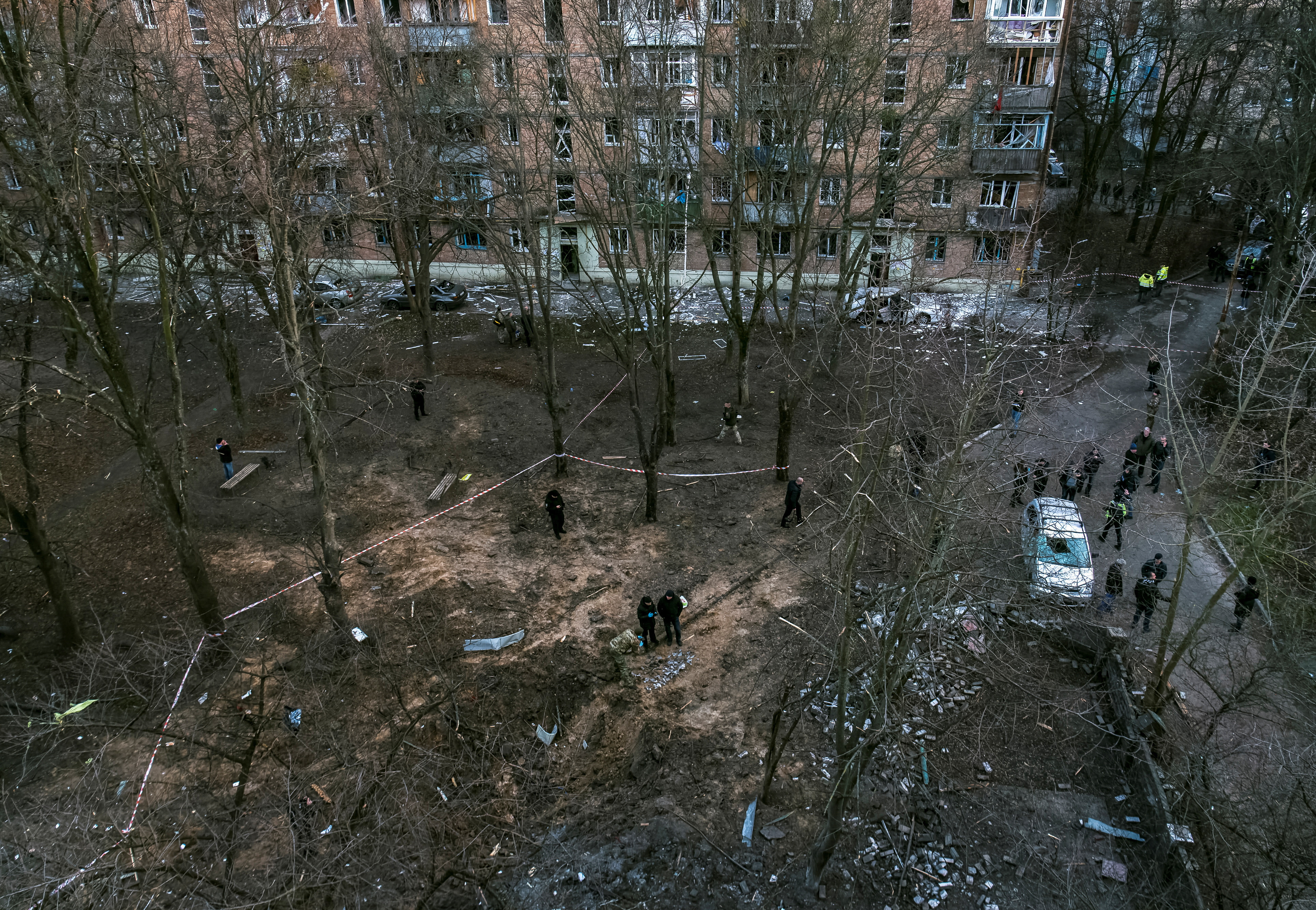
Police experts work at a site of residential houses heavily damaged by a Russian missile strike, amid Russia’s attack on Ukraine, in Kyiv, Ukraine December 31, 2022. REUTERS/Vladyslav Musiienko

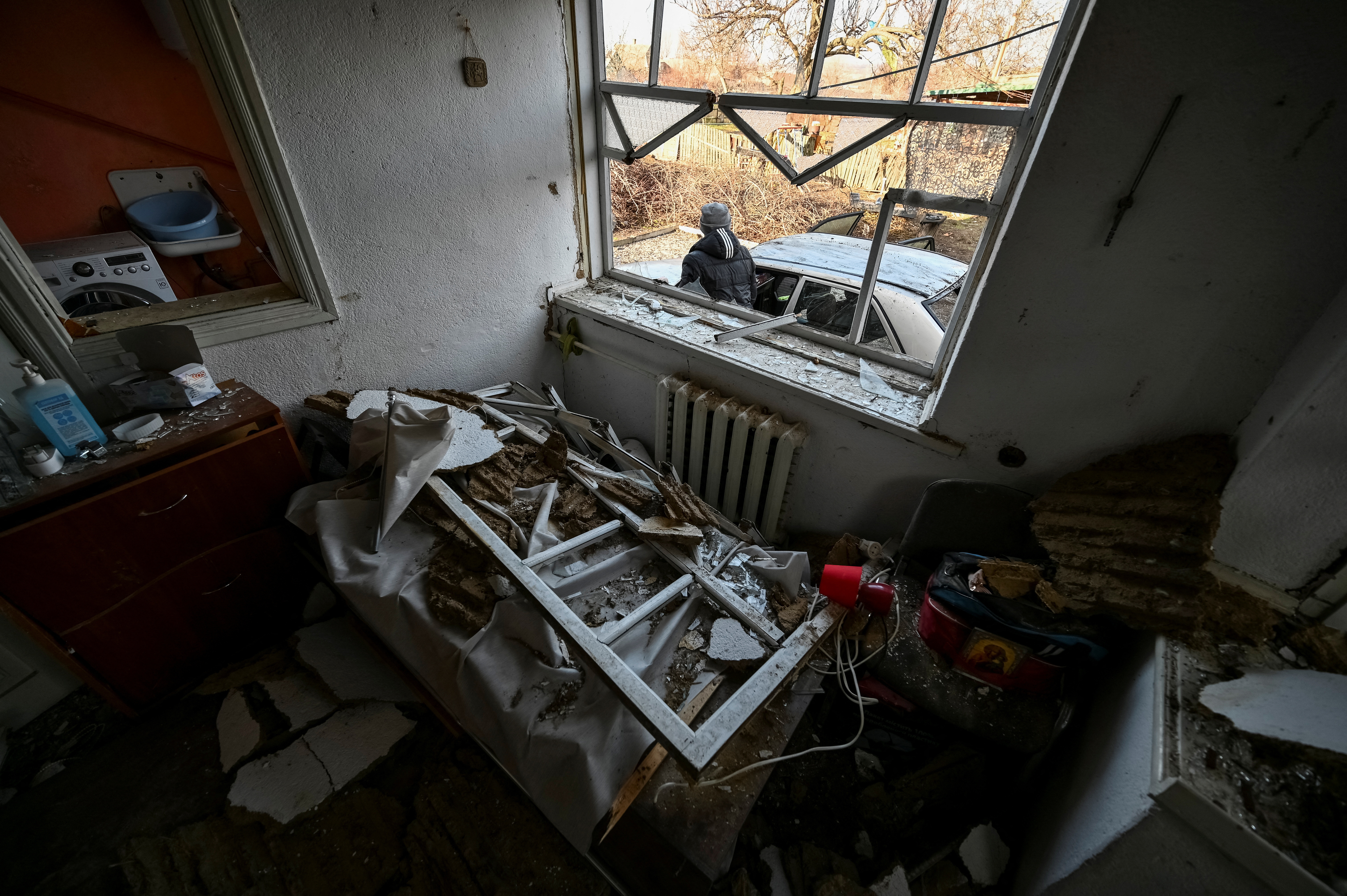
A view of a house destroyed by a Russian military strike is seen, as Russia’s attack on Ukraine continues, in the village of Stepne, in Zaporizhzhia Region, Ukraine December 29, 2022. REUTERS/Stringer
Categories
Audio Sources - Full Text Articles

Though faulted, Benedict turned Vatican around on sex abuse

VATICAN CITY (AP) — Pope Emeritus Benedict XVI is rightly credited with having been one of the 20th century’s most prolific Catholic theologians, a teacher-pope who preached the faith via volumes of books, sermons and speeches. But he rarely got credit for another important aspect of his legacy: having done more than anyone before him to turn the Vatican around on clergy sexual abuse.

As cardinal and pope, Benedict pushed through revolutionary changes to church law to make it easier to defrock predator priests, and he sacked hundreds of them. He was the first pontiff to meet with abuse survivors. And he reversed his revered predecessor on the most egregious case of the 20th century Catholic Church, finally taking action against a serial pedophile who was adored by St. John Paul II’s inner circle.

But much more needed to be done, and following his death Saturday, abuse survivors and their advocates made clear they did not feel his record was anything to praise, noting that he, like the rest of the Catholic hierarchy, protected the image of the institution over the needs of victims and in many ways embodied the clerical system that fueled the problem.

“In our view, Pope Benedict XVI is taking decades of the church’s darkest secrets to his grave with him,” said SNAP, the main U.S.-based group of clergy abuse survivors.

Matthias Katsch of Eckiger Tisch, a group representing German survivors, said Benedict will go down in history for abuse victims as “a person who was long responsible in the system they fell victim to,” according to the dpa news agency.

In the years after Benedict’s 2013 resignation, the scourge he believed encompassed only a few mostly English-speaking countries had spread to all parts of the globe. Benedict refused to accept personal or institutional responsibility for the problem, even after he himself was faulted by an independent report for his handling of four cases while he was Munich bishop. He never sanctioned any bishop who covered up for abusers, and he never mandated abuse cases be reported to police.

But Benedict did more than any of his predecessors combined, and especially more than John Paul, under whose watch the wrongdoing exploded publicly. And after initially dismissing the problem, Pope Francis followed in Benedict’s footsteps and approved even tougher protocols designed to hold the hierarchy accountable.

“He (Benedict) acted as no other pope has done when pressed or forced, but his papacy (was) reactive on this central issue,” said Terrence McKiernan, founder of the online resource BishopAccountability, which tracks global cases of clergy abuse and cover-up.

As prefect of the Congregation for the Doctrine of the Faith for a quarter-century, the former Cardinal Joseph Ratzinger saw first-hand the scope of sex abuse as early as the 1980s. Cases were arriving piecemeal to the Vatican from Ireland, Australia and the U.S., and Ratzinger tried as early as 1988 to persuade the Vatican legal department to let him remove abuser priests quickly.

Vatican law at the time required long and complicated canonical trials to punish priests, and then only as a last resort if more “pastoral” initiatives to cure them failed. That approach proved disastrous, enabling bishops to move their abusers around from parish to parish where they could rape and molest again.

The legal office turned Ratzinger down in 1988, citing the need to protect the priest’s right to defense.

In 2001, Ratzinger persuaded John Paul to let him take hold of the problem head on, ordering all abuse cases be sent to his office for review. He hired a relatively unknown canon lawyer, Charles Scicluna, to be his chief sex crimes prosecutor and together they began taking action.

“We used to discuss the cases on Fridays; he used to call it the Friday penance,” recalled Scicluna, Ratzinger’s prosecutor from 2002 to 2012 and now the archbishop of Malta.

Under Ratzinger’s watch as cardinal and pope, the Vatican authorized fast-track administrative procedures to defrock egregious abusers. Changes to church law allowed the statute of limitations on sex abuse to be waived on a case-by-case basis; raised the age of consent to 18; and expanded the norms protecting minors to also cover “vulnerable adults.”

The changes had immediate impact: Between 2004 and 2014 — Benedict’s eight-year papacy plus a year on either end — the Vatican received about 3,400 cases, defrocked 848 priests and sanctioned another 2,572 to lesser penalties, according to the only Vatican statistics ever publicly released.

Nearly half of the defrockings occurred during the final two years of Benedict’s papacy.

“There was always a temptation to think of these accusations of this scourge as something that was contrived by the church’s enemies,” said Cardinal George Pell of Australia, where the allegations hit early and hard and where Pell himself was accused of abuse and of dismissing victims.

“Pope Benedict realized very, very clearly that there is an element of that, but the problem was much, much deeper, and he moved effectively toward doing something about it,” said Pell, who was eventually acquitted of an abuse conviction after serving 404 days in solitary confinement in a Melbourne lockup.

Among the first cases on Ratzinger’s agenda after 2001 was gathering testimony from victims of the Rev. Marcial Maciel, the founder of the Mexico-based Legionaries of Christ religious order. Despite volumes of documentation in the Vatican dating from the 1950s showing Maciel had raped his young seminarians, the priest was courted by John Paul’s Curia because of his ability to bring in vocations and donations.

“More than the hurt that I received from Maciel’s abuse, later on, stronger was the hurt and the abuse of power from the Catholic Church: the secrecy, ignoring my complaints,” said Juan Vaca, one of Maciel’s original victims who along with other former seminarians filed a formal canonical case against Maciel in 1998.

Their case languished for years as powerful cardinals who sat on Ratzinger’s board, including Cardinal Angelo Sodano, John Paul’s powerful secretary of state, blocked any investigation. They claimed the allegations against Maciel were mere slander.

But Ratzinger finally prevailed and Vaca testified to Scicluna on April 2, 2005, the very day that John Paul died.

Ratzinger was elected pope two weeks later, and only then did the Vatican finally sanction Maciel to a lifetime of penance and prayer.

Benedict then took another step and ordered an in-depth investigation into the order that determined in 2010 that Maciel was a religious fraud who sexually abused his seminarians and created a cult-like order to hide his crimes.

Even Francis has credited Benedict’s “courage” in going after Maciel, recalling that “he had all the documentation in hand” in the early 2000s to take action against Maciel but was blocked by others more powerful than he until he became pope.

“He was the courageous man who helped so many,” Francis said.

That said, Benedict’s protocol-bending courage only went so far.

When the archbishop of Vienna, Cardinal Christoph Schoenborn, publicly criticized Sodano for having blocked the Vatican from investigating yet another high-profile serial abuser — his predecessor as Vienna archbishop — Benedict summoned Schoenborn to Rome for a dressing down in front of Sodano. The Vatican issued a remarkable reprimand taking Schoenborn to task for having dared speak the truth.

And then an independent report commissioned by his former diocese of Munich faulted Benedict’s actions in four cases while he was bishop in the 1970s; Benedict, by then long retired as pope, apologized for any “grievous faults” but denied any personal or specific wrongdoing.

In Germany on Saturday, the We are Church pro-reform group said in a statement that, with his “implausible statements” about the Munich report, “he himself seriously damaged his reputation as a theologian and church leader and as an ‘employee of the truth.’”

“He was not prepared to make a personal admission of guilt,” it added. “With that, he caused major damage to the office of bishop and pope.”

The U.S. survivors of the Road to Recovery group said Benedict as cardinal and pope was part of the problem. “He, his predecessors, and current pope have refused to use the vast resources of the church to help victims heal, gain a degree of closure, and have their lives restored,” the group said in a statement calling for transparency.

But Benedict’s longtime spokesman, the Rev. Federico Lombardi, says Benedict’s action on sex abuse was one of the many underappreciated aspects of his legacy that deserves credit, given that it paved the way for even more far-reaching reforms.

Lombardi recalled the prayers Ratzinger composed in 2005 for the Good Friday Via Crucis procession at Rome’s Colosseum as evidence that the future pope knew well — earlier and better than anyone else in the Vatican — just how bad the problem was.

“How much filth there is in the church, especially among those who, in the priesthood, are supposed to belong totally to him (Christ),” Ratzinger wrote in the meditations for the high-profile Holy Week procession.

Lombardi said he didn’t understand at the time the experience that informed Ratzinger’s words.

“He had seen the gravity of the situation with far more lucidity than others,” Lombardi said.

___

Follow AP’s coverage of the death of Pope Emeritus Benedict XVI at https://apnews.com/hub/pope-benedict-xvi

Categories
Audio Sources - Full Text Articles

New York Times quietly admits that the media’s dishonest hyping of phony polls really did cost Democrats the midterms

Help support Palmer Report! Our articles are all 100% free to read, with no forced subscriptions and nothing hidden behind paywalls. If you value our content, you’re welcome to pay for it:

Pay $5 to Palmer Report:

Pay $25 to Palmer Report:

Pay $75 to Palmer Report:


The 2022 election cycle saw the Democratic Party holding ground on a historically successful level, given the decades-long trend of a new President’s party getting wiped out in the first midterms. Once the dust settled, I made the argument that the Democrats would have done even better if the media hadn’t spent the final month of the election cycle baselessly yelling “red wave” and hyping obviously phony pro-republican polls.

It seemed fairly obvious at the time that this false media narrative suppressed Democratic voter turnout, given that most people are less likely to bother voting if they’re told they’re going to lose badly anyway. Last month I went so far as to argue that if not for the media’s voter suppression, the Democrats would likely have kept the House, and would likely have flipped the Senate seat in Wisconsin. This would have given the Democrats the ability to work around the filibuster and pass any legislation they wanted. But when I spelled out why this was the media’s fault, some folks told me that was a reach, and that I shouldn’t blame the media for the Democratic Party’s inability to get over the hill.

Here’s the thing, though. The New York Times has a habit of spending New Years Eve quietly admitting that the ratings-driven false narratives it’s been hyping all year are in fact false. This isn’t a matter of Auld Lang Syne, so much as the reality that most of the public isn’t paying attention to political news while ringing in the new year. December 31st is an ideal time for the media to confess to its sins while no one is paying attention, in a way that allows it to later argue that it’s good about admitting its failures.

Sure enough, yesterday the New York Times published a lengthy New Years Eve expose which spelled out precisely how the media’s phony “red wave” narrative, and embrace of phony Republican polls, kept the Democrats from keeping the House majority and from winning the Senate race in Wisconsin. In other words, the New York Times is now saying exactly what I’ve been saying for the past month and a half: the Democrats would have won the midterms outright if the media hadn’t dishonestly screwed the Democrats out of their hard earned victory.

Specifically, the New York Times is revealing that because so many phony pro-Republican polls showed Wisconsin Senator Ron Johnson ahead by five to eight points, major outside donors were afraid to put last minute money into the race, even though Democratic candidate Mandela Barnes had internal polling showing that the race would come down to as little as one point. Sure enough, Barnes lost by one point.

Further, the New York Times is exposing just how illegitimate some of these midterm polling outfits were. One of them was openly bragging about placing financial bets on the same races it was polling. Two other polls were literally run by high school kids. Yet, as Palmer Report spent the midterm election cycle trying to warn everyone about this, major aggregate sites like FiveThirtyEight and RealClearPolitics were ludicrously including these illegitimate polls in their averages. And most (not all, but most) major media outlets made a point of hyping those averages, even knowing they were full of obviously illegitimate polls.

This means that pretty much everyone involved with the midterms did their job horrifically, except for the Democratic Party. Illegitimate pollsters presented themselves as being legitimate. Major aggregation sites included those polls in their averages instead of having the guts to throw them out. The media, which had already decided that the “red wave” narrative was its most ratings-friendly narrative leading up to election day, eagerly embraced the phony polls and the tainted averages. And let’s not forget how badly the Republicans blew it; they ended up with a historically poor midterm showing, even with the polls, the aggregators, and the media all but trying to rig the midterms in the Republicans’ favor.

What’s galling is just how obvious it was at the time that there wasn’t going to be any “red wave.” The polling averages were slowly but consistently shifting in the Democrats’ favor from June to late October, meaning the Democrats had the momentum heading into election day and were set to outperform historical trends. Then when the illegitimate polls began surfacing with a few weeks to go, it was easy to identify them and omit them. And when a few major legitimate polling outlets suddenly began shifting their numbers in the Republicans’ direction shortly thereafter, it was obvious that they were just nervously trying to cover their tracks in case the illegitimate polls were somehow correct – and so those polls needed to be struck as well.

Given that nothing at all was happening in the real world that would explain a sudden major shift in polling toward the Republicans in the final few weeks of the midterm elections, that final shift should have been ignored entirely. In fact Palmer Report spent those final weeks urging everyone to begin ignoring the polls entirely – not because polling in general is a bad thing to look at, but because something had obviously gone fatally wrong with them. At that point we said that the most logical move was to revert back to where the polling averages had been just before they went insane. Sure enough, the final midterm results ended up looking a lot like where the polling averages had been a few weeks before election day, just before the flood of illegitimate polls began shifting the polling averages and the media narratives sharply in the Republicans’ favor.

And now, in a New Years Eve mea culpa that’s not even really a mea culpa, the New York Times is quietly admitting that the media’s embrace of illegitimate pro-Republican polling is what directly kept the Democrats from winning the midterms outright. The kicker is that while the Times is bashing “the media” for this behavior, the Times is conveniently ignoring that it participated in this behavior just as eagerly as any other major news outlet.

Click here to support Palmer Report! Our articles are all 100% free to read, with no forced subscriptions and nothing hidden behind paywalls. If you value our content, you’re welcome to pay for it:

Pay $5 to Palmer Report:

Pay $25 to Palmer Report:

Sign up for the Palmer Report mailing list

Follow Palmer Report on FacebookTwitterPostMastodon


So what could have been done differently? How could this have been avoided? After all, if Palmer Report and a few others saw exactly what was happening during the final few weeks of the midterm election cycle and called it out in real time, there’s no excuse for everyone else in the game to have blown this so badly. But then that’s the problem. The media did know better – it had to – and it didn’t care. One of the saddest realities I’ve had to face in my years working in the field of political analysis is that you can’t make the media care about doing its job honestly just by asking nicely, or hoping the media will come around.


More than ever, it’s clear that the mainstream media is going to have to be forced to do its job more honestly. And the only one who can do that is you. It’s not enough for Palmer Report to spell out in real time how the media is dishonestly screwing us over in the name of chasing ratings. You, the consumers of political media, have to actively push back against the media’s antics each and every day, until the media understands that it can’t keep getting ratings just by bullshitting us.

The mainstream media’s negligently and willfully dishonest coverage of the midterms cost the Democrats the midterms. Now we can’t pass the key legislation that a House majority and 52 Senate seats would have allowed, and instead we have to spend two years sitting through House Republican hearings about phony scandals. You should be overwhelmingly angry – in fact you should out of your mind pissed off – at the major media outlets for how they spent the midterm election cycle misleading you and everyone around you. The media’s lies literally cost us the midterms, and now even the New York Times is admitting as much. Our top priority in 2023 must be forcing the media to start being more honest with its coverage. We simply cannot allow the media to screw over the country with its ratings-driven lies anymore going forward. And that’s a New Years resolution we plan to keep.

Support Palmer Report! Our articles are all 100% free to read, with no forced subscriptions and nothing hidden behind paywalls. If you value our content, you’re welcome to pay for it:

Pay $5 to Palmer Report:

Pay $25 to Palmer Report:

Pay $75 to Palmer Report:

Write for the Palmer Report Community Section.

Help support Palmer Report! Our articles are all 100% free to read, with no forced subscriptions and nothing hidden behind paywalls. If you value our content, you’re welcome to pay for it:

Pay $5 to Palmer Report:

Pay $25 to Palmer Report:

Pay $75 to Palmer Report:

The post New York Times quietly admits that the media’s dishonest hyping of phony polls really did cost Democrats the midterms appeared first on Palmer Report.

Categories
Audio Sources - Full Text Articles

Saved Web Pages – Daily Report at 9 p.m. [Inoreader digest]

1636973850.png

Saved Web Pages – Daily Report at 9 p.m.

created by Michael Novakhov  •  Jan 01 2023

The most notable news articles in full text version.
Current Page:
https://www.inoreader.com/stream/user/1006407045/tag/web-pages/view/html

COVID-19 was initially considered a respiratory disease, but the severe acute respiratory syndrome…
badgut.org 7h

The Roaring Twenties, the Great Depression, Prohibition, World War II, the Cold War, sixties counterculture,…
historyextra.com 8h

Bryan Kohberger, the suspect arrested in connection with the deaths of four University of Idaho students,…
newsweek.com 10h

Russian President Vladimir Putin speaks during a meeting with Chinese President Xi Jinping, seen…
stripes.com 13h

Stroudsburg, Pennsylvania CNN  —  ..
edition.cnn.com 15h

BOISE, Idaho (AP) — A suspect arrested in connection with the slayings of four University of Idaho…
wfmz.com 16h

Skip to content A flyer seeking information about the killings of four University of Idaho…
thehill.com 16h

You can unsubscribe from those emails at any time.

Inoreader. Take back control of your news feed. Follow us on Twitter and Facebook.
Innologica Ltd. 35 Akad. Boris Stefanov str., 1700 Sofia, Bulgaria

The News And Times Information Network – Blogs By Michael Novakhov – thenewsandtimes.blogspot.com
Categories
Audio Sources - Full Text Articles

DeSantis’ second inauguration as governor will have a ‘Free State of Florida’ theme, an intimate candlelight dinner, and a toast to moms supporting the GOP governor

Then-Florida Governor-elect Ron DeSantis, left, arrives with his wife Casey during an inauguration ceremony, Tuesday, January 8, 2019, in Tallahassee, Florida.Then-Florida Governor-elect Ron DeSantis, left, arrives with his wife Casey during an inauguration ceremony, Tuesday, January 8, 2019, in Tallahassee, Florida.

Lynne Sladky/AP Photo

  • DeSantis is being sworn in for his second term on January 3 in Tallahassee. 
  • Lots of onlookers will be watching for signs of his national political aspirations. 
  • Numerous events are scattered over the week, including a candlelight dinner and a ball. 

The political world will be watching Tallahassee this week as Republican Gov. Ron DeSantis of Florida prepares to kick off his second term. 

The governor will take the oath of office on the steps of the Historic Capitol on Tuesday at noon, and several other events will be scattered in Florida’s capital over two days. 

Eagle-eyed viewers will be closely watching for signs of DeSantis’ national ambitions. DeSantis is a favorite to run for the GOP nomination in 2024 behind former President Donald Trump, who made his White House bid official on November 15. 

“When he gives his speech I think that speech — although it will be for Florida — may be telling his projections for 2024,” Jennifer Carroll, who was lieutenant governor under former GOP Gov. Rick Scott, told Insider. “For the inauguration, that would be the thing to look for: What is he going to say in the speech? What is going to be the delivery and the tone?”

The inauguration festivities formally kick off Monday with an intimate candlelight cocktail hour and dinner. 

On Tuesday, after the noon swearing-in on the steps of the Historic Capitol, Florida first lady Casey DeSantis will hold “A Toast to One Million Mamas,” in recognition of the 1.1 million women she mobilized in support of her husband. 

The final event of the two-day bash is the inaugural ball, which typically takes place at the Donald L. Tucker Civic Center. The DeSantises want guests to stay late and dance at the ball, and got a band to perform, said a person briefed on the planning who spoke on condition of anonymity. 

Five people who donated $1 million will get the “inaugural chair” designation and access to multiple inaugural events, according to a breakdown of sponsorship packages obtained by Politico. The overarching theme is “The Free State of Florida,” the Florida Standard first reported.

“The Free State of Florida” is a motto mirroring DeSantis’ 2022 campaign theme. Ahead of Election Day, his campaign ran ads titled “My Florida Story” that featured people talking about how the governor’s policies on COVID-19, when he pushed to keep schools and workplaces open.

DeSantis carried the state by nearly 20 points on Election Day against former Democratic Rep. Charlie Crist. The victory was a stunning turnaround for the governor, who won his first gubernatorial race by just 33,000 votes. 

During his second term, DeSantis will have a supportive supermajority in the Republican legislature. So far, DeSantis pledged to undo sales taxes on certain items and pitched a plan to make it more difficult for teachers to enroll and stay in unions. He has called his priorities for the 2022 session his “Freedom Agenda.” 

DeSantis, 44, is currently the youngest state governor in the US, though he’s about to be unseated from that designation by Gov.-elect Sarah Huckabee Sanders in Arkansas, who is 40. 

Over the course of his two-day inauguration, lobbying offices and law firms also are expected to have their own events in Florida’s capital. 

Officials stand on stage during an inauguration ceremony where Ron DeSantis was sworn in as Florida Governor, Tuesday, January 8, 2019, in Tallahassee, Florida.Officials stand on stage during an inauguration ceremony where Ron DeSantis was sworn in as Florida Governor, Tuesday, January 8, 2019, in Tallahassee, Florida.

Lynne Sladky/AP Photo

Inauguration tickets raise funds for the Republican Party of Florida 

The funds collected from ticket sales for the various official inauguration events will go toward the Republican Party of Florida. Under state law, individuals and corporations don’t have limits as to how much they can contribute to state political parties or committees. 

The inaugural chairs for the event, The Florida Standard reported, are Brian Ballard of Ballard Partners; Nick Iarossi of Capital City Consulting; Bill Rubin of Rubin Turnbull & Associates; and Jeff Hartley of Smith, Bryan & Myers. 

“Both the Governor and First Lady oversaw every detail,” Hartley told Insider of the forthcoming inauguration. “It was put together in a tight timeframe with a small staff who did an unbelievable job of pulling it all together over the holidays.”

Five donors who paid $1 million for tickets will get to attend the candlelight dinner and the ball, receive prime seats to the swearing-in, be able to take a photo with the governor, and get two tickets each to “A Toast to One Million Mamas,” according to Politico.

The toast is taking the place of what has traditionally been a tea with the first lady, according to a Republican strategist who spoke on condition of anonymity to protect invitee information. The event is expected to celebrate DeSantis’ successful endorsements of school board candidates who align with his agenda and to include members of the conservative “Moms for Liberty” group. 

Guests of the governor for various events will include conservative media influencers, three people told Insider. 

Major fundraising is typical for an inauguration, whether it be at the state or federal level. Numerous corporations that do business with the federal government also helped bankroll President Joe Biden’s made-for-TV inauguration celebrations, Insider reported.

DeSantis released a partial list of donors in 2019 that included now-political foe Disney and the private prison company the GEO Group.

This inauguration, DeSantis is considering turning down donations from Big Tech companies, The New York Times reported

DeSantis himself has become a prolific fundraiser who shattered records for a gubernatorial campaign, according to the money-in-politics nonpartisan research organization OpenSecrets. His political action committee, Friends of Ron DeSantis, raised nearly $206 million as of November 2, according to the Florida Department of State Division of Elections. 

During Tuesday’s ceremony, DeSantis is expected to appear alongside his wife and Lieutenant Governor Jeanette Nuñez.

Other top Florida officials also tend to appear at the inauguration, including the attorney general, the chief financial officer, and the commissioner of agriculture. 

The 2023 gubernatorial inauguration is the same day as the start of the new Congress up in Washington, DC, so not all of the Florida delegation will be attending. 

“I support Governor DeSantis and am honored to have been invited to his inauguration,” GOP Rep. Matt Gaetz of Florida told Insider. “Unfortunately, I have other pressing business in Washington on January 3rd.”

Emails inquiring about attendance were sent to the offices of other Republican members of the Florida delegation, including now-Sen. Rick Scott, Sen. Marco Rubio, as well as Reps. Byron Donalds and Brian Mast, were not answered in time for deadline. An email sent to a representative for former Florida Gov. Jeb Bush also was not met with a response. 

Then-Florida Gov.-elect Ron DeSantis, right, and his wife Casey wave to supporters as they walk onto the stage after he was declared the winner of the election at his party Tuesday, November 6, 2018, in Orlando, Florida.Then-Florida Gov.-elect Ron DeSantis, right, and his wife Casey wave to supporters as they walk onto the stage after he was declared the winner of the election at his party Tuesday, November 6, 2018, in Orlando, Florida.

Phelan M. Ebenhack/AP Photo

Every inauguration has a different focus and events

DeSantis’ 2019 inauguration had roughly 3,000 guests in attendance, according to The Naples Daily News.

That inauguration included an appreciation event for military veterans and first responders at the Tallahassee Automobile Museum and a legislative luncheon at the state Capitol. The event was a nod to DeSantis’ experience given that he is a veteran who was a lawyer for the Navy. 

The events from the last inauguration also included a breakfast at Goodwood Museum in Tallahassee to recognize Nuñez as the highest-ranking Hispanic woman elected in Florida history.

When DeSantis was first sworn in in 2019, he and his wife opted not to hold a traditional inaugural parade. Instead, they held their son Mason’s baptism at the governor’s mansion with water they collected from the Sea of Galilee during a trip to Israel, according to The Tampa Bay Times.

“The pomp and circumstance is fine, but ultimately this is about putting the pedal to the metal,” the governor told the Associated Press about opting not to have a parade. 

There will be no parade in Tallahassee in 2023, either. The inauguration for Scott — who was DeSantis’ predecessor in the governor’s mansion, did include a parade. Asked by Insider to talk about Florida inaugurations, Scott smiled as he recounted his first swearing-in over a decade ago.

“It’s fun. We had a parade,” Scott said in an interview on Capitol Hill of the official celebrations he partook in.

The only low point that stuck out was a minor technical difficulty. “I walked out to use a teleprompter and it didn’t work,” Scott said of the communications snafu.

Scott said he kept things low-key after his swearing in. 

“They had a ball … but we didn’t have one,” he said, adding, “Every inauguration is different.”

Read the original article on Business Insider
Categories
Audio Sources - Full Text Articles

Lula takes over in Brazil, slams Bolsonaro“s anti-democratic threats

2023-01-02T01:04:15Z

Leftist leader Luiz Inacio Lula da Silva was sworn in as president of Brazil on Sunday (January 1) under tightened security in the capital of Brasilia following threats of violence by supporters of his far-right predecessor Jair Bolsonaro.

Luiz Inacio Lula da Silva was sworn in as Brazil’s president on Sunday, delivering a searing indictment of far-right former leader Jair Bolsonaro and vowing a drastic change of course to rescue a nation plagued by hunger, poverty and racism.

In a speech to Congress after officially taking the reins of Latin America’s biggest country, the leftist said democracy was the true winner of the October presidential vote, when he ousted Bolsonaro in the most fraught election for a generation.

Bolsonaro, who left Brazil for the United States on Friday after refusing to concede defeat, rattled the cages of Brazil’s young democracy with baseless claims of electoral weaknesses that birthed a violent movement of election deniers.

“Democracy was the great victor in this election, overcoming … the most violent threats to freedom to vote, and the most abject campaign of lies and hate plotted to manipulate and embarrass the electorate,” Lula told lawmakers.

Lula, who was behind bars during Bolsonaro’s 2019 inauguration on graft convictions that were later overturned, delivered a veiled threat to his predecessor.

Although Bolsonaro’s Florida trip insulates him from any immediate legal jeopardy in Brazil, he now faces mounting judicial risks – related to his anti-democratic rhetoric and his pandemic handling – after losing his presidential immunity.

“We do not carry any spirit of revenge against those who tried to subjugate the nation to their personal and ideological designs, but we will guarantee the rule of law,” Lula said, without mentioning Bolsonaro by name. “Those who erred will answer for their errors.”

He also accused Bolsonaro’s administration of committing “genocide” by failing to respond properly to the COVID-19 virus that killed more than 680,000 Brazilians.

“The responsibilities for this genocide must be investigated and must not go unpunished,” he said.

Lula’s plans for government provided a stark contrast to Bolsonaro’s four years in office, which were characterized by backsliding on environmental protections in the Amazon rainforest, looser gun laws and weaker protections for indigenous peoples and minorities.

Lula said he wants to turn Brazil, one of the world’s top food producers, into a green superpower.

In his first decisions as president, Lula restored the authority of the government’s environmental protection agency Ibama to combat illegal deforestation, which had been diluted by Bolsonaro, and revoked a measure that encouraged illegal mining on protected indigenous lands.

He also unfroze the billion-dollar Amazon fund financed by Norway and Germany to back sustainability projects, reinforcing his commitment to ending deforestation in the Amazon, which surged to a 15-year high under Bolsonaro.

The administration of U.S. President Joe Biden, who shared little in common with Bolsonaro and chafed at his lackluster environmental policies, wished Lula and his Vice President Geraldo Alckmin success.

“We look forward to continuing the strong U.S.-Brazil partnership in trade, security, sustainability, innovation, and inclusion,” U.S. Secretary of State Antony Blinken tweeted. “Here’s to a bright future for our countries – and the world.”

Lula also revoked Bolsonaro’s looser gun policies, which had prompted a sharp rise in gun ownership.

“Brazil does not want more weapons, it wants peace and security for its people,” he said.

After the swearing-in, Lula drove in an open-top Rolls-Royce to the Planalto palace, where he walked up its ramp with his wife and a diverse group that included Chief Raoni Metuktire of the Kayapó tribe, a young Black boy and a disabled man.

Lula was then handed the presidential sash – a hugely symbolic act in Brazil that Bolsonaro had repeatedly said he would never do – by Aline Sousa, a Black garbage collector.

Tens of thousands who had gathered to celebrate on Brasilia’s esplanade cheered as Lula wiped away tears.

In a subsequent speech, he pledged to unite the polarized country and govern for all Brazilians.

“There are not two Brazils,” Lula said. “We are one country, one great nation.”

Lula said he would be fiscally prudent, but made clear his main focus would be on ending hunger and narrowing rampant inequality. He also said he aims to improve the rights of women, and attack racism and Brazil’s legacy of slavery.

“This will be the hallmark of our government,” he said.

Allies said Lula’s new-found social conscience was the result of his 580 days in prison, Reuters reported on Sunday.

Lula’s inauguration took place amid heightened security.

Some of Bolsonaro’s supporters have claimed the election was stolen and called for a military coup to stop Lula returning to office in a climate of vandalism and violence.

On Christmas Eve, a Bolsonaro supporter was arrested for making a bomb that was discovered on a truck laden with aviation fuel at the entrance to Brasilia airport, and confessed he was seeking to provoke a military intervention.

Bolsonaro has seen his support among many former allies evaporate due to the anti-democratic protests.

On Saturday night, then-acting President Hamilton Mourao, who was Bolsonaro’s vice president, criticized his former boss for allowing anti-democratic sentiment to thrive post-election.

“Leaders who were supposed to reassure and unite the nation … allowed silence or inopportune and deleterious protagonism to create an atmosphere of chaos and social disintegration,” Mourao said.

Lula’s election victory marked a stunning political comeback, giving him an unprecedented third term after a hiatus that saw him spend a year-and-a-half behind bars.

In his previous two terms as president from 2003-2010, the former union leader lifted millions of Brazilians from poverty during a commodity boom that buoyed the economy.

Now, he faces the daunting challenge of improving Brazil’s stagnant economy while also uniting a divided country.

“A lot is expected of Lula,” said Creomar de Souza, director of Dharma Political Risk consultancy in Brasilia. “He’ll have the difficult mission to restore normality and predictability in Brazil, and above all to rapidly deliver results that improve the quality of life for its inhabitants.”

Related Galleries:
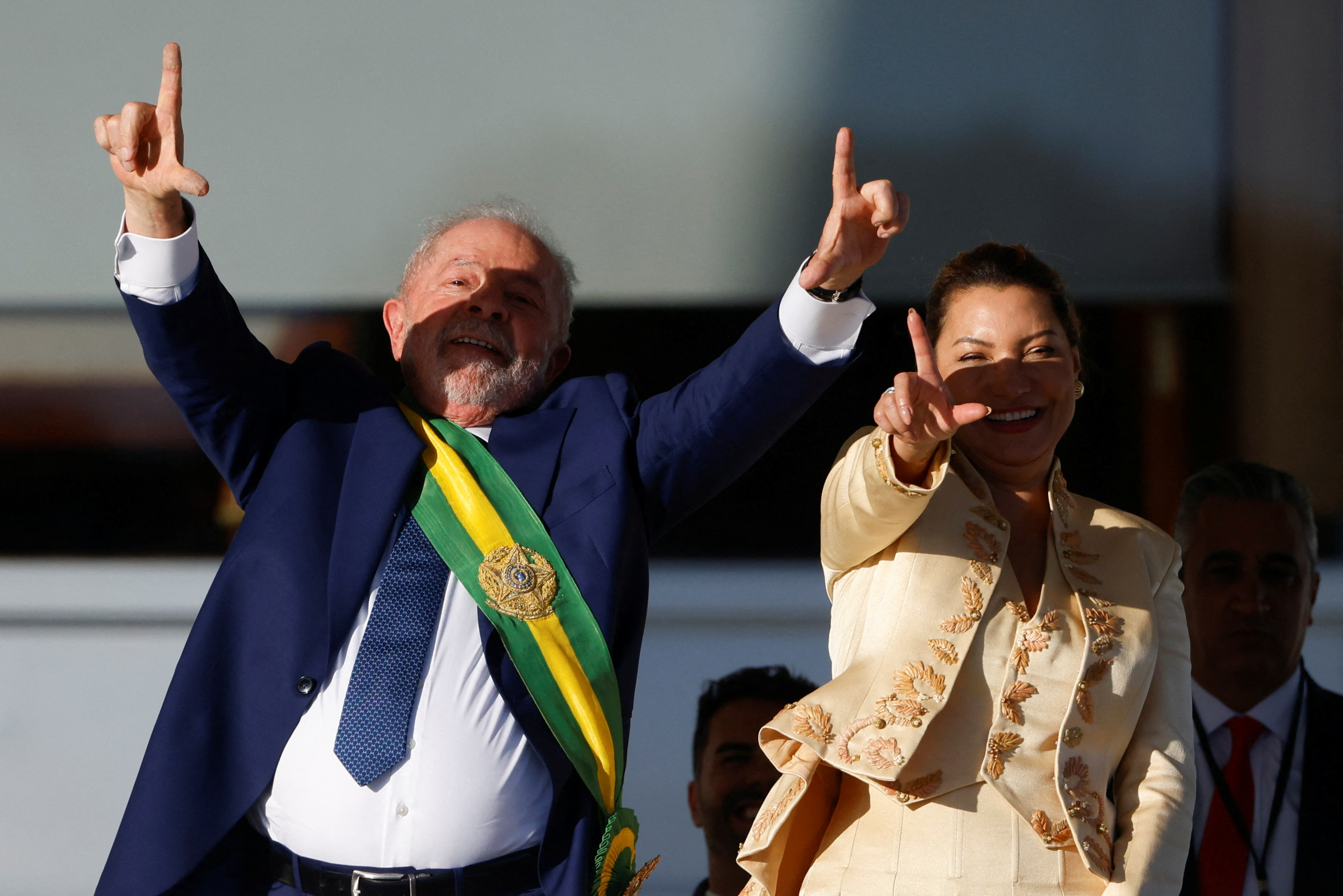
Brazil’s President Luiz Inacio Lula da Silva and his wife Rosangela “Janja” da Silva gesture at the Planalto Palace, in Brasilia, Brazil, January 1, 2023. REUTERS/Adriano Machado
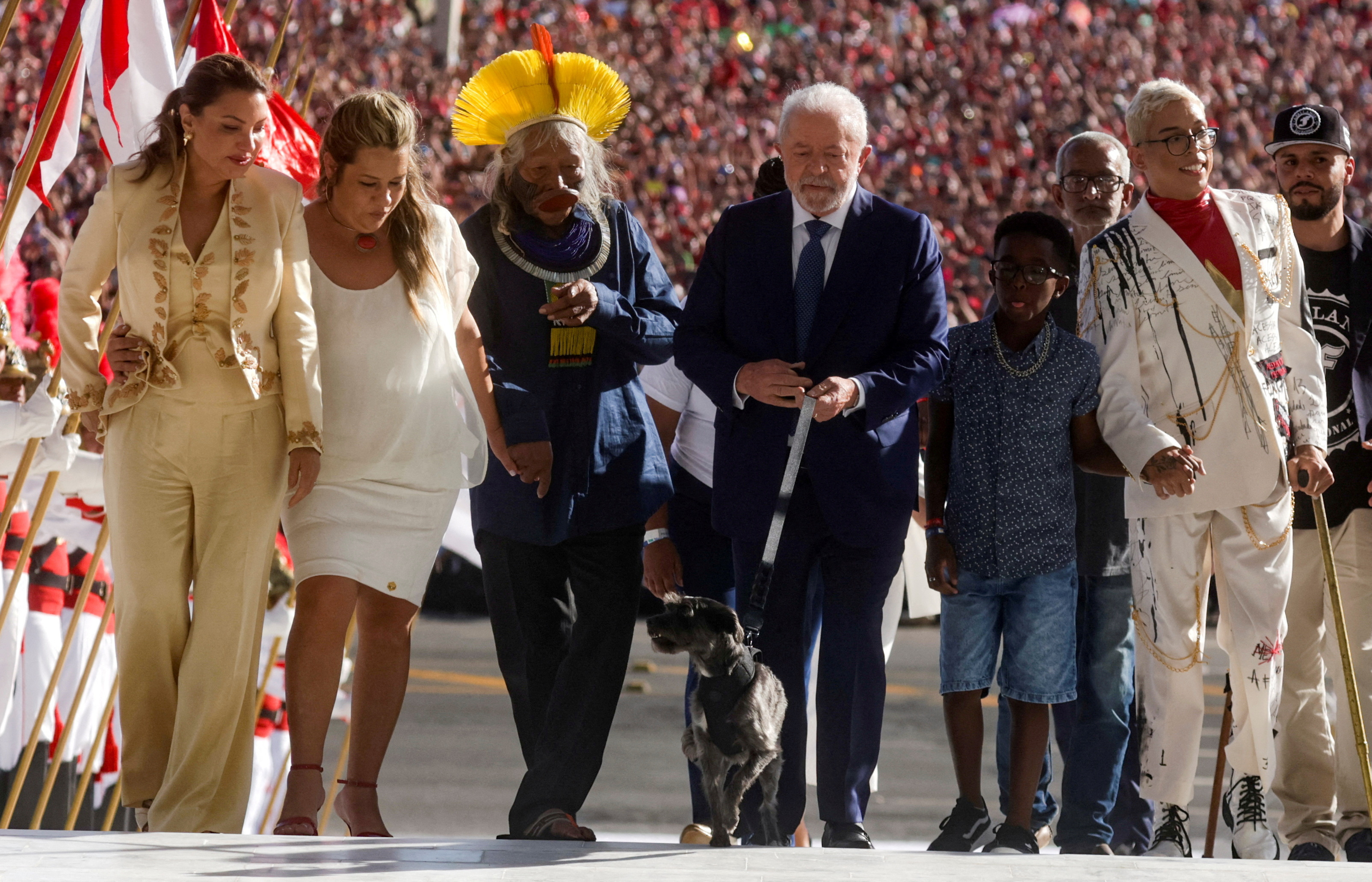
Brazil’s President Luiz Inacio Lula da Silva, his wife Rosangela “Janja” da Silva, Vice President Geraldo Alckmin and his wife Maria Lucia Ribeiro Alckmin, walk through the ramp of the Planalto Palace after his swearing-in ceremony, in Brasilia, Brazil, January 1, 2023. REUTERS/Ricardo Moraes
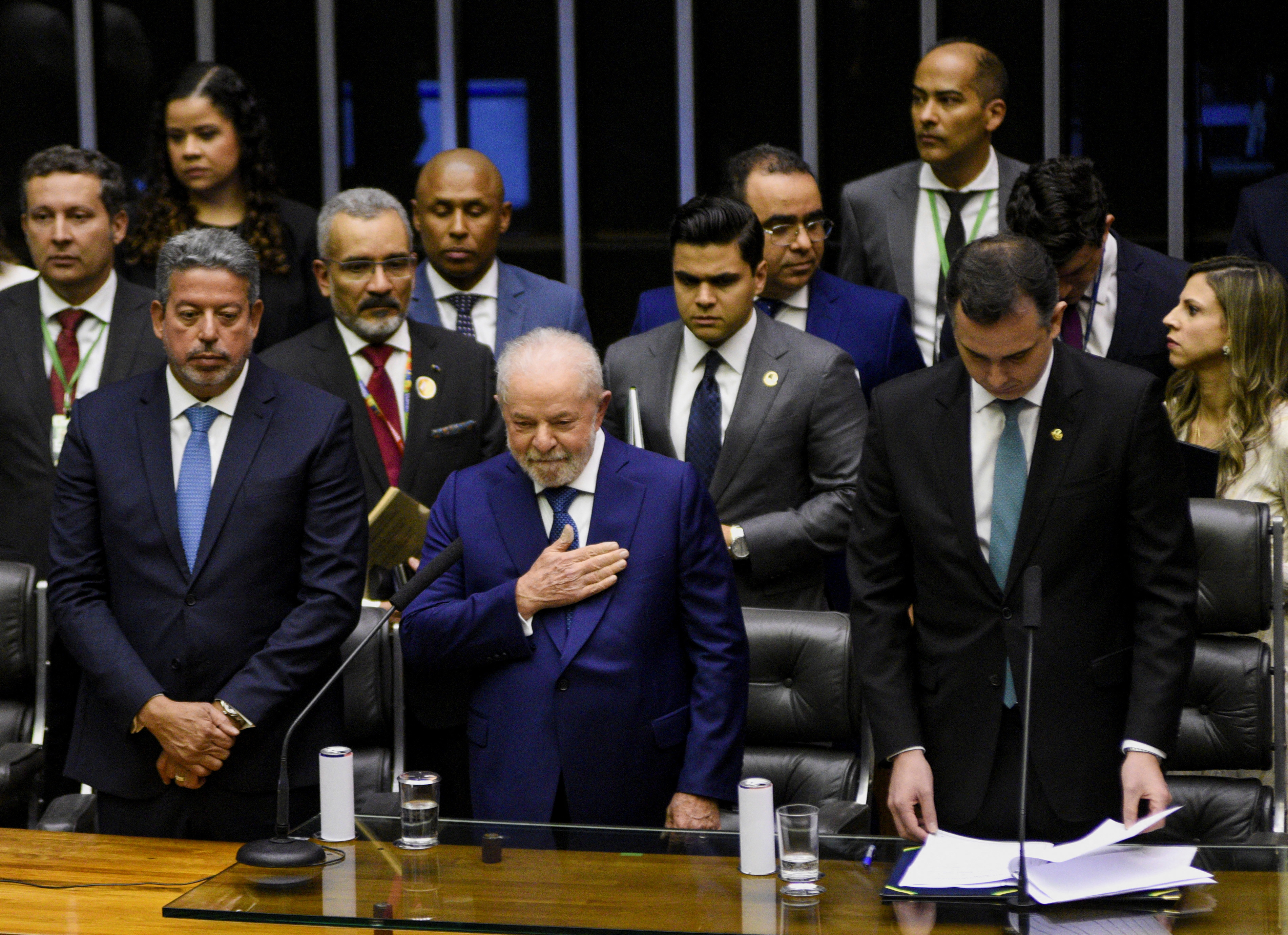
Brazil’s new President Luiz Inacio Lula da Silva gestures as he is sworn in at the National Congress, in Brasilia, Brazil, January 1, 2023. REUTERS/Jacqueline Lisboa
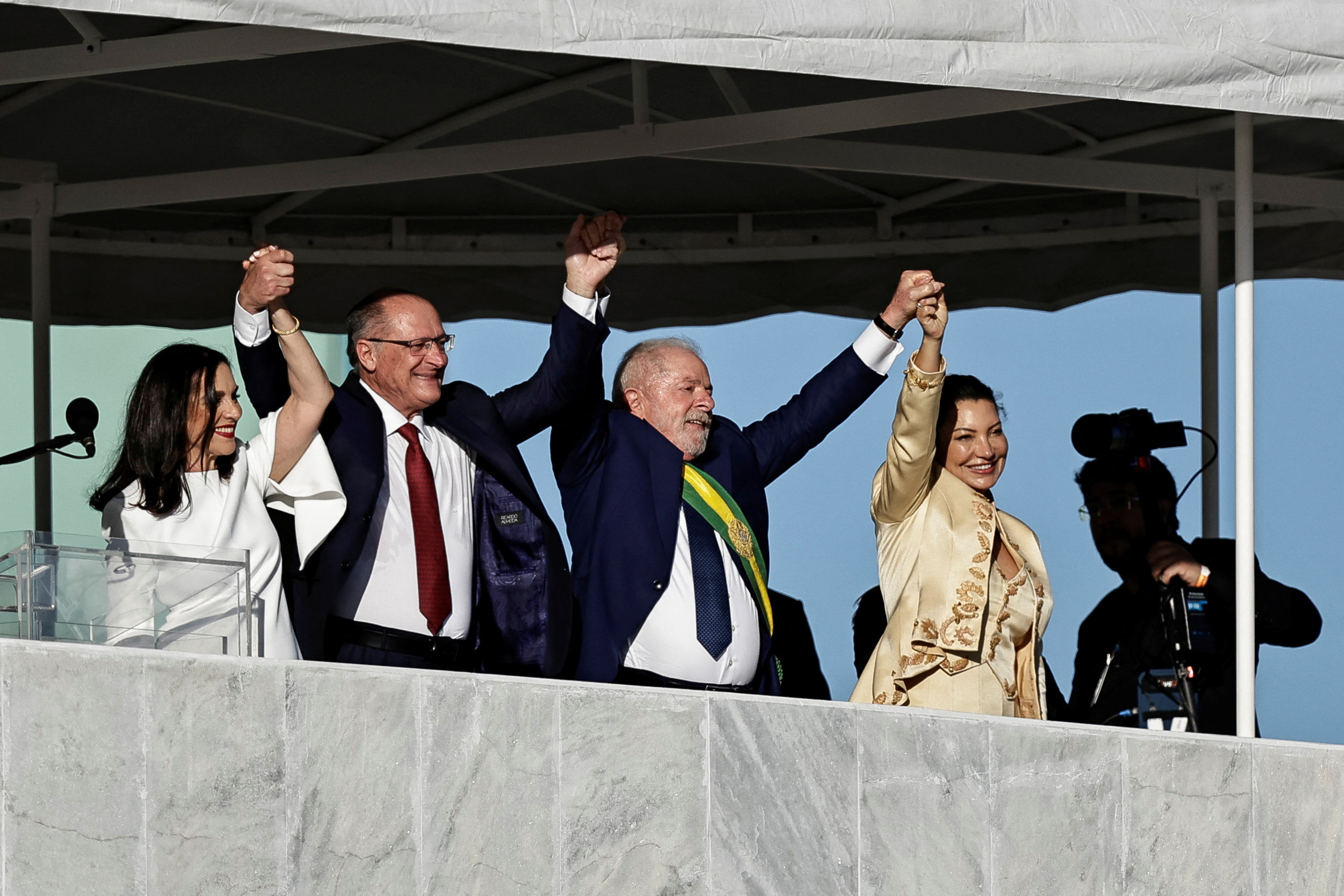
Brazil’s President Luiz Inacio Lula da Silva, his wife Rosangela “Janja” da Silva, Vice President Geraldo Alckmin and his wife Maria Lucia Ribeiro Alckmin raise their arms from a balcony at the Planalto Palace, in Brasilia, Brazil, January 1, 2023. REUTERS/Ueslei Marcelino
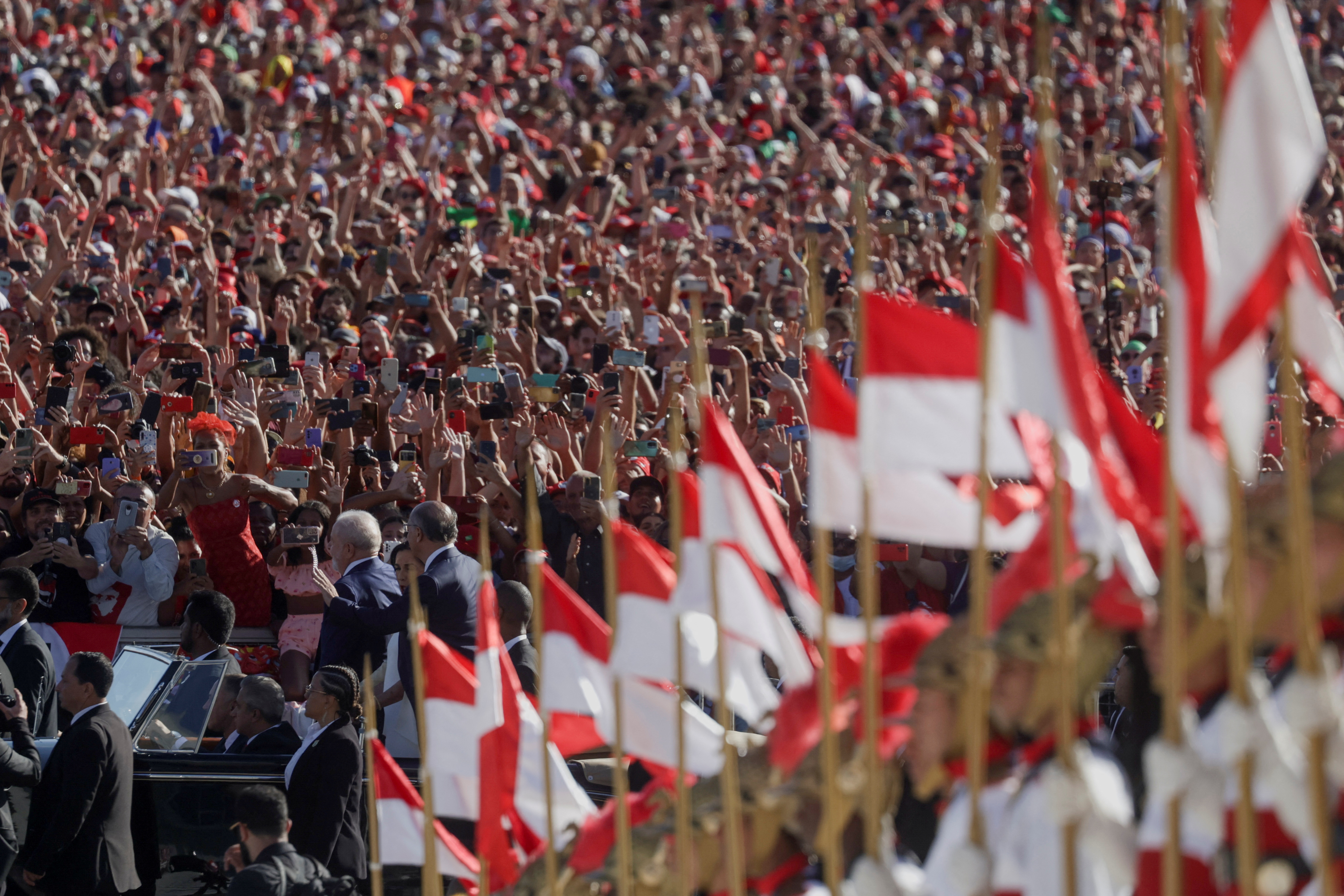
Brazil’s President Luiz Inacio Lula da Silva arrives at the Planalto Palace after his swearing-in ceremony, in Brasilia, Brazil, January 1, 2023. REUTERS/Ricardo Moraes
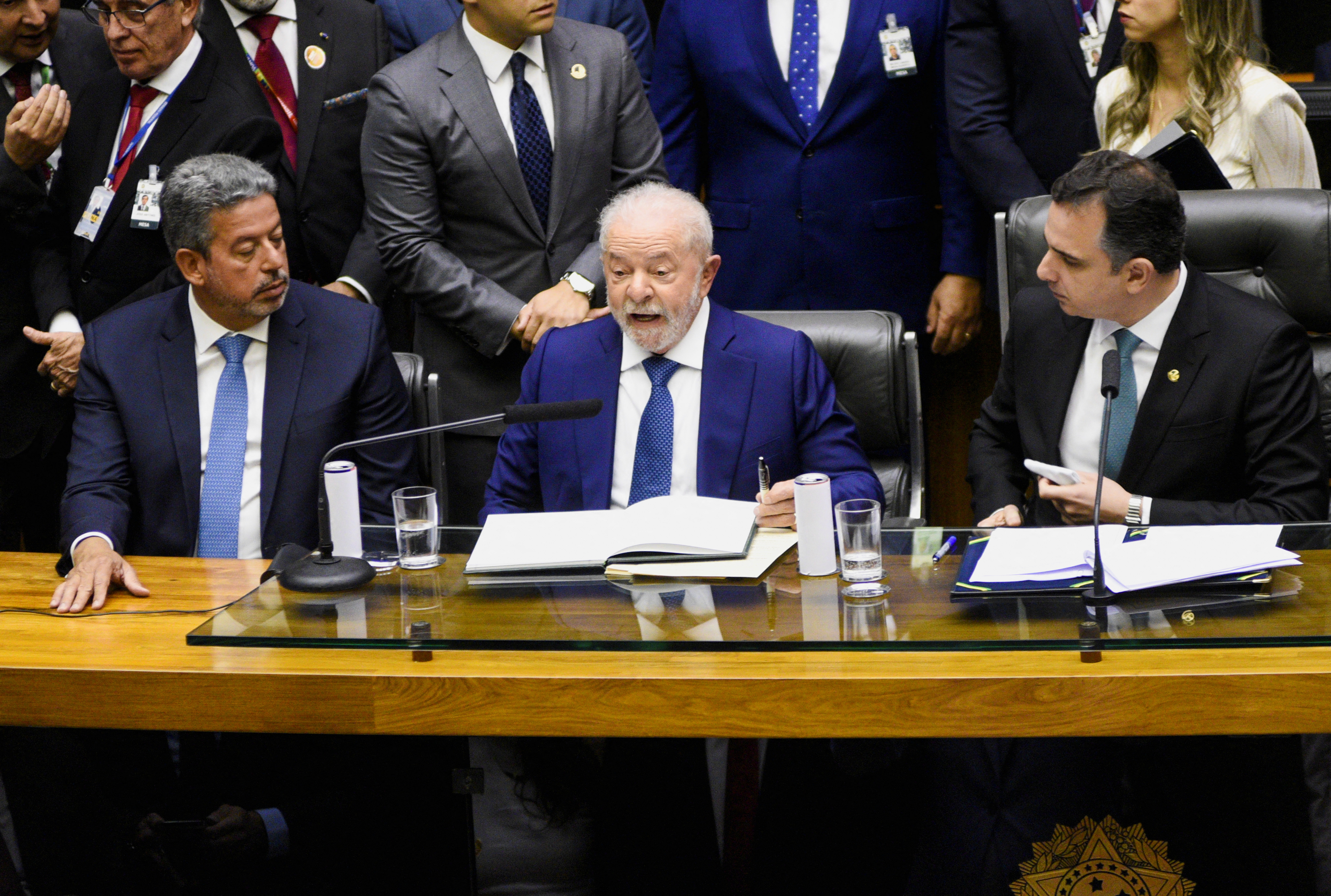
Brazil’s new President Luiz Inacio Lula da Silva speaks after being sworn in, at the National Congress, in Brasilia, Brazil, January 1, 2023. REUTERS/Jacqueline Lisboa NO RESALES. NO ARCHIVES
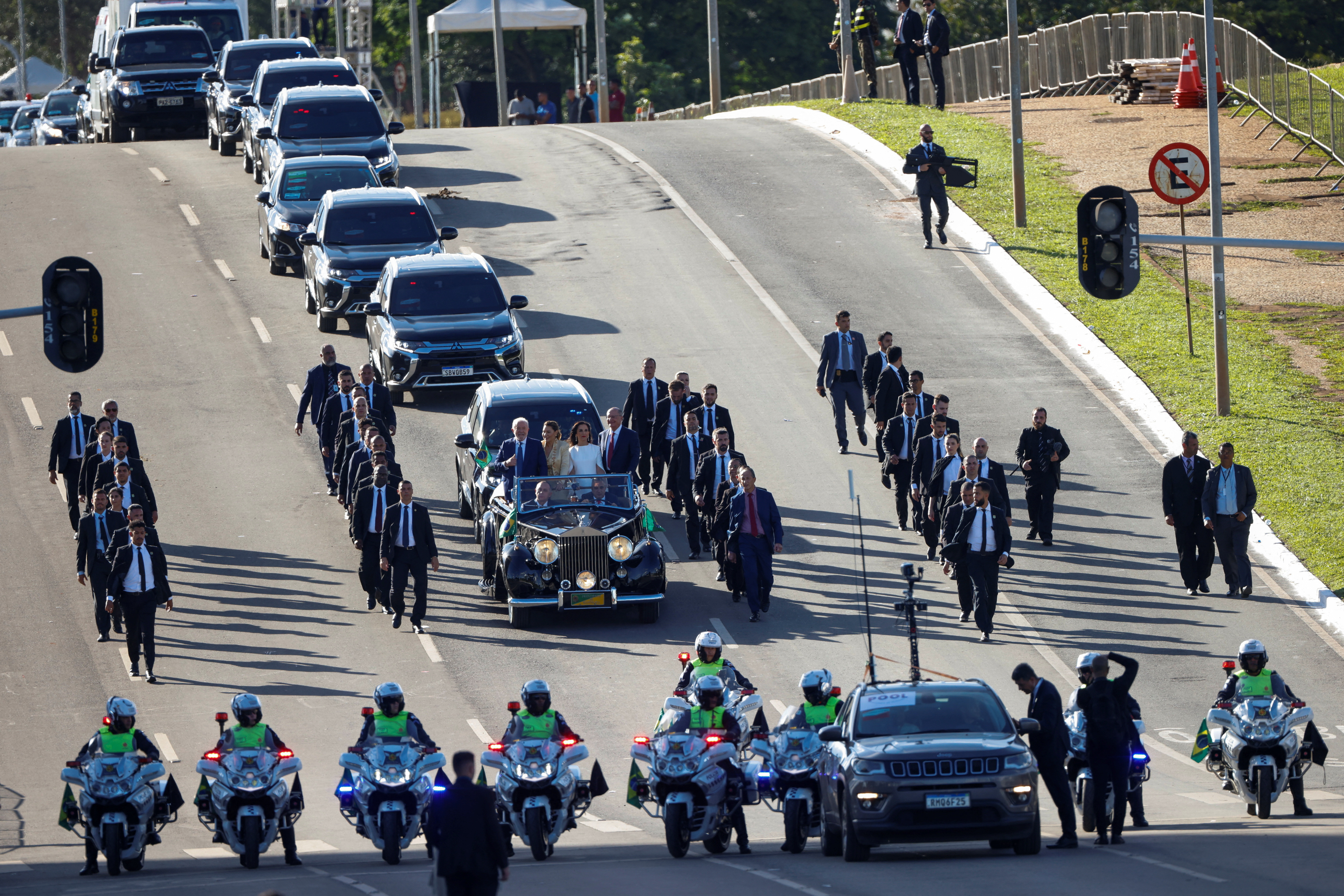
Brazil’s President Luiz Inacio Lula da Silva rides on a motorcade after his swearing-in ceremony, in Brasilia, Brazil, January 1, 2023. REUTERS/Adriano Machado
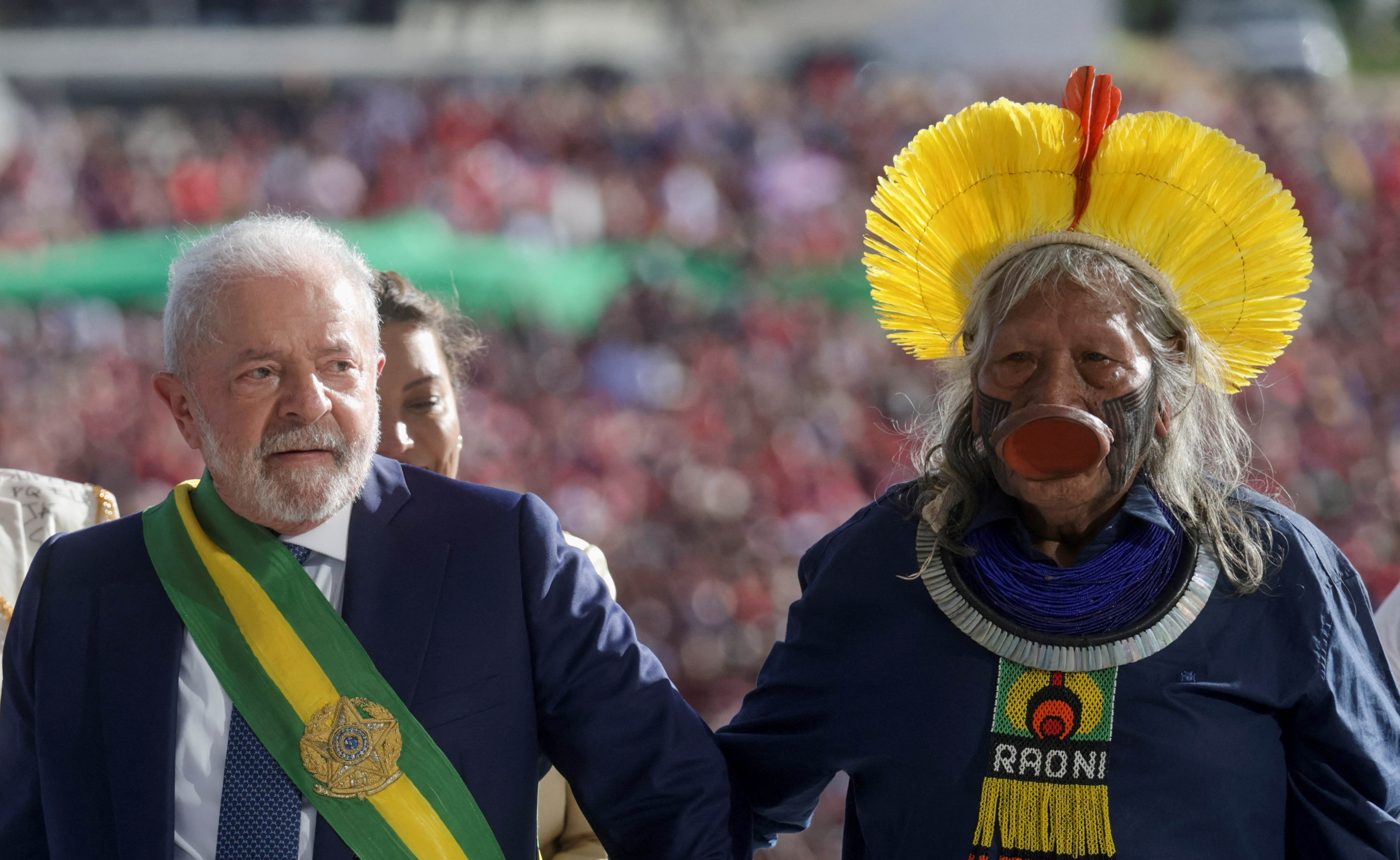
Brazil’s President Luiz Inacio Lula da Silva walks with Chief Raoni at the Planalto Palace, in Brasilia, Brazil, January 1, 2023. REUTERS/Ricardo Moraes
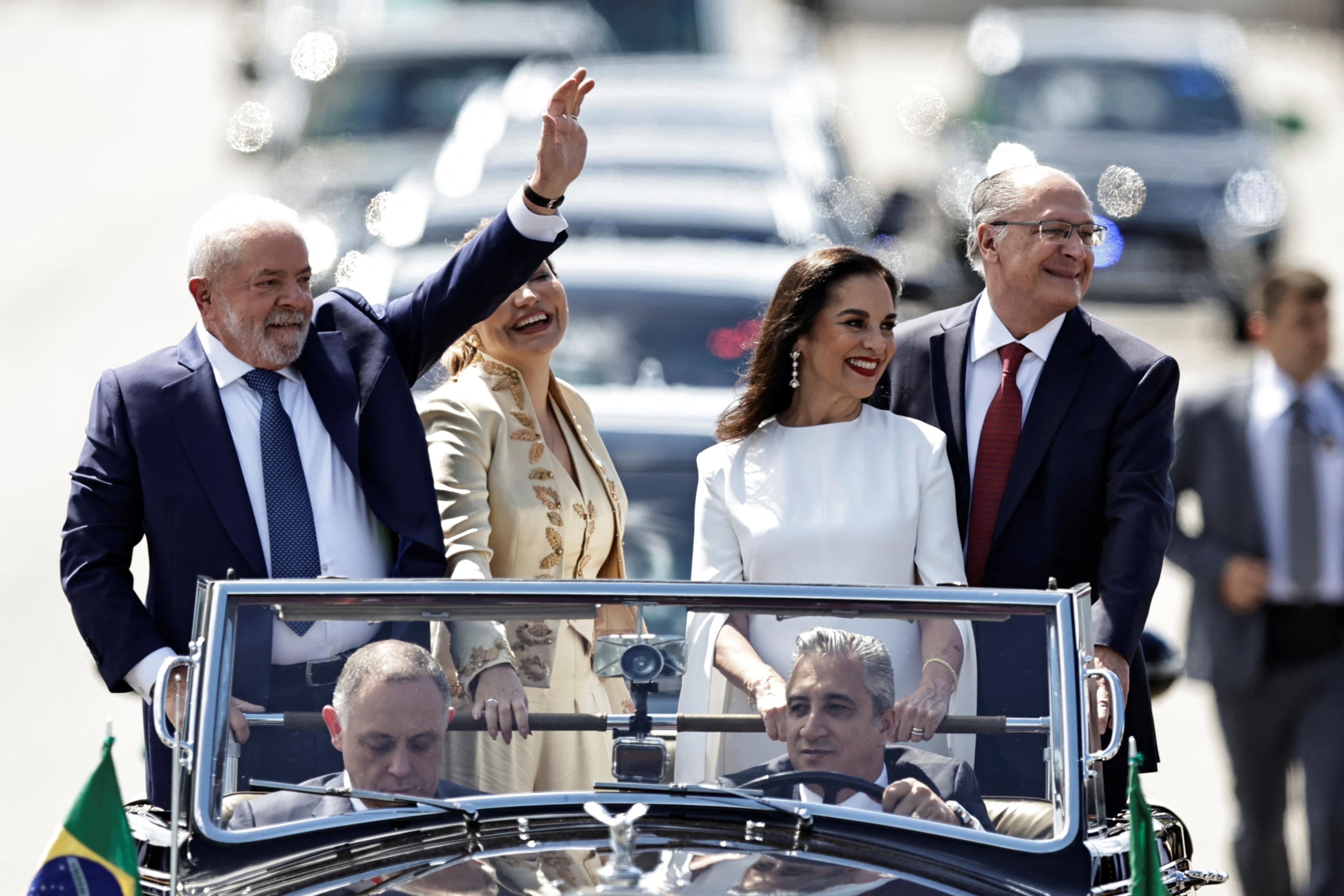
The motorcade of Brazil’s President elect Luiz Inacio Lula da Silva is seen near the Planalto Palace in Brasilia, Brazil, January 1, 2023. REUTERS/Ueslei Marcelino
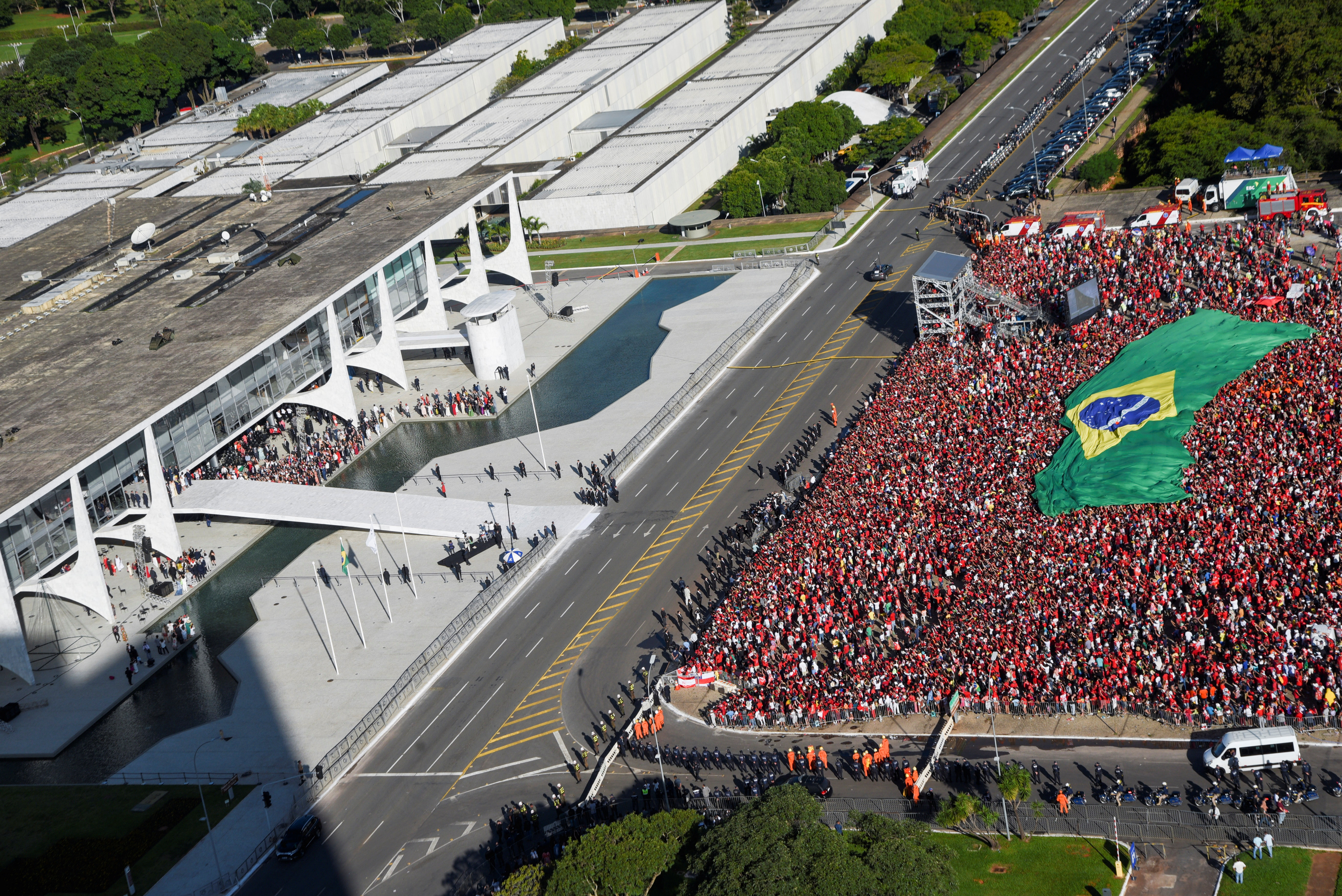
Supporters of Brazil’s new President Luiz Inacio Lula da Silva gather outside the Planalto Palace, in Brasilia, Brazil, January 1, 2023. REUTERS/Jacqueline Lisboa NO RESALES. NO ARCHIVES
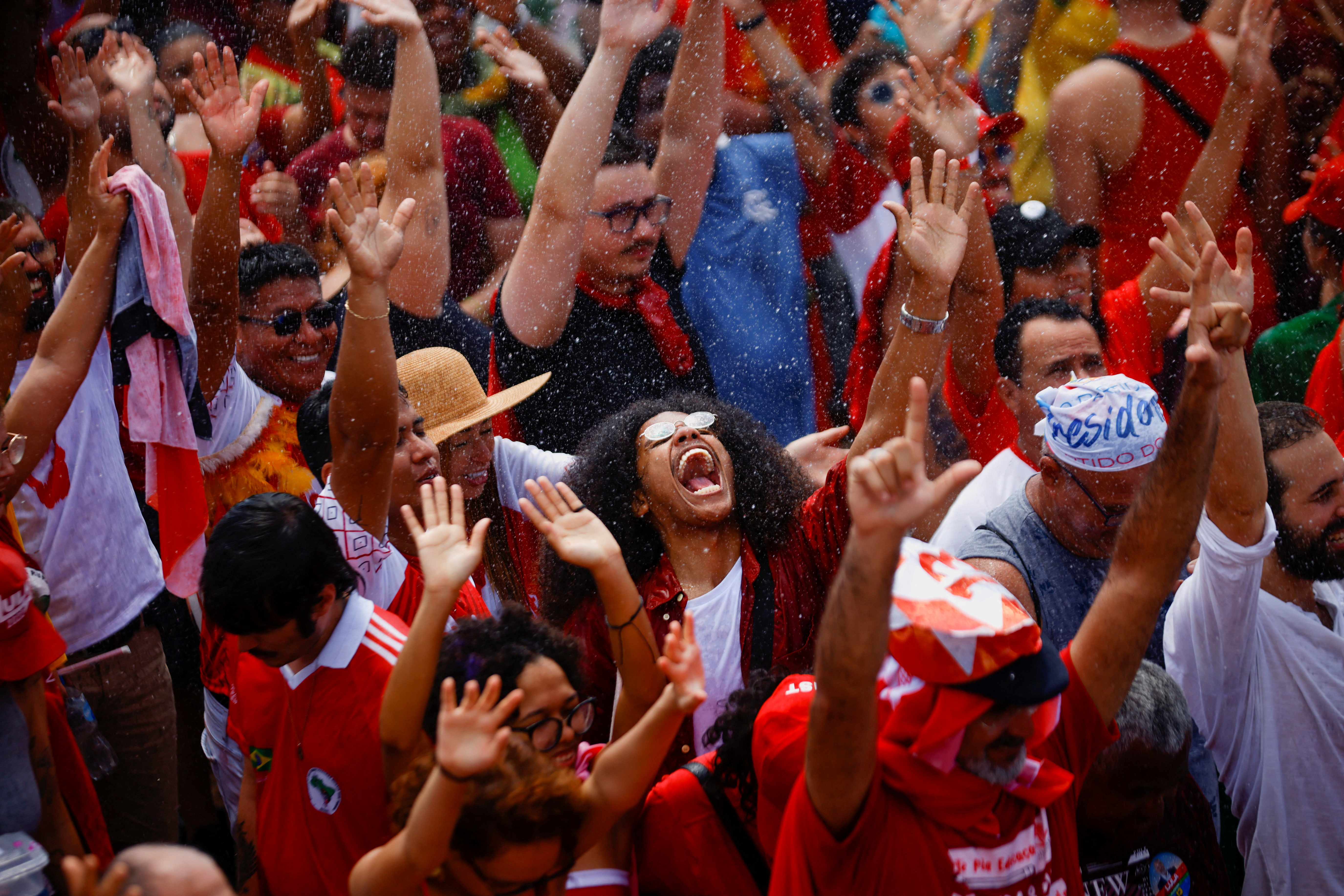
Supporters of Brazil’s President elect Luiz Inacio Lula da Silva gather outside the Planalto Palace ahead of Lula’s swear-in ceremony, in Brasilia, Brazil, January 1, 2023. REUTERS/Adriano Machado
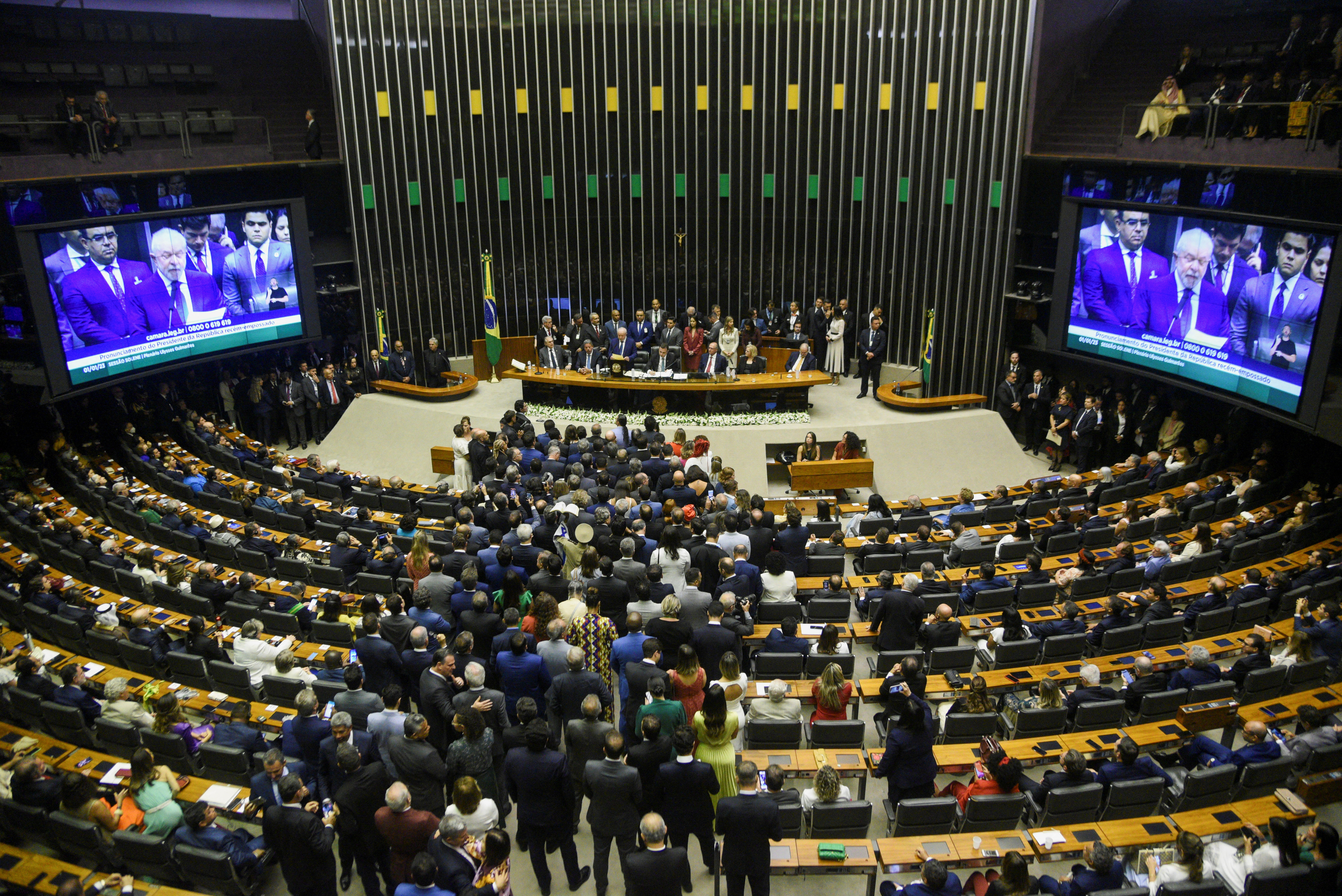
General view as Brazil’s new President Luiz Inacio Lula da Silva delivers a speech after being sworn in at the National Congress, in Brasilia, Brazil, January 1, 2023. REUTERS/Jacqueline Lisboa
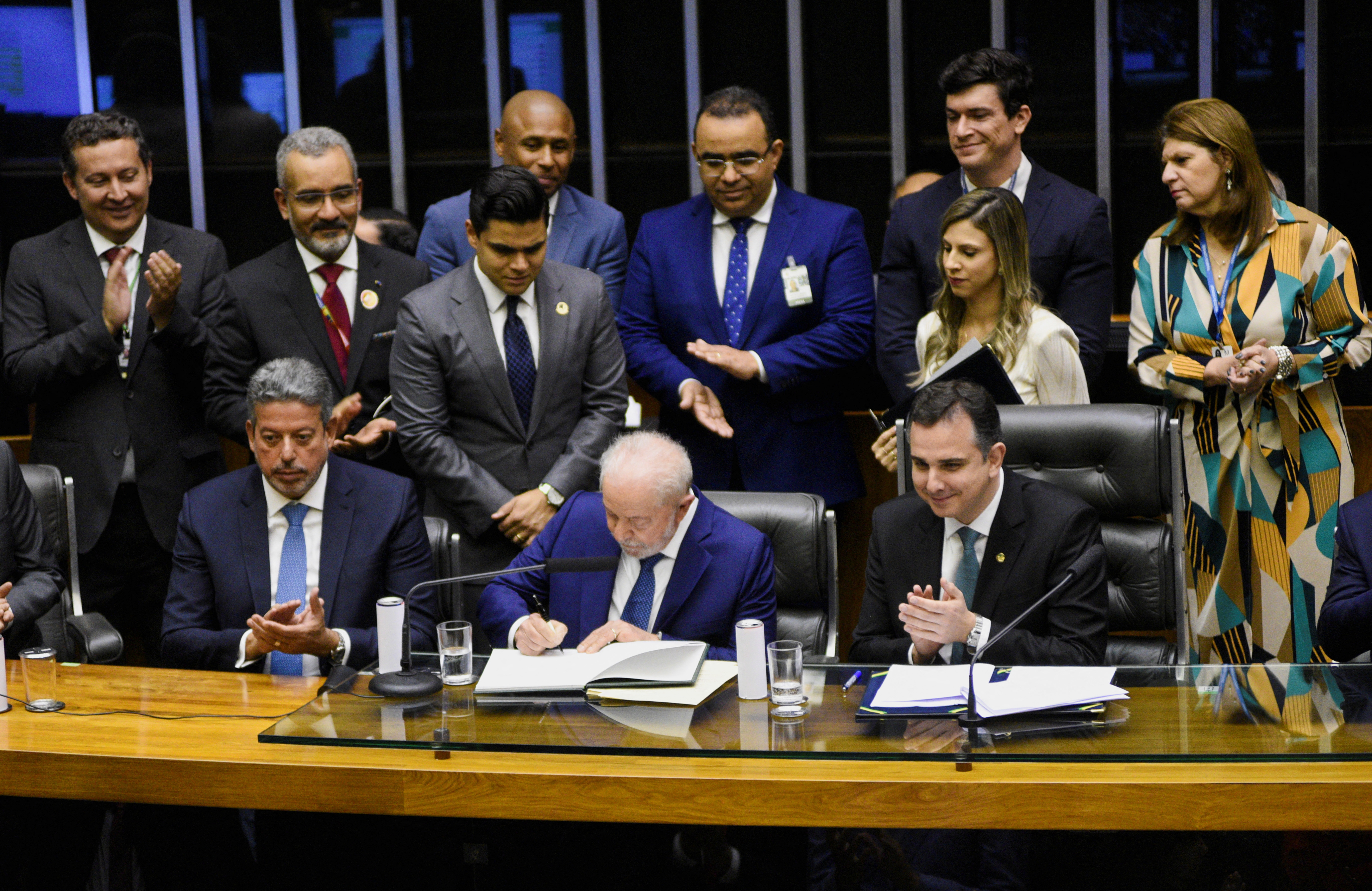
Rodrigo Pacheco, President of Brazil’s Federal Senate, and Arthur Lira, President of Brazil’s Chamber of Deputies, applaud after Brazil’s new President Luiz Inacio Lula da Silva was sworn in, at the National Congress, in Brasilia, Brazil, January 1, 2023. REUTERS/Jacqueline Lisboa
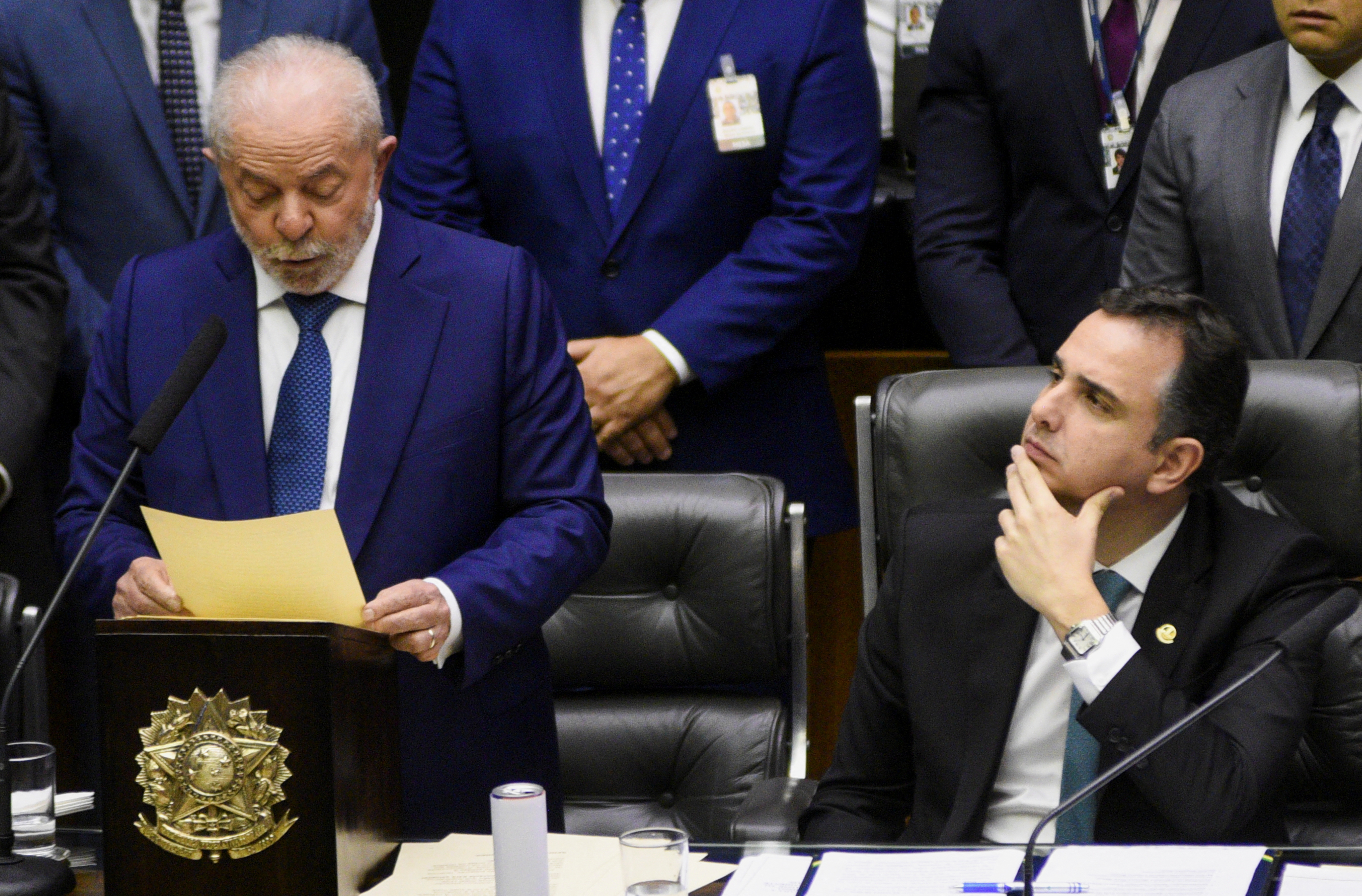
Rodrigo Pacheco, President of Brazil’s Federal Senate, listens as Brazil’s new President Luiz Inacio Lula da Silva delivers a speech after being sworn in at the National Congress, in Brasilia, Brazil, January 1, 2023. REUTERS/Jacqueline Lisboa NO RESALES. NO ARCHIVES
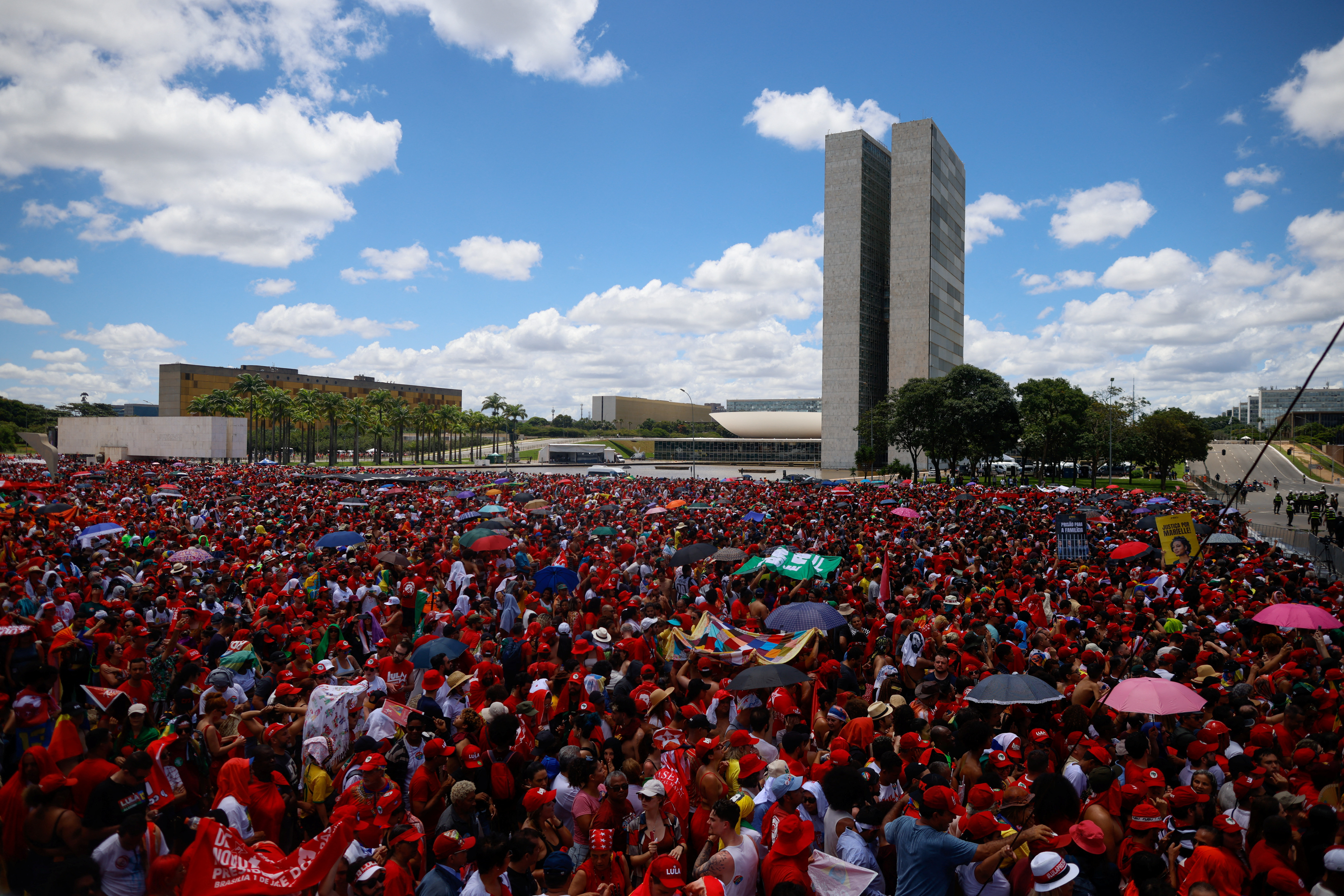
Supporters of Brazil’s President elect Luiz Inacio Lula da Silva gather outside the Planalto Palace ahead of Lula’s swear-in ceremony, in Brasilia, Brazil, January 1, 2023. REUTERS/Adriano Machado

Supporters of Brazil’s President elect Luiz Inacio Lula da Silva are sprayed with water during hot weather, as they gather outside the Planalto Palace ahead of Lula’s swear-in ceremony, in Brasilia, Brazil, January 1, 2023. REUTERS/Adriano Machado

Categories
Audio Sources - Full Text Articles

Donald Trump caught trashing his own supporters

19121c5c768fb6ee35d5576afe2d9a7f?s=100&d

Help support Palmer Report! Our articles are all 100% free to read, with no forced subscriptions and nothing hidden behind paywalls. If you value our content, you’re welcome to pay for it:

Pay $5 to Palmer Report:

Pay $25 to Palmer Report:

Pay $75 to Palmer Report:


There is new information that’s come out in a January 6 interview. This interview was with Stephanie Grisham. She is the former white house press secretary for Donald Trump. This interview is interesting. Of course, it’s about Donald Trump and the terrorists who stormed the Capitol on January 6.

According to details of this interview, Grisham said that Trump was proud of his little robots for coming to his defense. Look at them, he mused, speaking about what “fighters” they were! And they were fighting for him! Never had a traitor been prouder, I’m sure. Except for one thing. There was one thing that was bringing Trump down that day. And that is — their appearance.

That’s right. According to transcripts, Grisham said Trump was upset about how “trashy some of his supporters looked. And this concerned him.

Click here to support Palmer Report! Our articles are all 100% free to read, with no forced subscriptions and nothing hidden behind paywalls. If you value our content, you’re welcome to pay for it:

Pay $5 to Palmer Report:

Pay $25 to Palmer Report:

Sign up for the Palmer Report mailing list

Follow Palmer Report on FacebookTwitterPostMastodon


I guess it wasn’t enough that he’d turned these people into his own little terrorists. They had to look glamorous and striking while beating people up. None of this surprises me because Trump’s the type to value people solely by the exterior. He doesn’t have a soul, so it’s not like he has it within him to look for others’ souls.


I do wonder how his loving cult members might feel about this information. I know I wouldn’t be happy. However, there is a chance they will not believe it. As cult members, Maga are premium members. I suspect they do not have it within themselves to think their savior could wrong them in any way. They can’t admit the truth because then they’d have to admit he doesn’t know give a shit about any of them.

But it’s still nice to have clarification. So to recap — while Police — heroes, patriots, the ones Trump – and Maga — profess to LOVE — were getting terrorized — while people in congress and his own VP were in mortal danger — what was on Trump’s mind was — looks. Appearances. Wardrobe perhaps? How perfectly Trumpian of him.

Support Palmer Report! Our articles are all 100% free to read, with no forced subscriptions and nothing hidden behind paywalls. If you value our content, you’re welcome to pay for it:

Pay $5 to Palmer Report:

Pay $25 to Palmer Report:

Pay $75 to Palmer Report:

Write for the Palmer Report Community Section.

Help support Palmer Report! Our articles are all 100% free to read, with no forced subscriptions and nothing hidden behind paywalls. If you value our content, you’re welcome to pay for it:

Pay $5 to Palmer Report:

Pay $25 to Palmer Report:

Pay $75 to Palmer Report:

The post Donald Trump caught trashing his own supporters appeared first on Palmer Report.

Categories
Audio Sources - Full Text Articles

Biden to promote U.S. infrastructure spending in bipartisan Kentucky visit

2023-01-02T00:49:00Z

Democratic U.S. President Joe Biden will join Republican Senate Minority Leader Mitch McConnell in a Wednesday event in Kentucky aimed at highlighting the effects of the $1 trillion 2021 infrastructure bill, a White House official said Sunday.

The pair, along with Republican Ohio Governor Mike DeWine and Democratic Kentucky Governor Andy Beshear, are to appear at a ceremony highlighting the $1.64 billion in funding awarded to for the Brent Spence Bridge Corridor Project connecting the two states across the Ohio River.

Funding for the crossing includes a new bridge and rehabilitation of the heavily congested 60-year-old one.

The new bridge is intended to rehabilitate a heavily congested 60-year-old span and add a second crossing.

McConnell, of Kentucky, was among the Republicans who voted for the infrastructure law, which was passed in November 2021, while many House Republicans including Representative Kevin McCarthy it.

McConnell said last week in a statement that “building a new companion bridge on the Brent Spence Bridge corridor will be one of the bill’s crowning accomplishments.”

The event is set to take place the day after McCarthy’s Republicans take the majority in the House, breaking Democrats’ control of Congress and ushering in a period of divided government.

Kentucky and Ohio had sought funding for the project for years.

“This project will not only ease the traffic nightmare that drivers have suffered through for years, but it will also help ensure that the movement of the supply chain doesn’t stall on this nationally significant corridor,” DeWine said.

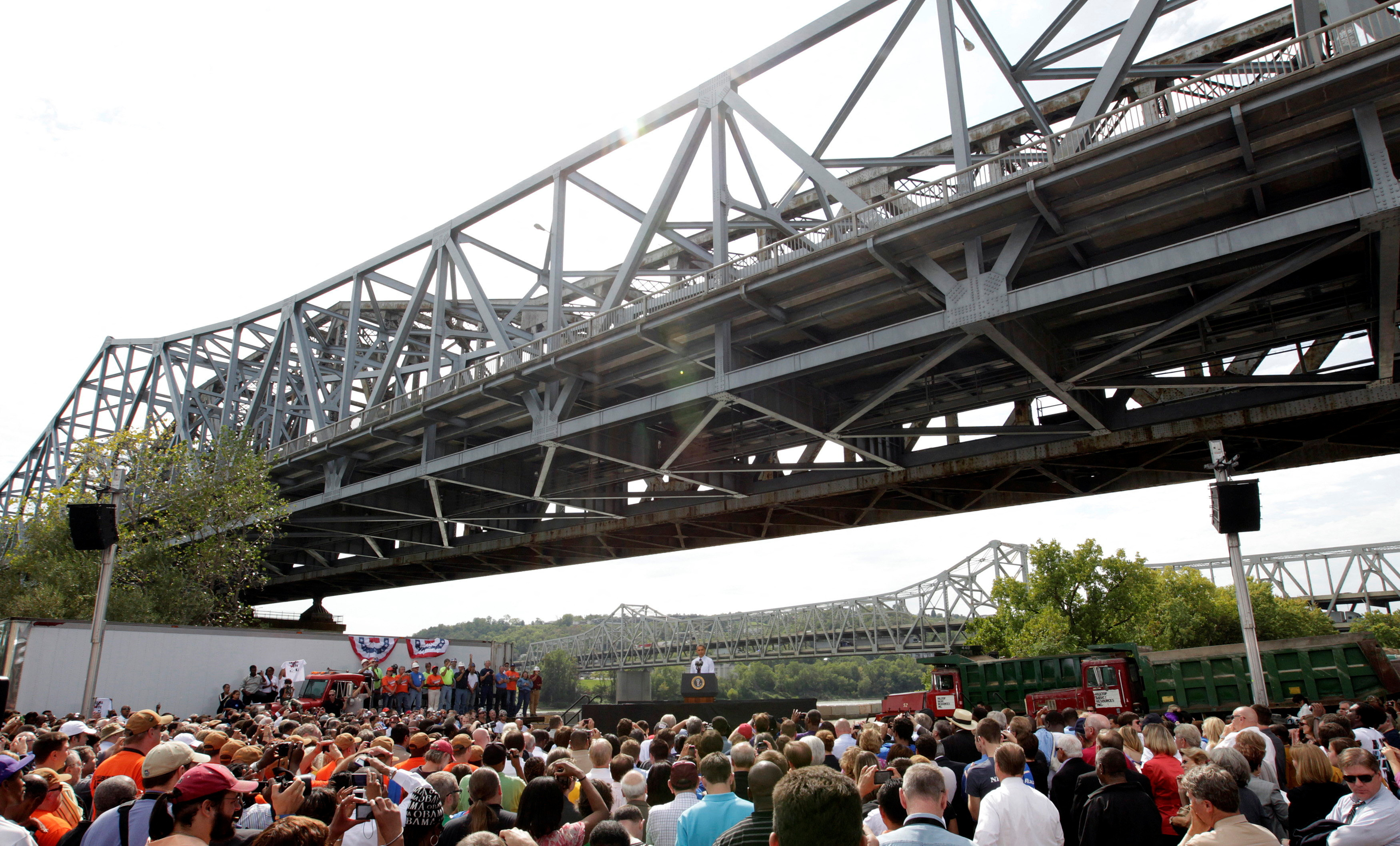
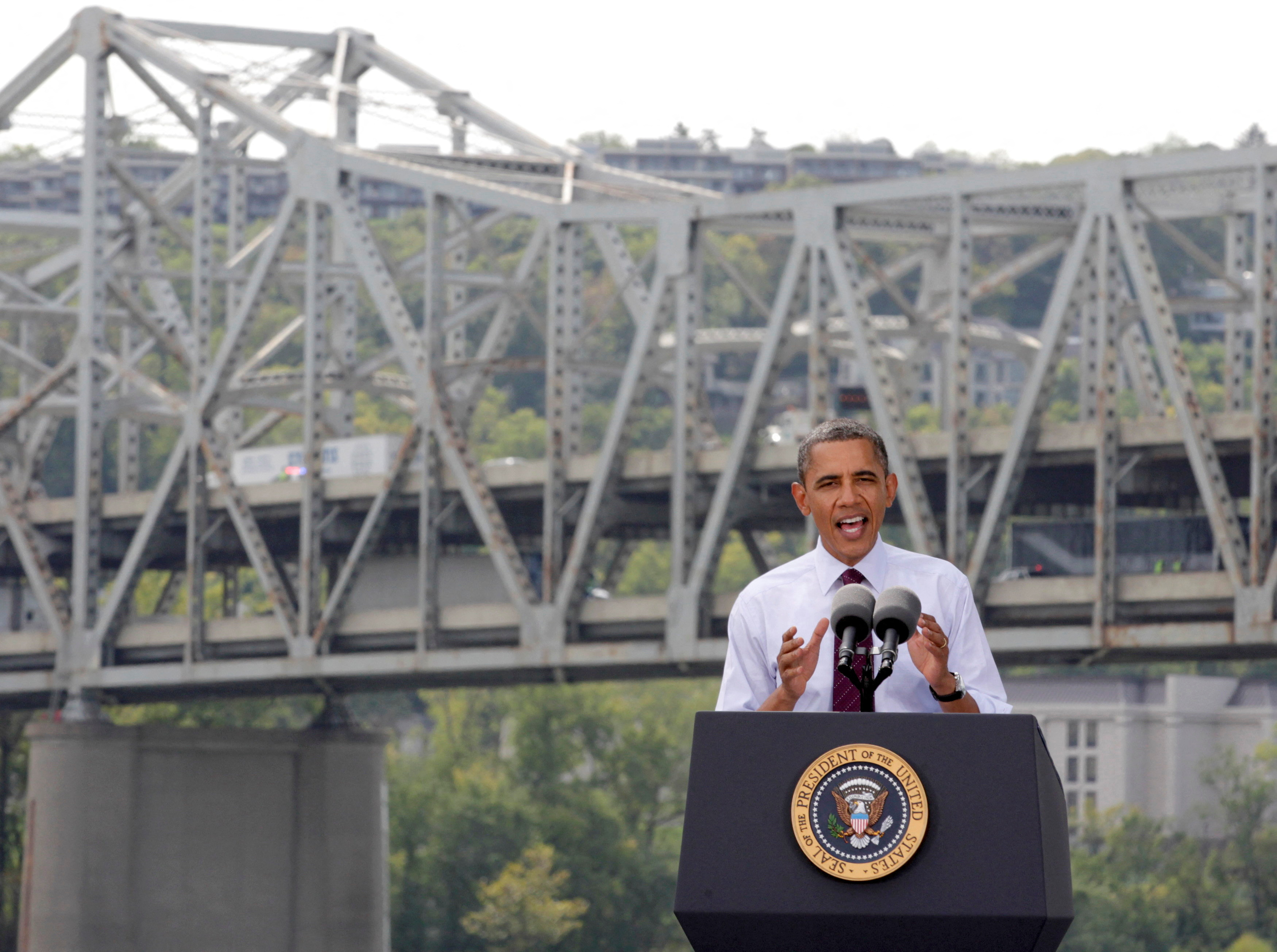
Then President Barack Obama visited the crossing in 2011 and urged Congress to pass a jobs bill costing billions of dollars that he said could include rebuilding the bridge, which by then had already been declared functionally obsolete.

During his 2016 run for the White House, Donald Trump backed funding for the project, but he failed during his four years in office to secure money for it or to pass the big infrastructure bill he repeatedly promised.

The 2021 infrastructure law includes $27 billion over five years to fix and replace thousands of aging U.S. bridges.

Other administration officials including Vice President Kamala Harris will also tout infrastructure awards in other events this week.

Related Galleries:

U.S. President Barack Obama speaks in front of the dilapidated Brent Spence Bridge during a visit to Cincinnati, Ohio September 22, 2011. REUTERS/John Sommers II

U.S. President Barack Obama speaks in front of the dilapidated Brent Spence Bridge during a visit to Cincinnati, Ohio September 22, 2011. REUTERS/John Sommers II


Categories
Audio Sources - Full Text Articles

Accused Idaho killer was studying under serial killer expert

(NewsNation) — Accused Idaho killer Bryan Kohberger previously studied under an academic who is a serial killer expert.

Kohberger, who was a graduate student at Washington State University’s Department of Criminal Justice and Criminology at the time of the killings, also studied criminology during his time at DeSales University in Center Valley, Pa.

It was there that he studied under Dr. Katherine Ramsland, a forensic psychologist who has spent decades researching serial killers and mass murderers. She appeared on NewsNation in October to discuss the Delphi case.

She is known for having developed a close relationship with the serial killer Dennis Rader, more commonly known as BTK.

In an exclusive interview, Rader’s daughter, Kerri Rawson, spoke to NewsNation’s Brian Entin.

“It’s hard to be the kid of this guy and live with this,” she said, choking back tears. “You know? And then see somebody else go do this and wonder did your dad influence this? Did your dad talk to him? Was he studying my father outside of academics? Am I ever going to get answers to that, I don’t know.”

So far, Ramsland is not discussing the case publicly. “I cannot make media statements about him at this time,” she said.

The public defender representing Kohberger told Entin that his dad went out to Idaho and drove back with him to Penssyvalnia in the White Hyundai Elantra sought by police in mid-December.

Watch the interview with Kerri Rawson in the video player at the top of the page.

WP Radio
WP Radio
OFFLINE LIVE