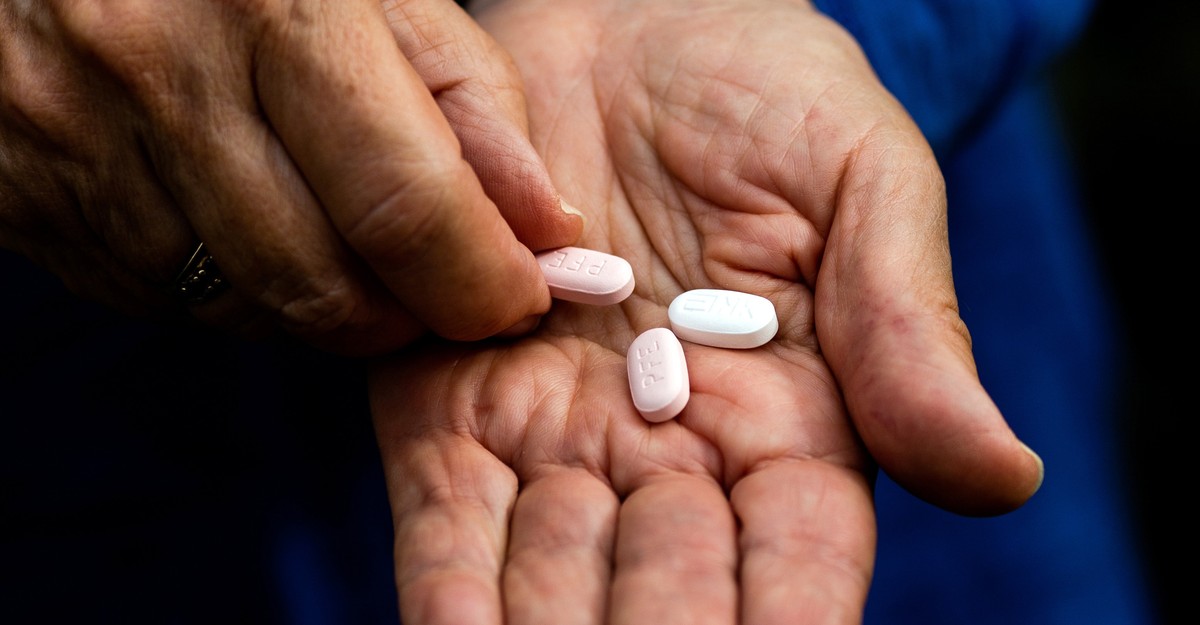
Four days after recovering from a COVID-19 infection, President Joe Biden has tested positive again. When he first got sick, Biden—like more than one-third of the Americans who have tested positive for COVID-19 this summer, according to the U.S. government’s public records—was prescribed Paxlovid, an antiviral pill treatment made by Pfizer. Like many Paxlovid takers, he soon tested negative and resumed his normal activities. And then, like many Paxlovid takers, his infection came right back. (Biden does not currently have symptoms, according to his physician.)
With more than 40,000 prescriptions being handed out a day, we’re taking Paxlovid at about the same rate that we’re taking oxycodone. When Biden got sick last week, he started taking the pills before the day was out. When Anthony Fauci had COVID in June, he took two courses. That enthusiasm is in line with the government’s messaging around the drug.
The Biden administration has consistently hailed Paxlovid as an effective tool in the fight against SARS-CoV-2. “For the most part, Paxlovid is doing what you’re asking it to do,” Fauci told me recently. Many researchers and physicians agree. Ann Woolley, the associate clinical director of transplant infectious diseases at Brigham and Women’s Hospital, told me that she feels “very fortunate” to be able to offer Paxlovid to her patients, even if it’s not a COVID panacea.
But some providers are prescribing the drug with a bit less enthusiasm, particularly when it comes to vaccinated patients (such as Biden and Fauci). Reshma Ramachandran, a family-medicine doctor and researcher at Yale, told me that she’s feeling a sense of “resignation” about Paxlovid. Though it’s one of the few COVID treatments she can offer, she can’t say with confidence that the pills will help someone who’s been immunized. Bob Wachter, the chair of medicine at UC San Francisco, called assessing the value of Paxlovid for these patients a “massively complicated three-dimensional chess game.” Anyone who might want to take the drug should discuss with their doctor whether and when they’ve been infected before, how many vaccine doses they’ve had (and when they had them), their age, and other risk factors—all in light of the limited clinical data that are now available. Patients will surely struggle to make sense of all these variables. Their doctors might, too. “I can barely decide whether I want it, and I do this for a living,” Wachter said.
A person could have easily forgiven such confusion when Paxlovid was first being rolled out on a large scale, following an emergency authorization last winter. But now, eight months later? More than 3 million people have taken it. Pfizer has announced two sets of results from its clinical trial and submitted data to the FDA for full approval. Dozens of independent studies of the drug have been published or released as preprints. And yet, doctors remain unsure of: who might benefit from Paxlovid and in what ways; who really needs it; why and how often rebound infections such as Biden’s and Fauci’s occur; whether the drug reduces patients’ risk of developing long COVID; and whether the virus will slowly develop resistance to the drug.
Read: Rebound COVID is just the start of Paxlovid’s mysteries
These questions remain unanswered (or incompletely answered) thanks to corporate secrecy, the minutiae of drug testing, and the necessary care with which human trials are conducted. But in a more fundamental way, the persistent fog around Paxlovid comes from the disease that it’s meant to alleviate. The pandemic is simply moving too quickly, the virus is evolving too fast, and our responses to it are changing too often for anyone to find unambiguous answers about one specific drug.
Before we walk into that fog, let’s get some things settled: Paxlovid is effective at keeping unvaccinated, high-risk people—those who are most likely to require hospitalization if they come down with COVID—alive and out of the hospital. The drug has some side effects, such as a strange and unpleasant taste, but its safety profile is stellar. (It does have some known, dangerous interactions with other common medications.) No one died while taking it in Pfizer’s clinical trials. Got it? Good. Now on to the mysteries.
When I spoke with Fauci, he repeatedly emphasized that the point of Paxlovid is “to keep you out of the hospital and prevent you from progressing to severe disease.” But does the drug really have this benefit for young, vaccinated people, who would seem to represent a significant proportion of those taking it? COVID hospitalization rates for those younger than 60 are currently less than two per 100,000. Given those numbers, Paxlovid—or any other drug, for that matter—isn’t likely to provide much benefit. “If your risk of hospitalization is incredibly low, to make that even lower is somewhat improbable,” David Boulware, an infectious-disease physician and a researcher at the University of Minnesota, told me.
That might explain why Pfizer’s trial found no statistically significant effect on hospitalization among a group of unvaccinated people at low risk from the disease and vaccinated people at high risk. An Israeli study conducted this winter similarly showed that Paxlovid did not significantly affect hospitalization rates in vaccinated, high-risk patients younger than 65. A study from Hong Kong did find that vaccinated Paxlovid takers were only about two-thirds as likely as non-takers to be hospitalized; but these data were not broken down by age, and the most popular vaccine choice among older Hong Kongers, Sinovac, is less effective than the mRNA-based vaccines that have dominated in the United States. A study that Woolley co-authored in Massachusetts found that Paxlovid reduced the risk of hospitalization for vaccinated people of all ages by 28 percent; and if a person’s last shot was more than 20 weeks old, the protection offered by the pills nearly doubled.
With the exception of Pfizer’s clinical trial, these studies are not placebo-controlled experiments, which makes them vulnerable to confounding factors. Woolley acknowledged the limitations of her own research, and told me that the benefit she found was “incremental.” Still, thanks to the paper, “I do feel like I have, now, significant data and experience to be able to have a well-informed discussion with my patients,” she said. “I’m not worried that we are giving placebo.”
Read: Paxlovid mouth is real—and gross
Other experts aren’t yet convinced. “I think we’re still left with a little bit of head-scratching about the utility of the drug in younger people or in people who are fully vaccinated and boosted,” Wachter told me. Boulware said he’s eager to see Pfizer’s results separated by vaccination status, which the company has not released. Those numbers wouldn’t necessarily tell us how Paxlovid fares against BA.5, but at least they come from a placebo-controlled trial. The data that have been made public to this point, he said, “suggest that there’s really minimal to no benefit, most likely, for the vast majority of people.”
If Paxlovid was shown to have benefits beyond keeping people out of the hospital—if we knew that it made symptoms less intense, for example, or go away sooner—then the case for using it in young, vaccinated people might be stronger. But so far, those data have been lacking too. Pfizer’s own trials found that the drug did not reduce the duration of COVID patients’ symptoms or work to prevent infection when taken as a prophylactic.
According to a CDC advisory, people who take Paxlovid for a COVID-19 bout could experience a resurgence of the infection—a Paxlovid rebound—between 2 and 8 days after their initial recovery. Biden’s four-day boomerang, then, is fairly typical.
How common are these rebounds, and why do they occur? Even now, no one really knows. The Biden administration and researchers have maintained that rebound cases are not severe in general. But no definitive evidence has emerged to indicate how often they occur, who’s most likely to get them, or whether they’re related to Paxlovid at all. “It remains one of the most confusing things I can recall during the pandemic,” Wachter said.
The few studies that have quantitatively assessed the rate of rebound have returned a range of numbers, centered at something less than 10 percent. Pfizer told me this spring that just 2 percent of their unvaccinated, high-risk Paxlovid takers rebounded during clinical trials. In June, a Mayo Clinic study of 483 patients logged a symptom-rebound rate of less than 1 percent, while one from Case Western Reserve University and the National Institutes of Health found that 5.4 percent of Paxlovid patients tested positive again within 30 days, and 5.9 percent had a recurrence of symptoms. (Similar numbers rebounded after taking molnupiravir.)
Yet some clinicians told me that they don’t yet buy these numbers. Wachter said he suspects the real rebound rate is more like 10 or 15 percent. Ramachandran’s experience with her patients, family, and friends makes her think it’s even higher, perhaps 25 or 50 percent. (She stressed that this estimate is purely based on anecdotes.) Woolley didn’t want to pick a number, but said that a rate higher than 2 percent and much lower than 20 seems plausible to her. Even Fauci was willing to entertain the notion that 2 percent simply isn’t right. “I want to be humble and modest enough to say I don’t know,” he said.
Daniel Griffin, an infectious-disease expert, believes that fewer than 10 percent of people who take Paxlovid end up rebounding, but he also thinks those rebounds have nothing to do with the drug. “We’ve always seen this,” he told me. According to Griffin, physicians who have been taking care of COVID patients since 2020 were already seeing a pattern of disease, especially in high-risk patients, that entailed two weeks of worsening symptoms. He suspects Paxlovid suppresses the first half of the illness; when that suppression stops, you get the “rebound.”
Some experts have hypothesized that the way we’re using Paxlovid may be causing rebound. Wachter raised the possibility that taking Paxlovid too early in your course of illness could be one factor. The idea is plausible, Woolley told me, but “it goes against what we know also to be the case: The earlier you treat with an antiviral, the more effective it is.” (The FDA has only authorized Paxlovid to be distributed within the first five days of a patient’s having COVID symptoms.)
Do rebound cases suggest that the virus can evolve, within a patient, to make itself Paxlovid-proof? Again, the research seems to point in two directions. A group of researchers at UC San Diego studied one rebound case very carefully, and ruled out antiviral resistance as the cause. But even if resistance isn’t driving rebound, subsequent research has shown that SARS-CoV-2 is capable of developing resistance to Paxlovid, at least in a lab setting. “Any time you’re treating a disease caused by an RNA virus with a single drug, it’s not optimal, just because their capacity for change is great,” Timothy Sheahan, a virologist at the University of North Carolina at Chapel Hill, told me. He described the way he studies antiviral resistance in the lab. Step one: Grow a virus. Step two: Add some antiviral medicine, but not enough to completely suppress viral replication. Step three: Introduce that virus to a new host. Repeat. It sure sounds a lot like a COVID patient taking Paxlovid, rebounding, not realizing that they’re contagious again, and giving the virus to somebody else.
To ward off the possibility of resistance, Sheahan said, we need other drugs. “My hope, taking a page from the HIV-therapy playbook, is that there will and should be a multidrug cocktail to treat this disease, at the very minimum containing a few direct-acting antivirals,” he said. He’s also keen to find out whether such a cocktail would eliminate rebound.
Other researchers, including the ones from UC San Diego, suspect that prescribing a longer Paxlovid course might do the trick. Pfizer is planning to test whether a 10- or 15-day course of the drug might lead to better results, including lower rebound rates, among immunocompromised patients.
“I think it’s really important to determine what the real duration of treatment should be,” Fauci told me. Maybe, he said, it’s “going to have an impact not only on rebound, but also on whether a person gets long COVID or not.” But Ramachandran and Wachter both said they fear that hypothetical connection could go both ways: Perhaps rebound could raise a person’s chances of getting long COVID. To be clear, there is no empirical evidence as yet that supports this possibility—just physicians’ feelings of uncertainty around Paxlovid, plus some anecdotes. A few months ago, Wachter’s wife had COVID, took Paxlovid, and rebounded. Now, he said, she gets tired much more easily than she did before.
Don’t expect this fog to lift anytime soon. For one thing, Pfizer has not yet made full data on the use of Paxlovid by vaccinated people available to researchers or anyone else. The Biden administration has not made any public efforts to pressure the company into doing so.
More research groups are, of course, working to find answers. Several experts told me they’re eagerly awaiting the results of the RECOVERY trial in the U.K., which will rigorously test Paxlovid in hospitalized patients. Woolley and her colleagues plan to study the risk profiles of patients who request a second course of Paxlovid because they experience a rebound. At UNC, Sheahan is part of a group working on a rebound-related study. Fauci said, “We are making steps and planning studies and doing concept sheets for studies” regarding rebound rates and the appropriate duration of treatment.
All of that research is going to take time. A spokesperson for the RECOVERY trial told me that fewer than 100 participants had been recruited as of July 25, and that the researchers need “at least several thousand” to draw conclusions. “It is likely to be many months yet before the trial can generate a result for Paxlovid,” they wrote in an email. Pfizer’s trial in immunocompromised patients, which will specifically investigate rebound and treatment duration, is listed as “not yet recruiting” on clinicaltrials.gov. Sheahan and his colleagues began planning their study around the turn of the new year, and only received approval from their institutional research board this month. They haven’t yet begun enrolling participants. When I asked Sheahan when he expected results, he said, “Hopefully several months.”
By the time this work gets peer-reviewed and published, it will be a little out of date. Months from now, America’s immune landscape will be different thanks to new infections, waning immunity, and newly formulated vaccines. We might be facing a new variant or subvariant that causes more or less severe disease, or replicates differently in the body, or simply responds differently to antivirals. The pandemic has been in an accelerating state of all-over-the-place since last year; research on Paxlovid can only lag behind.
In the meantime, patients and providers are muddling through. All of the doctors I spoke with said that they’re still erring on the side of prescribing Paxlovid, thanks to its lack of debilitating side effects. Sheahan, though not a medical doctor, was recently a Paxlovid patient when he came down with COVID after traveling. “I ended up on the medication within 48 hours after the onset of symptoms and was antigen negative in nine days. And it never came back,” he said when we spoke last week. Five days later, he emailed me to say that he had tested positive again.