The Russian invasion of Ukraine that began on Feb. 24 continues, with casualties mounting on both sides.
Ukrainian forces are putting up resistance in the east, where the focus of the war has shifted, and President Volodymyr Zelenskyy regularly calls on the world to do more to help. Governments around the globe have imposed heavy sanctions against Moscow but have stopped short of direct intervention for fear of sparking a wider conflict.
Meanwhile, rising geopolitical risk and volatile energy and financial markets are rocking Asia.
For all our coverage, visit our Ukraine war page.
Read our in-depth coverage:
— Indonesia’s Widodo to visit Zelenskyy and Putin
— Analysis: Russia hand’s demotion signals shift in Xi’s strategy
— Analysis: China feels slight unease in intimidating Japan with Russia
— Turkey becomes magnet for Russians and Ukrainians alike
Entries include material from wire services and other sources.
Note: Nikkei Asia on March 5 decided to temporarily suspend its reporting from Russia until further information becomes available regarding the scope of the revised criminal code.
Here are the latest developments:
Monday, June 27 (Tokyo time)
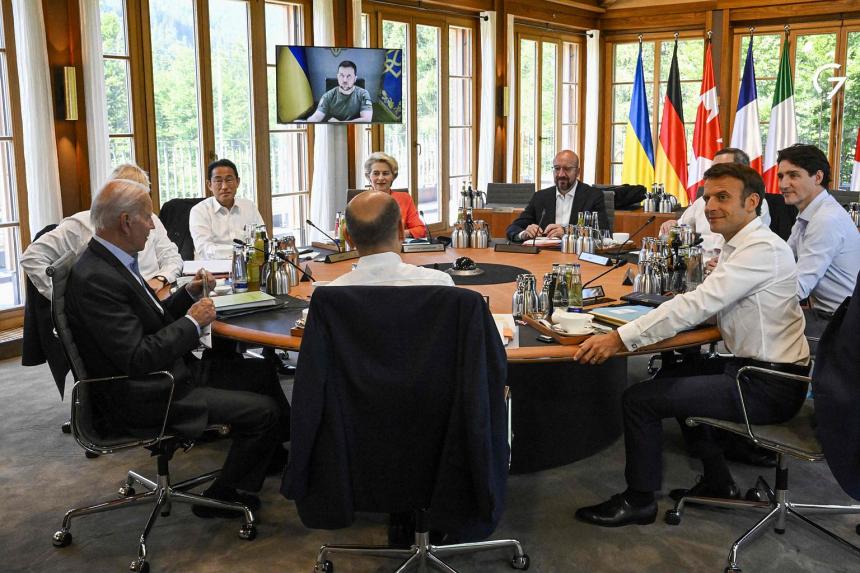
9:30 p.m. Group of Seven leaders plan to expand sanctions against Russia, targeting Moscow’s imports of components and technology crucial to producing military equipment, the White House says as President Joe Biden meets with his G-7 peers in Germany.
Washington also intends to raise tariffs on about 570 groups of Russian products worth $2.3 billion, as well as ban the import of new gold into the U.S. Leaders of the G-7 rich democracies also commit to impose sanctions on those responsible for human rights abuses, including war crimes and Russia’s tactics to steal Ukrainian grain, the White House says.
 Russian oil is sought by crisis-hit Sri Lanka, which has sent two ministers to Moscow to negotiate for fuel. © Reuters
6:30 p.m. The Group of Seven rich democracies will commit on Tuesday to a new package of coordinated actions meant to raise pressure on Russia over its invasion of Ukraine, and will finalize plans for a price cap on Russian oil, a senior U.S. official says. The announcement came amid news that Russia looked set to plunge into its first sovereign default in decades.
“The dual objectives of G-7 leaders have been to take direct aim at (Russian President Vladimir) Putin’s revenues, particularly through energy, but also to minimize the spillovers and the impact on the G-7 economies and the rest of the world,” the U.S. official says on the sidelines of the annual G-7 summit.
6:15 p.m. Ukrainian grain exports in the first 22 days of June fell by around 44% from a year earlier to 1.11 million tons, agriculture ministry data show. The volumes included 978,000 tons of corn, 104,000 tons of wheat and 24,000 tons of barley. Ukraine exported up to 6 million tons of grain a month before Russia launched an invasion on Feb. 24.
3:30 p.m. Sri Lanka is sending two ministers to Russia to negotiate for fuel, which the Indian Ocean island nation has almost run out of as its economy has collapsed. Power and Energy Minister Kanchana Wijesekera said the two ministers are scheduled to leave for Russia on Monday to continue in-person talks that Sri Lanka has been having with Russian authorities to directly purchase fuel, and to discuss related issues. He urged people on Saturday not to line up for fuel, saying new shipments would be delayed due to “banking and logistics reasons.”
1:38 p.m. Oil prices extend gains as investors stood on guard for any moves against Russian oil and gas exports that might come out of a meeting of leaders of the Group of Seven meeting in Germany. Brent crude futures edged up 22 cents, or 0.2%, to $113.34 a barrel by 0342 GMT after rebounding 2.8% on Friday. U.S. West Texas Intermediate crude was at $107.73 a barrel, up 11 cents, or 0.1%, following a 3.2% gain in the previous session.
 Russian Central Bank headquarters in Moscow. The country’s potential default on foreign debt could further alienate it from the global financial system following sanctions imposed over the war in Ukraine. © Reuters
8:30 a.m. Russia is poised to default on its foreign debt for the first time since 1918 following the Bolshevik Revolution, further alienating the country from the global financial system following sanctions imposed over its war in Ukraine. The country faces a Sunday night deadline to meet a 30-day grace period on interest payments originally due May 27. But it could take time to confirm a default. Russia calls any default artificial because it has the money to pay its debts but says sanctions have frozen its foreign currency reserves held abroad.
6:40 a.m. A “stealthy network of commandos and spies” from the U.S. and allies is “rushing to provide weapons, intelligence and training” for Ukraine, with much of the work being done outside the country at bases in Germany and elsewhere, The New York Times reports, citing American and European officials.
Some CIA personnel continue to secretly operate in Ukraine, mostly in Kyiv, “directing much of the vast amounts of intelligence the United States is sharing with Ukrainian forces, according to current and former officials,” the Times reports. “At the same time, a few dozen commandos from other NATO countries, including Britain, France, Canada and Lithuania, also have been working inside Ukraine.”
5:09 a.m. U.S. President Joe Biden tells allies “we have to stay together” against Russia on Sunday as G-7eaders gathered for a summit dominated by the war in Ukraine and its impact on food and energy supplies, as well as the global economy. At the start of the meeting in the Bavarian Alps, four of the Group of Seven major industrial nations moved to ban imports of Russian gold to tighten sanctions on Moscow and cut off its means of financing the invasion of Ukraine. But it was not clear whether there was consensus on the plan, with European Council President Charles Michel saying the issue would need to be handled carefully and discussed further.
Sunday, June 26
 Smoke rises after a missile strike in Kyiv on June 26. © Reuters
6:01 p.m. The Group of Seven must impose more sanctions on Russia and send Ukraine more heavy arms, Ukrainian Foreign Minister Dmytro Kuleba tweets Sunday as the G-7 summit in Germany continues.
The tweet includes a photo of an apparently injured child being moved by first responders. “This 7 y.o. Ukrainian kid was sleeping peacefully in Kyiv until a Russian cruise missile blasted her home,” Kubela writes. “Many more around Ukraine are under strikes.”
3:23 p.m. Less than 3 percent of Japanese companies operating in Russia have decided to withdraw following its invasion of Ukraine, the lowest proportion among the Group of Seven nations, a recent survey shows. A considerable number of Japanese companies were cautious about exiting from Russia, with many only suspending operations in the hope of resuming business in the future, the analysis of the survey said.
Only 4, or 2.4 percent, of the 168 Japanese companies operating in Russia had decided by June 19 to cease business in the country, according to analysis by Teikoku Databank based on the survey conducted by the Yale School of Management in the United States covering around 1,300 major companies worldwide. The figure was far lower than the around 48 percent of British companies that have announced their withdrawal from Russia, followed by about 33 percent of Canadian companies and around 29 percent of U.S. enterprises.
 Russian servicemen demonstrate the Iskander missile system at a 2015 event outside Moscow. © Reuters
2:45 a.m. Russia will provide Belarus with the Iskander missile system in the “next few months,” President Vladimir Putin tells Belarusian counterpart Alexander Lukashenko at a meeting.
The system can launch both cruise and short-range ballistic missiles capable of carrying conventional and nuclear warheads, Putin says, according to a readout on the Russian presidential website.
Lukashenko claims concerns about “training flights of aircraft of the United States of America and NATO, which are trained to carry nuclear warheads.”
The meeting in St. Petersburg comes as a Ukrainian defense official accuses Russia of trying to drag Belarus into the war.
1:52 a.m. The U.S. and other Group of Seven rich countries will agree on an import ban on new gold from Russia when they meet for a three-day summit in Germany that begins later today, a source tells Reuters.
The U.S. Treasury Department will issue a determination to prohibit the import of new gold into the U.S. on Tuesday, which will further isolate Russia from the global economy by preventing its participation in the gold market, the source says.
1:00 a.m. Sweden still has not resolved Turkey’s concerns over support for “terrorism” and an arms embargo, Turkish President Recep Tayyip Erdogan tells Swedish Prime Minister Magdalena Andersson in a phone call on the Scandinavian nation’s bid to join NATO.
Erdogan, who has expressed opposition to Sweden and Finland becoming NATO members, says he wants to see binding commitments on these matters. Ankara accuses the two countries of supporting organizations affiliated with the Kurdistan Workers’ Party (PKK), an armed group that is outlawed in Turkey.
The NATO chief also had a phone call with Erdogan.
Saturday, June 25
11:45 p.m. Russian forces are in full control of Sievierodonetsk, marking Kyiv’s biggest setback on the battlefield in more than a month. The eastern city was under attack for weeks in some of the heaviest fighting of the war.
“The city is now under the full occupation of Russia. They are trying to establish their own order, as far as I know they have appointed some kind of commandant,” Sievierodonetsk Mayor Oleksandr Stryuk says on national television, according to Reuters, confirming Russian control of the ruined city once home to 100,000 people.
Pro-Russian separatists say Moscow’s forces are now attacking the last major Ukrainian-held bastion in eastern Luhansk province, Sievierodonetsk’s twin city Lysychansk on the opposite bank of the Siverskyi Donets River.
4:15 a.m. At the Uniting for Global Food Security Conference in Berlin, U.S. Secretary of State Antony Blinken echoes fellow Group of Seven top diplomats’ statement on Russia’s role in worsening food supply instability.
“The Russian military is laying waste to Ukrainian farms and grain silos, stealing Ukrainian grain and the equipment needed to harvest it, blocking access to and from Ukrainian ports by the sea,” Blinken says.
Moscow has rejected such accusations and says it is ready to help. The Russian Embassy in Sri Lanka, now in the throes of an economic crisis, puts out the following message.
3:00 a.m. European Union leaders’ decision to grant EU candidate member status to Ukraine and Moldova continues a policy of Russian “containment,” Moscow says.
“Such an aggressive approach of the European Union obviously carries the potential for the emergence of new deeper lines of division and crises in Europe as a whole,” Foreign Ministry spokesperson Maria Zakharova says in a statement. “This policy of Brussels has nothing to do with the real needs of the inhabitants of Ukraine and the EU countries.”
Foreign Minister Sergey Lavrov tells reporters that Moscow believes it is unlikely that the EU’s “Russophobic” policy will disappear in the near or long term. “That’s the path chosen by the Europeans,” he says.
 Russia’s Foreign Ministry spokeswoman Maria Zakharova speaks during a session of the St. Petersburg International Economic Forum on June 16. © Reuters
1:00 a.m. Foreign ministers of the Group of Seven nations have held a meeting “focused on Russia’s culpability for aggravating the global food crisis as a result of the war.”
“G-7 foreign ministers made clear that Russia’s war against Ukraine is exacerbating food insecurity, including by blocking the Black Sea, bombing grain silos and ports, and damaging Ukraine’s agricultural infrastructure,” according to a chair’s statement.
 Ukrainian soldiers patrol an area in the city of Sievierodonetsk on June 20. © Reuters
Friday, June 24
3:00 p.m. Ukrainian troops will “have to be withdrawn” from the mostly Russian-occupied battleground city of Sievierodonetsk, the regional governor says. Some of the heaviest fighting of the entire Russian invasion of Ukraine has taken place in Sievierodonetsk, where street-by-street battles have been going on for a month, with Russia slowly and painstakingly taking more ground. “Remaining in positions smashed to pieces over many months just for the sake of staying there does not make sense,” Gov. Serhiy Gaidai said on television.
 A launch truck fires a High Mobility Artillery Rocket System at the Yakima Training Center in Washington state, U.S. (The Olympian via AP)
7:30 a.m. The United States will send another $450 million in military aid to Ukraine, including additional medium-range rocket systems, to help reverse Russian progress in the war, officials say. The latest package includes four High Mobility Artillery Rocket Systems, which will double the number Ukraine has now. All four were pre-positioned in Europe and training on them has begun, said a Pentagon spokesman. The first four HIMARS that the U.S. sent have already gone to the battlefield in Ukraine.
4:50 a.m. Ukraine may be on the path to EU membership, but that does not mean the journey will be a short one. EU leaders say Ukraine must meet conditions on the rule of law, corruption and the judiciary in order to advance to the next stage of accession negotiations, the Financial Times reports. Croatia, the most recent country to join the EU, took nine years to go from candidate status to membership, the FT reports. Ukraine applied for EU membership in February.
3:45 a.m. Ukrainian President Volodymyr Zelenskyy reacts to the European Council decision.
3:25 a.m. Ukraine has been granted European Union candidate status, European Council President Charles Michel says. Moldova’s candidate status is also now official. “Today marks a crucial step on your path towards the EU,” Michel says in a tweet.
12:45 a.m. BRICS leaders gingerly weigh in on Ukraine at a summit where Chinese President Xi Jinping and Russian President Vladimir Putin push back against Western pressure.
“We have discussed the situation in Ukraine and recall our national positions as expressed at the appropriate fora, namely the UNSC [United Nations Security Council] and UNGA [United Nations General Assembly],” the BRICS leaders say in a joint declaration marking their latest summit. They stop short of using the words “war” or “invasion” to describe Russia’s aggression against Ukraine.
“We support talks between Russia and Ukraine,” the leaders say, adding that they have also discussed concerns about the humanitarian situation in and around Ukraine.
The BRICS are Brazil, Russia, India, China and South Africa.
Thursday, June 23
10:20 p.m. Germany has moved to the second stage of its natural gas emergency plan in response to cuts in the supply from Russia.
“We are in a gas crisis,” says Robert Habeck, the economy minister, accusing Moscow of using gas as a weapon against Germany.
10:10 p.m. Nike will make a full withdrawal from the Russian market, Reuters reports, citing a statement from the sportswear company.
Nike stores in Russia had been suspended in response to President Vladimir Putin’s invasion of Ukraine. The decision to leave the Russian market is mostly symbolic, since Russia and Ukraine account for less than 1% of Nike’s revenue, Reuters reports.
6:00 p.m. Turkish Foreign Minister Mevlut Cavusoglu says Ankara is investigating claims that Ukrainian grain has been stolen by Russia and would not allow any such grain to be brought to Turkey. Kyiv’s ambassador to Ankara said in early June that Turkish buyers were among those receiving grain that Russia had stolen from Ukraine, adding he had sought Turkey’s help to identify and capture individuals responsible for the alleged shipments.
“We take every claim seriously and are investigating them seriously. We notify especially the Ukrainian side of the result every time,” Cavusoglu said.
 British citizens Aiden Aslin, left, and Shaun Pinner, right, and Moroccan Brahim Saadoun, center, face the death sentence for fighting for Ukraine.
4:15 p.m. Two Britons and a Moroccan who were captured while fighting for Ukraine and sentenced to death by a court in the self-proclaimed breakaway Donetsk People’s Republic (DPR) are preparing to appeal, the TASS news agency cites one of their lawyers as saying. The court in the DPR, one of Russia’s proxies in eastern Ukraine, found the three men — Britons Aiden Aslin and Shaun Pinner and Moroccan Brahim Saadoun — guilty of “mercenary activities and committing actions aimed at seizing power and overthrowing the constitutional order of the DPR.”
4:00 p.m. Oil prices continue to retreat as investors reassess the risks of recession and the impact of interest rate hikes in major economies on fuel demand. U.S. West Texas Intermediate crude futures fell $1.4, or 1.3%, to $104.78 a barrel by 06:43 GMT. Brent crude futures fell $1.3, or 1.2%, to $110.40. Both benchmarks tumbled by as much as $3 a barrel in early morning Asian trade, after plunging around 3% in the previous session. They are at their lowest levels since mid-May.
 The town of Dobropillia, in the Donetsk region, tries to clean up on June 14. Russia “want[s] to destroy the entire Donbas step-by-step,” President Volodymyr Zelenskyy says. © Reuters
11:24 a.m. Ukrainian President Volodymyr Zelenskyy urges its allies to accelerate the shipment of heavy weapons to match Russia on the battlefield. “The occupier’s goal here is unchanged,” he said in a video address. “They want to destroy the entire Donbas step-by-step. What is quickly needed is parity on the battlefield in order to halt this diabolical armada and push it beyond Ukraine’s borders.”
9:32 a.m. A Ukrainian official overseeing the country’s push to join the European Union says she is “100%” certain all 27 EU nations will approve Ukraine’s EU candidacy during a summit this week. Ukrainian President Volodymyr Zelenskyy expressed similar optimism, calling it a “crucial moment” for Ukraine. Ukraine’s bid will be the top order of business for EU leaders meeting in Brussels. In an interview with The Associated Press, Deputy Prime Minister for European and Euro-Atlantic Integration Olha Stefanishyna said the decision could come Thursday, when the leaders’ summit starts.
4:00 a.m. The demotion of Le Yucheng, China’s first vice foreign minister, has sent shock waves through national political circles.
On June 14, it was announced that Le had been appointed deputy head of the National Radio and Television Administration and “no longer serves as vice foreign minister.” That meant the pro-Russian diplomat was no longer front-runner in the race to become foreign minister.
His fingerprints were all over the now-famous summit between Chinese President Xi Jinping and Russian President Vladimir Putin in Beijing on Feb. 4. But then came Russia’s invasion of Ukraine. Read more in this week’s China Up Close.
 Russian President Vladimir Putin attends a meeting with Chinese President Xi Jinping in Beijing on Feb. 4. (Sputnik via Reuters)
12:45 a.m. In a virtual speech at the opening of the BRICS Business Forum, Chinese President Xi Jinping calls sanctions a “double-edged sword.”
“To politicize the global economy and turn it into one’s tool or weapon, and willfully impose sanctions by using one’s primary position in the international financial and monetary systems will only end up hurting one’s own interests as well as those of others, and inflict suffering on everyone,” Xi says, without mentioning Russia or the Western nations sanctioning it, according to a transcript published by Xinhua.
Just last week, Xi denounced heavy-handed unilateral sanctions in a virtual speech to the St. Petersburg International Economic Forum.
At the BRICS event, Xi describes the “Ukraine crisis” as “another wake-up call for all in the world,” taking a veiled jab at NATO.
“It reminds us that blind faith in the so-called ‘position of strength’ and attempts to expand military alliances and seek one’s own security at the expense of others will only land oneself in a security dilemma,” the Chinese leader says.
Indian Prime Minister Narendra Modi, in his virtual opening address at the BRICS event, mentions neither Russia nor Ukraine, instead touting India’s economic policies.
The BRICS are Brazil, Russia, India, China and South Africa.
 High gasoline prices have been one of the most glaring indicators of rising inflation for Americans. © Reuters
Wednesday, June 22
10:30 p.m. U.S. President Joe Biden has called on Congress to suspend the federal gasoline tax for three months, through September, to ease the pain at the pump for Americans.
The average price of a gallon of gasoline in the U.S. is hovering around $5. The federal gas tax accounts for 18 cents of what drivers pay per gallon.
Biden is under pressure as U.S. inflation runs high. A White House statement acknowledges that “a gas tax holiday alone will not, on its own, relieve the run up in costs that we’ve seen.”
“But the president believes that at this unique moment when the war in Ukraine is imposing costs on American families, Congress should do what it can to provide working families breathing room.”
In other energy news, a fire at an oil refinery in southern Russia’s Rostov region Wednesday was caused by a drone attack, Russian state media report.
10:15 p.m. “Europe should be ready in case Russian gas is completely cut off,” Fatih Birol, the head of the International Energy Agency, tells the Financial Times in an interview.
Birol says Russia’s recent decision to reduce gas supplies to European countries may be a step toward deeper reductions that Moscow can use as a bargaining chip as Western nations apply sanctions pressure.
 Casualties have amounted to about 55% of the original strength of the forces of the Russian-backed, self-proclaimed Donetsk People’s Republic (DPR) Britain says. © Reuters
6:09 p.m. Seven Russian missiles hit the southern Ukrainian city of Mykolaiv on Wednesday, regional governor Vitaliy Kim says. In a statement on the Telegram messaging app, he gave no details of any casualties or damage.
2:39 p.m. Casualties have amounted to about 55% of the original strength of the forces of the self-proclaimed Donetsk People’s Republic (DPR), one of Russia’s proxies in eastern Ukraine, Britain says. Figures published by the DPR showed that by June 16, 2,128 military personnel had been killed in action, with 8,897 wounded since the beginning of 2022, the British Defense Ministry said in a daily Twitter update.
2:33 p.m. Indonesian President and G-20 Chairman Joko Widodo will visit his counterparts in Ukraine and Russia next week to press for a peaceful resolution to their conflict, his foreign minister says, the first such trip by an Asian leader. The Ukraine war has overshadowed meetings of the Group of 20 major economies this year, with Indonesia struggling to unify its members while resisting pressure from Western states threatening to boycott a November leaders’ summit and pushing for Russia’s exclusion.
7:29 a.m. Chevron Chief Executive Michael Wirth rebutted White House officials’ criticism of the oil industry over energy costs, saying reducing fuel prices will require “a change in approach” by the government. The comments in a letter mark the latest in a series of acrimonious exchanges between the U.S. oil industry and President Joe Biden over who is to blame for high fuel prices that have helped drive inflation to 40-year highs.
The White House asked the CEOs of seven refiners and oil companies including Chevron to a meeting this week to discuss ways to increase production capacity and reduce energy prices. Wirth said he would attend. “Your administration has largely sought to criticize, and at times vilify, our industry,” Wirth said in the letter to Biden. “These actions are not beneficial to meeting the challenges we face.”
 Germany faces certain recession if faltering Russian gas supplies stop completely, an industry body warns. © Reuters
4:44 a.m. Germany faces certain recession if faltering Russian gas supplies stop completely, an industry body warns. The EU relied on Russia for as much as 40% of its gas needs before the war — rising to 55% for Germany — leaving a huge gap to fill in an already tight global gas market. Germany’s BDI industry association cut its economic growth forecast for 2022 to 1.5% from the 3.5% expected before the war began on Feb. 24. It said a halt in Russian gas deliveries would make recession in Europe’s largest economy inevitable.
12:54 a.m. The U.S. disagrees “vigorously” with Russia’s position that the American citizens captured in Ukraine are not covered by the Geneva Conventions, a senior State Department official says, adding that Washington has conveyed its stance on the issue to Moscow.
Kremlin spokesman Dmitry Peskov, interviewed by U.S. television network NBC on Monday, said two Americans detained in Ukraine while fighting on the Ukrainian side of the war were mercenaries who endangered the lives of Russian service personnel and should face responsibility for their actions.
Tuesday, June 21
10:00 p.m. U.S. Attorney General Merrick Garland is visiting Ukraine to discuss efforts to identify, arrest and prosecute those involved in war crimes and other atrocities committed during Russia’s invasion, a Justice Department official says. Garland will meet with Ukrainian Prosecutor General Iryna Venediktova.
 Dmitry Muratov’s 2021 Nobel Peace Prize medal is exhibited before it was sold by Heritage Auctions in New York on June 20. © Reuters
9:30 a.m. The Russian co-winner of last year’s Nobel Peace Prize, Dmitry Muratov, sold his prize medal for $103.5 million at an auction on Monday to raise money for children displaced by Russia’s invasion of Ukraine. The full purchase price of the medal will benefit UNICEF’s humanitarian response for Ukraine’s displaced children, said Heritage Auctions, which conducted the auction. Muratov, editor of the Novaya Gazeta, which is fiercely critical of the Kremlin, won the 2021 Nobel Peace Prize with Maria Ressa of the Philippines.
6:29 a.m. The United States is in talks with Canada and other allies to further restrict Moscow’s energy revenue by imposing a price cap on Russian oil, Treasury Secretary Janet Yellen said on Monday. “We are talking about price caps or a price exception that would enhance and strengthen recent and proposed energy restrictions by Europe, the United States, the U.K. and others, that would push down the price of Russian oil and depress Putin’s revenues, while allowing more oil supply to reach the global market,” Yellen told reporters in Toronto.
3:00 a.m. A food warehouse in the Black Sea port of Odesa was destroyed in a Russian missile attack but no civilians were killed, the Ukrainian military says. The Operational Command South says Russian forces fired 14 missiles at southern Ukraine during a three-hour barrage “in impotent anger at the successes of our troops.”
Monday, June 20
4:08 p.m. Russia’s blockade of the export of millions of tons of Ukrainian grain is a war crime, EU foreign policy chief Josep Borrell says.
“We call on Russia to deblockade the (Ukrainian) ports … It is inconceivable, one cannot imagine that millions of tons of wheat remain blocked in Ukraine while in the rest of the world people are suffering hunger,” he tells reporters. “This is a real war crime, so I cannot imagine that this will last much longer,” he says on arriving at a meeting of European Union foreign ministers in Luxembourg.
 Oil tankers are loaded at a Sinopec terminal at Yaogang oil depot in Nantong, Jiangsu province, China, in June 2019. © Reuters
12:41 p.m. China’s crude oil imports from Russia soared 55% from a year earlier to a record level in May, displacing Saudi Arabia as the top supplier, as refiners cashed in on discounted supplies amid sanctions on Moscow over its invasion of Ukraine. Imports of Russian oil, including supplies pumped via the East Siberia Pacific Ocean pipeline and seaborne shipments from Russia’s European and Far Eastern ports, totaled nearly 8.42 million tons, according to data from the Chinese General Administration of Customs. Chinese companies, including state refining giant Sinopec and state-run Zhenhua Oil, have ramped up purchases of Russian oil, enticed by steep discounts. China is the world’s biggest crude oil importer.
 Smoke and flames rise from Sievierodonetsk’s Azot chemical plant on June 19. Russia’s Defense Ministry says its attack on the city in eastern Ukraine is “developing successfully.” © Reuters
9:03 a.m. Ukraine’s President Volodymyr Zelenskyy predicts Russia will escalate its attacks this week as European Union leaders consider whether to back Kyiv’s bid to join the bloc and Moscow presses its campaign to win control of the country’s east.
“Obviously, this week we should expect from Russia an intensification of its hostile activities,” Zelenskyy said in his Sunday nightly video address. “We are preparing. We are ready.” Ukraine applied to join the EU four days after Russian troops poured across its border in February. The EU’s executive, the European Commission, on Friday recommended that Ukraine receive candidate status.
Sunday, June 19
8:08 p.m. Russia says its offensive against Sievierodonetsk in eastern Ukraine is proceeding successfully, after it took control of a district in the outskirts of the city. “The offensive in the Sievierodonetsk direction is developing successfully,” Russian Defense Ministry spokesman Igor Konashenkov said in a video statement. He said the settlement of Metyolkine, on the eastern outskirts of the city, had been taken. Konashenkov said long-range Kalibr cruise missiles struck a command center in the Dnipropetrovsk region, killing Ukrainian generals and officers, including from the general staff.
1:42 p.m. Two top commanders of fighters who defended the Azovstal steel plant in Ukraine’s southeastern port of Mariupol have been transferred to Russia for investigation, Russia’s state news agency TASS reports. Uncertainty has surrounded the fate of hundreds of fighters captured by Russian forces in May after a monthslong siege of Mariupol. Moscow said at the time they were moved to breakaway Russian-backed entities in eastern Ukraine. Citing an unnamed Russian law enforcement source, TASS said late on Saturday that Svyatoslav Palamar, a deputy commander of the Azov battalion, and Serhiy Volynsky, the commander of the 36th Marine Brigade of the Ukrainian Armed Forces, were moved to Russia.
Saturday, June 18
3:40 a.m. In his prerecorded message to the St. Petersburg International Economic Forum, Chinese President Xi Jinping urges nations to ” reject attempts at decoupling, supply disruption, unilateral sanctions and maximum pressure,” in what appears to be a jab at Western nations’ isolation campaign against Russia.
Xi calls for economic globalization and “true multilateralism.”
“China stands ready to work with Russia and all other countries to explore development prospects,” Xinhua reports the Chinese president as saying.
Other leaders speaking at the event include Egyptian President Abdel-Fattah el-Sissi and Kazakh President Kassym-Jomart Tokayev.
3:10 a.m. Russian warships sailed south of Tokyo this week, while Chinese destroyers passed through a strait north of Japan, Japan’s Ministry of Defense says. Read more.
 Russian President Vladimir Putin speaks at the St. Petersburg International Economic Forum on June 17. (TASS Host Photo Agency Pool via AP)
1:50 a.m. Danish Foreign Minister Jeppe Kofod accuses a Russian military ship of violating Denmark’s territorial waters twice in one night.
In a Twitter post, the minister calls the incident “a deeply irresponsible, gross and completely unacceptable Russian provocation.”
Kofod says the Russian ambassador has been summoned to the Ministry of Foreign Affairs. The Russian side’s response was not immediately clear.
12:05 a.m. Western nations’ attempt to destroy the Russian economy with sanctions has failed, Russian President Vladimir Putin says at the St. Petersburg International Economic Forum.
Maintaining the pretext that the war is not a Russian invasion but a “special military operation,” he says the economy is gradually returning to normal.
Putin pins the blame for energy and food inflation on the West, claiming Russia is not blocking shipments of Ukrainian grain through the Black Sea.
His speech was delayed by more than an hour after the forum, known as the “Russian Davos,” was the target of a cyberattack.
Friday, June 17
11:55 p.m. U.K. Prime Minister Boris Johnson makes a surprise visit to Kyiv.
8:00 p.m. The European Commission has recommended that Ukraine be made an official candidate for membership in the European Union.
4:58 p.m. The evacuation of 568 civilians sheltering in bunkers under the Azot chemical plant in the embattled city of Sievierodonetsk is currently impossible due to shelling and heavy fighting, the governor of Ukraine’s Luhansk region says. In a post on Telegram messenger, he said there were 38 children taking shelter in the bunkers at the chemical plant.
 Smoke rises after a military strike on a compound of Sievierodonetsk’s Azot Chemical Plant, amid a Russian attack on the city on June 10. © Reuters
4:30 p.m. Ukrainian missiles hit a Russian naval tugboat transporting soldiers, weapons and ammunition to the Russian-occupied Zmiinyi (Snake) Island south of the Odesa region on Friday, the regional governor says. Odesa Gov. Maksym Marchenko identified the vessel as the Vasiliy Bekh. Ukraine’s Naval Command said the tugboat had a TOR anti-air missile system on board but this had failed to stop the strike.
 The superyacht Amadea is moored in Honolulu on June 16. The Russian-owned yacht arrived in Honolulu Harbor flying an American flag after the U.S. last week won a legal battle in Fiji over the $325 million vessel. © AP
2:30 p.m. A Russian-owned superyacht seized by the U.S. arrived in Honolulu Harbor on Thursday flying an American flag. The U.S. last week won a legal battle in Fiji over the $325 million vessel and immediately sailed it to Hawaii. The FBI has linked the Amadea to the Russian oligarch Suleiman Kerimov. The U.S. said Kerimov secretly bought the Cayman Island-flagged vessel last year through various shell companies.
11:00 a.m. Australian Prime Minister Anthony Albanese says he will attend “an important” NATO meeting in Madrid at the end of the month as the U.S.-led alliance looks to further strengthen its ties in the wake of Russia’s war in Ukraine. Australia, one of the largest non-NATO contributors to the West’s support for Ukraine, has been supplying aid and defense equipment and has banned exports of alumina and aluminum ores, including bauxite, to Russia. “I’m going to NATO as a priority … to support the people of Ukraine standing up against this thuggish illegal behavior of Russia,” Albanese said on Friday.
 Australian Prime Minister Anthony Albanese speaks during a joint press conference with New Zealand Prime Minister Jacinda Ardern, in Sydney on June 10. © AP
8:08 a.m. Law enforcement in the U.S., Germany, the Netherlands and Britain have dismantled a global network of internet-connected devices that had been hacked by Russian cybercriminals and used for malicious purposes, the U.S. Justice Department says. The network, known as the RSOCKS botnet, comprised millions of hacked computers and devices worldwide, including Internet of Things gadgets like routers and smart garage openers, the department said. RSOCKS users paid a fee of between $30 and $200 per day to route malicious internet activity through compromised devices to hide the true source of the traffic, it said.
5:00 a.m. Italian power company Enel agrees to sell its entire stake in Russian unit PJSC Enel Russia to local buyers for about 137 million euros ($145 million), according to a news release.
The buyers are energy group Lukoil and investment fund Gazprombank-Frezia.
“Following completion of the transaction, Enel will dispose of all its Russian power generation assets, which include approximately 5.6 GW of conventional capacity and around 300 MW of wind capacity at different stages of development,” Enel says.
 From left, German Chancellor Olaf Scholz, Ukrainian President Volodymyr Zelenskyy, French President Emmanuel Macron and Italian Prime Minister Mario Draghi attend a news conference in Kyiv on June 16. © Reuters
1:00 a.m. The leaders of France, Germany, Italy and Romania voice support for Ukraine’s bid to join the European Union after a meeting with President Volodymyr Zelenskyy in Kyiv.
“All four of us support the immediate granting of EU candidate status for Ukraine,” French President Emmanuel Macron says.
Zelenskyy says he has received invitations from European partners to attend some major upcoming events, including the NATO summit in Madrid.
12:15 a.m. The U.K.’s latest round of sanctions in response to the Ukraine war target a Russian official accused of involvement in forced deportations and adoptions.
Russian Children’s Rights Commissioner Maria Lvova-Belova “has been accused of enabling 2,000 vulnerable children being violently taken from the Luhansk and Donetsk regions and orchestrating a new policy to facilitate their forced adoptions in Russia,” the U.K. government says in a statement.
Also sanctioned is the head of the Russian Orthodox Church, Patriarch Kirill, who London says has given “prominent support” to Russian aggression against Ukraine. The new sanctions come a day after Ukrainian President Volodymyr Zelenskyy talked about Ukraine’s defense needs by phone with British Prime Minister Boris Johnson.
The Ukrainian people do not have the luxury of tiring of the war, British Foreign Secretary Liz Truss tells the House of Commons.
Thursday, June 16
5:37 p.m. The leaders of Germany, France and Italy arrived in Kyiv in an overnight train in a joint demonstration of support for Ukraine, where officials were pleading for more and faster deliveries of Western arms to hold off Russia’s assault. “It’s an important moment. It’s a message of unity we’re sending to the Ukrainians,” French President Emmanuel Macron said after the train pulled into the station in Kyiv.
The visit by Macron, German Chancellor Olaf Scholz and Italian Prime Minister Mario Draghi has taken weeks to organize, while all three have faced criticism from Kyiv over support viewed as tepid. Britain’s Boris Johnson already visited more than two months ago. Still, the decision by the three most powerful EU leaders to travel together held strong symbolism at a pivotal moment — a day before the EU’s executive commission is expected to recommend pushing forward with Ukraine’s bid to join the bloc.
11:00 a.m. Japan ran its biggest single-month trade deficit in more than eight years in May as high commodity prices and declines in the yen swelled imports, Ministry of Finance data shows. Imports soared 48.9% in the year to May, above a median market forecast for a 43.6% gain in a Reuters poll. That outpaced a 15.8% year-on-year rise in exports in the same month, resulting in a 2.385 trillion yen ($17.8 billion) trade deficit, the largest shortfall in a single month since January 2014.
 Pipes of Nord Stream 1 in Germany on March 8. Further cuts by Russia’s Gazprom mean the pipeline will run at just 40% capacity. © Reuters
9:00 a.m. Russian Gazprom’s move to cut supplies of gas to Germany is a warning signal that could cause problems for Europe’s biggest economy in winter, the head of Germany’s energy regulator told a newspaper. Gazprom on Wednesday announced a further cut in the amount of gas it can pump through Nord Stream 1, meaning the pipeline will run at just 40% capacity. “It would significantly worsen our situation,” regulator chief Klaus Mueller told the Rheinische Post daily. “We could perhaps get through the summer as the heating season is over. But it is imperative that we fill the storage facilities to get through the winter.”
4:00 a.m. Swedish furniture brand IKEA will reduce its workforce in Russia and Belarus, sell factories and close its purchase and logistics offices in Moscow and Minsk. The company paused operations in the two countries in early March, but has continued to pay salary for workers.
3:00 a.m. The Federal Reserve raises the benchmark interest rate by 75 basis points — the largest hike since November 1994 — in its latest move to curb the worst inflation the U.S. has faced in 40 years. Federal Reserve Chair Jerome Powell said the Fed’s goal is a sustained inflation rate of 2%. “What’s becoming more clear is that many factors that we don’t control are going to play a very significant role in deciding whether that’s possible or not. And here I’m thinking of course of commodity prices, the war in Ukraine, supply chain,” Powell said at a news conference following the meeting.
2:50 a.m. Japanese budget airline ZIPAIR Tokyo says it will remove the “Z” logo from the tail of its planes. The design change was motivated in part by Russian forces’ use of the letter “Z” on tanks, trucks and other equipment during their invasion of Ukraine.
 Ammunition, weapons and other equipment bound for Ukraine are processed at Dover Air Force Base in the U.S. in January. (Courtesy of U.S. Air Force)
2:15 a.m. The U.S. is providing another $1 billion in security assistance for Ukraine, including additional artillery and coastal defense weapons, as well as ammunition for the artillery and advanced rocket systems needed to support Kyiv’s defensive operations in the Donbas region, President Joe Biden says.
“I am also announcing an additional $225 million in humanitarian assistance to help people inside Ukraine, including by supplying safe drinking water, critical medical supplies and health care, food, shelter and cash for families to purchase essential items,” Biden says, according to a White House statement.
 NATO Secretary General Jens Stoltenberg says group members are expected to agree an assistance package for Ukraine that will help it transition to modern standard weaponry at a summit later this month. © Reuters
Wednesday, June 15
11:55 p.m. Russia’s state-owned Gazprom says it will cut flows of natural gas to Germany through the Nord Stream pipeline for the second time in two days, blaming delays to turbine repairs.
Germany’s economy minister, Robert Habeck, says the timing of the maintenance cited for Tuesday’s reduction appears to be a “political decision.”
11:00 p.m. Japanese Prime Minister Fumio Kishida says he will attend the NATO summit later this month, becoming the first Japanese leader to do so.
The June 29-30 gathering in Madrid will closely follow the Group of Seven summit in Germany, which Kishida will also attend.
Kishida says the Western alliance has relevance for Asia in light of the Ukraine conflict, stressing that “unilateral change to the status quo by force is not acceptable anywhere in the world.” Read more.
10:45 p.m. Turkish Foreign Minister Mevlut Cavusoglu details a United Nations plan to create a sea corridor from Ukraine for grain exports, saying safe routes could be formed without needing to clear the mines around Ukrainian ports.
His comments appear to mark a shift from an earlier proposal to de-mine Ukraine’s ports, a move that Kyiv fears would leave it far more vulnerable to Russian attack from the Black Sea.
8:26 p.m. Chinese President Xi Jinping told Russian President Vladimir Putin during a phone call on Wednesday that all parties should work toward resolving the crisis in Ukraine “in a responsible manner,” Chinese state broadcaster CCTV reported.
7:30 p.m. NATO members are expected to agree an assistance package for Ukraine that will help it move from Soviet-era weaponry to NATO standard gear at a summit later this month, the group’s Secretary-General Jens Stoltenberg says. “It is very much about enabling the Ukrainians to transition from Soviet-era, from old equipment to more modern NATO standard equipment,” he told reporters ahead of a meeting of the alliance’s defense ministers in Brussels.
11:50 a.m. The European Union’s top aviation safety regulator said he is “very worried” about the safety of Western-made aircraft continuing to fly in Russia without access to spare parts and proper maintenance. The EU and the U.S. have moved to restrict Russia’s access to spare parts following its invasion of Ukraine.
“This is very unsafe,” Patrick Ky, executive director of the European Union Aviation Safety Agency, told reporters on the sidelines of a conference, adding regulators do not have good data on many of the planes flying in Russia or if any have experienced safety issues in recent months.
9:38 a.m. The U.S. will build temporary silos along the border with Ukraine in a bid to help export more grain and address a growing global food crisis, President Joe Biden said. Since the Russian invasion and blockade of Ukrainian Black Sea ports, grain shipments have stalled and more than 20 million tons are stuck in silos. Ukraine says it faces a shortage of silos for a new crop. The war is stoking prices for grains, cooking oils, fuel and fertilizer. Russia and Ukraine account for nearly a third of global wheat supplies. Ukraine is also a major exporter of corn and sunflower oil and Russia a key fertilizer exporter.
 Russia’s Daria Kasatkina competes at the French Open in May. © Reuters
3:11 a.m. Russian and Belarusian tennis players will be allowed to compete at the U.S. Open this year — but only under a neutral flag, the United States Tennis Association says.
“Tennis has done much through [the] Tennis Plays for Peace [program] for humanitarian support of Ukraine,” USTA President Mike McNulty says. “Unfortunately, the need for help only continues to grow. The USTA will be responding very soon with a broad set of initiatives that will include significant financial assistance and other programs to further support humanitarian relief and the people of Ukraine.”
Players from Russia and Belarus are not allowed to compete at Wimbledon later this month, a move that prompted the men’s ATP and women’s WTA tours to strip the Grand Slam event of its ranking points.
Tuesday, June 14
9:34 p.m. Russia’s invasion of Ukraine will create a global wheat shortage for at least three seasons by keeping much of the Ukrainian crop from markets, Ukrainian Agriculture Minister Mykola Solskyi tells Reuters. Ukraine, known as Europe’s breadbasket, has had its maritime grain export routes blocked by Russia and faces problems such as mined wheat fields and a lack of grain storage space.
“Now we are talking about three wheat harvests at the same time: We cannot take out last year’s crop, we cannot harvest and take out the current one, and we do not particularly want to sow the next one,” Solskyi says.
6:00 p.m. Russia has struck an artillery weapons depot with Kalibr cruise missiles in Ukraine’s Chernihiv region, the RIA news agency reports, citing the Russian defense ministry. Russian air defense forces shot down a Ukrainian MiG-29 fighter jet and an Mi-24 helicopter, TASS news agency reports, citing the ministry.
4:30 p.m. The Moscow Exchange says it will suspend trading of the Swiss franc against the ruble and the dollar from Tuesday after Switzerland adopted new EU sanctions against Russia. “The suspension of operations is due to difficulties conducting settlements in Swiss francs faced by market participants and the financial sector in connection with the restrictive measures imposed by Switzerland on June 10,” the Moscow Exchange said in a statement. Switzerland, which is not a member of the European Union, updated its sanctions package last Friday to match the EU’s latest restrictions against businesses, banks and individuals from Russia and Belarus.
8:44 a.m. Russian forces cut off the last routes for evacuating citizens from the eastern Ukrainian city of Sievierodonetsk, a Ukrainian official said, as the Kremlin pushed for victory in the Donbas region. The last bridge to the city was destroyed, trapping any remaining civilians and making it impossible to deliver humanitarian supplies, said regional governor Sergei Gaidai, adding that some 70% of the city was under Russian control. Ukraine has issued increasingly urgent calls for more Western heavy weapons to help defend Sievierodonetsk, which Kyiv says could hold the key to the battle for the eastern Donbas region and the course of the war, now in its fourth month.
5:09 a.m. The main goal of Russia’s military operation in Ukraine is to protect the Donetsk and Luhansk people’s republics, the Kremlin said after Denis Pushilin, the leader of the Russian-backed separatist Donetsk region of Ukraine, asked for additional forces from Moscow. Pushilin said earlier on Monday, “All necessary forces, including the allied ones, including the forces of the Russian Federation, will be involved in order to counter the enemy.” Kremlin spokesman Dmitry Peskov was quoted by Russia’s RIA state news agency as saying, “In general, the protection of the republics is the main goal of the special military operation.”
 A road sign apparently damaged by cluster munition is seen amid Russia’s attack on Ukraine. © Reuters
1:00 a.m. Russia’s relentless shelling of the eastern Ukrainian city of Kharkiv with cluster munitions and scatterable land mines amounts to a war crime that indiscriminately killed hundreds of civilians, Amnesty International says. Ukraine’s second largest city Kharkiv was under near-constant bombardment from the beginning of Russia’s invasion of Ukraine on Feb. 24 until Ukrainian forces pushed the Russians away from the city in May. Ukraine has said 606 civilians were killed there and 600,000 evacuated. Amnesty said that it had found during a 14-day investigation in April and early May evidence that Russia had used cluster munitions and scatterable mines in Kharkiv.
12:30 a.m. NATO chief Jens Stoltenberg says it is still possible for Sweden and Finland to overcome Turkey’s concerns over terrorism and arms sales “within a reasonable time” to advance their applications for membership in the alliance. Stoltenberg tells the Financial Times that Turkey’s opposition to the two countries membership bids was unexpected. “Earlier in the process, we had no reasons to believe there would be any problems,” he says. “The Turkish concerns are not new.” Turkey “is an important ally, and when an ally raises security concerns, we have to address them,” Stoltenberg adds.
Monday, June 13
6:00 p.m. An industrial zone where about 500 civilians are sheltering is under heavy artillery fire from Russian forces, the regional governor says. Serhiy Gaidai, governor of the Luhansk region in eastern Ukraine that includes Sievierodonetsk, says on Facebook that Russian forces control about 70% of the city and fighting there is fierce.
11:30 a.m. Business sentiment among major Japanese companies in the April-June period was negative for the second consecutive quarter as Russia’s invasion of Ukraine drove oil prices higher, government data shows. The confidence index covering companies capitalized at 1 billion yen ($7.4 million) or more logged minus 0.9, compared with minus 7.5 in the January-March period, dragged down by a plunge in auto-related manufacturers at minus 25.4, according to the joint survey by the Finance Ministry and Cabinet Office. The sector was hit by a decrease in production due to parts supply shortages. The figures are calculated by subtracting the percentage of companies reporting worsening conditions from those seeing improvements.
9:40 a.m. NATO Secretary-General Jens Stoltenberg says Turkey has “legitimate concerns” over terrorism and other issues that need to be taken seriously. Turkey has accused Finland and Sweden of supporting Kurdish militants and says it will not back the Nordic nations’ NATO bid until they change their policies. Speaking at a joint news conference with Finnish President Sauli Niinisto, Stoltenberg stressed that “no other NATO ally has suffered more terrorist attacks than Turkey” and pointed to its strategic geographic location with neighbors like Iraq and Syria.
1:56 a.m. Russian forces have blown up a bridge linking the embattled Ukrainian city of Sievierodonetsk to another city across the river, cutting off a possible evacuation route for civilians, local officials say. Sievierodonetsk has become the epicenter of the battle for control over Ukraine’s eastern Donbas region.
For earlier updates, click here.

/cloudfront-us-east-2.images.arcpublishing.com/reuters/THQTN5F6JNM3FNLSDM5W5DTPOY.jpg)
 This article links to a state controlled Russian media.