
Categories
Saved Web Pages

G-7 to pledge fresh support for Ukraine as war rages

sv_meet_270622.jpg?VersionId=TU10p1gNeK4

ELMAU CASTLE (AFP, REUTERS) – Leaders of the Group of Seven (G-7) were on Monday (June 27) expected to announce new economic measures to tighten the screws on Moscow, as Ukrainian President Volodymyr Zelensky appealed for more help in fending off Russia’s invasion.

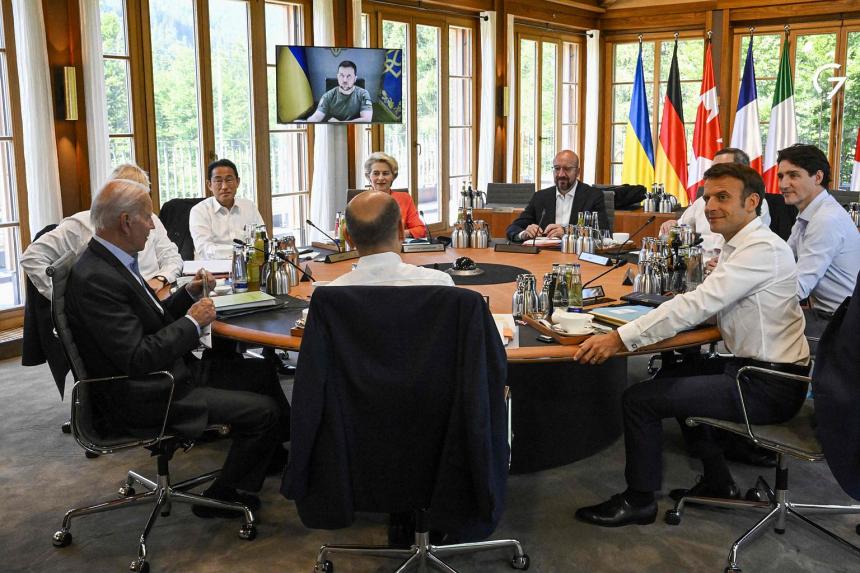
US President Joe Biden and his counterparts from the G-7 wealthy democracies are holding a three-day summit in the Bavarian Alps that has been dominated by the war in Ukraine and its global fallout.

Mr Zelensky joined the leaders of the United States, Germany, Britain, France, Italy, Japan and Canada via video link.

A European official, speaking on condition of anonymity, said the Ukrainian leader asked for anti-aircraft defence systems, more sanctions on Russia and security guarantees. Mr Zelensky also asked for help to export grain from Ukraine and for reconstruction aid, the official said.

The high-level talks come a day after Kyiv suffered the first Russian onslaught on the capital in three weeks, Ukraine said, with a missile attack hitting a residential building and leaving one person dead.

Two women were also killed by Russian bombardments on the northeastern Kharkiv region over the past 24 hours, the local governor said on Monday.

Among the new action being weighed by G-7 leaders was a price cap on Russian oil imports and fresh sanctions on Russia’s defence sector, the White House said on Monday.

In his evening address late on Sunday, Mr Zelensky renewed his calls for more weapons and air defence systems.

“Delays in the transfer of weapons to our state, any restrictions, are actually an invitation for Russia to strike again and again.”

The G-7 summit, held at the luxury Elmau Castle, runs until Tuesday. It will be followed by a meeting of Nato countries in Spain which Mr Zelensky is likewise expected to dial into.

European Commission President Ursula von der Leyen, attending the G-7 gathering, stressed the message of unity among Kyiv’s allies.

“We will support Ukraine for as long as necessary,” she told reporters on Sunday.

Last week, the European Union showed its support by granting Kyiv candidate status.

G-7 members kicked off their gathering on Sunday by announcing a plan to ban on imports of Russian gold, the latest in a series of sanctions aimed at punishing President Vladimir Putin for his Feb 24 invasion.

But as the war drags on, its impact on other countries has intensified, with soaring food and energy prices driving up global inflation and fanning fears of recession.

British Prime Minister Boris Johnson warned his fellow G-7 leaders not to give in to “fatigue” and said Ukraine would need long-term help.

A senior US official on Monday said the G-7 had made progress on talks to set a price cap on Russian oil.

The move would have the twin goals of starving the Kremlin of a key revenue stream for its war machine while forcing down the price of Russian oil in the hopes of reining in inflation, the official said.

European Council President Charles Michel however said on Sunday that all 27 member states would have to agree to such a price cap, which would require tweaking existing sanctions.

Mr Biden and his G-7 counterparts will further announce new sanctions targeting Russia’s defence industry at the summit, the US official told reporters.

The leaders also share the view that money collected from higher trade tariffs imposed on Russian exports should be funnelled as aid to Ukraine “to ensure that Russia pays for the cost of its war”, the official added.

Downing Street for its part said Mr Johnson would call for “urgent action” to get Ukraine’s vital cereal exports moving again, which have been held up by Russia’s blockade of key ports.

With millions of tonnes of grain trapped in silos, concerns are growing that African nations highly reliant on Ukrainian exports could face famine.

Non-G-7 countries Argentina, Indonesia, India, Senegal and South Africa have been invited to join the G-7 summit from Monday.

Indonesian President Joko Widodo, who will host a G-20 summit in November, has said he plans to use the trip to also visit Ukraine and Russia in the coming days to ask Mr Putin and Mr Zelensky to open a dialogue for peace.

Indonesia, like most major emerging economies, has tried to maintain a neutral position, and Mr Widodo has not bowed to Western pressure to exclude Mr Putin from the November meeting.

On the ground in Ukraine, Kyiv mayor Vitali Klitschko said Sunday’s missile attack on the city was a Russian attempt to “intimidate Ukrainians” ahead of the Nato meeting.

Tearful residents recounted the moment the missiles struck.

“I woke up at the first explosion, went to the balcony and saw missiles falling and heard a huge explosion – everything vibrated,” 38-year-old Yuri told AFP, declining to give his surname.

Russia denied it had hit a civilian target, however, saying its forces had struck the Artyom weapons factory in the neighbourhood.

Mr Biden condemned the strikes on Kyiv as “barbarism”.

German Chancellor and G-7 host Olaf Scholz said the attack showed again “that it is right to stand together and support Ukrainians”.

After failing to capture Kyiv early on, Russian troops shifted their focus to the eastern Donbas region, which has been partially under the control of pro-Moscow separatists since 2014.

The Russians made a strategic breakthrough on Saturday when they took the industrial hub of Sievierodonetsk, the scene of weeks of fierce battles that have left it largely destroyed.

Sievierodonetsk’s mayor said it had been “fully occupied” by Russian troops after Ukrainian forces retreated to better defend the neighbouring city of Lysychansk.

Its capture would give Russia control of the entire Luhansk region in the Donbas.

Categories
Saved Web Pages

What Russia’s military shake-up reveals about Putin’s war in Ukraine

GettyImages-899208650.jpg

When General Alexander Dvornikov was made overall commander of Russia’s forces in April, it looked as if the amateurishness and incoordination of the early stage of the Ukraine war might be being addressed. Now, though, Dvornikov is not around, and a new commander may shape a savage new phase of operations.

In recent days, the Russian defence ministry announced that Colonel General Alexander Lapin was in command of the Central Group of Forces in Ukraine, while General Sergei Surovikin was heading the Southern Group of Forces during the invasion. Of Dvornikov, who has not been seen for weeks, there was no mention, and the British Ministry of Defence suggests
he has been removed from his post.

Lapin has been commander of the Central Military District since 2017 and is considered a safe pair of hands. The arrival of Surovikin, though, was a surprise given that he was previously head of the VKS, the Russian’s combined air and air defence forces. He is no airman. Until 2017, Surovikin served in the Ground Forces, fighting in the Soviet war in Afghanistan, Russia’s military intervention into the Tajikistan civil war, and then the Second Chechen War, where he was wounded in action. He has a reputation for extreme toughness: in 2004, one of his subordinates shot himself in Surovikin’s office after he had been chewed out.

Surovikin has had a rather chequered past. He spent seven months in custody after the hard-line 1991 coup against Mikhail Gorbachev, as three protesters died when Surovikin forced his way through them. Then in 1995, he was convicted of having stolen and sold a service sidearm, although the charge was later quashed.

Nonetheless, he is also one of the most able officers of his generation, with a reputation as a problem-solver. He spent a tour between 2008-10 in charge of the General Staff’s Main Operations Directorate, its main planning and coordination department, which is often the mark of a high-flier tipped for the top. Then, in 2012, Surovikin was tasked with setting up the new Military Police (until then, Russia had lacked such a service).

In 2017, he was put in charge of Russia’s Group of Forces in Syria, for which he was awarded the Hero of Russia medal, and then on his return to Russia made commander of the VKS. This was a very unusual choice, but reflected a desire to see aerospace and ground forces coordinate better. There was a sense that Surovikin could break old habits and force the air forces to think more imaginatively about the future of air warfare.

His unprecedented second tour heading forces in Syria in 2019 made him a man to watch, possibly even a future Chief of the General Staff.

The current incumbent, General Valery Gerasimov is the longest-serving Chief of the General Staff in post-Soviet times, and there were hints that retirement was looming until the invasion. Now, Putin seems to fear the destabilising effect of reshuffles at the top of the system, but is certainly willing to shuffle through his generals. Colonel General Andrei Serdyukov, head of Russia’s airborne troops, has apparently been replaced
by Colonel General Mikhail Teplinsky, Lapin’s former chief of staff, for example.

Over-heated headlines notwithstanding, this is not a ‘purge’ nor a sign of dysfunction or despair, but rather an attempt to identify which officers are best suited to the unexpectedly tough fight in which Russia has become embroiled in Ukraine.

As a result, while the overall strategy is not going to change, the tactics may. Surovikin is likely to want to re-emphasise airpower, but also may well be willing to up the ante to maintain Russia’s current advance. Above all, the 55-year-old is arguably a more plausible successor to Gerasimov. He has more to prove and more to lose, and a track record of ruthlessness, even by the standards of his peers.

He will therefore presumably want to make the best of the campaign season, drawing on his own harsh lessons from Chechnya and Syria. The summer could get still hotter in the Donbas.

Surovikin has had a rather chequered past

Categories
Saved Web Pages

The cyber security impact of Operation Russia by Anonymous

Following a huge build-up of Russian military forces on the Ukrainian border, Russian forces invaded Ukraine on 24 February. Russia’s invasion has been met by condemnation from around the world. Nations have come out in support, enacting rising economic sanctions against Russia and providing equipment and resources to Ukraine. The invasion has also strengthened ties within the European Union, as well as highlighting the importance of Nato.

One response surprised many, but with hindsight it was fairly obvious what would happen. Just hours after the news of Russia’s invasion, a message was posted on Twitter by YourAnonNews, stating: “The Anonymous collective is officially in cyber war against the Russian government.”

Operation Russia, or #OpRussia as it is otherwise known, has been one of the largest campaigns by Anonymous since the group’s inception nearly two decades ago. Anonymous is an online hacktivist collective that has been described as everything from a digital version of Robin Hood to cyber terrorists.

Operation Russia has quite possibly been their largest campaign to date, in terms of both scope and scale. Anonymous has previously targeted corporations, syndicates and other groups, but this is the first time they have attacked the government of a nation state.

Following their announcement, Anonymous has so far hacked the Central Bank of Russia, released the personal details of 120,000 Russian soldiers and accessed the Kremlin’s CCTV System. It has also attacked Russia’s critical infrastructure, shutting down gas pipelines in the process, and hacked Russia state media organisations by replacing the original scheduled content with videos of the invasion.

The actual effectiveness of these attacks, in terms of how far they were able to penetrate, is subject to debate, but what cannot be denied is that many of Russia’s systems were hacked. It was claimed that Anonymous was able to take down more than 1,500 Russian and Belarusian websites, including state media outlets and financial institutions, in a 72-hour period.

As such, the reputational harm to the Russian government has been substantial, as it was shown to not be as invincible as had been previously proclaimed. “Anonymous have taken a big step, whether or not they really did any damage,” says Brad King, chief technology officer at Scality. “You put an image up on the on the screen of what is supposed to be an important government site and you’ve done damage.”

One thing Operation Russia has done is raise global awareness of the dangers of being hacked. Cyber attacks no longer have purely virtual consequences, as online activities can now be linked to real-world effects.

The scale and audacity of Anonymous’s operation has meant that a topic that is usually covered in the technology section has once again become front-page news,” says Dave Lear, lead security architect at an end-user organisation. “The wider population are beginning to appreciate the importance of robust operational security. Anonymous has brought awareness more to the forefront.

“Cyber security has always been a business requirement, with the mandatory annual training that people have to do,” he says. “They understand it more now.”

As the Operation Russia campaign continues, questions have been raised about the possibility of similar attacks against the UK in the future. As such, many organisations are now reviewing their own cyber security posture and determining whether they are sufficiently capable of defending themselves.

“Our executive board came to me and said: ‘We’ve heard this is happening in Russia. How can that affect us? What do we need to do and what do we need to be aware of?’” says Lear. “I had to write a paper outlining what’s happened, the likely outcome, what to expect and what we need to do now to be prepared in the future.”

One consequence of Operation Russia is that cyber security budgets have been protected for the coming financial year. Despite the current economic uncertainty, which has seen many departmental budgets reduced, the ongoing situation has reinforced the need for organisations to have a prepared security team.

“Companies might be cutting other stuff to save money, but they’re not cutting their cyber budget,” says Lear. “The cyber market, in terms of jobs, is buoyant. This is the where the money is being invested.”

Even security professionals who are not actively looking for work are still being approached by recruitment agencies for positions in other organisations. This has also led to organisations investing in new cyber security technologies to better protect themselves against attacks. The need to protect against ransomware attacks has seen many looking into object locking on cloud storage platforms.

“People like Veeam, Commvault and others are pushing this idea of object lock, which is the AWS technology to block data from being deleted for a fixed period of time,” says King at Scality. “This keeps hackers from being able to corrupt backups.”

The current penchant for ransomware attacks to target cloud backups, as well as their servers, has resulted in targets being unable to restore their data. As such, offline backups, such as magnetic tape, for example, have witnessed a resurgence, so that an offline backup is available if the cloud storage backup has been compromised.

The need for scheduling server updates as soon as they have been released has also been highlighted, as many of the hacks have been through poorly patched or out-of-date systems. “We do see that our customers are getting much more serious about keeping their server software up to date,” says King.

“There have been a few zero-day bugs and customers used to say, ‘We’ll look at it over the next two weeks’. Now, they’re coming to us and asking, ‘How does this affect our platform?’ People are certainly becoming more cautious.”

The unknown nature of Anonymous has also meant that there is a renewed interest in a global identification system. “There’s going to be a push to move faster on a global trusted ID for human beings,” says King. “Being able to be sure that someone is who they say they are is already a key step. The most advanced is the ability to have a global identity.”

One of the key questions that Operation Russia has raised is, ‘Are we prepared and could we stop it?’ Unfortunately, the answer for many will be that it is highly unlikely. No matter how robust a defence strategy may be, anyone sufficiently intent on breaking into a system will be able to do so. “We can mitigate and we can defend. It’s whether or not we can prevent it,” says Lear.

“You look at Russia and the things that they’ve been up to in the past. They’ve had this capability for decades now: you’d think they’d have put some defence measures in place on their side that are being broken through.”

Just like the WannaCry attack in 2017, Operation Russia has been a wake-up call for the technology sector. When the WannaCry attack swept across the internet, many organisations only had an IT team and security wasn’t something they would take sufficiently seriously. In the fallout that followed, organisations started having their own cyber security complement, because they realised this could happen to them. The same is true today: Anonymous, having proven the damage that hackers can cause, has reinforced the idea that security is no longer a luxury, but a necessity.

“The NCSC is not aware of any current specific threats to UK organisations in relation to events in and around Ukraine,” says a spokesperson for the National Cyber Security Centre. “In heightened periods of international tension, all organisations should be vigilant to the risk of cyber compromise and follow our guidance for heightened periods of cyber risk.”

This heightened tension has been seen in many organisations mandating additional levels of security. For example, the finance sector has responded by requiring additional confirmations of identity whenever online purchases are made.

However, organisations that take the appropriate steps to reinforce their cyber security posture, by ensuring their systems are securely patched and by having a robust online and offline backup policy, will mitigate the risk of their systems being penetrated.

“Many applications are willing to take the risk of frustrating customers with multi factor authentication for the benefit of being sure that they don’t get hacked,” says King.

A further step in their preparedness will be ensuring that the appropriate disaster recovery plans are in place, in the event of loss of websites or key systems, as well as ensuring that contingency plans are up to date with the latest network details.

“The majority of companies who take cyber security seriously will expect to at some point be hacked in some shape or form,” says Lear. “There is so much capability out there that you cannot stop everything. What you have to do is balance between the impact and how you deal with it.”

Categories
Saved Web Pages

Putin could be TOPPLED by ‘deadly’ secret plot to remove him from power

Final-Ukraine-13.jpg?strip=all&quality=1

PUTIN UP A FIGHT

  • 4:36 ET, Jun 27 2022
  • Updated: 5:11 ET, Jun 27 2022

VLADIMIR Putin could be ousted by a deadly plot launched by his closest allies to remove him from power, an ex-CIA agent has claimed.

Daniel Hoffman, a former Moscow station chief, believes Putin’s position would be in danger if the war in Ukraine fails – with a plot to remove him potentially life-threatening.

Speaking to the Daily Beast, Hoffman said: “These guys that are going to do it are going to be so secret about it, so that Putin doesn’t find them and kill them first.

“It’ll happen all of a sudden. And he’ll be dead. Nobody’s gonna ask, “Hey Vladimir, would you like to leave?”

“No. It’s a f***ing hammer to the head and he’s dead. Or it’s time to go to the sanatorium. They schwack him for it. That’s what they’ll do.”

Speculation around the despot’s health continues, with various reports claiming the Russian leader is suffering a variety of illnesses, including blood cancer and Parkinson’s.

Putin has been seen in the past with his legs covered with a thick blanket at a parade, and appeared to shake uncontrollably during a meeting with Belarusian dictator Alexander Lukashenko.

But Hoffman believes there are three key figures to keep a watchful eye on should the Russian president be replaced.

The names include defence minister Sergei Shoigu, who has played a crucial role during Russia’s war in Ukraine and Nikolai Patrushev, the chief of Putin’s Security Council.

Another name in the running, according to Hoffman, would be FSB intelligence agency director Alexander Bortnikov.

Read our Ukraine-Russia war blog below for the latest news…

  • The United States on Monday announced new G7 sanctions targeting Russia’s defence industry in a bid to hobble the Kremlin’s ability to maintain the military machine during its invasion of Ukraine.

    “G7 leaders will align and expand targeted sanctions to further restrict Russia’s access” to Western technology that can support the Russian arms industry, the White House said.

    And the US will also “aggressively target Russian defence supply chains… and limit Russia’s ability to replace the military equipment it has already lost during its brutal war”.

  • Regional authorities urged civilians on Monday to urgently evacuate the eastern Ukrainian city of Lysychansk which is being attacked by Russian forces.

    “The situation in the city is very difficult,” Serhiy Gaidai, the governor of the Luhansk region which includes Lysychansk, wrote on the Telegram messaging app.

  • President Volodymyr Zelensky will urge world powers to step up their support for Ukraine when he addresses the G7 summit on Monday, as Kyiv reels from the first Russian strikes on the capital in weeks.

    US President Joe Biden and his counterparts from the Group of Seven wealthy democracies, meeting in the Bavarian Alps, have stressed their unity in the face of Russia’s aggression — even as the global fallout worsens.

    Zelensky is set to join the leaders of the United States, Germany, Britain, France, Italy, Japan and Canada via video link at 10:00 am (0800 GMT).

    In his daily address late Sunday, Zelensky renewed his calls for more weapons and air defence systems to be delivered to Ukraine and for fresh sanctions against Russia by G7 nations.

    “We need a powerful air defence — modern, fully effective. Which can ensure complete protection against these missiles. We talk about this every day with our partners. There are already some agreements. And partners need to move faster if they are really partners, not observers,” he said.

    “Delays in the transfer of weapons to our state, any restrictions are actually an invitation for Russia to strike again and again.”

    Zelensky’s appeal came after Russia struck a residential building in Kyiv, Ukraine said, leaving one person dead and wounding four others including a seven-year-old girl.

  • Britain is providing technology to ensure that any wheat stolen from Ukraine by Russia does not make it to the global market, Britain’s environment minister George Eustice said on Monday.

    Russia’s Feb. 24 invasion of Ukraine and blockade of its Black Sea ports has prevented the country, traditionally one of the world’s top food producers, from exporting much of the more than 20 million tonnes of grain stored in its silos.

    Last week Turkey said it was investigating claims that Ukrainian grain had been stolen by Russia and shipped to countries including Turkey, but added the probes had not found any stolen shipments so far.

    Russia has previously denied allegations that it has stolen Ukrainian grain.

    “Russia, it appears, are stealing some wheat from those stores,” Eustice, Secretary of State for Environment, Food and Rural Affairs, told Sky News.

    “What the UK government is doing is making available the technology that we’ve got to be able to test the provenance of wheat. We’re working with other countries including Australia on this so that we can ensure that stolen Ukrainian wheat does not find a route to market.”

  • A number of people have been left dead after Ukraine’s north-eastern Kharkiv region had recently been under heavy Russian bombardment.

    Oleh Syniehubov, the regional head, says the area was shelled again overnight.

    Since the start of the invasion of Ukraine troops have destroyed 4,019 residential homes, 97 medical facilities and 427 educational institutions.

  • Boris met with the G7 today, in order to discuss the world’s approach to Russia’s invasion of Ukraine.

    He was full of praise for the President, saying he would be happy to host the wartime hero at Downing Street.

    “I think that Volodymyr Zelenskyy has done an absolutely amazing job of leading his country and leading world opinion in an appalling time,” Johnson told ITV News.

    “If he ever becomes free to leave and it makes sense for him to leave Ukraine, then obviously the UK would be only too honoured to host him.

    “But the most important thing is for us to continue to be united here at the G7. And we are.”

  • As Russia’s brutal invasion of Ukraine wages on, they continue to suffer heavy losses.

    UK intelligence has reported that the Donetsk militia alone has lost 55% of its original force.

    Other reports claim the invading force has lost over 30,000 soldiers since the war began.

  • Former boxer and mayor of Kyiv, Vitali Klitschko, has paid tribute to his fallen comrades as the EU announce Ukraine as been awarded candidate status.

    “We paid a very high price for this chance,” he wrote on Telegram. “Yes, we still have a lot to do on the way to the European family.

    “But I am sure that Ukraine will do everything necessary, fulfil all the conditions and pass the necessary laws. Because otherwise our state has no future. Indeed, our best defenders are dying for it.”

  • Britain will join Canada and Japan in banning gold imports from Russia.

    The Russian gold industry was worth $15.2bn to Russia in 2021 alone, meaning this will deal a potent blow to their economy.

    The ban will come into effect soon, as the west looks to hit Russia with more sanctions as they continue their brutal invasion of Ukraine.

  • Dramatic video captures the moment a Russian surface-to-air missile system fires on itself in a bizarre malfunction.

    In the footage, the missile can be seen shooting into the sky – before turning mid-air and slamming back into where it came from in an enormous explosion.

    The short clip was reportedly shot in the Ukrainian city of Alchevsk in the Luhansk region, which is under the occupation of pro-Russian separatist forces and is on the front line of the war in Ukraine.

    It was filmed in the early hours of Friday morning when Russian troops reportedly launched a missile to intercept an oncoming Ukrainian plane.

    However, seconds later, the missile was returned to sender after the tracking system went haywire.

    The video shows a huge explosion as well as bright flashes shooting down from the crash site.

    image-890.png?strip=all
  • Russia will begin sending nukes to its ally in the coming months, as the war with Ukraine escalates.

    The Iskander-M missile is a short-range nuclear capable weapon.

    Putin stated that it “can fire ballistic and cruise missiles, both conventional and nuclear types”.

  • Russia’s brutal invasion of Ukraine has featured a key tactic, laying mines across the country.

    In newly released information it was revealed that it will take over a decade to remove these mines.

    When asked if Britain would Ukraine in de-mining the nation, Johnson had this to say: “Yes, I don’t want to get into the technical or military details, but you can take it from what we have already done in supplying equipment to the Ukrainians to help themselves protect that we are certainly talking to them at a technical level to help de-mine Odesa.”

  • VLADIMIR Putin would “fight to the end” during scraps at school as a child, his former classmates and teachers claim.

    The Russian tyrant was branded “sneaky” and a “problem causer” by those who knew him in his younger years – decades before he waged war in Ukraine.

    According to his former pals, Putin would terrorise his school in Leningrad’s Dzerzhinsky district and would “get into a frenzy” should anyone pick a fight with him.

    His newly qualified form teacher, 26-year-old Tamara Chizova, said she was driven to despair by the “disorganised” youngster who would “definitely cause problems”, reports The Times.

    With a rebellious streak in him, his childhood best friend Viktor Borisenko recalled Putin was the first to join a fight when one broke out.

    He said: “He could get into a fight with anyone. He had no fear.

    “It never occurred to him that the other boy was stronger and might beat him up.

    “If some hulking guy offended him, he would jump straight at him — scratch him, bite him, pull out clumps of his hair.

    “He wasn’t the strongest in our class, but in a fight he could beat anyone because he would get into a frenzy and fight to the end.”

  • A superyacht owned by a Russian tycoon boasting an eye-watering £61million price tag is set to be auctioned off after being seized.

    The stunning 240ft vessel – named The Axioma – has a catalogue of bougie features including six decks, a pool with a swim-up bar and even a cinema.

    Owned by Russian billionaire Dmitry Pumpyansky, the mighty yacht was seized back in March amid Western sanctions over Vladimir Putin‘s bloody war in Ukraine.

    It is now to be auctioned off for a huge sum of cash under the orders of Gibraltar’s supreme court, reports YouTube channel ESysman SuperYachts.

    And the winning bidder will be setting sail amid copious amounts of luxury, with six cabins able to accommodate up to 12 guests.

    All rooms are set on the main deck – which has large windows for breath-taking panoramic views.

    image-916.png?strip=all&w=620
    image-915.png?strip=all&w=620
    NINTCHDBPICT000296969901.jpg?strip=all
  • VLADIMIR Putin has called a morbidly obese general out of retirement to lead his troops in Ukraine as he is running out of senior officers, reports claim.

    The Russian despot is now “scraping the barrel” and relying on 20st vodka-swilling General Pavel, 67, to revive his faltering invasion.

    He is said to be in charge of Putin’s special forces in eastern Ukraine after the unit’s former commander was seriously injured in an artillery strike, a source told the Daily Star.

    The hulking veteran reportedly served in Russia‘s bungled invasion of Afghanistan in the 1980s and has over four decades’ experience under his straining belt.

    General Pavel first became a commander of elite troops 25 years ago, but had settled into high-calorie retirement.

    He reportedly scoffs five meals a day and washes it down with at least a litre of vodka.

    NINTCHDBPICT000742934190.jpg?strip=all
  • Ukrainian forces are likely to have withdrawn from the remaining defensive positions in Sieverodonetsk according to the UK’s Ministry of Defence.

    In their latest intelligence update the Ministry said: “Most Ukrainian forces have likely withdrawn from their remaining defensive positions in the Donbas city of Sieverodonetsk.

    “In April 2022, Russia revised its immediate campaign plan from aiming to occupy the majority of Ukraine, to a more focused offensive in the Donbas.

    “Russia’s capture of the city is a significant achievement within this reduced objective. The settlement was a major industrial centre and it occupies a strategic position on the Siverskyi Donets River.

    “However, it is only one of several challenging objectives Russia will need to achieve to occupy the whole of the Donbas region.

    “These include advancing on the major centre of Kramatorsk and securing the main supply routes to Donetsk city.”

WP Radio
WP Radio
OFFLINE LIVE